What 5th Grade Division Includes
5th Grade Division develops a learner’s ability to divide multi-digit whole numbers, explain the reasoning behind a method, and interpret remainders in context. Instruction should connect division to multiplication, place value, equal sharing, equal-size groups, area models, partial quotients, and eventually the standard algorithm.
A practical teaching sequence is:
- Check multiplication facts and place-value understanding.
- Revisit equal-sharing and equal-group models.
- estimate quotients before calculating.
- Use area models or partial quotients to make place-value reasoning visible.
- Connect that reasoning to long division.
- Interpret remainders according to the situation.
- Apply division in word problems and verify answers with multiplication.
Do not advance merely because a learner has completed a page. Advance when the learner’s written work and explanations show that the current idea is secure. Grade labels describe the intended practice level; local curricula and instructional sequences differ.
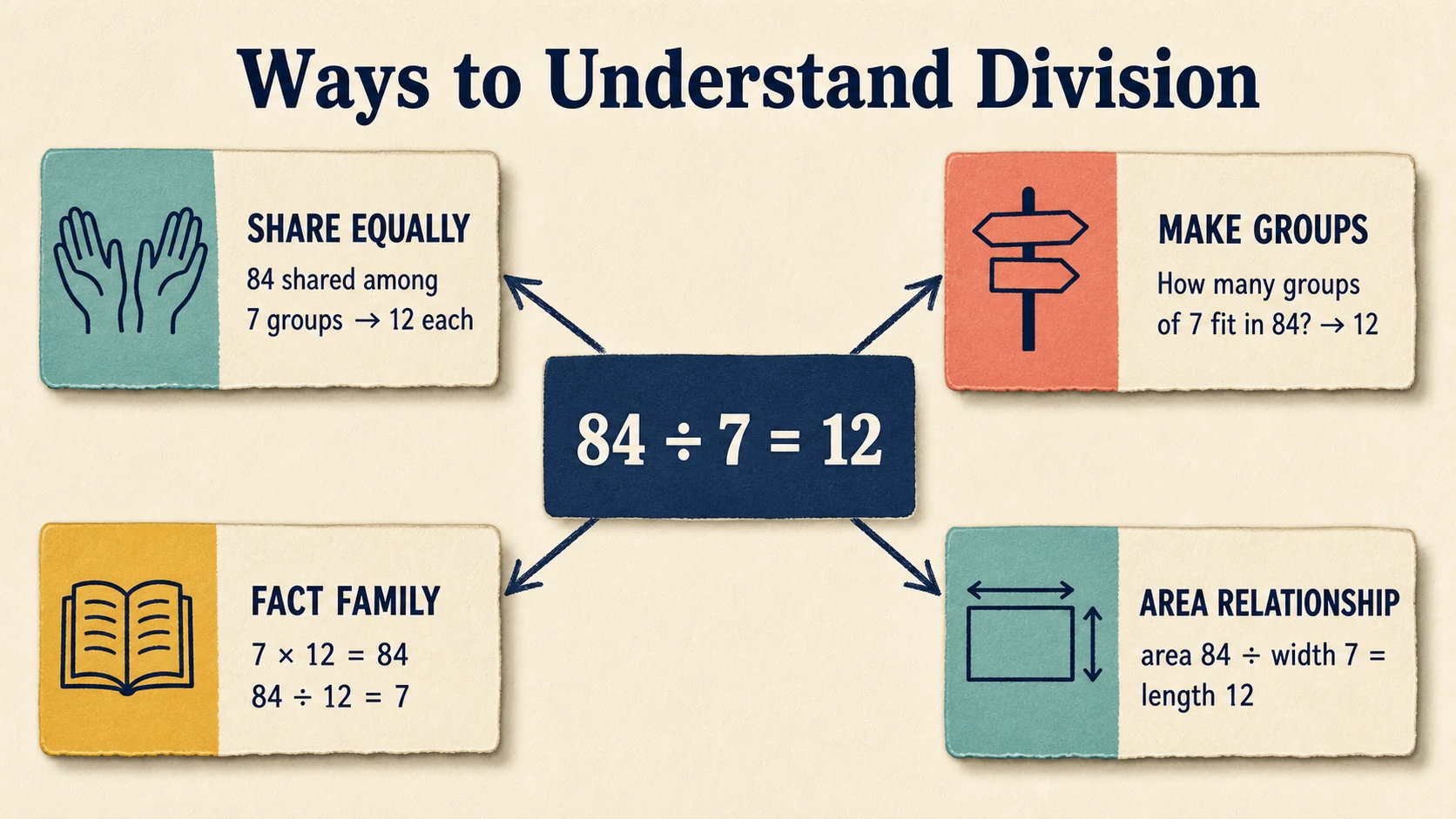
The skill map connects prerequisite knowledge, calculation methods, checking, and applications.
The broader 5th Grade Math collection can help you place division alongside the other mathematical work described for this grade. The Common Core State Standards for Mathematics provide one widely used reference point for grade-level expectations, including multi-digit whole-number division. They should not be treated as proof that one worksheet fits every local sequence.
Prerequisites to Check Before Long Division
A learner does not need perfect speed before beginning multi-digit division, but several foundations should be dependable enough that they do not consume all of the learner’s attention.
Multiplication and division relationships
Division is the inverse of multiplication. For example:
- 42÷6=7 because 6×7=42.
- 56÷8=7 because 8×7=56.
- If 9×6=54, then 54÷9=6 and 54÷6=9.
Check whether the learner can use a known multiplication fact to recover an uncertain division fact. A learner who pauses at 63÷7 but can reason, “Seven times nine is sixty-three,” has a usable strategy. A learner who guesses needs more work with fact families and equal groups.
Place value and decomposition
Multi-digit division requires attention to hundreds, tens, and ones. Before formal long division, ask the learner to decompose numbers:
- 384=300+80+4
- 672=600+70+2
- 1,248=1,200+48
Then connect compatible decompositions to a divisor. For 672÷6, the decomposition 600+60+12 is more helpful than 600+70+2, because every part is divisible by 6.
Subtraction, estimation, and comparison
Partial quotients and long division both involve subtraction. A learner should also be able to judge whether a proposed quotient is reasonable. For 816÷4, an estimate based on 800÷4 shows that the answer should be near 200. An answer of 24 or 2,040 should therefore trigger a review.
Use a short diagnostic rather than a long test. Ask for four multiplication facts, two related division facts, one decomposition, and one estimate. The pattern of errors will tell you whether to begin with prerequisite review or multi-digit division.
A Grade-Appropriate Teaching Progression
The catalogue describes a path from concrete sharing and grouping through facts, single-digit divisors, long division, and contextual remainder problems. For fifth-grade practice, the central work is multi-digit whole-number division while retaining those earlier meanings.
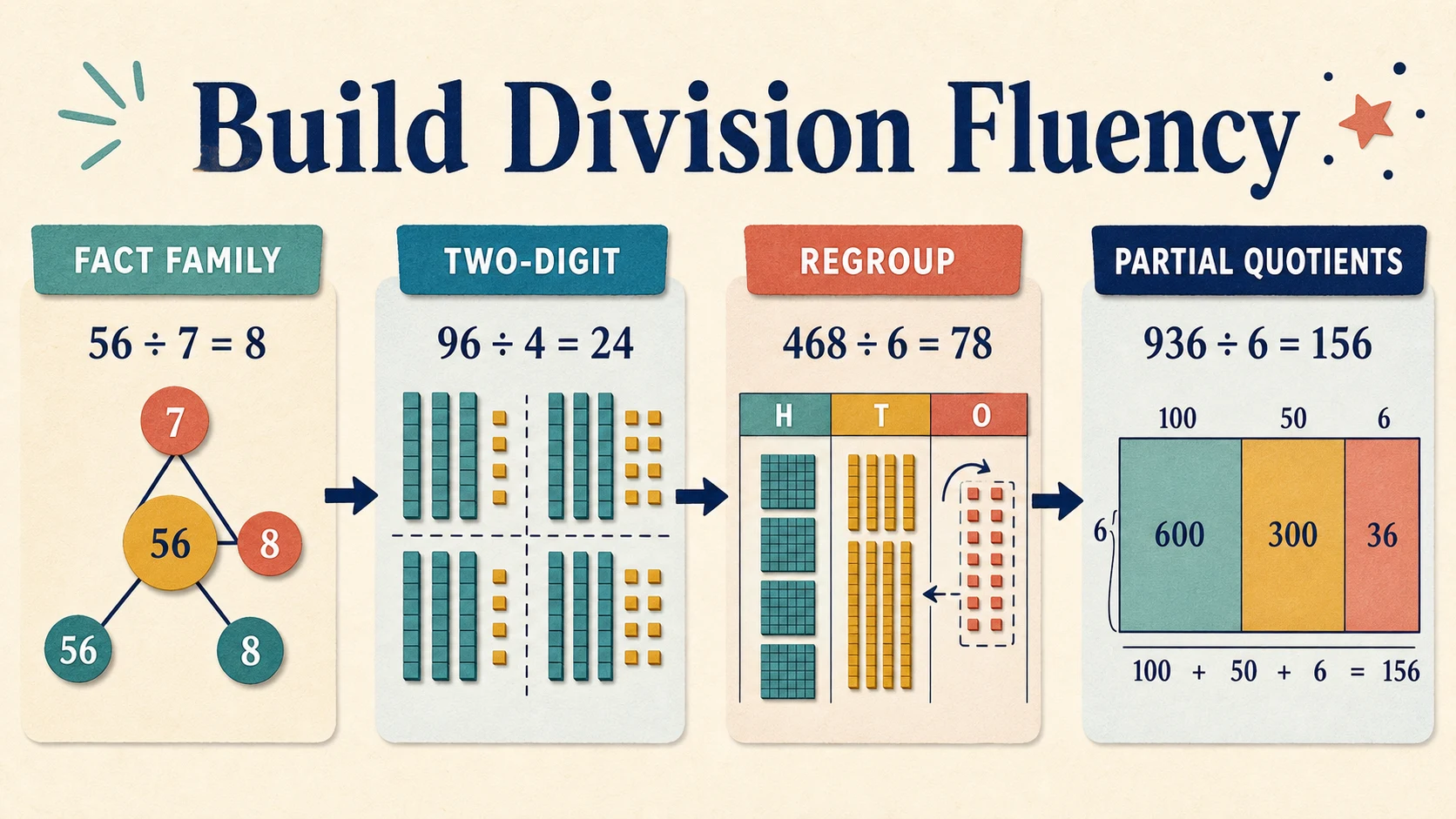
Support can be reduced as the learner demonstrates accurate reasoning and increasingly independent work.
| Stage |
Teaching focus |
Example prompt |
Evidence of readiness to continue |
| 1. Meaning |
Equal shares and equal-size groups |
“Share 24 counters among 6 groups.” |
Explains what the quotient represents |
| 2. Inverse relationship |
Multiplication and division fact families |
“Use 7×8 to solve 56÷7.” |
Derives facts without guessing |
| 3. Place-value division |
Break a dividend into divisible parts |
“Split 936 into parts that divide by 6.” |
Chooses useful decompositions |
| 4. Estimation |
Locate the quotient’s approximate size |
“Is 1,248÷6 near 20, 200, or 2,000?” |
Selects a sensible range and explains why |
| 5. Visual methods |
Area model or partial quotients |
“Record chunks of 6 removed from 936.” |
Connects each chunk to multiplication |
| 6. Standard algorithm |
Divide, multiply, subtract, and bring down with meaning |
“What quantity does the first quotient digit represent?” |
Maintains place value and records every step |
| 7. Remainders |
Interpret what is left |
“Do we report, discard, or use the remainder?” |
Uses the context, not a fixed rule |
| 8. Independent application |
Mixed calculations and word problems |
“Choose a method, solve, and check.” |
Selects an efficient method and verifies the result |
The mnemonic “Divide, Multiply, Subtract, Bring down” may help organize the standard algorithm, but it is not an explanation. Ask what each digit represents. In 936÷6, the 1 in the hundreds place means one hundred, not one.
Concrete and Visual Models
Equal sharing and equal-size groups
The two basic interpretations of division should remain visible even with larger numbers.
In a sharing, or partitive, problem, the number of groups is known: “Thirty-five pencils are shared equally among 5 tables. How many pencils does each table receive?” The quotient, 7, is the size of each share.
In a grouping, or quotitive, problem, the group size is known: “Thirty-five pencils are packed in bundles of 5. How many bundles can be made?” The quotient, 7, is the number of groups.
Both produce 35÷5=7, but the 7 answers different questions. Ask the learner to name the meaning of the quotient before calculating.
Counters, connecting cubes, bundled craft sticks, or quick sketches can represent these structures. Concrete materials are especially useful when a learner can perform written steps but cannot explain why division is appropriate.
Area models and partial quotients
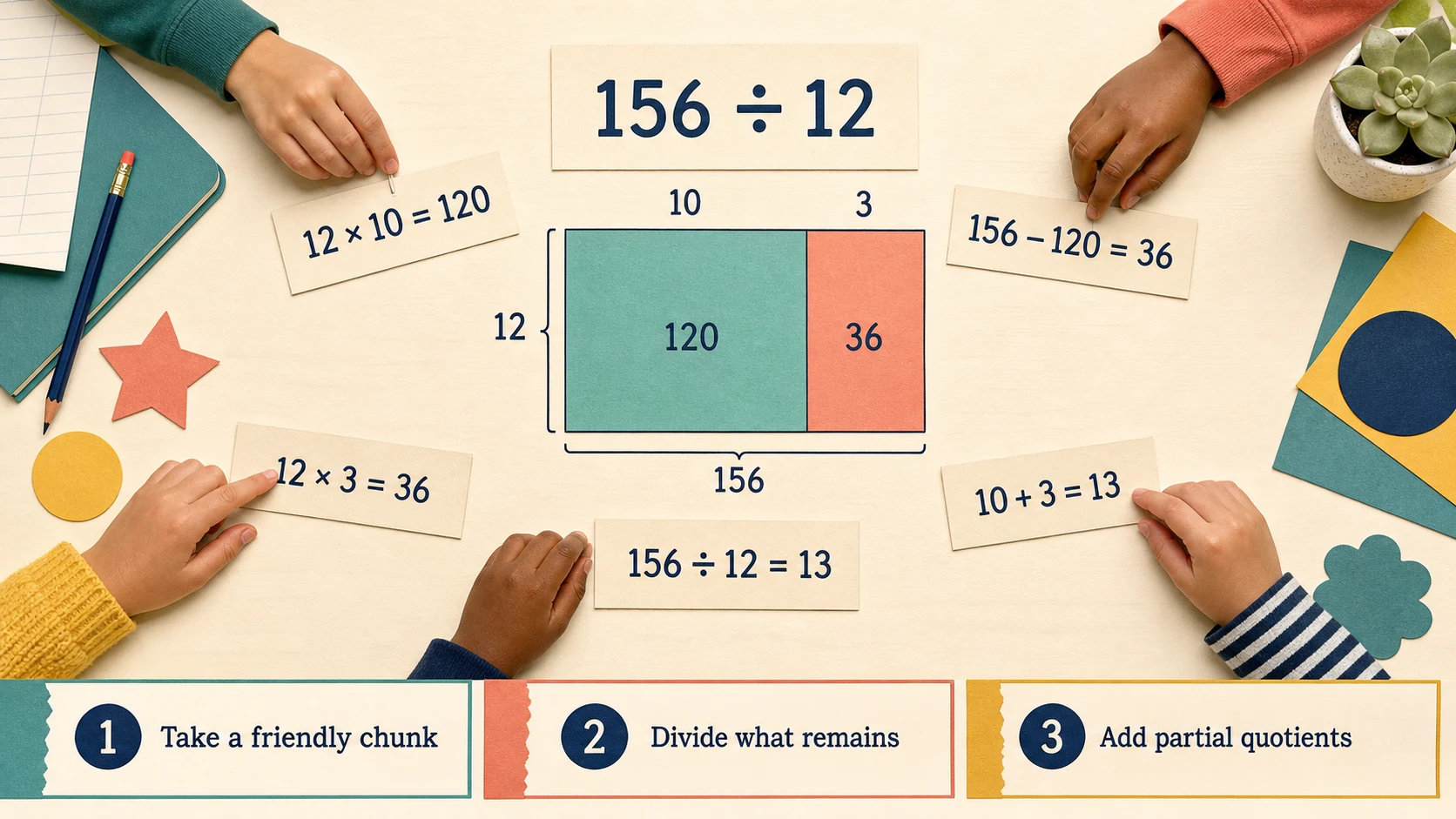
An area model treats the dividend as an area and one factor as the divisor. To find 156÷12, draw a rectangle with one side labeled 12. Break the area into manageable products:
- 12×10=120
- 12×3=36
- 120+36=156
The missing side is 10+3=13, so 156÷12=13.
Partial quotients use the same reasoning in a subtraction record. From 156, subtract 120, representing 10 groups of 12. The remaining 36 contains 3 more groups. The quotient is 10+3=13.
These models allow different correct decompositions. A learner might use 12×5, 12×5, and 12×3. The route is longer but mathematically sound.
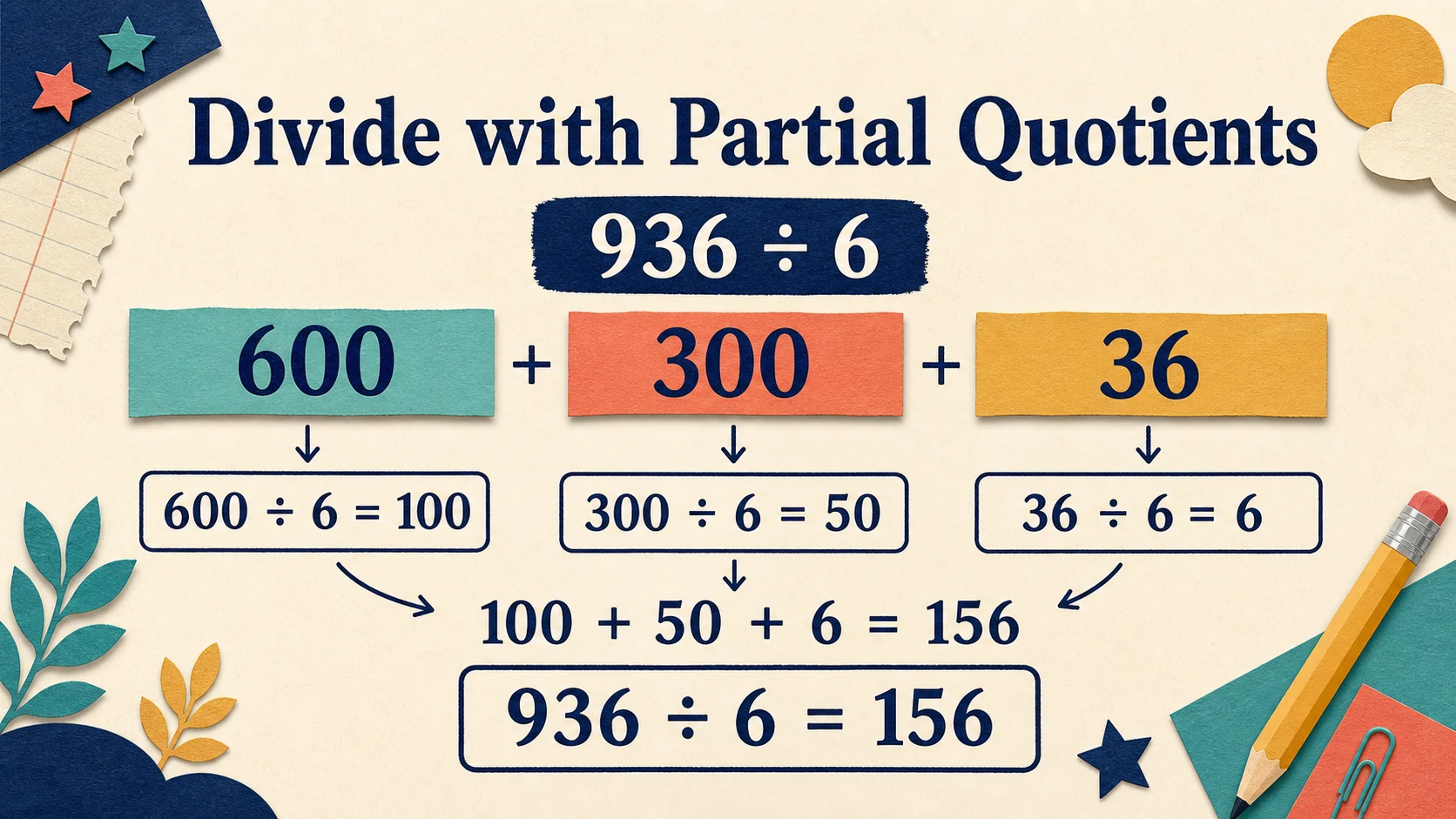
The representation should make equal groups and place-value-sized chunks visible before the notation is compressed.
The IES guide on teaching mathematics to young children offers high-level instructional context for using representations and helping learners connect mathematical ideas. For a fifth grader, concrete objects are not a sign of failure; they are a temporary way to expose reasoning that may be hidden in symbols.
Fully Checked Worked Examples
Example 1: Exact division with partial quotients
Find 936÷6.
First estimate. Since 900÷6=150, the quotient should be a little more than 150.
Use convenient chunks:
936−600=336(600=6×100)
336−300=36(300=6×50)
36−36=0(36=6×6)
Add the partial quotients:
100+50+6=156
Therefore:
936÷6=156
Check:
156×6=(100×6)+(50×6)+(6×6)
=600+300+36=936
The estimate and multiplication check both support the answer.
Example 2: Standard algorithm with a zero in the quotient
Find 1,224÷6.
- Six goes into 12 hundreds 2 hundreds times. Record 2.
- 2×6=12. Subtract to leave 0 hundreds.
- Bring down the 2 tens. Six goes into 2 tens 0 times, so record 0 in the tens place.
- Bring down the 4 ones, making 24 ones.
- Six goes into 24 four times. Record 4.
- 4×6=24, leaving 0.
Thus:
1,224÷6=204
Check:
204×6=(200×6)+(4×6)
=1,200+24=1,224
The zero is essential. Writing 24 would give 24×6=144, which is far smaller than the dividend.
Example 3: Division with a remainder
Find 847÷5.
Using the standard algorithm:
- Five goes into 8 one time; 8−5=3.
- Bring down 4 to make 34.
- Five goes into 34 six times; 34−30=4.
- Bring down 7 to make 47.
- Five goes into 47 nine times; 47−45=2.
Therefore:
847÷5=169 R 2
Check the division equation:
(169×5)+2=845+2=847
Also confirm that the remainder is valid:
0≤2<5
A remainder equal to or larger than the divisor would show that at least one more full group could be formed.
Example 4: A context that requires rounding up
Twenty-five students need transportation. Each van holds 6 students. How many vans are needed?
Calculate:
25÷6=4 R 1
Four vans hold:
4×6=24
One student would still need a seat, so another van is required. The answer is 5 vans, not 4 R 1.
The calculation describes four complete groups and one person left over. The context determines the final form of the answer.
Example 5: A context in which the remainder is the answer
There are 38 markers. They are placed into complete sets of 6. How many markers remain after making as many complete sets as possible?
38÷6=6 R 2
Six complete sets use:
6×6=36
Then:
38−36=2
The question asks how many remain, so the answer is 2 markers. Reporting 6 sets would answer a different question.
Boundary Cases and Remainder Decisions
Remainders cannot be interpreted by one universal rule. Teach the learner to return to the wording after calculating.
Exact, rounded-up, complete-group, and leftover answers
Compare these situations:
- Exact answer: Forty-eight cards are shared equally among 8 learners. Each receives 48÷8=6 cards.
- Round up: Fifty people travel in vehicles holding 8 people each. Since 50÷8=6 R 2, 7 vehicles are needed.
- Use only complete groups: Fifty beads are used to make bracelets requiring 8 beads each. Six complete bracelets can be made; two beads are unused.
- Report the remainder: After making those bracelets, 2 beads remain.
- Record quotient and remainder: A calculation-only prompt may expect 6 R 2.
Also include dividends smaller than the divisor. With whole-number quotients, 3÷5 makes zero complete groups with 3 remaining. This case reveals whether the learner believes the divisor must always “go into” the dividend at least once.
Division by 1 is another useful check: 428÷1=428. Division of zero by a nonzero number gives zero: 0÷7=0. Do not present division by zero as an ordinary calculation; it does not have a defined quotient.
A Short, Repeatable Lesson Routine
A focused lesson can be brief. Its duration should respond to the learner’s attention, accuracy, and explanation rather than follow a universal timetable.
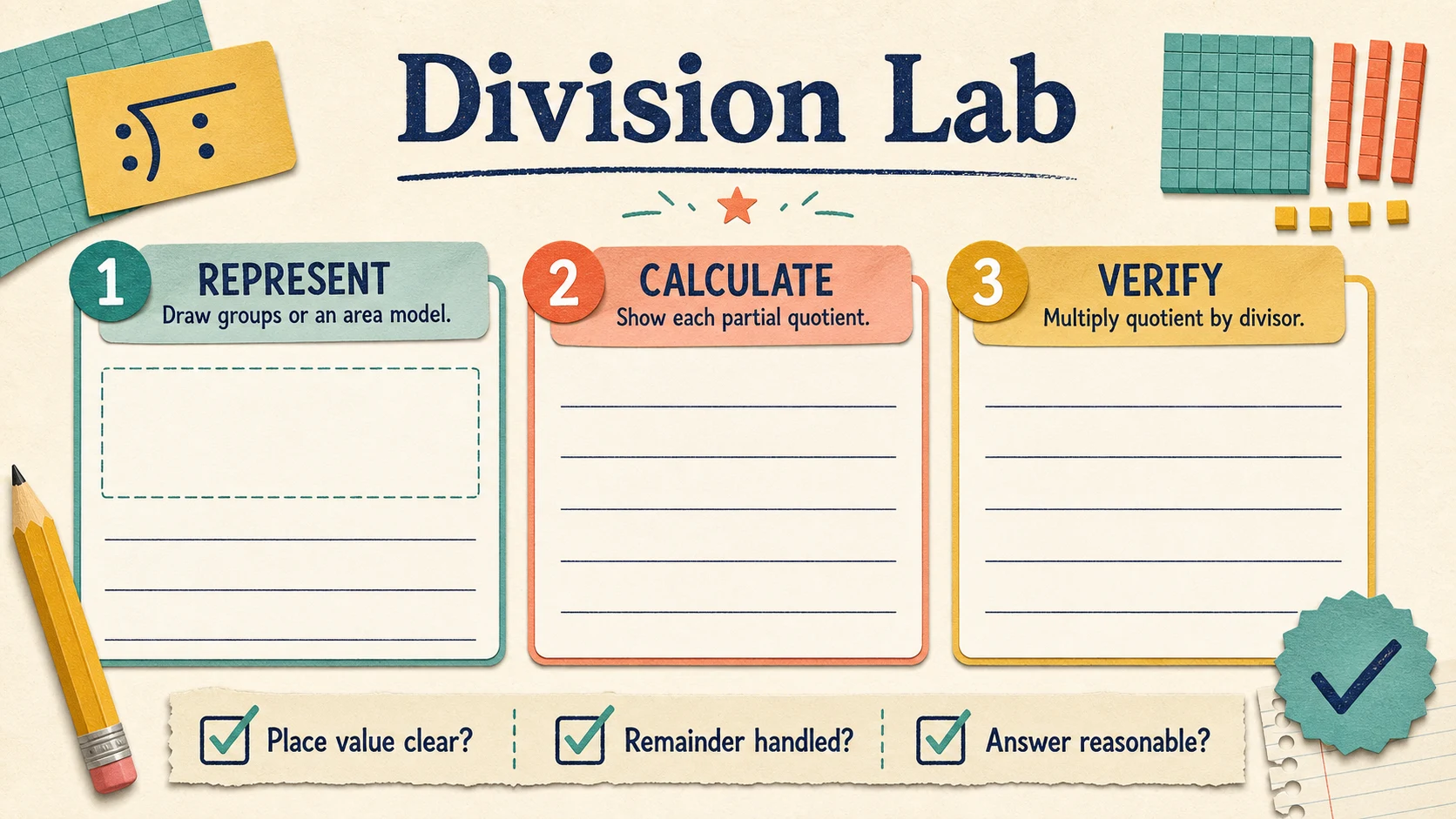
The routine moves from retrieval and modeling to supported practice, independent work, and a final check.
1. Retrieve a prerequisite
Use two or three related facts:
7×8=56,56÷7=8,56÷8=7
If facts are effortful, allow a multiplication chart during conceptual work. Remove that support gradually rather than letting fact recall obscure the division idea being taught.
2. Model one problem aloud
Estimate first, then solve. Name place values and connect every subtraction to a multiple of the divisor. Keep the model visible.
3. Solve one together
Ask the learner to choose the next step and explain it. Prompt with “What quantity are we dividing?” or “Which multiplication fact supports that choice?” Avoid supplying the next quotient digit immediately.
4. Assign a small independent set
Use three to six carefully selected problems. Include one familiar example, one that exposes the day’s likely error, and one short application. Stop and reteach if the same misunderstanding appears twice.
5. Close with verification
Have the learner check one answer using:
divisor×quotient+remainder=dividend
The IES practice guide for assisting students struggling with mathematics provides authoritative, high-level framing for explicit instruction, mathematical representations, purposeful practice, and monitoring. Applying those ideas still requires judgment about the individual learner’s observed work.
Choosing Practice That Matches the Need
Practice should isolate a current need before mixing several demands.
Use division-fact work when the learner understands equal groups but cannot retrieve or derive facts reliably. Use decompositions and partial quotients when facts are available but place-value reasoning is weak. Use standard-algorithm practice when the learner can explain partial quotients and needs a more compact method. Use word problems when calculation is sound but selecting or interpreting division is difficult.
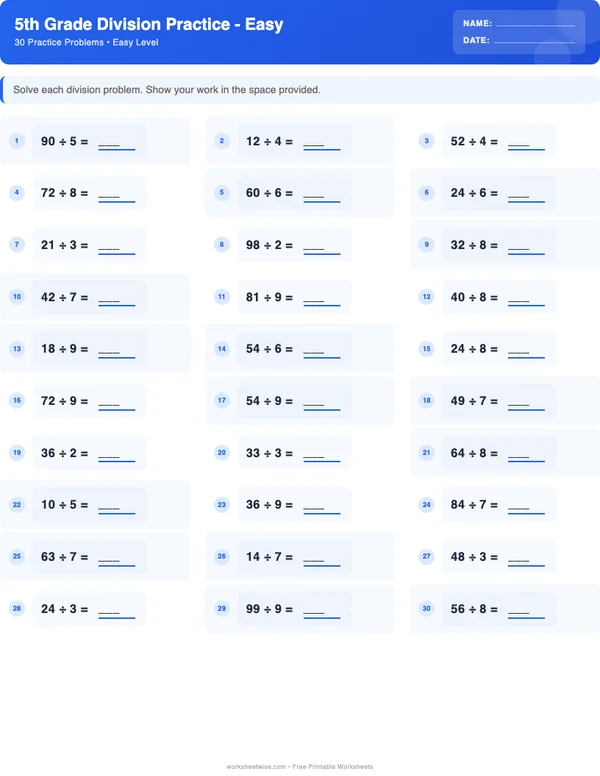
The free easy 5th Grade Division worksheet contains 30 exercises covering division facts, long division, mental math, and number sense, with separate answers. It can serve as a practice source, but 30 problems need not be assigned at once. Select a short run that matches the learner’s present goal.
For broader or repeated practice, the focused division pack contains 18 worksheets. More pages are useful only when the chosen problems address an identified need.
Differentiating support without changing the mathematics
For a learner needing more support:
- Use smaller dividends while preserving the same model.
- Provide a multiplication chart or list of useful multiples.
- Mark place-value columns.
- Begin with exact quotients before introducing remainders.
- Let the learner use partial quotients before requiring the standard algorithm.
- Reduce the number of problems while requiring a check and explanation.
For a learner ready for greater independence:
- Remove preselected chunks in partial-quotient work.
- Mix exact quotients and remainders.
- Include zeros in the quotient.
- Ask for an estimate before computation.
- Present two contexts with the same calculation but different remainder interpretations.
- Ask the learner to compare two valid methods.
These are instructional suggestions, not universal prescriptions. Increase or reduce support according to the work produced.
Common Errors and Diagnostic Responses
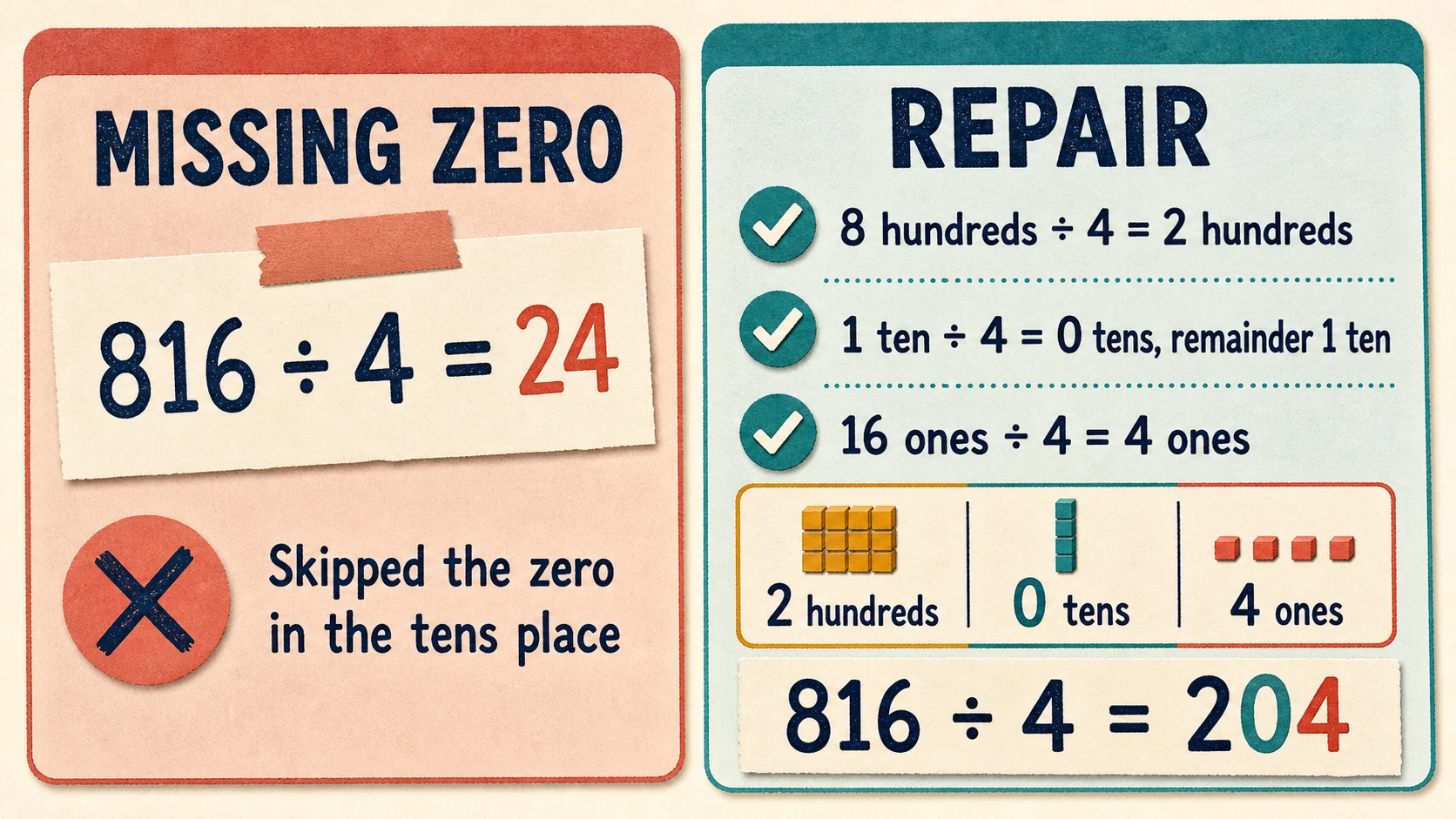
Treat an error pattern as evidence about the next teaching move, not merely as an incorrect answer.
| Observed work |
Likely issue to investigate |
Teaching response |
| 1,224÷6=24 |
A zero in the quotient was omitted |
Rebuild the problem with place-value columns and verify by multiplication |
| Quotient is much too large or small |
No estimate or weak magnitude sense |
Estimate with a nearby compatible number before solving |
| Repeated subtraction is correct but very long |
The learner uses groups that are too small |
Build a list such as 6,60,600 and connect each to 1, 10, or 100 groups |
| Remainder is 7 when dividing by 6 |
The learner stopped before forming all full groups |
Review the rule that the remainder must be less than the divisor |
| Every remainder is rounded up |
A calculation rule is being applied without context |
Contrast transport, complete-set, and leftover questions |
| Algorithm steps are performed but cannot be explained |
Procedure is detached from place value |
Return to an area model or partial quotients |
| The divisor and dividend are reversed |
Division structure is uncertain |
Act out or sketch what is being shared and identify the total and group information |
| Multiplication check reproduces the wrong dividend |
A quotient digit or subtraction is incorrect |
Compare each partial product with the corresponding place-value amount |
Do not diagnose from one careless mark. Look for repetition across two or three examples, then ask the learner to explain a fresh problem. A verbal explanation can distinguish a recording slip from a conceptual misunderstanding.
Monitoring Progress and Deciding When to Move On
Keep a simple record with four columns: date, problem type, method used, and observed evidence. Useful evidence includes accurate estimates, correct quotient placement, valid remainders, appropriate contextual answers, and successful multiplication checks.
At the end of a short session, classify the work:
- Secure: Accurate without prompts and explained coherently.
- Developing: Accurate with a model, chart, or occasional prompt.
- Not yet secure: Repeated conceptual error, unreliable place value, or an inability to check the answer.
Move to a more compact method when the learner can connect the current model to multiplication and place value. Introduce mixed practice when one problem type is secure in isolation. Return to a representation when a previously hidden misconception appears.
Accuracy alone is insufficient if the learner cannot interpret an answer. Conversely, a sound explanation paired with a small arithmetic slip suggests a different next step from a perfectly executed but unexplained procedure.
A Two-Week Practice Plan
This plan is a flexible instructional suggestion, not a universal timetable. Shorten, repeat, or reorder days in response to observed work.
Each day has one main purpose so that errors can guide the following session.
| Day |
Main focus |
Suggested evidence |
| 1 |
Check multiplication facts, related division facts, place value, and estimation |
Note which prerequisites require support |
| 2 |
Model equal sharing and equal-size groups |
Learner distinguishes share size from number of groups |
| 3 |
Divide using helpful decompositions |
Parts recombine to the original dividend |
| 4 |
Build area models for exact quotients |
Missing side matches a multiplication check |
| 5 |
Use partial quotients with one-digit divisors |
Chunks are valid multiples of the divisor |
| 6 |
Review Days 1–5 with a short mixed set |
Learner chooses a representation with fewer prompts |
| 7 |
Connect partial quotients to the standard algorithm |
Each recorded digit is explained by place value |
| 8 |
Practice quotients containing zero |
Zero placeholders are recorded correctly |
| 9 |
Calculate and check remainders |
Every remainder is less than the divisor |
| 10 |
Interpret remainders in contrasting contexts |
Final answers match what each question asks |
| 11 |
Solve mixed calculation and word problems |
Learner identifies when and why to divide |
| 12 |
Diagnose one persistent error pattern |
Fresh problems show whether reteaching worked |
| 13 |
Complete a small independent set |
Work includes estimates or checks without reminders |
| 14 |
Review the record and choose the next target |
Adult and learner identify one secure skill and one next step |
If Day 7 reveals weak place-value understanding, return to partial quotients instead of pushing through the algorithm. If calculation is accurate but Day 10 remains difficult, continue contextual problems without adding harder arithmetic. Pacing should follow evidence, not the calendar.
Limitations and the Next Useful Step
A worksheet can provide structured practice and an answer key, but it cannot observe a learner’s strategy, determine why an error occurred, or decide whether a remainder should be discussed with objects, drawings, or language. The grade label indicates intended practice level rather than a guarantee of fit. Local sequences differ, and this guide does not claim comprehensive standards alignment, certification, or guaranteed outcomes.
Begin with four diagnostic problems: one division fact, one exact multi-digit quotient, one quotient containing zero, and one contextual remainder problem. Use the learner’s work to select a single target. Then assign a short, relevant set from the free 5th Grade Division worksheet, review the reasoning as well as the answers, and choose the following lesson from the evidence.