What 5th Grade Subtraction Includes
5th Grade Subtraction brings together three connected abilities: subtracting multi-digit whole numbers accurately, subtracting decimals by place value, and subtracting fractions when the denominators may differ. A learner should also be able to interpret subtraction as removal, comparison, or finding a missing part; choose an efficient strategy; estimate before calculating; and verify a result with addition.
The concise answer is this: teach place-value meaning first, connect that meaning to a reliable written method, and choose practice from the learner’s observed work. If the learner cannot explain a regrouping step, more pages of the same algorithm are unlikely to clarify it. Return to a base-ten model, an expanded-form recording, or a number line before increasing the difficulty.
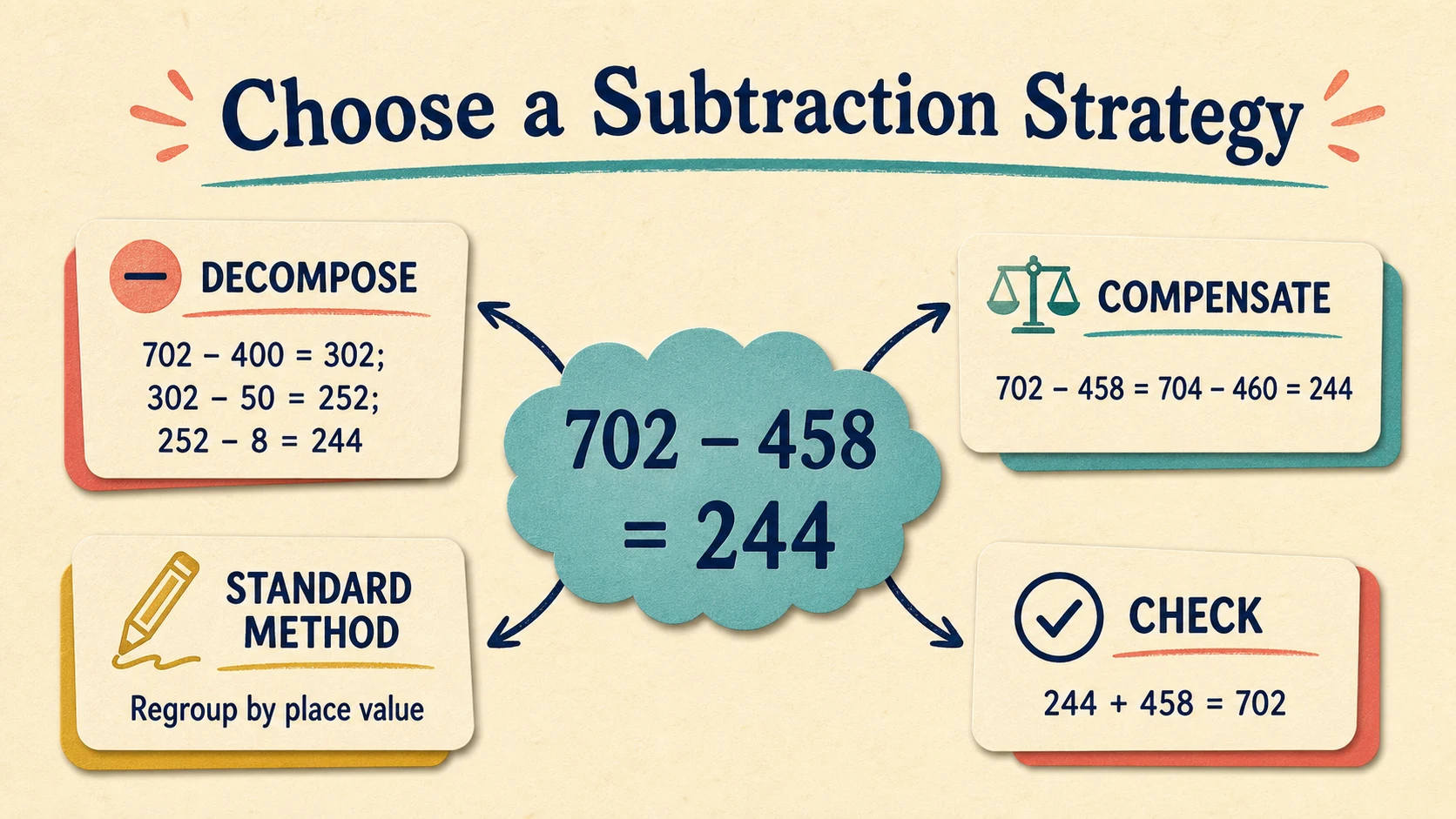
The topic connects meaning, place value, calculation, checking, and problem interpretation.
The grade label describes the intended practice level, not a universal timetable or a guarantee that every learner has completed the same prior sequence. Local curricula differ. The Common Core mathematics framework is useful high-level context because it treats conceptual understanding and procedural skill as complementary, but this guide does not claim comprehensive alignment with every state, district, or homeschool program.
For related materials, adults can begin at the 5th Grade worksheet hub, narrow the selection through 5th Grade Math, or review the complete Subtraction topic collection.
Prerequisites to Check Before New Instruction
A short prerequisite check is more useful than assuming that an older learner has mastered every earlier step. Give one or two problems from each area and ask the learner to explain the work.
Place value and comparison
Check whether the learner can:
- Read and write multi-digit whole numbers.
- Identify the value of a digit by its position.
- Compare two numbers and predict which difference should be positive.
- Decompose a unit into ten units of the next smaller place, such as one hundred into ten tens.
- Read decimal places through the positions currently being used.
A learner who treats the 6 in 6,204 as six rather than six thousand will have difficulty understanding either estimation or regrouping.
Addition and subtraction relationships
The learner should recognize that addition can check subtraction:
a−b=cbecausec+b=a
For example, 52−19=33 can be checked with 33+19=52. This relationship also supports missing-part problems: if a container holds 52 items and currently has 19, the missing amount is the number that combines with 19 to make 52.
Foundational fraction knowledge
Before subtracting fractions with unlike denominators, check whether the learner can:
- Identify the numerator and denominator.
- Generate equivalent fractions.
- Find a common denominator for simple pairs.
- Recognize when a fraction answer can be simplified.
- Relate fractions to points or distances on a number line.
If equivalent fractions are not secure, teach that prerequisite separately. Subtraction should not become a guessing procedure for changing denominators.
A Practical Teaching Progression
The sequence below is an instructional suggestion. Move forward, pause, or return to an earlier stage according to the learner’s explanations and written work.
| Stage |
Teaching focus |
Useful model or prompt |
Evidence to look for |
| 1 |
Meaning of subtraction |
Act out removal, comparison, and missing-part situations |
Learner explains what the difference represents |
| 2 |
Estimation and magnitude |
Round or use nearby compatible numbers |
Estimate is reasonable and has the correct scale |
| 3 |
Whole-number place value |
Base-ten blocks or an expanded-form chart |
Regrouping preserves the total quantity |
| 4 |
Standard whole-number method |
Vertically aligned computation |
Each digit is subtracted in its correct place |
| 5 |
Zeros and repeated regrouping |
Place-value chart with explicit trades |
Learner can regroup across one or more zeros |
| 6 |
Decimal subtraction |
Place-value grid; add placeholder zeros |
Decimal points and corresponding places align |
| 7 |
Fraction subtraction |
Fraction strips or a number line |
Equivalent fractions are made before subtraction |
| 8 |
Word problems and mixed practice |
Ask what is known, changed, compared, or missing |
Operation is chosen from the situation |
| 9 |
Independent selection and checking |
Estimate, solve, then verify with addition |
Learner detects and repairs implausible answers |
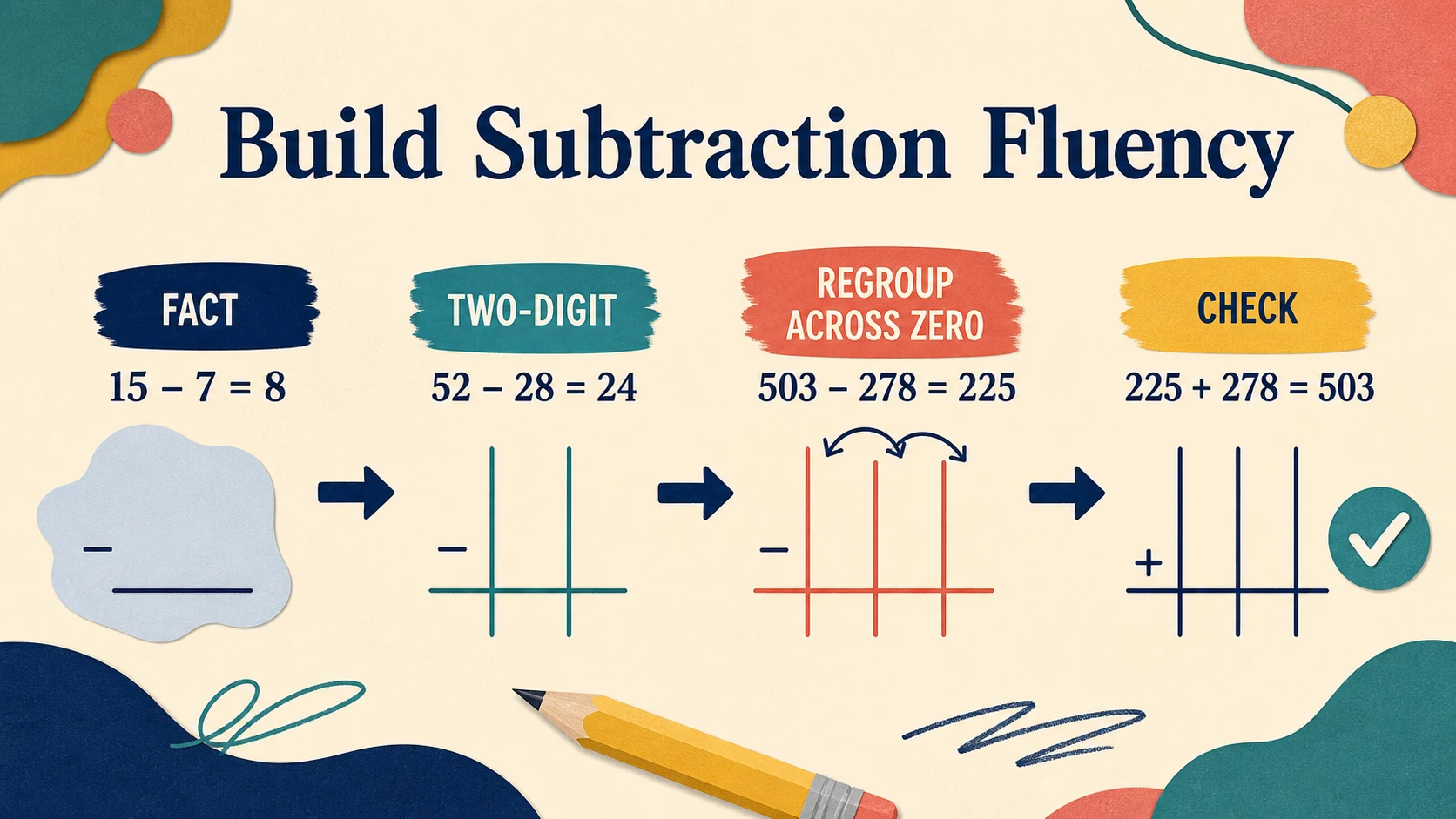
Support can be reduced when the learner explains the model, method, and check consistently.
The IES guide Teaching Math to Young Children concerns preschool, prekindergarten, and kindergarten rather than fifth grade. Its high-level emphasis on developmental progressions and monitoring what a learner knows is still relevant framing, but it is not evidence about this specific worksheet or a fifth-grade teaching sequence.
Concrete and Visual Models That Still Matter
Models are not only for early elementary lessons. They can expose the place-value reasoning hidden inside a compact algorithm.
Base-ten blocks and place-value disks
Use blocks or disks to represent ones, tens, hundreds, and thousands. For 403−178, the learner cannot remove eight ones from three ones. The quantity can be renamed without changing its value:
- Trade one hundred for ten tens, leaving three hundreds.
- Trade one of those tens for ten ones.
- The representation is now 3 hundreds, 9 tens, and 13 ones.
- Remove 1 hundred, 7 tens, and 8 ones.
- The remaining amount is 2 hundreds, 2 tens, and 5 ones: 225.
The instructional purpose is not merely obtaining 225. It is seeing why regrouping is valid.
Open number lines
An open number line is especially useful for comparison and mental subtraction. To find 503−287, count up from 287:
287→300(+13)
300→500(+200)
500→503(+3)
The total distance is 13+200+3=216, so 503−287=216. Check: 287+216=503.
Fraction strips and decimal grids
Fraction strips show why unlike denominators cannot be subtracted directly. Eighths and thirds name different-sized parts; both quantities must first be expressed with a shared unit.
A decimal grid or place-value chart serves a related purpose. It makes clear that tenths are subtracted from tenths and hundredths from hundredths. Writing 6.4 as 6.40 does not change the value; it makes the hundredths place visible.
The IES elementary intervention guide, Assisting Students Struggling with Mathematics, recommends systematic instruction, clear mathematical language, selected concrete and semi-concrete representations, number lines, and deliberate word-problem instruction. Those are broad instructional recommendations for grades K–6, not an evaluation of WorksheetWise materials.
Fully Checked Whole-Number Examples
Example 1: Multi-digit subtraction with regrouping
Find:
63,402−28,759
Estimate first:
63,000−29,000≈34,000
Align the numbers by place value:
  63,402
- 28,759
--------
Start with the ones. Two ones cannot supply nine ones. Because the tens digit is zero, regroup one hundred as ten tens, then regroup one of those tens as ten ones.
- Ones: 12−9=3
- Tens: 9−5=4
- Hundreds: 3−7 requires regrouping one thousand, so 13−7=6
- Thousands: 2−8 requires regrouping one ten-thousand, so 12−8=4
- Ten-thousands: 5−2=3
Therefore:
63,402−28,759=34,643
Check with addition:
34,643+28,759=63,402
The answer also agrees with the estimate of about 34,000.
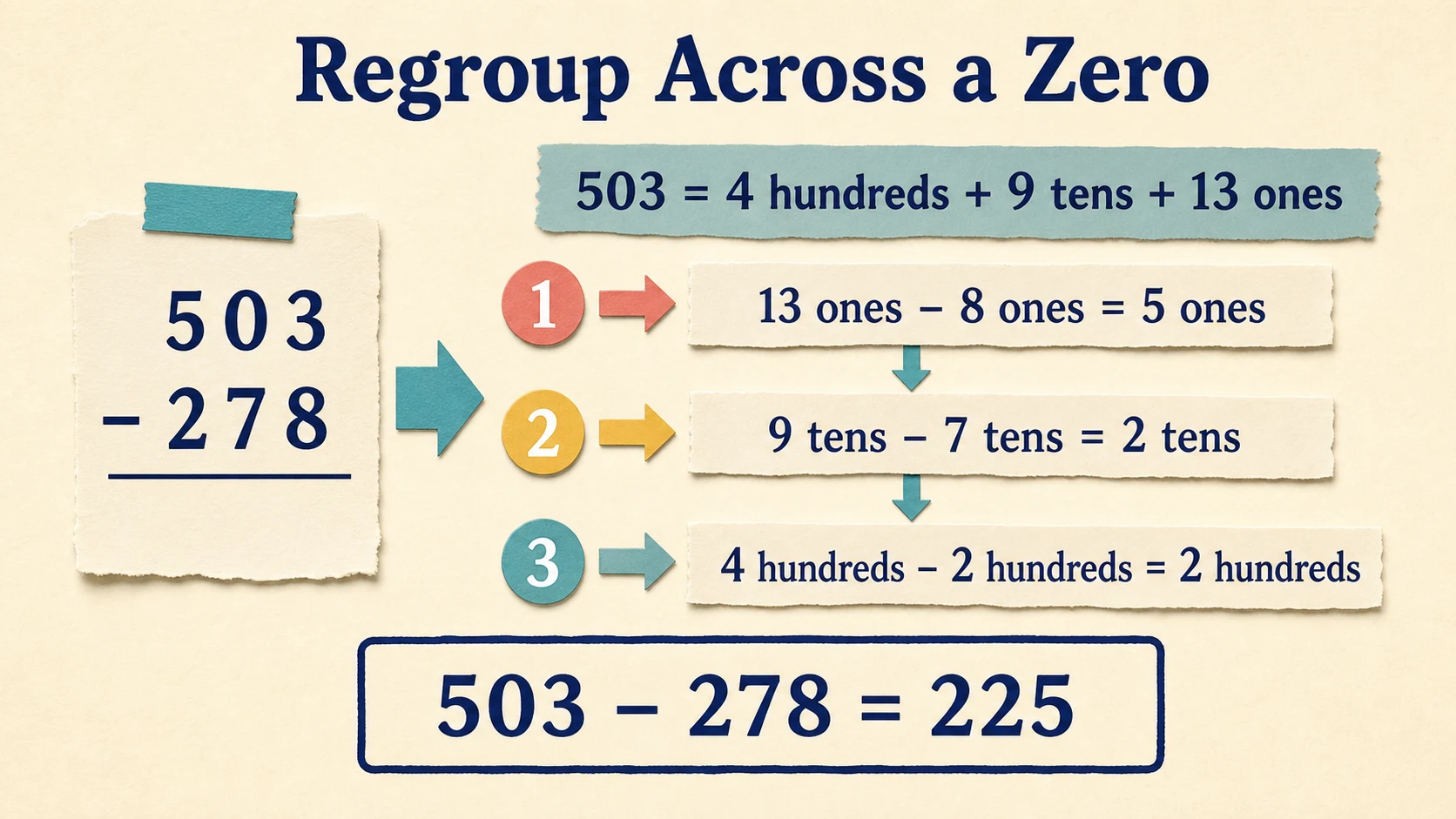
The written steps should remain connected to trades between place-value units.
Example 2: Regrouping across zeros
Find:
70,000−38,476
A useful estimate is:
70,000−38,000≈32,000
Repeated regrouping is needed because the ones, tens, and hundreds positions initially contain zeros. After renaming the necessary units, subtract by place:
  70,000
- 38,476
--------
  31,524
Check:
31,524+38,476=70,000
So:
70,000−38,476=31,524
If the learner writes 42,476 or 32,424, do not label the error as simple carelessness. Ask the learner to represent 70,000 in a place-value chart and show each trade. The written marks must correspond to a conserved quantity.
Example 3: Compensation for efficient mental subtraction
Find:
50,003−29,998
Since 29,998 is two less than 30,000, subtract 30,000 and then add back 2:
50,003−30,000=20,003
20,003+2=20,005
Therefore:
50,003−29,998=20,005
Check:
20,005+29,998=50,003
Compensation is efficient here, but it should be chosen because of the numbers—not used as a rule for every problem.
Decimal and Fraction Examples
Example 4: Subtracting decimals by place value
Find:
82.50−37.86
Align the decimal points so hundredths are under hundredths:
  82.50
- 37.86
-------
  44.64
The regrouping follows the same base-ten relationships used with whole numbers:
- 0 hundredths cannot supply 6 hundredths, so regroup one tenth as ten hundredths: 10−6=4.
- Four tenths remain; 4−8 requires regrouping one whole: 14−8=6.
- One whole remains in the ones place; 1−7 requires regrouping one ten: 11−7=4.
- Seven tens remain; 7−3=4.
Check:
44.64+37.86=82.50
Thus:
82.50−37.86=44.64
A decimal point should not be inserted by counting digits from the right. Its position follows the aligned place-value columns.
Example 5: Subtracting unlike fractions
Find:
87−31
Eighths and thirds are different-sized units. A common denominator is 24:
87=2421
31=248
Now subtract equal-sized parts:
2421−248=2413
The fraction 13/24 is already in simplest form because 13 and 24 have no common factor greater than 1.
Check by addition:
2413+248=2421=87
Therefore:
87−31=2413
Boundary Cases Worth Teaching Explicitly
Boundary cases reveal whether the learner understands subtraction or is following surface cues.
Subtracting zero and subtracting a number from itself
4,728−0=4,728
Nothing has been removed, so the quantity is unchanged.
4,728−4,728=0
The entire quantity has been removed. These two cases are easy to confuse when a learner relies on a memorized phrase rather than the equation.
Zeros written after a decimal
6.4=6.40
A trailing zero does not change the value. It can clarify alignment:
6.40−2.75=3.65
Check:
3.65+2.75=6.40
The minuend is smaller
Within whole-number-only practice, 18−25 does not have a nonnegative whole-number answer. It may signal that the numbers were reversed, or it may be an intentional introduction to negative numbers in a later sequence. Read the task’s stated number domain before deciding.
In a word problem, order comes from meaning. “How much warmer is 25 degrees than 18 degrees?” is 25−18=7, even if 18 appears first in the sentence.
A zero difference after equivalent forms
43−86=0
The numerals look different, but the fractions are equivalent. This is a useful check on whether the learner considers value rather than appearance.
A Short, Repeatable Lesson Routine
The following 15–20 minute routine is an instructional suggestion, not a required schedule.
- Retrieve for two minutes. Use two familiar facts or one prior skill.
- Estimate for two minutes. Ask for a reasonable range before exact calculation.
- Model for four minutes. Demonstrate one problem with blocks, a number line, a fraction strip, or a place-value chart.
- Solve together for four minutes. Let the learner explain each decision while the adult records only when needed.
- Practice independently for five minutes. Select two to four problems with one controlled increase in difficulty.
- Check and reflect for two minutes. Verify with addition or another representation. Record one error pattern or successful strategy.
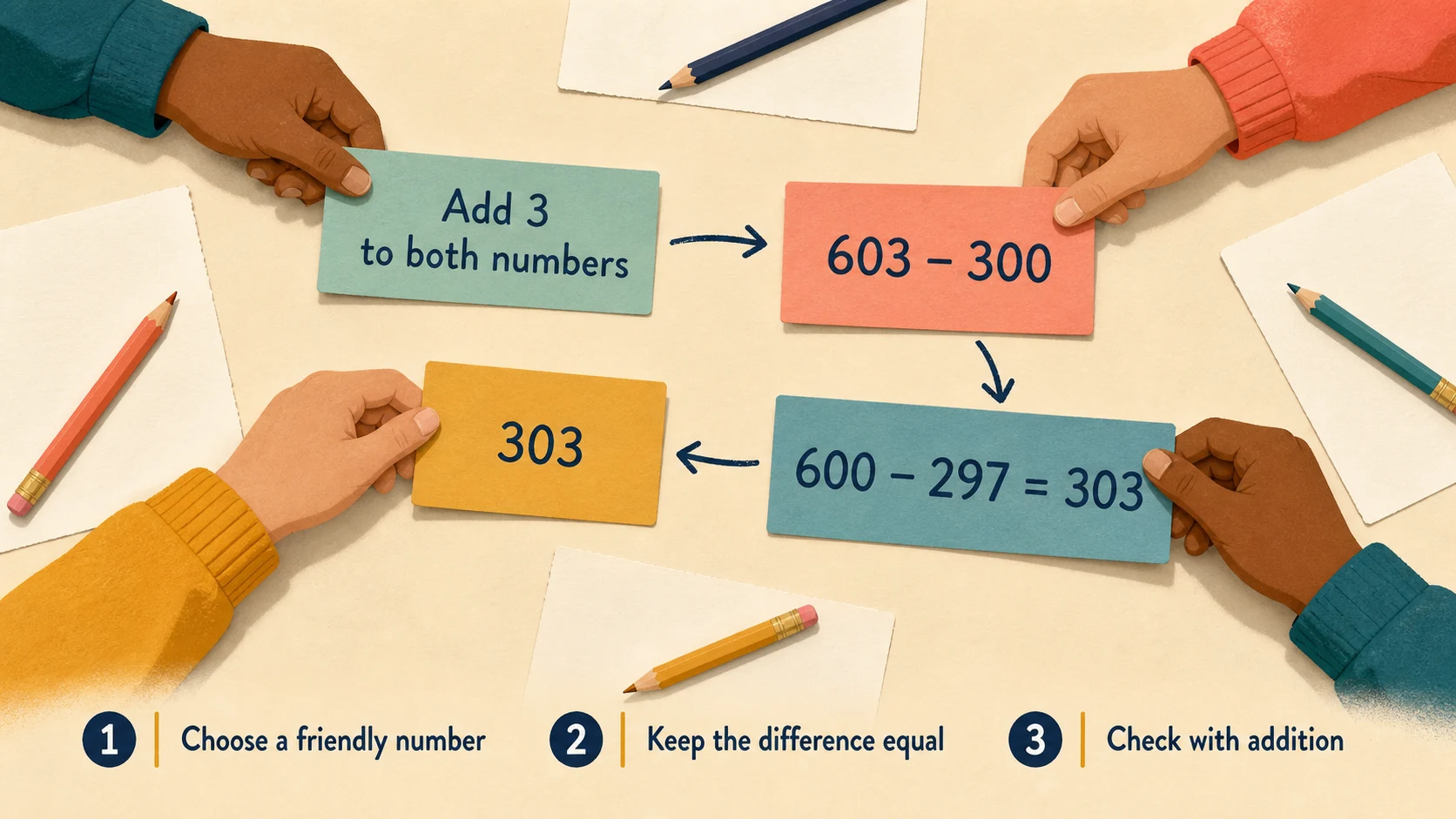
Each lesson moves from retrieval and meaning to independent work and a visible check.
Keep prompts precise: “Which place needs to be regrouped?” is more useful than “What do you do next?” Ask the learner to name units—“four tenths” rather than merely “four”—when place-value confusion is present.
How to Choose Appropriate Practice
Choose practice by the error you need to understand or the skill you need to stabilize.
When foundational fluency is uneven
Use a small set of subtraction facts mixed with related addition equations. Include missing-part forms such as:
17−□=9
9+□=17
This makes the inverse relationship visible. Avoid hiding a place-value problem under a large volume of fact practice.
When regrouping is the main need
Begin with problems requiring one regroup, then include a zero in one interior place, and only later use repeated zeros. Keep the number of problems modest enough that the learner can explain the trades.
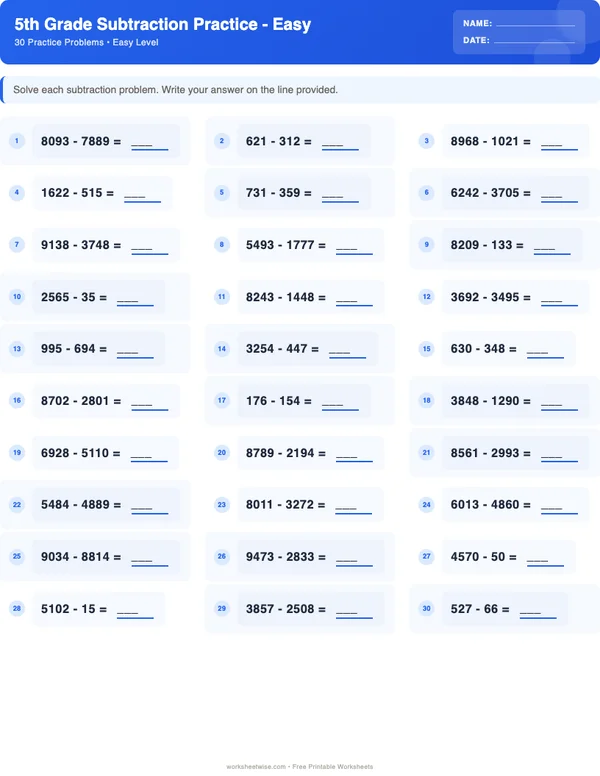
The free standard easy subtraction worksheet contains 30 exercises and an answer key. Its listed skills include subtraction facts, mental math, number sense, and regrouping. It is suitable as a practice source, but the adult should select or pause items according to the learner’s work rather than assuming all 30 must be completed at once.
When transfer is the goal
Mix calculation with the three subtraction situations:
- Removal: A collection had 425 cards; 178 were removed.
- Comparison: One route is 425 miles and another is 178 miles. How much longer is the first?
- Missing part: A goal is 425 pages and 178 have been read. How many remain?
All use 425−178=247, but the difference has a different meaning in each context. Ask the learner to state what 247 represents.
For broader repeated practice, the 5th Grade Subtraction Worksheet Pack contains 18 worksheets. Selection should still be diagnostic: more material is useful only when its problem type matches the next learning need.
Differentiation Driven by Observed Work
Differentiation should change the support or mathematical demand, not simply assign more or fewer problems.
For a learner who understands the situation but loses track during regrouping:
- Use a place-value chart.
- Allow color or light marks to show each trade.
- Present fewer digits at first.
- Ask for an addition check after each problem.
For a learner who calculates accurately but cannot interpret word problems:
- Keep the arithmetic manageable.
- Sort examples into removal, comparison, and missing-part situations.
- Ask the learner to identify the unknown before writing an equation.
- Require a labeled answer rather than only a numeral.
For a learner ready for greater challenge:
- Offer two methods for the same problem and compare efficiency.
- Include missing-digit equations.
- Ask the learner to create a word problem for a given equation.
- Mix whole numbers, decimals, and fractions while clearly identifying the number type.
- Include an incorrect worked solution and request a diagnosis.
These are instructional options, not child-specific prescriptions. Persistent difficulty can have many causes that written work alone does not establish.
Common Errors and Diagnostic Responses
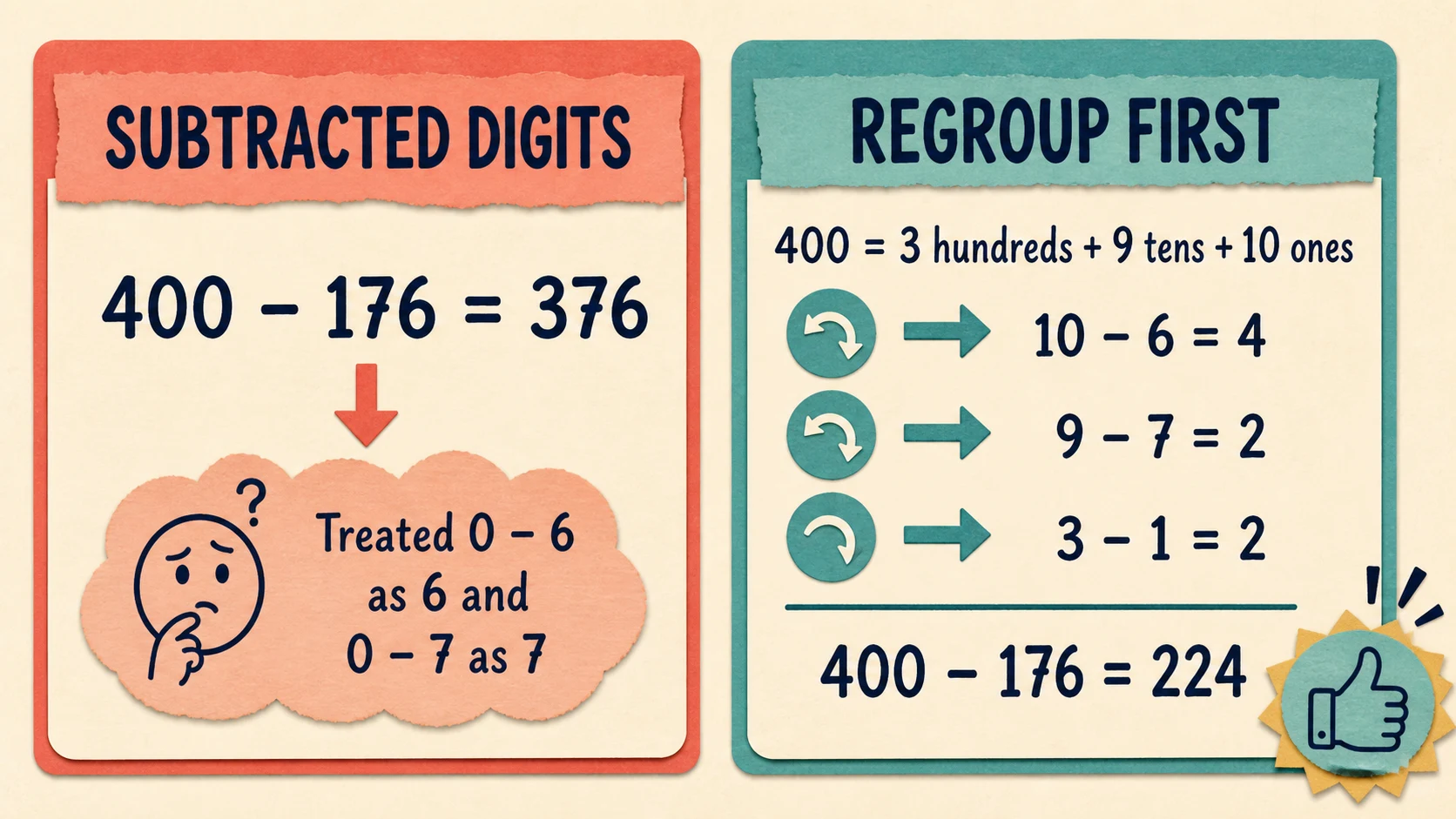
Treat an error as evidence about the learner’s current method, then choose the smallest useful response.
| Observed error |
Likely mathematical issue to investigate |
Diagnostic prompt |
Teaching response |
| Smaller digit is always subtracted from larger digit |
Order and regrouping are not understood |
“What does this column represent?” |
Rebuild the problem with base-ten units |
| Regrouping changes a digit but not its neighbor |
Trade is remembered as a mark, not a quantity |
“Where did those ten ones come from?” |
Show the exchange and conserve the total |
| Zeros are skipped during regrouping |
Place-value chain is unclear |
“Rename the number in expanded form” |
Use a chart and record each intermediate trade |
| Decimal points are misaligned |
Digits are being aligned by appearance |
“Which digits name tenths?” |
Align by place-value labels and add placeholders |
| Numerators and denominators are both subtracted |
Fraction units are not treated as fixed-sized parts |
“Are thirds and fifths the same-sized pieces?” |
Use strips and form equivalent fractions |
| Word-problem numbers are automatically subtracted in reading order |
Operation is selected from keywords or position |
“What quantity is unknown?” |
Identify the situation before calculating |
| Answer is unreasonable but accepted |
Estimation and checking are absent |
“Should the difference be near 20, 200, or 2,000?” |
Estimate first and verify with addition |
Do not correct every line immediately. Ask the learner to explain one representative problem. A consistent misconception calls for teaching; an isolated copying slip calls for a brief correction and another opportunity.
Monitoring Progress Without Over-Testing
Use a compact record once or twice per practice cycle. Note:
- Problem type.
- Whether a model or prompt was needed.
- Accuracy of the calculation.
- Quality of the explanation.
- Whether the learner estimated.
- Whether the learner independently checked the result.
- The specific error pattern, if any.
A useful instructional decision rule is to advance when the learner solves a small, varied set accurately and can explain why the method works. Return to a model when correct answers depend on prompting, the same misconception repeats, or the learner cannot connect the written marks to place value.
Speed should not be the only measure. Accuracy without meaning may break down on boundary cases, while a clear but slow method may need practice rather than reteaching. If timed activity is used, keep it secondary to the mathematical purpose and review the resulting work for strategy and errors.
An Adaptable Two-Week Practice Plan
This plan assumes ten short sessions, but it is not a universal timetable. Combine days, repeat them, or extend the sequence according to observed work.
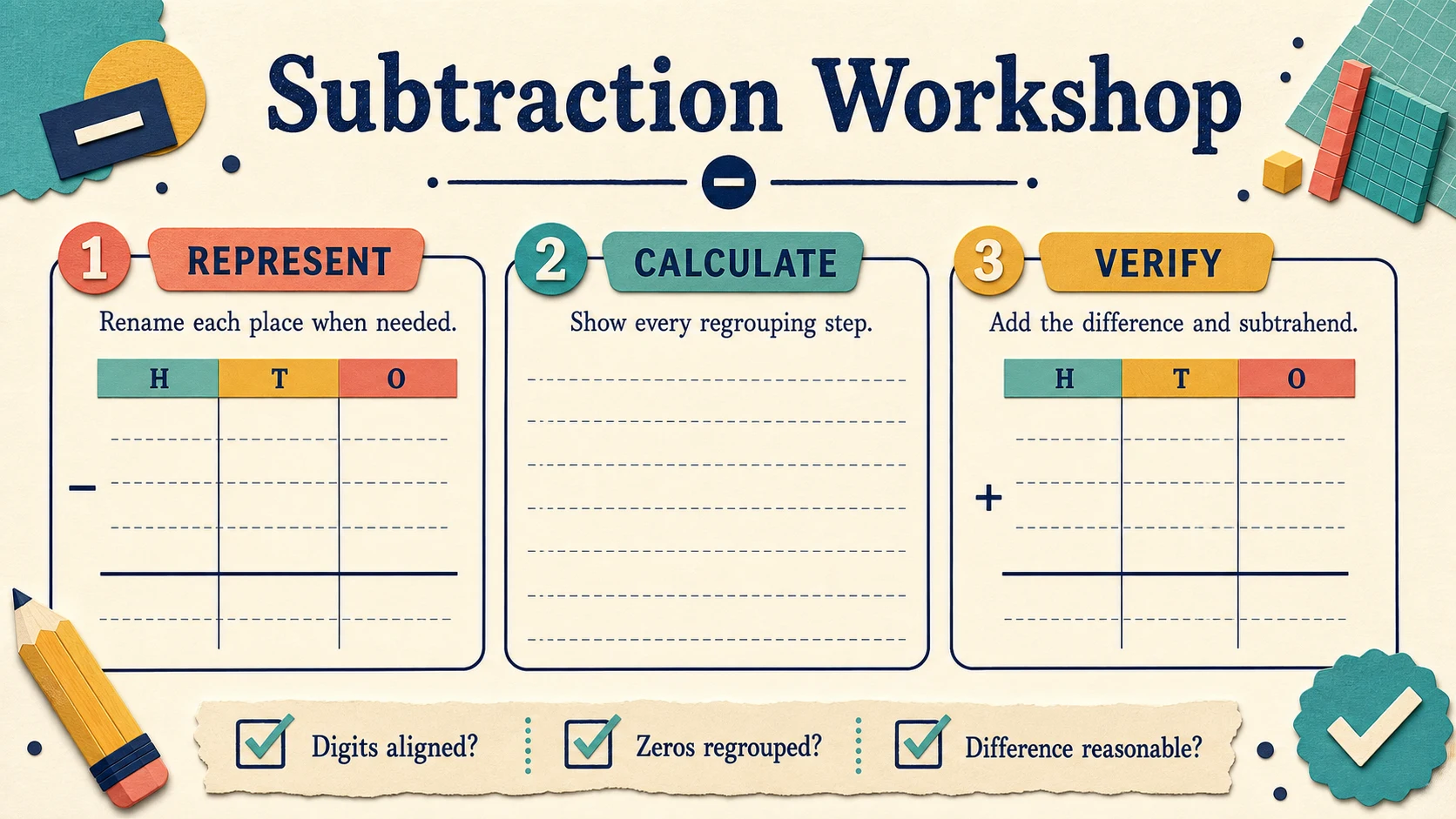
The plan alternates explanation, calculation, application, and review instead of adding difficulty every day.
| Day |
Main focus |
Suggested activity |
Evidence to record |
| 1 |
Baseline |
Sample facts, one regrouping problem, one decimal, one fraction, and one word problem |
Independent strengths and recurring errors |
| 2 |
Meaning |
Sort removal, comparison, and missing-part situations |
Whether equations match situations |
| 3 |
Whole-number regrouping |
Model one trade, solve two together, then two independently |
Place-value explanation |
| 4 |
Regrouping across zeros |
Use a chart before the written algorithm |
Accuracy of each trade |
| 5 |
Strategy choice |
Compare the standard method, counting up, and compensation |
Whether the chosen method fits the numbers |
| 6 |
Decimal subtraction |
Align place values and use placeholder zeros where helpful |
Decimal placement and estimation |
| 7 |
Fraction preparation |
Build equivalent fractions with strips or a number line |
Common-unit understanding |
| 8 |
Fraction subtraction |
Solve like- and unlike-denominator examples |
Equivalent forms and simplification |
| 9 |
Mixed application |
Combine calculation and all three word-problem structures |
Operation choice and labeled answers |
| 10 |
Review and next decision |
Revisit baseline types with different numbers |
What is independent, prompted, or not yet secure |
Do not automatically move from Day 4 to decimals if repeated regrouping is still unexplained. Likewise, do not hold a learner on routine whole-number pages when the work is accurate, checked, and clearly explained. Pacing should follow evidence.
Limitations and the Honest Next Step
A printable page can provide consistent practice and an answer key, but it cannot determine why an error occurred. It also cannot observe how a learner used a model, selected an operation, or responded to a prompt. Adults need to inspect the written steps and ask for a brief explanation.
Grade-level materials do not replace local curriculum requirements, teacher judgment, or specialized evaluation. This guide offers instructional suggestions, not medical guidance, certification, guaranteed outcomes, or a universal teaching schedule. The supplied sources support broad instructional framing; they did not evaluate WorksheetWise or this particular subtraction worksheet.
The most useful next action is to give the learner four carefully chosen problems—one straightforward subtraction, one regrouping problem, one boundary case, and one short word problem. Ask for an estimate, a solution, and an addition check. Then use the observed pattern to select a few matching items from the free 5th Grade Subtraction worksheet, or create a narrower set with the free worksheet generators.