5th Grade Decimals at a Glance
Fifth-grade decimal instruction should connect three ideas: decimals extend the base-ten place-value system, they can represent fractions with denominators such as 10 and 100, and they can be calculated with using the four operations. A learner needs more than a rule for moving or placing a decimal point. They should be able to represent a decimal, explain its value, estimate a reasonable result, calculate accurately, and check whether the answer makes sense.
A practical teaching sequence is:
- Confirm whole-number place value and fraction foundations.
- Read, write, represent, compare, and round decimals.
- Connect decimal notation to fractions.
- Add and subtract decimals.
- Multiply decimals.
- Divide decimals.
- Apply the skills in measurement, money, and other word problems.
The learner’s observed work should determine the pace. If a student calculates 0.36+0.4 incorrectly because the digits are not aligned by place value, more addition problems alone may reinforce the wrong method. Return to a place-value chart or hundredths model, clarify that 0.4=0.40, and then resume symbolic practice.
Grade labels describe the intended practice level; local curricula and teaching sequences differ. The Common Core State Standards for Mathematics provide one useful reference point: their progression includes reading, writing, comparing, and rounding decimals in fifth grade, along with decimal operations. A school or homeschool program may introduce, review, or extend these ideas at different times.
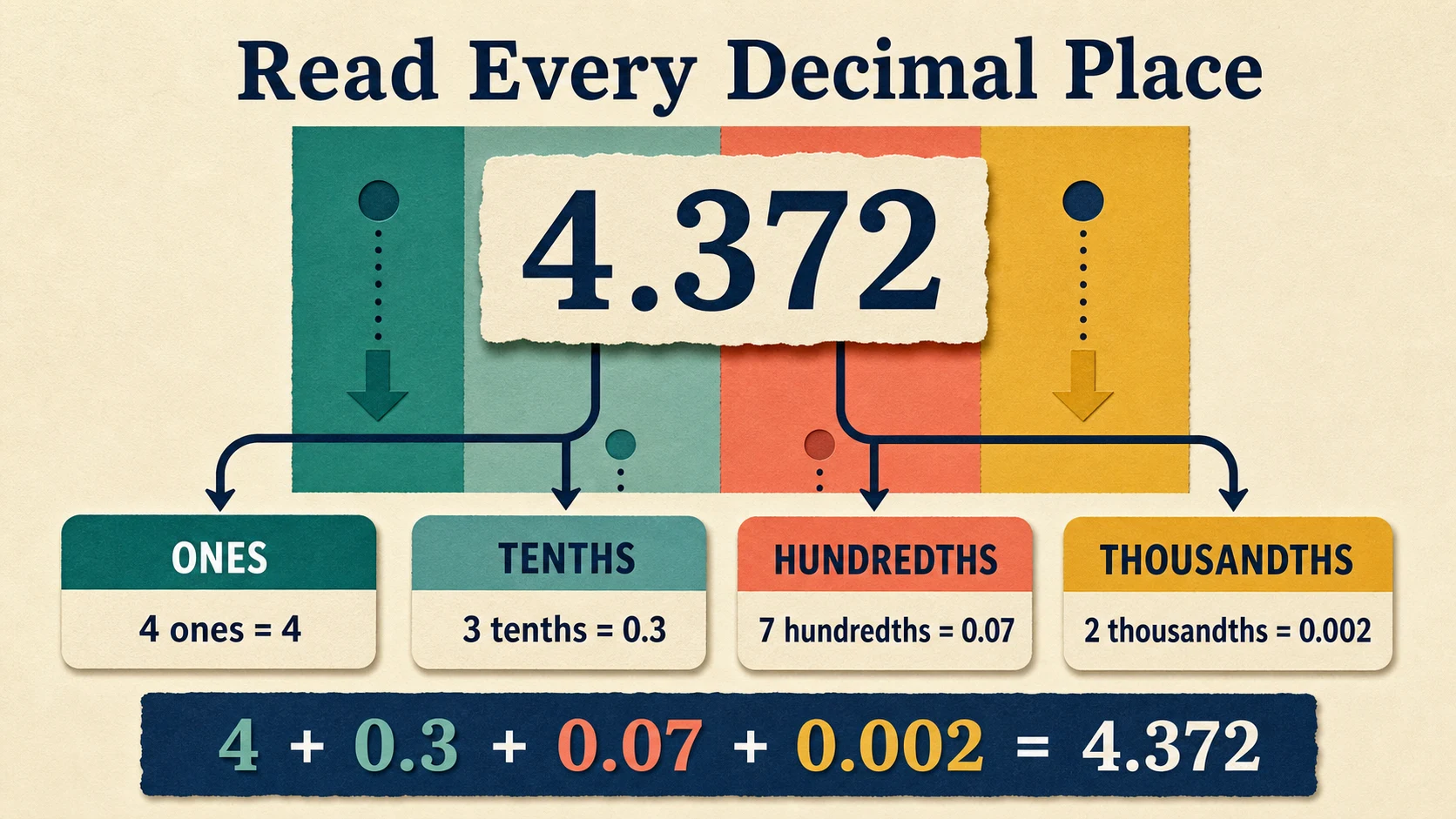
Decimal work connects representation, place value, comparison, estimation, and computation.
Prerequisites to Check Before Teaching Decimal Operations
Decimal difficulties often begin with an earlier idea that is not yet secure. A short prerequisite check is more useful than assuming every fifth grader needs the same starting point.
Whole-number place value
Ask the learner to explain the value of a digit in numbers such as 4,352 and 40,352. They should recognize that a digit’s value depends on its position and that moving one place left makes its value ten times as great. The same base-ten structure continues to the right of the decimal point.
For example:
- In 4,352, the 3 represents 300.
- In 43.52, the 3 represents 3.
- In 4.352, the 3 represents 0.3, or three tenths.
If the learner names digits without describing their values, use expanded form before beginning operations.
Fractions with denominators of 10 and 100
Check whether the learner can interpret 106 and 10036 as parts of one whole. Then connect them to decimal notation:
106=0.6
10036=0.36
A learner who sees fractions only as two unrelated whole numbers may need visual fraction work first. The decimal point does not create the quantity; it records the value using base-ten notation.
Whole-number operations and estimation
Decimal calculation depends on addition, subtraction, multiplication, and division with whole numbers. A learner does not need perfect speed, but weak regrouping or multiplication facts can obscure the decimal concept being taught.
Estimation is equally important. Before calculating 6.2×3.1, the learner should be able to reason that the result will be near 6×3=18. That estimate later helps identify an answer such as 192.2 as unreasonable.
| Check |
Short prompt |
Evidence to look for |
If it is not secure |
| Place value |
What is the value of 7 in 4. seventy? Actually use 4.72. |
Seven tenths, or 0.7 |
Use a place-value chart |
| Fraction meaning |
Shade 10023 |
Twenty-three of 100 equal parts |
Use a hundredths grid |
| Equivalent forms |
Write 0.5 in hundredths |
0.50 or 10050 |
Build tenths from hundredths |
| Comparison |
Compare 0.8 and 0.35 |
0.8>0.35, with a reason |
Represent both on one model |
| Estimation |
Estimate 4.9+2.1 |
About 7 |
Practice rounding to nearby whole numbers |
| Whole-number computation |
Find 42×6 |
Accurate method and result |
Separate fact or algorithm support |
Concrete and Visual Models That Clarify Decimal Meaning
A model should make the value visible and then connect that value to notation. Do not leave the model as a separate activity. Ask the learner to label what each piece represents and write the corresponding fraction and decimal.
Base-ten blocks
One consistent convention is to let:
- One flat represent 1.
- One rod represent 0.1.
- One small cube represent 0.01.
Under that convention, two rods and seven small cubes represent:
0.2+0.07=0.27
The whole must remain fixed during a problem. If the flat represents 1 at the beginning, it cannot silently become 100 later. State the unit before building the number.
Base-ten blocks are especially helpful when regrouping. Ten hundredths can be exchanged for one tenth, just as ten ones can be exchanged for one ten.
Hundredths grids
A 10-by-10 grid divided into 100 equal cells represents one whole. Shading 36 cells shows:
10036=0.36
To compare 0.36 and 0.4, rewrite 0.4 as 0.40. A grid then shows 36 shaded cells compared with 40 shaded cells, so:
0.36<0.40
This directly addresses the mistaken belief that a decimal with more digits must be larger.
Place-value charts and number lines
A place-value chart separates ones, tenths, hundredths, and thousandths. It is useful for reading numbers, aligning operations, and explaining zeros.
| Ones |
Tenths |
Hundredths |
Thousandths |
| 3 |
0 |
7 |
5 |
The chart represents 3.075, read as three and seventy-five thousandths. The zero is important because it holds the tenths place.
Number lines add information about magnitude. Placing 0.4 and 0.36 between 0 and 1 makes their order visible. Zooming in between 0.3 and 0.4 can help the learner locate hundredths precisely.
Money and measurement contexts
Money can clarify hundredths because one cent is one hundredth of a dollar. Thus, $0.25 represents 25 hundredths of a dollar. It is useful for addition and subtraction, but it does not display every decimal situation naturally. Values involving thousandths or more than two decimal places require another representation.
Measurement provides additional contexts. A length of 2.35 meters can be interpreted as 2 whole meters and 35 hundredths of a meter. Keep units attached throughout the calculation so that the answer can be interpreted, not merely computed.
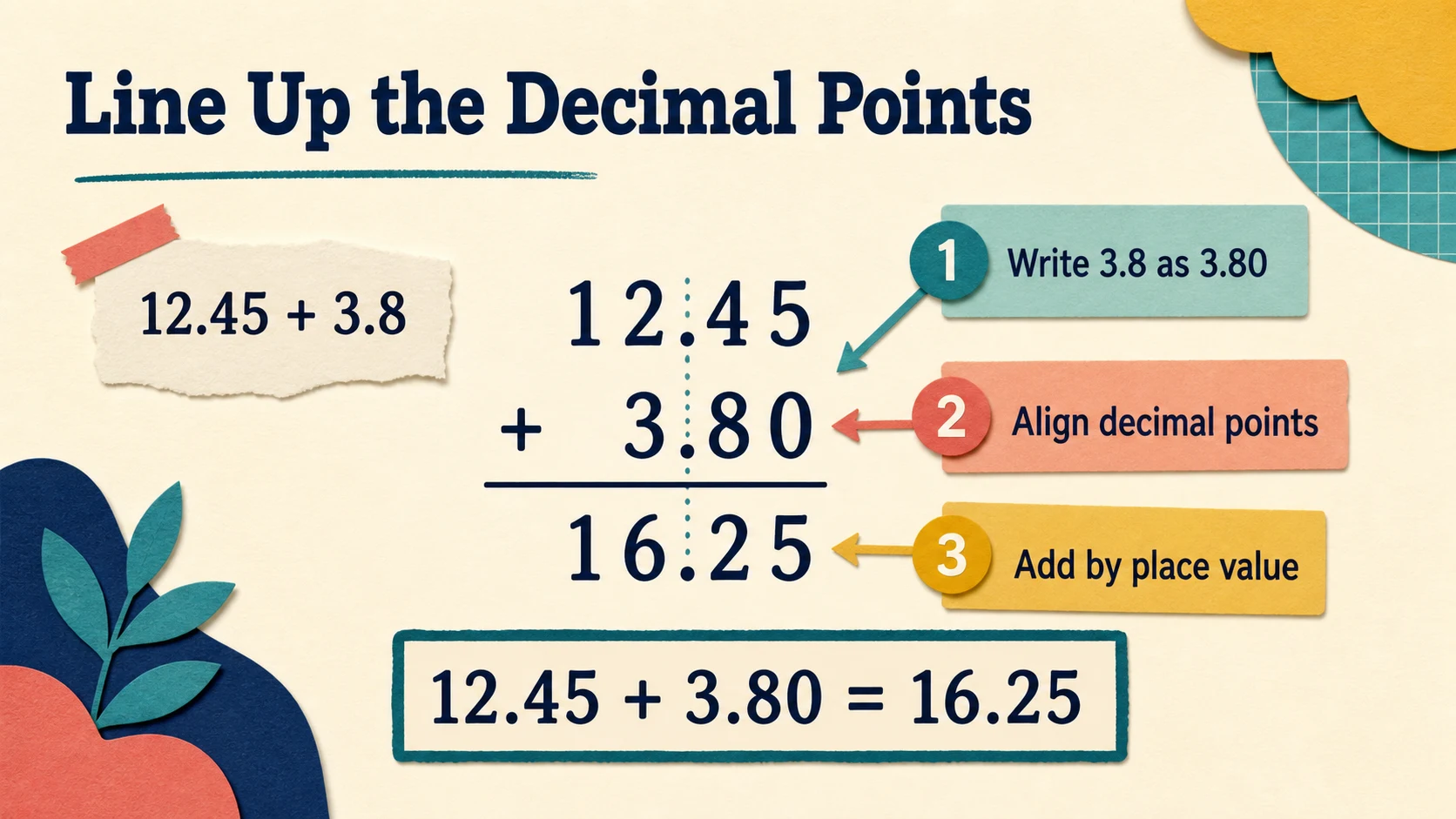
Move from a model to place-value notation and then to an efficient written method.
A Grade-Appropriate Teaching Progression
The progression below moves from meaning to efficient calculation. It is not a universal timetable. Spend longer wherever the learner’s explanations or written work reveal uncertainty.
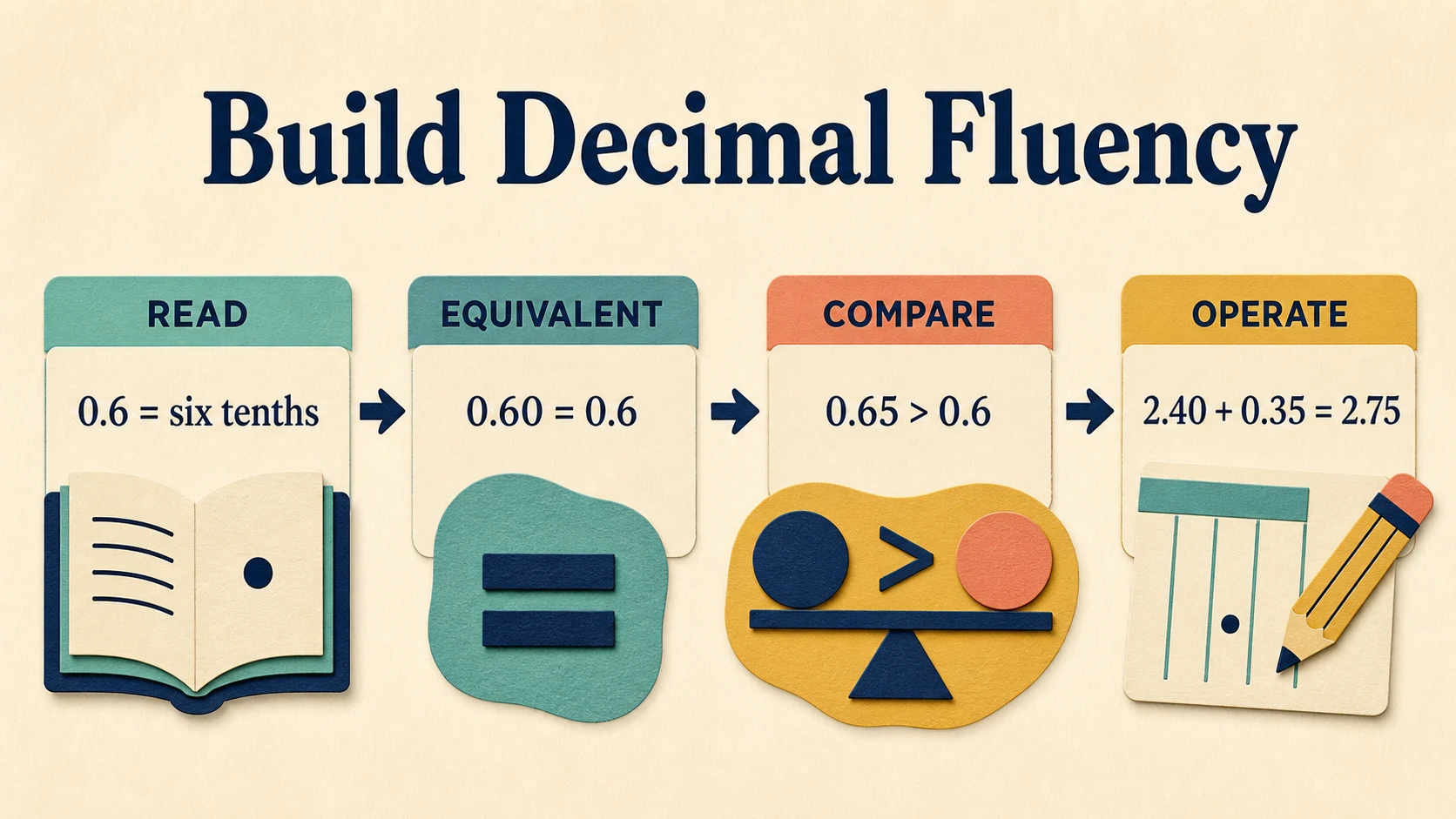
Reduce support only after the learner can explain the values represented.
| Stage |
Main learning goal |
Useful representation |
Readiness evidence |
| 1. Build and name |
Read and represent decimals |
Blocks, grids, place-value charts |
Matches a model, fraction, and decimal |
| 2. Compose and decompose |
Express a value in different forms |
Expanded form and charts |
Explains 2.47=2+0.4+0.07 |
| 3. Compare and order |
Judge magnitude by place value |
Grids and number lines |
Compares from left to right by place |
| 4. Round and estimate |
Identify nearby benchmark values |
Number lines |
Gives a reasonable estimate and explains it |
| 5. Add and subtract |
Combine like place values |
Charts, models, written algorithms |
Aligns places and checks with estimation |
| 6. Multiply |
Interpret groups and scale |
Area or grouping models |
Estimates before placing the decimal |
| 7. Divide |
Interpret sharing or measurement |
Equal groups and written methods |
Explains the quotient in context |
| 8. Apply and review |
Select an operation independently |
Diagrams as needed |
Solves mixed problems and checks results |
The IES guide on teaching mathematics to young children supports broad instructional practices such as using developmental progressions, monitoring what learners know, and helping them describe mathematical ideas. Although its stated age range is younger than fifth grade, those high-level principles can still inform how an adult sequences representations and listens to explanations. It does not evaluate WorksheetWise materials or prescribe this decimal sequence.
For learners experiencing persistent difficulty, the IES practice guide on assisting students struggling with mathematics offers high-level guidance on systematic instruction, mathematical language, representations, and cumulative review. Use that source as general instructional framing, not as evidence about a particular worksheet or individual child.
Fully Checked Worked Examples
Each example includes a reasonableness check. Encourage the learner to predict first, calculate second, and explain last.
Example 1: Read and decompose a decimal
Write 4.308 in expanded form.
The digits occupy these places:
- 4 is in the ones place.
- 3 is in the tenths place.
- 0 is in the hundredths place.
- 8 is in the thousandths place.
Therefore:
4.308=4+103+1000+10008
or:
4.308=4+0.3+0.008
Check by adding the decimal parts:
4+0.3+0.008=4.308
Boundary case: 4.308 is not the same as 4.38. In 4.308, the 8 represents eight thousandths; in 4.38, it represents eight hundredths.
Example 2: Compare decimals of different lengths
Compare 0.7 and 0.68.
Write both values to the hundredths place:
0.7=0.70
Now compare:
0.70>0.68
Therefore:
0.7>0.68
A visual check gives the same conclusion: 70 hundredths is greater than 68 hundredths. The number of written digits does not determine size.
Boundary case: Adding zeros at the right end of a decimal does not change its value, so 0.7=0.70=0.700. A zero inserted between existing place values can change the number: 0.7=0.07.
Example 3: Add decimals with unlike written lengths
Find:
3.6+0.47
Estimate:
3.6+0.5≈4.1
Rewrite 3.6 as 3.60 and align equal places:
  3.60
+ 0.47
------
  4.07
Calculate by place:
- Hundredths: 0+7=7.
- Tenths: 6+4=10 tenths, which regroup as 1 one and 0 tenths.
- Ones: 3+1=4.
Therefore:
3.6+0.47=4.07
The result is close to the estimate of 4.1, so its magnitude is reasonable.
Example 4: Subtract across zeros
Find:
5−2.68
Estimate:
5−2.7≈2.3
Write 5 as 5.00:
  5.00
- 2.68
------
  2.32
Regroup 5.00 as 4 ones, 9 tenths, and 10 hundredths. Then:
- Hundredths: 10−8=2.
- Tenths: 9−6=3.
- Ones: 4−2=2.
Thus:
5−2.68=2.32
Check with addition:
2.32+2.68=5.00
The answer also agrees with the estimate of about 2.3.
Example 5: Multiply decimals and place the decimal by magnitude
Find:
2.4×1.3
Estimate:
2.4×1.3
is a little more than 2.4×1, so the answer should be a little more than 2.4. Using nearby whole numbers also gives 2×1=2.
Calculate 24×13:
24×13=24×(10+3)=240+72=312
Because 2.4=1024 and 1.3=1013:
2.4×1.3=1024×1013=100312=3.12
Therefore:
2.4×1.3=3.12
The answer is a little more than 2.4 and close to the rough estimate, so 3.12 is reasonable. An answer of 31.2 would be far too large.
Example 6: Divide a decimal by a whole number
Four containers share 6.8 liters equally. How much goes in each container?
The operation is:
6.8÷4
Interpret 6.8 as 68 tenths. Divide:
68 tenths÷4=17 tenths
Seventeen tenths equals 1.7, so:
6.8÷4=1.7
Each container receives 1.7 liters.
Check with multiplication:
1.7×4=6.8
Boundary case: Division does not always make a number smaller. For example, 3÷0.5=6 because six groups of one-half fit into 3. The size of the divisor matters.
A Short, Repeatable Lesson Routine
A focused routine can fit into approximately 20 to 30 minutes, but the learner’s work should control the actual time. Stop early when accuracy deteriorates or extend discussion when a useful misconception appears.
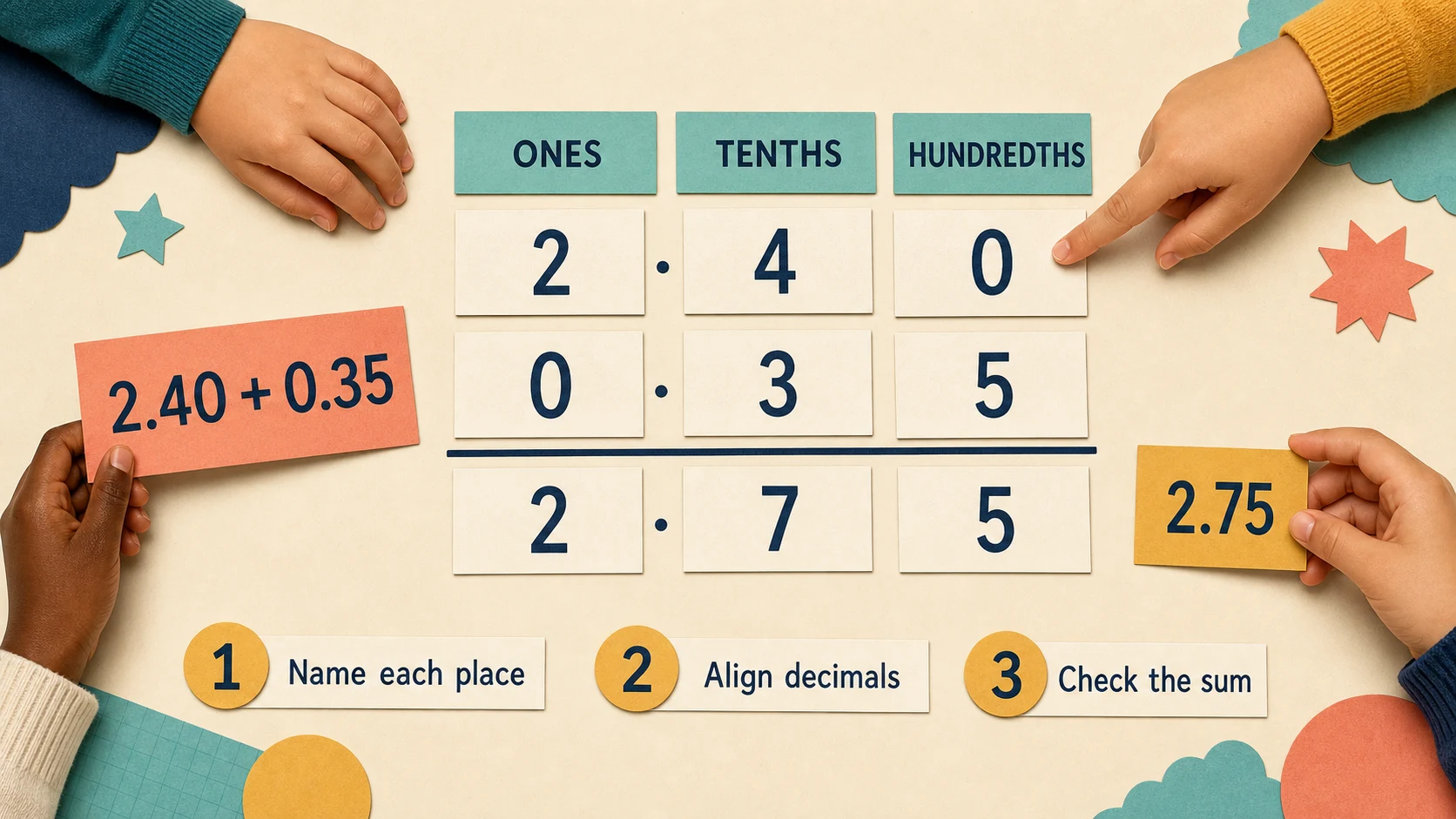
A stable routine leaves attention available for the mathematics rather than the procedure.
The five-part routine
- Retrieve a prerequisite. Use two or three oral prompts, such as naming the value of a digit or converting tenths to hundredths.
- Model one new idea. Demonstrate a single example with a grid, blocks, number line, or place-value chart. Say what each symbol represents.
- Solve together. Let the learner choose or complete the next step and explain why it is valid.
- Practice independently. Give a short set in which most items address the same skill. Include one previously learned item for review.
- Check and reflect. Review the work, not just the score. Ask the learner to correct one error and state a check that could catch it.
An instructional suggestion is to begin with four to six independent problems rather than an entire page. This is not a sourced universal dosage. It is a manageable starting point that lets an adult inspect strategy and accuracy before assigning more.
Choosing Practice and Differentiating Support
The best practice set is the one that reveals and strengthens the next needed skill. Problem count alone does not show whether practice is appropriate.
The 5th Grade Math hub helps place decimal work alongside other fifth-grade topics. The dedicated Decimals topic guide narrows the selection to decimal practice, while the broader 5th Grade worksheet hub can support planning across subjects.
Match practice to observed evidence
Choose representation and place-value work when the learner:
- Reads 0.04 as four tenths.
- Treats a placeholder zero as unimportant.
- Cannot explain why 0.5=0.50.
- Compares decimals by counting digits.
Choose addition or subtraction practice when the learner understands magnitude but misaligns place values, omits placeholder zeros, or struggles to regroup.
Choose multiplication practice when whole-number multiplication is workable but the learner cannot predict product size or place the decimal reasonably.
Choose division practice when the learner can divide whole numbers but has difficulty interpreting decimal quantities as equal groups or checking with multiplication.
Choose mixed word problems only after individual operations are sufficiently secure. Otherwise, an incorrect answer may come from operation selection, computation, reading, or units, making the source of difficulty hard to identify.
Adjust support without changing the mathematical goal
For more support:
- Use fewer problems at one time.
- Keep a place-value chart visible.
- Pair each symbolic problem with a model.
- Provide an estimate before calculation.
- Ask the learner to explain one step at a time.
- Mix in previously successful examples.
For greater challenge:
- Remove unnecessary placeholder zeros and ask the learner to supply them.
- Include decimals of different written lengths.
- Ask for two representations of one value.
- Require an estimate and an exact answer.
- Include error analysis: “A student wrote 0.4<0.36. Explain and correct the reasoning.”
- Use multi-step contexts after single operations are accurate.
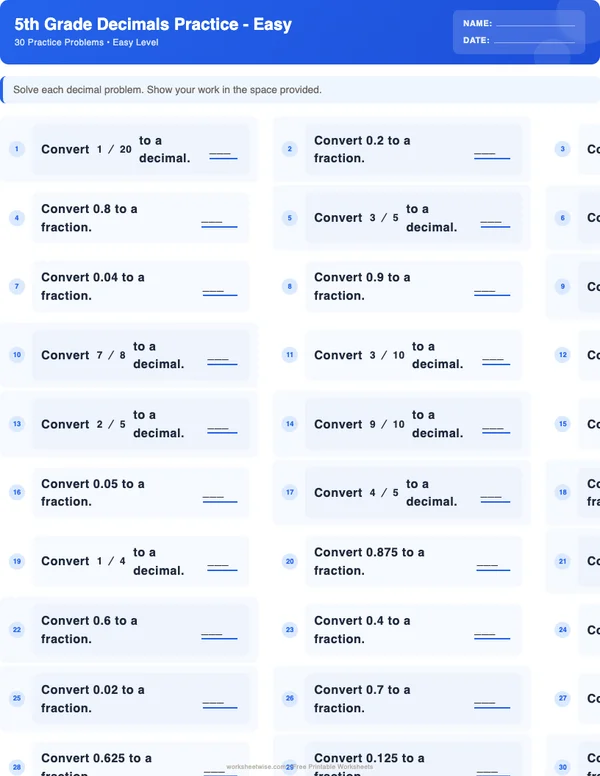
The 30-problem free easy decimal worksheet covers conversion, addition, subtraction, multiplication, decimal operations, and number sense, with a separate answer key. It can be divided into shorter sets; there is no need to complete all 30 exercises in one sitting. The focused decimal pack contains 18 worksheets for families or educators who need a broader bank of practice.
Common Errors and Diagnostic Responses
An error is evidence about the learner’s current reasoning. Identify the pattern before choosing another page.
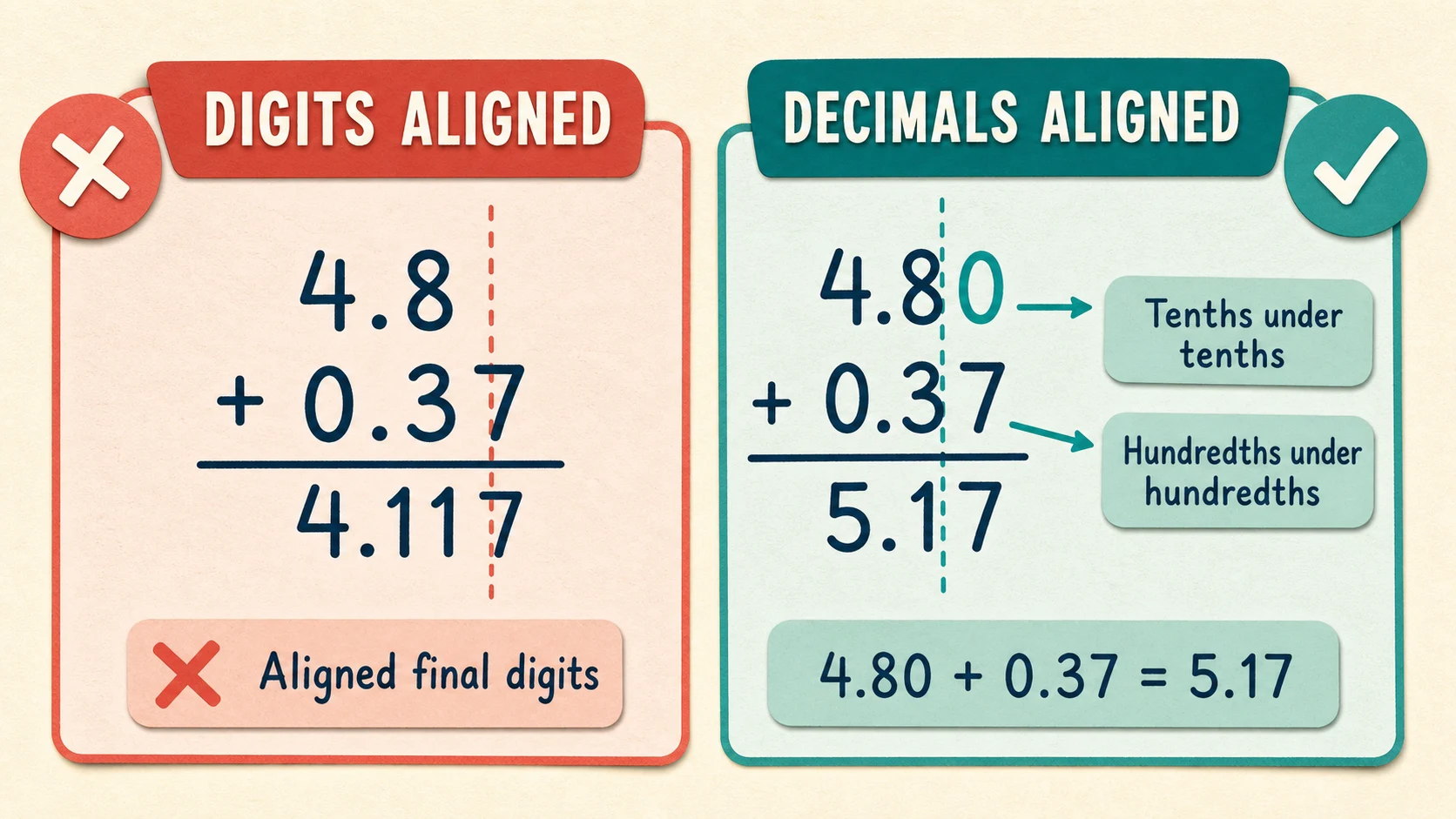
The response should address the idea behind the error, not merely repeat the rule.
| Observed error |
Likely reasoning to investigate |
Diagnostic prompt |
Teaching response |
| Says 0.36>0.4 |
More digits means a larger number |
Which is greater: 36 hundredths or 40 hundredths? |
Shade both on hundredths grids |
| Writes 0.5+0.25=0.30 |
Aligns numbers at the right edge |
What place is the 5 in? |
Rewrite 0.5 as 0.50 and align places |
| Reads 3.04 as 3.4 |
Ignores the placeholder zero |
Where are the tenths? |
Build the number on a place-value chart |
| Gives 2.3×4.1=943 |
Calculates whole numbers without restoring magnitude |
Should the result be near 8, 80, or 800? |
Estimate first, then connect to fractions |
| Gives 4.8÷6=8 |
Loses the scale of tenths |
Is 4.8 shared among six groups more or less than 1 each? |
Interpret 4.8 as 48 tenths |
| Rounds 2.45 to 2.4 at the tenths place |
Looks at the target digit rather than the next digit |
Which digit is immediately right of the tenths? |
Mark target and deciding digits on a number line |
| Removes any zero |
Overgeneralizes that zeros do not matter |
Compare 0.5, 0.50, and 0.05 |
Discuss trailing and placeholder zeros separately |
| Produces a correct answer without units |
Treats a context as bare computation |
What does 1.7 describe? |
Restate the answer with its unit |
Separate slips from misconceptions
A single incorrect answer may be a copying or arithmetic slip. A repeated error across differently formatted problems is stronger evidence of a misconception.
After a correction, give:
- One near-identical problem to test the repaired step.
- One problem with different numbers but the same structure.
- One mixed problem later to see whether the learner independently selects the corrected method.
If the error disappears only while the model is present, keep fading support gradually. If it returns after a day or two, schedule cumulative review rather than immediately increasing difficulty.
Monitoring Progress Without Chasing Speed
Monitor explanations, representations, estimates, calculations, and checks. A percentage alone can hide important differences: two learners may each answer eight of ten correctly, while one has secure reasoning with two arithmetic slips and the other is guessing successfully.
A simple weekly record
For each skill, record one of three descriptions:
- Supported: succeeds with a model, prompt, or worked example.
- Developing: succeeds independently on a focused set but not consistently in mixed work.
- Secure for current practice: explains the method, solves independently, and checks a new example accurately.
These labels describe current evidence, not fixed ability. Recheck after a delay.
Useful monitoring prompts include:
- “What does this digit represent?”
- “Can you show the number another way?”
- “What answer would be reasonable?”
- “Why are the decimal points aligned here?”
- “How can multiplication check this division?”
- “Which step caused the error?”
Advance when the learner demonstrates the idea across more than one format. Return to a representation when explanations become procedural or estimates conflict sharply with answers.
A Two-Week Practice Plan
This plan assumes ten short sessions and can be shortened, extended, or reordered. It is an instructional suggestion, not a universal timetable or child-specific prescription.
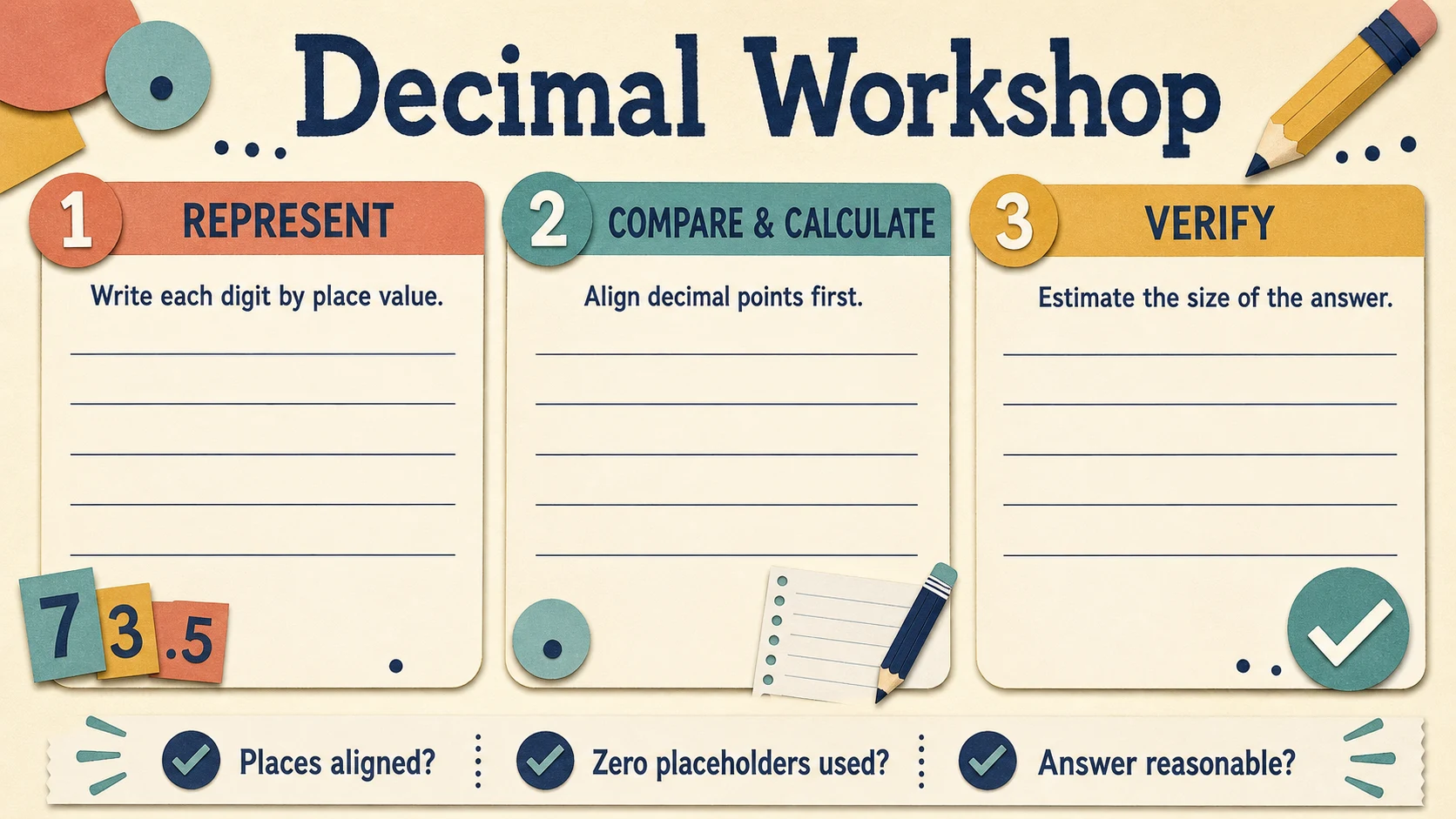
Each session combines a focused skill, a brief review, and evidence for the next decision.
| Day |
Focus |
Suggested activity |
Evidence to collect |
| 1 |
Prerequisite check |
Place value, tenths, hundredths, and estimation prompts |
Starting point and misconceptions |
| 2 |
Represent decimals |
Build and shade decimals; write fractions and expanded forms |
Accurate links among representations |
| 3 |
Compare and order |
Use grids and number lines, then symbols |
Place-value explanations |
| 4 |
Round and estimate |
Locate decimals between benchmarks |
Reasonable rounded values |
| 5 |
Add decimals |
Model regrouping, then solve a short focused set |
Correct alignment and estimation |
| 6 |
Subtract decimals |
Include whole-number minus decimal boundary cases |
Regrouping across zeros |
| 7 |
Multiply decimals |
Estimate, calculate, and justify product size |
Sensible decimal placement |
| 8 |
Divide decimals |
Share decimal quantities and check by multiplication |
Quotient meaning and units |
| 9 |
Mixed application |
Choose operations in money or measurement contexts |
Independent operation selection |
| 10 |
Review and reassess |
Repeat selected Day 1 prompts and correct one prior error |
Retention and next practice need |
Keep earlier skills active with one or two review items per session. If Day 5 reveals that the learner still compares decimals by length, pause addition and revisit equivalence and place value. If Day 8 shows accurate division but weak multiplication checks, review the related multiplication fact or decimal product rather than reteaching every division step.
Limitations and an Honest Next Step
A worksheet can provide orderly practice and make written errors visible, but it cannot by itself determine why a learner chose a method. Models, discussion, observation, and correction remain necessary. Money contexts support hundredths but do not cover every decimal value. A correct page also does not prove durable understanding; delayed and mixed review is needed to see whether the learner can transfer the skill.
This guide does not claim comprehensive alignment with every local curriculum, certification by an external organization, guaranteed outcomes, or a timetable appropriate for every learner. The authoritative sources above support high-level instructional framing only; they did not evaluate WorksheetWise or this exact material.
A useful next action is to give the learner four to six selected items from the free 5th Grade Decimals worksheet. Ask for an estimate, visible work, and one verbal explanation. Use the resulting evidence to select the next skill. If you need practice targeted to a narrower pattern, explore the free worksheet generators rather than assigning unrelated repetition.