What 5th Grade Multiplication Should Include
The central goal of 5th Grade Multiplication is accurate, explainable computation. A learner should connect equal groups, arrays, place value, area models, partial products, and the standard algorithm rather than treating each as an unrelated procedure. Practice should include multiplication facts, mental strategies, multi-digit whole-number multiplication, estimation, and checking. Decimal and fraction multiplication may also appear in a fifth-grade program, depending on the local sequence.
Grade labels describe the intended practice level, not a universal timetable. Local curricula and teaching sequences differ. Begin with the learner’s observed work: if basic facts consume most of the learner’s attention, strengthen fact strategies while continuing carefully supported multi-digit work. If the learner computes accurately but cannot explain an answer or recognize an unreasonable result, emphasize models, estimation, and word problems.
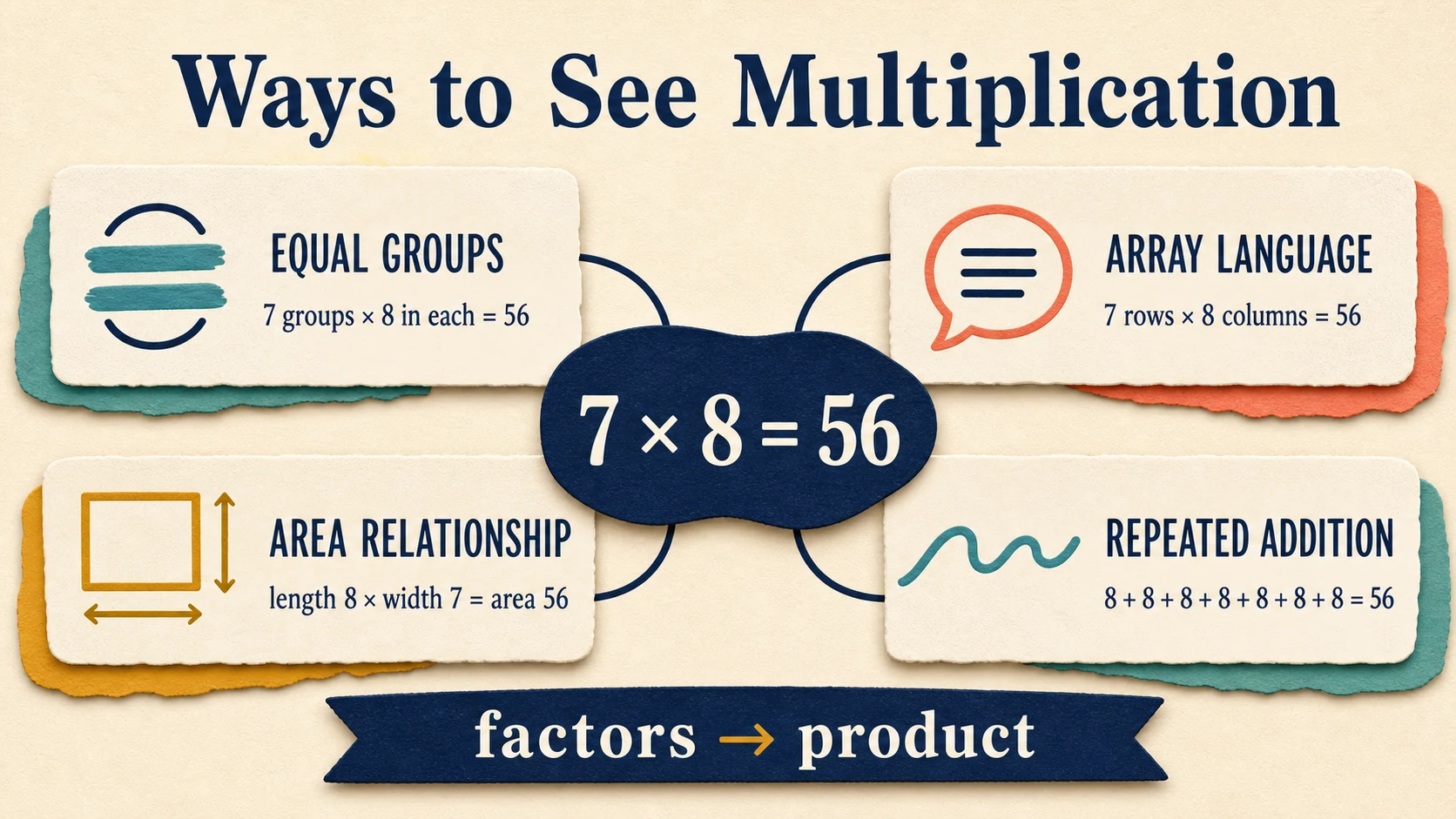
The skill develops through connected ideas: groups, facts, place value, partial products, algorithms, estimation, and application.
The 5th Grade Math collection can help adults place multiplication practice alongside related work with decimals, fractions, expressions, and measurement. The Multiplication topic guide provides the most focused route into multiplication materials.
Prerequisites to Check Before Teaching the Algorithm
A learner does not need perfect speed before beginning fifth-grade multiplication. However, several foundations should be available well enough that they do not overwhelm the new work.
Meaning of multiplication
The learner should be able to interpret 4×6 as four groups of six, an array with four rows of six, or six added four times. It is also useful to recognize that 4×6 and 6×4 have the same product even though a story may describe the groups differently.
Ask the learner to draw 3×8, describe the drawing, and write a matching equation. A correct answer without a matching representation may indicate procedural recall without secure meaning.
Multiplication facts and derived strategies
The learner should know many facts through 10×10, ideally with strategies for facts that are not recalled immediately. The catalogue progression also includes facts through 12. Useful derivations include:
- 7×8=(5×8)+(2×8)=40+16=56
- 6×9=(6×10)−6=60−6=54
- 4×7 is double 2×7, so 14+14=28
- 8×6 is double 4×6, so 24+24=48
Skip counting can support these facts, but it should remain a bridge. For a calculation such as 8×7, a known or derived product is more efficient than counting seven eight times.
Place value and addition
Before multiplying multi-digit numbers, check whether the learner can:
- Read numbers by place value.
- Decompose 326 as 300+20+6.
- Explain that multiplying by 30 means multiplying by 3 tens.
- Add partial products accurately.
- Regroup in addition and one-digit multiplication.
A learner who writes 24×30=720 and can explain 24×3 tens as 72 tens has the place-value idea needed for two-digit multipliers.
Estimation
Estimation is a prerequisite for judging an answer, not merely a final extra step. For 398×21, the estimate 400×20=8,000 establishes a useful range. An answer such as 83,580 should then look implausible before anyone consults an answer key.
A Grade-Appropriate Teaching Progression
The progression should move from meaning to efficiency while preserving the connections between representations. The Common Core mathematics standards place multi-digit whole-number multiplication with the standard algorithm in Grade 5. That source supplies broad standards context; it does not determine the exact pace needed by an individual learner or evaluate these materials.
| Stage |
Main teaching focus |
Useful representation |
Evidence for moving on |
| 1. Diagnose foundations |
Equal groups, facts, place value, addition |
Objects, arrays, fact strategy notes |
Learner explains products and derives unfamiliar facts |
| 2. Multiply by powers of ten |
Products involving 10, 20, 300, and similar values |
Place-value chart, expanded notation |
Learner explains shifts in value without relying on “add a zero” |
| 3. One-digit multiplier |
Multi-digit number multiplied by one digit |
Base-ten drawing, expanded form |
Partial products are complete and added accurately |
| 4. Two-digit multiplier |
Tens and ones in the multiplier |
Area model, partial-products table |
Learner records both rows and explains their values |
| 5. Standard algorithm |
Compact recording with regrouping |
Algorithm annotated by place value |
Work is accurate, aligned, and explainable |
| 6. Application and checking |
Word problems, estimation, unknowns |
Bar model, equation, written check |
Learner selects an operation and evaluates reasonableness |
| 7. Broader fifth-grade multiplication |
Decimal or fraction multiplication as locally appropriate |
Area grids, number lines, fraction models |
Learner connects the procedure to magnitude and units |
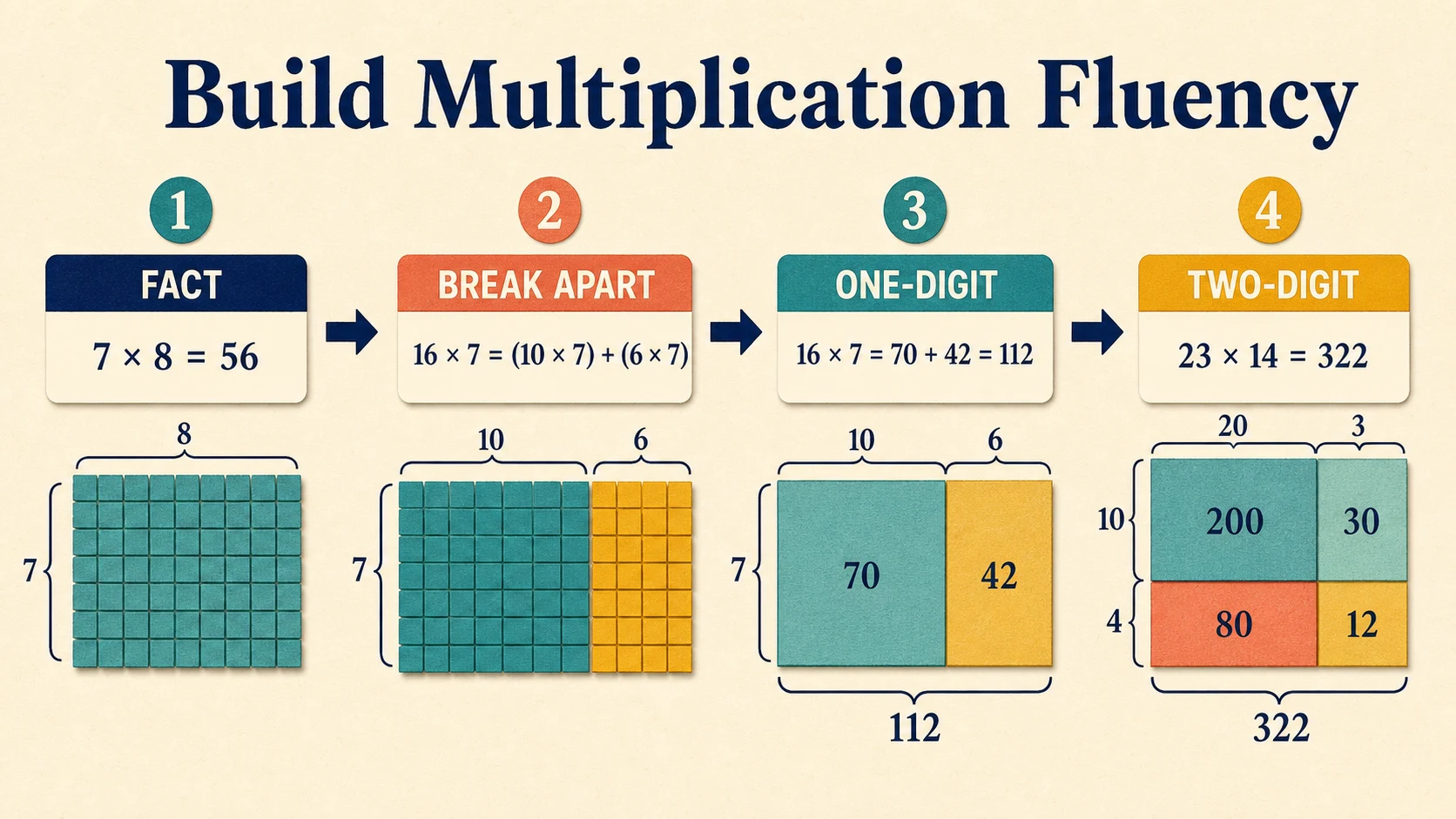
Move forward when the learner’s work shows readiness, and return to a model when an error exposes a missing connection.
This table is a planning sequence, not a requirement that every learner spend the same number of days at each stage. One learner may need three sessions on partial products; another may understand them after one demonstration but need more work on fact retrieval.
Concrete and Visual Models That Explain the Procedure
Equal groups and arrays
Counters, tiles, buttons, or quick sketches make multiplication visible. To model 4×13, build four equal rows of 13. Then split each row into 10 and 3:
4×13=(4×10)+(4×3)=40+12=52
The split shows the distributive property and anticipates partial products. Rotating an array also illustrates the commutative property: a 4-by-13 array and a 13-by-4 array contain the same number of objects.
Base-ten blocks and drawings
For 23×4, represent 23 as two tens and three ones. Four copies produce eight tens and twelve ones. Regroup twelve ones as one ten and two ones, giving nine tens and two ones, or 92.
A learner does not need physical blocks indefinitely. A labeled sketch—four groups, each containing two tens and three ones—can preserve the reasoning while making the work faster.
Area models
An area model is particularly useful for two-digit multiplication:
34×27=(30+4)(20+7)
Divide a rectangle into four regions:
Then add:
600+210+80+28=918
Every partial product has a visible source. This makes a missing tens product easier to detect than it would be in an unexplained compact algorithm.
Open number lines
A number line can clarify repeated equal jumps and multiplication by a decomposed factor. For 18×6, six jumps of 18 reach 108. A more efficient version combines jumps:
5×18=90,1×18=18,90+18=108
Number lines are less convenient for large written computations, but they are valuable when the learner needs to reconnect a symbolic expression to quantity.
The IES guide on teaching mathematics to young children offers high-level instructional framing around mathematical ideas, progress monitoring, and representations. Although its stated age range is younger than fifth grade, the general purpose of connecting language, symbols, and representations can inform prerequisite repair. It should not be treated as a fifth-grade scope-and-sequence document.
Fully Checked Worked Examples
Example 1: Multi-digit number by one digit
Find 3,482×6.
Decompose the larger number:
3,482=3,000+400+80+2
Multiply each part:
6×3,000=18,000
6×400=2,400
6×80=480
6×2=12
Add the partial products:
18,000+2,400+480+12=20,892
Check by estimation:
3,500×6=21,000
The exact answer, 20,892, is close to the estimate and has the expected size.
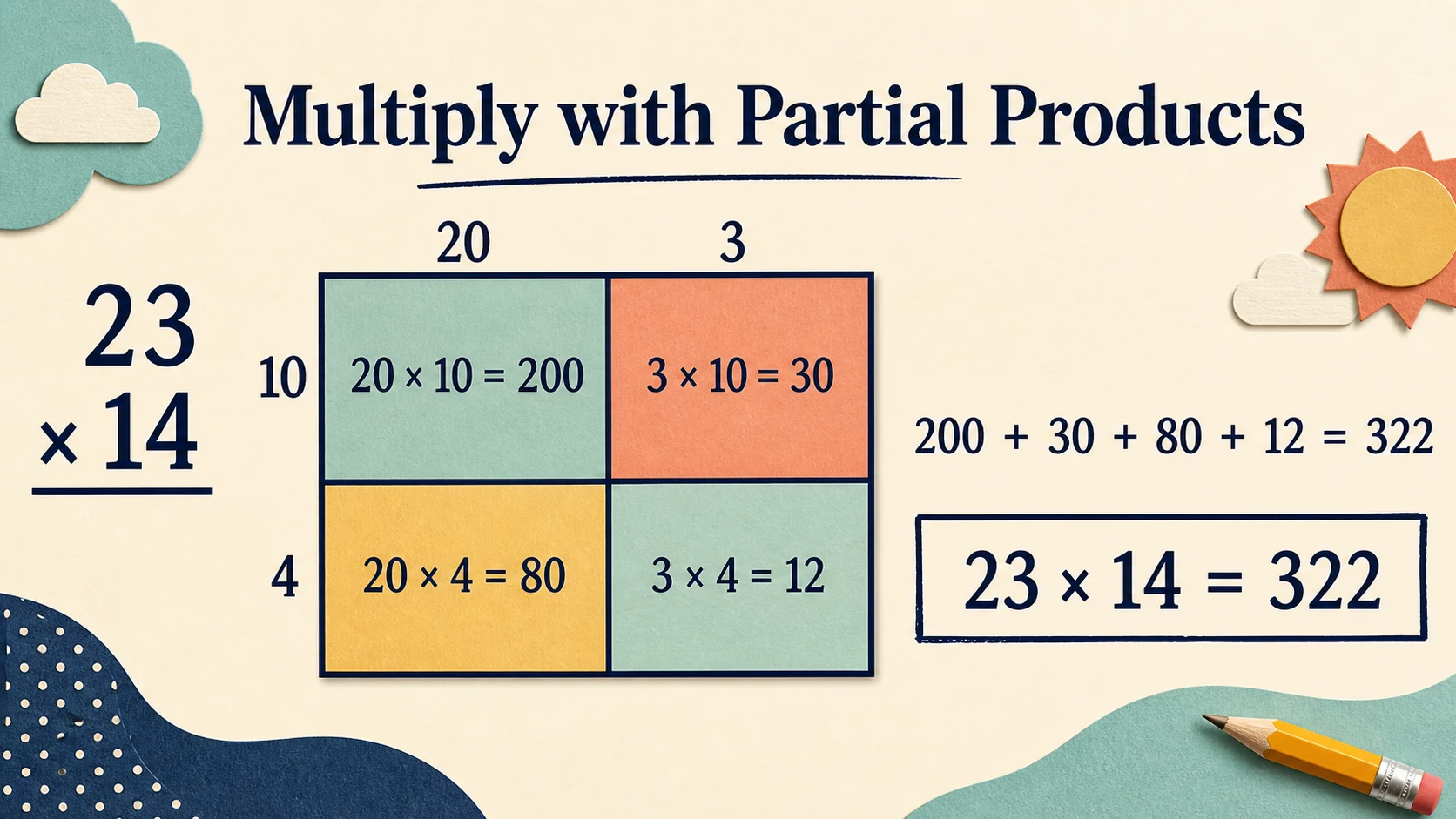
The representation should explain where each partial product comes from before the recording becomes compact.
Example 2: Two-digit multiplier with partial products
Find 247×36.
Separate 36 into 30 and 6:
247×36=(247×30)+(247×6)
First calculate:
247×30=(247×3)×10=741×10=7,410
Then:
247×6=1,482
Add:
7,410+1,482=8,892
Check with a different decomposition:
247×36=247×(40−4)
247×40=9,880
247×4=988
9,880−988=8,892
Both methods give 8,892.
Example 3: A zero inside the multiplier
Find 4,306×207.
Decompose 207 by value:
207=200+0+7
Then:
4,306×200=861,200
4,306×0=0
4,306×7=30,142
Add:
861,200+0+30,142=891,342
Estimate:
4,300×200=860,000
Because the exact multiplier is 207, an exact answer slightly above 860,000 is reasonable. 891,342 fits that expectation.
This boundary case reveals whether a learner attends to place value. Treating the 2 in 207 as 2 rather than 200 would produce an answer far too small.
Example 4: Multiplying decimals
Find 2.4×0.35.
Use fractions based on place value:
2.4=1024,0.35=10035
Therefore:
2.4×0.35=1,00024×35
Calculate the whole-number product:
24×35=(24×30)+(24×5)=720+120=840
Then:
1,000840=0.840=0.84
Check the magnitude: 0.35 is less than 1, so multiplying 2.4 by 0.35 should produce a number less than 2.4. The answer 0.84 passes that check.
This example belongs only where the local fifth-grade sequence includes decimal multiplication. It should not replace needed work on whole-number place value.
Example 5: A multiplication word problem
A school stores 28 boxes of pencils. Each box holds 144 pencils. How many pencils are stored?
The equal-size groups indicate multiplication:
28×144
Decompose 28:
144×28=(144×20)+(144×8)
144×20=2,880
144×8=1,152
2,880+1,152=4,032
Answer in context: The school stores 4,032 pencils.
Check:
30×144=4,320
Because 28 groups are two groups fewer than 30 groups:
4,320−(2×144)=4,320−288=4,032
A Short, Repeatable Lesson Routine
A focused session can last about 15–25 minutes, but the learner’s attention and observed work should determine the actual length.
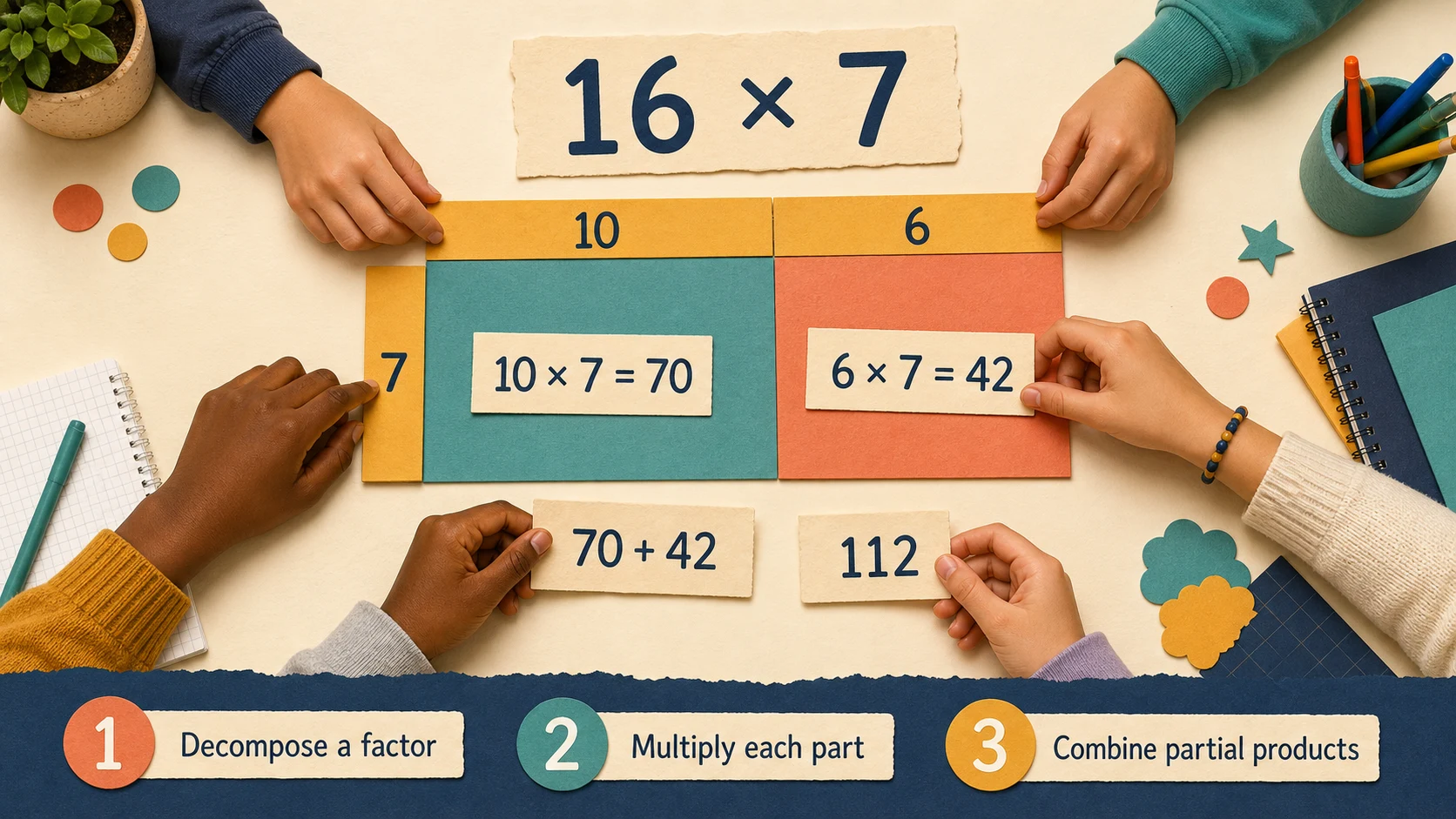
Keep the structure predictable while changing the numbers, representations, and amount of support.
1. Retrieve and connect
Spend two or three minutes on a few facts connected to the day’s work. Before 326×24, for example, revisit 3×4, 6×4, 326×4, and multiplication by 20.
2. Model one example
Demonstrate one carefully selected problem. Name the value of each digit and show why every partial product is present. Keep the learner active by asking for the next decomposition or an estimate.
3. Solve one together
Share the recording. The adult might draw the area model while the learner calculates each region. Correct misunderstandings immediately, but ask the learner to identify what each number represents.
4. Attempt a short independent set
Use three to six problems with enough similarity to reveal whether the method is stable. A large mixed page is not necessary at this point.
5. Check and summarize
Have the learner estimate one answer, verify one with another method, and explain one step aloud. Record the error pattern or successful strategy that should shape the next session.
The IES practice guide for assisting students struggling with mathematics provides high-level guidance on systematic instruction, mathematical language, representations, word problems, and cumulative review. These principles can guide lesson design, but they do not prescribe a universal session length or diagnose an individual child.
Choosing Practice That Matches the Evidence
Practice should address the next learning need, not simply present more problems.
When facts are effortful
Choose a small fact family and encourage derivation. Mix 7×5, 7×3, and 7×8 so the learner can use:
7×8=(7×5)+(7×3)
Avoid making speed the only measure. Track whether the learner chooses an efficient strategy and becomes more accurate across several sessions.
When place value is weak
Choose problems such as 32×4, 320×4, and 3,200×4. Ask how the products are related. Use expanded notation before expecting a compact algorithm.
When partial products are incomplete
Use an area model with every region labeled. For 43×26, the learner must account for:
40×20,40×6,3×20,3×6
A set of four to six related examples is more diagnostic than 30 calculations completed with the same hidden misconception.
When the algorithm is secure
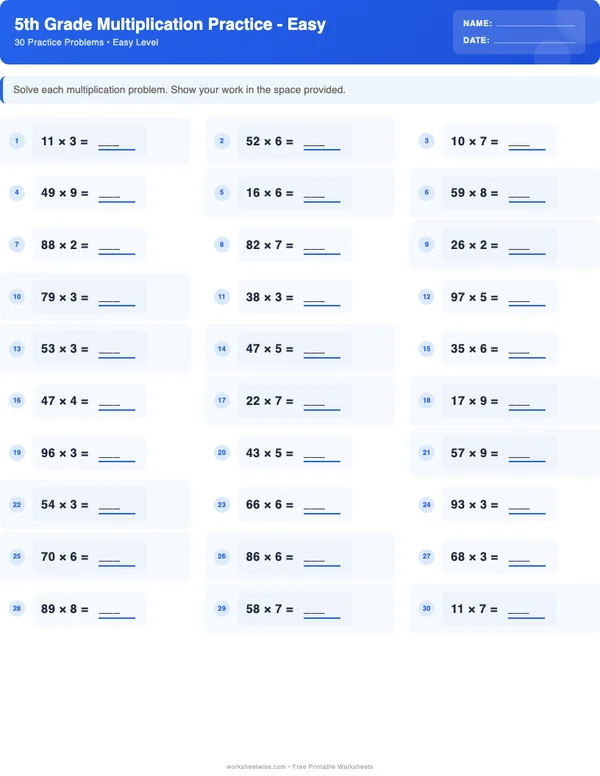
Mix problem structures: one-digit and two-digit multipliers, zeros, estimation, word problems, and an unknown factor. The focused worksheet listed in the catalogue contains 30 easy-level exercises emphasizing facts, times tables, mental math, and number sense. It is suitable for reinforcement or a foundation check, but it should not be mistaken for a complete assessment of fifth-grade multi-digit multiplication.
The free standard-theme multiplication worksheet includes an answer key. Select part of the page when a full set would create unnecessary repetition. The focused multiplication pack contains 18 worksheets and can provide a broader bank from which to choose; its size does not mean every page must be completed.
Differentiation Without Lowering the Mathematical Goal
Support should reduce avoidable load while preserving the central idea.
For a learner who needs more support:
- Use fewer problems and more space.
- Keep an area model beside the written algorithm.
- Provide a fact chart temporarily when fact retrieval blocks place-value reasoning.
- Highlight tens and ones in different colors.
- Ask for an estimate before calculation.
- Alternate one modeled problem with one learner attempt.
- Return to smaller numbers while retaining the same structure.
For a learner showing secure understanding:
- Ask for two methods and a comparison.
- Include missing-factor equations such as 36×□=1,080.
- Ask the learner to locate and correct a fictional error.
- Include multipliers containing zero.
- Require an estimate and a written reasonableness statement.
- Use word problems with extra information that must be ignored.
- Explore decimal or fraction multiplication only when it fits the local sequence and prerequisite understanding is secure.
Differentiation is not simply making numbers smaller or larger. A problem such as 4,006×305 can be challenging because of place-value boundaries, while a larger-looking problem may be routine if every digit is nonzero.
Common Errors and Diagnostic Responses
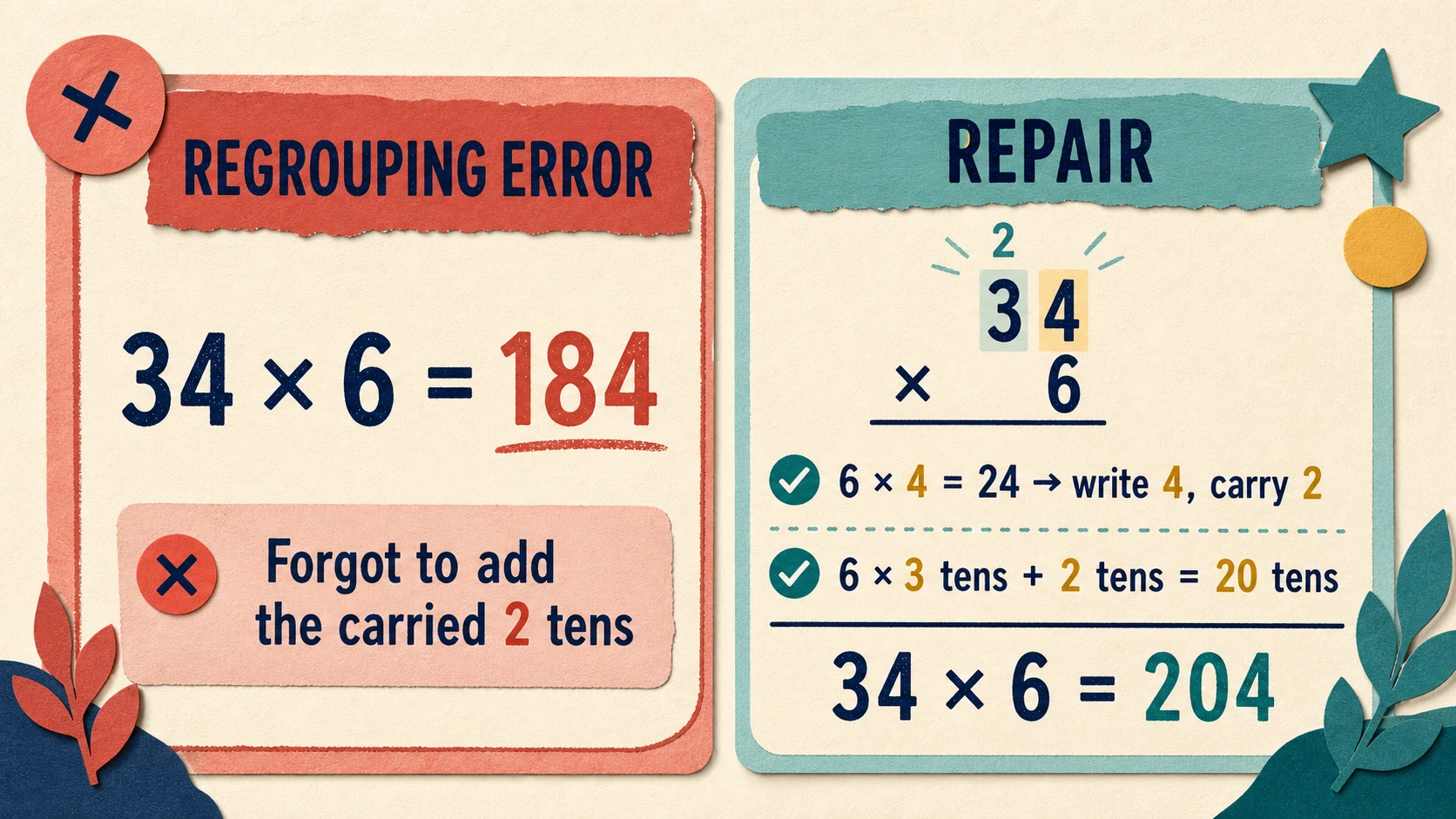
Treat an error as evidence about the learner’s current reasoning, then choose a response aimed at that reasoning.
| Observed work |
Likely issue to investigate |
Instructional response |
| 34×20=680, but the learner says the zero was “added” |
Rule is detached from place value |
Show 20 as two tens: 34×2 tens equals 68 tens |
| One partial-product row is missing |
Multiplier was not fully decomposed |
Return to a four-region area model |
| Second algorithm row begins in the ones column |
Tens digit treated as ones |
Label it “30,” calculate n×30, and align by value |
| Regrouped digits are added or multiplied inconsistently |
Working-memory or notation overload |
Use expanded partial products before compressing the recording |
| 3,205×4=12,820 becomes 1,282 |
Zero or place is lost |
Read each partial product by place and compare with an estimate |
| Decimal answer is larger when multiplying by a number below 1 |
Magnitude is not being monitored |
Use a number line or area interpretation before revisiting placement |
| Word problem is added instead of multiplied |
Equal groups were not identified |
Mark number of groups and amount in each group; write units |
| Answer is unreasonable but accepted |
Checking is procedural or absent |
Estimate first and compare the final answer with the estimate |
Do not infer a fixed cause from one mistake. Ask the learner to explain the step, solve a nearby example, and represent it another way. A single slip and a repeated misconception require different responses.
Monitoring Progress and Deciding When to Move On
Use brief samples collected over time rather than one long score. A simple record can include:
- Date and problem type.
- Accuracy.
- Strategy or representation used.
- Whether prompting was needed.
- Ability to estimate and check.
- Repeated error pattern.
- Next instructional step.
Move from area models toward the standard algorithm when the learner consistently includes all partial products and explains their place values. Move toward mixed independent work when the learner can select the method, calculate accurately, and recognize implausible answers.
If accuracy falls after support is removed, reinstate only the support that addresses the breakdown. For example, keep place-value labels but remove the completed area regions. Independence should be faded gradually, not assumed after one successful page.
A useful monitoring set might contain five items: a fact derived strategically, a multi-digit-by-one-digit product, a two-digit multiplier, a zero boundary case, and a word problem. Compare like with like from one checkpoint to the next.
A Two-Week Practice Plan
This plan is an instructional suggestion, not a sourced or universal timetable. Sessions may be combined, shortened, or repeated according to the learner’s work.
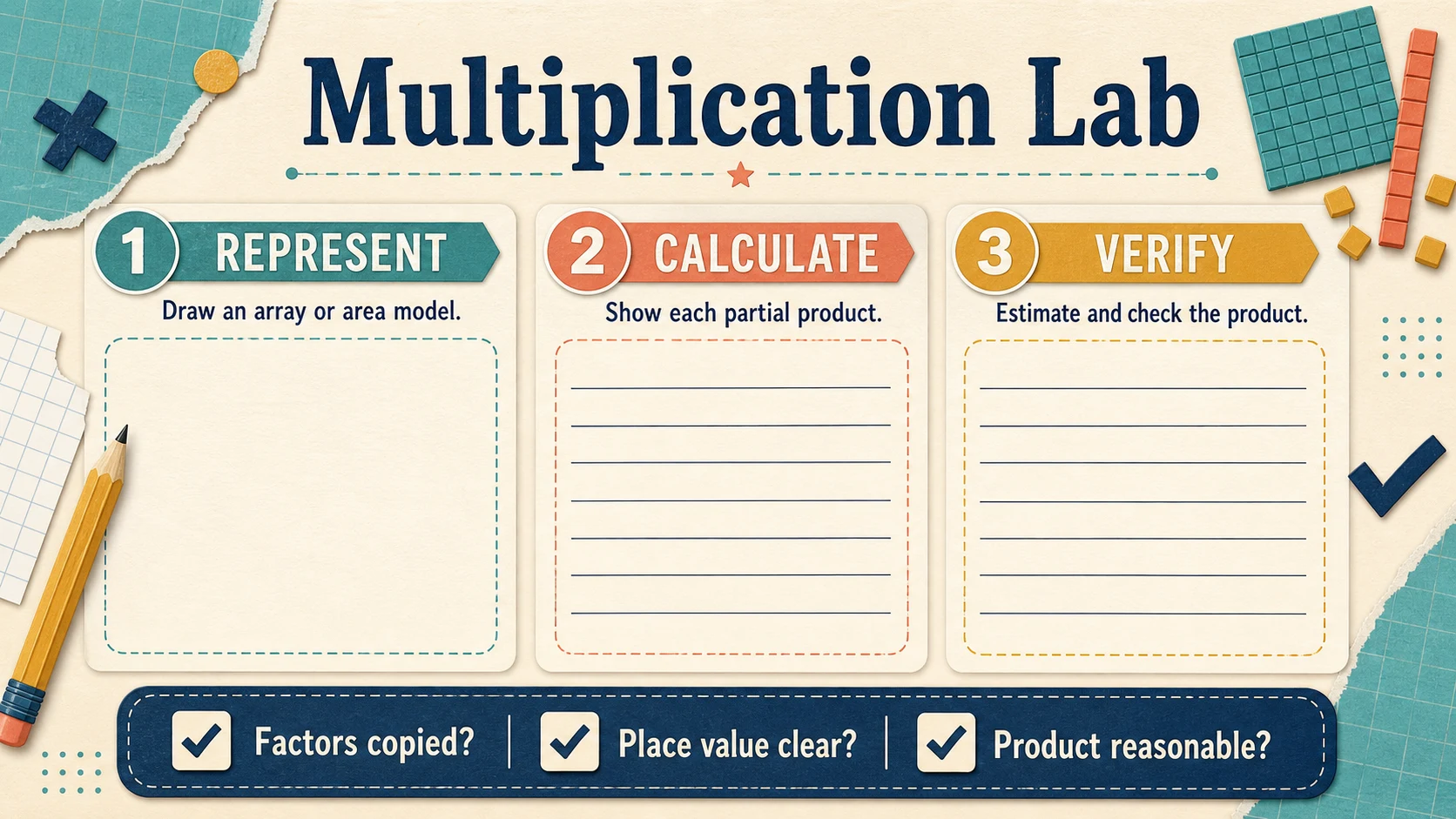
Use each day’s evidence to retain, repeat, or adjust the following day’s task.
| Day |
Focus |
Suggested work |
Checkpoint |
| 1 |
Diagnose |
Facts, equal groups, place value, one multi-digit problem |
Note strategies and recurring errors |
| 2 |
Fact connections |
Derive ×6, ×7, ×8, or ×9 facts from known facts |
Explain two derivations |
| 3 |
Powers of ten |
Compare 23×4, 230×4, 23×40 |
Explain the value of each product |
| 4 |
One-digit multiplier |
Base-ten or expanded-form examples |
Complete every partial product |
| 5 |
Compact recording |
Connect expanded form to the algorithm |
Check one product by estimation |
| 6 |
Review |
Mixed facts and one-digit multipliers |
Revisit the Day 1 error pattern |
| 7 |
Two-digit multiplier |
Area models and four partial products |
Label every region |
| 8 |
Partial products |
Move from area model to written rows |
Explain why the tens row has its value |
| 9 |
Boundary cases |
Multipliers with zero; zeros inside larger numbers |
Use an estimate to reject one false answer |
| 10 |
Application |
Word problems and a short cumulative check |
Choose the operation and state units |
| 11 |
Targeted repair |
Practice only the weakest observed component |
Compare with earlier work |
| 12 |
Independent set |
Short mixed set without immediate prompting |
Record accuracy and method selection |
| 13 |
Broader connection |
Decimal or fraction model if locally appropriate; otherwise deeper whole-number work |
Explain expected magnitude |
| 14 |
Review and next decision |
Repeat a five-item monitoring sample |
Decide whether to advance, consolidate, or reteach |
Keep daily fact review brief after strategies are understood. If the learner’s accuracy deteriorates, stop expanding the set and examine the work. More repetitions of an unstable method can reinforce the wrong pattern.
Scope, Limitations, and the Next Useful Step
Multiplication includes more than completing fact sheets or reproducing an algorithm. This guide addresses interpretation, fact strategies, whole-number computation, representations, estimation, application, and selected fifth-grade extensions. It does not establish comprehensive alignment with every state or local curriculum, guarantee a learning outcome, or determine an individual learner’s needs from a score alone.
A downloadable worksheet also has limits. An answer key confirms final answers, but it may not reveal whether an error came from a fact, place-value misunderstanding, missing partial product, regrouping slip, or misread context. Review the written work and ask for a brief explanation before choosing more practice.
The honest next step is to collect a small, representative sample. Start with selected problems from the free 5th Grade Multiplication worksheet, ask the learner to show and explain the work, and classify any errors using the diagnostic table above. Then use the free worksheet generators or the focused topic materials to choose practice for the specific skill the sample reveals—not merely another page at the same label.