5th Grade · 9 live skills
5th Grade math worksheets
Pick the exact skill below. Each page combines a real free download, a separate answer key, practical teaching guidance and an optional focused pack.
See all 5th Grade subjects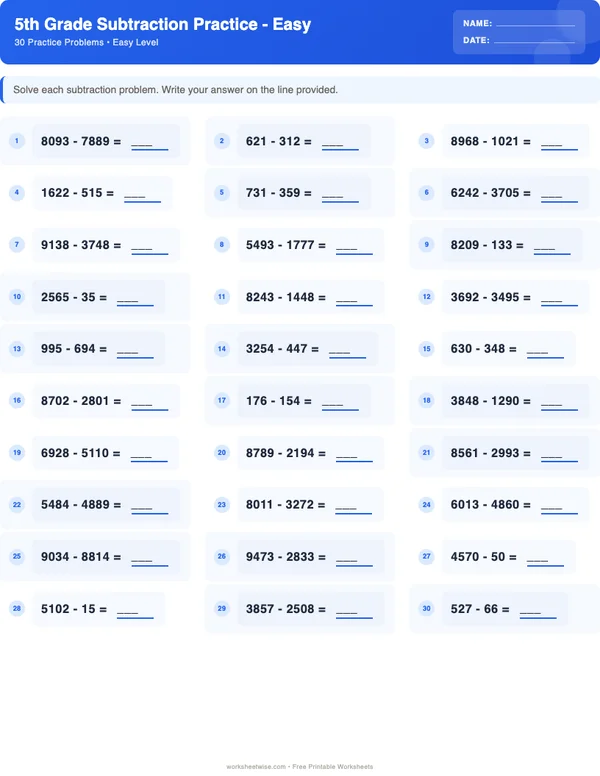
Complete guide
How to teach and practise 5th grade math worksheets
3,325 words Updated 6 instructional visuals
Choose one narrow skill before printing
The useful starting point is not “fifth-grade math” as a whole. It is one bounded task that reveals what the learner understands—for example, comparing decimals to thousandths, multiplying a two-digit number by a two-digit number, or adding two fractions with unlike denominators.
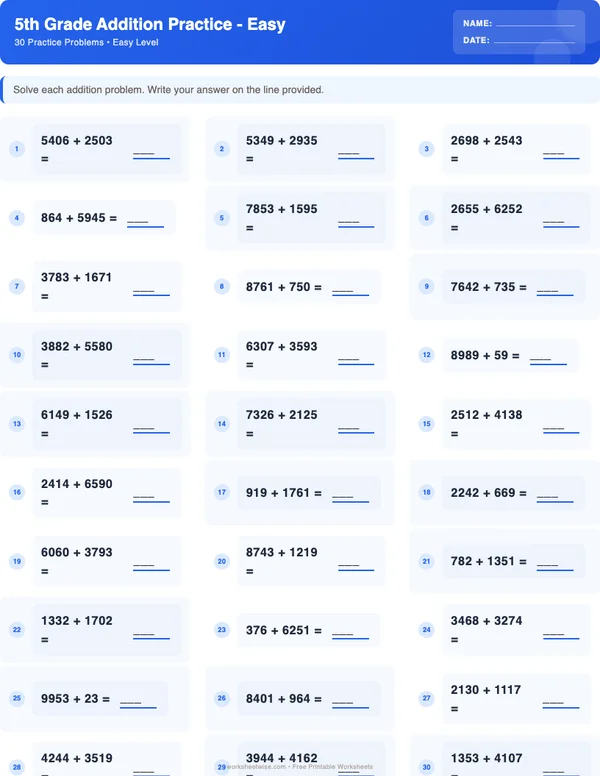
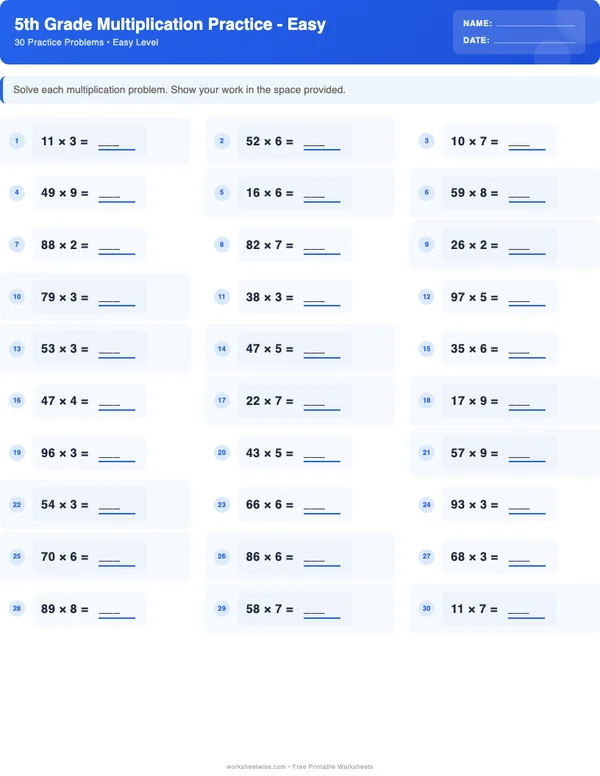
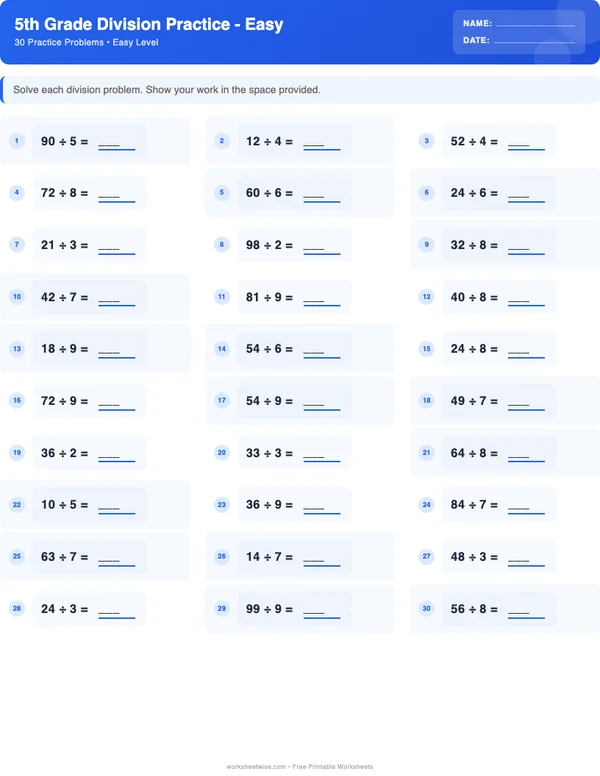
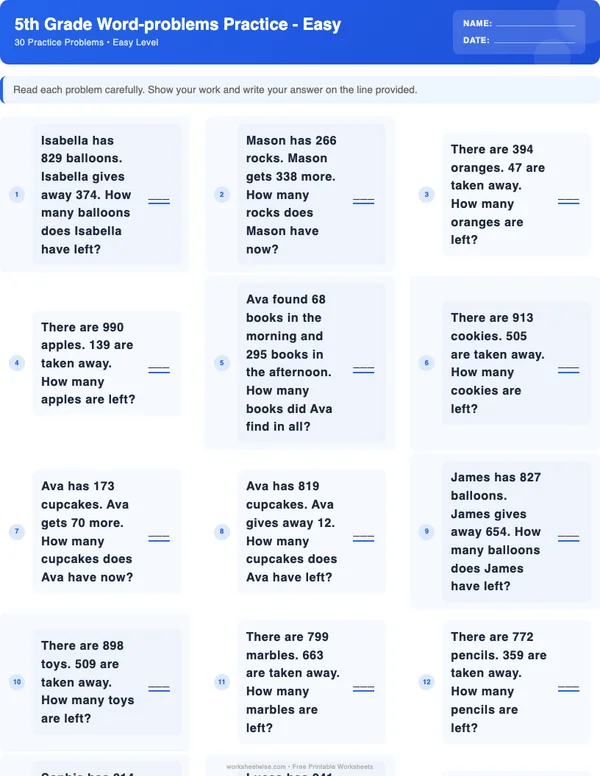
The live catalogue contains 162 fifth-grade math worksheet variants across nine topics: addition, subtraction, multiplication, division, fractions, decimals, place value, geometry, and word problems. Each topic has a free entry point. Eight free sheets contain 30 problems, while fractions contains 22 and word problems contains 16. Those counts matter: a 30-problem sheet can supply selected practice, but it need not become a 30-problem sitting.
Start with evidence already available. Look at the learner’s most recent work and ask:
- Was the operation chosen correctly?
- Was the representation—number line, area model, equation, or diagram—appropriate?
- Did place value remain intact?
- Was the answer reasonable before exact calculation?
- Can the learner explain one step without reciting a rule?
Then choose the topic that addresses the earliest unstable decision. If a learner computes 0.36 + 0.4 incorrectly because digits are aligned from the right rather than by place, the next task is decimal place value, not generic addition. If 3/4 + 2/5 = 5/9, the issue is fraction equivalence, not weak whole-number facts.
Grade labels describe intended practice level; local curriculum sequences differ. A fifth-grade label is therefore a discovery aid, not proof that every fifth grader has already received the prerequisite instruction. It is not a diagnosis or a promise of progress.
Read the nine skills as a connected progression
The nine catalogue topics overlap, but they are not interchangeable. Place value organizes the number system. Addition and subtraction combine or compare quantities. Multiplication and division work with equal groups, scaling, arrays, and quotients. Fractions and decimals extend number beyond whole numbers. Geometry applies multiplication and spatial reasoning to attributes such as area and volume. Word problems test whether the learner can identify and represent quantitative relationships.
The Common Core Grade 5 overview places particular emphasis on fraction operations, multi-digit and decimal operations, division with two-digit divisors, and volume. That external framework describes intended grade-level learning; it did not evaluate WorksheetWise. It also helps explain why a catalogue that includes addition and subtraction is not merely repeating earlier grades: those operations remain embedded in decimal work, fraction work, measurement, and multi-step reasoning.
Place value before procedures
The place-value catalogue progresses through composing and decomposing numbers, standard and expanded form, comparison, ordering, rounding, and decimal place value. At this level, observable readiness means more than naming digits. A learner should be able to explain that the 6 in 6.24 is ten times the value of the 6 in 0.624, or that 4.070 and 4.07 name the same number.
Use the 5th Grade Decimals guide and free sheet when the learner can identify decimal places but needs practice comparing, rounding, converting, or calculating. Step back to place-value work when the learner treats a decimal as two whole numbers separated by a dot, aligns digits without regard to units, or assumes more digits always means a greater value.
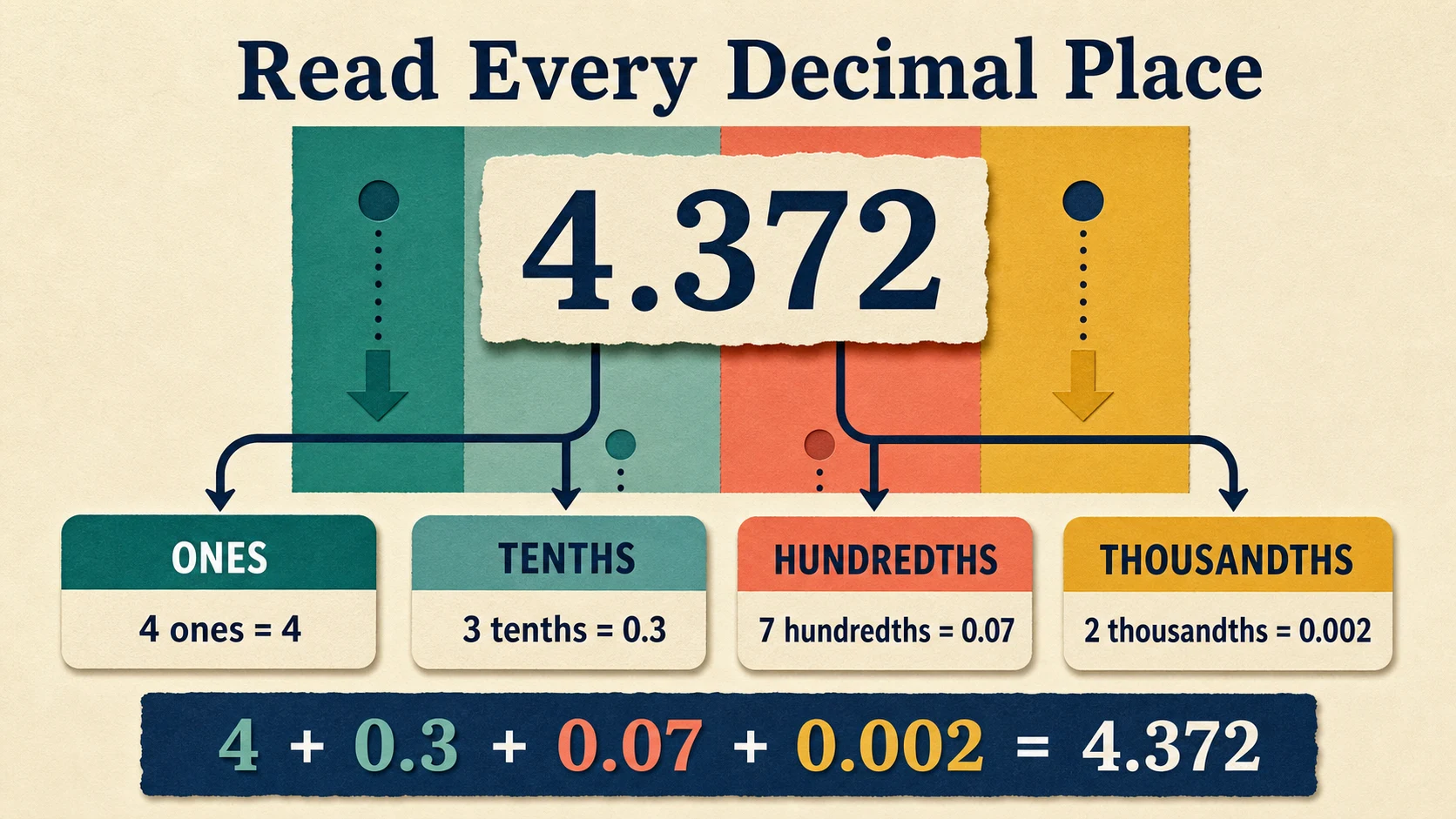
Decimal work branches from base-ten place value into representation, comparison, rounding, and operations; a wrong comparison should be addressed before a page of decimal computation.
Addition and subtraction as inverse operations
The live addition and subtraction sheets each offer 30 problems. Their wider progressions run from concrete models through multi-digit and later decimal or fraction applications. In fifth-grade selection, distinguish calculation trouble from place-value trouble.
For 50,003 − 27,856, a learner who writes the correct subtraction but mishandles regrouping needs a carefully modeled subtraction task. A learner who reads 50,003 as “fifty thousand three hundred” needs place-value work first. A learner who solves accurately but cannot decide whether a comparison story calls for subtraction needs word-problem work.
The catalogue guidance suggests connecting subtraction to addition and using physical trading to make regrouping meaningful. That is a WorksheetWise teaching suggestion, not a claim that one model will work for every learner. The 5th Grade Addition guide and free sheet is a sensible entry when addition itself is the bounded target.
Multiplication and division as related structures
Multiplication develops from equal groups and arrays into partial products and algorithms. Division develops through equal sharing, measurement or grouping, fact families, partial quotients, and written division. Keep the relationship visible: a quotient can be checked with multiplication, while a product can be decomposed with the distributive property.
The IES elementary mathematics intervention guide recommends systematic instruction, precise mathematical language, selected concrete and visual representations, number lines, deliberate word-problem instruction, and timed activities as one possible fluency tool. These are sourced recommendations for instruction in elementary grades, not findings about these worksheets.
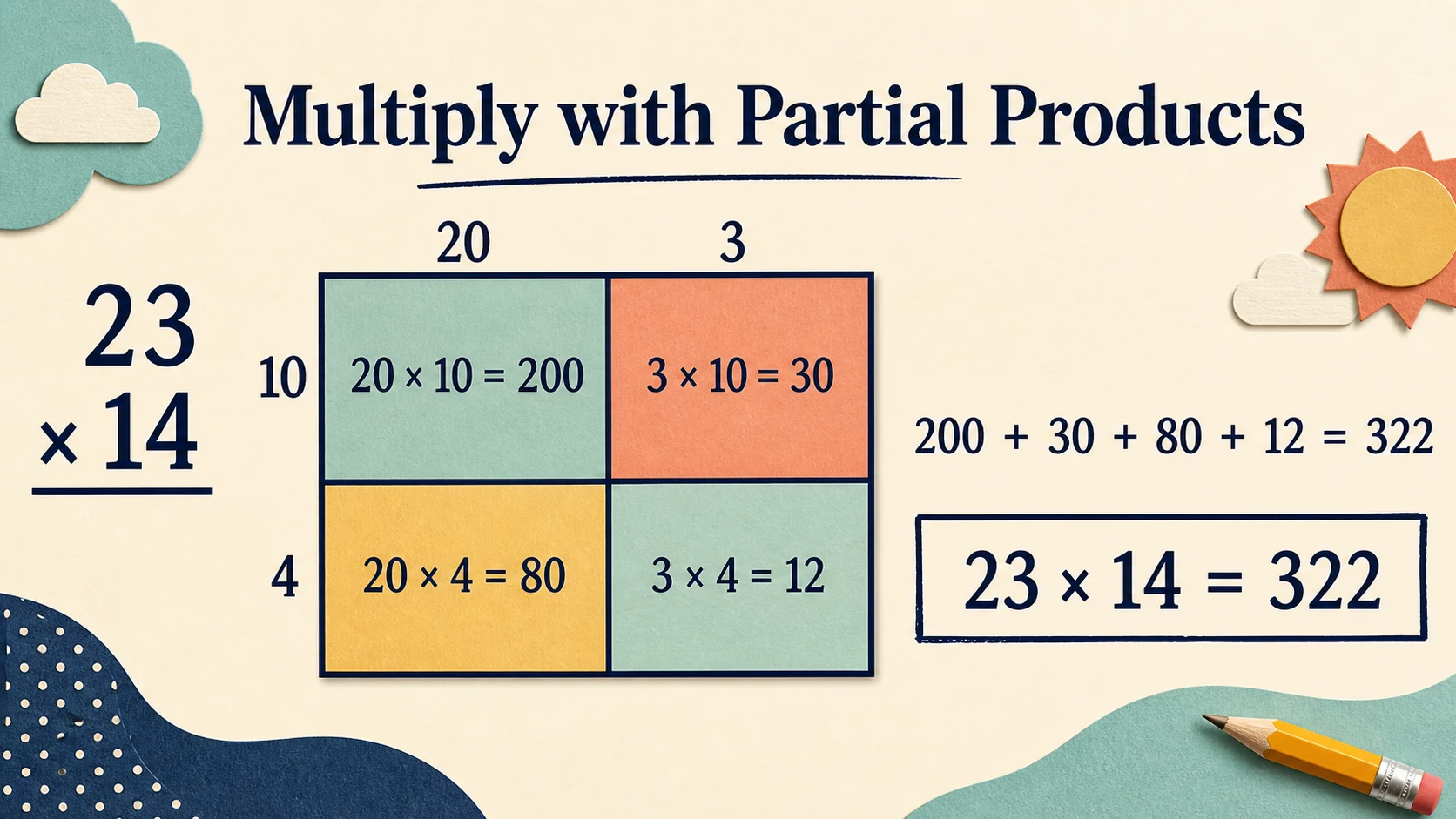
An array or area model can expose partial products before the learner is asked to compress the reasoning into a standard written procedure.
Fractions and decimals need different comparisons
Both topics represent quantities smaller than one, but their error patterns differ. Fraction comparison depends on the same whole, numerator–denominator relationships, benchmarks, and equivalence. Decimal comparison depends on base-ten positions and equivalent forms such as 0.4 = 0.40.
Do not move from an error in one system directly to mixed fraction–decimal conversion unless the prerequisite representation is secure. A learner who thinks 1/8 > 1/4 needs equal-whole fraction models or a number line. A learner who thinks 0.36 > 0.4 needs tenths and hundredths represented on the same grid or chart.
Geometry and word problems apply, rather than merely repeat
The geometry catalogue includes shape properties, angles, coordinate geometry, area, perimeter, and volume. These tasks may reveal arithmetic errors, but the central target can still be geometric. Confusing square units and linear units is different from making a multiplication slip.
Word problems span all nine topics. They require the learner to interpret a situation, identify relevant quantities, represent their relationship, calculate, and check the result. A word-problem sheet is not the best first choice when the underlying computation is entirely unfamiliar. It is useful when the learner can calculate in isolation but chooses operations by keywords or cannot explain what a remainder means.
Define worksheet difficulty by what the task demands
The free catalogue sheets are labeled “easy,” but that word describes an entry-point task, not a learner. Define its practical meaning through observable features:
- The page isolates one named topic.
- The problem format is relatively consistent.
- Directions and notation do not introduce many simultaneous decisions.
- The learner can begin after a short model or reminder.
- Most effort can go toward the target calculation or representation rather than decoding a novel format.
A task becomes more demanding when it introduces larger numbers, unfamiliar representations, multiple operations, unlike denominators, decimal placement decisions, irrelevant information, an unknown in a less familiar position, or an explanation requirement. Difficulty also changes with support. The same problem may be manageable with a place-value chart and much harder without it.
Do not infer that a 30-problem “easy” sheet should be completed quickly or independently. Sample six to ten items distributed across the page. Stop once the work provides a stable pattern. More repetitions of the same misconception rarely clarify the misconception.
Check representative examples before assigning more work
Fully working a few examples helps an adult distinguish a conceptual error from a copying or calculation slip. Each example below belongs here because it tests a relationship represented in the live fifth-grade catalogue.
Example 1: Compare decimals by place value
Decide whether 0.405 is greater than, less than, or equal to 0.45.
Write both to thousandths:
0.405 = 405/10000.450 = 450/1000
Because 405 < 450, the checked comparison is:
0.405 < 0.450, so 0.405 < 0.45.
A learner may say 0.405 > 0.45 because 405 is greater than 45. That treats the digits after the decimal as whole numbers and ignores place. Ask the learner to compare the tenths first: both have 4 tenths. At the hundredths place, the first has 0 hundredths while the second has 5 hundredths, so the decision is already made.
This belongs in fifth-grade decimal and place-value practice because the grade-level framework includes reading, writing, comparing, and rounding decimals to thousandths, along with decimal operations to hundredths. Use a thousandths chart for the comparison target; do not turn the moment into a long lesson on addition.
Example 2: Multiply with partial products
Calculate 34 × 27.
Decompose 27 into 20 + 7:
34 × 27 = 34 × (20 + 7)
34 × 20 = 680
34 × 7 = 238
680 + 238 = 918
Check with a different decomposition:
27 × 30 = 810
27 × 4 = 108
810 + 108 = 918
The answer is 918. An estimate also supports it: 34 × 27 is close to 30 × 30 = 900.
If the learner writes 68 + 238 = 306, the missing zero is not best described as carelessness. Ask what 34 × 20 means: twenty groups of 34, or two groups of 34 tens. If the learner gets both partial products right but adds them incorrectly, switch the immediate target to addition rather than assigning more multiplication models.
This example belongs because the catalogue’s multiplication progression explicitly moves through arrays, area models, partial products, and multi-digit computation.
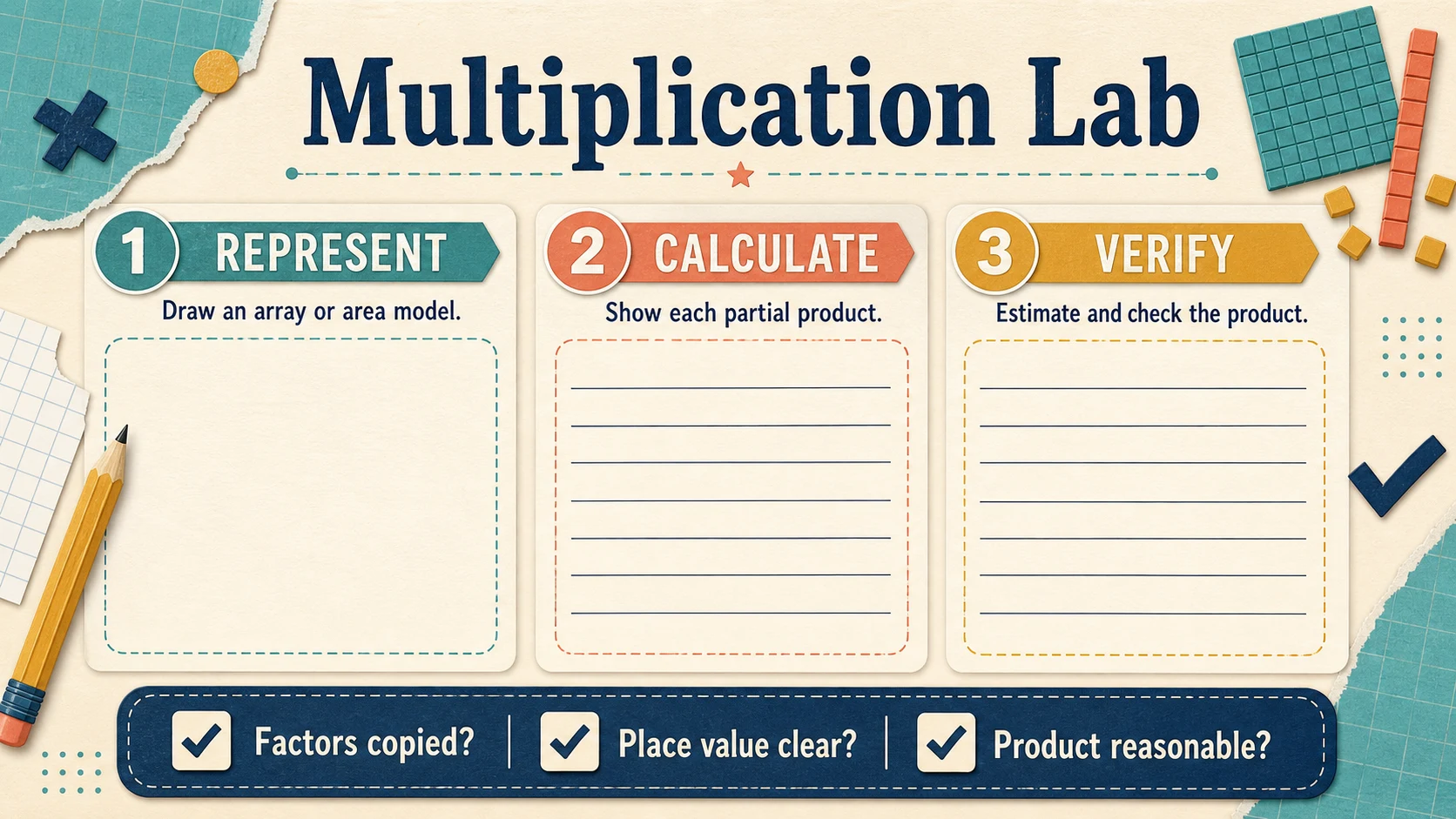
Short multiplication sessions should revisit the same distributive structure after a gap, while separating model errors from addition errors.
Example 3: Add unlike fractions and estimate
Calculate 3/4 + 2/5.
The least common denominator of 4 and 5 is 20:
3/4 = 15/20
2/5 = 8/20
Therefore:
3/4 + 2/5 = 15/20 + 8/20 = 23/20 = 1 3/20
Check reasonableness: 3/4 is 0.75 and 2/5 is 0.4, so the sum is 1.15, which equals 1 3/20.
The common answer 5/9 results from adding both numerators and denominators. Ask the learner to estimate before correcting the procedure: 3/4 alone is greater than 5/9, so 5/9 cannot be the sum of two positive fractions. Then use fraction bars or a number line to establish equivalent parts.
This belongs because grade-five fraction work includes adding and subtracting fractions with unlike denominators and judging reasonableness with benchmarks. The Common Core fraction standards explicitly connect equivalent fractions, visual models, equations, and estimation. That source establishes a grade-level target; it does not certify this particular sheet. The 5th Grade Fractions guide and free sheet offers the catalogue’s 22-problem entry point.
Example 4: Interpret a division remainder
A class has 157 notebooks. The notebooks are packed equally into boxes holding 12. How many full boxes can be packed, and how many notebooks remain?
Use partial quotients:
12 × 10 = 120
157 − 120 = 37
12 × 3 = 36
37 − 36 = 1
So:
157 ÷ 12 = 13 remainder 1
Check:
12 × 13 + 1 = 156 + 1 = 157
The answer is 13 full boxes with 1 notebook remaining. If the question instead asked how many boxes were needed to transport every notebook, the contextual answer would be 14 boxes. The calculation is unchanged; the interpretation changes.
This belongs because the division catalogue includes multi-digit dividends, division facts, and contextual remainder decisions. An answer of “13 R1 boxes” is mathematically incomplete if the situation asks for a count of boxes needed.
Example 5: Separate volume from surface measures
A rectangular prism is 6 inches long, 4 inches wide, and 3 inches high. Find its volume.
First find the base area:
6 × 4 = 24 square inches
There are 3 layers of that base:
24 × 3 = 72 cubic inches
Therefore:
V = 6 × 4 × 3 = 72 cubic inches
Check by associating differently:
6 × (4 × 3) = 6 × 12 = 72
If the learner answers 72 square inches, the multiplication is correct but the unit is not. Ask what is being counted. Area counts unit squares covering a surface; volume counts unit cubes filling space. This example belongs because fifth-grade geometry includes volume, and the grade-five measurement standards connect unit cubes, rectangular prisms, multiplication, and addition.
Use a routine that produces evidence, not exhaustion
A useful session can take 15–20 minutes. Keep its structure stable while changing the mathematical target.
Launch with one retrieval item
Begin with one previously learned item that supports today’s task. Before decimal addition, ask the learner to identify the value of each digit in 3.47. Before fraction addition, ask for an equivalent fraction to 2/3. This is a check, not a trap. If the prerequisite is missing, change the session rather than pushing through the planned page.
Model one problem and name the decision
Work one example while saying why each step is valid: “I align 0.6 and 0.27 by ones, tenths, and hundredths, not by the last digit.” Then ask the learner to explain the same decision in their own words. Precise language matters more than a memorized slogan.
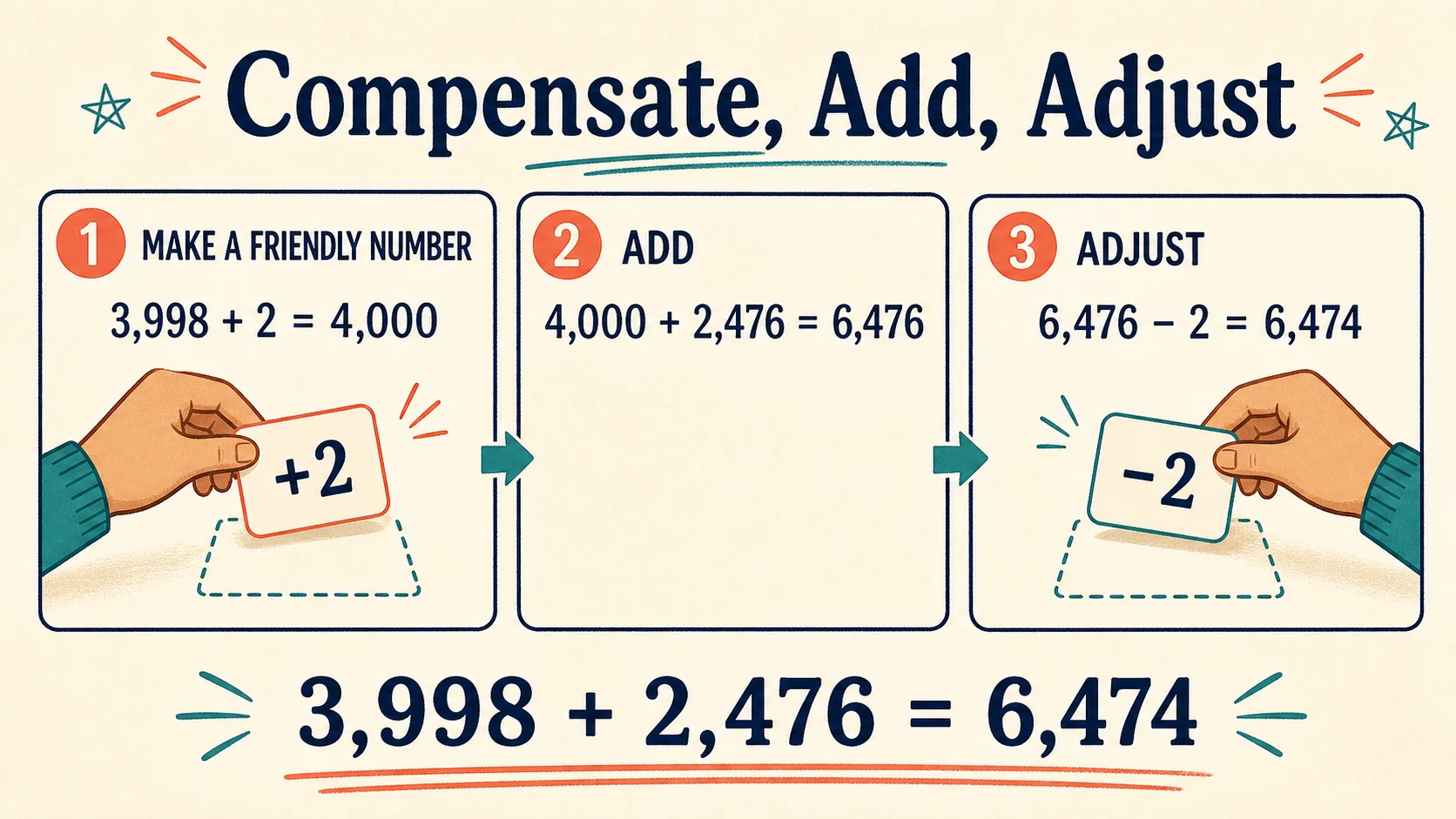
For fifth-grade addition, the repeatable core is prerequisite check, one explained model, a small independent sample, and a decision from the resulting work.
Assign a small, distributed sample
Choose six to ten problems rather than automatically assigning the full page. Include an early item, several middle items, and at least one later item so that the sample reflects any progression in the sheet. Ask for a written estimate or representation on two problems, not every problem.
Review by error type
Mark correct answers, but discuss the first informative error. Ask:
- What was the problem asking?
- What did you represent?
- Which step changed the value?
- How can you check without repeating the identical procedure?
Use the answer key to verify work quickly, not as the whole lesson. An answer key can confirm a result; it cannot reveal why the learner chose a method.
Record one next decision
Write a brief observation such as: “Compared tenths correctly on 5 of 6 items; treated trailing zero as changing value once.” The next session can then target equivalent decimal notation instead of repeating the entire decimals category.
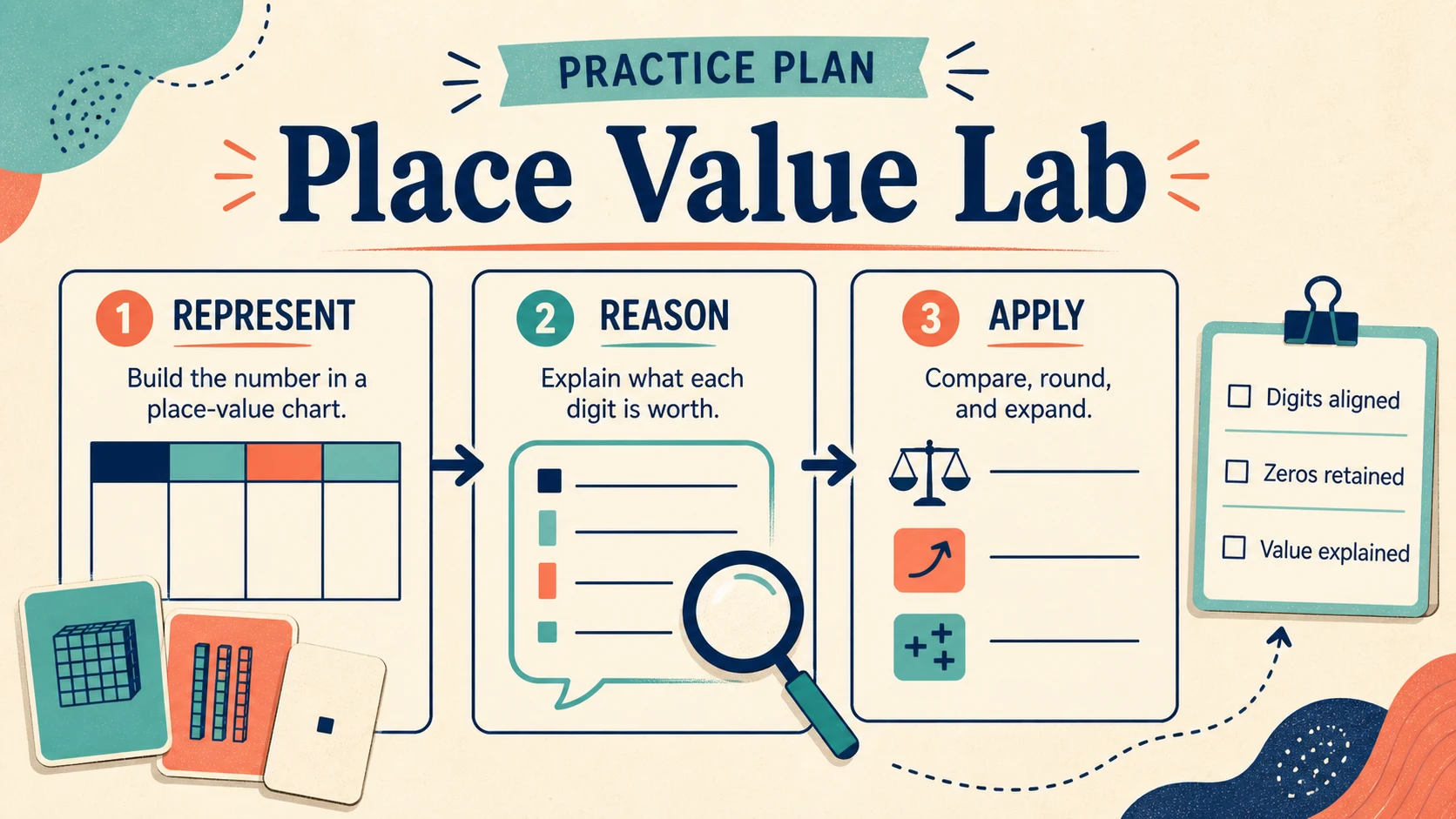
Across two weeks, alternate new place-value decisions with brief checks of earlier ones; do not use daily page completion as the progress measure.
Interpret errors without assigning labels
A wrong answer is evidence about a particular task under particular conditions. Look for patterns across several items before changing course.
- Correct setup, isolated arithmetic slip: Ask for an inverse-operation or estimation check. Keep the same target, but reduce the number of items.
- Repeated place-value misalignment: Return to a chart, expanded form, or base-ten representation. Preserve the same numbers if possible.
- Correct computation, wrong operation in stories: Have the learner retell the situation and draw a tape diagram before calculating.
- Procedure recalled but explanation absent: Compare one worked and one nonworked example. Ask why the method preserves value.
- Accurate answer with an unreasonable unit: Revisit what is counted—objects, groups, square units, or cubic units.
- Slow but accurate work: Do not automatically lower the mathematical target. Reduce copying, provide space, and observe whether retrieval or representation causes the delay.
- Several unrelated errors late on the page: Consider fatigue or volume before concluding that multiple concepts are insecure.
The IES intervention guide supports systematic instruction and carefully chosen representations, but it does not justify diagnosing a learning condition from worksheet performance. Persistent concerns across settings should be shared with the learner’s teacher or an appropriately qualified professional, along with actual work samples rather than labels.
Adapt the page while preserving the mathematics
An adaptation should remove an irrelevant obstacle without quietly replacing the target.
For decimal comparison, permit a place-value chart or zeros added to equivalent forms. Do not replace decimals with whole numbers if decimal magnitude is the target. For multiplication, allow graph paper to keep partial products aligned. Do not provide the products if retrieving or deriving them is what is being assessed. For fraction addition, offer fraction strips or a number line while retaining unlike denominators.
Other useful adjustments include:
- Read directions aloud when reading load is not the target.
- Cover unused rows so the learner sees four problems at a time.
- Enlarge the page or provide separate workspace.
- Let the learner dictate an explanation while the adult records it.
- Split ten selected problems across two sittings.
- Use counters, base-ten blocks, fraction strips, or unit cubes before returning to symbols.
- Remove timing unless fluency under time is explicitly being observed.
- Allow a calculator only when computation is incidental to another target, such as analyzing a geometric relationship.
Preserving the target also means resisting accidental escalation. A learner practicing two-digit multiplication does not need a dense multi-step story at the same time. Conversely, a learner practicing problem representation should not be blocked by burdensome numbers that obscure the story structure.
Plan review from the learner’s work
A two-week plan should revisit a target after a delay and mix it with prerequisite or application tasks. It should not be fourteen consecutive pages.
For example, a bounded decimal sequence might be:
- Day 1: compare six decimals using a place-value chart.
- Day 2: write four decimals in expanded form.
- Day 4: compare six decimals without the chart, explaining two.
- Day 6: round four decimals and locate each between benchmarks.
- Day 8: add four decimal pairs after estimating.
- Day 10: solve two decimal word problems and review the original comparison error.
Advance when the learner repeatedly chooses a sound representation, calculates accurately, and checks reasonableness across more than one session. If accuracy disappears as soon as the model is removed, fade support more gradually. If the learner succeeds on isolated calculations but not stories, keep the computation stable and vary only the context.
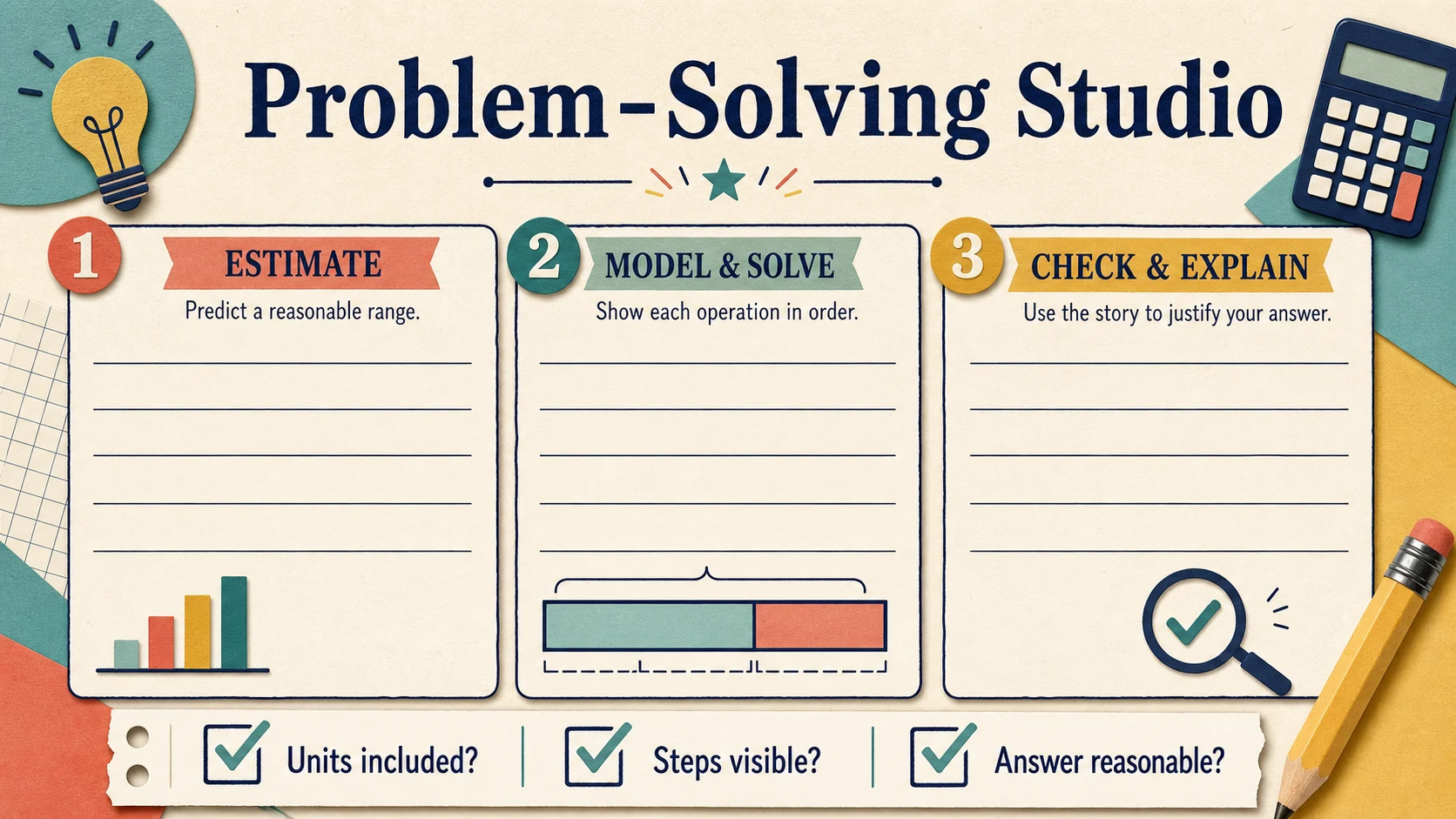
Word-problem review should vary the position of the unknown and the meaning of the remainder while keeping the underlying computation within reach.
Know what a worksheet cannot establish
A worksheet can provide practice and a useful work sample. It cannot by itself establish curriculum mastery, explain motivation, diagnose a disability, or show how a learner reasons during discussion. A correct page may reflect genuine understanding, remembered procedures, substantial prompting, or copied patterns. An incorrect page may reflect a misconception, unclear directions, fatigue, language load, cramped workspace, or unfamiliar notation.
The Common Core standards describe what students should know and be able to do, including explaining reasoning as well as producing answers. They do not prescribe a single local sequence, and they do not assess WorksheetWise materials. Likewise, the IES early-mathematics guide recommends developmental progressions and monitoring what children know, but its stated audience and evidence concern preschool through kindergarten. Its broad progression principle can inform adult judgment here; it should not be presented as fifth-grade evidence.
Use worksheet results alongside conversation, classroom information, prior work, and observation. If the learner has not been taught the relevant content, treat the page as a preview or discovery task—not a failed test.
Make the next selection observable
Choose one topic and one behavior you can see. A strong starting statement is: “Today I want to see whether the learner compares decimals by tenths, then hundredths, rather than by the number of digits.”
Open the 5th Grade Decimals guide and free sheet, select six comparison items, permit a place-value chart, and ask for an explanation on two. Record which place determined each comparison. If that decision is stable, the next task can be decimal rounding or computation. If it is not, keep the quantities and return to a hundredths or thousandths representation before printing another full worksheet.
Put it into practice
Use the guide with a real printable
Move from explanation to a short, observable practice task. Check the first item together, then adjust the next session from the learner's actual work.
Open the first free worksheet