5th Grade · 3 live skills
5th Grade grammar worksheets
Pick the exact skill below. Each page combines a real free download, a separate answer key, practical teaching guidance and an optional focused pack.
See all 5th Grade subjects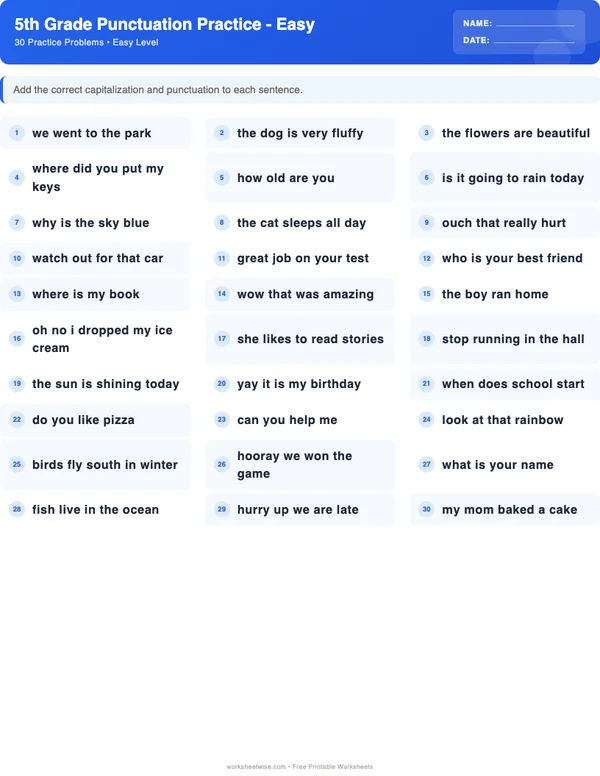
Complete guide
How to teach and practise 5th grade grammar worksheets
3,220 words Updated 6 instructional visuals
Choose one grammar decision, not “more grammar”
The live fifth-grade grammar catalogue contains 54 worksheet variants across three distinct topics: Parts of Speech, Punctuation, and Sentence Structure. Each topic has one free entry sheet, for three free resources in total. The most useful starting point is not necessarily the first sheet in a sequence. It is the sheet that tests one decision the learner is ready to make:
- Choose Parts of Speech when the learner needs to explain what a word is doing in a particular sentence.
- Choose Punctuation when the sentence’s meaning is clear but its marks are missing, confused, or inconsistently applied.
- Choose Sentence Structure when the learner has trouble recognizing complete thoughts, repairing fragments or run-ons, or combining ideas clearly.
Keep the target narrow enough to observe. “Improve grammar” is not observable. “Distinguish a verb from a noun when the same word can serve either role” is. So is “place a comma before a coordinating conjunction joining two complete thoughts.”
Grade labels describe the intended practice level; local curriculum sequences differ. A fifth-grade label is a discovery aid, not a placement decision. Use the learner’s actual response—not age, confidence, speed, or the worksheet title—to decide what comes next. These materials can supply practice and evidence, but they cannot diagnose a learning condition or guarantee a writing outcome.
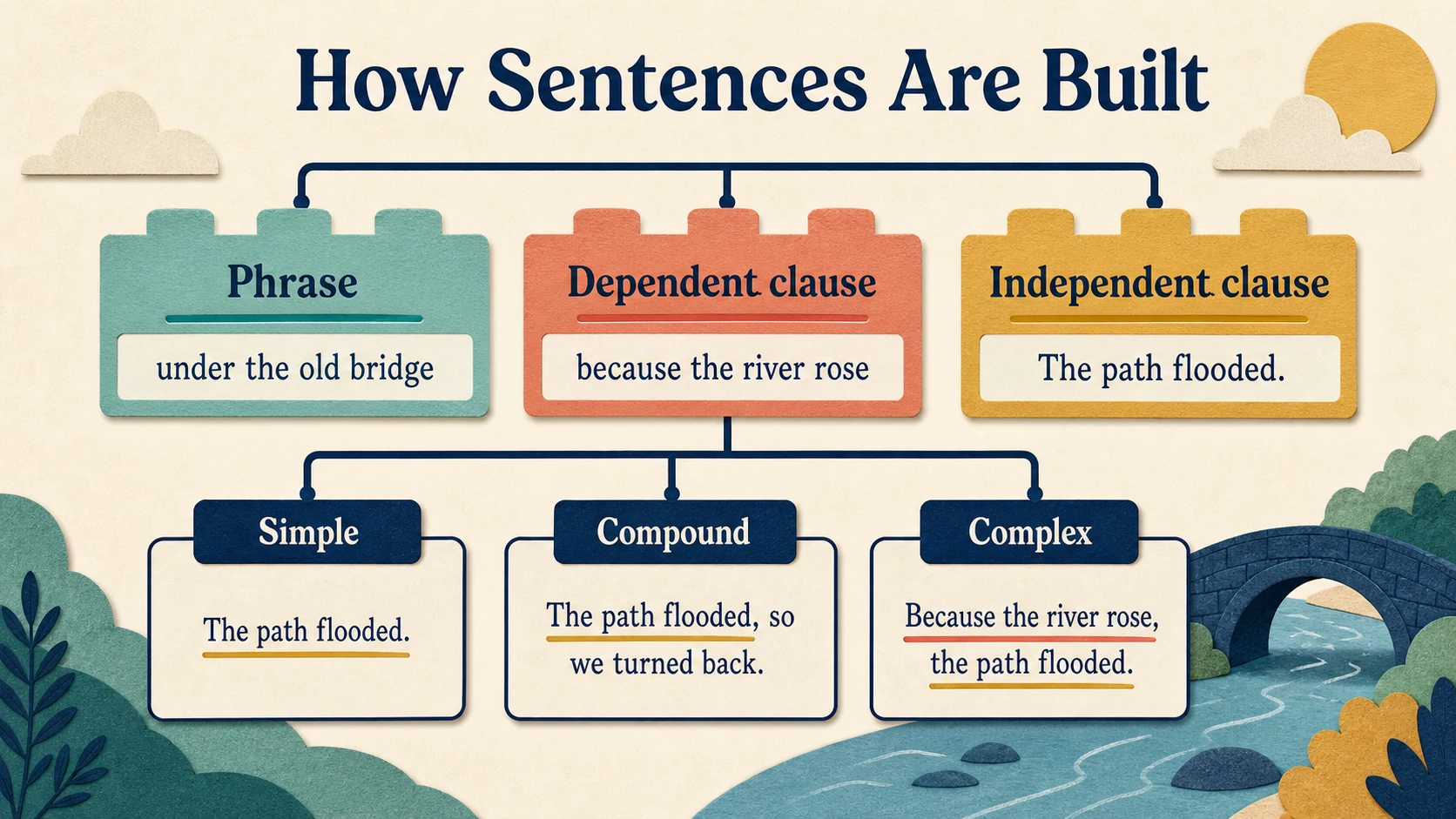
The three live paths meet at sentence-level writing, but each asks the learner to notice and control something different.
What changes by fifth grade
Earlier grammar work often centers on concrete distinctions: a noun names a person, place, thing, or idea; a verb shows action or links a subject to a description; a complete sentence needs a subject and predicate; an end mark closes a thought. Those foundations still matter in fifth grade, but the reasoning becomes more contextual.
A fifth grader may need to decide whether light is a noun, verb, or adjective based on its use. The learner may have to distinguish a comma in a series from a comma that separates an introductory element. Sentence work can move beyond identifying a subject and predicate toward repairing run-ons, joining related ideas, or varying sentence beginnings.
That progression is not a license to skip foundations. If a learner cannot locate the two complete thoughts in a compound sentence, rehearsing the comma rule alone will produce guessing. Return briefly to subjects and predicates, then reapply the punctuation rule. Conversely, a learner who can explain sentence boundaries does not need a long review of every sentence type before editing one comma pattern.
The Common Core ELA framework presents grade-specific expectations within a larger literacy structure spanning reading, writing, speaking, listening, and language. It also treats literacy as work that crosses subject areas. That makes grammar most useful when a learner applies it to meaningful sentences, not only isolated labels. The standards are a reference point, however; schools and local curricula may organize instruction differently. See the Common Core English Language Arts standards for the source framework. The catalogue identifies these worksheets as aligned with Common Core Language standards, but that description should not be read as an independent review of every local requirement.
Compare the three live skill paths
Parts of Speech: determine a word’s job
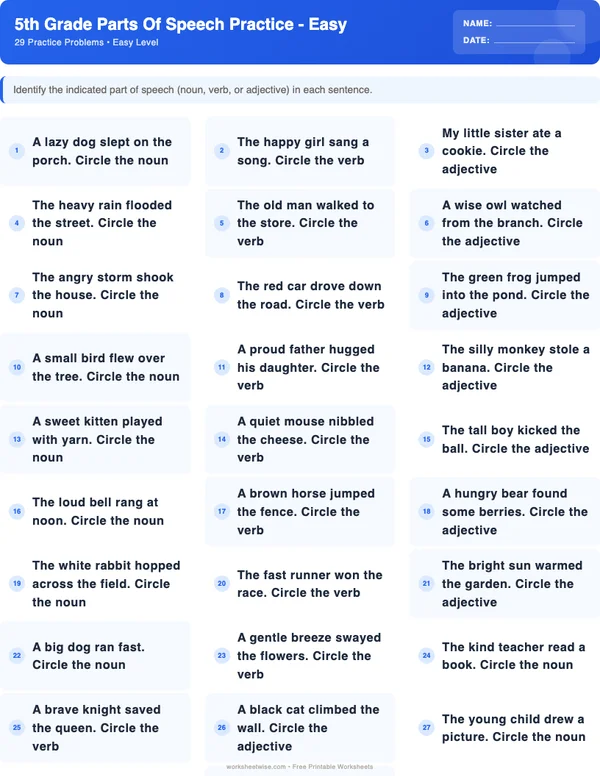
The 5th Grade Parts of Speech guide and free sheet contains 29 problems. Its stated progression runs from identifying nouns and verbs in simple sentences to classifying all eight parts of speech in more complex passages: nouns, verbs, adjectives, adverbs, pronouns, prepositions, conjunctions, and interjections.
This path is useful when a learner can read a sentence but cannot explain how its words relate. It also supports later work with pronoun antecedents and sentence revision. Identification should remain contextual because one spelling can perform different grammatical jobs.
Punctuation: represent a known relationship
The 5th Grade Punctuation guide and free sheet contains 30 problems. The catalogue covers end punctuation, commas in several constructions, apostrophes, quotation marks, colons, and semicolons. Activities may ask learners to identify missing marks, correct errors, or apply a rule in original writing.
This path is appropriate when the learner can say the intended sentence clearly but does not reliably show its structure on the page. Select one punctuation function at a time. Commas in lists, commas after introductory elements, and commas in compound sentences are not interchangeable uses of the same visual mark.
Sentence Structure: build and connect complete thoughts
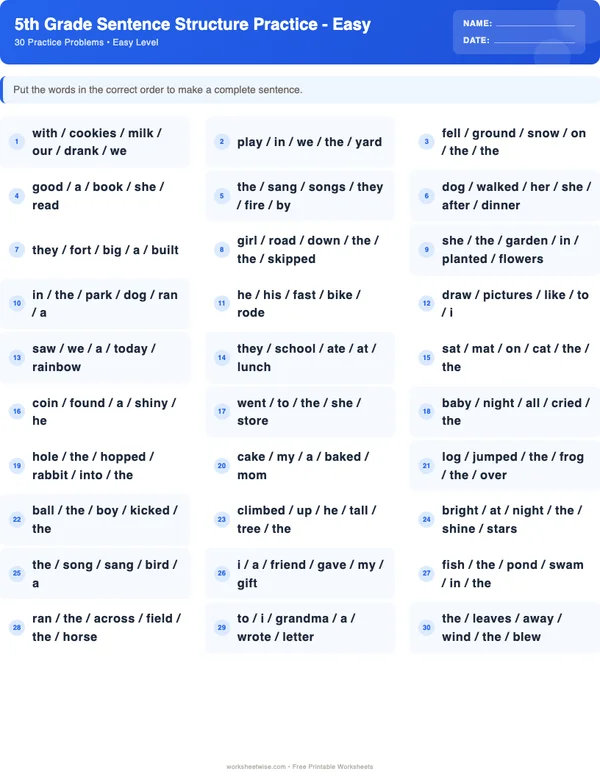
The 5th Grade Sentence Structure guide and free sheet also contains 30 problems. Its scope includes complete sentences, subjects and predicates, fragments, run-ons, sentence types, expansion, and combining. The later work involves coordinating and subordinating relationships, not merely making sentences longer.
Choose this path when the difficulty occurs before punctuation: the learner cannot tell where one complete thought ends, supplies a fragment as a sentence, or connects ideas without showing their relationship.
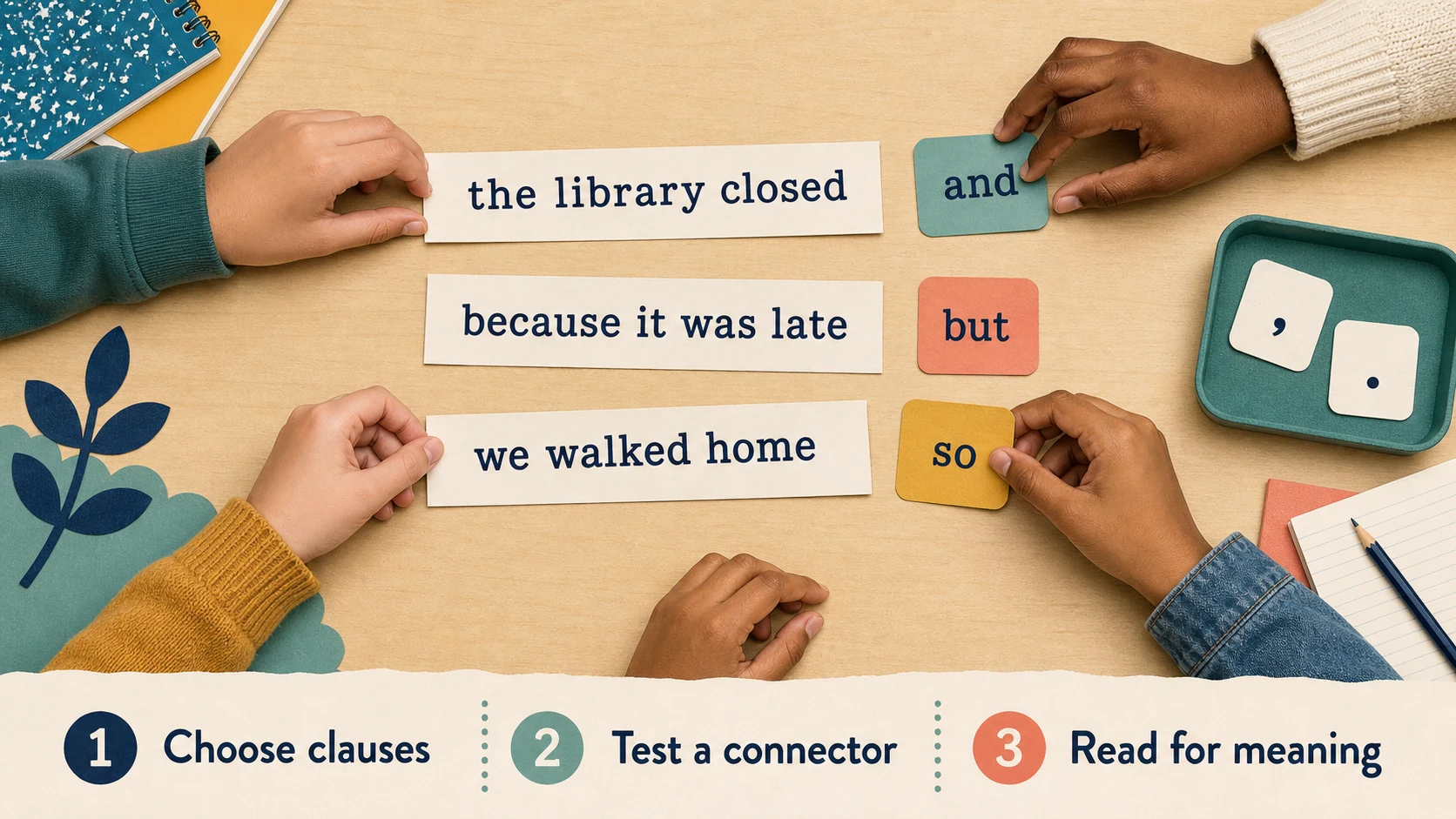
Sentence-structure practice should move from hearing complete thoughts to marking their parts and then revising one example independently.
Start from an observable task feature
All three free sheets are catalogued as “easy,” but that label describes entry-task features, not the learner. Here, treat the level as an accessible starting format: familiar fifth-grade content, a bounded direction, and responses that can be made one item at a time. Do not call a child “easy,” “developing,” or “advanced.”
Before selecting a full sheet, give three short probes without preteaching. Allow the learner to read them aloud.
- Word function: In “We light the candles,” what part of speech is light?
- Punctuation: Correct “After the concert we waited for Mia.”
- Structure: Is “Because the rain flooded the field” a complete sentence?
Use the reasoning, not only the score:
- If the learner says light is an adjective because light can describe something, begin with parts of speech in context.
- If the learner hears a pause after concert but cannot explain or mark the introductory element, begin with that single comma use.
- If the learner calls the third example complete because it has several words and a verb, begin with dependent fragments.
When all three are correct, ask for explanations and one original example. Correct answers produced by guessing do not yet show stable control. When all three are incorrect, start with sentence structure because complete-thought awareness will support the other two paths. This ordering is an editorial teaching suggestion derived from the task relationships; it is not a diagnostic rule.
Checked examples that expose fifth-grade reasoning
Example 1: one word, two grammatical roles
Consider these sentences:
- “We watch the meteor shower.”
- “My watch stopped at noon.”
In sentence 1, watch is a verb. The subject we performs the action watch. In sentence 2, watch is a noun: it names the object that stopped. The spelling does not determine the part of speech; the word’s job in the sentence does.
A common error is “Watch is always a verb because watching is an action.” That answer shows a remembered definition applied without checking context. Ask, “Who or what stopped?” The answer is “my watch,” which identifies the complete noun phrase as the subject.
This belongs in fifth-grade parts-of-speech work because the live topic explicitly moves toward classifying words in context and recognizes that words can serve different functions.
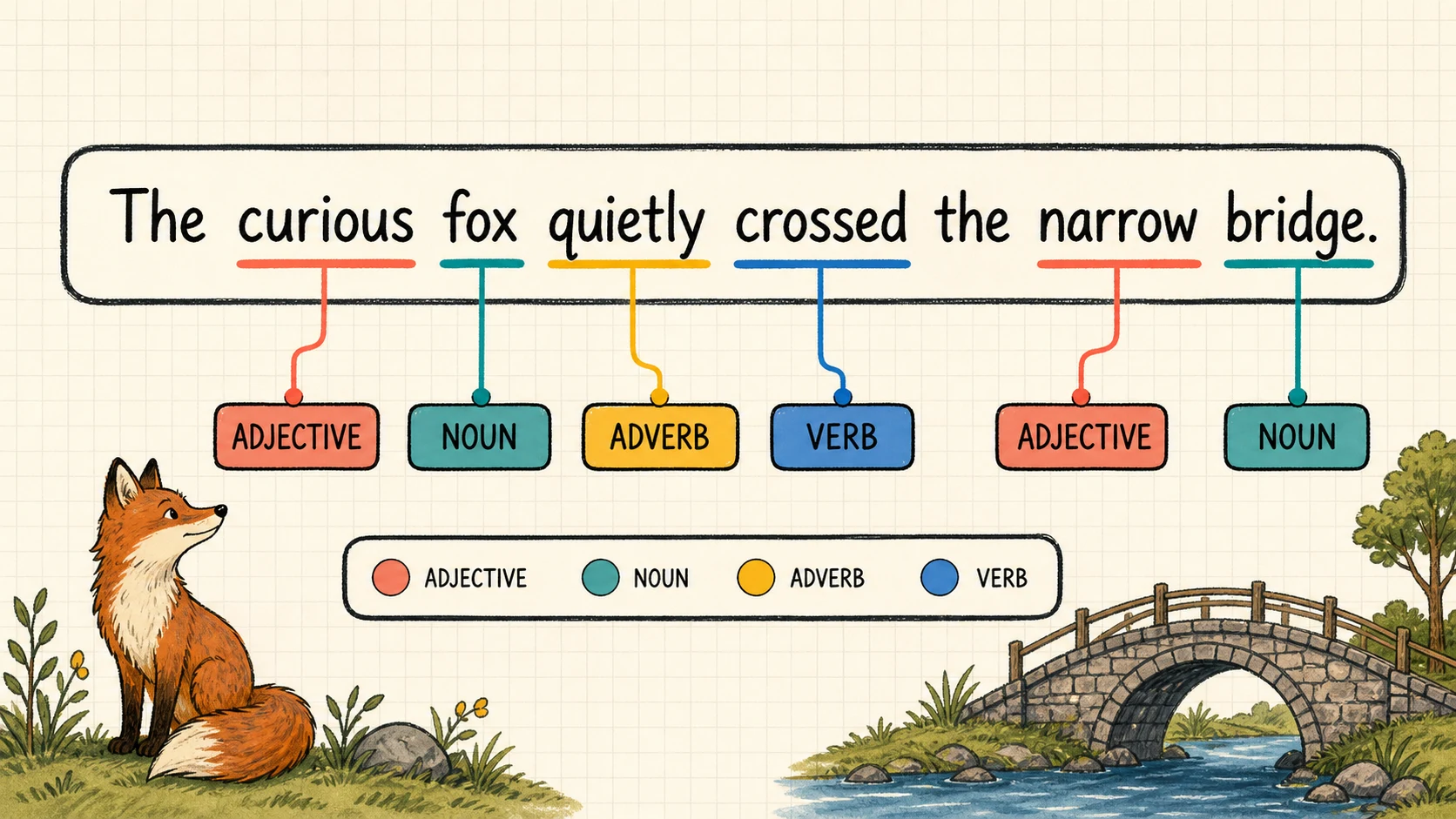
The decisive evidence is the word’s relationship to the rest of the sentence, not a memorized one-word definition.
Example 2: a comma after an introductory element
Unpunctuated version:
After the final rehearsal the choir walked onto the stage.
Checked version:
After the final rehearsal, the choir walked onto the stage.
“After the final rehearsal” introduces when the main action occurs. The comma marks the boundary before the independent clause “the choir walked onto the stage.” The correction is not justified merely by saying, “Put a comma where you pause.” Speech can help a learner hear a boundary, but the grammatical relationship supplies the reliable reason.
If the learner inserts “After, the final rehearsal…” the issue may not be general comma carelessness. The learner may be treating the first word as the whole introduction. Bracket the groups:
[After the final rehearsal], [the choir walked onto the stage].
This example belongs here because commas after introductory elements are named in the live punctuation description and teaching guidance.
Example 3: joining two complete thoughts
Starting sentences:
Nia revised the opening paragraph.
She added a clearer topic sentence.
Two correct combinations are:
Nia revised the opening paragraph, and she added a clearer topic sentence.
After revising the opening paragraph, Nia added a clearer topic sentence.
The first is compound: “Nia revised the opening paragraph” and “she added a clearer topic sentence” can each stand alone. A comma plus and joins them. The second recasts one action as an introductory phrase and avoids repeating the subject.
An unchecked answer such as “Nia revised the opening paragraph, she added a clearer topic sentence” creates a comma splice: a comma alone is being asked to join two independent clauses. Ask the learner to underline each complete thought. Once both can stand alone, the learner can choose a period, a semicolon where appropriate, or a comma with a coordinating conjunction.
This belongs in fifth-grade practice because it integrates the catalogue’s sentence-combining work with its compound-sentence punctuation work.
Example 4: distinguishing a fragment from a sentence
Test this group of words:
Because the robotics team needed another battery.
It contains a subject, “the robotics team,” and a predicate, “needed another battery,” but because makes the thought dependent. A reader expects the result or main action. One repair is:
Because the robotics team needed another battery, Maya visited the supply cabinet.
Another is:
The robotics team needed another battery.
Removing because makes the original clause independent. A learner who simply adds a period has changed the appearance, not the structure. Ask, “Because this happened—what happened next?” That prompt exposes the missing main thought.
This is fifth-grade sentence-structure work because the live path includes fragments and complex sentences. It is more demanding than checking whether a short sentence has a capital letter and period.
Example 5: apostrophe meaning, not decoration
Compare:
The dogs are waiting by the gate.
The dog’s leash is by the gate.
The dogs’ leashes are by the gate.
In the first sentence, dogs is a plural noun and needs no apostrophe. In the second, one dog possesses a leash, so the apostrophe comes before s. In the third, multiple dogs possess leashes, so the apostrophe follows the plural s.
If a learner writes “The dog’s are waiting,” ask what belongs to the dogs. If nothing follows or is understood as possessed, an apostrophe is not justified. This example fits the live punctuation path because its scope explicitly distinguishes apostrophes in contractions from apostrophes showing possession.
Read errors as evidence, not verdicts
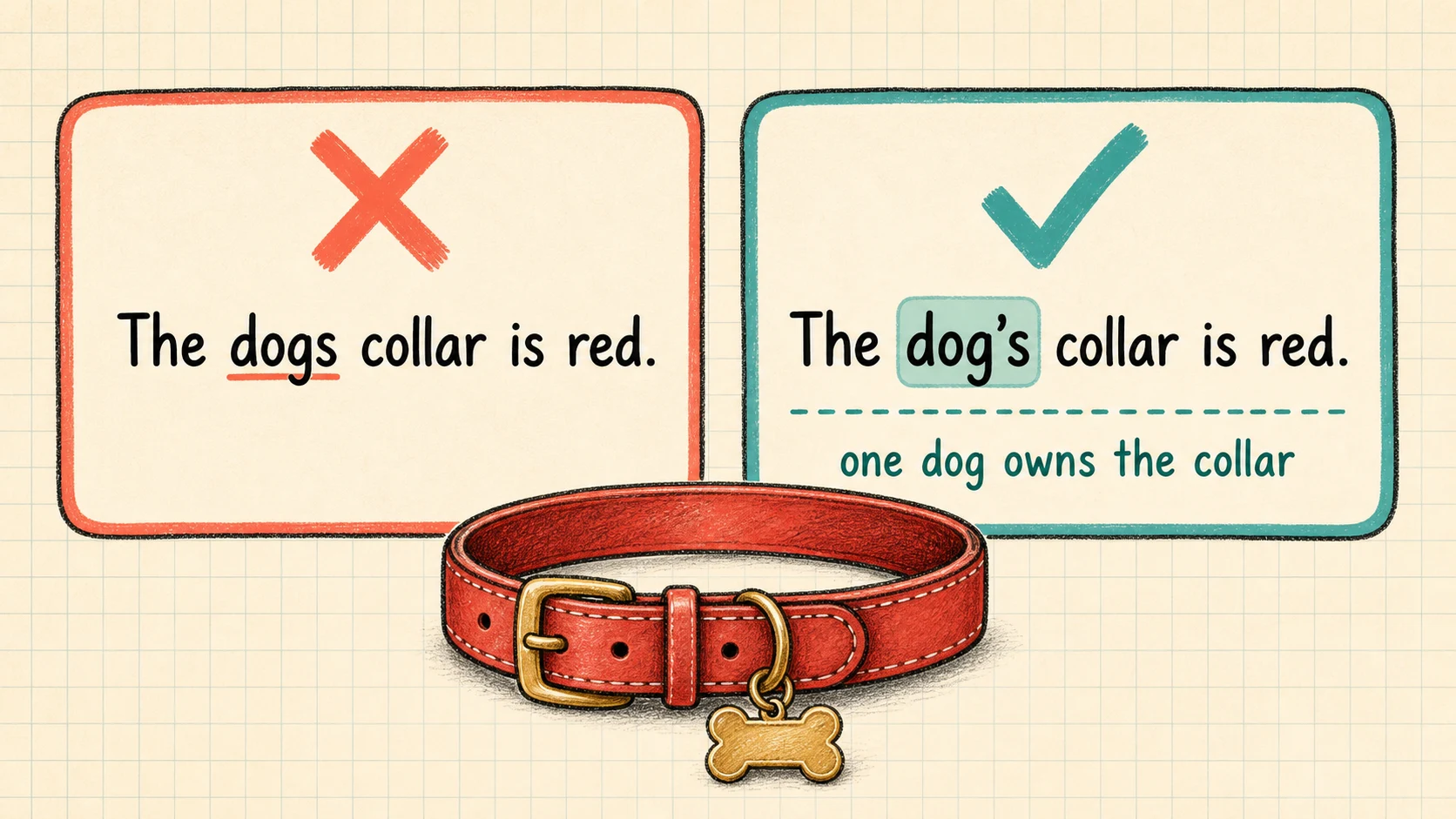
Different wrong marks can point to different unfinished decisions, so the adult’s follow-up should match the evidence.
A worksheet total hides useful distinctions. Sort errors by what the learner actually did.
| Observed response | Plausible interpretation to test | Useful next prompt |
|---|---|---|
| Labels every action-associated word a verb | Uses word meaning but ignores sentence function | “What is the subject doing in this sentence?” |
| Adds commas wherever speech pauses | Relies on sound without identifying structure | “Which words form the introductory group?” |
| Joins two sentences with a comma alone | Recognizes related ideas but not the required connector | “Can both sides stand alone?” |
| Calls every long group of words a sentence | Uses length instead of completeness | “What complete message does the reader receive?” |
| Adds apostrophes to most plural nouns | Associates apostrophes with final s | “Is this showing more than one, ownership, or missing letters?” |
| Corrects a sentence but cannot explain why | May have guessed or recognized a visual pattern | “Name the rule, then make another example.” |
These are hypotheses for the next teaching move, not diagnoses. One error can result from a rushed reading, unfamiliar vocabulary, handwriting load, unclear directions, or an unfinished grammar concept. Check the same decision in a second sentence before drawing a conclusion.
Also distinguish knowledge from transfer. A learner might identify an introductory phrase on a worksheet but omit the comma in a science response. That does not make the worksheet useless; it shows that the next task should involve applying the same rule to the learner’s own writing.
Use a short teach–try–transfer routine
A sentence-structure session
Keep one session to about one rule and a small set of representative items.
- State the decision. “Today we will decide whether a group of words expresses a complete thought.”
- Model one item. Think aloud while finding the subject, predicate, and any dependent word such as because.
- Solve two together. Have the learner mark the evidence rather than only circle “fragment” or “sentence.”
- Assign three to five independent items. Stop if the same misconception repeats; more identical errors are not useful practice.
- Transfer once. Repair one fragment from a draft, reading response, or newly composed example.
- Record the next move. Write one note: “Recognizes subjects and predicates; next, contrast independent clauses with clauses beginning with although or when.”
The Institute of Education Sciences writing practice guide recommends daily writing time and instruction in sentence construction as part of elementary writing instruction. It also places sentence work within a broader writing process rather than treating grammar exercises as the whole of writing. That supports a brief practice-to-writing transfer, but the guide did not assess WorksheetWise materials. See IES, Teaching Elementary School Students to Be Effective Writers.
A punctuation session
Use the same structure but make the learner name the punctuation function.
- Read the sentence without adding marks.
- Divide it into meaningful groups or clauses.
- Select a rule.
- Insert the mark.
- Reread and explain how the mark represents the relationship.
- Apply that rule to one original sentence.
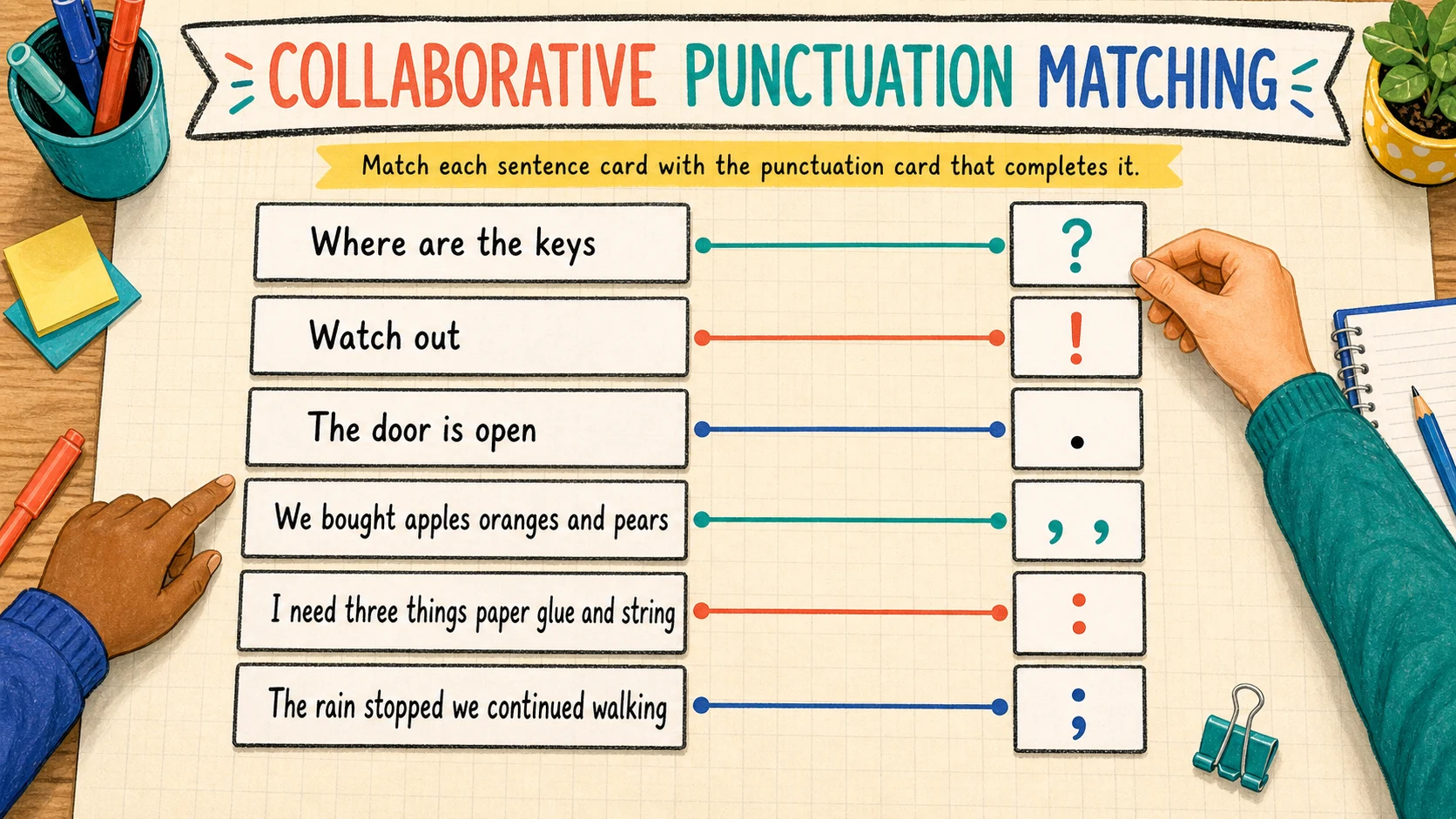
The mark comes after the learner identifies the sentence relationship; it is not the first guess.
For a daily warm-up, one fully explained item is often more informative than ten rapidly corrected items. In a writing mini-lesson, model the rule, edit a shared sentence, and then ask learners to find one relevant place in their own drafts. For test preparation, retain the explanation step: selecting an option without naming why the alternatives fail encourages answer-pattern guessing.
Plan review without mixing the rules
A two-week cycle can revisit a target while leaving room for writing:
- Days 1–2: Model and practice one rule, such as commas after introductory elements.
- Day 3: Contrast correct examples with one near-miss.
- Day 4: Edit a short passage containing that rule.
- Day 5: Apply it to two original sentences and save one response.
- Days 6–7: Briefly retrieve the same rule alongside one previously secure rule.
- Day 8: Correct an error and explain it orally.
- Day 9: Edit authentic classroom or home writing.
- Day 10: Compare the new response with the saved Day 5 response and choose the next target.
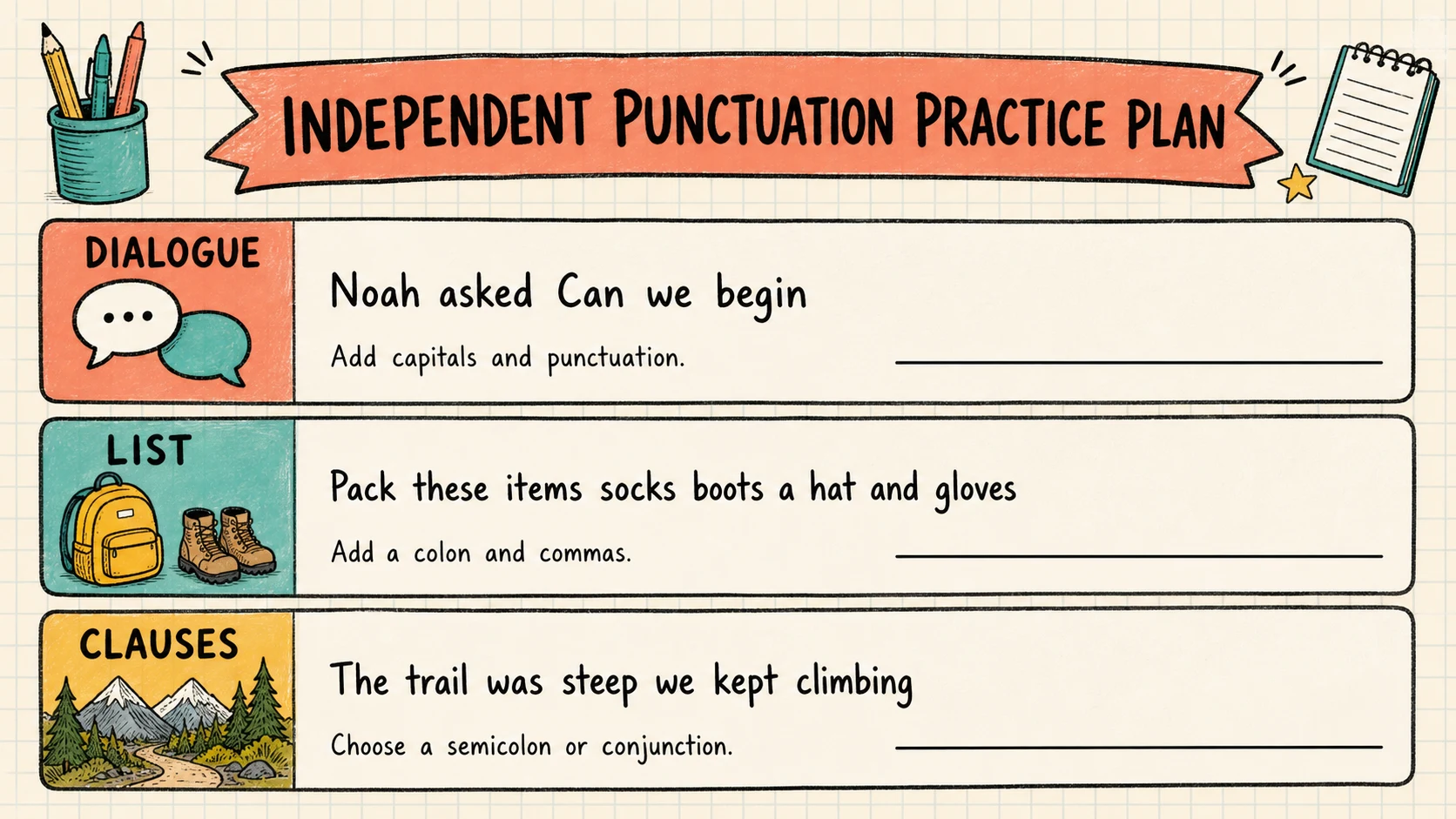
Review should revisit the same punctuation decision in new contexts before introducing another comma function.
This is a suggested scheduling model, not a sourced dosage or promise of improvement. Shorten or extend it according to the learner’s evidence. Move on when the learner can explain the rule and apply it in a new sentence—not merely when every item has been completed.
In a classroom, the Classroom Grammar Worksheets collection can help organize shared and independent use. At home, the 5th Grade Homeschool Worksheets path can place the selected grammar task beside other subject work. Neither setting changes the core decision: one target, visible evidence, and a deliberate next task.
Adapt the work while preserving its target
An adaptation should reduce an unrelated barrier without answering the grammar question.
If reading load interferes, read the direction and sentence aloud, but still require the learner to identify the word function, clause boundary, or punctuation rule. If handwriting is slow, allow pointing, highlighting, movable word cards, or oral explanation before the learner writes one final answer. If visual density is distracting, cover all but one row. If vocabulary is unfamiliar, replace a difficult content word while preserving the same construction.
For the fragment “Because the nocturnal animal left its burrow,” changing nocturnal to small reduces vocabulary demand while retaining the dependent-fragment target. Adding “it was hungry” would not preserve the task because it supplies the missing main clause.
For punctuation, an adult may type the learner’s dictated sentence, but should not insert the comma. For parts of speech, color coding is useful only if the learner chooses the category; precoloring the noun or verb removes the decision.
Avoid adaptations that silently change the skill:
- Do not turn sentence combining into copying a completed model.
- Do not accept “it sounds right” as the only explanation when the target is a grammatical boundary.
- Do not mix five comma rules because one rule seems too brief.
- Do not require lengthy handwriting when the target is identifying an antecedent.
- Do not simplify every sentence until context no longer matters.
Know what a grammar worksheet cannot show
A correct worksheet can show performance on the sampled items under those conditions. It cannot establish that the learner will transfer the rule to all writing, understands every use of the mark, or has mastered a complete grade-level curriculum. The catalogue counts—54 variants, three topics, and three free entry resources—describe available materials, not measured outcomes.
Grammar practice should not replace composing, revising, reading, discussion, or feedback on meaning. The IES elementary writing guide includes sentence construction within several broader recommendations, including daily writing, using the writing process for varied purposes, and building an engaged writing community. A bounded worksheet is therefore best used as instruction or rehearsal connected to real writing.
Nor should a fifth-grade grammar page be treated as a foundational-reading intervention. The approved IES foundational skills guide addresses kindergarten through grade 3 and recommends work such as academic language, sound awareness, decoding, word analysis, and daily connected-text reading. It can clarify that literacy includes more than grammar, but its grade range and instructional purpose differ from this page. See IES, Foundational Skills to Support Reading for Understanding.
If persistent errors appear across reading, speaking, and writing, document the examples and consult the learner’s teacher or an appropriate school professional. Do not infer a diagnosis from worksheet responses.
Make the next task visible
Begin with the three-item probe in this guide. Choose the one response whose reasoning is least secure, then open only its matching free resource. For example, if the learner treats “Because the robotics team needed another battery” as complete, use the 5th Grade Sentence Structure guide and free sheet. Complete five relevant items, ask for an explanation after each, and finish by repairing one fragment in the learner’s own writing.
Record one observable note: “The learner identified the subject and predicate but needed a prompt to notice because.” That note—not the grade label or a broad judgment about grammar—selects the following task.
Put it into practice
Use the guide with a real printable
Move from explanation to a short, observable practice task. Check the first item together, then adjust the next session from the learner's actual work.
Open the first free worksheet