5th Grade · 1 live skills
5th Grade spelling worksheets
Pick the exact skill below. Each page combines a real free download, a separate answer key, practical teaching guidance and an optional focused pack.
See all 5th Grade subjectsComplete guide
How to teach and practise 5th grade spelling worksheets
3,433 words Updated 6 instructional visuals
Choose one spelling decision, not all 30 words at once
The most useful starting point on this page is a worksheet task that isolates one spelling pattern the learner can examine, explain, and apply. Begin with a word sort, look-cover-write-check cycle, or short correction task rather than treating a 30-problem sheet as a single test. Check the learner’s work for a repeated error, then choose the next activity around that evidence.
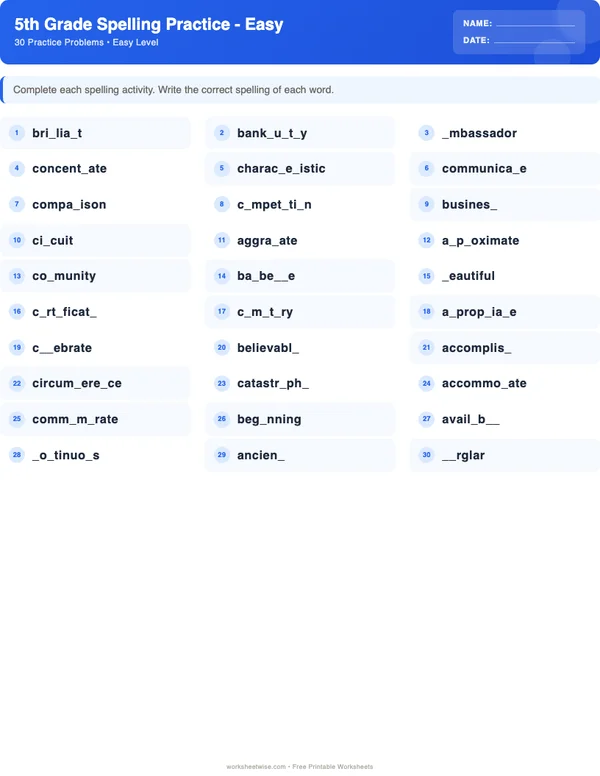
The live catalogue contains 18 worksheet variants for one fifth-grade spelling topic, Spelling Words, with one free 30-problem sheet. The represented practice includes:
- Short- and long-vowel spellings
- Consonant doubling
- R-controlled vowels
- Silent letters
- Prefixes and suffixes
- Multisyllabic words
- High-frequency words
- Look-cover-write-check
- Rainbow writing
- Pattern sorting
- Sentence writing
- Identification of misspelled words
These skills are related, but they are not interchangeable. Sorting rain, play, cake, and break asks a learner to compare several spellings for long a. Correcting a misspelled word inside a passage asks the learner to notice an error while also reading for meaning. Writing a sentence adds decisions about vocabulary, grammar, capitalization, and punctuation. Select the task that reveals the spelling knowledge you actually need to observe.
The “5th Grade” label describes the intended practice level. It is not a guarantee of fit, and local curriculum sequences differ. If age appears elsewhere while browsing, use it as a discovery aid rather than a placement decision. Choose from the learner’s current spelling evidence, not age alone.
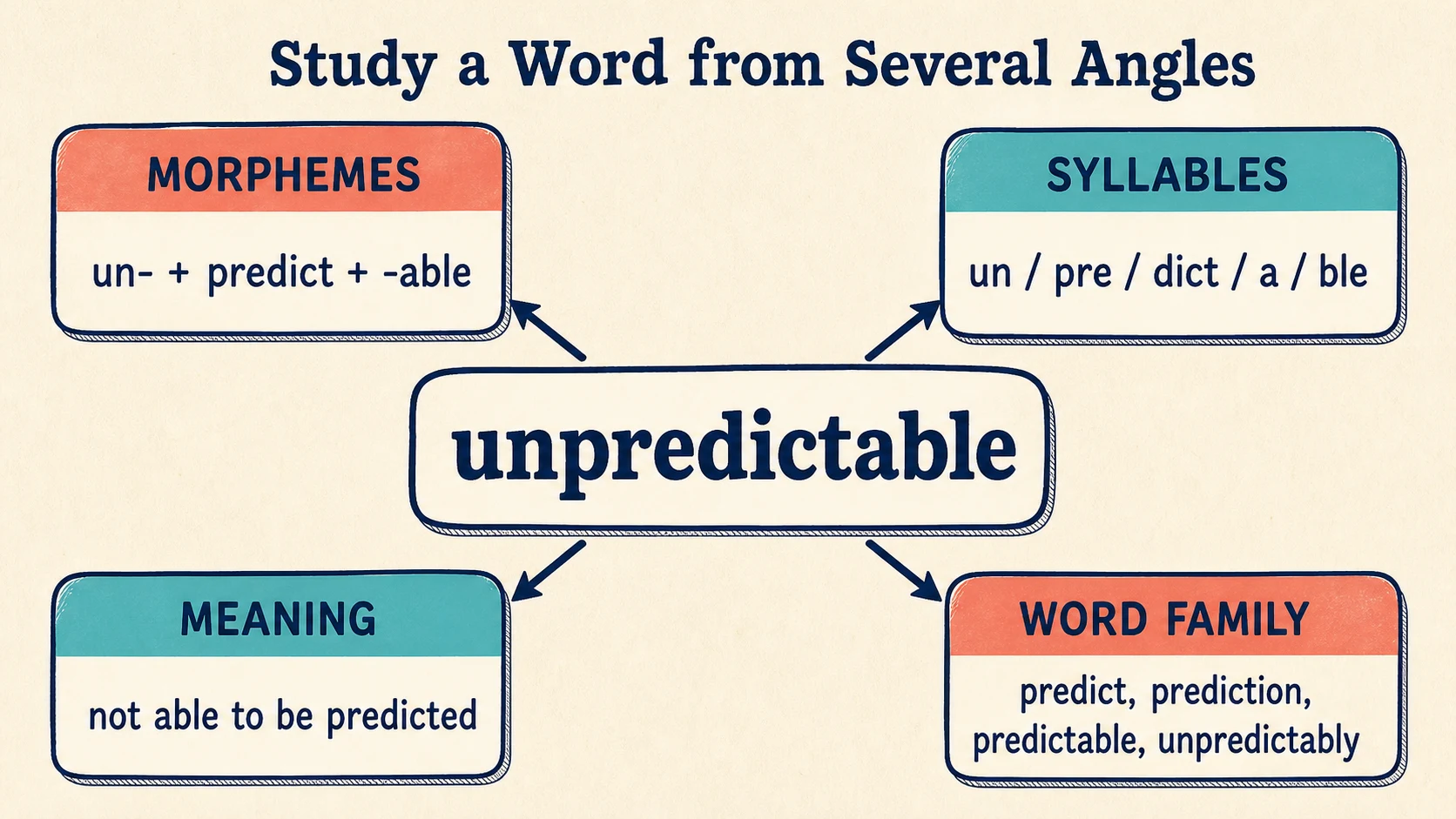
The page connects sound and letter patterns, meaningful word parts, memory practice, error detection, and spelling in sentences.
Read the catalogue as a progression of decisions
A productive progression moves from noticing a feature to recalling it, applying it, and monitoring it in connected writing. That is more precise than moving through worksheets merely because their numbers increase.
First compare visible patterns
A sort makes the learner attend to what is the same and what changes. For example, the four catalogue teaching-tip words cake, rain, play, and break share a long-a pronunciation but not a single spelling.
A useful sort is:
| Final silent-e | Vowel team ai | Final ay | Less predictable ea |
|---|---|---|---|
| cake | rain | play | break |
This example belongs here because long-vowel spellings are explicitly included in the live topic, and all four words appear in its teaching guidance. The checked observation is that each word contains the long-a sound: /kāk/, /rān/, /plā/, and /brāk/. The important learning is not “long a always uses one rule.” It is that the same sound can have several written patterns.
Ask, “What do you notice about where each spelling occurs?” The learner may observe that ay appears at the end of play, while ai occurs inside rain. Treat that as a working observation, not a universal rule proved by four examples. Add new words later to test and refine it.
Then retrieve the spelling from memory
Look-cover-write-check changes the demand. The learner first studies the complete word, hides it, writes from memory, and compares the attempt with the model. A correct copy made while looking does not show the same retrieval as a correct spelling produced after covering the word.
Use only three to five related words in one round. If the target is silent letters, for instance, the adult can display each chosen word, ask the learner to name the part likely to be forgotten, and then begin the cover-write-check sequence. The catalogue identifies silent letters as a target but does not publish a verified word list for that target, so the adult should use words printed on the selected worksheet rather than assuming a particular list belongs to it.
Next apply the pattern in context
Sentence writing checks whether the spelling survives when attention is divided among meaning and sentence construction. This matters because correctly spelling an isolated list word does not automatically show that the learner will spell it correctly during authentic writing.
The IES elementary writing practice guide recommends instruction that develops fluency with spelling and sentence construction, alongside regular opportunities to write. That is external guidance, not an evaluation of WorksheetWise. On this page, sentence activities provide one practical bridge between word study and writing.
Finally monitor and edit
Finding a misspelled word in a passage requires comparison between the printed form and the learner’s stored knowledge. Correction adds another step: the learner must produce the accurate form and ideally explain the changed part.
Do not assume that finding an error proves the learner could spell the word during drafting. Recognition, correction, and independent production are distinct observations. A strong sequence checks all three over time.
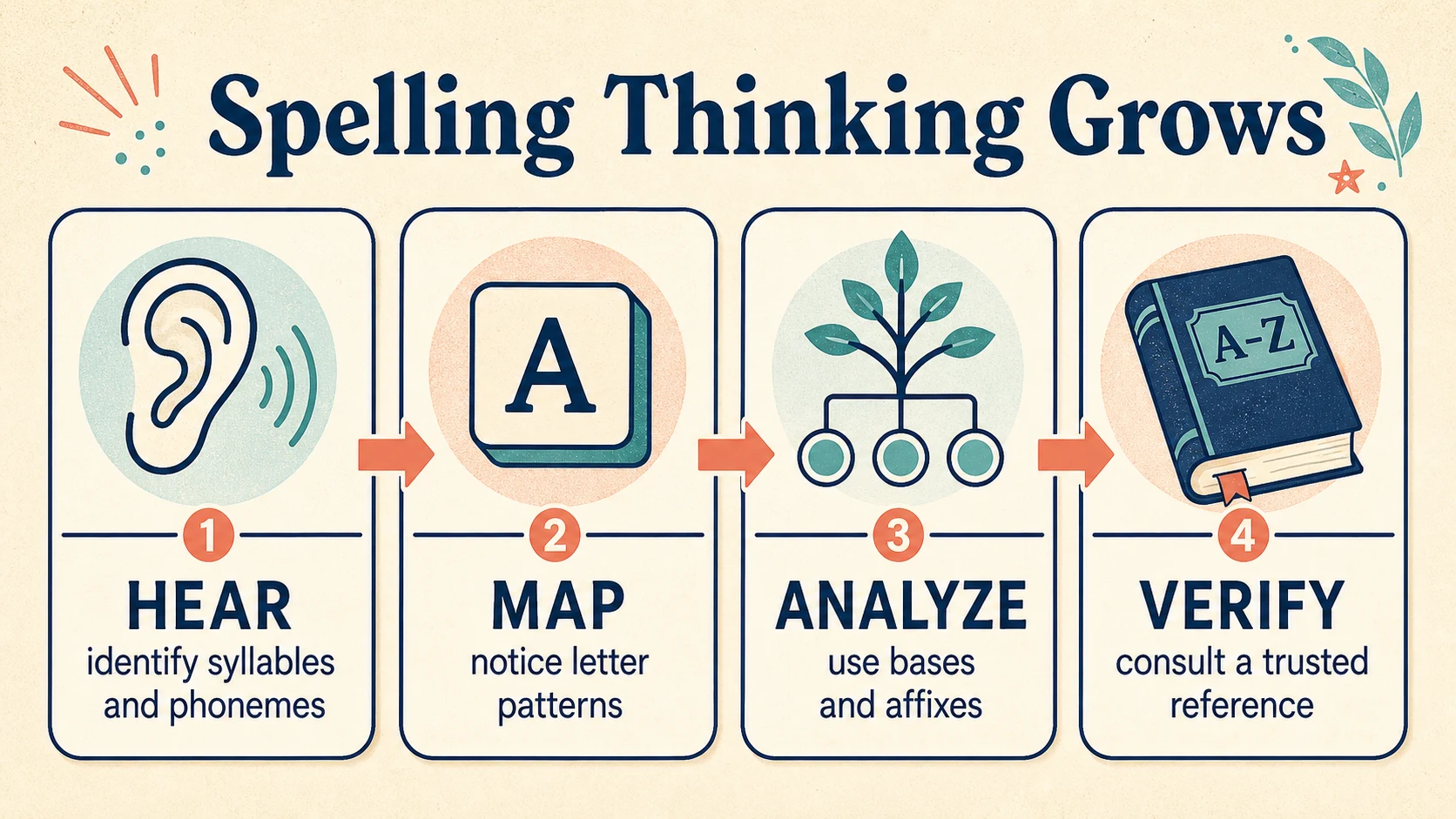
Support can recede from visible models and adult prompts to recall, sentence use, and independent editing.
Separate the six major pattern families
The catalogue spans several kinds of spelling knowledge. Keeping their demands separate makes the resulting errors easier to interpret.
Vowels: hear the sound, then compare spellings
Short vowels may invite a relatively direct sound-to-letter comparison, while long vowels can be represented in multiple ways. R-controlled vowels add another relationship: the vowel sound changes when followed by r. A learner who succeeds with one-syllable short-vowel words may still need explicit comparison among long-vowel spellings.
Worked example 1:
- Say rain, play, cake, and break naturally.
- Underline the letters representing long a: rain, play, ca_e, break.
- Sort by spelling, not merely by sound.
- Cover the words and write them from dictation.
- Check the exact letters.
All four pronunciations and written forms have been checked. This belongs at fifth-grade practice level because the task goes beyond hearing a shared vowel sound: it asks the learner to compare alternative graphemes, remember them, and state a useful positional observation.
The IES foundational reading guide recommends linking speech sounds with letters and teaching learners to analyze word parts, write words, and recognize them. Its stated scope is kindergarten through third grade, so it should not be presented as fifth-grade standards guidance. It does, however, explain why an adult might return to explicit sound–spelling analysis when an older elementary learner’s work shows a foundational gap.
Consonants: inspect the exact point of change
Consonant-doubling mistakes can look like weak memory when the learner may instead be missing a word-change convention. Use a base word and its changed form if those forms appear in the selected resource. Ask the learner to mark:
- The base
- The added ending
- The consonant that changes or doubles
- Any letter that is dropped
Do not teach “always double the last consonant” as a universal rule. The decision depends on word structure and the ending being added. A worksheet can provide bounded comparison practice, but the adult still needs to verify the examples on that sheet and discuss counterexamples when they arise.
Silent-letter work has a different demand. The learner may pronounce a word accurately while omitting a letter that is not independently audible. Here, visual inspection, saying the letters, tracing the tricky segment, or marking it in color can preserve attention to the correct written form.
Meaningful parts: prefixes, suffixes, and bases
Prefix and suffix tasks should retain the meaningful base rather than becoming exercises in circling arbitrary letter strings. Consider a checked illustrative example: help + ful = helpful. The correct result has one l at the end of help and one in the suffix -ful: helpful, not helpfull. The base remains visible and the suffix contributes the meaning “full of” or “characterized by.”
This example belongs here because suffixes are a verified catalogue target and the decision requires attention to both spelling and structure. It is an editorially supplied illustration, not a claim that helpful appears on the free sheet.
Ask three questions:
- What is the base word?
- What does the added part contribute?
- Which exact letters meet at the boundary?
That routine helps distinguish a suffix-boundary error from a mistake inside the base.
Multisyllabic words: reduce memory load without changing the word
For a long word, have the learner pronounce it naturally, divide it into spoken parts, inspect the complete spelling, and identify the segment most likely to be lost. Then return to the whole word before writing it. Avoid teaching an artificial pronunciation as though it were the correct spoken form; use temporary emphasis only as a memory cue.
Multisyllabic work is not automatically “harder” than every shorter word. Familiarity, regularity, meaningful parts, and the task format all affect demand. A familiar compound may be easier to spell than a short word with an unexpected vowel spelling.
Work one complete example from model to sentence
A complete cycle shows what each response does—and does not—demonstrate.
Worked example 2 uses the catalogue word break:
- Inspect: break has five letters. The long-a sound is represented by ea.
- Compare: Unlike cake, rain, and play, it does not use silent-e, ai, or final ay.
- Retrieve: Cover the model and write break.
- Check: Compare letter by letter: b-r-e-a-k.
- Use: “We will take a break after lunch.”
- Edit: If the learner writes brake, ask whether the sentence means a pause or the device used to stop something.
The model spelling, letter count, sound-spelling observation, and sentence usage have been checked. Break and brake are pronounced alike in common US English but differ in spelling and meaning. This example belongs here because it combines a verified long-vowel target with sentence-level meaning. It also shows why sound alone cannot settle every spelling decision.
If the learner writes brek, the likely immediate observation is that the long-a spelling was reduced to a single vowel. If the learner writes brake in the pause sentence, the letters form a real word, but the meaning is wrong. Those responses call for different follow-up tasks.
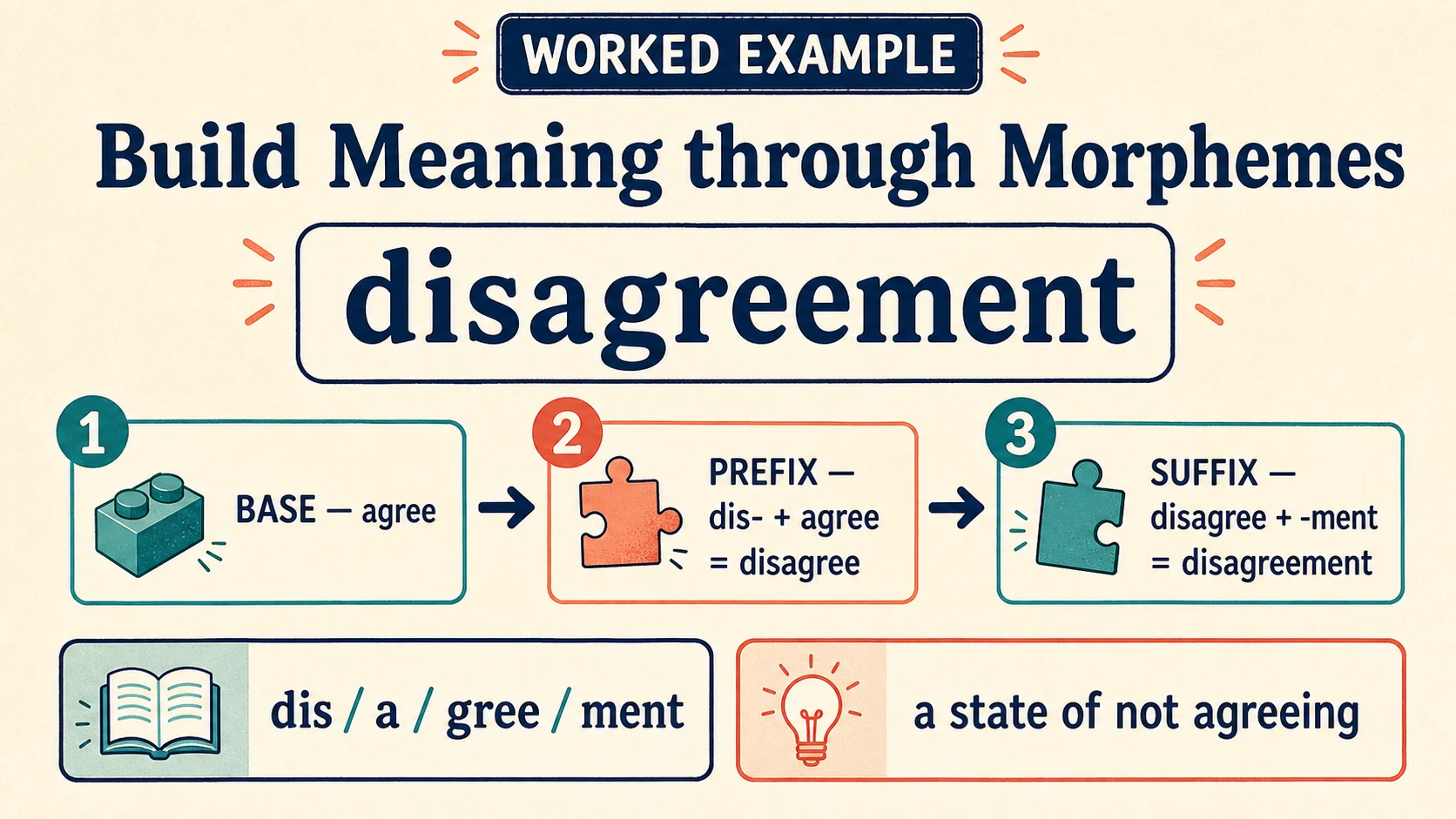
The useful work is visible in the path from inspecting letters to recalling the word and choosing it accurately in context.
Define worksheet difficulty by what the learner must do
The free sheet is catalogued as “easy,” but that label should describe the task presentation, not the learner. The verified facts tell us that it contains 30 problems; they do not provide enough detail here to certify its exact mix of prompts, reading load, visual supports, or response length.
Preview the PDF and judge its observable demands:
- Is the correct word visible for copying, briefly visible before recall, or absent?
- Does the learner choose among options or generate the whole spelling?
- Are words grouped by one announced pattern or mixed across patterns?
- Is the response one word, a sort, a correction, or a complete sentence?
- Does the task include a model?
- How much passage reading is required before the spelling decision?
- Must the learner explain the pattern?
- Are previously taught patterns mixed with the new target?
A word search, for example, supplies every letter inside a visual field and asks for recognition. It may provide engaging review and repeated inspection of correct forms, as the catalogue suggests. It does not by itself establish that the learner can retrieve those spellings without a visible model.
Similarly, rainbow writing offers repeated visual and motor attention to a word. Use it when careful inspection is the goal. Do not count several colored tracings as several independent retrieval attempts.
When choosing among the 18 variants, begin with the narrowest format that answers your question. If you need to know whether the learner distinguishes long-a spellings, use a sort. If you need to know whether the word can be recalled, use look-cover-write-check. If you need to know whether spelling transfers into composition, request a sentence.
Use a short routine that produces evidence
A useful session can remain brief while including explanation, retrieval, and application.
A repeatable 12-minute lesson
Minute 1–2: Name the target. Say, “Today we are comparing ways to spell long a,” rather than, “Finish this page.”
Minute 3–5: Examine and sort. Use four to eight words from the selected worksheet. Ask the learner to mark the target letters and explain the groups.
Minute 6–8: Cover, write, and check. Dictate three words without showing them. After each attempt, compare only the relevant section first, then the whole word.
Minute 9–10: Use one word in context. The learner writes or orally composes a sentence. If handwriting load obscures the spelling target, the adult may transcribe the sentence while leaving the target word for the learner to write.
Minute 11–12: Record one result. Note the pattern, one independent success, one recurring error, and the next task.
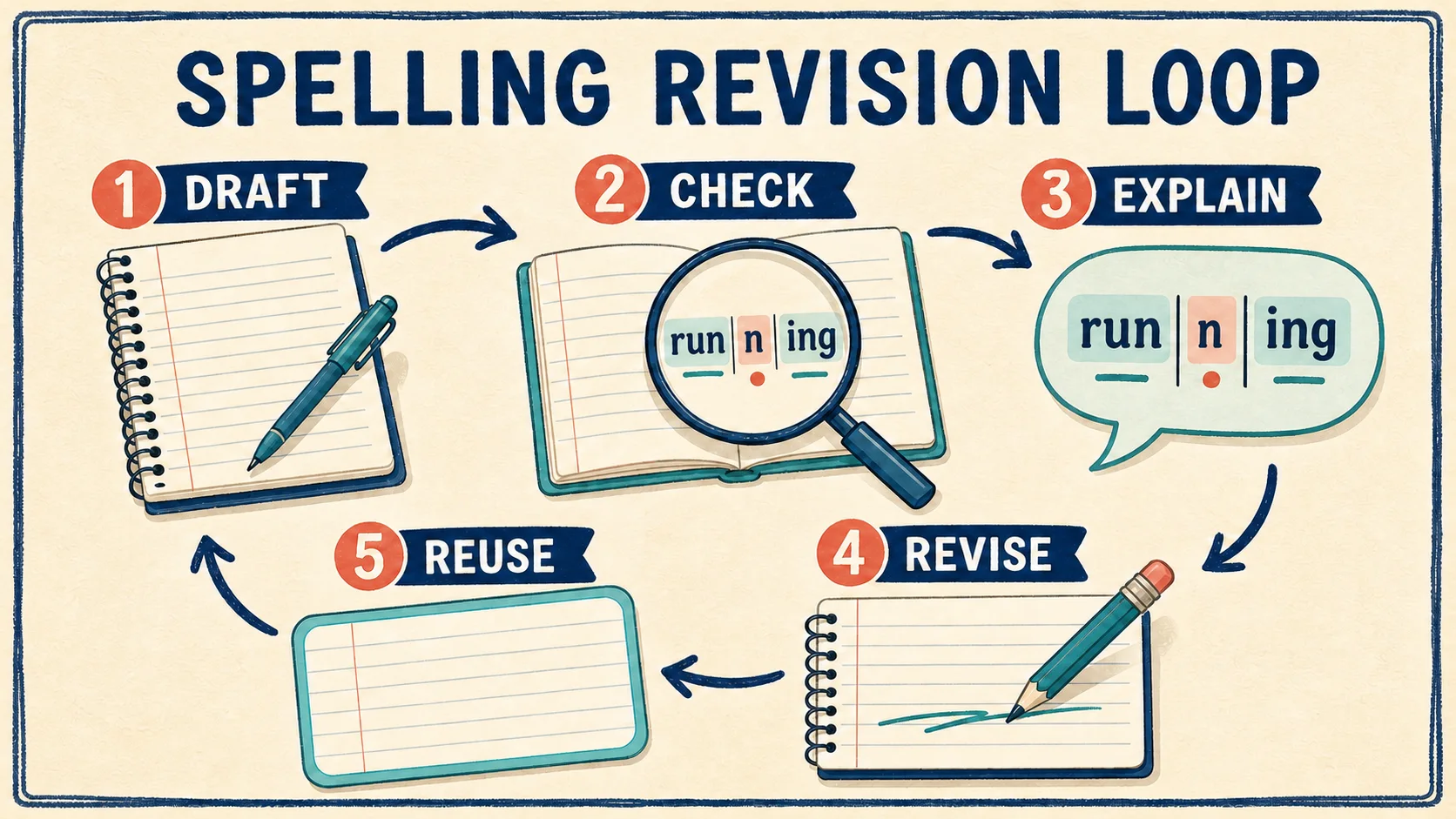
One compact revision cycle moves from drafting to checking and explaining, then revises the word before testing it in a fresh context.
This routine is an editorial suggestion derived from the live activity types. It is not a prescribed schedule from IES or Common Core. Extend or shorten it according to attention and the number of useful responses, not according to a need to complete all 30 problems.
For a classroom fast-finisher task, include a checking key or clearly defined self-check procedure. For homework, send one sentence explaining the target so the adult does not turn the sheet into an unsupported test. The Homework Spelling Worksheets collection can help locate practice by setting, while Classroom Spelling Worksheets offers another context-specific route.
Interpret errors before selecting another sheet
A wrong spelling is evidence only when the adult examines what changed.
Pattern error, memory lapse, or task overload?
Worked example 3:
Target: rain
Attempt: rane
Both spellings can plausibly suggest long a to a learner, but only rain is correct for the weather word. Ask the learner to compare rain with ca_e. If the learner sorts rane with silent-e words, the issue is likely confusion between two long-a patterns, not failure to hear the vowel. The next task should contrast ai and silent-e spellings rather than repeat unrelated words.
Worked example 4:
Target phrase: a short break
Attempt: a short brake
The response is a correctly spelled English word in the wrong semantic context. Have the learner pair brake with stopping a bicycle or car and break with a pause or something separating. The next useful task is meaning-based sentence choice, not basic sound segmentation.
Worked example 5:
Target: helpful
Attempt: helpfull
The base help is intact; the extra letter occurs in the suffix. Ask the learner to box help and underline -ful. Then contrast the ending visually and retrieve the whole word once. The next task should examine suffix boundaries, not short vowels.
Each analysis is intentionally tentative. A single response cannot establish why an error occurred. Ask the learner to explain, then check one or two comparable items. Do not diagnose a learning disorder or infer a general ability level from worksheet performance.
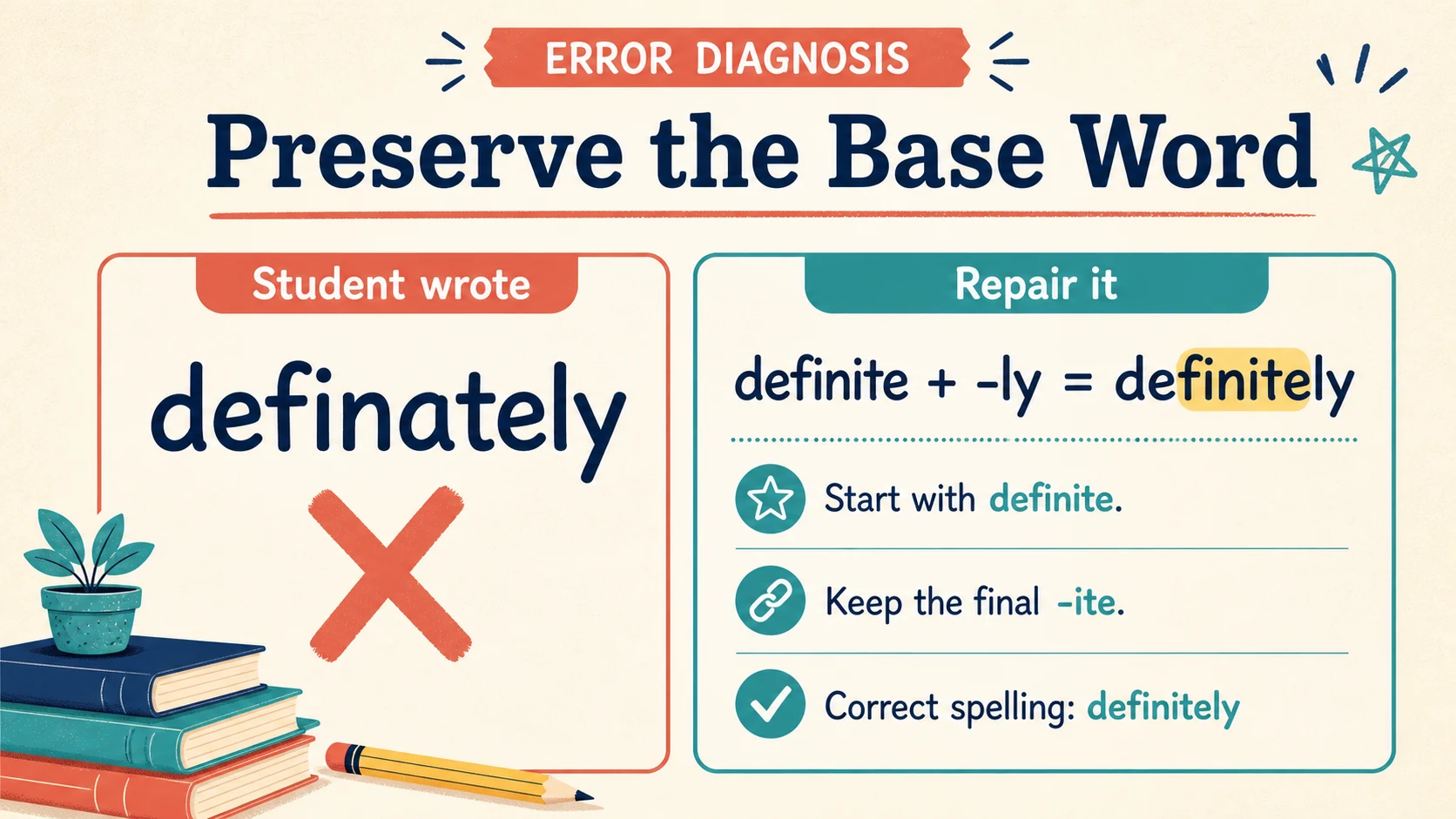
Different letter changes point toward different checks: sound–spelling comparison, meaning, word structure, retrieval, or reduced task load.
Use these response rules:
- Same pattern missed twice: return to a visible comparison and a three-word retrieval round.
- Correct in isolation, missed in a sentence: practice one dictated sentence and one self-written sentence.
- Accurate correction but inaccurate first attempt: schedule delayed retrieval without the model.
- Many unrelated errors during a passage: reduce reading or writing load and test one spelling target separately.
- Correct answers with no explanation: ask for a sort or pattern justification before increasing independence.
- Accurate work across two occasions: introduce a contrasting or previously taught pattern rather than adding more copies of the same words.
Adapt access while preserving the spelling target
An adaptation should remove an irrelevant barrier without supplying the spelling decision being assessed.
If handwriting is tiring, let the learner say a sentence while an adult writes everything except the target word. If dense print is distracting, cover the unused rows and reveal one item at a time. If oral directions are hard to retain, show a small routine card: look → cover → write → check. If visual marking helps, allow underlining, letter tiles, or color coding during the study phase.
Preserve the target carefully:
- For pattern recognition, letter tiles and movable word cards are appropriate because the learner still compares spellings.
- For retrieval, remove the completed model before the learner writes.
- For sentence transfer, support punctuation or transcription while leaving the target word unsupplied.
- For error detection, read the passage aloud if decoding is masking the spelling check, but do not point to the misspelled word.
- For meaning choice, explain unfamiliar sentence vocabulary without naming the correct homophone.
Do not reduce a suffix task to copying if the goal is to understand base-plus-suffix structure. Do not convert independent recall into multiple choice and then treat the result as equivalent. Both adapted tasks may be useful, but they answer different questions.
For home practice, the 5th Grade Homeschool Worksheets area can place spelling alongside other fifth-grade work. The Homeschool Spelling Worksheets collection is the narrower route when spelling is the only target.
Build review across two weeks
Cumulative review is part of the catalogue teaching guidance, but review should be selective. Repeating every item equally gives the adult less information than revisiting words according to the errors observed.
A practical two-week sequence
Week 1
- Day 1: Preview one pattern and sort six to eight worksheet words.
- Day 2: Use look-cover-write-check with three to five words.
- Day 3: Contrast the target pattern with one plausible alternative.
- Day 4: Write or dictate two sentences containing target words.
- Day 5: Check three new items, two previously missed items, and one sentence.
Week 2
- Day 1: Revisit only the words or pattern boundaries that were uncertain.
- Day 2: Find the pattern in current reading material.
- Day 3: Correct a short, adult-prepared sentence containing one relevant error.
- Day 4: Write a new sentence without a visible model.
- Day 5: Compare the fresh work with Week 1 and choose the next bounded target.
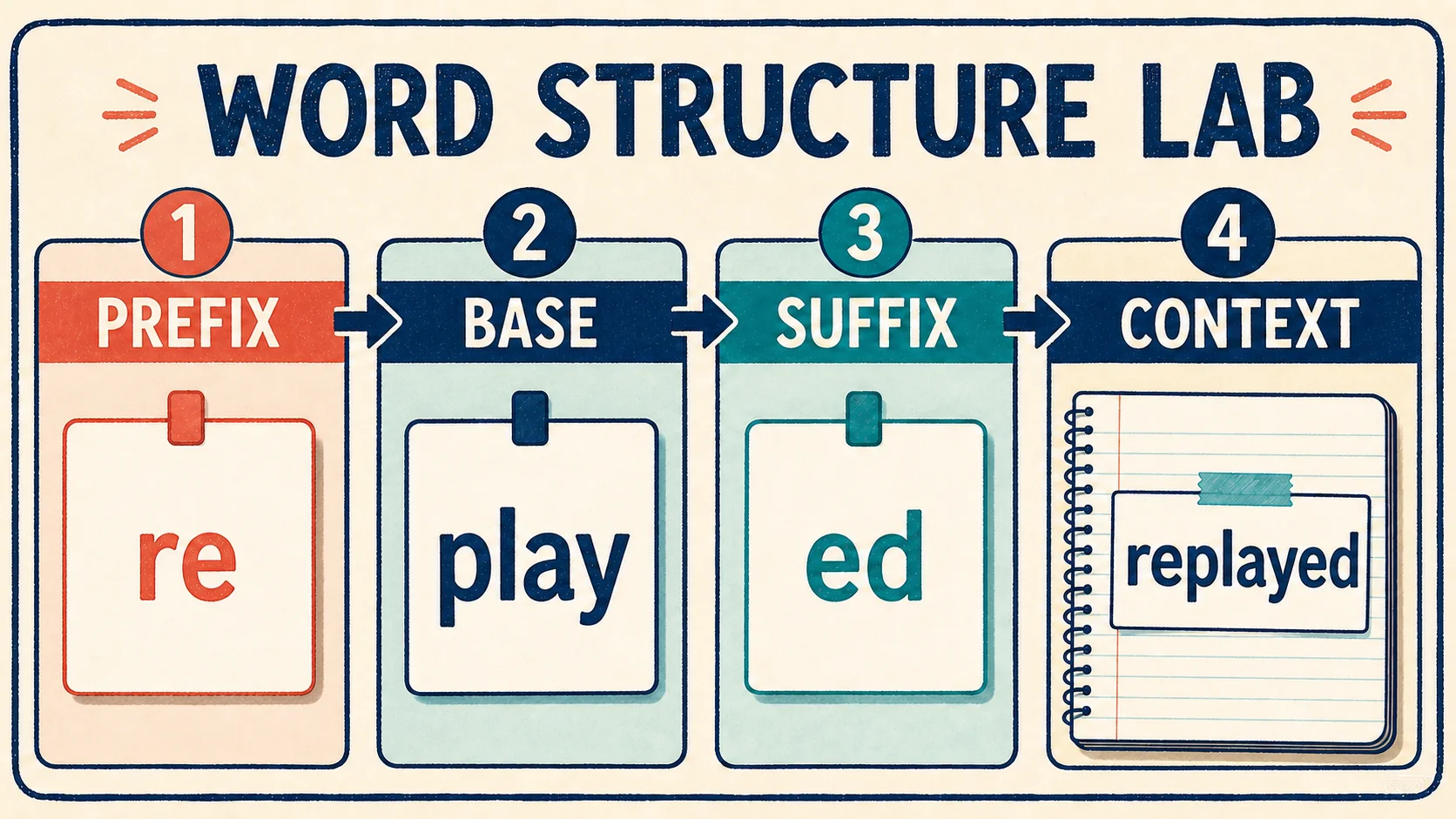
Use word structure to test transfer: reconnect a prefix, base, and suffix, then verify the complete word in context rather than merely repeating the first week’s copying.
This schedule is a suggested implementation, not a sourced dosage claim. Change the number of words when the task stops producing clear evidence. Two carefully examined errors can guide instruction better than 30 hurried responses.
The Common Core ELA standards organize literacy through grade-specific expectations and broader reading, writing, speaking, listening, and language capacities. They also leave adoption and integration decisions to states. Accordingly, a fifth-grade page label should be treated as an intended practice level, not proof of alignment to every local sequence. Check the learner’s school materials when a particular standards match matters.
Know what these worksheets cannot establish
A worksheet can show how a learner responded to a particular set of words under particular conditions. It cannot, by itself:
- Diagnose dyslexia, attention difficulties, or another condition
- Establish a learner’s overall reading or writing level
- Prove mastery from one perfect attempt
- Show independent recall when answers were visible
- Guarantee transfer into everyday writing
- Represent every fifth-grade spelling sequence
- Replace reading, discussion, and sustained composition
- Demonstrate that a word search improved visual memory merely because it was completed
- Confirm that every one of the 18 variants is suitable without previewing it
The catalogue says its worksheets support weekly spelling instruction and transfer into everyday writing. Treat that as the intended use. Verify transfer by examining later, unprompted writing rather than promising an outcome.
If errors remain frequent across unrelated patterns, first reduce the task and gather clearer examples. Compare performance when the word is copied, recalled after a delay, dictated in isolation, and used in a sentence. Share those dated samples with the learner’s teacher if broader support may be useful. Keep the description factual: “The learner wrote rane for rain on two dictated attempts,” not “The learner has a vowel disorder.”
Make the next worksheet earn its place
Open the 5th Grade Spelling Words guide and free sheet, preview the 30 problems, and circle one activity that targets a single pattern. Use no more than eight items in the first session. Afterward, write one observable note in this form:
When the model was hidden, the learner spelled ___ correctly in ___ of ___ attempts and changed ___ to ___.
Then make one decision. If the errors share a pattern, choose another activity that contrasts that exact pattern. If isolated words are accurate but sentence spellings are not, move to one context sentence. If the learner is accurate in both forms on two separate occasions, choose a new or cumulative target from the same resource rather than assigning more identical repetition.
Put it into practice
Use the guide with a real printable
Move from explanation to a short, observable practice task. Check the first item together, then adjust the next session from the learner's actual work.
Open the first free worksheet