6th Grade · 6 live skills
6th Grade math worksheets
Pick the exact skill below. Each page combines a real free download, a separate answer key, practical teaching guidance and an optional focused pack.
See all 6th Grade subjects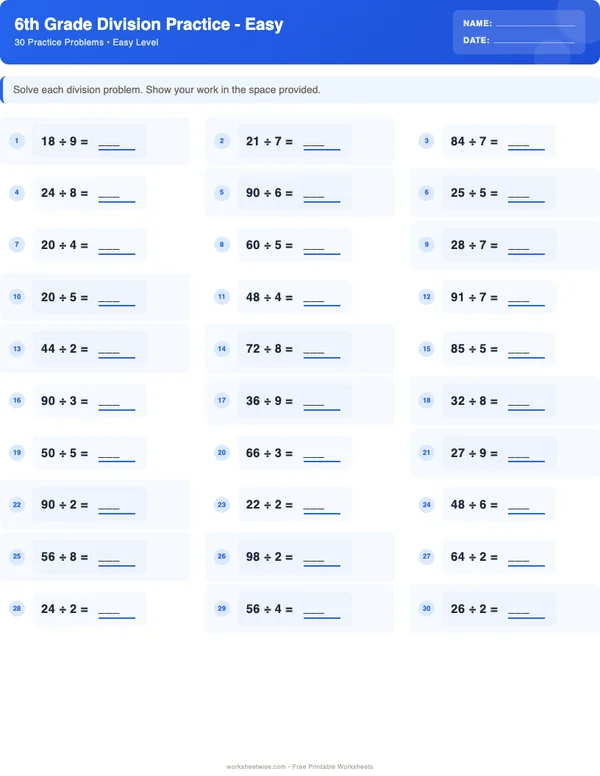
Complete guide
How to teach and practise 6th grade math worksheets
3,328 words Updated 6 instructional visuals
Choose one bounded sixth-grade math target
The live WorksheetWise catalogue offers six sixth-grade math entry points: multiplication, division, fractions, decimals, geometry, and word problems. There are 108 worksheet variants across these topics, including one free entry sheet per topic. The useful first decision is not “Which worksheet is sixth grade?” All six carry that intended practice label. The decision is “Which single, observable skill should the learner practice today?”
Start from recent work, not age alone. A learner who calculates accurately but treats a remainder of 1 as meaningless needs contextual division practice, not another page of division facts. A learner who writes needs decimal place-value comparison before decimal multiplication. A learner who computes correctly but chooses the wrong operation in a story problem needs help representing relationships, not harder arithmetic.
Grade labels describe intended practice level; local curriculum sequences differ. Age, when shown elsewhere in the library, is a discovery aid rather than a placement decision. It does not establish what a learner understands. For ages three and four, brief adult-led oral, matching, manipulative, and movement activities should take priority over desk work. That early-years principle is not a reason to make sixth-grade work childish: older learners who need a concrete model can use tiles, strips, grids, or drawings with age-respectful language.
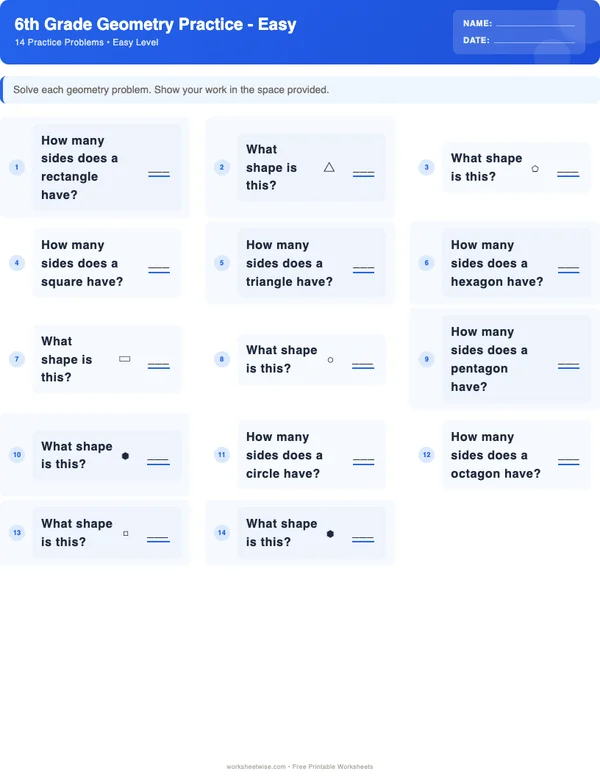
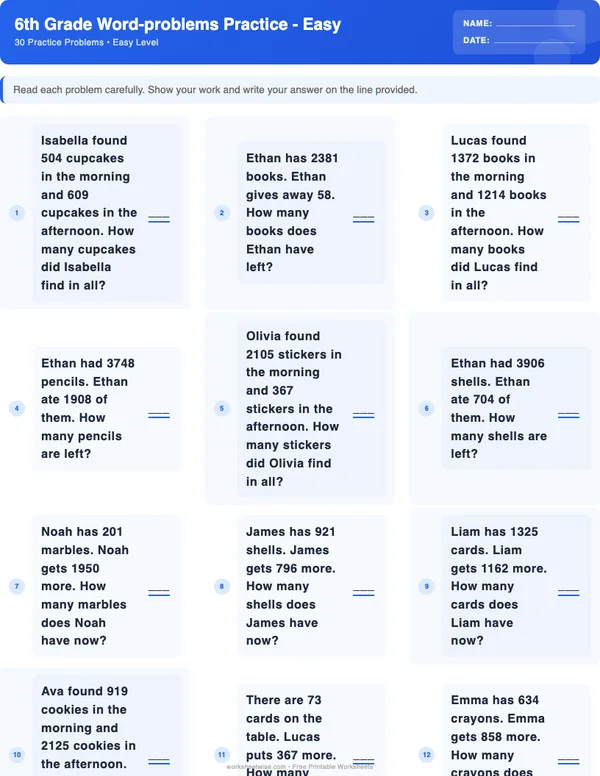
The free sheets currently contain 30 multiplication problems, 30 division problems, 22 fraction problems, 30 decimal problems, 30 geometry problems, and 30 word problems. Each is catalogued as “easy.” Here, that label should describe the task—not the learner. Look for observable features such as familiar notation, one operation at a time, supplied visual structure, smaller or friendlier numbers, limited reading load, and fewer decisions per item. Inspect the actual sheet before relying on the label.
See how the six live skills connect
These topics overlap, but they are not interchangeable. Multiplication and division concern equal groups and inverse relationships. Fractions and decimals represent quantities, comparisons, and operations below or between whole numbers. Geometry asks learners to reason about spatial attributes and measures. Word problems ask them to interpret a situation and coordinate representation, operation choice, computation, and checking.
A practical progression through the live catalogue is:
- Establish the needed whole-number relationship or place-value idea.
- Represent the relationship with an array, diagram, number line, grid, or labeled figure.
- Calculate while keeping units and magnitude visible.
- Apply the same mathematics in a problem that requires choosing a method.
- Use errors to choose the next, narrower task.
This is not a mandatory order for every learner. For example, fraction comparison can be secure even when long division remains hesitant. Geometry may reveal strong reasoning that a dense word problem hides. Compare evidence skill by skill.
Multiplication supports structure, not merely recall
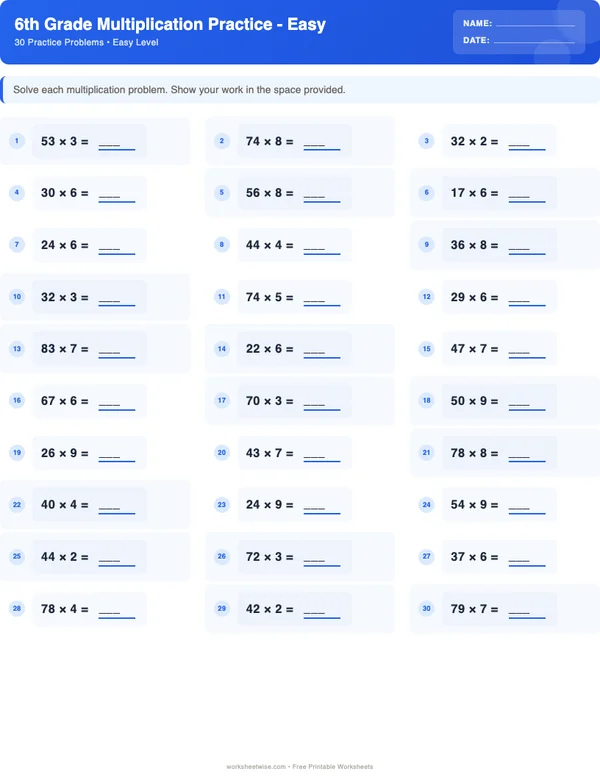
The multiplication catalogue description spans equal groups, arrays, facts through 12, multiplication properties, area models, partial products, and the standard algorithm. At sixth-grade practice level, multiplication often functions as infrastructure for fraction operations, area, volume, ratios, and expressions.
Use the 6th Grade Multiplication guide and free sheet when the work shows an inaccurate product, an unstable fact relationship, or a place-value error in a multi-digit product. Do not send every slow solution back to fact drills. A learner may know that yet still misalign partial products in .
The catalogue’s teaching suggestion is to connect facts through properties. For example:
This example belongs here because it exposes multiplicative structure useful beyond recall. Check it by the commutative relationship , or by . If the learner writes , the likely instructional issue is distributing 7 to only one addend—not “weak multiplication” in general. Ask the learner to draw seven rows split into groups of five and three, then reconnect the two partial products.
Division adds interpretation to inverse facts
Division includes equal sharing, measuring how many groups fit, fact families, long division, and remainders. A correct quotient is not enough when the situation requires interpreting what remains.
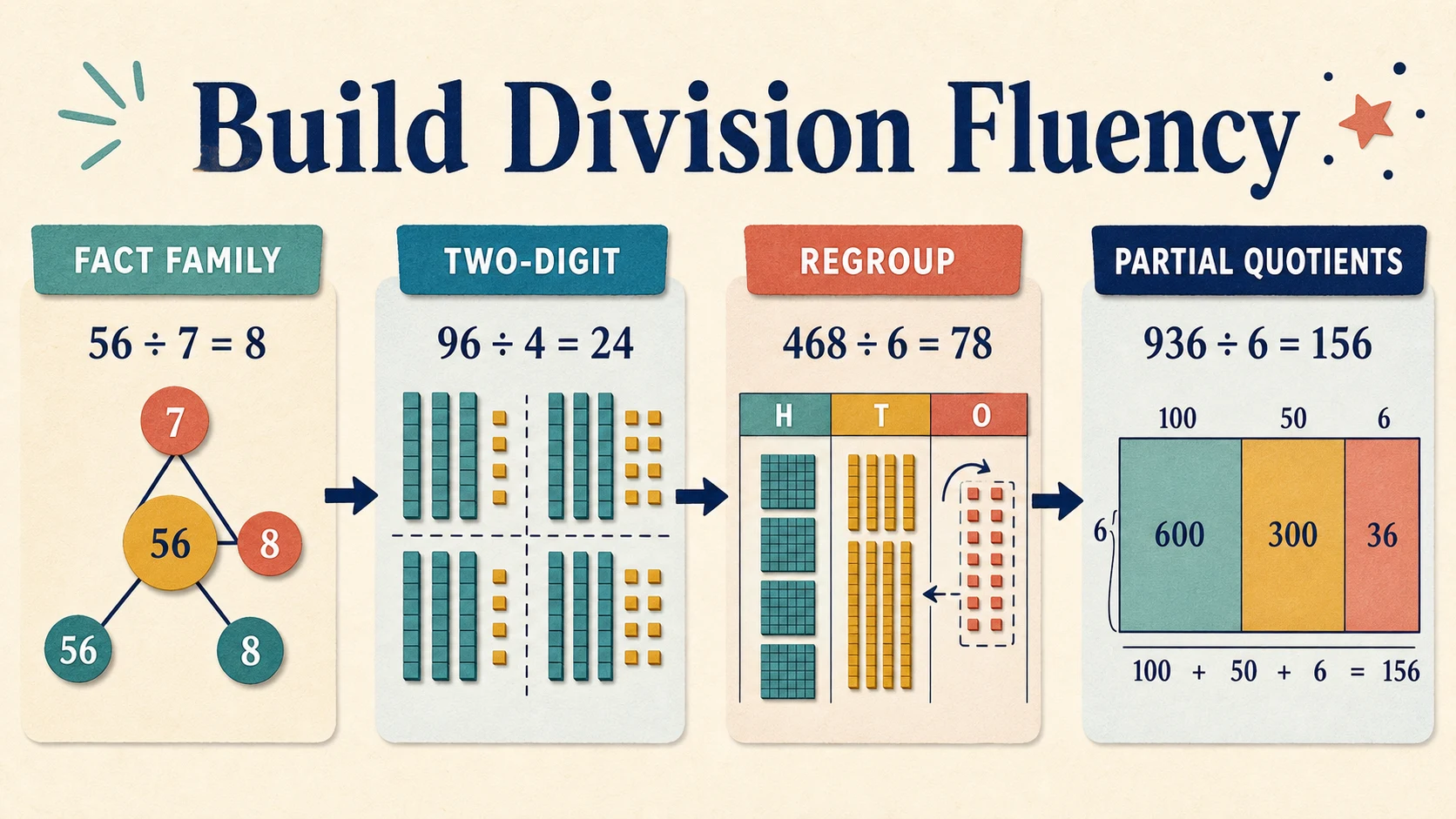
Move from a represented division relationship to an independently solved quotient only after the learner can explain what each quantity means.
Consider 157 books packed equally into boxes holding 12 books:
because , and .
The arithmetic answer is . If the question asks how many boxes are needed to transport every book, the answer is 14 boxes. If it asks how many completely full boxes can be packed, the answer is 13 full boxes, with 1 book left. This example belongs in sixth-grade division because it separates calculation from contextual interpretation.
Choose the 6th Grade Division guide and free sheet when the learner confuses divisor and dividend, loses place value during long division, or cannot explain a remainder. The catalogue suggests partial quotients or an area model as a bridge. That is a suggestion from the supplied catalogue, not a claim that one representation works for everyone.
Fractions require magnitude before procedures
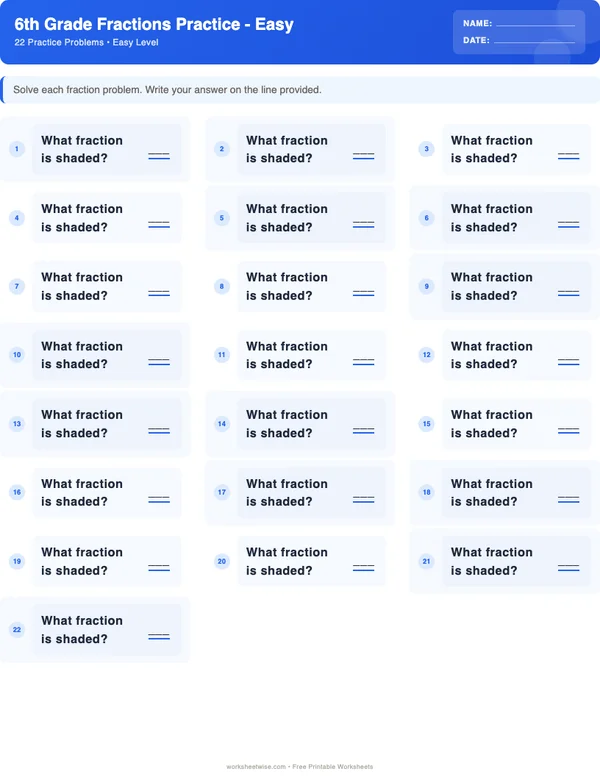
The fraction collection includes identification, comparison, equivalence, mixed numbers, and all four operations. The most important first question is whether the learner treats fractions as numbers with magnitude. A memorized denominator rule can conceal a fragile understanding.
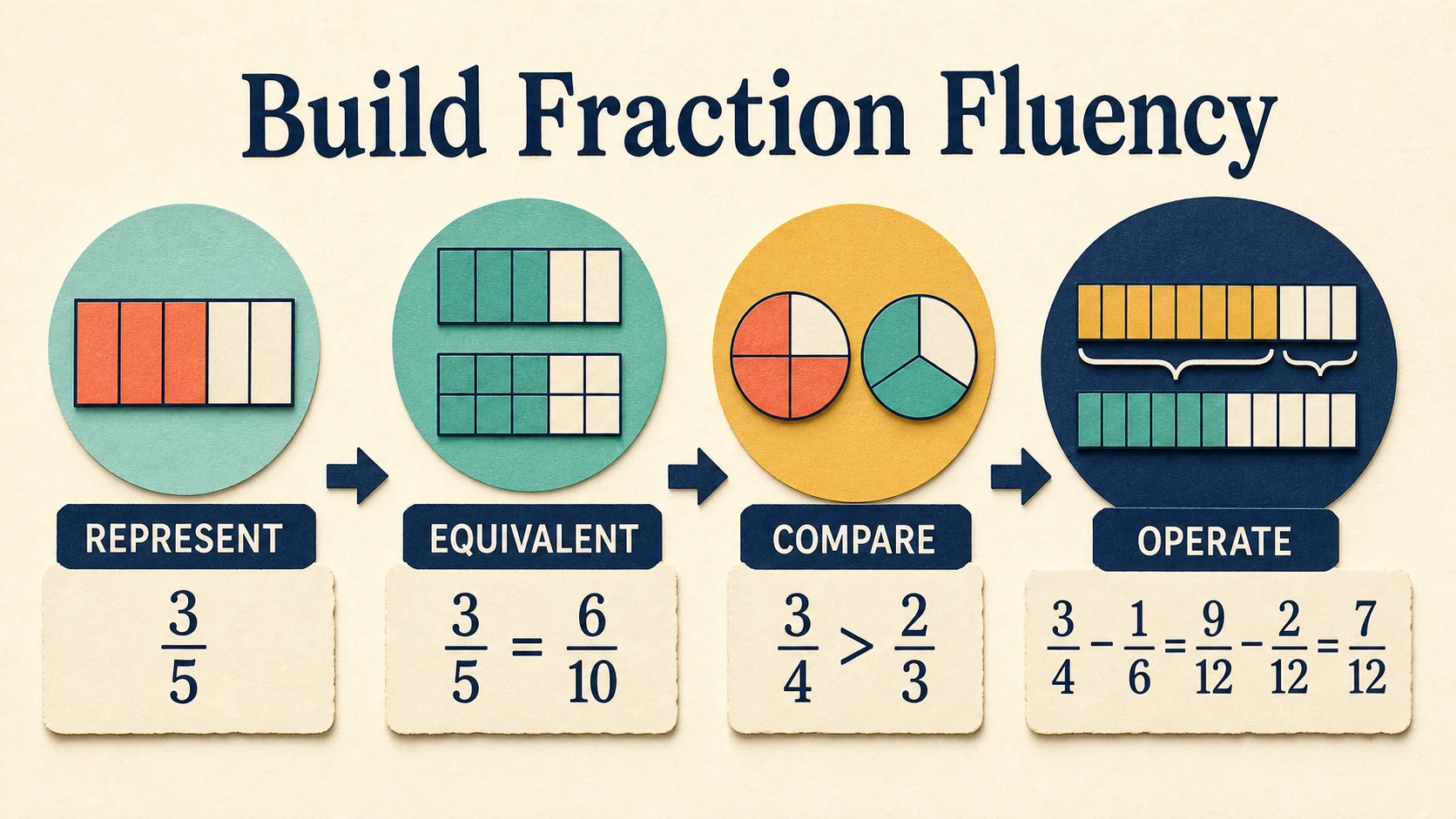
Keep a number line or fraction strip available while moving from equivalence and estimation into symbolic fraction operations.
Work this comparison:
Using a common denominator of 18:
Therefore, . A second check uses distance from 1: is below 1, while is below 1; , so is closer to 1.
This example belongs here because the fractions have different numerators and denominators, yet remain manageable through equivalence and benchmark reasoning. If the learner chooses because 9 is greater than 6, return to equal-length strips or a number line. Do not merely repeat “larger denominators mean smaller pieces,” because numerator and denominator must be considered together.
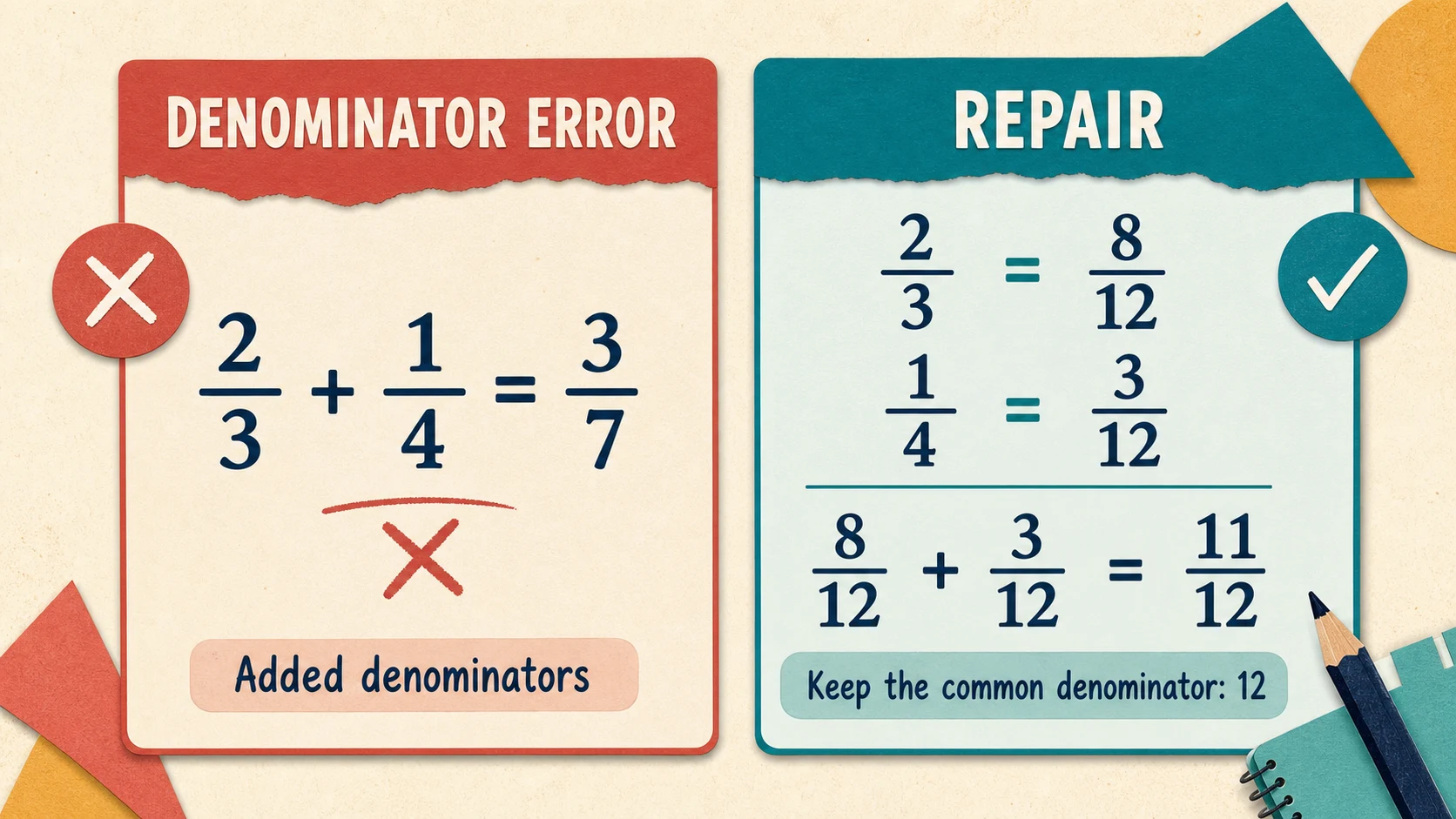
Treat a fraction error as evidence about equivalence, magnitude, or operation meaning before assigning more mixed practice.
For an operation check:
An estimate confirms the result: is near 1 and is three quarters, so a total between and 2 is reasonable. If the learner writes , they have added numerators and denominators. Select equivalent-fraction work from the 6th Grade Fractions guide and free sheet, then retry one addition item with a fraction strip.
Decimals expose place-value reasoning
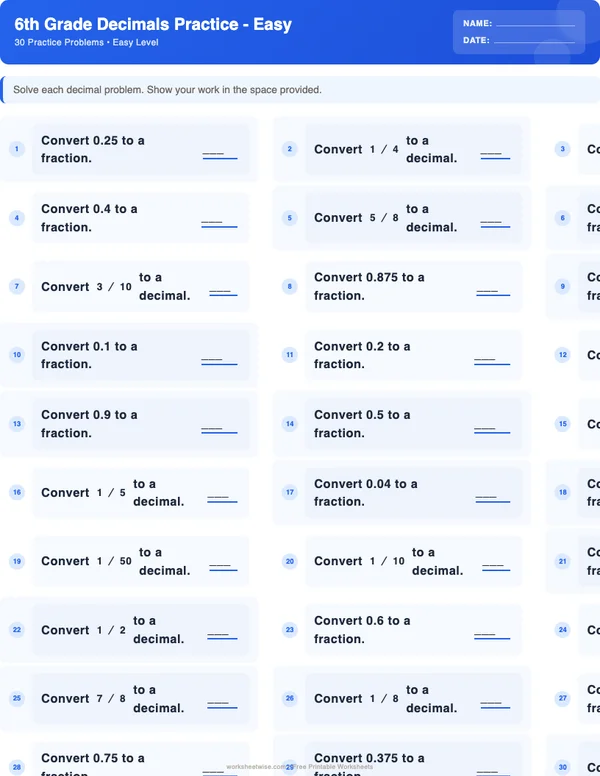
Decimal work covers place value, fraction–decimal conversion, comparison, rounding, and all four operations. A learner may correctly recite “line up the decimal points” without understanding why the columns must represent equal units.
Compare and . Rewrite as :
On a hundredths grid, shades 36 squares and shades 40. The extra digit in does not make the number larger. This example belongs here because “longer decimal means larger number” is an observable misconception named in the catalogue guidance.
For multiplication, calculate:
One check is fraction conversion:
Another check is magnitude: means four tenths of 3.2, so the result must be less than 3.2. An answer of 12.8 may show correct whole-number multiplication with an unjustified decimal placement.
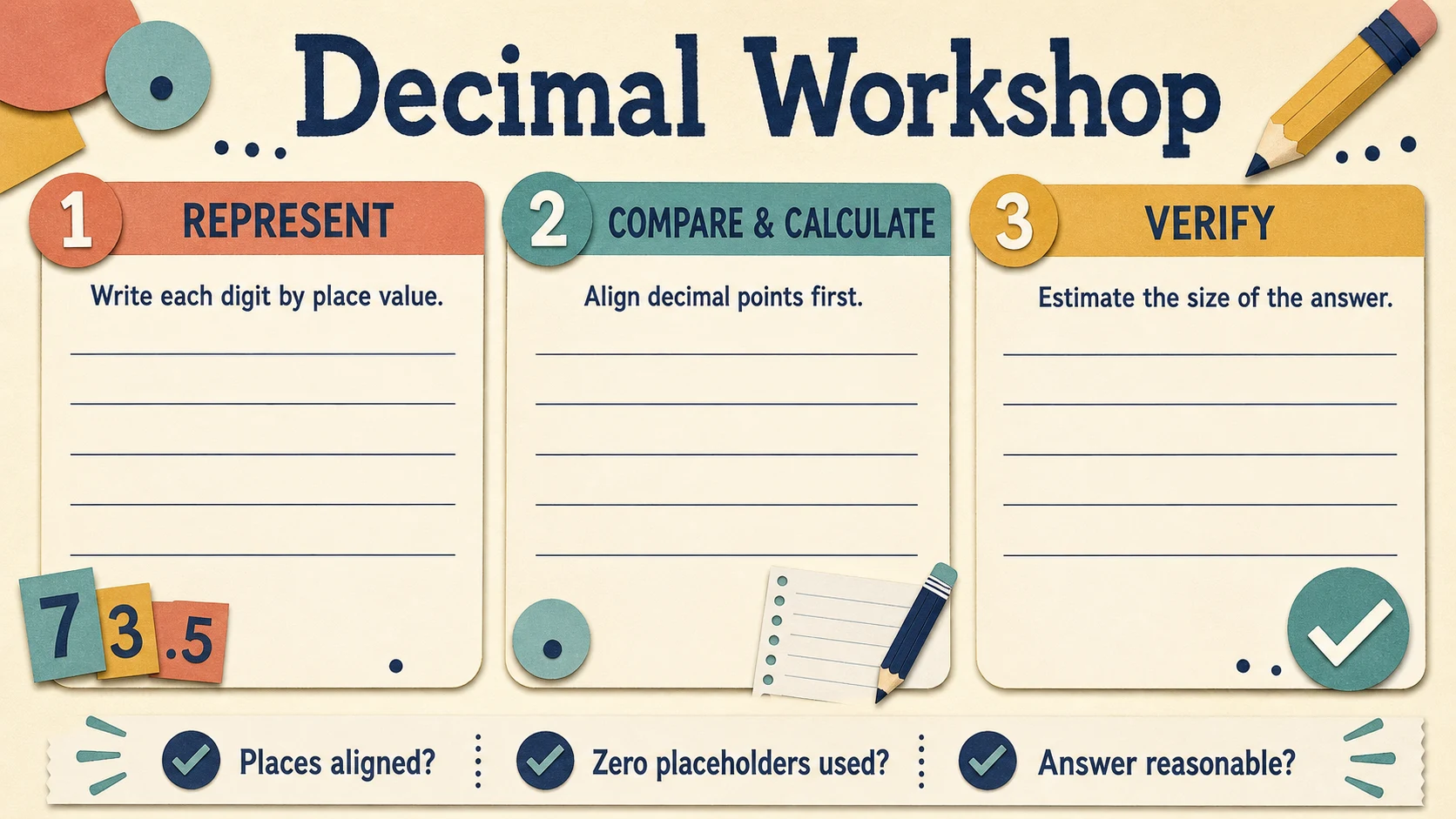
Space decimal comparison, computation, and short review checks across days instead of treating one completed page as proof of durable understanding.
Use the 6th Grade Decimals guide and free sheet when current work points specifically to decimal notation, magnitude, or computation. Money can provide a familiar context, but hundredths grids and base-ten representations make place value visible without assuming financial familiarity.
Geometry separates attributes that formulas can blur
The geometry catalogue spans shape attributes, symmetry, angles, area, perimeter, volume, coordinates, and transformations. Before assigning a formula page, determine whether the learner knows which attribute the problem asks them to measure.
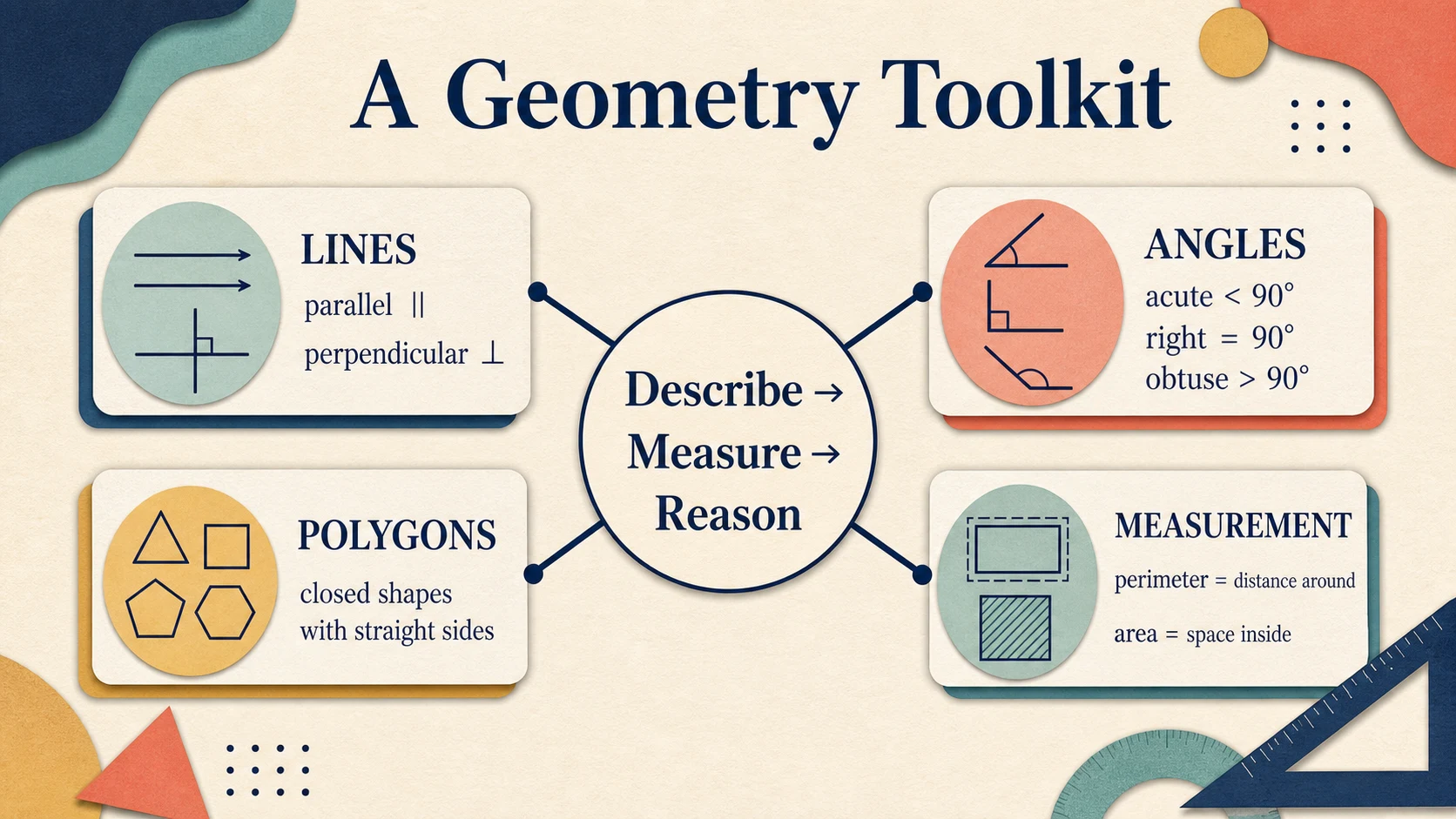
Use the geometry branches to identify whether today’s target is classification, measurement, coordinates, or transformation—not simply “geometry.”
Take a rectangle 8 units long and 3 units wide:
while
The checks are physical: area counts 24 unit squares covering the interior; perimeter counts edge units around the boundary. This example belongs here because it makes the difference between area and perimeter explicit rather than relying on formula recall.
Now keep the area at 24 square units but change the dimensions to 6 by 4:
Same area, different perimeter. If the learner assumes equal area guarantees equal perimeter, ask them to build or draw both rectangles on square paper and trace their boundaries.
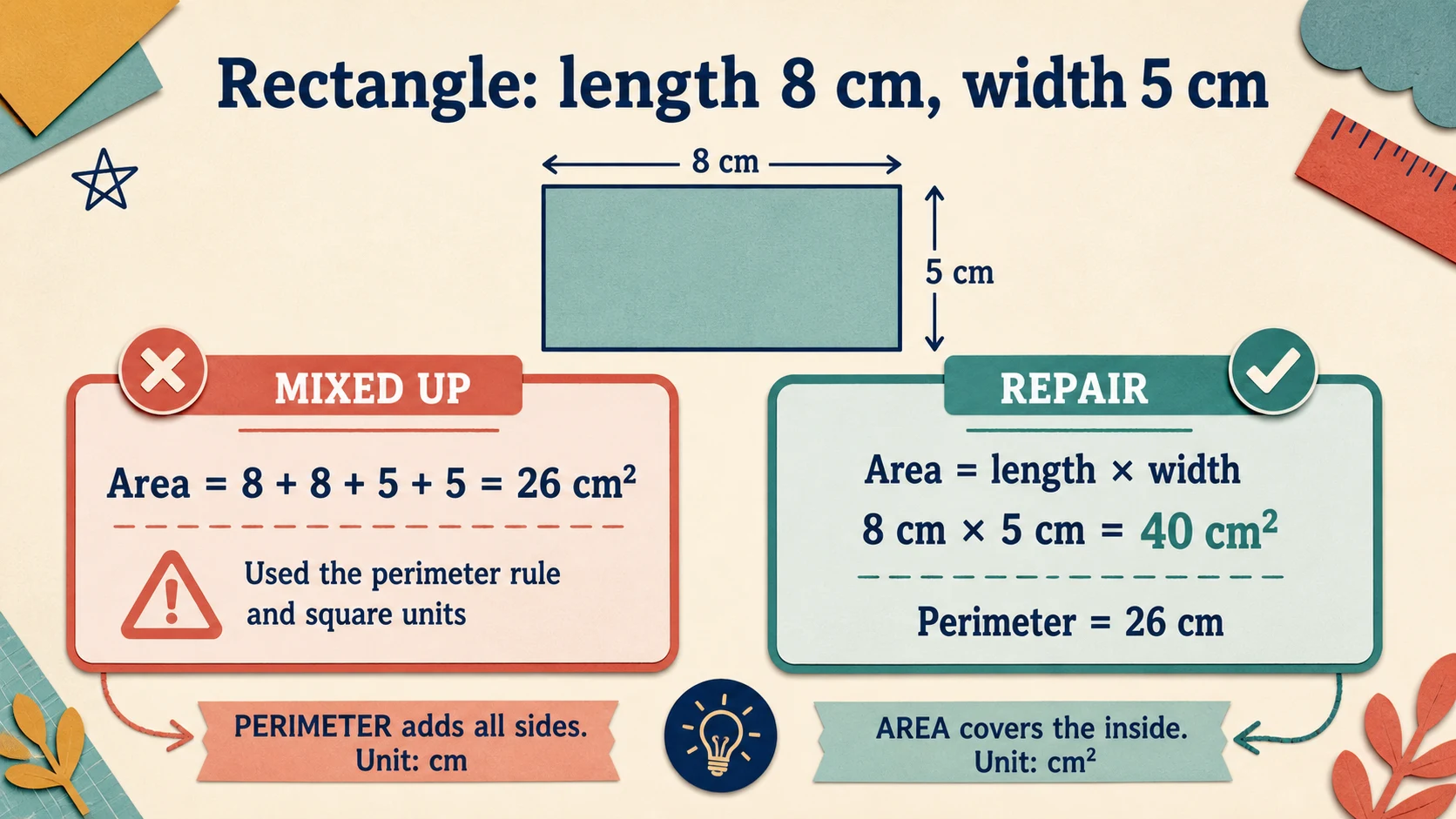
Match the response to the error: confused units call for measuring and labeling; a copied formula error calls for reconstructing what is being counted.
The 6th Grade Geometry guide and free sheet is the better starting point when diagrams, dimensions, angles, or coordinate relationships are central. It is not automatically the right choice merely because multiplication appears inside an area calculation.
Word problems test representation and decisions
Word problems combine reading, relationships, operation choice, computation, units, and reasonableness. An incorrect answer can originate at any of those points. The catalogue advises reading the full problem, retelling it, identifying known and unknown quantities, choosing a representation, solving, and checking. It specifically cautions against rigid keyword rules.
Consider: “A club buys 8 packs of 15 markers. It uses 37 markers. How many remain?”
First find the total:
Then subtract the used markers:
Check by reversing the final step: . The answer is 83 markers.
This example belongs here because it requires two operations and separates the quantities’ roles. A keyword shortcut may fail: “remain” signals the final relationship but does not reveal that multiplication must happen first. If the learner calculates , have them retell the situation and draw eight equal boxes labeled 15 before discussing operations.
Choose the 6th Grade Word Problems guide and free sheet when arithmetic is reasonably secure in isolated form but operation choice or explanation breaks down in context.
Use standards as a map, not a placement verdict
The Common Core State Standards for Mathematics organize Grade 6 work around ratios and proportional relationships, the number system, expressions and equations, geometry, and statistics and probability. They also describe mathematical practices such as making sense of problems, reasoning about quantities, modeling, using tools strategically, and attending to precision.
Those standards provide a public reference for intended grade-level mathematics. They do not show that a particular learner must begin at a particular worksheet, and they do not independently verify WorksheetWise materials. The supplied catalogue says its worksheets target specific Common Core math standards, but adults should inspect the target stated on an individual resource and compare it with their local curriculum sequence.
The six live hub topics do not reproduce the full Grade 6 standards structure. Multiplication, division, fractions, and decimals can support number-system and ratio work; geometry has a direct topic connection; word problems can apply ideas across domains. Do not infer that this hub alone covers every standard, every prerequisite, or every locally required task.
Select a starting sheet from evidence
Use a recent notebook page, quiz, conversation, or five-item check. Identify the earliest point at which the learner’s reasoning becomes unreliable.
Ask four selection questions
- What is the smallest teachable target? “Compare decimals to hundredths” is more actionable than “needs decimals.”
- Is the barrier conceptual, procedural, or contextual? A concept error changes what quantities mean; a procedure error disrupts otherwise understood steps; a contextual error occurs when representing or interpreting a situation.
- What task feature should be reduced? Options include number size, reading load, number of operations, visual clutter, or the amount of unsupported work.
- What evidence would justify moving on? Require more than a page score—for example, three accurate solutions plus one clear explanation and one delayed check.
If two skills are implicated, begin with the dependency. For , first determine whether the learner knows and understands decimal magnitude. For an area story problem, separate rectangle measurement from reading comprehension. One bounded target makes the resulting work interpretable.
Define difficulty by the work on the page
Do not describe a learner as “easy,” “developing,” or “advanced.” Describe the assignment:
- More supported: one operation, friendly numbers, a worked model, visual representations, and limited text.
- Less supported: mixed operations, no indicated strategy, larger or less familiar numbers, multiple representations, and a requirement to justify or interpret.
- More complex: irrelevant information, multiple steps, unknowns in varied positions, conversions, or a need to compare methods.
The free sheets are all catalogued as easy, but the topic demands and problem counts differ. A 22-item fraction sheet is not necessarily lighter than a 30-item multiplication sheet; each fraction item may require more representation and decision-making. Preview five items before assigning the whole resource.
Run a short practice cycle that produces evidence
The IES practice guide on assisting students who struggle with mathematics recommends systematic instruction, clear mathematical language, representations, number-line work, deliberate word-problem instruction, and purposeful fluency activity. This is sourced general guidance; it is not an evaluation of WorksheetWise.
Before the sheet: establish the target
State one goal: “Today we will decide which decimal is greater and explain using place value.” Ask one oral warm-up such as, “Which is greater, 0.6 or 0.57? How do you know?” Record the explanation, not just the answer.
Model one representative item. Keep the thinking visible:
Name tenths and hundredths. Then ask the learner to explain the same comparison using a grid or number line.
During the sheet: sample, pause, and question
Assign three to five items first. Avoid turning a 30-problem sheet into an endurance test when the goal can be observed sooner. After the sample, ask:
- What did you notice?
- Which representation or fact did you use?
- How did you check the size of the answer?
- What would change if one number changed?
If all sampled answers show the same error, stop. Repeating 25 more items will make the error pattern longer, not more informative.
After the sheet: use a delayed transfer item
Select one new item with the same target but a different surface form. After decimal comparisons, ask the learner to order , , and . After contextual division, change the meaning of the remainder. After area and perimeter, provide the measures without labeling which formula to use.
Record one sentence: “Next time, continue with…” or “Next time, return to….” This creates a usable instructional trail without making a diagnosis.
Interpret errors before assigning more practice
An answer key confirms whether an answer matches; it does not explain why it differs. Ask the learner to reconstruct one response.
Use these evidence-to-action pairs:
- because 36 is greater than 4: Compare with on a hundredths grid.
- : Build both fractions with strips, establish a common unit of fifteenths, and retry.
- given as the number of boxes required: Keep the computation and revisit what the remainder means in that context.
- Area reported as 22 square units for an 8-by-3 rectangle: Count interior squares and boundary lengths separately; label the units.
- A two-step story solved with one operation: Retell the sequence and represent the known total or equal groups before calculating.
- Correct method with an isolated arithmetic slip: Correct the slip, check with an inverse operation or estimate, and continue with a small sample.
A crossed-out answer or slow response alone does not reveal a misconception. Nor does one correct response prove secure understanding. Look for a repeated pattern, an explanation, and performance on a nearby but nonidentical item.
Adapt the task without removing its mathematics
Preserve the target while reducing barriers unrelated to it.
For a learner working on fraction addition, read directions aloud if decoding is the barrier, but do not supply the common denominator. Provide fraction strips if magnitude is part of the intended reasoning. Reduce the number of items while retaining unlike denominators and an explanation requirement.
For decimal computation, enlarge the place-value columns or allow graph paper. Do not pre-place every decimal point if decimal placement is the target. For geometry, redraw a cramped figure, color-code given dimensions, or permit square tiles. Keep the learner responsible for deciding whether area, perimeter, or volume is required.
For word problems, allow oral retelling, underline quantities after the full problem has been read, or provide a blank tape diagram. Do not underline operation keywords or name the operation when choosing it is the target.
The IES early mathematics practice guide emphasizes progressions, monitoring what children know, mathematical language, representations, and integration with everyday activity. Its primary audience is younger children, so use its broad representational principles cautiously here—not as direct sixth-grade placement guidance and not as evidence about WorksheetWise.
Know what these worksheets cannot establish
A worksheet is a sample of performance under particular conditions. It cannot diagnose a learning disability, determine a complete instructional level, establish standards mastery, or explain motivation. A high score may reflect a familiar format or substantial prompting. A low score may reflect unfamiliar notation, reading demands, fatigue, distraction, or a genuine mathematics gap. Collect more than one kind of evidence before making consequential decisions.
The live catalogue facts establish topic availability, problem counts, free entry points, and catalogue descriptions. They do not establish research outcomes, review ratings, learner gains, or universal sequencing. Answer keys can support quick checking, but an adult still needs to inspect units, representations, explanations, and error patterns.
For classroom use, a teacher can combine a short worksheet sample with discussion, observation, and an exit item. At home, an adult can use the same pattern without recreating school: one target, one model, a small problem set, and one transfer question. If persistent difficulty affects broader learning, bring specific work samples and observations to the learner’s teacher or another qualified professional rather than assigning a label.
Make the next assignment observable
Choose one current error from the learner’s work and translate it into a task that can be seen and checked:
- “Represent and compare three pairs of decimals to hundredths.”
- “Solve two division situations and explain how each remainder changes the answer.”
- “Add three pairs of fractions after estimating each sum.”
- “Find area and perimeter for two rectangles with equal area.”
- “Solve one two-step equal-groups story and check it with an equation.”
Then open the matching free topic guide—not the broadest possible collection. If no existing sheet isolates the exact numbers or structure you need, use the free deterministic worksheet generators to create a short set around that one target. Begin with four items, ask for one explanation, and use the learner’s work to choose tomorrow’s task.
Put it into practice
Use the guide with a real printable
Move from explanation to a short, observable practice task. Check the first item together, then adjust the next session from the learner's actual work.
Open the first free worksheet