4th Grade · 1 live skills
4th Grade spelling worksheets
Pick the exact skill below. Each page combines a real free download, a separate answer key, practical teaching guidance and an optional focused pack.
See all 4th Grade subjectsComplete guide
How to teach and practise 4th grade spelling worksheets
3,199 words Updated 6 instructional visuals
Choose one spelling pattern before choosing a worksheet
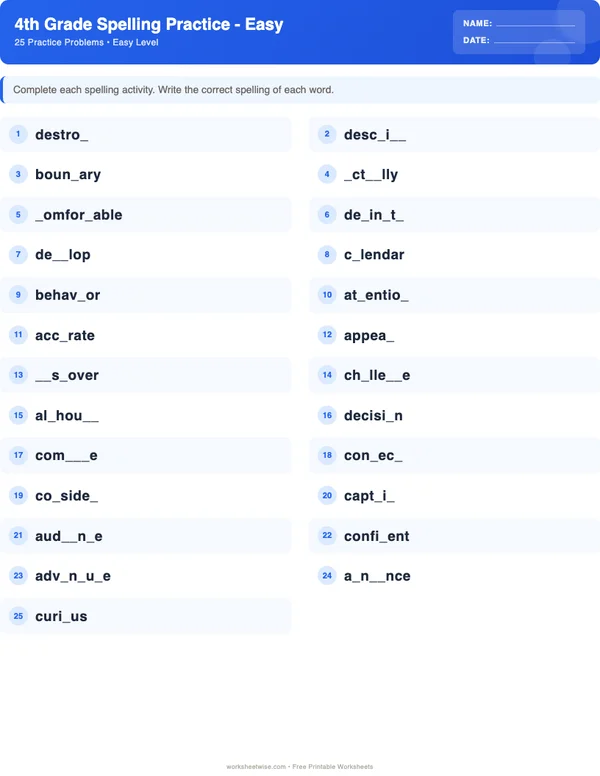
Fourth-grade spelling practice is most useful when an adult selects one bounded target, watches how the learner handles it, and chooses the next task from that evidence. The live WorksheetWise catalogue currently contains 18 fourth-grade spelling worksheet variants and one free resource: a 25-problem Spelling Words sheet. The catalogue covers short vowels, long-vowel spellings, consonant doubling, r-controlled vowels, silent letters, prefixes, suffixes, high-frequency words, and multisyllabic words.
Do not begin by asking, “Which worksheet looks fun?” Begin with a narrower question: “Which spelling decision does this learner need to practice?” A learner who writes hoping for hopping needs different work from one who writes nite for night or omits the prefix in unhappy. These errors may all produce misspelled words, but they point to different next tasks.
Grade labels describe an intended practice level, not a placement decision. Local curriculum sequences differ, and fourth graders do not encounter every pattern in the same order. Age can help an adult discover potentially suitable materials, but it is not a placement decision either. Use a brief sample of the learner’s actual spelling to decide where to start.
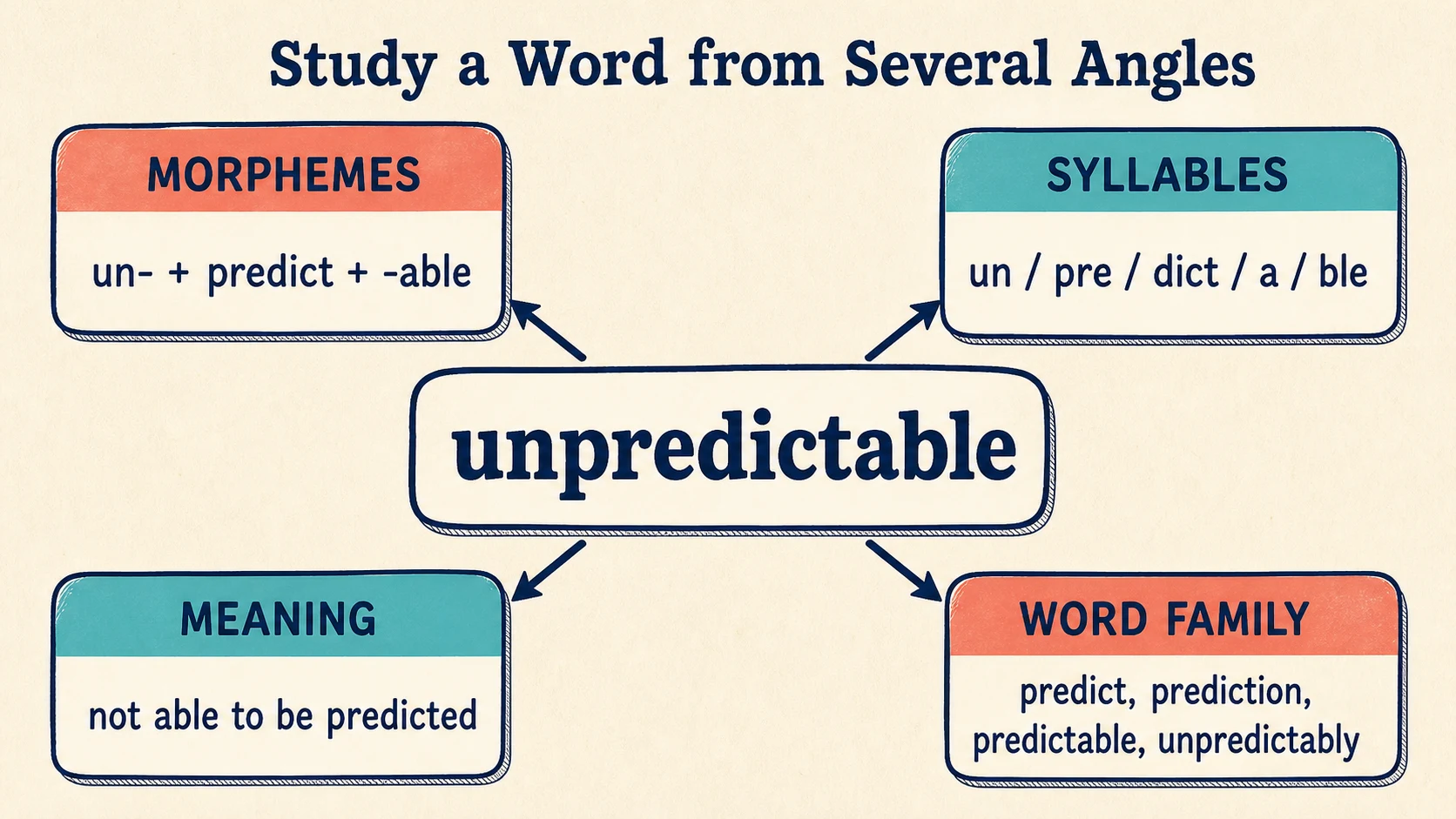
The live fourth-grade collection connects sound patterns, meaningful word parts, visual word memory, sentence use, and error checking rather than treating spelling as one undivided skill.
Read the live catalogue as a progression, not a flat list
The catalogue’s spelling targets overlap, but they should not be flattened into interchangeable “word practice.” Each asks the learner to notice and remember something different.
Vowel patterns require comparison
Short-vowel work asks the learner to connect a vowel sound with a spelling in a relatively compact word. Long-vowel work is less predictable because one sound can appear in several written patterns. The catalogue’s teaching example groups cake, rain, play, and break as long-a words.
That group is instructionally useful precisely because the words do not look the same:
- cake uses final silent e.
- rain uses ai.
- play uses ay.
- break uses ea in a less regular spelling.
A worksheet that merely asks a learner to copy all four words exercises attention and handwriting. A sort or comparison asks a more important question: “Which letter pattern represents the long-a sound in this word?” That makes long-vowel spelling a pattern-selection task rather than a single-rule task.
R-controlled vowels deserve their own attention. In a word such as storm, the vowel cannot be treated exactly like the short o in stop. The neighboring r changes the sound-pattern relationship the learner must recognize. If short-vowel items are accurate but r-controlled items are not, returning to a general short-vowel page would miss the actual need.
Consonant doubling depends on word structure
Consonant doubling often appears when a suffix is added, so the learner must coordinate the base word and the ending. Compare:
- hope + -ing → hoping
- hop + -ing → hopping
These answers have been checked: hoping retains the long vowel associated with hope and drops the final e before -ing. Hopping doubles the final p, preserving the short vowel in hop. The pair belongs in fourth-grade spelling practice because it forces a decision between two visually similar but meaningfully different words.
A learner who spells both forms with one p may not yet be attending to the vowel and base word together. A learner who writes hoppping understands that doubling is relevant but has not controlled how much to double. Those are different errors and call for different responses.
Silent letters require stable visual memory
Silent-letter words contain information that cannot be recovered from sound alone. In knock, the initial k is written but not pronounced. In night, the letters gh are not separately heard in ordinary pronunciation. Sounding out may help the learner identify much of the word, but it does not independently supply every letter.
This is where look-cover-write-check can be useful:
- Look carefully at the whole word and name the unusual part.
- Cover the word completely.
- Write it from memory.
- Uncover and compare letter by letter.
- Repeat only the missed word or missed section.
This routine is a catalogue suggestion, not a claim that WorksheetWise has tested an outcome. It is most informative when the learner marks the uncertain section before covering the word: knock or night. That turns a general memory exercise into attention to the feature that must be retained.
Prefixes and suffixes add meaning as well as letters
Affix work asks the learner to preserve a base while adding a meaningful part. Check these examples:
- happy → unhappy: the prefix un- is added; happy remains visible.
- help → helpful: the suffix -ful has one final l.
- care → careless: the suffix -less is attached to the complete base.
- kind → kindness: -ness forms the new word without removing letters from kind.
These examples belong here because they expose several possible errors: omitting an affix, changing the base unnecessarily, or spelling a frequent suffix by sound alone. They also connect spelling with meaning. Asking what un- contributes to unhappy provides a stronger check than asking only whether the word “looks right.”
Multisyllabic words can combine several demands. A learner may need to hold the base, divide the spoken word into manageable parts, and remember an affix. Success on short affixed words does not automatically show control of longer words.
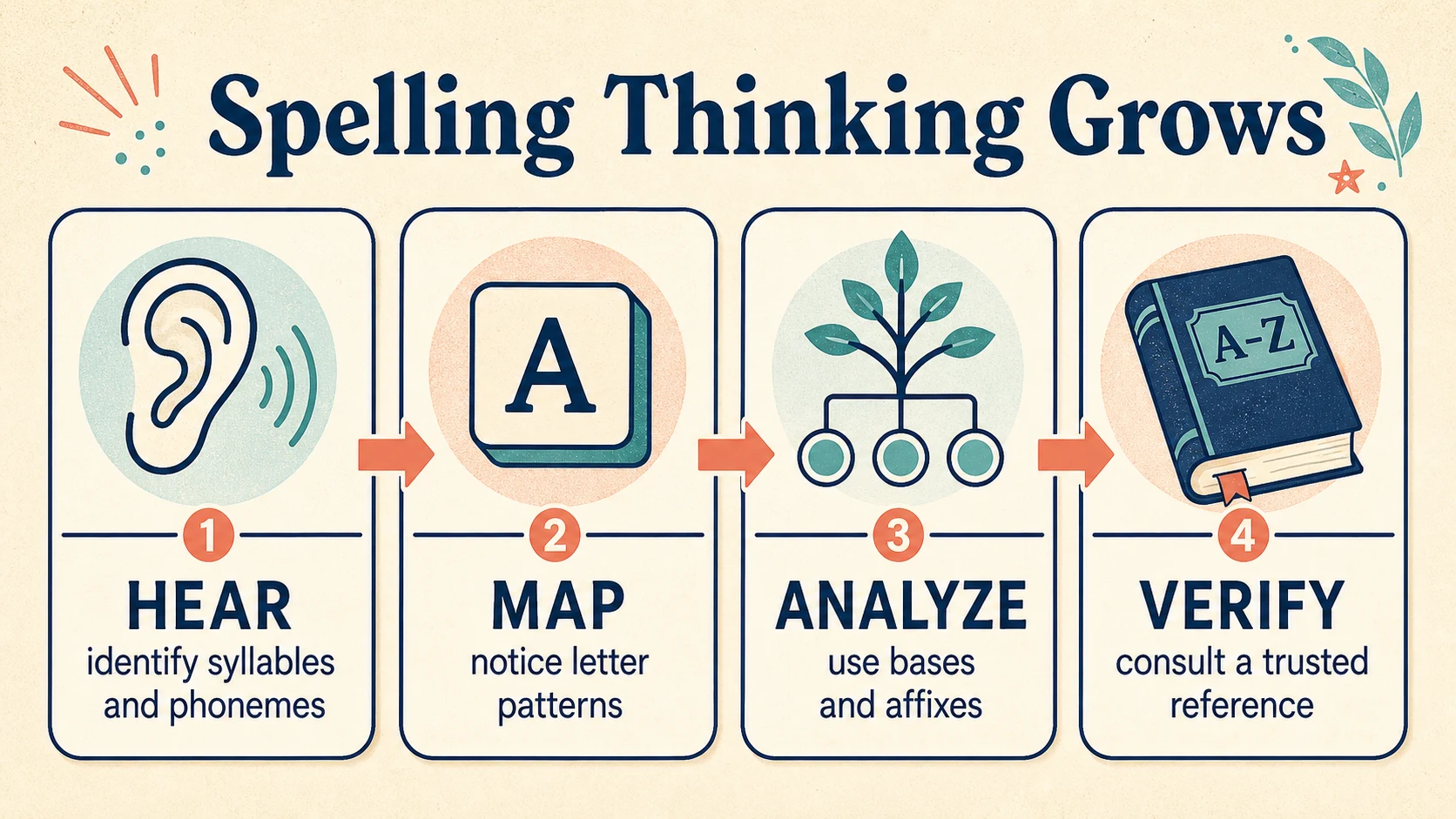
Move from visible models and spoken comparisons to covered recall, sentence use, and independent proofreading only after the target pattern is clear.
Start with a five-word evidence check
Before assigning all 25 problems on the free sheet, use a small check that samples different decisions. Say each word, use it in a sentence, and ask the learner to write it without seeing a model. A useful adult-created check might include one familiar long-vowel word, one consonant-doubling word, one silent-letter word, one affixed word, and one previously studied high-frequency word.
This is a selection tool, not a standardized assessment. Do not interpret a total score as a diagnosis.
Select by error concentration
Choose the first worksheet target using these criteria:
- If two or more errors share one pattern, begin there.
- If errors are scattered, choose the pattern the learner can discuss but cannot yet apply consistently.
- If isolated words are correct but sentences contain errors, begin with context or proofreading rather than another copying task.
- If the learner cannot hear or compare the relevant word parts, provide oral comparison before independent written work.
- If the page introduces several unfamiliar patterns at once, narrow it by assigning only the items belonging to one pattern.
Suppose a learner writes cake, rain, and play correctly but writes breck for break. Do not conclude that “long vowels are weak.” Three long-a patterns are already secure in this sample. The useful target is the unusual spelling in break, compared with a known ea word if one is available in prior instruction.
Suppose another learner writes hoping correctly for “I am hoping for sunshine” but also writes hoping for “The rabbit is hopping.” The issue is not remembering the string of letters hoping. The learner needs to contrast the base words hope and hop, then connect vowel length to the spelling change before -ing.
Define difficulty through the task
The live free sheet is catalogued as “easy,” but that label must describe the resource, not the learner. In practical terms, lower-demand task features may include familiar words, one clearly signaled operation, a visible model, limited sentence generation, or recognition before independent recall. A task becomes more demanding when the model is removed, several patterns are mixed, words must be used in original sentences, or errors must be found in a passage.
A learner can therefore complete a lower-demand matching task and still need support with unaided dictation. Conversely, a learner may spell individual words accurately but need a harder transfer task involving sentences. Describe the observed task: “accurate with a model, inconsistent after covering,” not “an easy speller.”
Work four representative examples completely
Checked examples help an adult see what each worksheet format can reveal.
Example 1: Sort long-a spellings
Sort cake, rain, play, and break by the letters representing long a.
| Spelling pattern | Word |
|---|---|
| a-consonant-e | cake |
| ai | rain |
| ay | play |
| ea | break |
All four words contain the long-a sound, but each uses a different spelling. This example belongs on this page because long-vowel spellings are explicitly part of the live catalogue, and sorting by pattern is one of its listed activities.
After the sort, ask: “Which word cannot be predicted by choosing the most common-looking pattern?” The intended observation is that break needs particular attention. Do not offer a false universal rule such as “long a is always ai in the middle.”
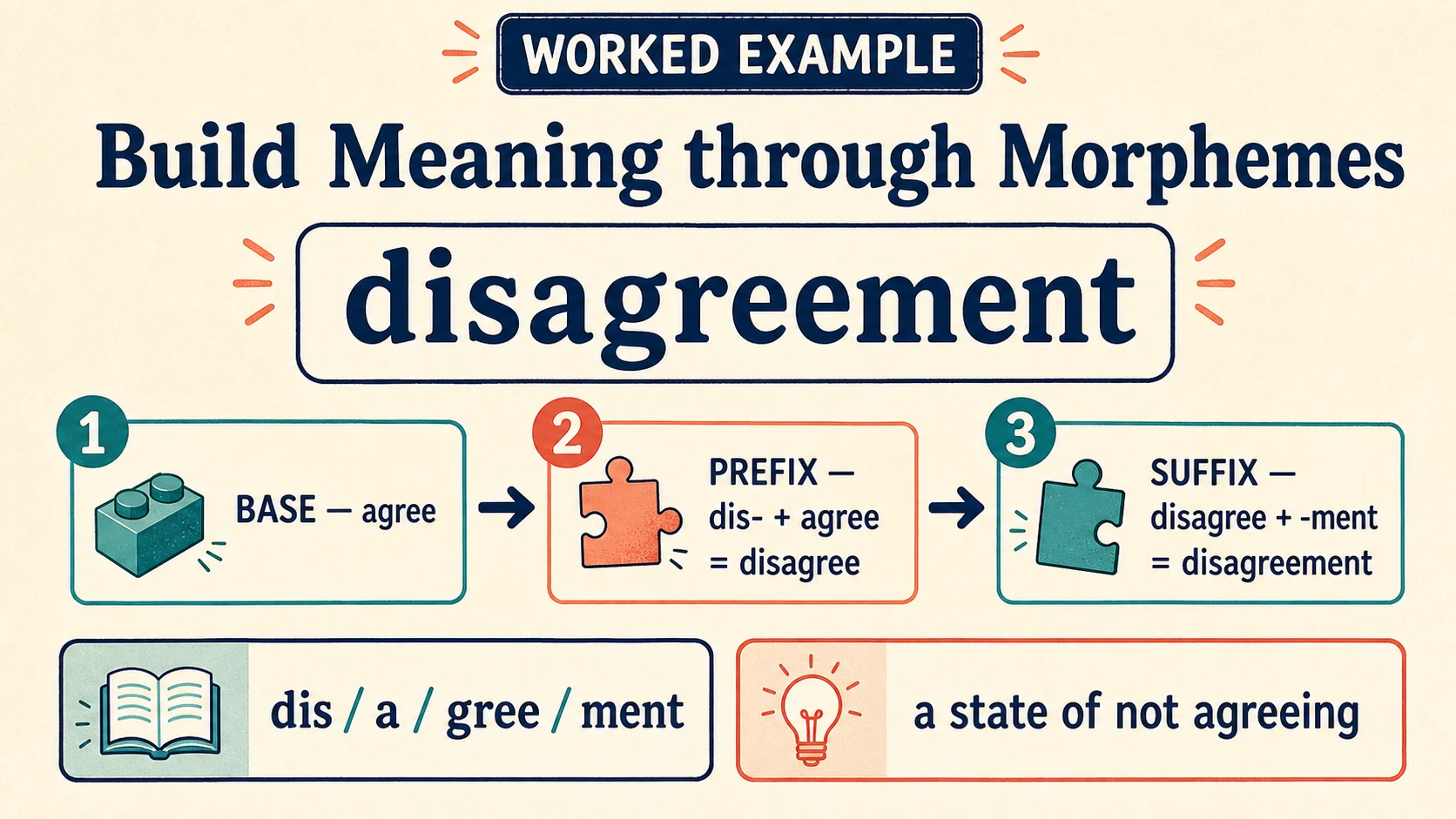
The useful work is the learner’s explanation of the chosen letter pattern, followed by accurate recall after the model is removed.
Example 2: Choose hoping or hopping
Complete each sentence.
-
“We are ___ that the game continues.”
Correct answer: hoping. -
“The frog is ___ across the path.”
Correct answer: hopping.
The first sentence comes from hope and refers to wanting something to happen. The second comes from hop and describes repeated jumping. This checked pair belongs here because it joins sentence context with consonant doubling, two live catalogue features.
If the learner chooses correctly but cannot spell the forms, return to the bases hope and hop. If the learner spells both correctly in isolation but reverses them in sentences, emphasize meaning and rereading rather than more copying.
Example 3: Repair a silent-letter sentence
Draft: “At nite, I herd a nok at the door.”
Checked correction: “At night, I heard a knock at the door.”
The target silent-letter corrections are nite → night and nok → knock. The correction herd → heard is a different issue: two words can sound alike while carrying different spellings and meanings. It should not be mislabeled as the same silent-letter pattern.
This example belongs here because identifying misspelled words in passages is a live activity. It also demonstrates why an adult should classify errors instead of circling every mistake as equivalent. Ask the learner to underline only the letters that changed, then explain which corrections could not be determined from sound alone.
Example 4: Preserve the base in an affixed word
Prompt: Add a prefix or suffix to complete each sentence.
-
“The directions were not clear; they were ___.”
Correct answer: unclear. -
“Maya showed great ___ to the new student.”
Base: kind. Correct answer: kindness. -
“That cracked cup is ___.”
Base: use. Correct answer: useless.
These answers have been checked for spelling and sentence meaning. They belong here because prefixes and suffixes appear in the catalogue, while sentence use tests whether the learner can connect the completed word with context.
Notice that use + -less becomes useless, not uselesss and not usless. The final e in use remains, and the suffix contributes its own double s. Have the learner bracket the parts: use + less. That preserves the affix target while reducing visual overload.
Interpret errors before assigning more problems
An error is useful when it changes the next teaching decision. Merely writing the correct form beside every misspelling does not show whether the difficulty involved hearing, pattern selection, memory, meaning, or proofreading.
A practical error map
| Observed work | Plausible interpretation | Next response |
|---|---|---|
| ran for rain | The vowel team was omitted | Compare short-a and long-a aloud; then sort ran/rain |
| hoping for hopping | The learner did not preserve the short vowel through doubling | Contrast hope/hop before adding -ing |
| nite for night | The spelling follows sound but omits the conventional silent-letter sequence | Mark igh, use look-cover-write-check, then recall later |
| unkindnes for unkindness | The prefix and base are present; the suffix ending is incomplete | Box un, kind, and ness separately |
| Correct list, errors in a paragraph | Recall has not transferred consistently to proofreading | Use a short passage containing two target words |
| Correct after copying, incorrect when covered | Recognition exceeds unaided recall | Shorten the set and add delayed covered retrieval |
These interpretations are hypotheses based on the written evidence, not diagnoses. Confirm them by asking the learner to read the word, identify the intended pattern, and try one closely related item.
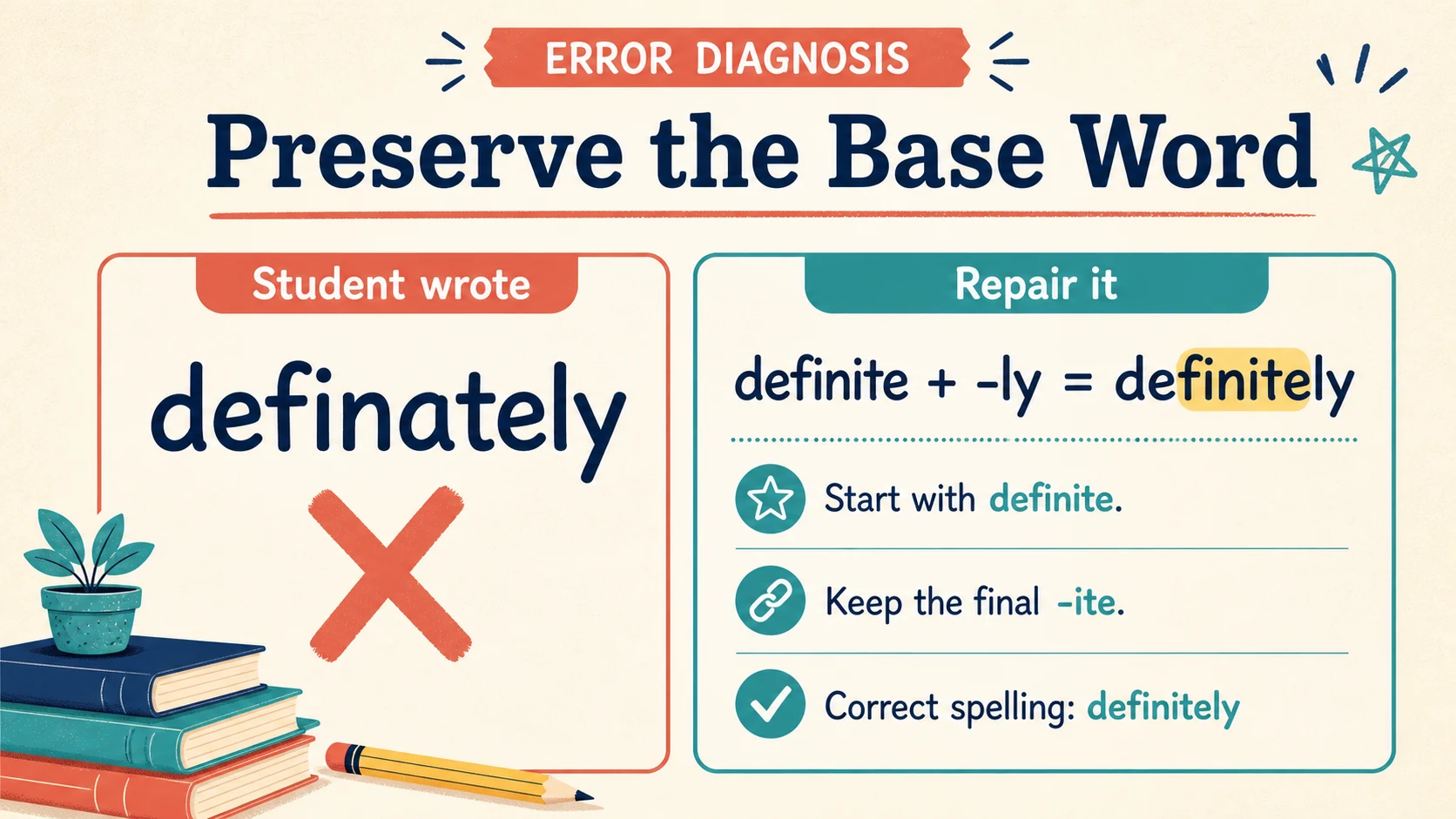
Match the response to the part of the word that changed: vowel pattern, doubled consonant, silent sequence, base, affix, or context choice.
The IES foundational reading practice guide supports systematic instruction that helps elementary learners connect sounds, letter patterns, and word reading. It does not evaluate WorksheetWise. Applied cautiously here, that guidance favors explaining a spelling pattern and giving connected practice rather than assigning an unrelated list.
The IES elementary writing guide recommends teaching the writing process and foundational writing skills while giving students regular opportunities to write. It likewise did not assess these worksheets. For this page, the relevant editorial implication is that spelling-list accuracy should eventually be checked in a sentence or short piece of writing.
Use a short routine that produces visible evidence
A spelling session does not need to consume the whole homework period. Ten focused minutes can reveal more than prolonged, inattentive copying.
The look, sort, recall, use, check cycle
- Look: Present three to six words sharing one target. Read them and mark the relevant letters.
- Sort: Group the words by their actual spellings, not merely by sound.
- Recall: Cover the models and dictate the words in a new order.
- Use: Put one or two words into supplied or learner-created sentences.
- Check: Compare letter by letter, circle the changed section, and name the pattern.
If the learner misses rain, do not require three unexamined copies of the whole list. First identify ai as the missing part. Then use a small correction sequence: look at rain, cover it, write it, check it, and try it again after another word.
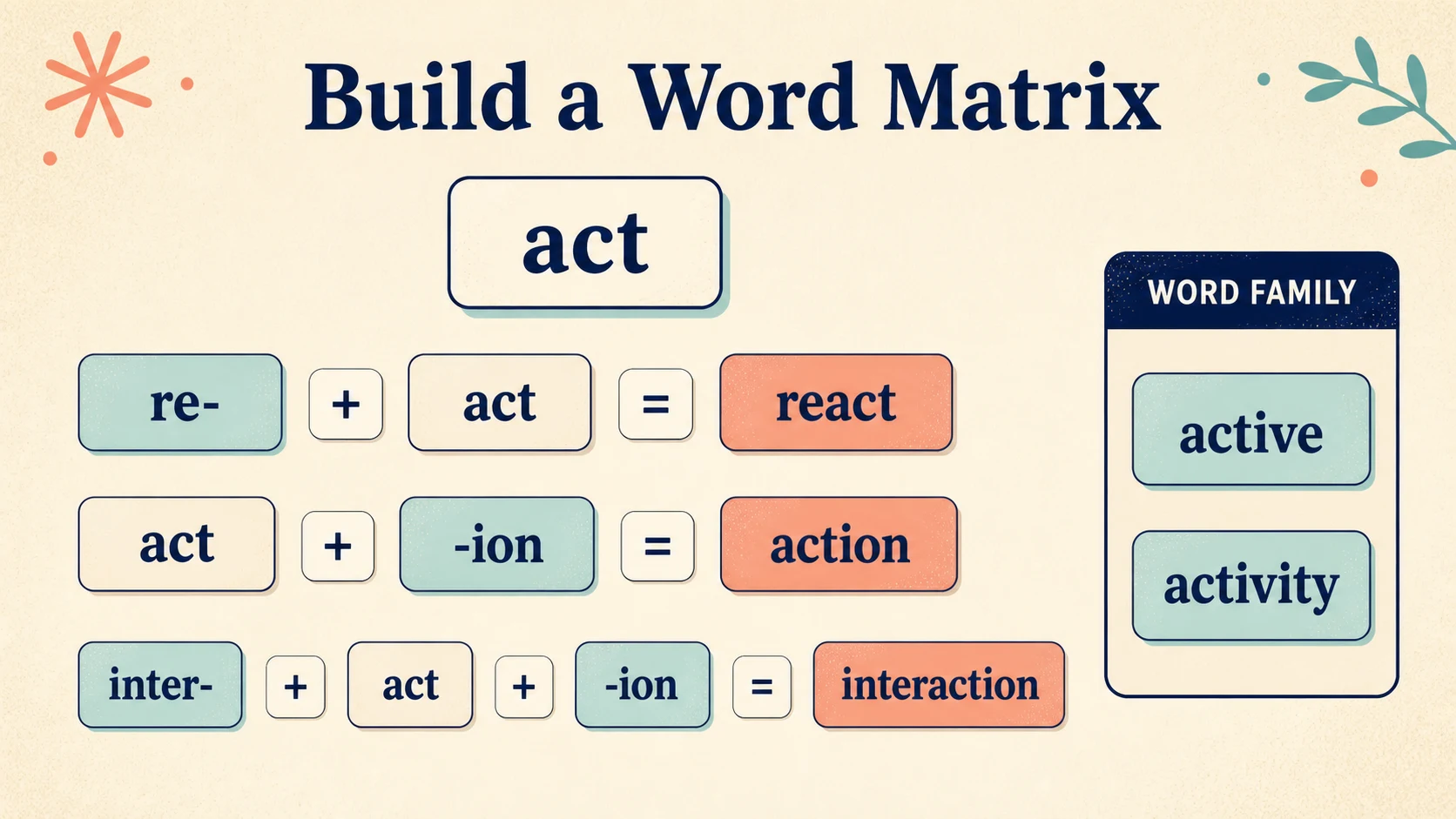
Each session should end with something observable: a correct covered spelling, an accurate sort, or a target word used and checked in context.
The catalogue also lists rainbow writing and word searches. Treat these as review formats, not automatic substitutes for recall. Rainbow writing can direct attention to letter order if the learner says or marks the target pattern while tracing. A word search can support careful visual recognition, but finding night in a grid does not establish that the learner can spell night from dictation.
Plan two weeks without turning practice into repetition
A two-week sequence can revisit one target in changing formats.
Week one: establish and contrast
- Day 1: Preview and sort four to six words by pattern.
- Day 2: Use look-cover-write-check on the words that were missed.
- Day 3: Contrast confusing forms, such as hoping/hopping.
- Day 4: Complete sentence items requiring meaning as well as spelling.
- Day 5: Dictate a mixed sample and retain the actual errors.
Week two: retrieve and transfer
- Day 6: Revisit only the missed pattern after a delay.
- Day 7: Add two new words that genuinely use the same pattern.
- Day 8: Find and correct target errors in a short passage.
- Day 9: Write two sentences containing selected target words.
- Day 10: Check a cumulative sample containing current and previously practiced patterns.
This schedule is a suggested implementation, not a sourced promise about learning outcomes. It prevents every day from becoming the same copying exercise and gives the adult several kinds of evidence.
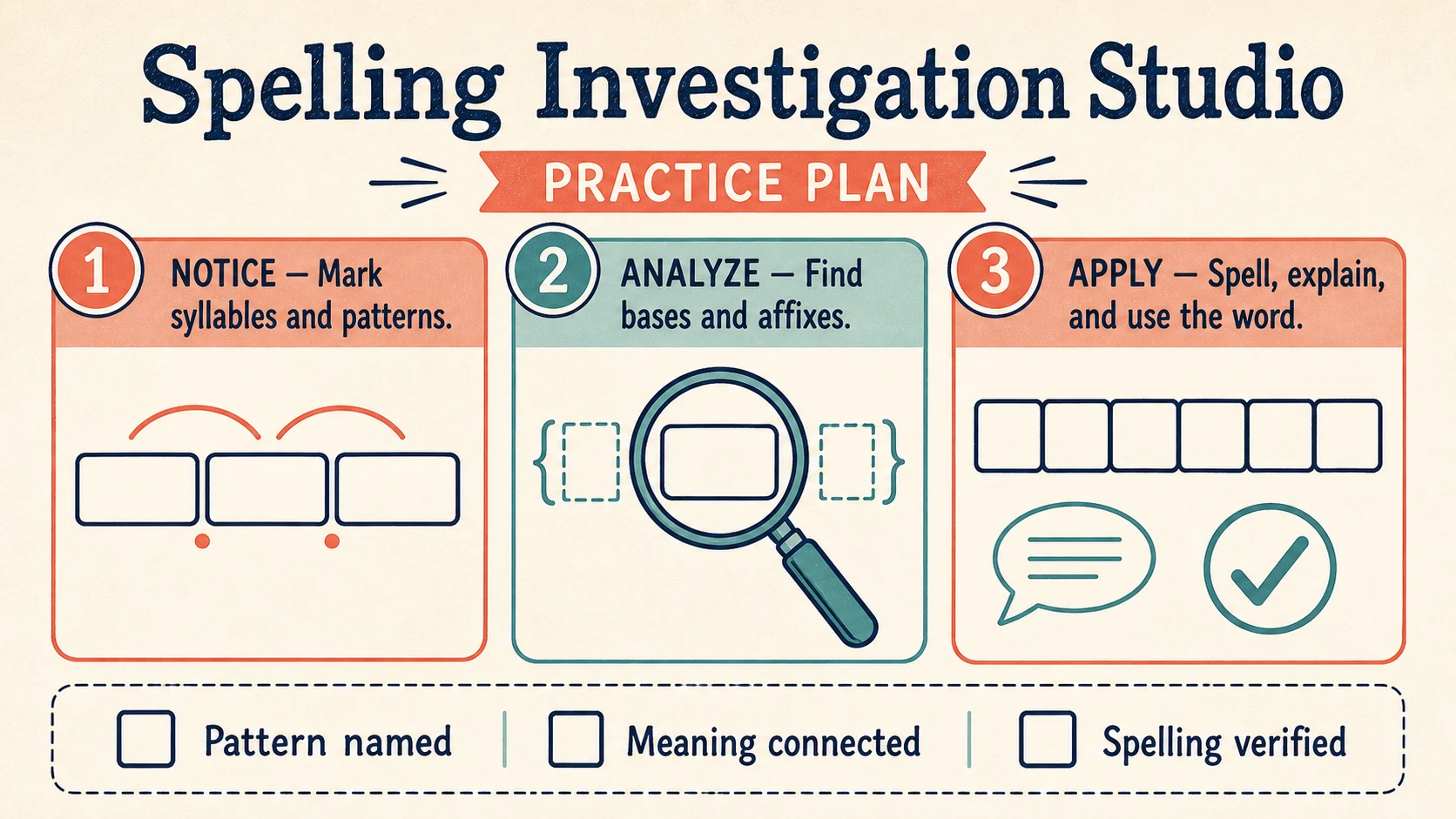
Revisit the same spelling decision through sorting, recall, context, proofreading, and delayed review rather than repeating one page unchanged.
For weekly home use, the Homework Spelling Worksheets collection can help adults find a practice context. Educators planning independent or fast-finisher work can compare the Classroom Spelling Worksheets. Families coordinating spelling with broader home learning can use the 4th Grade Homeschool Worksheets. These links organize materials by setting; they do not determine the correct level for an individual learner.
Adapt the task while preserving the spelling decision
An adaptation should reduce an obstacle without replacing the target skill.
When writing volume is the obstacle
Ask the learner to spell four target words rather than twenty-five, but keep covered recall. Let the learner dictate a sentence to the adult and independently write only the target word. This reduces handwriting volume without converting spelling into multiple-choice recognition.
When visual density is the obstacle
Cover unused parts of the page, enlarge one section, or present one row at a time. Keep the original spelling pattern and response requirement. Do not reveal the answer beside the item during recall.
When oral language needs support
Read the word, place it in a concrete sentence, and ask the learner to repeat it before spelling. For an affixed word, say the parts separately and then blend them: kind, ness, kindness. This supports access to the word while preserving the need to spell its parts.
When the standard task is already secure
Increase the task demand, not merely the list length. Remove the visible model, mix two previously taught patterns, ask for sentence use, or insert target errors into a brief proofreading passage. The catalogue suggests adding two or three challenge words that extend a pattern; adults should verify that each proposed word actually follows or meaningfully contrasts with the target.
The Common Core English Language Arts standards include grade-level expectations for language conventions and using spelling resources as appropriate. They did not review WorksheetWise, and local standards may sequence expectations differently. Use standards as broad planning context, not as evidence that every fourth-grade worksheet suits every fourth grader.
Know what a spelling worksheet cannot establish
A worksheet provides a sample under particular conditions. It cannot establish a diagnosis, explain every error, or prove that a spelling has transferred to unrestricted writing. Performance may change with fatigue, unfamiliar vocabulary, handwriting demands, attention, or whether a model is visible.
Avoid these conclusions:
- “Five errors mean the learner is below grade level.”
- “A perfect word search means the spellings are mastered.”
- “Correct copying means the words can be recalled.”
- “One difficult suffix proves a general language problem.”
- “A fourth-grade label means the page matches every local curriculum.”
Instead, report what was observed: “The learner spelled four long-a words correctly when visible and two correctly after covering,” or “The base word stayed intact, but -ness lost its final s twice.” Such descriptions make the next decision defensible.
Also distinguish worksheet practice from authentic writing. Sentence construction and passage correction move closer to everyday use, but they remain controlled tasks. Check later whether the learner notices the same target in ordinary writing. If persistent concerns extend beyond the sampled pattern, consult the learner’s teacher or an appropriately qualified professional rather than treating a printable as an assessment instrument.
Make the next task answer one clear question
Use the learner’s most recent work to choose one of three routes:
- Pattern unclear: return to a visible comparison and sort.
- Pattern understood but not recalled: use a small look-cover-write-check set.
- Words recalled but not transferred: use sentence dictation or a short proofreading passage.
Then write one observable goal for the next session. For example: “After sorting cake, rain, play, and break, the learner will spell three of the four from covered dictation and mark the long-a letters during checking.” This goal names the material, condition, response, and evidence. It does not label the learner or promise a long-term result.
Start now with the 4th Grade Spelling Words guide and free 25-problem sheet. Preview the items, select only one shared pattern for the first sitting, and save the learner’s uncorrected spellings. Use those spellings—not the grade label or total worksheet count—to select tomorrow’s task.
Put it into practice
Use the guide with a real printable
Move from explanation to a short, observable practice task. Check the first item together, then adjust the next session from the learner's actual work.
Open the first free worksheet