4th Grade · 3 live skills
4th Grade grammar worksheets
Pick the exact skill below. Each page combines a real free download, a separate answer key, practical teaching guidance and an optional focused pack.
See all 4th Grade subjects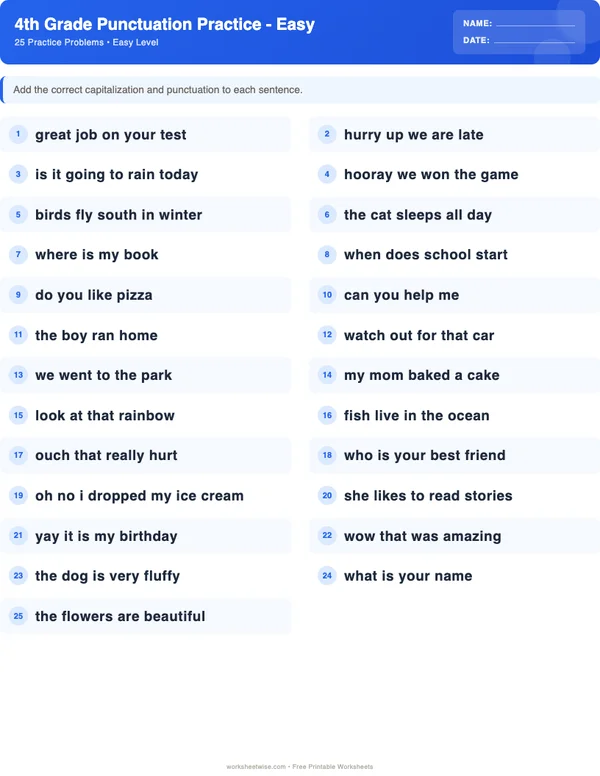
Complete guide
How to teach and practise 4th grade grammar worksheets
3,443 words Updated 6 instructional visuals
Start with one bounded grammar decision
The live 4th grade grammar catalogue contains 54 worksheet variants across three topics: parts of speech, punctuation, and sentence structure. Each topic has one free 14-problem entry sheet. The most useful starting point is not “grammar” in general. Choose one decision the learner can make and explain:
- Which job is a word doing in this sentence?
- Which punctuation rule applies here?
- Is this thought a complete, correctly joined sentence?
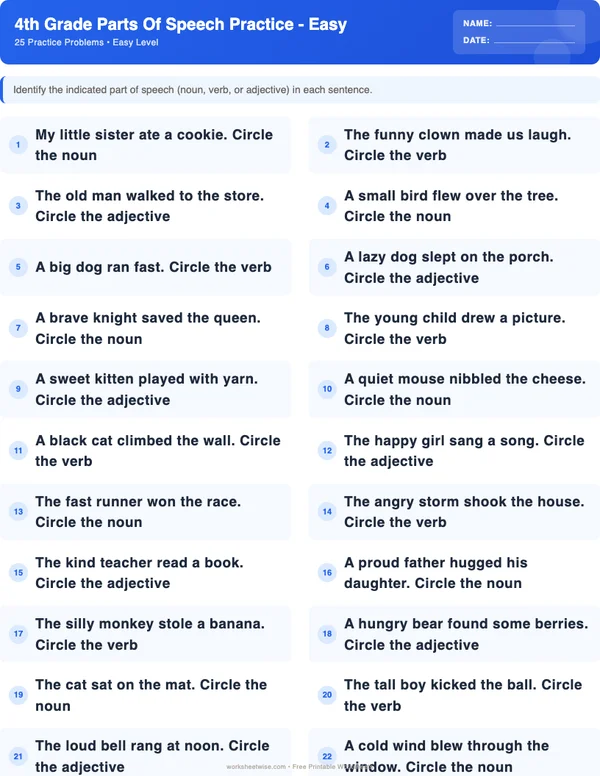
Begin with the 4th Grade Parts of Speech guide and free sheet when the learner cannot reliably distinguish nouns, verbs, and other word functions in context. Choose the 4th Grade Punctuation guide and free sheet when the sentence is structurally sound but its commas, apostrophes, quotation marks, or end marks are missing or misused. Use the 4th Grade Sentence Structure guide and free sheet when fragments, run-ons, weak sentence combining, or incomplete subjects and predicates are the main concern.
Grade labels describe the intended practice level, not a placement verdict. Local curriculum sequences differ, and a learner’s age is only a discovery aid—not a placement decision. Look at the work actually produced. One corrected item can reveal more about a useful next task than the worksheet title alone.
How the three live skill strands fit together
The strands overlap, but they are not interchangeable. Parts of speech examines the function of words and groups of words. Sentence structure examines how those parts form complete thoughts and connect clauses. Punctuation shows readers how the completed structure should be interpreted.
Consider this sentence:
After the storm ended, we carried the wet branches outside.
A parts-of-speech task might ask the learner to identify storm and branches as nouns, ended and carried as verbs, wet as an adjective, or after as part of an introductory phrase. A sentence-structure task might ask for the subject and predicate or examine how the opening element relates to the main clause. A punctuation task would focus on the comma after ended.
The sentence supplies one context, but each task demands a different decision. Marking every noun does not demonstrate control of the introductory comma. Adding the comma does not prove that the learner can explain why wet modifies branches. Keep the target visible so a correct response is credited for the right reason.
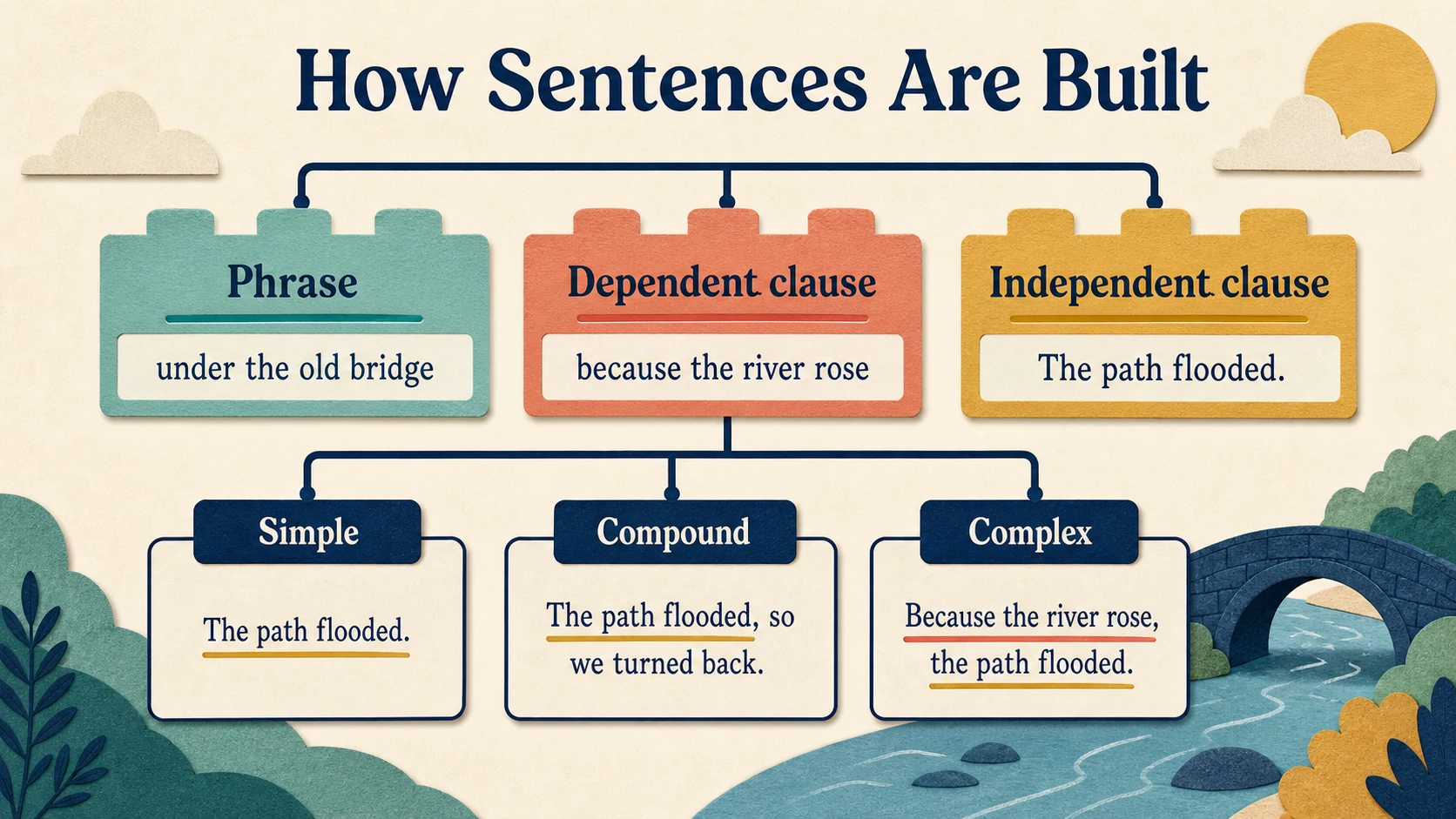
Sentence structure connects complete thoughts, subjects and predicates, fragments and run-ons, sentence expansion, and sentence combining.
What comes before and what develops here
Earlier grammar work commonly emphasizes complete sentences, basic nouns and verbs, and end punctuation. The live 4th grade resources retain those foundations while extending practice toward all eight parts of speech, sentence combining, compound and complex constructions, introductory elements, dialogue punctuation, contractions, possessives, and more varied sentence beginnings.
That progression is not a command to teach every listed feature at once. A learner who can identify nouns but cannot find the complete subject may need sentence-structure practice rather than a larger parts-of-speech inventory. A learner who writes complete sentences but omits commas in a series has a narrower punctuation target.
The catalogue describes its worksheets as using explicit instruction followed by guided and independent practice and as aligning with Common Core Language standards. The Common Core English Language Arts standards provide a public standards framework, but a standards label should not replace inspection of the exact item, the local curriculum, or the learner’s response.
Choose a starting sheet from observable evidence
Use a short writing sample, a recently completed worksheet, or three sentences dictated by the learner. Circle repeated errors before selecting a resource.
| Evidence in the work | Best initial strand | Bounded target |
|---|---|---|
| The learner labels words by meaning alone and ignores their sentence function | Parts of speech | Identify nouns and verbs in complete sentences |
| Lists repeatedly lack separators | Punctuation | Place commas between items in a series |
| Apostrophes appear in ordinary plurals | Punctuation | Distinguish plural nouns from possessive nouns |
| Groups of words lack a subject or a complete predicate | Sentence structure | Distinguish fragments from complete sentences |
| Two complete thoughts are joined only by a comma | Sentence structure, then punctuation | Locate both clauses and choose a valid joining method |
| Every sentence begins with the subject | Sentence structure | Revise one sentence with an introductory phrase |
| Pronouns leave the reader unsure who is meant | Parts of speech in sentence context | Connect each pronoun to a clear antecedent |
Do not assign all three free sheets as a placement battery. Each contains 14 problems, so completing all of them could obscure the specific decision you need to observe. Start with three or four representative items. Continue only if the responses remain informative.
Define “easy” by the task, not the learner
The three free catalogue sheets carry the difficulty label “easy.” Treat that label as a description of an entry task, never as a description of a child. Observable entry-task features might include a clearly stated direction, one dominant rule, familiar vocabulary, limited sentence length, or a response that requires identifying or correcting one feature at a time.
Before using a sheet, inspect it. Ask:
- Must the learner recognize a feature, supply it, explain it, or use it in original writing?
- Does one item contain several possible corrections?
- Is unfamiliar vocabulary adding a reading demand?
- Is handwriting or copying consuming attention that should be spent on grammar?
- Does the page provide an example of the intended response?
These questions describe the actual demand. They are more useful than deciding that a learner “is easy” or “is advanced.”
Parts of speech: identify a word’s current job
The live parts-of-speech strand progresses from nouns and verbs in simple sentences toward classifying nouns, verbs, adjectives, adverbs, pronouns, prepositions, conjunctions, and interjections in more complex passages. Its teaching guidance recommends beginning with the concrete core of noun and verb, working in real sentences, and recognizing that a word’s function can change with context.
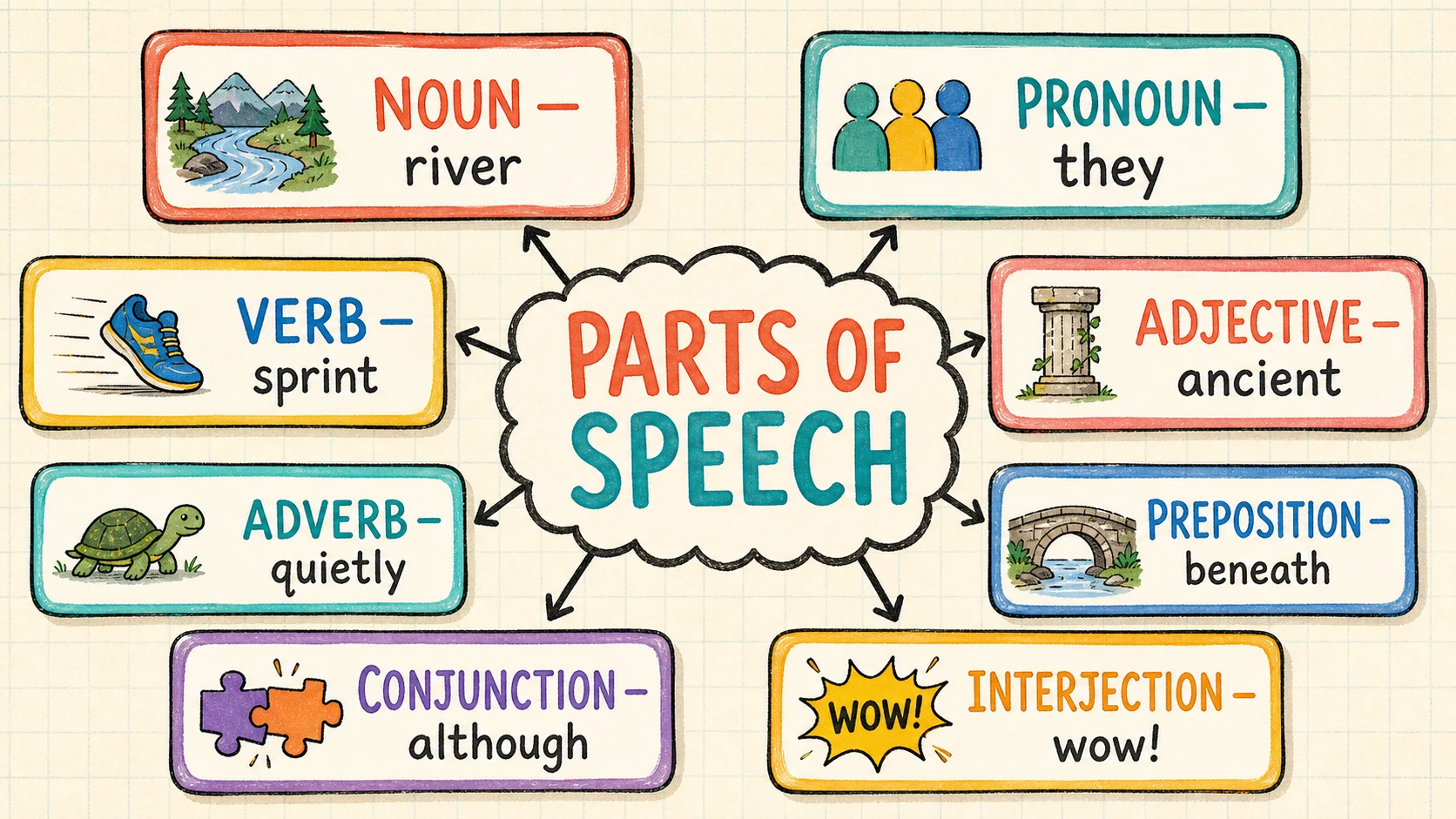
The 4th grade target is not merely memorizing eight labels; it is using sentence context to determine what each word does.
Checked example: the same word in two roles
Compare:
We light the lantern at dusk.
The light filled the tent.
In the first sentence, light is a verb. The subject we performs the action light. In the second, light is a noun and is the subject of filled. The spelling and pronunciation are the same, so a learner cannot solve the task by memorizing “light is a noun.”
A useful check is substitution:
We carry the lantern at dusk.
The sunshine filled the tent.
Carry occupies a verb position; sunshine occupies a noun position. Both substitutions preserve the basic structures, confirming the classifications.
This example belongs in 4th grade practice because the catalogue explicitly extends parts-of-speech work beyond isolated definitions and notes that English words can perform different functions depending on context. If the learner labels both instances as nouns, say, “You recognized one possible meaning. Now use the whole sentence to test the word’s job.” That response preserves what was understood while redirecting attention to syntax.
Checked example: pronoun and antecedent clarity
Consider:
When Maya met Ava after practice, she carried the poster home.
She is a pronoun, but its antecedent is unclear: either Maya or Ava could have carried the poster. Two valid revisions are:
When Maya met Ava after practice, Maya carried the poster home.
After practice, Maya met Ava, who carried the poster home.
The first replaces the pronoun with the intended noun. The second restructures the sentence so who refers to Ava. This is not just a labeling exercise; it shows why pronoun-antecedent work matters to meaning.
This example belongs here because the live guidance calls for teaching upper-grade pronouns alongside their antecedents. If a learner circles she correctly but sees no ambiguity, the next task should be revision for reference—not another page of pronoun identification.
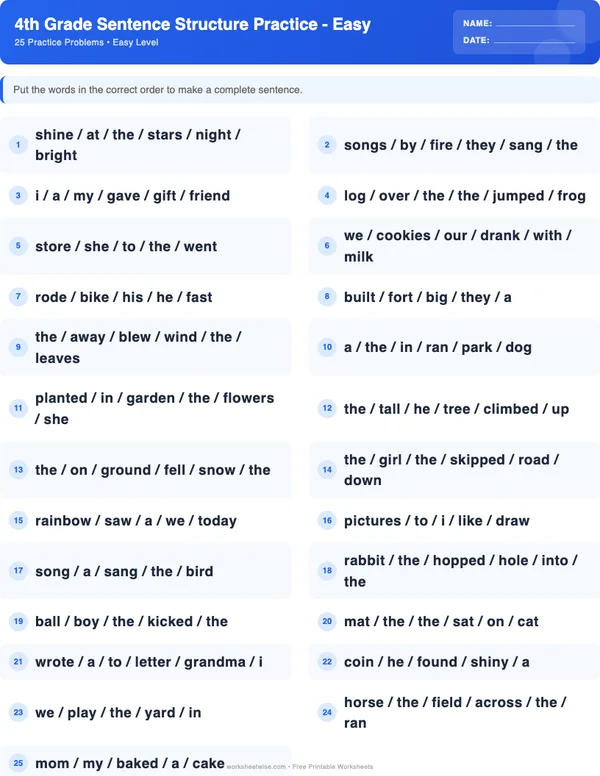
Sentence structure: find complete thoughts before joining them
The live sentence-structure strand includes sentence types, subjects and predicates, fragments, run-ons, expansion, and combining. A practical entry question is: “Who or what is this about, and what does the sentence say about that subject?”
Checked example: fragment or complete sentence
Examine:
Under the old wooden bridge.
This group of words has detail but no complete assertion. Under the old wooden bridge is a prepositional phrase; it does not tell who or what acted or existed there. Two possible completions are:
The hikers rested under the old wooden bridge.
Under the old wooden bridge, a fox waited.
Both revisions supply a subject and a predicate. The second also creates an introductory phrase followed by a comma.
This example belongs at this level because the catalogue specifically identifies fragments, subjects and predicates, and varied sentence beginnings as sentence-structure targets. If the learner calls the fragment a sentence because it starts with a capital and could end with a period, ask for the “who or what” and “did what or was what.” The error suggests reliance on surface punctuation, not proof of a broader reading or language problem.
Checked example: three legitimate ways to combine
Start with:
The rain stopped. We returned to the field.
Three correct combinations express slightly different relationships:
The rain stopped, and we returned to the field.
When the rain stopped, we returned to the field.
The rain stopped; we returned to the field.
The first joins two independent clauses with a comma and coordinating conjunction. The second makes the timing relationship explicit with a dependent opening clause. The third uses a semicolon between closely related independent clauses.
An incorrect version is:
The rain stopped, we returned to the field.
That comma splice uses a comma alone to join two complete thoughts.
This is appropriate representative work because the live strand moves from simple sentences to combining clauses and forming compound and complex sentences. Do not require the semicolon form merely because it appears more sophisticated. Ask which version expresses the intended relationship most clearly. The catalogue includes semicolons in its punctuation progression, but local instructional order may place them later.
The IES guide on teaching elementary students to be effective writers recommends explicit instruction in the writing process and in foundational writing skills, alongside frequent opportunities to write. Applied here, a worksheet should feed into composing or revising a real sentence rather than remain a disconnected labeling event. That application is an editorial suggestion; the source did not evaluate WorksheetWise.
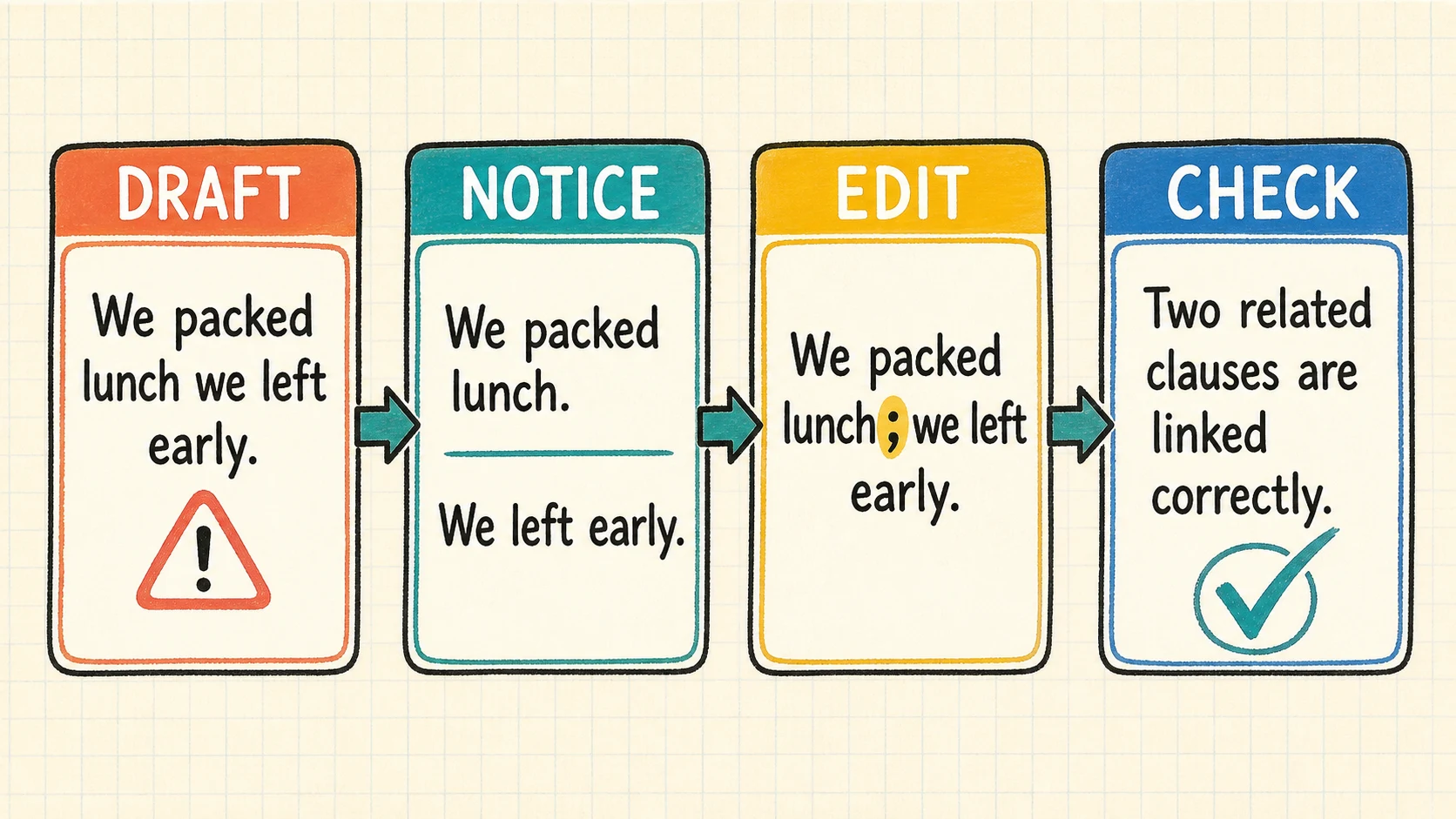
Move from noticing a marked feature, to explaining a rule, to correcting a sentence, and finally to applying the feature in the learner’s own writing.
Punctuation: teach one reason for a mark at a time
The live punctuation strand ranges from end marks to commas in lists, dates, addresses, compound sentences, and introductory elements; it also includes apostrophes, quotation marks, colons, and semicolons. Those uses should not be flattened into “comma practice” or “apostrophe practice.” Each mark can serve more than one purpose.
Checked example: commas in a series
The unpunctuated sentence is:
We packed pencils notebooks markers and tape.
The checked version is:
We packed pencils, notebooks, markers, and tape.
The commas separate four items in a series. The final comma before and follows the convention used in this guide; if a local style guide handles that comma differently, follow the required local convention consistently.
This example belongs here because commas in lists are explicitly named in the live catalogue. It is also bounded: the learner need not decide among dialogue, introductory, date, and clause-joining comma rules at the same time.
A learner who inserts only one comma—
We packed pencils, notebooks markers and tape.
—may understand that the sentence contains a list but not yet track every boundary. Have the learner underline each item first, then place a separator between neighboring items. That is a different teaching response from the one needed when no list is recognized.
Checked example: contraction, possessive, or plural
Compare:
The dogs barked.
The dog’s leash was red.
The dogs’ leashes were tangled.
It’s raining.
The checks are:
- dogs is a plural noun: more than one dog, with no ownership.
- dog’s is singular possessive: the leash belongs to one dog.
- dogs’ is plural possessive: the leashes belong to multiple dogs.
- it’s is the contraction of it is.
Replace it’s with it is to verify the contraction: “It is raining” remains grammatical and preserves the meaning. That replacement test does not work for possessives.
This belongs in the 4th grade punctuation guide because the catalogue explicitly distinguishes apostrophes in contractions from apostrophes in possessives. If a learner writes apple’s for a simple plural, avoid saying, “Apostrophes show more than one.” Ask whether the word means “several apples,” “something belonging to one apple,” or a contraction. The answer selects the form.
A short routine that ends in real writing
A repeatable lesson can fit into about ten to fifteen focused minutes, adjusted for the learner’s stamina and the complexity of the item.
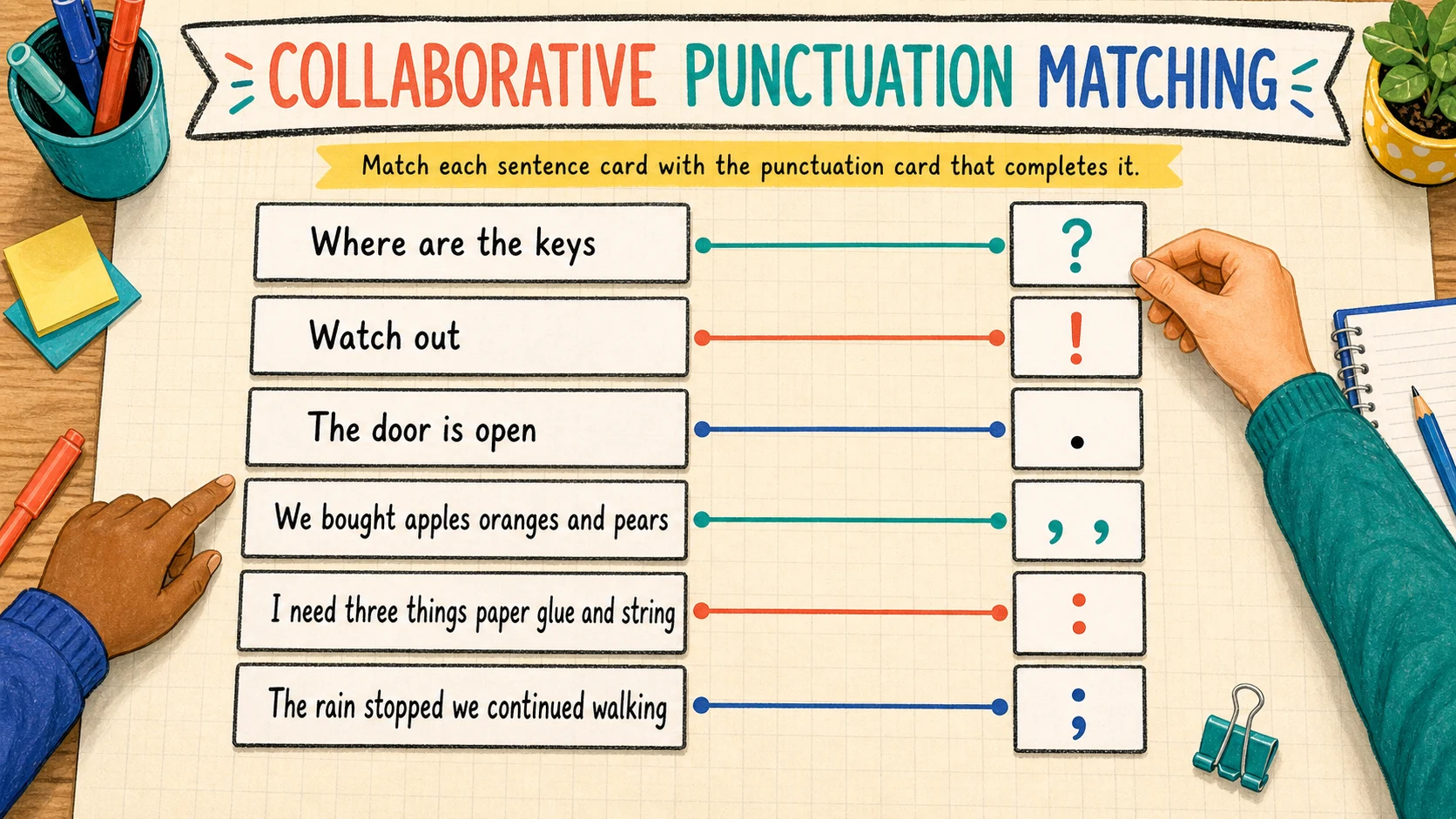
Use a compact cycle: notice, name the reason, complete a few items, revise one authentic sentence, and record the next decision.
Model, guide, release, inspect
- State one target. Say, “Today we will separate items in a series,” not “Today we will do commas.”
- Model one item aloud. Underline the list items and explain why each comma is placed.
- Complete two items together. Ask the learner to identify the structure before adding any mark.
- Assign three or four independent items. Stop before fatigue turns the page into handwriting endurance.
- Transfer the skill. Have the learner write or revise one sentence connected to current reading, science, social studies, or daily life.
- Inspect the reasoning. Ask, “What made you choose that answer?” Record whether the error concerned recognition, rule selection, execution, or transfer.
For parts of speech, the transfer might be replacing a vague verb with a precise one. For sentence structure, it might be combining two repetitive sentences from a paragraph. For punctuation, it might be correcting one list or possessive in the learner’s own writing.
The IES foundational reading practice guide addresses foundational skills that support reading for understanding. It is useful background for considering how word reading and oral language demands can affect access to written tasks, but it is not a 4th grade grammar worksheet review. If decoding consumes most of the learner’s attention, read the directions or sentence aloud while preserving the grammar decision.
Interpret errors before assigning more problems
A wrong answer is evidence about a decision, but one response does not establish a diagnosis.
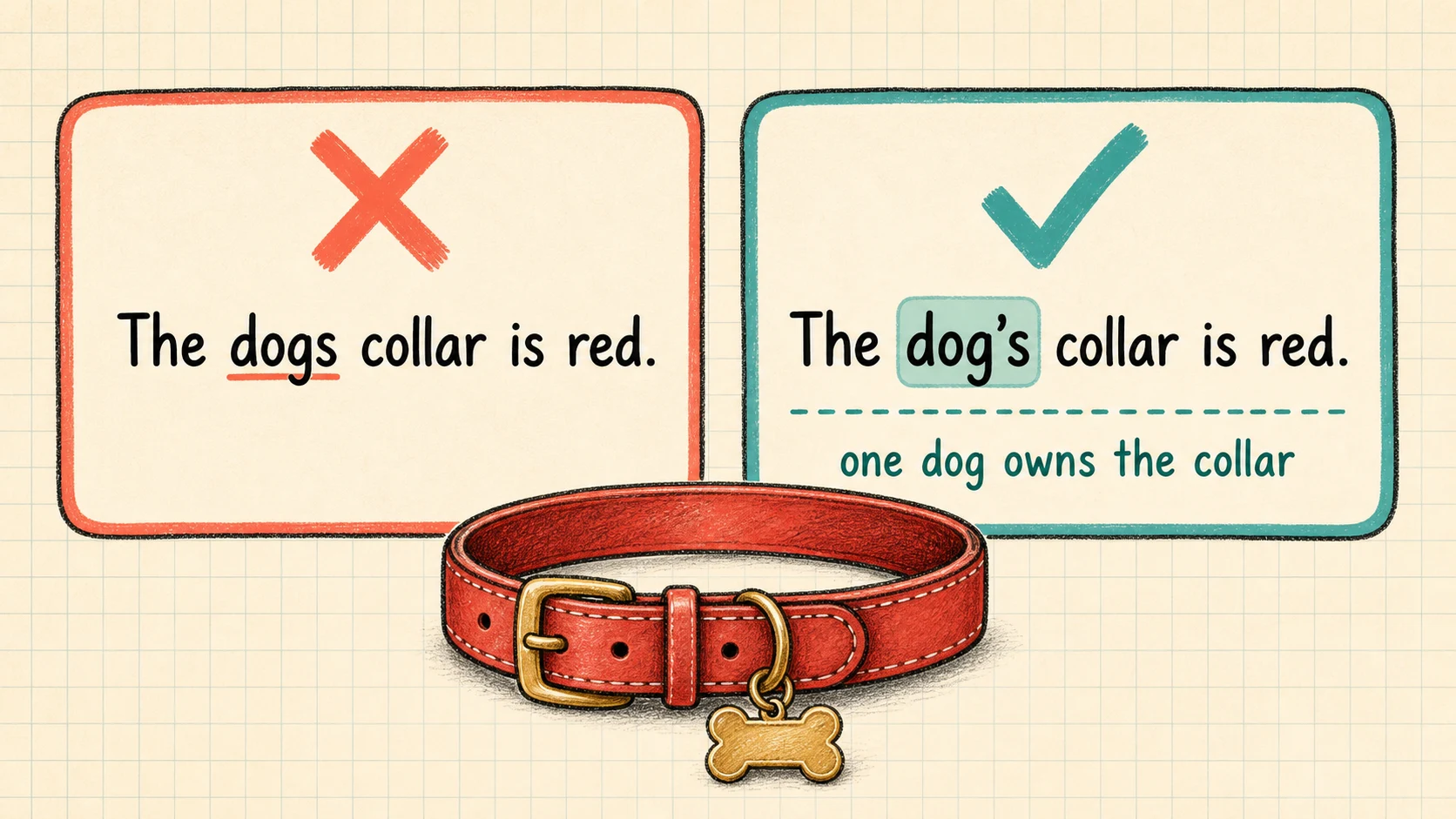
Match the teaching response to the observable error: locating a structure, selecting a rule, executing a convention, or transferring it into writing.
Four error patterns that require different responses
The learner cannot locate the relevant structure.
If commas in a compound sentence are the target but the learner cannot identify the two complete clauses, return briefly to subjects, predicates, and complete thoughts. More comma items will not repair an unseen clause boundary.
The learner sees the structure but chooses the wrong rule.
A learner may identify two complete thoughts yet insert a comma without a conjunction. Compare three joining options side by side and have the learner name what each option requires.
The learner explains the rule but omits the mark while drafting.
This may be a transfer or editing issue. Let the learner finish the draft, then conduct a single-purpose editing pass: “Check only introductory commas.” Do not turn the pass into a search for every possible error.
The learner answers correctly but cannot explain why.
The response may be a guess or pattern match. Ask for a short justification or a parallel example. If the explanation is sound, move toward independent application; if not, retain guided practice.
Also watch for inconsistent responses tied to vocabulary, sentence length, copying, or crowded page layout. Those observations support an adaptation. They do not justify a diagnosis.
Adapt the access route while preserving the grammar target
An adaptation should reduce an irrelevant barrier without supplying the answer.
For a parts-of-speech target, an adult can read the sentence aloud, enlarge the text, or let the learner point to the word instead of copying it. Do not color-code all nouns in advance if identifying nouns is the target.
For punctuation, provide movable comma or apostrophe cards so the learner can test placements. Reading the sentence with different pauses can support attention, but voice alone should not become the rule: grammatical structure determines many punctuation decisions.
For sentence combining, allow oral rehearsal before writing. Give the learner two sentence strips to move and connect. If choosing a conjunction is the target, do not provide the conjunction already inserted.
Other target-preserving adaptations include:
- Covering the rest of the page so only one item is visible.
- Reducing the number of items while retaining the same decision.
- Letting the learner dictate an explanation to an adult.
- Providing a small rule card with one relevant example.
- Separating editing from handwriting-intensive drafting.
- Using familiar names and topics when vocabulary is distracting.
The boundary is simple: support reading, memory, motor demands, or visual access as needed, but leave the grammatical decision to the learner.
Build review from evidence, not worksheet completion
A two-week plan should revisit the same bounded target in changing contexts rather than introduce a new rule every day.
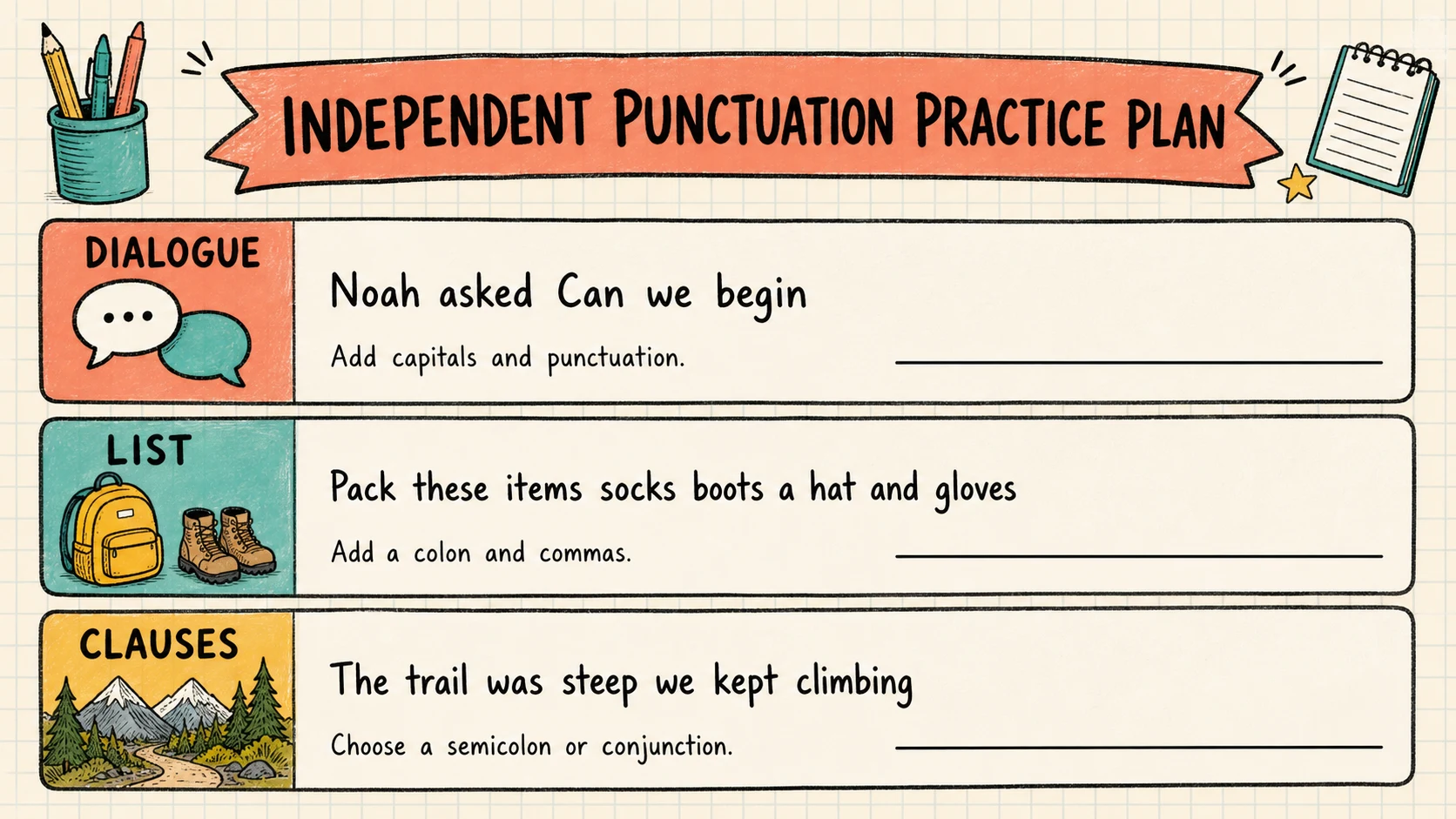
Alternate brief instruction, guided correction, independent items, authentic writing, and delayed review so the adult can see whether the rule transfers.
A practical sequence for commas in a series could be:
- Day 1: Model one list and complete three guided examples.
- Day 2: Correct four list sentences and explain each separator.
- Day 3: Write two original lists inside complete sentences.
- Day 4: Find one series in a book or classroom text and discuss its punctuation.
- Day 5: Complete a short mixed check containing list and non-list sentences.
- Days 6–7: Pause or work on ordinary writing without prompting the rule.
- Day 8: Revise a paragraph containing one missing series comma.
- Day 9: Write a sentence with four listed items.
- Day 10: Review the original errors and choose the next target.
A correct worksheet followed by repeated omission in original writing means the learner is not yet independently transferring the convention. Continue with editing and composing, not a harder punctuation label. Conversely, consistent independent use is a reason to reduce prompts or select a new bounded rule.
For classroom use, the Classroom Grammar Worksheets collection can support warm-ups or mini-lessons. At home, use the same narrow routine rather than treating a full page as mandatory homework. The aim is observable control of a decision, not speed or volume.
Know what these worksheets can and cannot show
Worksheets can reveal whether a learner identifies, corrects, or applies particular grammar features under the conditions provided. They can support explicit instruction, guided practice, independent review, editing, and preparation for item formats encountered in assessments.
They cannot, by themselves, establish a diagnosis, explain every error, or prove that a skill transfers to spontaneous writing. A correct selected response may reflect elimination rather than rule knowledge. An incorrect response may reflect difficult vocabulary, misread directions, fatigue, or handwriting demands rather than lack of grammatical understanding.
The 54 variants offer practice choices, but the catalogue count is not a prescribed sequence. The three free resources are entry points, not comprehensive assessments. Standards alignment also does not guarantee that every local curriculum teaches each feature in the same month or order.
When evidence is mixed, collect a second kind of response: ask for an explanation, an oral correction, or an original sentence. If uncertainty persists or errors appear across reading and writing contexts, share specific work samples with the learner’s teacher. Describe what happened—“joined two complete thoughts with a comma alone in four sentences”—instead of assigning a label.
Make the next task visible
Choose one recent sentence and classify the needed decision:
- Word function unclear: open the 4th Grade Parts of Speech guide and free sheet.
- Punctuation rule misapplied: open the 4th Grade Punctuation guide and free sheet.
- Thought incomplete or incorrectly joined: open the 4th Grade Sentence Structure guide and free sheet.
Complete only the first three relevant items. Ask the learner to explain one answer, then revise one sentence from current writing using the same skill. Record the exact observable result—such as “found both complete clauses but forgot the conjunction”—and use that evidence to choose tomorrow’s task.
Put it into practice
Use the guide with a real printable
Move from explanation to a short, observable practice task. Check the first item together, then adjust the next session from the learner's actual work.
Open the first free worksheet