1st Grade · 7 live skills
1st Grade phonics worksheets
Pick the exact skill below. Each page combines a real free download, a separate answer key, practical teaching guidance and an optional focused pack.
See all 1st Grade subjects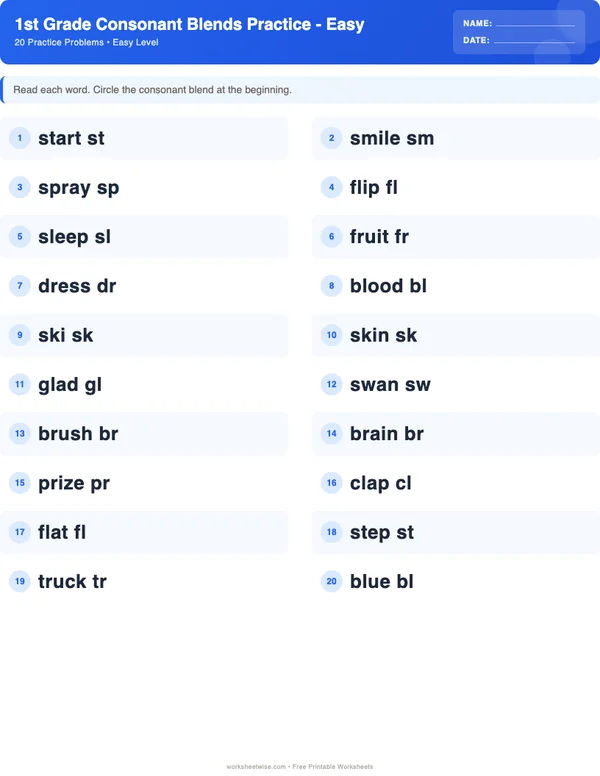
Complete guide
How to teach and practise 1st grade phonics worksheets
3,431 words Updated 6 instructional visuals
Choose one phonics target before choosing a worksheet
The most useful 1st grade phonics worksheet is not necessarily the one marked “1st Grade” or “easy.” It is the one that asks the learner to practice a skill they are ready to learn without burying that skill under too many additional demands.
The live WorksheetWise catalogue contains 126 variants across seven phonics topics, with seven free entry points. Those topics are CVC words, consonant blends, digraphs, long vowels, short vowels, word families, and sight words. Each free sheet contains 20 problems. That common format makes the sheets convenient to compare, but the underlying work is not interchangeable:
- A short-vowel item asks the learner to identify the vowel sound inside a closed syllable.
- A CVC item asks the learner to blend or segment three phonemes.
- A blend item adds another sound that must remain audible.
- A digraph item requires two letters to be treated as one sound.
- A long-vowel item introduces a different spelling pattern and often a contrast with a short vowel.
- A word-family item emphasizes a recurring ending while the onset changes.
- A sight-word item may combine regular sound-spelling relationships with an irregular part that must be remembered.
Start by watching the learner read or spell three to five carefully chosen words. Select one bounded target—such as hearing short i in CVC words, retaining both sounds in an initial st blend, or reading final sh. Do not begin with “phonics” as the target; that category is too broad to guide a lesson or interpret an error.
Grade labels describe intended practice level, and local curriculum sequences differ. Age is a discovery aid rather than a placement decision. A younger learner may be ready for a specific sound-matching task, while an older learner may still need explicit work with that same relationship. For ages three and four, prioritize brief adult-led oral, matching, manipulative, and movement work over desk work.
Read the live progression as a set of dependencies
The catalogue suggests a practical path from short-vowel recognition and simple CVC decoding toward more complex consonant and vowel patterns. It should not be treated as a rigid ladder. A learner can, for example, recognize sh in familiar words while still confusing short e and short i. The adult’s job is to identify which knowledge is secure enough to support the next task.
The IES foundational reading practice guide recommends explicit work connecting sound segments to letters, teaching decoding and word analysis, and giving learners daily opportunities to read connected text. That guidance supports moving between oral sounds, printed words, spelling, and short text rather than completing isolated worksheet items only. It does not constitute an assessment of WorksheetWise or guarantee a particular result.
Short vowels supply the middle sound
Short vowels are the foundation for the catalogue’s CVC work. A learner who cannot reliably distinguish the vowel in map, sit, hot, cup, and pen will have difficulty choosing the correct middle letter even when the surrounding consonants are secure.
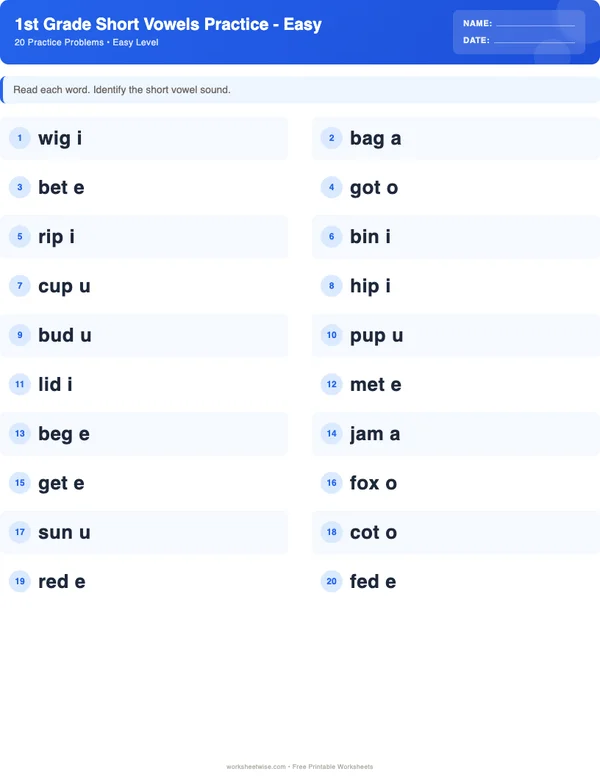
The short-vowels resource includes picture sorting, word reading, spelling, and fill-in-the-middle activities. Those formats test different things. Picture sorting reduces the reading demand but still requires the learner to name the picture consistently. Reading a printed word tests decoding. Writing the missing vowel adds letter recall and handwriting.
A useful supported progression is:
- Say two words and ask whether their middle sounds match.
- Sort spoken or pictured words under vowel anchors.
- Choose a missing vowel in a printed CVC word.
- Read complete CVC words.
- Spell a spoken CVC word.
- Read or write the pattern in a short sentence.
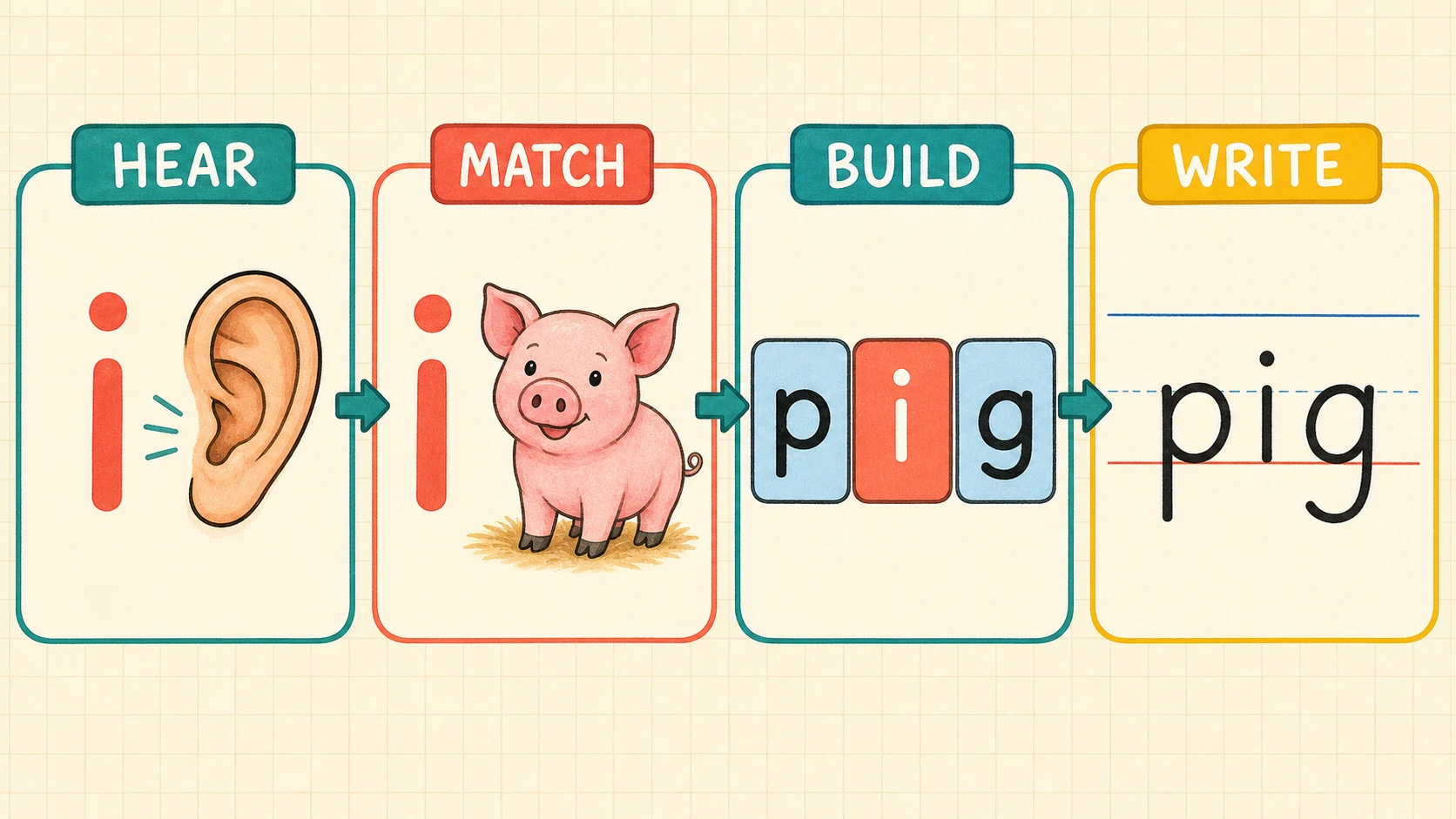
Use this progression to change the amount of support while keeping short-vowel discrimination—not worksheet completion—as the target.
Consider the pair pen and pin. Say each word naturally, then stretch only the middle sound: /p/ /ĕ/ /n/ and /p/ /ĭ/ /n/. The consonants and word length remain constant, so the vowel is the decisive contrast. If the learner reads both as pin, ask them to repeat the words, watch the adult’s mouth, and place each word under an egg or itch anchor. This example belongs at the short-vowel stage because no blend, digraph, long-vowel marker, or irregular spelling complicates the decision.
The 1st Grade Short Vowels guide and free sheet is therefore a sensible starting point when the learner can identify most consonants but guesses the middle of simple words.
CVC words combine segmentation, mapping, and blending
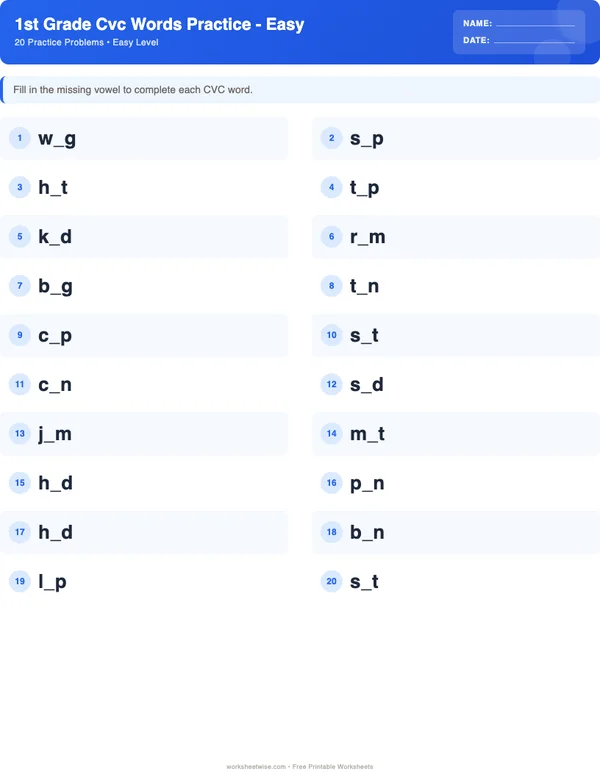
CVC words such as cat, pin, and hug contain three sound positions. They require the learner to notice each phoneme, connect it to a grapheme, and combine the sequence into a word. The catalogue’s CVC resource includes all five short-vowel families through word building, picture matching, fill-in-the-blank work, and reading.
Work the example map with three connected sound boxes:
- Say map normally.
- Stretch it as /mmm/ /ă/ /p/.
- Push one token for each sound: m | a | p.
- Replace the tokens with letters.
- Sweep under the three letters and blend: map.
- Ask the learner to rebuild or write the word without copying.
There are exactly three phonemes and three graphemes in this example, so each box receives one sound-letter match. It belongs here because it tests the basic CVC structure without an extra consonant or a two-letter grapheme.
If the learner can blend map but spells it mp, the missing vowel points toward segmentation or vowel identification, not necessarily failure to recognize m or p. If the learner says each sound correctly but cannot combine them, return to continuous blending: /mmmaaap/ → map. The 1st Grade CVC Words guide and free sheet is a better choice than a blend sheet in either case because it removes the additional sound.
Word families develop flexible use of a shared ending
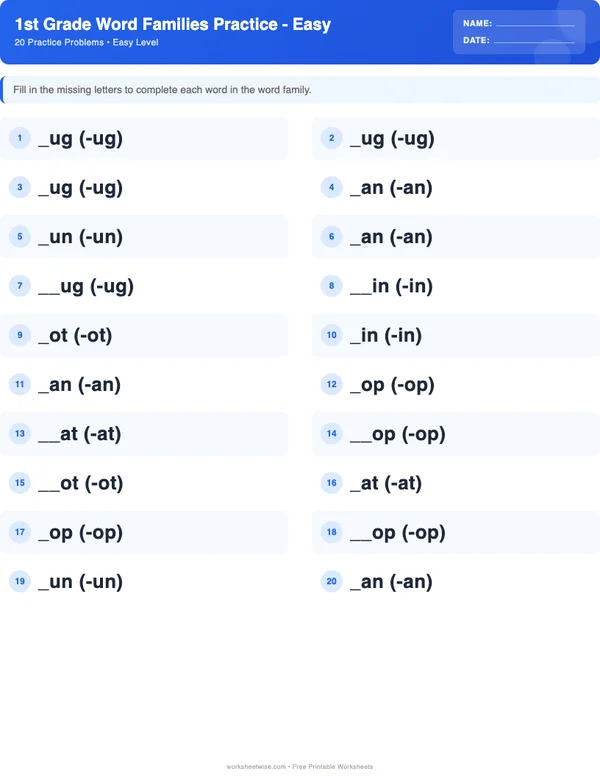
Word families reorganize known CVC knowledge around a stable rime: cat, bat, hat, mat, and sat share -at. That can reduce the amount that changes from one word to the next, but the learner must still inspect the onset rather than recite a memorized sequence.
Build this checked chain:
at → sat → mat → map
The first change adds /s/. The second replaces /s/ with /m/. The final change replaces /t/ with /p/. Ask, “What stayed the same?” after sat → mat, then “What changed at the end?” for mat → map. This example belongs in word-family practice because it first stabilizes -at and then deliberately breaks the family, revealing whether the learner is reading the whole word.
A learner who calls mat “sat” may be over-relying on the known ending or the previous response. Point to the initial letter, have the learner say /m/, and blend again. If every -at word is read accurately but an unfamiliar CVC word is not, add mixed CVC practice rather than teaching more families immediately. The 1st Grade Word Families guide and free sheet is most useful when the learner can already decode individual CVC words but needs to notice and manipulate repeated patterns.
Keep blends and digraphs conceptually separate
Blends and digraphs both place consonant letters together, but they demand different sound analysis. Flattening them into “two consonants” invites predictable mistakes.
In a blend, every consonant remains audible
In stop, the initial st represents /s/ followed by /t/. The word has four phonemes: /s/ /t/ /ŏ/ /p/. In ship, by contrast, sh represents one phoneme. Counting letters alone will not reveal that difference.
For a checked blend chain, use:
lap → clap → clam → clamp
- lap has /l/ /ă/ /p/.
- clap adds /k/ before /l/.
- clam changes final /p/ to /m/.
- clamp adds final /p/ after /m/.
The final word has five phonemes: /k/ /l/ /ă/ /m/ /p/. This chain belongs in blend practice because the learner must preserve both sounds in initial cl and final mp. It also changes only one sound at each step, allowing the adult to locate the point at which a sound disappears.
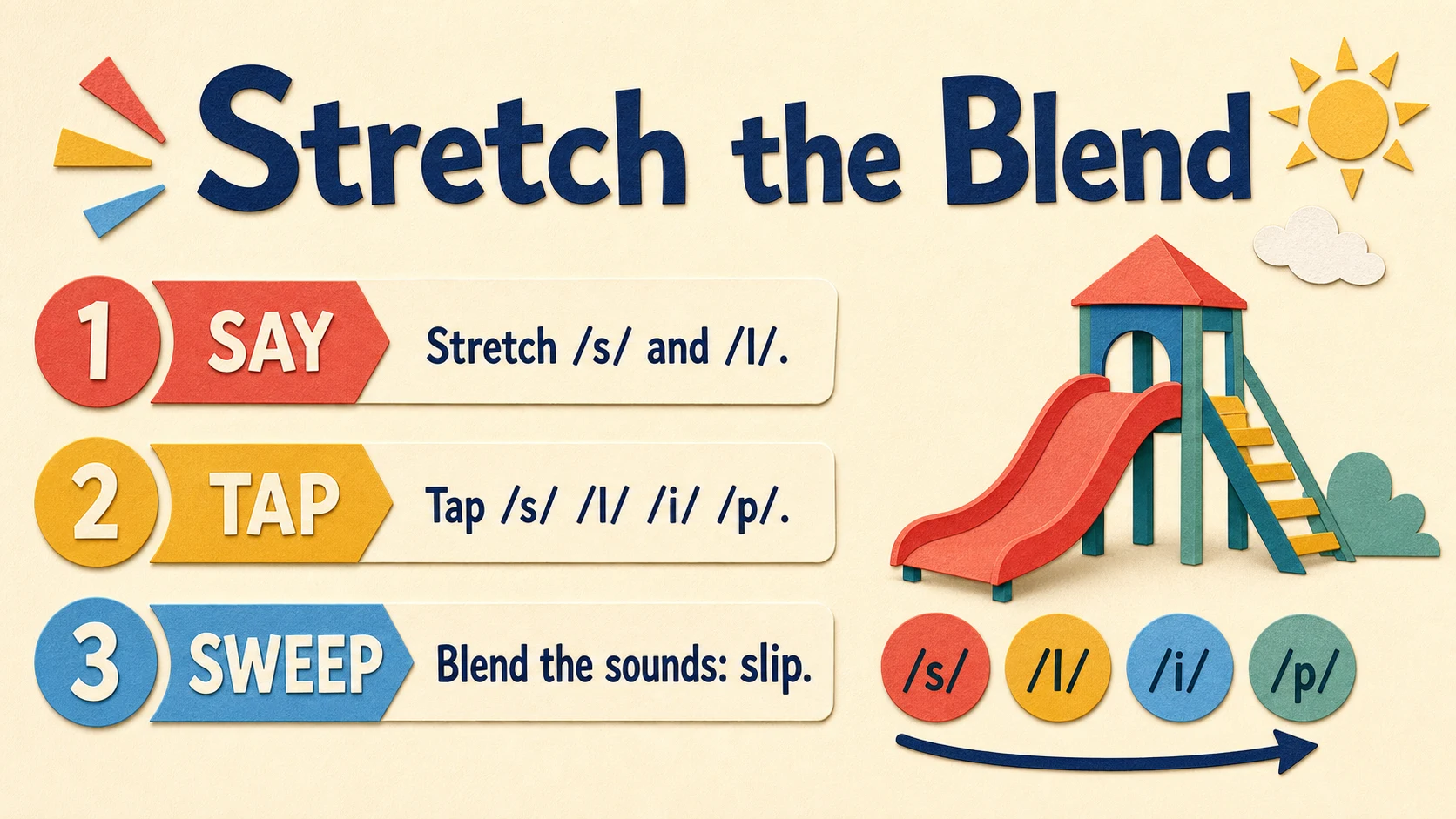
Move from hearing every sound in a blend to building, reading, and briefly applying the same pattern.
If stop becomes “sop,” have the learner tap four fingers while saying /s/ /t/ /ŏ/ /p/, then blend without a pause. If tent becomes “ten,” contrast the words and ask which one ends with /t/. These are omissions within a blend; they do not call for teaching st as a single sound. Begin with a small set such as st, sp, and sl, then add other groups after the learner retains both sounds. The 1st Grade Consonant Blends guide and free sheet provides the relevant entry point.
In a digraph, two letters represent one sound
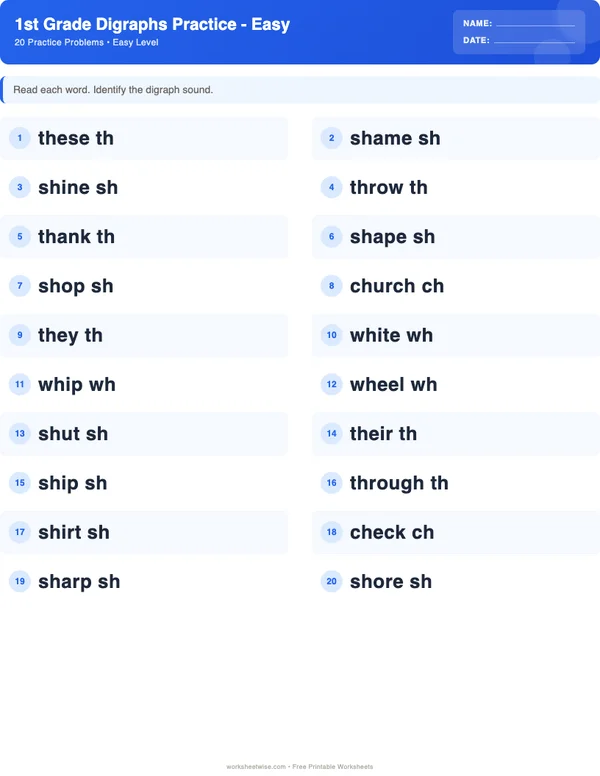
The live digraph topic covers sh, ch, th, wh, and final ck. Use one pattern at a time before mixing them.
Compare:
- slip: s and l represent two sounds.
- ship: sh represents one sound.
- wish: final sh still represents one sound.
- chip: ch represents one sound.
For ship, map three phonemes: sh | i | p. The first sound uses two letters, but it belongs in one sound box. For slip, map four: s | l | i | p. This checked comparison belongs here because word length and vowel remain similar while the consonant relationship changes.
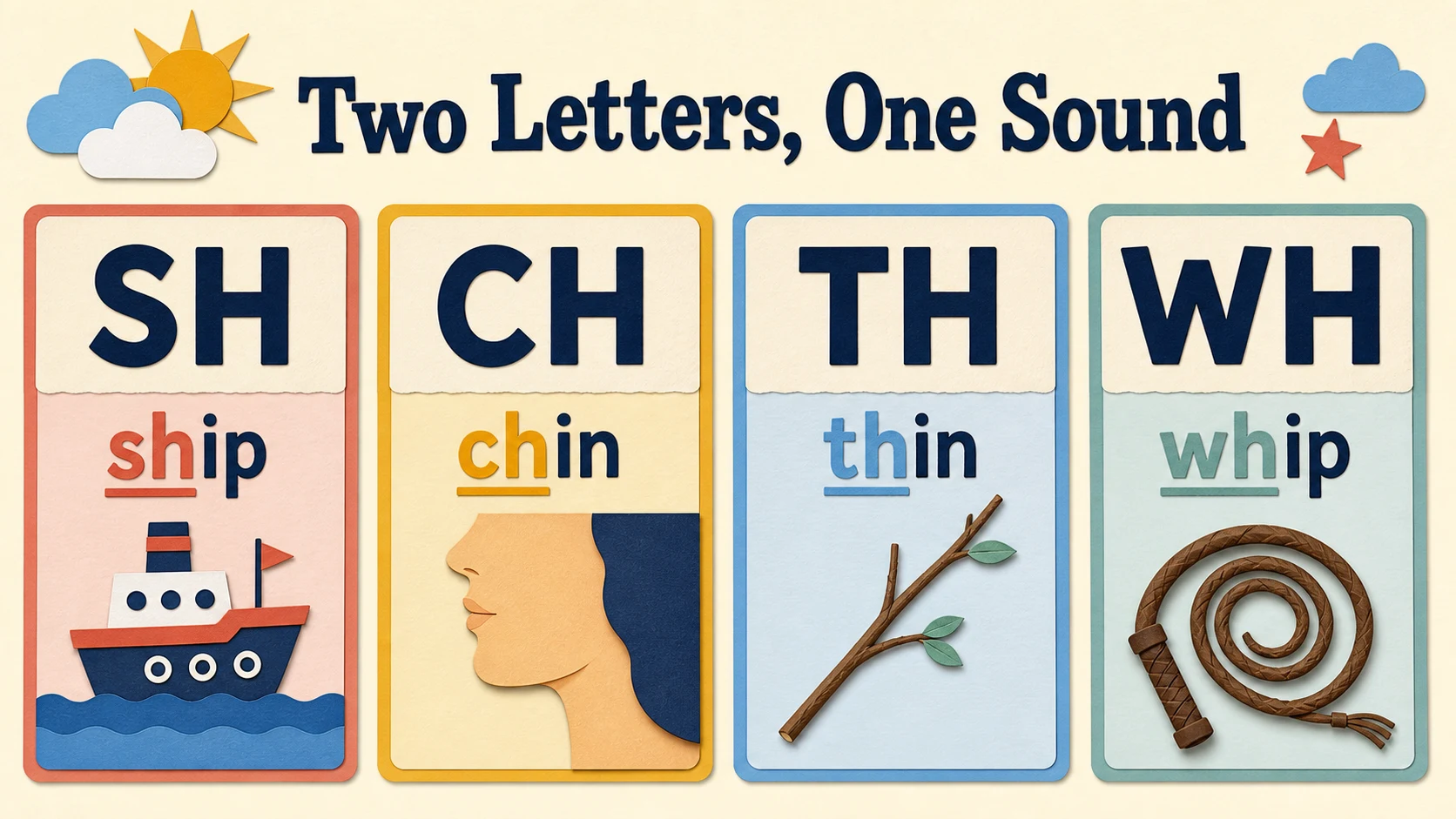
The map separates recognizing a digraph, locating it, decoding it, and spelling it so the adult can identify the actual point of difficulty.
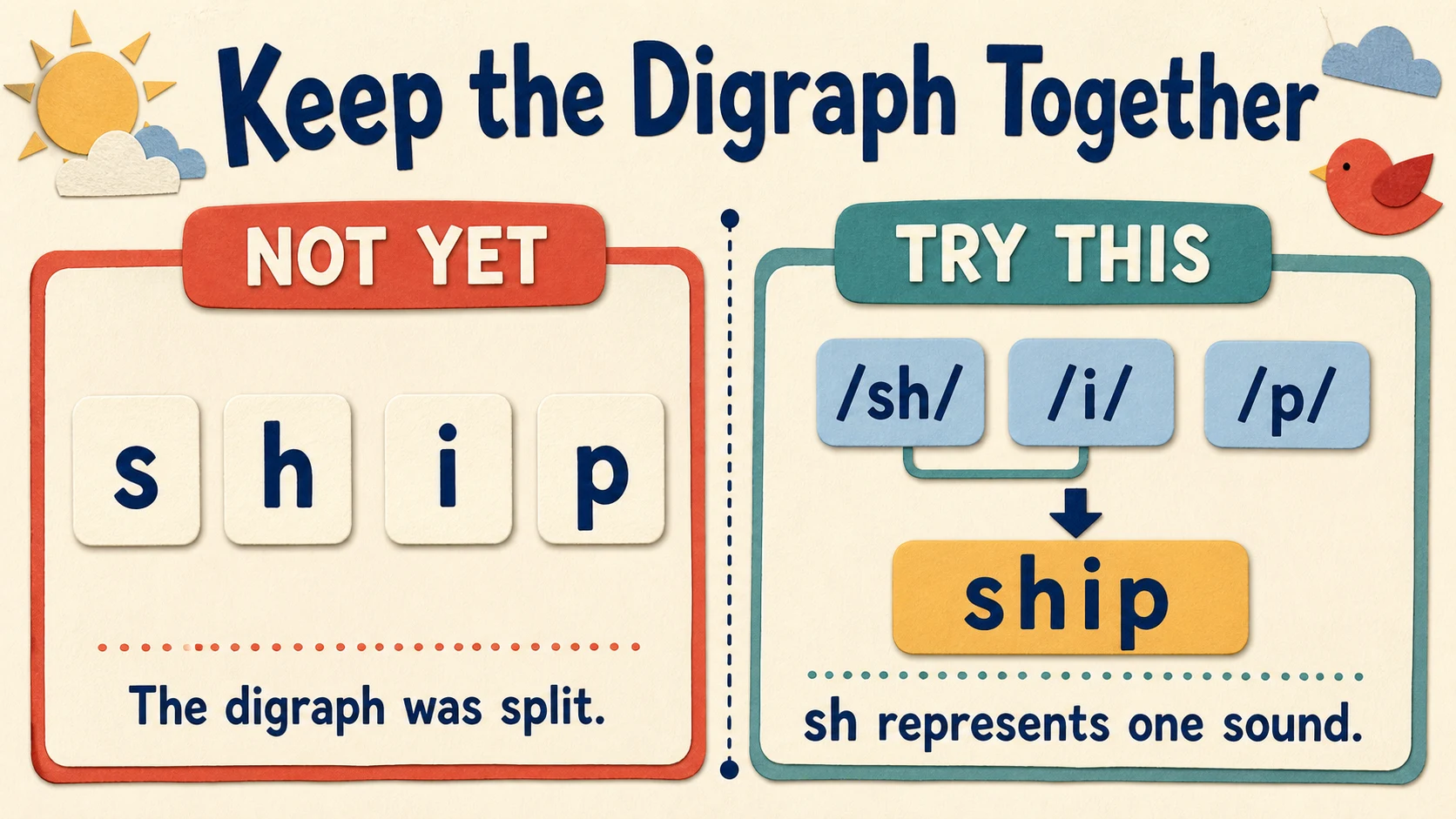
Treat “two letters” and “one sound” errors differently from vowel confusion or guessing from a picture.
If the learner reads ship as “sip,” ask them to underline sh, hold two fingers together, say /sh/, and blend again. If they read chip as “ship,” the learner retained the idea of one sound but selected the wrong digraph sound. Contrast only ch and sh with words such as chip/ship and chop/shop. If duck is spelled duk, the sounds have been represented plausibly, but the target final spelling pattern has not been recalled. Focus the response on final ck after a short vowel rather than restarting all CVC work.
Use the 1st Grade Digraphs guide and free sheet once basic CVC blending is reasonably stable and the learner is ready to treat a letter pair as one sound.
Contrast long vowels with known short-vowel words
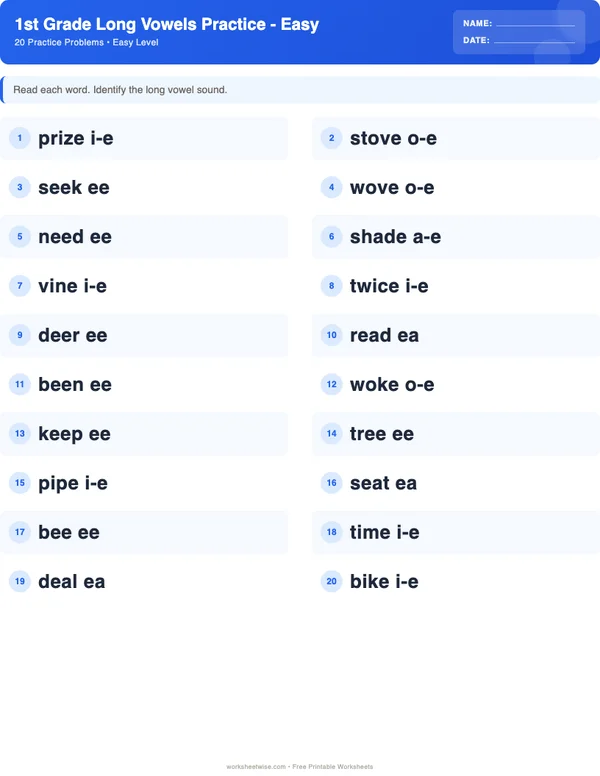
Long-vowel work adds spelling patterns including silent e, vowel teams, and open syllables. These should not be introduced as a single undifferentiated category. A learner may understand cap/cape while not yet knowing that long a can also appear in rain or day.
Begin with silent-e pairs because the change is visually clear:
- cap → cape
- pin → pine
- hop → hope
- cub → cube
Check hop → hope explicitly. Hop has three phonemes, /h/ /ŏ/ /p/. Hope also has three phonemes, /h/ /ō/ /p/, despite having four letters. The final e changes the vowel pattern but is not pronounced as a separate phoneme. This example belongs at the long-vowel stage because the learner must use the final letter to reinterpret the medial vowel.
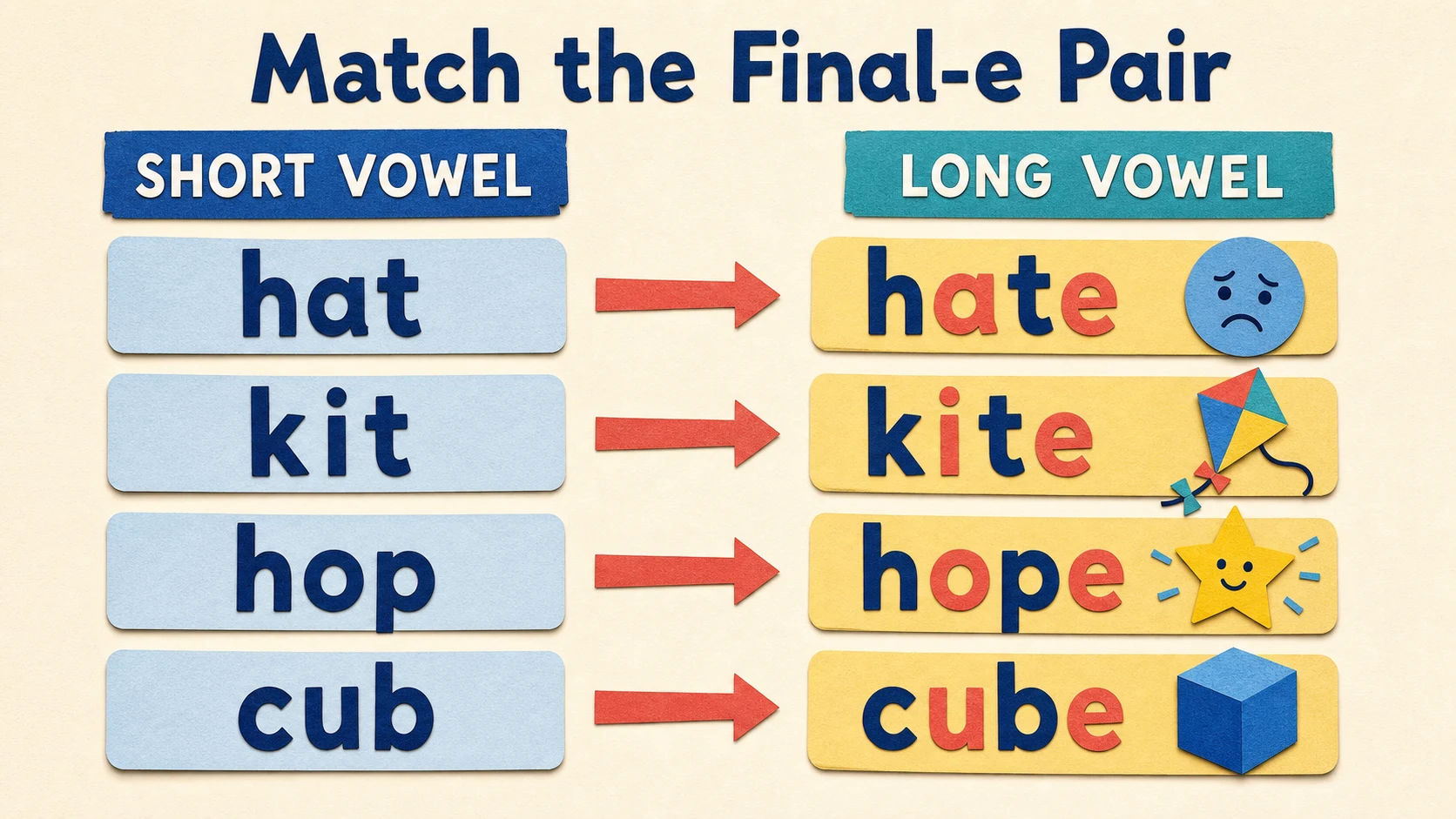
Keep each lesson centered on one long-vowel spelling pattern, with an explicit short-versus-long comparison.
A useful six-minute routine is to read two contrasting pairs, build one pair with movable letters, sort four words, spell one dictated word, and read one short sentence. If the learner reads hope as “hop,” cover and reveal the final e, asking what changed in the spelling and vowel sound. If the learner reads rain but spells it rane, the long-a sound is recognized; the unresolved decision is which spelling pattern belongs in that word.
Do not present the rhyme “two vowels go walking” as a rule that always works. Vowel teams vary, so teach the actual pattern represented in the chosen words. Start with a small set—perhaps silent e only—before asking the learner to sort a_e, ai, and ay.
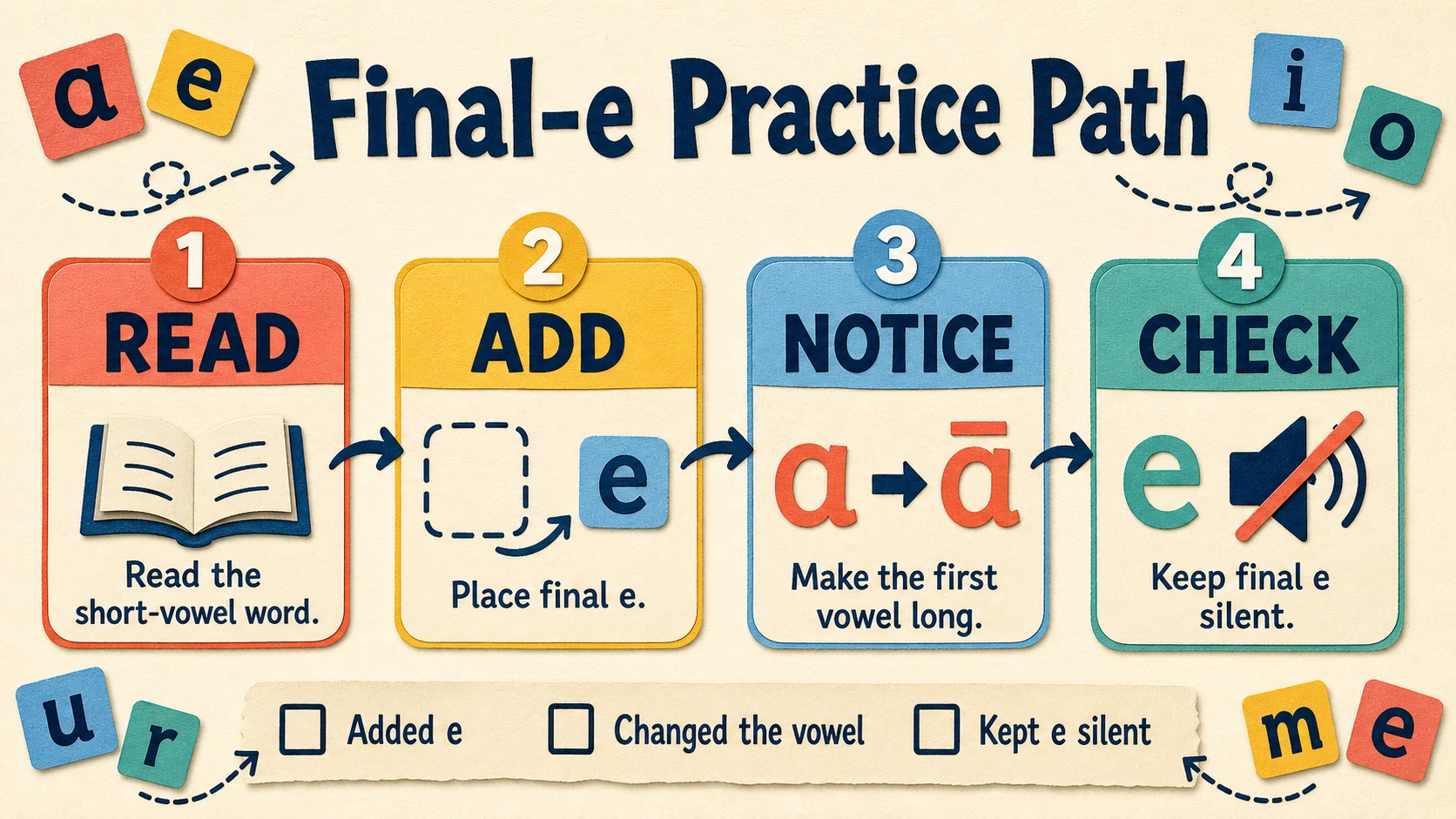
Space new-pattern practice and cumulative review across short sessions instead of treating one completed page as mastery.
The 1st Grade Long Vowels guide and free sheet is appropriate when short CVC words are read accurately enough that the learner can attend to the changed vowel pattern. Continue including a few short-vowel words so the learner must inspect the spelling rather than assume every vowel is long.
Place sight words beside phonics, not outside it
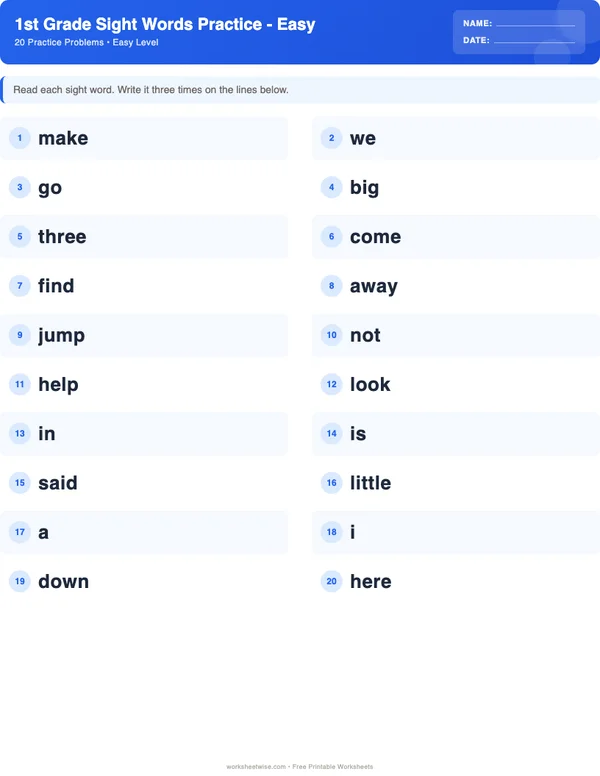
The sight-word catalogue entry includes high-frequency words that are decodable and words with an irregular spelling component. That distinction matters. “Memorize the whole shape” hides useful sound-letter information, while forcing every spelling into a regular pattern creates false explanations.
Take said. It contains /s/ /ĕ/ /d/. The initial s and final d map regularly. The letters ai represent /ĕ/ in this word and require specific attention. Ask the learner to:
- Say said.
- Segment /s/ /ĕ/ /d/.
- Identify the regular first and last sounds.
- Mark ai as the unexpected part.
- Read and write the word in a sentence: “I said yes.”
This example belongs in sight-word study because the learner can use phonics for part of the word while learning the unusual vowel spelling. By contrast, a regular high-frequency word such as and can be decoded from its constituent sounds and should not automatically be treated as wholly irregular.
The catalogue suggests introducing small groups and reviewing them repeatedly. Treat that pacing as a practical suggestion, not a universal schedule. A learner’s accurate recall should determine whether to add words. If a word is recognized on a flashcard but missed in a sentence, practice it in connected text. If it is read correctly but misspelled, return to sound mapping and the particular irregular letters.
Define “easy” by the work on the page
Every representative free sheet is catalogued as “easy,” but that label describes a resource setting, not a learner. Define difficulty through observable task features:
- How many sound-spelling correspondences appear?
- Is one pattern practiced repeatedly or are several mixed?
- Must the learner read, spell, sort, or write a sentence?
- Are pictures carrying part of the identification load?
- Does the task include blends, digraphs, or multiple vowel patterns?
- How many items must be completed before a break?
- Can the learner manipulate letters, or must they write every answer?
- Is the word isolated, placed in a sentence, or embedded in connected text?
A 20-item picture-matching page may be accessible to a learner who can name every picture, yet confusing to someone who uses a different label for an image. A 20-word silent-e sort may look visually simple while requiring knowledge of several vowel contrasts. “Easy” should therefore mean features such as one established pattern, familiar directions, limited choices, and little unrelated writing—not a fixed characteristic of the child.
The Common Core English Language Arts standards include Grade 1 expectations involving regularly spelled one-syllable words, common consonant digraphs, final-e conventions, vowel teams, and syllable knowledge. Those expectations can help an adult understand why the skills matter at this intended practice level, but they do not establish the correct sequence for every local curriculum or place an individual learner.
Use one repeatable routine and preserve the target
A worksheet becomes more informative when it sits inside a short teach-practice-check cycle.
Before the sheet: run a three-word probe
Choose three words that isolate the proposed target. For short i, try sit, lip, and fin. For initial st, try step, stop, and stuck. For final sh, try fish, wish, and dash.
Ask the learner to read each word, then spell one without copying. Record the exact response. “Read stop as sop” is useful evidence; “struggled” is not.
If two or three responses show the same bounded gap, use the matching sheet. If the errors are unrelated, reduce the task and investigate one contrast orally before printing anything.
During the sheet: model, guide, release
Model one item while explaining the sound decision. Complete the next item together. Then let the learner attempt two or three independently. Stop to inspect the pattern before assigning all 20 problems.
A sheet’s problem count is available material, not a required session length. Completing five well-chosen items and explaining the spelling may be more useful than rushing through 20. Avoid giving the answer immediately after an error. Prompt at the relevant level: “Say every sound,” “What does sh represent?” or “Compare hop with hope.”
After the sheet: read and spell beyond its layout
Select one correct word and one corrected word. Ask the learner to read both without picture support, spell one from dictation, and use one in a short oral or written sentence. The IES foundational guide emphasizes connecting word-level instruction with reading connected text, so finish with one or two decodable sentences containing the taught pattern.
Writing can expose knowledge that recognition tasks conceal. The IES elementary writing practice guide recommends explicit teaching of writing processes and foundational writing skills, with regular opportunities to write. In this phonics setting, a brief dictated word or sentence is a limited application of that principle, not a substitute for a full writing lesson.
Adapt access without replacing the phonics decision
An adaptation preserves the target when it reduces an unrelated obstacle but still requires the learner to process the intended sound-spelling relationship.
For a learner who tires during handwriting, use magnetic letters for ship but still require selection of s-h for /sh/. For a learner who loses their place, cover all but one row. For a learner who needs oral rehearsal, let them say and stretch clap before writing it. For a learner who cannot reliably name a picture, tell them the intended word; do not let picture-label uncertainty become a phonics score.
For ages three and four, turn a page into brief adult-led work: say and match two sounds, move a token into sound boxes, hop once per phoneme, or choose between two letter cards. Stop before the task becomes prolonged desk work. Age remains a discovery aid, not a placement decision.
Avoid adaptations that erase the skill. Reading every word aloud for a decoding task changes it into matching. Providing sh as the only possible tile during spelling removes the digraph choice. Allowing a picture guess without checking the letters bypasses decoding. Instead, reduce the number of choices, shorten the session, enlarge the print, or provide manipulatives while retaining the essential decision.
Interpret errors as evidence, not diagnoses
One response cannot establish a diagnosis, and repeated errors can have several causes. Use the smallest warranted interpretation and test it with another example.
| Observed response | Plausible interpretation to test | Next check |
|---|---|---|
| Reads pen as “pin” | Short e/i discrimination is uncertain | Contrast bed/bid orally and in print |
| Reads stop as “sop” | One sound in the initial blend is omitted | Segment step into four sounds |
| Maps ship into four sound boxes | Letters are being counted instead of phonemes | Compare ship with slip |
| Reads hope as “hop” | Final e is not changing the vowel interpretation | Compare hop/hope and cop/cope |
| Reads mat as “sat” after several -at words | The ending or previous response is dominating attention | Mix mat, map, and sat |
| Spells said as sed | Sounds are represented, but the irregular spelling is not recalled | Mark the regular and unexpected parts of said |
Look for consistency across reading and spelling. A learner who reads ship and spells ship has stronger evidence of the mapping than one who selects a matching picture. A learner who reads stop correctly but writes sop may need closer observation of segmentation during encoding.
Do not infer a disorder, intelligence level, effort, or future outcome from worksheet performance. Also avoid declaring mastery after one accurate page; item familiarity, pictures, imitation, or a repeated pattern may support performance. Recheck later with reordered words, a new example, and a short sentence.
Make the next task observable
Use this decision sequence after a brief sample:
- If the learner cannot identify the middle vowel in simple spoken or printed CVC words, start with one short-vowel contrast.
- If the vowel is identified but three sounds are not blended or segmented, use CVC sound boxes and continuous blending.
- If CVC words are secure and a consonant disappears from stop or clamp, choose one blend group.
- If two-letter consonant patterns are treated as two sounds in ship or confused with blends, teach one digraph explicitly.
- If short vowels are stable but hop/hope are read alike, begin a silent-e contrast.
- If words are decoded accurately but a repeated family does not transfer, mix family members with near-neighbors.
- If a high-frequency word contains an unexpected spelling, map its regular sounds and mark only the irregular part.
The boundary is one useful instructional decision, not comprehensive placement. These sheets do not replace a curriculum, oral language work, teacher observation, connected reading, or professional evaluation when broader concerns persist. The catalogue facts identify available practice; they do not prove standards alignment, intervention effectiveness, or learner outcomes.
For the next session, write down one exact target and three probe words. If the target is basic three-sound blending—for example, “The learner will blend and spell map, sit, and hug without picture cues”—open the 1st Grade CVC Words guide and free sheet, teach only the needed items, and use the learner’s reading and spelling to choose tomorrow’s task.
Put it into practice
Use the guide with a real printable
Move from explanation to a short, observable practice task. Check the first item together, then adjust the next session from the learner's actual work.
Open the first free worksheet