1st Grade · 9 live skills
1st Grade math worksheets
Pick the exact skill below. Each page combines a real free download, a separate answer key, practical teaching guidance and an optional focused pack.
See all 1st Grade subjects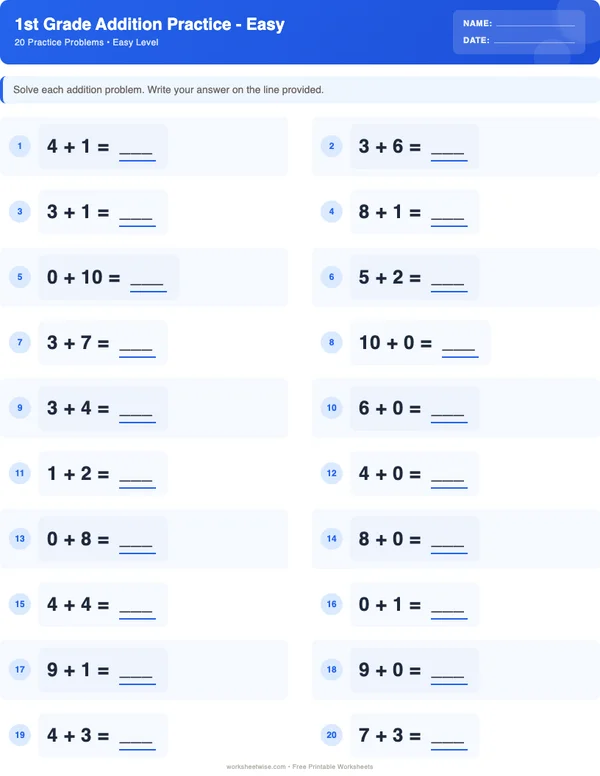
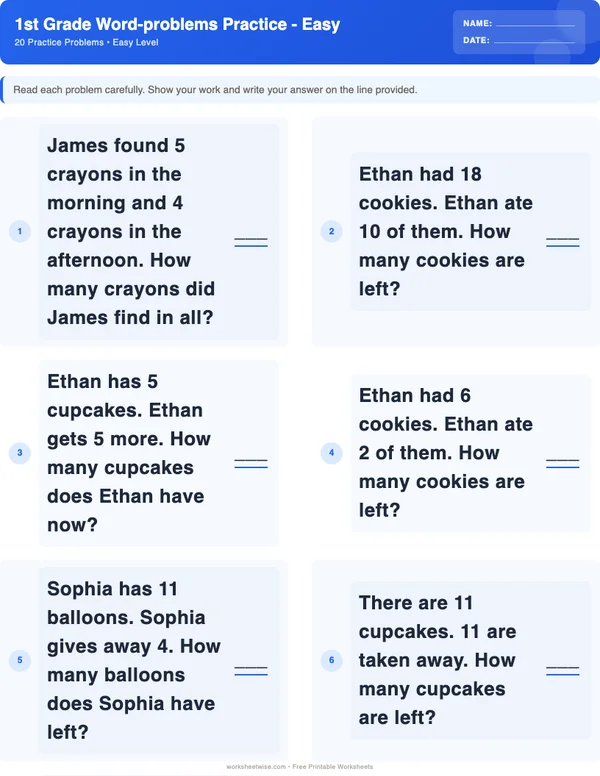
Complete guide
How to teach and practise 1st grade math worksheets
3,692 words Updated 6 instructional visuals
Choose one narrow skill before printing
The live 1st Grade Math catalogue contains 162 worksheet variants across nine topics: counting, addition, subtraction, fractions, place value, telling time, money, geometry, and word problems. Nine free entry points are available, one for each topic. The most useful starting worksheet is not necessarily the one labeled “1st Grade.” It is the one whose problems reveal a specific, teachable next step.
Use this decision:
- Pick one bounded target, such as counting a scattered set accurately, representing a teen number as one ten and some ones, or reading clocks to the hour and half-hour.
- Ask the learner to complete a short sample without coaching.
- Inspect the method, not just the score.
- Choose the next task from the error pattern: repeat with a clearer model, reduce one source of complexity, or move to a closely related skill.
Grade labels describe intended practice level; local curriculum sequences differ. A first grader may be ready for one topic but need concrete support in another. The catalogue’s “easy” label describes the available worksheet version, not the learner. On this page, interpret it through observable task features: short directions, early-grade quantities or representations, one primary operation or decision per item, and limited steps. The actual sheets vary in length from six fraction problems to twenty problems in several other topics.
The worksheets are designed around particular Common Core mathematics targets, but a label does not establish what any individual child has learned. The Common Core mathematics standards describe grade-level expectations, while instruction, assessment, and local sequencing remain local decisions. Use completed work as evidence for the next teaching choice, not as a diagnosis.
See the nine topics as connected but distinct
The topics form a progression, but they are not interchangeable. Counting supplies number order and one-to-one correspondence. Place value organizes quantities into tens and ones. Addition combines quantities; subtraction can remove, compare, or find a missing part. Word problems ask the learner to identify which relationship applies. Fractions and geometry emphasize equal parts, attributes, and spatial structure. Time and money use number knowledge inside specialized systems.
A learner who can recite to 100 may still double-count objects. A learner who knows may not recognize a comparison story as subtraction. Someone who counts by fives may still confuse the clock’s hands. These differences matter when selecting a worksheet.
| Topic | Useful first target | What the work can reveal |
|---|---|---|
| Counting | Count a set once and state the total | One-to-one correspondence and stable number order |
| Addition | Add within 10 using a visible model | Whether the learner counts all, counts on, or recognizes combinations |
| Subtraction | Model a take-away or missing-part situation | Whether the operation matches the story |
| Fractions | Partition a shape into equal halves | Whether “equal” guides the partition |
| Place value | Build and write a teen number | Whether one ten is distinguished from loose ones |
| Telling time | Read hour and half-hour clocks | Whether the hands’ different jobs are understood |
| Money | Identify coins and count one denomination | Whether coin value is separate from coin size or appearance |
| Geometry | Sort shapes by an attribute | Whether the learner uses properties rather than orientation |
| Word problems | Retell and model a one-step situation | Whether quantities and their relationship are understood |
The full worksheet library extends beyond this hub into the broader K–8 progression, including later work with decimals, ratios, geometry, and linear equations. That wider sequence is useful for context, but it should not pull a first-grade session toward later procedures before the current representation makes sense.
Start with counting, place value, or operations when number structure is the issue
Separate reciting from counting objects
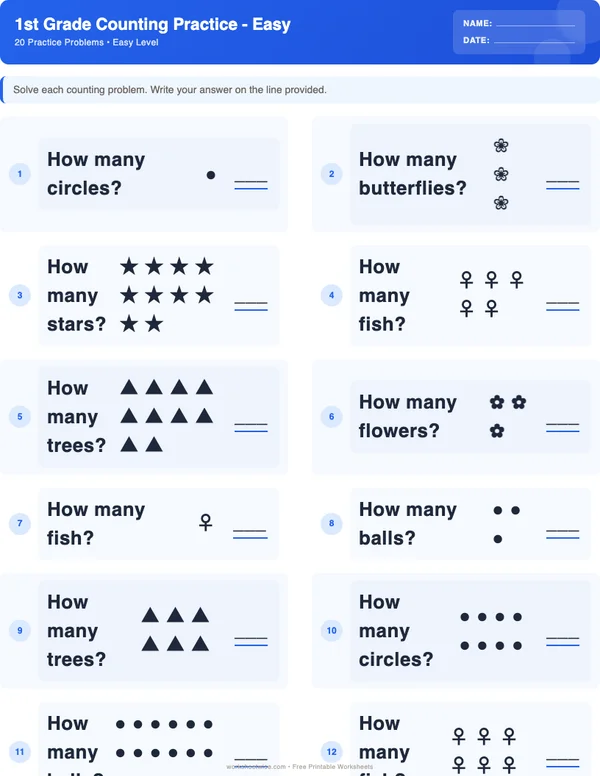
The free counting sheet contains 20 problems. Catalogue activities include number sequences, missing numbers, and counting sets. Before choosing it, place 13 counters in a scattered arrangement and ask, “How many are there? Show me how you know.”
Watch for three different performances:
- The learner touches or moves each object once, says one number per object, and gives 13 as the total.
- The learner recites correctly but skips or recounts objects.
- The learner gets 13 but cannot preserve the total after the counters are spread differently.
Only the first performance provides clear evidence of coordinated one-to-one counting and cardinality in this task. For the other two, use a line of counters, then a scattered set, before assigning a full page. Moving each counted object into a cup preserves the counting target while reducing tracking demands.
Checked example 1: counting on from 46. The sequence is . If the blanks are , the missing numbers are 47, 48, and 50. This belongs in the 1st grade counting progression because the catalogue explicitly includes counting forward from a given number and missing-number sequences. Writing 56 after 49 would suggest attention to the ones digit without maintaining the decade transition. Return to a number line around 45–52 rather than restarting at 1.
The 1st Grade Counting guide and free sheet is a sensible first choice when the difficulty appears before an operation begins.
Connect teen numbers to one ten and some ones
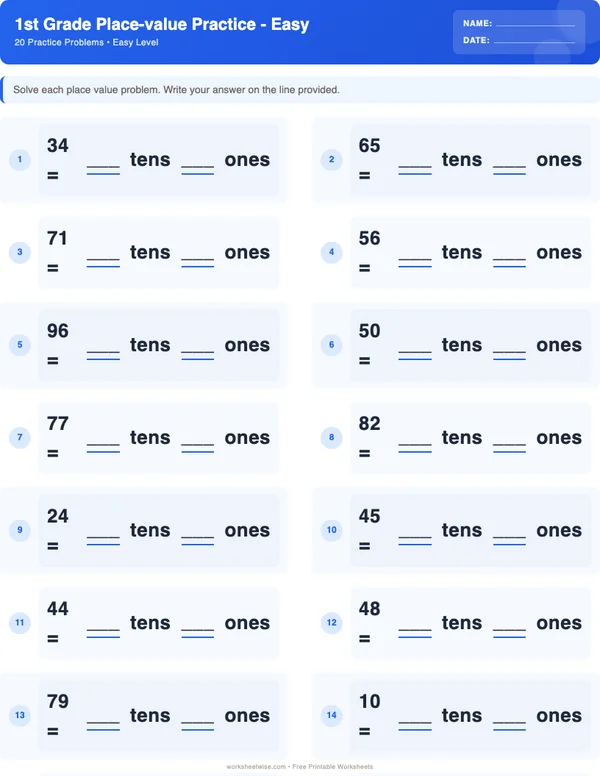
Place value is the better starting point when a learner can count but treats multi-digit numerals as two unrelated digits. The free place-value sheet has 20 problems and covers composing, decomposing, and comparing numbers within its early-grade level.
Checked example 2: represent 14. Bundle ten sticks and leave four single sticks. The total is , so 14 has 1 ten and 4 ones. Reversing the digits gives 41, which represents 4 tens and 1 one, not the same quantity. This example belongs here because understanding teen numbers as a ten and some ones is the catalogue’s stated beginning of the place-value progression.
If the learner writes “10 tens and 4 ones,” ask them to point to each bundle and each single. If they count all 14 correctly but write 41, keep the quantity visible while matching it to a two-column tens-and-ones chart. That adaptation preserves place value; tracing “14” repeatedly would mainly rehearse numeral formation.
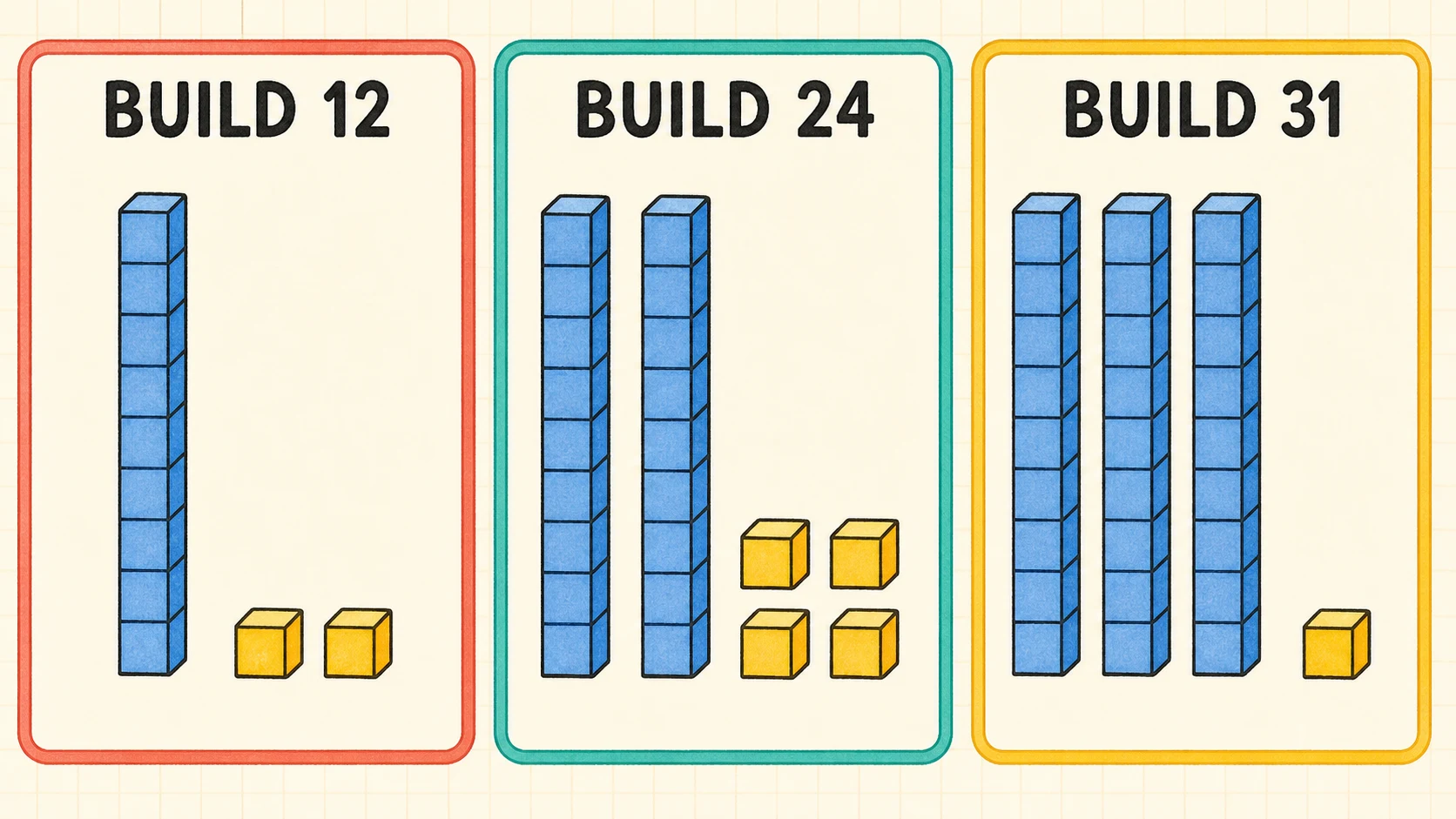
Use the plan to revisit teen-number composition across several short sessions, changing the quantity while keeping the tens-and-ones decision stable.
The 1st Grade Place Value guide and free sheet is the stronger entry point if errors cluster around 12–19, digit reversal, or the meaning of a ten.
Distinguish addition from subtraction situations
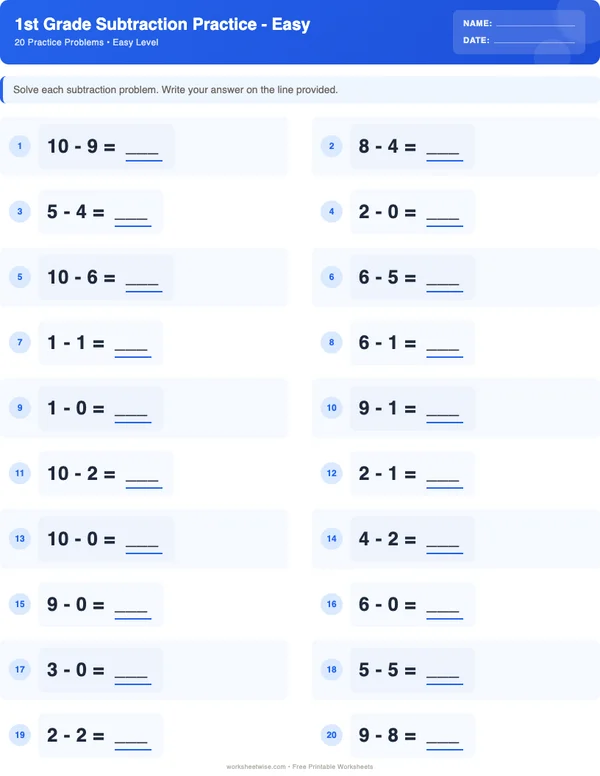
Addition and subtraction each have 20-problem free sheets. Do not select between them solely because one answer was wrong. First identify the relationship the learner misunderstood.
Checked example 3: make ten to solve . Split 5 into 2 and 3. Then , and . Therefore, . Check by counting: eight counters plus five counters make thirteen. This belongs in 1st grade addition because the catalogue progression moves through addition within 10 and 20 and specifically identifies making ten as a strategy.
A response of 12 may be a counting slip. A response obtained by recounting all objects correctly is mathematically valid but less efficient than counting on or making ten. Ask, “How much does 8 need to become 10?” If the learner cannot answer with a ten frame, return to composing and decomposing numbers within 10 before increasing the total.
Checked example 4: interpret . If 13 birds are present and 5 fly away, . Check through the related addition fact: . The same equation can answer a missing-part question: “Thirteen counters are needed; five are already here. How many more?” This belongs in the subtraction progression because the catalogue distinguishes removal, comparison, and missing-part situations.
If the learner adds to get 18, computation may not be the main issue. Ask them to act out the story and show whether the starting group becomes larger or smaller. The 1st Grade Addition guide and free sheet and 1st Grade Subtraction guide and free sheet should be treated as neighboring resources, not consecutive levels every learner must complete in a fixed order.
Treat fractions as equal-part reasoning
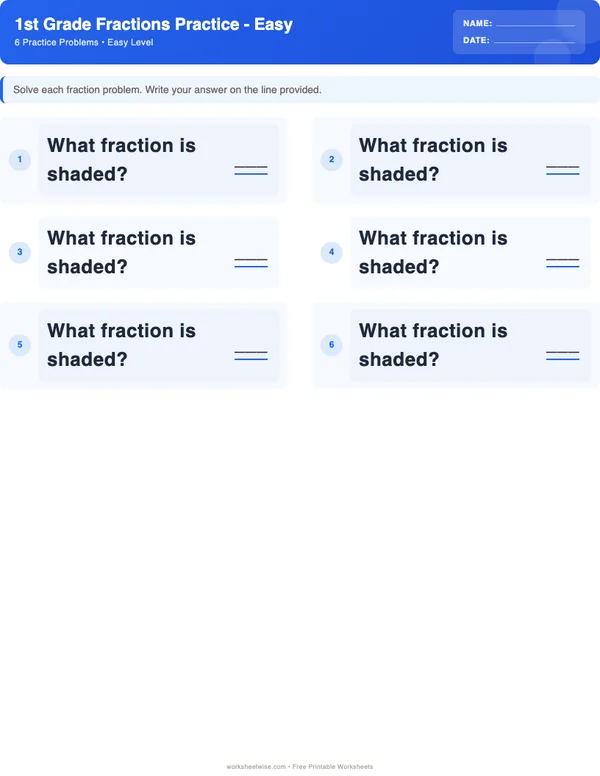
The free fractions sheet contains six problems, considerably fewer than the 20-problem sheets for counting, operations, place value, money, and geometry. Six carefully observed responses may be more useful than a longer page because drawing and explaining partitions takes time.
Test equality before fraction vocabulary
Fold a paper rectangle into two equal parts and shade one. Then make a second rectangle with one tiny section and one large section. Ask which model shows halves and why. The defining issue is equality, not merely the number of pieces.
Checked example 5: one fourth of a set. Arrange 8 counters into 4 equal groups. Each group contains counters, so one of the four equal groups is 2 counters, or one fourth of 8. Check: four groups of two reconstruct the original eight. This example belongs at the edge of the page’s early fraction work because it keeps the emphasis on equal partitioning rather than introducing fraction algorithms.
If the learner says one fourth is four counters, they may be using the denominator as an answer rather than as the number of equal groups. Keep all eight counters visible, create four equal spaces, and distribute one counter to each space in turn. This preserves the fraction target while removing the need to draw equal regions accurately.
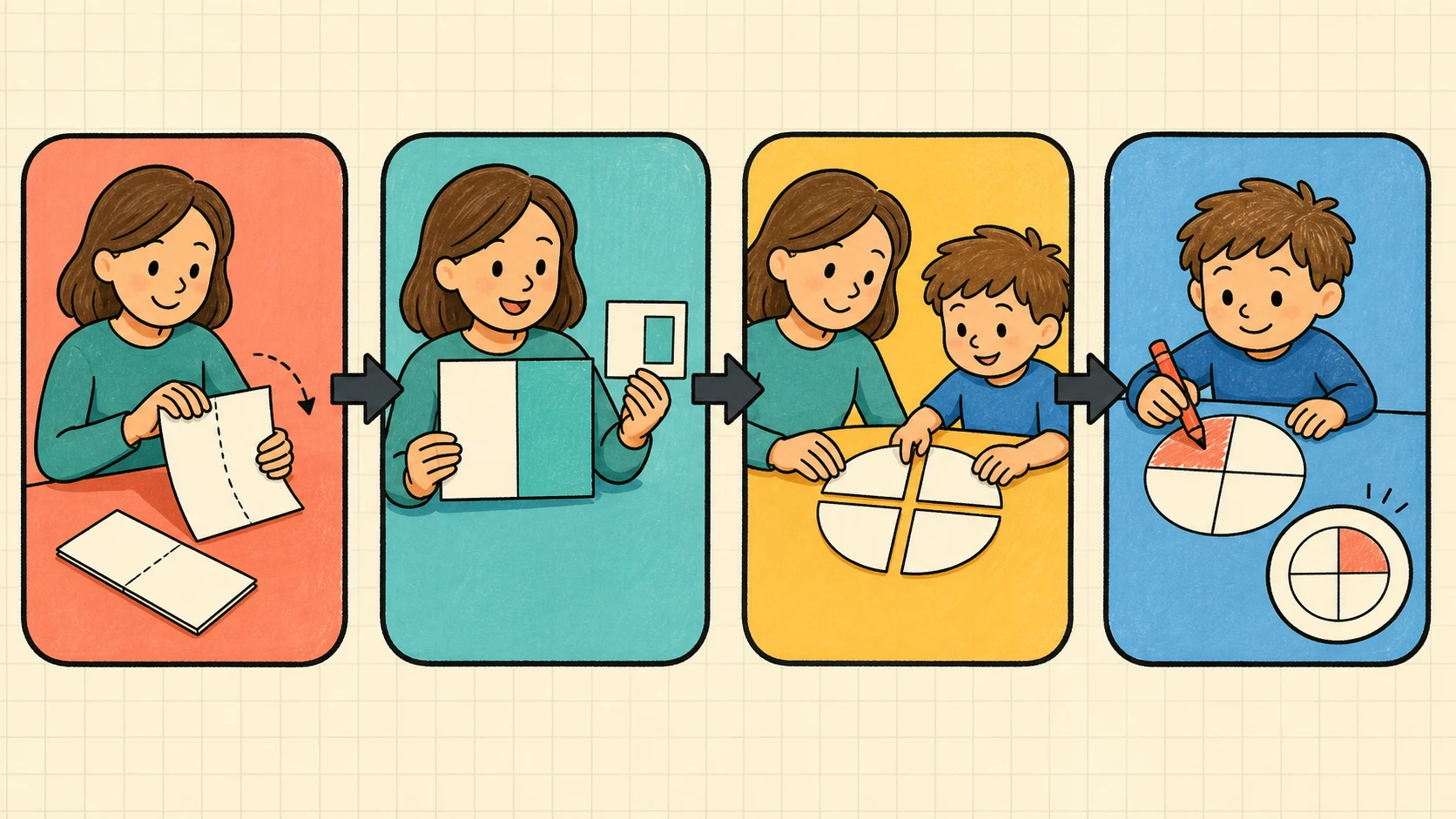
Move from a real object or folded strip to a drawing and only then to a fraction name; ask what makes the parts equal at every stage.
The catalogue describes later fraction work—number lines, equivalence, comparison, mixed numbers, and operations—but those are progression context, not evidence that every 1st grade sheet asks for them. Start with equal parts and inspect the actual worksheet before assigning it.
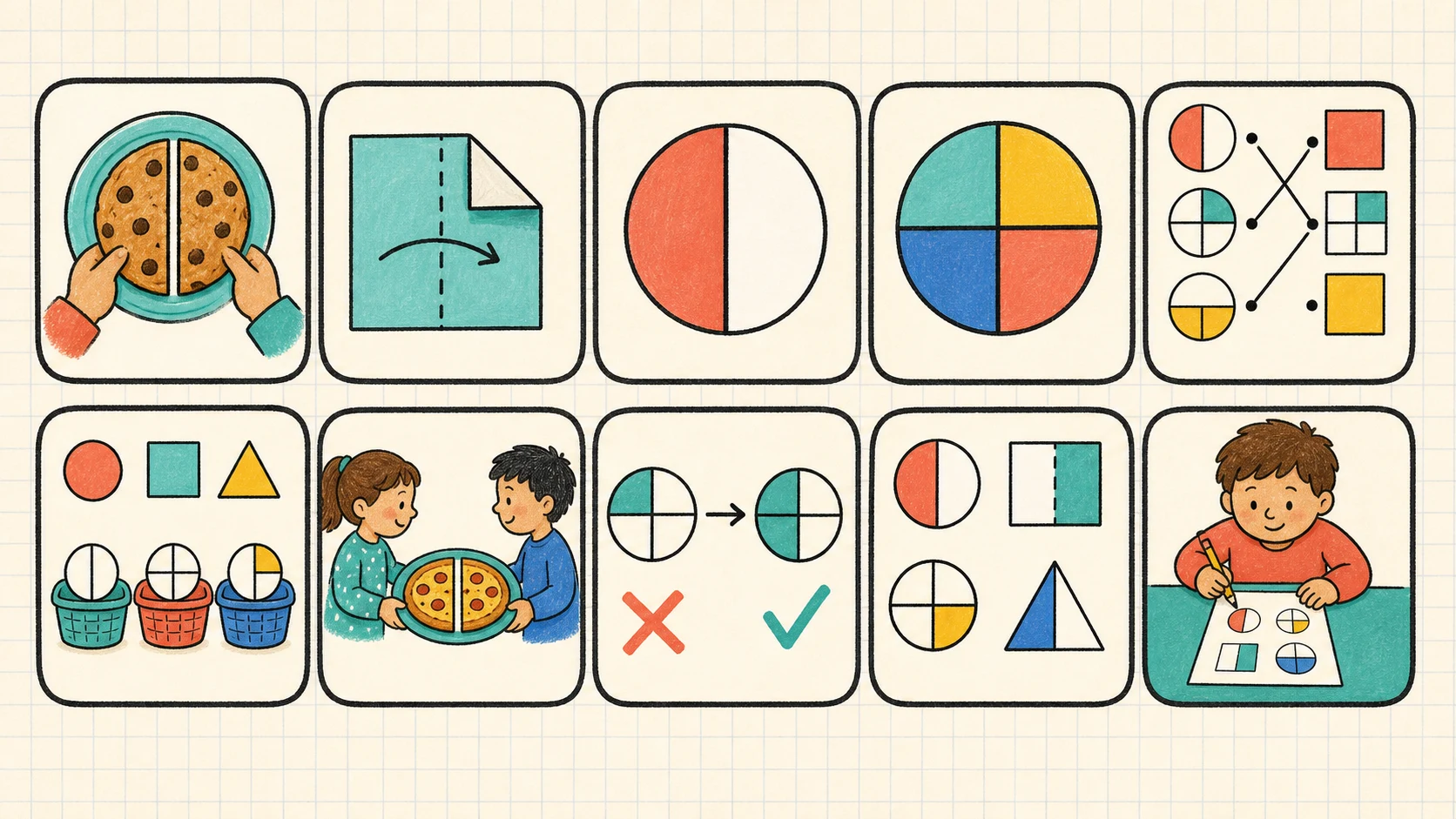
Alternate partitioning, matching, and explanation so repeated practice strengthens one idea without repeating an identical page.
Use the 1st Grade Fractions guide and free sheet when the immediate target is identifying or making equal parts.
Read clocks by coordinating two hands
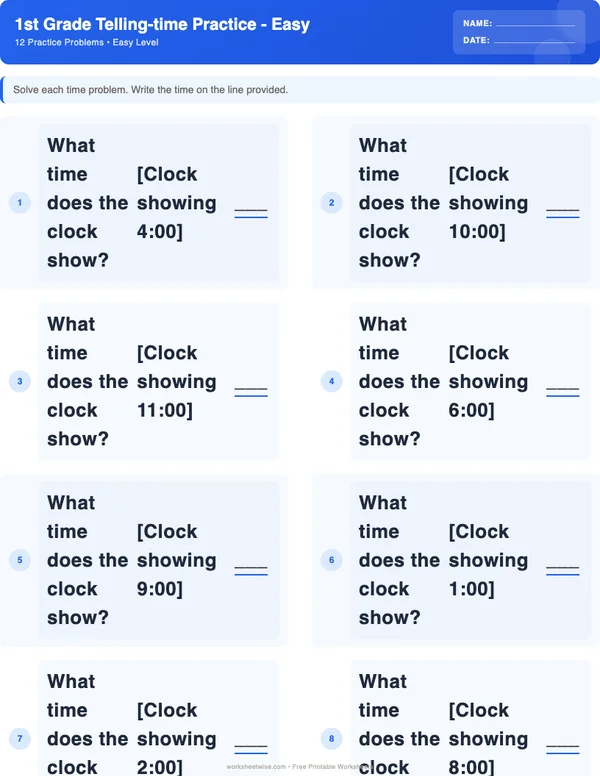
Telling time combines several ideas that should be separated during teaching: the hour hand indicates the current hour region, the minute hand marks minutes around the face, and the hands move together. The free sheet contains 12 problems.
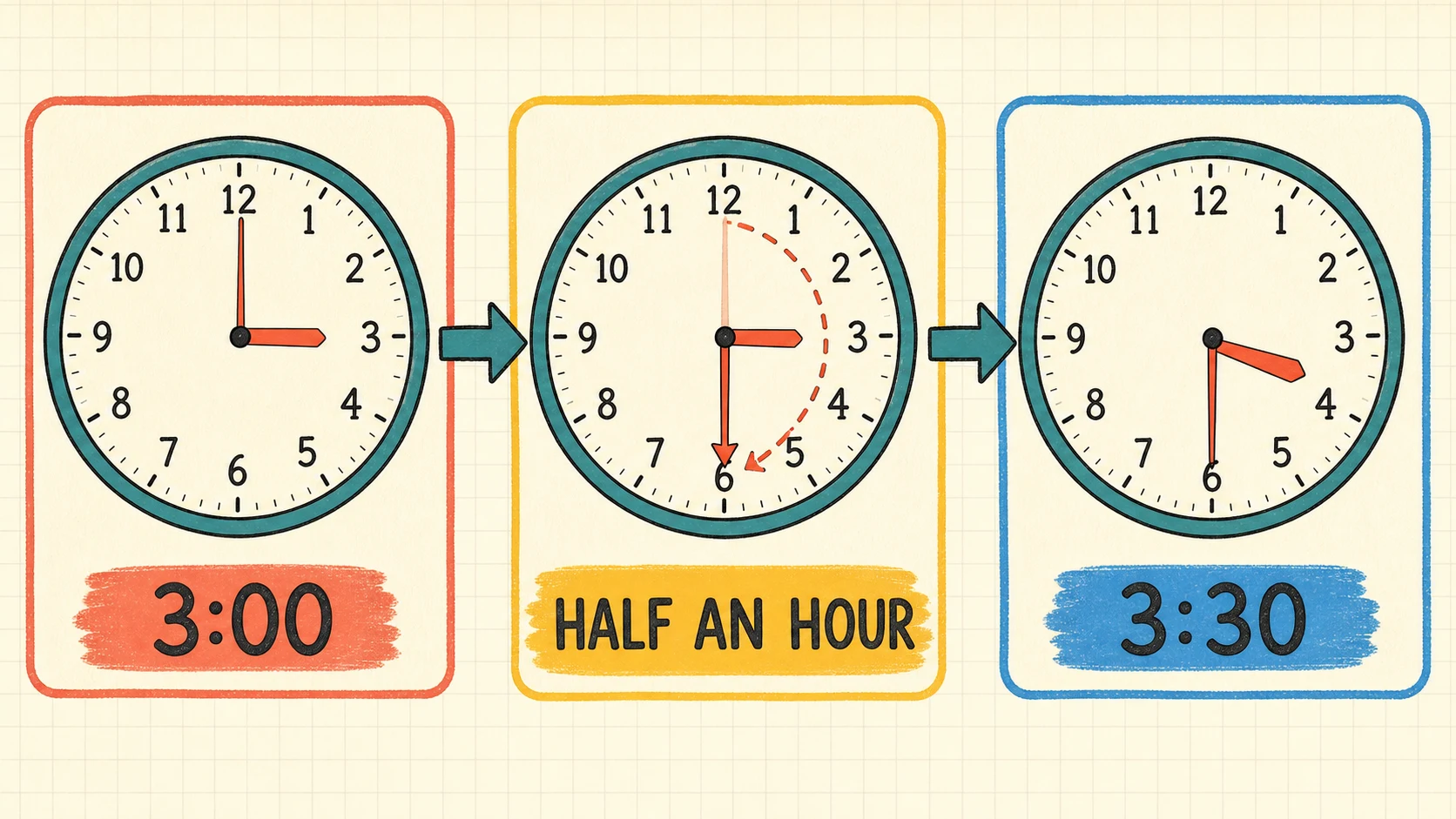
Use the map to locate the missing link—hand identification, hour reading, five-counting, or coordination—instead of treating every wrong time as the same error.
Work from the hour hand outward
Begin with a geared demonstration clock if available. Cover the minute hand and position the hour hand just after 3. Ask for the approximate hour. Then reveal the minute hand at 6.
Checked example 6: read 3:30. The minute hand points to 6, which represents 30 minutes because . The hour hand lies between 3 and 4 because half of the hour has passed. The time is 3:30, not 6:15 and not 4:30. This belongs here because the catalogue progression begins with the hour and half-hour.
For a clock showing 3:45, the minute hand points to 9, or 45 minutes, while the hour hand is approaching—but has not reached—4. The time remains 3:45. Reading 4:45 suggests that the learner chooses the nearest numeral rather than identifying the hour interval.
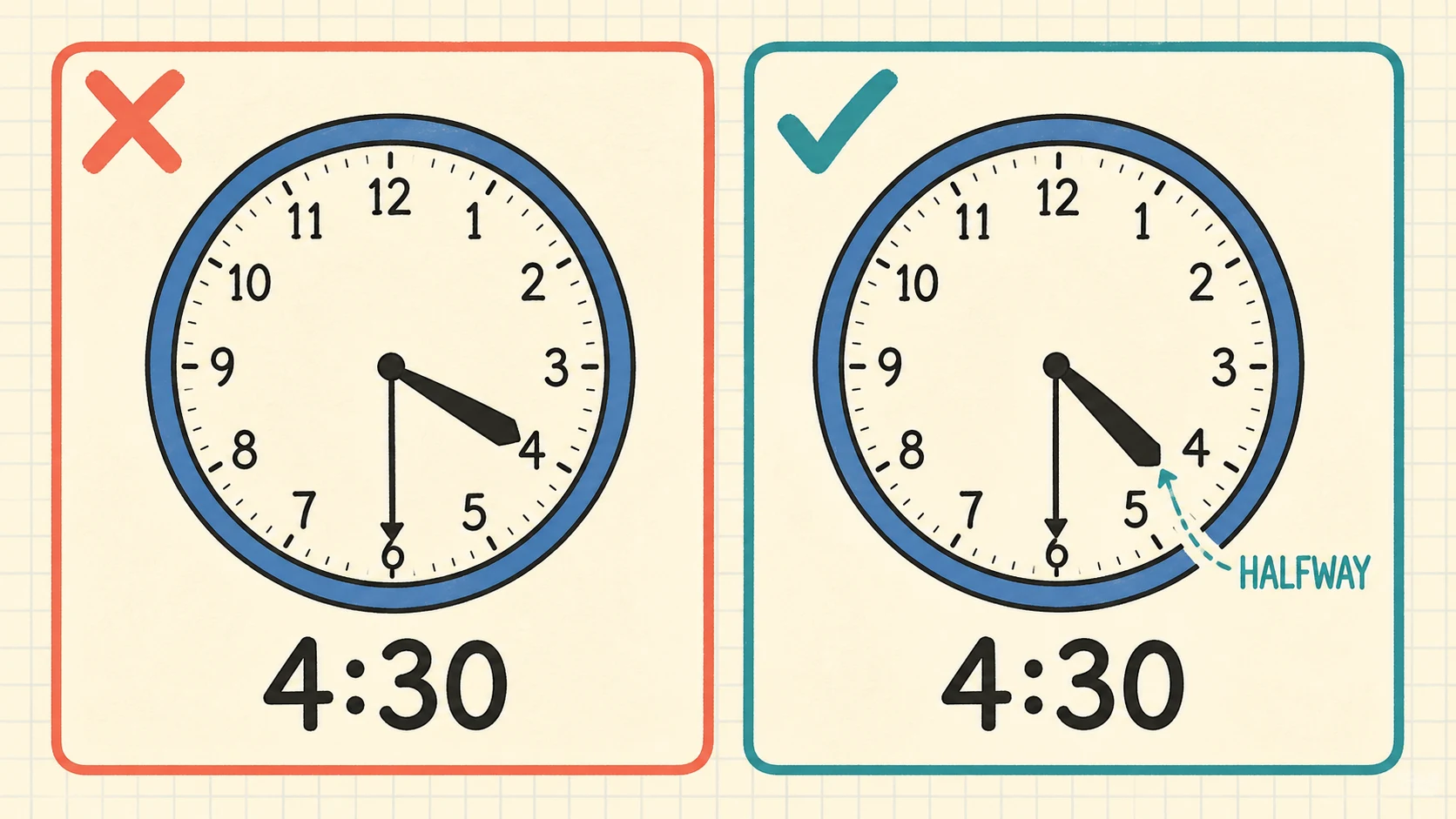
Match the response to the specific clock feature that needs attention; do not respond to every error with more skip-counting.
A clock with independently movable hands can accidentally show an impossible relationship. Use a geared clock when demonstrating movement, then use printed faces for reading practice. The 1st Grade Telling Time guide and free sheet is appropriate after the learner can distinguish the hands and read at least an hour-only demonstration.
Use money to apply counting, not replace it
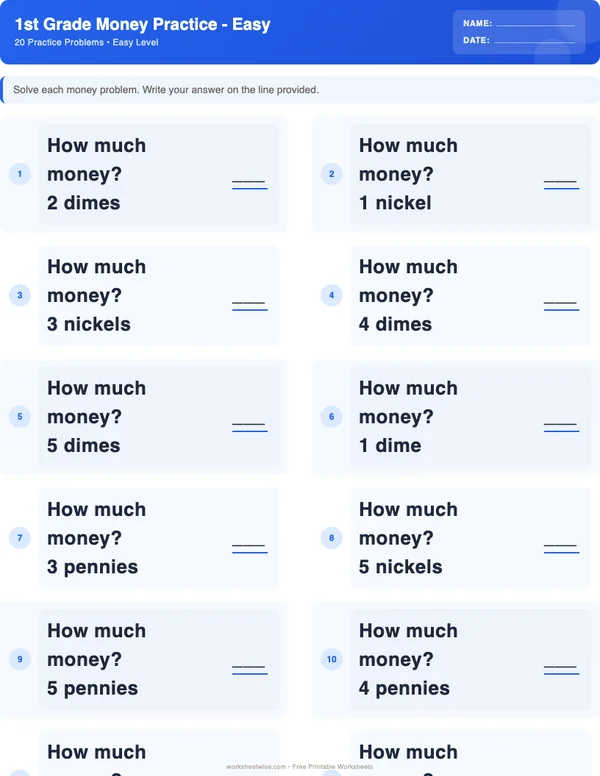
The money entry point contains 20 problems. The catalogue progression begins with identifying common US coins and their values, then moves toward mixed collections and purchase situations. Coin names, values, and skip-counting all create separate demands.
Introduce one denomination at a time
Start with pennies for counting by ones, then dimes for tens, nickels for fives, and quarters for twenty-fives. This ordering is a catalogue teaching suggestion, not a required curriculum sequence. Real or realistic play coins are useful because coin value cannot be inferred reliably from size.
Checked example 7: count two dimes, one nickel, and three pennies. Start with the greatest-value coins: , then , then . The collection is 28 cents. Check by grouping the three pennies as 3 and calculating . This belongs in the early money progression because it combines coin recognition with counting by tens, fives, and ones without requiring decimals or change-making.
If the learner reports 6 cents, they counted coins instead of values. If they report 33 cents, ask them to name each coin and write its value before counting. If the values are correct but the total is wrong, simplify to one dime, one nickel, and pennies while preserving mixed-coin counting.
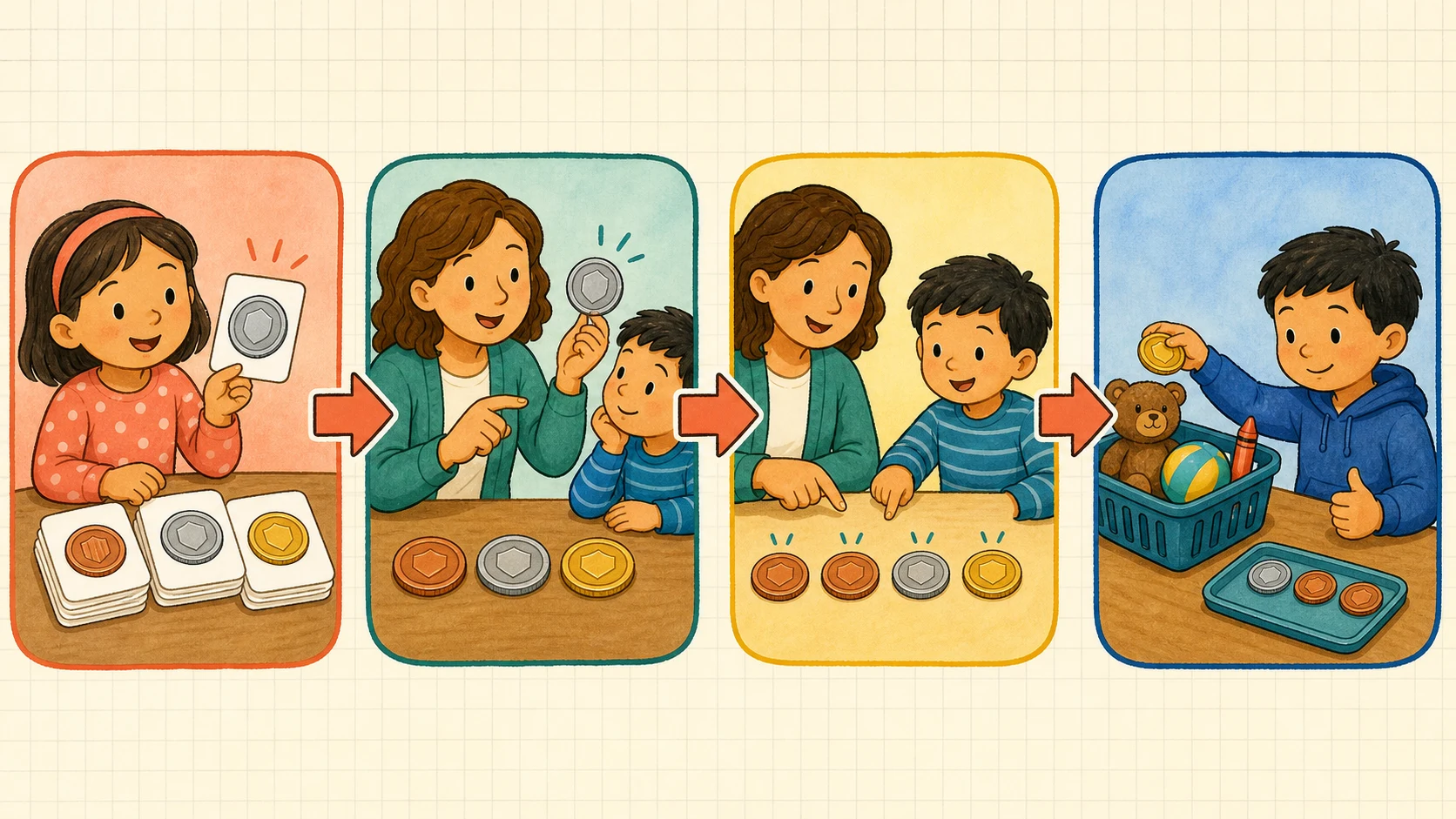
Name the coins, state each value, order them from greatest value to least, count on, and verify the total with a second grouping.
The catalogue also mentions making change and dollar-and-cent problems as later money work. Do not infer readiness for those tasks from coin identification alone.
Keep geometry physical and varied
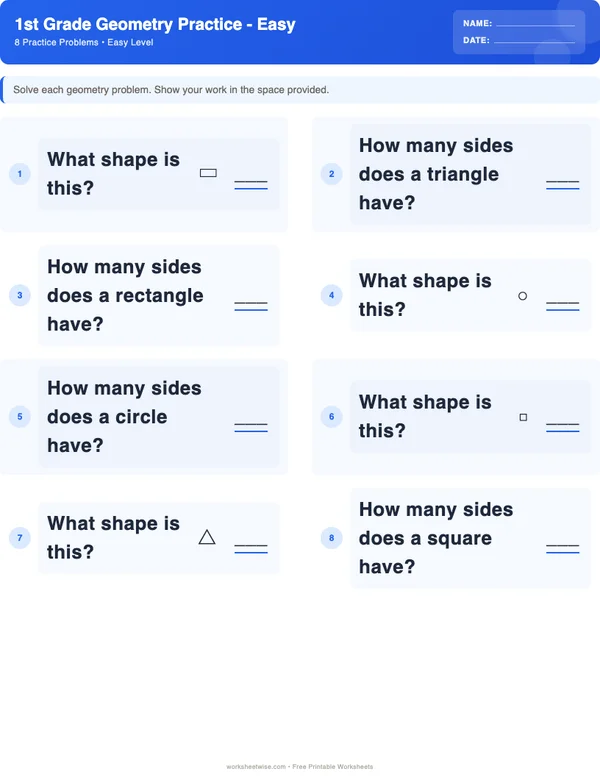
The free geometry sheet has 20 problems. Early work includes identifying and describing two-dimensional shapes and three-dimensional solids. Later catalogue coverage includes area, perimeter, volume, angles, and coordinate geometry; those later topics should not drive the choice of a 1st grade starting task.
Ask the learner to sort a set of triangles, rectangles, circles, hexagons, cubes, cones, cylinders, and spheres. Include triangles turned sideways and rectangles that are long, tall, or nearly square.
Checked example 8: classify a turned triangle. A closed shape with three straight sides and three corners remains a triangle when rotated. Orientation changes where the shape points, not its attributes. This belongs here because recognizing and describing early shapes is part of the catalogue’s first geometry stage.
Calling only an upright, symmetrical example a triangle indicates reliance on a familiar picture. Rotate the same cardboard triangle while asking what stayed unchanged. Do not simplify by showing only “standard-looking” shapes; that would remove the classification target. Instead, reduce the number of competing categories while preserving varied orientation.
Make word problems a relationship check
The free word-problem sheet contains 12 problems. Word problems are not merely reading-decorated computation. A learner must identify the quantities, determine how they relate, represent the situation, calculate, and judge whether the result makes sense.
Retell before choosing an operation
Use a consistent sequence:
- Read the complete problem.
- Retell what happened without looking at the text.
- Identify what is known and what must be found.
- Act it out, draw it, or use a bar model.
- Write an equation and solve.
- Check the answer against the story.
This routine aligns with the catalogue guidance. The IES practice guide for teaching mathematics to young children also supports systematic attention to mathematical ideas, progress monitoring, and instruction that helps children connect representations. IES did not assess WorksheetWise; its guidance is cited here to inform how an adult can use any practice page.
Checked example 9: comparison rather than removal. “Mia has 12 blocks. Leo has 7 blocks. How many more blocks does Mia have?” The difference is . Check: . Nothing was taken away in the story, yet subtraction represents the comparison. This belongs here because the catalogue explicitly identifies comparison as one subtraction situation.
A keyword rule could mislead the learner in other stories. Ask, “What amount would Leo need to match Mia?” Then draw bars of lengths 12 and 7 and mark the unmatched part as 5. If reading load obscures the mathematics, read the problem aloud while leaving all numbers and the required relationship unchanged. That adaptation preserves the math target.
Interpret errors before assigning another page
A score compresses unlike errors into one number. Instead, mark each response by what happened.
| Observed work | Plausible interpretation to test | Next instructional move |
|---|---|---|
| Skips objects in a scattered set | Tracking, not number order, may be unstable | Move counted objects into a separate area |
| Writes 41 for one ten and four ones | Numeral position may not match the model | Use a tens-and-ones chart |
| Solves every story by addition | Operation chosen before understanding the relationship | Act out removal, comparison, and missing-part stories |
| Divides a shape into unequal “halves” | Number of regions is noticed, equality is not | Fold and compare the parts |
| Calls 3:45 “4:45” | Nearest numeral is used for the hour | Trace the hour hand’s travel from 3 toward 4 |
| Counts six mixed coins as 6 cents | Objects are counted instead of coin values | Label each coin’s value before totaling |
| Rejects a rotated triangle | Recognition depends on orientation | Rotate one shape and name invariant attributes |
These are hypotheses to check, not diagnoses. A single mistake may reflect fatigue, unclear printing, language load, visual tracking, or an accidental slip. Look for the same pattern in two or three differently presented items before changing the target.
The IES guide on assisting students who struggle with mathematics recommends systematic instruction, clear mathematical language, representations, and regular review. Applied here, that means demonstrating one decision, prompting the learner to explain it, and checking whether the decision transfers to a new item. It does not mean assigning a learner a fixed ability label.
Use a short worksheet routine that produces evidence
A full 20-problem sheet is not automatically a full lesson. Use this repeatable routine for classroom, homework, homeschool, or after-school practice.
Preview, sample, then decide
Preview for one minute. Identify the single target and circle three representative items: an early item, a middle item, and one with a changed representation.
Model one item. Think aloud about the mathematical decision, not merely the written steps. For , say, “Eight needs two to make ten, so I split five into two and three.”
Release two items. Ask the learner to solve independently and explain one answer. Give neutral prompts such as “Show what that number represents.”
Pause after evidence. If both answers reveal the same misunderstanding, stop the page. Return to counters, a drawing, a clock, coins, or a shape model. More identical items would rehearse the error.
Finish selectively. Assign enough items to test consistency, not automatically every item. Later, revisit one old item beside one new item.
Check with the answer key. Every worksheet includes an answer key, which helps an adult verify results quickly. The key confirms an answer; it cannot reveal the learner’s reasoning. Compare the answer with the marks, model, or explanation on the page.
For planned instructional checks, the formative assessment Math Worksheets collection offers a relevant context. “Formative” should describe what the adult does with the evidence: adjust the next task.
Adapt access without changing the mathematics
An adaptation preserves the target when it reduces an unrelated barrier but retains the central decision.
For counting, enlarge or space the objects while still requiring one-to-one counting. For addition, provide counters or a ten frame but keep the same addends. For fractions, precut equal paper strips if drawing accuracy is interfering, while still asking the learner to identify equal parts. For clocks, read the directions aloud but leave the hand positions unchanged. For money, use physical coins that match the pictured denominations. For word problems, read the text aloud without telling the learner which operation to use.
Avoid adaptations that answer the mathematical question: coloring the correct fraction in advance, pointing to the operation sign, arranging coins with a written running total, or naming a shape before asking for its category.
Shorten a session when attention declines. Split 20 problems into groups of five, but mix one previously learned item into the next session. A six-problem fraction page may still require several pauses for folding, drawing, or explanation.
Respect the limits of worksheet evidence
A worksheet shows performance under particular conditions. It does not establish a diagnosis, fixed level, long-term mastery, or future outcome. Correct answers may come from guessing or imitation; incorrect answers may conceal sound reasoning interrupted by a calculation slip.
The catalogue covers one grade and one subject on this page. It does not determine a district’s instructional sequence. It also cannot replace oral explanation, manipulatives, movement, discussion, observation, or authentic uses such as reading a daily schedule or counting play coins.
Use difficulty labels only for task comparison. A page is more demanding when it has larger quantities, fewer visual supports, mixed representations, less predictable item order, more language, or multiple steps. Describe those features directly: “This page mixes comparison and take-away stories,” not “This is for advanced children.”
Make tomorrow’s task follow today’s evidence
Choose one free sheet, preview three items, and write the target at the top in observable language: “Build each teen number with one ten and some ones,” “Read the hour hand before the minute hand,” or “Explain why the parts are equal.”
After the learner works, record one sentence:
- Observed: “Counted 13 objects correctly in a row but recounted two in a scattered set.”
- Next: “Move each counted object into a cup, then try a new scattered set of 12.”
If no topic clearly stands out, begin with the 1st Grade Place Value guide and free sheet. Build 14 with one bundle of ten and four singles, match the model to the numeral, and use that one checked response to decide whether the next task should remain concrete, move to a drawing, or proceed to the free worksheet.
Put it into practice
Use the guide with a real printable
Move from explanation to a short, observable practice task. Check the first item together, then adjust the next session from the learner's actual work.
Open the first free worksheet