1st Grade · 3 live skills
1st Grade grammar worksheets
Pick the exact skill below. Each page combines a real free download, a separate answer key, practical teaching guidance and an optional focused pack.
See all 1st Grade subjects
Complete guide
How to teach and practise 1st grade grammar worksheets
3,342 words Updated 6 instructional visuals
Choose one grammar target, not a stack of worksheets
The useful starting point for first-grade grammar is one bounded decision: Does the learner most need to identify what words do, choose an end mark, or build a complete sentence?
The live WorksheetWise catalogue offers three first-grade grammar topics:
- Parts of Speech: 12 problems on the free sheet
- Punctuation: 12 problems on the free sheet
- Sentence Structure: 12 problems on the free sheet
Together, the catalogue contains 54 worksheet variants and three free entry points. The three topics are related, but they are not interchangeable. Parts-of-speech work asks a learner to classify or use words. Punctuation work asks the learner to interpret a sentence’s purpose and mark its ending. Sentence-structure work asks whether a group of words communicates a complete thought.
Start with the topic that matches an error you can actually observe. Use one free sheet as a short teaching sample rather than assigning all 12 problems immediately. Model one item, complete two together, and then ask the learner to try three independently. The pattern in those three responses should determine what happens next.
Grade labels describe the intended practice level; local curriculum sequences differ. “1st Grade” is therefore a catalogue guide, not proof that every first grader should complete every listed skill now. Likewise, the free sheets’ catalogue label of “easy” describes their starting position in this collection—not a learner. On this page, interpret that level through observable task features: short items, a single stated target, familiar sentence forms, and limited choices or corrections rather than extended paragraph editing.
What each live skill actually asks the learner to do
A grammar error can look like carelessness while hiding a more specific misunderstanding. Compare the mental work before selecting a page.
| Live topic | Central decision | Useful starting evidence | What the task does not establish |
|---|---|---|---|
| Parts of Speech | What job does this word perform in this sentence? | The learner can distinguish a naming word from an action word in a simple sentence. | Whether the learner can classify all eight parts of speech |
| Punctuation | Is this sentence telling, asking, or expressing something strongly? | The learner can say the sentence with an appropriate voice and choose ., ?, or !. |
Mastery of commas, apostrophes, quotation marks, colons, or semicolons |
| Sentence Structure | Does this group of words contain someone or something and what that subject does or is? | The learner can distinguish a complete thought from a fragment. | Control of later compound and complex sentence patterns |
The broader catalogue descriptions extend beyond first-grade entry work. Parts of speech eventually includes nouns, verbs, adjectives, adverbs, pronouns, prepositions, conjunctions, and interjections. Punctuation progresses beyond end marks to commas, apostrophes, quotation marks, colons, and semicolons. Sentence structure progresses toward expansion, combining, varied beginnings, and compound and complex sentences.
Those later destinations clarify the progression, but they should not inflate today’s lesson. A first grader who is deciding whether “The rabbit hops” is complete does not need a simultaneous explanation of dependent clauses. A learner sorting rabbit and hops does not need to memorize eight definitions.
The Common Core English Language Arts standards organize literacy through grade-specific expectations while also treating reading, writing, speaking, listening, and language as connected areas. WorksheetWise catalogue materials describe Common Core Language alignment, but standards organization does not prescribe the exact worksheet order for every learner. Check the sequence required by the learner’s school or local curriculum.
Start parts of speech with nouns and verbs in sentences
The 1st Grade Parts of Speech guide and free sheet is the strongest entry point when the learner can say a complete sentence but cannot yet explain who or what it is about and what happens.
Begin with concrete contrasts:
- A noun names the person, place, thing, or idea being discussed.
- A verb shows an action or state.
- The word’s job must be checked inside a sentence.
Do not start by asking for eight memorized category names. The live teaching guidance specifically places nouns and verbs first because they form the core of a sentence and are more concrete for young learners. Movement makes the distinction visible: hold up a cup for a noun; clap, bend, or jump for a verb. Then put both jobs into an oral sentence.
Checked example: “The fox jumps.”
Ask, “Who or what is this sentence about?” The checked answer is fox. In this sentence, fox is a noun because it names an animal.
Ask, “What does the fox do?” The checked answer is jumps. Here, jumps is a verb because it expresses the action.
The is not the noun, even though it appears beside one. A learner who circles the fox may understand the subject phrase but not the narrower instruction to identify the noun. Say, “You found the whole who-part. Now circle only the word that names the animal.”
This example belongs at the first-grade entry level because it has one concrete subject, one visible action, and no word whose grammatical job is ambiguous. It isolates the noun–verb distinction without requiring adjective, adverb, or pronoun knowledge.
Checked example: why a word list can mislead
Compare these two sentences:
- “We run home.”
- “The run was long.”
In sentence 1, run is a verb: it tells what we do. In sentence 2, run is a noun: it names the event that was long.
The answers are checked by substituting each word into the sentence’s structure, not by relying on a memorized claim that “run is always an action word.” This is an adult-led extension after the learner reliably handles clear nouns and verbs. It belongs here because the catalogue guidance explicitly warns that some English words perform different jobs in different contexts. It should not be used as the first independent item.
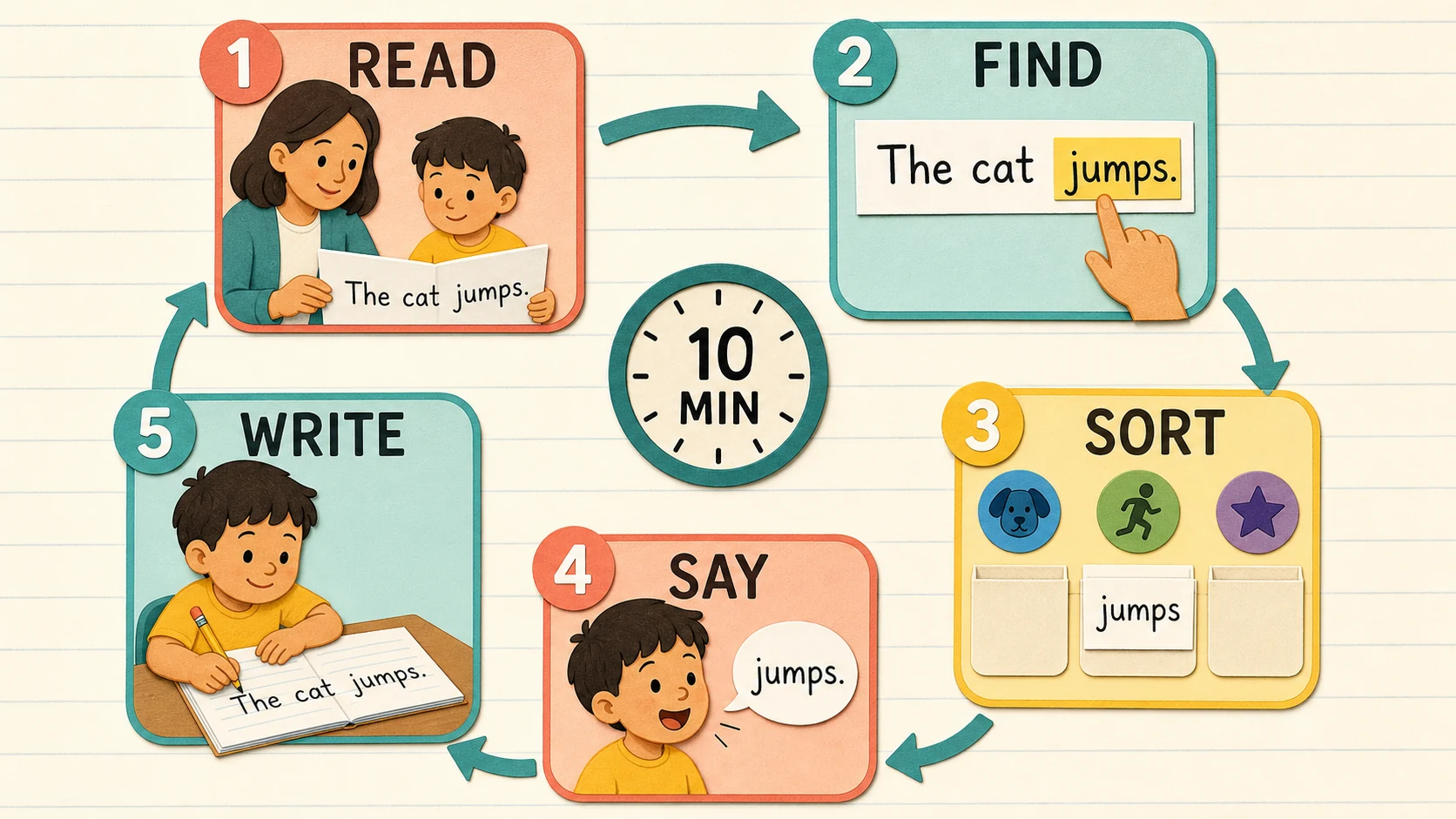
Use the routine to move from an acted or handled word to its job in a complete sentence, then release only a few items for independent classification.
When to add adjectives
Add an adjective only after noun–verb sorting is reasonably stable. Place a familiar object on the table and ask the learner to describe it:
- cup
- red cup
- small red cup
In “The red cup fell,” cup remains the noun, fell is the verb, and red describes the noun. If the learner circles both red and cup as nouns, cover red and ask, “What thing is left?” Then restore red and ask, “Which word tells more about that thing?”
This preserves the target. It does not turn a classification task into a spelling or handwriting test.
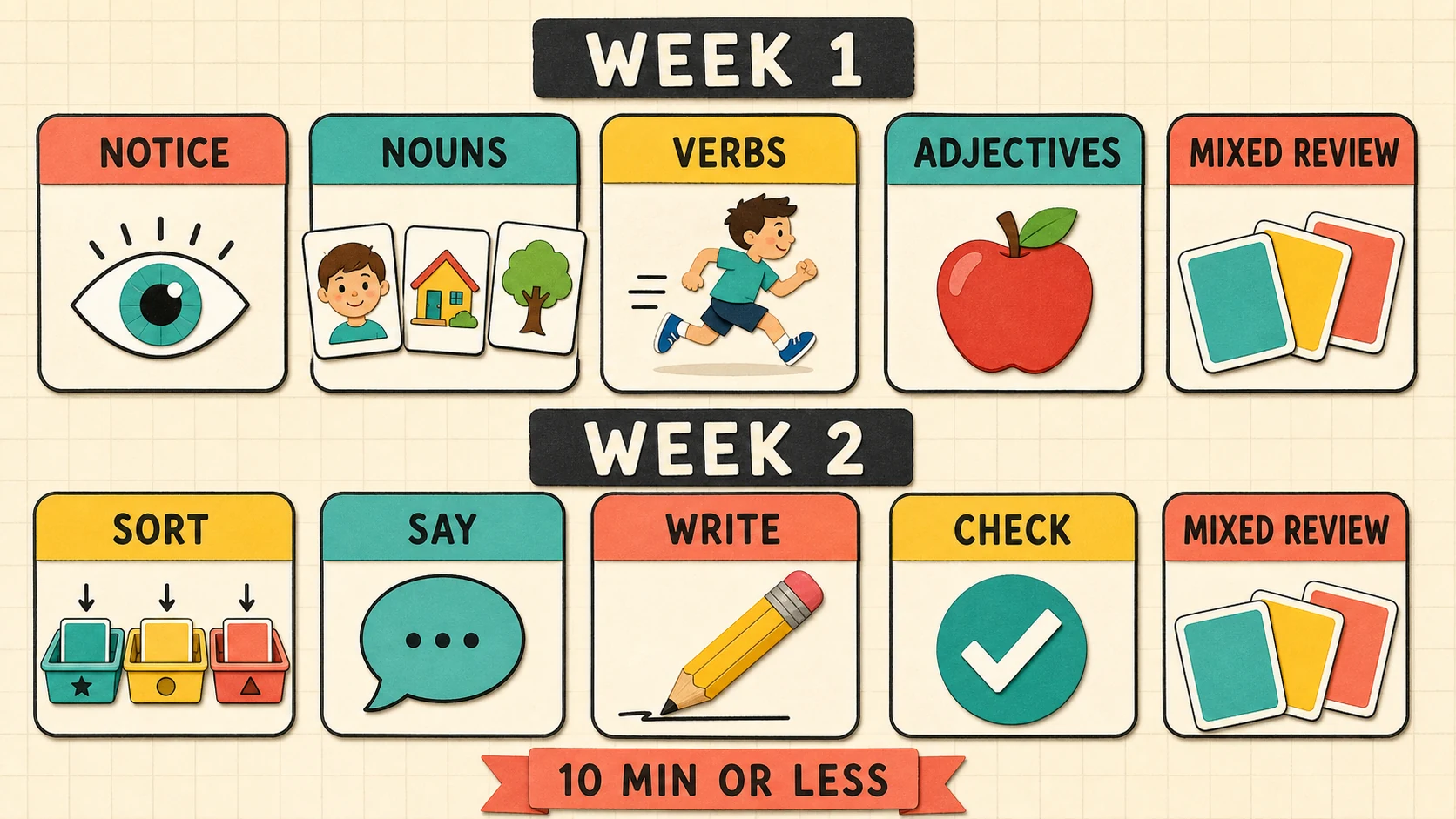
Space noun-and-verb review across several short meetings; introduce describing words only when the learner’s independent sorting shows that the first contrast is holding.
Teach end punctuation through meaning and voice
Choose the 1st Grade Punctuation guide and free sheet when the learner writes recognizable sentences but omits end marks or selects them without attending to meaning.
At this level, keep the initial set bounded to:
- A period for a statement
- A question mark for a direct question
- An exclamation point for a strong exclamation
Voice can support the decision, but voice alone is not a perfect rule. Questions in natural speech do not always rise, and people can read statements emphatically. Ask what the sentence is doing before asking how it sounds.
Checked example: three purposes, three marks
- “The bus is here**.**”
- “Is the bus here**?**”
- “Watch out for the bus**!**”
Each mark has been checked against the sentence’s communicative purpose. The first sentence tells something. The second asks directly whether something is true. The third gives an urgent warning with strong force.
These examples belong here because nearly all the words stay within one situation. The learner must notice sentence purpose rather than guessing from vocabulary. The third sentence also prevents the weak shortcut that any sentence containing bus takes the same mark.
Try reading all three aloud, then let the learner hold up a card showing the selected mark. This removes handwriting while preserving the punctuation decision. Once the oral choices are accurate, return to writing the marks.
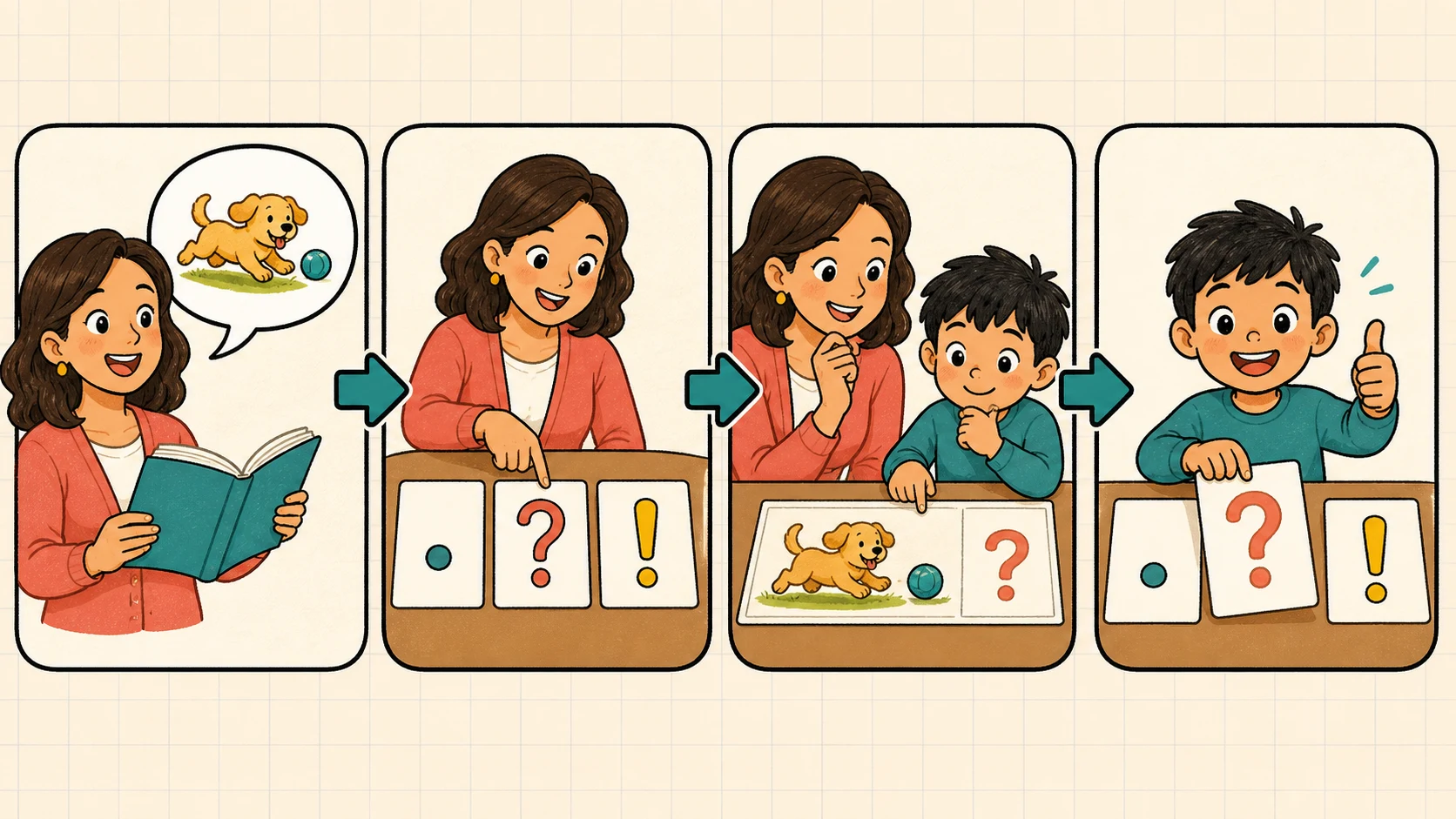
Keep the first punctuation routine focused on sentence purpose: say it, name what it does, choose the end mark, and reread the completed sentence.
Interpret punctuation errors precisely
A missing mark and a wrong mark are different evidence.
- If the learner consistently leaves every ending blank, the issue may be noticing where the sentence ends, remembering the convention, or managing the physical act of writing.
- If the learner uses periods for all three sentence purposes, ask the learner to sort oral examples into “telling,” “asking,” and “strong feeling or warning” before adding symbols.
- If every lively sentence gets an exclamation point, contrast excitement with grammar: “The puppy runs fast” can still be a statement.
- If a question mark appears after “I wonder where my shoe is,” do not introduce a full lesson on indirect questions. Use a clearer direct question—“Where is my shoe?”—to preserve the first-grade target.
Later punctuation categories should remain separate. A learner working on periods, question marks, and exclamation points should not lose credit for an untaught comma rule. The catalogue progression includes commas, apostrophes, quotation marks, colons, and semicolons, but their presence in the wider topic description is not a reason to teach them together.

Use later review days to mix the three end marks only after each purpose has been modeled clearly; review should test retention, not introduce a hidden new rule.
Build complete sentences before expanding them
Use the 1st Grade Sentence Structure guide and free sheet when the learner produces fragments, cannot explain what is missing, or needs to distinguish a complete thought from a phrase.
A practical first-grade frame is:
- Who or what?
- Did what—or is what?
This is a teaching scaffold, not a complete definition for every English sentence. It works well for clear first-grade examples such as “Birds fly” and “The soup is hot.”
Checked example: fragment or complete sentence
Consider:
- “Under the table”
- “The cat sleeps under the table.”
Sentence 1 is a fragment in this comparison. It identifies a location but does not tell who or what is under the table or what is happening. Sentence 2 is complete: the cat answers “Who or what?” and sleeps under the table tells what the cat does.
To repair the fragment, several answers are grammatically possible:
- “The ball rolled under the table.”
- “My shoes are under the table.”
- “A mouse hid under the table.”
Do not require one imagined answer unless the worksheet supplies a picture or word bank that constrains it. The grammatical target is completion, not matching the adult’s private sentence.
This example belongs here because the fragment is a familiar prepositional phrase and can be repaired orally before handwriting begins. It also checks whether the learner understands completeness rather than merely counting words; the four-word fragment is longer than the two-word complete sentence “Birds fly.”
Checked example: sentence combining without changing meaning
Start with:
- “The dog is big.”
- “The dog is brown.”
A checked combination is: “The dog is big and brown.”
The repeated subject appears once, and joins the two descriptions, and both original facts remain. “The big, brown dog” is not a complete sentence by itself because it names and describes the dog without saying what the dog does or is. It could become complete as “The big, brown dog barked.”
This distinction matters. A learner may successfully compress repeated information yet accidentally produce a fragment. The example belongs as a next step after simple completeness because it connects sentence construction with the catalogue’s later progression toward combining. It should not replace foundational “Who or what? Did what?” work for a learner still guessing about fragments.
The IES writing practice guide recommends teaching sentence construction as part of developing fluency with foundational writing skills, alongside regular opportunities to write and use the writing process. That supports connecting a worksheet item to a short piece of the learner’s own writing; it does not mean IES reviewed WorksheetWise materials. See IES, Teaching Elementary School Students to Be Effective Writers.
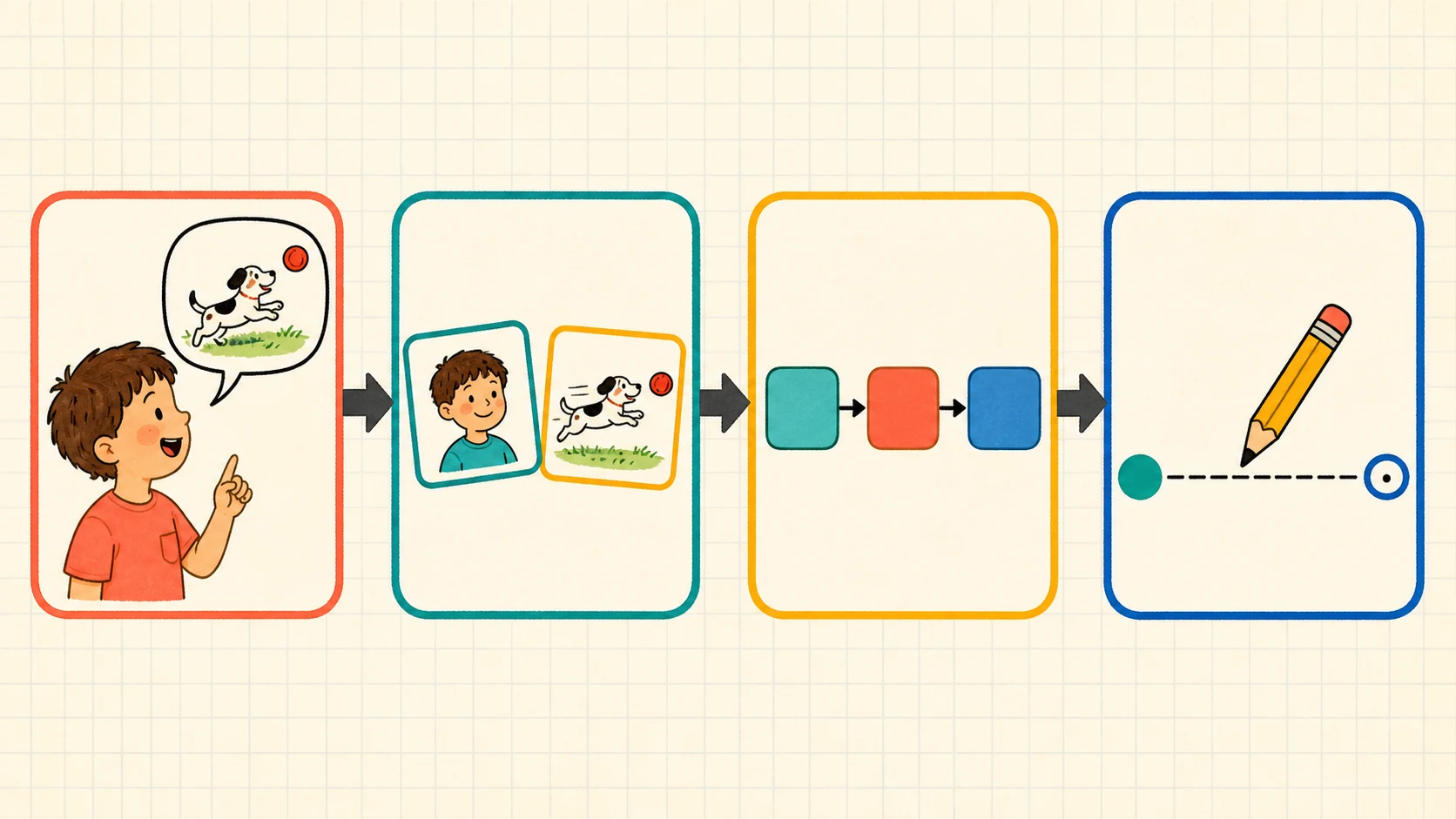
Move from oral completion and adult modeling to marked examples, then to one independently written sentence that uses the same structure.
Use a six-minute model–practice–check routine
A full 12-problem page can supply several meetings. It does not have to become one sitting. Use this routine for classroom warm-ups, homework support, or a short homeschool lesson.
Minute 1: State the single decision
Say exactly what the learner will decide:
- “Today we will find the naming word and action word.”
- “Today we will decide whether a sentence tells, asks, or exclaims.”
- “Today we will check whether each group of words is a complete thought.”
Avoid “We’re doing grammar.” That gives the learner no usable action.
Minutes 2–3: Model and think aloud
Complete one item yourself. Point to the evidence:
“In ‘The frog swims,’ frog names the animal. Swims tells what it does.”
Then do one item together. Ask the target question, wait, and request a brief reason. If the learner answers correctly for an incorrect reason, model the reasoning again.
Minutes 4–5: Release three items
Let the learner complete three similar items without coaching between each one. Help with reading a word if decoding would otherwise obscure the grammar target. Record the kind of help provided; an answer completed after the adult reads the sentence is different evidence from an answer completed after the adult names the grammatical category.
Minute 6: Transfer once
Ask for one oral or written example:
- Name an object and give an action it can perform.
- Say a question about lunch and choose its end mark.
- Repair “In the tall grass” into a complete sentence.
The IES foundational reading guide recommends academic-language development and daily work with connected text among its K–3 reading recommendations. A reasonable application here is to keep grammar connected to sentences the learner can understand and read, rather than treating every word as an isolated label. That application is a teaching suggestion, not a claim that the guide evaluates these worksheets.
Read the error pattern before choosing another page
One wrong answer does not identify a stable difficulty. Look across the three independent items and the transfer attempt.
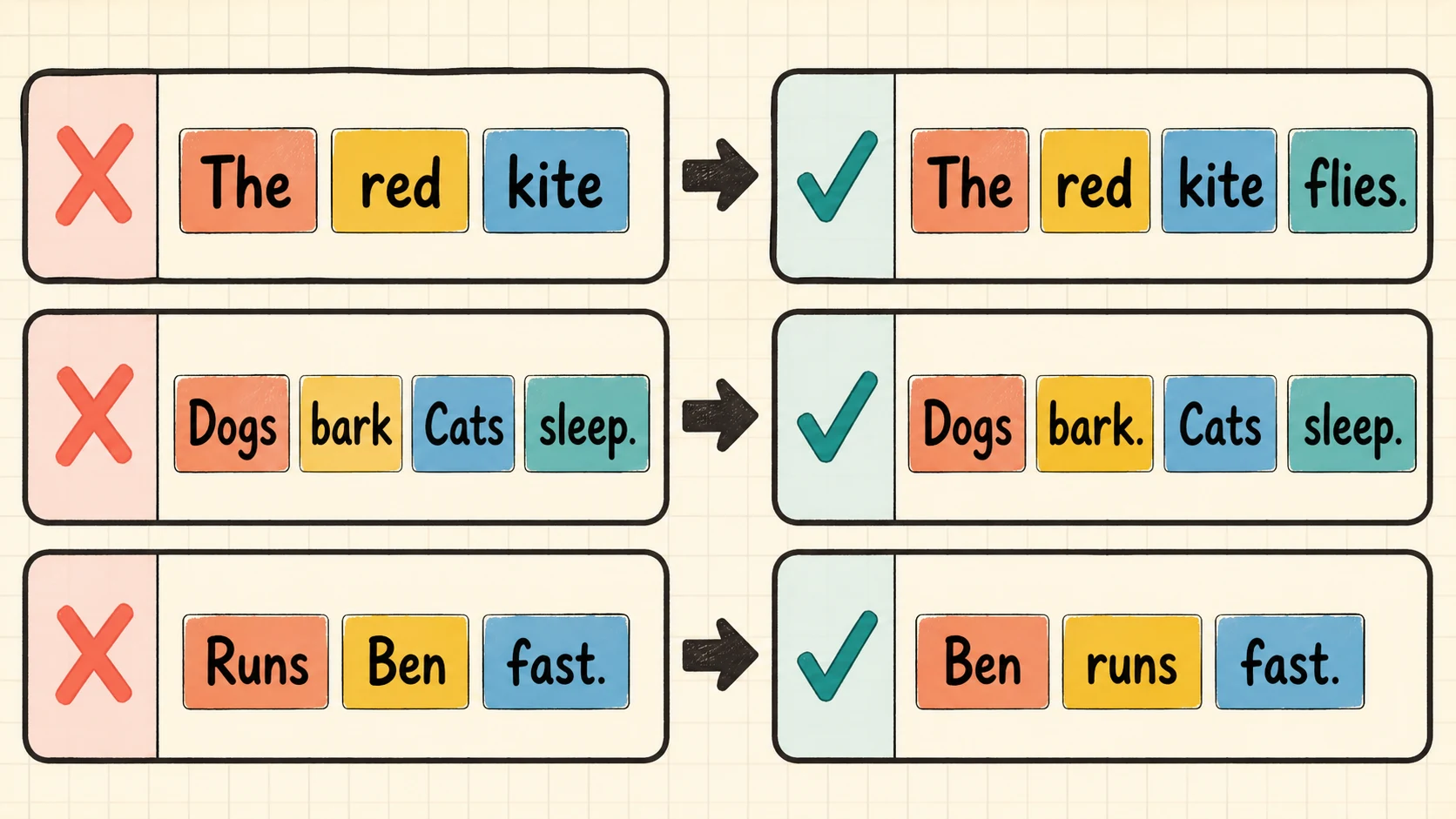
Match the teaching response to the observed sentence decision; do not turn a fragment error into a broad judgment about the learner’s language ability.
Use these interpretations as hypotheses to test, not diagnoses:
| Observed work | Possible interpretation | Next check |
|---|---|---|
| The learner calls every first word a noun. | Position may be driving the answer. | Put the noun later: “I see birds.” |
| The learner marks every action-looking word as a verb. | The learner may be using meaning without sentence context. | Compare “We run” with “The run ended.” |
| Every sentence receives a period. | The learner may not be distinguishing communicative purpose. | Sort three sentences orally before showing marks. |
| Long word groups are called sentences; short ones are called fragments. | Word count may be replacing the completeness test. | Compare “Under the old wooden chair” with “Birds fly.” |
| Oral answers are accurate, but written answers are incomplete. | Handwriting, copying, or memory load may be interfering. | Let the learner point, sort cards, or dictate while keeping the grammar decision unchanged. |
| Accuracy collapses when several skills are mixed. | The learner may control each skill separately but not yet select among them. | Return to one target, then mix only two familiar choices. |
Respond with a smaller contrast, not simply more items. If two of three noun–verb classifications are wrong, repeat the same contrast with concrete words. If all three are correct and the learner explains why, use the remaining sheet items for later review or introduce one adjective example. If end marks are accurate on the sheet but disappear in original writing, place a small “Read—decide—mark” reminder beside the writing paper and check one sentence at a time.
Adapt access without replacing the grammar target
An adaptation is useful when it lowers an unrelated barrier while leaving the central decision intact.
For a learner who finds handwriting effortful, allow pointing, circling, movable word cards, or oral answers. For a learner who needs reading support, read the sentence neutrally and ask the learner to make the grammar decision. For a multilingual learner, confirm the meaning of key vocabulary before evaluating English word roles or punctuation. For a learner distracted by a full page, cover all but one row.
Preserve the target carefully:
- If the goal is identifying nouns and verbs, reading the sentence aloud is an access support. Naming the noun for the learner is not.
- If the goal is end punctuation, offering
.,?, and!cards preserves the choice. Reading the sentence with an exaggerated question voice may supply too much of the answer unless voice is the scaffold currently being taught. - If the goal is sentence completeness, letting the learner dictate a repair preserves sentence construction. Rewriting the fragment yourself and asking the learner to copy it does not.
- If the goal is independent application, unlimited prompting changes what the result demonstrates. Note prompts and try a fresh item with less support.
Age is not supplied as a catalogue filter on this page. More generally, age should be used as a discovery aid rather than a placement decision. Grade labels also remain intended practice levels, not diagnoses. Select from demonstrated work, language comprehension, local expectations, and the task’s actual features.
Know what a worksheet can and cannot tell you
A short worksheet can show how a learner responded to a controlled set of items on one occasion. It cannot establish a diagnosis, prove general mastery, or predict writing outcomes. Correct multiple-choice answers may reflect recognition without independent production. Errors may reflect misunderstood directions, unfamiliar vocabulary, decoding load, attention, motor demands, or the grammatical target itself.
Grammar sheets also should not replace connected reading, conversation, or real writing. The IES writing guide recommends daily writing time, instruction in the writing process, foundational writing skills, and an engaged community of writers. Use a sheet to make one language feature visible, then return that feature to a sentence the learner wants to communicate.
The Common Core ELA framework similarly places language within a broader literacy system that includes reading, writing, speaking, and listening. A worksheet’s stated standards alignment should therefore be read as a curricular connection, not evidence that completing the page fulfills an entire standard or local instructional requirement.
Use professional or school-based support when concerns are broad, persistent, or extend well beyond the narrow worksheet target. Do not infer a language disorder, learning disability, or attention condition from grammar errors.
Make the next assignment observable
End each meeting by writing one factual note:
“With no prompt, Maya identified the noun and verb in 3 of 3 simple action sentences. She called run a verb in both context examples.”
That note supports a clear next decision: retain noun–verb work, test the same word in two contexts, or add one adjective contrast. Avoid labels such as “good at grammar” or “behind.” They do not tell the next adult what to teach.
For a first session, choose the single sentence that best matches the learner’s recent work:
- If nouns and actions are confused, open the 1st Grade Parts of Speech guide and free sheet.
- If sentences lack or misuse end marks, open the 1st Grade Punctuation guide and free sheet.
- If fragments appear, open the 1st Grade Sentence Structure guide and free sheet.
Use only the first six-minute cycle today: model one item, complete two together, collect three independent responses, and ask for one new example. Record exactly what the learner did. That observable evidence—not the page label or the number of unfinished worksheets—selects tomorrow’s task.
Put it into practice
Use the guide with a real printable
Move from explanation to a short, observable practice task. Check the first item together, then adjust the next session from the learner's actual work.
Open the first free worksheet