2nd Grade · 5 live skills
2nd Grade phonics worksheets
Pick the exact skill below. Each page combines a real free download, a separate answer key, practical teaching guidance and an optional focused pack.
See all 2nd Grade subjects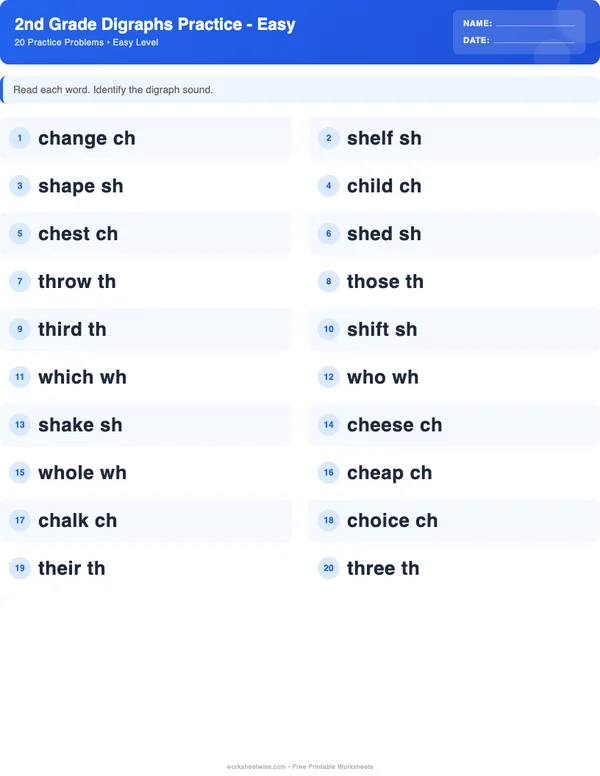
Complete guide
How to teach and practise 2nd grade phonics worksheets
3,479 words Updated 6 instructional visuals
Choose the phonics task that matches the learner’s next decoding decision
The most useful 2nd grade phonics worksheet is not necessarily the one labeled for the learner’s age or grade. It is the one that isolates a pattern the learner is ready to notice, read, and spell. Start by checking five live skill areas—short vowels, consonant blends, digraphs, long vowels, and sight words—then select one bounded target such as distinguishing short e from short i or retaining both sounds in initial st-.
WorksheetWise’s live 2nd grade phonics catalogue contains 90 variants across those five topics, with one free 20-problem sheet for each topic. That breadth is useful for comparison, but breadth should not become a five-skill lesson. One pattern, a few carefully chosen words, immediate feedback, and a short transfer task will reveal more than completing unrelated pages.
Grade labels describe the intended practice level; local curriculum sequences differ. Age is a discovery aid, not a placement decision. A second grader may need to revisit CVC vowels before working on vowel teams, while another may be ready to compare spellings within one long-vowel sound. For ages three and four, prioritize brief adult-led oral, matching, manipulative, and movement work over desk work: say and sort picture names, move counters for sounds, or step once per sound instead of requiring a full worksheet.
This guide compares the live skills without treating them as interchangeable, checks representative examples, and shows how to choose the next task from observable work. It does not diagnose a reading difficulty or promise an outcome.
Read the five live skill areas as a progression, not a checklist
The five catalogue topics overlap, but each asks the learner to make a different decision.
Short vowels establish the word’s center
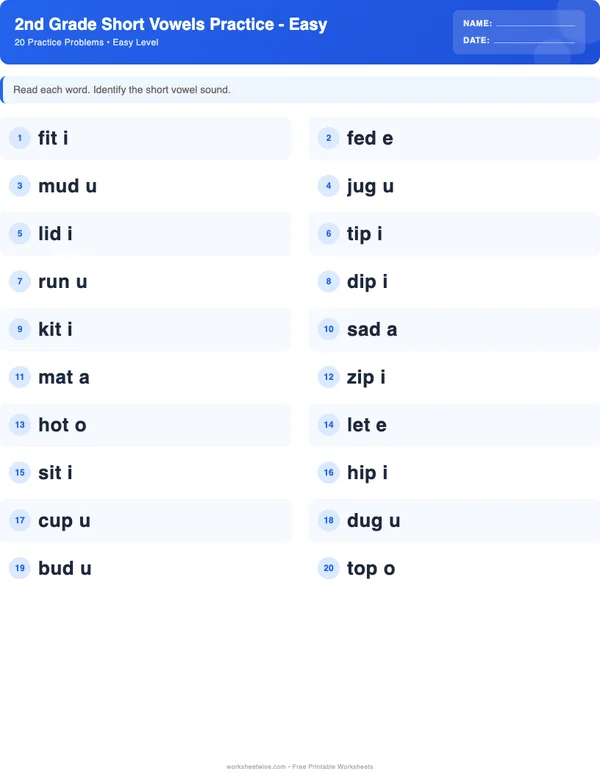
Short-vowel work asks the learner to identify and represent the vowel in a closed syllable such as cat, pen, sit, hot, or cup. This is the most useful starting area when the learner can hear or write the outside consonants but guesses the middle vowel.
The critical decision is not “Does this word contain a vowel?” It is “Which short-vowel sound occurs between these consonants?” Confusions such as pen/pin and bed/bid deserve direct comparison because both words preserve the initial and final consonants. A picture sort, fill-in-the-middle item, oral discrimination task, and dictated spelling can all assess that same target from different directions.
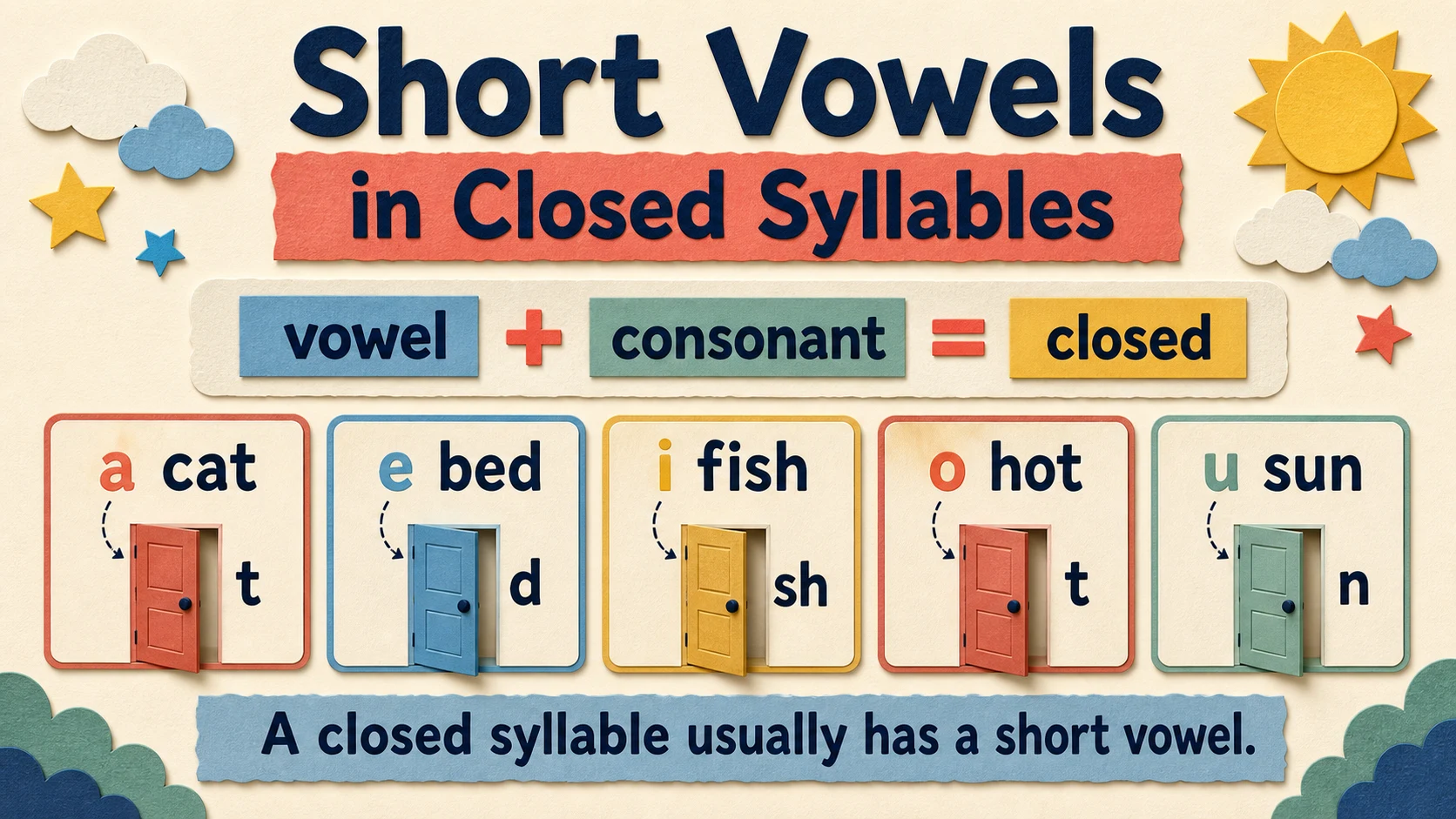
Use this map to keep short-vowel listening, reading, sorting, and spelling centered on the same vowel contrast.
Do not advance merely because the learner finished a page. Look for accurate reading without picture guessing and plausible spelling from dictation. The 2nd Grade Short Vowels guide and free sheet is the catalogue’s focused entry point for this check.
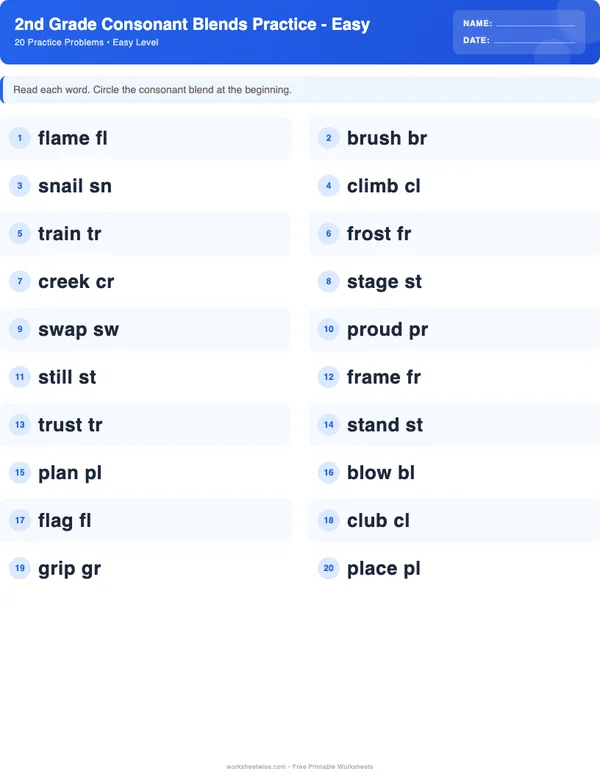
Consonant blends increase the number of sounds to retain
In a blend, each consonant keeps its sound. The word stop contains /s/, /t/, /ŏ/, /p/; the initial st- does not become a new sound. Blend work therefore asks the learner to hold and combine more sound units than a simple CVC word requires.
Initial blends and final blends also create different demands. In clap, the learner must enter the word through /k/ and /l/ without dropping either. In tent, the learner must continue through /n/ to the final /t/. A child who reads stop as sop is not showing the same error as one who reads it as step: the first drops a consonant; the second preserves the consonants but changes the vowel.
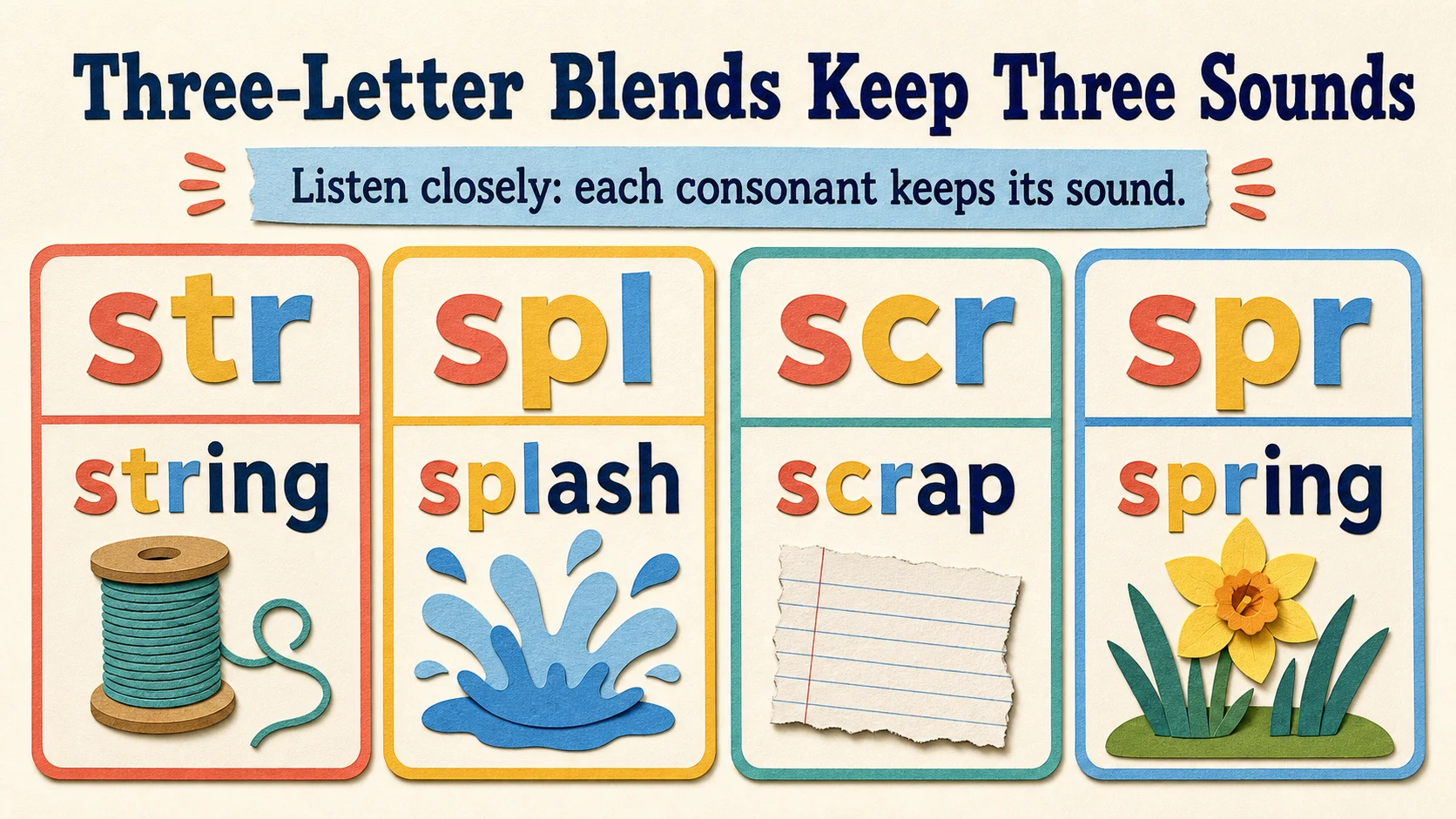
The useful distinction here is where a blend occurs and whether every consonant sound remains audible.
Start with a small set, perhaps st-, sp-, sn- or bl-, cl-, fl-, rather than displaying every possible blend. Use the 2nd Grade Consonant Blends guide and free sheet when CVC reading is reasonably secure but a consonant disappears from longer clusters.
Digraphs require two letters to be treated as one sound
Digraphs look superficially similar to blends because both may contain two consonant letters. The sound structure differs. In ship, sh represents one sound; in slip, sl represents two. That contrast is the central instructional decision.
The live digraph resource covers common patterns including sh, ch, th, wh, and final ck. Initial and final positions both matter: ship/wish, chin/much, and thin/bath. The two common pronunciations of th can be experienced through words such as thin and this without requiring the learner to memorize technical labels.
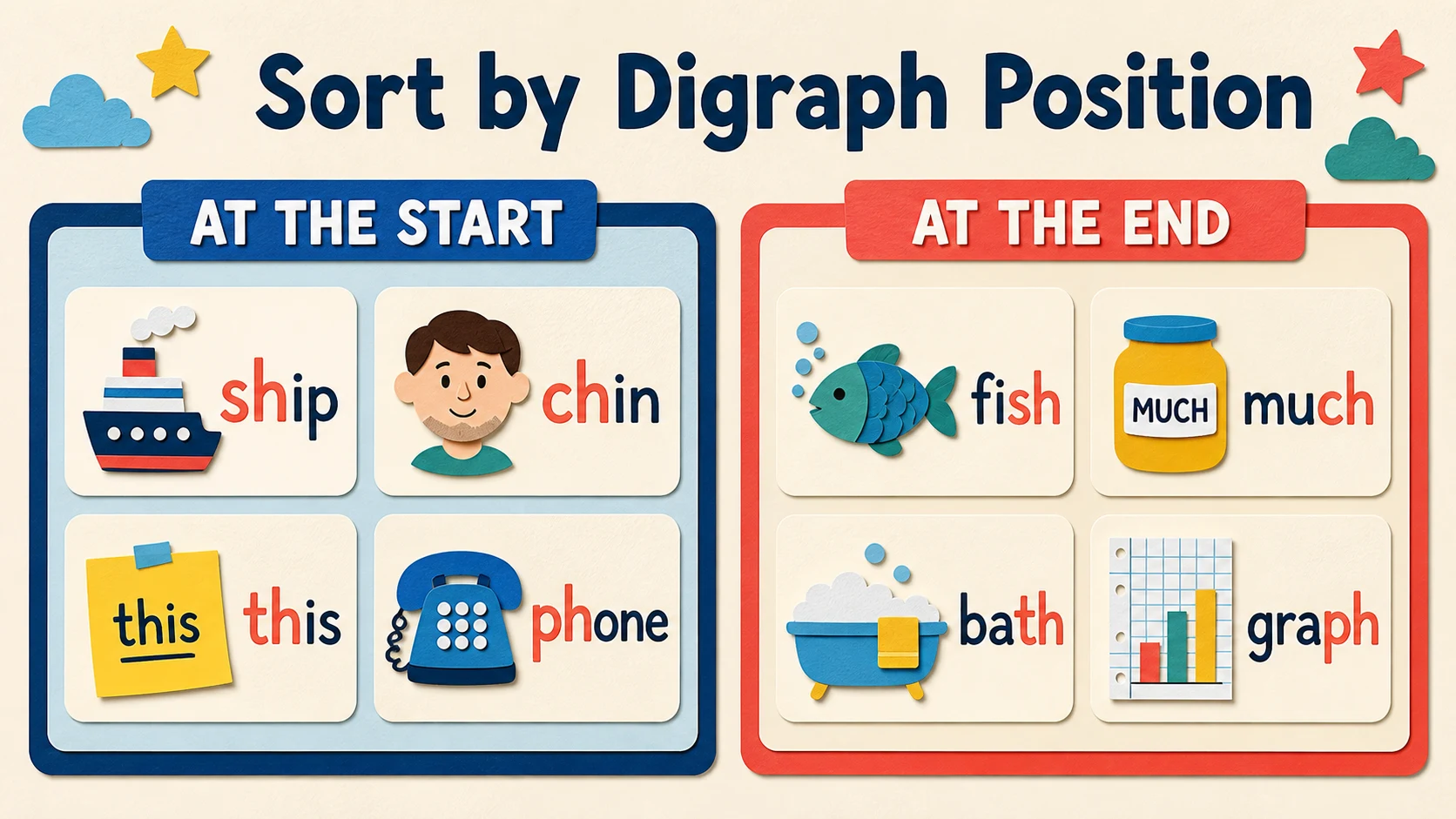
Keep the digraph routine anchored to the contrast “two letters, one sound,” followed by reading and spelling whole words.
Choose the 2nd Grade Digraphs guide and free sheet when the learner independently retains blends but separates a digraph into two sounds, substitutes a different digraph, or fails to recognize one across initial and final positions.
Long vowels introduce competing spelling patterns
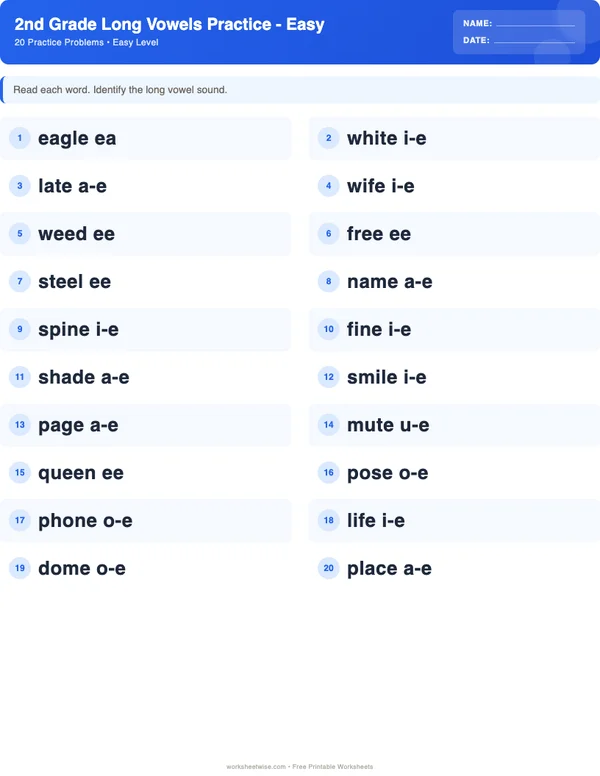
Long-vowel practice is not simply “make the vowel say its name.” The learner must distinguish short from long vowel sounds and attend to the spelling pattern that represents the long sound. The catalogue includes silent-e forms such as make, ride, and hope; vowel teams such as ai, ay, ea, ee, oa, and ow; and open syllables such as he and go.
Silent-e is a bounded starting target because a one-letter change creates a visible and audible contrast: cap/cape, pin/pine, hop/hope, and cub/cube. Vowel-team work is a later comparison among spellings. Avoid presenting sayings about vowel teams as exceptionless rules. Instead, teach a known pattern, read examples that fit it, and mark exceptions when they arise.
The Common Core Grade 2 foundational reading standards include distinguishing long and short vowels in regularly spelled one-syllable words, learning additional common vowel-team correspondences, and decoding regularly spelled two-syllable long-vowel words. This source describes one standards framework; it did not evaluate WorksheetWise, and a local sequence may organize the material differently.
Use the 2nd Grade Long Vowels guide and free sheet after checking that short-vowel CVC words are not being guessed from their first letters.
Sight words mix regular and irregular information
The live sight-word topic contains high-frequency words that may be fully decodable under patterns the learner knows and words with an unexpected spelling-sound relationship. Treating every high-frequency word as an unanalyzable picture would hide useful phonics information.
For said, the initial s and final d are regular, while ai represents an unexpected vowel sound in this word. The learner can read the known parts, identify the surprising part, and practice the whole word. For a decodable word such as and, ask for sound-by-sound reading before expecting quick recognition.
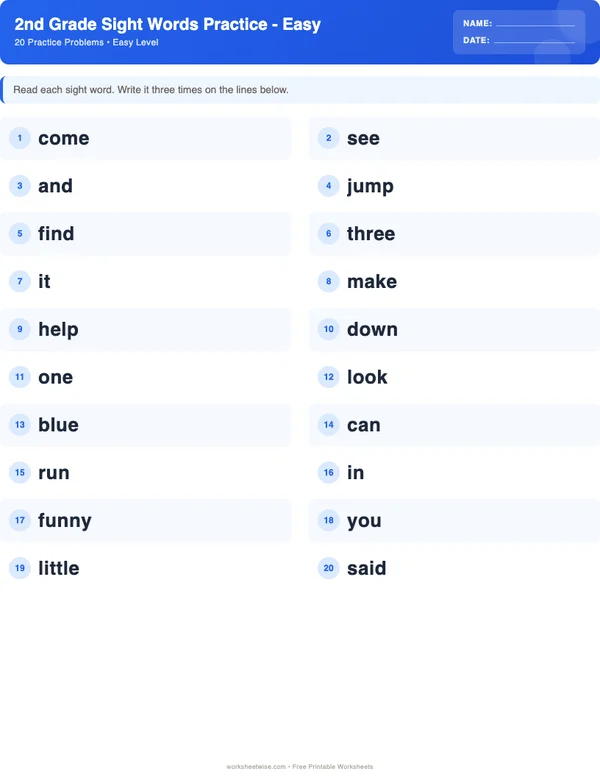
Sight-word practice is appropriate when a learner decodes the underlying patterns but repeatedly pauses at a small, taught group of frequent words in connected text. It should not replace instruction in vowel, blend, or digraph patterns. The 2nd Grade Sight Words guide and free sheet supplies a separate entry point when word recognition—not an unresolved basic vowel contrast—is the immediate target.
Use observable task features instead of labeling the learner
Each free catalogue sheet is marked “easy,” but that label should describe the task’s visible design, not the learner. In practical terms, the free sheets have 20 problems and focus on one named topic. Before assigning one, inspect the actual response demands:
- Are choices pictured, printed, or dictated?
- Does each item contrast two patterns or mix several?
- Must the learner recognize a word, read it aloud, sort it, or spell it?
- Are words isolated, placed in sentences, or embedded in a passage?
- Does handwriting load compete with the phonics decision?
- Can the learner rely on pictures without decoding?
- Does the page review known patterns alongside the new target?
A recognition item with two printed options generally supplies more support than spelling the word from dictation. Reading ship from a picture-word match differs from hearing /shĭp/ and writing all four letters. A sentence adds vocabulary, syntax, attention, and connected-text demands. These task differences explain difficulty more accurately than calling a child “easy,” “developing,” or “advanced.”
The Institute of Education Sciences recommends linking speech sounds to letters, teaching decoding and word analysis, and providing daily connected-text reading. Its foundational-skills guide also distinguishes the evidence ratings behind its recommendations. Those principles support moving between oral sound work, printed-word work, spelling, and text rather than treating worksheet completion as the goal. The guidance is general and does not represent an assessment of WorksheetWise. See the IES foundational reading practice guide.
Check these representative examples before choosing a page
The following examples use patterns explicitly present in the live catalogue. Each answer has been checked by identifying the sounds and relevant spelling pattern.
Worked example 1: pen or pin
Prompt: “I say pen. Choose the middle letter: e or i, then write the word.”
Checked answer: pen.
Reasoning: The spoken word is /p/ /ĕ/ /n/. The outside consonants are p and n, and short e represents the middle sound. Pin is /p/ /ĭ/ /n/, so it is a genuine minimal-pair distractor, not an arbitrary wrong answer.
Why it belongs here: The catalogue specifically identifies short e and short i as confusable and gives pen/pin as a comparison. The item isolates vowel discrimination while holding both consonants constant.
Interpretation: If the learner says the words distinctly but selects i for both, return to oral comparison and mouth observation before asking for more writing. If the learner hears the difference but writes another consonant, the vowel target may be intact; check letter formation or consonant correspondence separately.
Worked example 2: lap → clap → clam → clamp
Prompt: Read each word, then state what changed.
Checked sequence:
- lap = /l/ /ă/ /p/
- clap = /k/ /l/ /ă/ /p/; initial /k/ was added.
- clam = /k/ /l/ /ă/ /m/; final /p/ changed to /m/.
- clamp = /k/ /l/ /ă/ /m/ /p/; final /p/ was added.
Why it belongs here: This exact word chain comes from the live consonant-blends guidance. It progresses from a CVC word to an initial cl- blend and then to a word containing both an initial blend and final -mp. Every step changes one sound, making omissions visible.
Interpretation: Reading clap as lap indicates loss of the first blend sound. Reading clamp as clam indicates loss at the end. Those errors call for different placement of counters or finger taps; they should not be recorded simply as “blend trouble.”
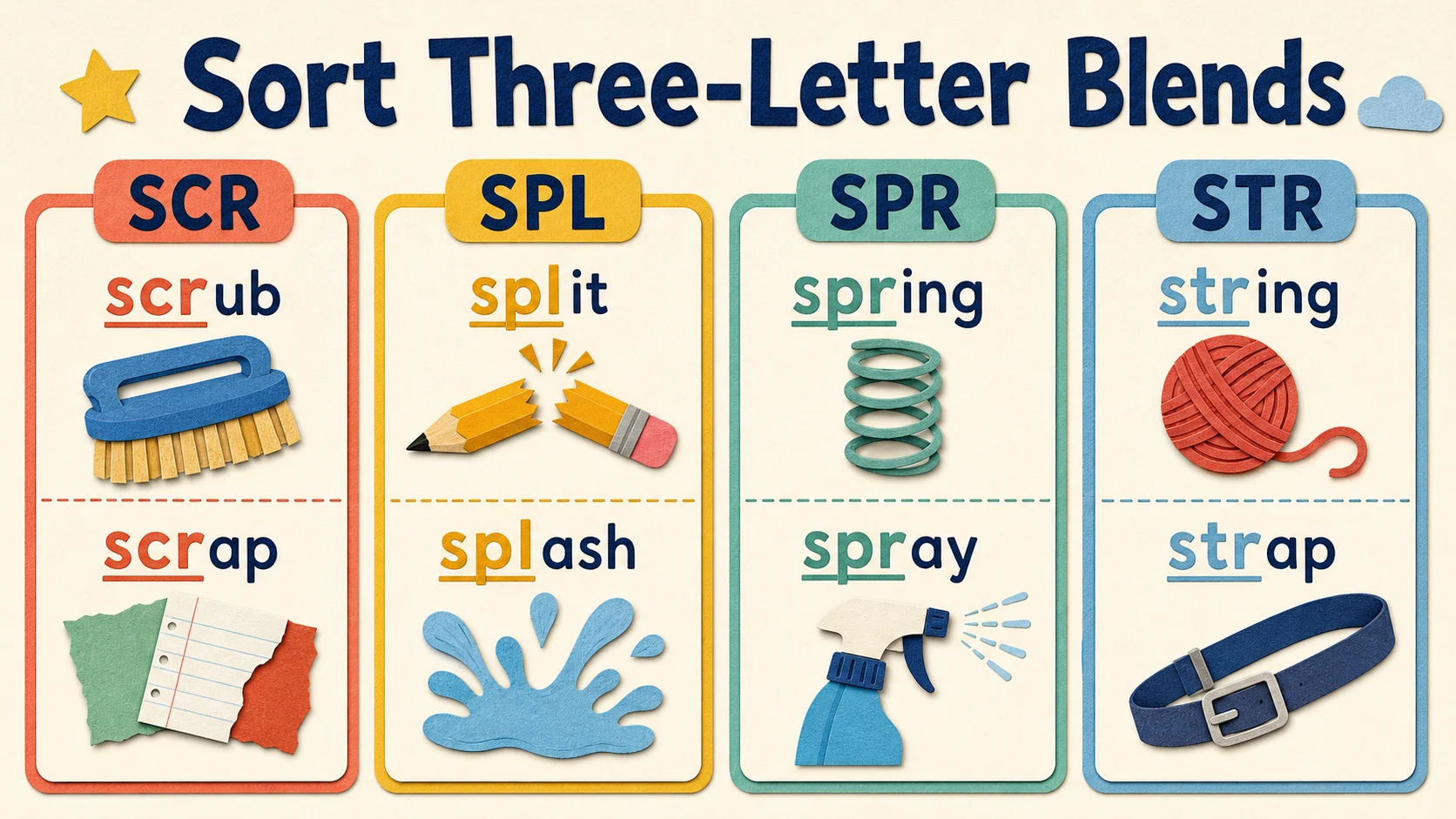
Use the routine with one blend family and record whether omissions occur at the beginning or end of words.
Worked example 3: ship compared with slip
Prompt: “Underline the two consonant letters at the start. How many sounds do those letters represent?”
Checked answer: In ship, sh represents one sound, /sh/. In slip, sl represents two sounds, /s/ and /l/.
The complete sound sequences are:
- ship: /sh/ /ĭ/ /p/, three sounds represented by four letters.
- slip: /s/ /l/ /ĭ/ /p/, four sounds represented by four letters.
Why it belongs here: The comparison preserves the short i and final p while exposing the defining difference between a digraph and a blend. It prevents the misleading shortcut that any two adjacent consonants behave alike.
Interpretation: If the learner reads both words correctly but cannot explain the sound count, model with counters without assuming the words are unreadable. If the learner says /s/ /h/ for sh, return to one digraph in whole words before mixing several digraphs.
Worked example 4: cap → cape
Prompt: Read cap. Add final e. Read the new word and explain what changed.
Checked answer: cap has short a, /k/ /ă/ /p/. Cape has long a, /k/ /ā/ /p/. The final e is not pronounced as a separate sound in this pattern; it changes the vowel sound.
Why it belongs here: The pair appears in the catalogue’s long-vowel teaching guidance and cleanly contrasts CVC with CVCe. Only one letter is added, so the learner can connect a visible spelling change with the changed vowel.
Interpretation: If the learner reads both as cap, contrast two or three known pairs rather than introducing vowel teams. If the learner says /kāpē/, acknowledge that all letters were noticed, then model that the final e is silent in this target pattern.
Worked example 5: the final ck in duck
Prompt: Segment duck, choose k or ck for the ending, and explain the choice.
Checked answer: duck, segmented /d/ /ŭ/ /k/. The word ends with the /k/ sound after a short vowel, and the catalogue identifies final ck in words such as duck, stick, and neck.
Why it belongs here: It connects short-vowel knowledge with a final digraph. The learner must hear three sounds while writing four letters, a useful check that letter count and sound count are not being confused.
Interpretation: Writing duk preserves all three sounds and shows a plausible representation of /k/, but it misses the target spelling. Respond to the specific spelling pattern; do not treat the attempt as evidence that the learner failed to segment the word.
Run a short routine that produces evidence
A worksheet becomes informative when an adult listens before, during, and after it. Use this repeatable routine for about six to twelve items rather than automatically requiring all 20.
Preview, model, release, and transfer
- Name the target. Say, “Today we will keep both sounds in st-,” or, “We will decide whether the middle sound is short e or short i.”
- Check orally. Ask the learner to repeat or sort two examples without print. This separates sound discrimination from letter recognition.
- Model one item. Think aloud briefly: “Stop: /s/ /t/ /ŏ/ /p/. I hear both /s/ and /t/, so I need st.”
- Complete three to five items. Ask the learner to read or explain each choice. Do not supply the answer through exaggerated picture clues.
- Correct immediately and specifically. Replace “Try again” with “You kept /s/ but dropped /t/. Tap four sounds.”
- Transfer the pattern. Dictate one untaught word using the same pattern, or place one taught word in a short sentence.
- Record one observation. Note the exact response: “Read stop as sop twice; retained both sounds after finger tapping.”
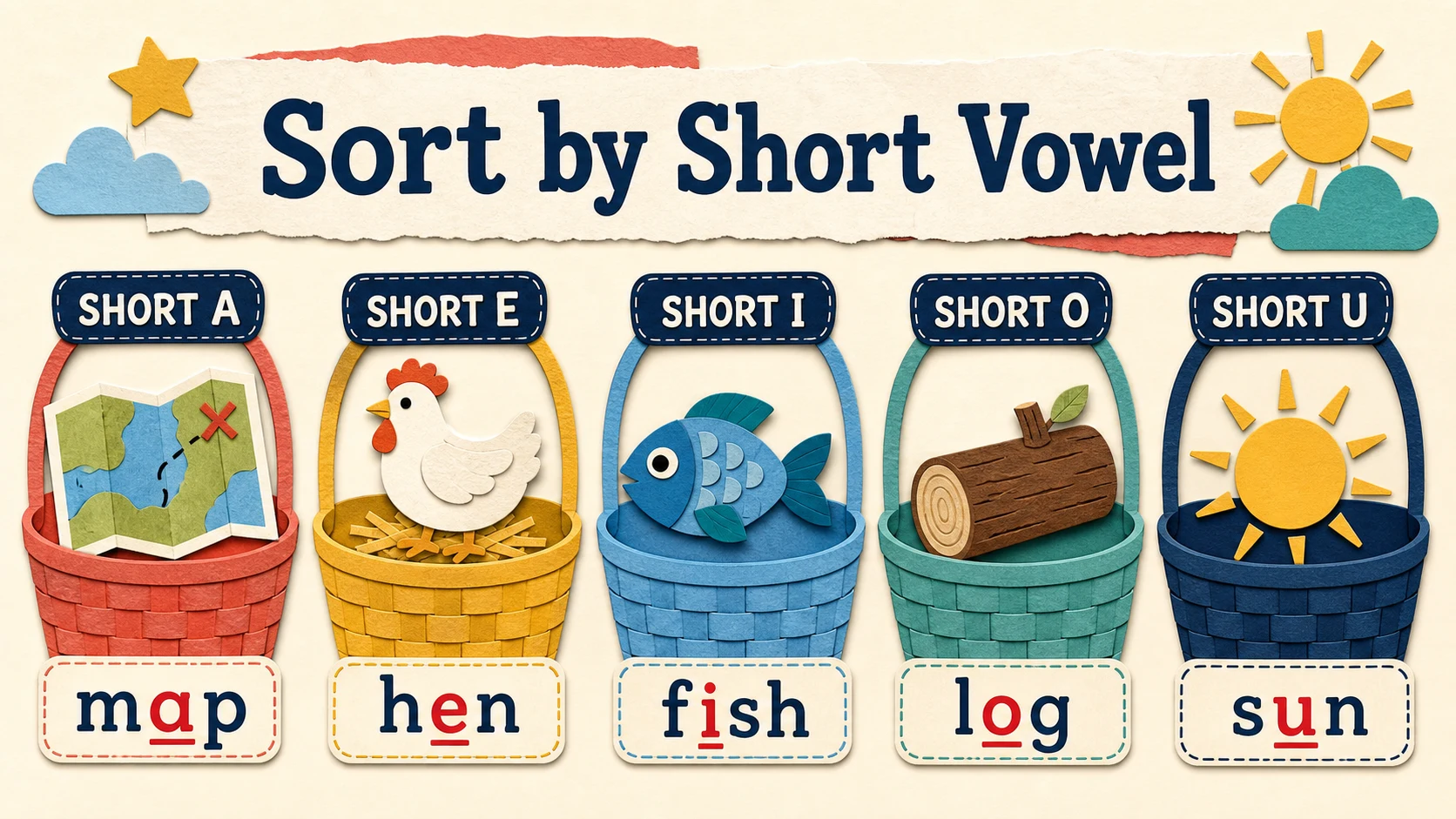
For short vowels, oral identification before print helps reveal whether the error is in hearing the vowel or mapping it to a letter.
Writing should be purposeful but limited enough that handwriting does not obscure the decoding target. The IES elementary writing practice guide recommends building fluency in foundational writing skills including handwriting, spelling, and sentence construction. That recommendation supports including brief encoding, but it does not mean every phonics check needs extensive copying, and the guide did not assess these worksheets.
Interpret patterns across errors, not a single wrong mark
A wrong answer tells you what happened on one item. A repeated error pattern can guide the next task.
Omission, substitution, confusion, and guessing need different responses
Sound omission: The learner reads stop as sop or tent as ten. Ask for counters or finger taps, one per sound, then blend again. Keep the word set small and distinguish initial from final omission.
Vowel substitution: The learner reads pen as pin while retaining /p/ and /n/. Return to an oral minimal-pair choice, then map the heard vowel to print. Do not add blends or sentences until the vowel decision is visible.
Pattern confusion: The learner treats sh like sl, or pronounces the final e in cape. Contrast two examples that differ only in the relevant feature. Ask how many sounds the highlighted letters represent.
Picture or context guessing: The learner names a pictured object without attending to all letters, or chooses a word because it makes sense in a sentence despite a mismatch in print. Cover the picture, point under each spelling unit, and ask for decoding before using context to confirm the word.
Accurate reading, weak spelling: The learner reads duck but writes duk. Preserve the successful reading observation and teach the final spelling pattern explicitly. Reading and spelling provide related but nonidentical evidence.
Slow but accurate work: Do not replace the target solely because the learner pauses. Repeat a short known set and then check a new example. Accuracy, explanation, and transfer matter before speed.
Use a simple three-column record: printed or spoken item; exact learner response; support that changed the response. This is more actionable than a percentage alone and is suitable for formative assessment phonics worksheets.
Adapt access without changing the phonics target
An adaptation preserves the decision being assessed. If the target is short-vowel discrimination, the learner must still distinguish the vowels even if the page presentation changes.
Useful adaptations include:
- Read directions aloud while leaving target words for the learner to decode.
- Cover the unused half of a crowded page.
- Cut a 20-item sheet into groups of five.
- Let the learner place letter tiles before writing.
- Use counters for sounds, then replace counters with graphemes.
- Accept pointing for an initial oral check, followed by one written transfer item.
- Enlarge print or increase spacing without changing the words.
- Say picture names consistently when vocabulary—not decoding—is blocking access.
- Allow a short movement response for ages three and four, such as stepping to the vowel card that matches a spoken word.
Do not read the answer choices aloud if independent decoding is the target. Do not replace spelling from dictation with copying and call the task equivalent. Do not simplify stop to top when the target is retaining st-; that removes the skill being checked. If sentence language is the barrier, return to isolated target words and later rebuild toward connected text.
For review outside school, the after-school phonics worksheet collection can provide a context-specific route, but the same rule applies: use a short, known target rather than assigning a stack of unrelated pages.
Plan review from performance, not the calendar alone
A two-week plan can organize opportunities, but learner work determines what appears on the next day.
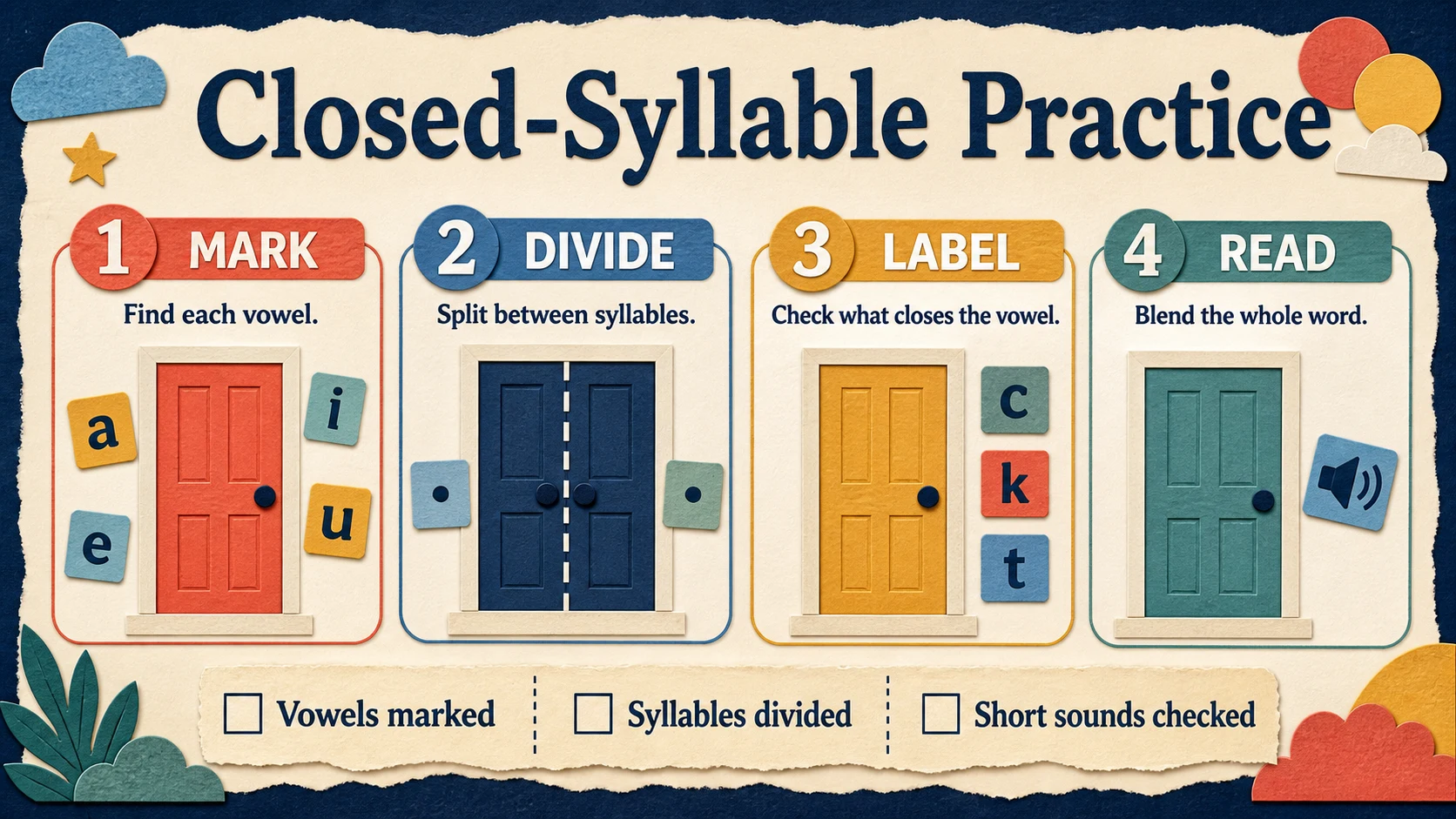
Treat the plan as a review framework: repeat or narrow a vowel contrast when the work shows a stable confusion.
For a learner confusing short e and i, a sensible sequence is:
- First session: oral sorting of pen/pin, bed/bid, and set/sit.
- Next session: match spoken words to e or i cards, then read four CVC words.
- Later session: spell two dictated words and explain the vowel choice.
- Review session: mix known short-a words with the e/i contrast.
- Transfer session: read a brief controlled sentence containing a taught word.
Move forward when the learner identifies the target in familiar and new examples with little or no prompting. Narrow the task when the same error recurs. If oral discrimination is accurate but printed responses are not, work on sound-letter mapping. If isolated words are accurate but connected reading breaks down, retain the pattern and reduce the sentence’s other demands.
The foundational-skills guidance from IES recommends connected-text reading every day to support accuracy, fluency, and comprehension. A worksheet can prepare a pattern, but it cannot supply the whole reading experience. Follow focused word work with a brief text containing patterns the learner has already been taught.
Keep clear boundaries around what the page can tell you
These worksheets provide practice opportunities, not a comprehensive placement system. A correct picture match may reflect vocabulary or visual elimination. An incorrect dictated spelling may involve handwriting, memory, or an unfamiliar word as well as phonics. Twenty items can show a useful pattern, but they do not establish a diagnosis.
The catalogue’s topic sequence should therefore be treated as a practical comparison, not a universal curriculum mandate. Short vowels commonly support later work with blends and long vowels, but digraphs, blends, spelling, irregular words, and connected text may be interleaved differently in a school’s program. Grade labels indicate intended practice level, and local curriculum sequences differ.
Do not infer a disability, intervention need, or grade placement from one sheet. When errors are persistent across carefully taught examples and settings, share exact work samples and response notes with the learner’s teacher or an appropriately qualified literacy professional. Report what was observed—such as “read final -nt as /n/ in four words”—without attaching a diagnosis.
Likewise, the approved sources describe general instruction or standards. They do not certify WorksheetWise, validate every catalogue sequence, or establish outcomes for a particular learner.
Make the next worksheet choice from one observable contrast
Begin with six oral or printed words rather than all five topics. Use two short-vowel CVC words, one blend word, one digraph word, one silent-e pair, and one familiar high-frequency word. Record the exact response to each.
Then choose only one starting target:
- If pen becomes pin, start with short e/i discrimination.
- If stop becomes sop, start with retaining both sounds in initial st-.
- If ship is treated as /s/ /h/…, start with sh as two letters representing one sound.
- If cape is read as cap, start with CVC/CVCe contrasts.
- If all four patterns are decoded but said repeatedly blocks connected reading, analyze and practice that irregular word.
For the immediate next action, open the 2nd Grade Short Vowels guide and free sheet, use only the first six relevant items, and write down the learner’s exact response to every e/i decision. Continue there if the vowel confusion repeats; otherwise use the evidence above to move to the single blend, digraph, long-vowel, or sight-word resource that matches the observed error.
Put it into practice
Use the guide with a real printable
Move from explanation to a short, observable practice task. Check the first item together, then adjust the next session from the learner's actual work.
Open the first free worksheet