1st Grade · 1 live skills
1st Grade spelling worksheets
Pick the exact skill below. Each page combines a real free download, a separate answer key, practical teaching guidance and an optional focused pack.
See all 1st Grade subjectsComplete guide
How to teach and practise 1st grade spelling worksheets
3,343 words Updated 6 instructional visuals
Choose one spelling pattern, not a longer word list
The most useful starting point in this 1st grade spelling collection is a worksheet that asks the learner to notice and use one bounded pattern. Start with short vowels if the learner confuses words such as cap and cup. Choose a long-vowel sort if the learner can spell short-vowel words but treats cake, rain, and play as unrelated exceptions. Use sentence work only after the learner can spell several target words in isolation.
The live catalogue contains 18 worksheet variants within one 1st Grade Spelling topic, plus one free 20-problem sheet. Across the topic, the named skills include:
- Short vowels
- Long-vowel spellings
- Consonant doubling
- R-controlled vowels
- Silent letters
- Prefixes
- Suffixes
- Multisyllabic words
- High-frequency words
- Look-cover-write-check
- Rainbow writing
- Word sorting
- Sentence use
- Identifying misspelled words
These are not interchangeable activities. Sorting reveals whether a learner sees a pattern. Look-cover-write-check adds a short memory demand. Sentence writing asks the learner to retrieve a spelling while also managing meaning, spacing, capitalization, handwriting, and punctuation. A passage containing errors adds proofreading and decision-making. Word searches can provide visual review, but finding a printed word is not the same as spelling it independently.
Grade labels describe an intended practice level, not a placement decision. Local curriculum sequences differ, and a learner’s actual work is more informative than age or grade alone. If age appears elsewhere while browsing, treat it as a discovery aid rather than a placement decision. For ages three and four, prioritize brief adult-led oral, matching, manipulative, and movement work over desk work.
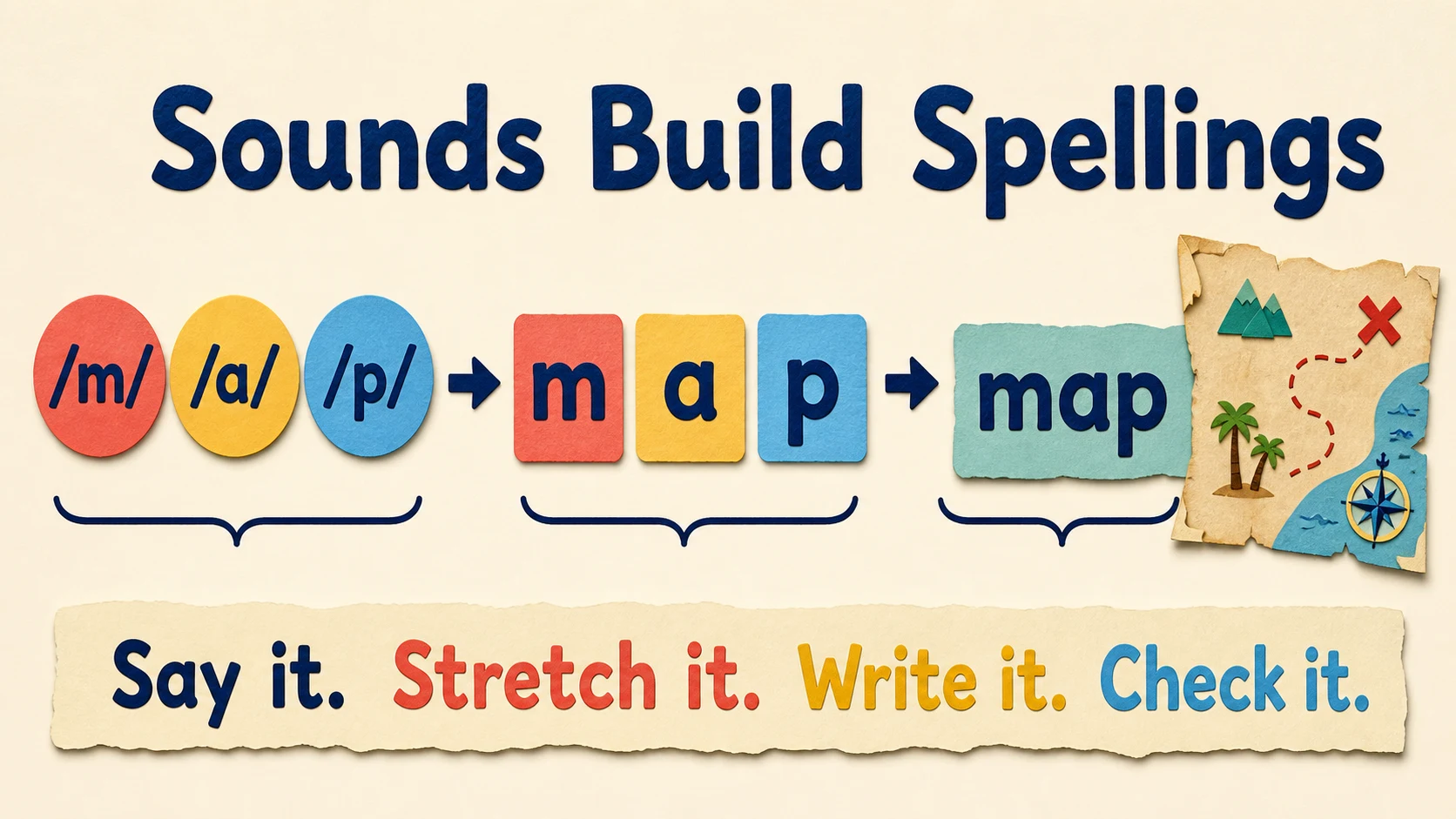
The spelling target sits at the center; sorting, memory practice, sentence use, and proofreading place different demands around it.
Read the catalogue as a progression of demands
The catalogue’s pattern list can be organized into a practical progression, but it should not be treated as a fixed universal sequence. A learner may understand a suffix before mastering every long-vowel spelling, or spell familiar high-frequency words while still confusing short vowels.
Begin with sounds that have a compact comparison
Short-vowel work is a useful early choice because the adult can hold most of the word constant and change one sound:
- map → mop
- sit → set
- bug → bag
The learner must hear the middle sound and connect it to the correct vowel. A worksheet becomes more informative when its alternatives are close enough to expose that decision. Sorting map, cap, hot, and log into short-a and short-o groups tests something different from copying all four words.
R-controlled vowels belong later in this comparison because the vowel does not behave as it does in a simple consonant-vowel-consonant word. In car, her, bird, fork, and turn, the vowel and r need to be considered together. Do not explain a misspelling of bird as carelessness if the learner writes berd; that response may show that the learner heard the sounds but selected another plausible vowel spelling.
Move from one-letter contrasts to spelling alternatives
Long vowels add a new decision: the same broad vowel sound can appear in different written patterns. The catalogue’s example family—cake, rain, play, and break—is useful precisely because the words share a long-a sound but not one spelling.
A first task might contrast cap/cape and kit/kite, where final e changes the vowel. A later sort might compare:
- cake, game, late under a_e
- rain, tail, paint under ai
- play, day, tray under ay
That sort is bounded: three visible patterns, one vowel sound, nine words. Asking for the “long-a rule” without showing the alternatives would flatten several spellings into an unreliable slogan.
Silent-letter work makes another kind of demand. In knock, the learner cannot spell by recording every heard sound with one obvious letter. The spelling must be learned as an ordered word pattern. That is different from a short-vowel error and calls for a different response.
Add meaningful word parts after the base is visible
Prefixes and suffixes should be studied as additions to a base word, not as decorative strings. For example:
- help + ful = helpful
- jump + ing = jumping
- un + kind = unkind
Consonant doubling intersects with suffix work. Compare hop + ing = hopping with hope + ing = hoping. The doubled p in hopping keeps the short vowel; the silent e is removed in hoping, and the single p accompanies the long vowel. This comparison is more useful than memorizing the two completed spellings separately.
Multisyllabic words add length, sound segmentation, and memory demands. They should not automatically be called “harder” merely because they have more letters. A familiar, regular two-part word such as sunset may be more accessible than a shorter word with an unexpected spelling.
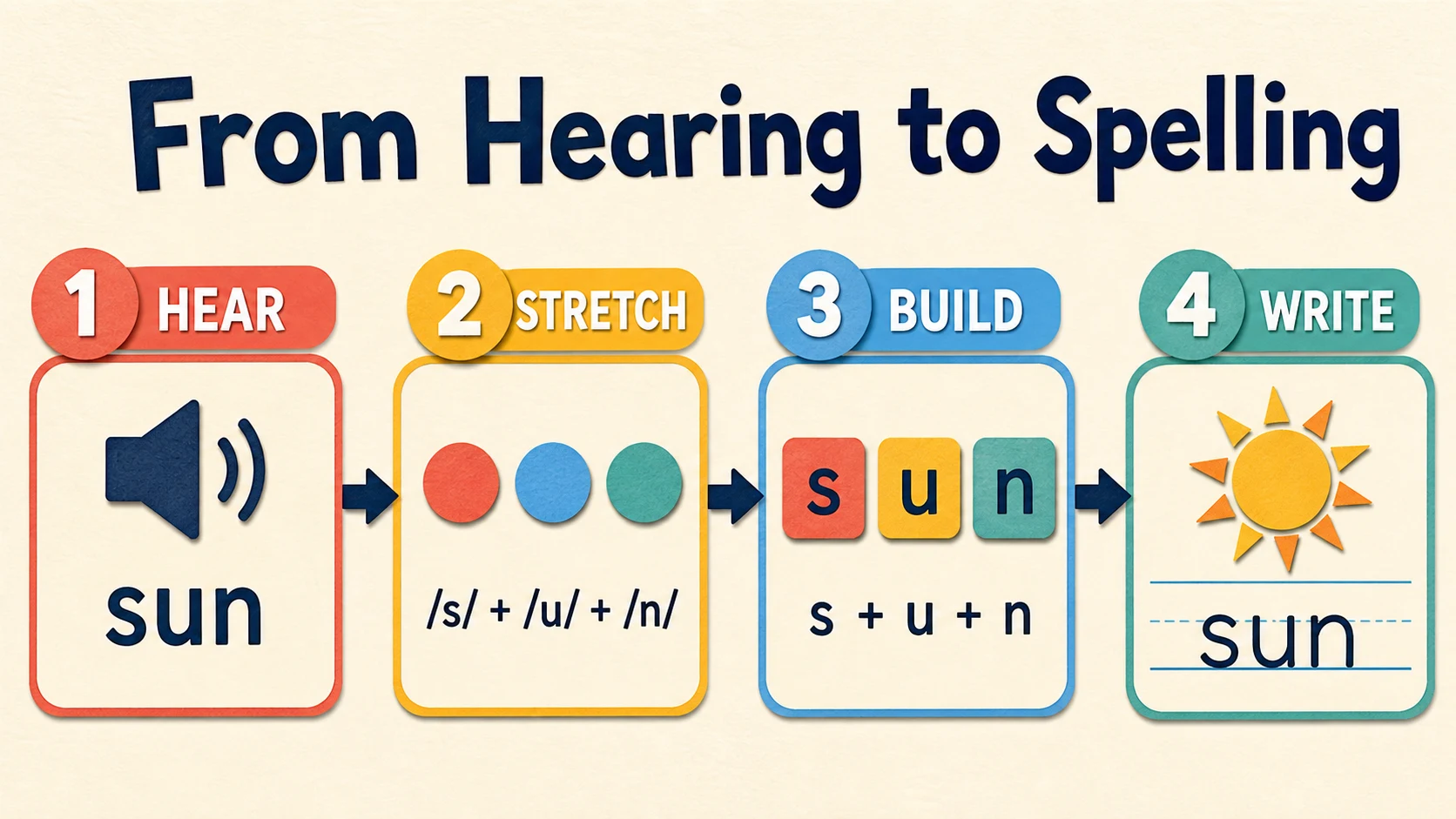
Support can recede from spoken comparison and visible sorting to covered recall, sentence writing, and independent proofreading.
Define worksheet difficulty by what the learner must do
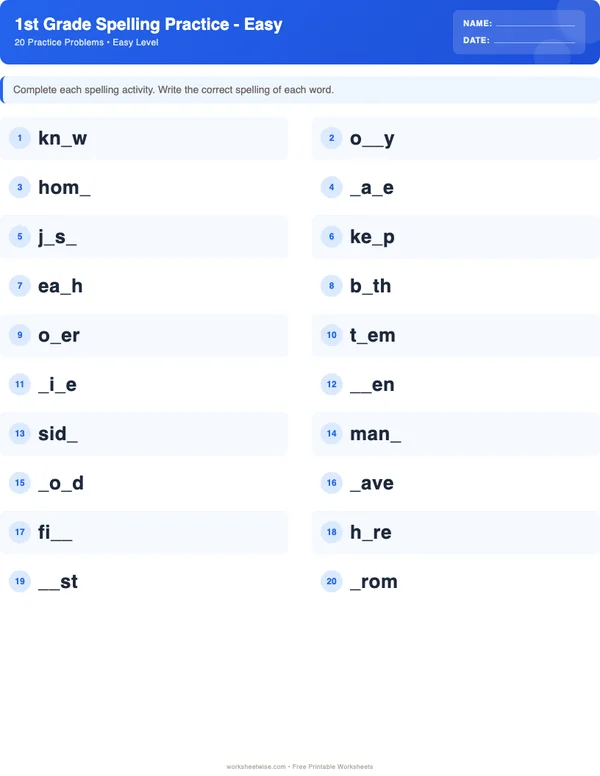
The free sheet is catalogued as “easy” and contains 20 problems. That label is a browsing aid, not a description of a child. Before assigning it, inspect the observable task features:
- Are target words visible, partially visible, or recalled from memory?
- Does each item test one contrast or several?
- Must the learner read directions independently?
- Are pictures, word banks, or pattern headings available?
- Does the learner copy, sort, complete, spell from dictation, write a sentence, or proofread?
- How much handwriting is required?
- Are previously taught patterns mixed with the new target?
- Does one error affect only one response, or can it disrupt a whole passage?
A visible word sort supplies substantial support. A look-cover-write-check task removes the model briefly. Dictation removes it completely. A sentence prompt adds composition demands. A proofreading passage may contain the correct-looking and incorrect-looking forms together, requiring the learner to locate an error before correcting it.
Thus, “20 problems” does not tell you whether the task is a good fit. Twenty quick matches may be less demanding than five dictated sentences. If the page is visually dense, fold or cover all but one row without changing the spelling decision. That adaptation reduces visual load while preserving the target.
The 1st Grade Spelling Words guide and free sheet is the concrete entry point for checking these features. Use the grade and difficulty filters to locate a candidate, then confirm the actual directions and word patterns before printing.
Work the spelling decision before assigning the page
The following examples are editorially constructed practice examples based on the catalogue’s named skills. They are not quoted from the free PDF and are not claims about its exact item wording.
Checked example 1: sort short-a and short-i
Sort these words: map, sit, cap, fin, bag, lip.
A checked answer is:
- Short-a: map, cap, bag
- Short-i: sit, fin, lip
Each word has a consonant-vowel-consonant structure, and the middle vowel is the only sorting feature. The learner must attend to the medial sound rather than the first or final consonant. This belongs at the 1st grade practice level because it connects speech segments with letters using short, decodable words.
If the learner places fin with the short-a words, say both words slowly: “fan, fin.” Ask, “Which middle sound do you hear in fin?” Do not supply a longer list yet. Recheck with pin/pan. Two successful contrasts offer better evidence for moving on than ten copied words.
This connection between speech sounds, letters, word analysis, writing, and word recognition is consistent with the instructional recommendations in the IES foundational reading practice guide. That guide did not evaluate WorksheetWise or this particular activity.
Checked example 2: compare long-a spellings
Sort cake, rain, play, game, tail, and day by spelling pattern.
A checked answer is:
- a_e: cake, game
- ai: rain, tail
- ay: play, day
All six words contain a long-a sound, but the written representation differs. The a_e words have a final e separated from a by a consonant. The ai spelling appears inside these words. The ay spelling appears at the end.
This example belongs here because long-vowel spellings are explicitly represented in the live topic description. It also shows why “sort by pattern” is more precise than “practice long a.” If a learner sorts by rhyme and places rain with game, acknowledge the shared vowel sound, then restate the visual question: “We are sorting by the letters that spell the sound.”
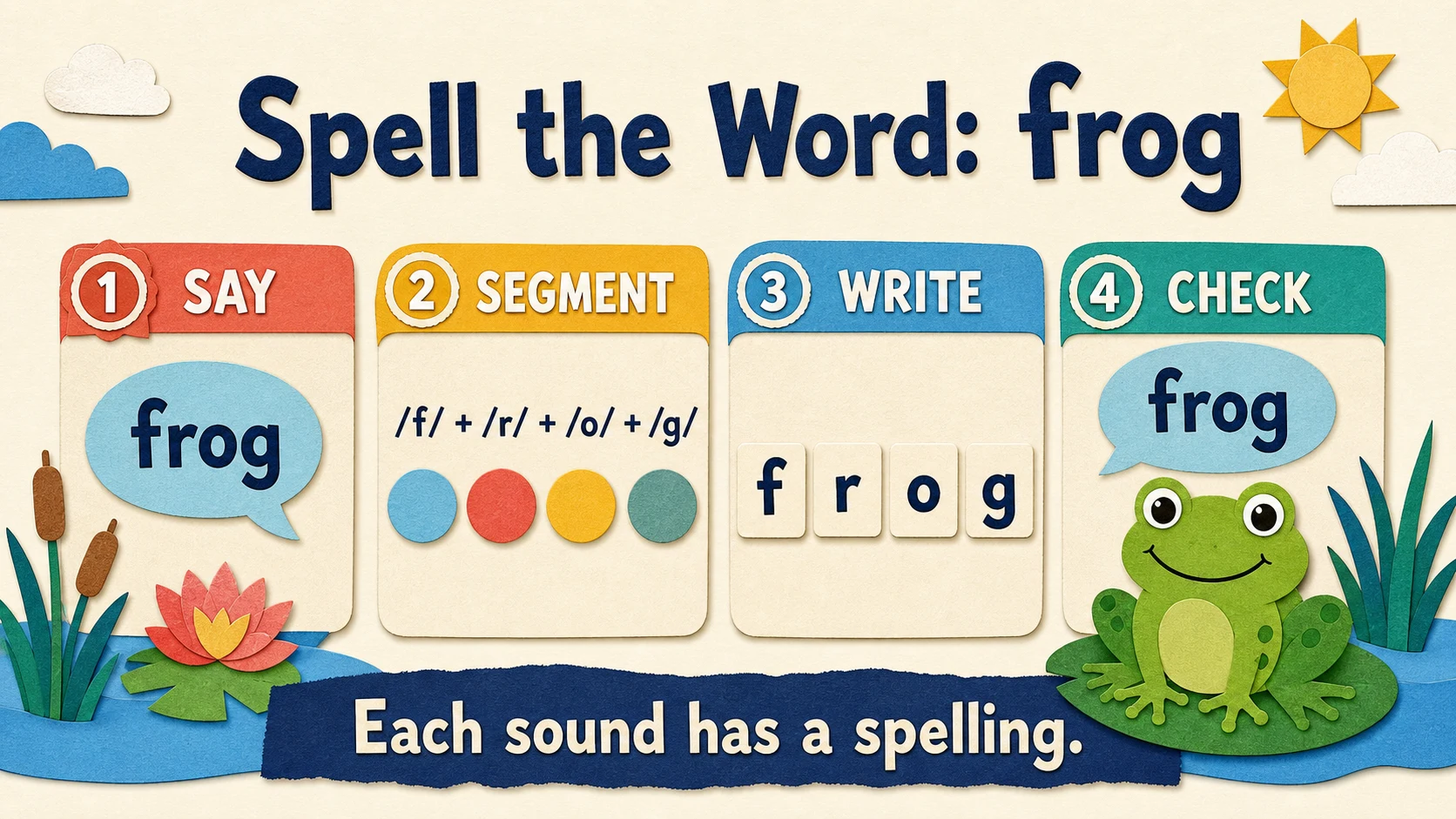
The adult models one comparison, checks the deciding letters, and then asks the learner to complete a parallel item.
Checked example 3: distinguish hopping from hoping
Complete both words:
- hop + ing = hopping
- hope + ing = hoping
Check the meaning with sentences:
- “The rabbit is hopping.”
- “I am hoping for sunshine.”
In hopping, double the final p before adding -ing. In hoping, remove the silent e and add -ing without doubling the p. The two results differ in spelling, pronunciation, and meaning.
This belongs in the guide because both consonant doubling and suffixes are live catalogue skills. It is not a sensible first task for a learner who cannot yet hear the difference between hop and hope. In that case, compare the base words orally and in print before adding -ing.
Checked example 4: correct a misspelling in context
Read: “I can plai with the red ball.”
The intended word is play. A checked correction is: “I can play with the red ball.”
The learner represented each sound plausibly but chose ai at the end of the word. The long-a comparison above shows that ay, not ai, is the target ending in this word. Ask the learner to underline the incorrect part in plai, write play, and compare it with day and tray.
This belongs here because identifying misspelled words and using spelling in sentences are both named catalogue activities. Context establishes that play is intended, while correction requires the specific letter pattern.
Checked example 5: segment a compound word
Spell sunset by parts:
- Say the word: sunset.
- Identify two meaningful parts: sun and set.
- Spell each part: s-u-n, s-e-t.
- Join them: sunset.
- Re-read the completed word.
The result is sunset, not sunsit or suset. This example belongs under the catalogue’s multisyllabic work, but it remains accessible because both parts use familiar short-vowel patterns. If the learner omits n, the issue may be holding the full first part in memory, not misunderstanding the vowel.
Use a short routine that produces evidence
A spelling session does not need to consume the whole worksheet. Eight to twelve focused minutes can reveal whether to repeat, adapt, or advance.
A six-step adult-led routine
- Name the target. Say, “Today we are comparing ai and ay.”
- Hear it. Read two or three target words aloud. Have the learner repeat them.
- Notice it. Circle or build the deciding letters with tiles or cards.
- Practice it. Complete four to six worksheet items of the same type.
- Retrieve it. Use look-cover-write-check with two words. The learner looks carefully, covers the word, writes it, then uncovers and checks.
- Apply and record. Dictate one word or short sentence, then note the exact result.
The check is part of the task, not an adult verdict delivered afterward. If rain becomes ran, compare the two forms and ask which one represents the long vowel. If the learner corrects it independently after uncovering the model, record both the first attempt and the correction.
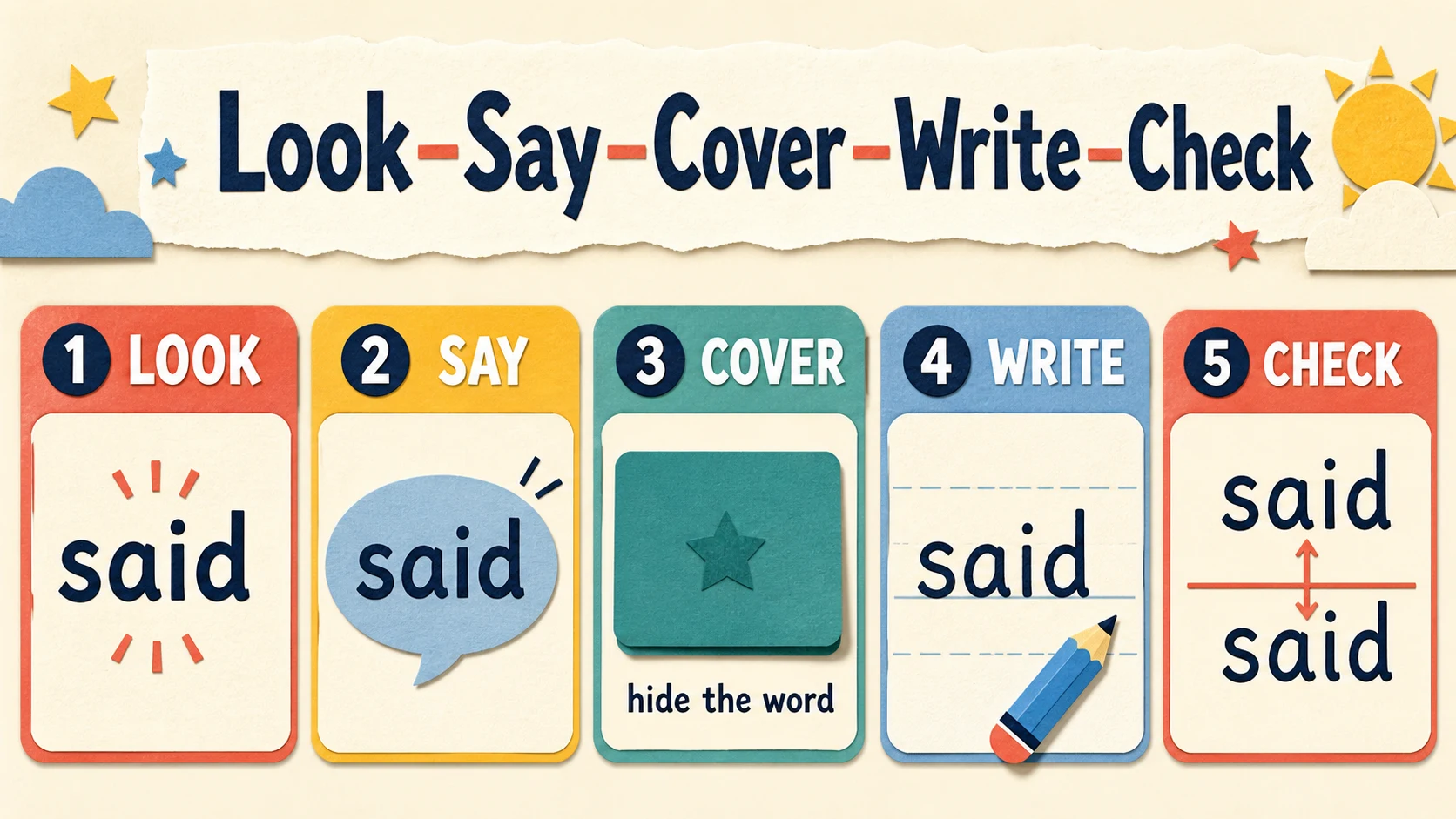
One brief cycle moves from hearing and noticing to supported practice, recall, and a documented next decision.
For homework, send a narrow direction such as “Complete items 1–6, then cover and spell rain and play once each.” The Homework Spelling Worksheets collection can help adults find work intended for that setting. Classroom users can place a completed pattern sort at a fast-finisher station through the Classroom Spelling Worksheets collection. Those settings change how a task is managed; they do not change the spelling pattern being taught.
Interpret errors by the decision they reveal
An incorrect spelling is useful only when the adult looks at what the learner actually wrote. Avoid replacing analysis with “careless,” “not ready,” or a score alone.
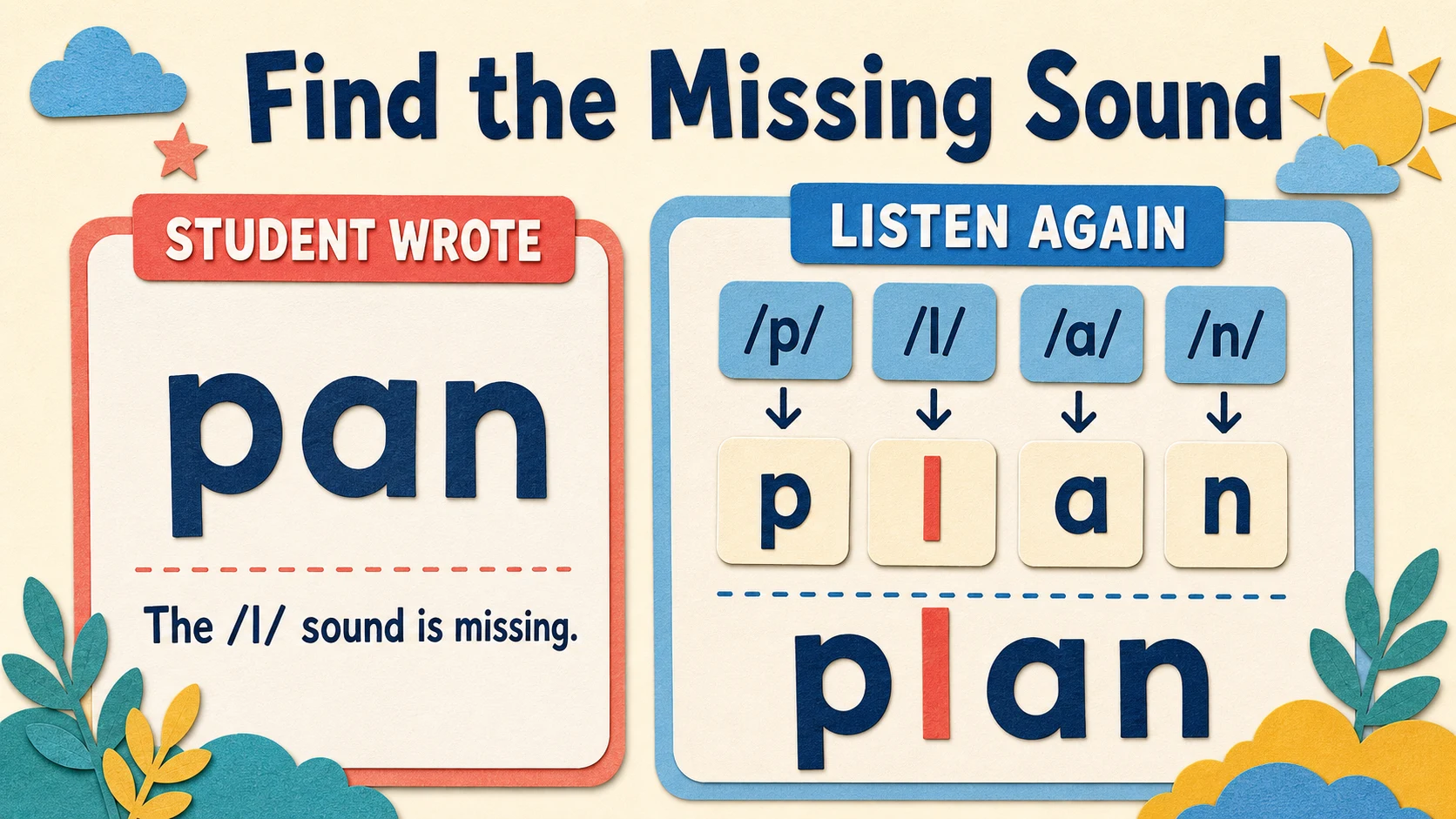
The response should match the visible error: sound comparison, pattern contrast, memory support, or a reduced writing load.
When the vowel does not match the spoken word
Example: bed written as bid.
Possible interpretation: the learner may not yet distinguish the short-e and short-i sounds in this word, or may know the sounds but confuse the letter choice. Check with a two-word oral contrast such as bed/bid before assigning more written items.
Next task: say four words and have the learner point to an e or i card. If the oral choices are accurate, return to a four-word written sort.
When the sound is plausible but the conventional pattern is wrong
Example: play written as plai.
Possible interpretation: the learner represents the long-a sound but has not secured where ai and ay occur in the practiced words.
Next task: sort rain, tail, play, and day, underlining only the vowel spelling. Then cover and spell one example from each group.
When a letter disappears in a longer word
Example: sunset written as suset.
Possible interpretation: the learner may lose part of the first syllable while holding the complete word in memory.
Next task: build sun and set separately with letter cards, slide the parts together, and read the result. This preserves the multisyllabic target while reducing memory and handwriting demands.
When isolation is accurate but sentence spelling is not
Example: the learner spells rain correctly from a list but writes “It will ran.”
Possible interpretation: the spelling has not transferred reliably when attention is divided among meaning, handwriting, spacing, and punctuation. It does not show that the list practice was useless, nor does it justify immediately introducing a new pattern.
Next task: dictate “Rain fell.” Ask the learner to reread and circle the target word. Add only one sentence at a time.
The IES elementary writing practice guide recommends building fluency with spelling alongside handwriting and sentence construction and also recommends regular opportunities to write. That supports connecting word study with brief sentence use, but it does not establish a particular number of repetitions or assess these worksheets.
When the answer is correct only with the model visible
Possible interpretation: the learner can match or copy the pattern but cannot yet retrieve it. Copying and independent spelling are different performances.
Next task: use a short look-cover-write-check cycle with two words, not the full list. Record whether the first attempt is accurate and whether the learner can locate the differing part during the check.
These observations guide instruction; they are not diagnoses. Persistent difficulty, distress, or broader concerns should be discussed with the learner’s teacher or an appropriately qualified professional rather than inferred from one worksheet.
Adapt the access, not the spelling target
A useful adaptation removes an unrelated barrier while keeping the intended decision intact.
Reduce visual and motor load
If a 20-problem page is crowded, show five items at a time. Let the learner answer orally while an adult records responses when the target is hearing or classifying the vowel. For word building, use letter tiles before pencil writing. Provide wider writing space or allow a keyboard if handwriting is obscuring what the learner knows.
Do not supply the missing vowel when vowel selection is the target. Do not leave the word bank visible during an independent-recall check. Those changes would replace the spelling decision rather than make it accessible.
Preserve meaning and language access
Preview picture names so the task does not become a vocabulary test. Say each target word naturally, use it in a short sentence, and ask the learner to repeat it. A multilingual learner may know a spelling pattern but not the pictured English noun.
When speech production differs from the pronunciation assumed by a worksheet, avoid treating accent or dialect as an error. Make the expected written form explicit and compare print patterns respectfully. The aim is to learn the spelling used in the task, not to erase the learner’s language variety.
Extend without changing topics too quickly
For a learner who completes a sort accurately, remove support in stages:
- Sort with headings and visible words.
- Sort without headings.
- Cover and spell one word from each group.
- Use one target word in a sentence.
- Find the pattern in a book the learner is already reading.
The catalogue suggests adding two or three challenge words that extend a pattern. Treat that as a teaching suggestion, not sourced guidance or a requirement. Choose a challenge word only if it tests the same bounded feature. After ai/ay, paint or tray extends the existing comparison; an unrelated silent-letter word does not.
The Common Core ELA standards overview explains that grade-specific standards add detail to broader reading, writing, speaking, listening, and language expectations. It does not certify these materials or determine the order every school should use. Grade labels here indicate intended practice level, while local curricula may introduce patterns in a different sequence.
Review across two weeks without turning practice into a test cycle
A simple two-week plan can mix supported work, retrieval, and application while keeping one pattern central.
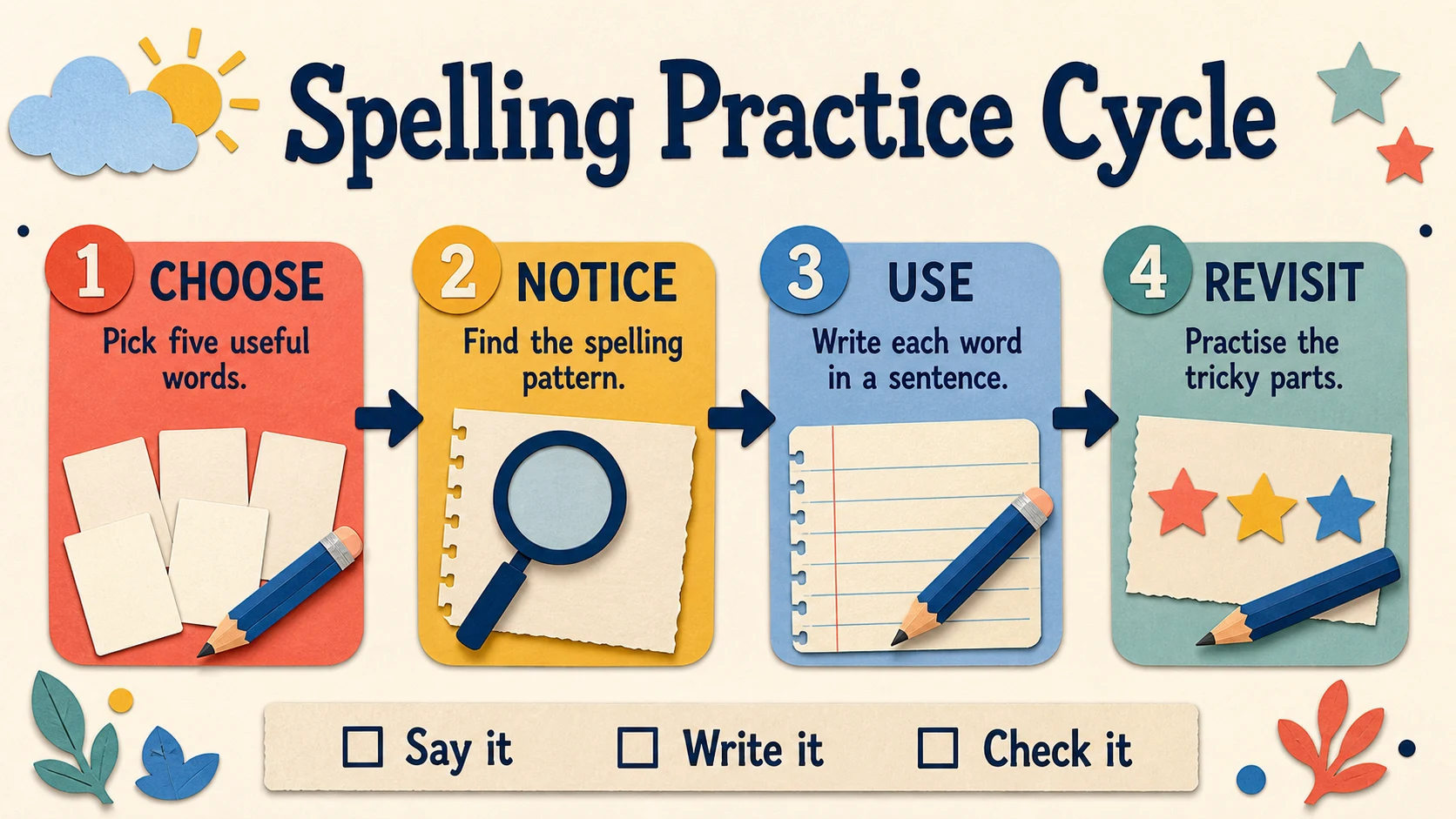
New-pattern days alternate with short recall and application checks so yesterday’s correct sort is not mistaken for independent mastery.
Week one: establish the comparison
- Day 1: Hear and sort six words by one pattern contrast.
- Day 2: Re-sort the same words, then explain where the deciding letters appear.
- Day 3: Use look-cover-write-check with three words.
- Day 4: Write or dictate one sentence containing a target word.
- Day 5: Spell two practiced words and one new word that follows the same pattern.
The new word matters because it checks whether the learner can use the pattern beyond the memorized list. Keep it clearly within the taught comparison.
Week two: retain and transfer
- Day 6: Mix four target words with two previously practiced words.
- Day 7: Correct one misspelling in a short sentence.
- Day 8: Find the target pattern in familiar reading.
- Day 9: Write two dictated words without a visible model.
- Day 10: Review the work and choose the next bounded target.
Record specific observations: “sorted 6/6 with headings,” “spelled play after checking,” or “used rain correctly in a dictated sentence.” Avoid global labels. One accurate session does not prove durable learning, and one poor session may reflect fatigue, unclear directions, unfamiliar vocabulary, or excessive writing load.
Know what a spelling worksheet cannot establish
A worksheet can sample performance on the words and task presented. It cannot by itself establish broad reading proficiency, explain the cause of an error, diagnose a learning condition, or guarantee transfer to independent writing. A word search may show that the learner can visually locate a spelling among letters; it does not show independent recall. Rainbow writing may increase attention to a printed word, but color use alone does not demonstrate pattern knowledge.
Similarly, a perfect copied list may reflect careful visual matching. To check retrieval, briefly remove the model. A perfect isolated-word check still does not establish sentence-level transfer. To check application, use one short sentence without overwhelming the learner with composition demands.
Do not infer standards alignment beyond what has been verified. The catalogue identifies grade-level expectations as the intended context, while curriculum sequence and terminology vary. The approved IES guides provide broader instructional guidance; they did not review WorksheetWise, the free sheet, or any of the 18 catalogue variants.
Make the next worksheet earn its place
Use the learner’s latest response to choose exactly one next task:
- If short vowels are confused orally, use an adult-led sound-and-letter match.
- If the sound is clear but the vowel letter is wrong, use a four- to six-word pattern sort.
- If sorting is accurate with words visible, use look-cover-write-check with two or three words.
- If isolated recall is accurate, use one dictated sentence.
- If sentence spelling is accurate, mix the current pattern with one previously practiced pattern.
- If errors scatter across unrelated features, reduce the task and observe one contrast before selecting another sheet.
Begin with the 1st Grade Spelling Words guide and free sheet. Preview its 20 problems, identify the single spelling decision you want to observe, and assign only the first coherent group of items. Afterward, write down one exact response—such as “play became plai”—and let that evidence select tomorrow’s sort, recall check, or sentence task.
Put it into practice
Use the guide with a real printable
Move from explanation to a short, observable practice task. Check the first item together, then adjust the next session from the learner's actual work.
Open the first free worksheet