Curated collectionAnswer keys includedPrint-ready PDFs
Easy and Beginner Geometry Worksheets
Define what easy and beginner geometry practice changes and what it deliberately keeps constant, then compare three checked examples, fading supports and readiness evidence.
Start with a real resource
Browse this worksheet collection
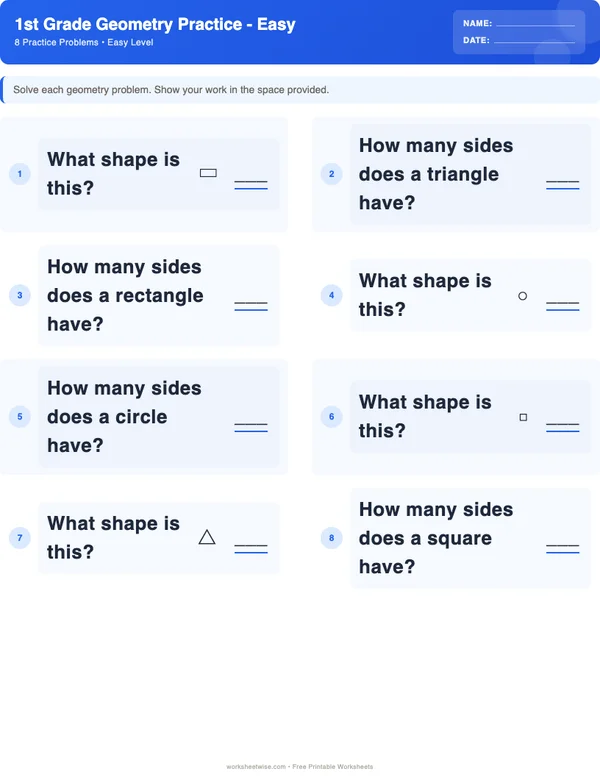
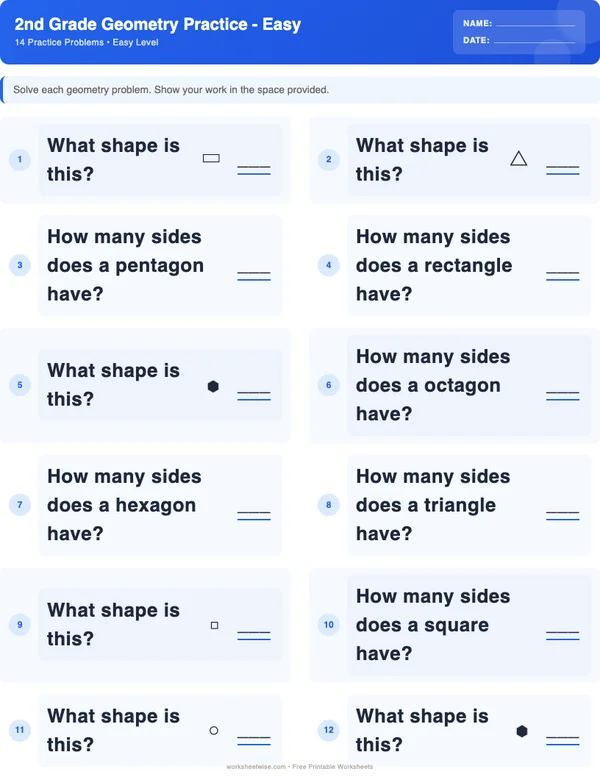
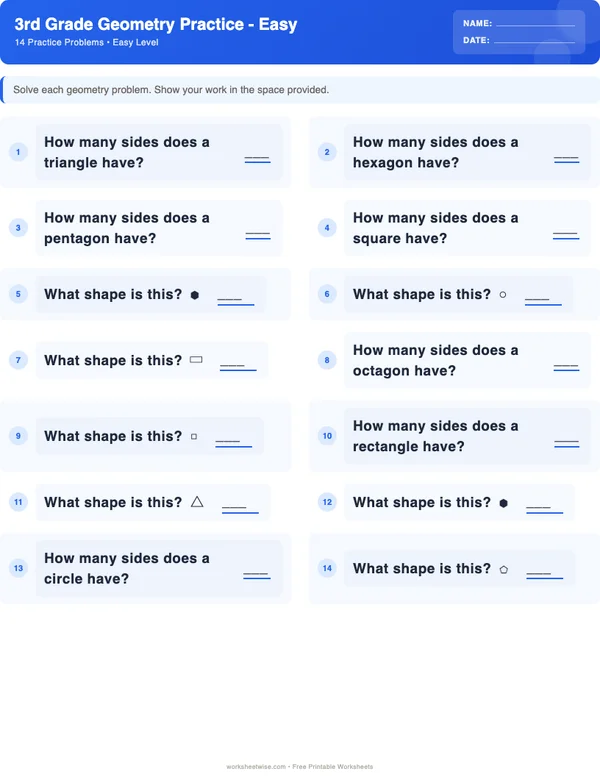
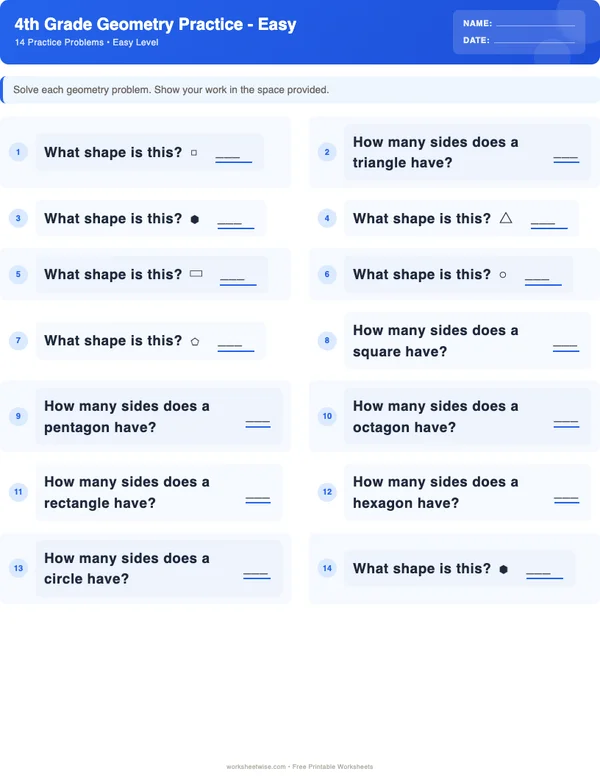
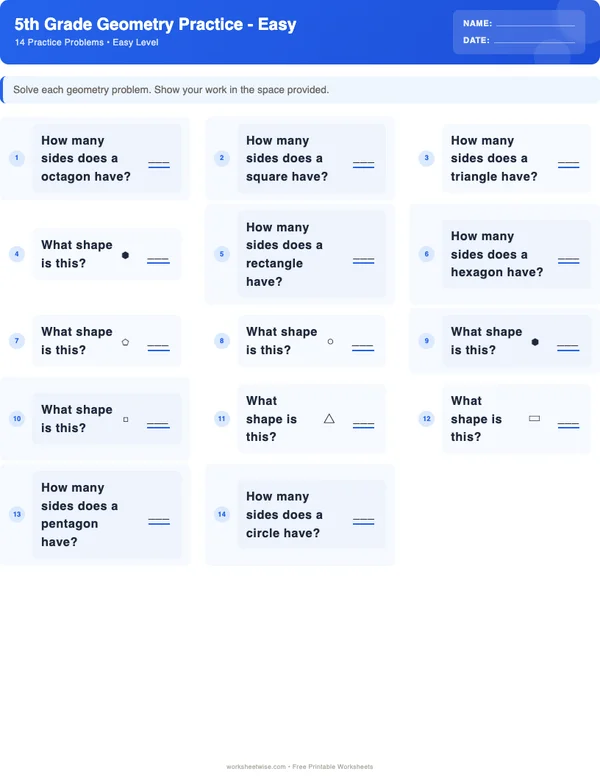
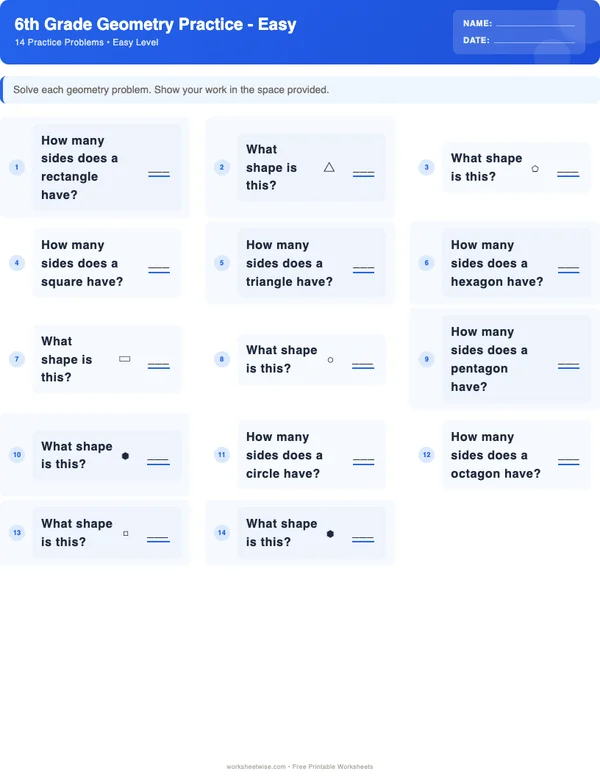
7 relevant free entry points are available. Each one includes a printable learner PDF and separate answer key.
A useful practice loop
Print less. Observe more.
- Choose one skill and model the first item aloud.
- Use a short set and notice the learner’s strategy.
- Change the next task from the work you can see.
Need more than the free sheet?
Plus includes all 42 matching catalogue variations where available, plus saved deterministic generators and the worksheet designer.
See Plus membershipComplete guide
How to teach and practise easy geometry worksheets
3,252 words Updated 6 instructional visuals
What “easy” changes in geometry practice
Easy and beginner geometry worksheets reduce the number of decisions a learner must make at once. They may use familiar shapes, whole-number measurements, visible grids, direct wording, uncluttered diagrams, or one repeated task type. They do not change the defining properties of a shape, the meaning of area or perimeter, or the logic required to justify an answer.
That distinction matters. A beginner triangle task can show clear examples and ask for one property at a time, but a triangle must still be recognized after it is rotated. An introductory area task can provide unit squares, but each square must still represent one square unit. Supports make the mathematics accessible; they must not quietly replace it with guessing.
On this page, “easy” is a worksheet difficulty filter, not a description of a learner. Observable task features determine the level:
- One target skill is emphasized at a time.
- Directions are short and consistent.
- Diagrams contain the information needed to begin.
- Early items provide models, grids, labels, or constrained choices.
- Calculations use manageable numbers.
- Later items check whether the learner can act without the initial support.
- Distractors reveal a relevant misconception rather than relying on visual tricks.
The live catalogue contains 42 easy geometry variants and seven free entry points across Kindergarten through 6th Grade. The free sheets contain 20 problems in Kindergarten through 2nd Grade, 25 in 3rd and 4th Grade, and 30 in 5th and 6th Grade. Those counts describe the available resources; they do not determine how many problems a learner should complete in one sitting.
Grade labels describe the intended practice level, and local curriculum sequences differ. Age and grade can help an adult discover a plausible starting page, but age is a discovery aid rather than a placement decision. Select from evidence in the work: what the learner understands, which support is needed, and what happens when that support is reduced.
Keep the geometry constant while reducing the load
A well-chosen beginner task changes access before it changes content. Consider four dimensions of difficulty.
Representation
A supported area problem might show every unit square in a rectangle. A nearby harder version might show only side lengths. Both ask for area, but the second requires the learner to construct or recall the row-by-column structure.
Similarly, an introductory coordinate task might provide a labeled grid, integer coordinates, and points in one familiar region. A harder variation might require interpreting a scale, working across more regions, or finding a missing coordinate from geometric conditions.
Language
“Circle every quadrilateral” is more accessible than a paragraph containing several conditions. That does not make the first task mathematically empty. The learner must still decide whether each figure has four straight sides.
Reduce reading load by reading directions aloud or clarifying a nontechnical word. Do not translate “quadrilateral” into “the shapes you should circle,” because that supplies the classification decision.
Number demand
Area, perimeter, angle, and coordinate tasks can become difficult because of arithmetic rather than geometry. Whole-number side lengths and small products let an adult observe whether the geometric idea is secure. Fractions, decimals, conversions, or several operations can be added later.
If a learner understands that perimeter is the distance around a figure but makes an addition error, the next geometry task should not automatically return to shape identification. Keep the geometric target and temporarily simplify the calculation.
Independence
Pointing to a model, tracing a boundary, using tiles, and selecting from two answers are supports. Explaining a property, drawing an example, and solving without the model require greater independence. Difficulty should rise by fading one support at a time, not by changing the diagram, vocabulary, numbers, and response format simultaneously.
The IES guide for teaching mathematics to young children recommends purposeful progressions, attention to children’s mathematical thinking, and instruction that helps learners describe their ideas. That sourced guidance supports using models and mathematical conversation. The exact prompts and fading sequence below are editorial suggestions for this geometry catalogue, not claims that IES evaluated WorksheetWise.
Compare nearby easier and harder tasks
“Easy” becomes useful only when an adult can see what sits on either side of it.
| Geometry target | A nearby easier feature | Appropriate beginner feature | A nearby harder feature |
|---|---|---|---|
| Identify shapes | Match identical outlines | Classify varied examples by a named property | Classify overlapping categories and justify every choice |
| Compose shapes | Copy a completed model | Combine provided pieces to make a named shape | Find several compositions or work under constraints |
| Area | Count fully drawn unit squares | Use rows and columns with a visible grid | Derive dimensions or decompose an irregular figure |
| Perimeter | Trace a highlighted boundary | Add labeled whole-number sides | Find missing sides or compare figures under a condition |
| Angles | Match an angle to a benchmark corner | Sort clearly drawn angles into categories | Measure, calculate unknown angles, or reason in composite figures |
| Coordinates | Read a labeled point from a clear grid | Plot ordered pairs on a consistent integer grid | Apply scale, constraints, or transformations |
A task is not necessarily hard because it has many shapes, and it is not necessarily easy because the page looks playful. Decorative art can crowd the visual field. Tiny labels can make a simple calculation inaccessible. Conversely, a clean page with 20 items may offer productive repetition if the learner completes only a selected set.
The free catalogue sheets are fixed at 20, 25, or 30 problems according to grade band. Treat that as available practice, not a required dose. Six carefully observed responses can tell you more about readiness than an exhausted attempt to finish every item.
Four checked examples of beginner geometry reasoning
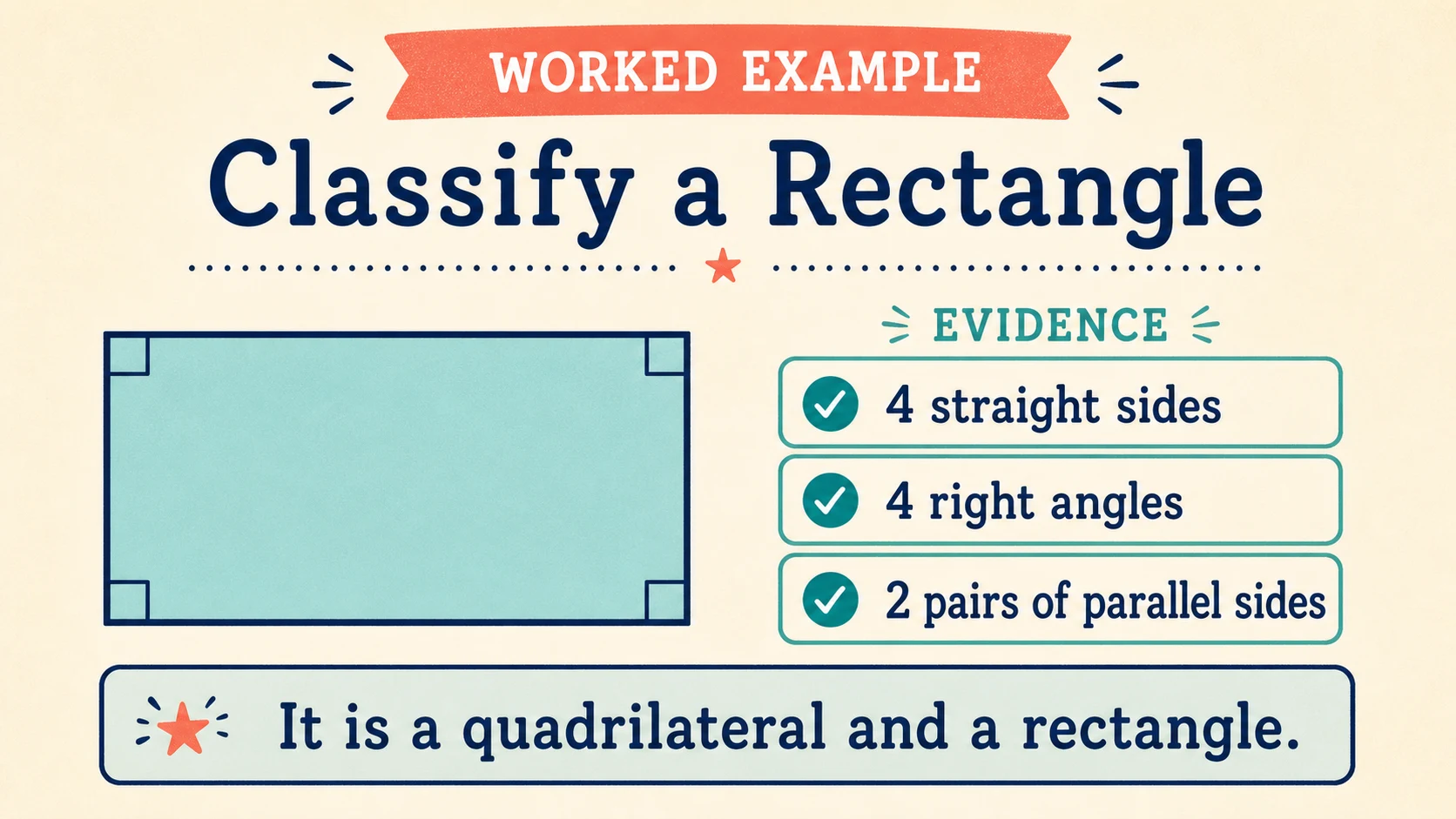
These examples are constructed from the catalogue’s stated geometry scope: shape identification and attributes, area, perimeter, angles, and coordinate geometry. Each calculation and classification is checked below.
Example 1: Recognize a rotated triangle
Suppose a row shows these figures:
- A three-sided closed figure with one point facing down.
- A four-sided figure tilted like a diamond.
- An open figure made from three line segments.
- A narrow three-sided closed figure leaning right.
The instruction is: “Circle every triangle.”
The correct choices are 1 and 4. Each is closed and has exactly three straight sides. Figure 2 has four sides, so its rotation does not make it a triangle. Figure 3 is not closed.
This belongs in beginner geometry because the decision rests on one defining set of attributes. Rotation varies, but the classification rule stays constant. It is more informative than matching only upright, equilateral-looking triangles because it checks whether orientation has been mistaken for a defining property.
An easier lead-in would ask the learner to match an upright triangle to an identical triangle. A harder follow-up could include a concave polygon, overlapping outlines, or a request to explain why every nonexample fails.
A useful adult prompt is, “What can you count or check?” If the learner says, “It is upside down,” respond, “Does turning it change the number of sides?” Do not simply rotate the page until the figure looks familiar.
Example 2: Separate area from perimeter
A rectangle is 4 units long and 3 units wide, with a full unit-square grid.
Area:
- There are 3 rows.
- Each row contains 4 unit squares.
- .
- The area is 12 square units.
Perimeter:
- The side lengths are 4, 3, 4, and 3 units.
- .
- The perimeter is 14 units.
Both answers are checked by their meanings: 12 counts the squares covering the interior; 14 counts the unit lengths around the boundary. The units differ for a reason.
This is an appropriate beginner example because the grid makes the area visible, every side length is a small whole number, and no measurement conversion competes with the distinction between covering and enclosing. Yet the geometry remains genuine: the learner must choose what to count.
For a supported 3rd-grade-style area example, connect the visible array to “square units” before using multiplication alone.
A nearby easier experience is to cover a paper rectangle with physical square tiles and trace the outside edge with a finger. A harder variation removes the interior grid, gives only the side lengths, or asks for a missing dimension.
The catalogue teaching guidance suggests beginning area and perimeter with square tiles and building several figures from the same number of tiles. That is a page-specific instructional suggestion from the supplied catalogue facts. It should be used as a teaching option, not presented as an independently tested outcome.
Example 3: Classify clear angle cases
Consider angles measuring , , and .
- , so it is acute.
- is a right angle.
- , so is obtuse.
This example belongs at an easy level because each measure lies clearly within or exactly on a familiar category boundary. The learner does not need to measure an imprecise drawing or calculate an unknown angle first.
The false difficulty signal is ray length. If the angle has long rays and the angle has short rays, the latter is still larger. An angle measures the turn between rays, not the amount of ink used to draw them.
An easier preparation would compare the opening of two hinged strips with a square corner. A harder next task would provide an unlabeled angle to measure, place several angles inside a composite figure, or ask for an unknown angle using a known total.
For a practical model, open a book cover or door and compare its opening with a right-angle corner. That preserves the angle concept. Asking the learner to memorize which picture “looks acute” does not.
Example 4: Plot and verify integer coordinates
Plot , , and on a consistently labeled coordinate grid.
- From the origin to : move 2 units horizontally, then 1 unit vertically.
- and share the first coordinate, 2, so they lie on the same vertical line.
- Their vertical distance is units.
- and share the second coordinate, 4, so they lie on the same horizontal line.
- Their horizontal distance is units.
- The vertical and horizontal segments meet at a right angle at .
The conclusions are internally checked by the shared coordinates and differences. This belongs in beginner upper-elementary geometry because the scale is one unit per grid interval, all coordinates are positive integers, and the point labels are explicit. The task still connects numerical location with geometric relationships.
A nearby easier task would ask the learner to read one labeled point. A harder task could change the scale, use additional regions of the coordinate plane, or ask the learner to find a fourth vertex from stated conditions.
Graph paper is a legitimate access support here because it stabilizes alignment. It should not become a cue that supplies the ordered pair. Ask the learner to say, “horizontal first, vertical second,” then plot.
Use a short routine that reveals thinking
A beginner worksheet works best inside a brief teach–try–check cycle. The aim is not to hurry through the page; it is to gather enough evidence to choose the next variation.
Preview one decision
Before writing, point to two representative items and name the target: “Today we are deciding whether each figure is a triangle,” or “Today we are finding the distance around each shape.”
Ask the learner to restate what must be found. If the answer names a procedure without the quantity—“I multiply”—return to meaning: “What would the product measure?”
Model one and think aloud
Demonstrate one example without narrating every pencil movement. For perimeter, say: “I need the entire boundary, so I check that every outside side is included once.” For classification, refer to attributes rather than appearance.
Solve two contrasting items
Choose items that differ in one important feature: an upright and rotated triangle, or two rectangles with the same area but different perimeters. Contrast makes the governing property visible.
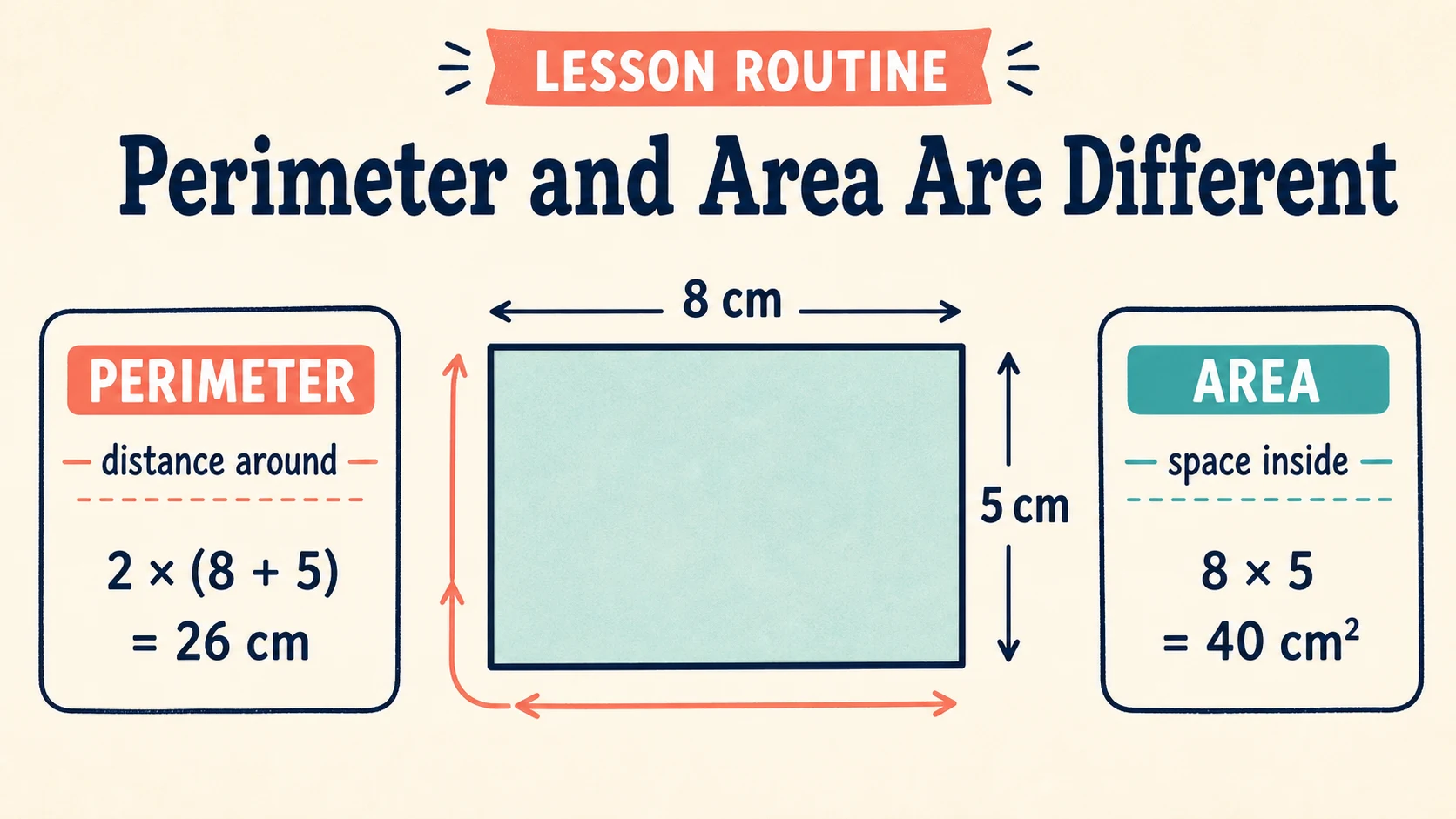
At the 3rd-grade entry point, a short model–attempt–explain cycle is more useful than assigning all 25 available problems automatically.
Ask for an explanation, then fade a support
Use a prompt such as “How did you know?” or “Show me what your number counts.” On the next item, remove one aid: close the model, turn over the attribute card, or use a rectangle without drawn unit squares.
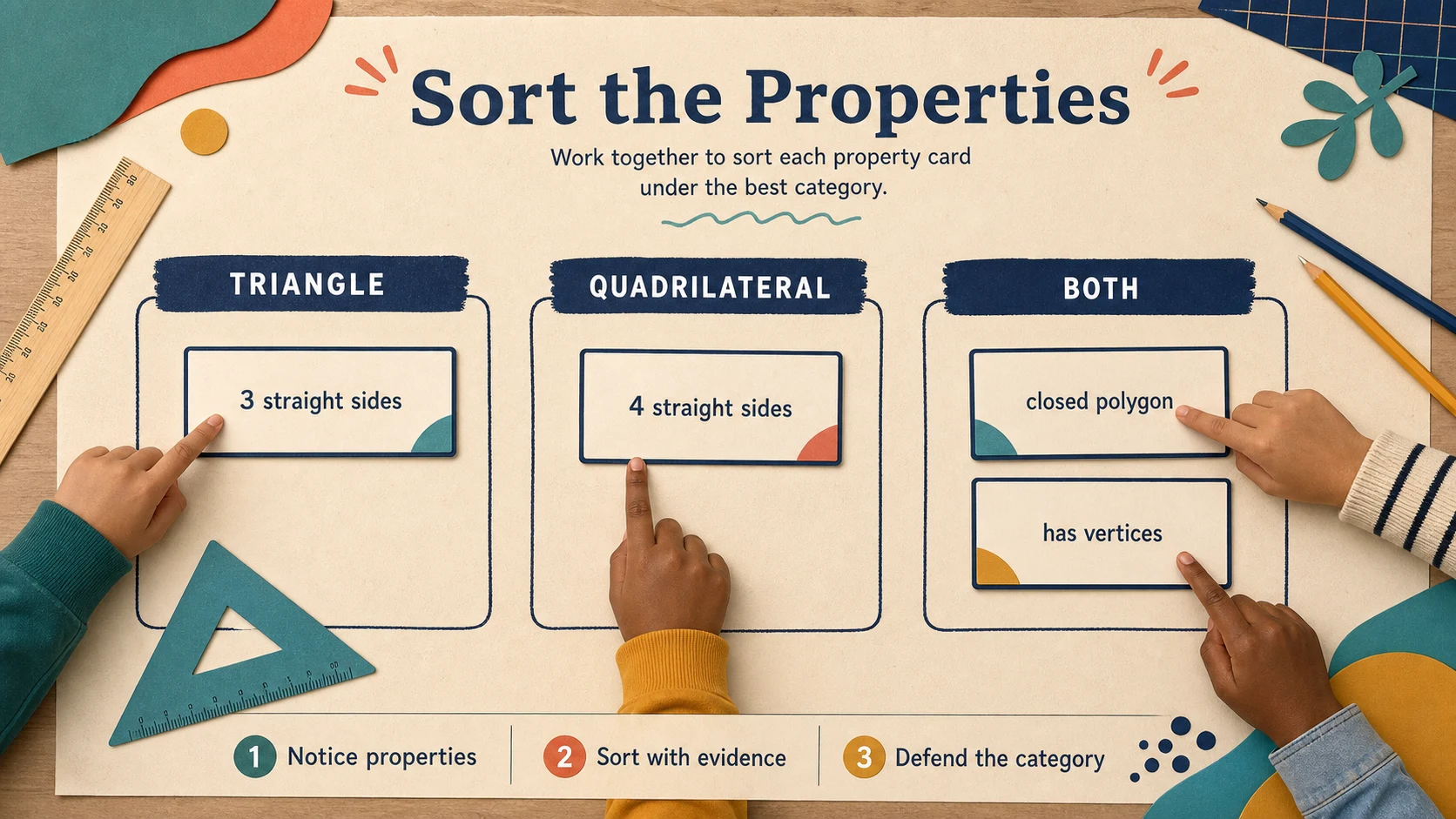
For a 6th-grade entry point, keep the routine brief while expecting more independent use of diagrams, coordinates, or measurements.
The IES practice guide on assisting students who struggle with mathematics supports systematic instruction, clear mathematical language, representations, and deliberate practice. That source informs the structure of this routine. The precise number of examples and prompts are suggestions for using these pages, not sourced prescriptions.
For children ages three and four, prioritize brief adult-led oral, matching, manipulative, and movement work over desk work. Ask a child to find a circle, make a triangle with sticks, step around a taped boundary, or match solid objects. A full written sheet is generally a poor placement decision merely because its pictures appear simple.
Fade support only after evidence appears
Support should recede in small, observable steps.
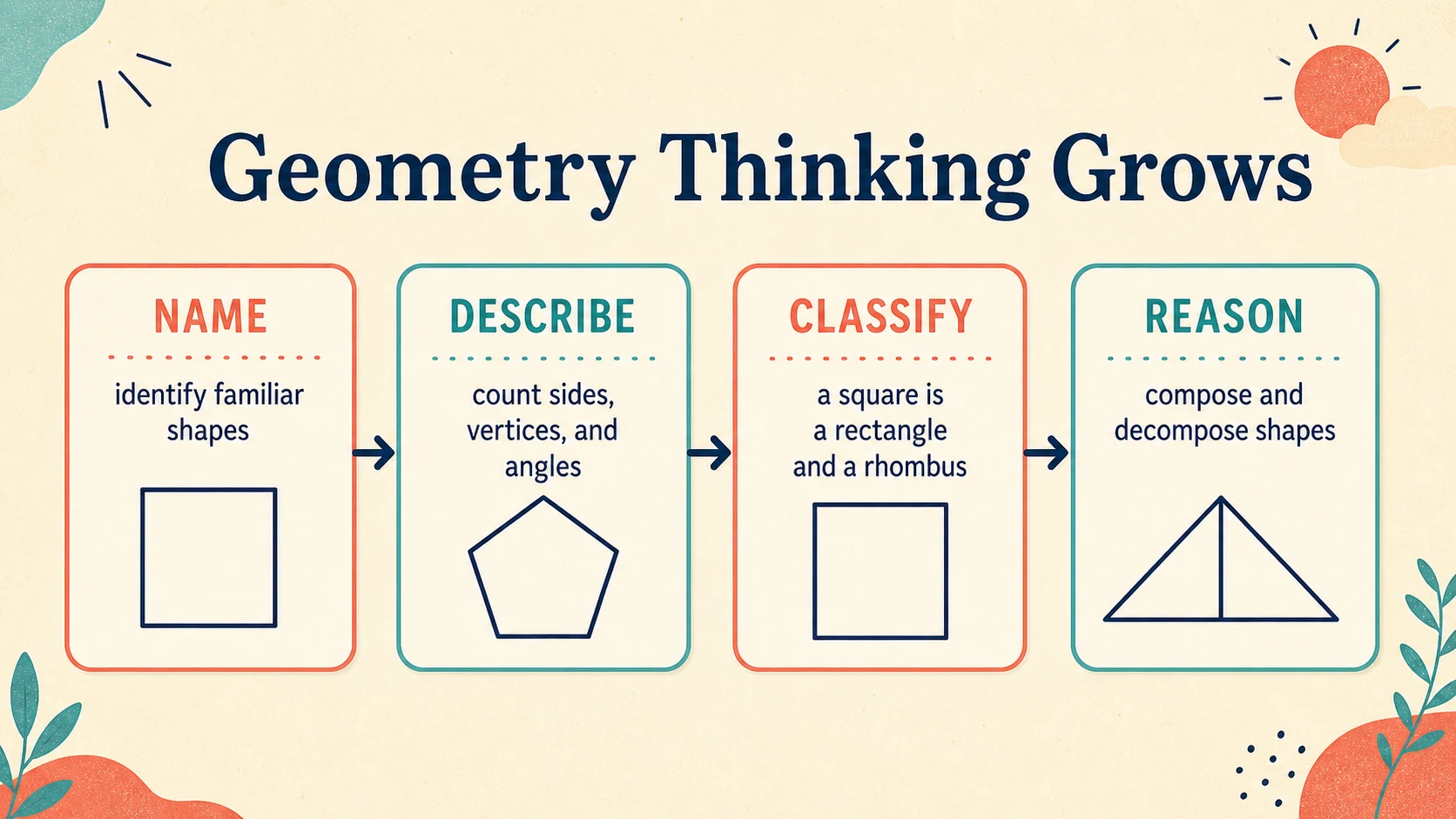
For 3rd-grade geometry, fade the model, prompt, or grid separately so the next response shows which support mattered.
For an area task, a possible sequence is:
- Cover a rectangle with physical square tiles.
- Count squares on a fully drawn grid.
- Use rows and columns on the grid.
- Use a partially drawn grid.
- Use labeled side lengths without interior squares.
- Explain why length times width counts square units.
Move forward when the learner solves contrasting items accurately and can connect the answer to the quantity. Move back one step if removing the support changes the underlying method.
Do not fade every support because one answer is correct. A learner may have copied a nearby pattern. Conversely, one arithmetic slip does not prove the representation is still required.
The Common Core mathematics standards illustrate that geometry expectations change across grades, moving from identifying and composing shapes toward reasoning about attributes, measurement, coordinates, area, surface area, and volume. Use that source as one reference point, not as a claim of alignment for every worksheet. Local curricula and sequences vary.
Read errors as evidence, not labels
An incorrect response should lead to a narrower next question.
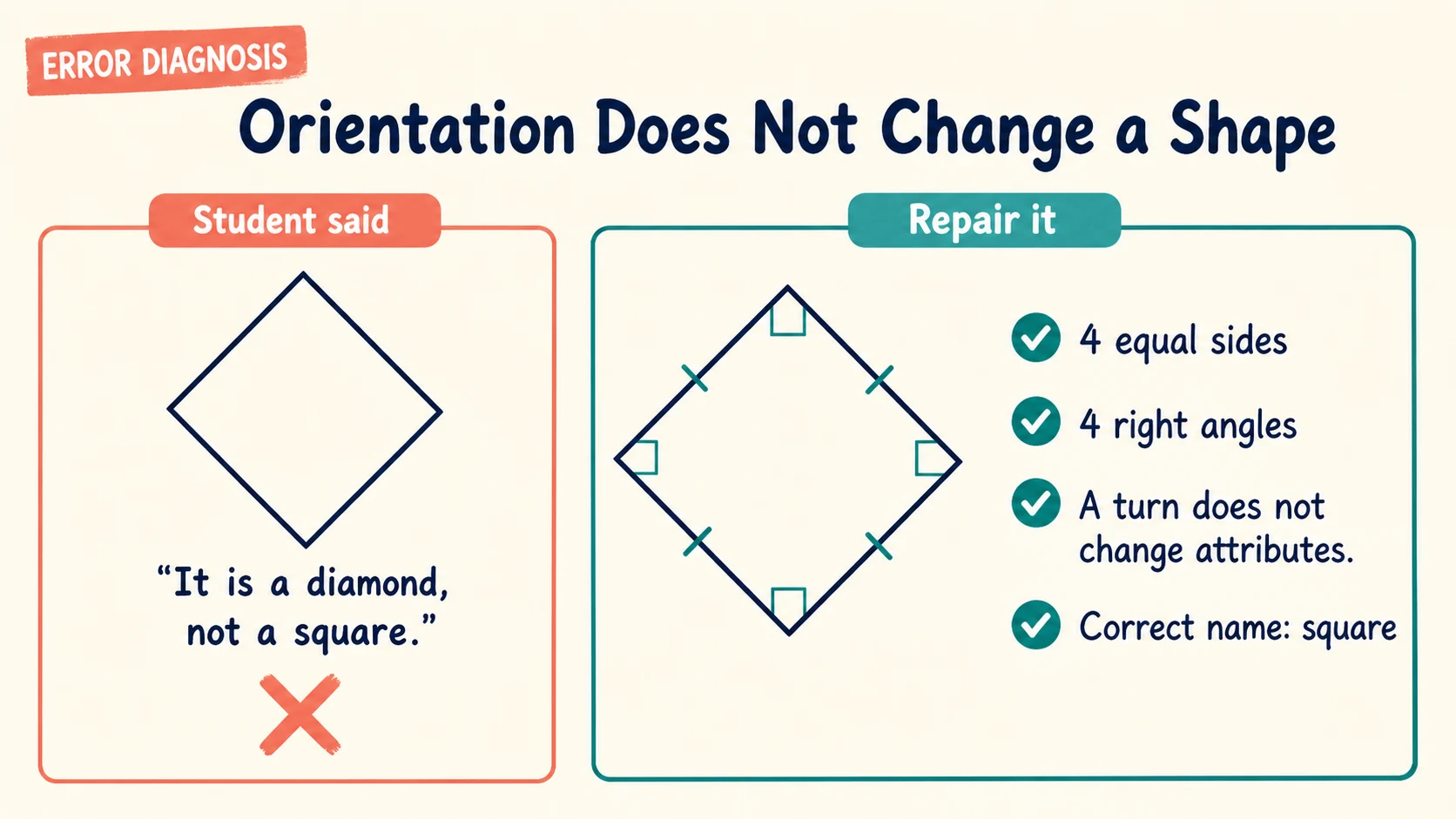
In 3rd-grade-style work, distinguish an attribute error from an area–perimeter mix-up before selecting more practice.
If a learner rejects a rotated triangle, show the same cutout in two orientations. Ask what changed and what stayed constant. If the learner calls an open three-segment figure a triangle, emphasize closure alongside side count.
If area and perimeter are reversed, ask the learner to shade what the answer measures. Shading the inside indicates area; tracing the outside indicates perimeter. Then rebuild the 4-by-3 example and attach the correct unit to each result.
If a learner counts a shared corner twice while finding perimeter, have them mark each side after adding it. If a learner counts only the visible top and side of a rectangle, ask whether the route has returned to its starting point.
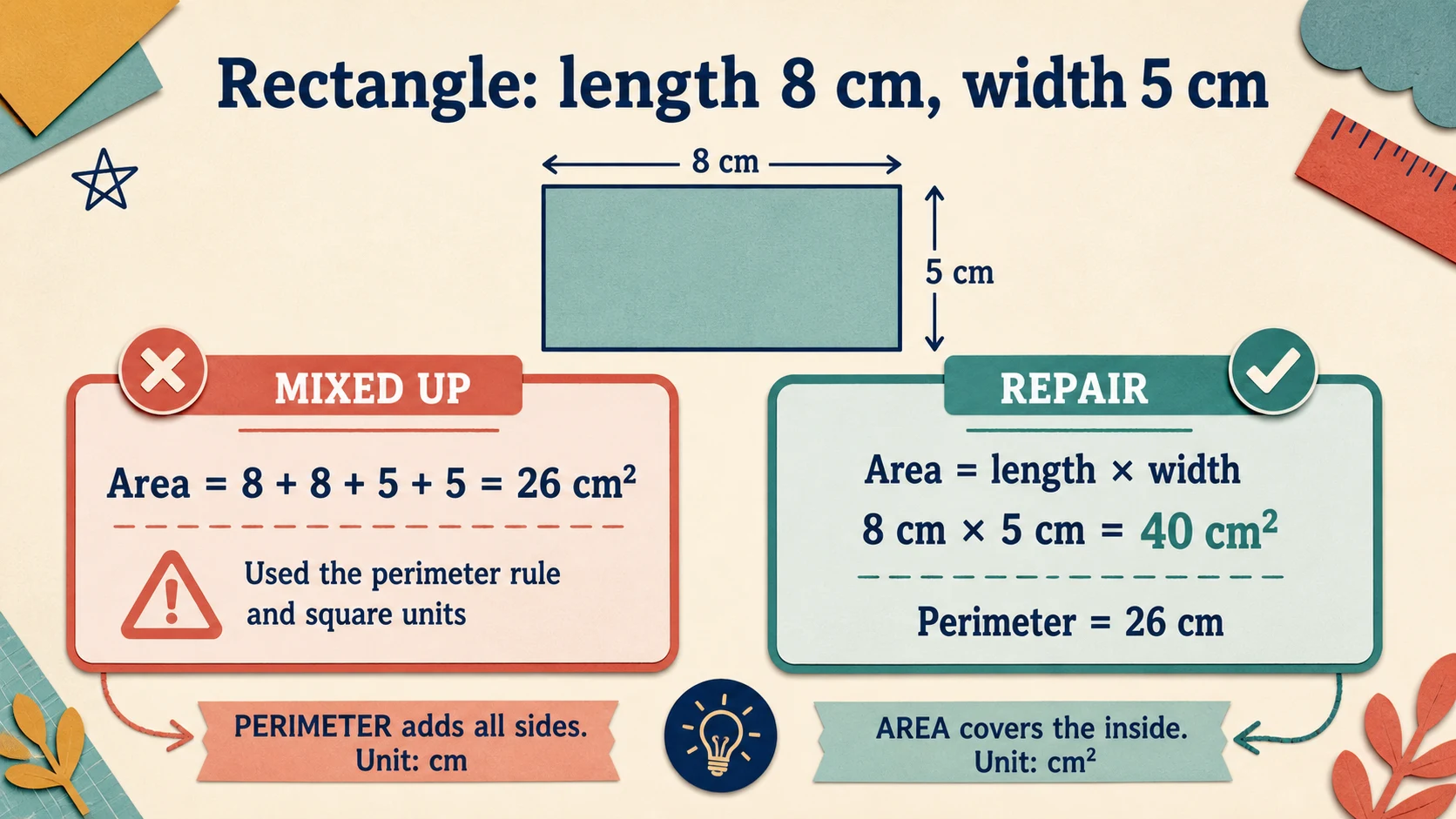
In upper-grade beginner work, separate diagram interpretation, formula choice, coordinate order, and arithmetic before changing levels.
For coordinates, reversing to suggests an order issue. Plot both points and compare the movements. Misplacing at may instead indicate a counting or axis-label issue.
These are interpretations to test, not diagnoses. Ask a follow-up that can disconfirm your first explanation. One wrong answer may result from fatigue, visual crowding, a copied number, or an unfamiliar direction.
Adapt access without removing the target skill
Useful adaptations preserve the mathematical decision:
- Read directions aloud when decoding is not the target.
- Enlarge diagrams and increase spacing.
- Cover unused rows to reduce visual crowding.
- Permit pointing, sorting, building, or oral explanations.
- Provide tiles for area, string for perimeter, hinged strips for angles, or graph paper for coordinates.
- Reduce the number of assigned items while retaining contrasting examples.
- Let the learner mark sides, vertices, right angles, rows, or coordinate movements.
- Use shapes in varied orientations.
An adaptation stops preserving the skill when it gives away the required decision. Color-coding every triangle before a classification task removes classification. Outlining the complete perimeter in the same color as the correct answer may convert reasoning into matching. Providing the multiplication expression on an area problem is appropriate only if the target is calculating area from a supplied model, not choosing the operation.
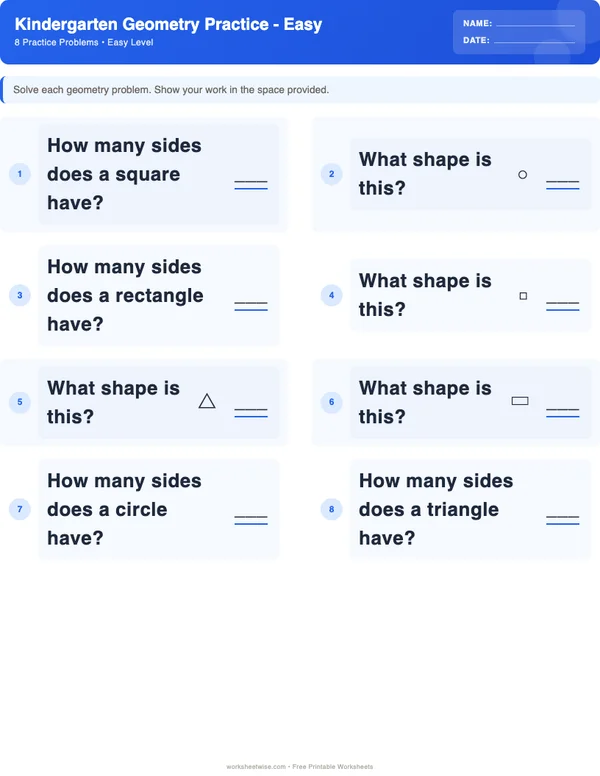
For younger shape work, compare the Kindergarten Geometry guide and free sheet with the 1st Grade Geometry guide and free sheet. For the transition into attribute reasoning, area, and perimeter, inspect the 3rd Grade Geometry guide and free sheet. The grade page is a candidate based on intended practice—not proof of placement.
Choose the next variation from observable readiness
After four to six representative items, sort the evidence into one of three decisions.
Keep the current variation
Stay when the learner is using the intended idea but still needs occasional prompting, a grid, manipulatives, or a reminder to explain units. Change the examples, not the target. Rotate the shapes, rearrange them, or alter small whole-number dimensions.
Add one challenge
Increase difficulty when the learner independently solves contrasting examples, explains what the answer represents, and catches or corrects an error. Change one feature:
- Remove the area grid but retain whole-number dimensions.
- Ask for a property-based explanation after classification.
- Include a less familiar orientation.
- Add one missing side to a perimeter figure.
- Remove coordinate movement arrows while keeping the scale constant.
- Ask the learner to create an example and a nonexample.
Step back to a clearer representation
Return to objects, movement, matching, tracing, or a completed model when the learner cannot begin, repeatedly uses an irrelevant feature, or gives a procedure with no connection to the quantity. Step back narrowly. A learner who confuses area and perimeter may still classify polygons successfully.
WorksheetWise’s seven free geometry entry points offer one easy sheet for each listed grade from Kindergarten through 6th Grade. Because sheets range from 20 to 30 problems, sample rather than require completion. The catalogue count of 42 variants gives room to change practice, but it does not itself establish a learning progression or guarantee a particular result.
Make the next choice concrete
Begin with one target, one support, and one planned fade. For example: use the 3rd-grade entry point to solve one tiled area model, one second model with different dimensions, and one rectangle without interior squares. Ask after each, “What does your number count?” If the learner answers “square units” and explains the row structure without relying on the first model, choose another no-grid variation. If not, rebuild the rectangle with tiles and keep the same mathematical target.
Open the 3rd Grade Geometry guide and free sheet now, select no more than six contrasting items, and record which single support—model, prompt, grid, or vocabulary reminder—you will fade on the final item.
Put it into practice
Use the guide with a real printable
Move from explanation to a short, observable practice task. Check the first item together, then adjust the next session from the learner's actual work.
Open the first free worksheetExplore a neighboring collection
Choose by a different teaching need
Easy and Beginner Addition Worksheets Easy and Beginner Counting Worksheets Easy and Beginner Division Worksheets Easy and Beginner Fractions Worksheets Easy and Beginner Money Worksheets Easy and Beginner Multiplication Worksheets Easy and Beginner Sight Words Worksheets Easy and Beginner Subtraction Worksheets