Curated collectionAnswer keys includedPrint-ready PDFs
Easy and Beginner Money Worksheets
Define what easy and beginner money practice changes and what it deliberately keeps constant, then compare three checked examples, fading supports and readiness evidence.
Start with a real resource
Browse this worksheet collection
3 relevant free entry points are available. Each one includes a printable learner PDF and separate answer key.
A useful practice loop
Print less. Observe more.
- Choose one skill and model the first item aloud.
- Use a short set and notice the learner’s strategy.
- Change the next task from the work you can see.
Need more than the free sheet?
Plus includes all 18 matching catalogue variations where available, plus saved deterministic generators and the worksheet designer.
See Plus membershipComplete guide
How to teach and practise easy money worksheets
3,593 words Updated 6 instructional visuals
What “easy” changes in money practice
Easy and beginner money worksheets should reduce the number of decisions a learner must coordinate at once. They should not reduce money to guessing from pictures.
On this page, an easy task typically changes observable features such as:
- how many coin denominations appear;
- whether coins are grouped or mixed;
- whether a value key, counting path, or worked example is visible;
- how many quantities must be combined;
- whether the amount stays below one dollar;
- whether the learner identifies, counts, compares, buys, or makes change;
- how much reading and irrelevant information surrounds the calculation.
What stays constant is the mathematical meaning. A dime must still represent 10 cents. Five pennies must still be equivalent to one nickel. A collection’s value must still come from the values of its coins, not their sizes or the number of objects shown.
That distinction matters when choosing among this catalogue’s 18 easy money variants. There are three free entry points—one each for 1st, 2nd, and 3rd grade—and all three cover the same broad topic at different intended practice levels. The free 1st- and 2nd-grade sheets contain 20 problems; the free 3rd-grade sheet contains 25. Problem count alone does not determine conceptual difficulty.
Grade and age labels are discovery aids, not placement decisions. Grade labels describe an intended practice level, and local curriculum sequences differ. Choose from what the learner can show with coins, words, and written work rather than from age or grade alone.
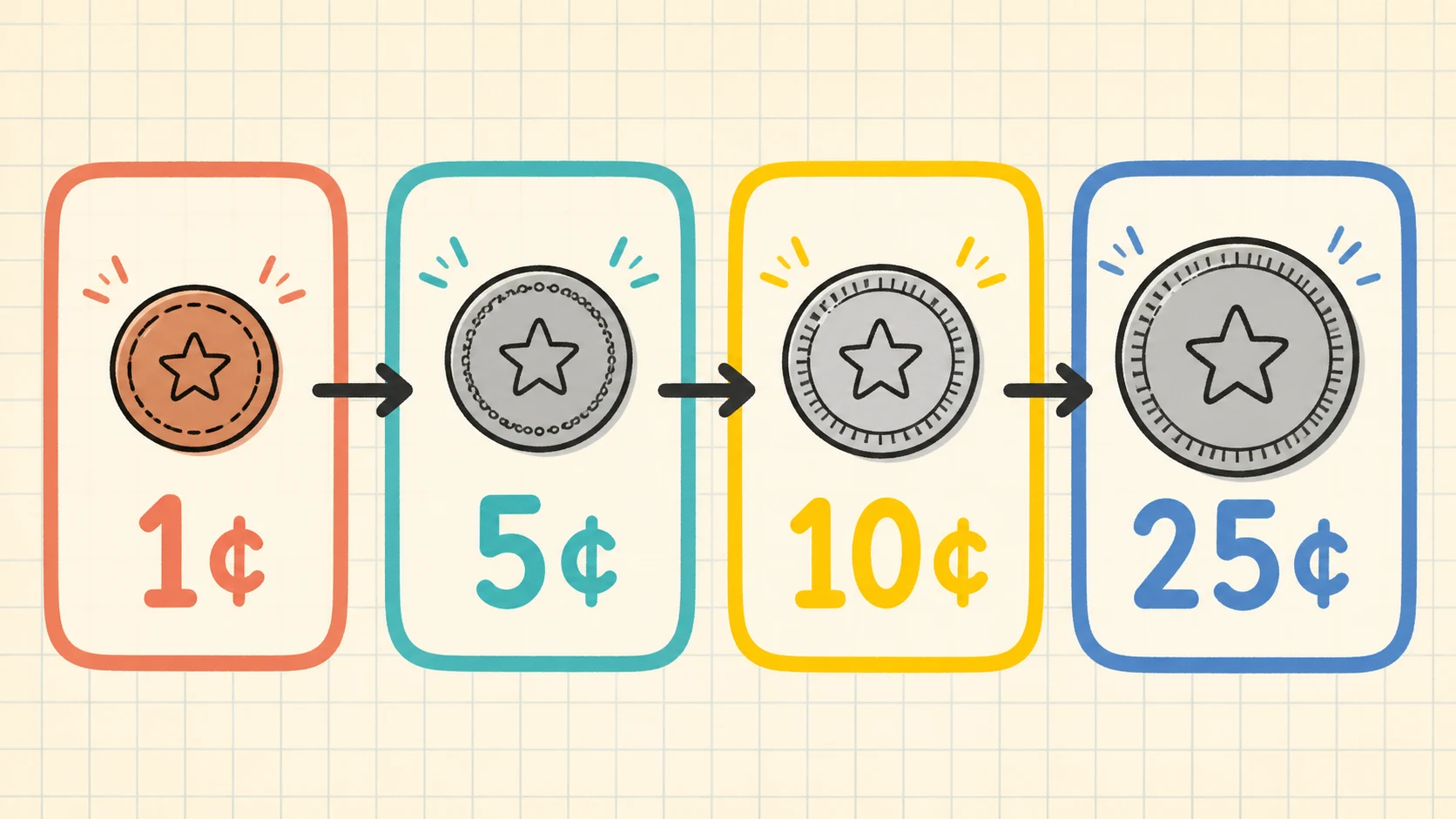
For early money work, coin identity, coin value, counting, and comparison form a connected path rather than four interchangeable worksheet labels.
The beginner boundary: easier, appropriate, and harder
A useful beginner task isolates one new demand while keeping the surrounding demands familiar. The following contrasts make that boundary visible.
| Task feature | Nearby easier task | Appropriate easy task | Nearby harder task |
|---|---|---|---|
| Coin recognition | Match identical coin images | Name a penny, nickel, dime, or quarter and state its value | Identify worn, rotated, or partially obscured coins without a key |
| Counting | Count pennies by ones | Count one repeated denomination using its value | Count an unordered mixed collection |
| Mixed coins | Sort coins by type | Count two denominations presented in descending value | Reorder four denominations mentally and total them |
| Comparison | Compare two collections of pennies | Compare two clearly organized totals | Compare mixed collections without writing intermediate totals |
| Purchase problems | Choose an item whose price exactly matches one shown amount | Decide whether a given collection is enough | Combine purchases, apply constraints, and calculate change |
| Change | Count up within a narrow interval with a visible path | Count up from a price to the amount paid | Subtract dollars and cents in a multistep situation |
The easy column is not a permanent category for a learner. It describes the current task. The same learner might independently identify coins, need a value key for mixed counting, and not yet be ready to make change.
The catalogue’s broad money description extends from identifying coins and bills through mixed collections, comparison, making change, and multistep purchase problems. Those are not equally introductory. A page labeled easy can contain several stages of one progression, so adults still need to inspect the actual items.
What deliberately stays challenging
A suitable beginner worksheet may still require the learner to:
- attach a numerical value to a coin;
- change counting increments when the denomination changes;
- understand that a smaller coin can have greater value than a larger coin;
- represent a total with a cent sign or money notation;
- explain why two different collections are equivalent.
Those are central money ideas, not clutter to remove. Reduce the surrounding load while preserving at least one of them as the lesson target.
Three catalogue entry points serve different decisions
The three free sheets are all marked easy, but their grade labels and problem counts should guide discovery rather than dictate placement.
The 1st-grade entry point: establish coin-value meaning
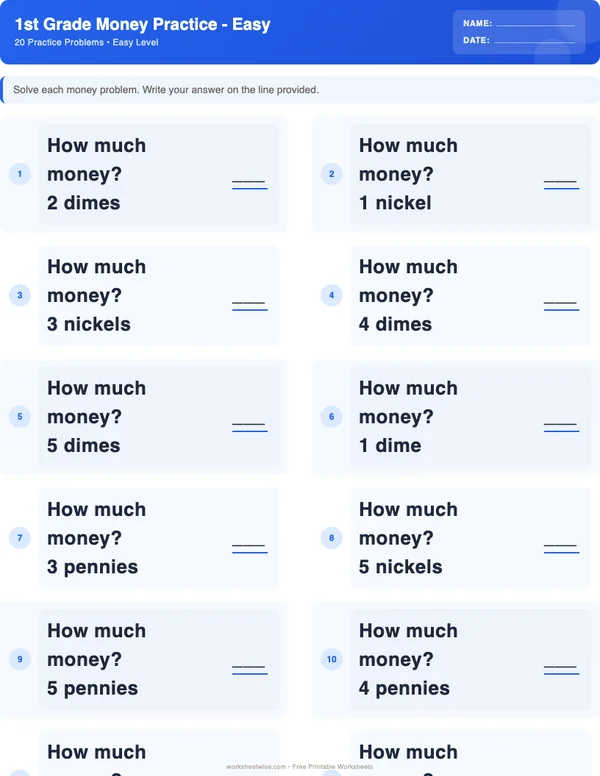
Use the 1st Grade Money guide and free sheet when the immediate question is whether the learner can connect common coin names to values and count small, controlled collections. The 20-problem format makes sense only if the items are sampled first and the work can be divided. It is not necessary to finish all 20 in one sitting.
A strong starting sequence is:
- Match real or realistic play coins to the printed images.
- Say each coin’s name and value.
- Count a repeated denomination.
- Count a small mixed set with the largest-value coin first.
- Explain the total aloud.
The catalogue teaching tip suggests introducing pennies, then dimes, nickels, and quarters. That is a page-specific instructional suggestion, not a universal curriculum rule. Its rationale is observable: counting by tens is often a more accessible transition from ones than switching immediately to fives, while quarters require a less familiar sequence of 25, 50, 75, 100.
The 2nd-grade entry point: coordinate denominations
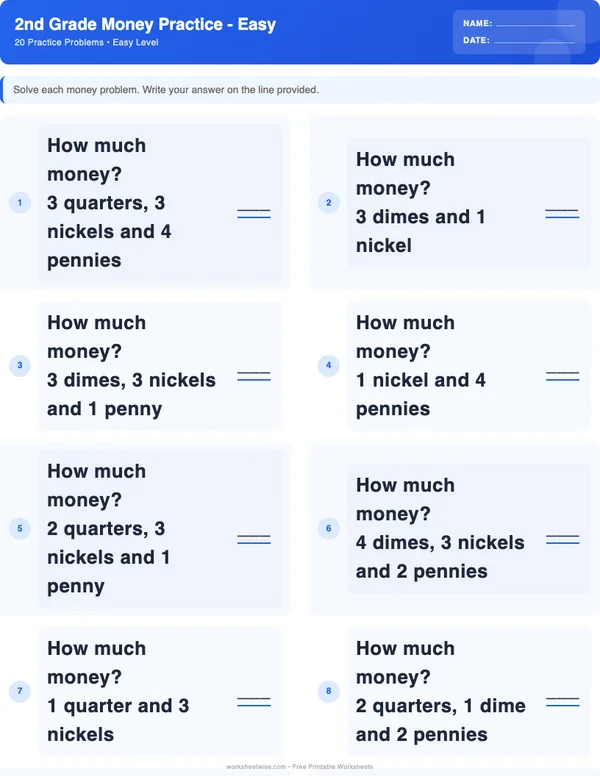
The 2nd Grade Money guide and free sheet is a better entry when coin names and individual values are secure but mixed collections remain effortful. Its 20 problems can be used to examine whether errors occur when the learner must switch from counting by tens to fives or ones.
For example, a learner might correctly say that a dime is worth 10 cents and a nickel is worth 5 cents, yet count two dimes, one nickel, and three pennies as 18 cents. That is not a coin-identification error. The denominations were known; the count-on sequence broke down.
The 3rd-grade entry point: connect totals to transactions
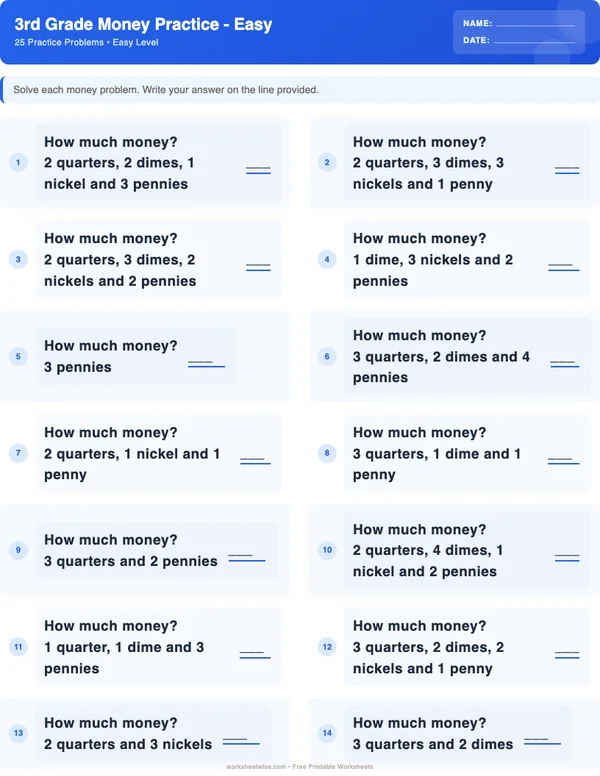
Use the 3rd Grade Money guide and free sheet when the learner can total common coin collections and is ready to apply those totals to prices, purchases, comparison, or change. Its free sheet contains 25 problems, but a longer sheet is not automatically harder than a shorter one. Five well-scaffolded transaction items may be less demanding than five crowded mixed-coin collections.
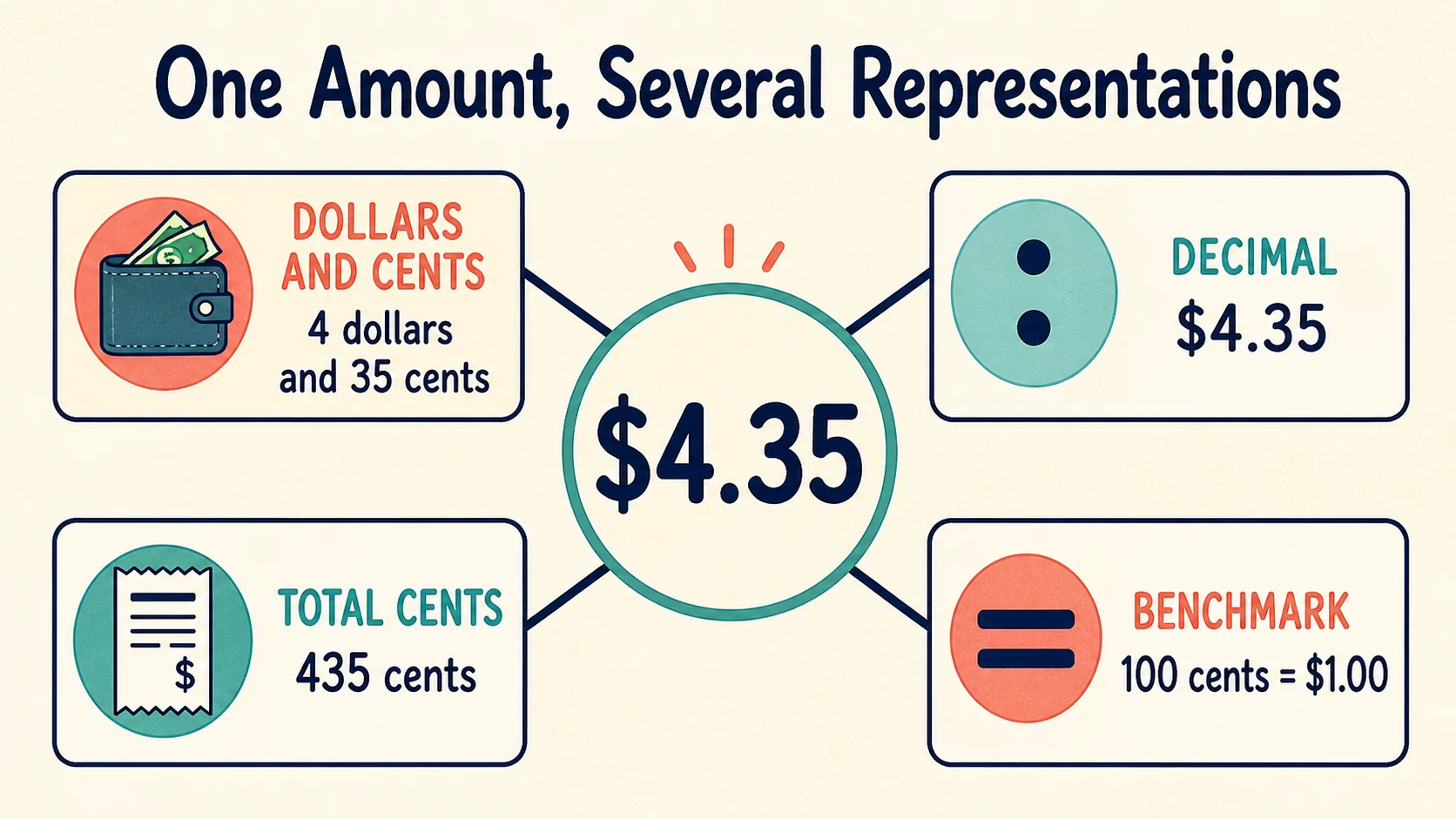
Later beginner practice coordinates coin totals with price, payment, and change while keeping the transaction structure explicit.
Four checked examples show what belongs here
Each example below has been calculated independently. The explanations identify why the task fits easy or beginner money practice and what variation should follow.
Example 1: repeated coins without a denomination switch
Task: Find the value of three dimes.
A dime is worth 10 cents:
- first dime: 10¢;
- second dime: 20¢;
- third dime: 30¢.
Checked answer: 30¢.
This belongs at the easy level because the learner performs one stable action: count by tens three times. Coin value still matters, but there is no switch between counting increments.
A nearby easier version would show one dime beside a visible “10¢” label, then ask the learner to match it to 10¢. A nearby harder version would add a nickel: three dimes and one nickel equal 30¢ + 5¢ = 35¢. That version requires a change from counting by tens to adding five.
Do not raise difficulty merely by drawing 12 dimes. That may increase writing and attention demands without revealing whether the learner understands a new money relationship.
Example 2: a controlled mixed collection
Task: Count two dimes, one nickel, and four pennies.
Arrange or identify the coins from greatest value to least:
- two dimes: 10¢ + 10¢ = 20¢;
- one nickel: 20¢ + 5¢ = 25¢;
- four pennies: 25¢ + 1¢ + 1¢ + 1¢ + 1¢ = 29¢.
Checked answer: 29¢.
This belongs here because it introduces mixed counting while keeping the total below one dollar and using only three denominations. The adult can provide a denomination-value key or place the coins in descending-value order without solving the problem.
Ask, “Why did you start with the dimes?” A useful response is that beginning with the greatest-value coins makes the count-on sequence easier to track. Starting with pennies is not mathematically wrong, but an inconsistent order can create more opportunities to lose the running total.
The next variation should change one feature. Remove the preset order while keeping the same coins, or replace two pennies with another nickel and ask whether the value stays the same. Do not simultaneously add quarters, hide the value key, increase the number of coins, and introduce a word problem.
Example 3: compare different-looking collections
Task: Which is worth more?
- Collection A: one quarter and two pennies.
- Collection B: two dimes and one nickel.
Calculate each collection:
- A: 25¢ + 1¢ + 1¢ = 27¢;
- B: 10¢ + 10¢ + 5¢ = 25¢.
Because 27¢ > 25¢, Collection A is worth 2¢ more.
This is appropriate beginner comparison work because both totals are small, but the collections cannot be judged reliably from the number or physical size of the coins. The task tests value, not visual quantity.
It also exposes a useful misconception. If the learner chooses Collection B because it has “more coins,” note that the learner compared object count rather than monetary value. If the learner says the collections are equal because a quarter “is 25” and overlooks the pennies, the likely issue is incomplete accumulation. Neither response supports a diagnosis; each only identifies what to test next.
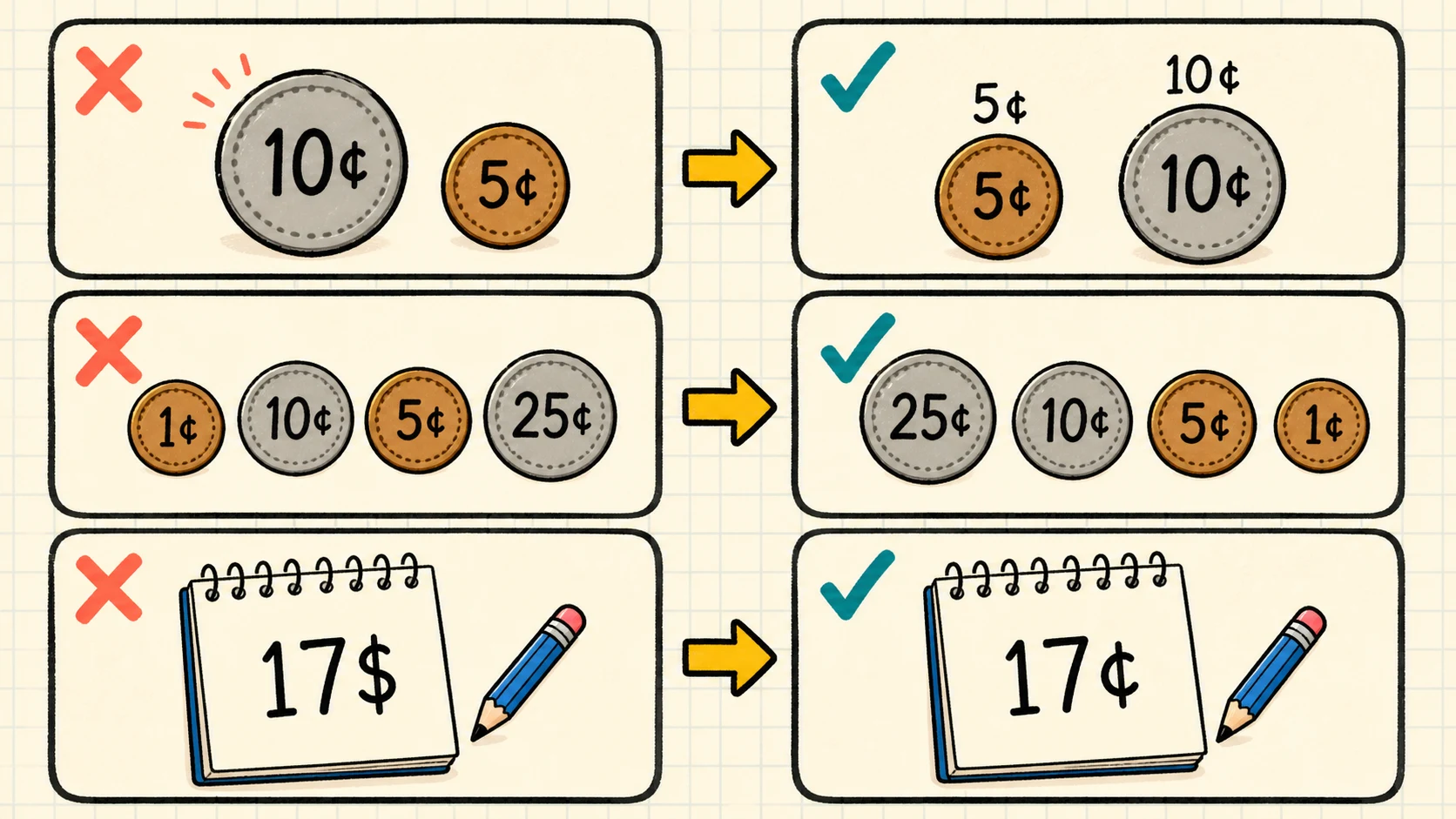
An incorrect total becomes useful when the adult records the strategy used and chooses one small follow-up check.
Example 4: count up to make change
Task: An item costs $3.67. The customer pays $5.00. Find the change by counting up.
Start at $3.67:
- add 3¢ to reach $3.70;
- add 5¢ to reach $3.75;
- add 25¢ to reach $4.00;
- add $1.00 to reach $5.00.
Now total the increments:
$0.03 + $0.05 + $0.25 + $1.00 = $1.33.
Check by addition:
$3.67 + $1.33 = $5.00.
Checked answer: $1.33.
This is the catalogue teaching tip’s worked change situation. It belongs at the upper edge of beginner practice only when the counting path is visible or modeled and the learner already understands dollars, cents, and equivalent amounts. Without those prerequisites, the same numbers create several demands at once: interpreting decimals, crossing a ten-cent boundary, crossing a dollar boundary, and combining the increments.
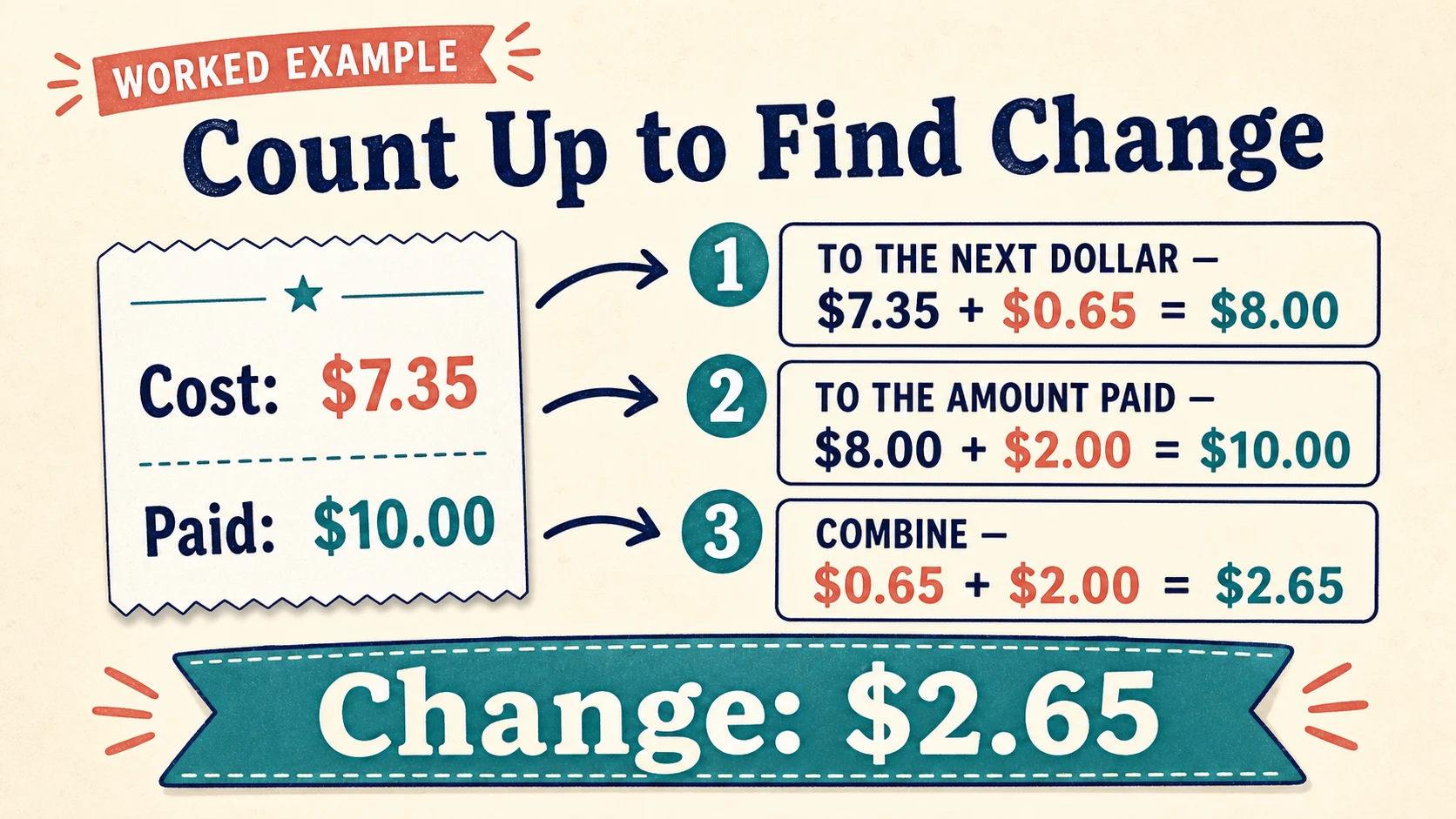
The useful bridge is not “coins, then symbols” in isolation; it is showing how each concrete increment appears in the written count-up path.
A gentler preceding example is a 72¢ item paid for with $1.00:
- 72¢ + 3¢ = 75¢;
- 75¢ + 25¢ = 100¢;
- 3¢ + 25¢ = 28¢.
The change is 28¢, checked by 72¢ + 28¢ = 100¢. This preserves the count-up idea while removing dollar notation above $1.
Supports should fade one at a time
The IES guide for elementary mathematics intervention recommends systematic instruction, clear mathematical language, and well-chosen concrete and semi-concrete representations. It also addresses deliberate word-problem instruction. The guide did not evaluate WorksheetWise, but its recommendations help adults decide how to mediate a worksheet.
For money, a support can be:
- actual or realistic play coins;
- a coin-name and value chart;
- coins sorted by denomination;
- an arrow showing greatest value to least value;
- a written running-total line;
- a number line;
- a completed example beside a parallel item;
- an adult reading the context aloud.
A support is ready to fade when the learner succeeds because the relationship is understood, not because the answer was copied.
A four-pass fading sequence
Use the same mathematical structure through four short passes:
- Build: The learner makes the printed collection with play coins.
- Mark: The learner writes each coin’s value beneath its image.
- Track: The learner records the running totals but no longer labels every coin.
- Explain: The learner solves from the image and explains the count without the value chart.
Suppose the collection is one quarter, two dimes, and three pennies. The checked total is 25¢ + 20¢ + 3¢ = 48¢. In the first pass, the learner handles all six coins. In the final pass, the learner might say, “I started at 25, counted 35, 45, then 46, 47, 48.”
Remove only one support after two or more comparable successes across separate items. Two correct answers copied from the same layout do not show that the strategy will transfer.
If accuracy collapses after removing the value chart, restore it and test individual coin values. If accuracy holds until the coins are shuffled, practice sorting before increasing the total. Those decisions preserve the target instead of treating every error as a need for an easier sheet.
A short routine for paper, coins, and talk
Worksheets work best here as records of thinking, not substitutes for handling and discussing money. The catalogue specifically suggests real or realistic play coins and a classroom-store context.
A 1st-grade routine: recognize, build, count, explain
Keep a session brief enough that the learner’s coin reasoning—not endurance—determines the result.
- Oral warm-up, two minutes: Hold up one coin. Ask for its name, value, and one observable feature.
- Build, three minutes: Re-create two printed collections with play coins.
- Count together, three minutes: Point to each coin while saying the running total.
- Independent sample, four minutes: Complete three or four worksheet items.
- Exit check, one minute: Ask the learner to make one stated amount in a different way.
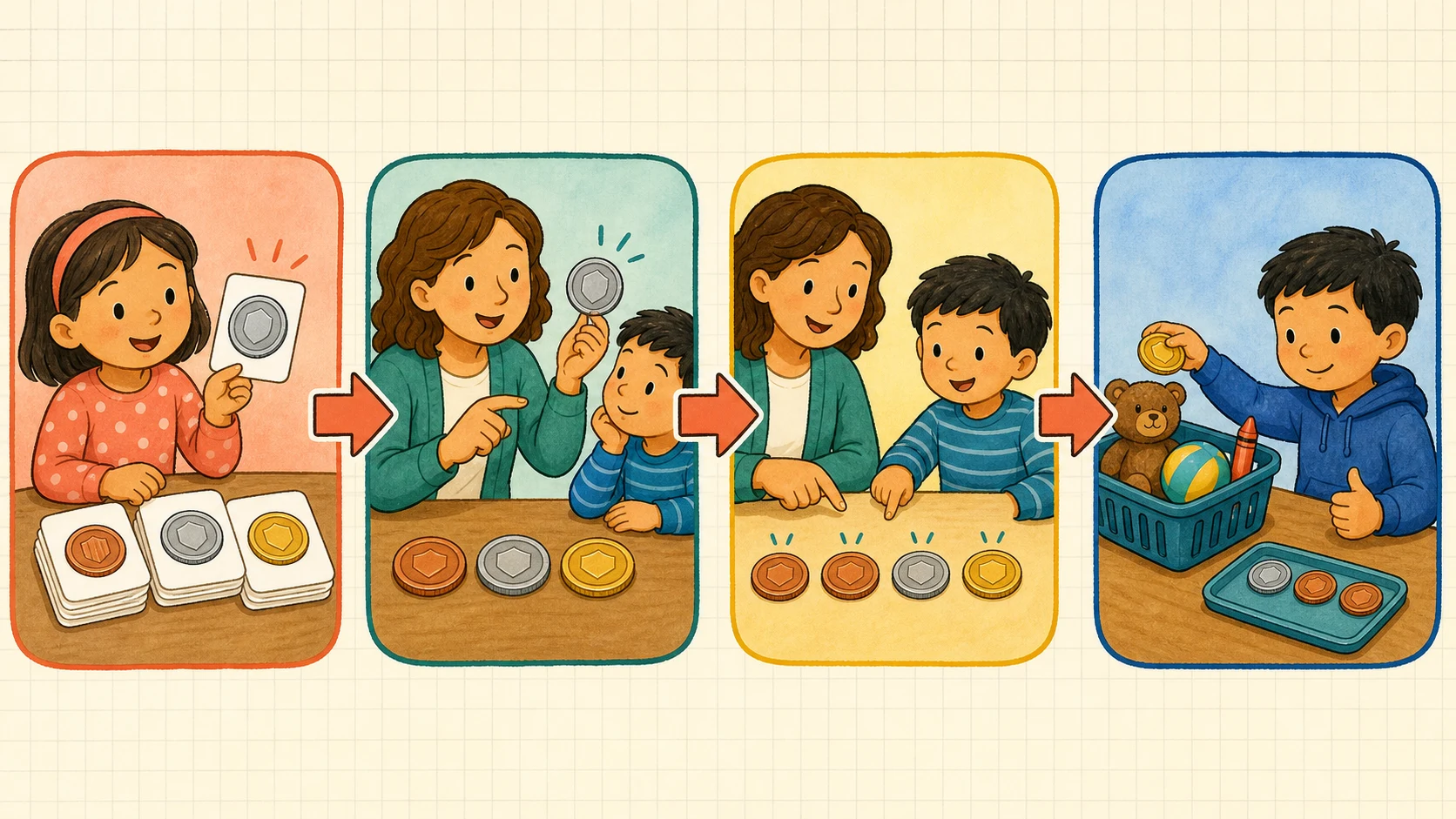
For early practice, a small written sample follows coin handling and oral counting; it does not consume the entire session.
Although this page’s catalogue entry points begin at 1st grade, adults may encounter younger children through search or family use. For ages three and four, prioritize brief adult-led oral, matching, manipulative, and movement work over desk work. A child might carry a play penny to a matching picture, sort two visibly different coins, or join an adult in counting pennies. Age remains a discovery aid, not a placement decision.
The IES early-childhood mathematics guide recommends teaching number and operations through a developmental progression, monitoring what children know, helping them describe their world mathematically, and integrating mathematics into daily activity. That guidance supports observing a child during coin play; it does not establish that a particular worksheet is appropriate.
A 3rd-grade routine: model, solve, verify, vary
- Present one transaction with coins, bills, or a drawn count-up path.
- Have the learner state what is known: price, payment, and requested change.
- Solve one parallel problem on paper.
- Verify by adding price and change.
- Change exactly one feature for the exit item.
The transaction routine separates understanding the situation, calculating the difference, and checking that price plus change equals payment.
For example, after solving 72¢ paid with $1.00, change the price to 68¢ but retain the $1.00 payment. The checked change is 32¢ because 68¢ + 2¢ = 70¢, + 5¢ = 75¢, and + 25¢ = 100¢. If the learner succeeds, vary the payment next. If not, keep the payment fixed and model another count-up path.
False signals that make a worksheet look easy or hard
Large coin pictures are not automatically beginner-friendly
Enlarged images may help visual access, but a page can still be conceptually demanding if the coins are mixed, rotated, tightly clustered, or embedded in a transaction. Conversely, small images do not make a task mathematically advanced; they may simply create a visual-access barrier.
Fewer problems do not guarantee easier reasoning
A five-item sheet containing multistep purchases can be harder than a 20-item sheet that asks for repeated-coin totals. Use problem count to plan stamina and session length, not to infer the required concept.
Real-life wording can add reading load
A shopping story may be familiar while still requiring the learner to identify relevant quantities, choose an operation, interpret dollars and cents, and ignore decorative details. Read the item aloud when reading is not the target. This preserves money reasoning without supplying the mathematical decision.
Correct totals can conceal fragile strategies
A learner may reach 30¢ for three dimes by counting the three objects and appending a zero. Ask for another representation: “Show 30¢ with different coins.” Three dimes, six nickels, one quarter plus five pennies, and 30 pennies are all valid. The explanation reveals more than a run of answer marks.
The Common Core mathematics overview distinguishes understanding from merely producing a correct answer and points to age-appropriate justification as evidence. This citation is a general assessment principle, not a claim that these sheets are aligned to a specific standard. Local standards and instructional sequences must be checked separately.
Interpret errors before changing levels
An error should trigger a small test, not a label.
| Observed response | Possible interpretation to test | Immediate follow-up |
|---|---|---|
| Calls a nickel “5” but cannot name it | Value may be recognized without vocabulary | Ask the learner to match coin names, images, and values |
| Counts three nickels as 3¢ | Counts objects rather than coin values | Replace nickels with pennies, then contrast the two collections |
| Counts 10, 20, 25, 26, 28 | Loses the one-cent increment | Have the learner touch and count each penny |
| Starts mixed sets randomly and loses track | Organization may be the obstacle | Ask the learner to sort before counting |
| Writes 75¢ as $75 | Money notation is not secure | Compare 75¢, $0.75, and $75 with concrete buying examples |
| Subtracts correctly but answers the wrong question | Situation interpretation may be the issue | Ask what each number represents before recalculating |
| Gives $1.23 change for the $3.67 example | Count-up increments may be recorded inaccurately | Rebuild each jump and verify with addition |
These are hypotheses for instruction, not diagnoses. A single response may result from fatigue, unclear printing, unfamiliar coin images, language demands, or an accidental slip. Look for the same pattern across two or three carefully chosen items.
Adapt access without replacing the money target
An adaptation preserves the intended reasoning while removing an unrelated obstacle.
For visual access, enlarge and space the coin images, provide physical coins for comparison, or outline each collection. Do not announce a coin’s value if identifying that value is the target.
For motor or writing needs, allow pointing, verbal answers, coin placement, stamps, or selecting from amount cards. The learner can demonstrate that two dimes and three pennies equal 23¢ without writing a long response.
For language access, preteach penny, nickel, dime, quarter, cent, cost, pay, and change. Read transaction text aloud and ask the learner to restate it using the actual objects. Keep mathematical terms precise: a coin has a value, a collection has a total, and change is the difference between payment and cost.
For attention and stamina, cover later rows, complete four items, pause for coin handling, and return for another four. Shortening a sitting does not require changing the mathematics.
For learners unfamiliar with US currency, explicitly teach that appearance and value do not follow a simple size rule. Treat currency knowledge as new content rather than evidence about general arithmetic ability.
The boundary is equally important: if an adult performs every denomination switch, supplies each running total, and writes the answer, the task no longer measures the learner’s money reasoning. Choose fewer items or restore an earlier representation instead.
Readiness for the next variation must be observable
Advance when the learner can demonstrate a stable strategy across more than one layout or context. Useful evidence includes:
- names the included coins and states their values without guessing;
- begins a mixed collection with a high-value coin or deliberately sorts it;
- maintains the running total when the counting increment changes;
- represents a total correctly in cents;
- explains why differently composed collections are equal or unequal;
- checks change by confirming that price plus change equals payment;
- solves a parallel item after one support is removed;
- notices and corrects an error without being told the answer.
Choose the next variation according to the evidence:
- If repeated-denomination counting is secure, add one different denomination.
- If sorted mixed sets are secure, shuffle the same coins.
- If totals below $1 are secure, compare two collections before introducing change.
- If count-up to $1 is secure, introduce a whole-dollar payment above $1.
- If calculation is secure but story interpretation is not, keep the numbers simple and vary the wording.
- If performance depends on a coin-value key, fade the key before increasing the number of denominations.
Move sideways when necessary. The Easy and beginner Counting Worksheets can isolate counting by ones, fives, or tens when the coin values are known but the count sequence is unstable. Use that resource as supporting practice, then return to coins; generic counting should not replace learning what the denominations mean.
Limits of an easy worksheet page
This page can provide structured practice and three free grade-based entry points within a catalogue of 18 variants. It cannot determine placement, diagnose a learning difficulty, confirm standards mastery, or replace observation of the learner using actual or realistic money.
Printed coin images also omit important real-world demands: recognizing wear, distinguishing similar surfaces, handling coins, deciding what payment is sensible, and communicating during a purchase. A correct worksheet total therefore supports a narrow claim: the learner solved that representation under those conditions.
Likewise, a low score does not establish that the entire money topic is too hard. Separate coin recognition, value recall, counting sequence, notation, reading, and transaction reasoning before choosing a different sheet.
For the next session, open the free deterministic worksheet generators and make one variation that changes only the learner’s next observable feature—for example, move from sorted dimes and pennies to the same denominations in a shuffled order. Use four items, keep play coins available, and record whether the learner independently sorts, counts, and explains the total.
Put it into practice
Use the guide with a real printable
Move from explanation to a short, observable practice task. Check the first item together, then adjust the next session from the learner's actual work.
Open the first free worksheetExplore a neighboring collection
Choose by a different teaching need
Easy and Beginner Addition Worksheets Easy and Beginner Counting Worksheets Easy and Beginner Division Worksheets Easy and Beginner Fractions Worksheets Easy and Beginner Geometry Worksheets Easy and Beginner Multiplication Worksheets Easy and Beginner Sight Words Worksheets Easy and Beginner Subtraction Worksheets