Curated collectionAnswer keys includedPrint-ready PDFs
Easy and Beginner Division Worksheets
Define what easy and beginner division practice changes and what it deliberately keeps constant, then compare three checked examples, fading supports and readiness evidence.
Start with a real resource
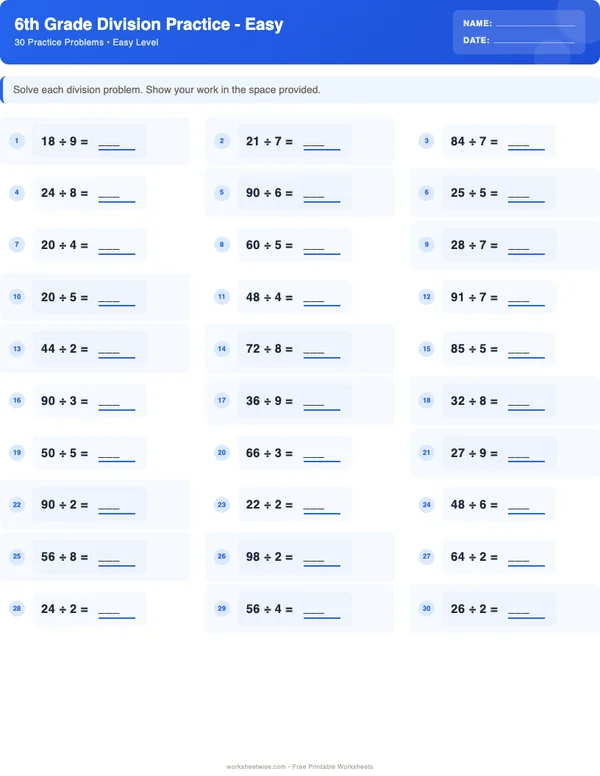
Browse this worksheet collection
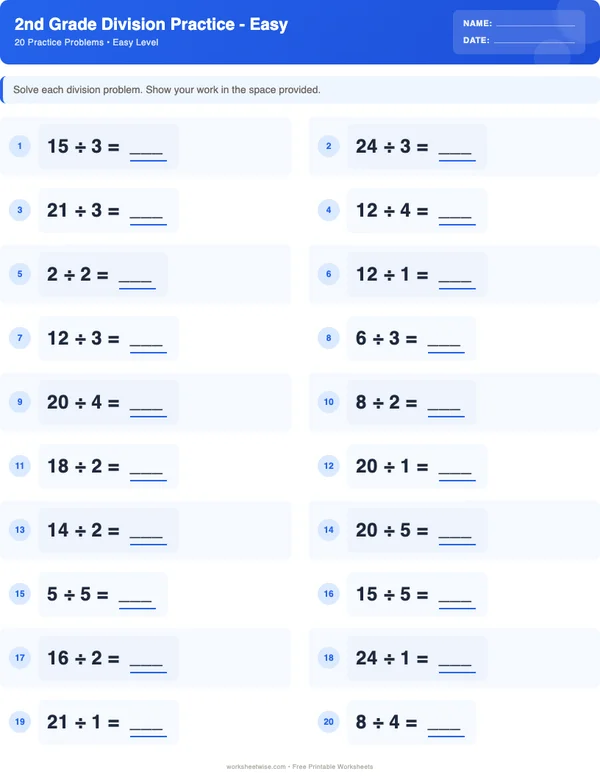
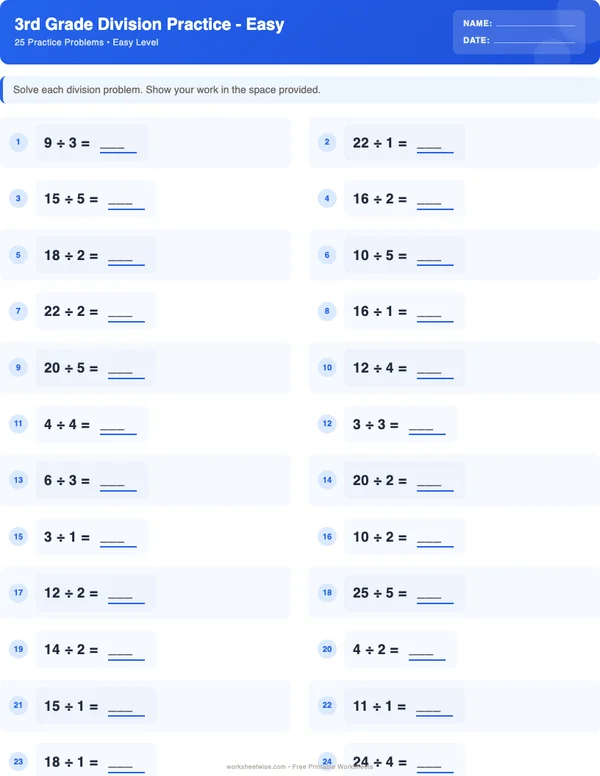
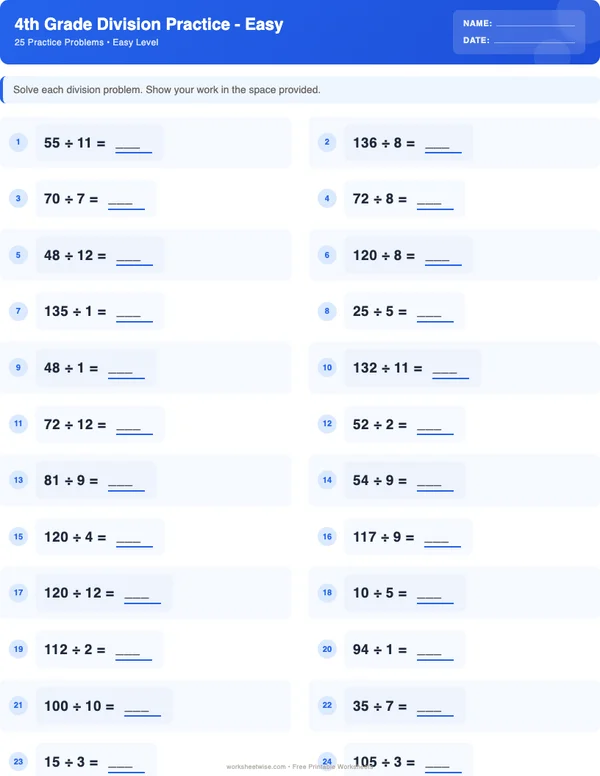
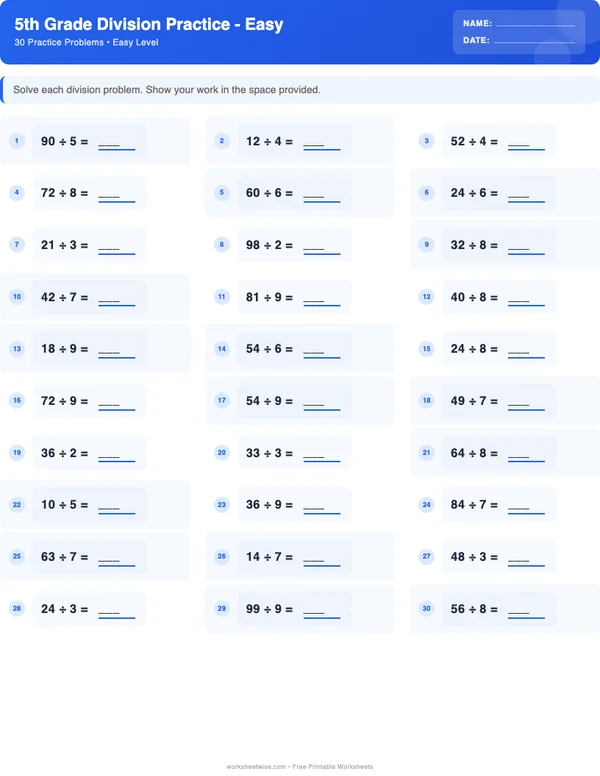
5 relevant free entry points are available. Each one includes a printable learner PDF and separate answer key.
A useful practice loop
Print less. Observe more.
- Choose one skill and model the first item aloud.
- Use a short set and notice the learner’s strategy.
- Change the next task from the work you can see.
Need more than the free sheet?
Plus includes all 30 matching catalogue variations where available, plus saved deterministic generators and the worksheet designer.
See Plus membershipComplete guide
How to teach and practise easy division worksheets
3,392 words Updated 6 instructional visuals
What “easy” changes in division—and what it does not
Easy and beginner division practice reduces avoidable load while keeping the mathematical decision intact: a learner must still determine how a quantity is being divided, identify what the quotient represents, and check whether the result makes sense. The level should be visible in the task—not attached to the learner.
On this page, “easy” can reasonably mean observable features such as:
- familiar whole-number quantities;
- divisors connected to accessible multiplication facts;
- exact quotients before remainders;
- one operation per item;
- clear wording or an immediately readable model;
- enough space to draw groups, arrays, or partial quotients;
- repeated practice with one task structure before the structure changes.
Easy practice should not turn division into answer copying. It should not remove equal grouping, equal sharing, inverse reasoning, place value, or interpretation. Those are the skill.
The live catalogue contains 30 variants across five grade-labelled entry points, from 2nd through 6th grade. There are five free resources: 20 problems at 2nd grade, 25 at both 3rd and 4th grade, and 30 at both 5th and 6th grade. Those counts describe available sheets, not an ideal session length. An adult can assign six well-chosen problems from a 30-problem sheet.
Grade labels describe the intended practice level, but local curriculum sequences differ. Use grade or age as a discovery aid, not a placement decision. Choose from evidence in the learner’s work: what can be represented, explained, calculated, and interpreted with reasonable independence.
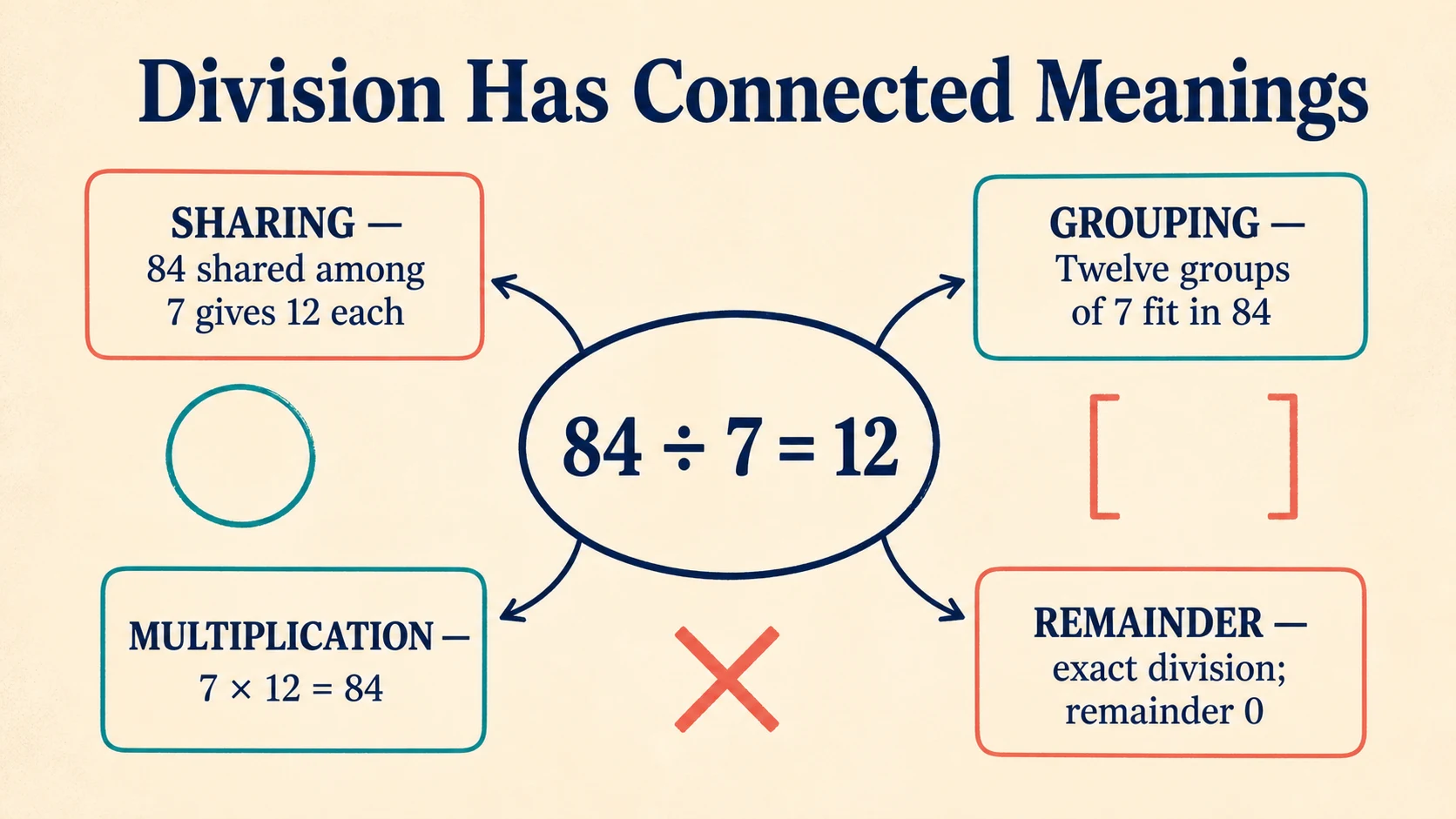
The useful progression is not simply toward larger numbers: it connects equal sharing, equal grouping, multiplication facts, equations, and explanations.
The division meaning that every beginner task should preserve
Division can answer two related questions. Adults should deliberately use both because the same equation can describe different actions.
Equal sharing: how many in each group?
Consider 12 crackers shared equally among 3 children.
Make three group spaces, then distribute one cracker to each space repeatedly:
- after one round, 3 crackers have been used;
- after two rounds, 6 have been used;
- after three rounds, 9 have been used;
- after four rounds, all 12 have been used.
Each child receives 4, so:
Check with multiplication:
This example belongs in beginner practice because the total is small, the sharing action is concrete, the quotient is exact, and the related multiplication fact is accessible. The important question is, “What does 4 mean?” Here, it means crackers per child.
Equal grouping: how many groups can be made?
Now ask: How many bags of 3 crackers can be made from 12 crackers?
Count groups of 3:
Four groups can be made, so the equation is again:
This time, 4 means the number of bags, not the number of crackers in each bag. A learner who calculates both answers correctly may still need conceptual practice if they cannot distinguish those meanings.
The catalogue guidance identifies concrete sharing and grouping as starting models and connects division directly with multiplication. That is page-specific sourced guidance supplied with these resources. It is also consistent with the IES guide on teaching mathematics to young children, which recommends helping children use representations, mathematical language, and progressively abstract ideas. IES did not evaluate WorksheetWise or these sheets.
For an early division equation, counters or a sketch should reveal why the quotient works before the written answer becomes the focus.
Three checked task types reveal whether a sheet really is beginner-friendly
The word “easy” is too vague to guide selection by itself. Compare what the learner must notice and hold in mind.
Checked example 1: a fact with an exact quotient
Solve:
A learner might reason, “Three times what equals 18?” Since:
then:
A second check is repeated subtraction:
Six groups were removed.
This is a suitable beginner item when the target is using multiplication to derive division facts. It keeps the divisor small, produces no remainder, and requires no place-value algorithm. It is slightly harder than only if 18 or the fact is less familiar. The printed number is not, by itself, a reliable measure of difficulty.
Checked example 2: a missing factor presented as division
Solve:
Ask:
Because , the quotient is 7. Verify:
This example belongs here because it makes the multiplication–division relationship explicit without adding a new context or a remainder. It can follow several modelled equal-group problems. It is a useful bridge from drawings to equations.
A nearby easier variation is , which uses the same divisor and a more familiar product. A nearby harder variation is embedded in a story where the learner must decide whether 7 names a group size or a group count. A much harder variation would change several things simultaneously—for example, with a remainder and written interpretation.
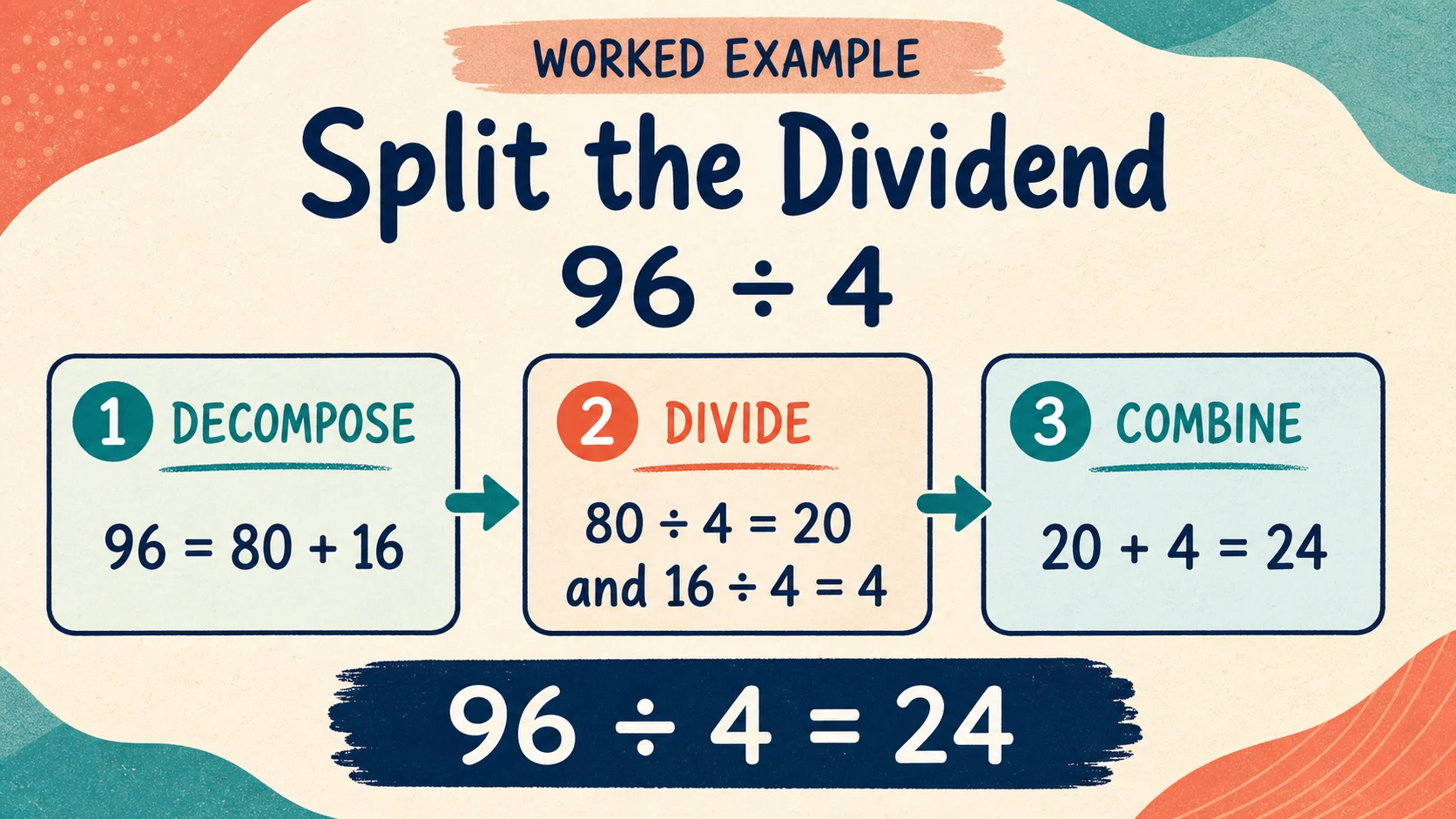
Checked example 3: one-digit division using place value
Solve:
Break 84 into division-friendly parts:
Then divide each part:
Combine the partial quotients:
Therefore:
Check:
This can be beginner-level practice for an older elementary learner who understands division facts but is beginning multi-digit division. It would not be an appropriate first division task for a learner who still needs to build equal groups physically. “Beginner” is relative to the specific division form being introduced, not a permanent description of a person.
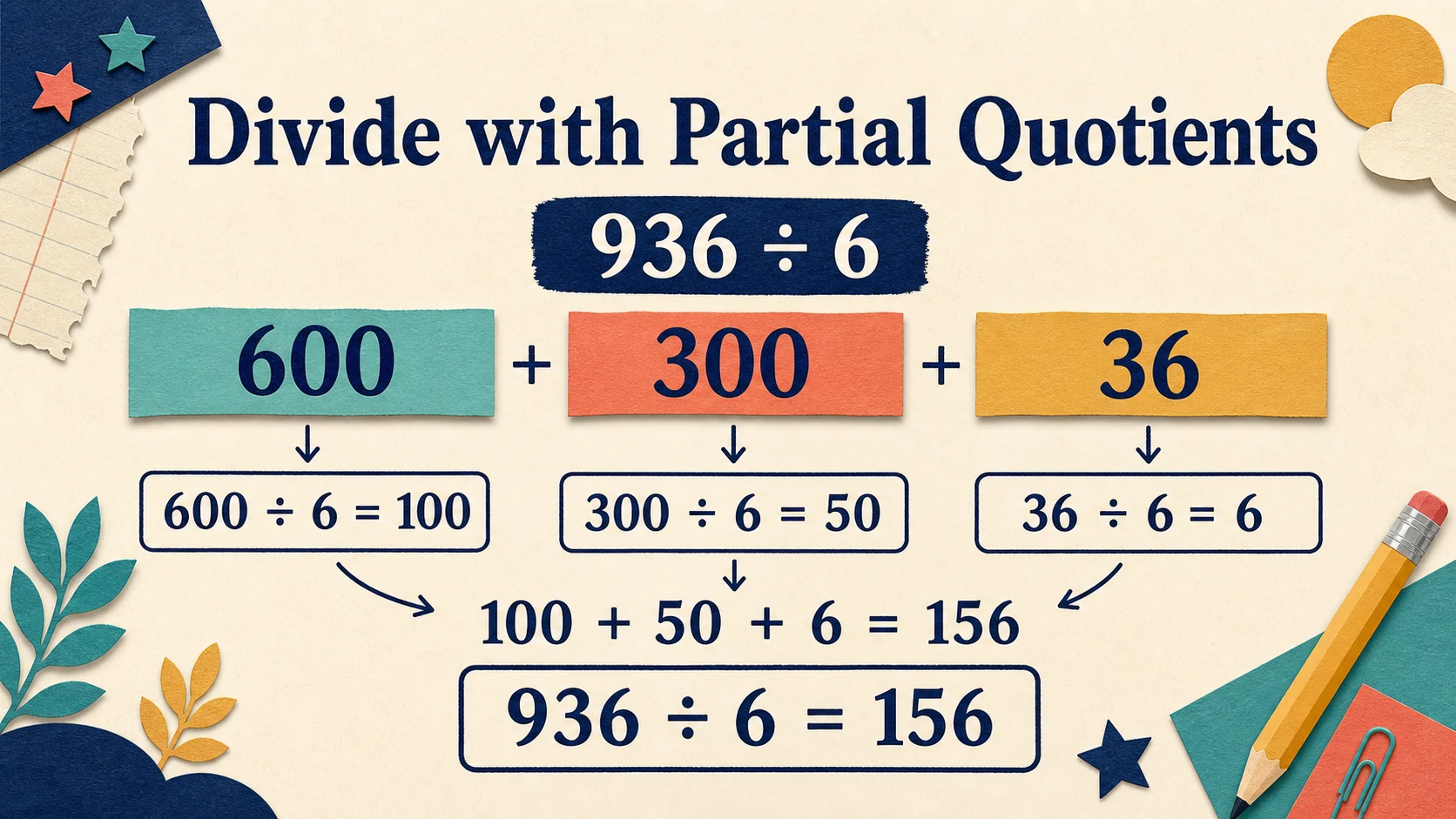
For an older learner new to a procedure, an easy item can preserve multi-digit division while using friendly decompositions and a multiplication check.
Nearby easier and harder variations should change one feature at a time
A useful sequence makes the source of difficulty visible. Start with a task the learner can represent, then alter one demand.
For , an easier neighbour might:
- provide 18 counters and three drawn circles;
- show “Share 18 equally among 3 groups”;
- include the multiplication prompt ;
- ask for an oral answer before a written equation.
A harder neighbour might:
- remove the drawing;
- ask how many groups of 3 fit into 18;
- use , requiring a less secure fact;
- place the equation in a short word problem;
- introduce a remainder;
- require the learner to explain what the quotient represents.
Do not make all six changes at once. If the learner then struggles, the work will not show whether the obstacle was fact retrieval, language, notation, representation, place value, or remainder interpretation.
For , a controlled progression could be:
- Partition 84 counters or base-ten representations into four equal groups.
- Use the written decomposition .
- Ask the learner to choose a useful decomposition.
- Solve with the same strategy.
- Solve , introducing a remainder only after exact division is secure.
The Common Core mathematics standards describe grade-level expectations involving multiplication and division relationships, whole-number quotients, multi-digit division, and interpretation. They are useful for understanding a broad progression, but they do not establish that an individual worksheet is appropriate for a particular learner. Local standards and instructional orders may differ.
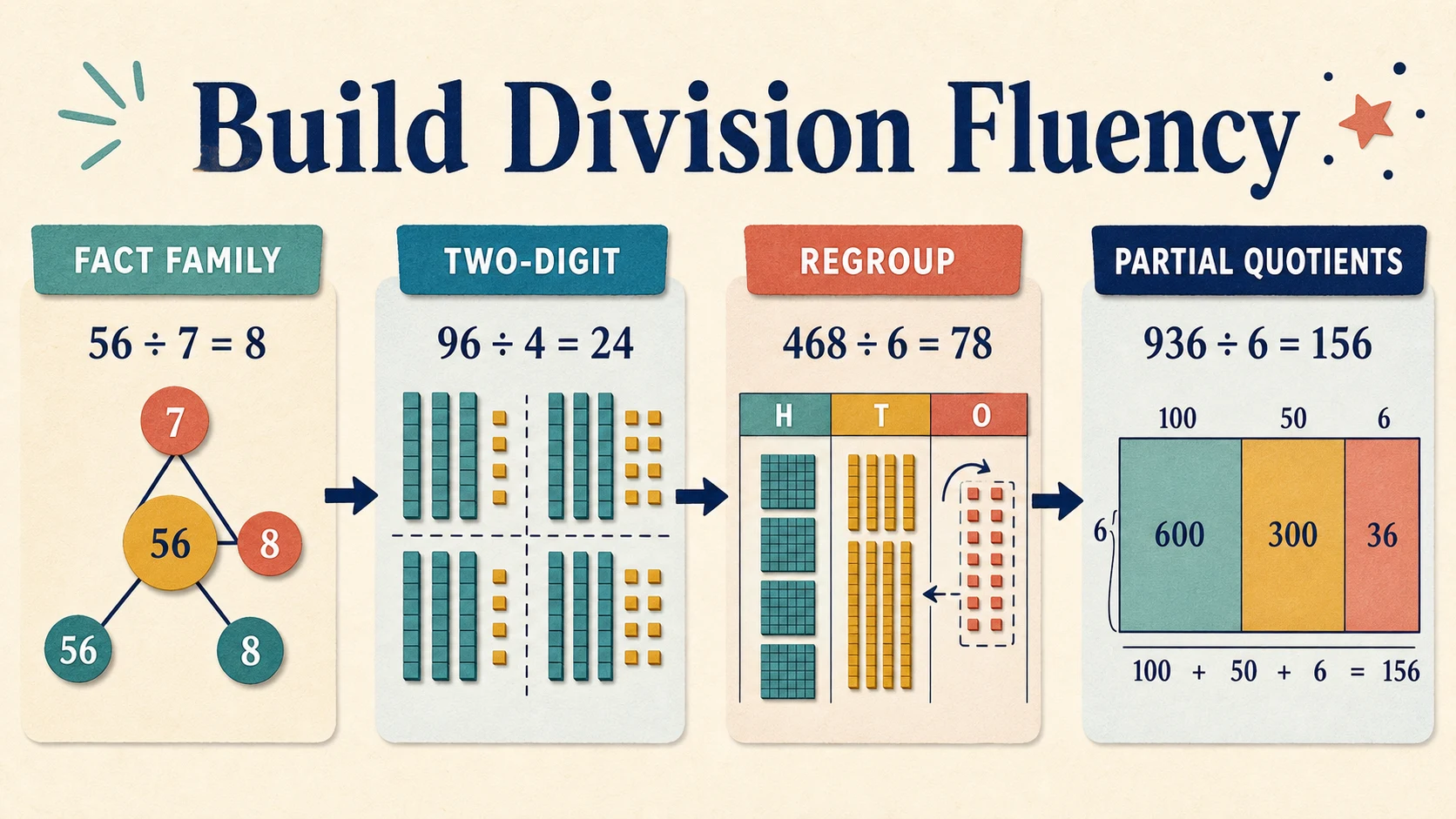
Support should fade by removing a prompt, model, or completed step—not by suddenly changing the divisor, notation, context, and number size together.
Remainders mark a change in meaning, not merely a harder calculation
A remainder task asks two questions: “What happens numerically?” and “What should the leftover mean here?” That interpretive demand is why exact quotients usually make better starting practice.
Checked example 4: the same calculation, three possible decisions
Calculate:
Check:
The arithmetic is fixed, but a context changes the final response.
Seats or vehicles. Twenty-five students need vans that hold six students each. Four vans hold only 24 students, so five vans are required. The practical answer rounds up.
Complete groups. Twenty-five counters are packed into complete bags of six. Four full bags can be made, with one counter left. If the question asks only for full bags, the answer is four.
Leftover as the focus. Twenty-five stickers are shared equally among six children. Each child receives four stickers, and one sticker remains. The answer must report both the share and the remainder.
This checked example comes directly from the teaching context represented in the catalogue and belongs near the upper boundary of beginner practice. The divisor and multiplication are manageable, but the response requires interpretation. A learner who writes has completed the computation; whether that is a sufficient answer depends on the question.
Do not introduce remainder interpretation merely because exact division appears fast. First check that the learner can explain what the dividend, divisor, and quotient mean. Then use two stories with the same calculation but different final decisions.
False difficulty signals can lead adults to choose the wrong sheet
Several visible features are tempting but unreliable measures of mathematical demand.
A longer sheet is not automatically harder
The catalogue’s free entry points range from 20 to 30 problems. That is volume, not conceptual level. Twenty repeated facts may be more tiring than eight carefully varied problems, but they may demand less reasoning. Assign a subset when attention, handwriting, visual scanning, or time would otherwise obscure division knowledge.
Bigger numbers are not always harder
may be easier than for a learner who readily recognizes tens but does not recall . Likewise, can be approachable through , while may stall because the related fact is unavailable.
Look at the number relationships, not just digit count.
Pictures are not automatically supportive
A clear array or set of group circles can expose the division structure. Decorative objects, crowded scenes, tiny icons, or groups that must first be counted may add visual work. Ask whether the image makes equal groups easier to perceive. If not, replace it with counters, quick circles, or a number line.
Fast answers do not prove readiness for harder division
A learner may recall without knowing whether 4 represents groups or items per group. Ask for one multiplication check and one representation. Conversely, slow counting with accurate equal groups can show sound understanding even before fact recall is fluent.
Neat algorithm steps do not prove place-value understanding
A memorized “divide, multiply, subtract, bring down” sequence may produce correct answers. The catalogue guidance appropriately cautions that learners should understand what the steps mean in place-value terms. Ask why a digit was placed in a particular quotient position or invite a partial-quotients solution. Treat the mnemonic as a memory aid after meaning has been established, not as evidence by itself.
Choose the entry point from observable evidence
Begin with the smallest task that will answer your instructional question.
Use the 2nd Grade Division guide and free sheet when you want to inspect early equal-sharing or equal-grouping work and the learner benefits from concrete quantities. Its free easy sheet contains 20 problems. The label is a discovery route, not a placement verdict.
Use the 3rd Grade Division guide and free sheet when the learner can model groups and is connecting multiplication facts with division equations. Its free easy sheet contains 25 problems.
Use the 4th Grade Division guide and free sheet to inspect movement toward larger whole-number work, including meaningfully structured division rather than only isolated facts. Its free easy sheet contains 25 problems.
The 5th Grade Division guide and free sheet and 6th Grade Division guide and free sheet each provide a 30-problem free easy sheet. These are possible entry points for multi-digit calculation, place-value explanations, partial quotients, or remainder interpretation. They should not be assigned solely because of the learner’s enrolled grade.
Select six to ten items that keep the intended feature stable. For example, if the target is deriving division facts from multiplication, choose exact quotients and avoid mixing in long division or contextual remainders. If the target is multi-digit division, make multiplication facts sufficiently accessible that fact retrieval does not consume the entire task.
Use a short routine that separates modelling, calculation, and explanation
A reliable practice session can fit into 12 to 18 minutes. The timing is a practical suggestion, not a sourced requirement.
Preview the meaning
Read one item aloud. Ask:
- What is the total?
- Are we sharing into a known number of groups, or making groups of a known size?
- What will the answer count?
Do not front-load every step. The preview should establish the situation and vocabulary.
Model one example and jointly solve one
For , make five equal groups or count groups of five. Write the related multiplication fact:
Then jointly solve . Ask the learner to choose a model or multiplication fact and explain the choice.
The IES practice guide for assisting students struggling with mathematics supports systematic instruction, clear mathematical language, visual representations, and deliberate practice with feedback. That is authoritative general guidance; it is not an endorsement or assessment of WorksheetWise.
Assign a small independent set
Give four to eight problems with the same central demand. Permit counters, sketches, or a multiplication chart if the purpose is division reasoning rather than unaided fact recall. Ask the learner to mark one answer they are unsure about rather than waiting silently.
Check by multiplication and meaning
For , verify . Then ask what 8 would mean in a sharing story and what it would mean in a grouping story. One equation can support both interpretations.
Record one observation and choose one change
Write a factual note such as:
- “Made equal groups accurately but counted the total twice.”
- “Used to solve independently.”
- “Computed but did not adjust the answer for van capacity.”
- “Solved with partial quotients and checked by multiplication.”
Avoid labels such as “bad at division” or diagnostic claims. One worksheet cannot establish a diagnosis, a stable ability level, or future outcomes.
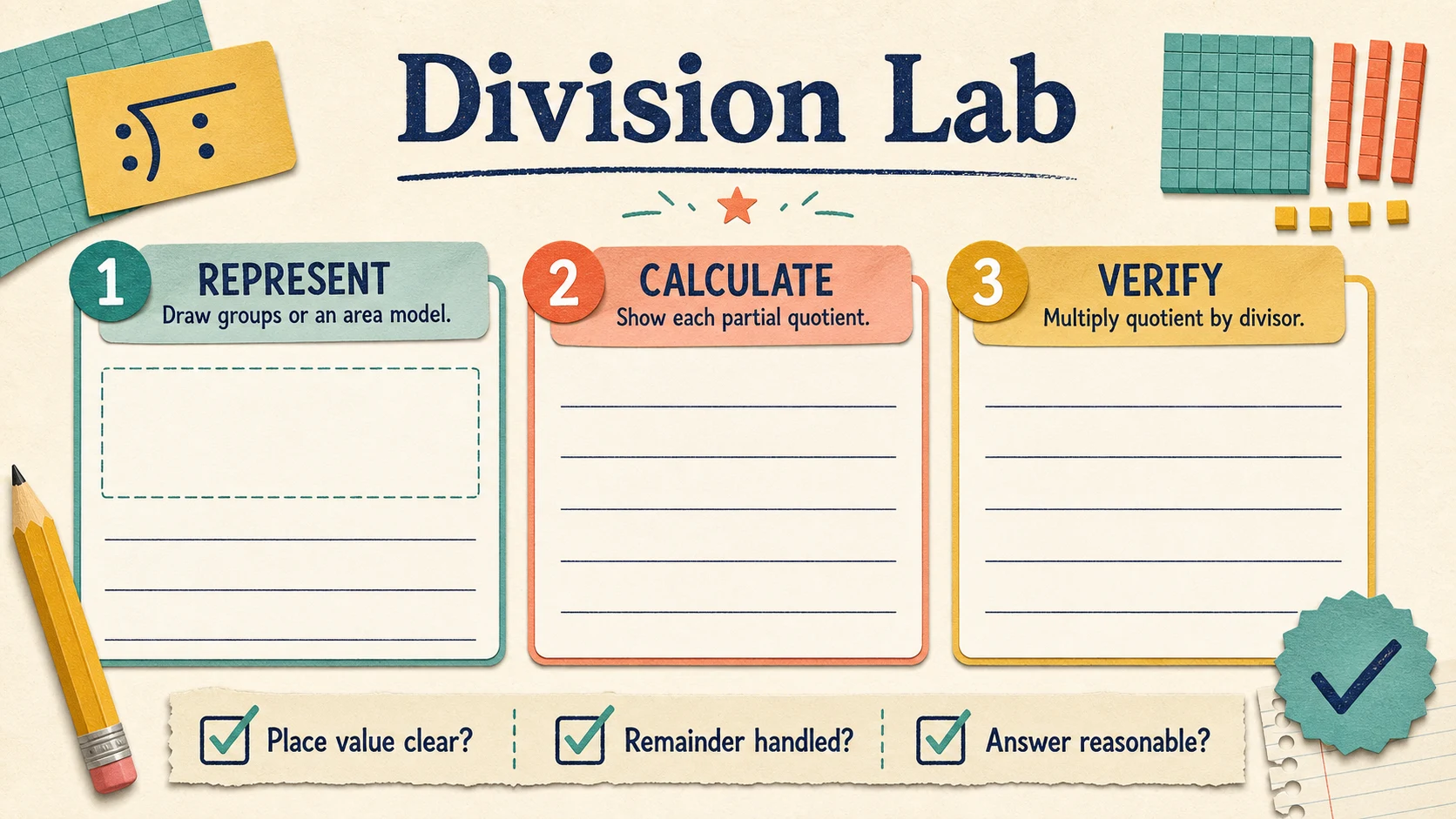
For older elementary practice, alternate brief supported work, independent attempts, and review; a 30-problem resource does not need to be completed in one sitting.
Adapt the access conditions without replacing division
An adaptation preserves the target decision while reducing an unrelated barrier.
If handwriting is difficult, let the learner point to groups, dictate an equation, use number cards, or write only the quotient. Do not turn the task into tracing answers.
If visual density interferes, cover all but one row, enlarge the page, or copy six selected equations onto separate cards. Keep the same division relationships.
If multiplication recall is the barrier but division meaning is the target, provide a multiplication chart or array. Ask the learner to locate the related fact and explain how it gives the quotient. If fact fluency is the target, that support should later be faded deliberately.
If mathematical English is unfamiliar, demonstrate “shared equally,” “groups of,” “in each group,” “altogether,” and “left over” with objects. Keep the numbers and required reasoning intact. Translation or oral explanation can support access without simplifying the mathematics.
If sustained attention is the issue, use two or three short rounds with movement between them. A learner can physically place 18 objects into three hoops, then record . Brief adult-led oral, matching, manipulative, and movement work is especially appropriate for ages three and four if an adult is informally exploring equal sharing; sustained worksheet desk work should not be the priority at those ages.
If a learner needs a more foundational prerequisite, the Easy and beginner Counting Worksheets can support one-to-one counting and quantity comparison. That is a temporary prerequisite route, not a substitute for returning to equal grouping.
Read errors as evidence about the next teaching move
Errors are useful only when the adult identifies the decision that went wrong.
Unequal groups
For , the learner makes groups of 5, 4, and 3. The total remains 12, but the groups are unequal. Respond by asking the learner to distribute one counter to each group in repeated rounds. The next task should keep 12 and 3, allowing the learner to repair equality without new number facts.
Dividend and divisor are reversed
The learner reads as “make 15 groups of 3.” Ask them to identify the total available and point to the number of groups or group size named in the prompt. Use a sentence frame: “I have ___ altogether. I divide it into/by ___.”
Multiplication is used without checking the relationship
For , the learner writes 5 because feels close. Have them calculate , compare it with 24, then test . The immediate need is checking a related fact, not a larger division problem.
A zero or place-value position is lost
In multi-digit work, a learner may obtain the correct partial values but record the quotient in the wrong place. Return to expanded form and label tens and ones. Keep the divisor unchanged and use a number that decomposes cleanly before returning to the missed item.
A remainder is reported but not interpreted
For the van problem, “4 R1” shows valid computation but an incomplete contextual decision. Ask, “Where does the remaining student go?” Do not reteach the calculation unless the check is also wrong.
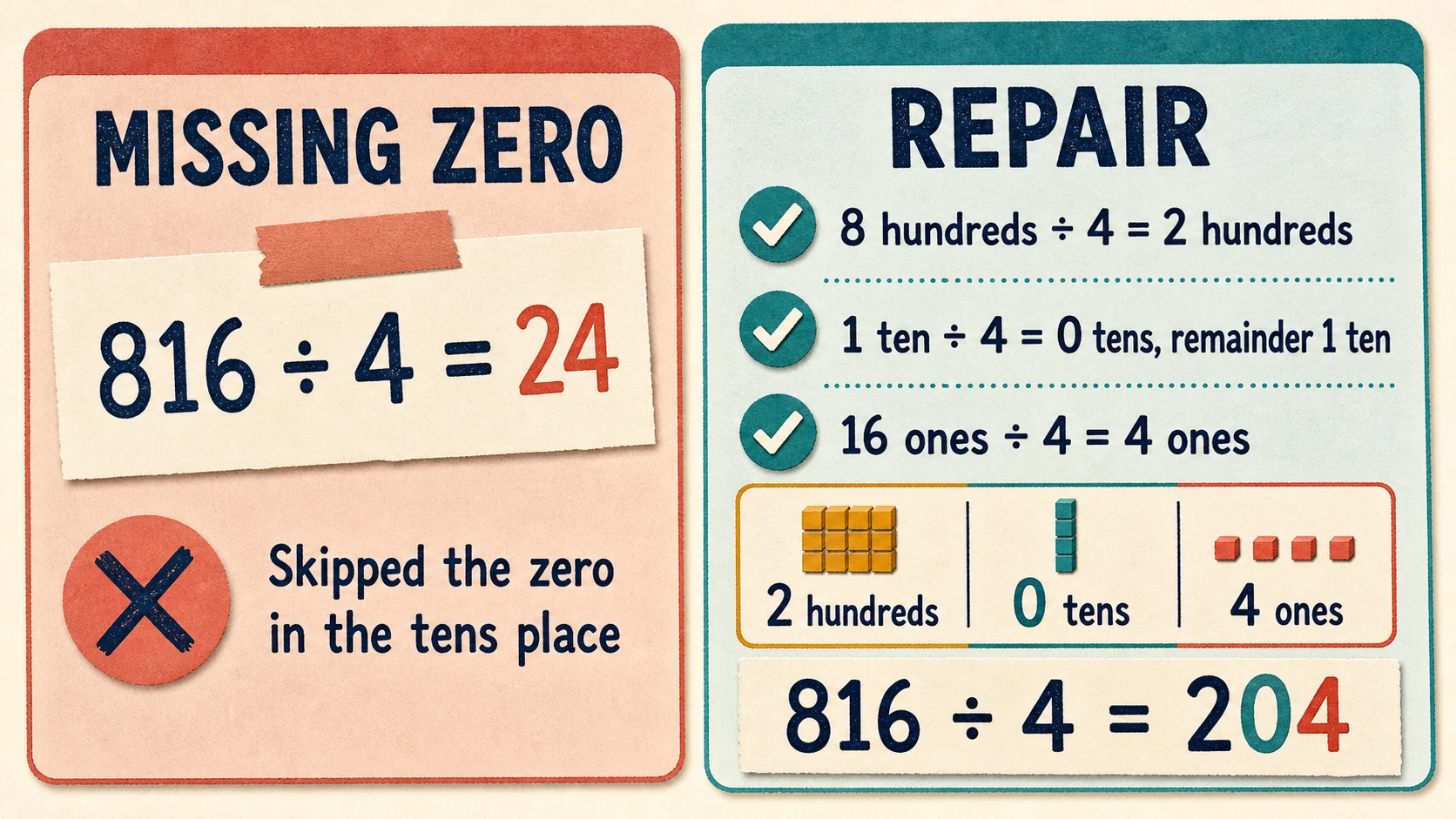
An error pattern can guide the next prompt or representation, but it cannot support a diagnosis from worksheet performance alone.
Fade supports only when the evidence names what can be removed
Remove one support after the learner succeeds on several varied examples and can explain why the method works. Useful readiness evidence includes:
- forming equal groups without adult correction;
- identifying what the quotient counts;
- connecting with ;
- checking an answer by multiplication;
- choosing a workable drawing or decomposition;
- completing an exact-quotient set without relying on copied steps;
- interpreting a remainder in a familiar context.
Then choose one next variation:
- remove pre-drawn groups but keep counters available;
- remove the multiplication prompt but still request a check;
- move from exact quotients to one simple remainder;
- keep the divisor constant while increasing the dividend;
- keep the numbers constant while changing sharing to grouping;
- remove a completed partial-quotients step;
- introduce one concise word problem after equation practice.
Do not advance because every answer is correct if the learner copied a model and cannot explain it. Do not hold a learner back because they use fingers, counters, or a sketch when those tools support accurate reasoning. Independence means choosing and using an appropriate strategy, not merely working without visible aids.
The catalogue stops at identifying available variants, grade-labelled resources, problem counts, and division teaching context. It does not establish a universal sequence, time requirement, standards match for each sheet, or measured learner outcome. Adults must inspect the actual problems and compare them with current work evidence.
Make the next choice from one six-problem sample
Open the free deterministic worksheet generators and create or select a short division set with exact quotients and one consistent divisor range. Use only six problems first.
Ask the learner to solve four, represent one, and check one by multiplication. Record whether the learner can state what the quotient means. If all four actions are accurate without step-by-step prompting, change exactly one feature next time—such as removing the model or adding one remainder context. If not, keep the numbers stable and change the support: counters, drawn groups, a related multiplication fact, or an expanded-form decomposition.
That six-problem sample gives you an observable next decision. It turns “easy” from a vague label into a controlled division task whose support, calculation, and meaning you can actually inspect.
Put it into practice
Use the guide with a real printable
Move from explanation to a short, observable practice task. Check the first item together, then adjust the next session from the learner's actual work.
Open the first free worksheetExplore a neighboring collection
Choose by a different teaching need
Easy and Beginner Addition Worksheets Easy and Beginner Counting Worksheets Easy and Beginner Fractions Worksheets Easy and Beginner Geometry Worksheets Easy and Beginner Money Worksheets Easy and Beginner Multiplication Worksheets Easy and Beginner Sight Words Worksheets Easy and Beginner Subtraction Worksheets