Curated collectionAnswer keys includedPrint-ready PDFs
Easy and Beginner Subtraction Worksheets
Define what easy and beginner subtraction practice changes and what it deliberately keeps constant, then compare three checked examples, fading supports and readiness evidence.
Start with a real resource
Browse this worksheet collection
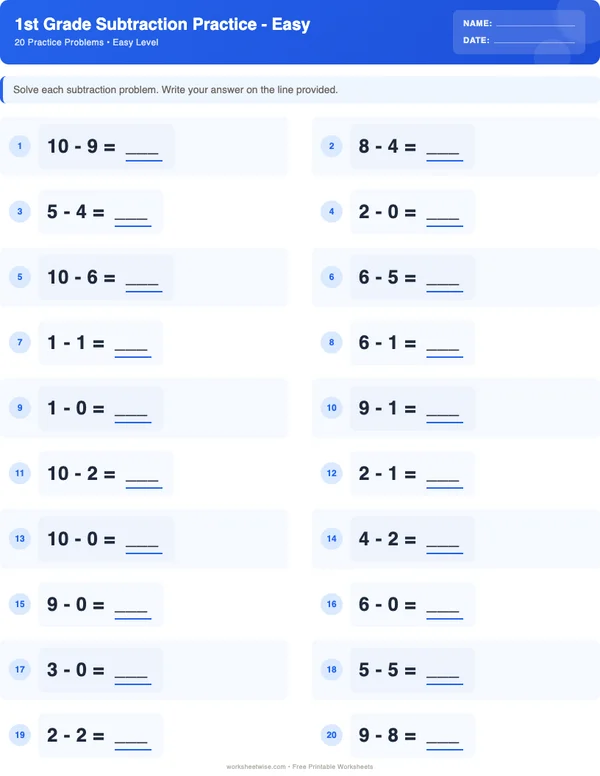
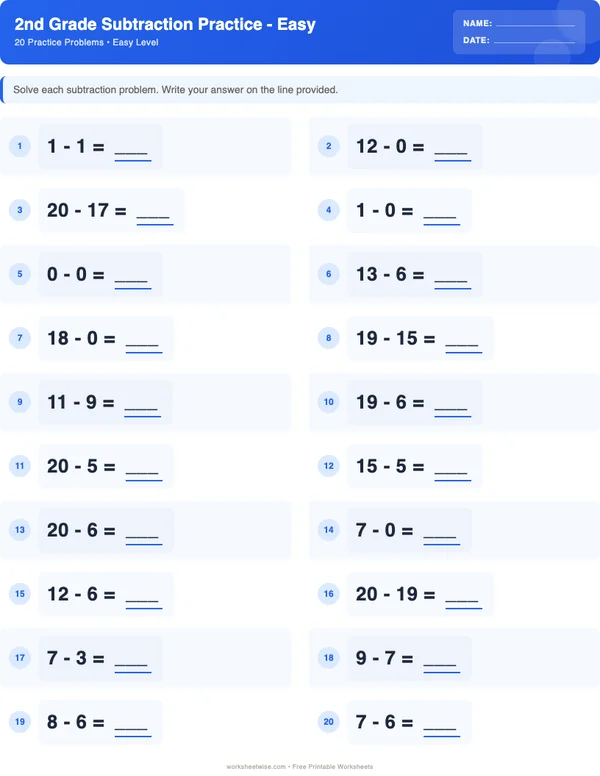
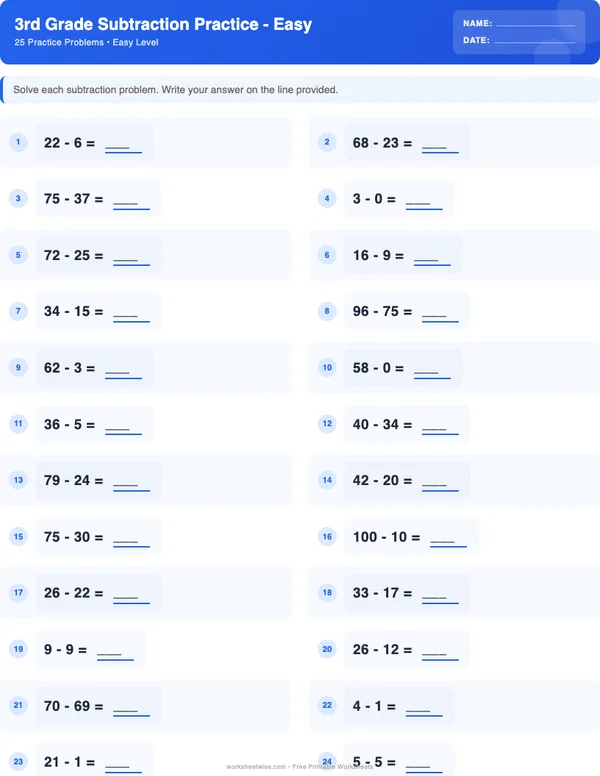
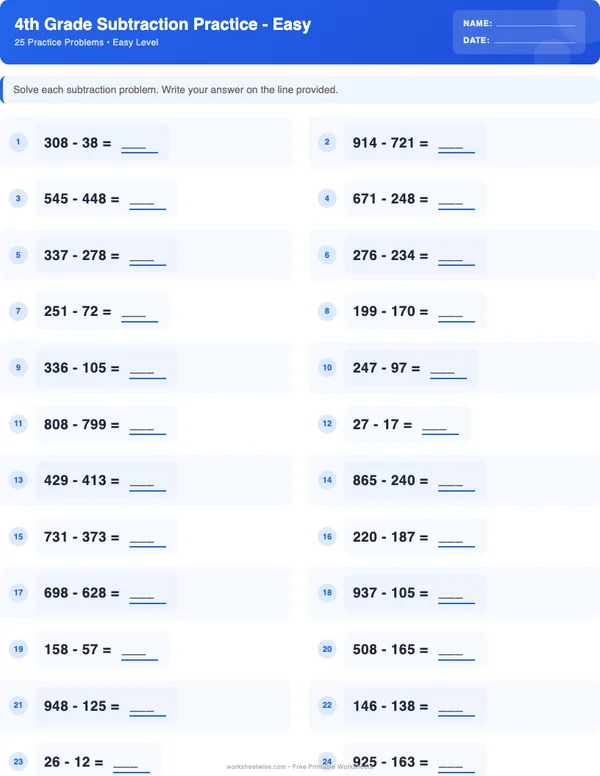
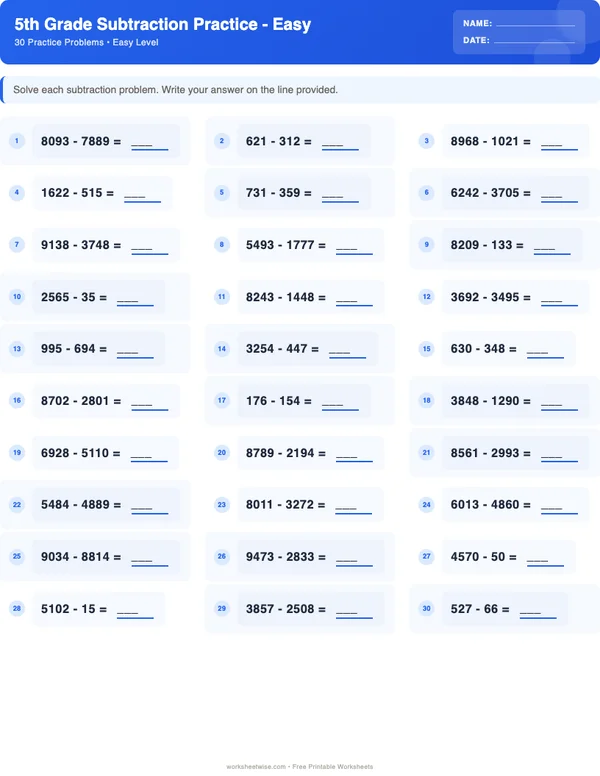
6 relevant free entry points are available. Each one includes a printable learner PDF and separate answer key.
A useful practice loop
Print less. Observe more.
- Choose one skill and model the first item aloud.
- Use a short set and notice the learner’s strategy.
- Change the next task from the work you can see.
Need more than the free sheet?
Plus includes all 36 matching catalogue variations where available, plus saved deterministic generators and the worksheet designer.
See Plus membershipComplete guide
How to teach and practise easy subtraction worksheets
3,561 words Updated 6 instructional visuals
What “easy” changes in subtraction—and what it keeps intact
Easy and beginner subtraction worksheets should reduce avoidable demands without removing the mathematical decision. The learner must still determine what subtraction means, track the quantity being removed or compared, calculate the difference, and check whether the answer is reasonable. What changes is the task design: smaller numbers, familiar representations, fewer steps, clearer spacing, limited regrouping, and access to supports such as counters, drawings, number lines, or related addition facts.
On this page, “easy” is a worksheet level defined by observable features. It is not a label for a learner. A useful beginner task might:
- keep quantities within 5, 10, or 20;
- present one subtraction situation at a time;
- use objects or marks that can be crossed out;
- avoid regrouping until place-value understanding is ready;
- provide enough space to align digits;
- keep directions short and consistent;
- change only one important feature between practice sets.
The subtraction itself must remain genuine. If an adult tells the learner exactly what to cross out, which number to start from, and what answer to write, the task has become copying rather than subtraction. Support should make the relationship visible, then gradually withdraw.
WorksheetWise currently lists 36 easy subtraction variants across Kindergarten through 5th Grade, with six free entry points. The free sheets contain 20 problems in Kindergarten through 2nd Grade, 25 in 3rd and 4th Grade, and 30 in 5th Grade. Those totals describe the catalogue, not an appropriate sitting length. An adult can assign five selected problems from a 30-problem sheet when five provide enough evidence.
Age and grade are discovery aids rather than placement decisions. Grade labels describe the intended practice level, and local curriculum sequences differ. Choose by inspecting what the learner can represent, explain, and solve—not by assuming that every learner of one age needs the same sheet.
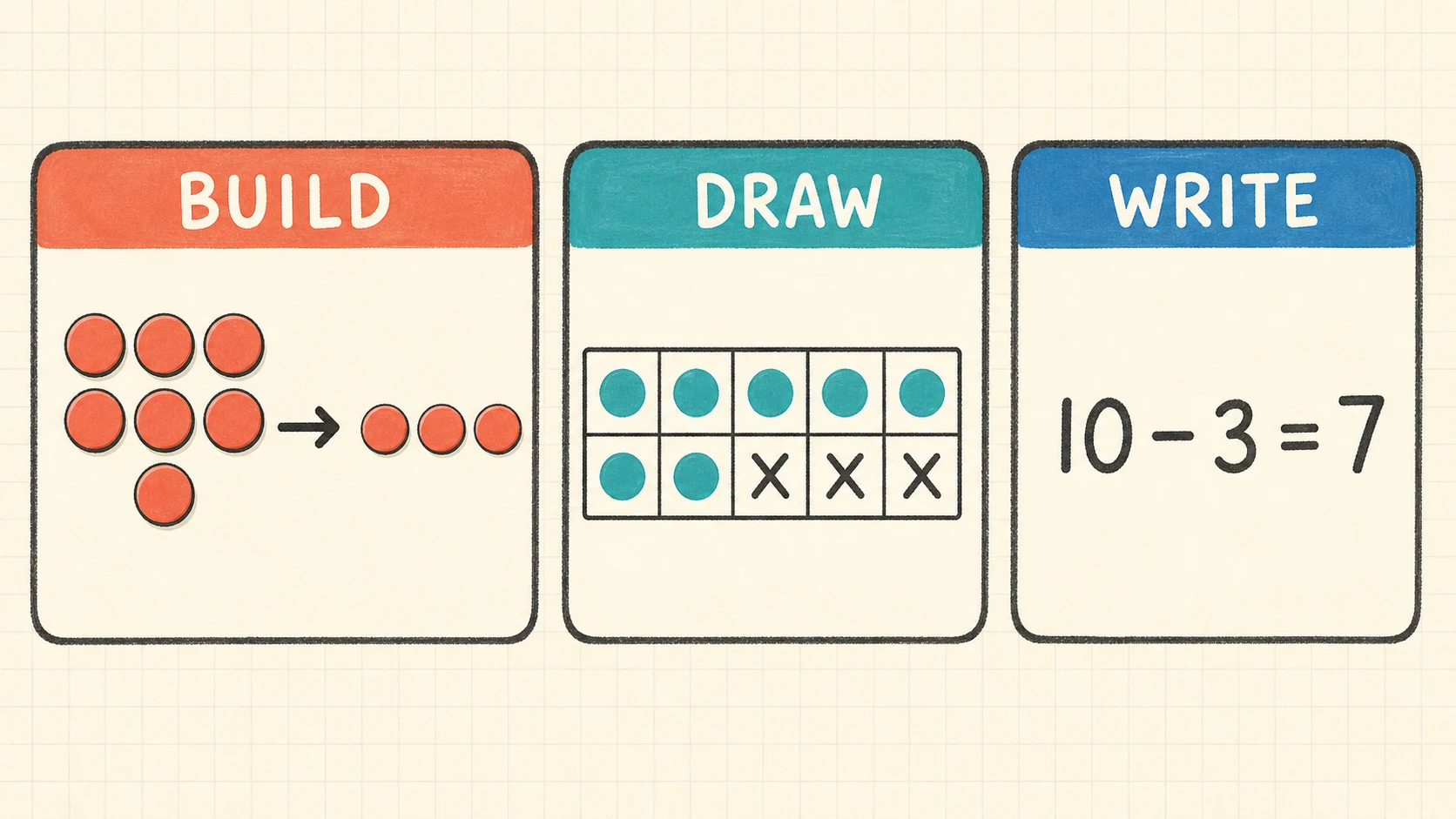
For early subtraction, the useful progression is from visible quantities to learner-made representations and only then to unsupported equations.
Hold the subtraction idea constant while changing the support
Beginner practice is most informative when the mathematical structure stays stable. Consider the take-away situation “There are 7 counters; 3 are removed.” It can appear in several forms:
- Seven physical counters, with the learner moving three away.
- A picture of seven dots, with the learner crossing out three.
- A number line showing a start at 7 and three backward jumps.
- The equation .
- A sentence: “Seven birds were on a fence. Three flew away. How many remain?”
All five can represent the same calculation, , but they do not impose the same reading, memory, or representation demands. Moving from counters to a bare equation changes the support, not the underlying subtraction.
The IES guide on teaching mathematics to young children recommends helping children connect informal mathematical knowledge, representations, and mathematical language. Applied here, that means an adult should explicitly connect the action to the equation: “You started with 7, took away 3, and 4 remained. That is what records.” The guide did not assess WorksheetWise; it provides general instructional guidance that can inform how adults use a sheet.
Features that usually make a subtraction task easier
A task is generally more accessible when the learner can see the starting quantity, act on it, and verify what remains. Numbers with familiar relationships also help: , , and offer visible or memorable structures. Horizontal equations avoid place-value alignment demands when the goal is basic facts.
Easy practice may also isolate one subtraction meaning. A row of take-away pictures is more predictable than a mixed set containing removal, comparison, missing-part problems, and multi-digit computation. That predictability is useful during initial learning, but it should not last indefinitely.
Features that make the nearby task harder
A harder neighboring task may keep the numbers small while changing what the learner must infer. “Maya has 8 shells. Leo has 5. How many more does Maya have?” still requires , but nothing physically leaves. A missing-part question—“There are 5 red counters and some blue counters, 8 altogether; how many are blue?”—can be represented by or .
Other increases include crossing 10, choosing a strategy without a supplied model, regrouping, reading a word problem, switching among subtraction meanings, or explaining why an answer works. Increase one of these deliberately. If number size, format, vocabulary, and strategy demands all change together, an error tells you very little.
Three checked examples reveal three different beginner demands
The word “subtraction” covers more than taking objects away. The live catalogue describes removal, comparison, and missing-addend situations. A well-chosen easy set should eventually expose the learner to all three, while keeping quantities and representations manageable.
Checked example 1: removal within 5
Place five buttons in a row. Say, “There are 5 buttons. Move 2 away. How many stay?”
The learner moves two and counts the remaining three:
Check the result by recombining the parts:
This belongs at the beginning because the start, action, and result are physically visible. The learner need not hold an unseen quantity in memory. It preserves the essential subtraction relationship: a whole of 5 is separated into parts of 2 and 3.
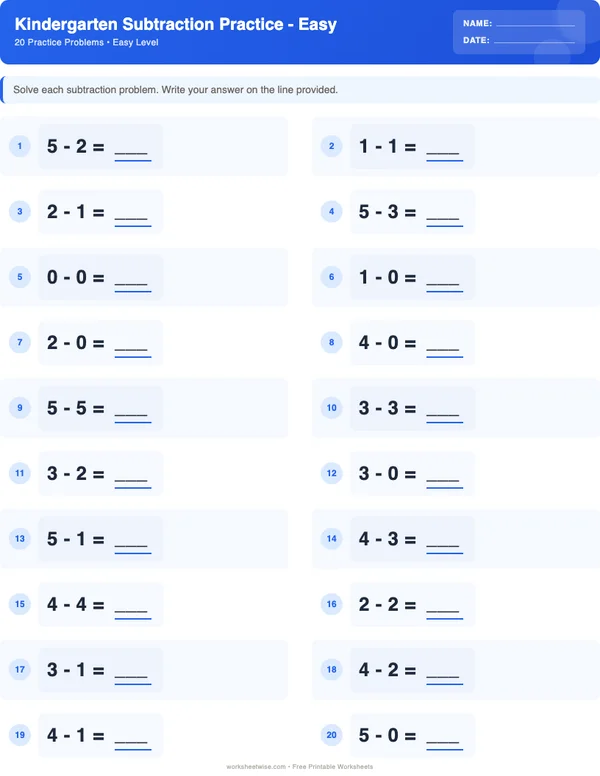
For a Kindergarten-oriented starting point, use the Kindergarten Subtraction guide and free sheet, but select only a brief portion. For ages three and four, prioritize short adult-led oral, matching, manipulative, and movement activities over desk work. A child might make five steps, step back twice, and say how many steps remain. Do not turn a 20-problem sheet into a required sitting for a very young learner.
Checked example 2: comparison without removal
Show one row of eight counters and a second row of five, aligned at the left:
Ask, “How many more counters are in Row A?”
Five counters pair exactly. Three in the longer row are unpaired, so:
Check with addition:
This example belongs in beginner subtraction because the numbers remain within 10 and the difference is visible. It is nevertheless harder than taking away two buttons: the learner must understand that subtraction can compare two quantities even though no objects disappear. If the learner answers 13, they may be combining the rows because the phrase “how many altogether?” is more familiar. Rebuild the two aligned rows before adding larger numbers.
Checked example 3: missing part within 20
Say, “A box holds 13 crayons when full. Eight crayons are already inside. How many more crayons are needed?”
The unknown is the missing part. One efficient route is to count up from 8:
- from 8 to 10 is 2;
- from 10 to 13 is 3;
- .
Therefore:
Check:
This belongs near the upper edge of beginner fact work because it stays within 20 and can use a make-10 relationship, but the missing amount is not directly shown. If the learner can solve only by drawing and crossing out 13 marks, retain the same number range while introducing a ten-frame or number line. The next step is a more efficient representation, not necessarily larger numbers.
The 1st Grade Subtraction guide and free sheet is a relevant place to inspect practice around early facts. Selection should still depend on the actual task features and the learner’s explanation.
Regrouping can be accessible without becoming trivial
“Easy” does not always mean single-digit. For an older elementary learner, an accessible subtraction task may involve multi-digit numbers but limit the number of regrouping decisions, provide clear place-value columns, and allow base-ten blocks.
Checked example 4: one regrouping decision
Solve:
Four tens and three ones cannot give away five ones. Trade one ten for ten ones. The value remains 43, but its representation becomes three tens and thirteen ones:
So:
Check by addition:
This example belongs at an accessible multi-digit level because it contains one clear regrouping event and no zero in the minuend. It is harder than , which needs no regrouping, but easier than , which requires reasoning across a zero.
A revealing wrong answer is 22:
The learner may be subtracting the smaller digit from the larger digit in each column without attending to which number is being reduced. Do not respond with “Remember to borrow” alone. Rebuild 43 with four tens rods and three ones, then attempt to remove five ones. The impossibility creates a reason to trade.
The IES practice guide for assisting students struggling with mathematics recommends systematic instruction, clear mathematical language, representations, and deliberate work with word problems. In this context, “regroup” or “trade one ten for ten ones” communicates the preserved value more accurately than treating a crossed-out digit as an unexplained rule.
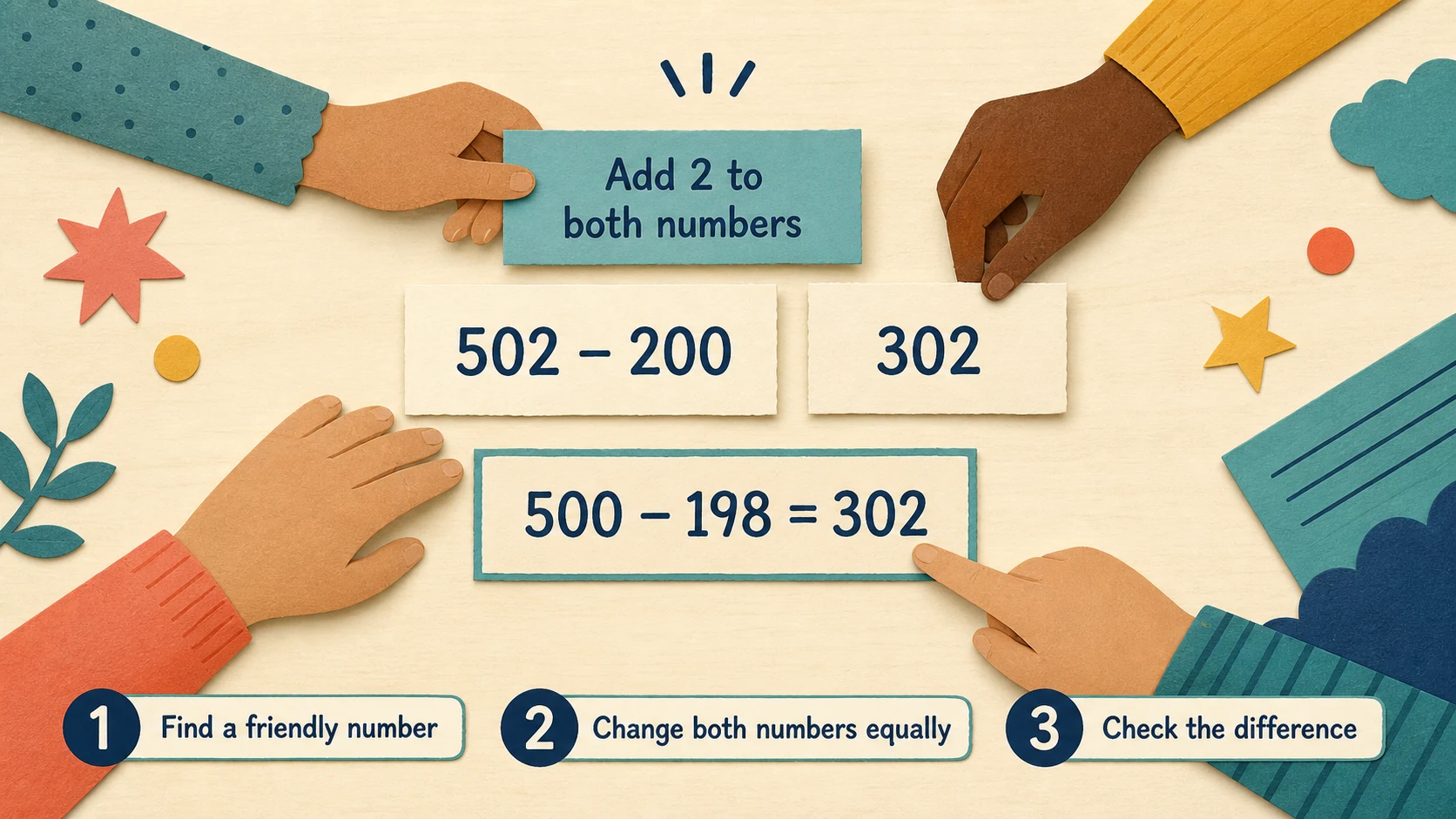
For a 3rd Grade entry point, keep the routine stable while changing whether the problem needs no regrouping, one regrouping, or an explanation.
Checked example 5: a no-regrouping contrast
Before , try:
Subtract ones: . Subtract tens: . Thus:
Check:
This easier neighbor clarifies the source of difficulty. Both problems use two-digit numbers and the same written format, but only requires changing one ten into ten ones. If is accurate and is not, the evidence points toward regrouping rather than a general inability to subtract.
False difficulty signals can send practice in the wrong direction
A wrong answer does not automatically mean the subtraction range is too hard. Several non-target demands can hide correct mathematical thinking.
Layout can masquerade as a subtraction error
A learner may know but misalign 31 under 52 when copying it. Use place-value columns or graph paper and ask the learner to name each column. That adaptation preserves subtraction while reducing a handwriting and alignment demand.
Crowded pages can also cause skipped rows, copied operators, or answers written beside the wrong problem. Cover unused rows with a blank card. This does not simplify the numbers; it controls visual competition.
Language can obscure a known relationship
“Fewer than,” “difference,” and “how many more are needed” signal different situations, but unfamiliar wording can interfere with operation choice. Read the problem aloud once without replacing its mathematics. Ask the learner to retell what is known and what must be found. Then offer counters or a quick drawing.
Avoid teaching a keyword rule such as “more means add.” In “How many more does 9 have than 6?” the required calculation is subtraction. Attend to the relationship in the whole sentence.
Speed is not the same as readiness
A learner who solves slowly but explains “7 plus 5 makes 12” has shown sound reasoning. A learner who answers several facts quickly but cannot model or check them may be recalling isolated responses. Time can be recorded if useful, but it should not override accuracy, strategy, or explanation.
Neatness is another false signal. Reversed digits, uneven circles, or large handwriting may make work look immature without invalidating the subtraction. Judge the mathematical evidence separately from presentation unless notation itself changes the meaning.
The Common Core mathematics standards describe progressions that include understanding subtraction situations, developing fluency, and using place-value methods. They can help adults recognize that subtraction changes across grades, but local sequences differ and a grade label is not a placement test. The standards do not assess this catalogue or guarantee that a particular sheet suits a particular learner.
Choose one next variation, not an entirely new task
Selection becomes easier when the adult names the feature being tested. Start with a problem the learner can represent, then alter one dimension.
| If current evidence shows… | Keep constant | Change next |
|---|---|---|
| Accurate removal within 5 with objects | Removal meaning and visible objects | Increase the starting amount to within 10 |
| Accurate pictures but uncertain equations | Number range and subtraction meaning | Replace the supplied picture with a learner-made drawing |
| Accurate take-away problems within 10 | Number range and calculation | Introduce one comparison problem |
| Accurate facts within 20 by counting all | Number range | Encourage counting up or using a related addition fact |
| Accurate two-digit subtraction without regrouping | Two-digit format and column layout | Add one regrouping event |
| Accurate regrouping with blocks | Same problems and language | Draw tens and ones instead of using blocks |
| Accurate drawings and explanation | Same number range | Remove the model on alternate problems |
Do not advance merely because the page was completed. Look for evidence across a small mixed sample: correct representation, accurate calculation, a sensible explanation, and a successful check. Likewise, do not repeat an entire worksheet because of one copied numeral.
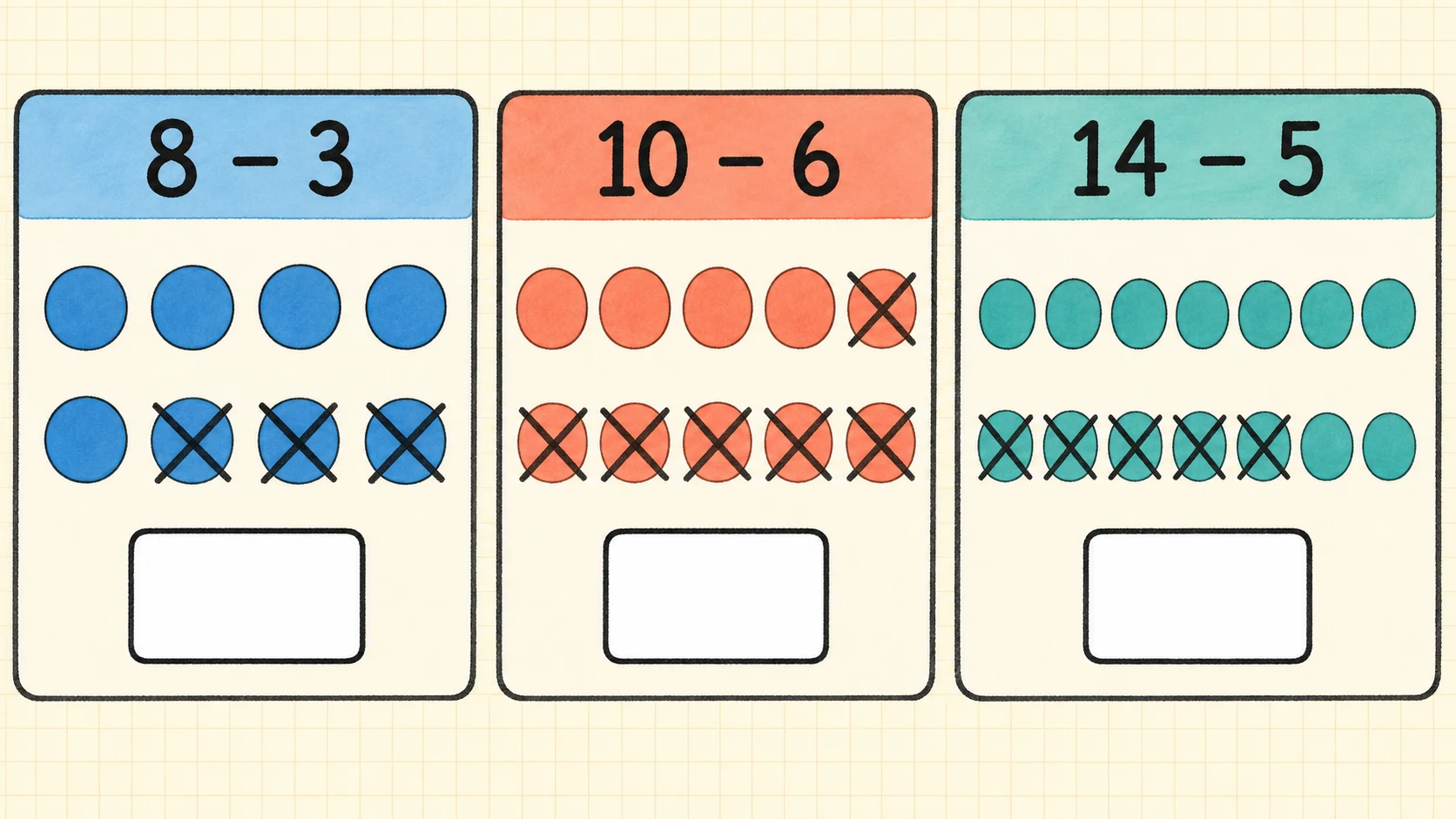
An early two-week plan should revisit the same subtraction relationships in different forms instead of assigning a fresh page every day.
For early facts, the most useful sequence may be objects → supplied picture → learner drawing → equation. For older work, it may be base-ten blocks → place-value drawing → written algorithm → estimation and addition check. In either case, fade the representation before increasing every other demand.
Use a brief routine that produces evidence
A worksheet is most useful when it sits inside a short interaction. The following routine works for a selected handful of problems and can be adjusted to the learner’s stamina.
Preview one decision
Before writing, point to one problem and ask, “What is happening here: are we taking away, comparing, or finding a missing part?” For a bare equation, ask, “What could this equation mean?” The goal is to activate the subtraction relationship, not deliver a lecture.
Model one, solve one together, watch one independently
Model the representation, including the check. Then solve a nearby example together. Finally, present one example without prompting. This third problem supplies the clearest evidence about which support is still necessary.
For , an adult might model counting up: “Six to 10 is 4, and 10 to 14 is 4, so the difference is 8.” On the shared example , the learner identifies two jumps: 5 to 10 is 5, then 10 to 13 is 3; . The independent example could be , which also has a difference of 5.
Check and name the strategy
Use addition when practical:
Ask, “How did you know?” Accept accurate descriptions before demanding formal vocabulary. Then supply concise language: “You used a related addition fact,” or “You regrouped one ten as ten ones.”
Stop after a small set that answers the instructional question. Twenty, 25, or 30 available problems are options, not a required dose. Save unused items for later review rather than extending the session after attention has fallen.
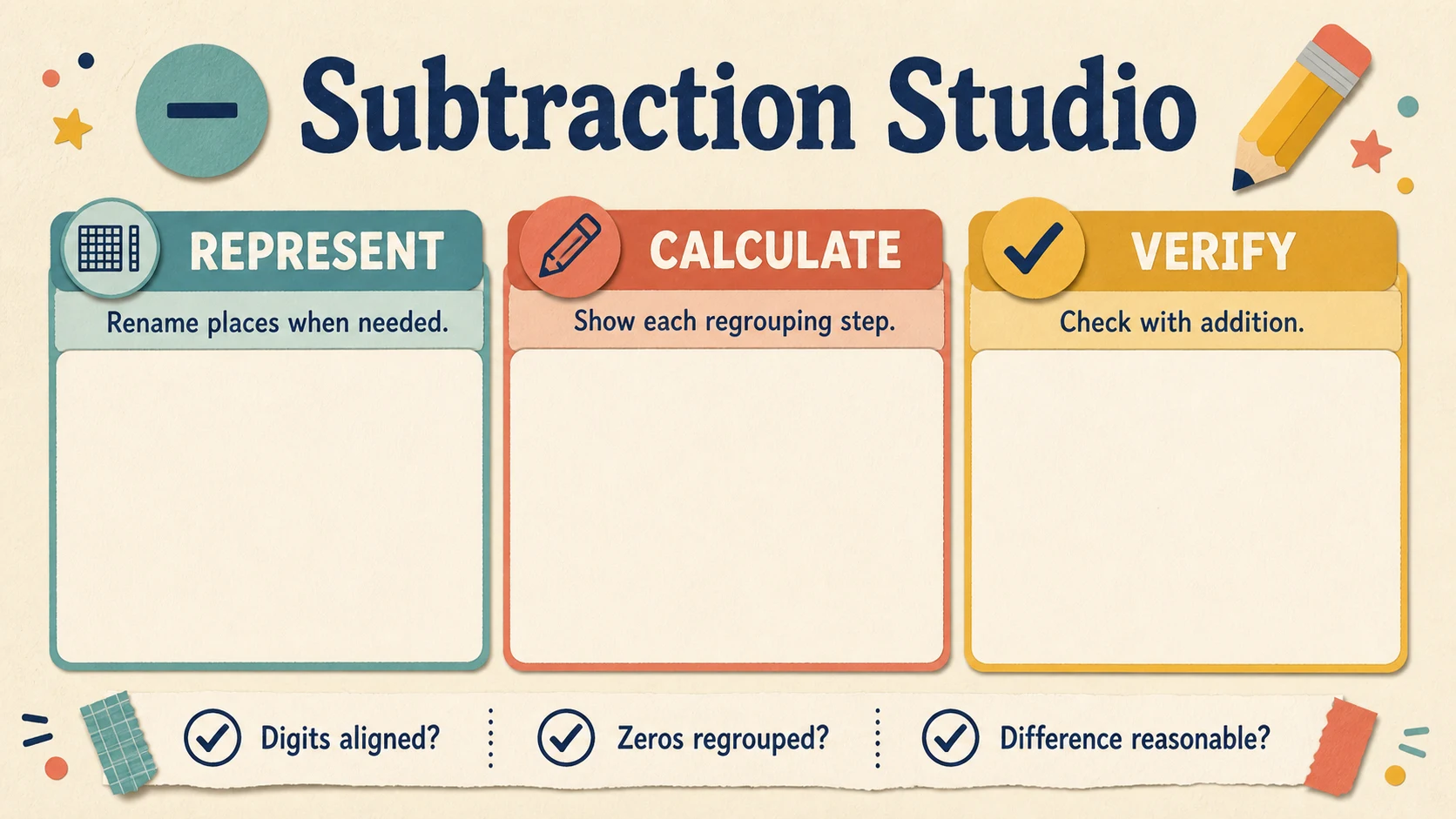
For 3rd Grade practice, space short reviews and compare methods before adding more regrouping steps.
Fade supports only when the learner replaces them with reasoning
Support fading is not the same as suddenly removing help. Withdraw one aid and watch whether the learner supplies an equivalent action.
If a learner uses counters for , move next to a picture of nine dots. Then ask the learner to draw only what is needed. Later, present without a model but allow the learner to choose one. Finally, mix it with and ask how the facts are related.
For multi-digit subtraction, keep base-ten blocks available while the learner begins drawing tens and ones. Next, place the blocks nearby but do not require them. Then use written notation and ask the learner to explain each regrouping. Removing blocks is appropriate when the learner can reconstruct the place-value exchange, not when the learner merely stops reaching for them.
A support has been faded successfully when accuracy and explanation remain stable. If accuracy collapses, restore the last useful representation, model one example, and make the next change smaller.
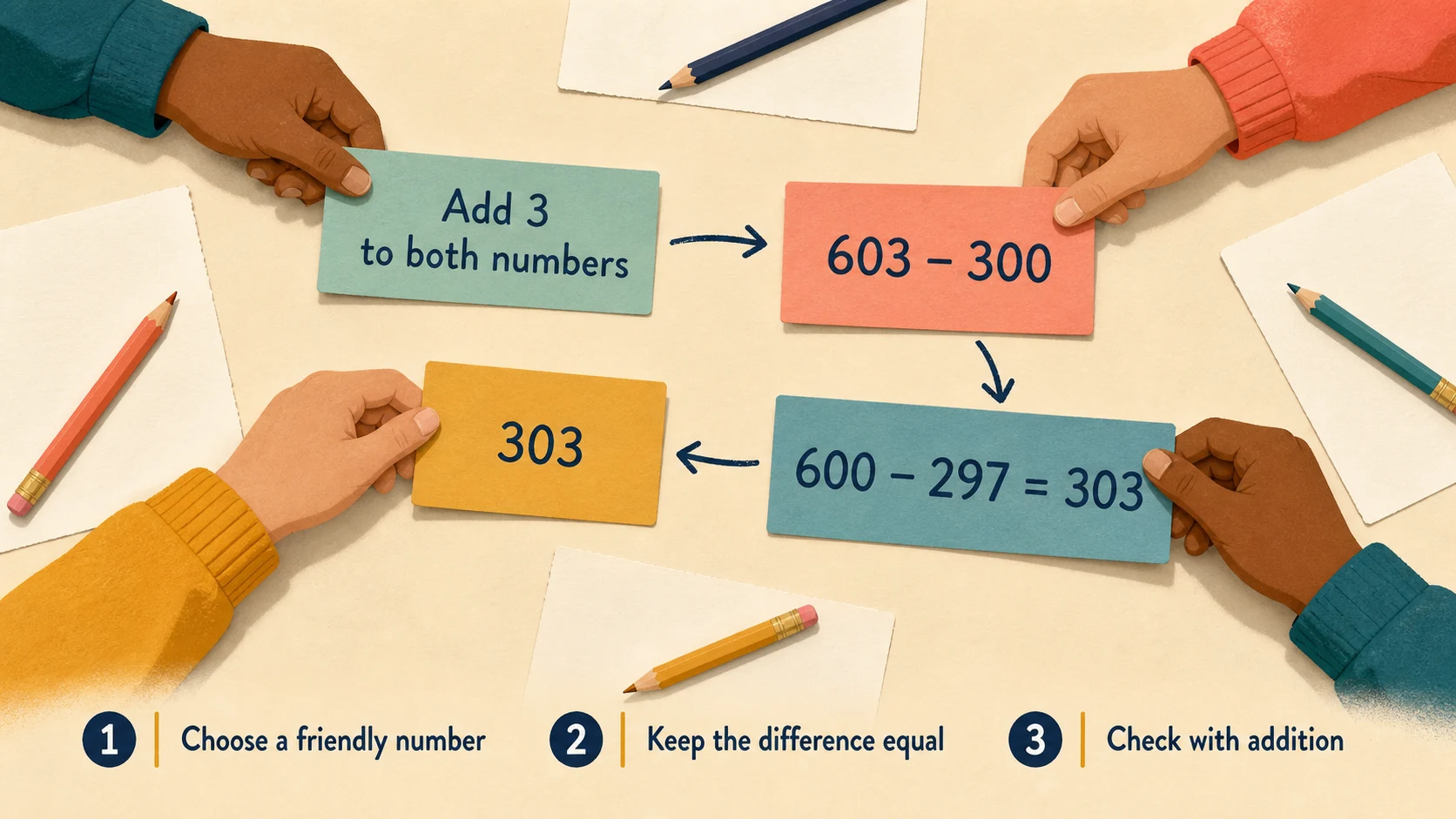
For a 5th Grade practice entry point, “easy” can mean a familiar whole-number structure, controlled regrouping, and a required reasonableness check.
Interpret errors by testing a nearby contrast
Treat an error as a clue, then run a small contrast rather than assigning indiscriminate repetition.
If the learner writes , ask them to check . Because that equals 14, the check exposes a one-too-many count. Recreate a number-line jump from 8 to 13 and label the intervals—not just the numerals.
If the learner writes , compare two prompts: “How many altogether are 8 and 5?” and “How many more is 8 than 5?” Build both with counters. The issue may be operation choice, not calculation.
If the learner writes , place beside it. Success on the no-regrouping item and failure on the regrouping item isolates the exchange as the likely instructional focus.
If the learner obtains 18 for but cannot explain the crossed-out digits, ask them to build 43 and remove 25. A correct answer with fragile reasoning calls for representation and explanation, not necessarily easier numbers.
These observations guide the next task; they do not constitute a diagnosis. Persistent difficulty can have many causes that a worksheet cannot determine. Adults should share concrete work samples and observations with the learner’s teacher when classroom performance, understanding, or access remains a concern.
Adapt the page without changing the target
Useful adaptations preserve the intended subtraction decision:
- Read directions or word problems aloud while leaving operation choice to the learner.
- Cover all but one row to reduce visual load.
- Enlarge the page or rewrite one problem with generous spacing.
- Supply counters, a number line, ten-frames, or base-ten blocks.
- Allow oral explanation instead of requiring a full written sentence.
- Use graph paper for place-value alignment.
- Reduce the number attempted while retaining representative problem types.
- Let the learner point, move, or match before recording an equation.
An adaptation changes the target if the adult supplies the operation in a word problem meant to test operation choice, completes the regrouping in a problem meant to assess regrouping, or narrows every comparison question into a rehearsed take-away script. State the goal before adapting: “Today I need to see whether you can compare two quantities,” or “Today I need to see whether you can regroup one ten.”
For learners ready to inspect grade-specific variations, compare the 3rd Grade Subtraction guide and free sheet with the 5th Grade Subtraction guide and free sheet. Do not assume that the latter is automatically the right destination. Inspect number size, regrouping, problem language, representations, and problem count.
Know what an easy worksheet cannot establish
A worksheet can show how a learner responded to a particular sample under particular conditions. It cannot by itself establish durable fluency, transfer to unfamiliar situations, understanding across all subtraction meanings, or the cause of errors. A completed page also cannot show how much prompting occurred unless the adult records it.
The catalogue’s six grades, six free entry points, and 36 variants provide choices, not a universal sequence. The listed free sheets range from 20 to 30 problems, but no catalogue count determines how many items an individual should complete. Grade labels indicate intended practice levels; curriculum order and terminology vary.
Do not infer that a learner is “behind,” “advanced,” or suited to a fixed level from one page. Record observable facts instead: “Solved four of five removal problems within 10 using counters,” “selected addition for both comparison questions,” or “regrouped accurately with blocks but not yet from written notation.”
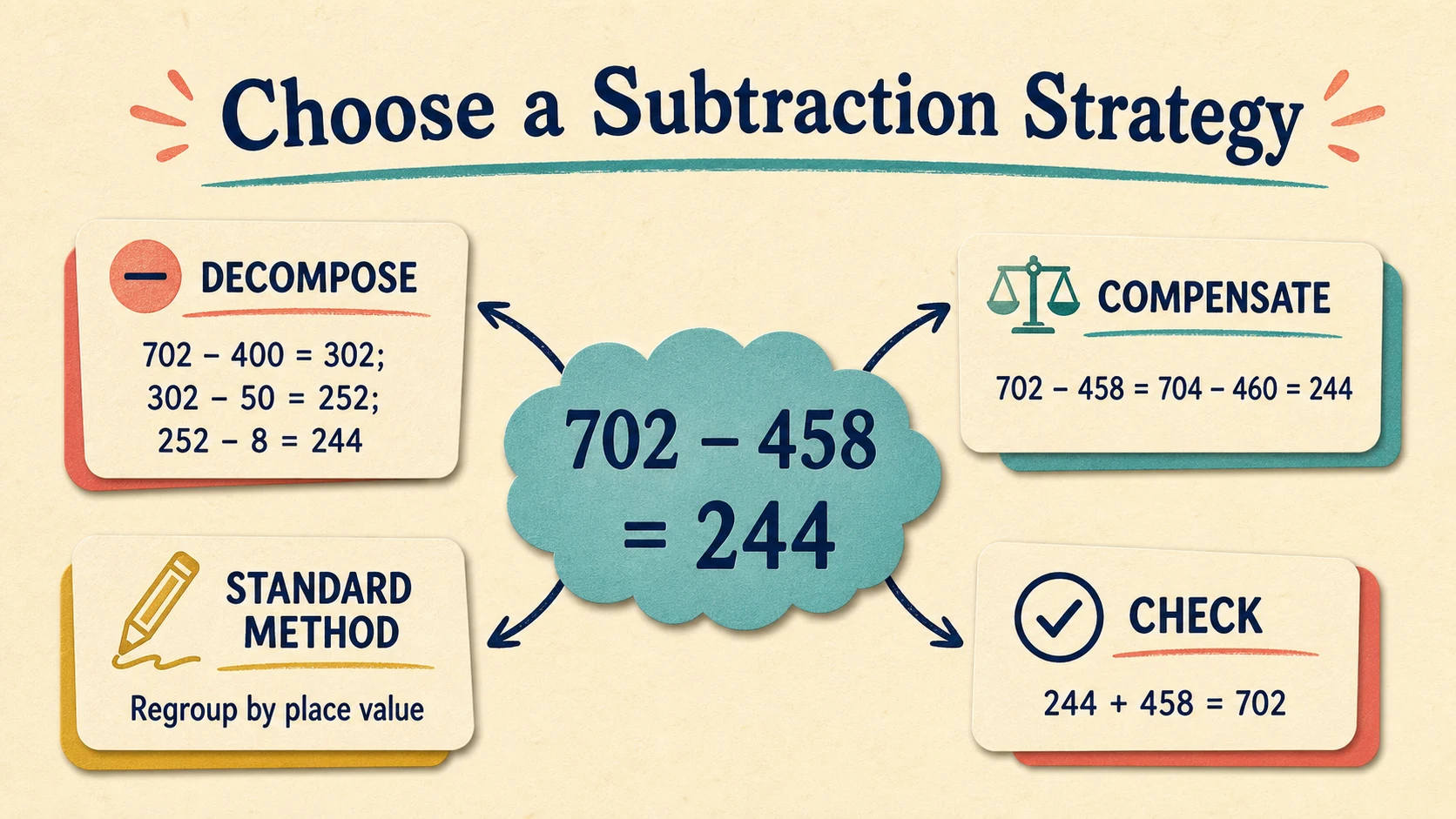
At the upper-elementary end, map each item to its actual demand: calculation, place value, interpretation, representation, or checking.
Make the next worksheet answer one real question
Choose the next practice by naming one question you want the learner’s work to answer. For example: “Can the learner solve comparison problems within 10 when no objects are removed?” Select three comparison items, keep counters available, and include one familiar take-away item as a contrast. Record whether the learner chose subtraction, represented the two quantities, found the difference, and checked it.
If those three comparison items are accurate and explained, the next variation could remove the supplied visual or introduce a missing-part problem while keeping numbers within 10. If operation choice is uncertain, retain the same quantities and align two rows of counters. If calculation is accurate but reading interferes, read the prompt aloud without naming the operation.
That is the central decision for easy and beginner subtraction practice: keep the subtraction relationship intact, reduce one unnecessary barrier, and change only enough to reveal the next piece of learning. As a practical next action, open the free deterministic worksheet generators, create a short subtraction set around the learner’s current number range, and vary just one feature—representation, problem meaning, or regrouping—on the next attempt.
Put it into practice
Use the guide with a real printable
Move from explanation to a short, observable practice task. Check the first item together, then adjust the next session from the learner's actual work.
Open the first free worksheetExplore a neighboring collection
Choose by a different teaching need
Easy and Beginner Addition Worksheets Easy and Beginner Counting Worksheets Easy and Beginner Division Worksheets Easy and Beginner Fractions Worksheets Easy and Beginner Geometry Worksheets Easy and Beginner Money Worksheets Easy and Beginner Multiplication Worksheets Easy and Beginner Sight Words Worksheets