Curated collectionAnswer keys includedPrint-ready PDFs
Easy and Beginner Fractions Worksheets
Define what easy and beginner fractions practice changes and what it deliberately keeps constant, then compare three checked examples, fading supports and readiness evidence.
Start with a real resource
Browse this worksheet collection
6 relevant free entry points are available. Each one includes a printable learner PDF and separate answer key.
A useful practice loop
Print less. Observe more.
- Choose one skill and model the first item aloud.
- Use a short set and notice the learner’s strategy.
- Change the next task from the work you can see.
Need more than the free sheet?
Plus includes all 36 matching catalogue variations where available, plus saved deterministic generators and the worksheet designer.
See Plus membershipComplete guide
How to teach and practise easy fractions worksheets
3,401 words Updated 6 instructional visuals
What “easy” fractions practice means on this page
Easy and beginner fractions worksheets reduce the number of decisions a learner must manage at once. They do not remove the central mathematical demand: recognizing, naming, locating, comparing, or operating on fractions according to the grade-level task.
On this page, “easy” is a worksheet filter, not a description of a learner. Observable features may include:
- familiar denominators;
- clearly partitioned models;
- one operation or relationship at a time;
- consistent representations across a short set;
- fewer distracting details;
- whole-number answers or uncomplicated equivalent forms;
- prompts that state exactly what to find;
- enough space to draw, label, or show intermediate work.
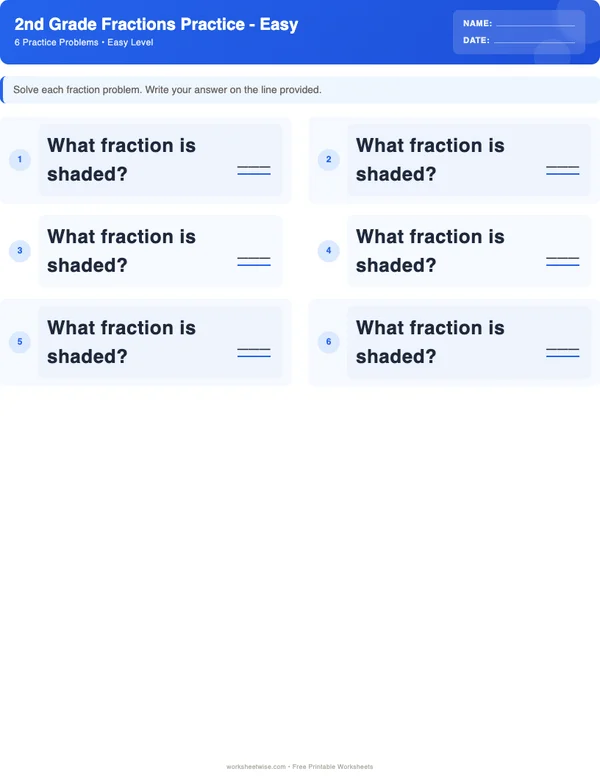
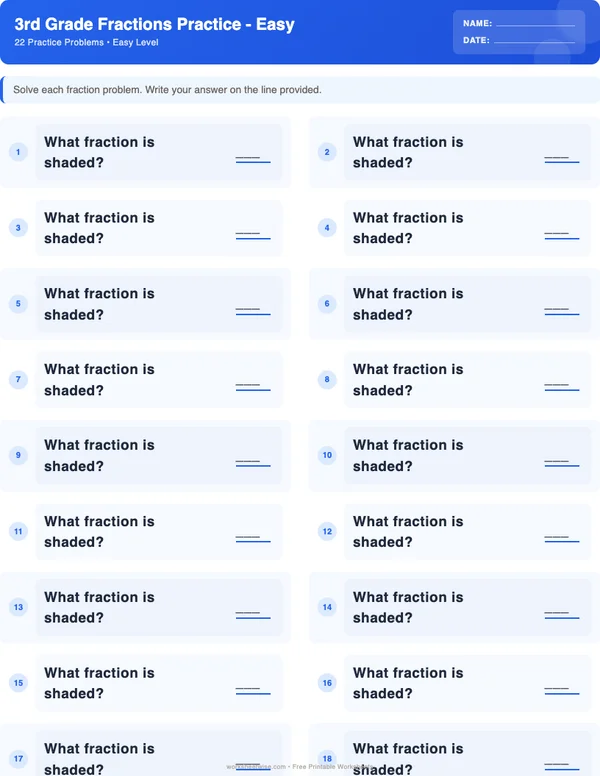
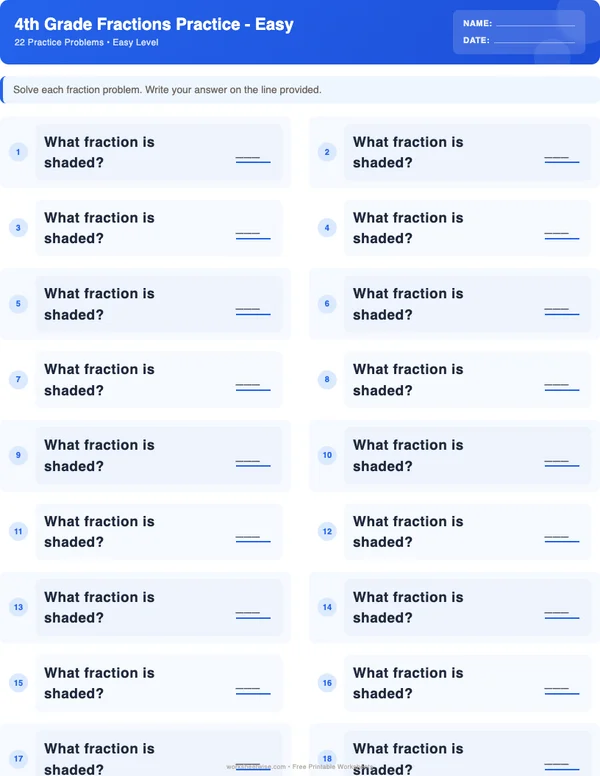
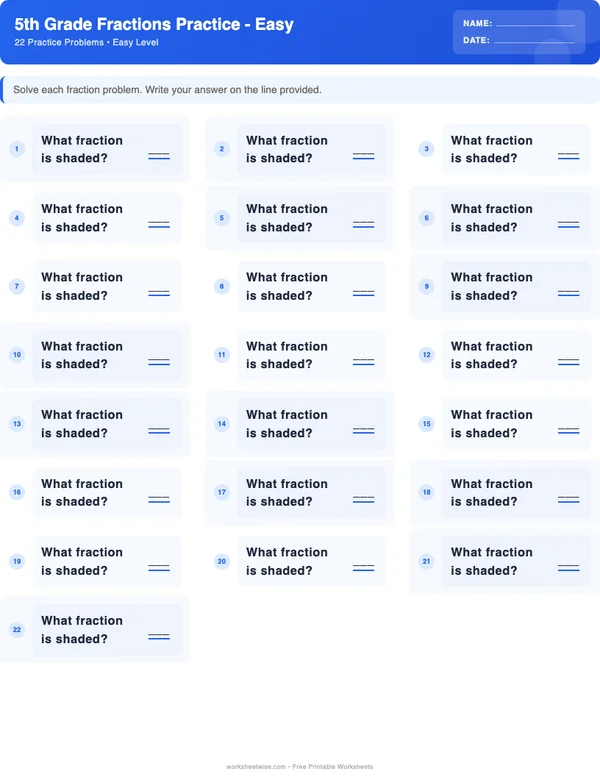
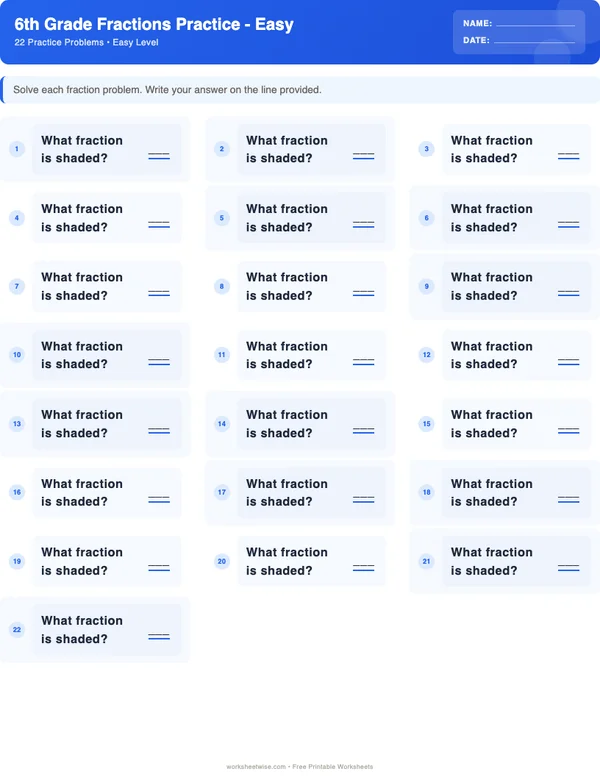
The live catalogue contains 36 easy fractions variants across 1st through 6th grade, with one free entry point for each grade. The 1st- and 2nd-grade free sheets contain six problems each; the free sheets for 3rd through 6th grade contain 22 problems each. Those counts describe the available sheets, not an appropriate sitting length for every learner. An adult can assign part of a sheet.
“Easy 1st-grade fractions” and “easy 6th-grade fractions” are therefore not interchangeable. A supported early task might ask a learner to identify one half of a partitioned shape. A supported upper-grade task might ask the learner to divide two fractions using familiar values and an explicit workspace. Both can be easy within their intended practice levels, but they require different knowledge.
Grade labels are discovery aids that describe intended practice levels. They are not placement decisions, and local curriculum sequences differ. Choose from the mathematics visible in the problems and from what the learner can explain, not from age, grade label, page length, or the word “easy.”
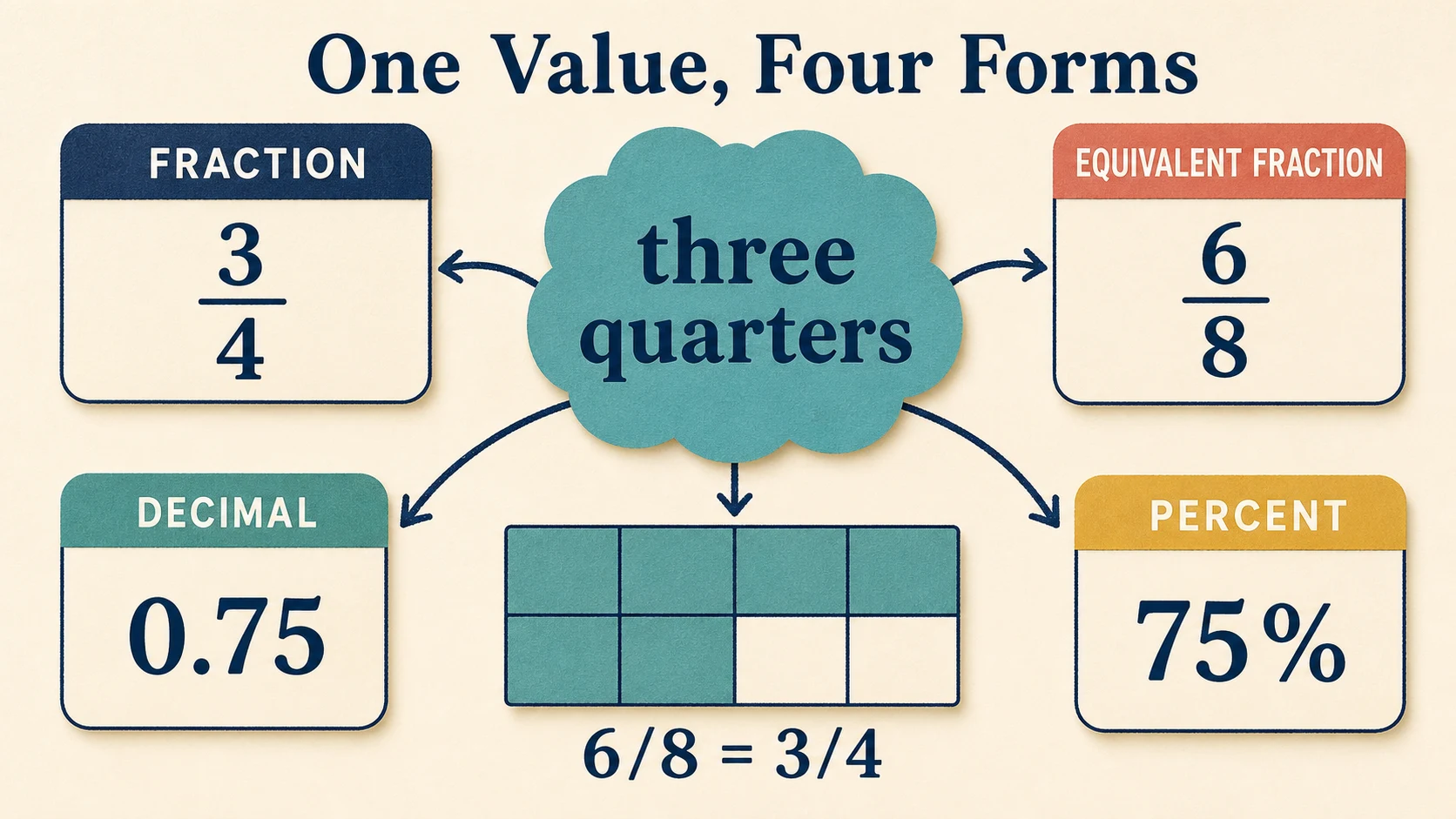
An upper-grade “easy” sheet can still address substantial fraction ideas; the support lies in how those ideas are presented and combined.
What changes—and what must remain constant
A useful beginner variation changes one source of difficulty while keeping the target skill intact. If the goal is to compare fractions, for example, changing from unlike denominators to like denominators can make the task more accessible. Replacing comparison with coloring, however, changes the skill.
Features worth simplifying
Simplify the representation, number choice, language, or amount of work before simplifying the mathematical goal.
For fraction identification, begin with shapes already divided into equal parts. For number-line placement, supply the endpoints and tick marks. For equivalence, pair fraction strips before asking for symbolic equations. For operations, use denominators with an obvious relationship, such as fourths and eighths, before unrelated denominators.
Instructions should also be direct. “Circle the greater fraction” is easier to process than a paragraph containing an unnecessary story. That language change preserves comparison.
Features to hold steady
Keep the meaning of the fraction visible. A learner naming should still connect 3 to the number of selected equal parts and 4 to the number of equal parts in one whole. A learner comparing and should still decide which value is greater, even if fraction bars are supplied.
Also keep a small explanation demand. The Common Core mathematics standards describe understanding as more than obtaining a correct answer and point to age-appropriate justification as evidence. This source did not evaluate WorksheetWise. Applied here, it supports asking one short follow-up: “How do you know?”
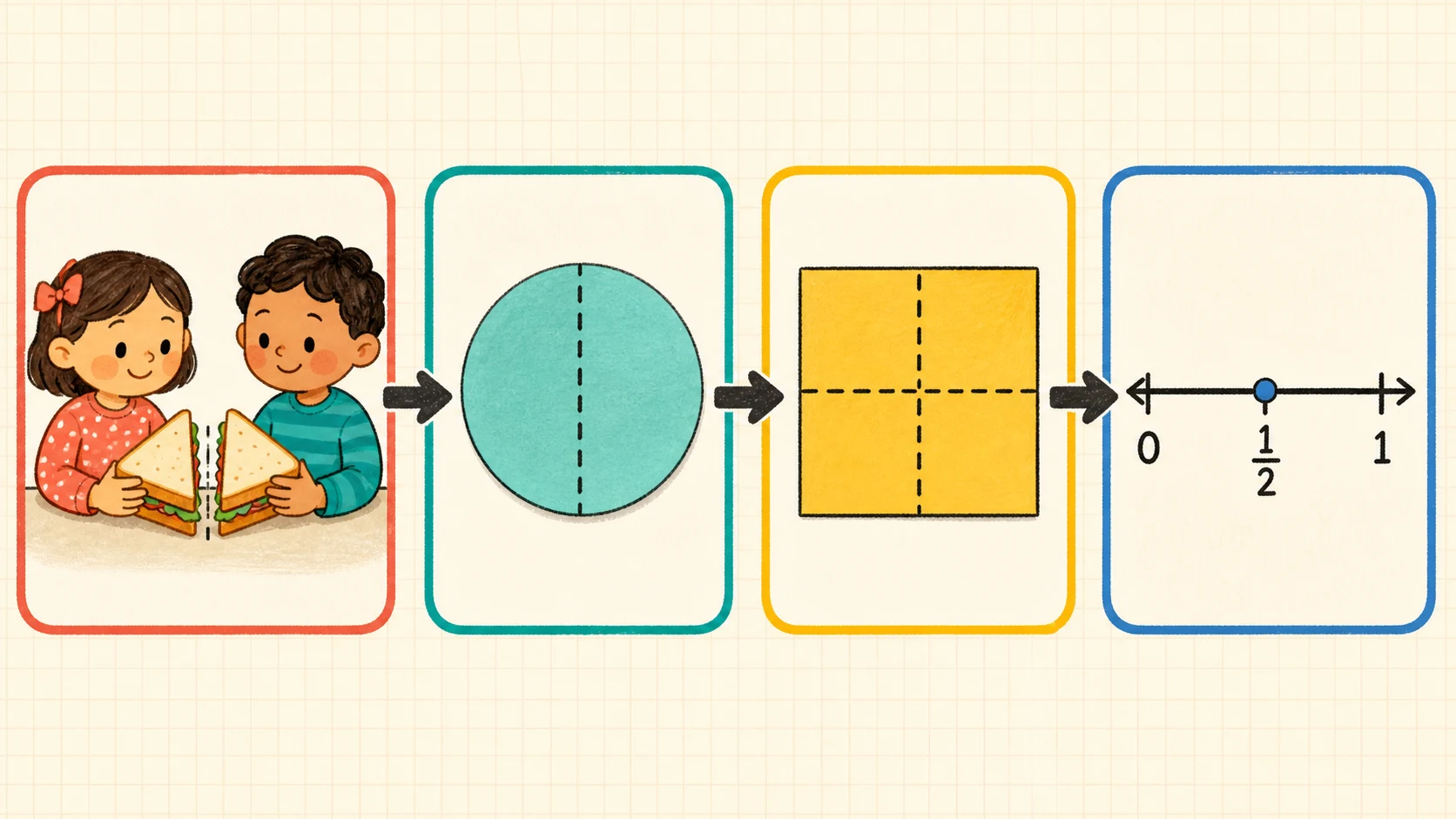
For an early fractions progression, remove one support at a time while preserving equal partitioning and fraction naming.
Compare three checked entry points before choosing
The catalogue’s free sheets provide three especially useful contrasts: a six-problem 1st-grade entry point, a 22-problem 3rd-grade entry point, and a 22-problem 6th-grade entry point. The catalogue identifies all three as easy, but their instructional jobs are different.
The 1st-grade entry point: establish equal parts
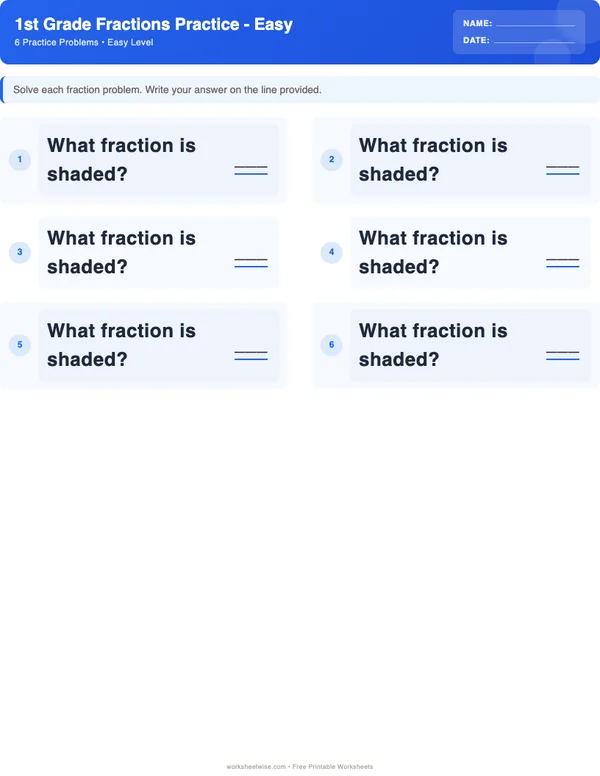
Use the 1st Grade Fractions guide and free sheet when the immediate work is identifying or naming simple fractional parts with substantial visual support. Six problems can be treated as a brief sample rather than a test.
The key prerequisite is not fluent fraction notation. It is understanding that a whole must be partitioned into equal parts before names such as half or fourth apply. An adult should be ready to cover the printed choices and use paper folding, counters, or matching if the symbols obscure that idea.
This entry point becomes too easy when the learner consistently identifies the fraction, rejects unequal partitions, and explains the numerator and denominator without relying on answer choices. It becomes too hard when the learner counts shaded regions correctly but ignores whether the total parts are equal.
The 3rd-grade entry point: connect models and numbers
The 3rd Grade Fractions guide and free sheet is a better match when the learner is ready to treat fractions as numbers, not only as pieces of a shape. The 22-problem free sheet provides more practice than the early-grade sheets, so selection matters. Begin with four to six problems that use the same representation.
A productive set might connect a divided strip, the symbol , and a point at on a number line. The learner has one underlying quantity to recognize across three forms. That belongs at this level because the concept stays stable while the representation changes.
The 6th-grade entry point: simplify the computation, not the concept
Use the 6th Grade Fractions guide and free sheet when the target is upper-grade fraction work such as operations, but the learner needs controlled values, explicit steps, or visual reference points. Do not send an older learner automatically to a 1st-grade sheet because fraction computation is difficult. First determine whether the gap concerns fraction magnitude, equivalence, multiplication facts, operation choice, or execution of a procedure.
An easy upper-grade item can use familiar values such as , yet still require the learner to interpret division and justify why the quotient exceeds 1. That is conceptually different from recognizing one half of a shape.
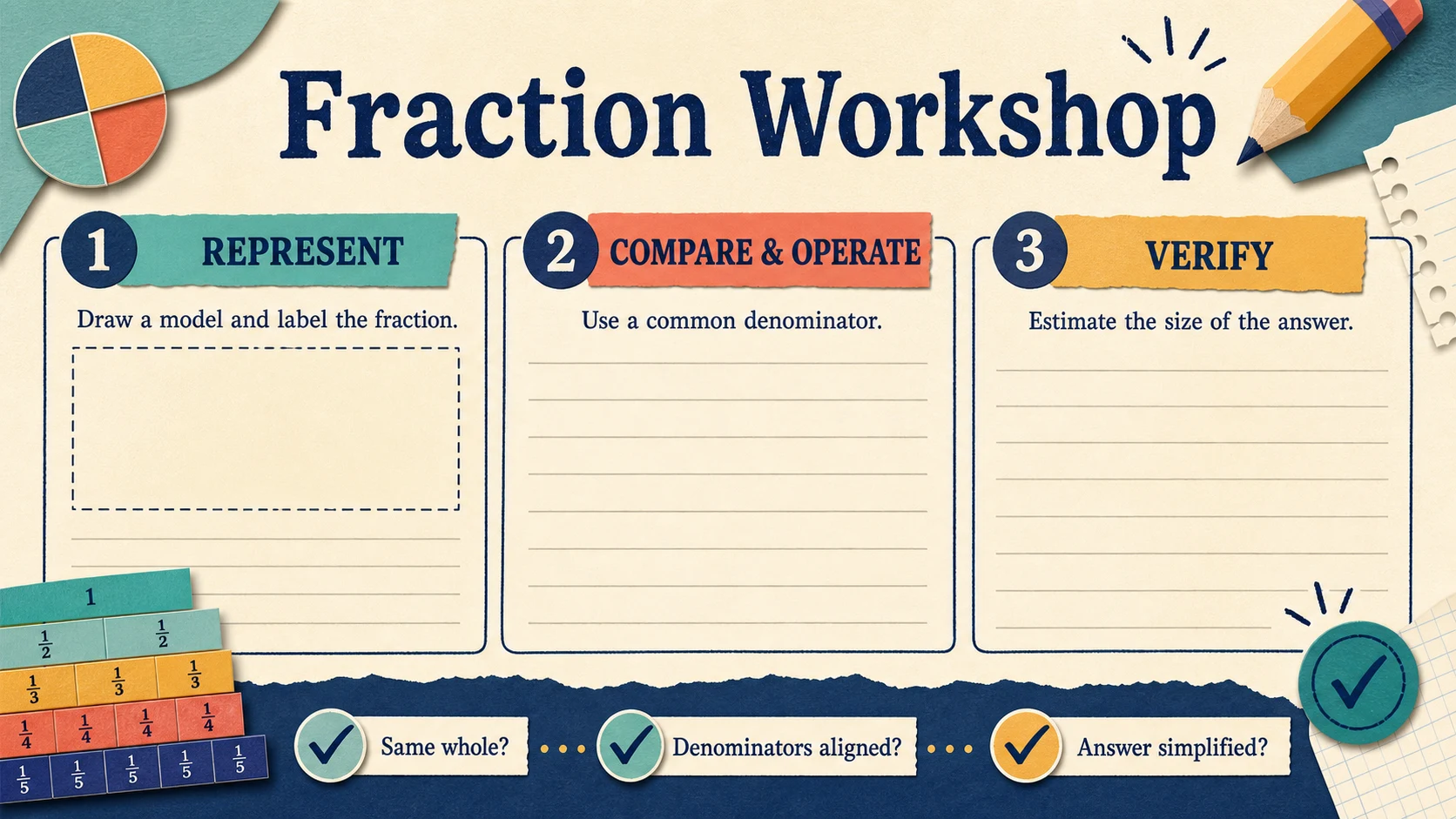
Upper-grade review should revisit a clearly identified fraction idea in short sets instead of treating all fraction errors as one problem.
Four checked examples and why they belong
The following examples are suggestions constructed from the page’s documented fraction progression and teaching context. They are not claims about the exact wording or artwork on a particular downloadable sheet.
Example 1: name a fraction only after checking equal parts
A rectangle is divided into four equal sections. Three are shaded.
Question: What fraction is shaded?
Checked answer: .
There are four equal parts in the whole, so the denominator is 4. Three of those parts are shaded, so the numerator is 3.
Now alter the drawing: divide a rectangle into four visibly unequal sections and shade three. The answer is not automatically , because the regions do not represent equal fourths.
This example belongs in easy early fractions practice because the numbers are small, the whole is explicit, and no comparison or computation is added. Yet the defining condition—equal parts—remains nonnegotiable. A learner who says “three fourths” only because three of four spaces are colored needs another equal-versus-unequal sorting example, not more notation drills.
Example 2: locate a fraction on a number line
A number line runs from 0 to 1 and is divided into four equal intervals.
Question: Where is ?
Checked answer: At the third tick after 0.
Each interval is one fourth of the distance from 0 to 1:
This belongs in beginner practice because the endpoints and equal intervals are supplied. The learner’s job is to coordinate the denominator with the number of equal intervals and the numerator with the number of intervals traveled.
A nearby easier task would ask the learner to match to an already labeled point. A nearby harder task would omit the interior tick marks or extend the line beyond 1. Those changes affect support and range without changing the target of locating a fraction.
The IES guide for assisting elementary students with mathematics recommends well-chosen concrete or semi-concrete representations and specifically recommends number lines for mathematical concepts and procedures. IES did not review this page or its worksheets. The relevant editorial decision is narrower: retain the number line long enough for the learner to explain the fraction as a distance from zero.
Example 3: compare fractions with a shared denominator
Question: Which is greater, or ?
Checked answer: .
Both fractions describe eighths of the same-size whole. Five eighths contains two more one-eighth units than three eighths. A pair of equal-length fraction bars would show the same relationship.
This belongs in easy comparison practice because the denominators match. The unit fractions are the same size, so only the counts of those units differ. The mathematical target—comparison—is genuine, but the learner does not yet need to rename either fraction.
A harder variation is versus , where numerator comparison alone is unreliable. Before making that jump, check whether the learner can explain why a shared denominator permits direct numerator comparison. Correct use of a memorized “bigger top number wins” rule is weak readiness evidence because that rule fails when denominators differ.
Example 4: verify equivalence visually and numerically
Question: Are and equivalent?
Checked answer: Yes.
Numerically,
Visually, shade two of four equal sections on one strip and four of eight equal sections on an identical strip. Both shaded lengths cover half of the same-size whole.
This belongs in beginner equivalence work because one fraction can be generated from the other by doubling both numerator and denominator, and the strips make the unchanged quantity visible. The important idea is not merely “multiply both numbers by 2.” It is that the pieces became half as wide while twice as many pieces were counted.
A harder variation would require finding a missing value, such as , without a supplied model. Move there only when the learner can explain why multiplying numerator and denominator by the same nonzero number preserves the value.
Example 5: add like denominators without adding the denominator
Question: Compute .
Checked answer: .
The addends contain two sevenths and three sevenths. Together they contain five sevenths:
The denominator remains 7 because the size of the unit has not changed. The incorrect answer treats the denominator as another count to add, even though no fourteenths were created.
This is an appropriate supported operations example because the fractional units already match and the result is less than one. A harder version could cross one whole, require unlike denominators, or embed the operation in a word problem. Add only one of those demands at a time.
A repeatable routine for one short session
A useful session can fit into 10–15 minutes. The goal is to gather evidence while giving focused practice, not to finish every printed item.
1. Preview the target
State one mathematical job: “Today you will compare fractions with the same denominator.” Avoid the vague direction “Do fractions.”
Ask a quick prerequisite question. For comparison, point to and ask what the 8 tells us. If the learner cannot identify eighths as the unit, pause and build or draw equal eighths.
2. Model one and think aloud
Complete one example while naming the decision:
“These fractions both use eighths, so the pieces are the same size. I compare how many eighths each fraction contains.”
Keep the explanation attached to the fraction meaning. Do not fill the demonstration with unrelated shortcuts.
3. Solve together, then independently
On the second problem, ask the learner to direct the steps. On the third, provide only the model or number line. On the fourth, remove that support if the learner can explain the earlier answer.
This sequence reflects the systematic instruction, clear mathematical language, and representation recommendations in the IES elementary mathematics intervention guide. It is a suggested application, not evidence about a particular WorksheetWise resource.
4. Close with one transfer question
Change one feature:
- move from versus to versus ;
- change a rectangle model to a number line;
- remove answer choices;
- ask the learner to create a fraction greater than .
Record what changed and whether the explanation stayed sound.
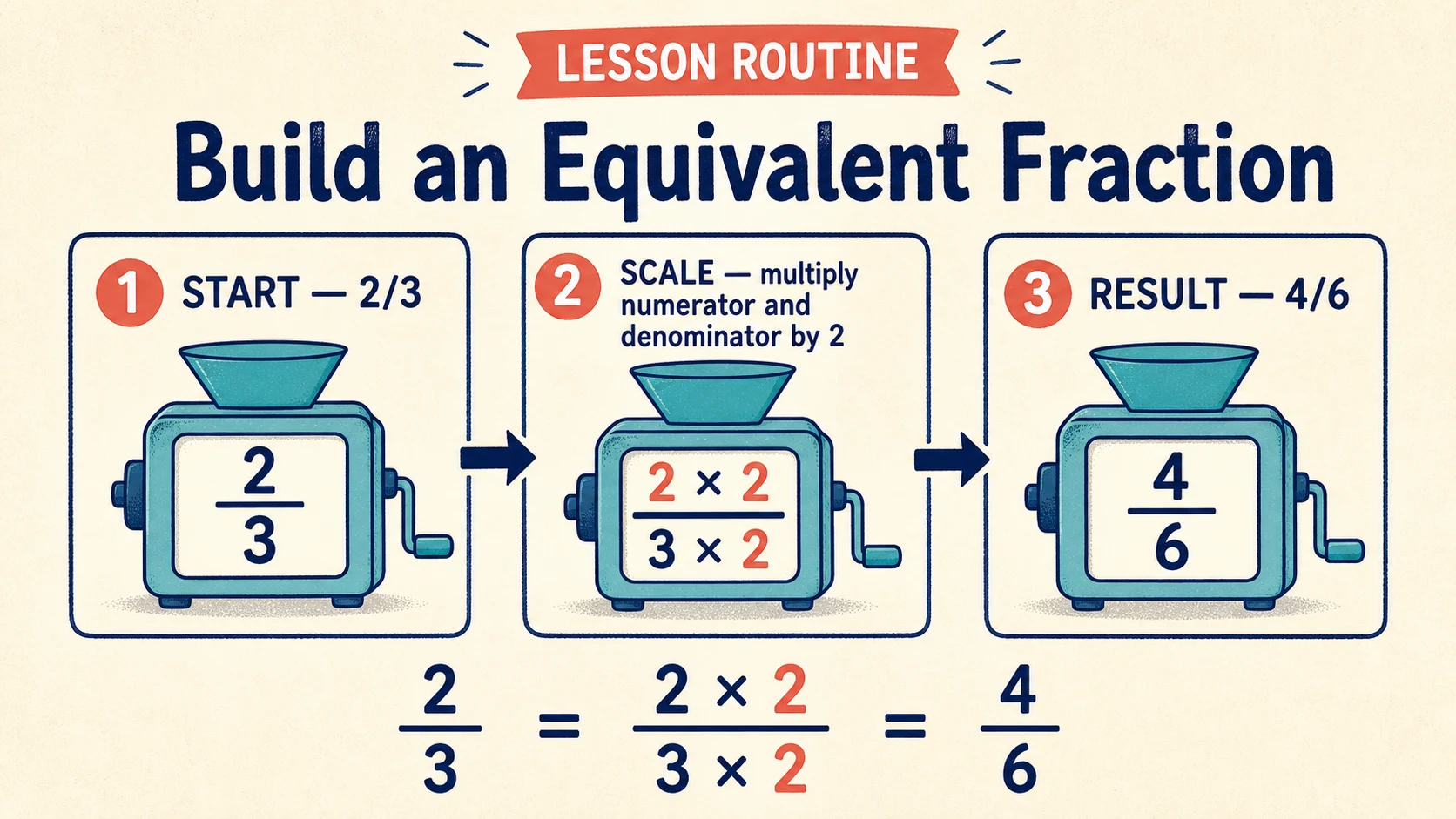
For middle-elementary practice, a brief model–guided attempt–independent attempt cycle reveals more than a long uninterrupted worksheet.
Fade supports without creating a surprise jump
Support should be removable. If every item always supplies a completed fraction bar, the adult cannot tell whether the learner can represent the fraction independently.
Use a deliberate fade:
- Supply a labeled model and solve together.
- Supply an unlabeled model for the learner to label.
- Supply an empty strip or number line for the learner to partition.
- Ask for a symbolic solution and permit a self-drawn model.
- Change the representation while keeping the values similar.
- Introduce one new numerical feature.
For equivalence, that might look like this:
- match pre-drawn models of and ;
- shade both fractions on equal strips;
- complete ;
- explain whether and are equal;
- generate a fraction equivalent to .
Do not fade every support simultaneously. Removing the model, introducing unfamiliar denominators, adding a written explanation, and increasing the number of items creates a new compound task. If performance drops, the cause becomes unclear.
The IES guide on teaching mathematics to young children recommends developmental progressions and progress monitoring that builds on what a child already knows. That guide addresses preschool through kindergarten and did not assess WorksheetWise. Its relevant principle here is to observe the current response and select the next manageable variation, particularly for learners near the beginning of formal fraction language.
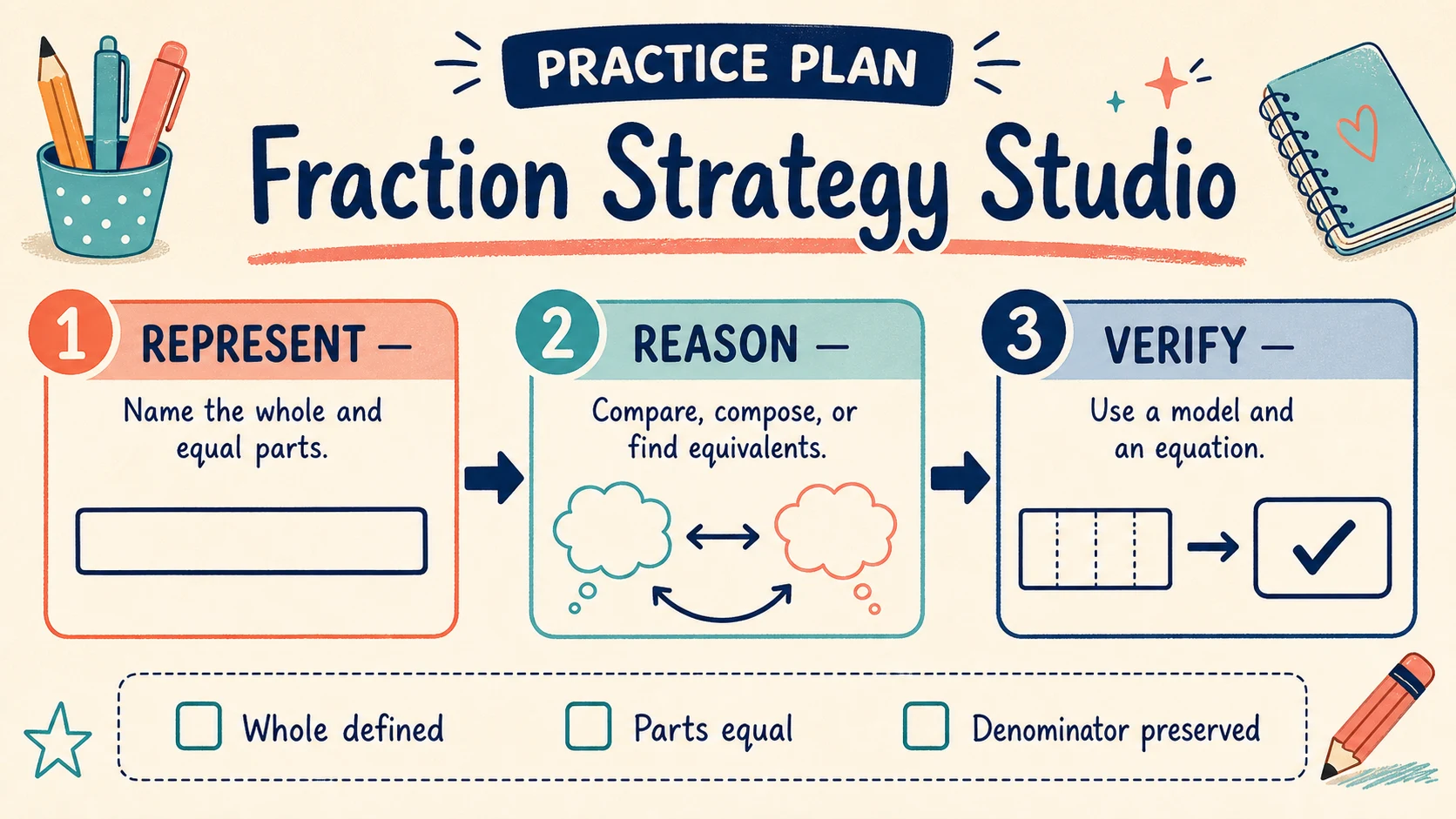
A two-week sequence should revisit the same fraction meaning through controlled changes rather than repeat an unchanged page daily.
Interpret errors before assigning another sheet
An incorrect answer is evidence about that item, not a diagnosis. Ask the learner to show or explain the decision before choosing a response.
Equal-parts error
Response: The learner calls three shaded unequal regions .
Interpretation: The learner may be counting regions without checking equal size.
Next teaching move: Sort drawings into “fair shares” and “not equal shares.” Keep four total regions constant so equality, not counting, is the deciding feature.
Denominator-as-size error
Response: The learner says because 8 is greater than 4.
Interpretation: Whole-number knowledge is being applied directly to denominators.
Next teaching move: Compare one fourth and one eighth of identical strips. Ask which partition creates larger individual pieces and why. Then place both values between 0 and 1.
Add-both-numbers error
Response: .
Interpretation: The learner may not be treating sevenths as the shared unit.
Next teaching move: Replace the symbols temporarily with language: “two sevenths plus three sevenths.” Build the quantities with seven-part bars, then return to notation.
Procedure without magnitude
Response: The learner calculates an operation correctly but cannot say whether the answer is reasonable.
Interpretation: Execution may be stronger than fraction-magnitude understanding.
Next teaching move: Ask for a benchmark first: less than , near 1, or greater than 1? For example, must be greater than and less than 2 because , so the sum exceeds , while both addends are below 1.
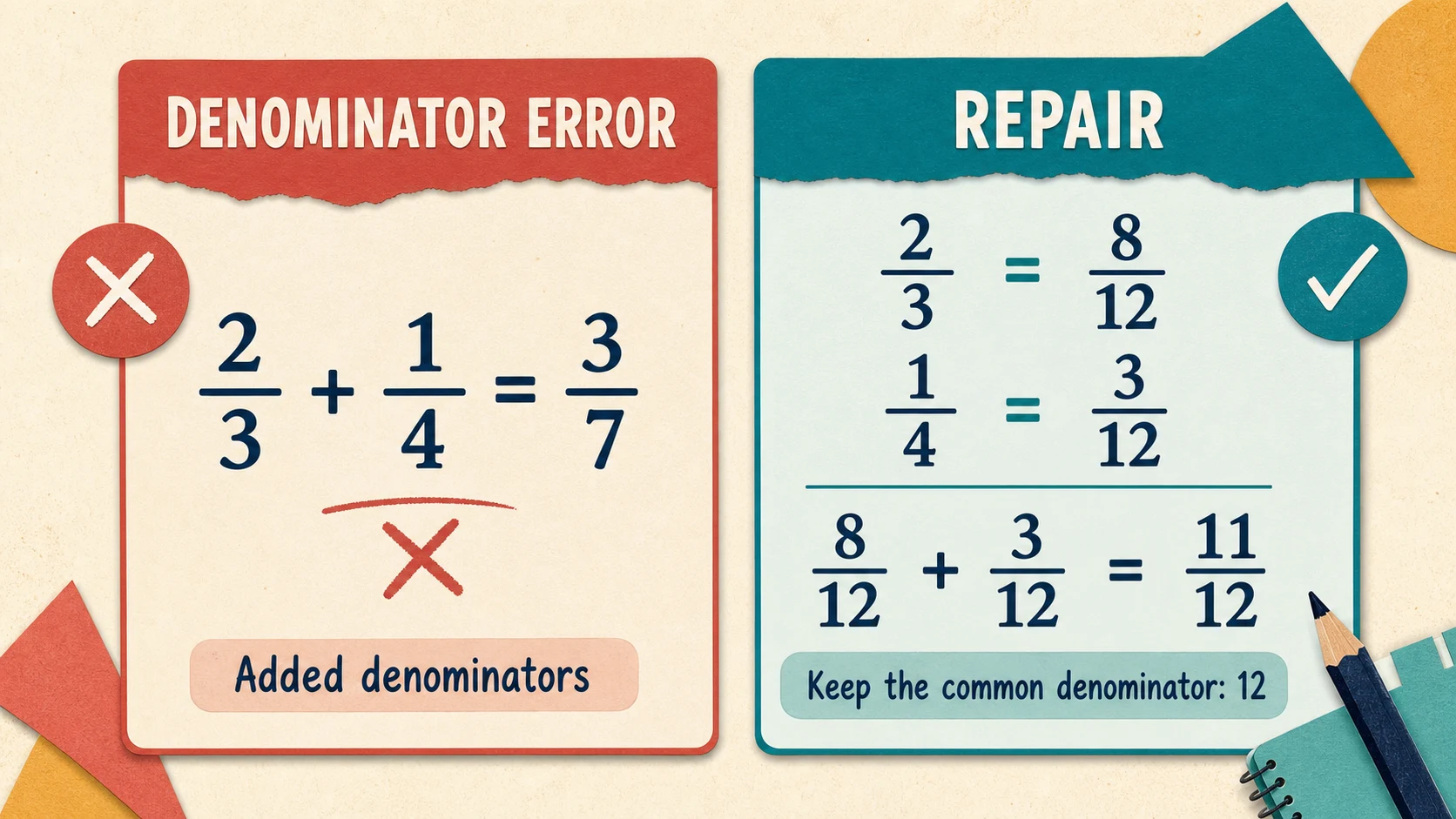
An upper-grade error should lead to a targeted representation or question, not an automatic return to the earliest fraction sheet.
False signals that make a task look easier or harder
A colorful page is not necessarily easier. Large print, friendly pictures, and fewer items can reduce visual load, but they do not establish the mathematical demand. Likewise, a plain page with 22 items is not necessarily advanced if every item repeats one supported relationship.
Problem count is also a poor placement signal. The six-problem 1st- and 2nd-grade free sheets are shorter than the 22-problem sheets for grades 3–6, but length does not define conceptual complexity. A learner may complete six unfamiliar number-line problems with more effort than 22 familiar like-denominator comparisons.
Speed is especially easy to misread. A fast correct answer may come from understanding, guessing, or a memorized rule. A slow answer may reflect careful drawing rather than weak knowledge. Use accuracy, representation, explanation, and transfer together.
Other false signals include:
- neatness, which does not prove fraction understanding;
- verbal confidence, which does not replace a checked model;
- correct answers with no stable method;
- difficulty with dense directions when the fraction reasoning is sound;
- arithmetic slips inside a correctly chosen fraction strategy;
- success on identical repetitions without success after one feature changes.
Timed work is not the default placement tool. If fluency practice is used, first verify that the learner understands the operation and can perform it accurately without time pressure.
Adapt the work while preserving fractions
Adaptations should remove barriers unrelated to the chosen fraction skill.
For visual crowding, cover all but one row. For handwriting difficulty, let the learner point, dictate, use fraction tiles, or write only the missing number. For language load, read the instruction aloud and retain the mathematical terms numerator, denominator, equal parts, equivalent, and number line. For attention or stamina, assign four selected problems and a final explanation rather than insisting on the full sheet.
If multiplication facts interfere with equivalent-fraction practice, provide a small fact reference while keeping the equivalence decision. If drawing equal partitions is not the target, supply a pre-partitioned model. If drawing is the target, do not supply the completed partition.
Use concrete materials as mathematical representations, not rewards. Paper strips, fraction tiles, circles, and number lines should correspond exactly to the symbols under discussion. Make the whole the same size when comparing models; otherwise, of a large object can appear greater than of a small one and obscure the intended comparison.
Boundaries matter. A worksheet cannot by itself determine why a learner is struggling, establish curriculum placement, or replace responsive instruction. These pages are practice resources, not diagnostic instruments. No result should be used to label a learner as “easy,” “beginner,” or “advanced.”
Choose the next variation from observable evidence
Move forward when the learner can do more than finish a repeated set. Look for three forms of evidence:
- Accuracy: The learner solves several selected items correctly without answer-revealing prompts.
- Explanation: The learner connects the procedure to fraction units, equal parts, a model, or a number line.
- Transfer: The learner succeeds when one nonessential feature changes.
If accuracy is weak, keep the same target and restore a representation. If answers are accurate but explanations are fragile, keep the numbers familiar and ask the learner to build or draw one example. If explanation is sound but work is laborious, offer a short additional set for fluency. If all three forms are present, increase one feature.
A sensible next variation might be:
- identification with supplied equal partitions → draw the partitions;
- matching a fraction to a labeled number line → label the points;
- like-denominator comparison → related denominators with fraction bars;
- visual equivalence → a missing numerator or denominator;
- like-denominator addition below 1 → a sum greater than 1;
- computation with an explicit operation → a one-step context requiring operation choice.
Do not equate finishing a 22-problem sheet with readiness. Stop once the evidence is clear or the learner’s attention no longer supports useful observation.
For the next session, choose one target, generate four to six closely related items with the free deterministic worksheet generators, and change only one task feature after the learner solves and explains the first set.
Put it into practice
Use the guide with a real printable
Move from explanation to a short, observable practice task. Check the first item together, then adjust the next session from the learner's actual work.
Open the first free worksheetExplore a neighboring collection
Choose by a different teaching need
Easy and Beginner Addition Worksheets Easy and Beginner Counting Worksheets Easy and Beginner Division Worksheets Easy and Beginner Geometry Worksheets Easy and Beginner Money Worksheets Easy and Beginner Multiplication Worksheets Easy and Beginner Sight Words Worksheets Easy and Beginner Subtraction Worksheets