Curated collectionAnswer keys includedPrint-ready PDFs
Easy and Beginner Multiplication Worksheets
Define what easy and beginner multiplication practice changes and what it deliberately keeps constant, then compare three checked examples, fading supports and readiness evidence.
Start with a real resource
Browse this worksheet collection
5 relevant free entry points are available. Each one includes a printable learner PDF and separate answer key.
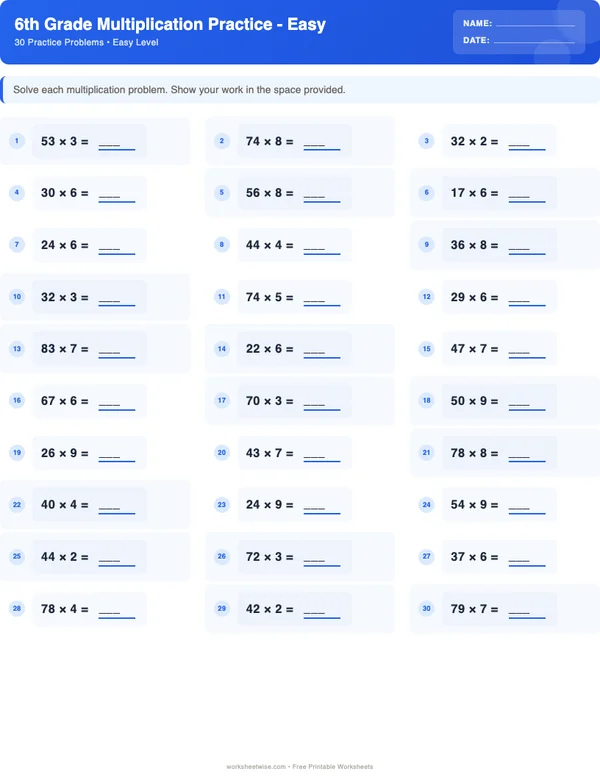
A useful practice loop
Print less. Observe more.
- Choose one skill and model the first item aloud.
- Use a short set and notice the learner’s strategy.
- Change the next task from the work you can see.
Need more than the free sheet?
Plus includes all 30 matching catalogue variations where available, plus saved deterministic generators and the worksheet designer.
See Plus membershipComplete guide
How to teach and practise easy multiplication worksheets
3,358 words Updated 6 instructional visuals
What “easy” multiplication practice means on this page
Easy and beginner multiplication worksheets should reduce the number of decisions a learner must manage at once while keeping multiplication itself intact. The learner still needs to identify equal groups, connect those groups to a multiplication expression, and find or explain a product. What changes is the surrounding demand: friendlier factors, visible models, familiar representations, fewer transitions between formats, and enough space to show thinking.
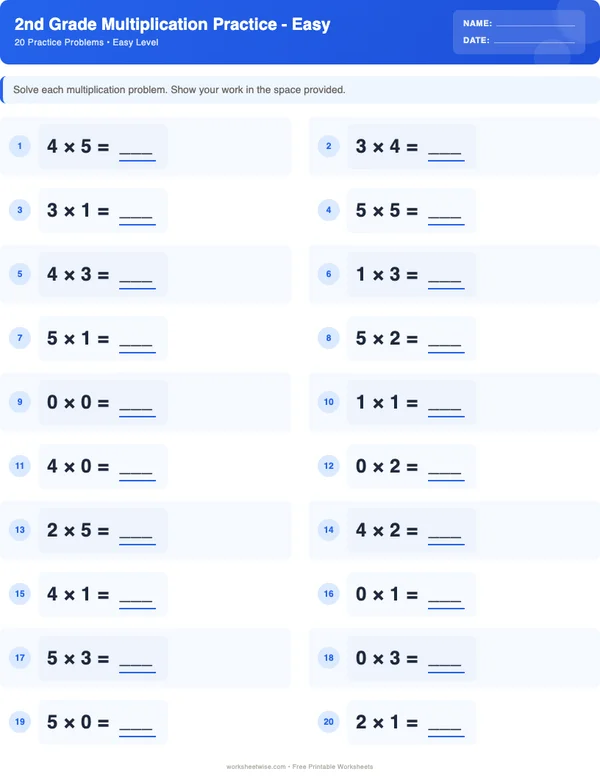
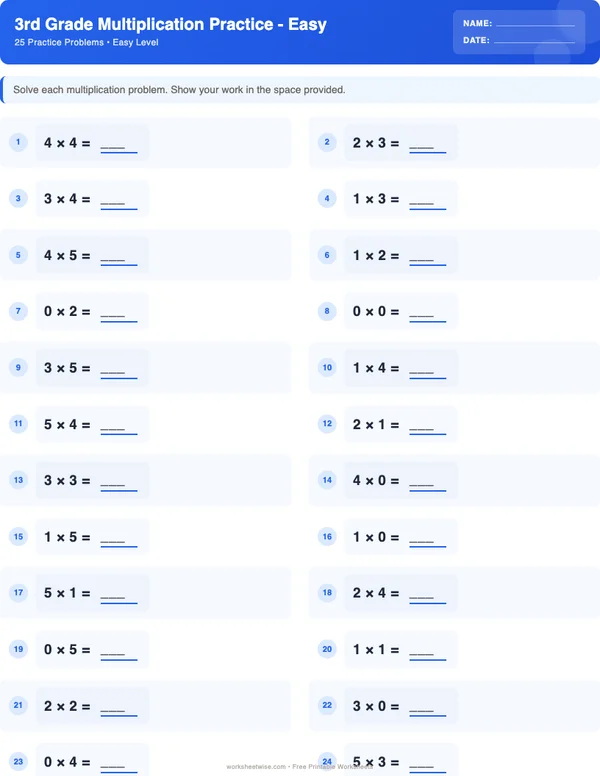
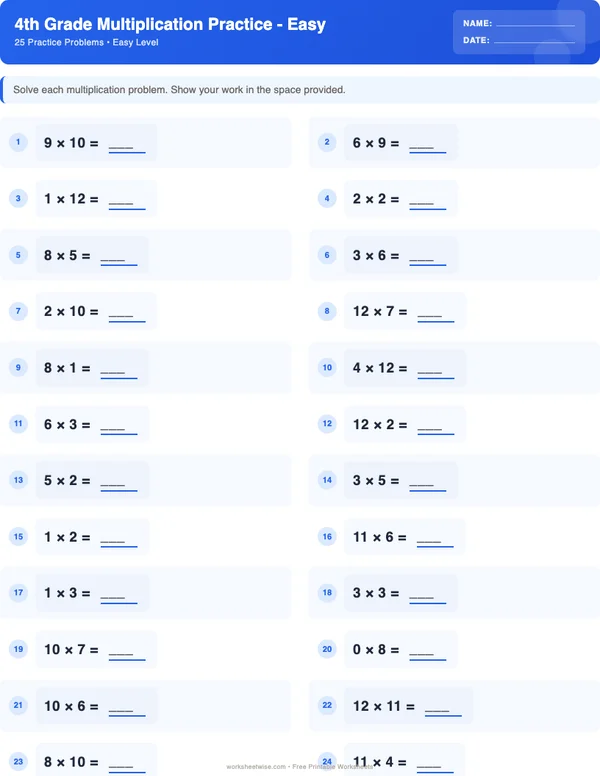
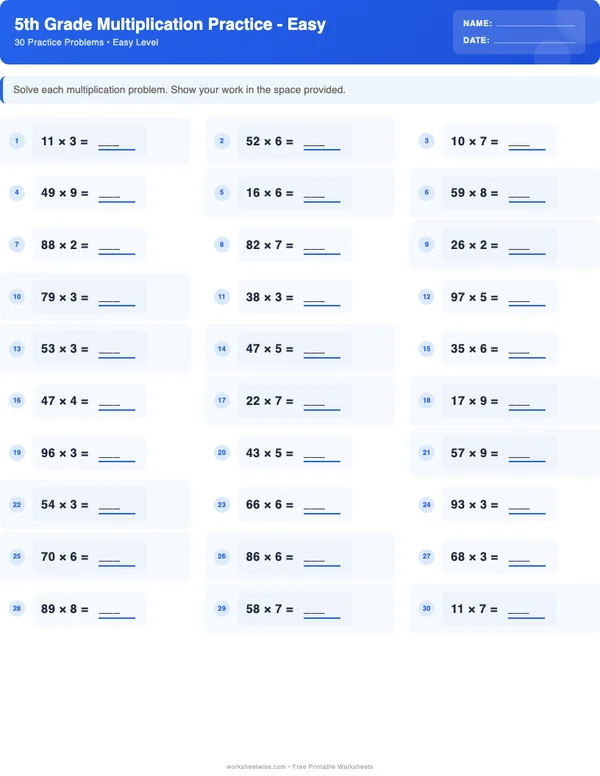
“Easy” is therefore an observable description of the task, not a label for a learner. On this page, the catalogue contains 30 multiplication variants across five intended grade levels—2nd through 6th grade—with one free entry point at each grade. The free sheets contain 20 problems in 2nd grade, 25 in 3rd and 4th grades, and 30 in 5th and 6th grades. Those counts describe the resources; they do not prescribe how many problems a learner should complete in one sitting.
Grade labels describe intended practice levels, but local curriculum sequences differ. Use grade and page labels to locate plausible material, then place by observing the actual work. A 5th grader rebuilding fact strategies may need an easy multiplication sheet without needing to be treated as younger. A 2nd grader who can make and describe equal groups may be ready for selected multiplication items without being ready for an entire page.
The central selection question is precise: Which part of multiplication should remain challenging today, and which other demands should be held constant?
The task features that make multiplication beginner-friendly
A genuinely beginner-friendly task usually controls several features at once.
The mathematical relationship stays visible
An array, equal-group drawing, number line, or short context lets the learner see what the factors mean. Four groups of three can be built, counted, drawn, and written as . The notation is connected to a quantity rather than presented as an isolated fact.
The IES practice guide for teaching mathematics to young children recommends helping children connect informal mathematical ideas, representations, and mathematical language. It does not assess WorksheetWise materials. Applied here, that guidance supports asking a learner to explain what each number represents instead of accepting a memorized product as the only evidence of understanding.
The factors permit an available strategy
Facts involving 0, 1, 2, 5, and 10 offer visible patterns or efficient reasoning routes. Facts involving 3 and 4 can often be reached by repeated groups or doubling. A beginner task may later include 6, 7, 8, or 9, but it should provide a route such as decomposing a factor rather than making instant recall the hidden entrance requirement.
The format does not keep changing
A page becomes harder when one item uses an array, the next is a word problem, the next asks for a missing factor, and the next requires a multi-digit algorithm. Each format may be appropriate on its own, but rapid switching tests interpretation and flexibility in addition to multiplication.
Easy practice commonly keeps the response stable: find the product, complete a model, or match one expression to one representation. Once the learner understands that response, several repetitions can strengthen the intended connection.
The written load is proportionate
Twenty to 30 catalogue problems do not have to become one uninterrupted assignment. Cover part of a page, circle a purposeful set, or stop after evidence appears. Reducing the number completed preserves multiplication; supplying every product does not.
Easier, beginner, and harder are different task designs
Nearby difficulty is best judged by changing one feature and watching what happens.
| Task position | Observable features | What the adult can learn |
|---|---|---|
| Easier than this level | Adult states the groups; learner builds or matches them; factors stay at 1, 2, 5, or 10; no writing is required | Whether the learner recognizes equal groups and can count the total |
| Beginner multiplication | Learner connects a model, words, and an expression; factors have an available strategy; one response format repeats | Whether the learner understands the operation and can use a reliable strategy |
| Harder than this level | Models are absent or must be created; factors are less familiar; a factor is missing; formats mix; multi-digit regrouping appears | Whether the learner can select and coordinate strategies independently |
An easier task might say, “Make three groups with two counters in each group.” A beginner task might show three groups of two and ask for . A harder variation might ask, “There are 18 counters arranged in three equal rows. How many are in each row?” The quantities are small in all three, but the last task reverses the relationship and introduces a missing factor.
Difficulty can also rise without larger numbers. Asking whether and produce the same total requires comparison and explanation. That is more conceptually demanding than calculating either product alone, even though both use friendly facts.
Three checked examples reveal what should change—and what should not
These examples illustrate three different beginner entry points represented in the catalogue progression: equal groups, fact strategies, and multi-digit multiplication. They are checked here step by step; they are teaching examples, not claims that these exact questions appear on every sheet.
Example 1: Build equal groups before compressing them into notation
Problem: Four bags hold three apples each. How many apples are there?
Make four equal groups:
- Bag 1: 3
- Bag 2: 3
- Bag 3: 3
- Bag 4: 3
Then connect the representations:
Check by counting all four groups: . The total is 12.
This belongs in beginner multiplication because the group count, group size, and total are explicit. The learner’s new work is recognizing that four equal groups of three can be represented by multiplication. The task does not also require decoding a complex story, selecting an operation from several possibilities, or recalling a difficult fact without support.
Ask, “What does the 4 tell us? What does the 3 tell us?” A correct answer with those roles reversed may still produce 12, but the explanation reveals whether the learner is reading the situation or relying only on commutativity.
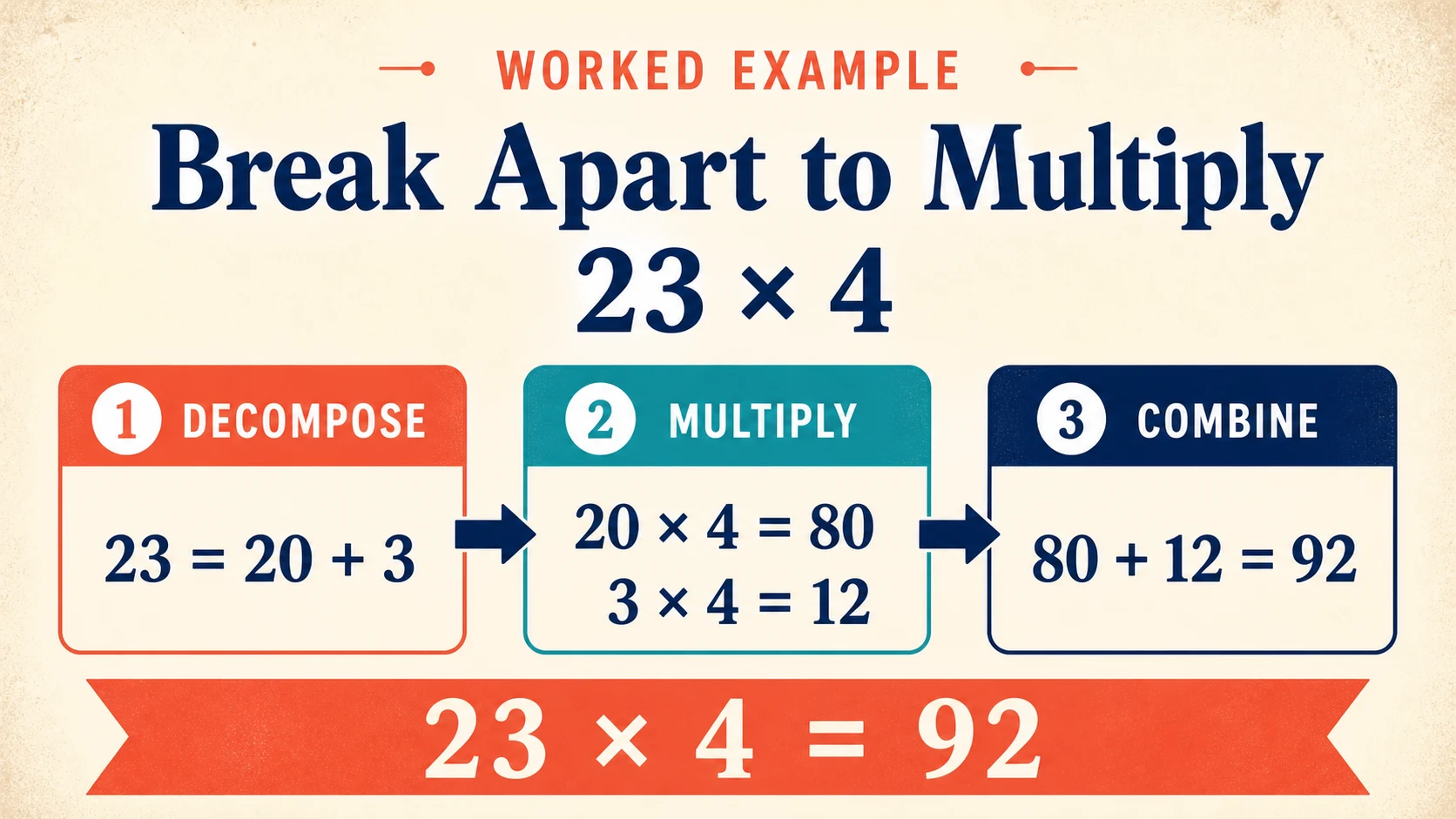
Use a concrete group or array first, then name the factors and record the product; the picture is a reasoning tool, not decoration.
Example 2: Use a known fact to reach a nearby fact
Problem: Find .
One checked route uses doubling:
Doubling 12 gives:
A second check uses equal groups:
A third check uses commutativity:
This belongs here because the learner does not need to retrieve instantly. The mathematical target is choosing and carrying out a dependable strategy. Keep the factor 6 constant while comparing and ; that makes the doubling relationship easier to notice.
A harder next version would be , provided the learner can extend the same reasoning: , then double 24 to get 48. Changing to , removing all recording space, and adding a timer at the same time would not reveal which change caused difficulty.
Example 3: Decompose a less familiar fact without changing the product
Problem: Find by splitting 8 into 5 and 3.
Apply the distributive property:
Check the addition: , then one more gives 56. Check the multiplication another way: , and doubling 28 gives 56.
This can belong in easy practice when the decomposition is provided and the component facts are available to the learner. It becomes harder if the learner must invent a decomposition, remember both partial products mentally, and record only the final answer.
The catalogue’s teaching guidance specifically suggests using the distributive property for later facts, including the split . That is page-supplied guidance, not a claim about universal curriculum order.
Beginner work can continue through the upper grades
Easy multiplication at an upper intended grade level should not mean disguising basic facts with larger print or childish imagery. It should reduce one source of complexity while retaining age-respectful mathematics.
Example 4: Keep place value visible in multi-digit multiplication
Problem: Find using partial products.
Decompose 23:
Multiply each part by 4:
Combine the partial products:
Check by repeated addition:
This belongs in beginner multi-digit multiplication because there is only one multi-digit factor, the one-digit factor is friendly, and the decomposition is transparent. The multiplication remains real: the learner must distribute 4 across tens and ones, calculate two products, and combine them. What stays constant is the representation and number of procedural decisions.
A harder nearby version might be , which introduces two partial products tied to the tens and ones in 14. Another harder version might require the standard algorithm without a place-value model. Those are reasonable later tasks, but they should not be introduced merely because was correct once.
The Common Core mathematics standards describe multiplication development across grades, from interpreting products and arrays to using properties and place-value strategies. They are a reference point, not proof that a particular WorksheetWise page aligns with every local sequence.
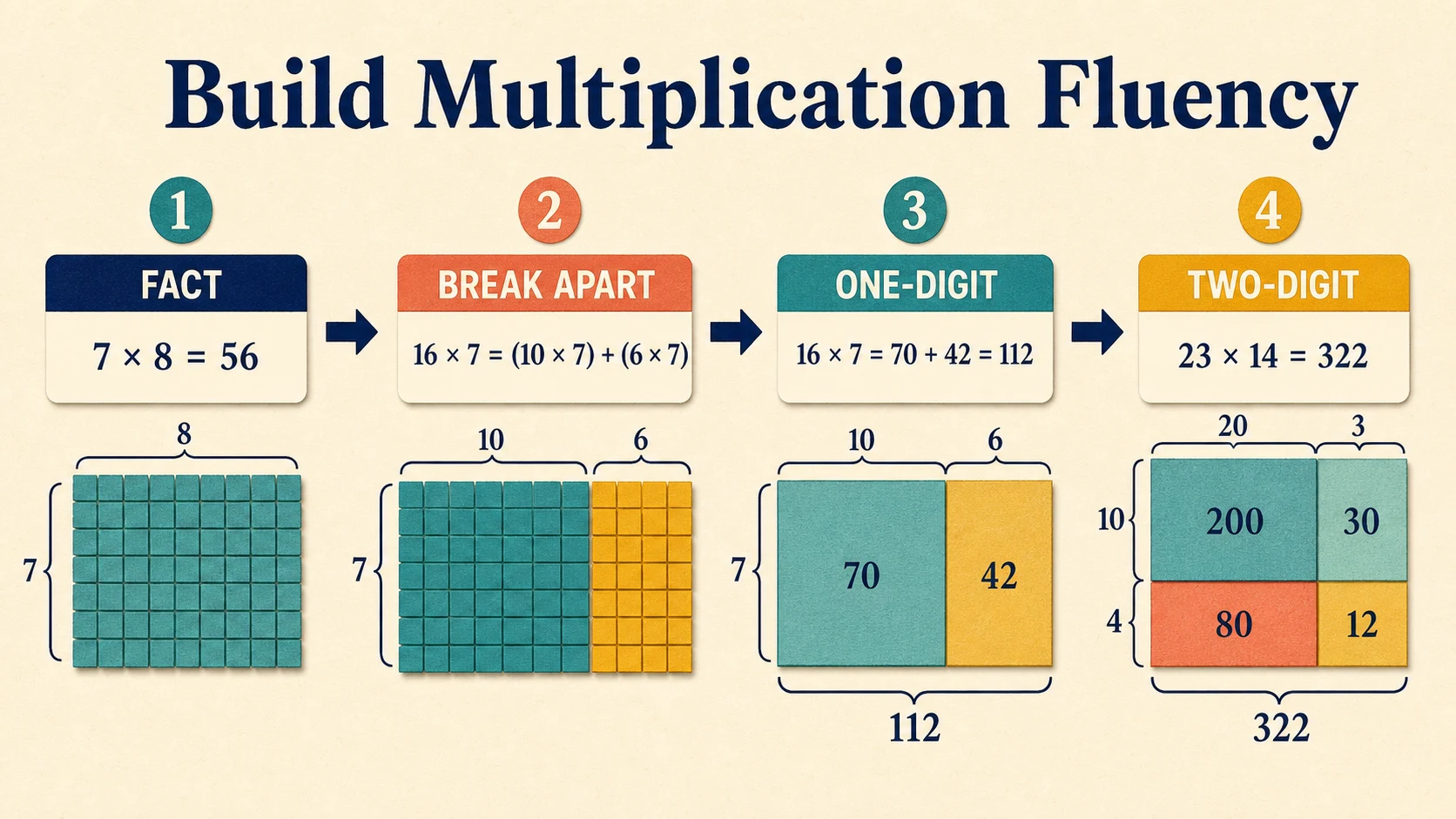
For an older learner, fade the place-value supports while preserving dignified content and a clear route from partial products to independent computation.
Choose a sheet by evidence, not by the grade printed on it
Age and grade can help an adult discover resources, but neither should make the placement decision alone. The catalogue offers 2nd Grade Multiplication, 3rd Grade Multiplication, 4th Grade Multiplication, 5th Grade Multiplication, and 6th Grade Multiplication entry points. Examine the task features before assigning one.
First identify the multiplication target
Choose one target for the session:
- recognizing equal groups;
- translating an array into an expression;
- using a fact strategy;
- explaining a property;
- finding a one-digit product;
- using partial products for a multi-digit calculation.
If the target is equal groups, a page dominated by bare equations removes the representation too soon. If the target is partial products, having the adult calculate every basic fact may help briefly, but it can also conceal whether fact retrieval is interrupting the multi-digit procedure.
Then inspect four sources of demand
Look at the factors, representation, response, and volume.
For factors, ask whether the learner has a usable route. For representation, determine whether models are shown, optional, or absent. For response, notice whether the learner calculates, matches, explains, or finds a missing value. For volume, select enough items to reveal a pattern without treating page completion as the goal.
The five free entry points provide convenient samples, but their 20-, 25-, or 30-problem totals are not instructional dosage recommendations. One sensible suggestion is to begin with three carefully chosen items: one likely accessible, one at the target boundary, and one that tests whether the strategy transfers.
Match support to the barrier
If the learner cannot interpret , provide counters or an array. If the learner understands the expression but forgets , invite a strategy such as . If the learner obtains 12 but writes 7 after adding the factors, ask for a model rather than supplying a mnemonic.
The IES guide on assisting students struggling with mathematics supports systematic instruction, clear mathematical language, representations, and deliberate practice. It does not diagnose any learner and did not evaluate these worksheets. Here, its practical implication is to choose support in response to observed work, then check whether the learner can use the idea with less prompting.
A short routine keeps the mathematics visible
A usable practice period can be brief and repeatable.
Preview, model, solve, explain, revisit
Preview: Select three to eight items around one target. Say what will stay the same: “Every problem today shows equal rows. We will write one multiplication expression for each array.”
Model: Work one example while naming the decisions. For , point to three rows, count five in each row, and calculate 15. Avoid modeling every item on the page.
Solve: Have the learner complete a small set. Watch the process before correcting the product. Record whether the learner builds groups, skip-counts, decomposes, recalls, or guesses.
Explain: Ask one focused question: “How did the array show the 3?” or “Which known fact helped?” Explanations should clarify the multiplication, not become a test of polished verbal fluency.
Revisit: Return to one missed item after another example. A corrected answer made with a stated strategy is stronger readiness evidence than a correction copied from an adult.
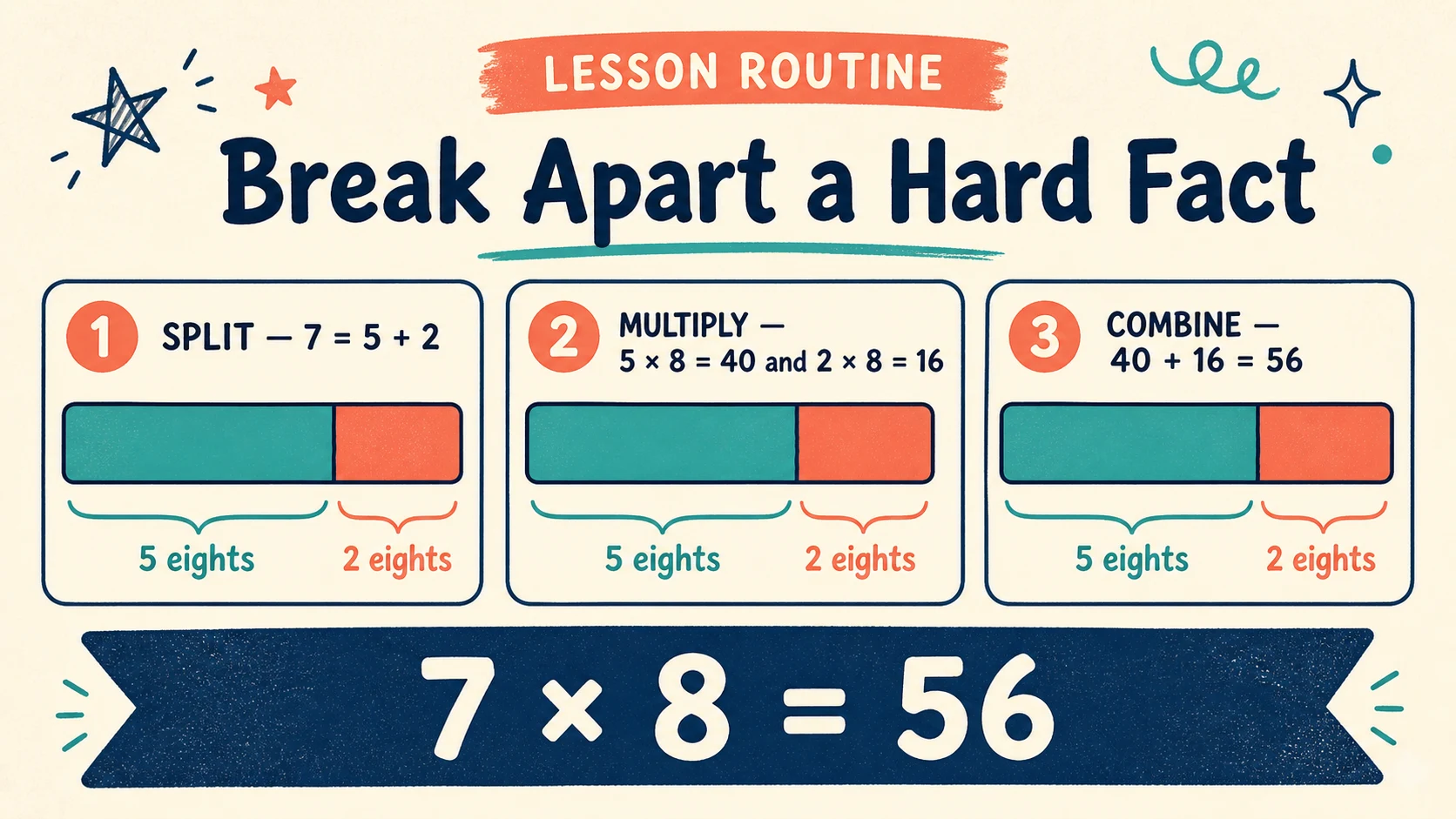
For early fact work, keep the routine compact: connect one model to one expression, practice a small set, and finish with an explanation.
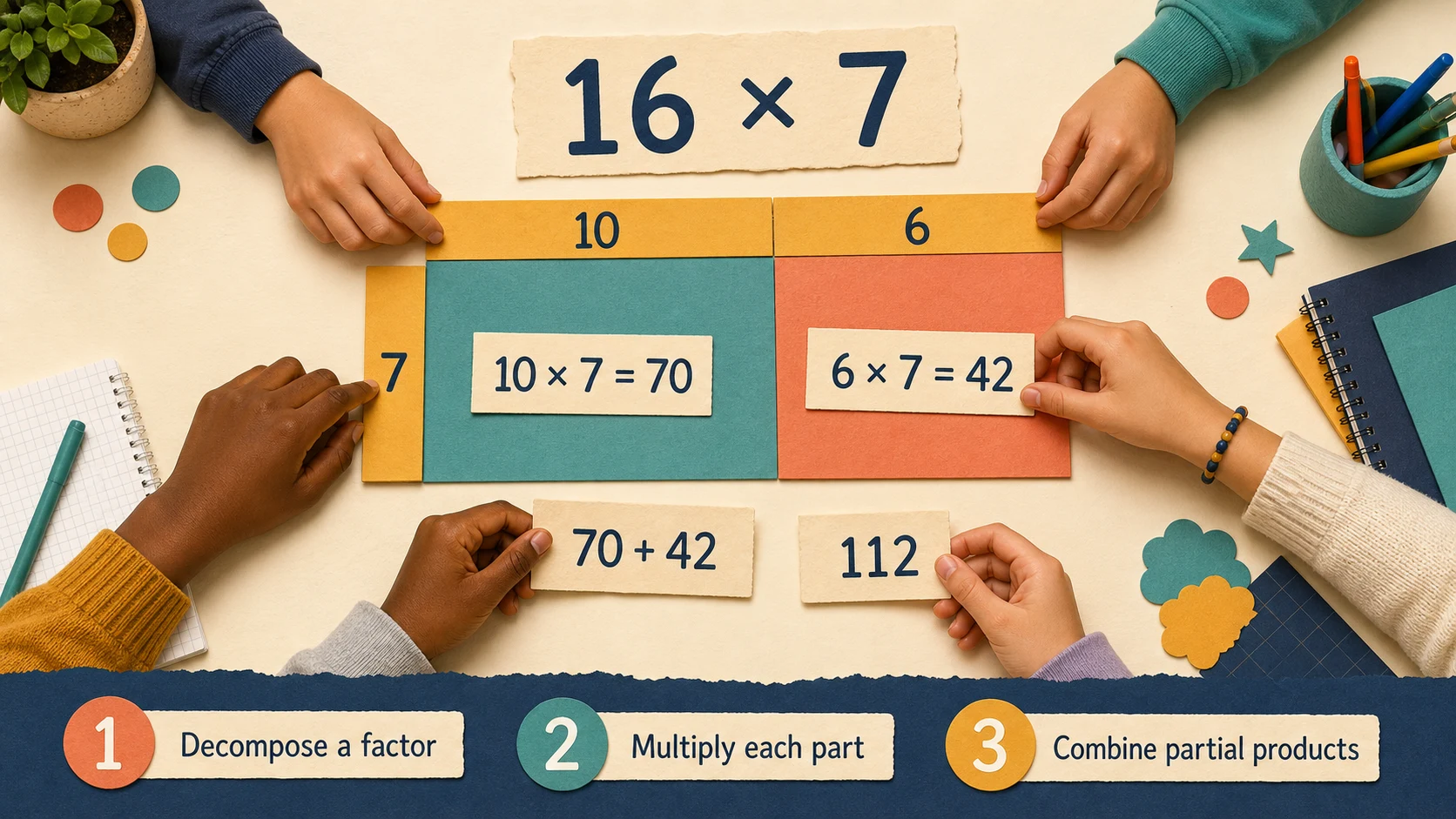
For upper-grade review, use the same predictable structure with age-respectful numbers, place-value language, and fewer adult prompts.
Interpret errors before choosing more practice
A wrong product is evidence, but it is not yet an explanation.
Product errors can come from different decisions
Suppose the learner answers . Adding the factors suggests that multiplication notation is not yet connected to equal groups. Ask the learner to build four groups of six. More bare facts would repeat the format that was misunderstood.
If the learner answers , ask for the strategy. The learner may have skip-counted and stopped after five counts, or may have confused the fact with . Marking only “wrong” loses that distinction.
If becomes 812, the learner may have found the correct partial products, 80 and 12, but concatenated them rather than adding. The multiplication components are intact; combining partial products is the immediate target.
If becomes 83, the learner may have multiplied the ones and carried over the 8 without understanding its place value. Return to and , then combine 80 and 12 explicitly.
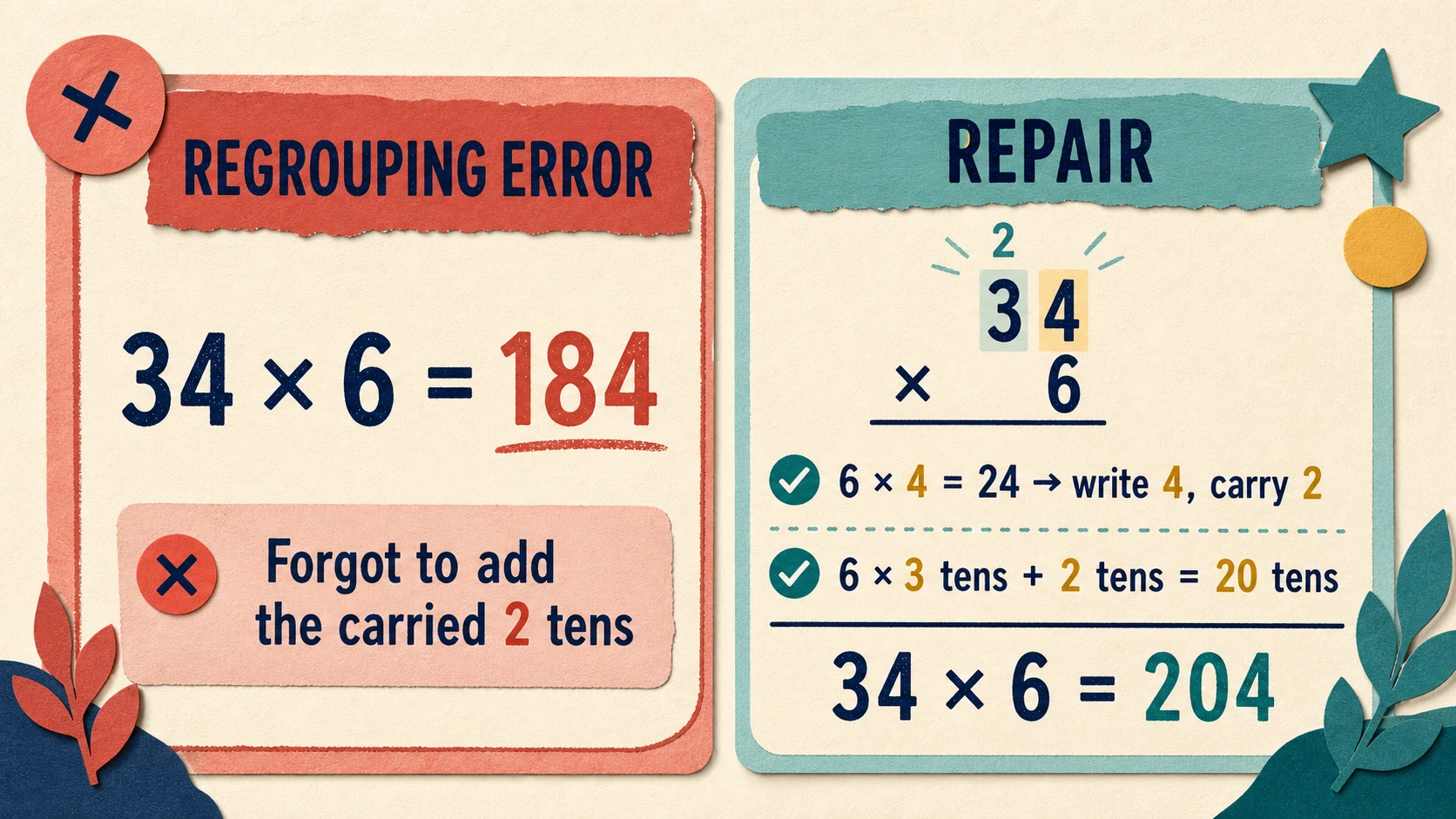
Pair each upper-grade error with a question or representation that tests its likely source; do not infer the cause from the final answer alone.
One error does not justify a diagnosis. Look for repetition across comparable items, ask the learner to explain, and consider nonmathematical factors such as misreading a symbol, losing a place on the page, or misunderstanding the requested response.
False difficulty signals can send practice in the wrong direction
Speed is an especially unreliable signal when used alone. A careful learner who draws an array for may understand the operation better than a fast learner who recalls 24 but cannot explain either factor. Timing also adds pressure and motor demands, so a slow result does not identify the mathematical barrier.
Page completion is another false signal. Finishing 30 problems can reflect endurance, copying, or repeated use of one narrow procedure. Completing six selected problems with accurate models and explanations can provide more useful placement evidence.
Neatness is not multiplication proficiency. Misaligned work can cause place-value errors and deserves a practical adaptation, but handwriting quality should not determine whether the learner understands equal groups or distributive reasoning.
Large numbers are not automatically harder, and small numbers are not automatically easier. may be more accessible than . A missing-factor question such as may be harder than , although it uses the same values.
Finally, needing a model is not failure. The relevant question is whether the model supports reasoning and can eventually be simplified or removed. A permanent prompt that gives away the structure may limit independence; a temporary array that the learner uses to explain a product is productive support.
Adapt the work without removing multiplication
Useful adaptations preserve the target relationship.
- Reduce the visible set by covering unused rows, while leaving each selected multiplication problem unchanged.
- Permit counters, grid paper, or drawn arrays when the target is understanding products.
- Provide a fact chart temporarily when the target is the sequence of multi-digit partial products, then check selected facts separately.
- Read directions aloud when reading load is blocking access, but do not interpret the mathematical relationship for the learner.
- Allow oral explanations or pointing to groups when written expression is not the target.
- Increase spacing or copy selected items onto uncluttered paper without changing factors or operations.
- Use movement: make four groups of three steps, claps, or objects before recording .
An adaptation stops preserving the skill when it supplies the mathematical decision being assessed. If the target is selecting a decomposition for , giving “split 8 into 5 and 3” changes the task into carrying out a provided decomposition. That may be an appropriate teaching step, but it should be described honestly as supported practice.
For learners who need to revisit the prerequisite idea of quantity or equal groups, the Easy and beginner Counting Worksheets can provide a nearby entry point. For learners ready to connect multiplication with inverse relationships, the Easy and beginner Division Worksheets offer a logical neighboring variation. These are suggestions based on task relationships, not placement mandates.
Fade support only when the evidence travels
Readiness is not one correct page. Look for a pattern across fresh but related items.
A learner is showing evidence to reduce support when they can:
- represent a multiplication situation without the adult arranging every group;
- explain what both factors mean;
- choose a known-fact, doubling, or decomposition strategy;
- notice and correct an unreasonable product;
- repeat the process on a new item with less prompting;
- retain the strategy when the visual arrangement changes.
Fade one support at a time. After is solved with the split provided, offer and ask the learner to choose a split. Keep pencil-and-paper space available. Next, remove the drawn boxes but allow the learner to create them. Only then ask for a compact solution.
If accuracy collapses, restore the last useful support rather than dropping all the way back to unrelated work. The objective is to identify the smallest prompt that restores reasoning.
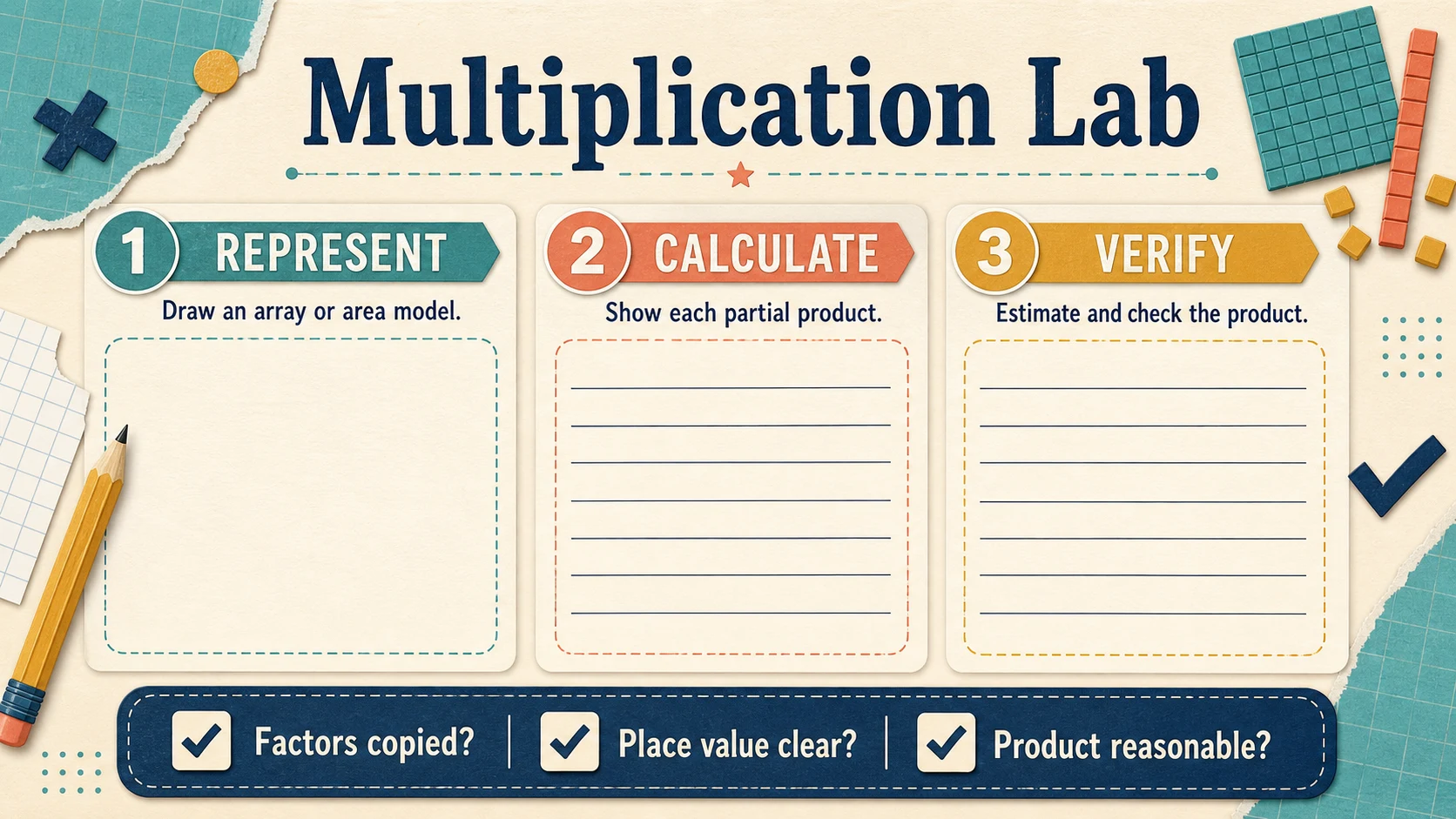
Across repeated upper-grade sessions, alternate supported computation, brief retrieval, explanation, and review instead of using one long block as the sole readiness test.
These observations have boundaries. They do not establish a learning diagnosis, standards mastery, or future outcome. A worksheet captures performance under one set of conditions. Classroom expectations, language demands, prior instruction, and local curriculum order can all change what a response means.
Make the next variation a controlled experiment
Choose one current success and alter exactly one feature.
If the learner can solve with an array, keep the factors and remove the printed array while allowing a self-drawn one. If the learner can solve when the split is supplied, keep the calculation and ask them to choose the split. If the learner can solve with labeled partial-product boxes, keep the numbers and replace the boxes with two blank lines.
Then observe three things: Does the learner start without being told the whole method? Is the strategy mathematically valid? Can the learner explain or check the result? Advance when that evidence appears on more than one comparable item; restore support when the changed feature, rather than the multiplication itself, causes the breakdown.
For the next session, open the free deterministic worksheet generators and create a short set that changes only one chosen feature—factor range, visual support, or number size. Start with one model, solve three to five selected problems, and record the exact prompt the learner no longer needs.
Put it into practice
Use the guide with a real printable
Move from explanation to a short, observable practice task. Check the first item together, then adjust the next session from the learner's actual work.
Open the first free worksheetExplore a neighboring collection
Choose by a different teaching need
Easy and Beginner Addition Worksheets Easy and Beginner Counting Worksheets Easy and Beginner Division Worksheets Easy and Beginner Fractions Worksheets Easy and Beginner Geometry Worksheets Easy and Beginner Money Worksheets Easy and Beginner Sight Words Worksheets Easy and Beginner Subtraction Worksheets