Curated collectionAnswer keys includedPrint-ready PDFs
Easy and Beginner Sight Words Worksheets
Define what easy and beginner sight words practice changes and what it deliberately keeps constant, then compare three checked examples, fading supports and readiness evidence.
Start with a real resource
Browse this worksheet collection
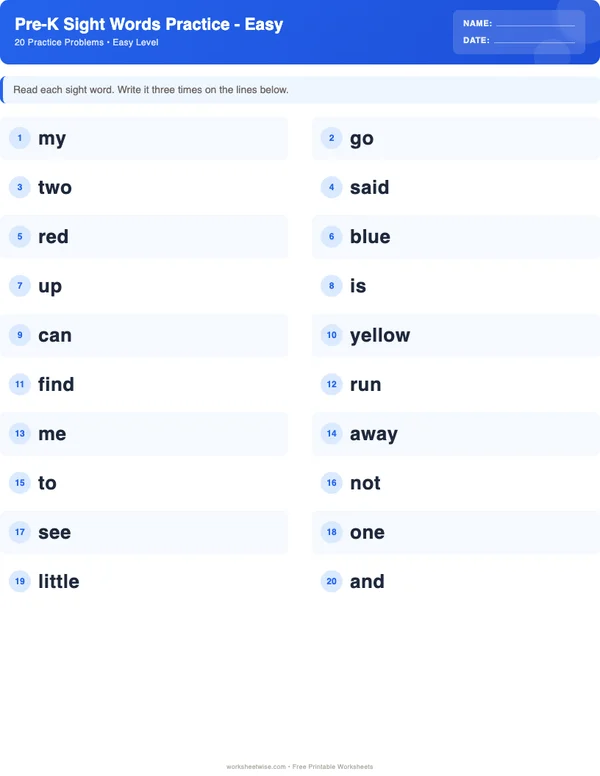
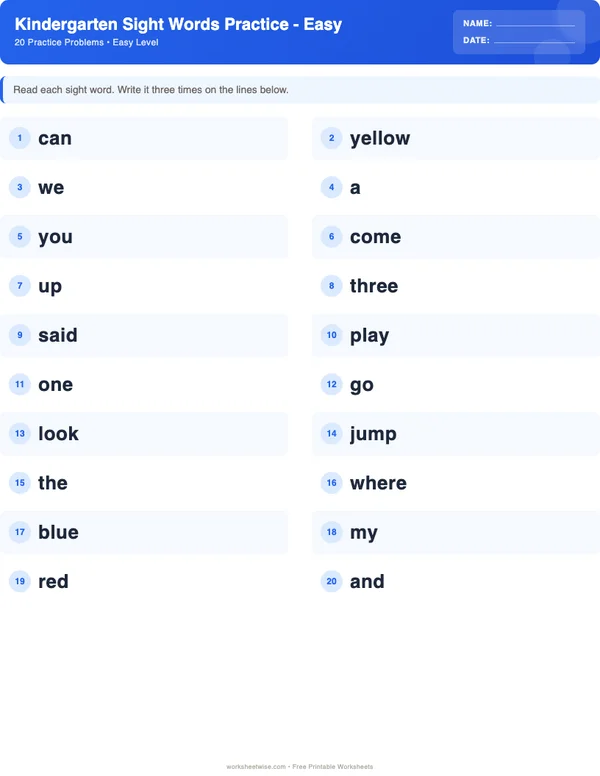
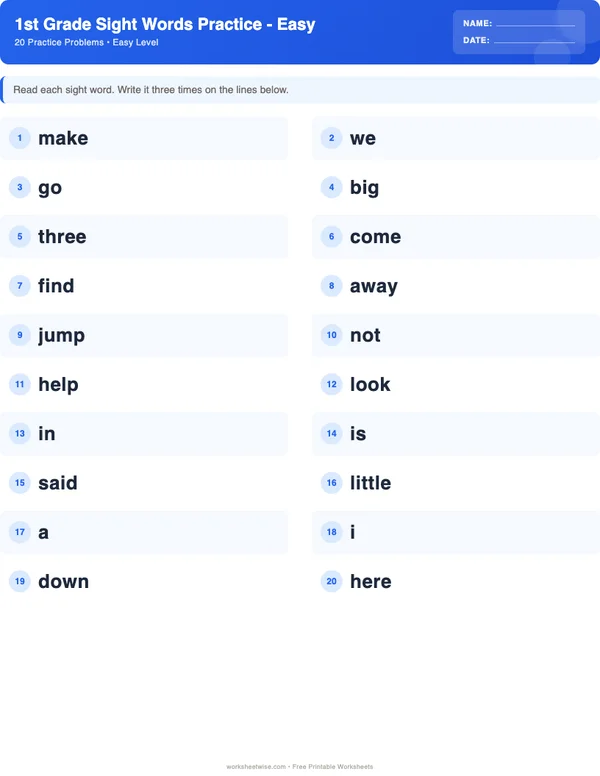
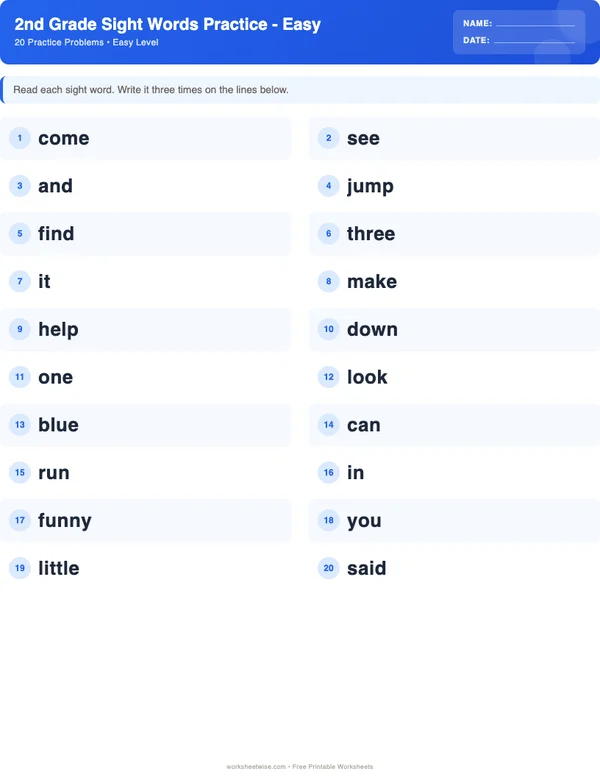
4 relevant free entry points are available. Each one includes a printable learner PDF and separate answer key.
A useful practice loop
Print less. Observe more.
- Choose one skill and model the first item aloud.
- Use a short set and notice the learner’s strategy.
- Change the next task from the work you can see.
Need more than the free sheet?
Plus includes all 24 matching catalogue variations where available, plus saved deterministic generators and the worksheet designer.
See Plus membershipComplete guide
How to teach and practise easy sight words worksheets
3,518 words Updated 6 instructional visuals
What “easy and beginner” means for sight-word practice
Easy and beginner sight words worksheets reduce the number of decisions a learner must make at once. They use a small, visible word set; short directions; familiar sentence structures; generous spacing; and direct supports such as models, tracing, matching, or a word bank. The target remains meaningful: recognize, read, spell, and use high-frequency words accurately.
“Easy” should describe observable task features, never the learner. On this page, it does not mean that every word has a simple spelling, that a sheet should be completed without adult help, or that fast performance matters more than accurate learning.
The live catalogue contains 24 variants across Pre-K, kindergarten, first grade, and second grade, including four free entry points. Each free sheet is labeled easy and contains 20 problems. Those grade labels describe the intended practice level; local curriculum sequences differ. Age and grade are discovery aids, not placement decisions. Select a sheet by watching what the learner can do with its actual words, directions, print demands, and sentence contexts.
Easy practice deliberately changes:
- how many words appear together;
- how much visual and oral support is available;
- how long the learner must remember a word before seeing it again;
- whether the response is matching, tracing, copying, recalling, or using;
- how complex the surrounding sentence is.
It deliberately keeps constant:
- attention to the complete printed word;
- connection between speech sounds and letters;
- accurate reading rather than guessing from a picture or first letter;
- repeated encounters with previously taught words;
- movement toward reading words in connected text.
The IES foundational reading practice guide recommends linking speech sounds with letters, teaching learners to decode and analyze words, and ensuring that they read connected text daily. That guidance is broader than this catalogue and did not evaluate WorksheetWise. It does, however, clarify an important boundary: a sight-word sheet should complement phonics and connected reading, not replace either one.
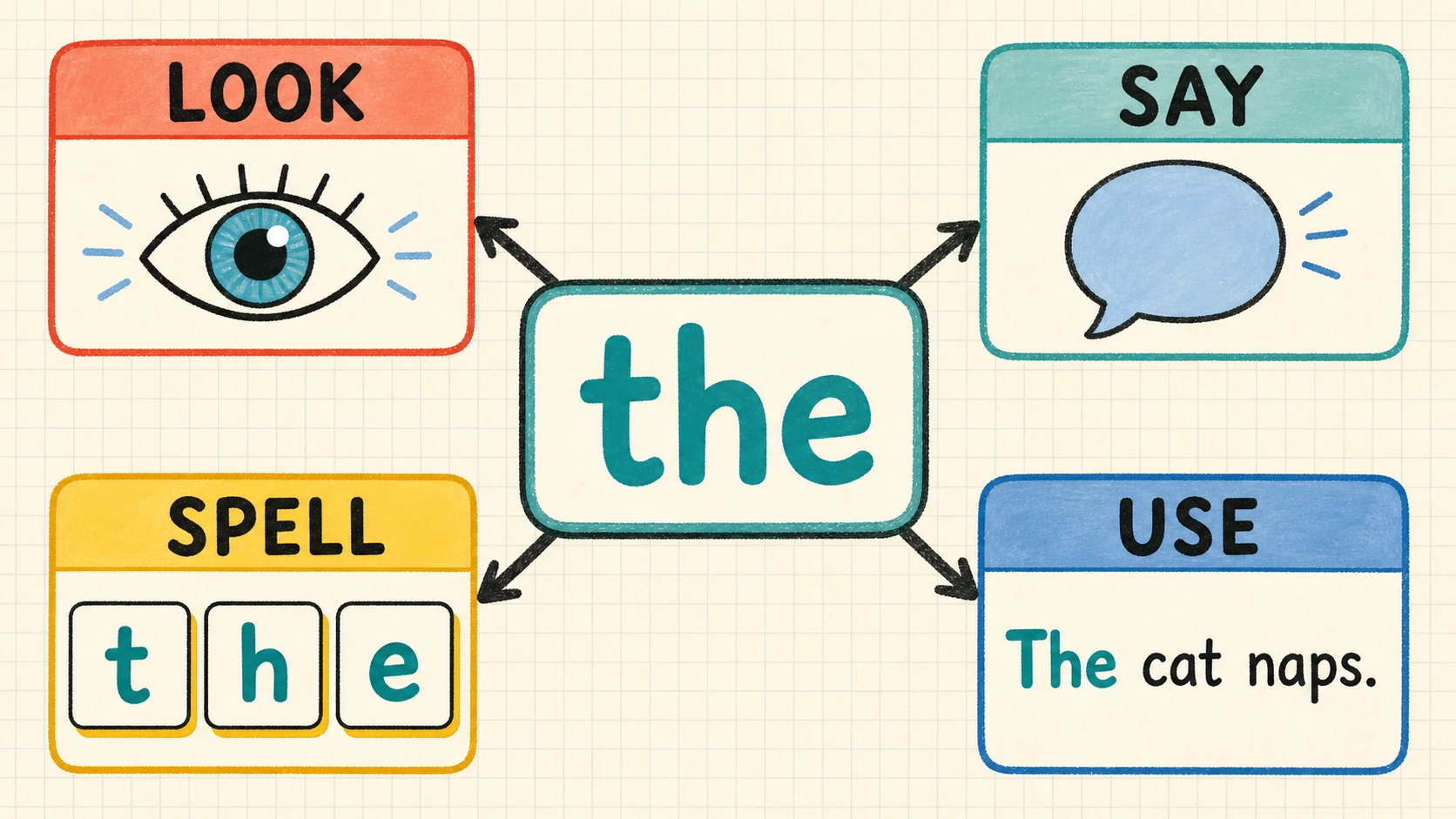
An easy first-grade task can connect seeing, saying, spelling, writing, and reading a word without increasing all five demands at once.
The skill is recognition built from careful word study
A sight word is a word a reader can recognize accurately without laboriously working through it on every encounter. That does not require teaching the word as an indivisible picture. Many high-frequency words contain regular sound-letter relationships, and even irregular words usually contain some regular parts.
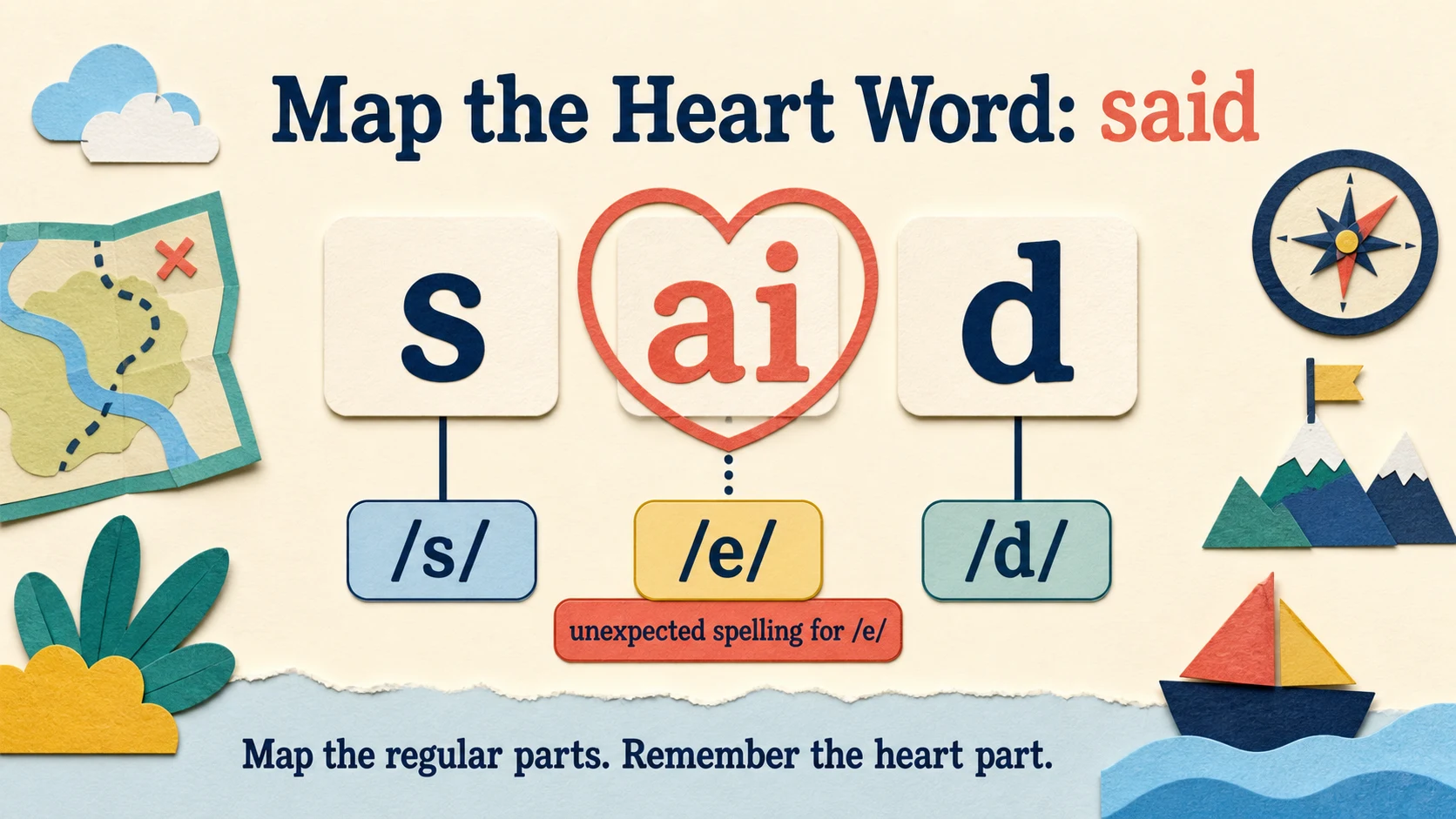
Consider said. In the common pronunciation /sed/, the initial s and final d represent expected sounds. The middle spelling ai is the part that does not represent its usual sound. A useful beginner explanation is:
- Say said.
- Stretch the sounds: /s/ /e/ /d/.
- Match s with /s/ and d with /d/.
- Mark ai as the part to remember.
- Read the whole word: said.
- Use it: “Maya said yes.”
This is more informative than asking the learner to memorize the outline of said. It also avoids the opposite mistake of requiring the learner to decode the word independently before the relevant spelling has been taught.
The catalogue describes tracing, writing, finding words in sentences, using words in context, and reading short passages. These response modes can serve the same word knowledge, but they are not interchangeable. Tracing checks whether a learner can follow a model. Writing from memory asks for recall. Finding a word among alternatives asks for visual discrimination. Reading it in a sentence adds meaning and connected-text demands.
Easier features nearby
A nearby easier variation might:
- present one known word and two clearly different choices;
- let the learner place a card on a matching word;
- keep the printed model visible during tracing or copying;
- ask for an oral response rather than handwriting;
- repeat one sentence frame: “I see ___.”
For a three- or four-year-old, begin here with brief adult-led oral, matching, manipulative, and movement work rather than extended desk work. Put word cards on the floor, say one word, and invite the child to step to its match. Stop while attention is still available.
Harder features nearby
A nearby harder variation might:
- mix visually similar words such as was, saw, and want;
- remove the model before spelling;
- place the word in a sentence without a word bank;
- require a sentence to be written and reread;
- mix new words with older words after a delay;
- use a short passage in which pictures do not reveal the answer.
The word itself need not change. Moving said from trace-and-read to independent sentence reading changes the task difficulty while keeping the target word constant.
Three checked words show three different beginner decisions
“Sight word” describes the goal of recognition, not one spelling category. Adults should inspect each word instead of applying the same memorization prompt to every item.
Example 1: and needs blending, then quicker recognition
The word and is a checked beginner example because its three letters support a straightforward sound-by-sound analysis in its usual isolated pronunciation: /ă/ /n/ /d/. Show and, point under each spelling, blend it, and then read it normally.
A supported item could ask the learner to circle and in:
cats and dogs
This belongs at the easy level because the target is shown, the phrase is short, and the alternatives are visually different. Yet the learner must still inspect all three letters. If the learner circles dogs after hearing the phrase, the response may reflect attention to meaning rather than recognition of and.
Fade support by removing the model and offering and, an, and at. That is harder because the alternatives share letters. Use it only after the learner can read and with the model and in a simple phrase.
Example 2: the needs attention to pronunciation and context
In the, th represents the opening sound, while the final e does not operate like the final e in made. The word can also be pronounced with a reduced vowel, as in “the cat,” or with a long vowel, as in “the end.” Accept either natural pronunciation when context supports it; do not turn accent or ordinary speech variation into an error.
Try:
Point to the in “The dog is wet.”
Then ask the learner to reread the sentence while tracking each word. This belongs here because the sentence is short, the target appears once, and the surrounding words can be handled orally with adult support. Capital The is still the same word, but capitalization adds a small visual variation worth teaching explicitly.
A false signal appears if the learner recognizes lowercase the on a card but pauses at The in a sentence. That pause does not necessarily mean the word was forgotten. The changed case and the work of tracking connected print may be the actual difficulty.
Example 3: was should not be guessed from its first letter
In a common pronunciation of was, the opening w is expected, while the vowel and final s do not match the most common beginner pronunciations a learner may know. Say the word naturally, map what can be mapped, and mark the unexpected spellings for attention.
Use a controlled choice:
“The cup ___ red.”
was with went
The answer is was, producing “The cup was red.” This example belongs at the easy level only if the learner has already been taught was and the sentence is read aloud when needed. It checks recognition in a meaningful frame. It should not be presented as a puzzle to solve from grammar alone.
To verify recognition, move the choices or show was later without the sentence. If the learner consistently chooses whichever word occupies the first position, the issue is response strategy, not word knowledge.
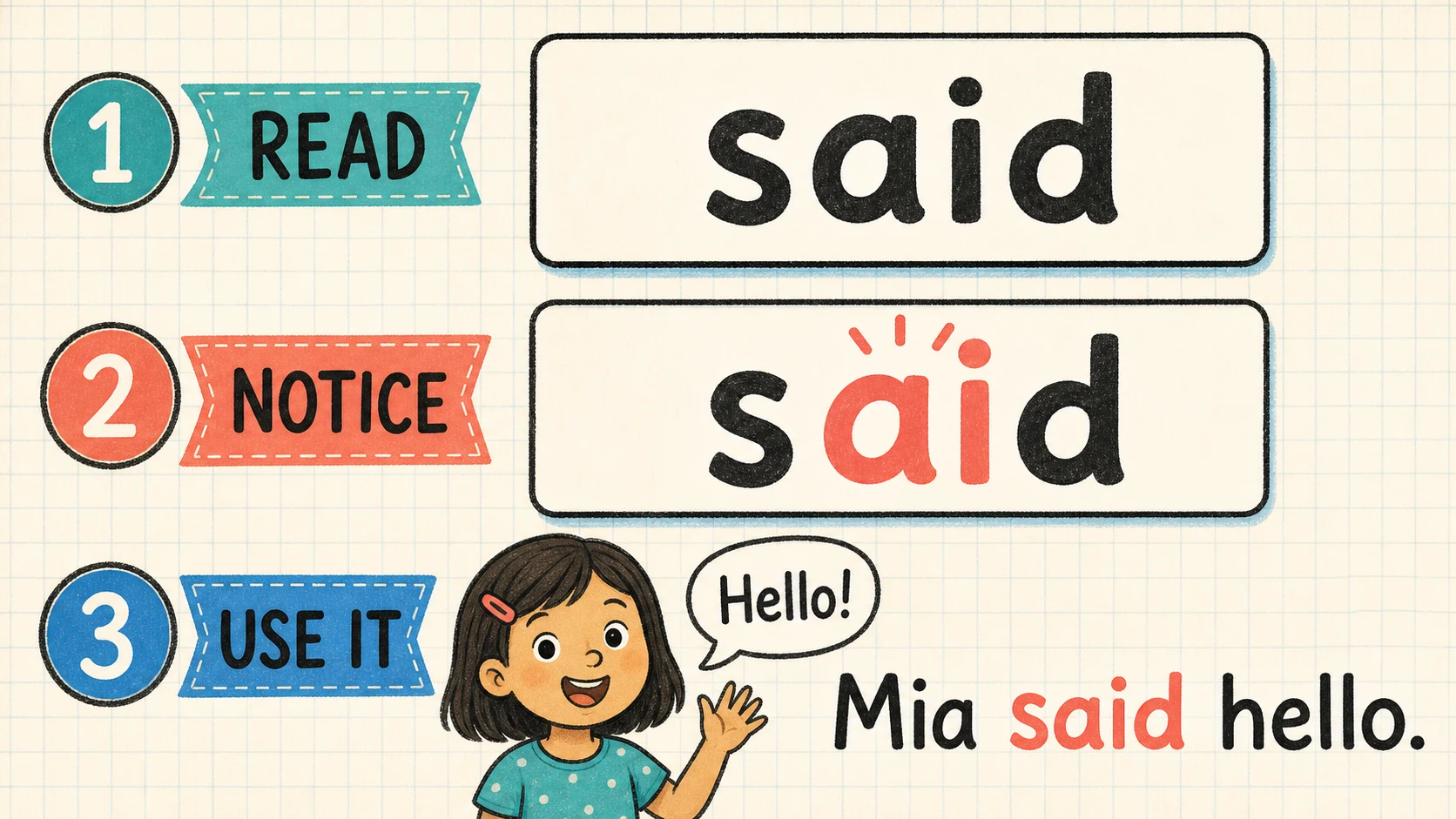
The model earns its place when it makes the spelling visible first and is then removed for a genuine recall check.
A fourth example separates reading from handwriting
Example 4: reading of accurately without making writing the gatekeeper
The common pronunciation of of does not use the most typical beginner sound for either letter: o represents /ŭ/, and f represents /v/. Teach the spoken word, point out both unexpected correspondences, and practice the whole word.
Place two cards on the table:
of on
Say, “Touch of.” Then reverse their positions and ask again. Finally, use:
a cup of milk
This belongs at the beginner level because the learner can answer by pointing, the field has only two choices, and the phrase provides meaning. Reversing the cards checks whether the learner attended to the word rather than its location.
Now ask the learner to copy of. A shaky or reversed letter does not cancel accurate reading. Reading the word and forming its letters are related but distinct demands. The IES elementary writing guide recommends building fluency with handwriting, spelling, and sentence construction. That source supports giving those skills explicit practice; it does not justify using handwriting neatness as the sole measure of sight-word recognition.
For a learner whose handwriting is effortful, accept pointing, moving a word card, saying the word, or selecting it with eye gaze while continuing separate handwriting instruction.
Select the sheet by task evidence, not by the cover label
Begin with a three-minute preview rather than assigning all 20 problems immediately. Choose four representative items: one direct match, one trace or copy, one independent recognition item, and one sentence item. Observe the kind of help required.
A good starting variation usually has these features:
- Most directions can be understood after one adult model.
- The learner can attend to the complete word, not merely its first letter.
- At least some target words are already familiar from instruction.
- Errors are few enough to discuss without turning every item into a correction.
- The response mode does not hide reading knowledge behind cutting, writing, or lengthy language demands.
- The learner can finish a short sample while remaining attentive.
Select the Pre-K Sight Words guide and free sheet for a child who benefits from adult-led naming, matching, card movement, and very short turns. For ages three and four, use individual items as prompts rather than expecting a full desk-work session.
The Kindergarten Sight Words guide and free sheet is a more suitable starting point when the learner can follow a simple page direction, match printed forms, and participate in brief sound-letter analysis. Choose the 1st Grade Sight Words guide and free sheet when phrase and sentence work is productive rather than overwhelming. Use the 2nd Grade Sight Words guide and free sheet when the learner needs easy task architecture but can work with broader reading and writing contexts.
These are selection suggestions based on observable task demands, not sourced placement rules. A seven-year-old may need the kindergarten entry point for an unfamiliar word set; a younger learner may recognize some first-grade words. Age helps locate resources, but performance on the actual task determines the starting variation.
At the second-grade entry point, “easy” can still mean a small word set and explicit models even when the learner reads the words in sentences.
Use a short routine that exposes what the learner knows
Before the page: teach, do not test
Choose three target words, not all 20 items. For each word:
- Show it and say it.
- Have the learner repeat it.
- Attend to the sounds and corresponding letters.
- Identify any unexpected spelling.
- Read the whole word.
- Say a short sentence containing it.
This routine is a page-use suggestion drawn from the catalogue’s supplied teaching guidance. The recommendation to connect sounds, letters, decoding, word analysis, and word recognition is also consistent with the IES reading guide. Neither source establishes that one fixed routine fits every learner.
During the page: model one, solve two, check one
Complete one item together. On the next two, wait before helping. If assistance is needed, use the smallest useful prompt:
- “Look through the whole word.”
- “Say the sounds you know.”
- “Which part is unexpected?”
- “Read the sentence again.”
- “Check the ending.”
After three attempts, insert a no-model check. For example, after tracing said, cover it and ask the learner to build said from letter tiles or choose it from three cards. Tracing alone cannot establish recall.
Teach a few words, complete a small cluster of items, and finish with reading rather than treating the full sheet as one uninterrupted test.
After the page: return the word to reading
Use one or two sentences that the learner can otherwise read with reasonable support. Ask the learner to track the print and find the target word after reading. The IES reading guide specifically recommends daily connected-text reading to support accuracy, fluency, and comprehension. A worksheet can prepare a word for that use, but repeated isolated cards are not connected text.
Do not demand speed on the first accurate attempts. A brief pause while checking letters is useful. Over later encounters, look for smoother recognition without prompting.
Fade one support at a time
Support fading is more informative when only one task feature changes. If the adult removes the model, enlarges the word set, adds similar distractors, and introduces a passage simultaneously, a new error cannot reveal which change caused the difficulty.
Use this sequence for a taught word such as said:
- Match said to an identical model.
- Trace said while naming its letters.
- Copy said with the model visible.
- Choose said from said, sit, and sand.
- Build or write said after the model is covered.
- Read “Lena said stop.”
- Find and read said in a short passage.
- Read it accurately on a later day without advance rehearsal.
Move forward after accurate, increasingly independent responses. If step five breaks down, restore the model briefly, study the unexpected ai, and try recall again. Do not automatically send the learner back to tracing ten times; tracing may practice movement without repairing the memory problem.
The supplied catalogue guidance suggests retiring a review card only after the learner reads it correctly on three separate occasions. That is a practical catalogue routine, not a universal research threshold. Treat it as a conservative organizational rule: record the date, context, and level of prompting so three responses are genuinely separate checks.
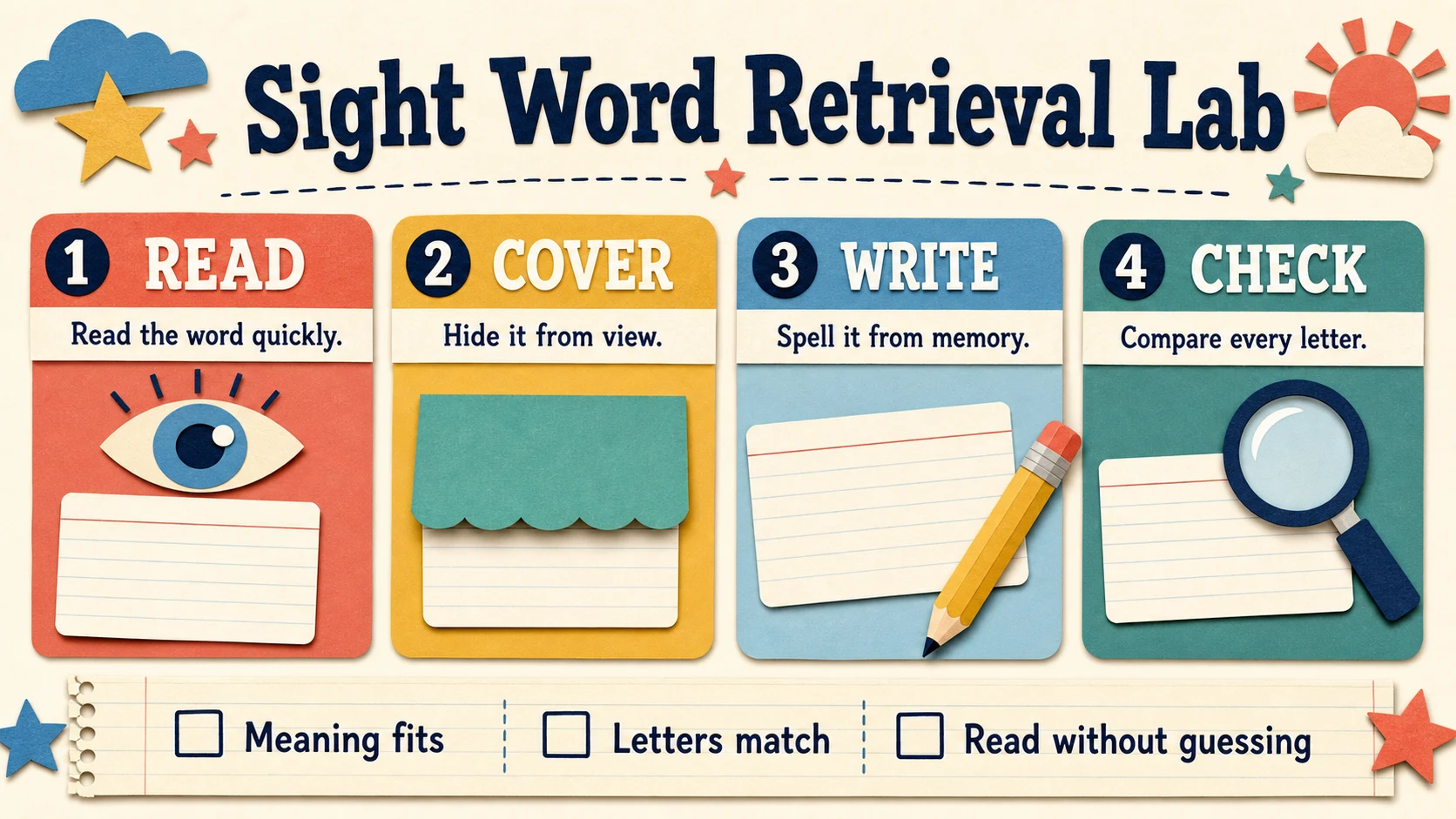
A review plan should revisit taught words after delays and in phrases or sentences, not merely repeat the same completed page.
False difficulty signals can send practice in the wrong direction
A page may look hard for reasons unrelated to sight-word recognition.
The learner reads correctly but writes slowly
Handwriting speed, pencil grip, copying distance, and letter formation can consume attention. Let the learner point, circle, stamp, or place a card for some responses. Preserve a smaller amount of separate writing practice. This adaptation keeps the target word and the need for accurate recognition intact.
The learner knows the word but not the direction
“Underline,” “complete,” “select,” and “use in context” may be unfamiliar. Demonstrate the action with a nontarget word. If the learner then completes the sight-word item, direction vocabulary caused the initial breakdown.
A familiar word appears in an unfamiliar form
Capitalization, font shape, tight spacing, or placement in a sentence can interrupt recognition. Compare the and The directly. Keep the letters clear; do not train recognition through decorative fonts or word silhouettes.
Pictures make guessing successful
If the sentence says “I see a ___” beside a dog, the learner can say dog without reading. Cover the picture or swap it after the first response. Sight-word recognition requires evidence from print.
Speed is mistaken for mastery
A fast first-letter guess can look fluent. Ask the learner to compare was, with, and went, or to identify the last letter. Accuracy across changed positions and later occasions is stronger evidence than one rapid response.
Vocabulary or sentence syntax blocks the response
A learner may recognize every word yet not understand a sentence. Read the sentence aloud and discuss its meaning. The Common Core ELA framework presents literacy as an integration of reading, writing, speaking, listening, and language across content. It does not prescribe this worksheet sequence, and local standards may differ, but it reinforces why isolated word naming is only one part of literacy use.
Read errors as information before adding repetition
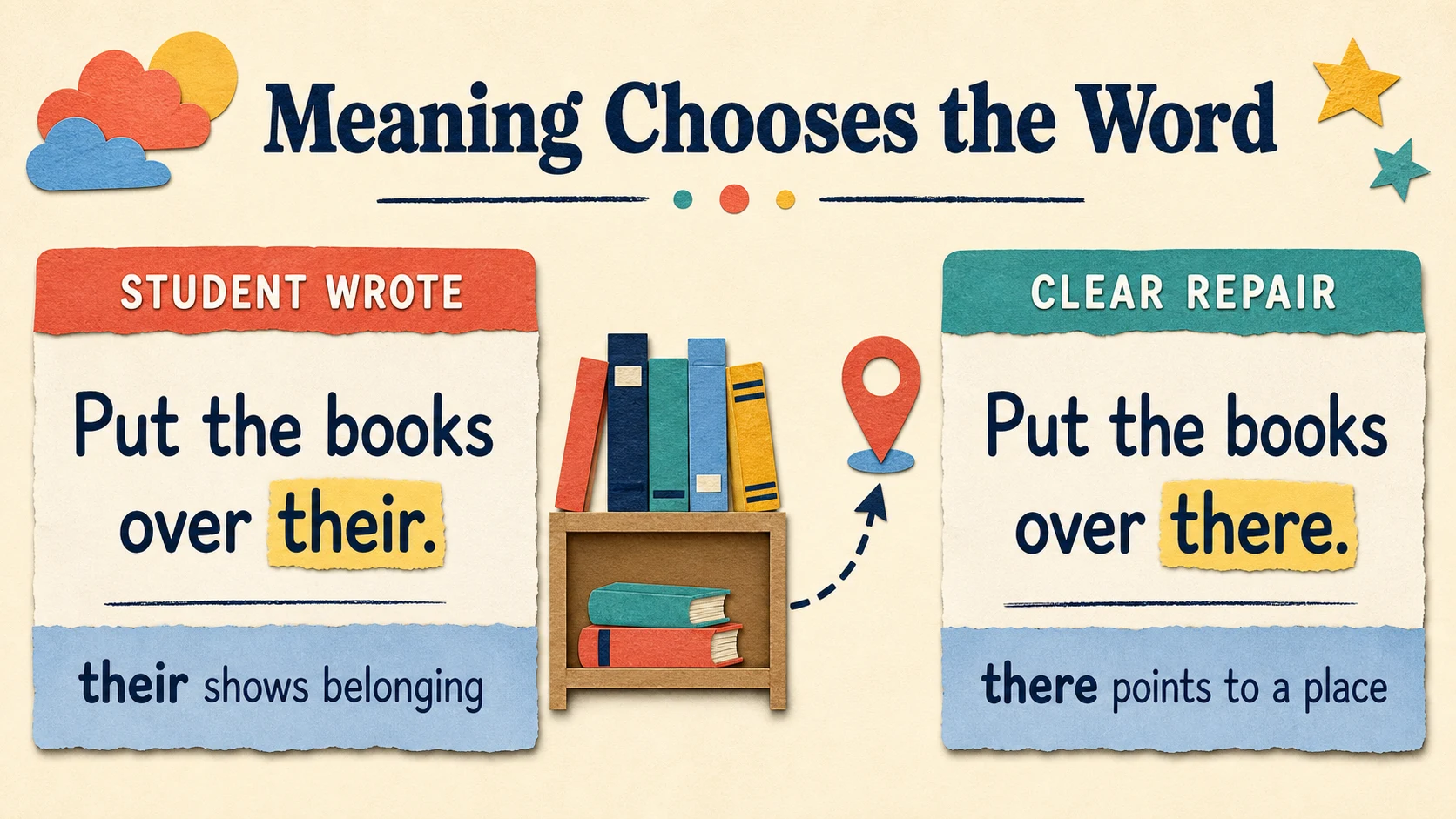
The useful response depends on whether the learner guessed, confused spellings, lost the word after a delay, misunderstood the sentence, or was blocked by the response format.
When an error occurs, record what the learner actually did.
If and becomes at, the learner attended to the beginning but not the ending. Place the words side by side, underline nd and t, and reread both.
If was becomes saw, the letters were present but their order was not secure. Build both words with tiles, move the letters, and read each result. More picture cues would not address the error.
If the learner reads said with the model but cannot retrieve it after covering, recognition with support is ahead of recall. Shorten the delay, restudy ai, then cover and retry.
If of is read correctly on a card but missed in “a box of pens,” connected-print tracking may be the issue. Point under each word while rereading, then withdraw the pointer.
If a learner gives the correct word orally but writes another spelling, separate reading evidence from spelling evidence. Revisit the spoken sounds and remembered letters; do not report the word as wholly unknown.
These patterns guide the next teaching response, but they do not diagnose a reading disorder, attention condition, visual problem, or any other condition. Persistent concerns across instruction and contexts should be documented and discussed with the learner’s teacher or an appropriately qualified professional.
Adapt access without removing the sight-word decision
An adaptation preserves the target when the learner still has to identify, read, recall, spell, or use the word.
Useful adaptations include:
- enlarging print while keeping the full word visible;
- reducing a 20-problem sheet to four or five items per sitting;
- covering surrounding rows to reduce visual crowding;
- reading directions aloud;
- allowing a spoken, pointing, card, or eye-gaze response;
- replacing pencil copying with letter tiles before returning to writing;
- giving movement breaks between short practice rounds;
- previewing sentence vocabulary without revealing the target answer.
An adaptation stops measuring the target when an adult says each answer immediately before the learner marks it, a picture uniquely reveals every word, choices remain in memorized positions, or the learner copies without ever reading.
For ages three and four, cut apart a few items only if safe and practical, use cards or magnetic letters, and keep the exchange oral and playful. Ask the child to match, hand over, step toward, or place a word. The full sheet can function as an adult’s source of prompts rather than as required seatwork.
Decide the next variation from readiness evidence
Move to a less-supported variation when the learner:
- reads the target accurately in more than one position or print context;
- attends to the middle and ending, not only the first letter;
- succeeds after the model is removed;
- recalls the word on a later occasion;
- reads it in a short sentence without relying on a picture;
- can explain or demonstrate the unexpected spelling when relevant;
- maintains accuracy when one support is removed.
Keep the present variation when responses are accurate only with a visible model, but attention and confidence are growing. Change the teaching response when the same specific confusion recurs. Move to an easier response mode when handwriting, directions, crowding, or session length masks reading knowledge.
A harder next step should change one feature: add a similar distractor, remove the word bank, increase the recall delay, shift from phrase to sentence, or ask for spelling from memory. Do not equate “harder” with smaller print, longer worksheets, trick directions, or time pressure. Those additions can raise burden without improving the sight-word decision.
No worksheet can by itself establish broad reading fluency, comprehension, grade placement, or a diagnosis. Grade labels indicate intended practice level, and curriculum sequences vary. Use the page as one source of observable evidence alongside oral reading, phonics work, writing, and discussion.
Make the next choice with one four-item check
Choose a grade entry point from the full worksheet library, then preview only four items: a match, a modeled written response, an unmodeled recognition item, and a sentence item. Note whether the learner succeeds independently, after one prompt, or only after the answer is supplied.
Tomorrow, repeat one word without the completed sheet in view. If it remains accurate, remove one support on the next variation. If it does not, reteach the word’s regular and unexpected parts before assigning more repetitions. That single delayed check gives you a concrete next action and a better basis for choosing among the catalogue’s easy sight-word variations.
Put it into practice
Use the guide with a real printable
Move from explanation to a short, observable practice task. Check the first item together, then adjust the next session from the learner's actual work.
Open the first free worksheetExplore a neighboring collection
Choose by a different teaching need
Easy and Beginner Addition Worksheets Easy and Beginner Counting Worksheets Easy and Beginner Division Worksheets Easy and Beginner Fractions Worksheets Easy and Beginner Geometry Worksheets Easy and Beginner Money Worksheets Easy and Beginner Multiplication Worksheets Easy and Beginner Subtraction Worksheets