What 6th Grade Geometry Should Cover
Sixth-grade geometry practice should strengthen a learner’s ability to describe shapes by their properties, distinguish perimeter from area, calculate measurements accurately, interpret points on a coordinate plane, and explain geometric reasoning with diagrams, numbers, and units. Begin with visual or concrete models when understanding is uncertain, then move toward drawings, formulas, and independent problem solving.
The learner’s work should determine the pace. A student who calculates accurately but cannot explain what a number represents needs more modeling, not simply more problems. A student who understands the model but makes occasional arithmetic errors may need short computation review alongside geometry.
Grade labels describe an intended practice level, not a universal timetable. Local curricula and teaching sequences differ. The Common Core State Standards for Mathematics provide one useful view of how geometric ideas develop, but families and educators should compare any resource with their own school or homeschool sequence.
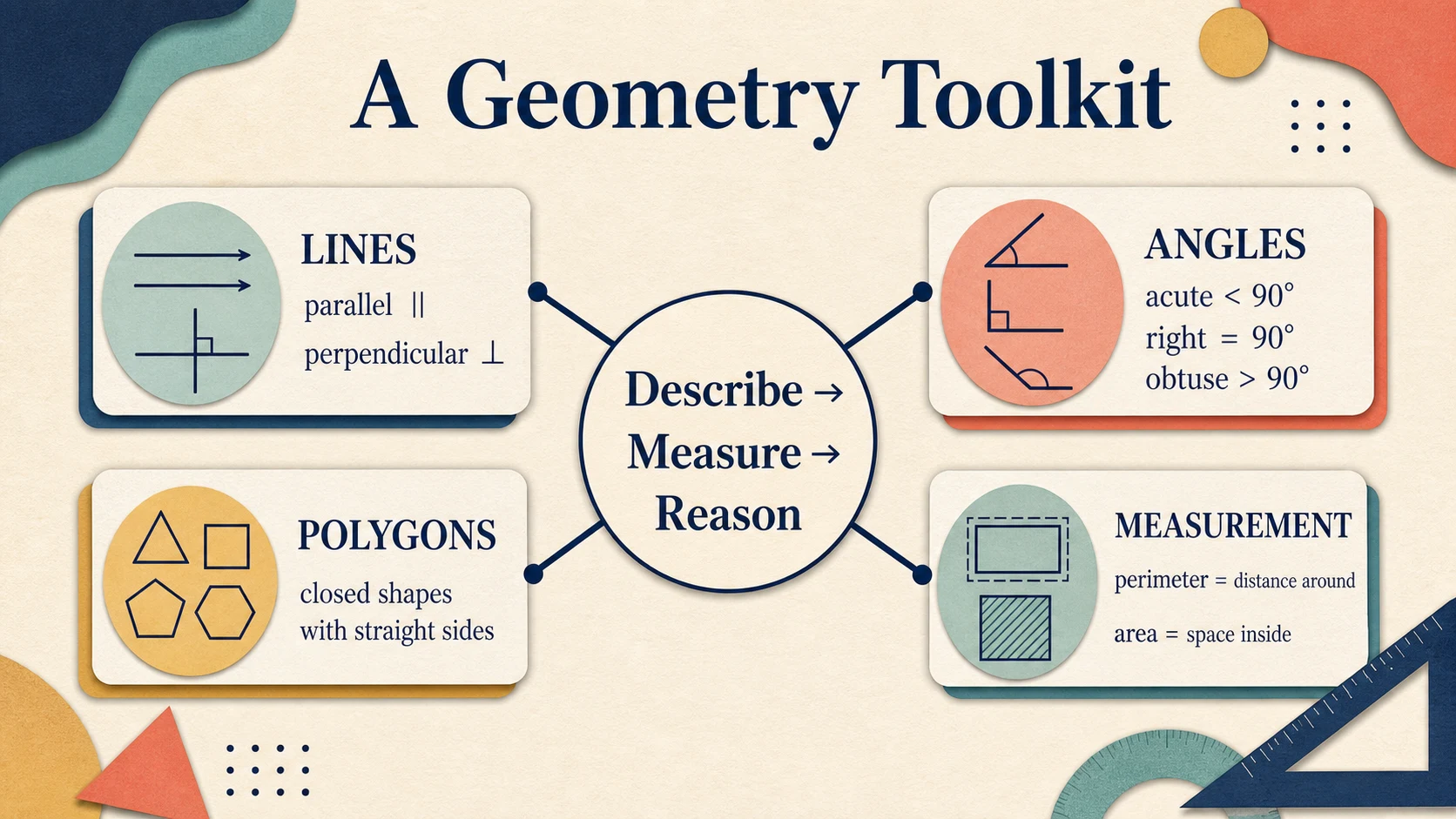
The major skills connect through properties, measurement, spatial reasoning, and mathematical explanation.
Prerequisites to Check Before Teaching
A learner does not need perfect mastery of every earlier skill. However, several prerequisites make 6th Grade Geometry more manageable.
Shape properties and classification
Ask the learner to identify common two-dimensional shapes and describe them without relying only on appearance. Useful properties include:
- Number of sides and vertices
- Equal or unequal side lengths
- Right, acute, and obtuse angles
- Parallel or intersecting sides
- Symmetry
- Whether a figure belongs to more than one category
Present shapes in varied orientations. A triangle remains a triangle when it points down or sits on a narrow side. A square rotated to resemble a diamond is still a square because its side lengths and angles have not changed.
When a learner names shapes only by how they “look,” return to property language. Ask, “Which facts about the sides and angles prove your answer?”
Whole-number and decimal computation
Perimeter and area problems depend on reliable addition and multiplication. Some learners understand the geometry but lose accuracy while calculating. Separate those issues during diagnosis.
For example, if a learner writes the correct expression 2(8+5) but evaluates it as 24, the geometric setup is sound; the arithmetic needs attention. If the learner writes 8×5 for perimeter, the difficulty is conceptual.
Units and measurement
Check whether the learner distinguishes linear and square units:
- A side length may be measured in centimeters.
- Perimeter is also measured in centimeters.
- Area is measured in square centimeters.
A square centimeter is a square measuring one centimeter on each side. It is not simply the word “centimeter” with a small 2 added as decoration. Building rectangles with square tiles helps make the unit visible.
Coordinate-plane foundations
The supplied sixth-grade catalogue includes plotting ordered pairs in all four quadrants as part of the wider mathematics progression. Before assigning extended coordinate work, check that the learner can:
- Identify the horizontal x-axis and vertical y-axis
- Locate the origin, (0,0)
- Read an ordered pair as (x,y)
- Move horizontally for x, then vertically for y
- Interpret positive and negative directions
If negative numbers are still new, coordinate work can provide a useful visual context, but it should not become a test of several unfamiliar ideas at once.
A Grade-Appropriate Teaching Progression
The table below is a practical sequence, not a claim that every school teaches the topics in this order.
| Stage |
Main focus |
Helpful model |
Evidence that the learner is ready to continue |
| 1 |
Name and classify shapes |
Cutouts, pattern blocks, traced figures |
Describes shapes by properties in different orientations |
| 2 |
Separate perimeter from area |
String around shapes and square tiles inside them |
Identifies whether a question concerns boundary or surface |
| 3 |
Calculate rectangle measurements |
Grid paper and labeled diagrams |
Chooses addition or multiplication appropriately and uses units |
| 4 |
Compare figures |
Tile-built rectangles and tables |
Explains how equal areas can have different perimeters |
| 5 |
Reason about angles |
Corners, hinged strips, transparent protractor |
Classifies angles and measures when required |
| 6 |
Work on coordinate planes |
Graph paper |
Plots and reads ordered pairs in all four quadrants |
| 7 |
Solve mixed problems |
Unlabeled diagrams and short word problems |
Selects a method without being told the operation |
| 8 |
Explain and check |
Written justification, estimation, inverse checks |
Defends an answer and notices unreasonable results |
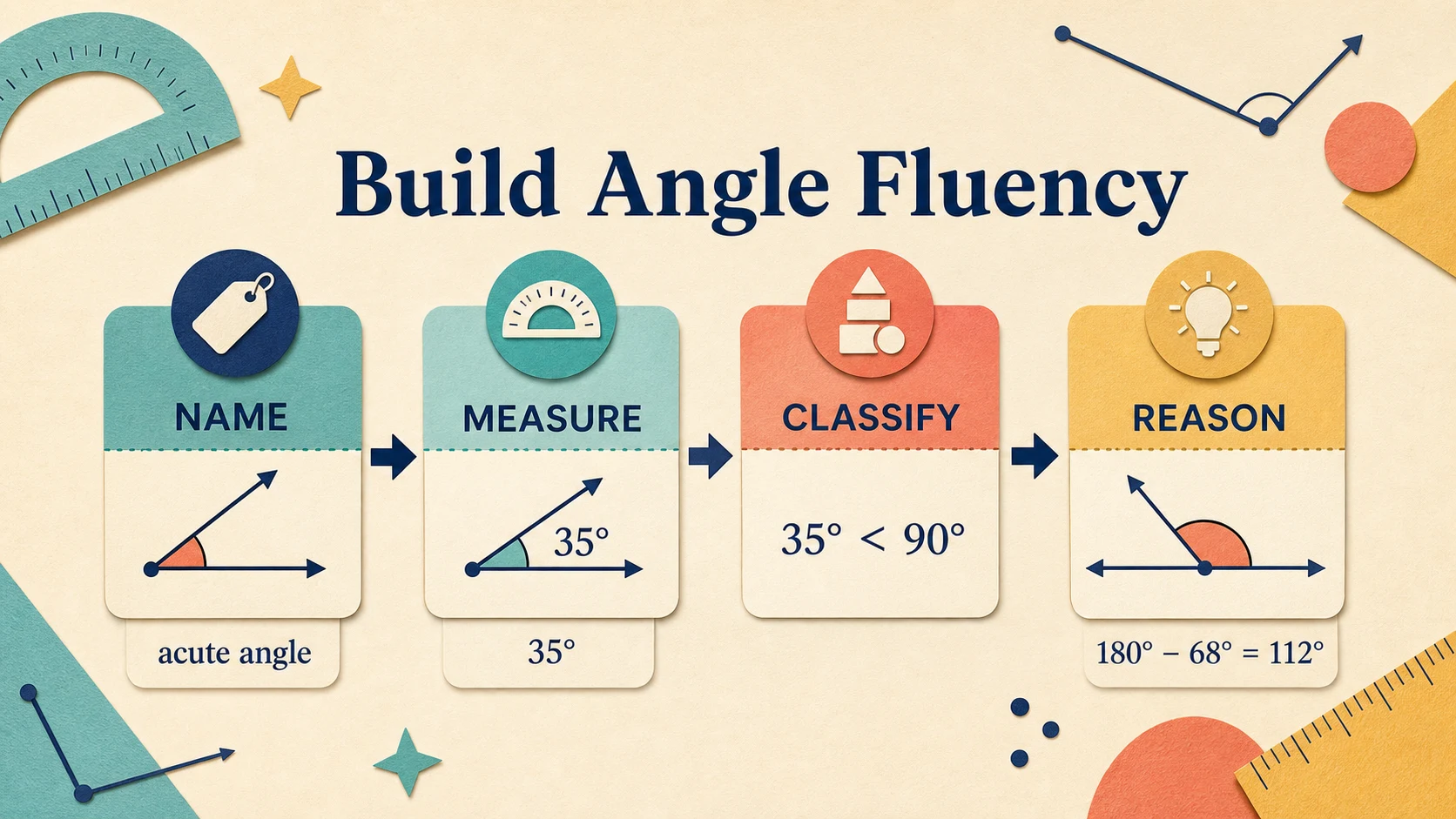
Support should fade as the learner demonstrates accurate choices, calculations, and explanations.
Do not move forward based only on the number of completed pages. Look for three kinds of evidence:
- Conceptual understanding: Does the learner know what is being measured or classified?
- Procedural accuracy: Can the learner carry out the calculation or plotting process?
- Reasoning: Can the learner explain why the method fits?
The IES guide on assisting students who struggle with mathematics offers high-level instructional guidance that includes systematic teaching, careful use of representations, and regular review. This supports using a deliberate progression when a learner’s work shows persistent gaps. It does not evaluate WorksheetWise materials or prescribe one timetable for every child.
Concrete and Visual Models That Clarify Geometry
Perimeter as a boundary
Use string, craft sticks, or a finger tracing around a shape. The key question is: “How far is it all the way around?”
Have the learner mark a starting point and trace each outside edge once. This prevents skipped or repeated sides. On an irregular figure, write each side length beside the corresponding edge before adding.
A useful physical comparison is a fence around a garden. The fence follows the boundary; it does not cover the ground inside.
Area as a covering
Cover a rectangle with equal square tiles, leaving no gaps and no overlaps. Count the tiles. Then arrange them into rows and columns.
For a rectangle with 4 rows of 6 tiles, the learner can see:
6+6+6+6=24
and then connect repeated addition to:
4×6=24
This makes A=l×w a summary of the tile structure rather than an unexplained rule.
The catalogue teaching guidance recommends beginning area and perimeter with square tiles and edge units. That is an instructional suggestion grounded in the supplied topic information. Adults can extend it by asking learners to sketch the tiled model after building it.
Angles as turns or openings
Two hinged strips, the corner of a book, or an opening door can model angle size. Emphasize that longer rays do not create a larger angle. The amount of turn or opening determines the angle.
Use a right-angle corner as a benchmark:
- Less than a right angle is acute.
- Exactly a right angle is 90∘.
- Greater than a right angle but less than a straight angle is obtuse.
- A straight angle is 180∘.
When measuring, place the protractor’s center at the vertex and align its baseline with one ray. A student who reads the wrong scale may still understand angle size; the correction should focus on choosing the scale that begins at zero on the aligned ray.
Coordinates as movement
Use graph paper and verbalize each ordered pair:
- Start at the origin.
- Read x first and move horizontally.
- Read y second and move vertically.
- Mark and label the point.
For (−3,2), move 3 units left and 2 units up. For (3,−2), move 3 units right and 2 units down. Comparing these two points helps expose sign and order errors.
The IES early-mathematics practice guide emphasizes, at a broad level, helping learners connect mathematical ideas with representations and mathematical language. Although its scope is younger children, that framing remains useful when selecting models: the object or picture should reveal the idea, and the adult should explicitly connect it to symbols and words.
Fully Checked Worked Examples
Example 1: Perimeter of a rectangle
A rectangle has a length of 9 centimeters and a width of 4 centimeters. Find its perimeter.
Perimeter is the distance around the boundary. A rectangle has two sides of each length:
P=9+4+9+4
P=26
The equivalent formula is:
P=2(l+w)=2(9+4)=2(13)=26
Answer: 26 cm.
Check by pairing equal sides:
9+9=18,4+4=8,18+8=26
The unit is linear because the problem asks for distance around the figure.
Example 2: Area of a rectangle
A rectangular poster is 12 inches long and 7 inches wide. Find its area.
Area measures the surface covered. Multiply the number of unit squares in each row by the number of rows:
A=l×w
A=12×7=84
Answer: 84 square inches, or 84 in2.
Check by decomposition:
12×7=(10×7)+(2×7)=70+14=84
The square unit distinguishes the area from a length.
Example 3: Equal area, different perimeter
Two rectangles are made with 24 square tiles.
- Rectangle A measures 6 units by 4 units.
- Rectangle B measures 8 units by 3 units.
First compare their areas:
AA=6×4=24 square units
AB=8×3=24 square units
The areas are equal.
Now calculate the perimeters:
PA=2(6+4)=2(10)=20 units
PB=2(8+3)=2(11)=22 units
Answer: Both rectangles have an area of 24 square units, but Rectangle A has a perimeter of 20 units and Rectangle B has a perimeter of 22 units.
This example disproves the assumption that equal area guarantees equal perimeter.
Example 4: A missing side length
A rectangle has an area of 54 cm2 and a width of 6 centimeters. Find its length.
Use the area relationship:
A=l×w
Substitute the known values:
54=l×6
Find the number that multiplied by 6 gives 54:
l=54÷6=9
Answer: The length is 9 cm.
Check:
9×6=54 cm2
Notice that the missing side is measured in centimeters, not square centimeters.
Example 5: Plotting and comparing points
Plot A=(−4,3) and B=(−4,−2). What do the points have in common, and how far apart are they vertically?
Both points have an x-coordinate of −4, so they lie on the same vertical line.
To find the vertical distance, count from −2 to 3:
3−(−2)=3+2=5
Answer: The points share x=−4 and are 5 units apart vertically.
Check by counting graph intervals: from −2 to 0 is 2 units, and from 0 to 3 is 3 units. Therefore:
2+3=5
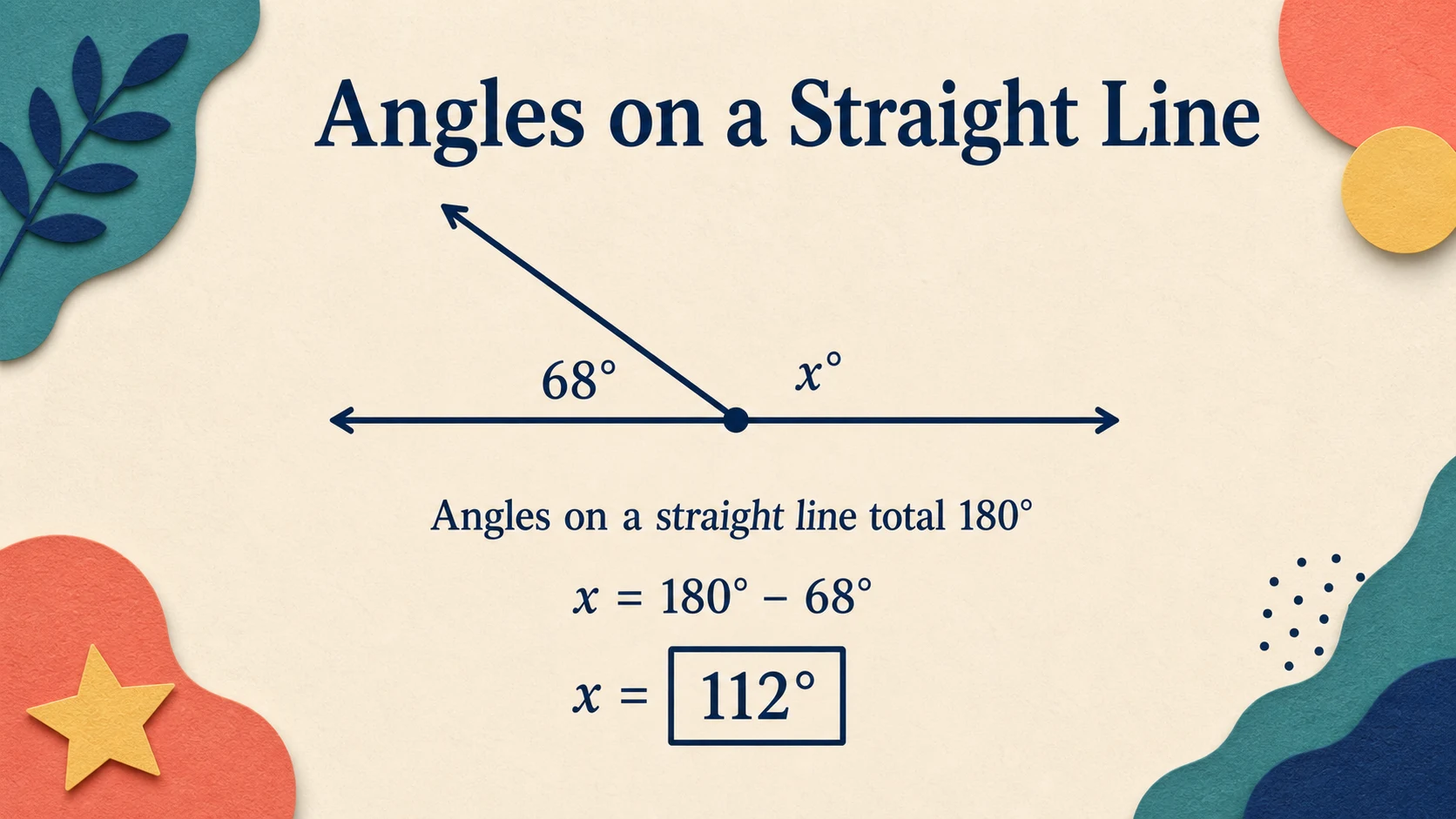
An effective worked example names the model, shows the calculation, includes units, and checks the result.
Boundary Cases Worth Teaching Explicitly
Boundary cases reveal whether a learner understands definitions rather than memorized pictures.
A rotated shape keeps its properties
Turning a square does not change its four equal sides or four right angles. If a learner calls the rotated figure a diamond, ask which measured property changed. “Diamond” may describe its appearance, but it does not replace a property-based classification.
A point on an axis is not in a quadrant
The point (0,5) lies on the y-axis because its x-coordinate is zero. The point (−3,0) lies on the x-axis. The origin (0,0) lies on both axes. These points are not inside any of the four quadrants.
Zero area and degenerate rectangles
A proposed “rectangle” measuring 8 units by 0 units has:
8×0=0
It does not cover a rectangular region. This is a useful numerical boundary case, but it should not be treated as an ordinary physical rectangle with an interior.
Same perimeter does not mean same area
Consider a 5×5 square and a 7×3 rectangle.
Their perimeters are:
2(5+5)=20
2(7+3)=20
Their areas are different:
5×5=25
7×3=21
Equal perimeter does not force equal area, just as equal area does not force equal perimeter.
Common Errors and Diagnostic Responses
An incorrect answer is useful evidence only when the adult identifies how it was produced.
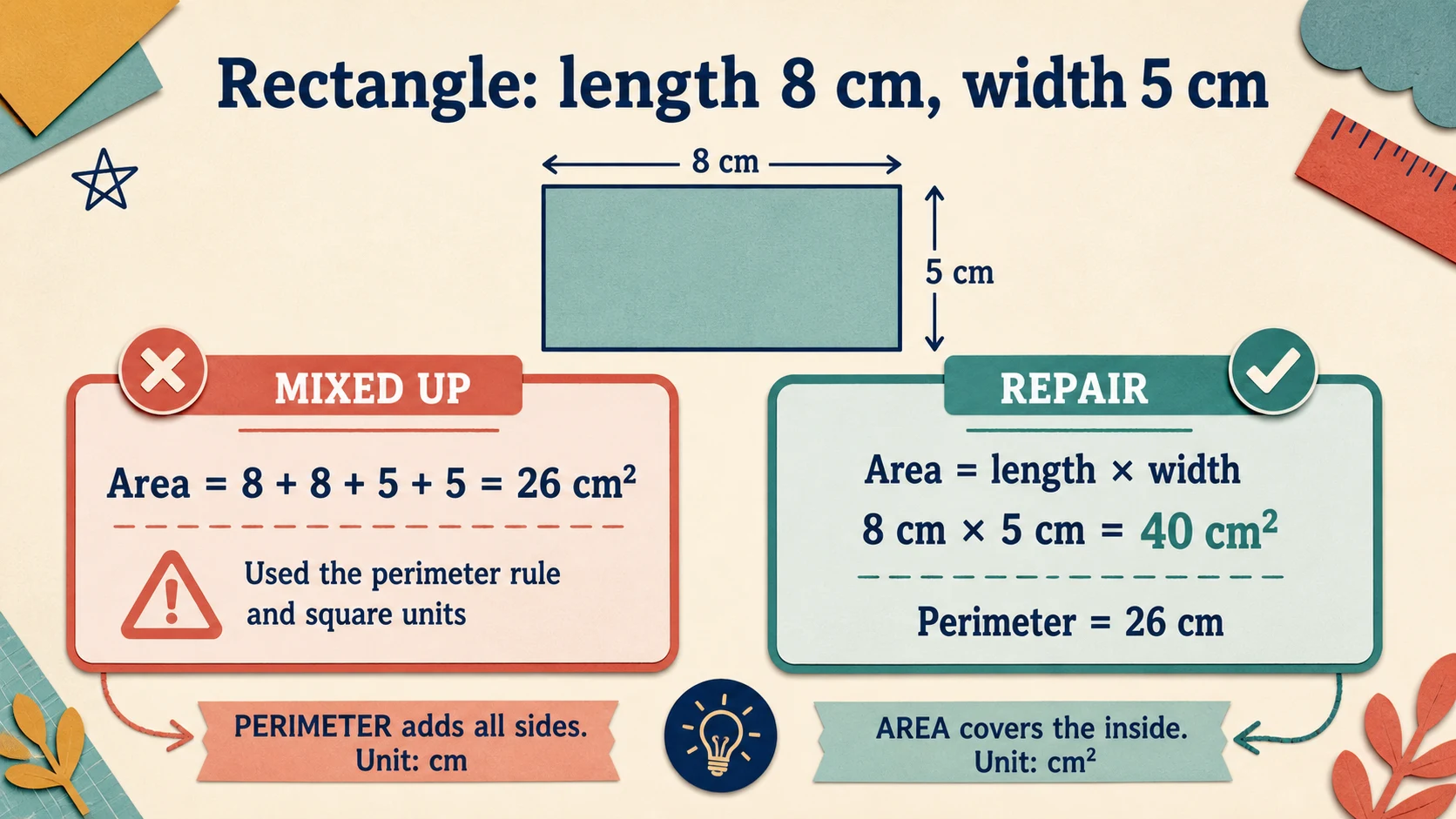
Match the teaching response to the learner’s reasoning, not merely to the final answer.
| Observed work |
Likely issue |
Diagnostic prompt |
Teaching response |
| Writes 8×5=40 for perimeter |
Confuses boundary with covering |
“Would tiles or a piece of string model this question?” |
Trace the boundary, label all four sides, and add them |
| Writes 26 square centimeters for perimeter |
Understands calculation but not unit type |
“Are we measuring a line or covering a surface?” |
Contrast cm with cm2 using drawn units |
| Counts only labeled sides |
Does not infer opposite sides of a rectangle are equal |
“Which side matches this one?” |
Mark matching sides before calculating |
| Calls every slanted four-sided figure a rhombus |
Classifies by appearance |
“What do you know about all four side lengths?” |
Require property evidence; include nonexamples |
| Plots (2,−5) as (−5,2) |
Reverses coordinate order |
“Which coordinate controls horizontal movement?” |
Use the phrase “across first, then up or down” |
| Plots (−3,4) three units right |
Misinterprets a negative x-value |
“Which direction contains negative numbers on this axis?” |
Label axis values before plotting |
| Reads 140∘ as 40∘ |
Selects the wrong protractor scale |
“Which scale starts at zero on the aligned ray?” |
Estimate acute or obtuse before reading |
| Uses l+w for rectangle perimeter |
Counts only one length and one width |
“How many outside sides does the rectangle have?” |
Build the expression from all four sides before using a formula |
| Gives a correct number with no model or work |
Reasoning cannot be inspected |
“Show how the diagram leads to that operation.” |
Request one labeled diagram and one equation |
Avoid correcting every mistake by demonstrating the entire problem. First ask the learner to explain the drawing, operation, and unit. A short prompt may reveal that only one step needs repair.
Repeated errors across several sessions call for smaller instructional steps and cumulative review. A one-time slip after several correct explanations may require only a quick check.
A Short, Repeatable Lesson Routine
A focused geometry lesson can take about 15 to 25 minutes, but this is an instructional suggestion, not a universal schedule. Extend, shorten, or pause according to the learner’s attention and observed work.
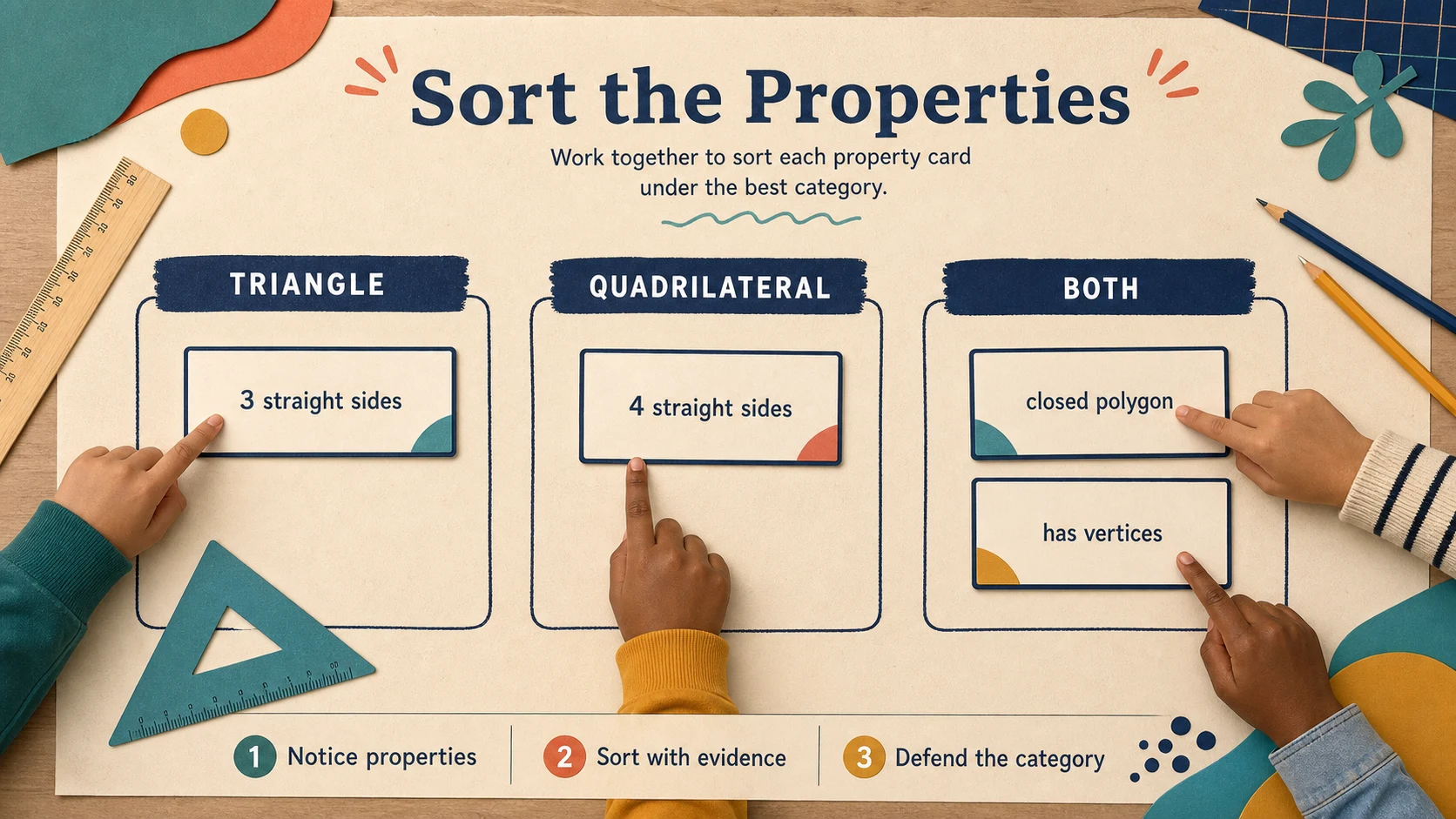
The routine moves from retrieval and modeling to independent work and a brief check.
1. Retrieve a prerequisite
Use two or three oral or visual prompts:
- “Point to the parallel sides.”
- “What is 7×6?”
- “Which unit would measure a tabletop’s surface?”
- “What does the first coordinate tell you?”
Keep this brief. If retrieval exposes a major gap, adjust the lesson rather than pushing into new work.
2. Model one example
Think aloud while labeling the figure. State what is being measured, why the operation fits, and how the unit will be written.
For area, say: “The rectangle has 8 unit squares in each row and 5 rows. Multiplication counts all the squares efficiently.”
3. Solve one together
Let the learner make the next decision. Ask for the model or operation before asking for the answer. Give only enough support to restart progress.
4. Assign a small independent set
Choose three to six problems that target the same idea with modest variation. Independent practice should show whether the learner can choose and carry out the method without prompts.
5. Close with an explanation
Use one exit prompt:
- “How do you know this is an area problem?”
- “Why is the answer in square units?”
- “What would stay unchanged if the shape were rotated?”
- “How did you check the plotted point?”
Record the result in one sentence for planning the next lesson.
Choosing Practice Without Overloading the Learner
The 6th Grade Math hub can help adults place geometry alongside sixth-grade work in ratios, negative numbers, expressions, and other topics. Within geometry, practice should be selected by demonstrated need.
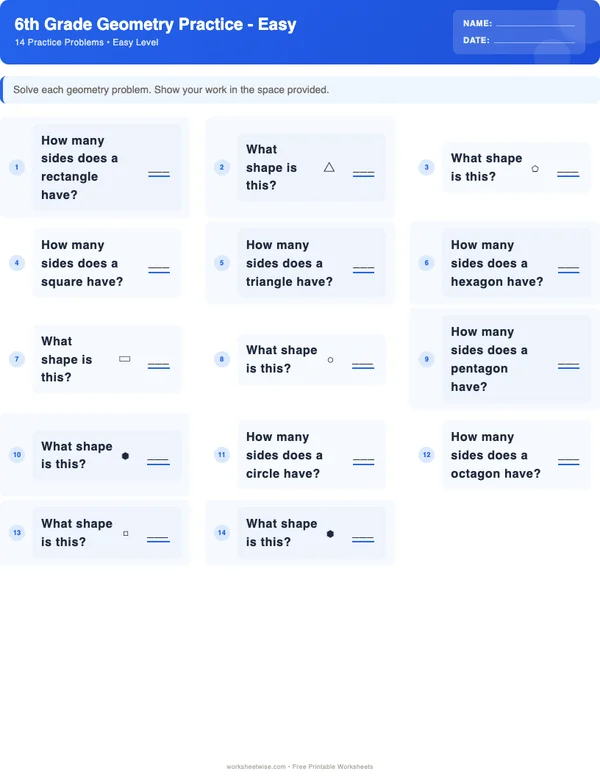
Start with the free easy geometry worksheet when the learner is beginning the topic, needs reinforcement, or requires a low-complexity check. The catalogue describes 14 exercises covering shapes, sides and vertices, perimeter, area, and geometric properties, with a separate answer key. It should be treated as one sample of performance, not a complete geometry assessment.
Choose practice according to these principles:
- Use a single-skill set when the learner cannot yet choose a method reliably.
- Mix perimeter and area once each concept is accurate in isolation.
- Include diagrams in different orientations to test property-based recognition.
- Add missing-measure problems after direct calculations are secure.
- Use coordinate work only when axis reading and signed numbers are sufficiently stable.
- Revisit previously learned formats so success does not depend on seeing identical problems.
- Leave enough space for diagrams, labels, equations, and units.
The focused geometry pack contains 18 worksheets. A larger pack can support spaced review and varied practice, but assigning every page is neither necessary nor automatically appropriate. Select pages based on error patterns and stop repeating a format once the learner demonstrates stable, explained accuracy.
Differentiation Without Changing the Mathematical Goal
When the learner needs more support
Reduce incidental difficulty while preserving the main concept:
- Provide grid paper for area and coordinates.
- Prelabel one matching pair of rectangle sides.
- Let the learner build a rectangle before drawing it.
- Present fewer problems at one time.
- Use whole-number measurements before decimals.
- Offer a formula only after connecting it to the model.
- Alternate one worked example with one learner-solved example.
If reading load obscures the geometry, read the problem aloud without identifying the operation.
When the learner is ready for more challenge
Increase reasoning rather than merely using larger numbers:
- Ask for two different rectangles with the same area.
- Give a perimeter and request possible side lengths.
- Remove an unnecessary label and ask what can be inferred.
- Ask the learner to find and correct a fictional student’s error.
- Compare points that share an x- or y-coordinate.
- Require two solution methods or a diagram-based check.
- Ask whether a claim is always, sometimes, or never true.
For example: “Rectangles with the same perimeter have the same area.” The 5×5 and 7×3 comparison shows that the claim is not always true.
Monitoring Progress and Deciding What Comes Next
Monitor a small set of observable behaviors rather than relying only on percentage correct.
| Indicator |
Beginning |
Developing |
Secure enough to extend |
| Identifies the target quantity |
Needs a prompt to distinguish boundary and surface |
Usually identifies it but hesitates in mixed sets |
Chooses perimeter or area and explains why |
| Uses representations |
Model is incomplete or unrelated |
Model supports some steps |
Creates a useful labeled model independently |
| Calculates |
Frequent operation or arithmetic errors |
Correct with checking prompts |
Accurate across varied examples |
| Uses units |
Omits or confuses units |
Correct after prompting |
Consistently uses linear or square units |
| Explains |
Gives an answer only |
Names the operation |
Connects properties, model, equation, and answer |
| Retains learning |
Success occurs only immediately after teaching |
Recalls with hints |
Solves after a delay and in mixed practice |
Use three checkpoints:
- Immediate: Can the learner solve a similar problem after modeling?
- Next session: Can the learner retrieve the method without seeing the example?
- Later mixed review: Can the learner recognize when to use the method among other problem types?
Advance when understanding is reasonably stable, not when every response is perfect. Return to a model when errors reveal a conceptual gap. If the concept is secure but computation is inconsistent, continue geometry while adding a short arithmetic warm-up.
A Two-Week Practice Plan
This plan assumes short sessions on ten practice days. It is adjustable and does not represent a required school sequence.
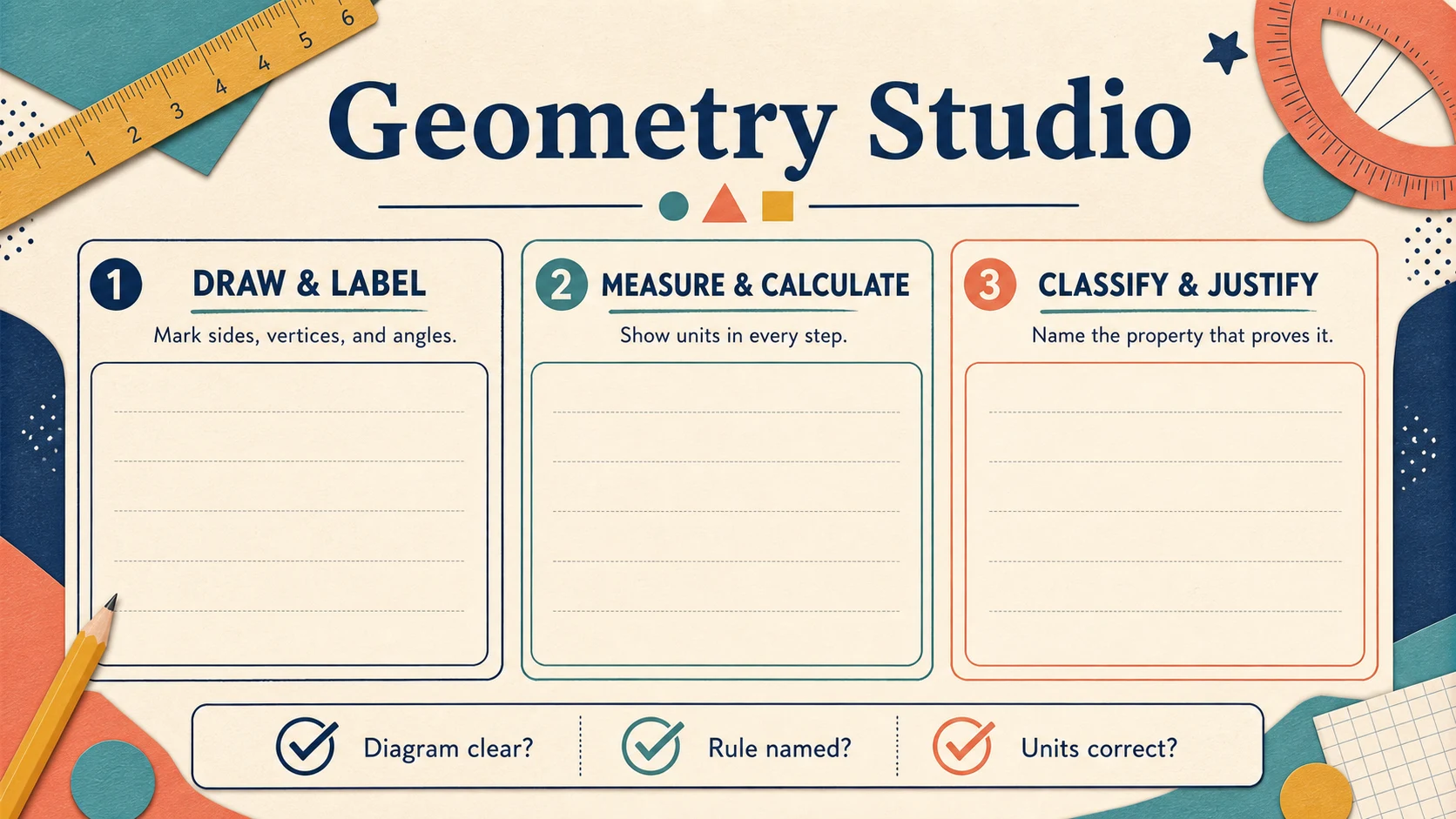
New instruction, retrieval, mixed practice, and review are distributed across two weeks.
| Day |
Focus |
Suggested activity |
Evidence to record |
| 1 |
Baseline and properties |
Classify varied shapes; solve one perimeter and one area problem |
Which terms, models, or units need review? |
| 2 |
Perimeter |
Trace boundaries, label every side, solve four problems |
Does the learner count each side exactly once? |
| 3 |
Area |
Build tiled rectangles and connect rows to multiplication |
Can the learner explain square units? |
| 4 |
Perimeter versus area |
Sort problems by target quantity, then solve a mixed set |
Does the learner choose without operation hints? |
| 5 |
Comparison |
Build rectangles with equal area and compare perimeters |
Can the learner explain why results differ? |
| 6 |
Delayed retrieval |
Revisit one problem from Days 2–5 without notes |
What was retained after the break? |
| 7 |
Missing measures |
Find an unknown side from a known area or perimeter |
Does the learner use inverse reasoning? |
| 8 |
Coordinates |
Plot and read points in all four quadrants and on axes |
Are coordinate order and signs accurate? |
| 9 |
Mixed reasoning |
Complete a short varied set and correct one false solution |
Can the learner justify method choices? |
| 10 |
Review and next decision |
Use a fresh worksheet sample; compare with Day 1 |
Which skill is secure, developing, or not yet ready? |
Keep the daily record simple. Note one success, one recurring error, and one next teaching move. If Day 4 shows continuing perimeter-area confusion, repeat concrete comparison work before introducing missing measures. If plotting errors arise from weak negative-number knowledge, pause coordinate extension and reinforce the number line.
Limits of Worksheets and an Honest Next Step
A worksheet can provide structured practice, visible work, and a convenient answer check. It cannot by itself show why a learner chose an operation, whether a correct answer came from sound reasoning, or whether the skill will transfer to a new diagram. Discussion, modeling, observation, and delayed review remain necessary.
The supplied catalogue covers shape identification, sides and vertices, perimeter, area, and geometric properties in an easy 14-problem worksheet. It does not establish comprehensive standards alignment, guarantee an outcome, or replace local curriculum decisions. Coordinate geometry and angle work may require separate materials depending on the learner’s sequence.
Begin with the free 6th Grade Geometry worksheet. Ask the learner to show all labels, calculations, and units. Then sort the observed errors into concept, procedure, arithmetic, or explanation. Use that evidence—not the grade label alone—to choose the next lesson or create a targeted review through the free worksheet generators.