Curated collectionAnswer keys includedPrint-ready PDFs
Easy and Beginner Counting Worksheets
Define what easy and beginner counting practice changes and what it deliberately keeps constant, then compare three checked examples, fading supports and readiness evidence.
Start with a real resource
Browse this worksheet collection
3 relevant free entry points are available. Each one includes a printable learner PDF and separate answer key.
A useful practice loop
Print less. Observe more.
- Choose one skill and model the first item aloud.
- Use a short set and notice the learner’s strategy.
- Change the next task from the work you can see.
Need more than the free sheet?
Plus includes all 18 matching catalogue variations where available, plus saved deterministic generators and the worksheet designer.
See Plus membershipComplete guide
How to teach and practise easy counting worksheets
3,377 words Updated 6 instructional visuals
What “easy and beginner” means for counting practice
Easy and beginner counting practice reduces the number of decisions a learner must manage at once. It may use a short, predictable number sequence; clearly separated objects; a visible number line; one missing value rather than several; or a familiar counting step such as one more. What remains constant is the mathematical work: each object must still receive one count, number words must remain in order, and the final number must represent the entire set.
That distinction matters. Making a page easier should not mean supplying the answer, turning counting into guessing, or replacing the target with handwriting practice. It should make the counting relationship easier to see.
On this page, “easy” is a worksheet filter defined by observable task features, not a label for a learner. The live catalogue contains 18 variants across Pre-K, kindergarten, and 1st Grade, with three free entry points. Each representative free sheet is listed as easy and contains 20 problems. The catalogue covers one subject—math—and one topic—counting.
Grade and age labels are discovery aids, not placement decisions. Local curriculum sequences differ, and a child’s useful starting point depends on the exact counting behavior being practiced. In particular, ages three and four generally need brief, adult-led oral, matching, manipulative, and movement experiences before or instead of sustained desk work.
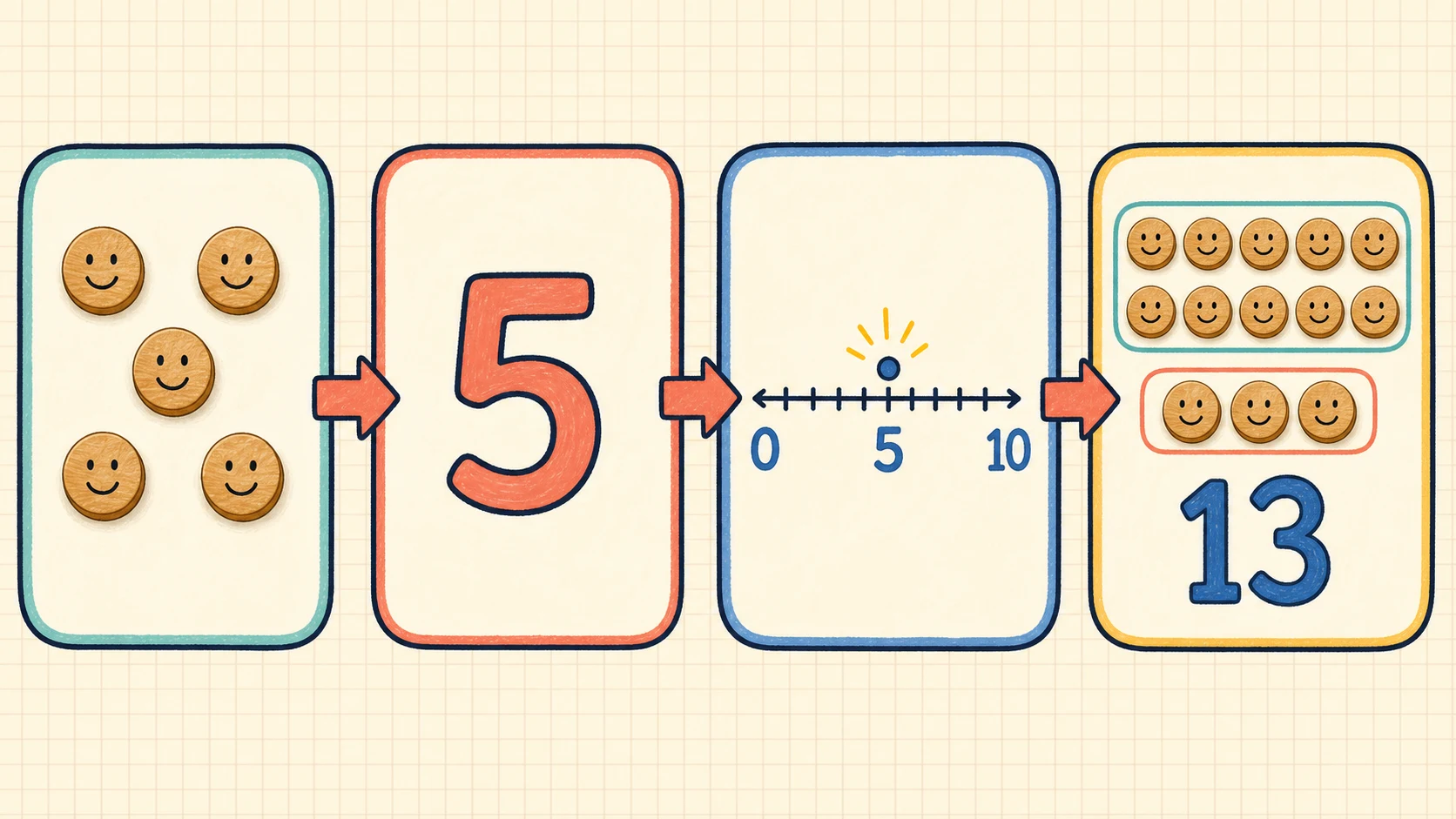
The central skill is not merely saying numbers: it is coordinating number order, one-to-one counting, quantity, sequence completion, and eventually patterned counting.
What changes—and what must stay mathematically honest
An adult can adjust five features without changing the core skill:
- Range: Count within 5 before counting within 10 or 20.
- Arrangement: Begin with objects in a row, then use two rows, a loose cluster, and finally a scattered set.
- Representation: Move from physical objects to pictures and then to numerals.
- Support: Offer touch-counting, movable markers, a number line, or a spoken start.
- Response: Let the learner say, point to, match, circle, or write the answer.
The invariant is the meaning of counting. If a learner counts seven counters, “seven” must name the quantity of the whole set. If the task is 12, 13, __, 15, the blank must be found through the sequence, not through the shape or position of a printed answer choice.
The catalogue’s teaching guidance suggests a concrete-to-picture-to-number path. That suggestion is also consistent with the Institute of Education Sciences recommendation to teach early number and operations through a developmental progression and monitor what a child already knows. The IES guide does not evaluate WorksheetWise or any worksheet on this page; it supplies broader instructional guidance for preschool, prekindergarten, and kindergarten. See IES, Teaching Math to Young Children.
Nearby easier task features
A nearby easier variation might:
- Use three to five identical objects in one straight row.
- Let the learner move each object into a “counted” area.
- Ask for an oral answer rather than a written numeral.
- Show a sequence beginning at 1 with only the last number missing.
- Keep all examples within one familiar range.
- Have an adult model the first item aloud.
For instance, matching a card showing 4 to a group of four buttons is easier than independently writing 4 after counting scattered pictures. Both address quantity, but matching removes numeral formation and narrows the response choices.
Nearby harder task features
A nearby harder variation might:
- Scatter objects so counted and uncounted items are harder to track.
- Mix object sizes or types while keeping each item worth one count.
- Start a sequence at a number other than 1.
- Place the blank in the middle rather than at the end.
- Remove the number line or touch-counting prompt.
- Mix counting by ones with counting by 2s, 5s, or 10s.
- Ask the learner to count backward.
- Require an explanation as well as an answer.
A task is not harder merely because the font is smaller or the page has decorations. Genuine difficulty comes from the mathematical and attentional demands needed to produce a correct count.
Three catalogue entry points serve different counting decisions
The three free resources are not interchangeable simply because each has 20 problems and an easy label.
Pre-K: make the count physically trackable
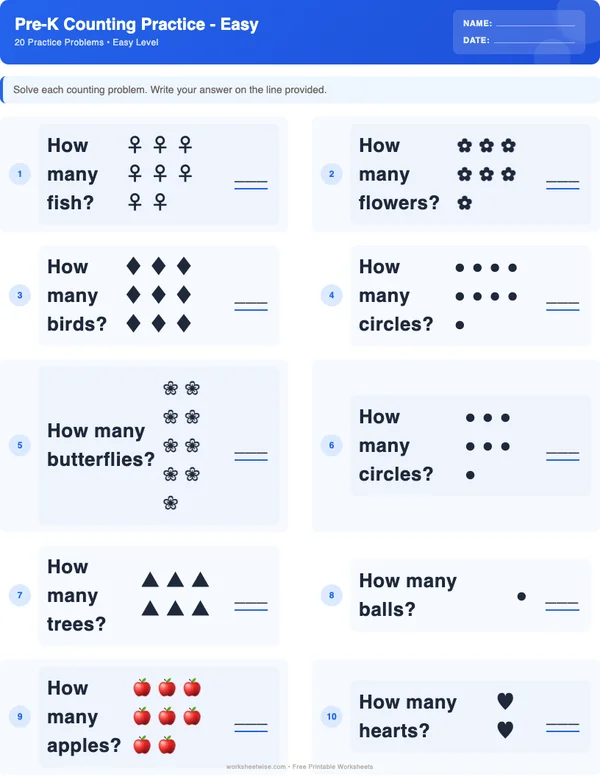
The Pre-K Counting guide and free sheet is the most relevant catalogue entry when the learner is building the connection among touching an object, saying one number word, and identifying how many objects there are. The listed teaching context emphasizes concrete objects and counting within 20.
For ages three and four, a 20-problem sheet should usually be treated as a source of individual prompts, not a required sitting. Choose one or two items, rebuild them with buttons or blocks, and stop while the learner is still participating productively. An adult can say, “Move one button into the cup each time you say a number.” That preserves counting while reducing pencil, visual-scanning, and sitting demands.
Kindergarten: connect quantities and number sequences
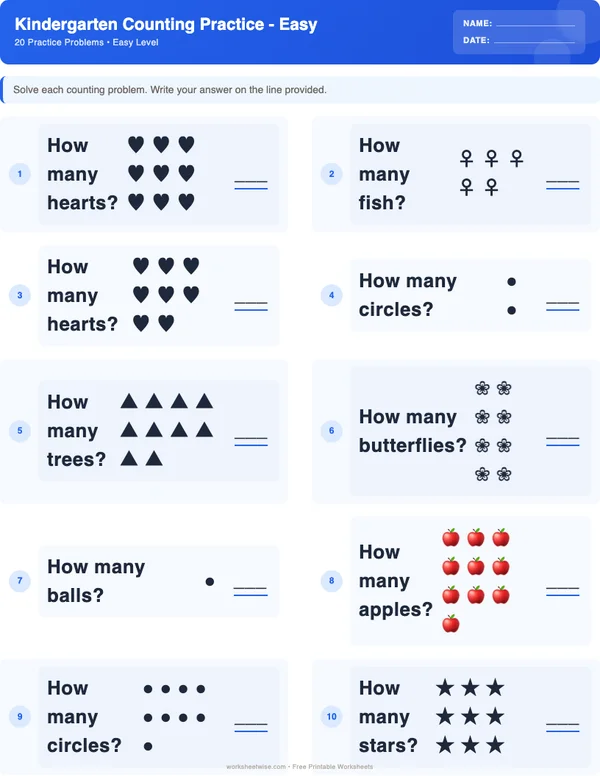
The Kindergarten Counting guide and free sheet is a sensible place to look when a learner can count small groups but needs practice with missing numbers, larger ranges, or counting toward 100. “Kindergarten” is not proof that the sheet is the right placement. First inspect the item range, layout, and support.
A child who recites to 30 but loses track of eight scattered objects may need quantity work rather than a longer oral sequence. Conversely, a child who reliably counts pictured sets might need number-sequence gaps beginning somewhere other than 1.
1st Grade: make sequence knowledge flexible
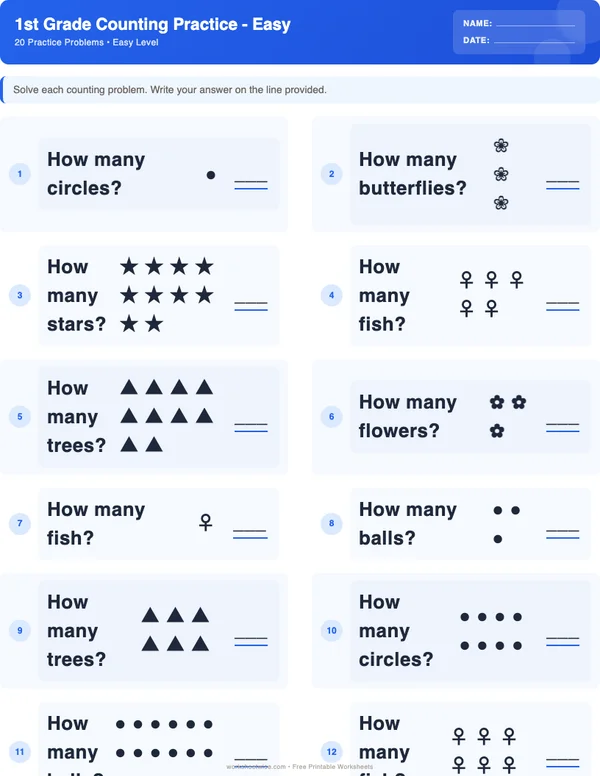
The 1st Grade Counting guide and free sheet is useful when practice needs to include counting forward from a given number, backward counting, or early skip-counting patterns. The catalogue specifically includes counting by 2s, 5s, and 10s in the broader topic description.
An easy 1st Grade variation should keep the pattern visible. It might show 20, 25, 30, __, 40 rather than present several unrelated skip-counting rules on one line. That is still legitimate mathematical work: the learner must identify and continue the constant increase of five.
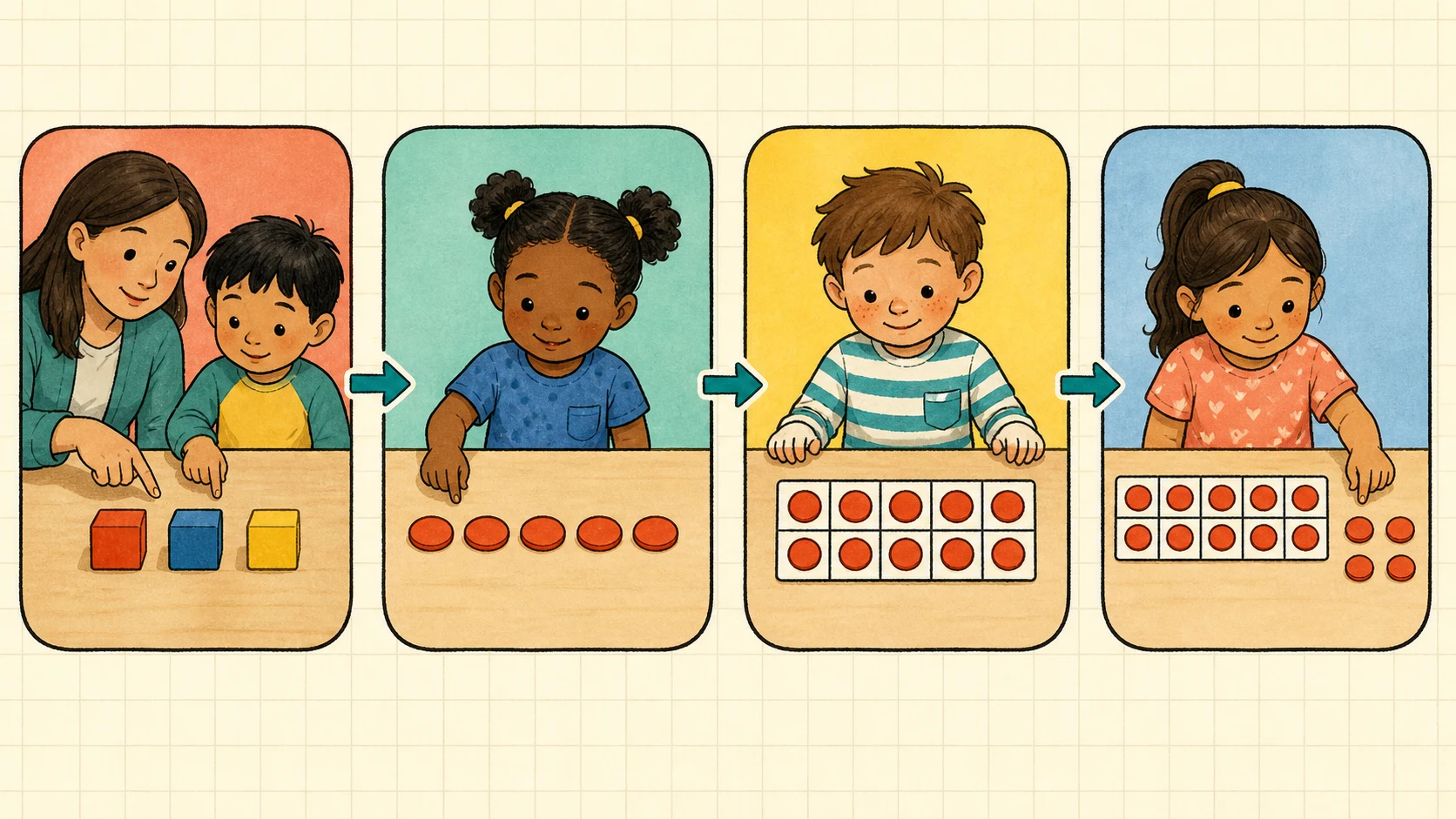
Support should fade one feature at a time: first the adult model, then the movable objects or number line, and only later the prompt itself.
Four checked examples show where the real work sits
The examples below are editorial teaching examples grounded in the catalogue’s stated skills. They are not quoted worksheet items and are not claims about every one of the 18 variants.
Example 1: count a row with one-to-one correspondence
Place six counters in a row:
● ● ● ● ● ●
Ask the learner to touch or slide each counter while saying:
1, 2, 3, 4, 5, 6
Then ask, “How many counters are there altogether?”
The checked answer is 6. There are six objects, each receives exactly one number word, and the last number said is six. If the learner recounts correctly but answers “five” afterward, the issue is not necessarily number-word order. The learner may not yet be using the final count as the quantity of the whole set.
This example belongs at the easy or beginner level because the objects are identical, equally spaced, and placed in one row. The learner does not need to distinguish irrelevant colors, navigate a cluster, or remember which objects have already been counted.
To make it easier, use four movable counters and a “counted” bowl. To make it harder without changing the skill, keep six counters but scatter them.
Example 2: complete one missing number
Consider:
12, 13, __, 15
Starting at 12 and counting forward by ones gives:
12, 13, 14, 15
The checked answer is 14. It must be greater than 13 by one and less than 15 by one.
This belongs here because the rule is stable, only one number is missing, and both neighboring numbers constrain the answer. It is more demanding than 1, 2, 3, __ because the sequence does not begin at 1 and includes a teen number. It is easier than 12, __, __, 15, which requires maintaining the direction while supplying two values.
A useful adult prompt is, “Start at 12 and say each number. Point to a place each time.” Avoid “What comes before 15?” unless you intend to practice the separate language of before and after. The counting task should remain visible.
Example 3: continue a count-by-5s pattern
Consider:
20, 25, 30, __, 40
The differences are:
25 − 20 = 530 − 25 = 5
Continuing the same step gives 30 + 5 = 35, followed by 35 + 5 = 40. The checked answer is 35.
This example fits easy 1st Grade counting because the step remains constant, the surrounding value confirms the result, and only one blank is present. It is harder than counting by ones because the learner must retain a step of five. It is easier than switching among counts by 2s, 5s, and 10s without a stated rule.
The catalogue suggests adding movement to patterned counting—for example, clapping on every fifth number. That is a page-specific teaching suggestion, not a research finding about this resource. Movement can make the repeated step audible and memorable without changing the target.
Example 4: count a scattered set without double-counting
Arrange eight counters loosely:
●       ●
    ●
●             ●
      ●
  ●        ●
A reliable strategy is to move each physical counter or mark each pictured counter while counting. A checked traversal finds 8 objects. Counting row by row also verifies the total: two on the top level, one below, two across the middle, one below them, and two at the bottom; 2 + 1 + 2 + 1 + 2 = 8.
This belongs near the upper edge of beginner quantity counting. The number is still small, but the arrangement removes the automatic left-to-right path. It tests whether the learner can coordinate objects and number words rather than merely recite a memorized sequence.
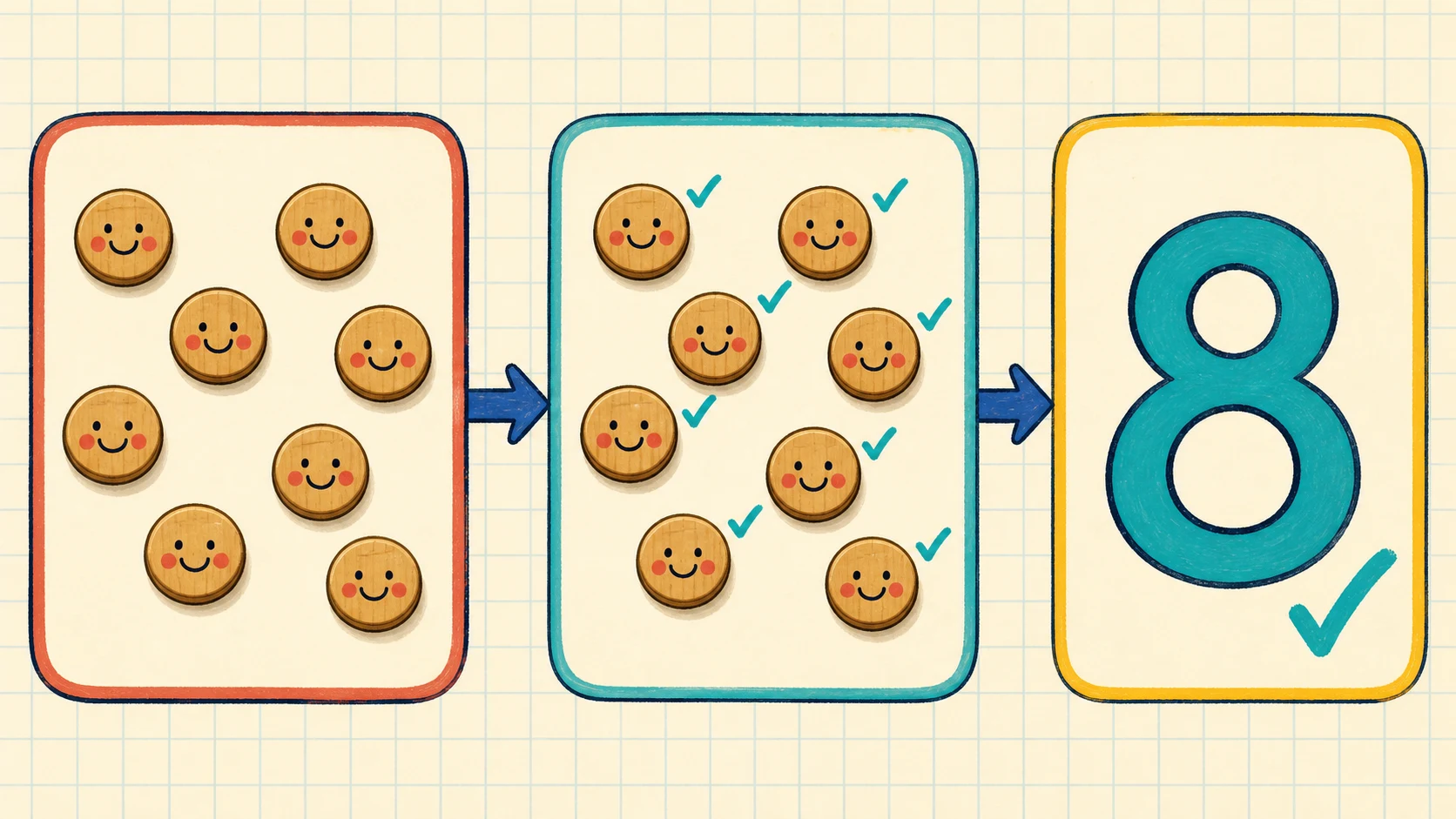
The answer becomes meaningful when the learner can connect the physical or pictured set, the spoken count, and the written numeral.
False difficulty signals can lead adults to choose the wrong page
Some features make a worksheet look advanced without increasing the counting demand. Others make a mathematically simple task unnecessarily difficult for reasons unrelated to counting.
Visual busyness is not mathematical depth
A page with cartoon scenery, several colors, or many objects may look harder. If every item forms a clear row and the learner only counts to five, the underlying counting demand remains limited. Decoration can still interfere with attention, but it does not create a more advanced counting concept.
Likewise, a plain sequence such as 46, 47, __, 49 may look easy because it has few marks on the page. Its number range and teen-to-decade transitions may make it less suitable for a learner currently coordinating small sets.
Handwriting can hide accurate counting
Suppose a learner counts nine objects correctly and says “nine” but reverses or poorly forms the numeral 9. That response provides evidence of accurate counting alongside a writing difficulty. Do not increase the counting support automatically. Let the learner point to 9, choose it from two numeral cards, or tell the adult what to write.
This adaptation preserves the target skill because the learner still determines the quantity. It changes only the response method.
Speed does not define beginner readiness
A slow correct count can show deliberate one-to-one tracking. A fast answer can come from guessing, recitation, or recognizing a familiar layout. Time alone does not tell an adult whether the mathematical relationship is secure.
The IES elementary mathematics intervention guide does include timed activities as one possible way to build fluency, but it also recommends systematic instruction, precise mathematical language, concrete and semi-concrete representations, and number lines. It does not say that every task should be timed or that speed should replace understanding. See IES, Assisting Students Struggling with Mathematics.
Use a short routine that reveals rather than masks understanding
A repeatable session can take eight to twelve minutes for an older elementary learner and much less for a three- or four-year-old.
1. Rebuild one item concretely
Choose one worksheet item and represent it with counters, buttons, linking cubes, or small toys. If the printed item has seven pictures, place seven objects. Ask the learner to move each one while counting aloud.
Listen before correcting. Does each movement receive one number word? Does the learner preserve the number-word sequence? Does the learner know that the last word gives the total?
2. Connect the model to the page
Point to the corresponding pictured or numerical item. Say, “You counted seven objects. Which numeral records seven?” If needed, offer 6 and 7 as choices. Do not recount for the learner unless modeling is the intended support.
3. Try two similar items
Keep the counting rule and number range stable. Change only the set or starting number. If the first sequence was 8, 9, __, 11, a suitable second sequence is 13, 14, __, 16. The learner practices the same relationship rather than decoding a new task type.
4. Make one controlled change
Move a blank into the middle, scatter a set, remove the number line, or begin at a non-1 number. Change one feature, observe the result, and restore the prior support if accuracy collapses.
5. End with a quick explanation
Ask, “How did you know?” An acceptable answer can be brief: “I counted each one,” “Fourteen comes after thirteen,” or “It goes up by five.”
The Common Core mathematics materials distinguish a correct answer from mathematical understanding and note that explanations should be appropriate to the learner’s level. They also describe standards as statements of what learners should know and do, not as a particular worksheet sequence. This page does not claim standards alignment. See the Common Core State Standards for Mathematics.
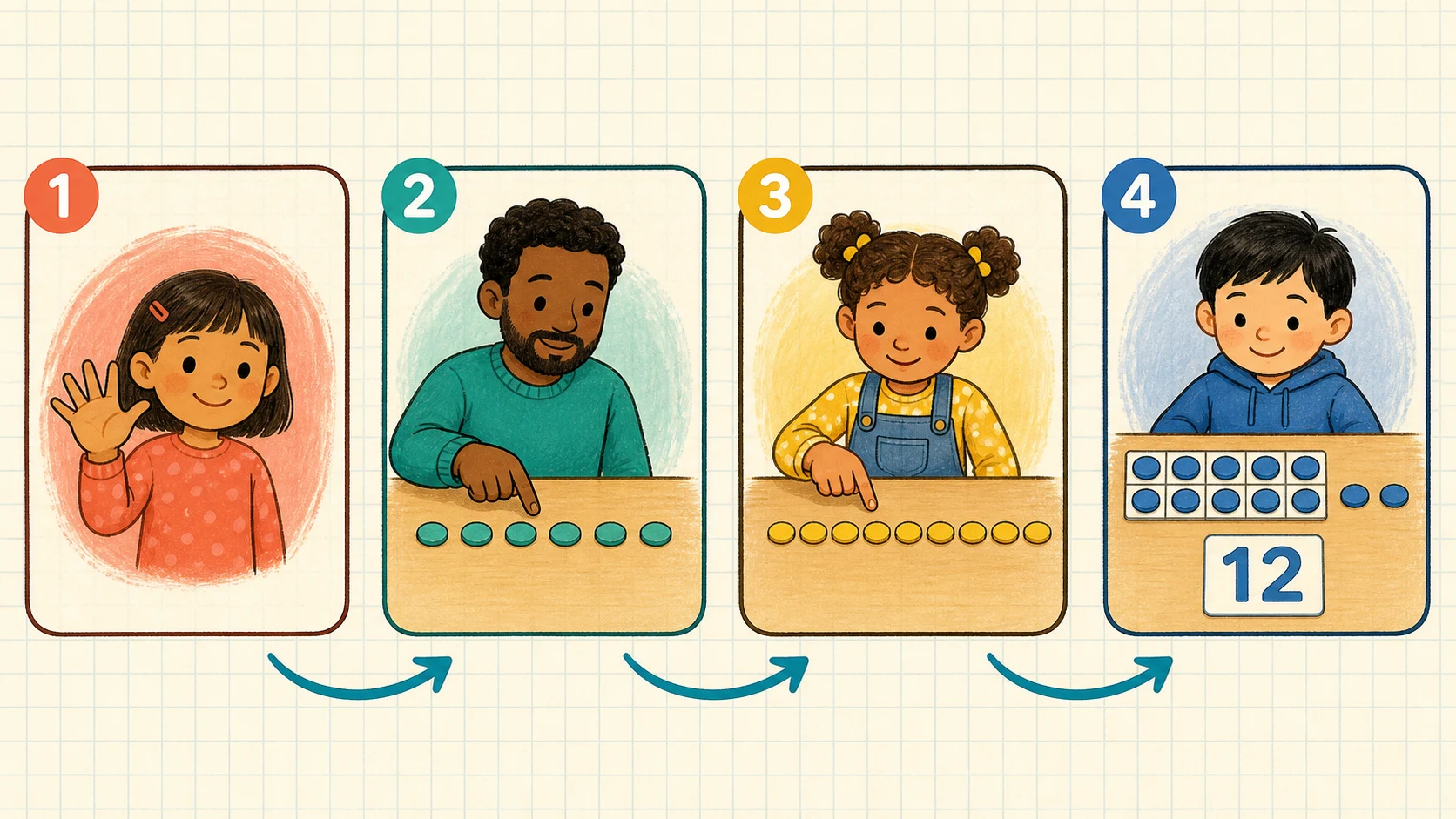
A consistent model–practice–change–explain routine makes it easier to identify which support actually matters.
Interpret errors before selecting another variation
Wrong answers are observations, not diagnoses. One response cannot establish a lasting learning need, and this guide cannot replace evaluation by a qualified educator.
Skipping an object
If a learner says the correct number sequence but leaves one object untouched, preserve the range and improve tracking. Let the learner move objects, draw a small mark on each picture, or count along a clear path. Do not immediately reduce the highest number; the obstacle may be organizing the set.
Counting one object twice
If the learner returns to an already-counted object in a scattered group, separate counted from uncounted objects. For pictures, cover each counted object with a transparent counter or pencil dot. Then try the same quantity in a different arrangement.
Losing the number-word sequence
A response such as 1, 2, 3, 5, 6 signals a different error from double-counting. Use a brief oral count with movement and a visible number line. Keep the set small enough that the adult can hear exactly where the sequence changes.
Giving the next number instead of the total
A learner counts five objects correctly, then answers “six.” Ask, “What was the last number you said?” Count again and pause after five. The teaching focus is the meaning of the final count, not longer recitation.
Reversing “before” and “after”
If __ 18 produces 19, restate the task as a direction: “Count forward and stop at 18. Which number did you say just before 18?” Add arrows or physically walk a floor number line. This preserves sequence reasoning while clarifying relational language.
Applying the wrong skip-counting step
For 10, 20, 30, __, an answer of 35 may mean the learner shifted from tens to fives. Ask the learner to state the step and show equal jumps on a number line. Keep the start and step visible on the next item.
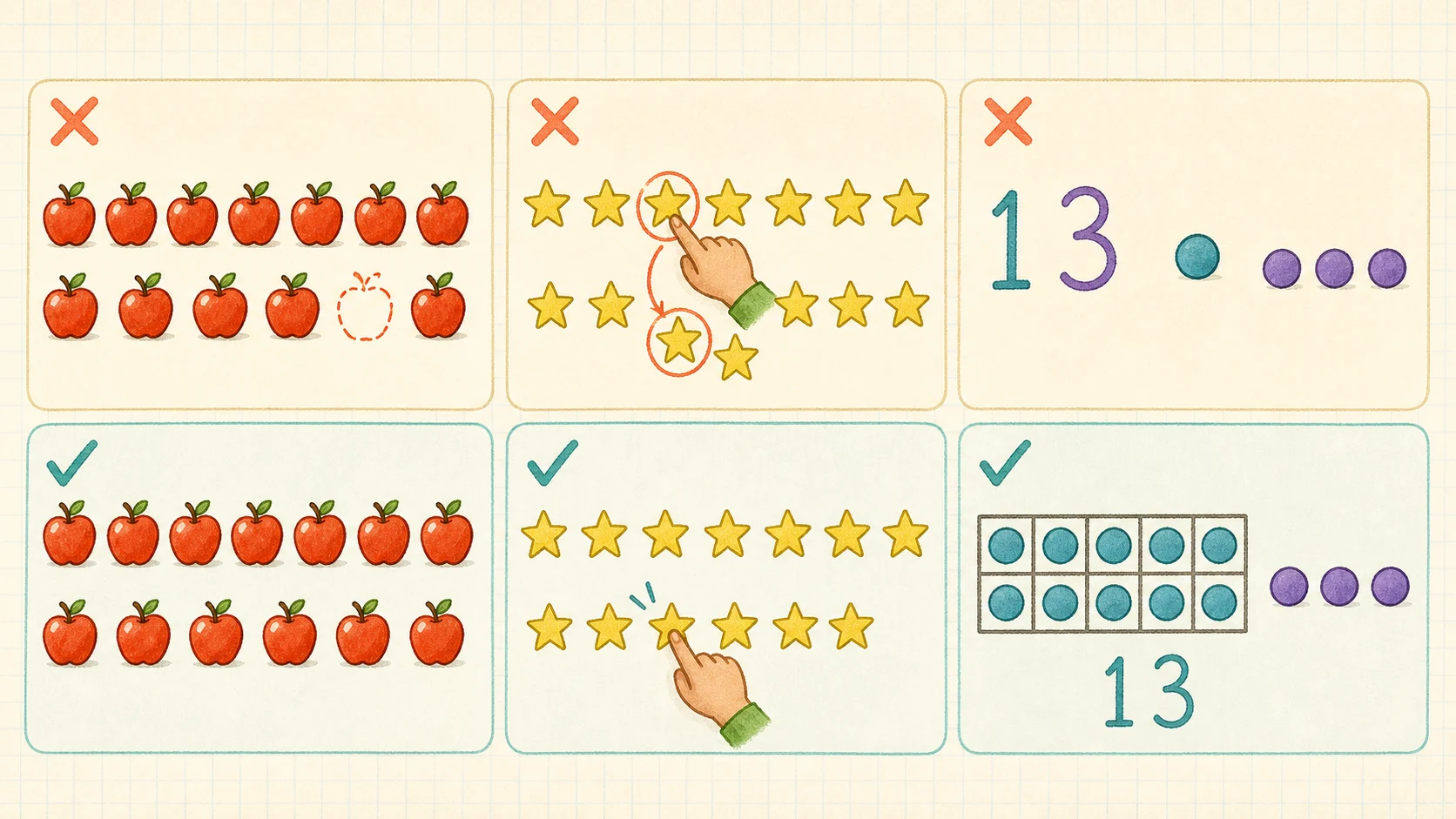
The useful response depends on the error pattern: tracking, sequence order, final-quantity meaning, relational language, and step size call for different supports.
Adapt access without replacing the counting target
A sound adaptation changes an obstacle outside the target skill while leaving the counting decision with the learner.
For a learner with limited fine-motor control, accept pointing, eye gaze, oral answers, numeral cards, or adult scribing. For a learner who has difficulty visually tracking a dense page, cover all but one row. For a learner who needs language support, use consistent phrases such as “count each,” “how many altogether,” “before,” and “after,” paired with demonstration. For a learner who benefits from movement, place numeral cards on the floor and step through the sequence.
Avoid adaptations that solve the mathematics. If the adult points to every object and says every number, the learner is only echoing. If an answer choice is visually highlighted, selecting it does not demonstrate counting. If the same spatial pattern always maps to the same answer position, the learner may learn the page’s cue rather than quantity.
Also keep worksheets within their proper boundary. They can provide structured practice with sets, missing numbers, and sequences. They cannot by themselves show whether a child can count real objects during play, explain a strategy across settings, or retain the skill over time. Brief oral and manipulative checks supply evidence the page cannot.
Fade support from one verified success to the next
Do not remove every support because one item was correct. Look for repeatable evidence across a few comparable tasks.
A practical fading sequence is:
- Adult models touch-counting with five objects.
- Learner touch-counts a new set while the adult points to the starting object.
- Learner chooses a starting point and marks each counted object.
- Learner counts an orderly pictured set without marks.
- Learner counts the same-sized scattered set.
- Learner records or selects the matching numeral.
Move forward when the learner completes two or three comparable examples accurately and can give a simple account of the method. If performance changes after a support is removed, replace the most recent support rather than restarting everything.
For number sequences, the fade might be:
- Full number line visible.
- Number line visible but not touched by the adult.
- Only the relevant section visible.
- Starting number supplied orally.
- Sequence completed without a reference.
- Same rule used from a different starting number.
Readiness for the next variation is not “finished the page.” More useful evidence includes stable one-to-one tracking, an accurate total after counting, correct continuation from different starting values, and recovery after a prompt such as “check each object.”
Choose the next variation from the behavior you observed
Use the smallest productive change:
- If orderly sets are accurate but scattered sets are not, keep the same quantity and change only the arrangement.
- If oral totals are accurate but written answers are not, preserve the counting level and change the response format.
- If sequences beginning at 1 are accurate, begin from 6 or 12 before extending the maximum number.
- If one missing endpoint is accurate, move one blank into the middle.
- If counting by 5s is accurate with a number line, use the same step with a partial line before removing it.
- If errors occur across several features, return to a shorter concrete task and identify the first point where the count stops being reliable.
A two-week plan should therefore repeat a skill while varying one condition, not simply assign ten different-looking pages. On one day, count six objects in a row; later, count six in two rows; then count six scattered objects; finally, match each set to the numeral 6. That sequence tests whether the quantity remains six despite changes in arrangement.
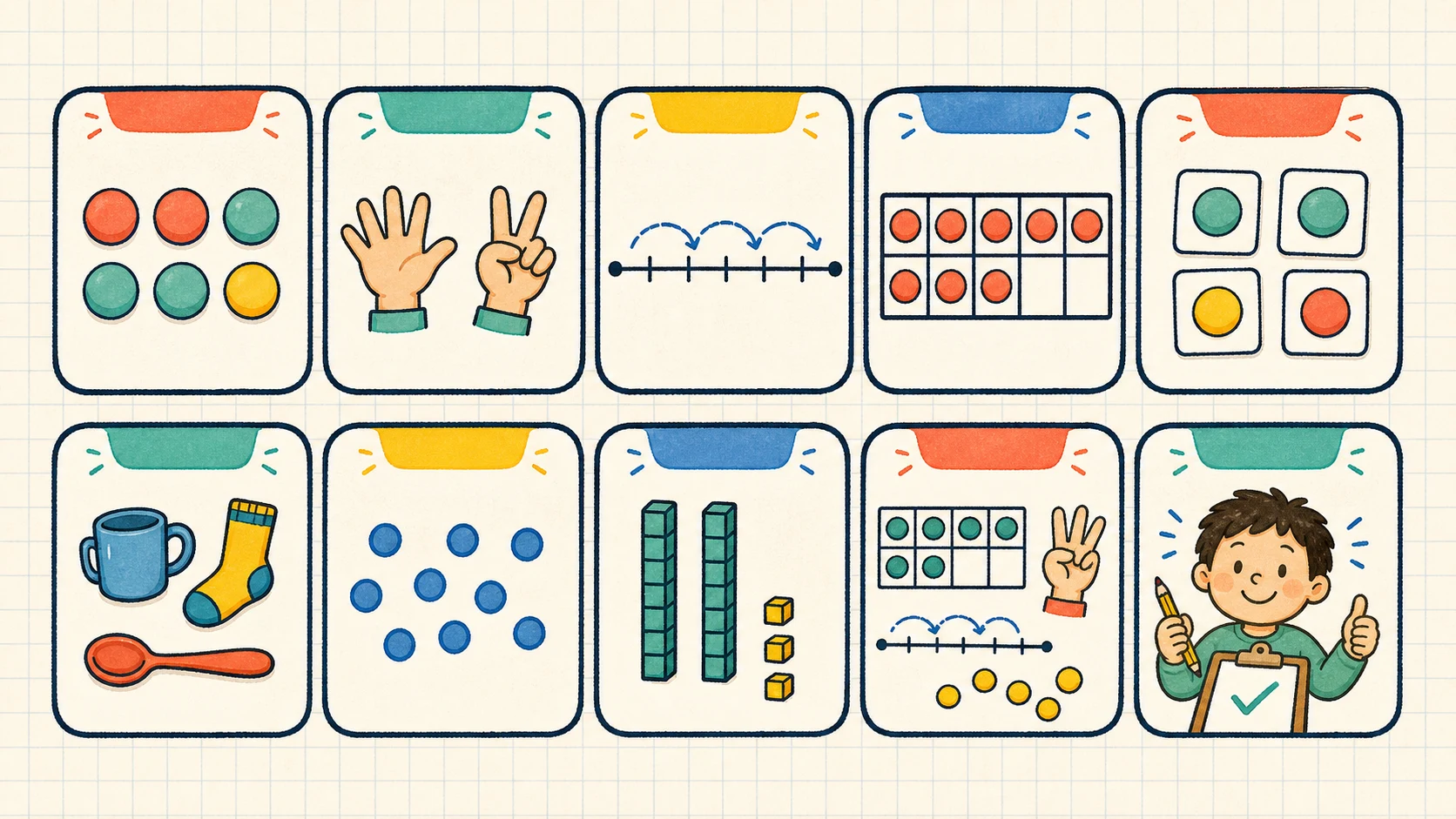
Planned review should revisit the same counting relationship under slightly changed conditions rather than equating more pages with stronger evidence.
The immediate next action is concrete: open the 1st Grade Counting guide and free sheet, choose one item, and reproduce it with movable counters before asking for a written answer. Record just three observations—whether each object received one count, whether the final number named the total, and whether the learner could explain the step. Use those observations, not age, speed, or page completion, to select the next variation.
Put it into practice
Use the guide with a real printable
Move from explanation to a short, observable practice task. Check the first item together, then adjust the next session from the learner's actual work.
Open the first free worksheetExplore a neighboring collection
Choose by a different teaching need
Easy and Beginner Addition Worksheets Easy and Beginner Division Worksheets Easy and Beginner Fractions Worksheets Easy and Beginner Geometry Worksheets Easy and Beginner Money Worksheets Easy and Beginner Multiplication Worksheets Easy and Beginner Sight Words Worksheets Easy and Beginner Subtraction Worksheets