Curated collectionAnswer keys includedPrint-ready PDFs
Easy and Beginner Addition Worksheets
Define what easy and beginner addition practice changes and what it deliberately keeps constant, then compare three checked examples, fading supports and readiness evidence.
Start with a real resource
Browse this worksheet collection
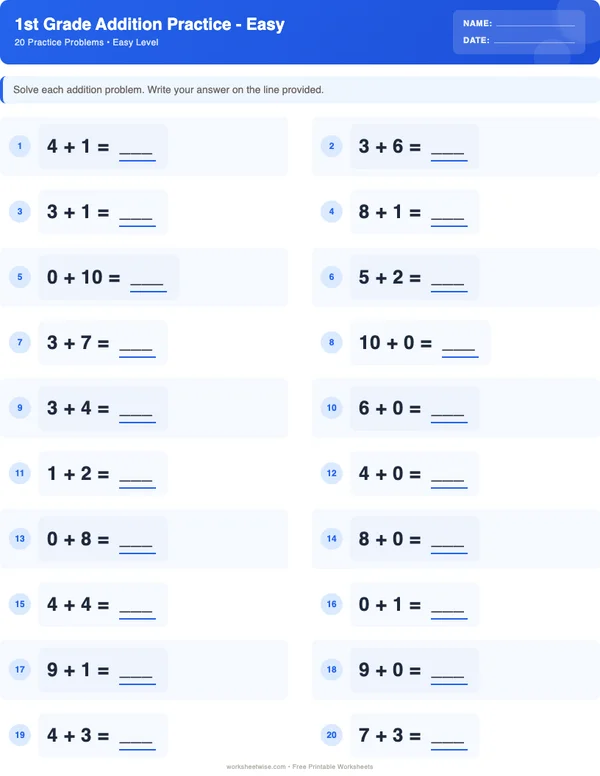
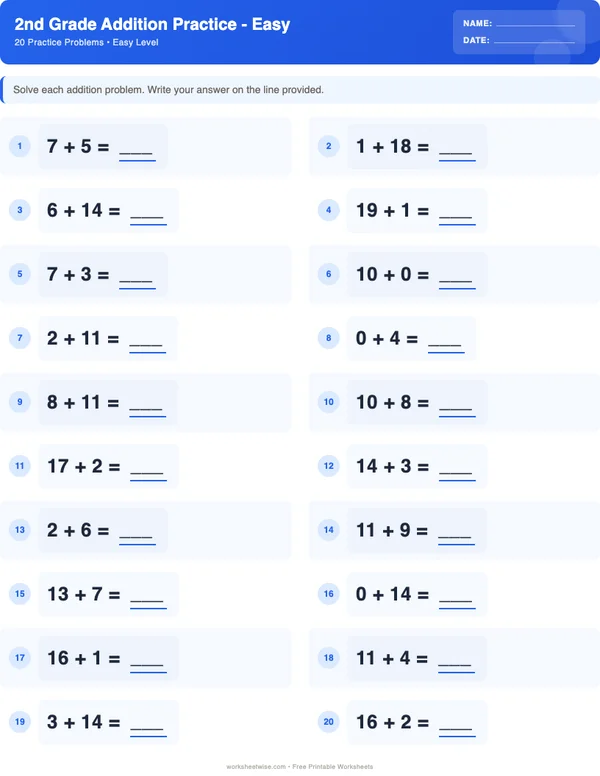
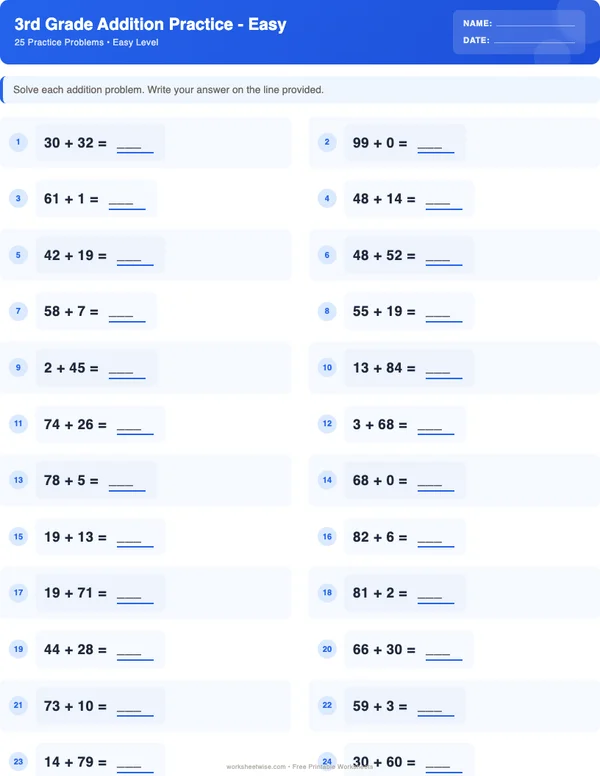
6 relevant free entry points are available. Each one includes a printable learner PDF and separate answer key.
A useful practice loop
Print less. Observe more.
- Choose one skill and model the first item aloud.
- Use a short set and notice the learner’s strategy.
- Change the next task from the work you can see.
Need more than the free sheet?
Plus includes all 36 matching catalogue variations where available, plus saved deterministic generators and the worksheet designer.
See Plus membershipComplete guide
How to teach and practise easy addition worksheets
3,752 words Updated 6 instructional visuals
What “easy” changes in addition practice
Easy and beginner addition practice reduces avoidable load while keeping the mathematical action intact: the learner must join quantities and determine the total. The work may use smaller numbers, familiar representations, fewer changes between problem types, generous writing space, or visible supports. It should not turn into copying answers, tracing unrelated numerals, or guessing from decorative pictures.
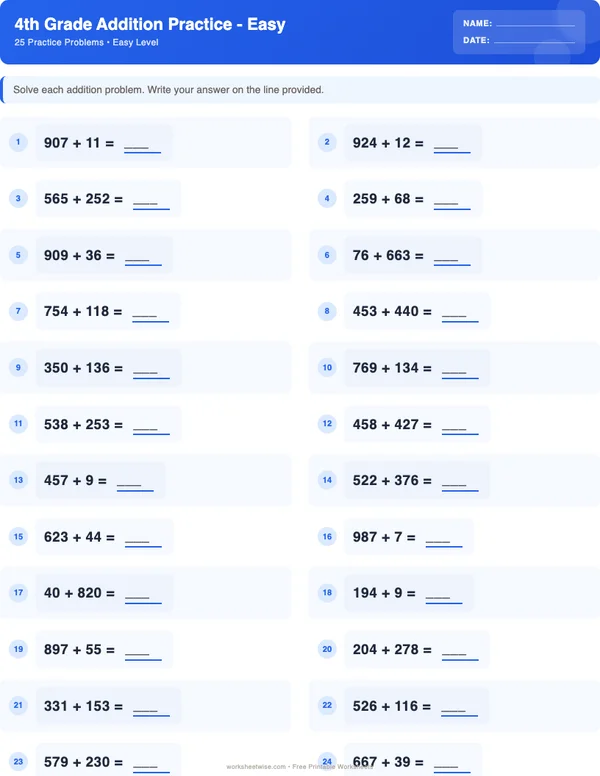
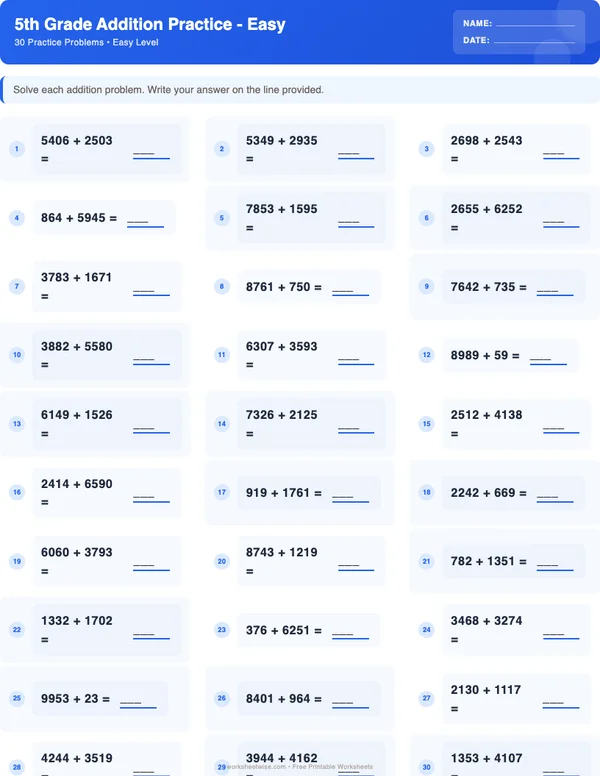
On this page, “easy” is a worksheet difficulty filter, not a label for a learner. The live catalogue contains 36 addition variants across six grade entry points, with six free resources. The free Kindergarten, 1st Grade, and 2nd Grade sheets each contain 20 problems; the 3rd and 4th Grade sheets contain 25; the 5th Grade sheet contains 30. Those counts describe the available sheets, not an amount every learner should complete in one sitting.
A useful beginner addition task usually keeps several features stable:
- The meaning remains “combine these amounts” or “add this amount.”
- The numbers fit a range the learner can represent or reason about.
- The notation is readable and consistent.
- One main challenge is introduced at a time.
- A learner can show how the answer was found.
- An adult can distinguish a counting error from a notation or place-value error.
Grade labels describe the intended practice level, but local curriculum sequences differ. Age is a discovery aid rather than a placement decision. Choose from what the learner can currently demonstrate, then use the grade pages to narrow the search.
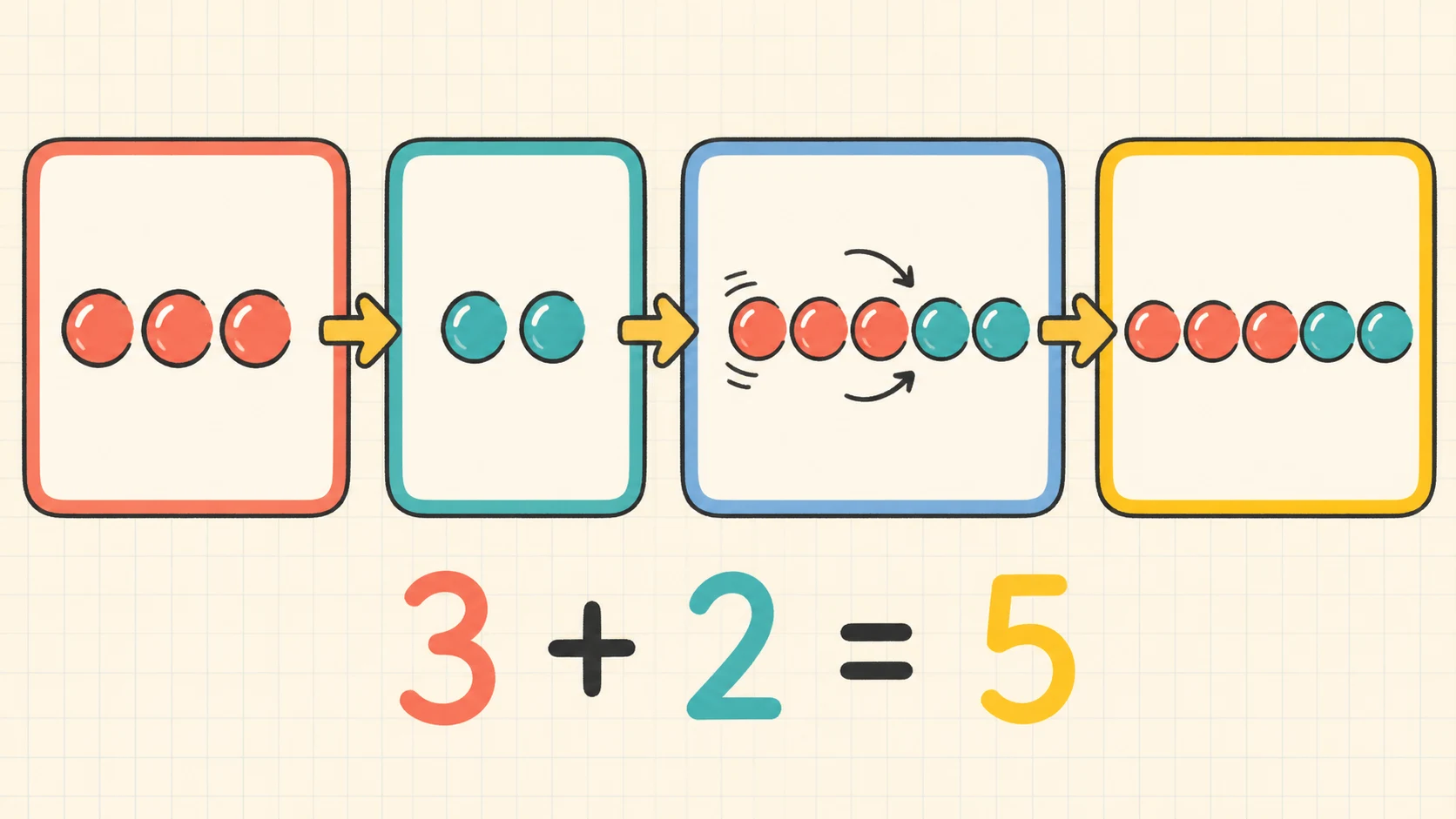
For early addition, the important connections are among quantities, drawings, spoken totals, and number sentences—not merely the printed answer.
Start with the addition action, then reduce the load
“Beginner” can describe several different starting points. One learner may understand joining groups but not recognize +. Another may know facts within 10 but lose track when a problem crosses 10. An older learner may add accurately yet misalign digits in a vertical calculation. These are different instructional decisions, even if all three learners use an easy sheet.
The central question is: What should change while addition itself stays constant?
If the target is understanding addition as joining, change the representation before changing the operation. Use counters, fingers, movements, or drawings. If the target is fact strategy, keep the notation but choose sums that expose a useful relationship, such as doubles or making ten. If the target is place-value addition, keep the numbers large enough to require place-value thinking but initially avoid regrouping.
The IES guide for teaching mathematics to young children recommends intentionally teaching mathematical ideas through progressions and helping children connect informal representations with mathematical language and symbols. Applied here, that means an adult should connect “three counters and two more counters” to 3 + 2 = 5, rather than presenting the symbols as a separate memorization task.
For ages three and four
For ages three and four, prioritize brief adult-led oral, matching, manipulative, and movement work over desk work. A printed page can supply an idea, but it should not dictate a long seated session.
For example, say, “Take two blocks. Add one more. How many now?” Let the child move the blocks, touch each object once, and say the total. A matching variation might pair a card showing two dots plus one dot with a card showing three dots. A movement variation could be “two jumps, then one more jump.” These preserve the addition action without making pencil control, scanning, or sustained sitting the main difficulty.
For learners ready for notation
Once a learner can reliably join visible groups, introduce or revisit + and =. Read 4 + 2 = 6 aloud as “four and two more make six.” Do not treat the equals sign as a prompt meaning “write the answer next.” It states that the expressions on both sides have the same value.
The Common Core mathematics standards provide one widely used example of how addition develops from representing situations and working within small ranges toward fluency and multi-digit computation. They are a reference point, not proof that a particular WorksheetWise sheet matches a learner’s local sequence.
Three checked examples show three different kinds of “easy”
The word “easy” is only useful when attached to observable task features. Compare these three calculations before choosing a sheet.
Example 1: 3 + 2 = 5 with counters
Place three counters in one group and two in another. Slide the groups together. Count the combined set once:
1, 2, 3, 4, 5
Therefore, 3 + 2 = 5.
This belongs in beginner addition because both addends and the total are small enough to represent directly, the groups can be seen, and no regrouping or multi-step reading is required. The learner still performs real addition: two quantities become one total.
A nearby easier task would be matching a picture of three objects plus two objects to a picture of five objects, with no numeral writing. A nearby harder task would remove the counters and ask for 3 + 2 from symbols alone. Another harder variation would ask, “Three birds were on a fence. Two more arrived. How many birds are there now?” That introduces language interpretation while keeping the same calculation.
The model earns its place when it explains why the total is five and can later be removed without changing the calculation.
Example 2: 8 + 5 = 13 by making ten
Start with 8. Decompose 5 into 2 and 3 because 8 needs 2 to make 10:
8 + 5
= 8 + 2 + 3
= 10 + 3
= 13
Check by counting on five steps from 8: 9, 10, 11, 12, 13. Both methods produce 13.
This example belongs at the upper edge of beginner fact practice because the total exceeds 10, but the numbers invite a visible strategy. It is more demanding than 3 + 2 because the learner must decompose 5 and hold the remaining 3 in mind. It is easier than a mixed page of unrelated sums within 20 if a ten-frame or split-five cue is available.
The support should expose the structure rather than perform the thinking. Five pre-drawn dots that can be split into two and three are useful. A printed arrow that reveals every step may be appropriate during teaching, but keeping that arrow forever can prevent the adult from seeing whether the learner owns the strategy.
Example 3: 243 + 315 = 558 without regrouping
Align the numbers by place value:
  243
+ 315
-----
  558
Check each column:
- Ones:
3 + 5 = 8 - Tens:
4 tens + 1 ten = 5 tens - Hundreds:
2 hundreds + 3 hundreds = 5 hundreds
So the sum is 558. A second check by decomposition gives the same result:
243 + 315 = (200 + 300) + (40 + 10) + (3 + 5)
= 500 + 50 + 8
= 558
This can be an easy addition task for an older elementary learner because the addends are multi-digit but no column requires regrouping. The target is place-value alignment and combining like units. Calling the number 243 “hard” merely because it has three digits would miss the task structure.
A nearby easier version is 23 + 15 = 38, with fewer place-value columns. A nearby harder version is 278 + 165 = 443, because the ones produce 13 and the tens produce another regrouping: 8 + 5 = 13, write 3 ones and regroup 1 ten; then 7 + 6 + 1 = 14 tens, write 4 tens and regroup 1 hundred; finally 2 + 1 + 1 = 4 hundreds.
These three examples should not be placed in one undifferentiated practice set. They target joining small visible sets, using a within-20 strategy, and preserving place value in multi-digit addition.
False difficulty signals can lead to the wrong worksheet
Some page features look demanding without making the addition itself harder. Others look friendly while quietly increasing the cognitive load.
A large numeral is not automatically a hard problem
Compare 421 + 326 with 8 + 7. The first has more digits but no regrouping:
421 + 326 = 747
The second has smaller numbers but crosses ten:
8 + 7 = 15
For a learner working on place-value alignment, 421 + 326 may be the cleaner task. For a learner still establishing what addition means, it is inappropriate even though the columns are simple. Difficulty depends on the target and prerequisite knowledge, not visual size alone.
Pictures do not automatically make a task easier
A clear ten-frame can reveal number structure. A crowded scene with differently sized objects may create scanning and counting demands unrelated to addition. If a learner calculates 4 + 3 correctly with counters but misses the same problem in a busy illustration, first simplify the visual field. Do not immediately conclude that the addition concept is missing.
Likewise, colorful clip art is not a mathematical support unless it represents the quantities or directs attention usefully.
More problems do not make each problem conceptually harder
A 30-problem sheet may contain individually accessible calculations while still being unsuitable as a single sitting. Fatigue, handwriting demands, and attention can affect later responses. The catalogue’s free sheets range from 20 to 30 problems depending on grade, but adults may assign a selected row, fold the page, cover unused items, or return to the remaining problems later.
Speed is another false signal. A slow correct solution with a coherent explanation may show stronger understanding than a fast string of guesses. Timed work changes the task by adding retrieval speed and pressure. Use it only when speed is genuinely the target and the learner already has accurate strategies.
Choose a page by the feature you want to observe
Begin with one decision: What evidence should this practice produce? Then select the narrowest variation that can produce it.
If you need evidence of joining
Choose small sums, objects or pictures that can be physically or visually combined, and little reading. Ask the learner to show what changes when the second addend is added. Suitable evidence includes moving two groups together, recounting the total, or explaining, “There were four, then two more, so now there are six.”
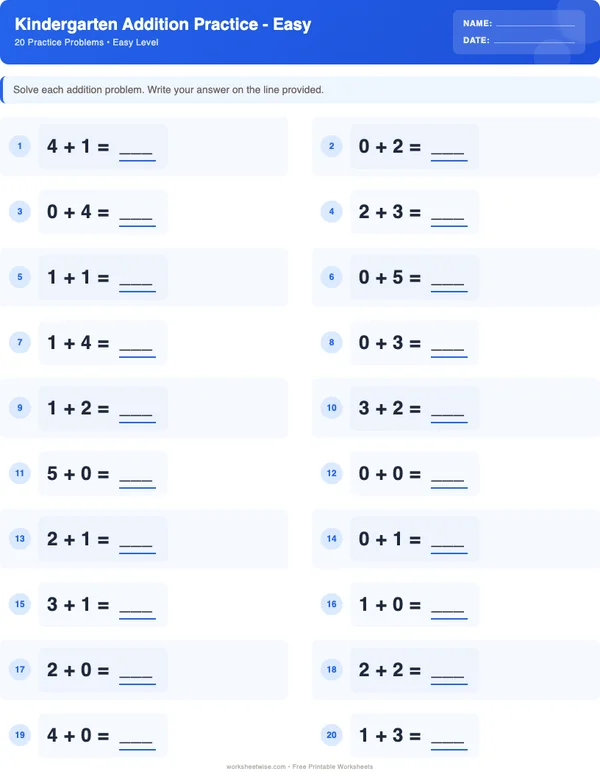
The Kindergarten Addition guide and free sheet is the most relevant catalogue entry point when the learner is connecting quantities to early addition notation. Use the grade label to discover materials, then inspect the actual problems before deciding.
If you need evidence of a fact strategy
Choose a short set organized around one relationship: adding one or two, doubles, near doubles, or making ten. Avoid mixing every fact type while a strategy is being learned.
For 6 + 7, a near-doubles explanation could be:
6 + 6 = 12
12 + 1 = 13
Therefore, 6 + 7 = 13.
Check by making ten:
6 + 7 = 6 + 4 + 3 = 10 + 3 = 13.
This fourth fully checked example belongs in supported within-20 practice because it can be solved through known relationships rather than counting all objects from one. It is harder than 6 + 1 but more instructionally focused than an arbitrary collection of sums.
The 1st Grade Addition guide and free sheet can help locate early fact work, while the 2nd Grade Addition guide and free sheet offers a nearby discovery path when the learner needs a different intended practice level.
If you need evidence of place-value reasoning
Choose aligned multi-digit problems and decide deliberately whether regrouping is present. Ask what each digit represents. A learner should be able to explain that the 4 in 243 means four tens, not simply “the middle number.”
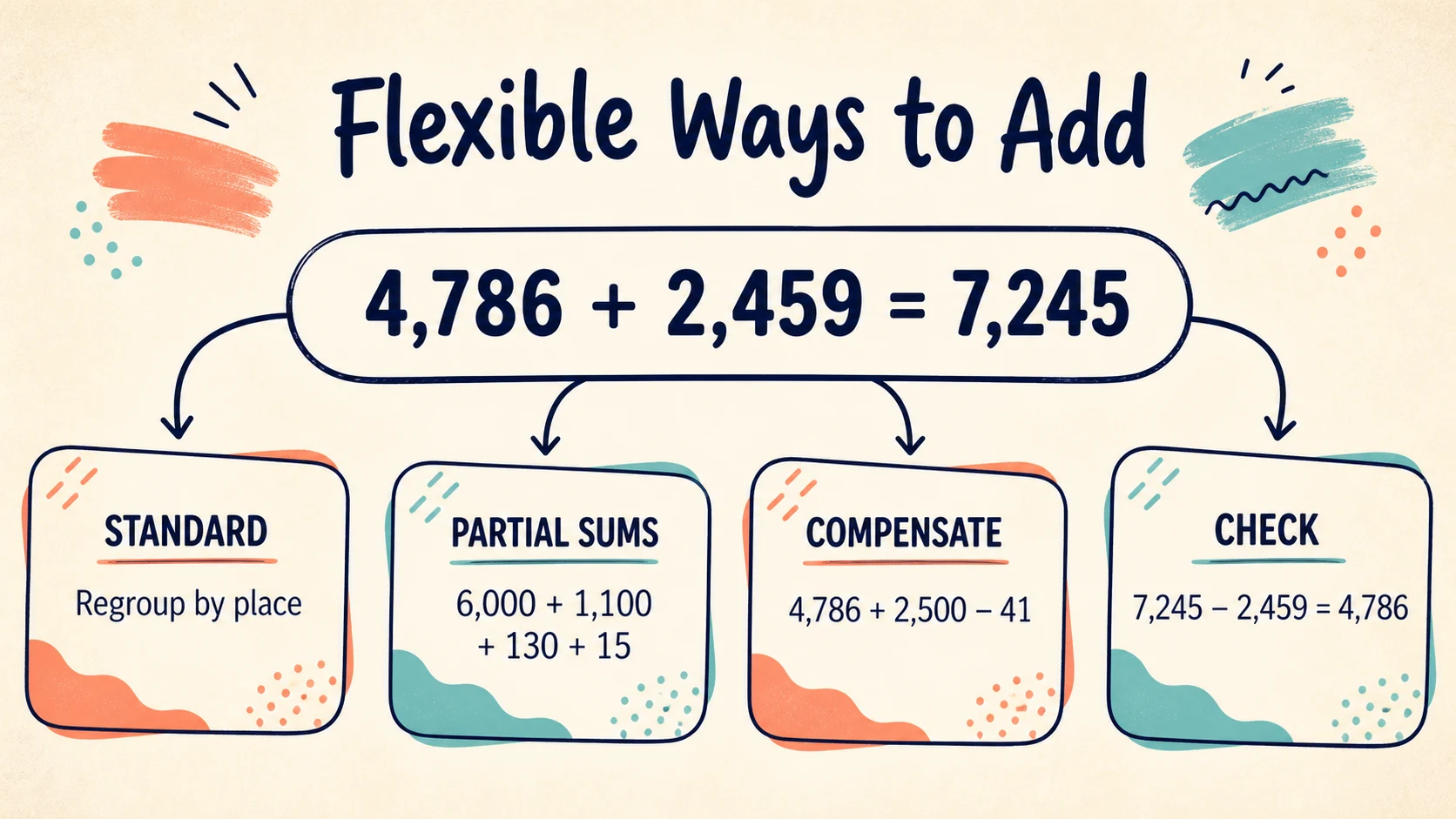
At an upper-elementary entry point, “easy” can mean isolating whole-number or place-value reasoning before adding regrouping, decimals, fractions, or mixed formats.
Use the 3rd Grade Addition guide and free sheet, 4th Grade Addition guide and free sheet, or 5th Grade Addition guide and free sheet as discovery routes. Do not infer placement from the learner’s age or enrolled grade alone.
A short routine makes each response informative
A worksheet is most useful when it sits inside a repeatable teaching exchange. The following routine can be completed with a few selected problems rather than an entire page.
1. Preview the target
Tell the learner what will stay constant: “Today every problem joins two amounts, and we will use making ten.” Review one prerequisite orally. For a multi-digit page, ask, “What does the 6 mean in 362?” before beginning.
2. Model one problem
Solve one example while naming the decision, not just the steps. For 9 + 4, say, “Nine needs one to become ten. I split four into one and three. Ten plus three is thirteen.”
Record:
9 + 4 = 9 + 1 + 3 = 13
Verify by counting on four numbers from 9: 10, 11, 12, 13.
3. Solve one together
Use a nearby problem such as 8 + 4. Ask, “How many does eight need to make ten?” If the learner answers 2, follow with, “If we split four into two and two, what remains?” Complete 8 + 2 + 2 = 12 together.
4. Watch two independent attempts
Choose problems with the same structure, such as 7 + 5 and 6 + 6. Let the learner select counters, a ten-frame, a drawing, or notation. Observe where the process becomes uncertain. Do not interrupt every hesitation; the method is part of the evidence.
5. Check and explain
Ask the learner to verify one answer by a second method. This may mean recounting counters, using a different decomposition, estimating whether a multi-digit total is reasonable, or adding by expanded form.
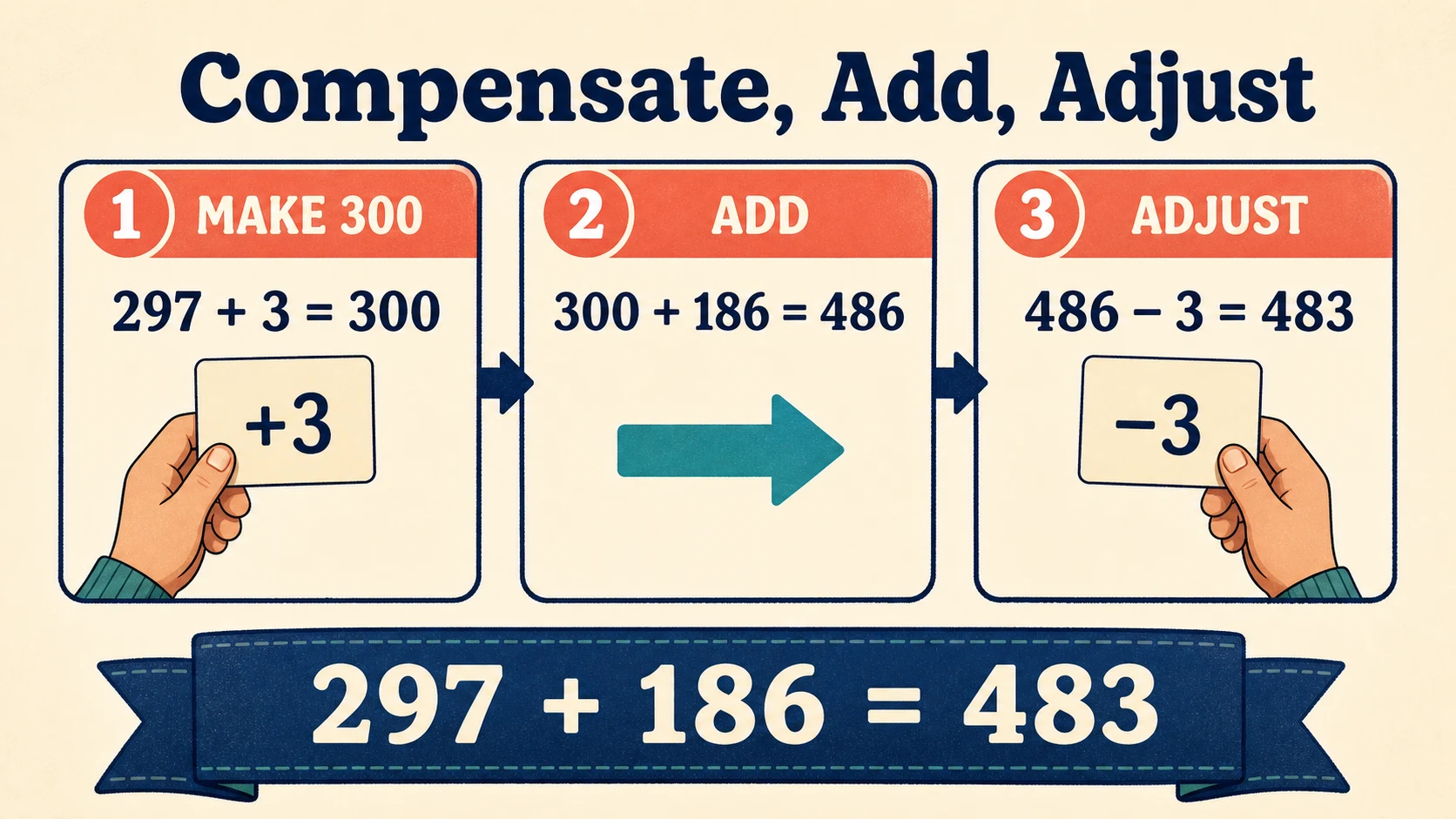
For an easy 3rd-grade addition sheet, the routine should reveal place-value decisions and accuracy before the learner is asked to complete all 25 problems.
The IES practice guide on assisting students who struggle with mathematics supports systematic instruction, clear mathematical language, representations, and regular opportunities to review important content. In this context, that favors brief modeled and guided practice followed by observable independent work—not an unexplained page followed only by an answer check.
Fade supports without changing everything at once
A support is ready to fade when the learner uses it accurately and can describe the mathematical relationship it represents. Remove one support while holding the numbers, operation, and problem format steady.
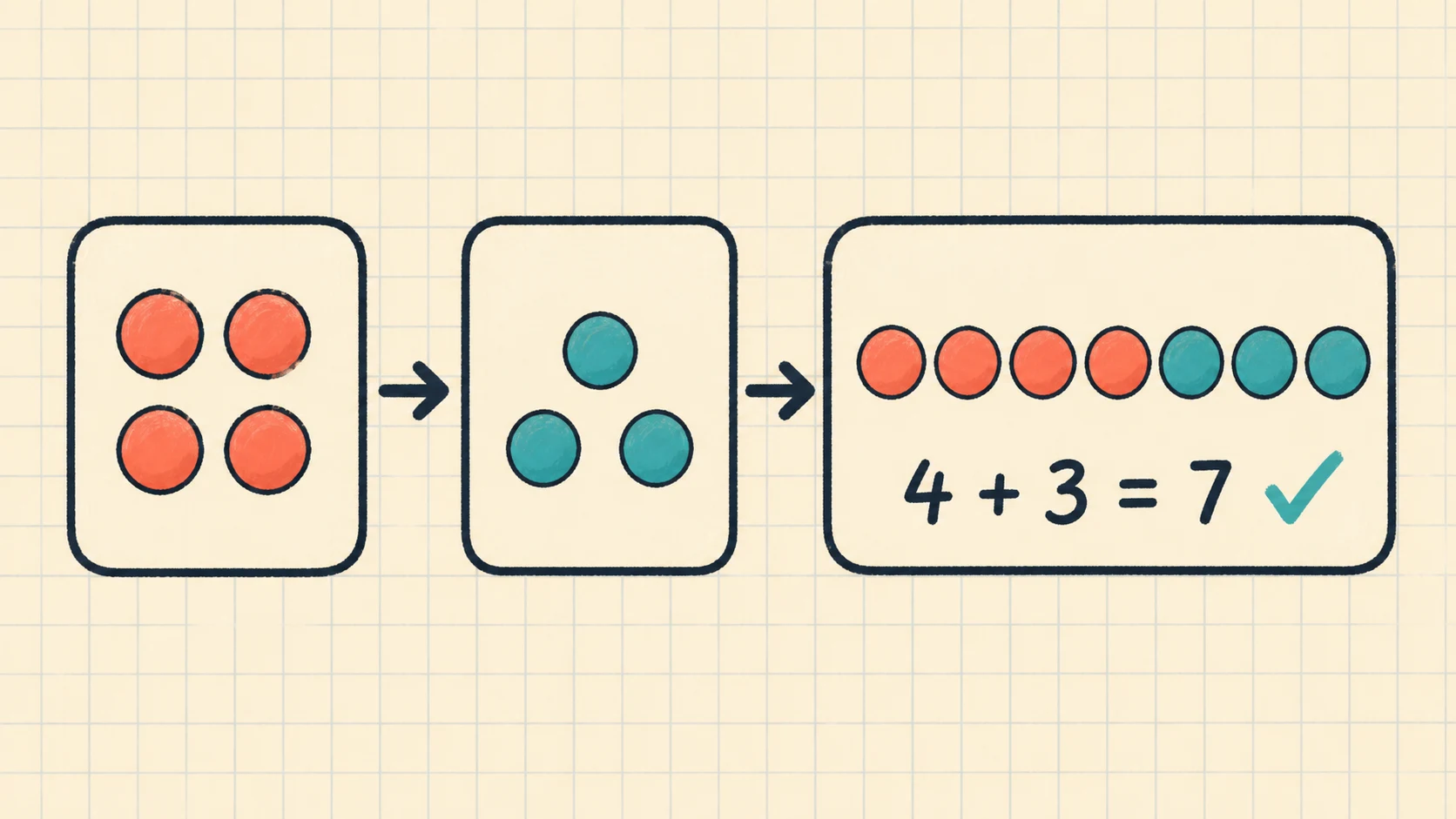
A five-step fading sequence
- The learner builds
4 + 3with physical counters. - The learner draws four marks and three marks.
- The learner uses a printed ten-frame but places or draws the marks.
- The learner sees only
4 + 3and may draw a model if needed. - The learner solves
4 + 3mentally and explains or checks the answer.
The total remains 7 throughout. Because the calculation stays constant, the adult can observe the effect of removing the representation. If the learner succeeds with counters but not with a drawing, return to a brief connection: build the counters, draw one mark for each counter, then cover the counters.
For making ten, fade from a filled ten-frame to an empty ten-frame, then to a small prompt such as “make 10,” and finally to no prompt. For multi-digit addition, fade from labeled hundreds-tens-ones columns to ordinary graph paper, then to unboxed vertical notation.
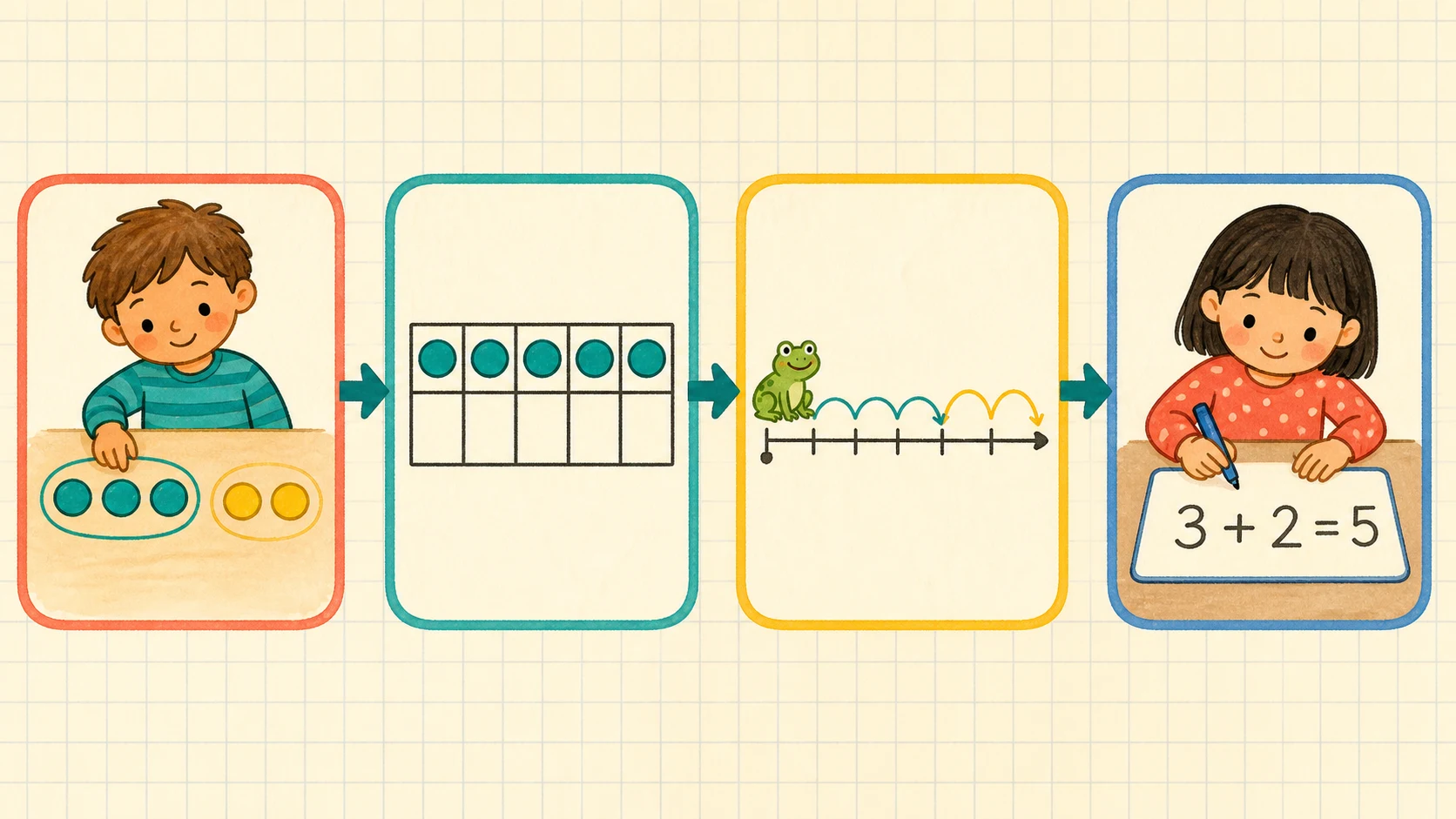
The useful progression removes a representation only after the learner can connect it to the same 1st-grade addition relationship.
Do not fade all supports in the same lesson while also enlarging the number range and changing from horizontal to vertical form. A wrong response would then have too many possible causes.
Interpret errors before selecting more practice
Wrong answers are information only when the adult looks at the method.
Counting and quantity errors
For 3 + 2, an answer of 4 may come from skipping an object, counting one object twice, or beginning the count-on sequence incorrectly. Ask the learner to touch or move each counter while counting. If one-to-one matching is inconsistent, use a shorter set and physical movement. The Easy and beginner Counting Worksheets may be a relevant prerequisite resource, but counting practice should supplement—not replace—the joining action.
Symbol and operation errors
A learner who writes 5 - 2 = 3 when shown two groups of five and two may understand the quantities but misread the operation sign. Ask, “Did the second group join, or did something leave?” Contrast one addition situation with one subtraction situation orally before returning to the sheet.
If the learner writes 3 + 2 = 32, the response may reflect concatenating digits rather than finding a total. Build the quantities and ask whether the combined set has more than three but fewer than ten objects. This checks meaning without supplying the answer.
Strategy errors across ten
Suppose the learner solves 8 + 5 as 12 and says, “I gave two to eight, then added two.” The decomposition lost one unit: 5 was incorrectly treated as 2 + 2. Rebuild five counters, move two to complete ten, and count the three remaining counters. Record 5 = 2 + 3 before repeating 10 + 3 = 13.
That error calls for making the split visible. It does not necessarily call for retreating to every sum within 5.
Place-value and regrouping errors
For 278 + 165, an answer such as 333 may indicate that the learner added column digits but did not preserve regrouped units. Ask the learner to represent 13 ones as 1 ten and 3 ones, then connect that exchange to the written 1 above the tens column.
An answer of 1,928 for 243 + 315 may come from treating each column total as a separate string rather than composing one number. Expanded form and place-value labels are more relevant than extra fact drills.
The purpose is instructional interpretation, not diagnosis. A small sample cannot establish a disability, disorder, or general mathematical capacity.
Adapt access while preserving addition
An adaptation preserves the target when it removes a barrier that is not the intended mathematical challenge.
For visual access, enlarge the print, increase spacing, cover unused rows, or use high-contrast counters. Do not replace a place-value task with a simpler operation unless place value is not the target.
For motor access, let the learner point, dictate, move number cards, use stamps, or answer orally while an adult records. If the target is addition reasoning, handwriting need not determine success.
For language access, read directions aloud, demonstrate “join,” “altogether,” and “more,” and use consistent sentence structures. Avoid assuming that difficulty with a word problem proves difficulty with its calculation. After clarifying the context, still ask the learner to identify the two quantities and their total.
For attention and stamina, assign four to six carefully chosen problems, take a movement break, and return later. Preserve the variety needed to check understanding: do not select only the first row if every problem there has the same answer pattern.
For ages three and four, keep adaptations especially concrete and brief: oral prompts, object matching, manipulatives, and movement should take priority over desk completion. For all ages, avoid turning adult help into answer giving. A useful prompt directs attention—“How many does eight need to make ten?”—while leaving the calculation to the learner.
Readiness for the next variation must be observable
A high score alone is weak evidence if the learner copied a model, relied on an adult prompt for every item, or completed only one repeated pattern. Look for a cluster of behaviors across more than one short session.
The learner may be ready to change one task feature when they can:
- Solve the current type accurately across a small mixed sample.
- Explain what the addends and total represent.
- Use a model without losing track of quantities.
- Check at least one answer through another representation or strategy.
- Recover from an error after a neutral prompt.
- Complete some examples without the support that was previously necessary.
- Maintain the method when the layout or order changes slightly.
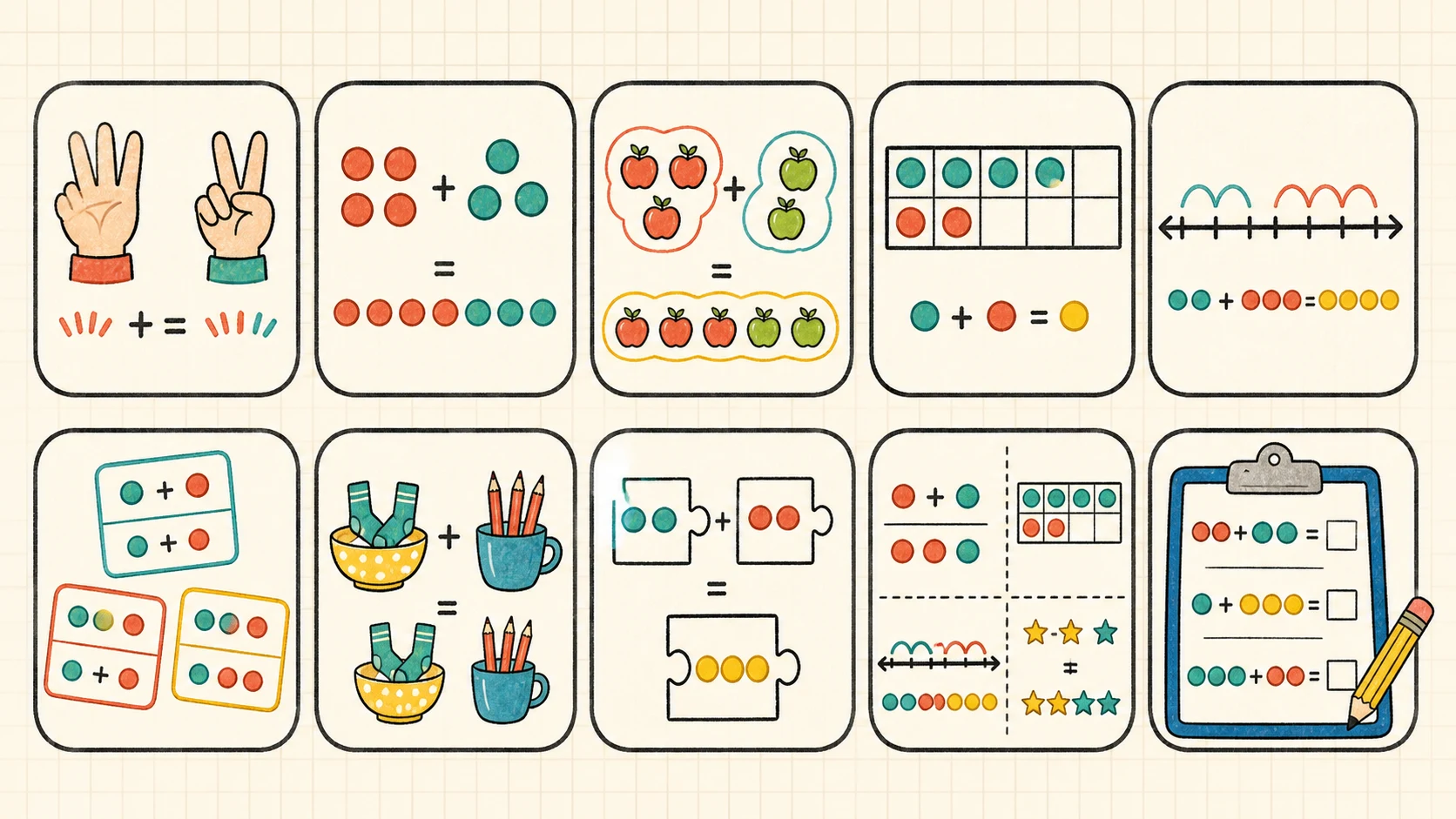
A two-week view is useful for comparing repeated evidence, not for forcing every learner through the same calendar or number of problems.
Choose only one next variation:
- Increase sums from within 5 to within 10 while keeping pictures.
- Keep sums within 10 but remove pre-drawn pictures.
- Keep the number range and introduce a missing addend, such as
4 + __ = 7. - Keep sums within 20 and mix making-ten problems with doubles.
- Keep three-digit addition but introduce one regrouping column.
- Keep regrouping absent but move from expanded form to standard vertical notation.
If accuracy collapses, restore the last useful support and collect another small sample. If performance remains accurate but the learner cannot explain any method, continue with representations and discussion before emphasizing speed.
Boundaries of an easy worksheet
A worksheet can provide selected practice and a record of responses. It cannot by itself determine readiness, explain every error, teach every prerequisite, or establish curriculum placement. It also cannot show whether a learner understands addition in conversation, with objects, in a story, and in notation unless an adult deliberately samples those forms.
The catalogue descriptions cover an addition progression from adding within 5 with objects and pictures through within 10 and 20 strategies and later multi-digit work. That broad progression should not be read as a claim that every variant contains every stage or that completing one sheet produces mastery.
Easy practice is also not always the right next step. If the learner solves every item immediately and explains the reasoning, repeating an equivalent page may add little evidence. Change one meaningful feature. Conversely, if the learner cannot reliably join two small physical groups, a denser symbolic sheet is unlikely to clarify the concept.
Local standards, instructional materials, and school expectations may sequence strategies differently. Use the approved sources as general guidance and the catalogue facts to understand available entry points; neither replaces observation of the learner or coordination with the learner’s teacher.
Make the next session a controlled comparison
Select four problems that preserve one addition idea and vary only the support. For example, use 4 + 3 with counters, 5 + 2 with a drawing, 6 + 3 with an optional empty ten-frame, and 5 + 4 in symbols. Ask for a total and one explanation each. Record whether the learner counted all, counted on, made a known combination, or needed a prompt.
Then choose the next sheet by the evidence: retain the representation if it supports accurate reasoning, fade it if the learner independently connects it to the number sentence, or reduce the number range if quantities are being lost. Use the free deterministic worksheet generators to create that single controlled variation for the next session rather than changing number range, layout, and strategy at the same time.
Put it into practice
Use the guide with a real printable
Move from explanation to a short, observable practice task. Check the first item together, then adjust the next session from the learner's actual work.
Open the first free worksheetExplore a neighboring collection
Choose by a different teaching need
Easy and Beginner Counting Worksheets Easy and Beginner Division Worksheets Easy and Beginner Fractions Worksheets Easy and Beginner Geometry Worksheets Easy and Beginner Money Worksheets Easy and Beginner Multiplication Worksheets Easy and Beginner Sight Words Worksheets Easy and Beginner Subtraction Worksheets