Curated collectionAnswer keys includedPrint-ready PDFs
Word Problems Worksheets by Grade and Level
Show the full word problems progression across 7 real grade combinations, compare task boundaries, model checked examples and explain how to choose the next level.
Start with a real resource
Browse this worksheet collection
7 relevant free entry points are available. Each one includes a printable learner PDF and separate answer key.
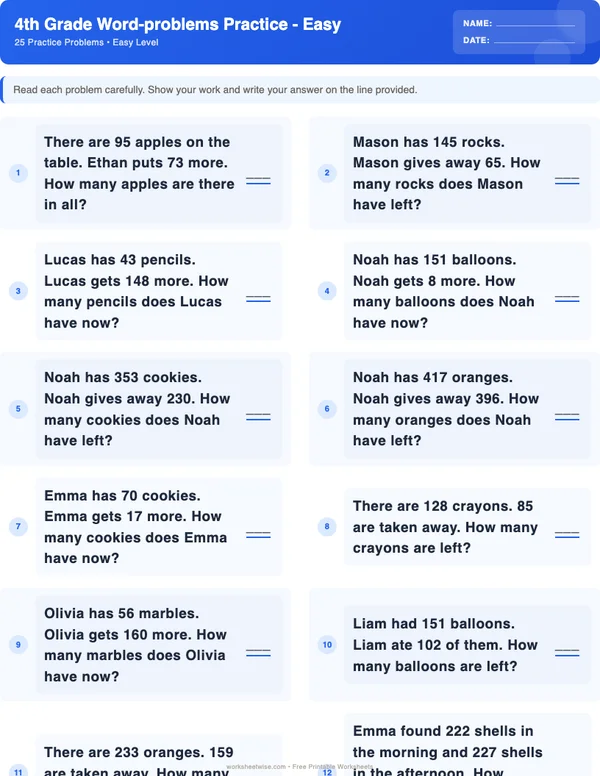
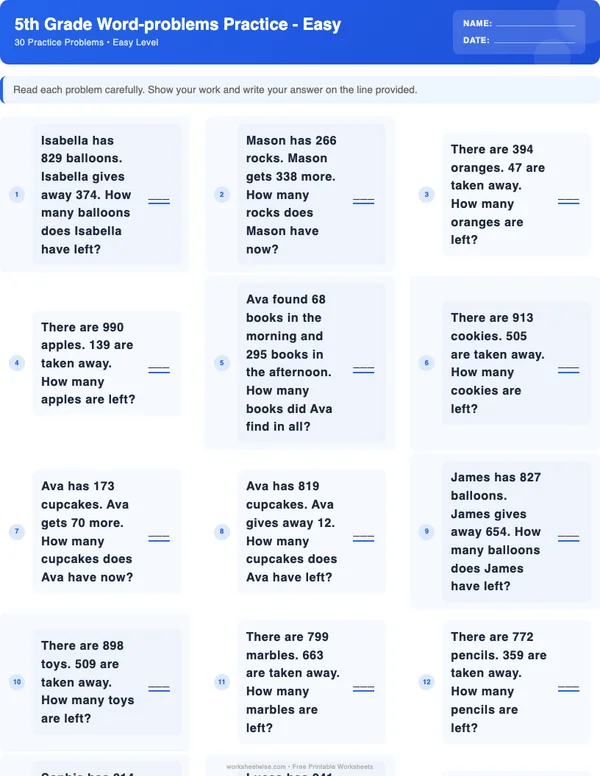
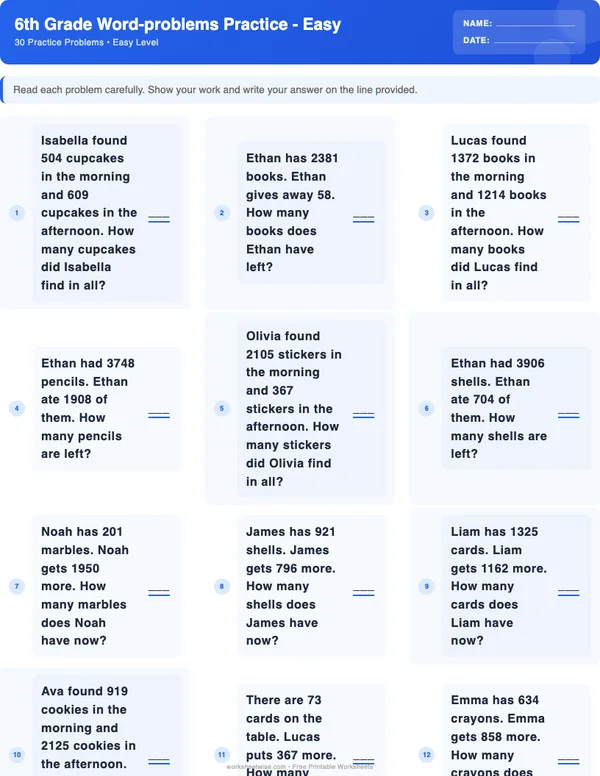
A useful practice loop
Print less. Observe more.
- Choose one skill and model the first item aloud.
- Use a short set and notice the learner’s strategy.
- Change the next task from the work you can see.
Need more than the free sheet?
Plus includes all 126 matching catalogue variations where available, plus saved deterministic generators and the worksheet designer.
See Plus membershipComplete guide
How to teach and practise word problems worksheets
3,320 words Updated 6 instructional visuals
Choose word problems by the thinking required, not the grade printed on top
Word problems worksheets should help a learner turn a described situation into mathematics. The important question is not simply, “Can the learner calculate?” It is, “Can the learner identify the quantities, understand their relationship, decide what must be found, choose a representation and check whether the answer fits the story?”
The live WorksheetWise catalogue provides seven free entry points—Kindergarten through 6th Grade—within 126 word-problem variants. The free Kindergarten, 1st Grade and 2nd Grade sheets each contain 12 problems; 3rd Grade and 4th Grade contain 14; 5th Grade contains 16; and 6th Grade contains 30. Those counts describe the resources, not an ideal workload. An adult may assign only two or three carefully chosen problems when close discussion is more valuable than completing a page.
Start where the learner can understand the situation with manageable support. Then increase one demand at a time: the language, number system, number of steps, position of the unknown, amount of irrelevant information or independence expected. Grade labels describe intended practice levels, but local curriculum sequences differ. Age is a discovery aid rather than a placement decision.
A productive worksheet session therefore has two goals: solve the mathematics and make the learner’s interpretation visible.
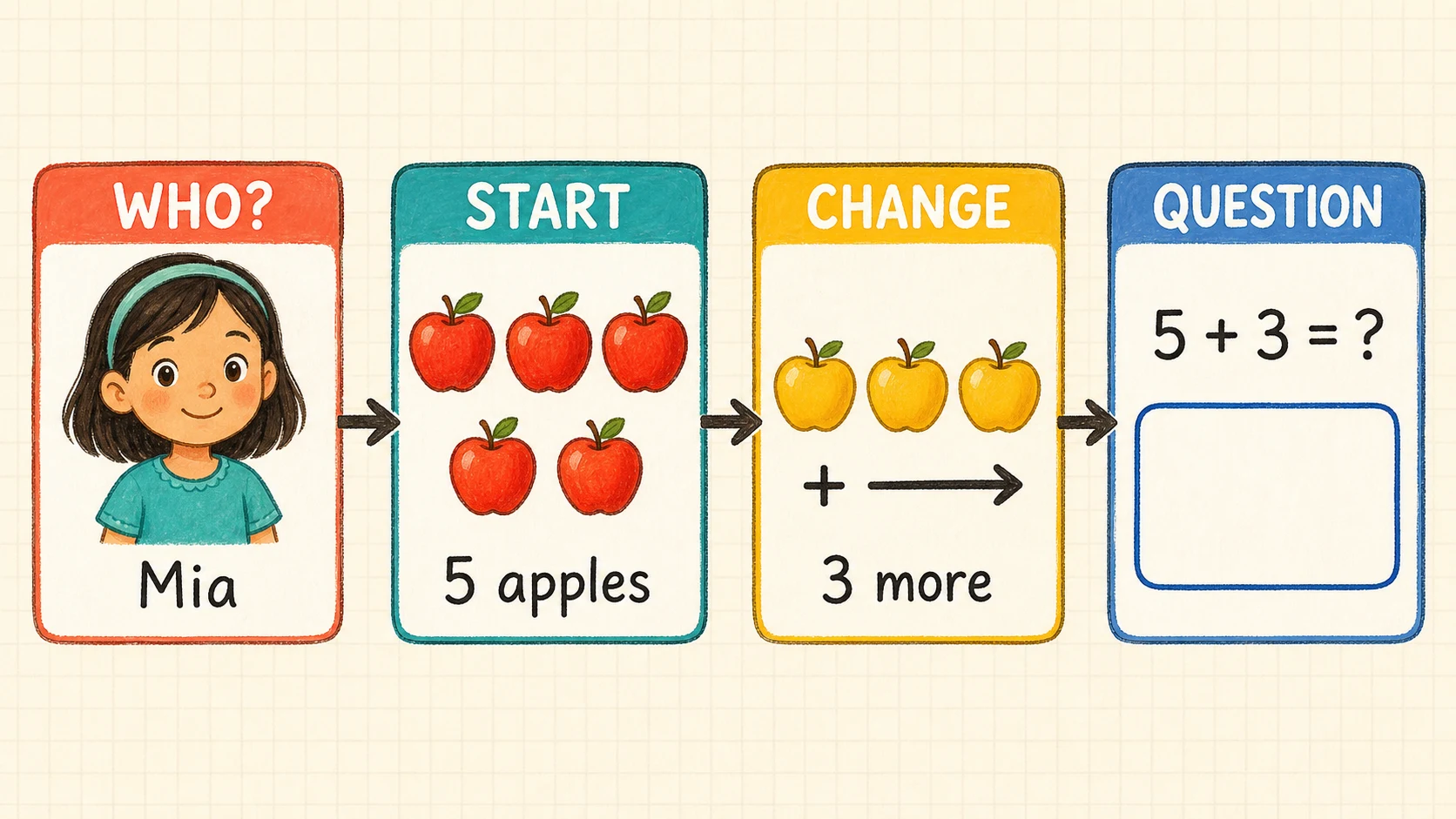
The early word-problem pathway connects understanding the story, representing the quantities, calculating and checking—not calculation alone.
What changes across the seven catalogue levels
The catalogue’s topic description traces a broad boundary: early work begins with simple one-step addition and subtraction stories, while upper-grade work can involve multiple steps, fractions, decimals and ratios. That is a progression in task structure, not a claim that every worksheet at a particular grade contains every listed feature.
Kindergarten and 1st Grade: make the story visible
At the earliest entry points, the adult can read the problem aloud and let the learner act it out with counters, toys or fingers. Keep the quantities visible. Ask the learner to show what happened before requesting an equation.
A Kindergarten problem might say:
Five birds are on a fence. Two more birds land. How many birds are on the fence now?
The learner can place five counters, add two and count seven. A part-part-whole bar model has one section of 5, one section of 2 and a whole labeled ?. The equation is 5 + 2 = 7. A check returns to the event: more birds arrived, so an answer smaller than five would not fit.
This belongs at an early level because it uses a short, one-step joining situation, small whole-number quantities and a result unknown. The mathematical answer has been checked: five plus two is seven.
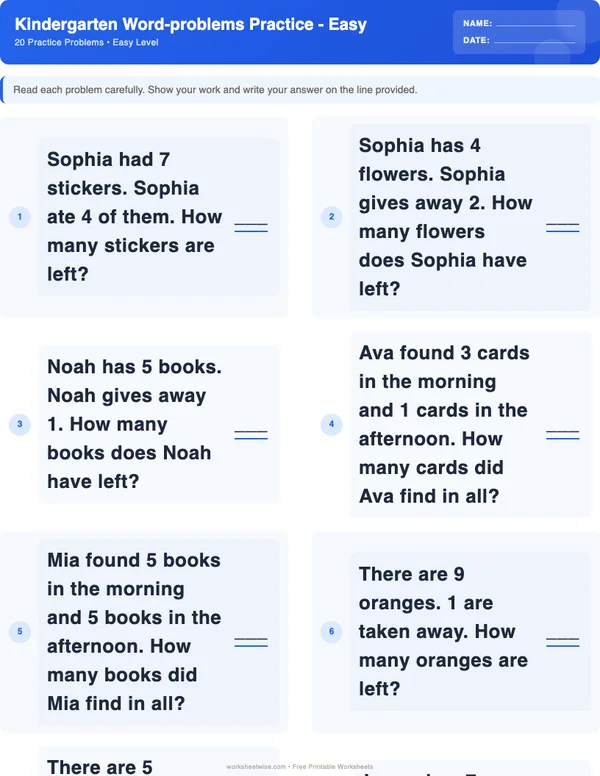
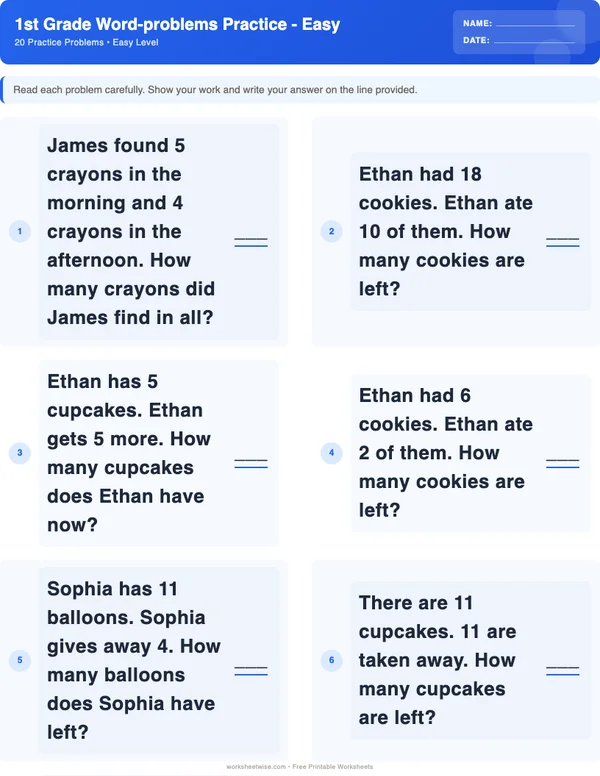
The catalogue’s free Kindergarten and 1st Grade sheets both contain 12 problems and carry the label “easy.” Treat that label as a browsing signal, not a learner description. Observable features that would make a problem an accessible starting point include one event, familiar objects, small quantities, a clearly stated question and the option to model every item. Confirm those features on the actual sheet rather than assuming the label guarantees them.
For ages three and four, prioritize brief adult-led oral, matching, manipulative and movement work over desk work. A child might “be” one of five birds and invite two adults or toys to join. The aim is understanding the change in the story, not filling a page.
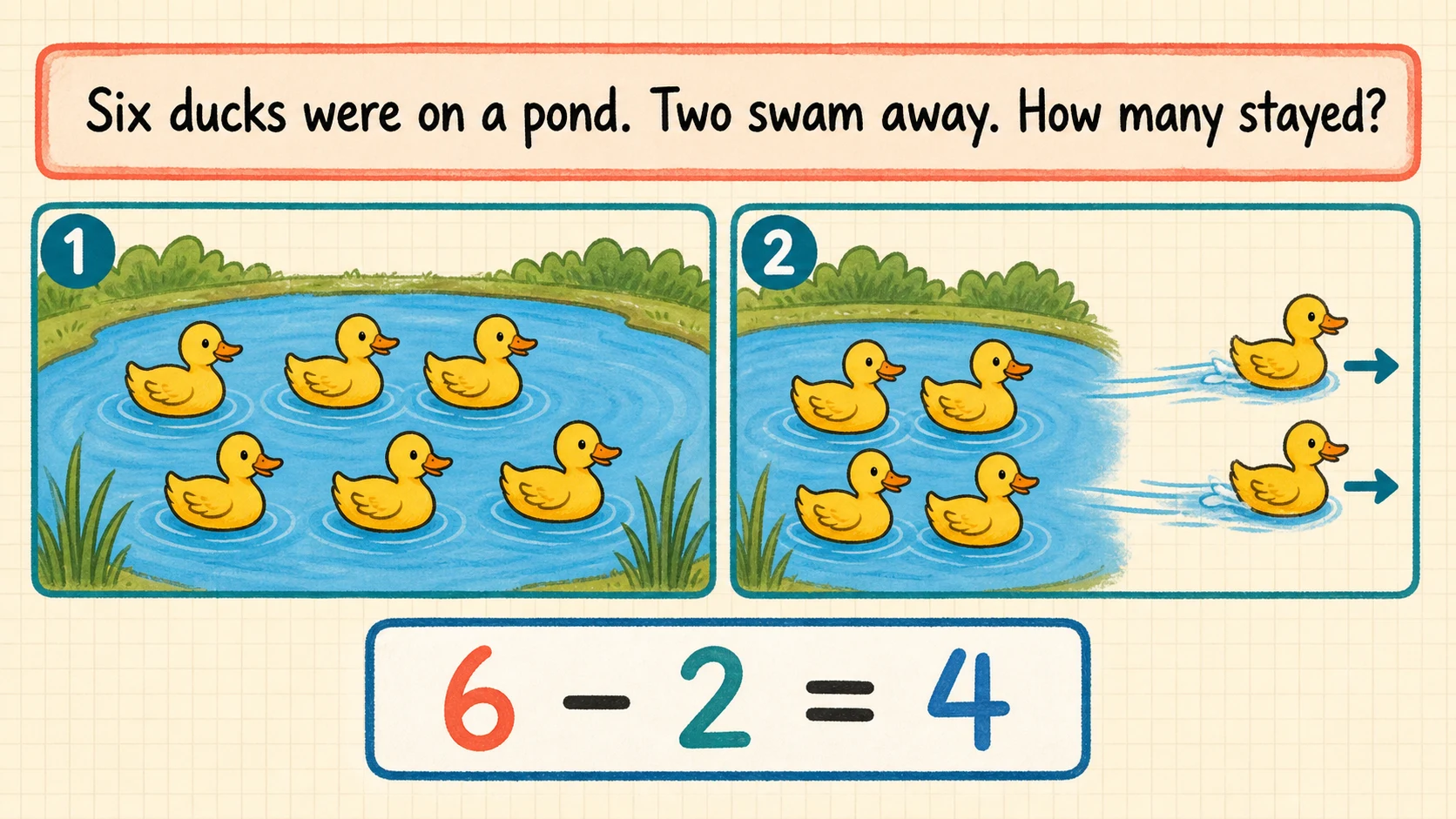
Concrete objects and a bar model let a 1st Grade learner explain why the quantities combine before writing an equation.
2nd and 3rd Grade: vary the relationship and the unknown
Once result-unknown stories are secure, do not merely increase the numbers. Change where the unknown appears.
Consider:
Maya had some stickers. Her aunt gave her 8 more. Now Maya has 21 stickers. How many stickers did Maya have at first?
This is a start-unknown joining problem. A bar model shows an unknown starting part plus 8 making a whole of 21. The learner can write ? + 8 = 21 and solve with 21 − 8 = 13. Check: 13 + 8 = 21.
The answer is 13 stickers. This example belongs around the 2nd-to-3rd Grade transition because the computation remains straightforward while the unknown has moved away from the result. A learner who relies on “more means add” may calculate 21 + 8 = 29; a learner who models the relationship can see that 21 is already the whole.
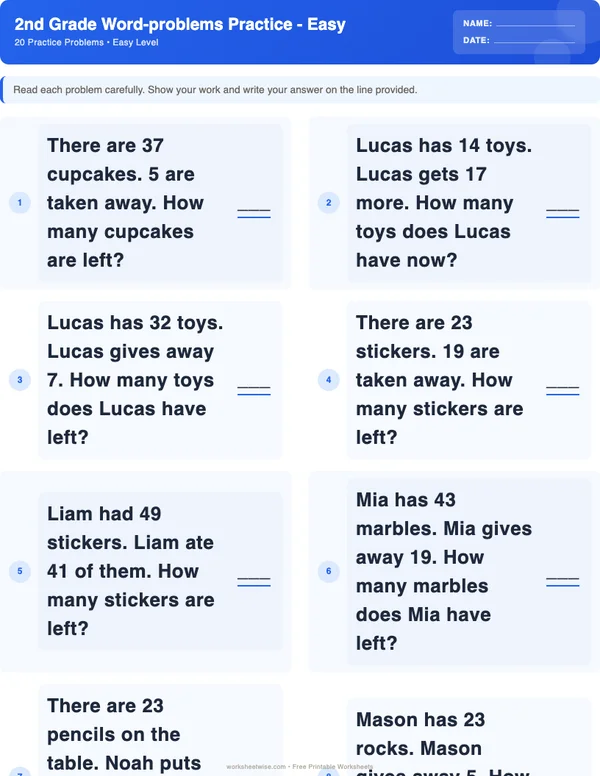
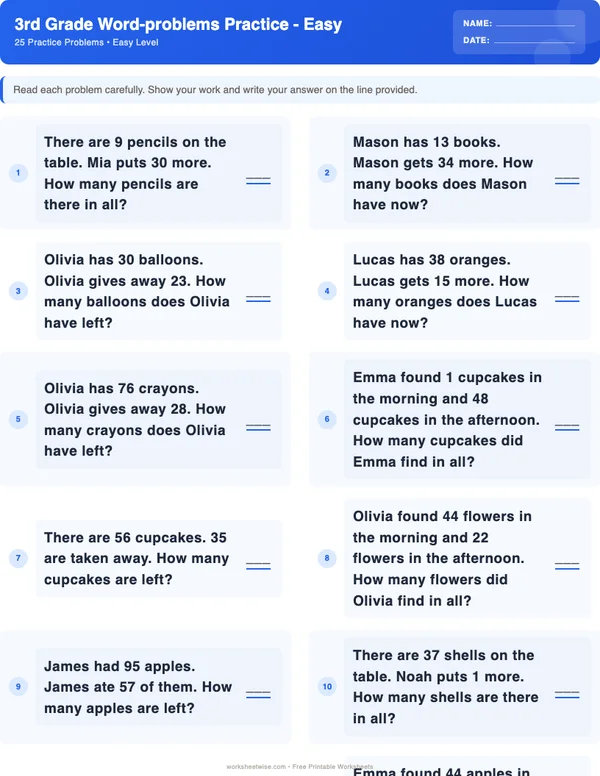
The free 2nd Grade sheet has 12 problems, while the free 3rd Grade sheet has 14. The additional items do not by themselves prove greater conceptual difficulty. Inspect whether the questions introduce comparison, equal groups, more varied unknown positions or multiple pieces of information.
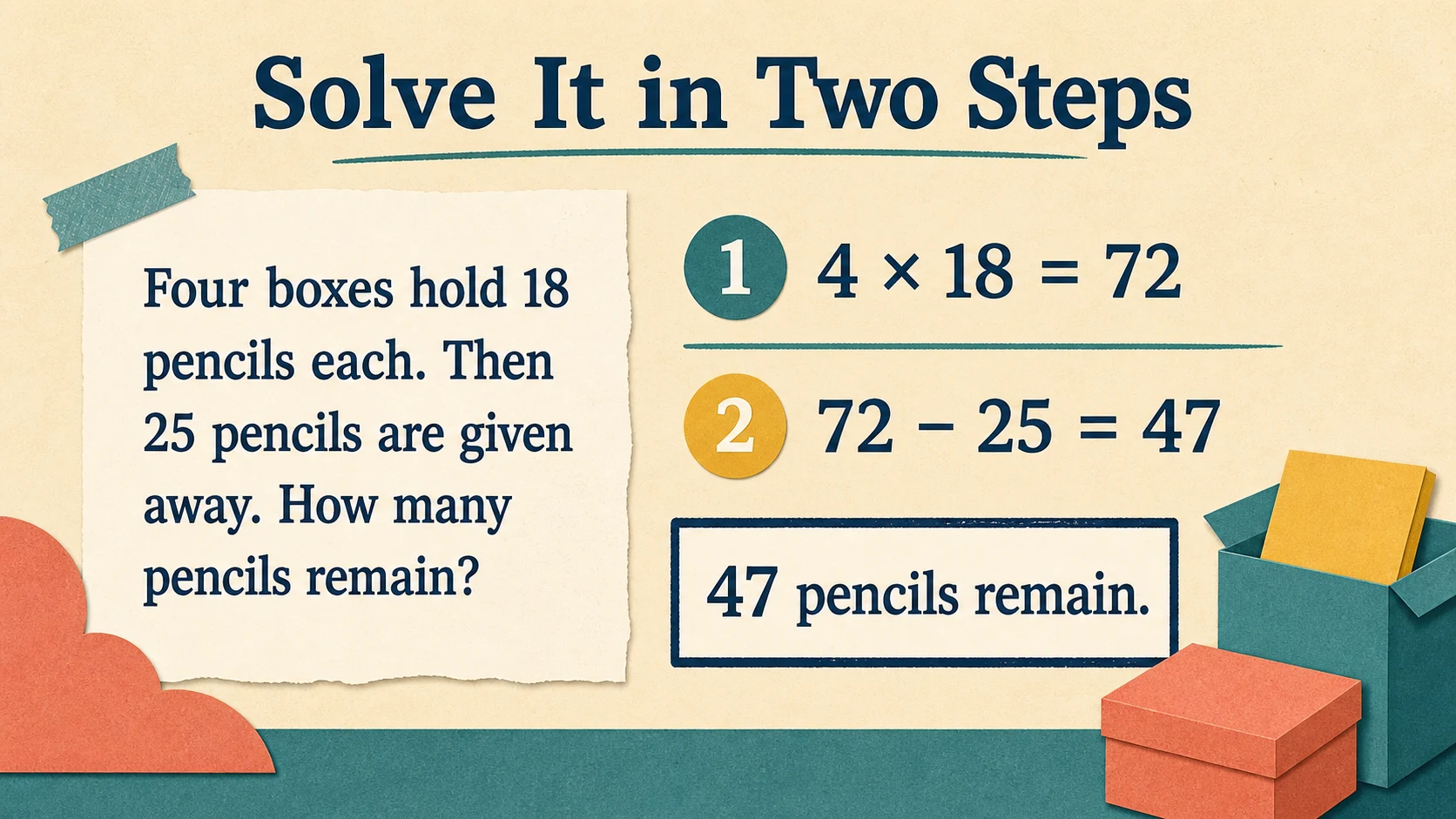
At the 3rd Grade entry point, the representation should reveal whether quantities form a whole, a comparison or equal groups.
4th and 5th Grade: coordinate steps and number types
Upper-elementary selection should account for both computation and comprehension. A learner may know fraction or decimal procedures but still need help deciding which quantities interact.
Here is a checked two-step example:
A class collected 168 cans on Monday and 137 on Tuesday. The cans were packed equally into 5 boxes. How many cans went into each box?
First combine the daily collections: 168 + 137 = 305. Then divide the total equally: 305 ÷ 5 = 61. Each box receives 61 cans. Check by multiplying: 61 × 5 = 305, which matches the collected total.
This fits a 4th-to-5th Grade boundary because the learner must form an intermediate total and then use it in a second operation. A useful diagram has two adjacent parts, 168 and 137, forming a total bar; a second bar partitions that total into five equal sections. The challenge is not hidden in large numbers—the relationship genuinely changes between steps.
The free 4th Grade sheet contains 14 problems and the free 5th Grade sheet contains 16. Before choosing between them, inspect the operations, number forms, number of steps and expected explanation. Do not advance solely because a learner finished 14 items quickly.
6th Grade: sustain reasoning across a longer set
The free 6th Grade entry point contains 30 problems, substantially more than the other free sheets. That makes workload an explicit selection issue. A 30-item sheet can be divided into short sets organized by problem type or used as a source from which an adult selects representative items.
The catalogue places fractions, decimals and ratios within the upper-grade span, but the verified facts do not identify the exact mix on this particular free sheet. Preview it before assigning it. Look for whether a problem requires one operation or several, whether units must be coordinated, whether a ratio describes a relationship and whether the learner must justify a choice.
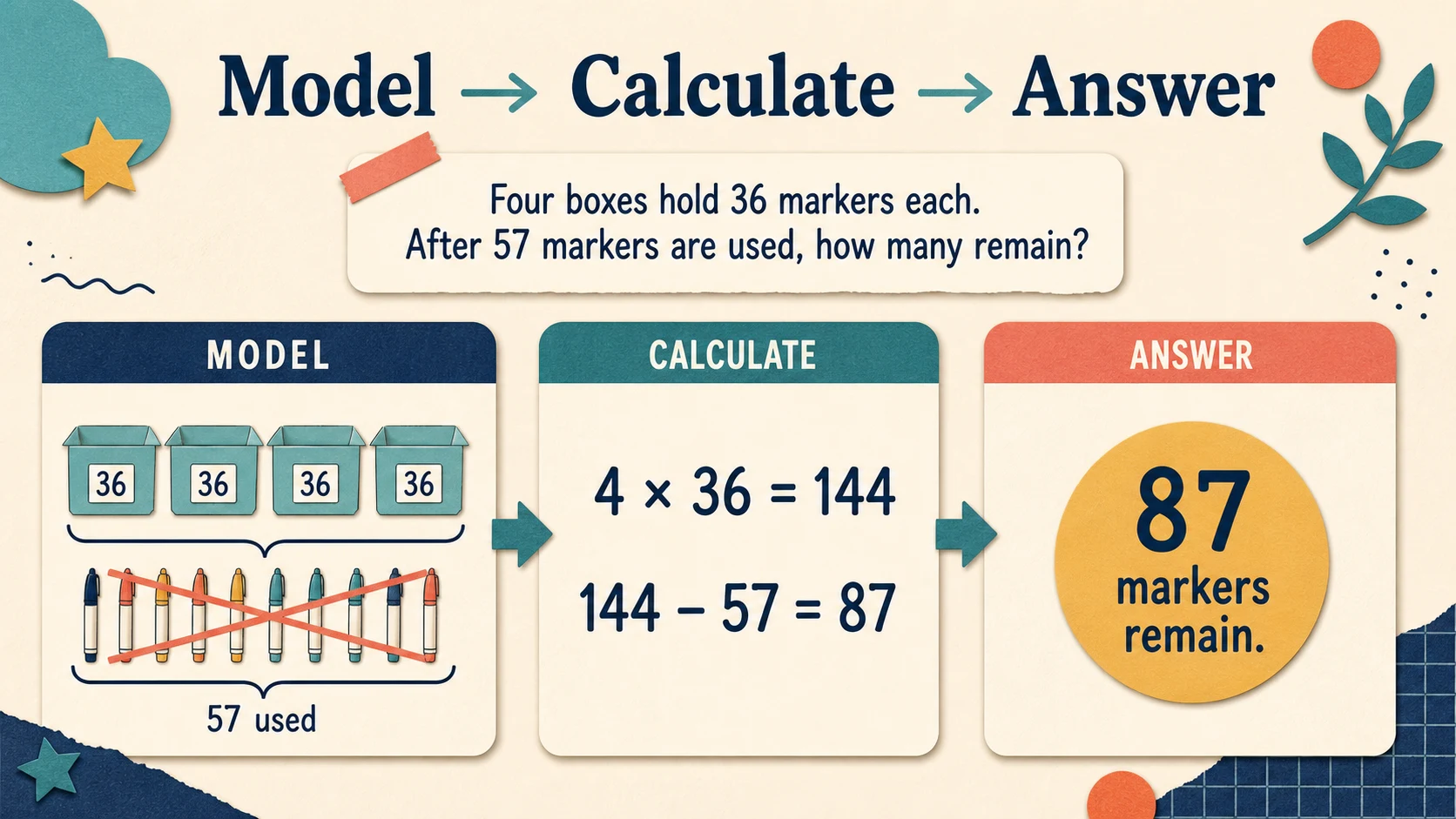
For 6th Grade practice, independence should grow through shorter supported sets before a learner tackles a long mixed page.
Use one routine from oral stories through multi-step problems
The following six-part routine is a page-specific teaching recommendation based on the catalogue’s teaching anchor. It is not presented as a quoted research protocol.
1. Read the entire problem
Do not calculate at the first number. Read to the end so the question can determine which facts matter. If decoding is the barrier, the adult may read aloud while preserving all mathematical decisions for the learner.
2. Retell the situation
Ask, “What is happening?” A valid retelling names the action or relationship without merely repeating number words. For example: “She had an unknown amount, received eight and ended with twenty-one.”
If the learner cannot retell it, pause before discussing operations. Act out the event, sketch it or replace unfamiliar names while keeping the quantities and relationship unchanged.
3. Separate what is known from what must be found
Record units with quantities: 168 cans, not just 168. Box the question. Let the learner cross out genuinely irrelevant information, but require an explanation.
4. Draw the relationship
Use a bar model, picture, table, number line or objects. Bar models—also called tape diagrams or strip diagrams—are especially versatile because the same visual language can show three major structures:
- Part-part-whole: two or more parts compose a total.
- Comparison: aligned bars show how much more or less one quantity is.
- Equal groups: a whole bar is partitioned into equal sections.
Calling bar models “the single most effective” strategy is part of the supplied teaching anchor, not a conclusion attributed here to the approved sources. The broader, sourced guidance is that the IES elementary intervention guide recommends deliberate word-problem instruction and well-chosen concrete and semi-concrete representations. It also recommends clear mathematical language (IES, Assisting Students Struggling with Mathematics).
5. Choose and complete the calculation
The representation should justify the operation. Ask, “What does this equation mean in the story?” Keep interpretation and arithmetic separable: if the learner chose the correct equation but made a subtraction error, the response should differ from the response to a misread relationship.
6. Check against the situation
A check is more than repeating the same calculation. The learner can use an inverse operation, estimate, substitute the result into the story, verify units or compare the answer with known bounds.
For the cans example, 61 is credible because five groups of about 60 make about 300. For the bird example, the final amount must exceed five because two birds joined.
Teach structures instead of operation keywords
Keyword rules fail because the same word can occur in different structures. “Left,” for example, does not automatically require subtraction:
There are 4 tables on the left side of the room and 6 on the right. How many tables are there?
Here “left” describes location, and the answer is 4 + 6 = 10.
Likewise, “in all” may appear in a question that requires subtraction:
A library has 45 animal and space books in all. There are 18 animal books. How many are space books?
The whole is 45 and one part is 18, so 45 − 18 = 27. Check: 18 + 27 = 45.
These two examples are appropriate across early elementary levels because they expose the limits of word hunting without requiring difficult arithmetic. Their purpose is question design: hold the calculation manageable while testing whether the learner interprets the structure.
The Common Core mathematics materials emphasize that understanding includes explaining why an answer is true, not only producing a correct result. They also describe applying connected mathematical ideas to real-world problems (Common Core State Standards Initiative, Mathematics). That source can inform instructional decisions, but it does not establish that any WorksheetWise page is aligned to a particular standard.
Add information traps without turning the task into a reading ambush
Extra and missing information reveal whether a learner treats every numeral as an instruction to calculate.
A checked extra-information problem
Noah has 24 red beads and 17 blue beads. He uses 9 red beads for a bracelet. His sister is 11 years old. How many red beads remain?
The relevant calculation is 24 − 9 = 15. The 17 blue beads and age 11 are irrelevant. Check: 15 + 9 = 24.
This belongs after a learner can solve a direct subtraction story. It preserves simple computation but raises the comprehension demand. Ask the learner to explain why each unused number does not affect the red beads remaining. Do not praise crossing out numbers indiscriminately; relevance depends on the question.
A checked missing-information problem
Six bags hold the same number of apples. How many apples are there altogether?
There is no numerical answer because the number of apples per bag is missing. If each bag held a apples, the total would be 6a, but a is not given.
This belongs wherever equal groups are being studied because it tests whether the learner recognizes the two quantities multiplication needs: number of groups and amount in each group. “Cannot determine from the information given” is the complete answer. Supplying a guessed value would change the problem.
Extra-information tasks should still use clear sentences and familiar contexts. Missing-information tasks should omit a mathematically necessary fact, not depend on obscure background knowledge.
Read errors as evidence about the next task
A wrong answer does not identify a diagnosis. It provides a clue to investigate with one follow-up question.
Correct operation, incorrect calculation
If the learner represents 21 − 8 but answers 14, preserve the word-problem target. Let the learner use counters, a number line or a separate computation aid. Then return to the story and check 14 + 8. The interpretation may be secure even though subtraction needs review. The Addition Worksheets by Grade and Level can isolate computation when addition itself is the obstacle.
Correct number, unexplained equation
A learner might write 27 for the library problem but be unable to say why. Ask for a bar model and a complete sentence: “There are 27 space books because 18 and 27 make the total 45.” A correct answer reached by guessing is not yet evidence of stable interpretation.
Combining every number
If the learner computes 24 + 17 + 9 + 11 in the bead problem, ask, “What does 11 measure?” Then label every number with its unit and role. This error points toward relevance and question-reading work, not harder arithmetic.
Reversing a comparison
For “Lena has 14 shells and Kai has 9; how many more does Lena have?” an answer of 23 suggests the learner combined the sets. Draw aligned bars of lengths 14 and 9. The unmatched segment is 14 − 9 = 5. Ask which quantity the answer measures: all shells or the difference.
Solving only the first step
In the cans example, an answer of 305 shows that the learner found the intermediate total but did not answer “in each box.” Have the learner underline the final question, label 305 as “total cans” and continue. Reduce the number of problems assigned while preserving two-step structure.
Choosing by keywords
When “more” triggers addition in the sticker example, ask the learner to place 21 as the whole in a bar model. Contrast ? + 8 = 21 with 21 + 8 = ?. The remedy is a pair of structurally different problems sharing the same tempting word.
The IES early-childhood guide recommends teaching number and operations through a developmental progression, monitoring what children know and helping them describe their world mathematically (IES, Teaching Math to Young Children). That supports observing a learner’s response and adjusting the next experience. It does not prescribe a worksheet grade or assess these catalogue resources.
Adapt access without removing the reasoning
An adaptation preserves the relationship the learner must understand. It should not silently make the operation choice for them.
Useful adaptations include:
- Read the text aloud without emphasizing operation words.
- Replace a name or unfamiliar object while retaining every quantity and relationship.
- Cover the rest of a long page and show one problem at a time.
- Permit counters, drawings, a number line or a blank bar-model template.
- Let the learner dictate the retelling before writing.
- Provide graph paper to keep multi-digit work aligned.
- Separate interpretation from computation by allowing a multiplication chart or calculator when arithmetic is not the target.
- Reduce a 30-problem assignment to a deliberately mixed set of four while retaining comparison, equal-group and multi-step demands.
Avoid adaptations that disclose the solution path, such as circling only the relevant facts in advance, writing an operation symbol beside the question or converting every story into an equation for the learner.
For ages three and four, a suitable adaptation is not a shortened desk worksheet. Use brief adult-led oral stories, matching, manipulatives and movement. The adult might say, “Put three bears in the cave; two more arrive,” and ask the child to show and tell what changed.
Select a real worksheet with a five-part preview
The seven free entry points make comparison possible, but placement should follow observable task features.
Check the story structure
Decide whether the learner needs part-part-whole, comparison or equal-groups practice. Within addition and subtraction, note whether the result, change or start is unknown. Choose a small mixed set only after the learner can explain the individual structures.
Check the mathematical load
Preview number size, operations, fractions or decimals, regrouping, remainders and number of steps. If both comprehension and calculation are new, you may not know which demand caused an error. Keep one familiar while introducing the other.
Check the language load
Look at sentence length, vocabulary, pronoun references, units and irrelevant facts. Language should require careful reading without turning the task into a vocabulary test unrelated to mathematics.
Check the representation expected
An accessible starting sheet permits objects or drawings. A later task may require the learner to select and create a representation independently. Difficulty should be described through these visible demands—not by labeling a learner “easy,” “developing” or “advanced.”
Check volume and independence
The free sheets range from 12 to 30 problems. Decide in advance how many constitute one session and what help is permitted. Completion speed alone is a poor reason to move up; listen for a retelling, inspect the model and request a reasonableness check.
A practical starting sequence is:
- Use the Kindergarten guide and free sheet when oral one-step stories, manipulatives and visible quantities are appropriate.
- Use the 1st Grade guide and free sheet for early written one-step practice with continued concrete and pictorial support.
- Compare the 2nd Grade guide and free sheet when varying the unknown or introducing comparison becomes the next useful demand.
- Open the 3rd Grade guide and free sheet when equal groups and more independent representation are plausible targets.
- Preview the 4th Grade guide and free sheet before assigning multi-step work.
- Compare the 5th Grade guide and free sheet when upper-elementary number types and longer reasoning chains are appropriate.
- Treat the catalogue’s 6th Grade resource as a longer upper-level option and sample it before assigning its 30 problems.
These are selection suggestions based on the catalogue progression, not promises about an individual learner or substitutes for local curriculum guidance.
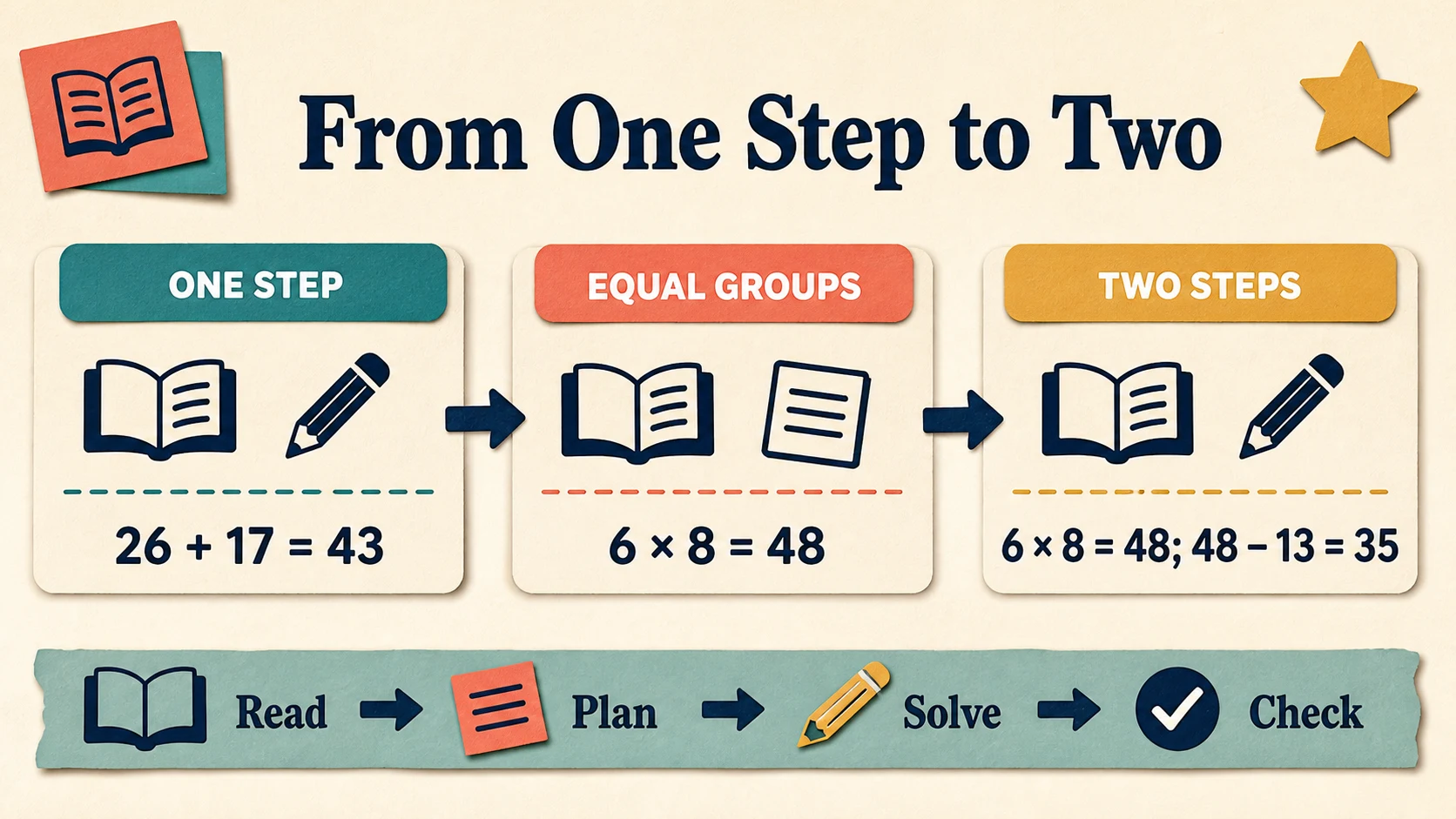
The useful 3rd Grade transition is from adult-supported modeling to independently choosing a representation, not merely using larger numbers.
Use a two-week cycle to decide whether to stay, step sideways or move on
A worksheet is most informative when revisited through related structures rather than completed once and forgotten.
During the first week, model the six-part routine with one problem, solve one together and let the learner attempt one independently. Alternate part-part-whole, comparison and equal-groups situations as appropriate. Include a result unknown and a less familiar unknown position.
During the second week, revisit the same structures with changed contexts. Add one problem containing irrelevant information and one with missing information. End with a mixed pair in which the same keyword appears but different operations are required.
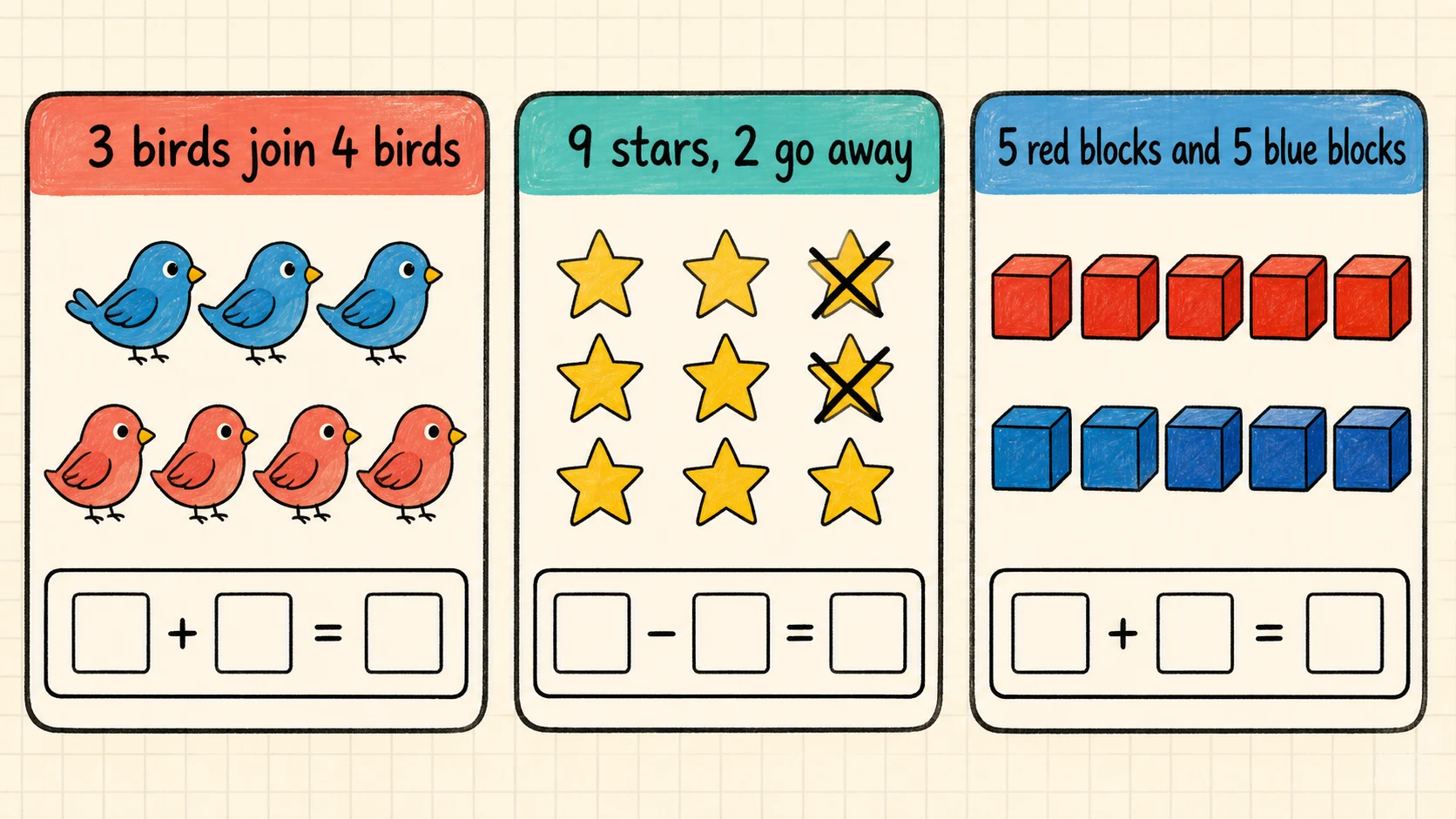
Short, revisited 1st Grade sets make it possible to observe whether the learner understands the structure rather than remembers yesterday’s wording.
After the cycle, move to a more demanding sheet only if the learner can usually retell the event, distinguish known from unknown information, choose a fitting representation, justify the operation and check the answer with decreasing support. Step sideways when one structure—such as comparison—remains uncertain. Step back in calculation load, but not necessarily grade label, when arithmetic obscures otherwise sound reasoning.
The observable next action is simple: open the 1st Grade Word Problems guide and free sheet, preview its 12 problems and select three with different relationships or unknown positions. Ask the learner to solve each using the six-part routine. Record exactly where support was needed; use that evidence, rather than age or page completion, to choose the next catalogue level.
Put it into practice
Use the guide with a real printable
Move from explanation to a short, observable practice task. Check the first item together, then adjust the next session from the learner's actual work.
Open the first free worksheetExplore a neighboring collection
Choose by a different teaching need
Addition Worksheets by Grade and Level Consonant Blends Worksheets by Grade and Level Counting Worksheets by Grade and Level CVC Words Worksheets by Grade and Level Decimals Worksheets by Grade and Level Digraphs Worksheets by Grade and Level Division Worksheets by Grade and Level Fractions Worksheets by Grade and Level