Curated collectionAnswer keys includedPrint-ready PDFs
CVC Words Worksheets by Grade and Level
Show the full cvc words progression across 3 real grade combinations, compare task boundaries, model checked examples and explain how to choose the next level.
Start with a real resource
Browse this worksheet collection
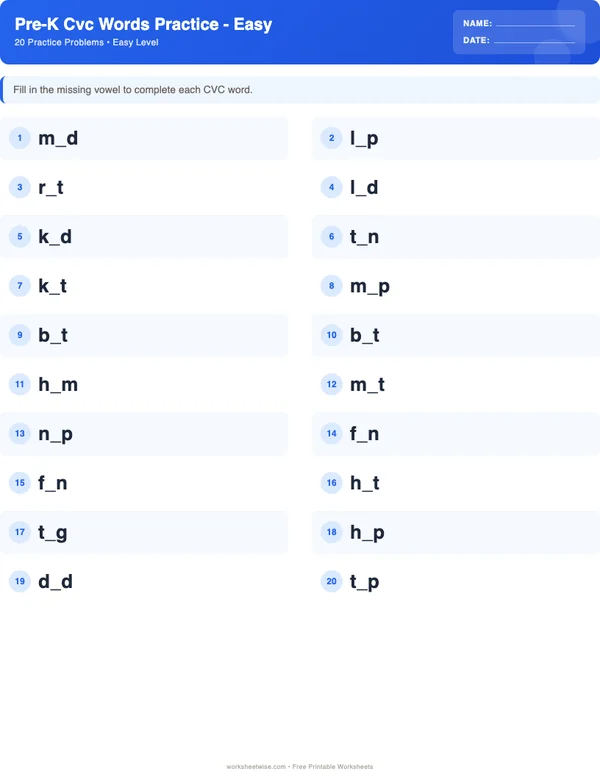
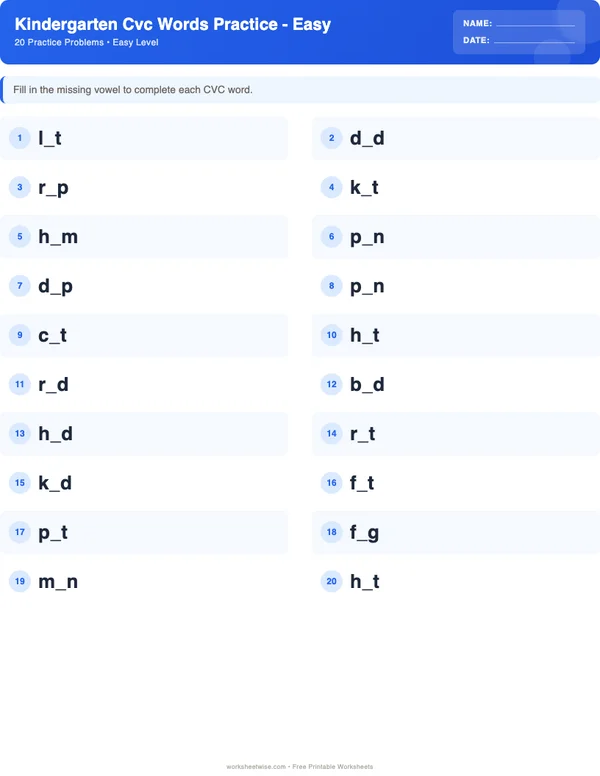
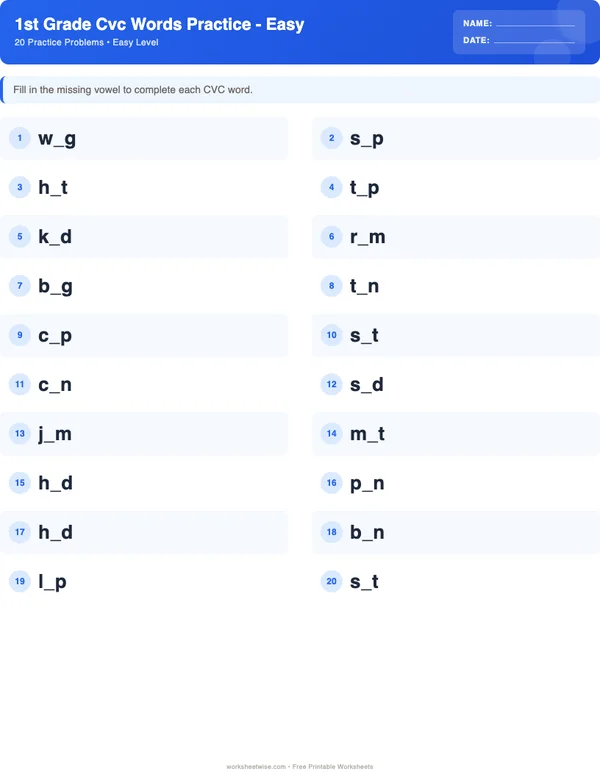
3 relevant free entry points are available. Each one includes a printable learner PDF and separate answer key.
A useful practice loop
Print less. Observe more.
- Choose one skill and model the first item aloud.
- Use a short set and notice the learner’s strategy.
- Change the next task from the work you can see.
Need more than the free sheet?
Plus includes all 54 matching catalogue variations where available, plus saved deterministic generators and the worksheet designer.
See Plus membershipComplete guide
How to teach and practise cvc words worksheets
3,447 words Updated 6 instructional visuals
Choose CVC practice by what the learner must do
CVC words have three sounds represented in a consonant-vowel-consonant pattern: cat, pin, and hug. The useful teaching question is not “Which grade is the learner in?” It is “What can the learner do with those three sounds, and how much support makes the task productive?”
WorksheetWise currently lists 54 CVC worksheet variants across three intended practice levels: Pre-K, Kindergarten, and 1st Grade. Each grade combination has one free 20-problem sheet, giving families and educators three free entry points. All belong to phonics and cover the same broad concept, but a sensible progression changes the representation, response, and amount of independence:
- Begin with adult-led listening, matching, movement, and letter manipulation.
- Move into reading and building CVC words with visible support.
- Progress to less-supported decoding, spelling, word comparison, and transfer to unfamiliar examples.
Age is a discovery aid, not a placement decision. A five-year-old who cannot yet isolate the middle sound may need the same concrete task as a younger learner. A younger child who confidently blends three sounds may be ready for a more demanding prompt. For ages three and four, prioritize brief adult-led oral, matching, manipulative, and movement work over desk work.
The catalogue’s “easy” label applies to all three free sheets. Treat that as a description of an entry-point worksheet, not a label for a learner. Observable task features matter more: whether pictures are present, whether letters are supplied, whether only one short vowel appears, whether the learner reads or writes, and whether an adult provides the sounds.
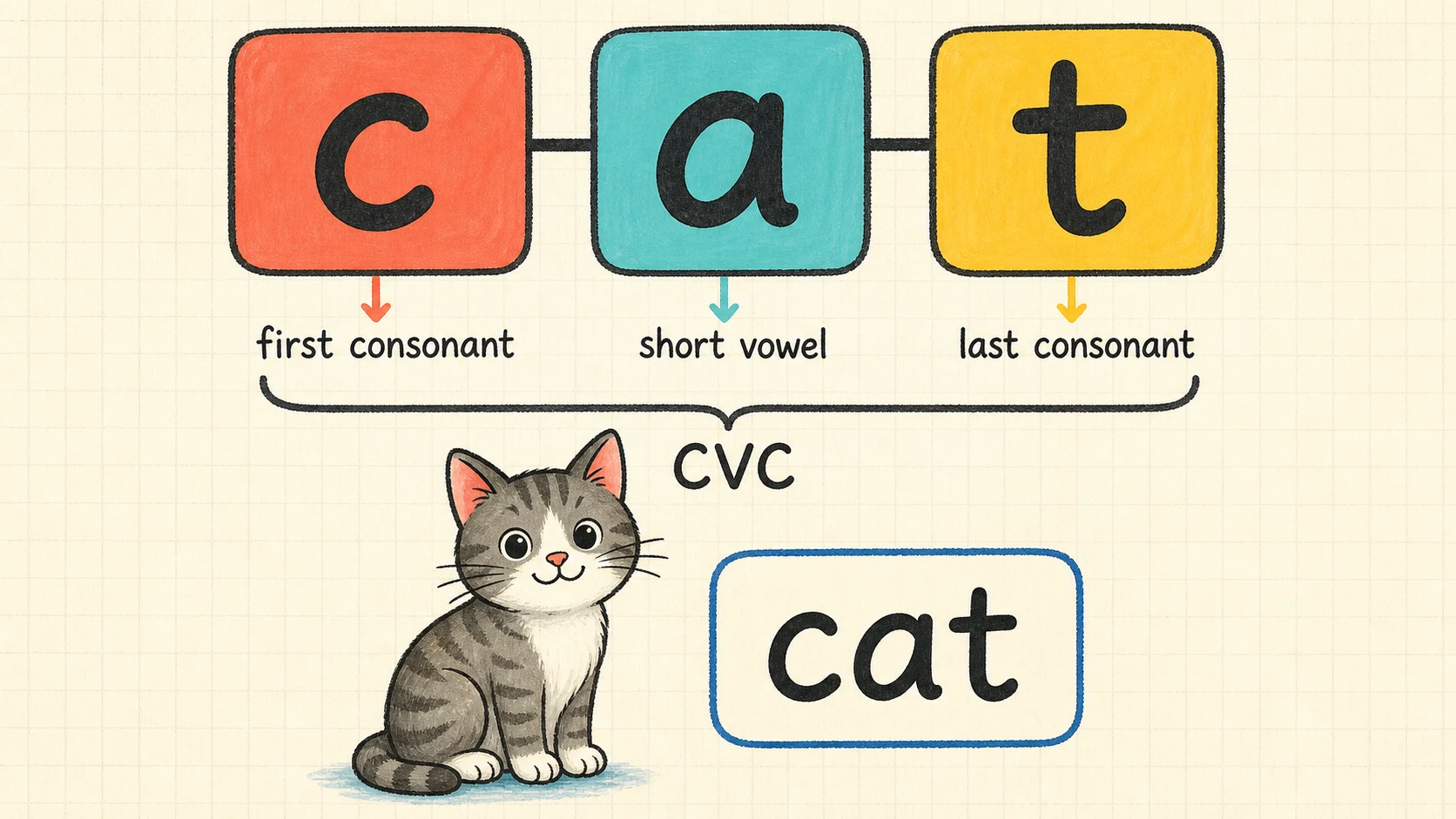
The CVC pathway connects hearing three sounds, matching sounds to letters, blending a word, and spelling it—not merely completing twenty printed items.
What counts as a CVC word—and what does not
A regular CVC example has three phonemes in the order consonant, short vowel, consonant, with a straightforward letter-to-sound match. In map, the learner can attend to /m/, /ă/, and /p/, connect those sounds to m-a-p, and blend them into the spoken word.
That definition sets important boundaries. Ship has three phonemes, but it contains the digraph sh and is not a three-letter CVC word. Stop includes an initial consonant blend. Cake introduces a silent-e spelling pattern and a long vowel. Car may not provide the intended short-vowel contrast in rhotic accents, while other accents complicate it differently. Those words can be appropriate later, but they should not be used to judge whether a learner understands the simplest CVC pattern.
Meaning also matters. A learner may decode ram accurately without knowing what a ram is. That is a vocabulary gap, not necessarily a decoding error. Conversely, correctly naming a picture of a cat does not demonstrate that the learner read cat. A page-specific task should make clear whether it is assessing spoken vocabulary, phoneme awareness, letter knowledge, decoding, or spelling.
The IES foundational reading practice guide recommends systematic work connecting segments of speech to letters and teaching learners to decode words. That guidance supports explicit CVC instruction, but it does not evaluate WorksheetWise materials or prescribe these catalogue levels.
The three catalogue starting points
The Pre-K CVC Words guide and free sheet, Kindergarten CVC Words guide and free sheet, and 1st Grade CVC Words guide and free sheet each offer a free 20-problem worksheet. Their shared catalogue description includes all five short-vowel families through word building, picture matching, fill-in-the-blank, and reading activities.
Those shared facts do not mean every grade label represents a rigid developmental stage. Grade labels describe intended practice level; local curriculum sequences differ. Use the labels to narrow the catalogue, then inspect the actual directions and response demands.
Pre-K: oral and concrete work before page independence
Start here when the learner benefits from an adult saying the word, emphasizing its sounds, and guiding a physical response. A productive task might ask the learner to match cat to a picture after the adult models the blend. Another might provide three sound boxes and movable letters.
For ages three and four, a 20-problem page should usually be a source of examples rather than a demand to finish all twenty. Select three to five items, work orally, let the learner move a token or letter, and stop while attention remains strong. The target is hearing and connecting sounds—not sitting still, controlling a pencil, or independently reading directions.
A child who can identify a cat picture but cannot say which sound begins cat is not yet showing CVC decoding. Shift from the printed answer to an oral contrast: “Which begins like cat: cup or sun?” Then return to the letters only after the sound is clear.
Kindergarten: visible letters, controlled contrasts, and word building
Choose the Kindergarten entry point when the learner can attend to three sounds and is ready to coordinate them with print. Pictures can still support meaning, but the learner should increasingly use letters to decide.
A strong early set keeps the vowel stable: cat, mat, map. Only one consonant changes at a time. This makes the comparison inspectable. If cat becomes mat, the first sound and first letter change while at stays constant. If mat becomes map, the final sound and final letter change while ma stays constant.
This level should include both reading and building. The learner might read map, then construct it with magnetic letters without copying. If construction is accurate only while the printed word remains visible, remove the model after reading and ask for spelling from memory.
1st Grade: reduced support and evidence of transfer
Use the 1st Grade entry point when the learner can blend familiar CVC words and needs practice with independence, mixed vowels, spelling, or unfamiliar strings. “1st Grade” should not mean a denser page containing more of the same picture matching. The useful shift is in the thinking demanded.
A learner might read cat, pin, mop, sun, bed with no pictures, spell selected words after hearing them, and explain which letter changed between two words. An occasional regular nonsense item such as nib or vog can check whether the learner applies letter-sound knowledge instead of recalling a memorized word.
Nonsense items need careful framing: “This is a made-up word. Read it using the sounds.” Do not ask for a picture or definition. One or two checks can be informative; a page dominated by meaningless strings removes vocabulary and comprehension from the activity and can become unnecessarily tiring.
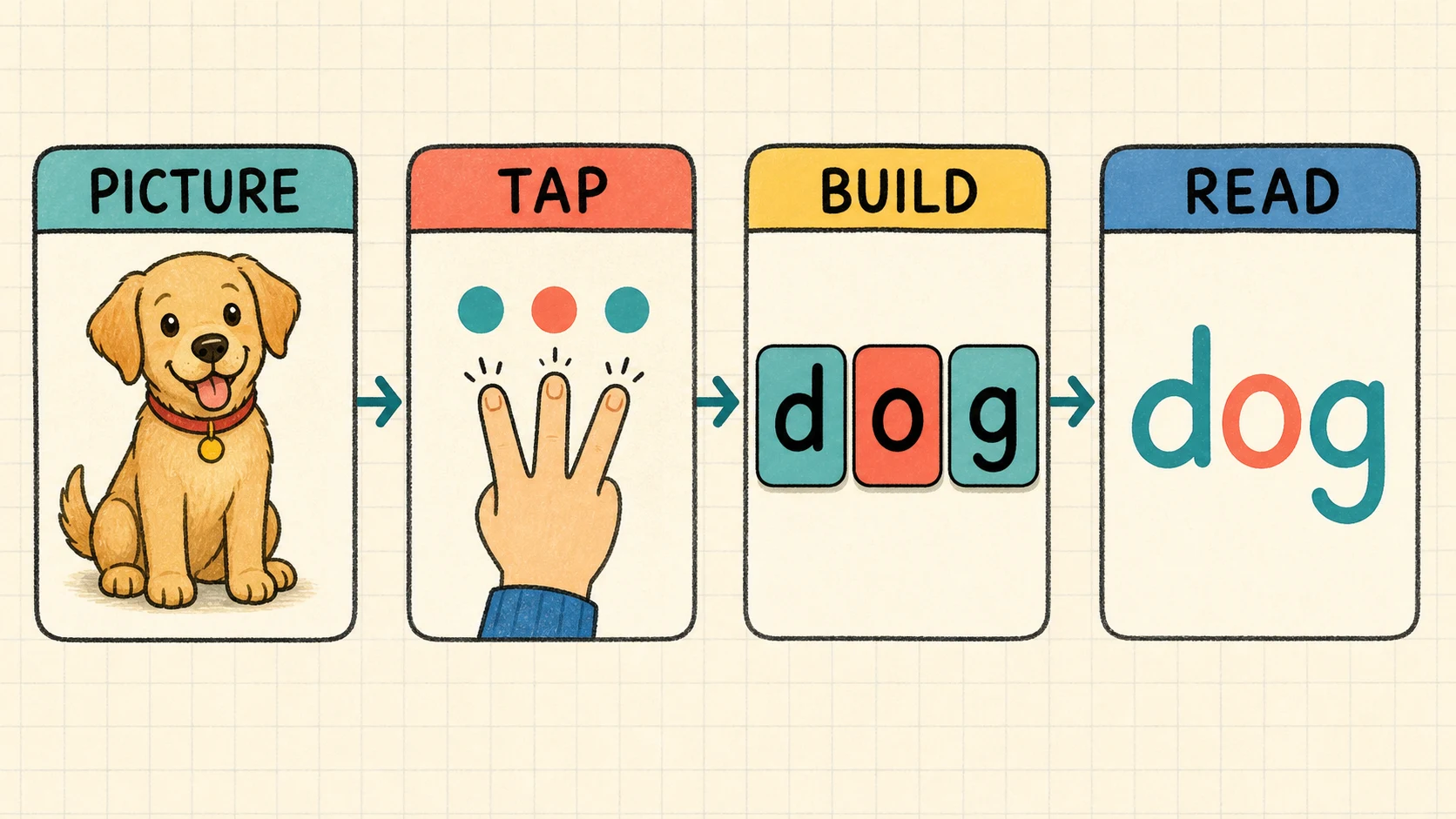
At the 1st Grade practice level, progress should be visible as less prompting, less picture dependence, more mixed-vowel reading, and accurate spelling—not simply a higher grade label.
Teach the blend before assigning the row
Many apparent worksheet errors begin before the pencil touches the page. If a learner says each phoneme with a full stop—“/c/ … /a/ … /t/”—the three parts can become disconnected. Model continuous blending by stretching the sounds without breaking the sequence: “/cccaaattt/ … cat.”
Some consonants, including /m/, /s/, and /f/, are easy to sustain. Stop sounds such as /t/, /p/, and /k/ should be produced cleanly rather than given an added “uh.” Saying “tuh” for /t/ inserts a vowel that is not in the word and makes blending harder.
The adult’s model can follow this sequence:
- Point to c, begin /c/, and move under the letters.
- Continue into /ă/ without pausing.
- connect cleanly to /t/.
- Say the whole word: cat.
- Ask the learner to repeat while moving a finger under c-a-t.
- Hide the word and ask the learner to build or write it.
This is explicit instruction: the adult demonstrates the action, explains where attention belongs, supports a response, and then reduces help. It is different from repeatedly telling the learner to “sound it out” without showing how.
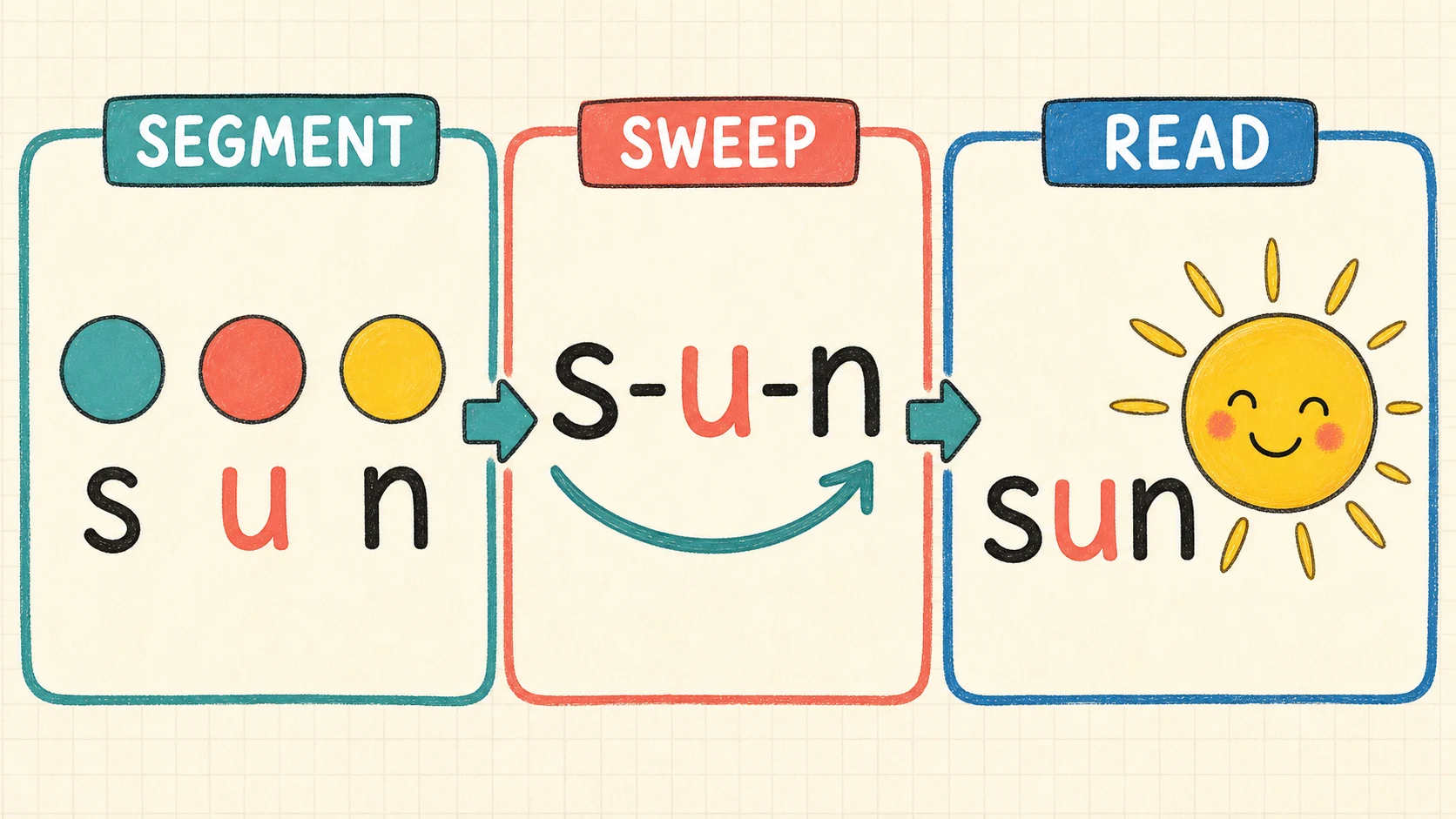
For map, the concrete model should preserve three sounds: move one token for /m/, one for /ă/, and one for /p/; sweep beneath them; read map; then spell it.
Four checked examples that expose different skills
Example 1: cat → mat
Both words are regular three-letter CVC words with the short a sound. Only the initial consonant changes: c becomes m. The medial a and final t remain stable.
This example belongs near the beginning because it limits the decision. Ask, “What sound changed?” and “Which letter must change?” A learner who rereads mat as cat may be relying on the familiar visual pattern or the previous answer rather than checking the first letter.
Follow decoding with encoding. After reading both words, cover them and ask the learner to build mat. If the learner builds cat, return to the initial phoneme: “Stretch mat. What do your lips do first?”
Example 2: mat → map
Again, both are regular short-a CVC words, but now the final consonant changes from t to p. The learner must hold the beginning while inspecting the ending.
This example belongs after an initial-sound change because final phonemes can be less salient in connected speech. Have the learner push three tokens while saying /m/ /ă/ /p/, then touch the final box and select p. Sweep under all three boxes to blend map.
Do not accept a picture-based guess as evidence. If pictures of a mat and map appear, cover them during the first reading. Reveal them afterward to confirm meaning.
Example 3: map → mop
These words differ only in the middle letter and vowel sound: short a becomes short o. The initial m and final p remain unchanged.
This example is more demanding than the preceding two because the learner must attend to the medial vowel, not merely detect a consonant at the edge. It belongs after stable short-a work and before a fully mixed-vowel list.
Ask the learner to say both words slowly, place one token per sound, and point to the box that changed. Then present a and o as letter choices. If the learner reads both as map, reduce the visual load and contrast the spoken words first: “Map, mop. Are the middle sounds the same or different?”
Example 4: nib and vog
Both are pronounceable CVC strings for the intended assessment purpose: n-i-b uses a short i pattern, and v-o-g uses a short o pattern. They are described here as made-up words, not vocabulary.
These examples belong later because successful reading cannot come from recognizing a familiar printed word or naming a picture. They provide a transfer check after the learner has practiced real CVC words.
Record the response rather than merely marking it wrong. Reading nib as nab suggests attention to the middle vowel needs checking. Reading vog as dog suggests the learner may be substituting a familiar word after noticing only part of the spelling. One response is not a diagnosis; repeat the observation with another controlled example before changing instruction.
Use three sound boxes to connect speech and print
Draw three connected boxes. Say a word naturally—sad—and have the learner repeat it. Next, stretch the word and push one token into each box for /s/, /ă/, and /d/. Finally, sweep a finger beneath all three boxes and blend sad.
The boxes represent sounds, not a universal one-letter-per-box rule. That distinction becomes essential when instruction later reaches digraphs. For the CVC words selected here, one sound maps neatly to one letter in each box, which lets the learner connect phoneme segmentation and spelling without an extra spelling complication.
A complete box routine is bidirectional:
- Hear sad and place three tokens.
- Replace the tokens with s, a, and d.
- Sweep and read sad.
- Mix the letters, hear the word again, and rebuild it.
- Write the word if handwriting will not obscure the phonics evidence.
If writing is effortful, magnetic letters preserve the spelling target. If touching small pieces is difficult, use larger cards or let the learner point while the adult moves them. These are access adaptations; they do not change the requirement to select and order the letters.
Pair every reading decision with spelling
Decoding moves from print to speech; encoding moves from speech to print. CVC practice is stronger when the learner must travel in both directions. After reading pin, say, “Now make pin without looking.” The second task shows whether the learner can segment the spoken word and retrieve the corresponding letters.
Writing should be meaningful but manageable. The IES elementary writing practice guide supports explicit instruction in foundational writing skills and regular opportunities to write. It does not establish that a particular CVC worksheet produces a specific result. Here, its practical relevance is modest and clear: spelling or writing a decoded word can complement reading practice when the motor demand is appropriate.
The Common Core English Language Arts standards include foundational-skills expectations involving letter-sound correspondences and decoding regularly spelled one-syllable words. That provides broad context, not guaranteed alignment for every WorksheetWise item. Local standards and teaching sequences may introduce or review CVC patterns at different times.
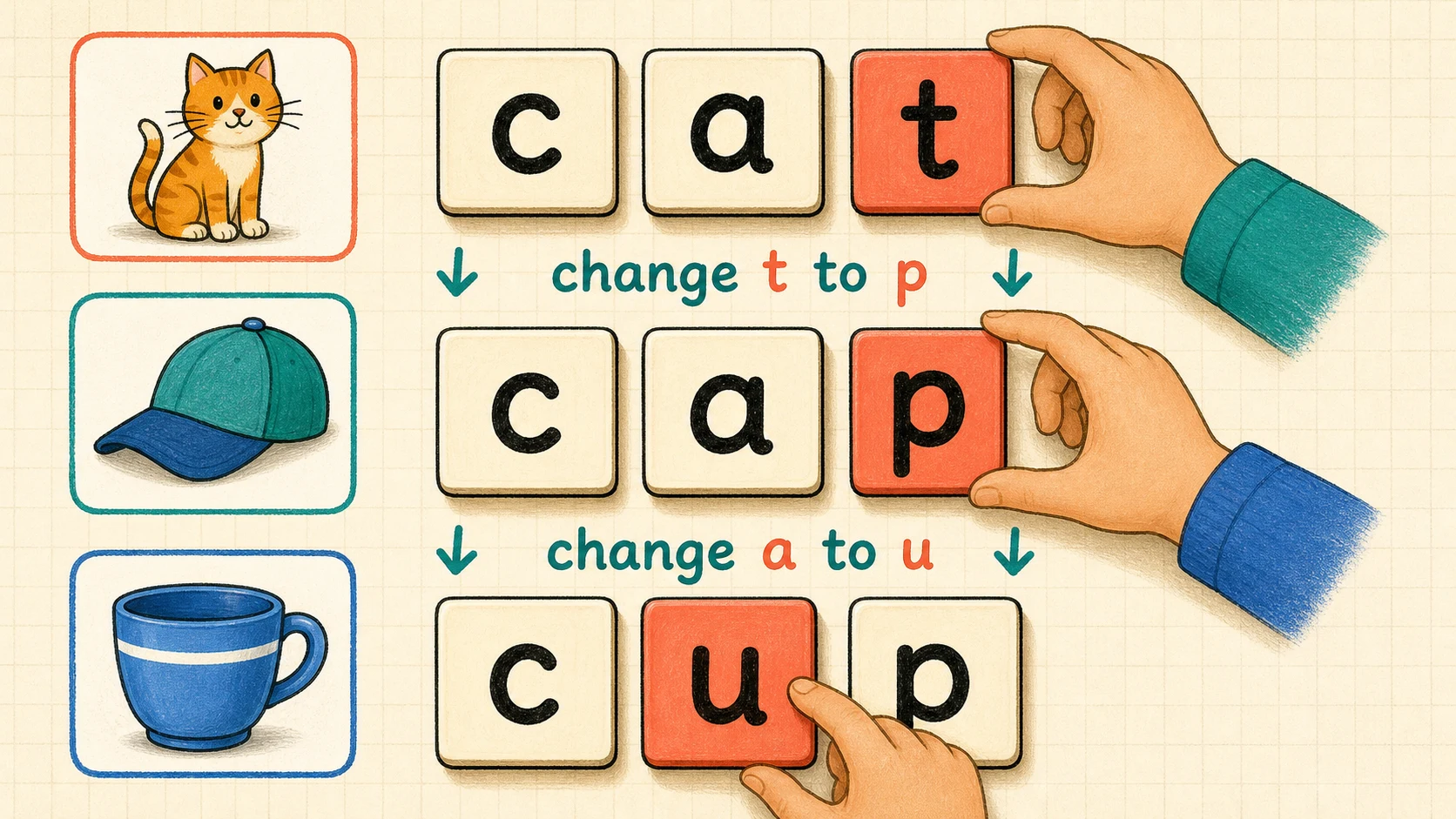
A short routine keeps the evidence clean: hear the word, map three sounds, blend through the letters, read it, then spell it without copying.
Read mistakes as evidence, not labels
A wrong answer does not explain itself. Look at what the learner said, pointed to, built, or wrote before deciding what to teach next.
The sounds remain separated
If cat becomes “/c/ … /a/ … /t/” with no whole word, the learner may know the individual correspondences but need a blending model. Return to continuous blending. Use an adult model, a finger sweep, and an immediate imitation rather than adding more independent items.
The first letter drives a guess
If map is read as man, the learner may have processed m-a and supplied a familiar ending. Ask the learner to touch the final letter and say its sound, then blend the entire sequence. Contrast map and man so the last letter carries the decision.
The middle vowel is ignored
If map and mop receive the same pronunciation, isolate the contrast orally before asking for letter selection. Hold the consonants stable and alternate map, mop, map. Ask which box changes. A mixed page containing all five vowels is premature if the learner cannot yet distinguish a controlled two-vowel contrast.
The picture overrides the print
If the learner names the picture correctly while the printed word is different, cover the picture and ask for decoding first. Restore the image as a meaning check afterward. Pictures are useful supports, but they should not conceal whether the letters were read.
Reading succeeds but spelling does not
If the learner reads sun but writes sn or san, use three boxes and ask for one sound in each position. This may indicate difficulty segmenting the vowel, recalling its letter, or both. Determine which by offering a and u as choices. Correct selection with choices but not from memory suggests a different next step from failure to hear that the middle sounds differ.
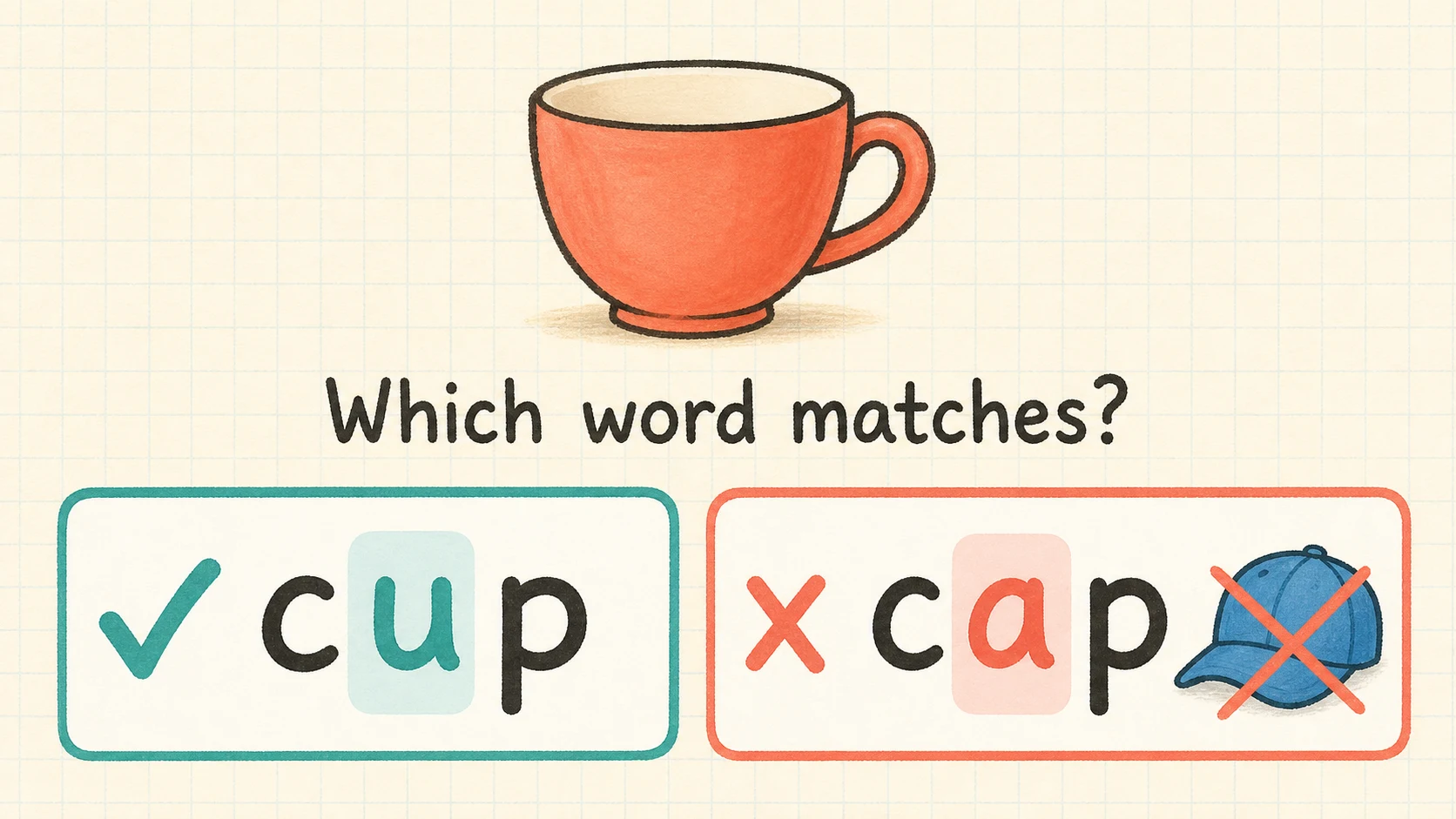
The useful response matches the observed error: reconnect separated sounds, inspect an ignored letter, contrast a vowel, remove a misleading picture, or rebuild the spelling.
These observations guide instruction; they do not establish a diagnosis. Hearing, language background, familiarity with the picture vocabulary, fatigue, and unclear directions can all affect a response. Look for a repeated pattern across several controlled examples.
Select a worksheet by its task boundaries
Before printing, inspect five features.
Vowel range
Choose one short vowel when the learner is establishing the pattern. Short a examples such as cat, bat, man, tap, and sad create a stable starting set. Move to short i, short o, short u, and short e as each contrast becomes manageable. A mixed-vowel page is for retrieval and discrimination after initial instruction, not the clearest place to introduce all five.
Amount of visual support
Picture matching is appropriate when the learner needs meaning support or a limited response choice. Letter tiles and partially completed words reduce memory demand. Unpictured word lists provide cleaner decoding evidence. Select the least support that still produces careful, successful attempts.
Required response
Circling a picture, filling one missing vowel, reading a whole word, building from dictation, and writing from dictation are not interchangeable tasks. A learner can circle the correct picture without spelling, or fill in a without blending the result. Match the response to the evidence you need.
Contrast design
Prefer controlled changes before random lists. cat → mat → map → mop changes one feature at a time: first consonant, last consonant, then vowel. This sequence lets the adult locate where attention breaks down. Random mixed words are more suitable for review once the learner can manage controlled contrasts.
Page length and independence
Each free catalogue entry has 20 problems, but twenty is an inventory fact, not a required sitting. Fold the page, cover rows, or select a subset. Stop if responses become impulsive or the learner loses the sound-to-letter process. Completion rate is less useful than accurate, explainable reading and spelling.
Adapt access without replacing the phonics target
An adaptation preserves the decision the learner must make. It changes how the task is presented or answered, not the underlying skill.
For a learner with limited pencil control, substitute magnetic letters, letter cards, pointing, or verbal responses. For visual crowding, reveal one row at a time. For attention needs, alternate one printed word with one standing movement: step once for each sound, then slide a hand through the air while blending. For a multilingual learner, preview the meaning of pictured words so unfamiliar vocabulary does not masquerade as a decoding problem.
Avoid adaptations that give away the answer. Reading the whole word aloud before asking the learner to match it tests listening and picture knowledge, not decoding. Leaving the target word visible during spelling turns the task into copying. Using only rhyming or memorized lists may produce fluent recitation without flexible reading.
When speech production makes a particular contrast hard to hear in the learner’s response, allow pointing or letter selection and consult people who understand the learner’s communication. Do not infer lack of phonics knowledge from pronunciation alone.
A two-week route through one real sheet at a time
A compact plan can use selected items from the 20-problem pages without treating the page as a daily quota.
During the first week, begin with short a. On day one, model three words with continuous blending and boxes. On day two, compare initial consonants: cat, mat. On day three, compare final consonants: mat, map. On day four, read and spell three to five short-a words. On day five, revisit only the response type that caused difficulty.
During the second week, add one new vowel family rather than mixing all five immediately. Contrast map and mop, then practice short-o examples with stable consonant frames where possible. Later in the week, mix a small number of established short-a and short-o words. End with one familiar real word, one less-practiced real word, and one clearly identified nonsense word.
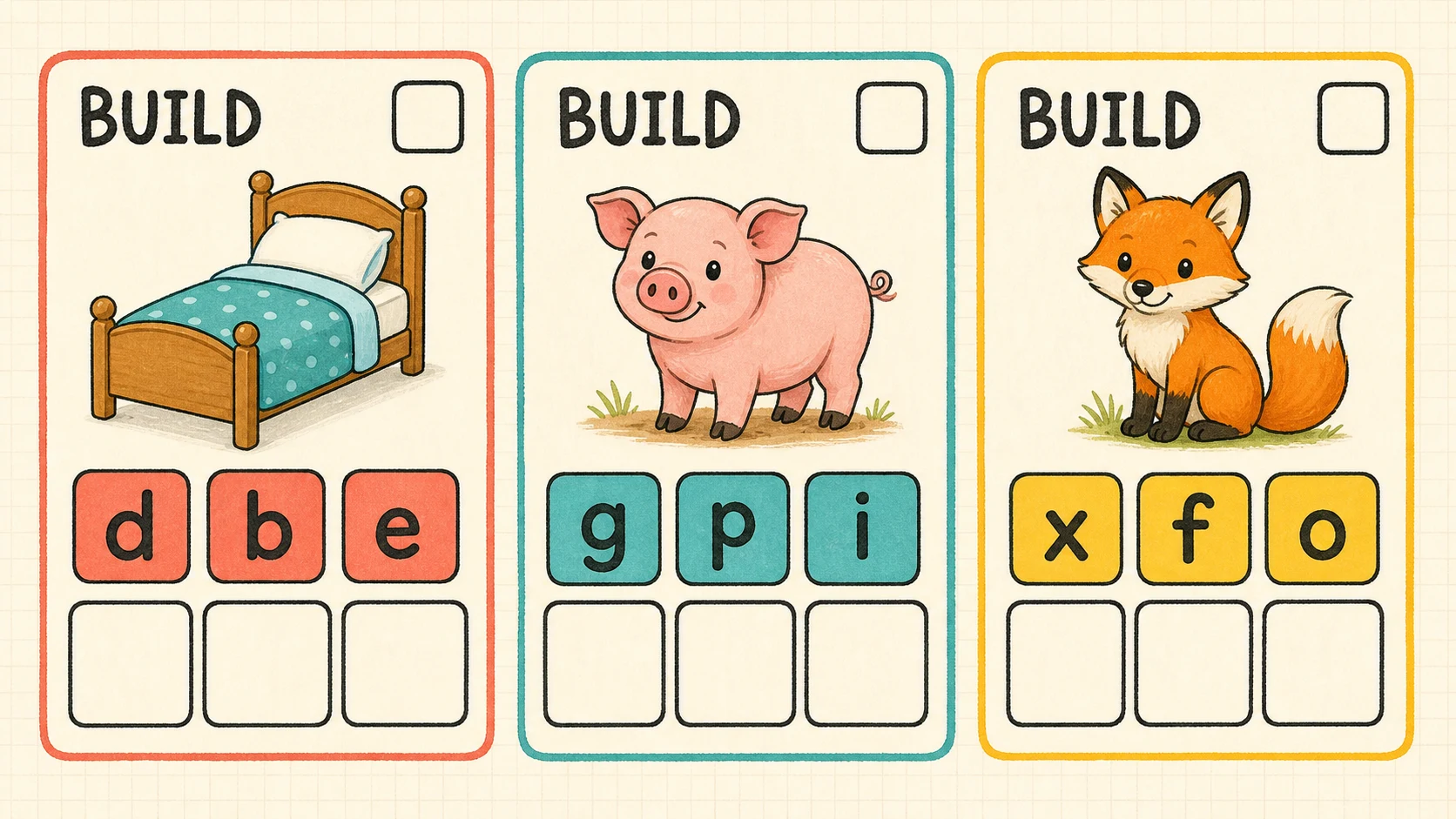
Across two weeks, the useful progression is controlled short-vowel instruction, immediate spelling, spaced review, and a small transfer check—not repeated completion of undifferentiated word lists.
Advance when the learner repeatedly blends the current set with little prompting, attends to all three letters, and can spell representative words without copying. Stay with the present boundary when support still determines success. Step back when guesses replace inspection or when a new vowel contrast disrupts an otherwise secure consonant pattern.
Make the next print choice from observable evidence
Start with the grade combination closest to the support required today:
- Choose the Pre-K resource for brief adult-led oral work, picture matching, sound boxes, and movable-letter responses.
- Choose the Kindergarten resource for supported print reading, controlled word changes, missing-letter decisions, and word building.
- Choose the 1st Grade resource for reduced picture support, mixed established vowels, read-then-spell tasks, and occasional nonsense-word transfer checks.
Then select three worksheet items rather than assigning the entire page immediately. Have the learner read each word with a continuous finger sweep, spell it without copying, and explain which sound or letter changed in a pair. Record the exact response. That small sample will tell you whether the next task should hold the vowel stable, contrast two vowels, reduce picture support, or increase independent spelling.
For the most concrete next action, open the Kindergarten CVC Words guide and free sheet, preview its 20 problems, and choose three items that let the learner read, build, and spell the same CVC pattern.
Put it into practice
Use the guide with a real printable
Move from explanation to a short, observable practice task. Check the first item together, then adjust the next session from the learner's actual work.
Open the first free worksheetExplore a neighboring collection
Choose by a different teaching need
Addition Worksheets by Grade and Level Consonant Blends Worksheets by Grade and Level Counting Worksheets by Grade and Level Decimals Worksheets by Grade and Level Digraphs Worksheets by Grade and Level Division Worksheets by Grade and Level Fractions Worksheets by Grade and Level Geometry Worksheets by Grade and Level