Curated collectionAnswer keys includedPrint-ready PDFs
Counting Worksheets by Grade and Level
Show the full counting progression across 3 real grade combinations, compare task boundaries, model checked examples and explain how to choose the next level.
Start with a real resource
Browse this worksheet collection
3 relevant free entry points are available. Each one includes a printable learner PDF and separate answer key.
A useful practice loop
Print less. Observe more.
- Choose one skill and model the first item aloud.
- Use a short set and notice the learner’s strategy.
- Change the next task from the work you can see.
Need more than the free sheet?
Plus includes all 54 matching catalogue variations where available, plus saved deterministic generators and the worksheet designer.
See Plus membershipComplete guide
How to teach and practise counting worksheets
3,626 words Updated 6 instructional visuals
Choose counting work by what the learner can do, not by the grade label
The useful progression across WorksheetWise’s three counting combinations is Pre-K concrete counting to 20, kindergarten counting and number-pattern work toward 100, and 1st Grade practice that strengthens flexible counting, missing-number reasoning, skip counting, and counting backward. Those are intended practice levels, not fixed placements. Local curriculum sequences differ, and a grade label does not establish what an individual learner understands.
Start by observing the task the learner can complete accurately:
- Can the learner say number words in order?
- Can the learner touch or move each object exactly once while counting?
- Can the learner state how many objects there are after counting?
- Can the learner continue from a number other than 1?
- Can the learner fill a missing number, count backward, or follow a skip-counting interval?
Select a worksheet that asks for the next small step, not every later skill at once. The live catalogue contains 54 counting variants across three grade combinations, with one free 20-problem entry point for each of Pre-K, kindergarten, and 1st Grade. Age can help adults discover a likely starting page, but it should never make the placement decision. In particular, for ages three and four, prioritize brief adult-led oral, matching, manipulative, and movement work over extended desk work.
What elementary counting actually includes
Counting is more than reciting “one, two, three.” A learner may remember the verbal sequence while still losing track of objects, counting one object twice, or failing to understand that the last number said tells the quantity of the whole set.
A practical concept map has six connected parts:
- Stable order: saying number words in the conventional sequence.
- One-to-one correspondence: assigning one number word to each object.
- Cardinality: understanding that the last count word names the set’s total.
- Numeral connection: linking a spoken quantity or set to a written numeral.
- Sequence flexibility: counting forward from a given number or backward from 20.
- Patterned counting: counting by equal intervals such as 2s, 5s, or 10s.

The cross-level progression keeps cardinality visible: touch six once each, restructure the same six, then compare 6 with 8.
The distinction between recitation and quantity is important. If a child chants to 20 but counts eight buttons as nine, more sequence chanting is not the most direct response. The target is coordinating each spoken word with exactly one button. If the child counts eight buttons correctly but cannot choose the numeral 8, the target changes again: connect the known quantity to its written symbol.
The IES guide to teaching mathematics to young children recommends developmental progressions, monitoring what children know, and helping them view and describe mathematical ideas in multiple ways. That guidance did not evaluate WorksheetWise. It supports a sound instructional decision here: identify the exact counting action, model it with objects, and change representation only when the learner’s behavior shows readiness.
The three catalogue starting points have different boundaries
All three free catalogue sheets contain 20 problems and currently carry the label “easy.” That label describes the catalogue entry, not the learner. Adults should interpret difficulty through observable features: the size of the number range, whether objects are orderly or scattered, whether the sequence begins at 1, whether visual support is present, how many blanks appear, and whether the interval is 1 or a larger skip.
Pre-K: quantities and sequences within 20
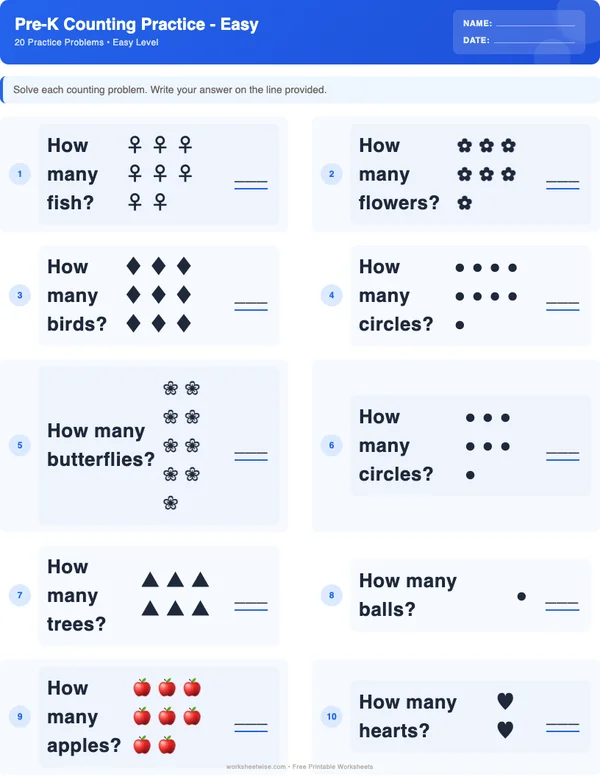
The Pre-K description places its main emphasis on counting to 20 with concrete objects. The corresponding Pre-K Counting guide and free sheet is the most plausible catalogue starting point when a learner needs to coordinate spoken numbers with actual items or small pictured sets.
Do not make the worksheet the first encounter. Put out six linking cubes. Ask the learner to slide each cube into a cup while saying one number word. Then ask, “How many cubes are in the cup?” Move to a picture only after that action is coordinated.
For ages three and four, use perhaps three to five prompts orally, then stop or switch to movement. An adult might ask the child to:
- give a toy bear four buttons;
- match a card showing three dots to three cubes;
- make five hops while counting aloud;
- touch each of seven pictures once;
- choose the numeral that matches a counted set.
These are brief counting experiences, not a demand to complete all 20 printed items in one sitting.
Kindergarten: connect quantities, numerals, and patterns toward 100
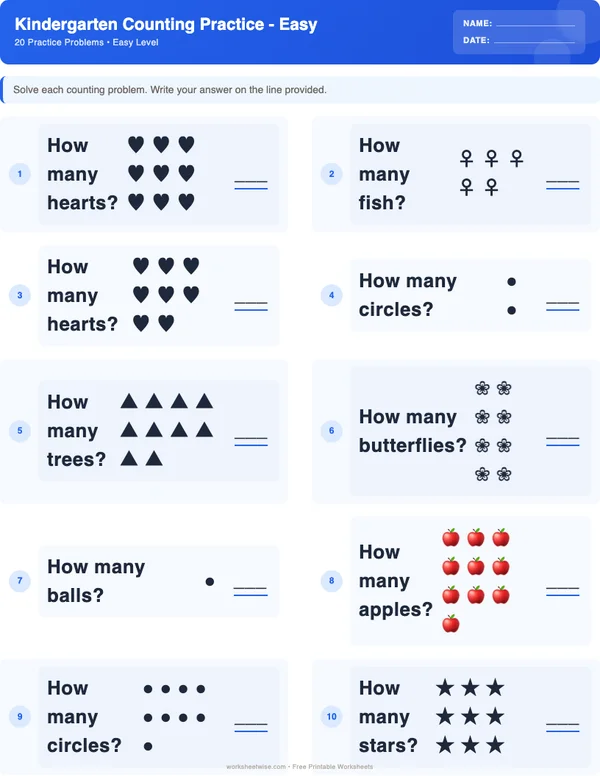
The catalogue describes counting to 100 as a key kindergarten milestone and includes structured practice with sets, sequences, and missing numbers. The Kindergarten Counting guide and free sheet is therefore useful when counting small sets is mostly reliable and the learner is ready to work across a longer number sequence.
A kindergarten-level task might show:
36, 37, __, 39
The checked answer is 38 because counting forward by one after 37 gives 38, followed by 39. This example belongs here because it tests sequence position without requiring the learner to begin at 1. It is more demanding than counting four visible objects: the objects no longer carry the meaning, and the learner must hold the number sequence mentally or use a number-line reference.
A hundred chart can make the structure visible. Ask the learner to point to 36, move one square right for each next number, and name the missing square. The chart is support for the counting target, not an answer to copy without explanation.
1st Grade: make counting flexible and purposeful
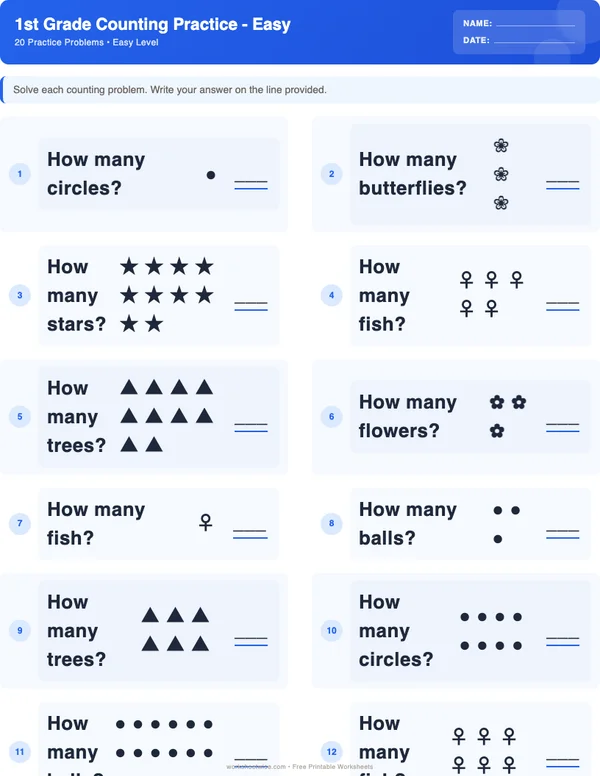
The 1st Grade Counting guide and free sheet is the strongest starting point when the learner can count sets and ordinary forward sequences but needs practice counting from arbitrary numbers, following equal intervals, or moving backward.
A suitable checked example is:
10, 15, 20, __, 30
The answer is 25. Each term increases by 5: 10 + 5 = 15, 15 + 5 = 20, 20 + 5 = 25, and 25 + 5 = 30. It belongs at this boundary because the learner must identify and maintain an interval rather than merely supply the next whole number.
Grade labels still describe intended practice level only. A 1st Grade learner who double-counts scattered objects may need the one-to-one work described in the Pre-K section. A kindergarten learner who can explain a skip-counting pattern may be ready for selected 1st Grade items. Placement should follow evidence from the task.
Move from objects to pictures to abstract numbers
Representation should change deliberately. Objects allow a learner to move counted items aside. Pictures preserve visual quantity but cannot physically be moved unless the learner marks them. Numerals remove the objects entirely and require the learner to reason with the number sequence or pattern.
A checked concrete-to-abstract example
Place 12 buttons in a scattered group. Ask the learner to move each button into a straight line while counting. If each button is moved once, the spoken count ends at 12. Ask, “How many are there altogether?” The correct answer remains 12, even after the buttons are rearranged, because moving the objects does not change the quantity.
Next, draw or show 12 dots. Have the learner touch or cross out each dot while counting. Finally, show the numeral 12 and say, “This numeral names the total you found.”
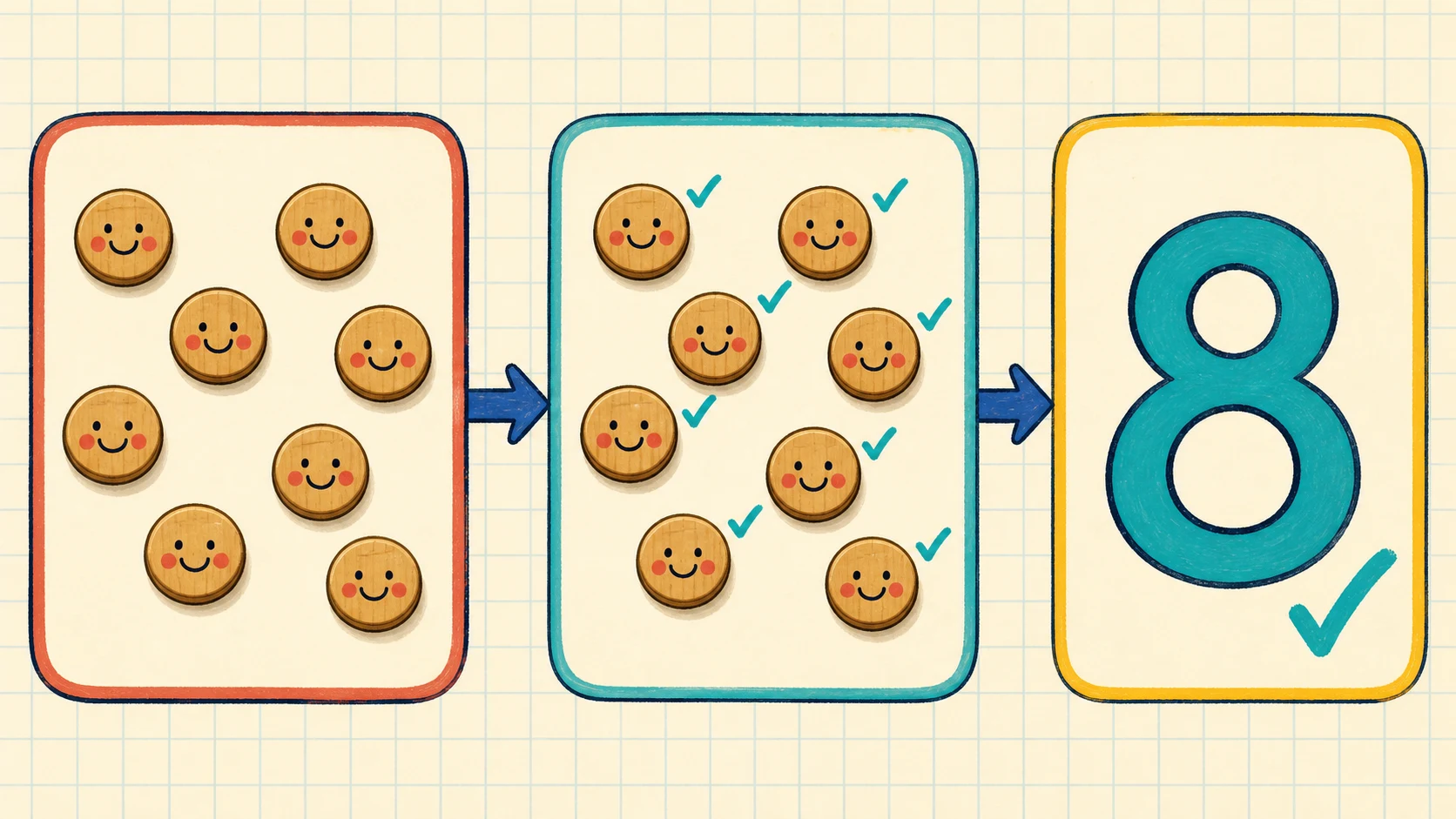
The worked example shows how a physical count can justify a pictured or written answer instead of becoming an unrelated warm-up.
This example belongs across the page’s progression because it separates three possible difficulties. Losing track while moving buttons points to one-to-one coordination. Counting correctly but giving a different total points to cardinality. Knowing the total but choosing 21 points to numeral interpretation or teen-number notation.
Do not remove the concrete model merely because the learner got one answer right. Ask for the same quantity in a new arrangement. Accurate counting in both a line and a scattered group provides stronger evidence than success on a neat row alone.
Question design determines the real difficulty
A worksheet’s number range is only one source of challenge. Two pages that both stay within 20 can demand very different thinking.
Ordered sets versus scattered sets
A row of eight stars supplies a visual route: start at the left and proceed to the right. Eight stars scattered across a box require the learner to create a route and remember what has already been counted. To preserve the counting target, allow the learner to point, circle, cross out, or cover each item.
Checked example: place seven counters in a row and seven in a scattered arrangement. Both totals are 7. If the learner says 7 for the row and 8 for the scattered group, the changed arrangement—not the quantity—is the informative variable. Return to seven physical objects and teach a tracking method.
Counting from 1 versus counting on
Compare these prompts:
- “Count from 1 to 14.”
- “Start at 9 and count the next five numbers.”
For the second prompt, the five numbers after 9 are 10, 11, 12, 13, 14. The endpoint is 14, but the central skill is beginning from 9 rather than restarting at 1. This belongs in the kindergarten-to-1st Grade transition because it tests flexible access to the sequence.
If the learner says “9, 10, 11, 12, 13” when asked for five numbers after 9, clarify whether the starting number counts as one of the requested responses. Ambiguous wording can create an apparent error. A well-designed prompt should say either “Say five numbers after 9” or “Make five counts beginning with 9.”
Forward, backward, and skip-counting intervals
Counting backward from 20 supports later work in which quantities decrease, but it should first be taught as a sequence:
20, 19, 18, 17, 16
Each number is one less than the preceding number. A learner who reverses two terms may need a visible number line and deliberate leftward movement.
Skip counting changes the interval. For:
4, 6, 8, __, 12
the checked answer is 10 because each step adds 2. Have the learner make one hop per term on a floor number line, landing on 4, 6, 8, 10, and 12. Movement should represent the equal jumps; it should not become disconnected exercise.
Teen numbers need focused language and structure
Numbers 11 through 19 deserve additional attention because their spoken English names do not present tens and ones as transparently as names such as twenty-four or thirty-six. A learner may count accurately but write 41 for fourteen, omit 15 after fourteen, or confuse “teen” and “ty.”
Use a ten-frame, a group of ten linked cubes, or one bundle of ten sticks plus loose ones. For 14, build one group of 10 and four single objects:
10 + 4 = 14
Ask the learner to say “fourteen,” point to the group of ten, point to the four extras, and then select 14. This is not an addition lesson in disguise; the decomposition clarifies the numeral’s structure while the target remains naming and counting the quantity.
Contrast only a small number of names at once. For example, build 13 and 30 with materials if confusion arises, then state the difference directly: 13 is one ten and three ones; 30 is three tens and no ones. Do not infer a language disorder, learning disability, or other diagnosis from reversals or naming errors. Record the precise response and test it again with a different representation.
A hundred chart can also show that 11–19 form a consecutive row segment even when their spoken names feel irregular. Ask the learner to cover 13, identify the number immediately before it, and identify the number immediately after it. The checked neighbors are 12 and 14.
Read errors as clues about the next prompt
An incorrect answer does not explain itself. Use a brief follow-up to locate where the counting process changed.
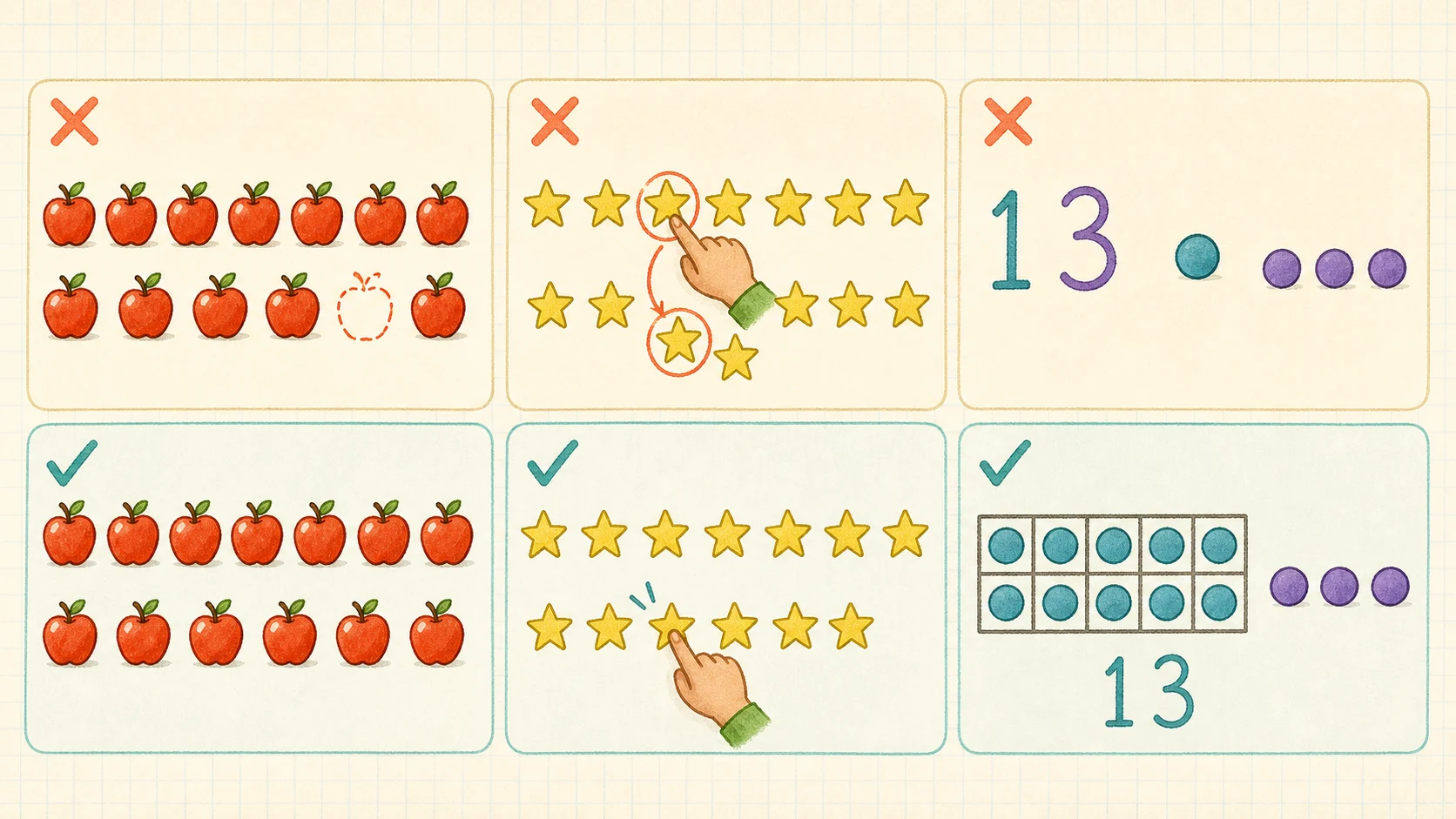
These response pairs turn a wrong answer into a specific next check rather than a label about the learner.
The count sequence is correct, but objects are skipped or repeated
Example: the learner says number words 1 through 9 in order while counting eight scattered buttons and reports 9. Ask the learner to move each button into a cup as it is counted. If the result becomes 8, the likely issue in that task was tracking, not knowledge of the verbal sequence.
Next action: repeat with eight objects in a new scattered arrangement and allow one consistent marking or moving strategy.
The objects are counted accurately, but the total is not retained
Example: the learner touches six toys correctly, ending with “six,” then answers “five” when asked how many there are. Restate: “The last number you said tells how many are in the whole group. You ended on six, so there are six.”
Next action: count another set of six, ask for the total without recounting, and then rearrange it to see whether the learner understands that the quantity remains six.
A missing-number response follows the wrong interval
For 15, 20, 25, __, 35, a response of 26 suggests the learner may have shifted from counting by 5 to counting by 1. The correct answer is 30, verified by adding 5 at every step.
Next action: clap once at each term while marking equal jumps of five on a number line. Then present a new sequence, such as 5, 10, 15, __, 25, whose answer is 20.
Teen-number names or numerals are confused
If a learner says 16 objects but writes 61, ask the learner to build 16 as ten linked cubes and six single cubes, then choose between 16 and 61. This preserves the quantity and numeral target without adding handwriting demands.
Next action: compare 16 with 60 only after 16 is stable. Record “selected 61 after accurately counting 16 objects,” not “doesn’t understand counting.”
The IES practice guide for assisting students struggling with mathematics discusses systematic instruction, clear mathematical language, representations, and number-line use. It did not diagnose any learner or assess these worksheets. Here, those principles support explicit modeling and short, targeted checks after an error.
Use a short routine that reveals learning
A repeatable session can fit into 10–15 minutes. For young children or learners who fatigue quickly, make it shorter.
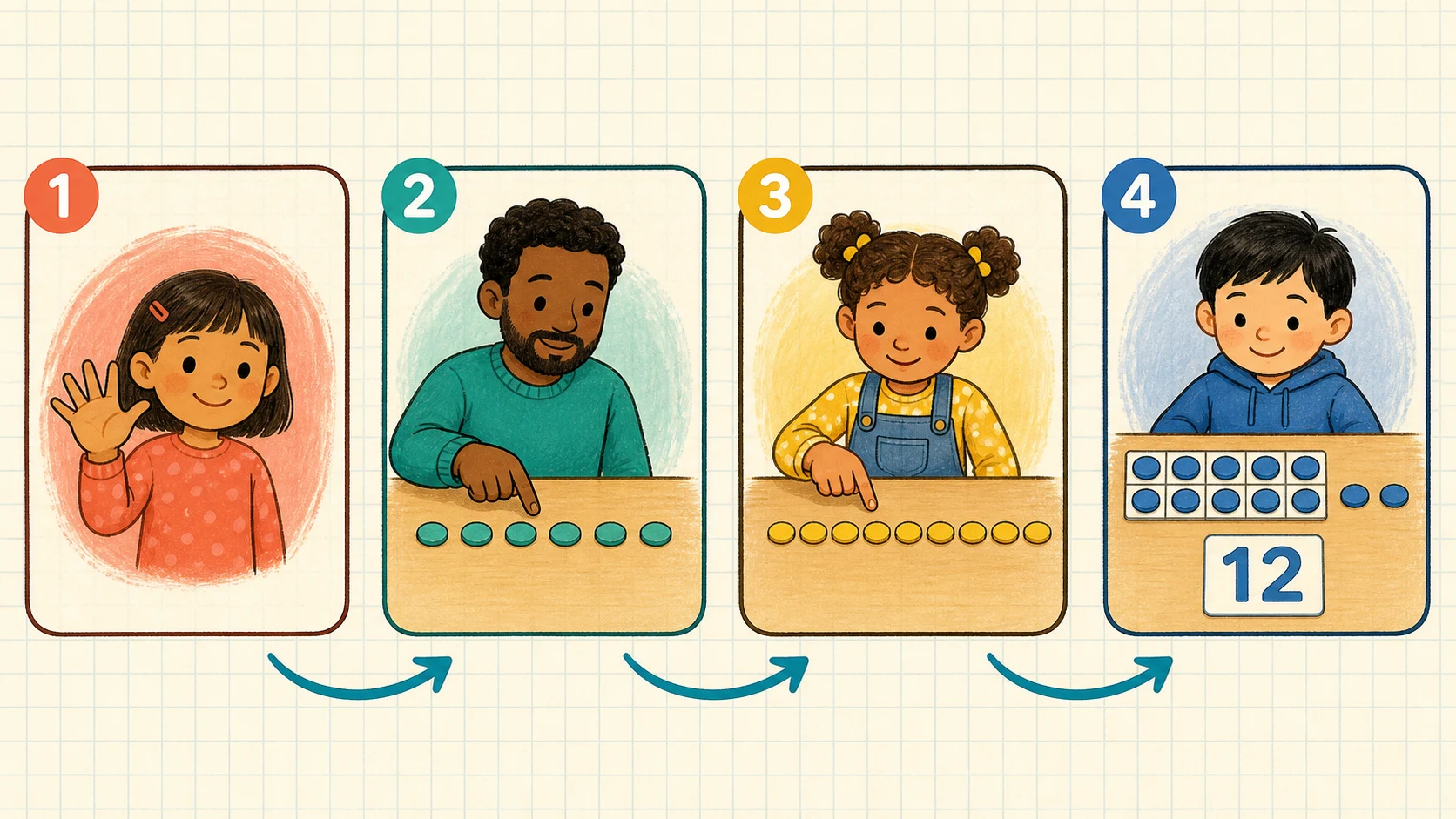
The routine keeps objects, explanation, written practice, and a final independent check connected to one counting target.
A six-part counting routine
- Name one target. Say, “Today we will count scattered objects without counting any object twice.”
- Model with objects. Count five buttons, sliding each one aside while speaking.
- Count together. Use a new set of six. Let the learner touch while both participants say the numbers.
- Try one independently. Present seven scattered objects and observe without correcting mid-count.
- Complete a small worksheet sample. Choose three to six items that use the same target.
- Check transfer. Change the arrangement or starting number and ask one final prompt without help.
The final check matters. If practice used neat rows, finish with a scattered set. If practice used a number line, finish with one short item after covering it. If the learner succeeds only while copying an adult’s actions, keep the same level but reduce the prompting on the next attempt.
The source of an answer should also be visible. Ask, “How did you keep track?” or “What changes each time?” A correct guess and a justified response are not equivalent evidence.
Adapt access without replacing the counting target
An adaptation should remove an unrelated barrier while keeping the mathematical decision intact.
For motor difficulty, let the learner eye-point, use larger counters, or direct the adult to move each object. The target remains matching one number word to one item. For handwriting difficulty, offer numeral cards or oral answers. The target remains identifying the quantity or missing number.
For visual crowding, increase spacing, cover unused rows, or present one problem at a time. When the goal is one-to-one correspondence, do not permanently replace every scattered set with a tidy row; that would remove the feature being assessed. Instead, teach a tracking method and gradually return to the scattered arrangement.
For language support, model concise sentence frames:
- “I counted ___ objects.”
- “The missing number is ___ because each number is one more.”
- “The pattern counts by ___.”
- “I started at ___ and counted backward.”
For attention or stamina, split a 20-problem sheet into several brief sessions. Completing all 20 items is not itself the target. A learner can demonstrate accurate counting through a smaller sample, especially when an adult also checks a transfer item.
For ages three and four, favor oral counting, matching, manipulatives, songs, and movement. A printed page can supply two or three picture prompts, but adult interaction should carry the lesson. Age remains a discovery aid, not a placement decision.
Select the next worksheet from observable evidence
Choose among the three real grade combinations by matching what the learner must do next.
Start with Pre-K when tracking quantity is the central need
Choose the Pre-K entry point when the learner benefits from small concrete sets, counting within 20, or direct matching between a set and a numeral. Before printing, confirm that the chosen items do not exceed the learner’s reliable oral range so far.
Move toward kindergarten-style work when the learner can count both rows and scattered groups, state the total, and connect that total to a numeral across several examples.
Start with kindergarten when sequence structure is the central need
Choose kindergarten when small-set counting is dependable but the learner needs longer sequences, missing numbers, counting on, or visual pattern support from a number line or hundred chart.
Move toward 1st Grade work when the learner can start from numbers other than 1, explain whether a sequence changes by 1 or another interval, and complete a short sample without copying a visible answer pattern.
Start with 1st Grade when flexible movement through numbers is the central need
Choose 1st Grade when the next target is counting forward from a given number, counting backward from 20, or skip counting by 2s, 5s, or 10s. These tasks should still be modeled through movement, objects, number lines, or charts when necessary.
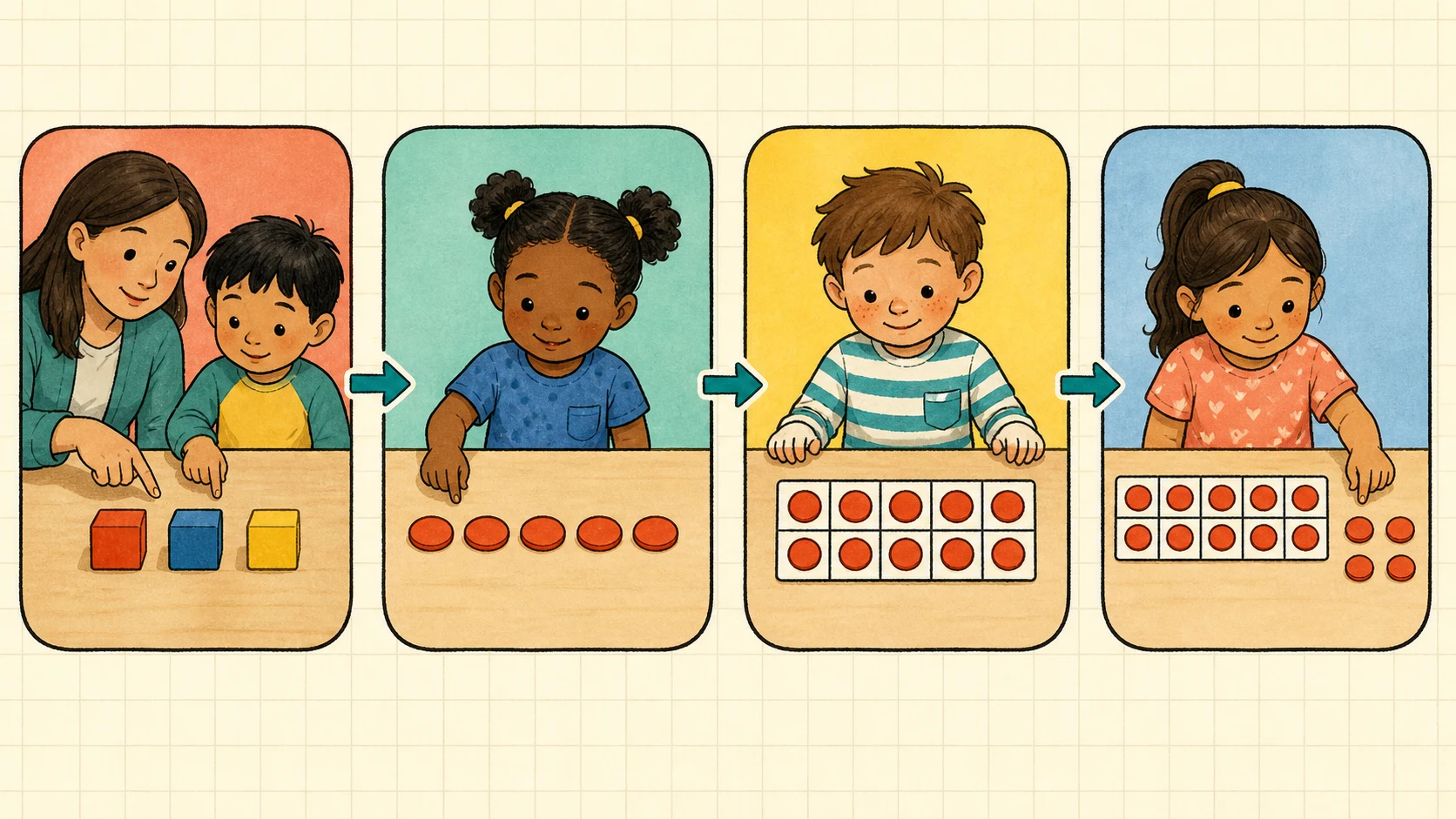
The progression changes one support at a time so independent work reflects the same skill that was modeled.
The Common Core mathematics standards provide one widely used reference for grade-level expectations involving counting and cardinality, but they are not a universal local sequence and did not assess WorksheetWise. Use local school expectations when required, while placing the learner according to observed task performance.
The catalogue’s “easy” free sheets should be judged by what is on the page. Look for:
- the highest and lowest numbers;
- ordered or scattered objects;
- forward, backward, or skip-counting direction;
- whether the sequence begins at 1;
- how many blanks occur in one sequence;
- whether pictures, a number line, or no support is supplied;
- the amount of writing required;
- the number of problems expected in one sitting.
Review over two weeks without turning practice into repetition
A short review cycle should vary representation while holding the target steady, then vary the target only when accuracy and explanation are stable.
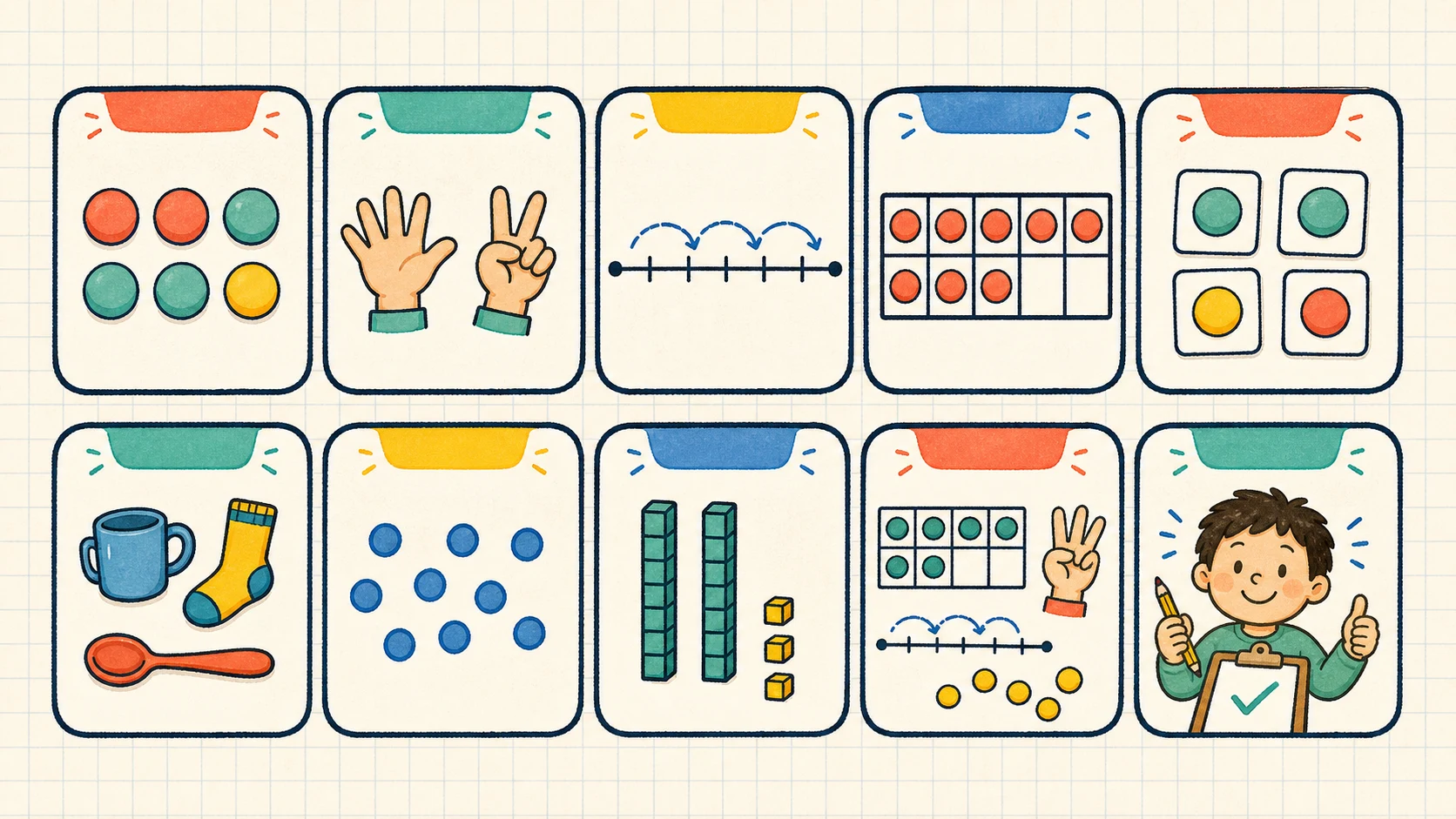
The two-week plan alternates object counts, number-line movement, written sequences, and independent checks instead of repeating one page format.
During the first week, select one central need. For one-to-one correspondence, use movable objects on day one, pictures that can be marked on day two, a mix of rows and scattered sets on day three, a few worksheet items on day four, and an unfamiliar scattered set on day five.
During the second week, revisit the same skill briefly before adding one adjacent demand. A learner who reliably counts sets within 20 might connect totals to written numerals. A learner who fills forward sequences by ones might start from a less familiar number. A learner who skip-counts by 5 with movement might complete one short written pattern and explain the interval.
Do not advance because two weeks elapsed. Advance when the learner’s actions show that the support can be reduced. Likewise, do not interpret a difficult day as a diagnosis. Fatigue, unclear directions, unfamiliar images, visual crowding, or writing demands may affect performance.
Worksheets also have firm limits. They cannot show everything about how a learner coordinated speech and touch unless an adult observes. They are weak measures of one-to-one correspondence when every set is arranged in a neat line. A completed sequence may reflect copying from a chart rather than independent recall. Use printed work as one source of evidence alongside oral prompts, manipulatives, movement, and explanation.
Make the next choice with one observed task
Today, present eight small objects in a scattered arrangement. Ask the learner to count them, state the total, and select or write 8. Then use the result:
- If objects are skipped or counted twice, begin with the Pre-K Counting guide and free sheet and model moving each object once.
- If the set is counted reliably but counting on or missing numbers is uncertain, open the Kindergarten Counting guide and free sheet.
- If quantity counting is secure and the next need is flexible forward, backward, or skip counting, use the 1st Grade Counting guide and free sheet.
Choose three to six relevant items rather than assigning all 20 automatically. End by changing the arrangement, starting number, or sequence while keeping the same target. That final unprompted response is the observable next action that should determine tomorrow’s level.
Put it into practice
Use the guide with a real printable
Move from explanation to a short, observable practice task. Check the first item together, then adjust the next session from the learner's actual work.
Open the first free worksheetExplore a neighboring collection
Choose by a different teaching need
Addition Worksheets by Grade and Level Consonant Blends Worksheets by Grade and Level CVC Words Worksheets by Grade and Level Decimals Worksheets by Grade and Level Digraphs Worksheets by Grade and Level Division Worksheets by Grade and Level Fractions Worksheets by Grade and Level Geometry Worksheets by Grade and Level