What 6th Grade Word Problems Require
Sixth-grade word-problem work asks a learner to translate a situation into mathematics, perform the needed computation, and interpret the result in context. A strong solver can:
- State what is happening in the problem.
- Separate relevant information from irrelevant information.
- Identify the unknown quantity.
- represent relationships with a diagram, table, number line, expression, equation, or inequality.
- Calculate accurately.
- attach the correct unit and explain what the answer means.
- check whether the result is reasonable.
The concise answer is this: teach the learner to understand the relationships before choosing operations. Do not make operation words the center of instruction. A phrase such as “how many more” often suggests comparison, but it does not by itself tell the learner how all quantities relate. Reading, modeling, solving, and checking should operate as one connected routine.
At this level, problems may involve whole numbers, decimals, fractions, ratios, negative numbers, variables, and measures of center or variability. Some require one operation; others require several dependent steps. The mathematical demands rise, but so do the reading and organizational demands.
Grade labels describe the intended practice level, not a guarantee that every learner has met identical prerequisites. Local curricula and instructional sequences differ. Use observed work—not age or grade alone—to decide where practice should begin.
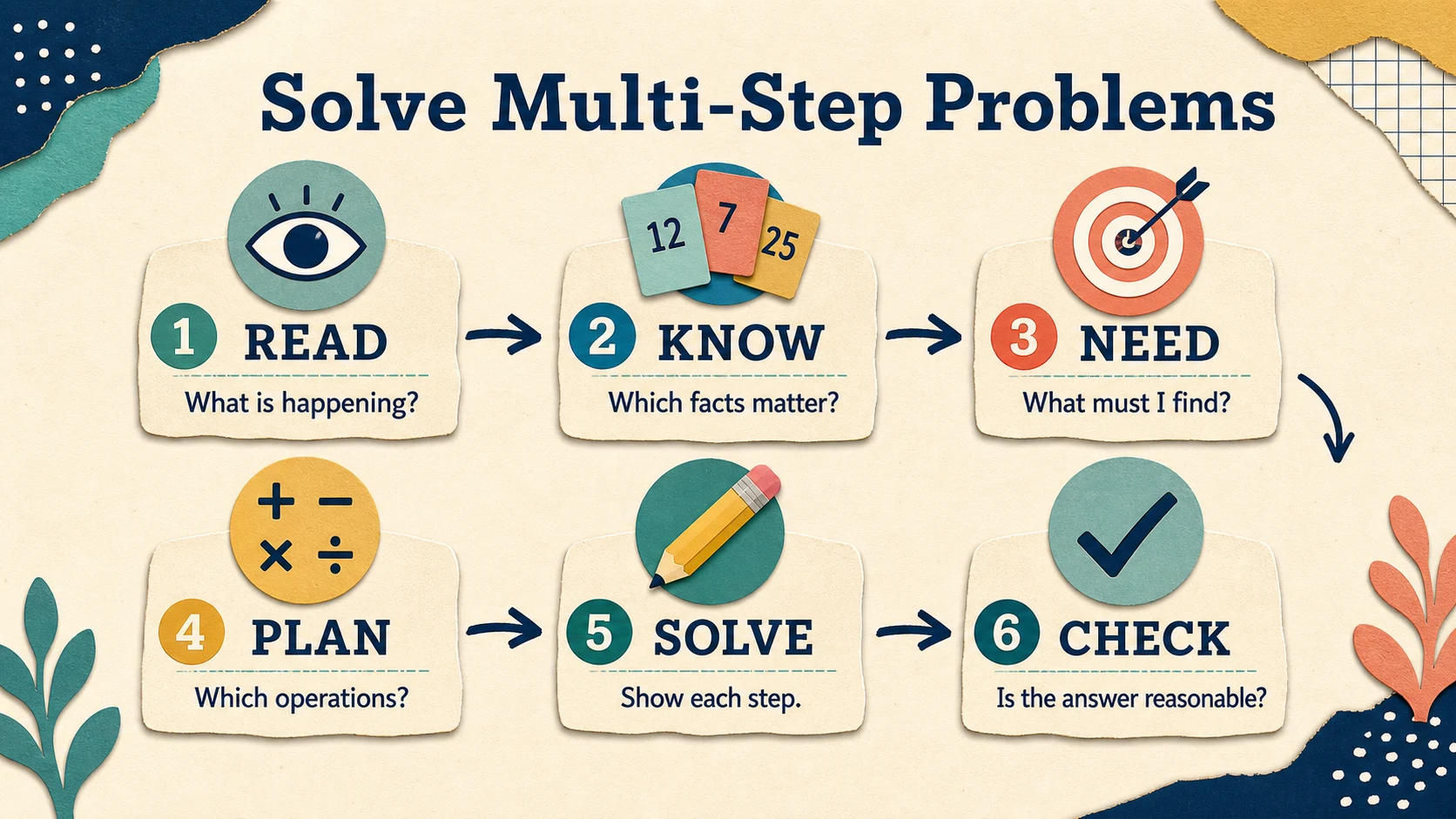
Successful problem solving connects comprehension, representation, calculation, interpretation, and checking.
Prerequisites to Check Before Increasing Difficulty
A learner does not need perfect fluency in every earlier skill, but recurring prerequisite gaps can hide the actual word-problem skill. Before assigning a long mixed set, sample the following areas.
Reading and mathematical language
Ask the learner to retell a short problem without solving it. Listen for accurate use of words such as total, difference, per, each, rate, ratio, increase, decrease, at least, and at most. The goal is not a memorized glossary. It is understanding how quantities are connected.
For example, compare these statements:
- “There are 8 more red tiles than blue tiles.”
- “There are 8 times as many red tiles as blue tiles.”
- “There are 8 red tiles for every 3 blue tiles.”
The number 8 appears in each statement, but the relationships are different: additive comparison, multiplicative comparison, and ratio.
Computation and number sense
Check whether the learner can perform the operations required by the planned problems. Useful samples include:
- operations with multidigit whole numbers;
- decimal addition, subtraction, multiplication, and division;
- fraction multiplication and division;
- comparison of positive and negative numbers;
- evaluation of a simple expression;
- solving a one-step equation;
- calculation of a mean or median.
If a learner chooses the correct equation but computes incorrectly, reteach the computation separately and then return to the original problem. If the computation is accurate but the equation is wrong, focus on comprehension and representation.
Representation and explanation
Ask the learner to show one situation in two forms, such as a tape diagram and an equation. Also ask, “What does this number represent?” A bare calculation may conceal whether the learner understands the quantities.
The IES guide for mathematics intervention recommends systematic instruction, clear mathematical language, carefully selected representations, number lines, and deliberate instruction on word problems. That guidance covers elementary grades through Grade 6 and supports the high-level instructional framing here. It does not evaluate any WorksheetWise resource.
A Grade-Appropriate Teaching Progression
Progress should reflect increasing reasoning demand, not merely larger numbers. A learner who solves a one-step problem with large numbers may still be less independent than one who organizes a three-step fraction problem correctly.
| Stage |
Problem characteristics |
Helpful representation |
Evidence of readiness to advance |
| 1. Interpret one relationship |
One operation; familiar whole numbers or decimals |
Picture, number line, or simple tape diagram |
Retells the situation and identifies the unknown |
| 2. Vary the unknown |
Result, starting amount, change, group size, or number of groups may be unknown |
Tape diagram and equation with a symbol |
Solves without relying on a fixed sentence pattern |
| 3. Connect rational numbers to context |
Fractions, decimals, rates, and negative values |
Fraction strips, double number line, ratio table |
Explains what each value and unit mean |
| 4. Coordinate two steps |
The first result is needed in the second calculation |
Labeled sequence of equations |
Records intermediate results and preserves units |
| 5. Solve ratio and variable situations |
Equivalent ratios, unit rates, expressions, equations, or inequalities |
Ratio table, graph, or equation |
Justifies the representation and checks the solution |
| 6. Evaluate problem information |
Extra data, missing data, multiple valid methods, or reasonableness decisions |
Student-chosen model |
Explains why information is used, ignored, or insufficient |
| 7. Work independently |
Mixed problem types with reduced prompts |
Efficient student-chosen representation |
Solves accurately and explains without adult cueing |
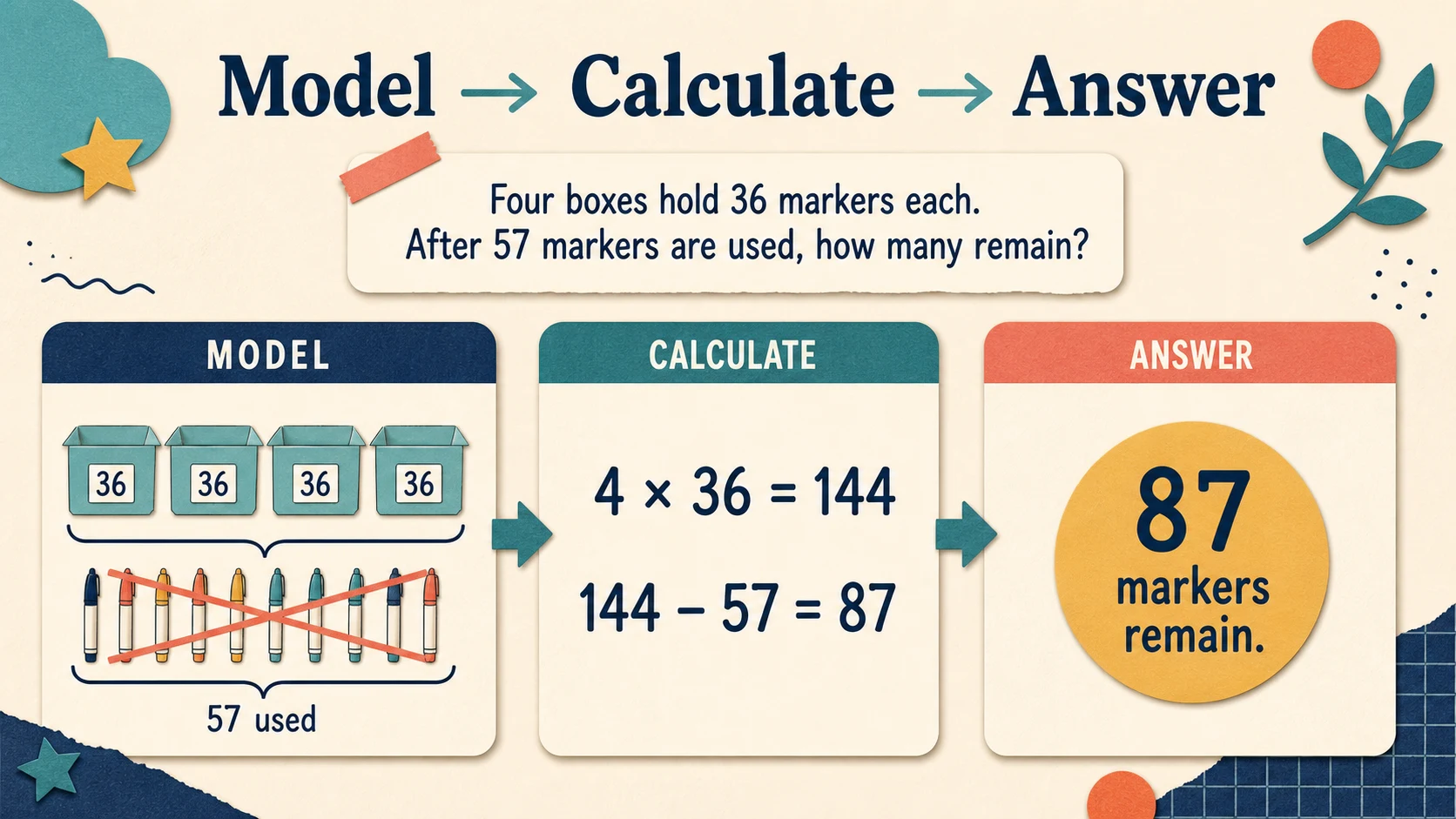
Move forward when the learner’s work shows stable understanding, and return to an earlier representation when errors reveal a gap.
The Common Core mathematics standards frame mathematical proficiency as more than obtaining an answer: understanding, procedural skill, application, and grade-appropriate justification all matter. The supplied catalogue identifies ratio reasoning in real-world problems as a particular Grade 6 emphasis. This guide does not claim comprehensive alignment with every state or local standard.
Concrete and Visual Models That Clarify Relationships
A model should expose the structure of a problem. It should not become extra decoration or a drawing assignment.
Objects and enactment
Counters, measuring cups, fraction strips, play money, or paper lengths can make a situation visible. To model 343 yards divided into pieces of 85 yard, for example, fraction strips can show how many five-eighths fit into fifteen-fourths.
Concrete materials are most useful when the learner connects every object to a number and unit. Ask, “What does this strip stand for?” Then connect the arrangement to an equation.
Tape diagrams
A tape diagram represents quantities with labeled bars. It works well for:
- part-part-whole relationships;
- additive or multiplicative comparisons;
- equal groups;
- fractions of a quantity;
- ratios;
- an unknown starting amount.
Suppose a club bought 7 identical notebooks and paid a $5 delivery fee. The total was $47. A tape diagram can show seven equal sections plus a separate $5 section. It points toward 7n+5=47 without requiring the learner to guess an operation from a keyword.
Number lines
Use number lines for signed quantities, elapsed distance, changes, intervals, and fraction or decimal magnitude. A jump from −7 to 5 is visibly 12 units, which helps prevent the mistaken conclusion that the change is 2.
Ratio tables and double number lines
These models organize equivalent ratios and rates. If 3 cups of concentrate combine with 5 cups of water, a table can track multiples:
| Scale factor |
Concentrate |
Water |
Total |
| 1 |
3 cups |
5 cups |
8 cups |
| 2 |
6 cups |
10 cups |
16 cups |
| 5 |
15 cups |
25 cups |
40 cups |
The table preserves the relationship among all three quantities. It is safer than changing numbers independently.
The earlier IES guide on teaching mathematics to young children recommends teaching through developmental progressions and monitoring what learners know. Its stated scope is preschool through kindergarten, so it is not direct Grade 6 guidance. The broad planning principles—sequence ideas and use evidence from learner work—remain useful, while the sixth-grade examples and pacing decisions here are instructional suggestions.
Four Fully Checked Worked Examples
Example 1: A ratio with a known total
Problem: A fruit drink uses 3 cups of concentrate for every 5 cups of water. A container holds 40 cups of the finished drink. How many cups of concentrate and water are needed?
Understand. One complete ratio batch has 3+5=8 equal ratio units. The total, 40 cups, includes both ingredients.
Represent.
3:5and3+5=8
The scale factor is:
40÷8=5
Solve.
3×5=15 cups of concentrate
5×5=25 cups of water
Check.
15+25=40
Also, 15:25 simplifies to 3:5. Both the total and the ratio are correct.
Answer: 15 cups of concentrate and 25 cups of water.
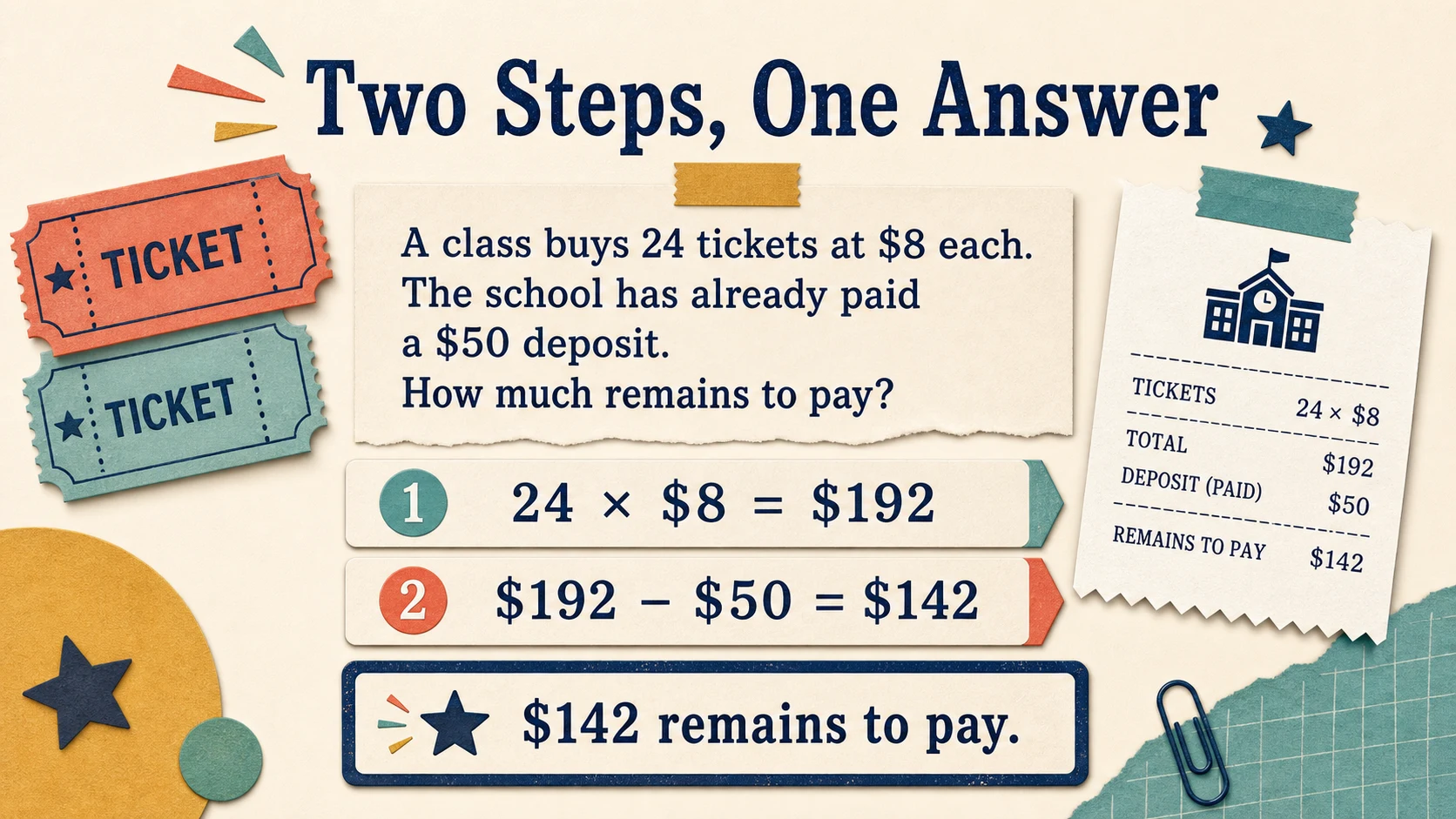
The representation identifies the relationship before the arithmetic begins.
Example 2: Dividing by a fraction
Problem: A 343-yard ribbon is cut into pieces that are each 85 yard long. How many complete pieces can be cut?
Understand. The question asks how many groups of 85 fit into 343. That is division.
Convert and solve.
343=415
415÷85=415×58
Simplify:
515×48=3×2=6
Check by multiplication.
6×85=830=415=343
No ribbon remains.
Answer: 6 complete pieces.
Example 3: Change across zero
Problem: At sunrise, the temperature was −7∘C. By noon, it was 5∘C. By how many degrees did the temperature rise?
Understand. The requested quantity is the distance from −7 to 5, not the sum of the absolute-looking digits.
Represent on a number line.
- From −7 to 0: 7 degrees.
- From 0 to 5: 5 degrees.
Solve.
7+5=12
Equivalently:
5−(−7)=12
Check.
−7+12=5
Answer: The temperature rose 12∘C.
Example 4: A two-step equation
Problem: Seven identical notebooks and a $5 delivery fee cost $47 altogether. What was the price of one notebook?
Understand. The total contains seven equal notebook prices plus one fixed fee.
Let n be the price of one notebook.
7n+5=47
Undo the fixed fee.
7n=47−5=42
Divide among seven notebooks.
n=42÷7=6
Check in the original situation.
7(6)+5=42+5=47
Answer: Each notebook cost $6.
Across these examples, notice that checking means more than repeating the same calculation. The ratio problem checks both total and equivalence; the ribbon problem uses multiplication; the temperature problem rebuilds the final value; and the notebook problem substitutes into the original equation.
Boundary Cases Learners Need to Recognize
A complete progression includes problems that cannot be solved by using every printed number.
Extra information
Problem: A store has 48 blue folders and 36 red folders. Each folder costs $2. Maya buys 7 blue folders. How much does she pay?
The numbers 48 and 36 describe inventory but are not needed. The relevant calculation is:
7×$2=$14
A learner who multiplies all the numbers may be treating “use the numbers” as the task instead of identifying the requested quantity.
Missing information
Problem: A class divides its art paper equally among 6 tables. How many sheets does each table receive?
This cannot be solved because the total number of sheets is missing. “Six tables” tells the number of groups but not the total to divide. Recognizing insufficient information is valid mathematical reasoning.
A remainder that changes the answer
If 53 learners travel in vans that hold 8 learners each, then:
53÷8=6 remainder 5
Six vans are not enough. The context requires 7 vans. In a different context—making complete teams of 8—the answer might be 6 complete teams with 5 learners left. Interpretation determines how the remainder is reported.
A result that is mathematically valid but contextually impossible
A calculation might produce 4.3 buses, −2 students, or 135% of a fixed inventory. Such results are signals to inspect the model, the arithmetic, and the meaning of the quantities. A decimal can be sensible for length or money but not for a count of indivisible objects.
A Short, Repeatable Lesson Routine
The following 20–25 minute routine is an instructional suggestion, not a universal timetable. Shorten, extend, or divide it according to the learner’s attention, accuracy, and explanations.
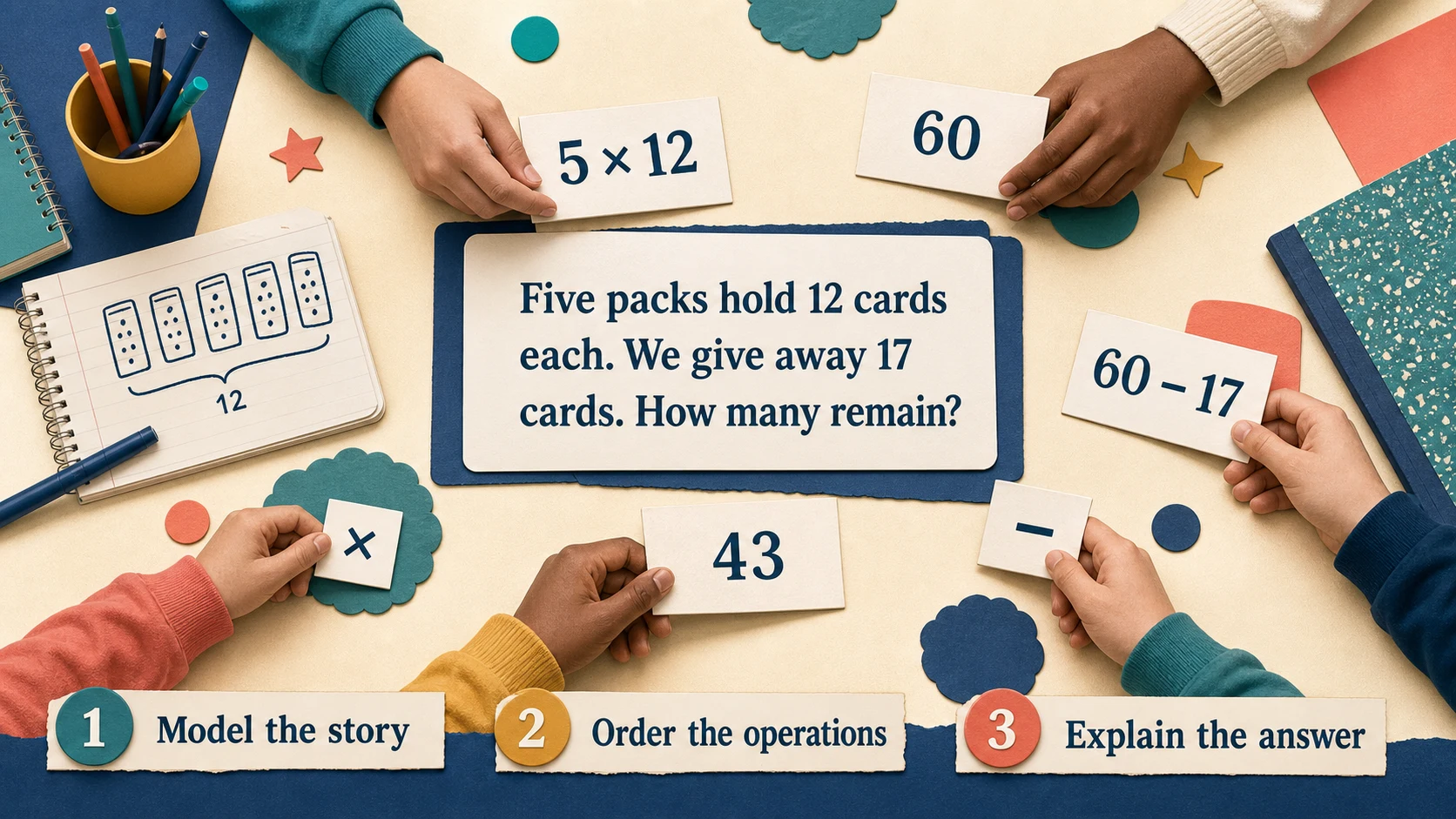
A stable routine reduces organizational demands while leaving the mathematical thinking visible.
1. Retrieve a prerequisite for three minutes
Use two or three quick items tied to the day’s problems: one fraction division, an equivalent ratio, or movement across zero. Keep this separate from the word problem so you can see whether computation is secure.
2. Model one problem for five minutes
Read the entire problem. Retell it, name the unknown, and label a diagram. Think aloud about relationships: “The $5 is a fixed fee; the seven notebook prices are equal.” Do not merely narrate arithmetic.
3. Solve one together for five minutes
Let the learner contribute the retelling, model, equation, and check. Prompt only where needed. Useful prompts include:
- “What does this number measure?”
- “Which quantities change together?”
- “Could you show that relationship?”
- “What must be found before the final question can be answered?”
4. Assign two independent problems for seven minutes
Choose problems with the same underlying structure but different wording or numbers. Independence here provides better evidence than completing ten heavily prompted items.
5. Review one explanation for three minutes
Have the learner explain the model and interpret the answer. Record one observation for the next lesson: secure, inconsistent, or not yet demonstrated.
Choosing Practice That Matches the Need
Begin with a small diagnostic sample rather than automatically assigning all 30 problems on a page.
If the learner struggles to retell situations, select short problems with familiar numbers and ask for oral retelling before calculation. If relationships are unclear, group practice by structure: comparison, equal groups, ratio, or change. If the learner understands individual structures but cannot choose among them, use mixed practice.
The 6th Grade math hub can help adults place word-problem practice alongside fractions, ratios, expressions, negative numbers, and statistics. The broader 6th Grade worksheet hub is useful when planning across subjects.
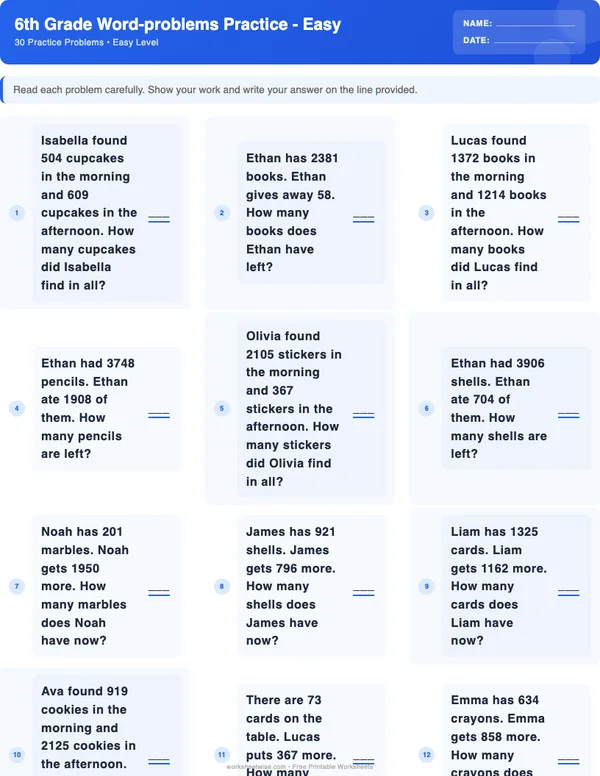
The free easy 6th Grade Word Problems worksheet contains 30 exercises with a separate answer key. Its catalogue skills include problem solving, reading comprehension, multi-step reasoning, and mixed operations. “Easy” should be interpreted as its labelled practice difficulty, not as a prediction that every learner will find every item easy.
A practical selection rule is:
- Choose 3–5 focused items when teaching a new structure.
- Choose 4–8 mixed items when checking whether the learner can select a method.
- Choose fewer items with fuller explanations when comprehension is the concern.
- Choose a longer set in sections when building independent work habits.
Avoid using the answer key only to mark right or wrong. Compare the equation, intermediate work, units, and final interpretation.
Differentiation Without Lowering the Mathematical Goal
When the reading load is the barrier
Read the problem aloud once, or let the learner read it in short sections. Clarify unfamiliar nonmathematical vocabulary without telling which operation to use. Provide space to record:
- what is known;
- what must be found;
- the relationship;
- the answer and unit.
This preserves the mathematics while reducing avoidable language and organization demands.
When representation is the barrier
Offer a choice of two appropriate models rather than drawing the model for the learner. For a ratio problem, ask, “Would a ratio table or double number line show this more clearly?” Fade the choice once the learner selects models reliably.
When computation is the barrier
Allow a multiplication chart, fraction strips, or a calculator only when the instructional goal is interpreting and representing the situation. Then assess the computation separately. Record which support was used so assisted and independent performance are not confused.
When practice is already secure
Increase depth before increasing volume. Ask the learner to:
- solve by a second method;
- write a matching equation;
- change the unknown’s position;
- add irrelevant information;
- remove essential information and explain what is missing;
- create a realistic problem for a supplied answer;
- compare two proposed solutions and identify which is valid.
Diagnosing Common Errors
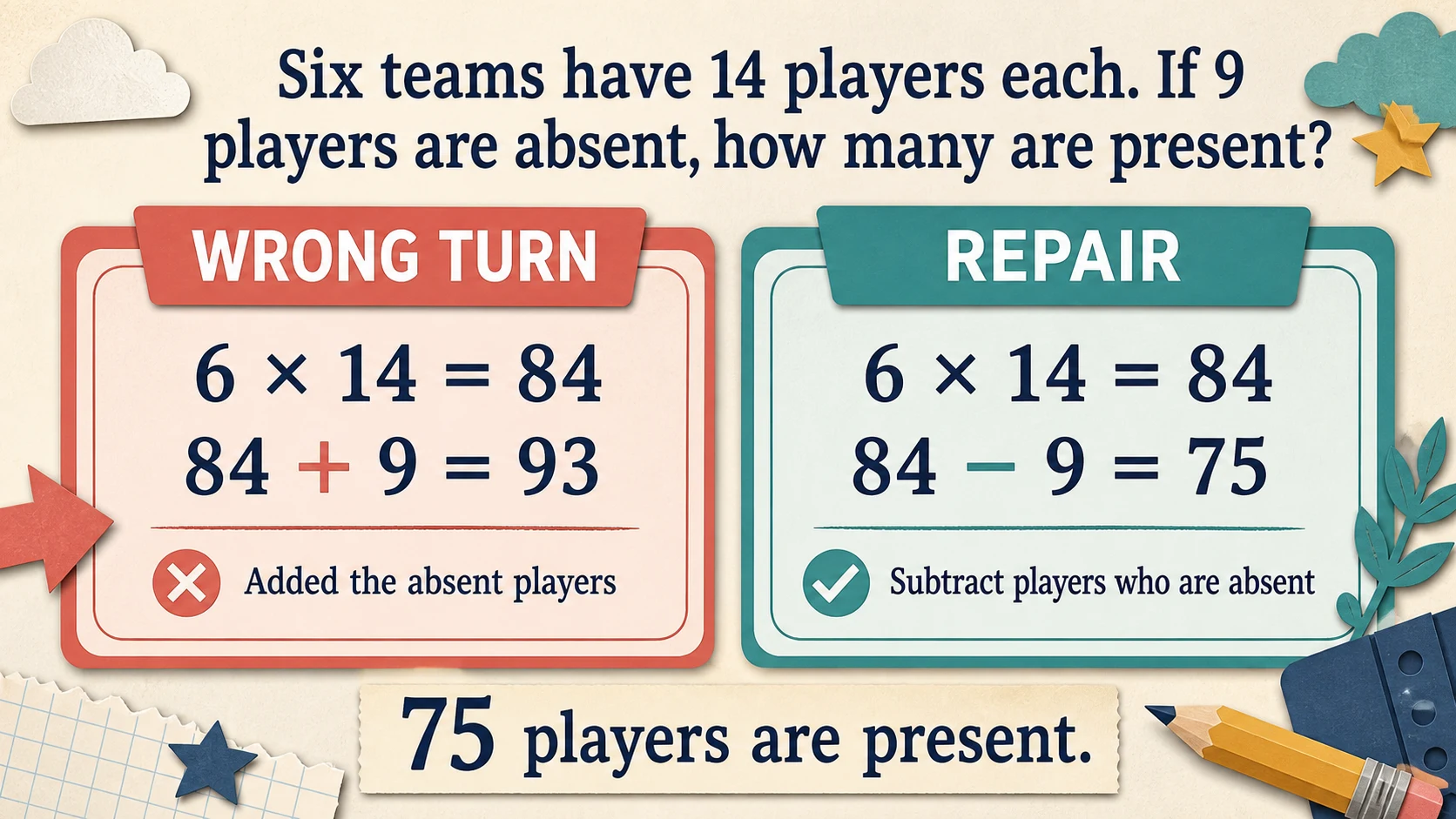
Treat an error as evidence about the learner’s current reasoning, then choose the smallest useful response.
| Observed work |
Likely issue to investigate |
Teaching response |
| Uses every number |
Assumes all printed data must be used |
Include extra-information problems and require a reason for each selected value |
| Circles a keyword and chooses an operation immediately |
Relies on verbal shortcuts |
Retell the situation and draw the relationship before writing an operation |
| Reverses ratio quantities |
Loses the order or labels |
Write units beside both columns of a ratio table |
| Adds numerator and denominator separately |
Fraction procedure is insecure |
Revisit equivalent fractions and fraction models outside the word problem |
| Writes 5−(−7)=2 |
Treats signs as decoration |
Show the interval on a number line and verify by addition |
| Stops after an intermediate calculation |
Loses the final question |
Underline the requested quantity and label each intermediate result |
| Gives 6 vans for 53 people at 8 per van |
Ignores the remainder’s meaning |
Ask whether the proposed answer accommodates every person |
| Correct number, missing or wrong unit |
Does not interpret the result |
Require a final sentence naming the quantity and unit |
| Changes method after an adult asks “Are you sure?” |
Uses adult reaction as feedback |
Ask for a check that would work even if no adult were present |
| Accurate with grouped problems, inaccurate with mixed problems |
Cannot yet identify structure independently |
Mix two known structures at a time and require model selection |
Do not infer a broad learning difficulty from one error. Look for a repeated pattern across several comparable problems. This guide provides educational suggestions, not medical or diagnostic guidance.
Monitoring Progress From Actual Work
Use a simple record with four dimensions:
| Dimension |
0: not shown |
1: shown with support |
2: shown independently |
| Understands and retells |
Retelling changes the situation |
Accurate after prompting |
Accurate and concise |
| Represents relationships |
No usable model or equation |
Model completed with cues |
Appropriate model selected independently |
| Computes |
Major procedure error |
Accurate with support |
Accurate independently |
| Interprets and checks |
Bare or unreasonable answer |
Unit/check added after prompting |
Contextual answer and valid check |
Score only a few representative problems. The purpose is instructional decision-making, not creating an elaborate grading system.
Look for patterns over time:
- If comprehension rises but computation remains weak, teach the relevant number skill directly.
- If computation is secure but representation stays weak, return to concrete and visual models.
- If supported performance is strong but independent performance drops, fade prompts more gradually.
- If one structure is secure, introduce a contrasting structure rather than assigning more near-identical items.
A useful advance criterion is repeated independent success with explanation across more than one session and more than one wording pattern. A single perfect page may reflect familiarity, prompting, or a narrow item type.
A Two-Week Practice Plan
This ten-session plan assumes brief weekday practice. It is a flexible instructional suggestion, not a required schedule. Repeat, combine, or pause sessions according to observed work.
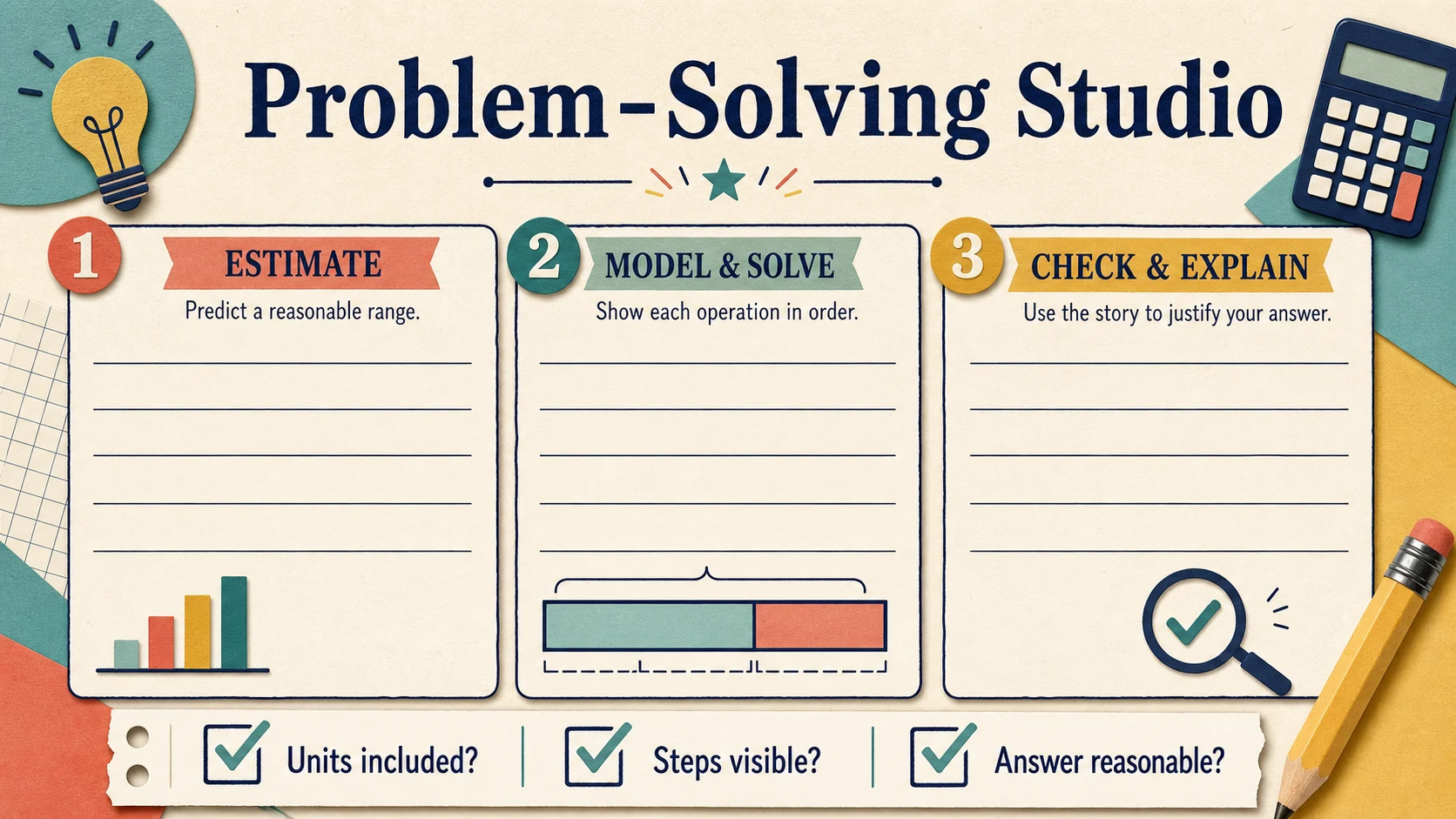
The plan alternates instruction, focused practice, mixed retrieval, and review.
| Day |
Focus |
Suggested work |
Evidence to collect |
| 1 |
Diagnostic |
Four varied problems; ask for retelling and shown work |
Which stage breaks down first? |
| 2 |
Part-whole and comparison |
Tape diagrams; vary the unknown position |
Can the learner explain each bar? |
| 3 |
Equal groups and fraction division |
Objects or fraction strips, then equations |
Is division interpreted correctly? |
| 4 |
Ratios |
Ratio tables and double number lines |
Are labels and scale factors preserved? |
| 5 |
Mixed review |
Two familiar structures plus one boundary case |
Does the learner select a model independently? |
| 6 |
Signed quantities |
Number-line changes across and on one side of zero |
Are direction and distance distinguished? |
| 7 |
Variables and fixed fees |
Translate situations into one-step equations |
Does each term have a contextual meaning? |
| 8 |
Multi-step organization |
Record intermediate answers with units |
Is the final question answered? |
| 9 |
Extra, missing, and remainder information |
Classify solvable and unsolvable problems |
Can the learner justify information choices? |
| 10 |
Independent check |
A short mixed set followed by error analysis |
What is secure, emerging, or still unsupported? |
If Day 4 reveals ratio confusion, do not rush to Day 6 merely to keep the calendar. Repeat ratio work with simpler values and clearer models. Conversely, if the learner is already independent, compress familiar sessions and use the saved time for explanation, problem creation, and comparison of methods.
Limits and the Next Useful Step
Worksheets provide structured practice, but a completed page alone cannot reveal every reason for an error. Adults still need to listen to explanations, inspect representations, separate comprehension from computation, and notice how much prompting was required. A worksheet also cannot establish a universal pace or guarantee an outcome.
For a learner beginning this topic, use the free easy-level worksheet as a brief diagnostic: select four to six varied problems, ask for full reasoning, and sort the work into comprehension, representation, computation, and interpretation. Then use the results to choose the next small teaching target. If broader, sustained practice is needed after that check, review the focused 6th Grade Word Problems pack or build targeted variations with the free worksheet generators.