Curated collectionAnswer keys includedPrint-ready PDFs
Decimals Worksheets by Grade and Level
Show the full decimals progression across 4 real grade combinations, compare task boundaries, model checked examples and explain how to choose the next level.
Start with a real resource
Browse this worksheet collection
4 relevant free entry points are available. Each one includes a printable learner PDF and separate answer key.
A useful practice loop
Print less. Observe more.
- Choose one skill and model the first item aloud.
- Use a short set and notice the learner’s strategy.
- Change the next task from the work you can see.
Need more than the free sheet?
Plus includes all 72 matching catalogue variations where available, plus saved deterministic generators and the worksheet designer.
See Plus membershipComplete guide
How to teach and practise decimals worksheets
3,274 words Updated 6 instructional visuals
Choose the decimal task by what the learner can show
The useful starting point is not the grade printed on a worksheet. It is the next decimal relationship the learner can represent, explain, and calculate with reasonable accuracy.
Across the WorksheetWise catalogue, decimals appear in four grade combinations: 3rd-, 4th-, 5th-, and 6th-grade math. Each grade has one free entry sheet. The 3rd- and 4th-grade free sheets contain 22 problems each; the 5th- and 6th-grade sheets contain 30 each. The full catalogue contains 72 decimal worksheet variants.
Those facts describe available practice, not four fixed stages every learner must follow. Grade labels indicate intended practice level, and local curriculum sequences differ. Before printing, inspect whether the questions ask the learner to:
- identify tenths and hundredths;
- connect a model, fraction, decimal, and money amount;
- compare or order decimals;
- round or estimate;
- add and subtract;
- multiply;
- divide; or
- interpret a decimal in a word problem.
Start where the learner can explain most of the prerequisite ideas but still has one meaningful challenge. Move down when notation is hiding the underlying place-value idea. Move up when the learner can solve, represent, and justify the current task—not merely complete repeated items by copying a procedure.
What decimal understanding includes
A decimal extends the base-ten place-value system to quantities smaller than one. If the whole is divided into ten equal parts, each part is one tenth, written . If the whole is divided into 100 equal parts, each part is one hundredth, written .
That definition contains three ideas a learner must coordinate:
- The size of a unit depends on the chosen whole.
- Each place is ten times the place to its right.
- Decimal notation and fraction notation can name the same quantity.
For example, , , 25 hundredths, and 25 cents as a part of one dollar all describe the same proportion of a whole in the stated context. Money is a helpful connection, but it should not become the only model. Money commonly displays hundredths, while decimal work also requires learners to interpret tenths and, later, other place values.
The Common Core mathematics overview emphasizes coherent connections among concepts, place value, arithmetic, and application. It also distinguishes understanding from simply producing an answer: learners should give grade-appropriate reasons for their conclusions. That principle is useful here without claiming that any WorksheetWise sheet has been assessed for standards alignment.
Keep one whole consistent
Use base-ten blocks with an explicit convention:
- one flat represents ;
- one rod represents ;
- one small cube represents .
Under that convention, three rods and six small cubes represent . Four rods represent , which is also . The model makes it possible to compare 36 hundredths with 40 hundredths directly.
Do not silently change the value of the flat, rod, or cube during a lesson. Base-ten materials can represent different wholes in other contexts, so state the convention before every activity: “Today, this flat is one whole.”
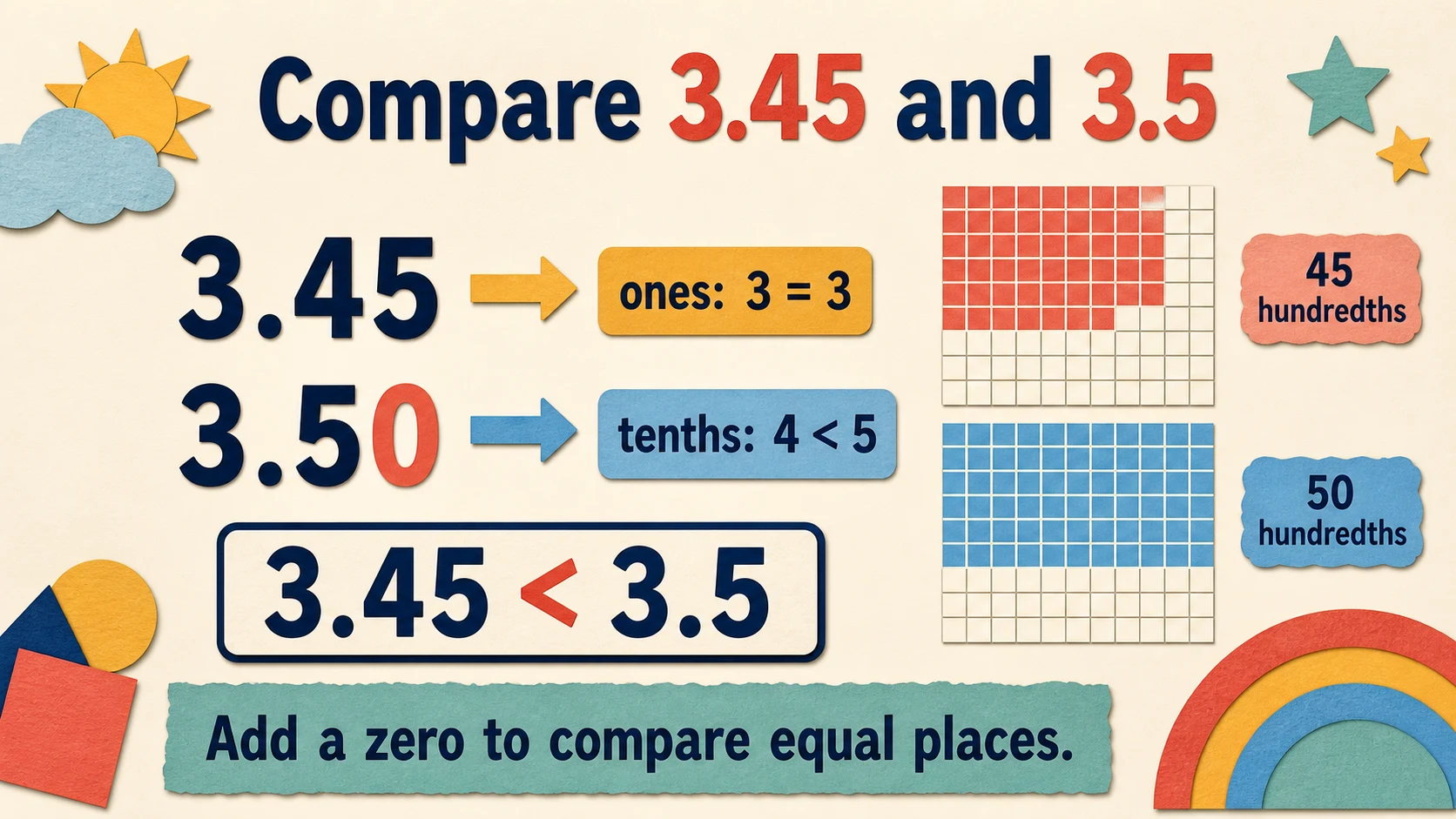
Use the model to establish what each digit means before expecting a learner to work from decimal notation alone.
Four grade entry points, with different task boundaries
The catalogue descriptions cover place value, fractions and decimals, comparison, ordering, rounding, and computation. That broad description does not mean every free sheet contains every task type. Open the selected grade page and preview the actual questions before assigning it.
3rd grade: establish the quantity behind the notation
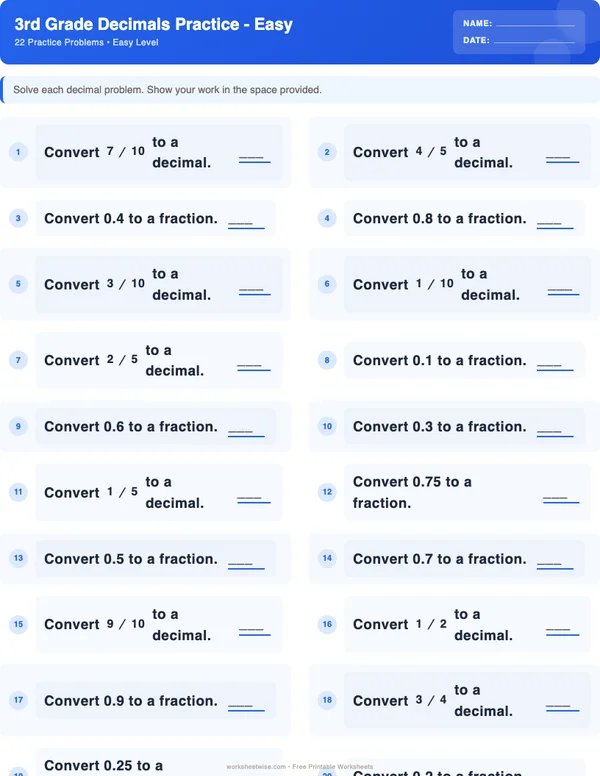
The 3rd Grade Decimals guide and free sheet is the most sensible catalogue entry point when a learner needs supported work with tenths, hundredths, models, or simple comparisons. Its free sheet has 22 problems and is labelled “easy.”
Here, “easy” should be read as a catalogue difficulty label, not a description of a child. Define the level by observable task features when previewing it: shorter directions, familiar representations, limited place values, a single operation or relationship at a time, and little need to choose among several procedures would make a task comparatively accessible. If the preview instead demands unsupported computation or unfamiliar notation, it may not be the right starting point despite the label.
A suitable boundary at this stage is understanding that means four tenths and means four hundredths. A learner who cannot yet distinguish those quantities needs models and place-value language before a page of mixed operations.
4th grade: coordinate models, symbols, and comparison
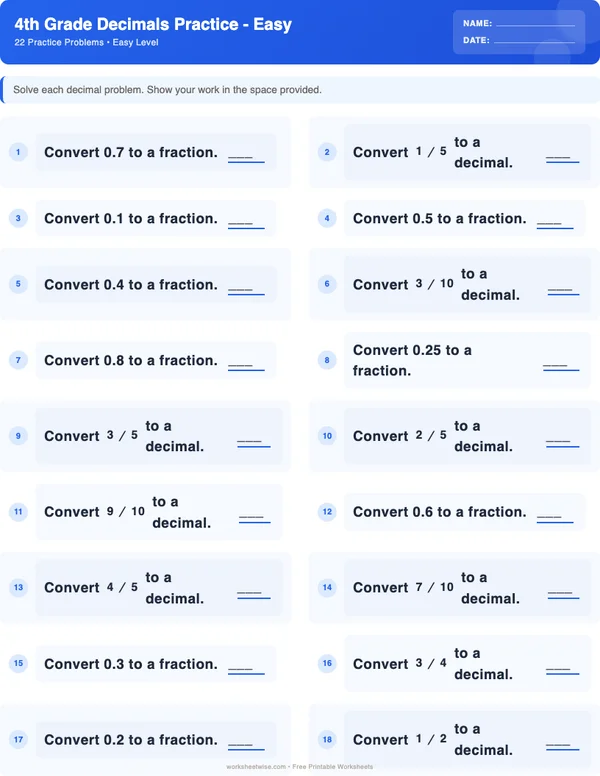
The 4th Grade Decimals guide and free sheet also provides a 22-problem free sheet labelled “easy.” Use this entry point when the learner can identify tenths and hundredths but needs to connect representations, compare values, order values, or explain equivalent forms such as .
Question design should now reduce some concrete support. A productive sequence might move from a shaded hundredths grid, to a decimal matched with a fraction, to a comparison containing only numerals. The target is not abandoning models; it is choosing a model when it helps justify a claim.
5th grade: make estimation part of computation
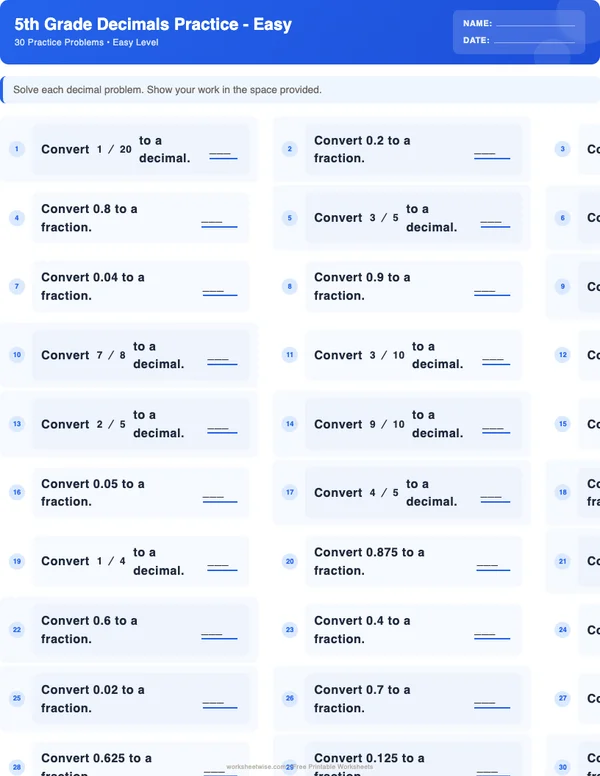
The 5th Grade Decimals guide and free sheet has 30 problems and the same catalogue difficulty label. The larger problem count is a workload difference, not proof of greater conceptual difficulty.
This entry point becomes useful when the learner understands place value through hundredths and is ready to apply that understanding in rounding or decimal computation. Preview for whether questions isolate one operation or mix several. A learner may be ready to add and subtract decimals while still needing explicit preparation for multiplication.
At this level, every computation routine should begin with a magnitude prediction. The estimate is not an optional extra after the exact calculation; it provides a range against which the answer can be judged.
6th grade: interpret operations in context
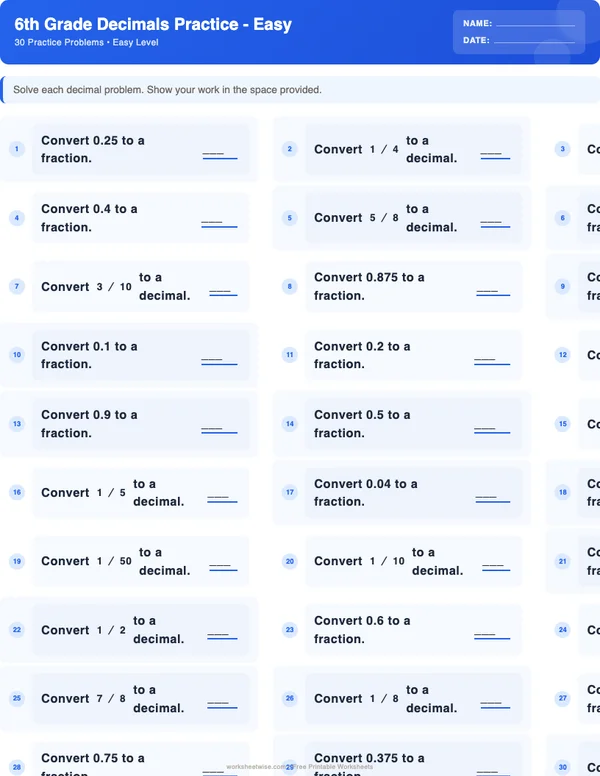
The 6th Grade Decimals guide and free sheet also contains 30 problems and is labelled “easy.” Consider it when the learner can use estimation, align place values in addition and subtraction, and explain decimal multiplication well enough to interpret more complex calculation or division contexts.
Useful questions include measured lengths, fabric quantities, prices, or equal sharing. The context must determine the operation. A page that merely surrounds a bare calculation with extra words does not necessarily strengthen reasoning.
For division, distinguish “how many groups?” from “how much in each group?” For instance, can represent splitting a $12.60 bill equally among three people. The answer, $4.20, is an amount in each share.
A checked progression from concrete quantities to operations
A decimal progression is useful only if each step reveals a new demand. Repeating the same numeral-reading task under different grade labels does not create progression.
Step 1: build, shade, and name
Ask the learner to build a decimal with base-ten blocks, shade it on a hundredths grid, say it aloud, and write it as both a decimal and a fraction.
Checked example 1: represent .
- Three rods represent .
- Six small cubes represent .
- Together, .
- On a hundredths grid, shade 36 of 100 squares.
- As a fraction, .
This belongs near the 3rd-grade entry point because it makes tenths and hundredths visible and asks for translation among representations without adding an operation. It also prepares the learner to compare decimals for a reason rather than by a visual feature such as the number of digits.
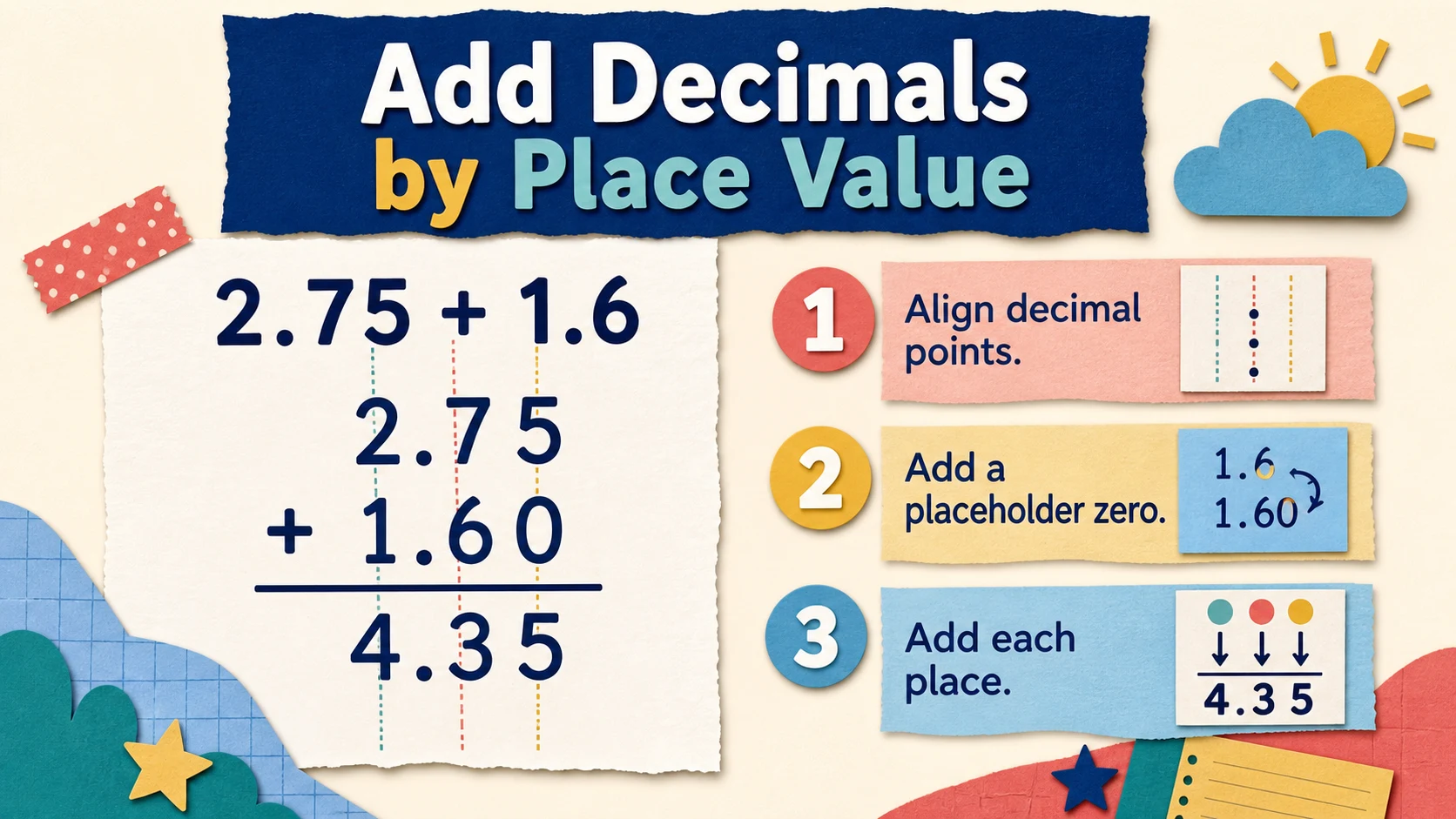
Remove support in deliberate steps: model the quantity, connect the symbols, then ask for an independent explanation.
Step 2: compare by equal place values
Checked example 2: compare and .
Rewrite as . Then compare:
- tenths: both values have at least three tenths, but has four tenths;
- hundredths: is 36 hundredths and is 40 hundredths;
- therefore, .
A hundredths grid confirms the result: 36 shaded squares cover less area than 40 shaded squares.
This example belongs across the 3rd- to 4th-grade boundary because it exposes a consequential misconception: more written digits do not make a decimal larger. The correct comparison depends on the value of each position.
Step 3: estimate, then add or subtract
Checked example 3: calculate .
Estimate first: is about , and is already close to , so a reasonable sum is a little over .
Write equivalent place values:
The exact answer agrees with the estimate. The zero in does not change its value; it makes the hundredths place visible.
This example belongs near the 4th- to 5th-grade transition because it requires both place-value equivalence and a computation check. If a learner writes , the error suggests digit-by-digit treatment without aligning equal units.
Step 4: use magnitude to place the decimal point
Checked example 4: calculate .
Estimate the size before calculating. Since is less than , the product must be less than . Three tenths of is :
One model is 24 tenths multiplied by three tenths, producing 72 hundredths. Another is an area model with side lengths and .
This example belongs near the 5th-grade computation boundary because estimation determines the product’s scale. A result of should be rejected immediately: multiplying a positive number by cannot make it three times as large.
Step 5: give division a unit and a meaning
Checked example 5: split $12.60 equally among three people.
Estimate: $12 divided by 3 is $4, so each share should be close to $4.
Check by multiplication:
Each person pays $4.20. This fits the 6th-grade end of the catalogue progression because the learner must select division from a sharing context, calculate, preserve the money unit, and verify the result.
A measurement variant changes the interpretation: 12.6 meters of fabric cut into three equal lengths gives 4.2 meters per length. The arithmetic is equivalent, but the unit and answer statement must match the situation.
How question design should change across the progression
A well-chosen sequence changes more than the number of problems.
Early questions should make the whole and its subdivisions visible. The learner may match a model to , shade 25 hundredths, or name the value of a digit. Later questions can conceal the representation and ask the learner to produce or select one.
Comparison questions should progress from common visual units to symbolic reasoning:
- compare two shaded hundredths grids;
- compare with ;
- compare values with different-looking forms, such as and ;
- order several decimals and explain the first place at which they differ.
Operation questions should progress from one clearly named operation to mixed situations in which the learner decides what to do. The final demand is interpretation, not longer arithmetic.
The IES guide on assisting elementary students with mathematics recommends systematic instruction, clear mathematical language, well-chosen concrete and semi-concrete representations, number lines, and deliberate word-problem instruction. Those sourced recommendations support moving purposefully among blocks, grids, number lines, equations, and contexts. The specific examples and worksheet-selection decisions in this guide are WorksheetWise editorial suggestions; IES did not review these worksheets.
Read errors as evidence about the next prompt
Wrong answers should change the next question you ask. They should not be used to label a learner.
“The longer decimal is larger”
If the learner says , ask: “How many hundredths is each number?” Then have the learner shade 36 squares and 40 squares on equal hundredths grids. Record .
Interpretation: the learner may be applying whole-number length logic to decimals or may not yet treat tenths as groups of ten hundredths.
Next task: compare and using grids, then compare and without grids while explaining the tenths place first.
“Line up the final digits”
If the learner writes decimal addition with the rightmost digits aligned rather than the decimal points, return to units. Ask which digits name ones, tenths, and hundredths.
Interpretation: the written algorithm has become detached from equal place values.
Next task: place and in a place-value chart, explain why they are equal, and then add .
“Count places but ignore magnitude”
If produces , ask whether multiplying by a number less than one should make a positive quantity larger or smaller.
Interpretation: the learner may know a partial rule for digits or decimal places without understanding the product’s size.
Next task: estimate , mark a plausible interval on a number line, and calculate only after agreeing that the answer must be less than .
“Divide because the numbers look divisible”
If the learner divides whenever a story mentions sharing, ask what the answer represents and whether the problem seeks the number of groups or the size of each group.
Interpretation: the operation may be selected from a keyword rather than the quantities’ relationship.
Next task: contrast “12.6 meters split into 3 equal pieces” with “How many 0.3-meter pieces fit into 12.6 meters?” The first calculation is ; the second is .
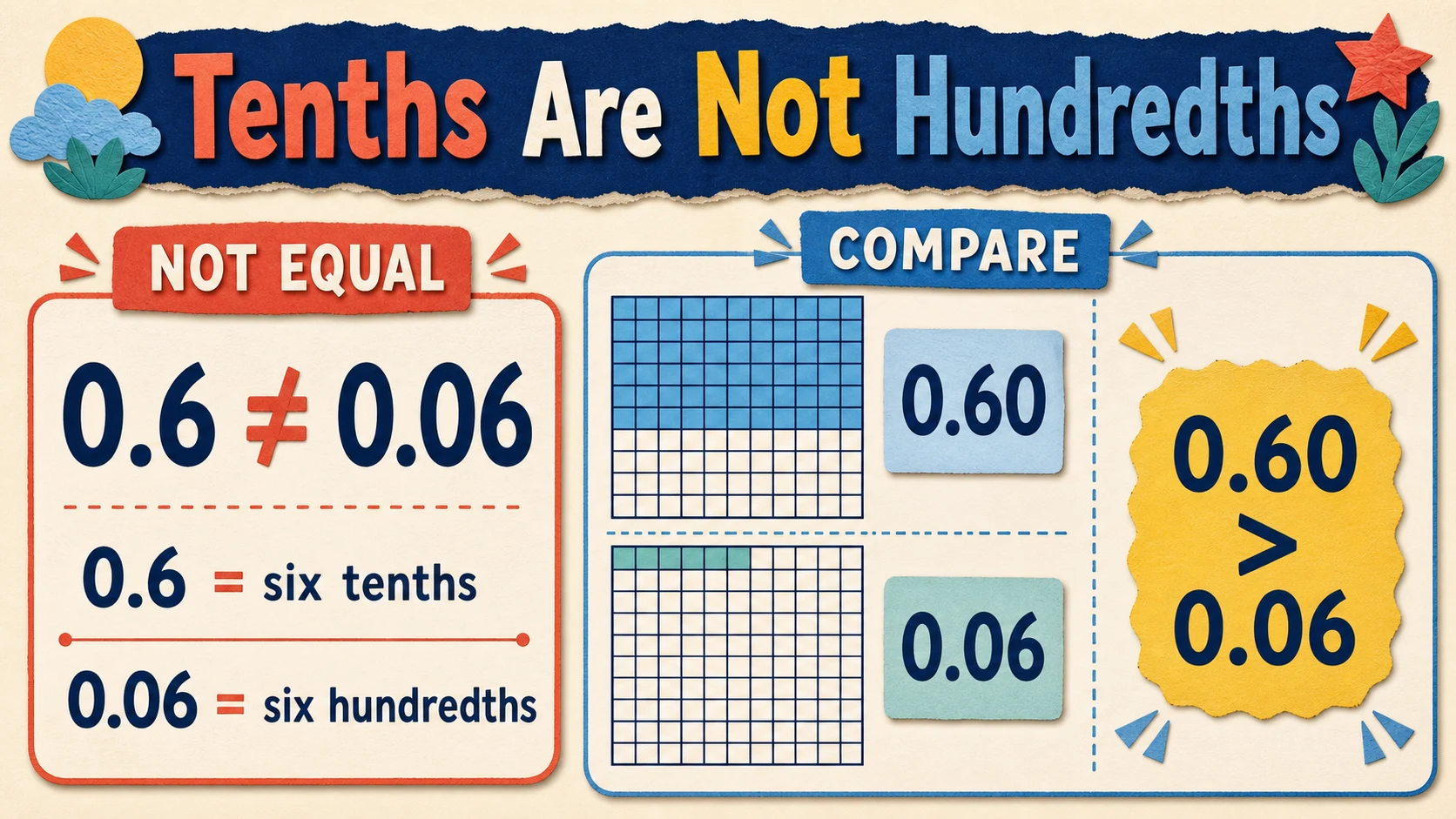
For an early decimal error, return to equal-sized units and ask the learner to show the quantity.
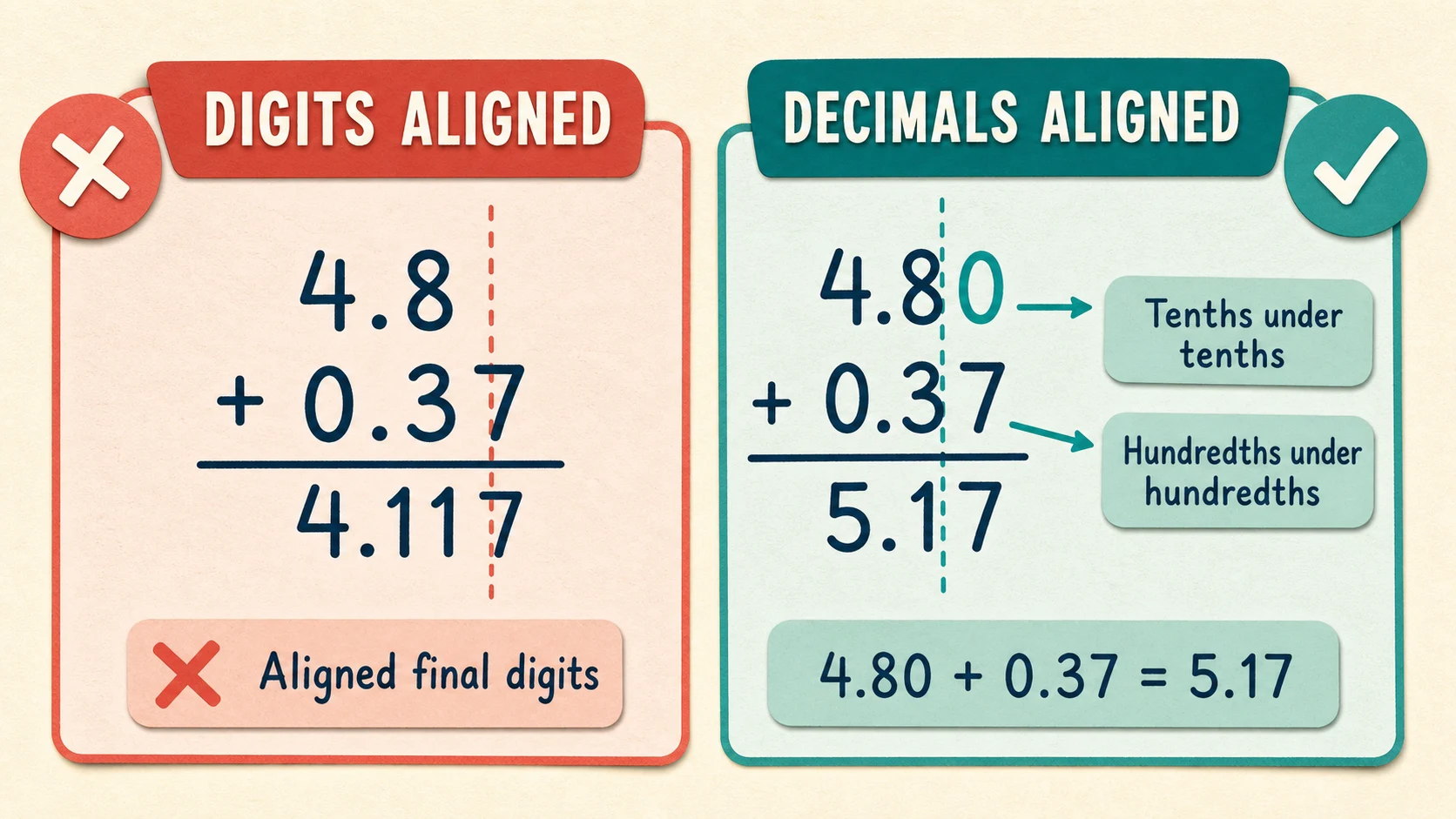
For an upper-level error, check operation meaning and magnitude before rehearsing another procedure.
A repeatable routine for using one worksheet
Before the page: predict and represent
Select three preview items that reveal the worksheet’s main demand. Do not begin with all 22 or 30 problems.
For one representative item:
- State what the whole is.
- Ask the learner to estimate or predict.
- Build, shade, sketch, or locate the value on a number line.
- Name the relevant units: ones, tenths, or hundredths.
- Solve while saying why each step is valid.
The IES early-mathematics guide is aimed at younger children than these catalogue pages, but two of its broad recommendations remain relevant as foundation-building principles: use a developmental progression and monitor what the child already knows. That source does not prescribe these decimal sheets or establish a grade placement for an individual learner.
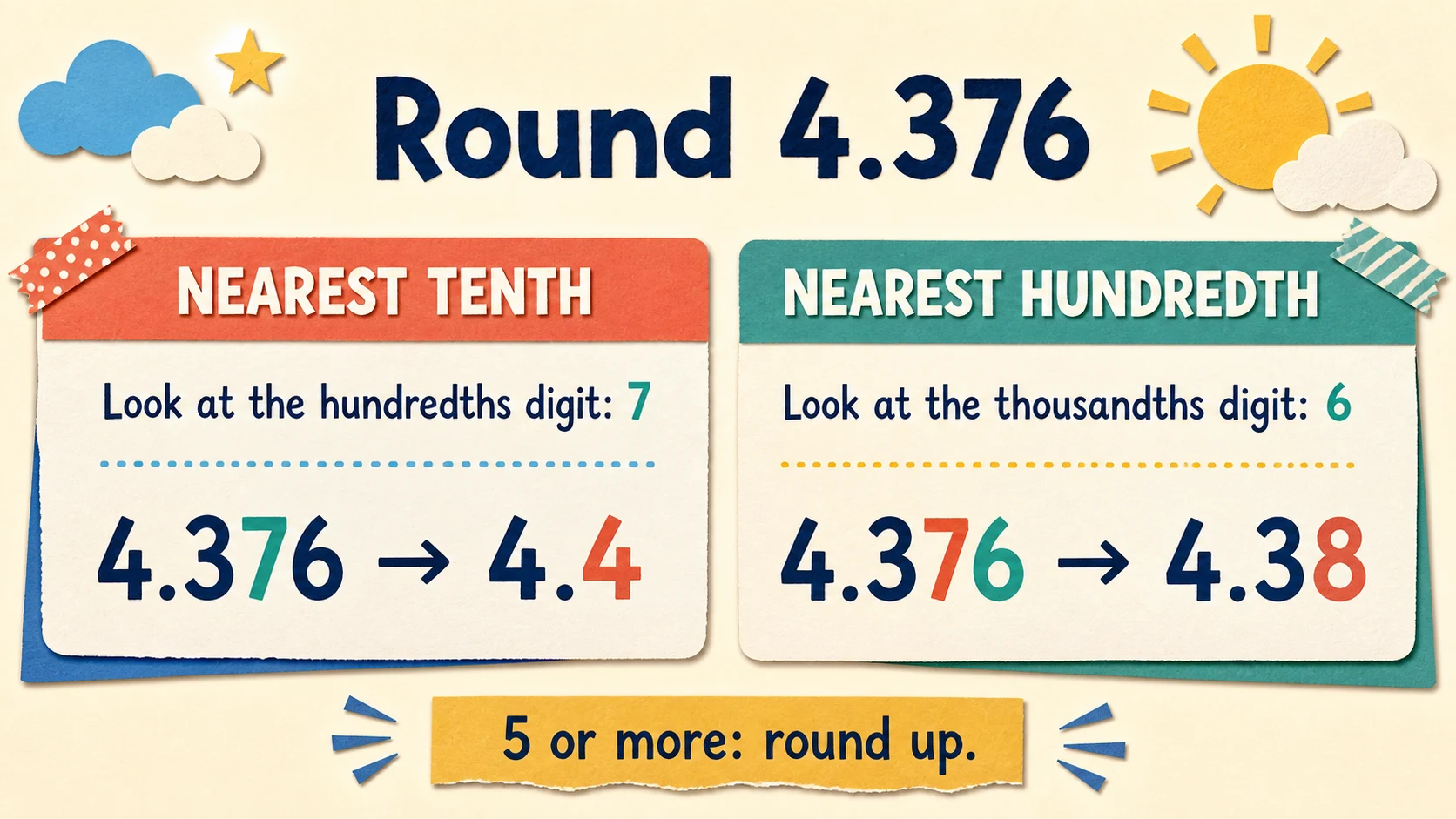
For an early entry point, keep the cycle concrete: show, name, write, compare, and explain.
During the page: sample for reasoning
Ask the learner to complete a short run, then pause. A useful first sample is four to six items, not the full sheet. Check:
- Are place values aligned?
- Can the learner explain a trailing zero?
- Was an estimate made before an operation?
- Does the answer’s size make sense?
- Can one answer be shown another way?
If the learner is accurate but cannot explain, add one representation prompt. If the learner explains correctly but makes an isolated arithmetic slip, correct the slip without dropping the conceptual level. If the same structural error repeats, stop the page and teach that relationship with a model.
After the page: use an exit item
Give one new item without copying the worksheet’s exact numbers. Preserve the same target.
After comparing and , for example, ask the learner to compare and , then justify the answer as hundredths. A correct response is:
because 58 hundredths is less than 60 hundredths.
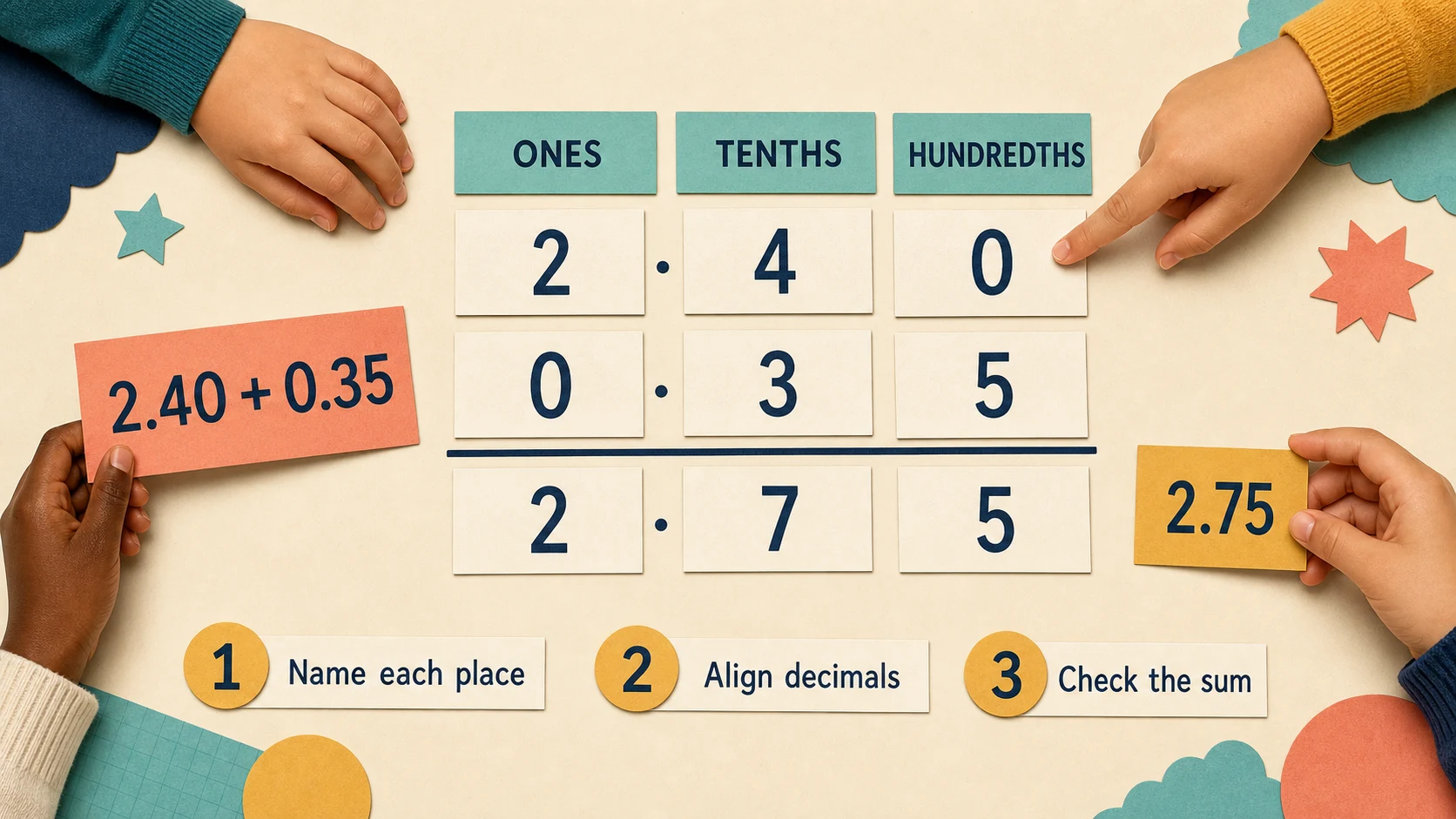
For upper-level practice, make estimate, calculation, context, and verification four visible parts of the same solution.
Adapt without changing the decimal skill
An adaptation should improve access while keeping the mathematical decision intact.
For place-value work, enlarge a hundredths grid, provide physical blocks, or use a place-value chart. Do not replace “compare two decimals” with “copy the greater number” because copying removes the target reasoning.
For reading or language support:
- read directions aloud;
- clarify words such as tenth, hundredth, product, and quotient;
- provide a sentence frame: “___ is greater because at the ___ place, ___ is greater than ___”;
- keep the numerals and required operation unchanged.
For writing or motor support, let the learner point, dictate, arrange digit cards, or use a calculator only when calculation fluency is not the target. If the target is decimal multiplication, a calculator would remove too much of the task; if the target is choosing an operation in a multistep context, it may preserve the intended reasoning.
Reduce visual load by covering unused rows or assigning six items at a time. Do not infer that a 30-problem sheet is automatically the correct choice because a learner works quickly. Speed alone does not show whether the learner understands magnitude, representation, or operation meaning.
Boundaries adults should keep in view
These worksheets provide practice, not a complete decimal curriculum. A printable page cannot by itself confirm whether a learner understands the chosen whole, can transfer knowledge to measurement, or can explain an unfamiliar comparison. Discussion, manipulatives, and new examples are needed alongside written work.
Catalogue grade and difficulty labels are discovery aids, not placement decisions. The “easy” label is meaningful only after translating it into features visible on the actual sheet. Likewise, 22 versus 30 problems describes length, not conceptual demand.
Do not diagnose a learning condition from decimal errors. A response such as identifies an idea to investigate; it does not establish why the learner made the error. Check the explanation, representation, language demands, and consistency across more than one example.
Do not assume that completing one grade page means the learner should immediately move to the next grade. The observable boundary is stronger: the learner can represent the decimal, explain place value, solve the target task, estimate when operations are involved, and apply the idea to one fresh example.
Select one real sheet and decide the next move
Use this decision sequence:
- Choose the 3rd-grade entry point when tenths and hundredths still need to be built, shaded, or named.
- Choose the 4th-grade entry point when the learner can identify the places but needs to coordinate models, equivalent notation, comparison, or ordering.
- Choose the 5th-grade entry point when place-value understanding is stable enough to support rounding or computation with estimation.
- Choose the 6th-grade entry point when the learner is ready to interpret multiplication or division in contexts and verify results by magnitude or an inverse operation.
Preview the actual free sheet because the catalogue description spans more skills than any single practice page necessarily contains. Assign four to six representative questions, ask for one explanation, and finish with a changed-number exit item.
The most practical next action is to open the 3rd Grade Decimals guide and free sheet, regardless of the learner’s enrolled grade, and use versus as a two-minute placement check. If the learner can model, compare, and explain those values, preview the next grade entry point. If not, stay with the concrete model until “36 hundredths is less than 40 hundredths” is visible, spoken, and written.
Put it into practice
Use the guide with a real printable
Move from explanation to a short, observable practice task. Check the first item together, then adjust the next session from the learner's actual work.
Open the first free worksheetExplore a neighboring collection
Choose by a different teaching need
Addition Worksheets by Grade and Level Consonant Blends Worksheets by Grade and Level Counting Worksheets by Grade and Level CVC Words Worksheets by Grade and Level Digraphs Worksheets by Grade and Level Division Worksheets by Grade and Level Fractions Worksheets by Grade and Level Geometry Worksheets by Grade and Level