Curated collectionAnswer keys includedPrint-ready PDFs
Addition Worksheets by Grade and Level
Show the full addition progression across 6 real grade combinations, compare task boundaries, model checked examples and explain how to choose the next level.
Start with a real resource
Browse this worksheet collection
6 relevant free entry points are available. Each one includes a printable learner PDF and separate answer key.
A useful practice loop
Print less. Observe more.
- Choose one skill and model the first item aloud.
- Use a short set and notice the learner’s strategy.
- Change the next task from the work you can see.
Need more than the free sheet?
Plus includes all 108 matching catalogue variations where available, plus saved deterministic generators and the worksheet designer.
See Plus membershipComplete guide
How to teach and practise addition worksheets
3,416 words Updated 6 instructional visuals
Choose addition practice by what the learner can show
The right addition worksheet is not automatically the one carrying the learner’s grade label. Choose it by inspecting the numbers, representations, regrouping demands, language, and amount of independent work. A useful sheet sits just beyond what the learner can already explain, while leaving enough mental space to notice a strategy.
WorksheetWise currently lists 108 addition worksheet variants across six grade combinations, from Kindergarten through 5th Grade. Each grade has one free entry point: 20 problems in Kindergarten, 1st Grade, and 2nd Grade; 25 problems in 3rd and 4th Grade; and 30 problems in 5th Grade. All six free sheets are catalogued as “easy,” but that label describes observable task features—not a learner. Before printing, check exactly what the questions ask the learner to represent, calculate, and explain.
Grade labels describe intended practice level; local curriculum sequences differ. Age is a discovery aid rather than a placement decision. Use a brief sample, observe the learner’s method, and move backward or forward according to the evidence.
The central teaching path is concrete-representational-abstract, or CRA:
- Concrete: Join counters, cubes, fingers, or base-ten blocks.
- Representational: Draw the action with ten frames, dots, number bonds, open number lines, or bar models.
- Abstract: Record and solve a number sentence.
These are connected views of the same mathematics, not three boxes to rush through. A learner may calculate 8 + 5 = 13 correctly but still benefit from showing how 5 can become 2 + 3, allowing 8 + 2 = 10 and then 10 + 3 = 13.
What addition understanding includes
Addition begins as joining two quantities, but elementary work gradually expands that meaning. Learners also encounter result-unknown situations, change situations, comparisons, missing addends, multi-digit calculations, and later addition involving decimals or fractions. A correct answer alone does not reveal whether the learner understands the quantities or has copied a procedure.
Look for four kinds of evidence:
- The learner can represent what the addends mean.
- The learner selects an efficient strategy rather than recounting everything.
- The learner keeps place values and units aligned.
- The learner can explain why the result is reasonable.
WorksheetWise’s instructional recommendation is to introduce “making ten” early because it connects fact work to later regrouping. That recommendation can be enacted concretely: when solving 9 + 6, move one of the six counters beside the nine, creating a group of ten and five remaining. The corresponding drawing shows a completed ten frame plus five. The abstract record is 9 + 6 = 10 + 5 = 15.
This editorial recommendation is consistent with broader guidance but should not be confused with a claim that an outside organization evaluated WorksheetWise. The IES guide for teaching mathematics to young children recommends teaching number and operations through a developmental progression, monitoring what children know, and including mathematics regularly. The IES elementary mathematics intervention guide separately recommends systematic instruction, clear mathematical language, and carefully selected concrete and semi-concrete representations.
First-grade addition connects quantities, ten-based representations, fact strategies, and written equations rather than treating them as separate topics.
Six grade entry points, with real task boundaries
The catalogue presents six free starting sheets, but the grade changes should reflect more than a longer page. Representation, number range, place value, and expected independence should change together.
Kindergarten: joining visible quantities
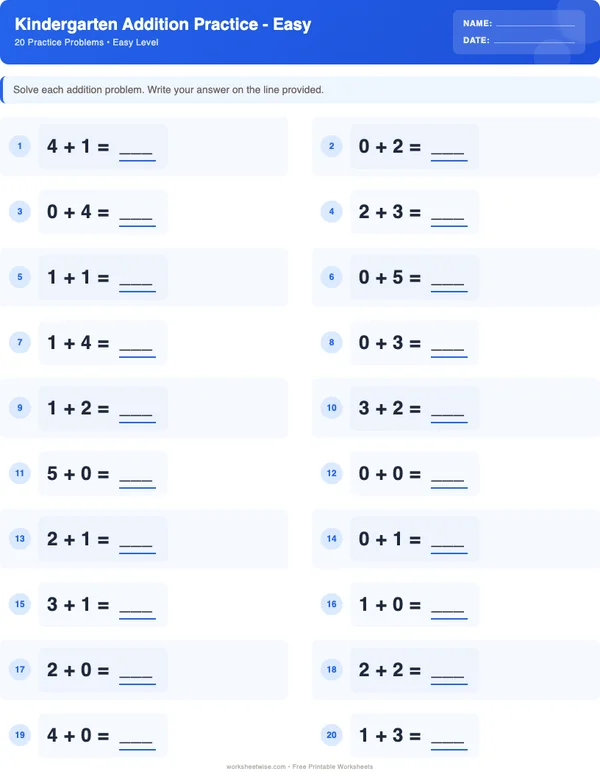
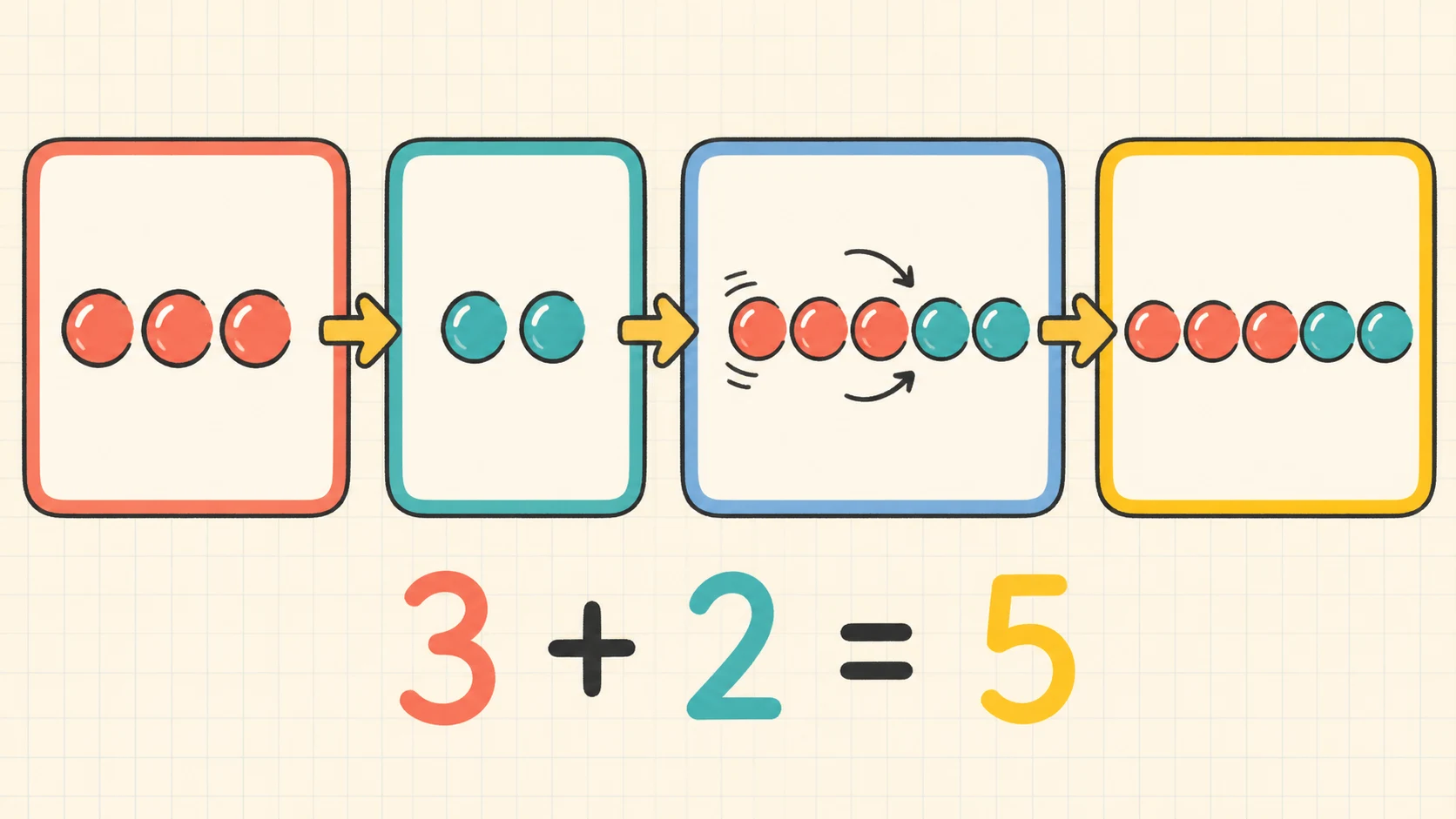
The free Kindergarten Addition guide and free sheet contains 20 problems. An appropriate starting task uses small quantities and permits objects, pictures, or fingers. The important action is physically joining sets and recognizing the total.
Consider 2 + 3. Place two counters on the left and three on the right. Slide them together and count five. Then draw two dots and three dots before recording 2 + 3 = 5. This example belongs at the Kindergarten entry point because the quantities can be perceived and joined directly; no place-value procedure or memorized fact is required.
Do not turn early addition into prolonged desk work. For children ages three and four, prioritize brief adult-led oral, matching, manipulative, and movement activities over worksheets. Ask a child to make two jumps, then three more, and tell how many jumps altogether. A worksheet can record one or two examples after the experience, but it should not replace the experience.
Move beyond this starting point when the learner can consistently join small sets, count each object once, and connect the action to an equation. Stay here if the learner says the last number counted but cannot explain that it names the total.
1st Grade: composing ten and adding within 20
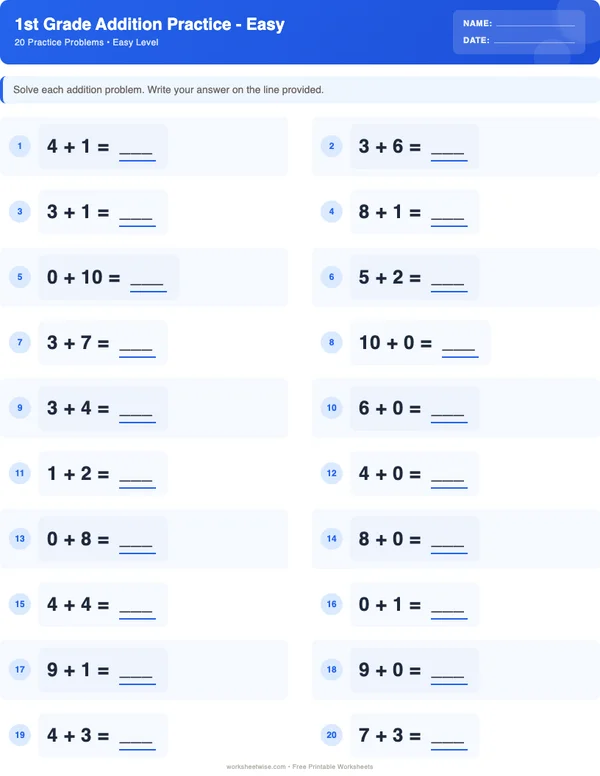
The free 1st Grade Addition guide and free sheet also contains 20 problems. A useful first-grade boundary is the shift from counting every item to counting on, using known facts, or making ten. Ten frames should remain available even after equations appear.
Checked example: 8 + 7 = 15.
- Put eight counters in a ten frame.
- Decompose seven into two and five.
- Use two to complete the ten frame.
- Combine ten and five.
- Record
8 + 7 = 8 + 2 + 5 = 15.
The arithmetic checks: 7 = 2 + 5, 8 + 2 = 10, and 10 + 5 = 15. This belongs in first-grade-oriented practice because it develops addition within 20 and makes the relationship to ten visible. It is more revealing than asking only for the final sum.
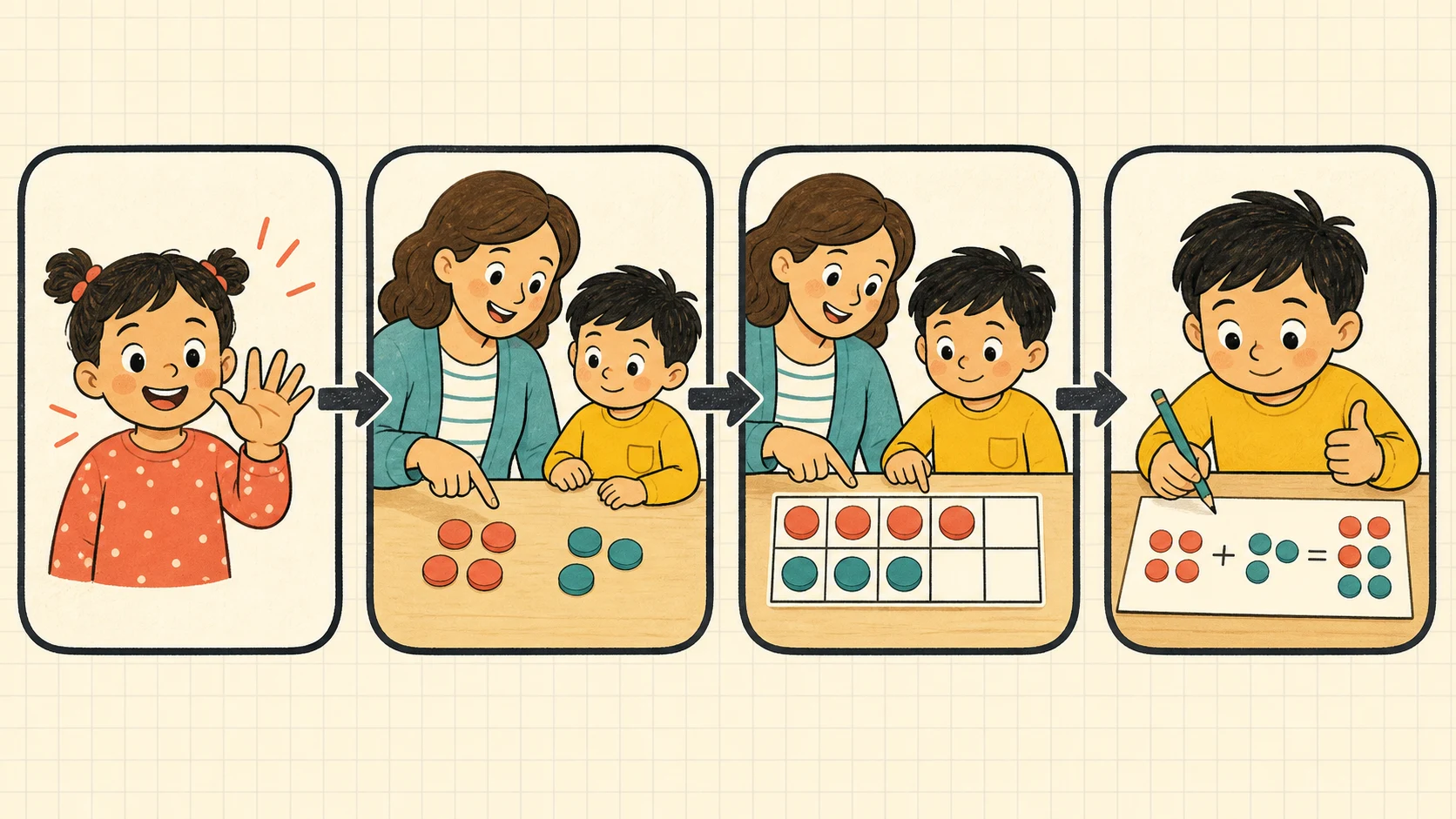
A first-grade routine should allow time to build, draw, discuss, and only then complete selected written items.
A learner ready for the next boundary can explain a strategy for facts such as 9 + 4 without counting both sets from one. Speed is not the criterion. Listen for structure: “Nine needs one, so I split four into one and three.”
2nd Grade: place value and the meaning of regrouping
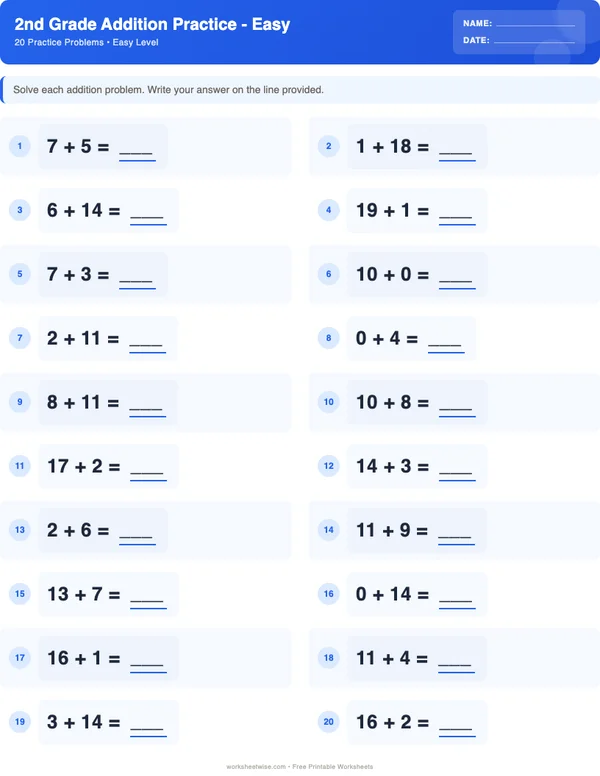
The free 2nd Grade Addition guide and free sheet contains 20 problems. At this point, task design can introduce or consolidate two-digit addition, but place value must remain visible. A vertical format is not enough evidence of understanding.
Checked example: 27 + 18 = 45.
Using base-ten blocks, combine two tens and seven ones with one ten and eight ones. There are three tens and fifteen ones. Trade ten ones for one ten, leaving four tens and five ones: 45.
The written method should mean the same thing:
  27
+ 18
----
  45
Seven ones plus eight ones equals fifteen ones. Write five in the ones place and regroup one group of ten into the tens column. Then 2 tens + 1 ten + 1 regrouped ten = 4 tens. This example belongs at the two-digit boundary because the learner must coordinate addition facts with place-value units. The small “1” is not a magic instruction; it represents ten.
A suitable next worksheet may add two-digit numbers without regrouping first, then include a small set with one regrouping. Avoid changing to larger numbers, two regroupings, and word-problem language simultaneously.
3rd Grade: multi-digit calculation with explanation
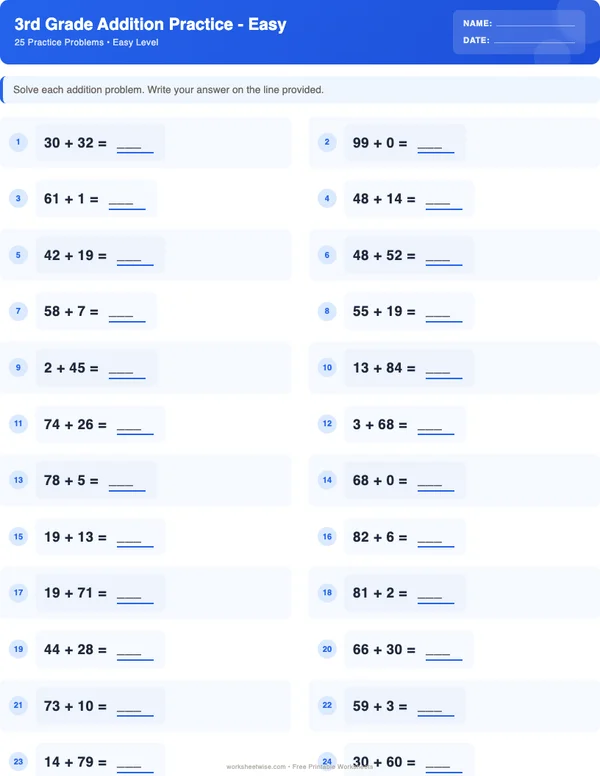
The free 3rd Grade Addition guide and free sheet contains 25 problems. Appropriate practice can ask learners to coordinate hundreds, tens, and ones; estimate; use more than one representation; and verify a result.
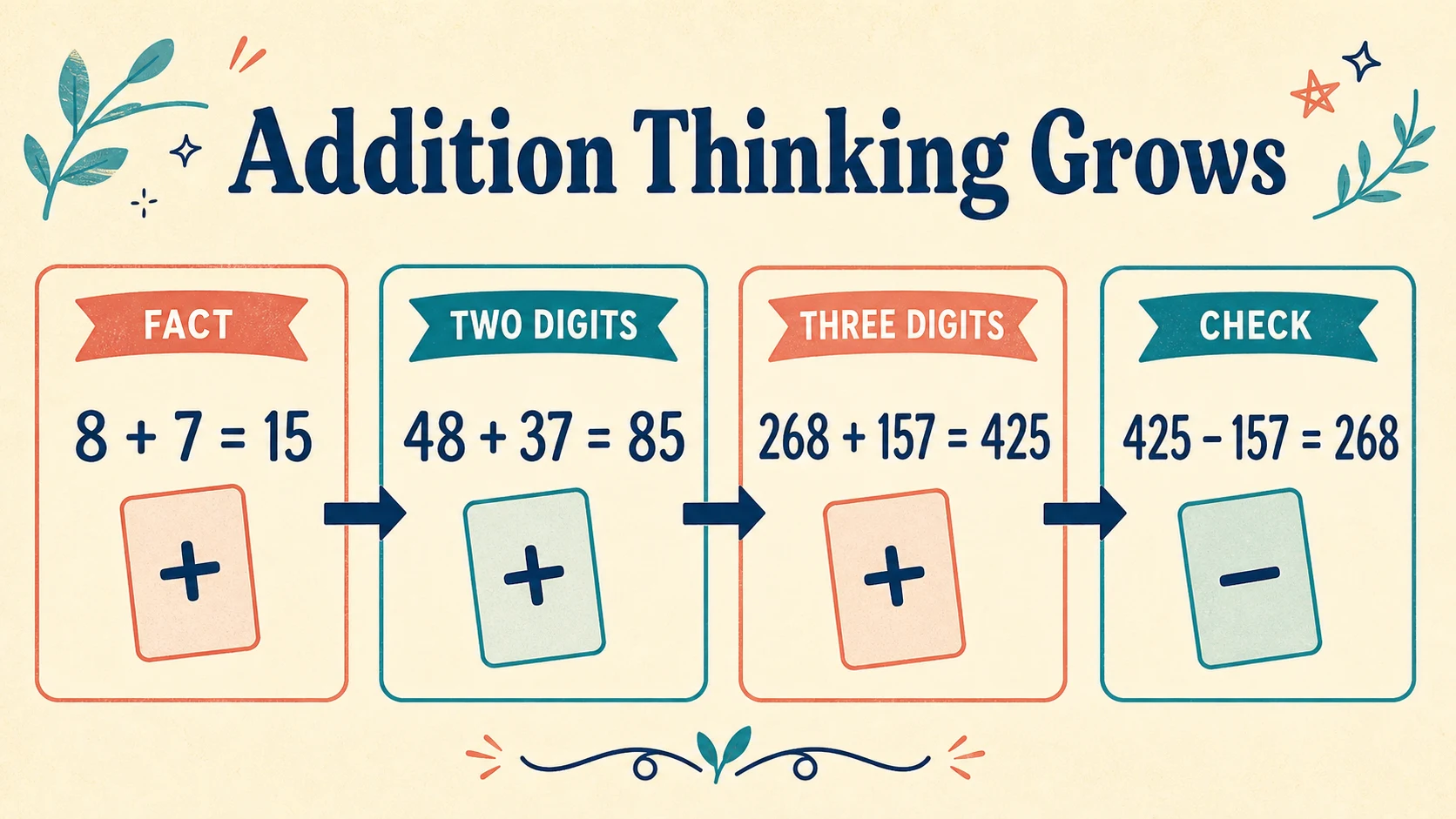
Third-grade practice can reduce visual prompts gradually while preserving estimation, place-value language, and opportunities to explain regrouping.
Checked example: 368 + 257 = 625.
Estimate first: 370 + 260 is about 630, so an answer near 600 is plausible. Add by place value:
- Ones:
8 + 7 = 15, or one ten and five ones. - Tens:
6 tens + 5 tens + 1 ten = 12 tens, or one hundred and two tens. - Hundreds:
3 hundreds + 2 hundreds + 1 hundred = 6 hundreds. - Result:
625.
A decomposition check gives the same answer:
(300 + 200) + (60 + 50) + (8 + 7) = 500 + 110 + 15 = 625.
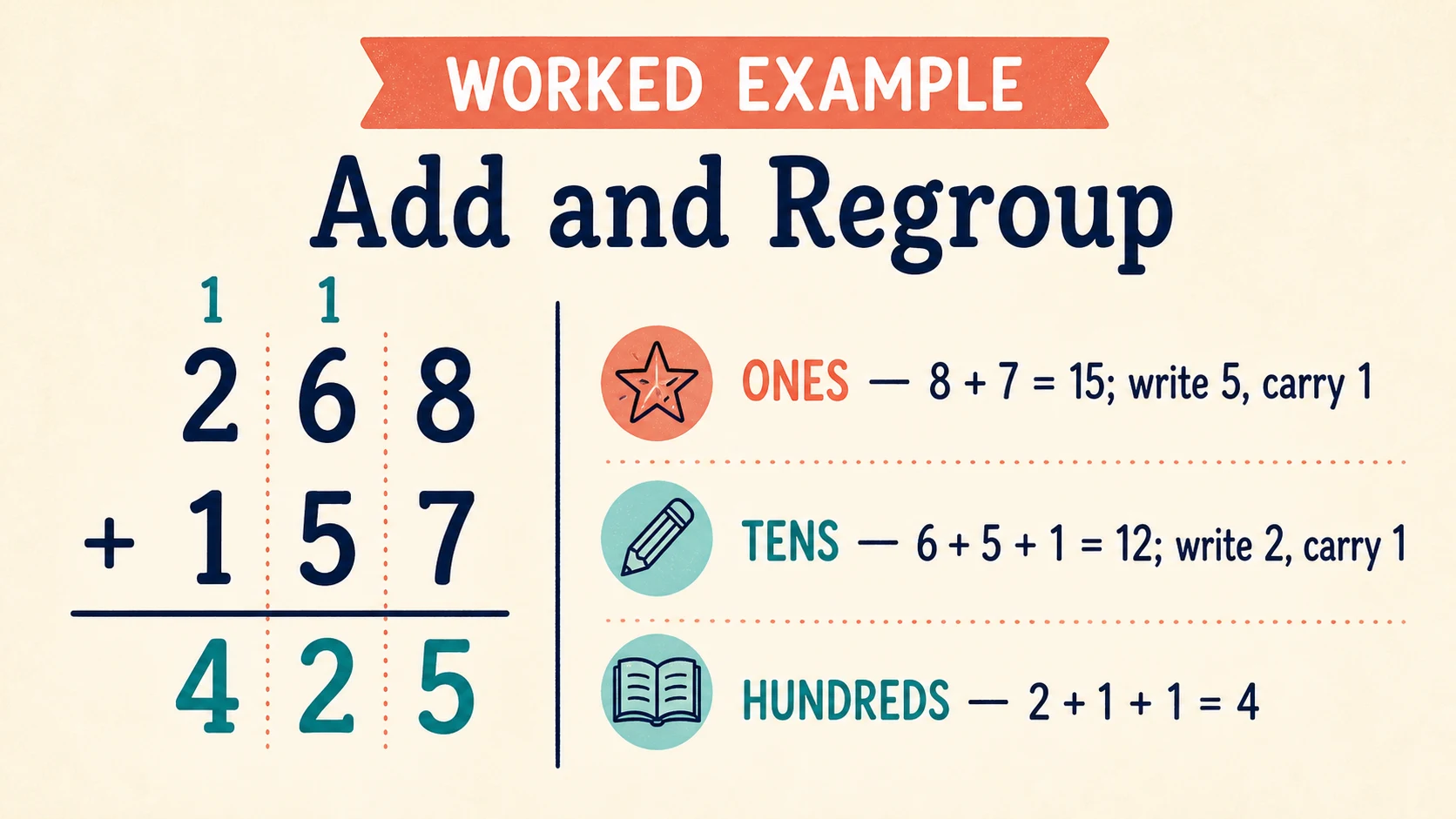
The worked example matters because each written regrouping should correspond to a quantity that can be shown with a place-value model.
This belongs at the 3rd Grade entry point because it requires two regroupings, place-value coordination, and a reasonableness check. If the learner produces 515, do not assign 25 more similar calculations immediately. First determine whether the error came from missing both regrouped units, misaligning columns, or misunderstanding that ten units compose one unit in the next place.
4th Grade: larger whole numbers and efficient verification
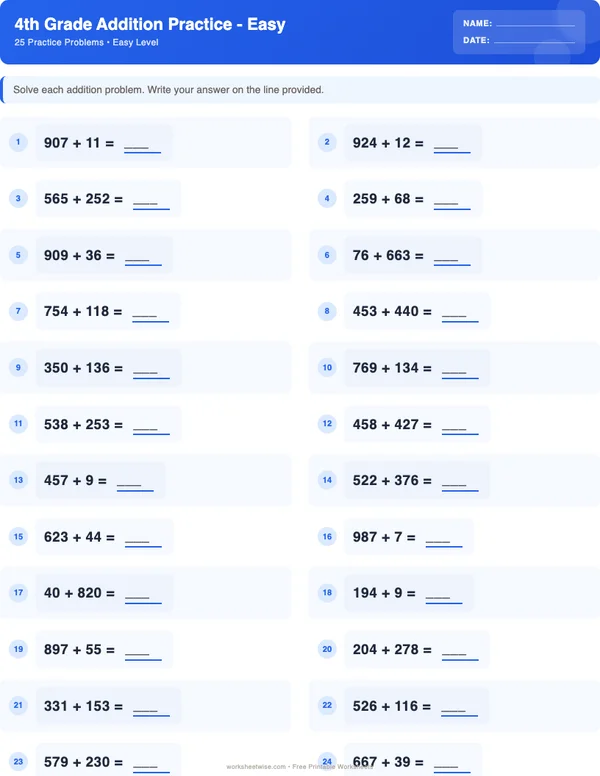
The free 4th Grade Addition guide and free sheet contains 25 problems. The useful change is not simply adding digits. Questions can require independent alignment, several addends, estimation, and comparison of strategies.
Checked example: 4,786 + 2,947 = 7,733.
A place-value calculation gives:
- Ones:
6 + 7 = 13; record 3 ones and regroup 1 ten. - Tens:
8 + 4 + 1 = 13; record 3 tens and regroup 1 hundred. - Hundreds:
7 + 9 + 1 = 17; record 7 hundreds and regroup 1 thousand. - Thousands:
4 + 2 + 1 = 7.
The answer is 7,733. Rounding to the nearest hundred gives 4,800 + 2,900 = 7,700, supporting the reasonableness of the exact sum. This example belongs here because it requires three linked regroupings and independent use of estimation without introducing decimal or fraction units.
A learner who understands the algorithm should be able to answer, “What does the regrouped 1 above the hundreds column mean?” The answer is one hundred, not simply “a carried 1.”
5th Grade: whole-number fluency and changing units
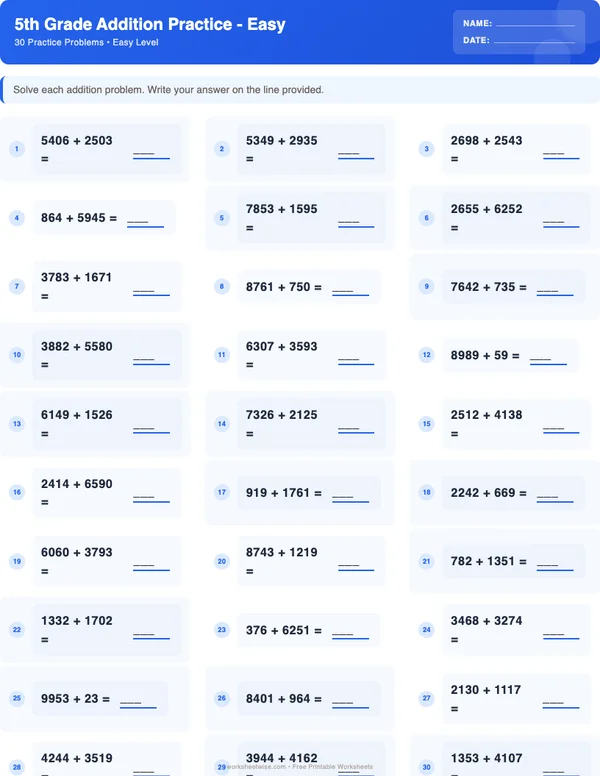
The free 5th Grade Addition guide and free sheet contains 30 problems. Catalogue descriptions extend the elementary addition progression to whole numbers, decimals, and fractions, but an individual worksheet should identify which quantity type it targets. Do not infer that every fifth-grade sheet contains all three.
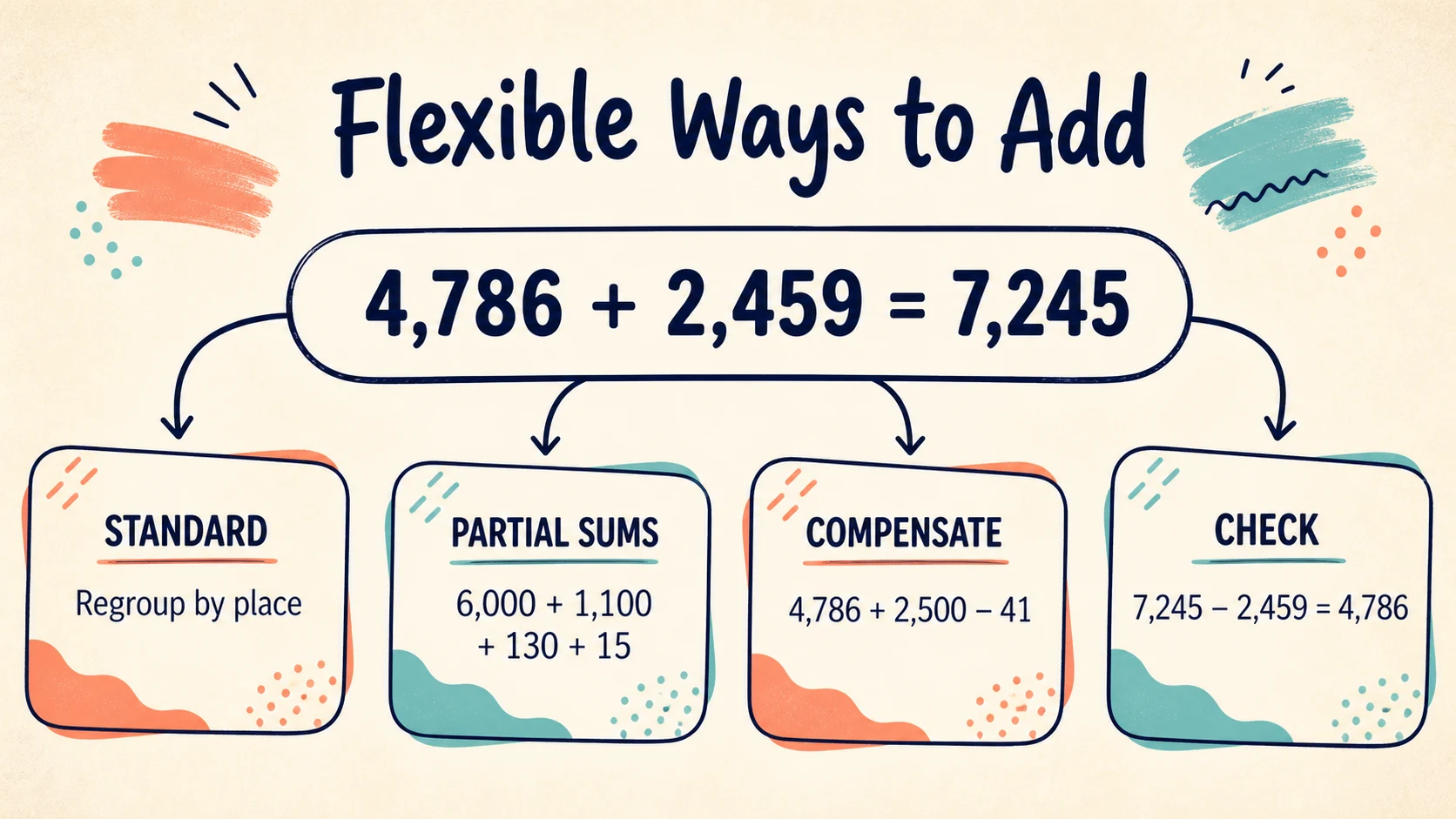
Fifth-grade selection should distinguish whole-number computation from decimal or fraction work because each places different demands on unit reasoning.
Checked decimal example: 3.48 + 2.70 = 6.18.
Align like units:
  3.48
+ 2.70
------
  6.18
Eight hundredths plus zero hundredths is eight hundredths. Four tenths plus seven tenths is eleven tenths, so regroup ten tenths as one whole. Three wholes plus two wholes plus the regrouped whole equals six wholes. The total is 6.18.
The decimal points align because the place-value units align—not because “decimal points always get stacked” as an unexplained rule. An estimate, 3.5 + 2.7 ≈ 6.2, confirms that 6.18 is reasonable. This example belongs at the upper-elementary boundary because the learner applies the regrouping structure already developed with whole numbers to tenths and hundredths.
If a worksheet uses fractions, inspect denominator demands. Adding 3/8 + 2/8 = 5/8 preserves the common unit of eighths. Adding fractions with unlike denominators introduces equivalence as an additional target and should not be selected merely because both tasks say “addition.”
How representation and question design should change
A progression becomes useful when support changes deliberately. The numbers alone do not determine difficulty.
Change one important demand at a time
A task can become more demanding through:
- a wider number range;
- fewer pictures or pre-drawn models;
- a new place-value unit;
- required regrouping;
- multiple regroupings;
- missing addends rather than result-unknown equations;
- several addends;
- word-problem language;
- independent strategy selection;
- required explanation or estimation.
For example, 6 + 7 = __ and 6 + __ = 13 use the same number relationship but ask different questions. In the first, the learner finds a total. In the second, the learner must identify a missing part. Likewise, 34 + 25 and 37 + 28 look similar, but only the second requires regrouping ones.
The Common Core mathematics standards emphasize both conceptual understanding and procedural skill, including age-appropriate justification—not merely obtaining an answer. The standards also organize addition expectations across grades, but they should not be treated as proof that a particular WorksheetWise resource aligns with a local curriculum. Consult the Common Core mathematics standards or the learner’s local curriculum when formal alignment matters.
Fade a representation only after it has meaning
A ten frame is useful when it helps the learner see five and ten relationships. It becomes clutter if the learner fills every box by counting from one without using the structure. Ask, “How many spaces are empty?” or “How could you complete ten?” to direct attention to the frame’s organization.
Base-ten blocks are useful when each piece retains its value and exchanges are explicit. If a learner treats a ten rod as one object and reports that two rods plus five units equals seven, return to unit language: “This rod is one group, but how many ones is it worth?”
An open number line can support jumps such as 46 + 27:
46 → 66 by adding 20, then 66 → 73 by adding 7.
The jumps should record a chosen decomposition, not become another picture copied mechanically.
Select a worksheet from observable evidence
Start with a two- or three-item probe rather than a full page. Include one familiar calculation, one item at the suspected boundary, and one prompt asking for an explanation.
Use these selection criteria:
- Number range: Can the learner identify and compose the quantities?
- Representation: Can the learner connect objects, a drawing, and an equation?
- Strategy: Does the learner count all, count on, make ten, decompose by place value, or use a written algorithm?
- Regrouping: Can the learner explain an exchange in unit language?
- Question form: Is the unknown always the result, or does it appear in another position?
- Independence: How much prompting or modeling is needed?
- Volume: Can the learner complete the useful practice without fatigue obscuring the target?
The free-sheet label “easy” should be read as a catalogue starting point. Define its suitability through the actual task: smaller numbers, visible supports, fewer transformations, straightforward result-unknown equations, or limited regrouping. Never describe a learner as “easy,” “developing,” or “advanced.”
Select the 2nd Grade Addition guide and free sheet, for example, when a learner can explain within-20 strategies and is ready to connect those facts to tens and ones. Select the 3rd Grade resource when hundreds and linked regroupings are the intended practice. Step back to the Kindergarten Addition guide and free sheet or first-grade resource if the learner still needs to compose and decompose numbers within ten.
Use a short routine instead of assigning the whole page at once
A worksheet is most informative when it sits inside a repeatable teaching routine.
A 12-minute addition cycle
- Launch for two minutes. Present one calculation orally. Ask for an estimate or invite two possible approaches.
- Build for three minutes. Model the quantities with counters, ten frames, or base-ten blocks. Have the learner perform any exchange.
- Draw and label for two minutes. Record a number bond, frame, bar, or place-value sketch. Label units.
- Connect for two minutes. Write the equation or vertical algorithm beside the model. Point to where each part appears.
- Practice for two minutes. Complete two carefully chosen worksheet items, not an arbitrary row.
- Exit for one minute. Ask, “What did you regroup, and why?” or “How did ten help?”
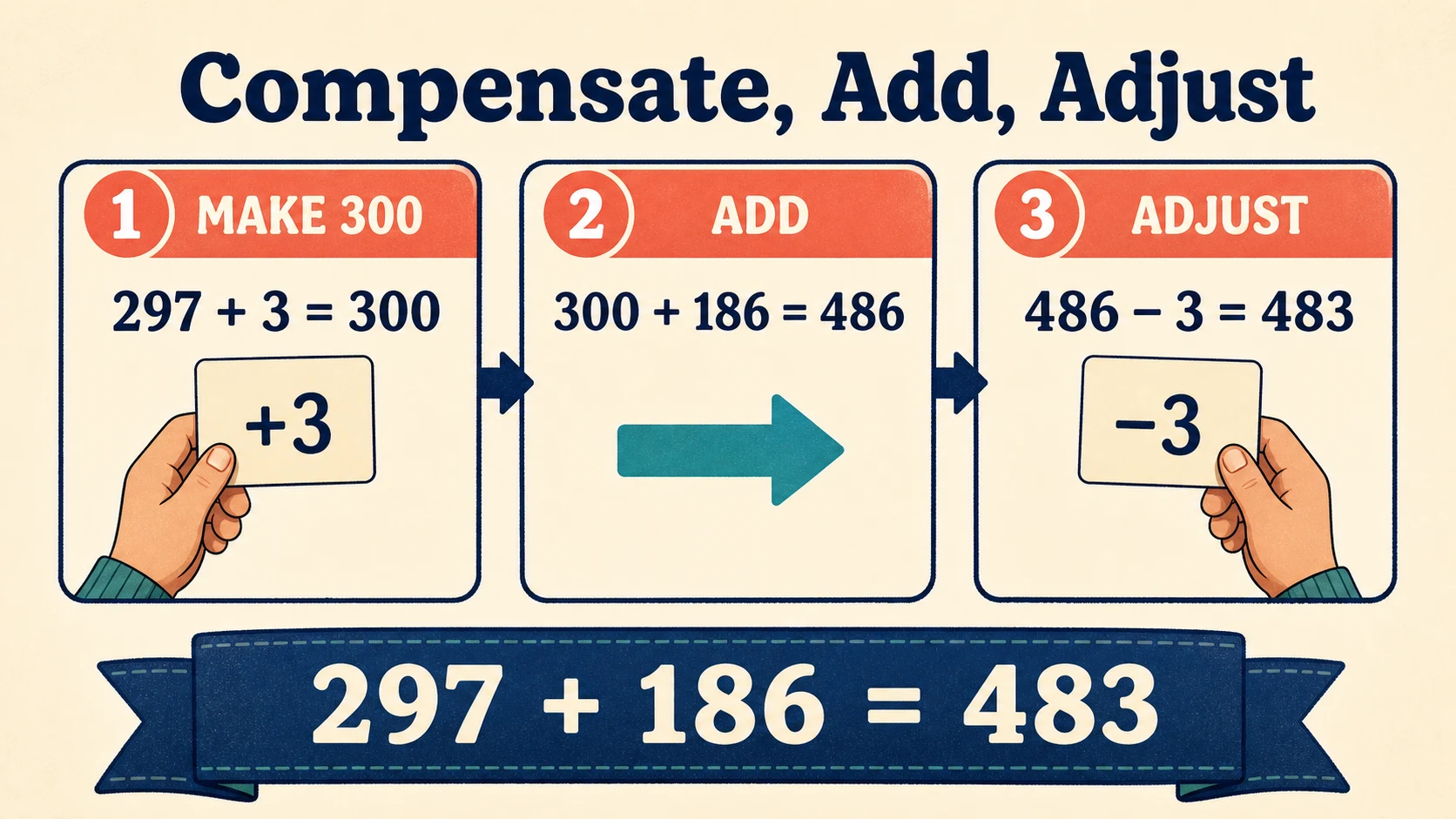
A third-grade routine keeps discussion and representation in the lesson even as written calculation becomes more independent.
Use the remaining items later for distributed practice. A short number talk can compare two correct methods for the same calculation. Record the methods neutrally, then discuss which is efficient for those numbers. For 199 + 36, one learner may use the standard algorithm; another may calculate 200 + 35 = 235. Both can be checked.
Timed practice can be included after the learner understands the facts and can use multiple strategies. The IES intervention guide lists timed activities as one way to build fluency, alongside systematic instruction, representations, mathematical language, number lines, and deliberate word-problem teaching. It does not justify replacing instruction with speed tests or treating speed as the only evidence of understanding.
Read errors before choosing more practice
An error is evidence about the method used. Ask the learner to reconstruct the thinking before correcting the page.
Counting and fact errors
If 8 + 5 becomes 12, the learner may have counted on “8, 9, 10, 11, 12” while treating 8 as the first added count. Ask the learner to hold 8 and make exactly five jumps: 9, 10, 11, 12, 13. Then rebuild the same fact on a ten frame and decompose five into two and three.
If every fact is solved by counting both sets from one, the answers may be correct while the strategy remains inefficient. Return to small sets and ask the learner to identify the larger addend, count on, and compare that method with making ten.
Place-value and alignment errors
If 27 + 18 becomes 315, the learner may have concatenated 3 tens and 15 ones without composing ten ones into another ten. Build 15 ones, trade ten, and name the result as four tens and five ones.
If 3.4 + 0.27 becomes 3.67 for a reason the learner cannot explain, ask for an expanded form: 3 + 0.4 + 0.2 + 0.07. The correct sum is 3.67, but the instructional concern is whether the learner aligned tenths with tenths and hundredths with hundredths or arrived there accidentally.
Procedure without meaning
A learner who says “carry the one” but cannot identify its value needs a place-value model, even if most answers are correct. Ask three questions:
- What unit did you have too many of?
- What new unit did you compose?
- Where is that unit recorded?
This is not a diagnosis. It is a decision to revisit a prerequisite representation before increasing the number range.
Adapt the work without removing the addition target
An adaptation should reduce an irrelevant obstacle while preserving the intended mathematics.
For a learner working on making ten, provide counters and a ten frame, reduce the page to six items, and allow oral explanations. Do not replace all within-20 facts with within-5 facts unless composing ten is not yet accessible; that would change the target.
For multi-digit addition:
- highlight place-value columns without supplying the sums;
- enlarge writing space;
- provide base-ten blocks or a place-value chart;
- read word problems aloud when reading is not the target;
- cover unused rows to reduce visual load;
- permit an estimate before exact calculation;
- ask for one complete explanation instead of written explanations for every item.
For a learner who finishes accurately, preserve the same number range but deepen the task: find a second strategy, write a missing-addend equation, identify an incorrect worked example, or choose two addends that produce a specified sum. More digits are not the only form of extension.
The IES intervention guide supports deliberate use of representations and clear mathematical language. That is sourced guidance. The specific adaptations above are WorksheetWise editorial suggestions for applying those principles; they are not claims of tested outcomes.
Know what a worksheet cannot establish
A worksheet can show written responses under particular conditions. It cannot, by itself, establish a diagnosis, prove durable fluency, reveal every strategy, or determine grade placement. Correct answers may come from counting, memorization, a model, prompting, or an unexplained procedure. Errors may reflect computation, place value, language, attention, handwriting, or fatigue.
The six free resources are entry points into a catalogue of 108 variants, not a promised sequence for every learner. The problem counts—20, 20, 20, 25, 25, and 30—describe page content, not the amount a learner must complete in one sitting. Stop when responses no longer represent the target skill reliably.
Use grade, age, and catalogue difficulty to narrow the search. Make the placement decision from observable work:
- what the learner builds;
- what the learner draws;
- what the learner calculates;
- what the learner explains;
- and what support was required.
Make the next choice from one explained problem
Choose the closest grade-level entry point in the full worksheet library, but begin with one boundary problem rather than the full sheet. Ask the learner to build or draw it, solve it, and explain the strategy.
If the explanation shows secure understanding, complete four to six items at that level and then introduce one new demand. If the learner cannot connect the model to the equation, move one representation backward—such as from an algorithm to base-ten blocks or from a fact to a ten frame—while keeping the quantities manageable. Your next practical action is to open the relevant grade’s free addition sheet, select one problem, and record exactly what the learner does without prompting.
Put it into practice
Use the guide with a real printable
Move from explanation to a short, observable practice task. Check the first item together, then adjust the next session from the learner's actual work.
Open the first free worksheetExplore a neighboring collection
Choose by a different teaching need
Consonant Blends Worksheets by Grade and Level Counting Worksheets by Grade and Level CVC Words Worksheets by Grade and Level Decimals Worksheets by Grade and Level Digraphs Worksheets by Grade and Level Division Worksheets by Grade and Level Fractions Worksheets by Grade and Level Geometry Worksheets by Grade and Level