Curated collectionAnswer keys includedPrint-ready PDFs
Consonant Blends Worksheets by Grade and Level
Show the full consonant blends progression across 3 real grade combinations, compare task boundaries, model checked examples and explain how to choose the next level.
Start with a real resource
Browse this worksheet collection
3 relevant free entry points are available. Each one includes a printable learner PDF and separate answer key.
A useful practice loop
Print less. Observe more.
- Choose one skill and model the first item aloud.
- Use a short set and notice the learner’s strategy.
- Change the next task from the work you can see.
Need more than the free sheet?
Plus includes all 54 matching catalogue variations where available, plus saved deterministic generators and the worksheet designer.
See Plus membershipComplete guide
How to teach and practise consonant blends worksheets
3,454 words Updated 6 instructional visuals
Choose the worksheet by the reading task, not the grade label
Consonant blends worksheets should help a learner read or spell whole words containing two or three adjacent consonants while preserving each consonant sound. In stop, the learner must retain /s/ and /t/ before blending the rest of the word. In tent, both /n/ and /t/ must remain audible at the end. This is different from memorizing “st” or “nt” as a single sound.
The WorksheetWise catalogue provides 54 consonant-blend variants across three intended practice levels: Kindergarten, 1st Grade, and 2nd Grade. Each grade has one free 20-problem entry sheet, for three free resources in total. The catalogue includes word sorting, picture-word matching, and sentence-reading activities. Those facts describe the available collection; they do not establish which sheet a particular learner should complete.
Use the grade label as an initial browsing shortcut. Then inspect what the learner must actually do:
- Does the page focus on two or three taught blends, or mix many blend families?
- Are pictures carrying part of the identification work?
- Must the learner read a complete word, spell it, sort it, or understand it in a sentence?
- Are the blends at the beginning or end of words?
- Can the learner complete several items without an adult naming the pictures or reading the choices?
Grade labels describe intended practice level, and local curriculum sequences differ. Age, when shown elsewhere in a worksheet library, is also a discovery aid rather than a placement decision. For ages three and four, prioritize brief, adult-led oral, matching, manipulative, and movement work over desk work. A child can step on floor cards for /s/, /t/, /o/, and /p/, then sweep a hand across the cards to blend stop. That preserves the sound task without requiring a long written session.
“Easy” is the catalogue’s difficulty label for all three free sheets. Interpret it through observable task features rather than treating it as a learner category. An easier entry task would offer familiar words, clear pictures, limited blend choices, short directions, and one repeated response format. A page becomes more demanding when pictures disappear, alternatives become visually similar, final consonants must be retained, sentences add meaning demands, or the learner has to spell rather than recognize the word.
What counts as a consonant blend
A consonant blend contains adjacent consonants whose individual sounds remain represented in pronunciation. In clap, /k/ and /l/ can both be heard. In bump, /m/ and /p/ both matter. The consonants are close together, but they have not combined into one new phoneme.
That boundary matters because blends and digraphs can look superficially similar on paper. In the digraph sh, two letters commonly represent one sound. In the blend sl, the learner retains /s/ and /l/. If a learner needs practice distinguishing these structures, compare this guide with the Digraphs Worksheets by Grade and Level collection rather than mixing both targets without explanation.
The supplied catalogue lists common initial blends such as bl, br, cl, cr, dr, fl, fr, gl, gr, pl, pr, sc, sk, sl, sm, sn, sp, st, sw, tr, and tw. Listed final blends include -nd, -nk, -nt, -mp, -lt, -ft, -sk, and -st. A worksheet need not include all of them to be useful. In fact, a narrow page may provide better evidence because an adult can see exactly which contrast caused difficulty.
The recommended starting boundary is fluent reading of CVC words. A learner who is still laboriously assembling sat, lip, or mud may be managing the underlying three-sound pattern rather than the added consonant in a blend. The CVC Words Worksheets by Grade and Level page is the more direct starting point in that case.
This sequence is consistent with, but not claimed to be assessed or endorsed specifically for WorksheetWise by, the IES foundational reading practice guide. That guide recommends explicit work connecting sounds with letters, decoding words, and reading connected text. It supports the instructional logic of modeling a sound-spelling pattern, practicing it in words, and then applying it in text. It does not evaluate these worksheets or prescribe one universal blend order.
A practical progression through the three catalogue levels
The three real grade combinations cover the same topic and each offers a free 20-problem sheet. The useful distinction is therefore not “which grade owns blends?” It is how much representation, language, and independence the task requires.
Kindergarten: hear both sounds and connect them to a whole word
A productive Kindergarten starting point uses a small blend set, orally familiar words, and strong support from pictures or movable letters. Begin with initial blends because their sounds can be stretched and noticed before the vowel. The supplied teaching guidance recommends starting with two or three s-blends, such as sl, sn, sp, st, or sw, because /s/ is continuous.
For example, place pictures of a star, sun, and spoon beside the written choices star, tar, and spoon. Ask the learner to say each target slowly and touch one finger for each sound near the beginning. This example belongs at the entry boundary because the pictures reduce vocabulary and memory demands while the word choices still require attention to the extra consonant. It is checked: star begins /s/ /t/, while tar begins /t/ without /s/. Spoon begins /s/ /p/.
Do not let picture naming replace decoding. If the learner selects star after glancing only at the illustration, cover the picture and ask for a left-to-right read of the printed word. Conversely, if the picture has an ambiguous name—perhaps a child calls a picture of a sled a “snow board”—name it together before judging blend knowledge.
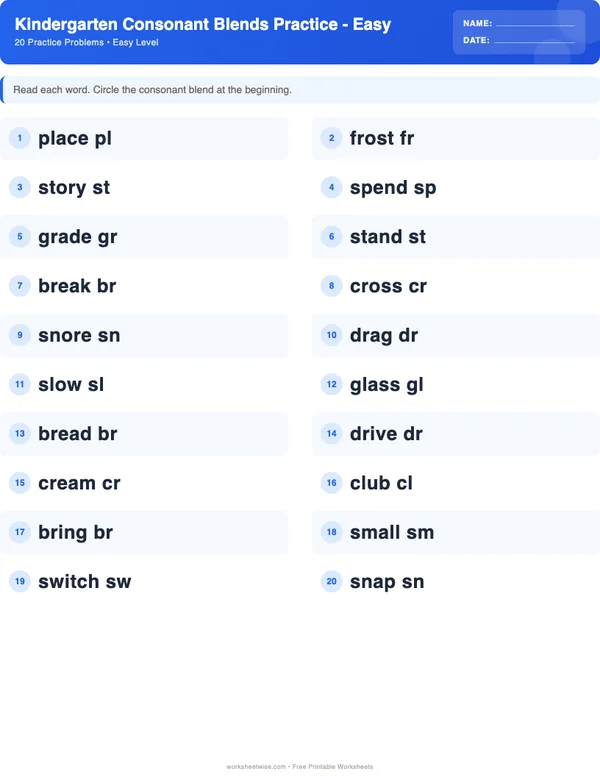
The Kindergarten Consonant Blends guide and free sheet is the catalogue entry point to inspect when the learner benefits from this degree of support.
1st Grade: compare, build, sort, and read
At a useful 1st Grade boundary, the learner should do more than identify a matching picture. Appropriate tasks include sorting whole words by their initial blend, completing a word from a limited set of blend choices, building words through controlled changes, and reading short sentences containing practiced patterns.
Consider the chain:
lap → clap → clam → clamp
Every step has been checked:
- lap contains /l/ /ă/ /p/.
- clap adds /k/ before /l/, forming the initial blend cl.
- clam changes the final phoneme from /p/ to /m/ while retaining cl.
- clamp adds /p/ after /m/, producing the final blend mp as well as the initial cl.
This example belongs in 1st Grade practice because it asks the learner to attend to exact letter and sound changes across related whole words. It also crosses an important boundary: the final word contains consonant clusters at both ends. An adult can stop after clam if clamp introduces too much information at once.
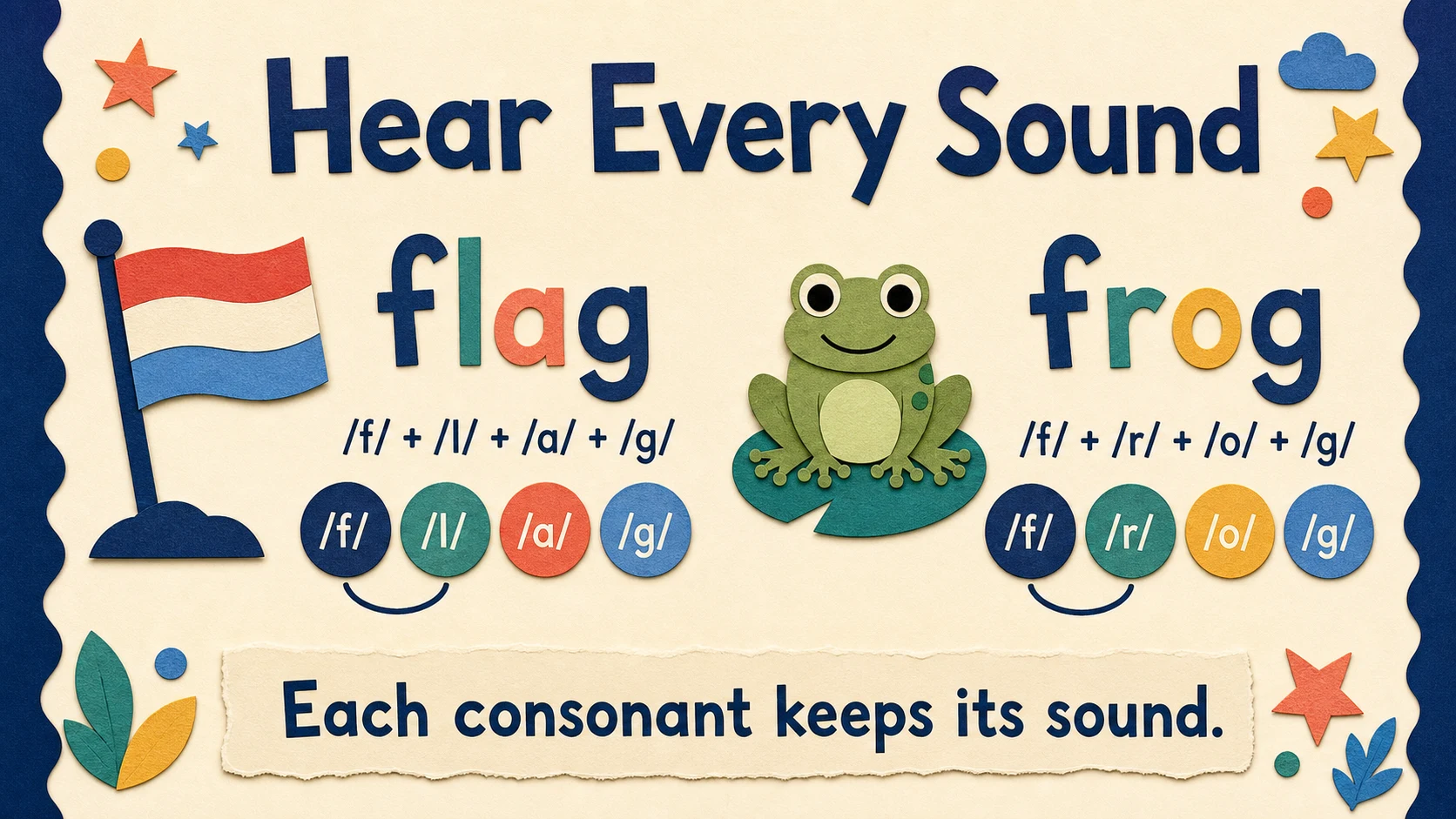
Move from sound tokens or letter tiles to the printed answer while keeping the same whole word in view.
Sorting also becomes useful here, but choose categories that require listening rather than visual guessing. A checked st/sp sort could contain stop, step, spin, and spot. Stop and step begin st; spin and spot begin sp. Ask the learner to read each word before placing it. If the heading cards alone tell the answer, have the learner explain, “I heard /s/ then /p/ in spot.”
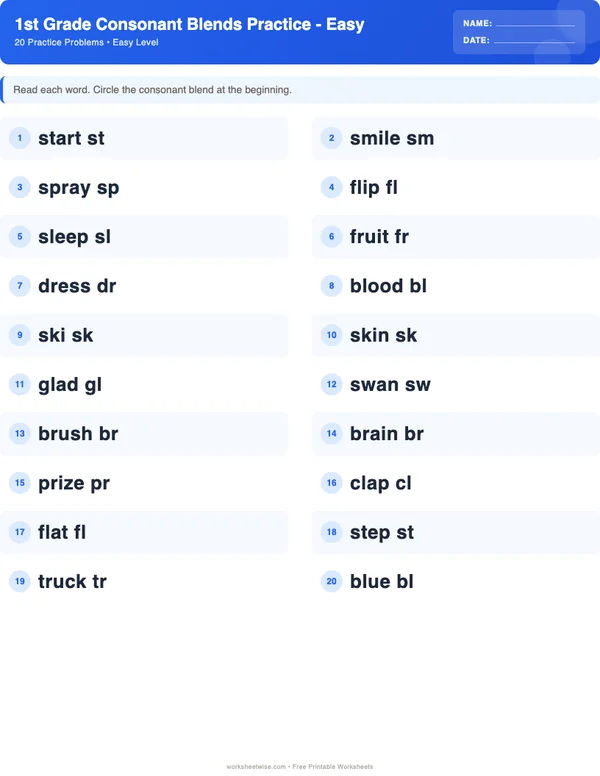
The 1st Grade Consonant Blends guide and free sheet is the most relevant entry point when the learner can read simple CVC words and is ready to compare or construct blend words with moderate support.
2nd Grade: retain blends while meaning and spelling demands grow
A 2nd Grade worksheet can reasonably ask the learner to apply known blends in less supported words, sentences, editing, or spelling. The blend remains the target, but the learner must retain it while also handling meaning, syntax, or a longer written response.
A checked sentence contrast is:
The frog slept on the soft sand.
The frog stepped on the soft sand.
The verbs differ by one consonant: slept begins sl, while stepped begins st. Both also end with a consonant cluster represented in spelling. This example belongs at a later practice boundary because the learner must decode the critical word and decide which verb makes sense in the sentence. Meaning should confirm decoding, not substitute for it.
A second suitable task is to edit The camp has a big ten. The intended word may be tent, but the adult should first ask the learner to read exactly what is written. The change from ten to tent adds final /t/, creating -nt. This belongs at the later boundary because it combines final-blend retention, spelling, and sentence meaning.
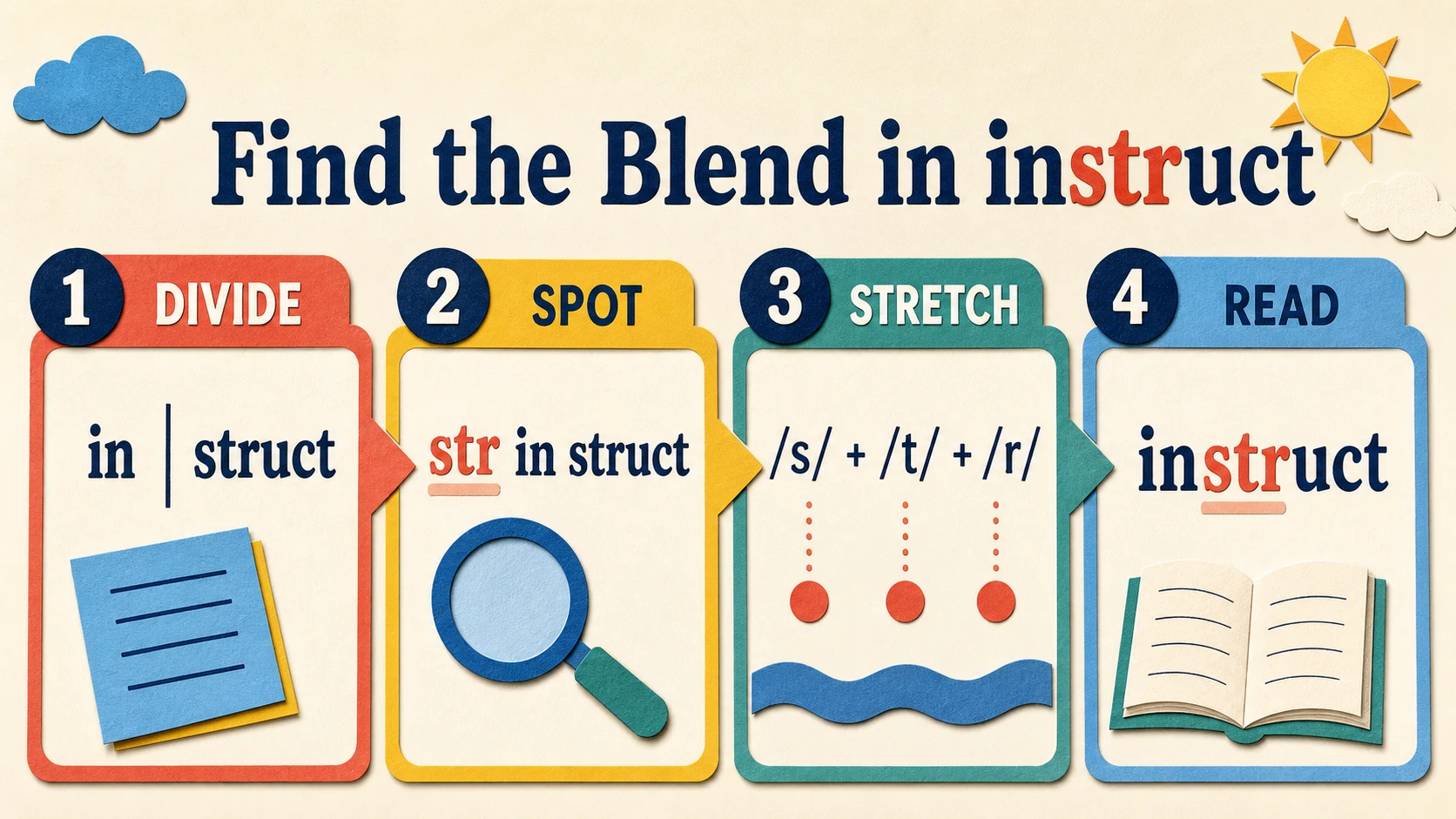
Reduce prompts only after the learner can preserve every consonant while reading the complete word.
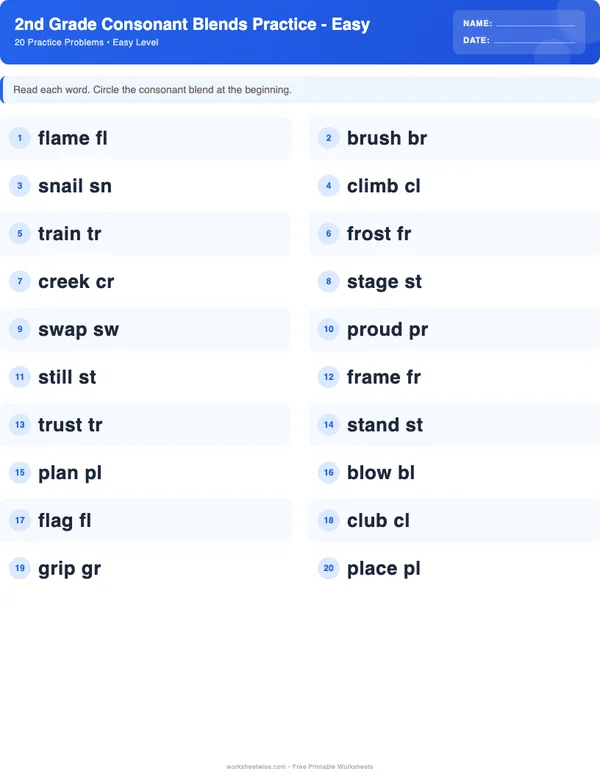
Use the 2nd Grade Consonant Blends guide and free sheet when the learner already handles familiar initial blends and needs to apply them in final-blend words, sentences, or less scaffolded tasks. Do not select it merely because the learner is enrolled in second grade.
Initial blends should come before the harder final boundary
Initial and final blends are not interchangeable practice. At the beginning of stop, an adult can stretch /s/—“ssssstop”—without losing the word’s onset. That makes s-blends particularly suitable for an explicit introduction. After two or three s-blends are stable, the supplied sequence moves to l-blends such as bl, cl, fl, gl, pl, and sl, then r-blends such as br, cr, dr, fr, gr, pr, and tr.
This is a teaching suggestion derived from the supplied catalogue guidance, not a universal curriculum mandate. Keep a blend in instruction long enough for the learner to read it in several whole words. Do not race through a checklist of isolated letter pairs.
Final blends are less conspicuous because a learner may release the vowel and stop before the last consonant. Minimal word pairs make the consequence audible:
- ten / tent: ten ends /n/; tent ends /n/ /t/.
- bum / bump: bum ends /m/; bump ends /m/ /p/.
- ran / rank: ran ends /n/; rank ends /n/ /k/.
The first two pairs come directly from the supplied teaching guidance, and each pronunciation contrast has been checked. The third follows the same teaching structure and is offered here as an additional example. These pairs belong on this page because the difference is precisely whether the final consonant of a blend is retained. Contrast the words orally, build them with tiles, and then read them in short phrases such as ten cups / a tent flap or a bum knee / bump the box.
A worksheet that mixes initial and final blends may be appropriate for review, but it is a poor first probe when the adult does not yet know where the breakdown occurs. Separate the positions first. The result—accurate initial words but omitted final consonants—gives a clear next teaching decision.
How the question design changes the evidence
Two pages can contain the same words yet measure different work. Before printing, identify what the response format allows you to observe.
Picture matching reduces language load but can hide guessing
Picture-to-word matching is appropriate when the adult wants to limit handwriting and hold attention on sound-letter correspondence. Confirm the picture’s name, then require the learner to read the selected word. Use plausible alternatives: stop, sop, and top reveal more than stop, fish, and moon because every alternative demands attention to the printed onset.
If the learner knows the image but not the word, the page has become a picture-recognition activity. Covering the image after naming it restores the decoding target.
Sorting reveals whether a contrast is stable
A word sort works best with two or three taught categories, not a crowded bank of unrelated blends. Ask for oral reading before sorting and a reason afterward. The explanation “flag starts /f/ /l/, so it goes under fl” provides stronger evidence than silent placement.
Sorts can also isolate position: initial st versus final -st, using step, stop, nest, and rest. All four are checked: step and stop begin st; nest and rest end st. This is more demanding than sorting st against br because the learner must notice where the same letters occur.
Sentence reading tests transfer, not initial teaching
Sentence tasks should use blends the learner has already practiced in words. Otherwise an error could reflect unfamiliar vocabulary, sentence complexity, or the blend itself. After the learner reads, ask one brief meaning question so that accurate sounding out is connected with comprehension.
The IES foundational reading guide recommends daily connected-text reading alongside instruction in decoding and word recognition. That supports moving from blend words to controlled sentences and decodable passages. It does not support replacing explicit word work with context guessing.
When writing is added, keep the response proportionate. The IES elementary writing guide recommends explicit strategy instruction, attention to transcription skills, and regular writing opportunities. For blend practice, one dictated phrase such as a fast frog may preserve the phonics focus better than requiring a paragraph whose planning and handwriting demands overwhelm the target.
A short routine that works with any selected sheet
Use the worksheet as one part of a repeatable lesson rather than as the entire lesson.
Preview, model, attempt, transfer
- Hear the contrast. Say two or three target words and have the learner repeat them slowly. For sp/st, use spin, spot, stop, and step.
- Map every sound. Place one tile or tap one finger for each phoneme. For stop, map /s/ /t/ /ŏ/ /p/. Do not map st as one sound.
- Model one worksheet item. Read from left to right and explain only the relevant decision: “I can hear /s/ and /p/ at the start of spot, so I choose sp.”
- Watch several independent attempts. Avoid correcting after the first hesitation. Note whether the learner preserves both consonants, uses the picture, rereads, or guesses from the first letter.
- Correct immediately and specifically. Return to sounds, rebuild the word, and reread the entire word—not just the blend.
- Transfer to connected text. Read one or two controlled sentences containing the practiced blends.
- Record the next decision. Choose among repeating the same contrast, reducing support, adding one blend, or moving from initial to final position.
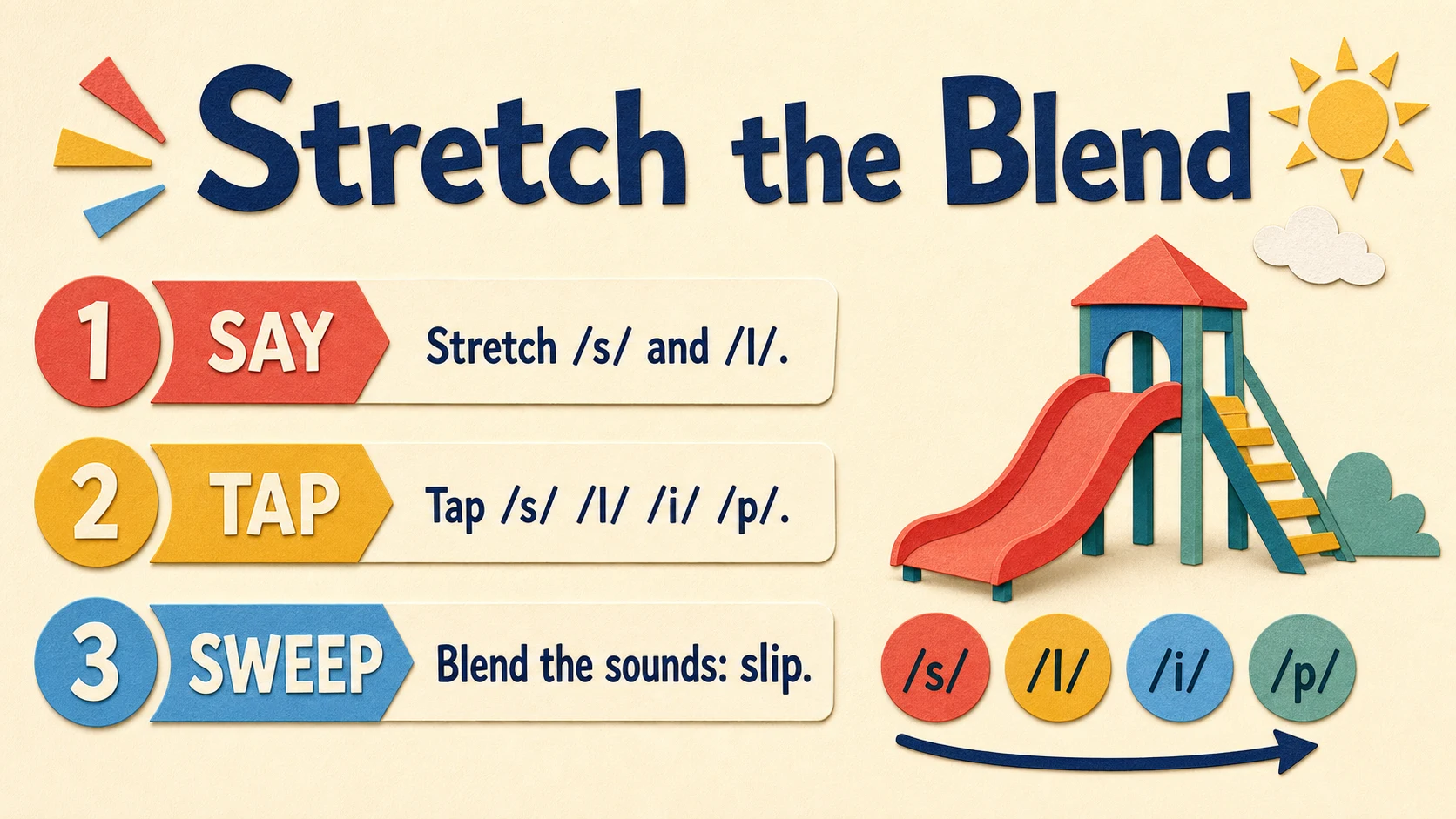
Keep the sequence stable so changes in performance reflect the word task rather than new directions.
Ten accurate picture matches do not automatically justify moving on if the learner cannot read the same words without pictures. Conversely, slow but complete sounding out may indicate that the representation is understood and needs additional practice rather than a simpler concept.
Read errors as information, not labels
An error should lead to a small testable response. It should not lead to a diagnosis.
When one consonant disappears
If stop becomes sop, the learner retained /s/ but omitted /t/. Ask for four finger taps—/s/, /t/, /ŏ/, /p/—then sweep across the fingers and blend the word. Build sop and stop side by side so the additional letter and sound are visible. Reread both words.
If tent becomes ten, use the same procedure at the end. Have the learner hold /n/ briefly and then release /t/. Avoid merely saying “Look carefully”; the useful correction identifies the missing sound.
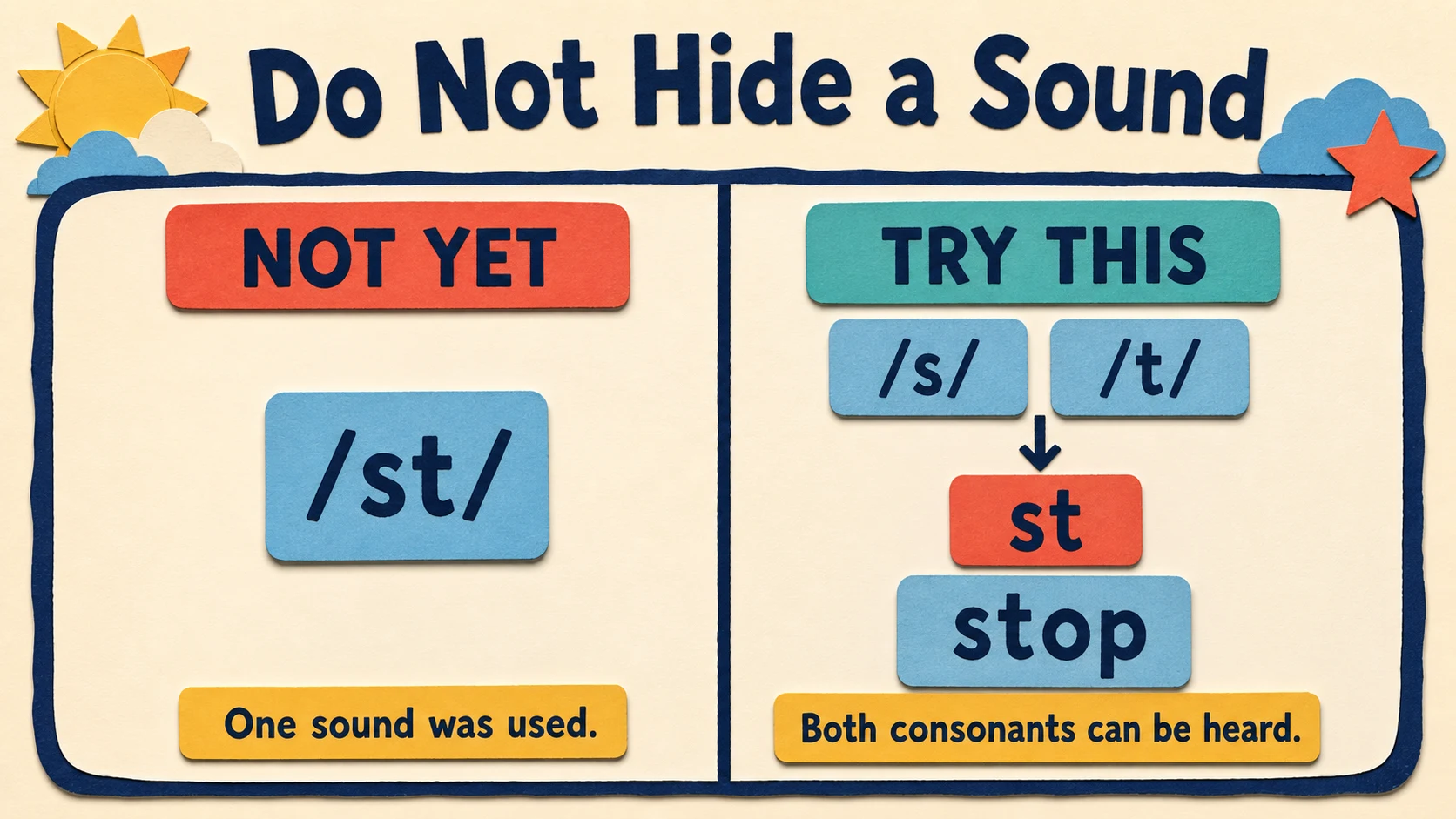
An omitted consonant calls for sound-by-sound remapping before another independent attempt.
When a learner inserts a vowel
A learner may read flag as “fuh-lag.” This can happen when letter names or isolated consonant pronunciations include an added schwa. Model a clipped /f/ immediately followed by /l/, then blend into flag. The goal is not faster speech; it is a continuous transition that does not create an extra syllable.
When the blend is correct but the word is not
Reading frog as from preserves fr but changes the final consonant. That is not evidence that the initial blend needs reteaching. Cover all but the final letter, compare frog/from, and ask the learner to reread from the beginning. Select the next item to test the final position while retaining fr.
When sentence meaning replaces decoding
If the sentence says “The frog can ___” and the learner guesses jump despite the printed word step, meaning has overtaken print. Cover the rest of the sentence, decode step, uncover it, and reread the full sentence. Context can confirm a decoded word but should not authorize a different one.
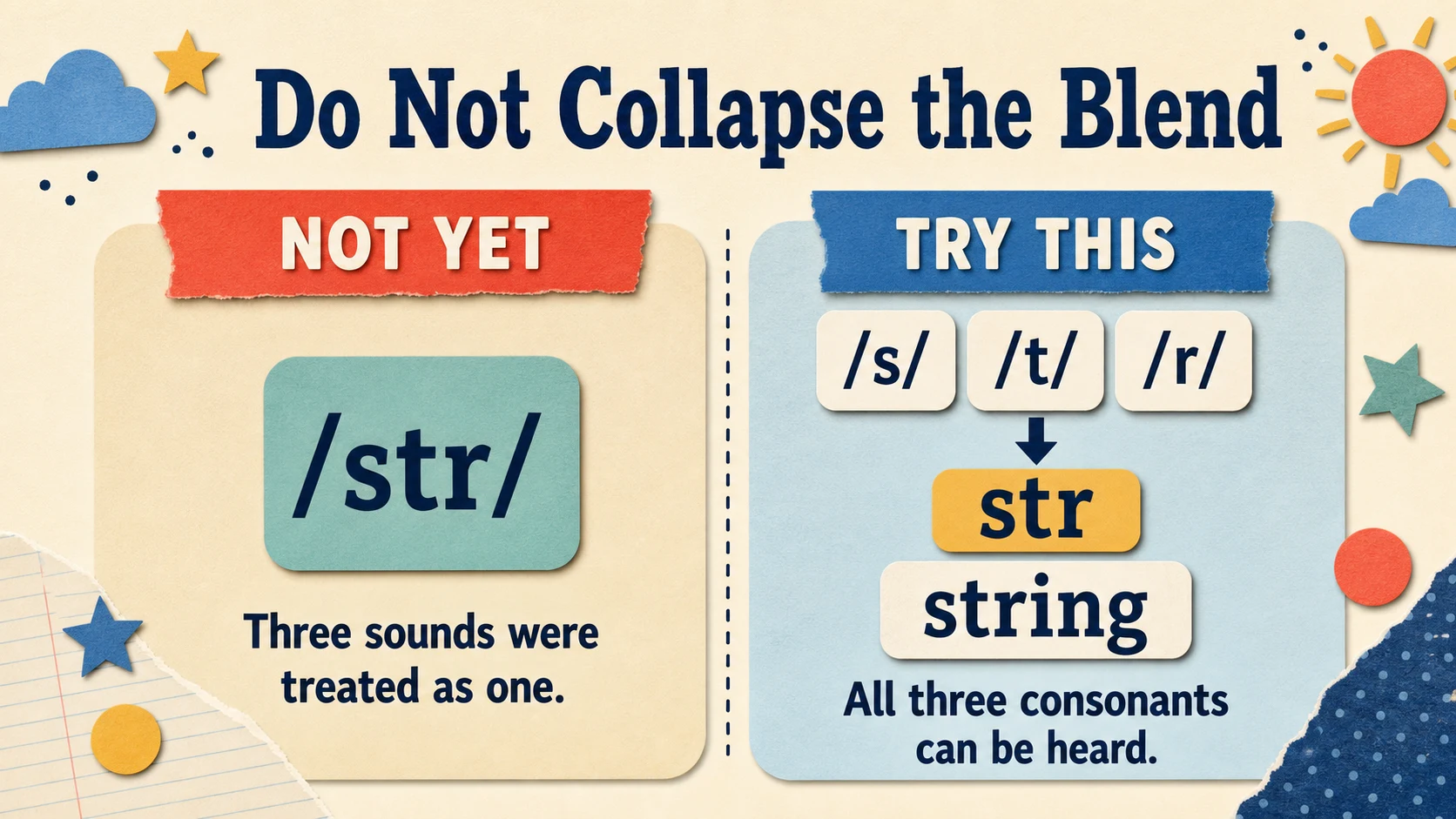
Later-level errors may come from the blend, another part of the word, or the added sentence demand; isolate the source before changing sheets.
Adapt the access demands without removing the blend task
An adaptation preserves the requirement to hear, retain, read, or spell every consonant. It changes how the learner accesses or records the work.
Useful adaptations include:
- Reduce a 20-problem page to five items at a time while keeping the same word contrast.
- Read directions aloud, but do not read the answer choices if decoding them is the target.
- Name ambiguous pictures before the learner begins.
- Cut apart items for sorting or pointing when handwriting would obscure phonics evidence.
- Offer letter tiles before pencil spelling, then ask the learner to copy and reread the completed word.
- Enlarge print or mask surrounding rows to reduce visual crowding.
- Permit oral answers, followed by pointing to the letters that represent each sound.
- Rehearse unfamiliar vocabulary orally so that word knowledge does not become an accidental barrier.
Do not “adapt” stop by pronouncing it for the learner and asking them to copy it, then count the copied answer as independent decoding. Do not remove one consonant from every choice or make the correct answer visually obvious. Those changes erase the decision the page was selected to observe.
The Common Core English Language Arts standards include early-foundational-skills expectations involving sound-letter correspondences, decoding regularly spelled one-syllable words, and recognizing common consonant digraphs; later foundational work expects learners to use combined knowledge of letter-sound relationships and syllable patterns when decoding unfamiliar words. Consult the official ELA standards for local planning context. This page does not claim that any WorksheetWise resource has been independently reviewed for standards alignment.
Decide whether to repeat, step back, or move forward
Choose the next sheet from observed performance across more than one response format.
Step back to CVC work when the learner cannot yet blend simple three-phoneme words without substantial prompting. The immediate target is then stable left-to-right blending, not memorizing a blend inventory.
Begin with supported initial blends when CVC reading is secure but the learner omits the second consonant in words such as stop or clap. Use two or three blends, pictures or tiles, and whole-word reading.
Stay at the current boundary when the learner succeeds only with pictures, needs repeated reminders to retain both consonants, or reads lists accurately but loses the blend in sentences. Change the representation before expanding the blend set.
Add another initial-blend family when the learner accurately reads practiced whole words, distinguishes close alternatives, and transfers the blends to a short sentence without relying on pictures.
Introduce final blends when familiar initial blends remain intact and the learner can attend to the end of a word. Start with contrasts such as ten/tent and bum/bump before mixing several final patterns.
Move toward less supported 2nd Grade practice when the learner can read and spell taught blends in words and apply them in controlled sentences. Increased difficulty should be visible in the task: fewer pictures, broader word sets, final blends, sentence-level decisions, or written production. It should not be inferred from a label attached to the learner.
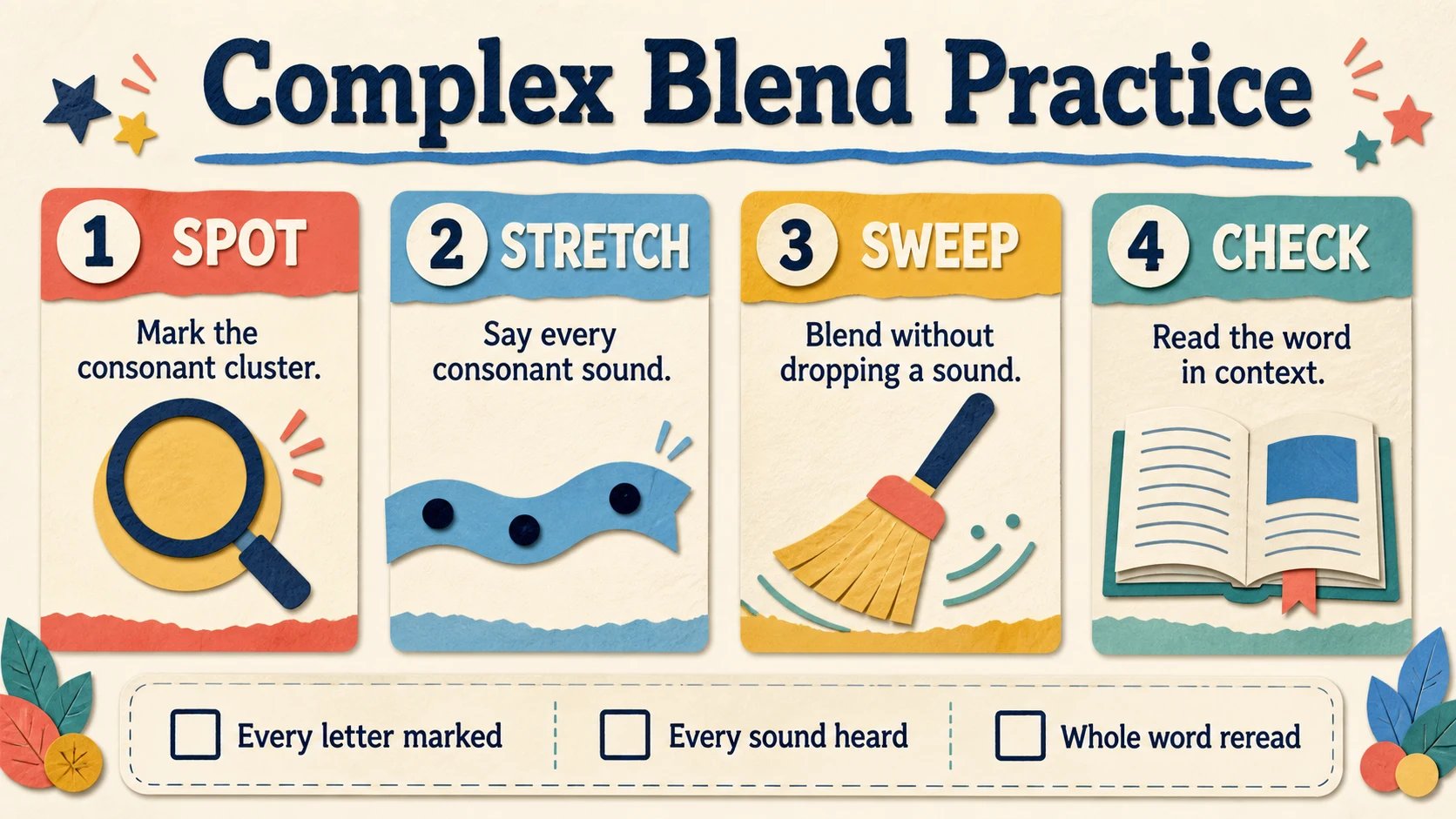
Alternate focused practice, cumulative review, and connected reading instead of introducing new blends every day.
A practical two-week sequence might spend several brief sessions on two initial contrasts, revisit them in a mixed sort, apply them in sentences, introduce one final contrast, and finish with cumulative reading. This schedule is a suggested implementation of the supplied teaching guidance, not a research finding or guaranteed timetable. If errors increase sharply after a new blend is added, return to the last stable contrast and narrow the next practice set.
Use one real sheet to make the next decision
Open the grade page that most closely matches the learner’s current task—not merely the learner’s enrollment—and preview its free 20-problem sheet. Choose Kindergarten supported practice for tightly scaffolded initial work, 1st Grade blend practice for sorting and word-building, or 2nd Grade application for less supported word and sentence work.
Complete only the first five representative items. Record whether the learner retained every consonant, needed the picture, used sound-by-sound mapping, and read the completed word. Then take one observable next action: repeat the same blend contrast with tiles, remove one support, introduce one new blend, or return to the CVC words collection. That five-item observation is more useful for selecting the next level than the grade label alone.
Put it into practice
Use the guide with a real printable
Move from explanation to a short, observable practice task. Check the first item together, then adjust the next session from the learner's actual work.
Open the first free worksheetExplore a neighboring collection
Choose by a different teaching need
Addition Worksheets by Grade and Level Counting Worksheets by Grade and Level CVC Words Worksheets by Grade and Level Decimals Worksheets by Grade and Level Digraphs Worksheets by Grade and Level Division Worksheets by Grade and Level Fractions Worksheets by Grade and Level Geometry Worksheets by Grade and Level