Curated collectionAnswer keys includedPrint-ready PDFs
Division Worksheets by Grade and Level
Show the full division progression across 5 real grade combinations, compare task boundaries, model checked examples and explain how to choose the next level.
Start with a real resource
Browse this worksheet collection
5 relevant free entry points are available. Each one includes a printable learner PDF and separate answer key.
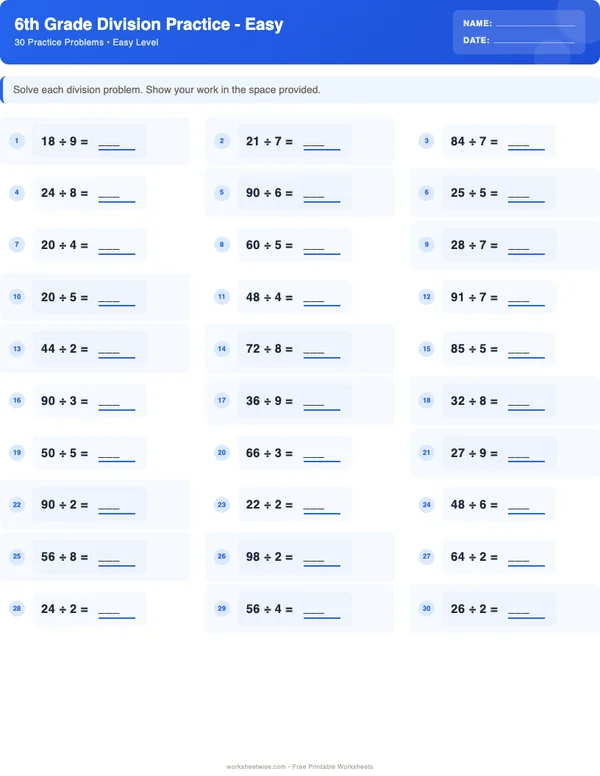
A useful practice loop
Print less. Observe more.
- Choose one skill and model the first item aloud.
- Use a short set and notice the learner’s strategy.
- Change the next task from the work you can see.
Need more than the free sheet?
Plus includes all 90 matching catalogue variations where available, plus saved deterministic generators and the worksheet designer.
See Plus membershipComplete guide
How to teach and practise division worksheets
3,275 words Updated 6 instructional visuals
Choose division practice by the work on the page
The right division worksheet is the one whose representation, number size, remainder demand, and amount of support match the learner’s next step. Do not select solely by grade. The live WorksheetWise catalogue contains 90 division variants across five intended practice levels—2nd through 6th grade—with one free entry sheet at each level. Those grade labels describe intended practice, but local curriculum sequences differ.
Start by watching the learner solve two or three examples:
- If equal sharing is unclear, begin with counters and drawings.
- If the learner can model division but cannot recall facts, connect each quotient to multiplication.
- If facts are secure but larger dividends cause trouble, use an area model or partial quotients.
- If the computation is correct but the final answer does not fit the situation, focus on interpreting remainders.
- If all of those are manageable, increase number size, reduce visual support, or mix problem types—one change at a time.
The catalogue labels each free sheet “easy,” but that label describes observable task features, not a learner. Here it should be read as an entry point within that grade collection. Inspect the actual questions: an accessible sheet may use familiar divisors, direct notation, limited language, or fewer interacting steps. A student who needs counters for may find an apparently simple symbolic page poorly matched; another student may complete it accurately and need a more demanding representation or application.
Age, when shown elsewhere in discovery tools, is also a discovery aid rather than a placement decision. For ages three and four, prioritize brief adult-led oral, matching, manipulative, and movement work over desk work. The five verified division combinations on this page begin at 2nd grade, so the catalogue does not establish a preschool division sequence.
What division means before it becomes an algorithm
Division answers two related questions. Both must be taught because the wording of a situation changes what the quotient represents.
Partitive division: sharing a total equally
In partitive division, the number of groups is known and the size of each group is unknown.
Checked example 1: Share 12 cookies equally among 3 friends.
Give one cookie to each friend repeatedly, or place 12 counters into 3 circles. Each circle receives 4:
Check through multiplication:
This example belongs at the beginning of the 2nd-grade-to-6th-grade progression because equal sharing is one of the verified catalogue’s starting models. It makes the dividend—the total of 12—and the divisor—the 3 known groups—visible before notation carries the meaning.
Quotitive division: measuring equal groups
In quotitive division, the size of each group is known and the number of groups is unknown.
Checked example 2: How many groups of 4 can be made from 12 counters?
Move the counters into groups of 4. There are 3 groups:
Check:
Although both opening examples use 12, they are not interchangeable. “Share among 3” asks for the amount in each group; “make groups of 4” asks how many groups can be formed. Ask the learner to identify what is unknown before calculating.
A useful adult prompt is: “Do we know how many groups there are, or how many go in each group?” That wording is a teaching suggestion derived from the two models in the supplied teaching anchor. It is not a claim that one phrase will resolve every word-problem difficulty.
The IES guide on teaching mathematics to young children supports using progressions, monitoring what children know, and helping them view and describe their mathematical world. It did not evaluate WorksheetWise. For early division, an appropriate application is to let the learner act out sharing and grouping, describe the action, and only then record the equation.
The five catalogue levels form a progression, not five isolated bins
The five real combinations are 2nd-, 3rd-, 4th-, 5th-, and 6th-grade math division. The verified topic description spans equal sharing, multiplication–division fact families, basic division facts, single-digit divisors, multi-digit long division, and contextual remainders. It does not assign every named skill exclusively to one grade. The progression below is therefore a practical selection framework, not a claim about the exact content of every variant.
2nd grade: make equal groups visible
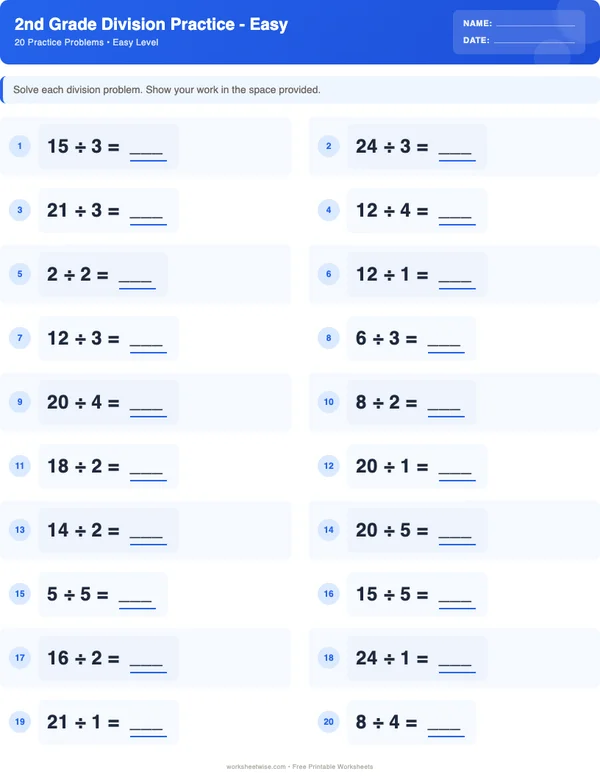
The 2nd Grade Division guide and free sheet is the first verified entry point. Its free sheet contains 20 problems. Consider it when the learner can count a total accurately and is ready to coordinate a total, equal groups, and a result.
A suitable starting task is with 15 counters. Ask the learner to share among 5 containers, count 3 in each, and verify . Keep the counters available. Removing them merely because the page uses symbols changes the task from modeling division to recalling a fact.
The boundary for moving on is observable: the learner can build equal groups, state what the answer counts, and connect the arrangement to a multiplication equation. Speed is not required.
3rd grade: connect models to related facts
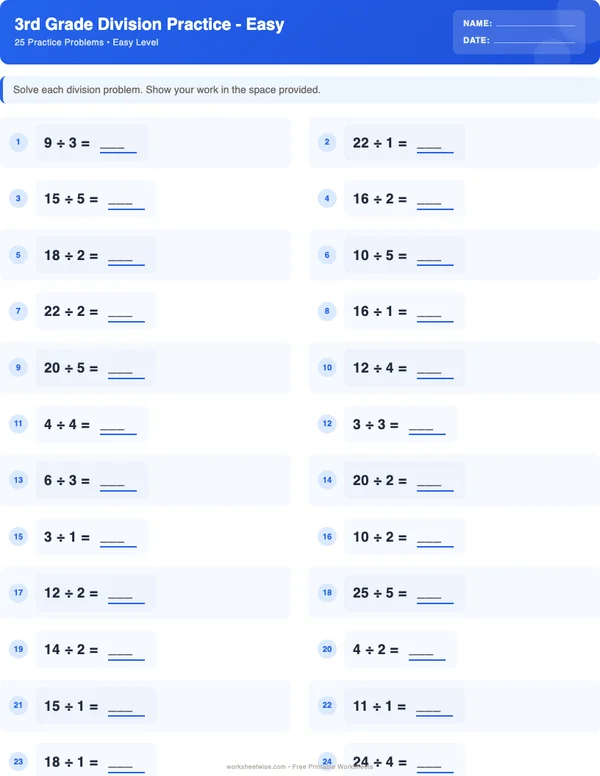
The 3rd Grade Division guide and free sheet has a 25-problem free entry sheet. A useful emphasis is using known multiplication to derive division facts.
For the fact family :
Ask, “What number times 6 makes 42?” This keeps division connected to multiplication instead of treating it as an unrelated set of facts. Mix sharing and grouping stories so that the learner must interpret, not merely scan for two numbers and divide.
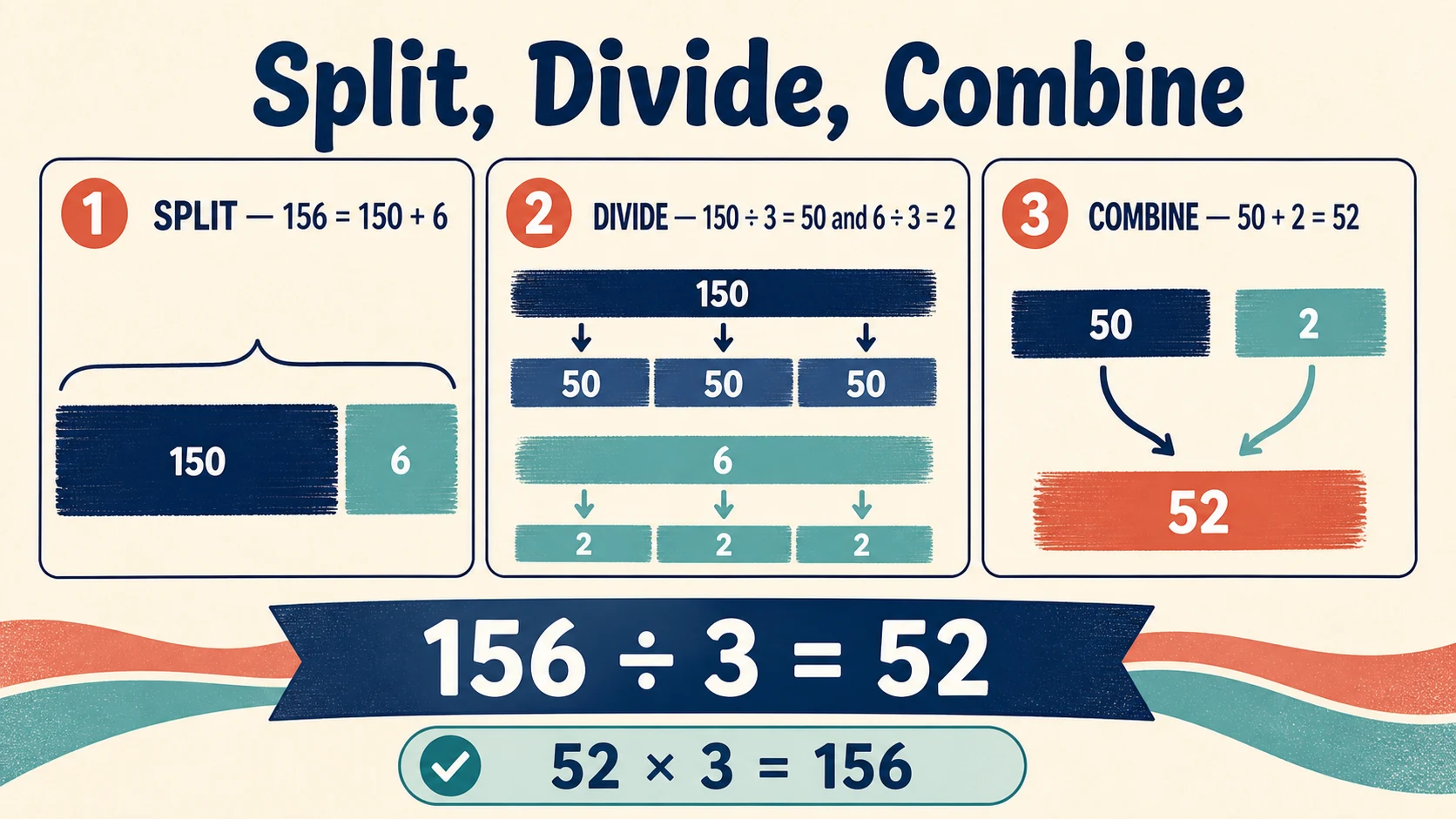
A brief 3rd-grade routine should move from a model to a related multiplication fact, a division equation, and an explained check.
4th grade: extend to larger totals and remainders
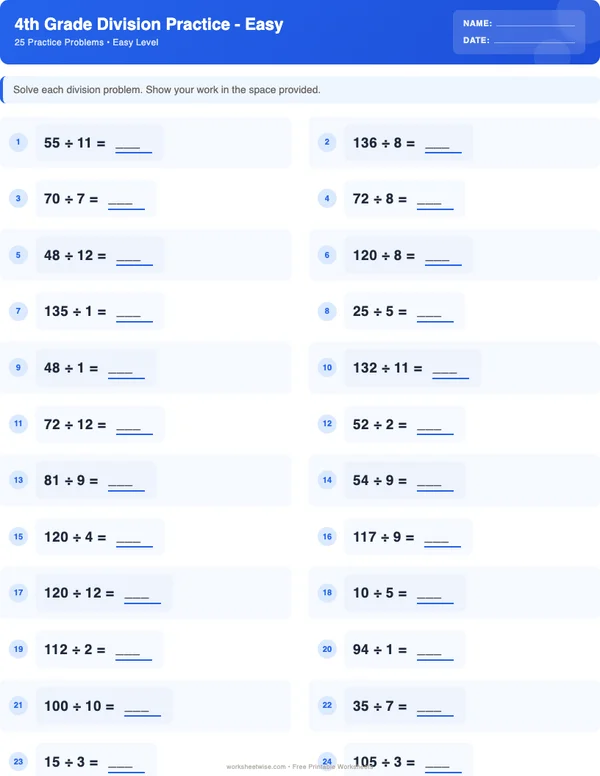
The 4th Grade Division guide and free sheet also provides 25 problems. Consider this collection when basic equal-group meaning is stable and the learner is ready to divide larger quantities, work with a single-digit divisor, or encounter a remainder.
The important change is not simply bigger numbers. The student must track place value, estimate quotient size, and decide what leftover units mean. A learner may compute correctly but still need different answers in different contexts.
5th grade: bridge models and written procedures
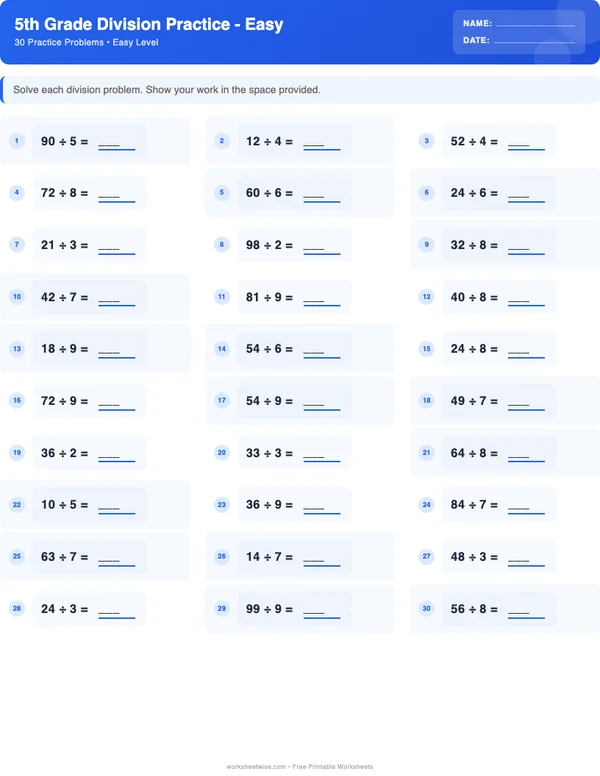
The 5th Grade Division guide and free sheet contains 30 problems. Use it as a possible bridge when the learner can divide with familiar facts but needs structured practice with multi-digit dividends.
Partial quotients can expose the multiplication inside the calculation. For , remove known multiples:
Then:
Add the partial quotients:
Check:
This method reveals why the quotient is 26. It also accepts a different valid decomposition, such as subtracting , then , then .
6th grade: consolidate, explain, and apply
The 6th Grade Division guide and free sheet has a 30-problem free entry sheet. Within the verified catalogue progression, this is the highest grade combination. That does not automatically make every question harder than every question in the lower collections; inspect the task features.
At this level, useful demands include choosing a strategy, maintaining place value across a multi-digit calculation, checking by multiplication, and explaining a contextual remainder. Independence means more than completing a memorized sequence: the learner should be able to say why a quotient digit belongs in a particular place.
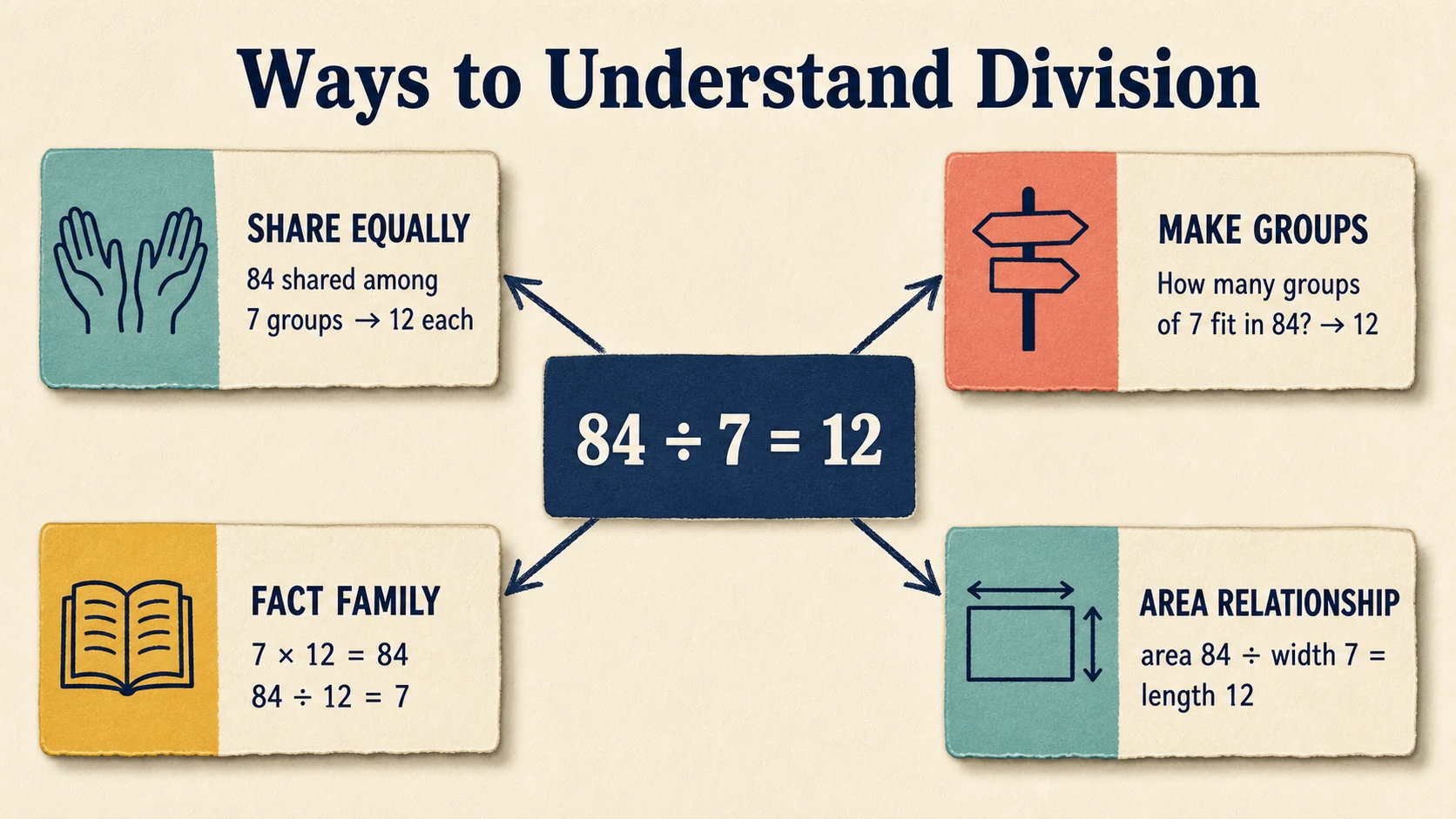
The upper-level map connects fact knowledge, place value, written strategies, checking, and remainder interpretation rather than treating them as separate topics.
Representation should change before the mathematics disappears
A productive sequence is concrete, representational, and symbolic, with movement in both directions. Concrete materials are not a reward or a sign of failure. They preserve the quantity while reducing the memory burden.
Concrete: manipulate the groups
Use counters, cubes, buttons, or folded paper sections. For , either share 18 objects among 3 spaces or build groups of 3 and count 6 groups. Ask what each physical group represents.
Limitations matter. Constructing 864 objects for is inefficient. At that point, bundle base-ten materials or move to a place-value drawing. The target is division reasoning, not endurance with loose counters.
Representational: draw arrays, bars, or areas
An array for can show 24 objects arranged in 6 equal rows of 4. A bar can show a total split into equal sections. An area model can decompose a large dividend into convenient products.
Checked example 3: Find with partial quotients.
Decompose 864 into multiples of 8:
Then:
So:
Check:
This example belongs in the upper part of the catalogue progression because it combines a multi-digit dividend, place-value decomposition, multiplication facts, and a symbolic check. It is also a conceptual bridge to the standard algorithm: the 8 hundreds and 64 ones are handled according to value, not as an unexplained string of digits.
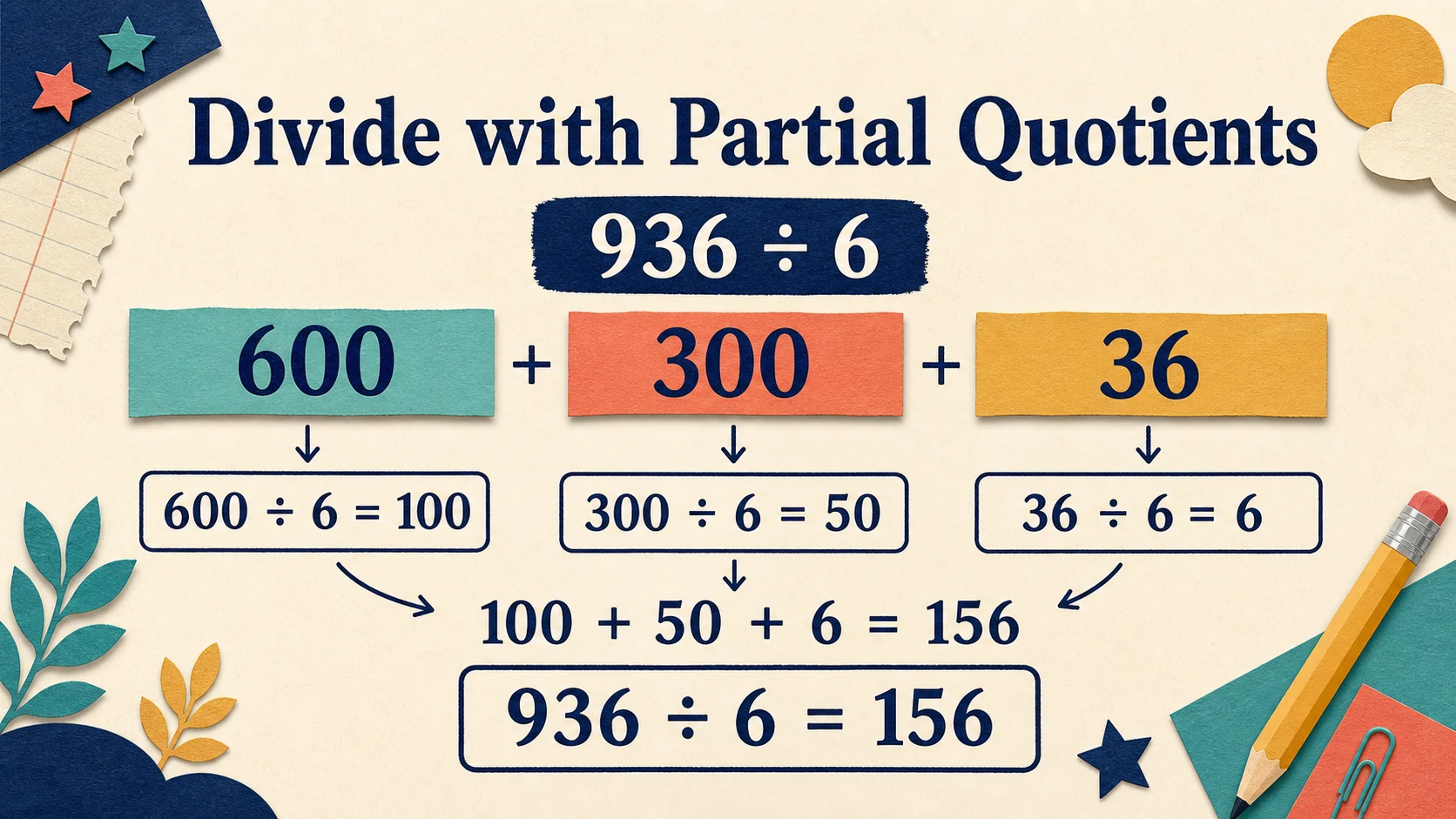
An upper-level worked example should preserve the equal-group meaning while making each place-value decision inspectable.
Symbolic: record an efficient method
“Divide, Multiply, Subtract, Bring down” can help recall an order, but it does not explain the quantities. Before relying on the mnemonic, ask:
- What portion of the dividend are you dividing now?
- What multiplication product did you remove?
- Why is the difference reasonable?
- What value does the digit you brought down have?
- How can multiplication verify the quotient?
The Common Core State Standards for Mathematics provide one widely used reference for grade-level expectations and mathematical practices, including making sense of problems and attending to precision. They do not establish the sequence of this catalogue, and local standards may differ. Use them only as one reference when comparing a worksheet with local instructional goals.
Remainders are decisions, not leftover notation
A remainder can be reported, discarded, used as the answer, converted into another form, or force the quotient upward. The context decides.
Three checked endings from the same computation
Checked example 4: , because and .
Now change the question:
-
Vans: Twenty-five students need vans that hold 6 students each. Four vans hold only 24, so 5 vans are required. Round up.
-
Full teams: Twenty-five students form teams of 6. There are 4 full teams, with 1 student not on a full team. Report the full groups and leftover.
-
After filling boxes: Twenty-five items are packed 6 per box. How many items remain after filling as many complete boxes as possible? The answer is 1 item. Here the remainder itself answers the question.
All three answers come from the same correct calculation, yet “4 R1” is not a sufficient final response to any of the stories. This cluster belongs from the point where remainders appear through the upper catalogue levels because it tests interpretation rather than merely computation.
A useful worksheet sequence places two or three contrasting contexts beside the same numerical division. That is an editorial teaching suggestion based on the supplied anchor, not sourced evidence that a particular WorksheetWise sheet contains that arrangement.
A repeatable routine for one worksheet session
Use a short routine that reveals thinking instead of turning the sheet into a race.
Preview, model, practice, and decide
-
Preview two questions. Identify the divisor size, representation, expected remainder, and language demand. Decide whether counters, a multiplication chart, or place-value paper should be ready.
-
Model one example. The adult solves while naming meaning: “I am finding how many groups of 6 fit into 156.” Show a multiplication check.
-
Solve one together. Let the learner choose sharing, grouping, an array, partial quotients, or a written algorithm. Ask one interpretive question.
-
Assign a small set independently. Five carefully selected questions can provide better evidence than pushing through 30 when the first strategy is unstable.
-
Check with multiplication. For a no-remainder result, verify divisor × quotient = dividend. With a remainder, verify divisor × quotient + remainder = dividend and confirm that the remainder is smaller than the divisor.
-
Record the next action. Note one observable decision: “Continue with divisor 4 and counters,” “Remove the array on two facts,” or “Add one van-style remainder problem.”
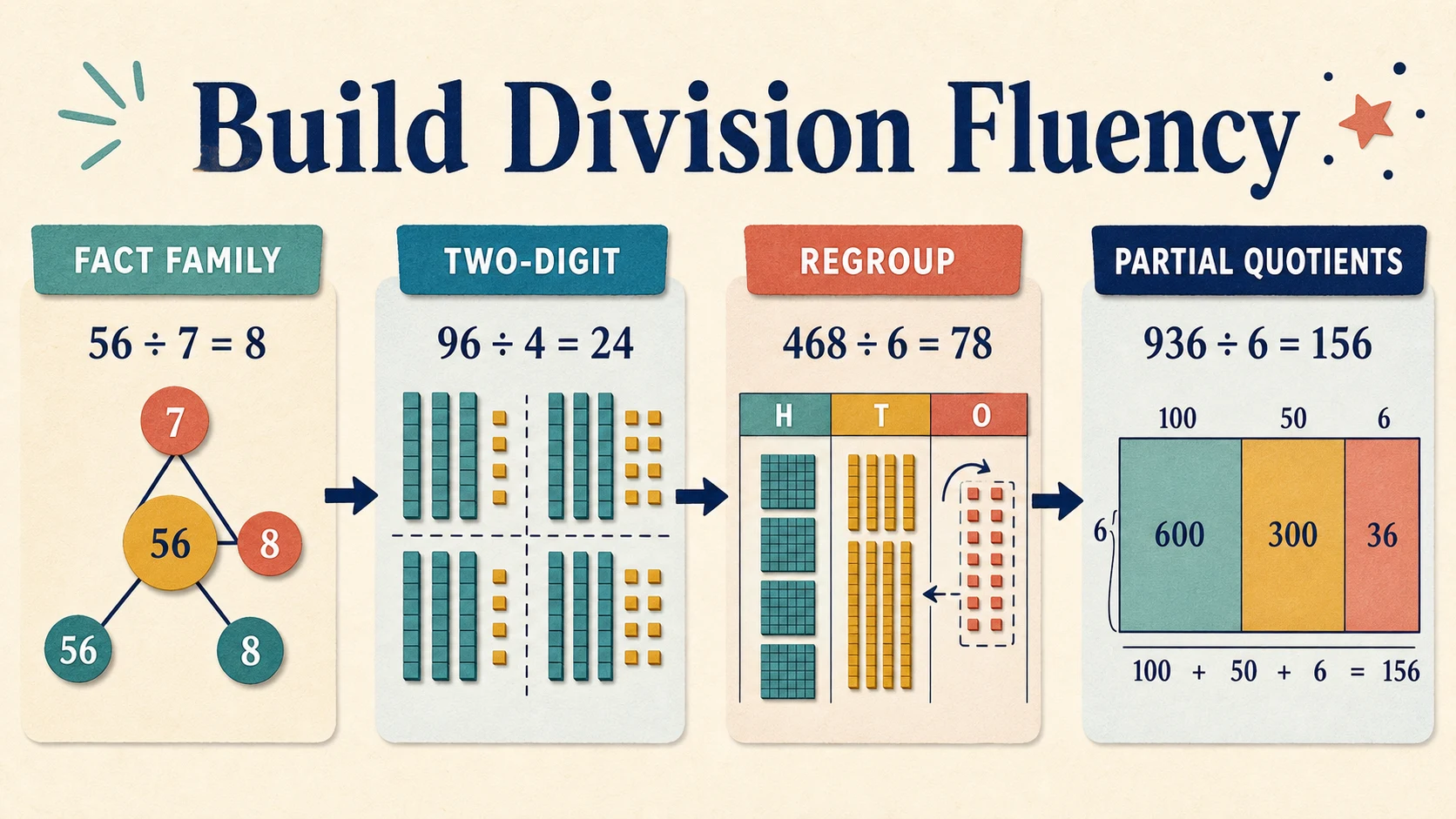
Support should fade only after the learner can explain the division decision and verify it, not after an arbitrary number of completed questions.
For extended review, alternate meanings and methods rather than repeating one format for days. For example: sharing on day one, grouping on day two, related facts on day three, partial quotients on day four, and contextual remainders on day five; then revisit the weak points. This is a suggested schedule, not a research-prescribed dosage.
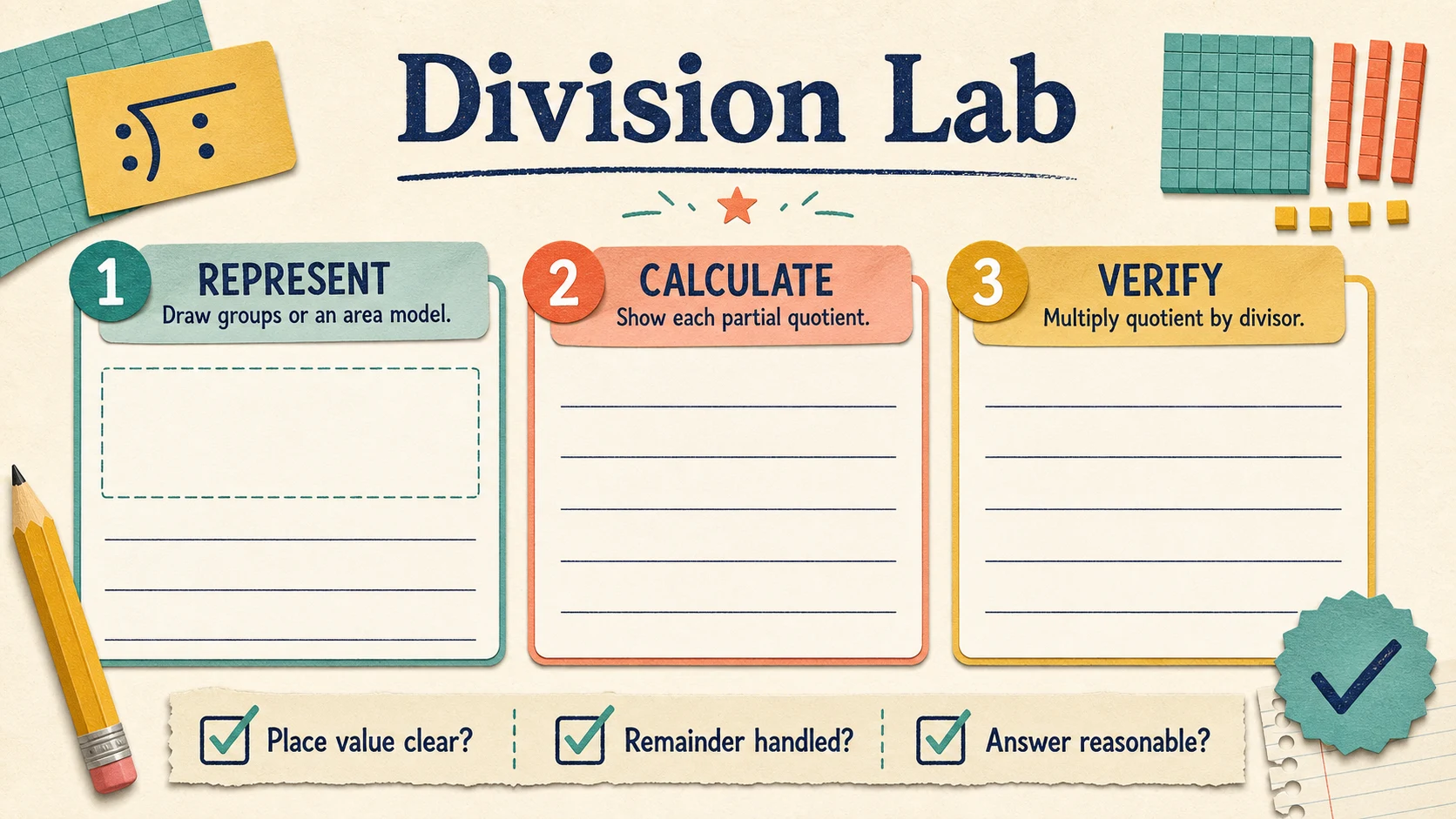
A two-week upper-level plan should revisit facts, place value, written strategies, and remainder decisions while varying the representation.
Read errors as evidence about the task
An incorrect answer does not identify a diagnosis. It shows where to look next. Ask the learner to recreate the work or explain one decision before selecting another page.
Error patterns and immediate responses
Unequal groups: The learner shares 12 objects among 3 groups as 5, 4, and 3. The likely issue is the equality condition, not division notation. Rebuild the groups one object at a time and compare their sizes.
Reversing what the quotient counts: For 12 objects in groups of 4, the learner answers 4 because 4 appears in the prompt. Ask, “Does your answer count groups or objects in each group?” Then have the learner point to each of the 3 groups.
Weak fact retrieval: The learner knows but stalls at . Write the known multiplication equation, cover the factor 8, and ask for the missing factor. Keep the target on inverse reasoning rather than penalizing slow recall.
Impossible remainder: The learner gives . Since the remainder is at least 5, another group can be made. Combine 5 of the 8 leftovers with the 7 groups to obtain . Check .
Place-value drift: In , the learner writes 18 after treating 800 as 80. Return to and . A place-value chart preserves the target skill while exposing the omitted hundred.
Algorithm without interpretation: The learner correctly obtains for the van problem and writes “4 vans.” Keep the computation, then test the answer against capacity: , which leaves one student without a seat. The needed response is 5 vans.
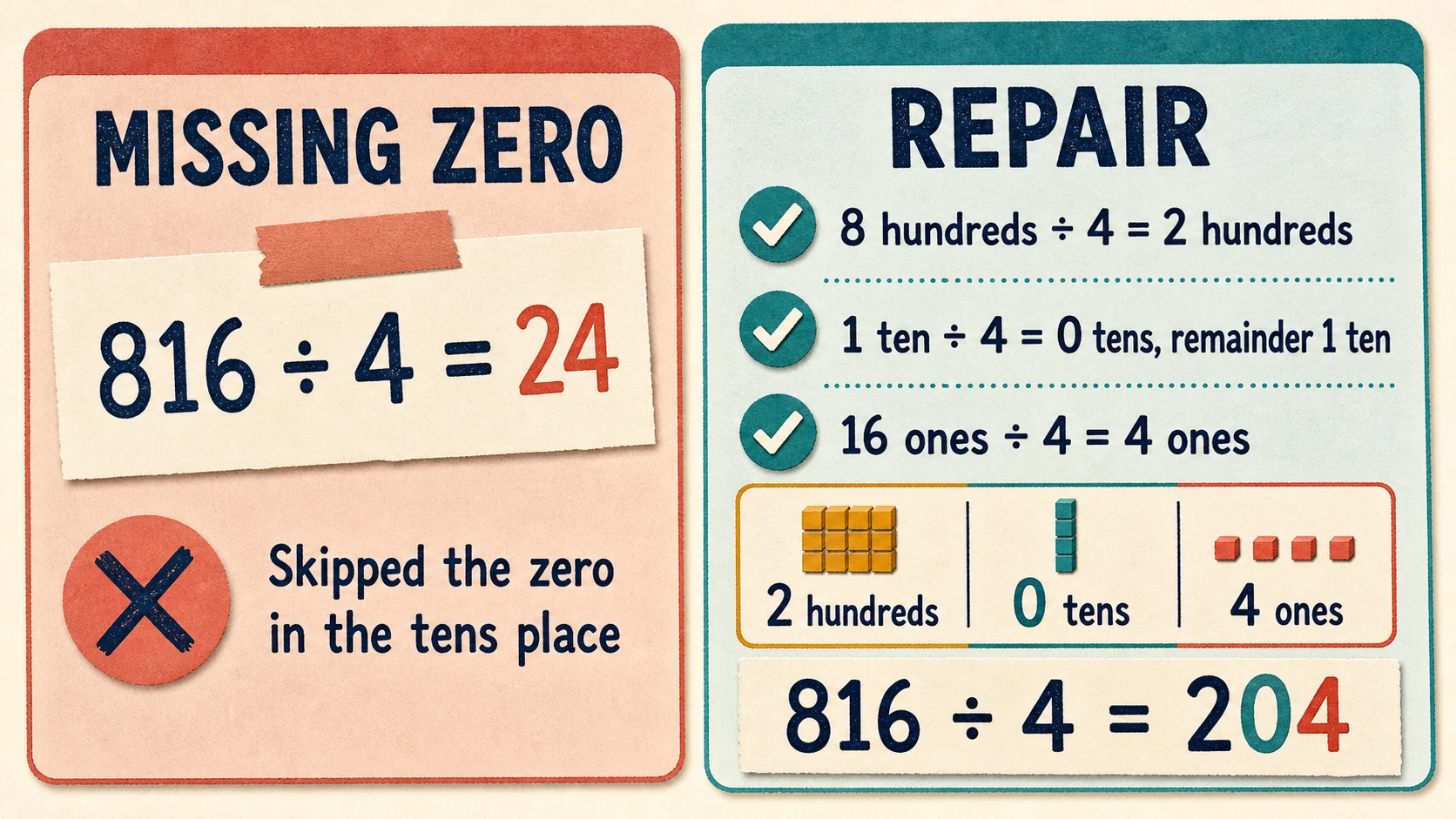
Upper-level errors should trigger a specific check—fact relationship, place value, remainder size, or contextual fit—rather than a general instruction to try harder.
The IES practice guide for assisting students struggling with mathematics recommends systematic instruction, clear mathematical language, representations, number lines, and deliberate work with word problems. It did not assess these worksheets. A fitting application here is to model one division structure explicitly, prompt the learner through another, and fade the prompt after the learner explains the connection.
Adapt the access, not the division target
An adaptation preserves the mathematical decision being assessed. If the target is interpreting a remainder, reading the story aloud preserves that target. Replacing the story with a bare equation does not.
Useful adaptations include:
- Read directions and word problems aloud when reading is not the target.
- Cover all but one row to reduce visual crowding.
- Provide counters or an array frame for equal-group reasoning.
- Supply multiplication facts when the target is place-value division rather than fact recall.
- Use graph paper to align quotient digits.
- Allow the learner to explain orally while an adult records the explanation.
- Reduce the number of repeated items while retaining sharing, grouping, exact division, and remainder contexts.
- Enlarge the page without changing the numbers or operation.
Be explicit about what the adaptation changes. A multiplication chart reduces the fact-retrieval demand; it does not make a multi-digit quotient conceptually understood. An adult who tells the learner to round up has completed the key reasoning in the van problem. Instead ask, “Will four vans seat everyone?”
A worksheet also has boundaries. It can present practice and make written errors visible, but it cannot by itself confirm why an error occurred. A correct page may reflect understanding, memorized procedure, prompting, or guessing. Use conversation, objects, and a fresh transfer question before deciding what comes next. Do not infer a diagnosis or promise an outcome from completion, accuracy, grade label, or difficulty label.
Select the next real sheet with four checks
Before printing, compare the page with the learner’s observed work.
Check the meaning
Does the learner need equal sharing, equal-size grouping, or both? If either interpretation is unstable, select an entry sheet that permits drawing or pair the symbolic questions with counters. Do not jump to long division because the learner can recite facts.
Check the numbers
Notice the divisor, dividend size, and whether facts are exact. Increase only one major demand when possible. Moving from to changes fact retrieval, place value, notation, and strategy selection at once.
Check the representation and support
Choose among objects, pictures, arrays, area models, partial quotients, and compact notation. “More advanced” should mean observable changes such as larger dividends, less visible grouping, mixed interpretations, multi-step recording, or independent remainder decisions—not a label attached to a child.
Check the application demand
Bare equations assess calculation more directly. Word problems add language, model selection, units, and contextual interpretation. If calculation is secure but van-style answers are not, choose application rather than a longer column of the same equations.
The free catalogue entries provide 20 problems at 2nd grade, 25 each at 3rd and 4th, and 30 each at 5th and 6th. Those counts describe page length, not instructional value or required completion. Print only the level you intend to inspect, and stop when the errors become repetitive enough to guide a response.
Make the next choice from evidence, not the grade label
Begin with one real entry point—the 3rd Grade Division guide and free sheet is a sensible choice when a learner can form equal groups and is ready to connect division facts to multiplication. Preview five questions rather than assigning all 25 immediately. Ask the learner to model one, solve two, check one by multiplication, and explain what the quotient counts in one word problem.
Then act on what you can see:
- Move to the 2nd-grade resource if equal groups are not yet stable.
- Stay at 3rd grade and change the representation if the meaning is sound but fact retrieval is slow.
- Compare the 4th-grade resource if the learner explains both division models and checks familiar facts independently.
- Move toward 5th- or 6th-grade work only when larger dividends, place value, and contextual remainders are the actual next demand.
Your practical next action is to open the 3rd Grade Division guide and free sheet, select five questions, and record one sentence after the session: “Next time, preserve ___ and change ___.” That observation—not age, speed, or the word “easy”—should determine the next division worksheet.
Put it into practice
Use the guide with a real printable
Move from explanation to a short, observable practice task. Check the first item together, then adjust the next session from the learner's actual work.
Open the first free worksheetExplore a neighboring collection
Choose by a different teaching need
Addition Worksheets by Grade and Level Consonant Blends Worksheets by Grade and Level Counting Worksheets by Grade and Level CVC Words Worksheets by Grade and Level Decimals Worksheets by Grade and Level Digraphs Worksheets by Grade and Level Fractions Worksheets by Grade and Level Geometry Worksheets by Grade and Level