Curated collectionAnswer keys includedPrint-ready PDFs
Fractions Worksheets by Grade and Level
Show the full fractions progression across 6 real grade combinations, compare task boundaries, model checked examples and explain how to choose the next level.
Start with a real resource
Browse this worksheet collection
6 relevant free entry points are available. Each one includes a printable learner PDF and separate answer key.
A useful practice loop
Print less. Observe more.
- Choose one skill and model the first item aloud.
- Use a short set and notice the learner’s strategy.
- Change the next task from the work you can see.
Need more than the free sheet?
Plus includes all 108 matching catalogue variations where available, plus saved deterministic generators and the worksheet designer.
See Plus membershipComplete guide
How to teach and practise fractions worksheets
3,293 words Updated 6 instructional visuals
Choose a fractions worksheet by the learner’s next mathematical move
The useful question is not “Which grade is the learner in?” but “What can the learner represent, explain, and calculate now—and what is the next manageable step?” WorksheetWise’s fractions catalogue contains 108 variants across six grade combinations, with one free entry point for each of Grades 1–6. The Grade 1 and Grade 2 free sheets contain 6 problems each; the Grade 3–6 free sheets contain 22 problems each.
Use the grade labels as intended practice levels, not fixed placements. Local curriculum sequences differ, and age is a discovery aid rather than a placement decision. A learner may need Grade 4 number-line work and Grade 3 visual equivalence practice at the same time. For ages three and four, prioritize brief adult-led oral, matching, manipulative, and movement work over desk work.
The catalogue labels all six free sheets “easy,” but that label should be interpreted through observable task features. Look at the representation, denominator range, number of steps, operation, and amount of symbolic notation. Do not label a learner “easy,” “developing,” or “advanced.”
A sound progression moves from equal sharing and partitioning, through naming and locating fractions, to comparison, equivalence, mixed numbers, and operations. At every stage, concrete and visual models should remain available. The IES guide to teaching mathematics to young children recommends building mathematical understanding through progressions, monitoring what children know, and helping them connect representations and mathematical language. That guidance supports deliberate movement from objects and drawings to symbols; it does not evaluate WorksheetWise materials.
What understanding a fraction requires
A fraction such as is not merely “three shaded pieces.” It is a number formed from a relationship: one whole has been divided into four equal parts, and three of those parts are being considered. The denominator tells how the whole or unit interval is partitioned. The numerator counts the selected parts.
Three conditions matter:
- The parts must be equal in size.
- The whole must be identified.
- The fraction must be interpreted in context: part of an area, part of a set, a distance from zero, a quotient, or an operator.
A worksheet that shows four equal sections with three shaded can support . A drawing with three small regions and one large region cannot represent fourths merely because it has four regions. This distinction is a productive starting point because it reveals whether the learner is counting pieces without attending to equality.
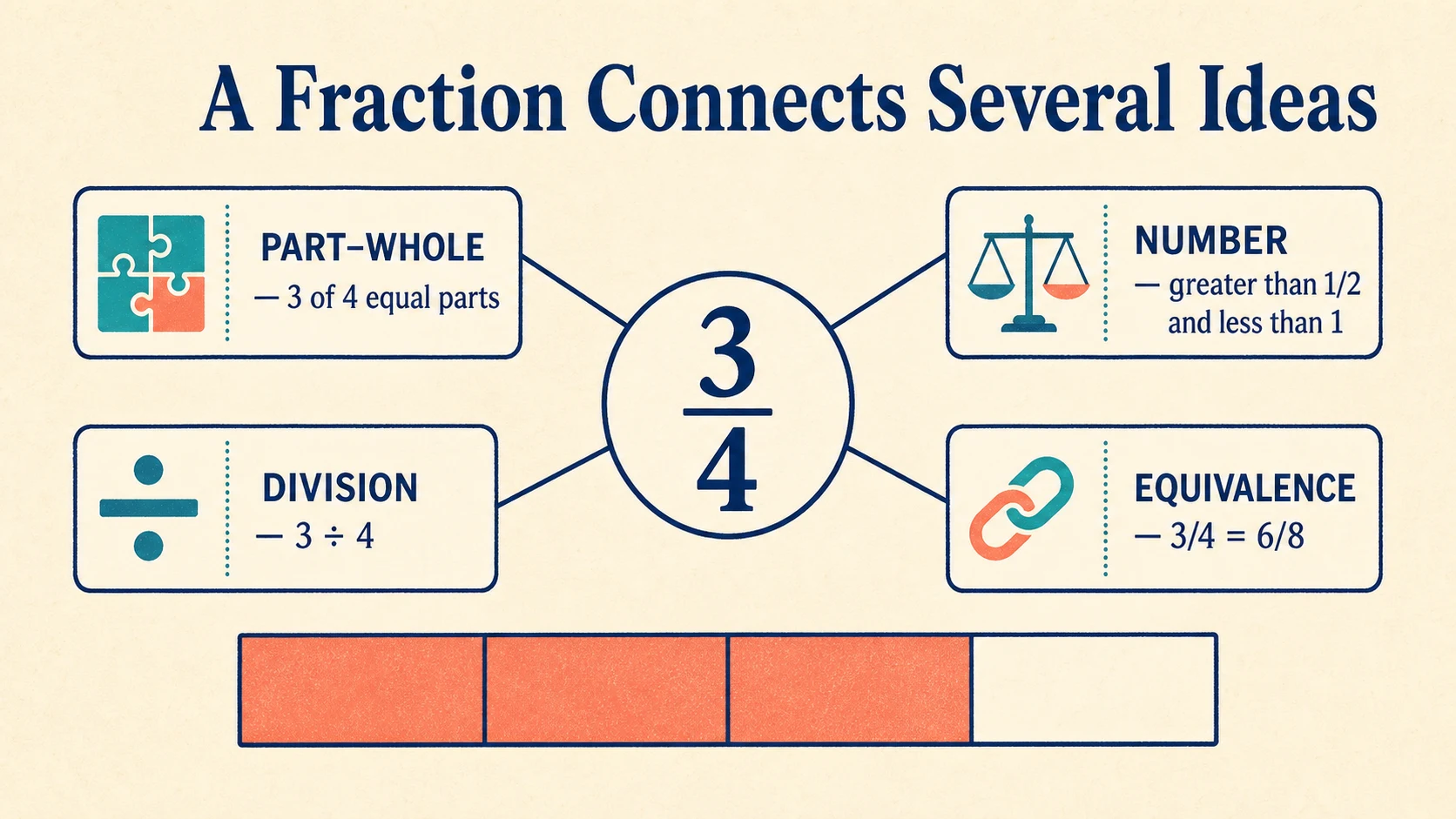
The middle-grade map connects representation, naming, number-line location, comparison, and equivalence rather than treating them as separate tricks.
Why the number line should appear early and often
Area models such as circles and rectangles make equal parts visible, but the number line establishes that fractions are numbers. It also fixes the whole as the distance from 0 to 1 and makes values greater than 1 possible without changing models.
Begin with a line from 0 to 1. Ask the learner to partition it into two equal intervals, then locate . Repeat with thirds and fourths. Later, use sixths and eighths. Ask two questions each time:
- How many equal intervals are between 0 and 1?
- How many of those intervals do you travel from 0 to reach the fraction?
A common error is to count tick marks instead of intervals. If a learner draws four internal marks to make fourths, there will be five intervals, not four. Do not correct this with a rule alone. Have the learner trace and count the spaces from 0 to 1.
The six-grade progression and its task boundaries
The six catalogue combinations describe a broad progression, but the verified catalogue facts do not specify every item on every sheet. The boundaries below are selection guidance derived from the stated sequence of fraction identification, comparison, equivalence, mixed numbers, and four operations. Inspect the actual free sheet before assigning it.
Grade 1: equal parts before fraction symbols
A useful Grade 1 starting point asks the learner to divide familiar shapes into two or four equal parts and describe them orally as halves or fourths. The central boundary is equality, not computation.
Checked example: fold a rectangular paper strip exactly in half. Open it and shade one section. The shaded amount is one of two equal parts, so it is . If the fold is off-center, the two pieces are not halves. This belongs at the beginning because the learner can establish the meaning through an action before being expected to interpret notation.
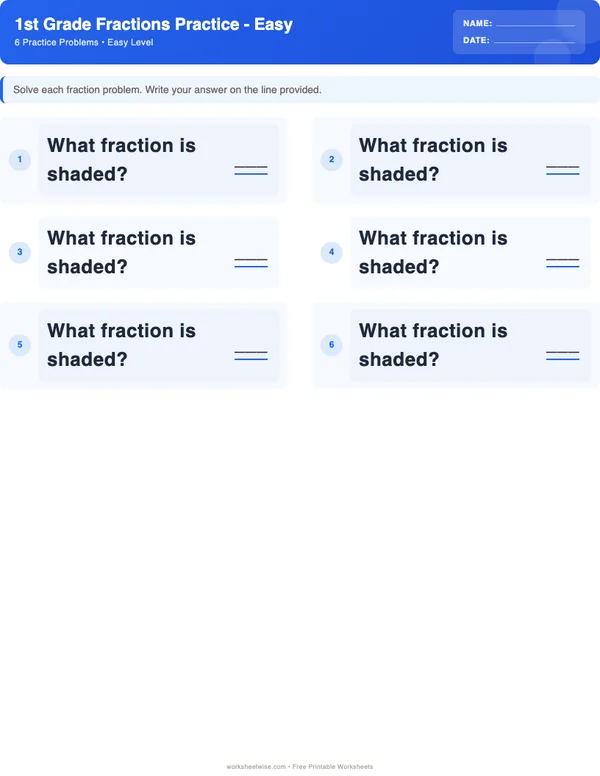
Choose the 1st Grade Fractions guide and free sheet when the immediate target is recognizing or making equal parts. The free entry point has 6 problems, which makes it suitable for a brief observation rather than a claim of mastery.
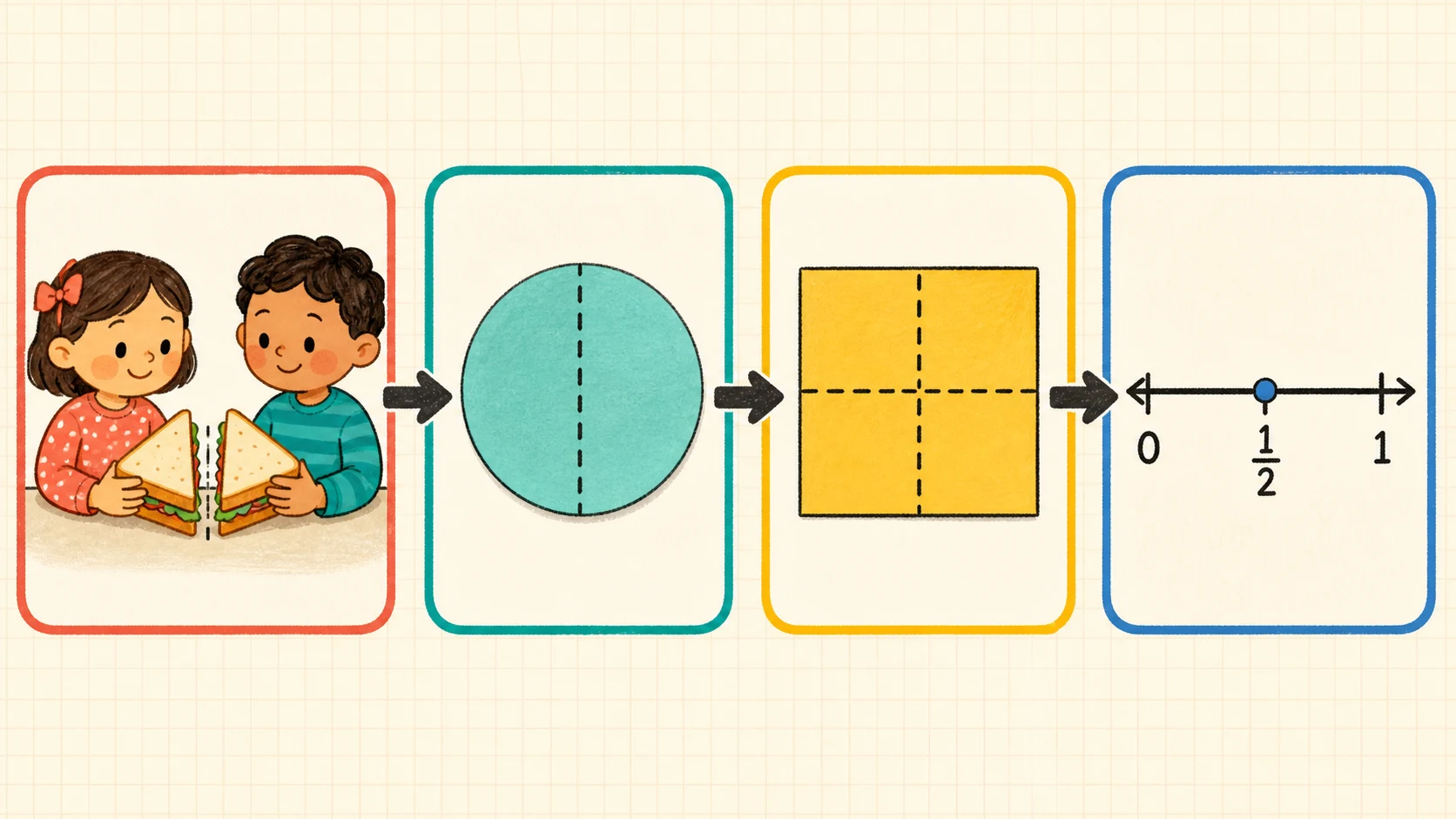
At the first-grade boundary, independence means making and identifying equal parts without an adult supplying the partition.
Grade 2: name equal shares and coordinate words, pictures, and symbols
Grade 2 practice can increase the demand by asking the learner to connect a partitioned model with a fraction name or symbol. The learner should still be able to touch, fold, cover, or draw the parts.
For example, show a rectangle divided into four equal columns with one shaded. Ask the learner to say “one fourth,” write , and explain what the 4 means. The answer is checked because one of four equal parts is selected. It belongs after basic partitioning because it coordinates three forms—image, spoken name, and notation—without yet requiring equivalence or an operation.
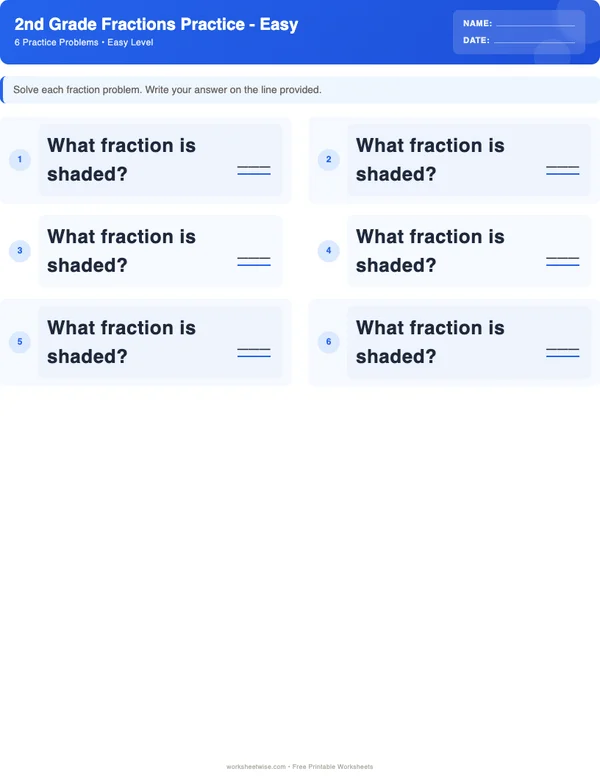
The 2nd Grade Fractions guide and free sheet is the more appropriate entry point when a learner can make equal parts but does not yet reliably match a model to a fraction symbol. Its free sheet also contains 6 problems.
Grade 3: treat fractions as locations and compare reasoned values
Grade 3 is a useful transition from “parts of a shape” to “numbers with size.” Questions may ask learners to place unit fractions and non-unit fractions on a number line, compare fractions with a shared numerator or denominator, and explain comparisons using a model.
Checked example: compare and . With equal-sized wholes, is larger. Dividing the same whole into eight equal pieces makes each piece smaller than dividing it into four. On a 0-to-1 number line, lies to the left of . This belongs at the Grade 3 boundary because it tests whether the learner understands denominator size instead of reading 8 as evidence of a larger value.
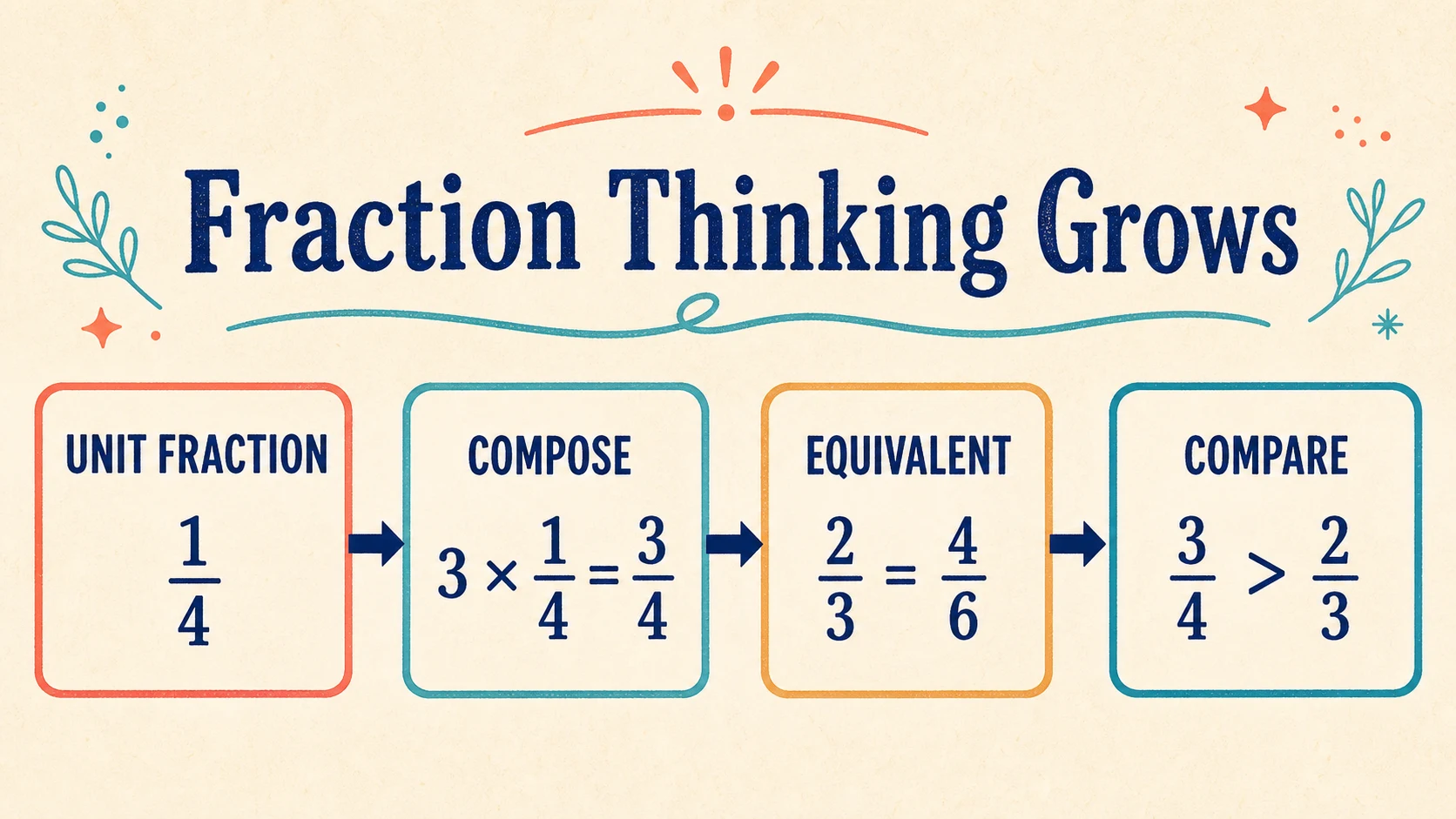
The third-grade progression should move from partitioned models to independently locating and comparing fractions as numbers.
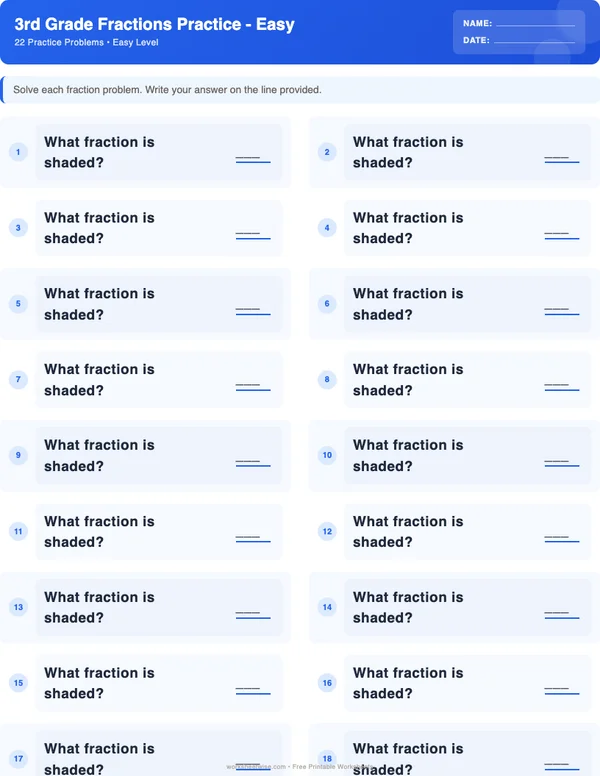
The free resource in the 3rd Grade Fractions guide and free sheet contains 22 problems. Rather than assigning all 22 immediately, first sample several items that use the target representation. Stop if repeated errors show that the learner needs a model or an earlier prerequisite.
Grade 4: establish equivalence before relying on procedures
At this boundary, the task should move from recognizing fraction size to generating and explaining equivalent fractions. Use paper strips, fraction bars, area models, and number lines before introducing multiplication of the numerator and denominator.
Checked example: fold one paper strip into fourths and shade two parts. Fold an identical strip into eighths and shade four. Both shaded lengths cover half of the strip, so
The symbolic relationship can then be described as multiplying both numerator and denominator of by 2. The direction matters: the visual evidence establishes the equality first; the procedure records a relationship the learner has already seen. This example belongs here because equivalence is the bridge from comparison and number-line reasoning to unlike-denominator operations.
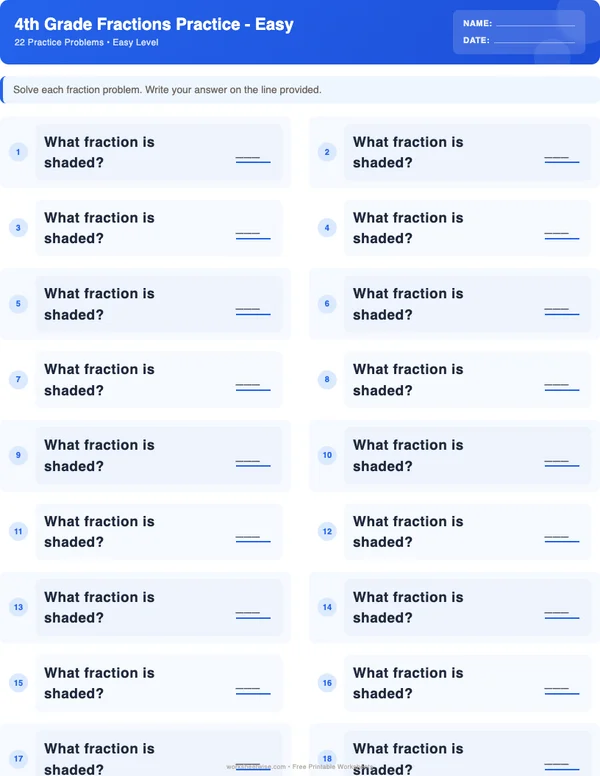
Use the 4th Grade Fractions guide and free sheet when a learner can locate common fractions but needs practice recognizing, generating, or using equivalent forms. Its free resource contains 22 problems.
Grade 5: connect equivalence to addition, subtraction, and multiplication
Grade 5 practice can ask learners to use equivalence within operations, interpret improper fractions and mixed numbers, and model a fraction of a quantity. The question design should still invite estimation and representation rather than rewarding an unexplained algorithm.
Checked example: estimate and then calculate
Because is close to 1 and is also close to 1, the sum should be close to 2 but less than 2. Rename as :
The result fits the estimate. This belongs at an operations boundary because it combines equivalence, addition, improper-fraction interpretation, and magnitude checking.
For fraction multiplication, use an area model. To find of , divide a rectangle into thirds in one direction and fourths in the other. Shade , then identify of that shaded region. Six of the twelve equal cells are in the overlap:
This checked model makes “multiply across” meaningful: the overlapping subdivisions produce the product. The 5th Grade Fractions guide and free sheet is the relevant catalogue entry when the learner can generate equivalent fractions and is ready to apply that understanding in operations.
Grade 6: coordinate all four operations and justify reasonableness
The upper boundary includes addition and subtraction with unlike denominators, multiplication, division, and movement between improper fractions and mixed numbers. The defining feature is not merely longer arithmetic. It is choosing a representation or procedure, tracking the unit, and deciding whether the result is reasonable.
Checked example: interpret
The question asks how many one-eighth units fit into three-fourths. Rename as . Six groups of fit, so the quotient is 6. A fraction-bar or number-line model shows six jumps of from 0 to . This belongs at the Grade 6 boundary because the learner must interpret division as measurement, use equivalence, and connect the model to a symbolic result.
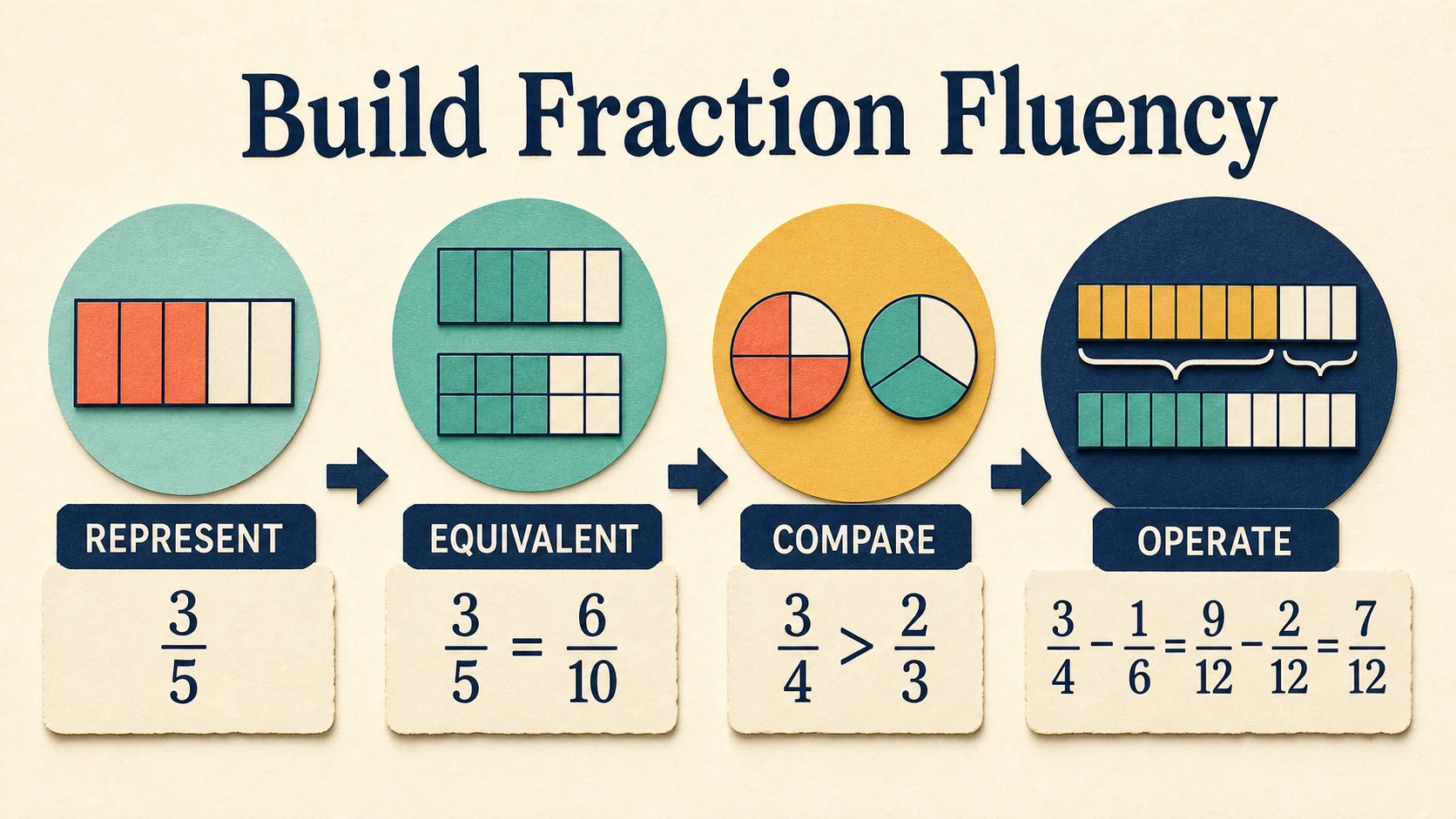
Upper-grade independence means selecting an operation and checking its scale, not merely completing a memorized sequence.
The 6th Grade Fractions guide and free sheet has 22 problems. Use it when the learner’s errors concern operation choice, equivalence within a calculation, or interpretation—not when equal partitioning and fraction magnitude are still unstable.
How representation and question design should change
The progression is not a march from pictures to picture-free pages. Representations should become more connected and purposeful.
A beginning prompt might say, “Fold this strip into four equal parts and shade one.” A later prompt could show the strip and ask for the symbol . Next, a learner might place on a number line, compare it with , generate , and use that equivalence during a calculation.
The intellectual demand also changes:
- Recognition: Which shape shows thirds?
- Construction: Partition this rectangle into thirds.
- Translation: Write the fraction represented by the shaded region.
- Location: Place on a number line.
- Comparison: Which is greater, and how does the model prove it?
- Generalization: Why does multiplying numerator and denominator by the same nonzero number preserve value?
- Application: Which operation answers a sharing or measurement situation?
- Verification: Is the calculated result consistent with an estimate?
The Common Core State Standards for Mathematics describe grade-level fraction expectations that progress from equal shares to fractions as numbers, equivalence, operations, and division. They are one authoritative reference for understanding task progression, not proof that a particular worksheet aligns with every local standard. Curriculum order and terminology can vary.
Use a short concrete-to-symbolic routine
A worksheet should sit inside instruction, not replace it. The following routine is a practical suggestion for adults; it is not quoted from the approved sources.
Before the page: establish the whole
Show the relevant model and ask, “What counts as one whole?” This prevents a learner from comparing shaded regions drawn inside differently sized wholes as though the pictures used the same unit.
Then ask for a rough prediction. For comparison, predict which value is nearer to 0, , or 1. For operations, estimate whether the result should be less than 1, between 1 and 2, or greater than 2.
During the page: require one model and one explanation
Complete the first item together. Let the learner build or draw a fraction bar, fold paper, use fraction circles, or partition a number line. Ask for a sentence that names the relationship: “Eighths are smaller than fourths because the same whole is divided into more equal parts.”
Release the next two or three items for independent work. Do not erase an incorrect answer immediately. Ask the learner to reconstruct it with a model so the source of the error becomes visible.
After the page: check transfer, not repetition
Give one new item with different numbers or a different representation. After a page comparing area models, ask for the same comparison on a number line. After unlike-denominator addition, ask for an estimate before any calculation.
Record one observable statement, such as “Placed correctly after partitioning 0–1 into four intervals,” rather than “understands fractions.” The first statement identifies what to practice next.
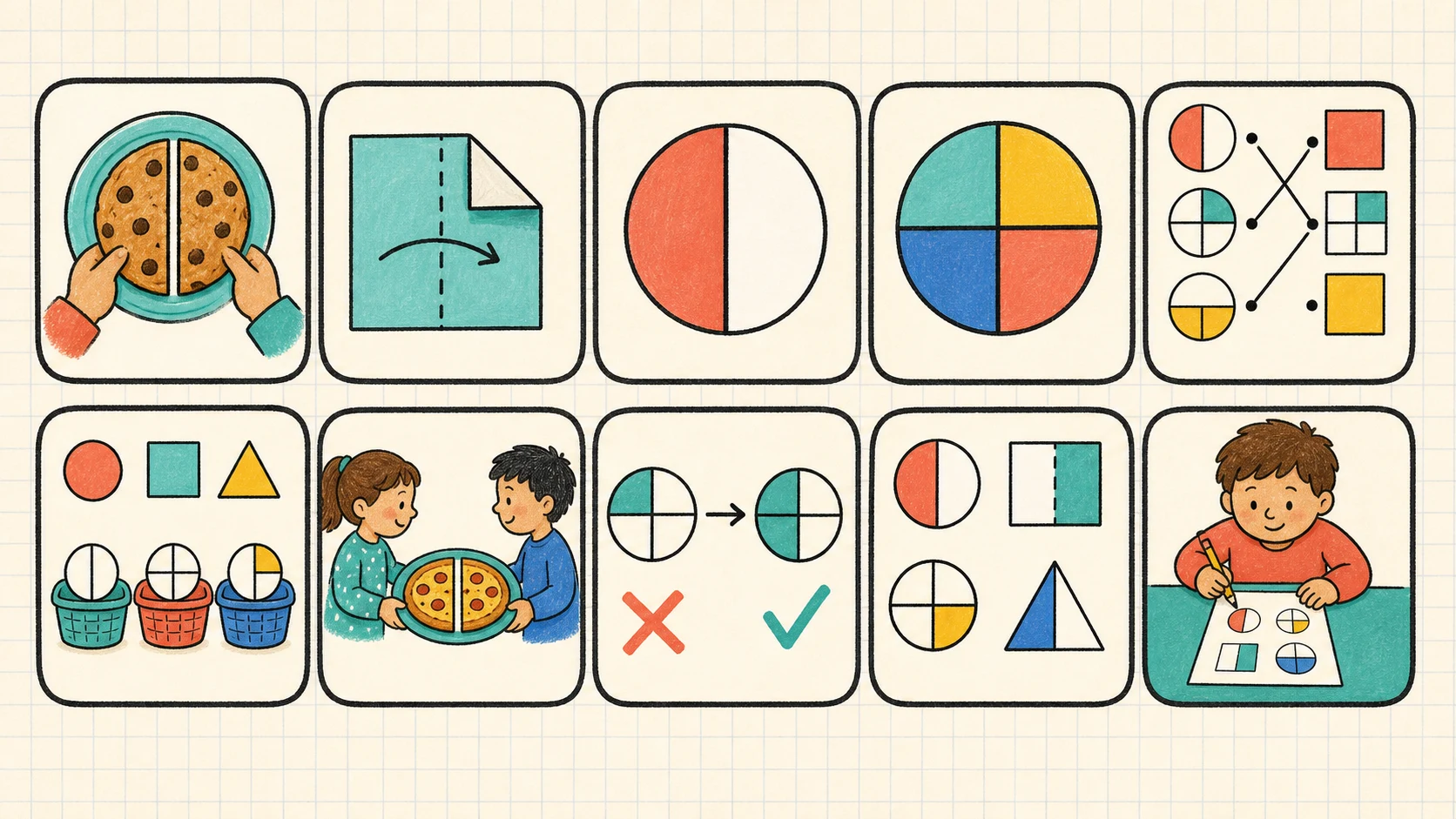
Brief, spaced first-grade encounters can rotate folding, matching, oral explanation, movement, and selected paper items.
Read errors as evidence about the next representation
An incorrect answer does not identify a diagnosis. It provides evidence about the strategy the learner used on that item. Confirm a pattern with another example and a brief conversation.
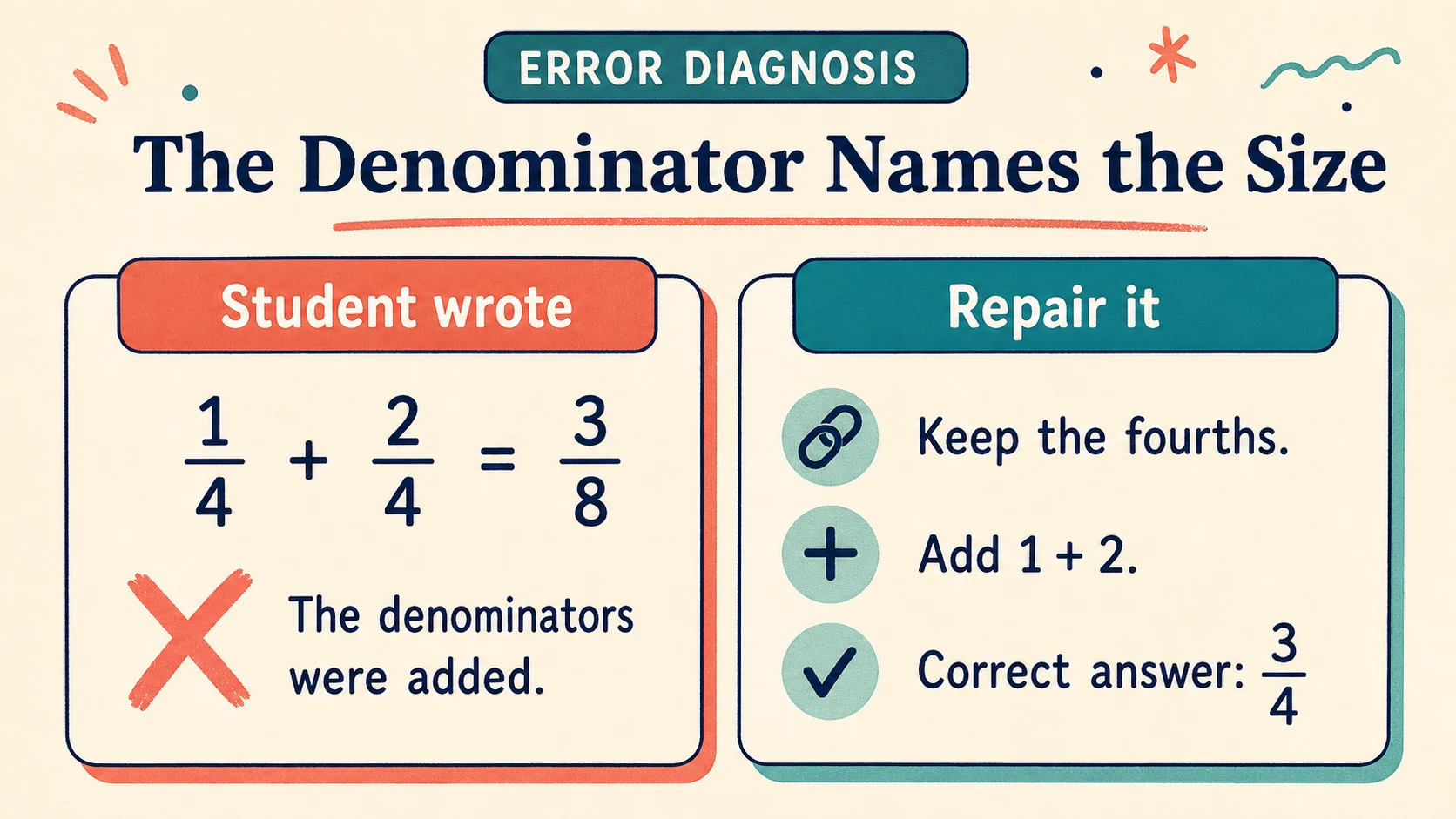
Third-grade errors become useful when each one triggers a specific model, question, and follow-up item.
“The larger denominator makes the larger fraction”
If a learner says , the likely strategy is comparing whole numbers 8 and 4. Return to identical fraction bars or a number line. Ask the learner to divide equal wholes into fourths and eighths and compare one part from each. Then check transfer with and .
Next action: assign comparison items with the same numerator and insist on an equal-whole model before symbols.
“Add the top and add the bottom”
A learner may write
Model two fourth-size pieces placed together. The unit remains fourths, so the result is , not . Ask why adding an extra fourth should produce an answer equal to the original ; the size check exposes the contradiction.
Next action: practice like-denominator addition with fraction strips and require the learner to name the unchanged unit.
“Count the marks instead of the intervals”
A learner locating may draw three tick marks between 0 and 1, then label the third mark without checking the number of spaces. Have the learner count jumps, not lines. Four equal intervals require three internal marks plus the endpoints.
Next action: partition blank number lines before using pre-partitioned ones.
“Invert automatically during division”
If a learner can perform “keep-change-flip” but cannot interpret , the procedure is disconnected from quantity. Ask, “How many eighths fit in three-fourths?” Build the six one-eighth jumps. Introduce or revisit the symbolic procedure only after the quotient is visible.
The IES practice guide for assisting students struggling with mathematics supports systematic instruction, clear mathematical language, multiple representations, number-line use, and attention to common misconceptions. These principles inform the response choices above; they are not a diagnosis of an individual learner or a review of WorksheetWise.
Select the next real worksheet with five checks
Do not choose by grade label alone. Open the candidate resource and inspect these features:
- Target: Identify one immediate goal—equal partitioning, naming, number-line placement, comparison, equivalence, mixed numbers, or a particular operation.
- Representation: Prefer a page that includes or permits the model the learner currently needs. A symbol-only page is a poor starting point when the misconception concerns magnitude.
- Denominator range: Check whether the learner can partition and reason about the denominators used. Halves and fourths may be appropriate while sixths, eighths, or unlike denominators are not yet useful.
- Step load: Distinguish one-step identification from tasks that require equivalence, calculation, simplification, and conversion to a mixed number.
- Page length: The two early-grade free sheets have 6 problems; the Grade 3–6 sheets have 22. A 22-problem page can be divided into smaller sets. Completion of every item is not inherently the instructional goal.
Select an earlier entry point if the learner cannot establish equal parts, identify the whole, or place familiar fractions between 0 and 1. Select a later one only when the learner can explain the prerequisite relationship with a model and handle a small transfer item independently.
The six free resources are entry points, not a complete assessment system. The catalogue facts establish their grade combinations, topic, difficulty label, and problem counts; they do not establish standards alignment, learning outcomes, diagnostic accuracy, or suitability for every learner.
Adapt the work without removing the fraction thinking
An adaptation should reduce an irrelevant barrier while preserving the target skill.
If drawing is laborious, provide pre-cut fraction strips but still require the learner to select and compare the correct pieces. If reading load is a barrier, read directions aloud without explaining which operation to choose. If the page is visually crowded, cover all but one row. If attention is limited, assign three carefully selected problems and a transfer item instead of demanding all 22 at once.
Allow a ruler or straightedge for number lines. Enlarge diagrams when equal partitions are difficult to see. Let the learner answer orally while an adult records the explanation. Use color to track equivalent pieces, but ask what the color means so decoration does not replace reasoning.
Do not preserve “difficulty” by removing models prematurely. Conversely, do not complete the partition, choose the operation, and supply the fraction language if those actions are the actual target. Support access; retain the decision the learner is meant to make.
Make the final decision from observable evidence
Start with one candidate page from the full worksheet library, then preview three items before printing or assigning it. Ask:
- Can the learner identify the whole?
- Can the learner build or draw the fraction?
- Can the learner estimate its size or the size of the result?
- Can the learner explain one comparison, equivalence, or operation?
- Can the learner solve a nearby example without the adult choosing the method?
If four answers are secure, move to a worksheet with one new demand. If the representation is secure but the symbols are not, keep the same values and add notation. If the symbols are accurate but explanations are weak, retain the level and require models and justification. If the learner cannot show the quantity, step back to fraction strips, paper folding, or a partitioned number line.
The practical next action is to open the grade guide closest to the learner’s current task—for example, the 3rd Grade Fractions guide and free sheet—and test only the first three relevant problems with a number line available. Record the learner’s model, explanation, and error pattern; use that evidence, not the printed grade label, to choose the following sheet.
Put it into practice
Use the guide with a real printable
Move from explanation to a short, observable practice task. Check the first item together, then adjust the next session from the learner's actual work.
Open the first free worksheetExplore a neighboring collection
Choose by a different teaching need
Addition Worksheets by Grade and Level Consonant Blends Worksheets by Grade and Level Counting Worksheets by Grade and Level CVC Words Worksheets by Grade and Level Decimals Worksheets by Grade and Level Digraphs Worksheets by Grade and Level Division Worksheets by Grade and Level Geometry Worksheets by Grade and Level