Curated collectionAnswer keys includedPrint-ready PDFs
Digraphs Worksheets by Grade and Level
Show the full digraphs progression across 3 real grade combinations, compare task boundaries, model checked examples and explain how to choose the next level.
Start with a real resource
Browse this worksheet collection
3 relevant free entry points are available. Each one includes a printable learner PDF and separate answer key.
A useful practice loop
Print less. Observe more.
- Choose one skill and model the first item aloud.
- Use a short set and notice the learner’s strategy.
- Change the next task from the work you can see.
Need more than the free sheet?
Plus includes all 54 matching catalogue variations where available, plus saved deterministic generators and the worksheet designer.
See Plus membershipComplete guide
How to teach and practise digraphs worksheets
3,430 words Updated 6 instructional visuals
Choose a digraph worksheet by the work it asks the learner to do
The right digraph worksheet is not automatically the one carrying the learner’s current grade label. Choose the page whose task is one manageable step beyond what the learner can already do: hear the target sound, connect it to two letters, read it inside a word, spell it, or use it in connected text.
WorksheetWise’s live catalogue contains 54 digraph worksheet variants across three intended practice levels—Kindergarten, 1st Grade, and 2nd Grade—with one free 20-problem sheet at each level. All three entry sheets are marked “easy,” but that label should be interpreted through observable task features, such as how much picture support is present, whether the digraph is supplied, and whether the learner identifies, reads, or writes the word. It should never become a label for the learner.
Use age as a discovery aid, not a placement decision. A 6-year-old who can read CVC words but cannot yet hear /sh/ in ship needs sound-level instruction before independent written practice. A younger learner who readily reads ship, wish, and chin may be ready for mixed-position work. For ages three and four, prioritize brief adult-led oral, matching, manipulative, and movement activities over desk work.
Grade labels describe intended practice level; local curriculum sequences differ. The practical question is: What can the learner do without guessing, and what is the smallest useful next demand?
What counts as a digraph—and what does not
A consonant digraph is a pair of letters representing one sound. In ship, the letters sh work together for /sh/. In chin, ch represents /ch/. This differs from a consonant blend. In slip, the s and l remain separately audible: /s/ /l/. That contrast matters because a learner who tries to pronounce both letters in sh may read ship as something like “s-hip.”
A simple physical cue makes the distinction visible:
- Hold two fingers apart while saying the two sounds in sl.
- Hold the same two fingers together while saying the one sound represented by sh.
The gesture is a teaching suggestion derived from the supplied teaching guidance, not a claim that one hand signal works for every learner. Keep it only if it helps the learner attend to “two letters, one sound.”
The core set represented in this catalogue is sh, ch, th, wh, and ck. These do not all behave identically:
- sh can occur initially or finally: ship, wish.
- ch can occur initially or finally: chin, much.
- th can occur initially or finally and has two common pronunciations: thin, math use the unvoiced sound; this, the, that use the voiced sound.
- wh commonly occurs at the beginning, as in when.
- ck represents
/k/after a short vowel at the end of a word, as in duck, neck, and stick.
Learners need exposure to both pronunciations of th, but they do not need to memorize the labels voiced and unvoiced. The useful behavior is hearing and producing each form in real words.
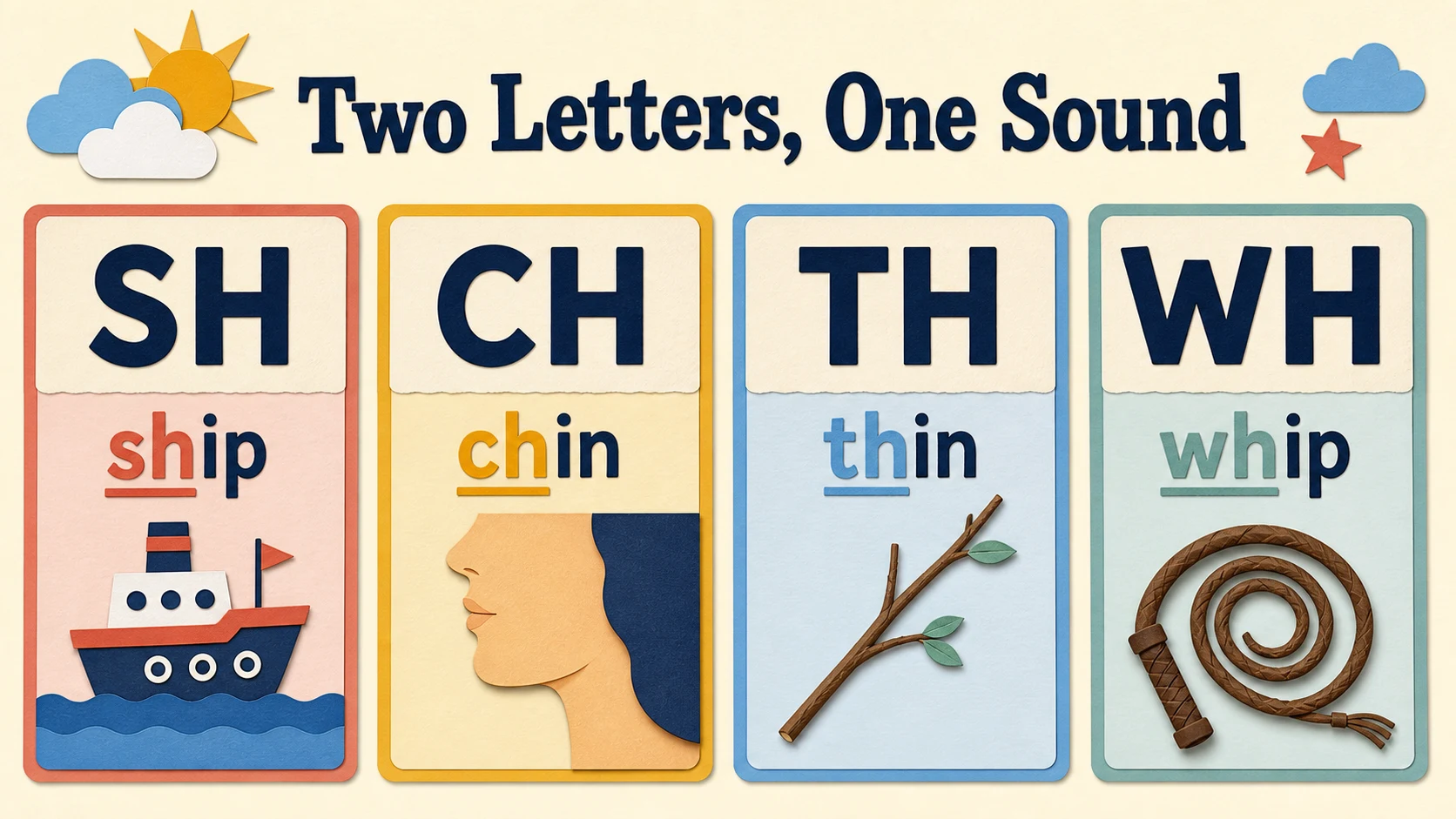
The map connects sound recognition, letter-pair recognition, word reading, spelling, and use in context—the separate demands adults should examine before choosing a page.
The IES foundational reading practice guide recommends explicit work with sound segments, letter–sound relationships, decoding, and connected text. That source offers general instructional guidance; it did not evaluate WorksheetWise or these particular worksheets.
Establish the starting point before printing
The supplied teaching anchor places digraphs after a solid foundation with CVC words and some exposure to blends. That boundary prevents the worksheet from carrying too many new demands at once.
Before selecting a level, try this short oral and reading check. It is a suggested placement routine, not a standardized assessment.
Check CVC control
Ask the learner to read five regular CVC words, such as:
- map
- sit
- red
- hop
- sun
The examples are checked: each has a consonant–vowel–consonant structure and a short vowel. If the learner cannot blend most of them without extensive prompting, return to the CVC Words Worksheets by Grade and Level before making digraphs the main written target.
Check whether two sounds stay audible in a blend
Say slip slowly. Ask, “What sounds do you hear at the beginning?” The checked answer is /s/ /l/: two adjacent consonant sounds, neither of which disappears.
Then say ship. The checked beginning is /sh/, one sound represented by two letters. Do not accept “It has two sounds because it has two letters.” That response reveals confusion between letters and sounds.
If blends themselves are unfamiliar, use the Consonant Blends Worksheets by Grade and Level for comparison work. The goal is not to master every blend first, but to give the learner a meaningful contrast.
Check position, not just recognition
Show or say ship and wish. Ask where /sh/ occurs.
- In ship, sh is at the beginning.
- In wish, sh is at the end.
Both words belong in an early digraph sequence because they hold the target sound in short, readable forms while changing its position. A learner who succeeds only when the digraph is highlighted at the beginning needs a page with final-position practice before moving to mixed text.
A useful progression across the three grade combinations
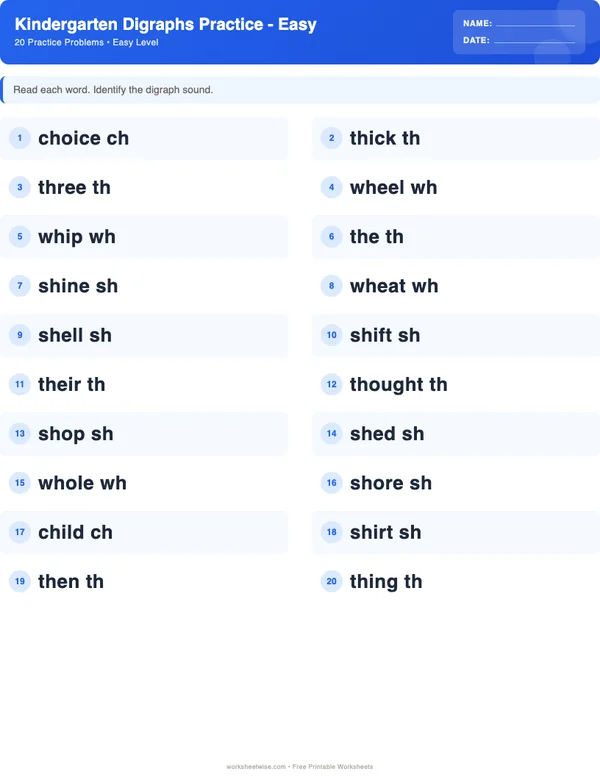
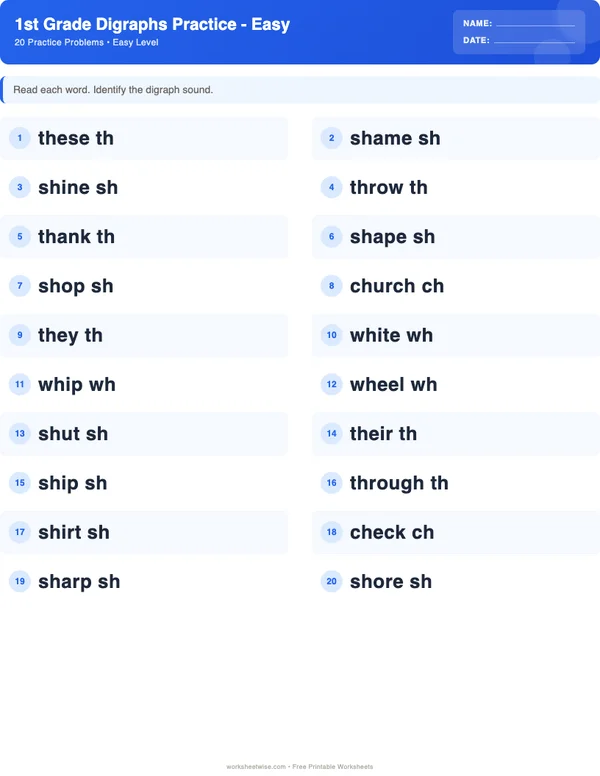
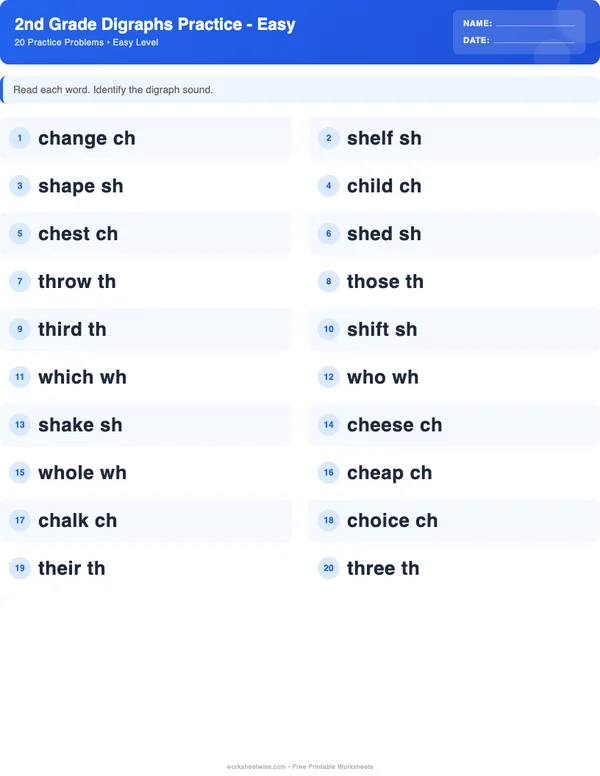
The catalogue offers three real starting points: Kindergarten digraphs, 1st Grade digraphs, and 2nd Grade digraphs. Each linked guide includes a free 20-problem sheet. Because all three free sheets share the same catalogue difficulty label, compare their actual prompts and supports rather than assuming “easy” means identical work.
A sound progression moves from supported discrimination to increasingly independent reading and spelling. The grade bands below describe sensible task boundaries, not universal standards placements.
Kindergarten: hear, match, and identify
Begin here when the learner needs pictures, oral modeling, a limited choice set, or visible marking of the target letters. Appropriate tasks include:
- deciding whether two spoken words begin with the same digraph sound;
- matching a pictured ship to sh;
- circling sh in a printed word;
- sorting ship and wish by initial or final position;
- choosing between two supplied letter pairs.
A checked example is: Which digraph completes _ip: sh or ch? The answer is sh, producing ship. It belongs at this stage because the learner chooses between supplied spellings rather than retrieving the letters independently. The adult should say the picture name first if the image could be interpreted in more than one way.
For a 3- or 4-year-old, convert the same target into a two-minute oral game. Put down cards for a ship and a chair. Say /sh/; the child touches the ship and holds two fingers together. This preserves sound-to-picture matching without requiring prolonged pencil control or a full worksheet.
First grade: read, locate, and complete
Move here when the learner can recognize a taught digraph but needs practice reading it in different positions or selecting it within a word. Useful tasks can reduce picture support, mix initial and final positions, and ask for short written responses.
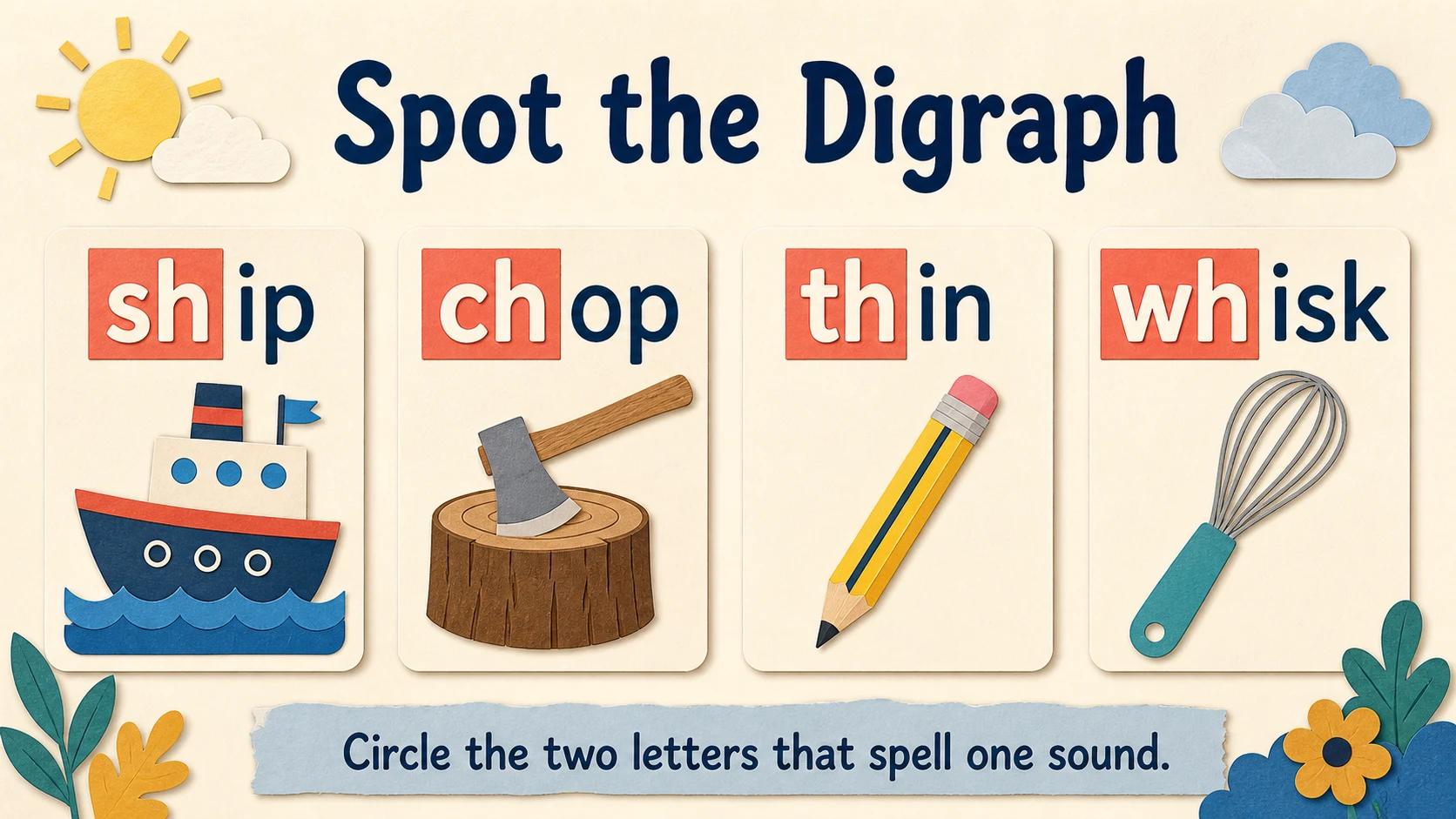
The worked path should make each decision visible: name the item, isolate the target sound, identify its position, and write the two-letter spelling.
Consider the checked prompt: Complete wi__ to name the word wish. The answer is sh. It belongs at this level because the learner must attend to a final digraph and place both letters after the vowel. It also checks a different boundary from _ip: recognition at the end rather than the beginning.
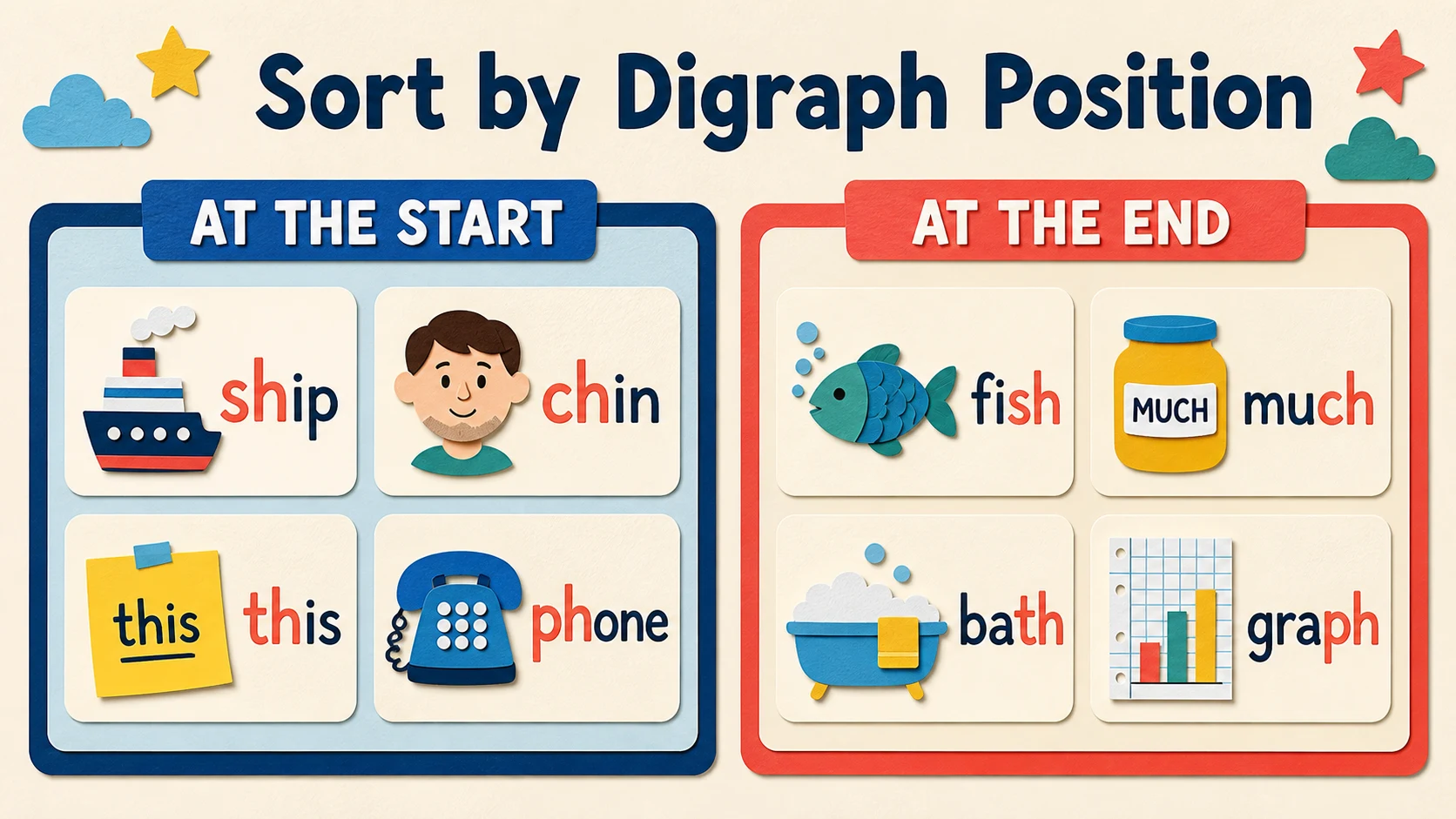
A stronger first-grade item might ask the learner to sort chin, much, ship, and wish into “digraph at the beginning” and “digraph at the end.” The checked sorting is:
- Beginning: chin, ship
- End: much, wish
This is harder than circling a highlighted pair because the learner must read each whole word and analyze position. It remains controlled because only ch and sh are involved.
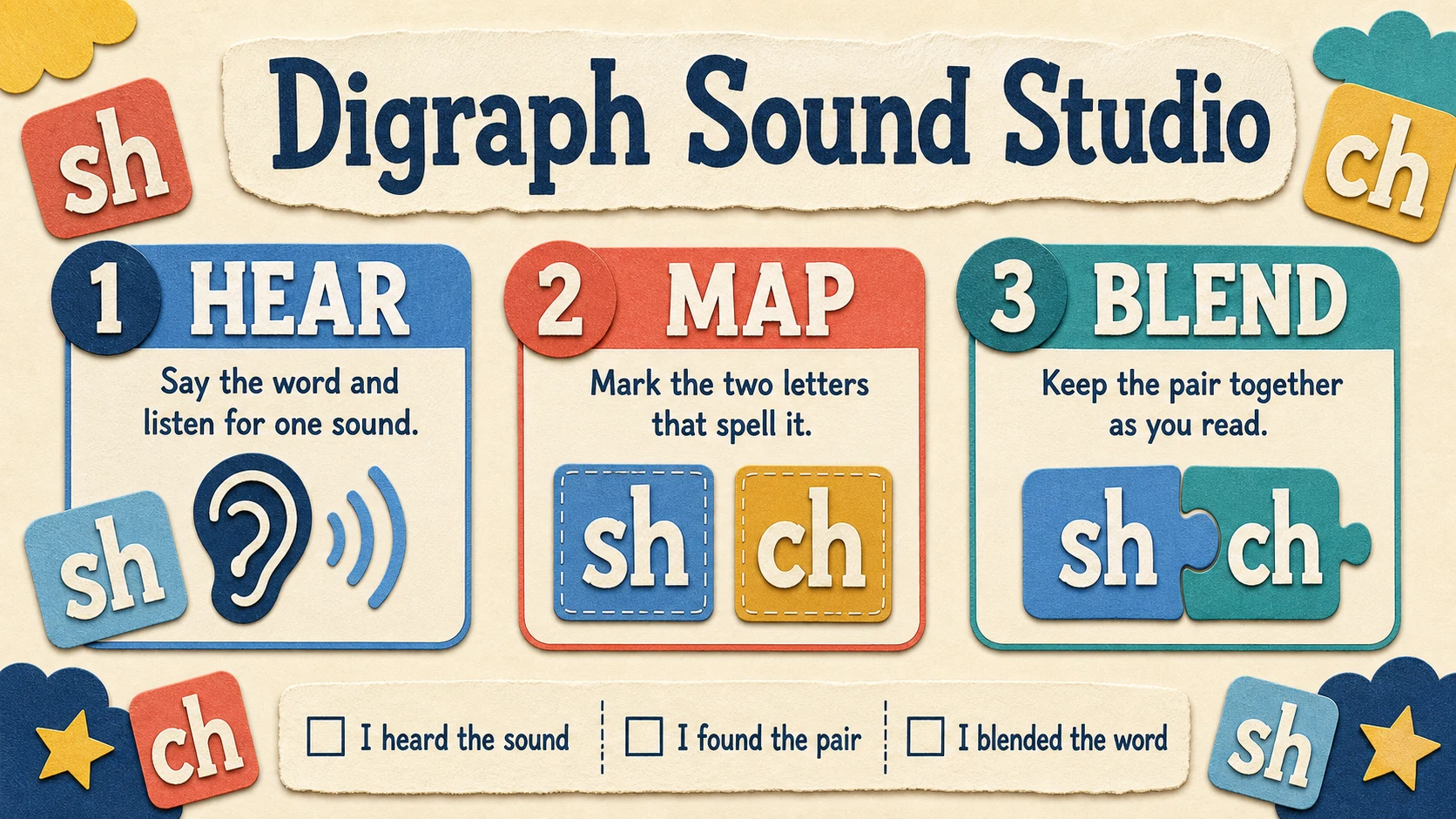
The plan illustrates deliberate spacing: concentrated work on one correspondence followed by review that brings earlier CVC and blend knowledge back into use.
Second grade: discriminate, spell, and apply in context
Use the 2nd Grade starting point when single-word recognition is secure enough that the worksheet can require less scaffolding and more transfer. Appropriate demands include:
- distinguishing several digraphs without highlighted cues;
- spelling a word from dictation;
- applying the final ck pattern after a short vowel;
- reading a controlled passage containing several digraph words;
- finding and correcting a plausible digraph spelling error;
- mixing digraph words with CVC and blend words.
A checked example is: Choose the correctly spelled word for a bird that says “quack”: duk or duck. The answer is duck. It belongs in a later application stage because the learner must connect /k/ at the end of a short-vowel word with ck, not merely recognize a named digraph.
Another checked example is: Sort thin, math, this, and that by the way the letters th sound. The first pair uses unvoiced th; the second uses voiced th. This task belongs after initial exposure because it asks the learner to compare pronunciation within the same spelling. The adult can name the two columns “quiet th” and “buzzy th” if technical labels distract from listening.
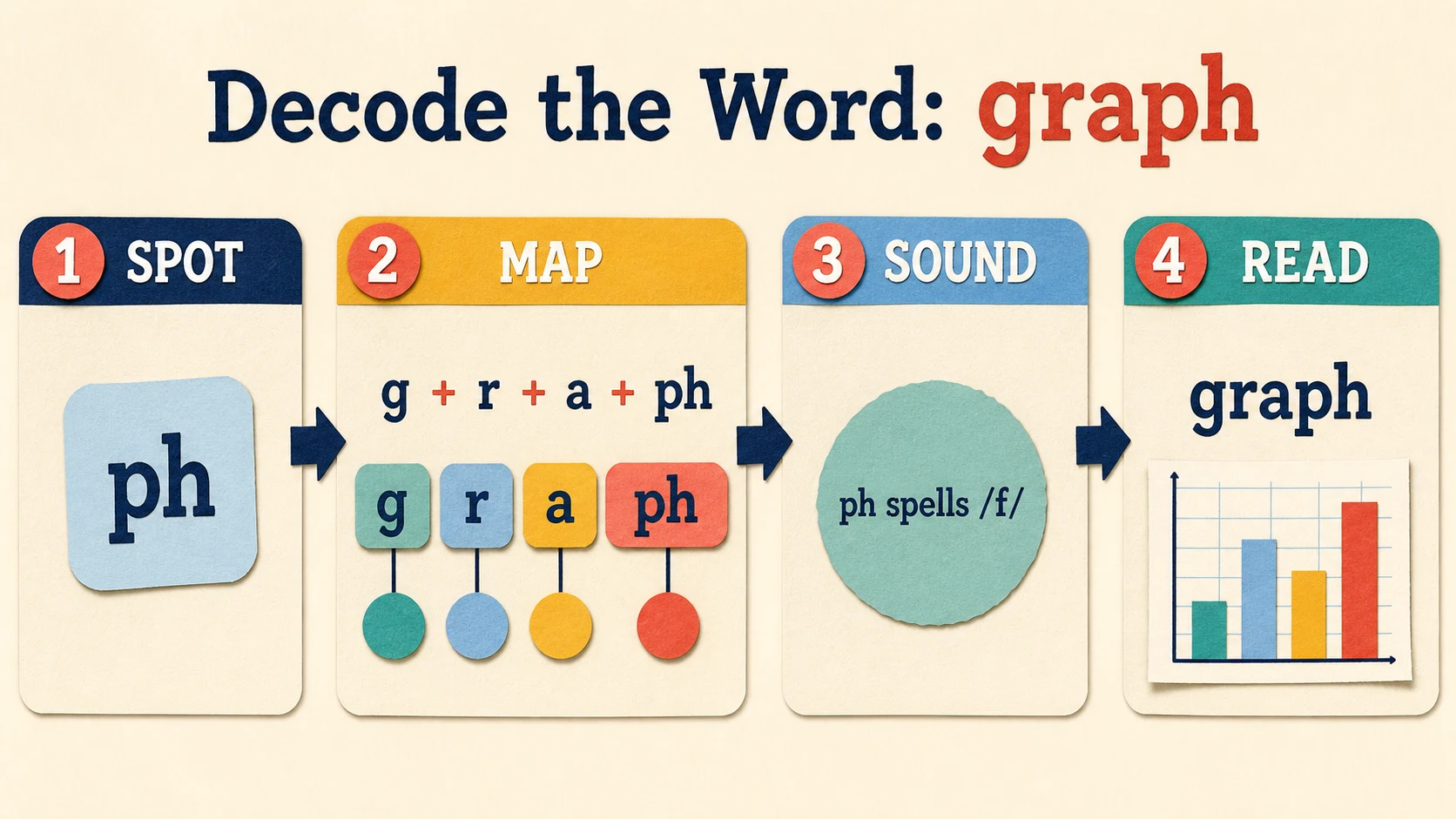
The meaningful change is not a more impressive grade label; it is the removal of cues and the addition of spelling, comparison, and connected-text demands.
Teach one digraph deeply before mixing the set
The supplied sequence recommends beginning with sh, then ch, then th, and spending at least a week on each. Treat that timing as instructional guidance for this page, not as a universal research-mandated schedule. A learner may need more time, and a local program may order correspondences differently.
Begin with the distinct sound in sh
Use a small word set in both positions:
- Initial: ship, shop, shed
- Final: wish, fish, rush
Each checked word uses sh for /sh/. Model one word, complete two together, and then ask for an independent response. Avoid presenting sh, ch, th, wh, and ck simultaneously on the first day; a large choice set can turn listening practice into visual guessing.
Contrast ch only after sh is recognizable
Introduce chin, chop, and much. Compare ship with chip. The only changed initial digraph alters the word:
- ship begins
/sh/. - chip begins
/ch/.
This is a useful checked contrast because both words have the same ip ending. If the learner reads both as ship, the issue is discrimination between the two digraph sounds, not CVC blending of ip.
Give both th pronunciations real airtime
Use thin, three, and math for unvoiced th, then this, the, and that for voiced th. Ask the learner to put a hand lightly on the throat while saying thin and this. The vibration in this can make the distinction easier to notice.
Do not insist on formal terminology or treat a dialect difference as carelessness. The target is flexible recognition of th in words, with pronunciation modeled respectfully in the instructional variety of English being used.
Change the representation without changing the target
Representation controls how much work is hidden inside a question. A picture-supported match, a printed word, dictation, and a sentence may all involve sh, yet they place different demands on memory, vocabulary, handwriting, and decoding.
Use this sequence when deciding whether to add or remove support:
- Adult says ship; learner identifies
/sh/. - Learner matches a ship picture to sh.
- Learner completes
_ipwith sh. - Learner reads ship without highlighting.
- Learner spells ship from dictation.
- Learner reads The ship is at the dock in controlled text.
The first two representations chiefly support sound recognition. The middle steps connect sounds and spellings at word level. The last step requires the learner to retain the correspondence while coordinating meaning and sentence reading.
The Common Core English Language Arts standards include grade-level expectations involving sound–spelling correspondences, decoding, and conventional spelling. They can help adults understand the broader instructional domain, but the existence of a digraph worksheet does not by itself establish standards alignment.
Question design matters as much as content. “Circle every sh” can be completed by visual scanning without reading. “Read each word and sort it by where /sh/ occurs” requires sound, word recognition, and positional analysis. “Write the word from dictation” adds retrieval and handwriting. Select the demand you intend to observe.
Use a short routine that exposes the learner’s thinking
A worksheet should sit inside a small teaching cycle rather than replace instruction. The following 10–15-minute routine is a practical suggestion based on the supplied teaching sequence.
The routine keeps explicit modeling, guided practice, independent work, and a final check close enough together for the adult to see where performance changes.
Hear and signal
Say three or four words without showing print: ship, sock, wish, sun. The learner holds two fingers together when hearing /sh/. Confirm that ship and wish contain the sound; sock and sun do not.
Map and blend
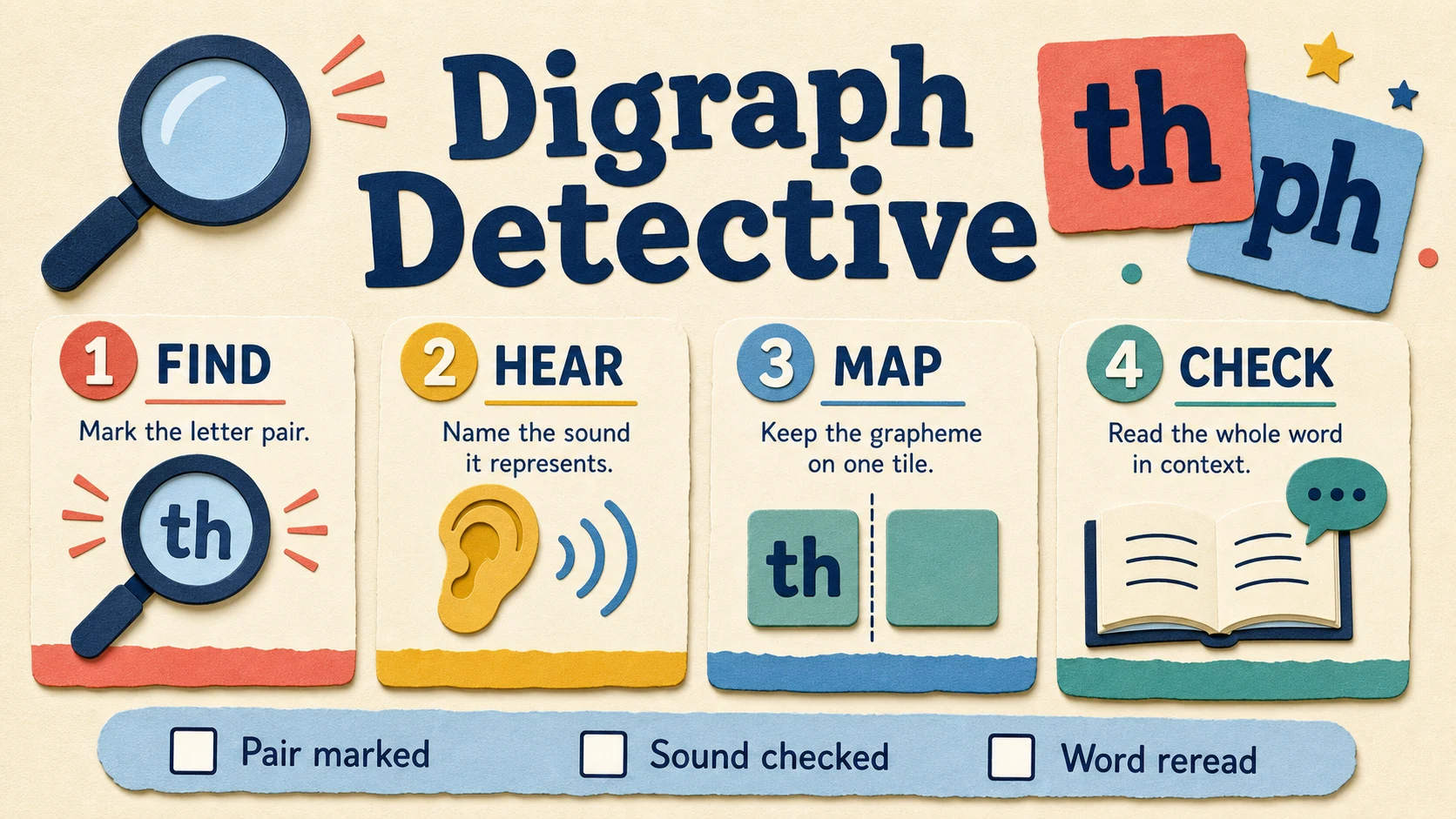
Write sh once. Say /sh/, then build ship with letter cards or tiles. Keep s and h physically together while sliding through /sh/ /i/ /p/. This preserves the “two letters, one sound” idea.
Complete a small worksheet set
Choose four to eight items sharing the day’s target. Ask the learner to explain one answer: “I wrote sh because I hear /sh/ at the end of wish.” Explanation is useful evidence, but it need not accompany every item.
Read in context and revisit earlier skills
Use a short controlled line such as: The ship is at the dock. This checked sentence contains initial sh in ship and final ck in dock. It also contains common words that may need to be supplied if they fall outside the learner’s current decoding knowledge.
Finish with one CVC word, one blend word, and one digraph word—for example, sit, slip, ship. This cumulative review helps distinguish the patterns and keeps earlier learning active. The IES foundational reading guide supports daily decoding and word-recognition practice alongside connected text; it does not prescribe this exact three-word set.
Read errors as information, not diagnoses
A wrong response shows what to check next. It does not establish a disability, disorder, or fixed ability level.
The learner separates the two digraph letters
If ship becomes “s-hip,” return to the sound contrast. Say slip and ship, use the two-fingers-apart/together cue, and ask how many sounds occur before the vowel. Then complete one supported sh item.
Observable next action: choose an initial-sh page with a small choice set rather than a mixed independent spelling page.
The learner recognizes sh only at the beginning
If ship is read correctly but wish is not, the learner may have tied the correspondence to one visual position. Sort a small set into initial and final sh, then use a worksheet that mixes both positions.
Observable next action: check shop, fish, shed, and rush without highlighting. Two accurate examples in each position provide better evidence than repeating ten initial-only items.
The learner confuses sh and ch
Use the controlled pair ship/chip. Say both, exaggerating only enough to make the difference audible, and have the learner watch the mouth. Return to a two-choice task before asking for spelling from memory.
Observable next action: present four words containing only sh or ch. If choices become reliable, reintroduce a broader set.
The learner writes k instead of ck
A response such as duk for duck shows that the learner heard final /k/; the unresolved part is its spelling in this word type. Model duck, neck, and stick: each ends with ck immediately after a short vowel. Contrast with ck as a final pattern rather than saying that every /k/ sound must be written ck.
Observable next action: use a short final-ck word sort before mixing ck with other digraphs.
The learner misses words inside a passage
If isolated words are accurate but sentence reading collapses, the difficulty may come from the combined load: other spellings, unfamiliar vocabulary, tracking, or sentence length. Do not infer that the digraph itself has been forgotten.
Observable next action: preview two target words, shorten the passage, and ask the learner to underline digraphs before reading. Then remove that support on a later attempt.
Adapt the activity while preserving the digraph decision
An adaptation is useful only if the learner still performs the target thinking. If the goal is hearing and selecting ch, an adult may write the answer after the learner points to ch. If the goal is independent spelling, writing it for the learner removes the skill being checked.
Helpful adaptations include:
- reducing 20 problems to two sets of five;
- covering the rest of the page to reduce visual crowding;
- enlarging print without highlighting the answer;
- allowing letter tiles instead of handwriting when sound-to-spelling mapping is the target;
- reading directions aloud while leaving target words for the learner to decode;
- naming an ambiguous picture without supplying its initial sound;
- using oral sorting for a young learner;
- adding a finger-together gesture as a temporary cue;
- previewing unfamiliar sentence vocabulary that is unrelated to the digraph target.
Be cautious with pictures. A learner may call an image boat when the worksheet expects ship. That is a vocabulary mismatch, not necessarily a digraph error. State the intended word, then let the learner decide which digraph it contains.
Also separate handwriting from spelling evidence. If the learner selects the correct letter tiles for wish but cannot form s and h legibly, record the digraph decision as correct and address letter formation separately.
The IES elementary writing practice guide recommends explicit instruction and supported practice in writing processes and foundational writing skills. It is relevant when transcription demands obscure a learner’s phonics knowledge, but it did not assess these worksheets or prescribe the adaptations above.
Compare the three free entry points by observable demand
Each catalogue entry contains 20 problems and is tagged “easy.” Before assigning all 20, inspect five representative items and answer these questions:
- Does the page focus on one digraph or mix several?
- Are words shown through pictures, print, or both?
- Is the learner matching, circling, completing, reading, or spelling?
- Are digraphs initial, final, or mixed?
- Are answer choices supplied?
- Must the learner read connected text?
- Does handwriting materially affect the response?
- Are CVC and blend words included for cumulative review?
Choose Kindergarten when oral modeling, picture matching, visible options, or one-position practice is still needed. Choose 1st Grade when the learner can read taught digraphs but needs mixed-position word work and short written completions. Choose 2nd Grade when the learner is ready to retrieve spellings, compare th pronunciations, apply final ck, or read several digraph words in context.
At the later practice level, review should alternate focused spelling decisions with cumulative word and passage reading rather than simply increasing the number of identical items.
Do not move up because a learner finished quickly. Check whether answers were read, reasoned through, or copied from visual patterns. Conversely, do not move down solely because handwriting was slow. Change the response mode and see whether sound–spelling knowledge remains accurate.
Know what a worksheet cannot establish
A worksheet can show performance on its particular words, directions, supports, and response format. It cannot by itself determine broad reading proficiency, identify a diagnosis, prove mastery in new contexts, or guarantee an instructional outcome.
The catalogue facts support these statements only: there are 54 variants, three represented grade combinations, and three free entry sheets with 20 problems each. They do not provide research findings, reviews, learner outcomes, or proof that one grade page is universally harder than another.
Likewise, the recommended sequence—sh, then ch, then th, followed by broader work including wh and ck—is a practical teaching path supplied for this catalogue. Local programs may introduce correspondences in another order. Preserve coherence with the learner’s classroom instruction when possible.
A completed page is strongest evidence when the adult also notes:
- which words were read without prompting;
- whether errors occurred initially, finally, or in both positions;
- whether the learner could explain one choice;
- whether the same pattern transferred to one new word;
- what support was needed.
Those observations turn a score into a next instructional decision.
Make the next worksheet earn its place
Open the Kindergarten Digraphs guide and free sheet, the 1st Grade Digraphs guide and free sheet, or the 2nd Grade Digraphs guide and free sheet based on the task boundary above. Preview five items before printing the full page.
Start with the smallest unresolved decision. If the learner cannot yet distinguish slip from ship, teach the sound contrast. If ship is secure but wish is not, choose mixed-position sh practice. If word reading is accurate, select spelling or controlled-text work. After five items, record one observable result—such as “read final sh in four of five words without a picture cue”—and use that evidence to choose the next level.
Put it into practice
Use the guide with a real printable
Move from explanation to a short, observable practice task. Check the first item together, then adjust the next session from the learner's actual work.
Open the first free worksheetExplore a neighboring collection
Choose by a different teaching need
Addition Worksheets by Grade and Level Consonant Blends Worksheets by Grade and Level Counting Worksheets by Grade and Level CVC Words Worksheets by Grade and Level Decimals Worksheets by Grade and Level Division Worksheets by Grade and Level Fractions Worksheets by Grade and Level Geometry Worksheets by Grade and Level