Curated collectionAnswer keys includedPrint-ready PDFs
Punctuation Worksheets by Grade and Level
Show the full punctuation progression across 7 real grade combinations, compare task boundaries, model checked examples and explain how to choose the next level.
Start with a real resource
Browse this worksheet collection
7 relevant free entry points are available. Each one includes a printable learner PDF and separate answer key.
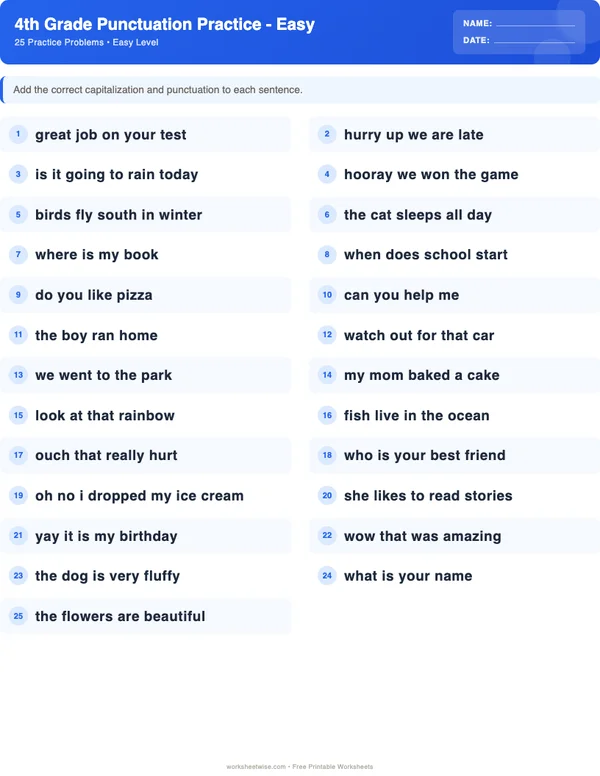
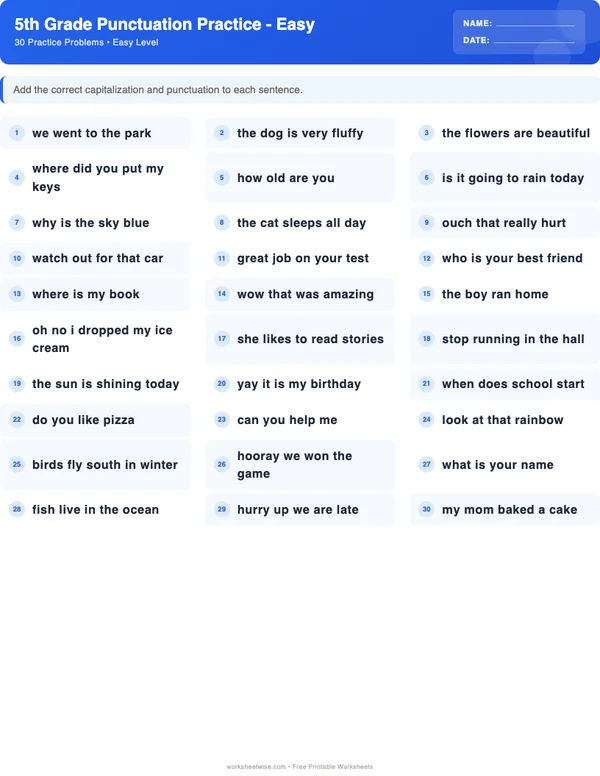
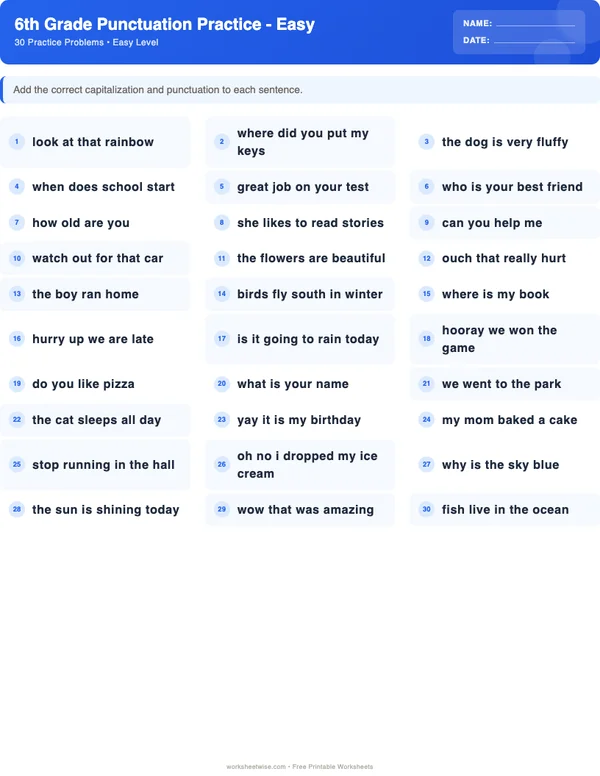
A useful practice loop
Print less. Observe more.
- Choose one skill and model the first item aloud.
- Use a short set and notice the learner’s strategy.
- Change the next task from the work you can see.
Need more than the free sheet?
Plus includes all 126 matching catalogue variations where available, plus saved deterministic generators and the worksheet designer.
See Plus membershipComplete guide
How to teach and practise punctuation worksheets
3,381 words Updated 6 instructional visuals
Choose punctuation practice by the decision a learner must make
The right punctuation worksheet is not simply the one carrying the learner’s grade label. Choose it by examining the work the learner must do: hear how a sentence ends, select one mark from a small set, apply a named comma rule, distinguish an apostrophe’s two jobs, format dialogue, or edit a paragraph containing several possible errors.
The live WorksheetWise catalogue contains 126 punctuation variants across seven grade combinations, from Kindergarten through 6th Grade. Each grade has one free entry sheet. Kindergarten through 2nd Grade sheets contain 12 problems, 3rd and 4th Grade sheets contain 14, and 5th and 6th Grade sheets contain 30. These counts describe practice volume, not instructional quality or learner readiness.
Start with end punctuation and speech. A period usually accompanies a steady drop in the reader’s voice, a question mark a rising question, and an exclamation point a strong or emphatic delivery. Then introduce comma rules separately, followed by apostrophes, quotation marks, and increasingly independent editing.
Grade labels describe the intended practice level; local curriculum sequences differ. Age, when shown elsewhere in a learning context, should be treated as a discovery aid rather than a placement decision. For ages three and four, prioritize brief, adult-led oral, matching, manipulative, and movement activities over desk work.
What punctuation understanding includes
Punctuation is a system of marks that helps a reader interpret sentence boundaries, relationships, interruptions, ownership, omitted letters, and spoken words. Learning it involves more than remembering the names of symbols. A learner must connect a mark to a purpose, notice the part of the sentence controlled by the rule, and explain why the mark belongs there.
That creates three related but distinct kinds of work:
- Recognition: identify a period, question mark, comma, apostrophe, or quotation mark.
- Application: add a mark when the relevant rule is already clear.
- Editing: decide whether a mark is missing, incorrect, or unnecessary when no rule has been named.
A recognition worksheet may ask a learner to circle the correct ending for “Where is my hat.” An application task may say, “Add commas to the list.” An editing task may present several sentences or a paragraph without identifying which punctuation needs attention. Success at the first task does not automatically establish success at the third.
The IES foundational reading practice guide emphasizes explicit instruction and supported practice in foundational language work. Applied here, that supports an adult modeling the connection between spoken expression and printed marks before asking for independent choices. This is general instructional guidance; it is not an evaluation of WorksheetWise resources.
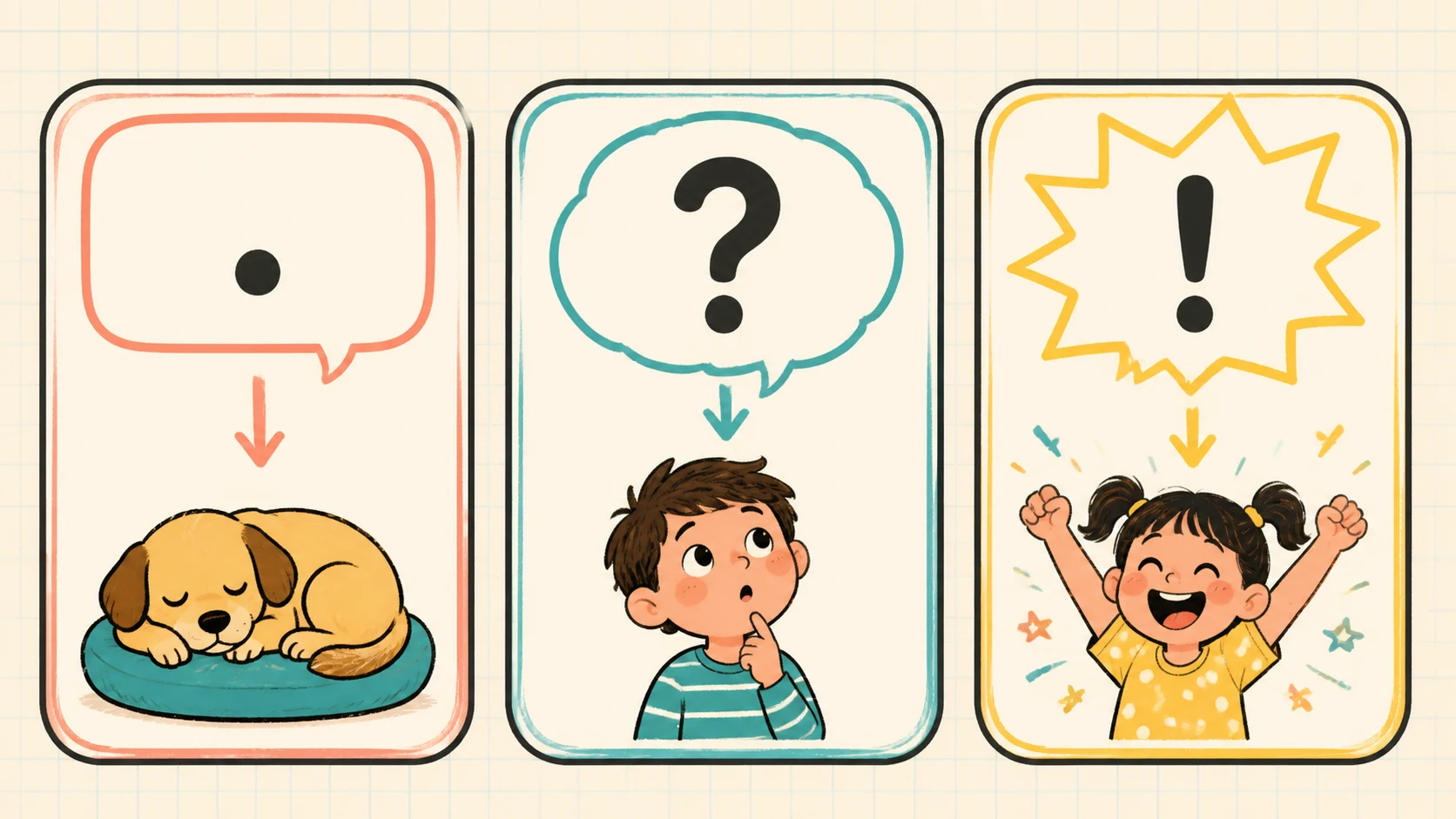
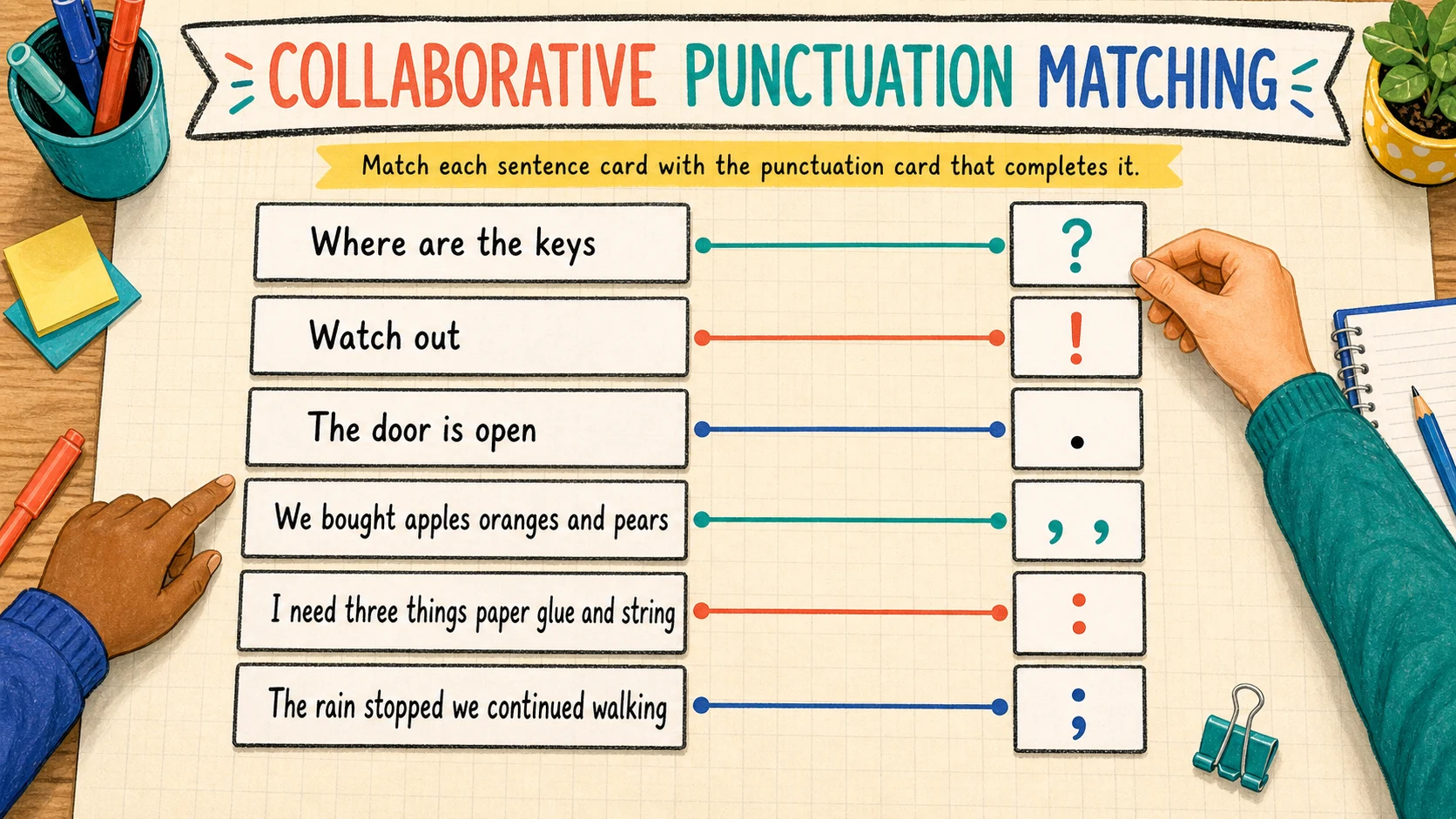
The early-grade map keeps the first decisions visible: hear the sentence, identify its purpose, and select the matching end mark.
A useful progression across all seven grade combinations
The catalogue’s grade sequence provides seven real starting points. It should be read as a progression of intended practice—not as seven fixed developmental stages.
Kindergarten: connect voice, meaning, and the final mark
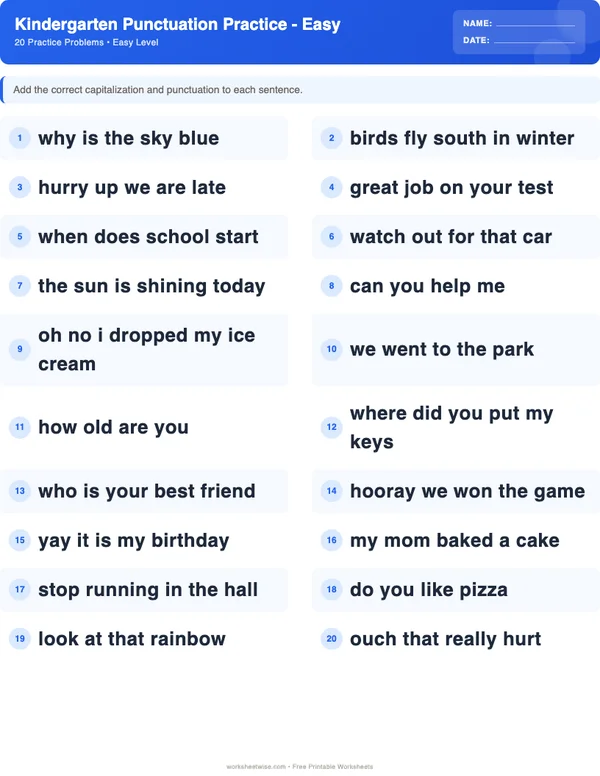
The Kindergarten entry point has 12 problems and is labeled “easy” in the catalogue. Define that level through its observable task features: short items, a narrow set of end marks, obvious sentence purposes, limited reading load, and one decision per item.
Begin away from the page. Read “The puppy is sleeping” with a steady ending. Read “Is the puppy sleeping?” with a rising question. Read “The puppy is sleeping!” with delighted emphasis. Ask the learner to hold up a period, question-mark, or exclamation-point card.
Keep an important boundary in view: volume alone does not determine punctuation. An exclamation point signals emphatic meaning, not merely shouting, and a question mark belongs to a direct question even if it is spoken quietly.
Use the Kindergarten Punctuation guide and free sheet after the learner can match several spoken sentences to marks with adult support.
1st Grade: identify and complete sentence endings
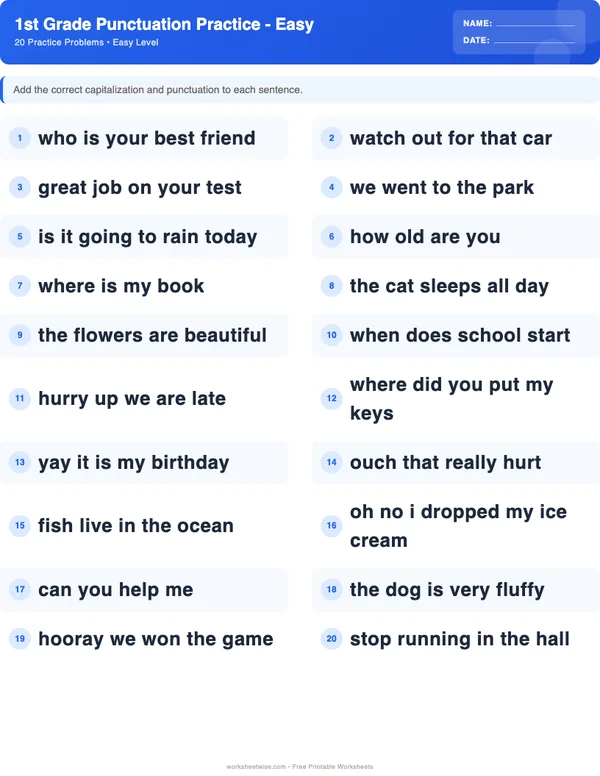
The 1st Grade entry point also contains 12 problems. Representation can now move from spoken sentences and mark cards to printed sentences with a missing ending. The central decision remains narrow: statement, question, or exclamation?
Checked example 1
Can you see the moon___
Correct answer: Can you see the moon?
This belongs at an early level because the learner needs to recognize a direct question and supply one end mark. It does not also demand comma knowledge, dialogue formatting, or error correction elsewhere in the sentence. Read it first with a rising voice, then compare it with “You can see the moon.” The wording changes the sentence purpose; the mark records that purpose.
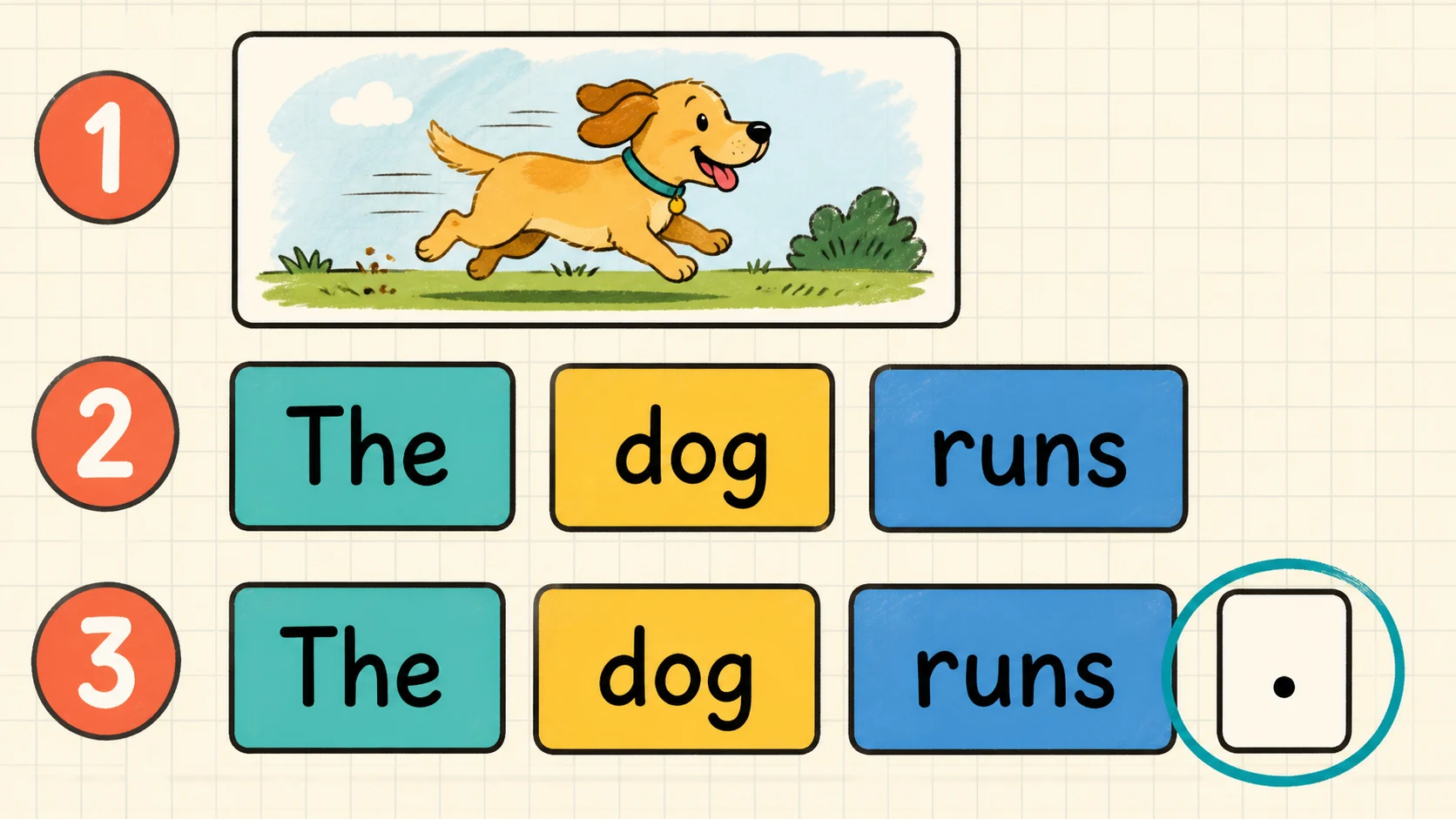
The worked example shows the important transition from hearing a sentence’s purpose to recording the corresponding end mark.
2nd Grade: add one clearly named convention at a time
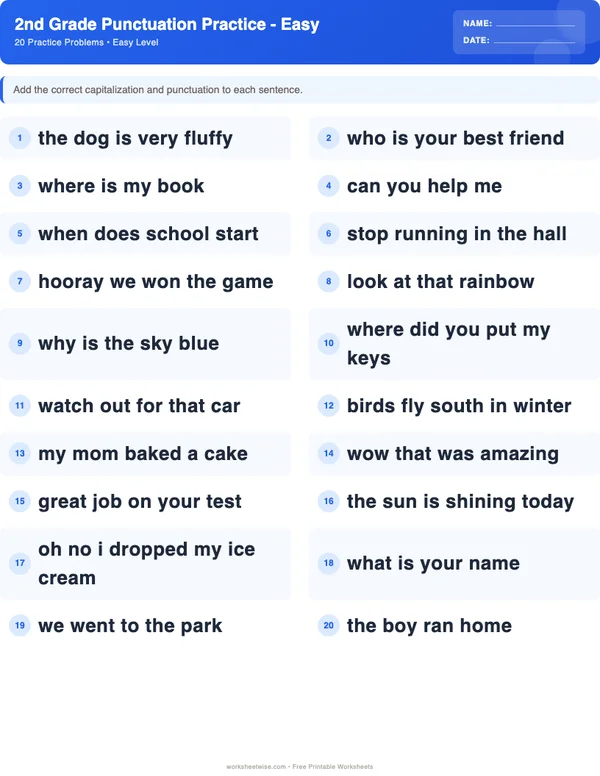
The 2nd Grade free sheet contains 12 problems. A useful next boundary is between end punctuation and internal punctuation. Continue reviewing sentence endings, but introduce one comma use without mixing it immediately with every other comma rule.
A practical order is:
- commas in a list;
- commas in dates;
- commas before a coordinating conjunction in a compound sentence;
- commas after introductory elements.
Checked example 2
I packed a shirt pants and socks.
Corrected sentence: I packed a shirt, pants, and socks.
This is a list of three items, so commas separate the items. The example belongs near the beginning of comma work because every comma performs the same visible job. Do not use it to teach compound sentences at the same time. A learner who inserts only the second comma may understand that a pause belongs before “and” but not yet see that commas separate all three list items.
The 2nd Grade Punctuation guide and free sheet is a sensible trial when the learner handles most end-mark choices but needs focused practice with internal marks.
3rd Grade: separate apostrophe meanings and begin short editing
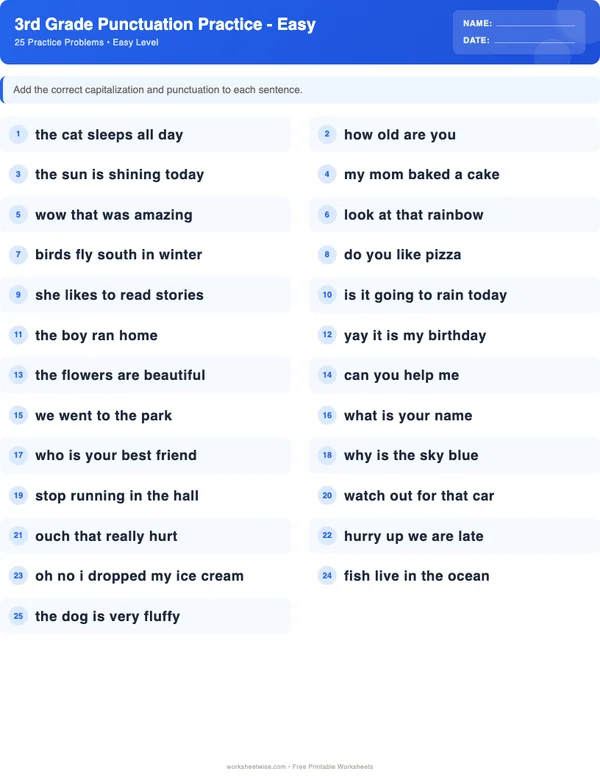
The 3rd Grade free entry contains 14 problems. At this point, question design can require the learner to inspect a word rather than only a sentence boundary. Apostrophes are especially useful because they represent two meanings that must remain distinct.
Checked example 3
can't = can + notthe dog's bone = the bone belonging to the dog
Both forms contain an apostrophe, but the reasoning differs. In can't, the apostrophe marks omitted letters from not. In dog's, it helps show possession: the bone belongs to one dog. This comparison belongs at an intermediate point because the learner must classify the apostrophe’s job from meaning, not merely notice its shape.
Ask, “Are letters missing, or does something belong to someone?” That question is more useful than telling the learner to “put in an apostrophe.”
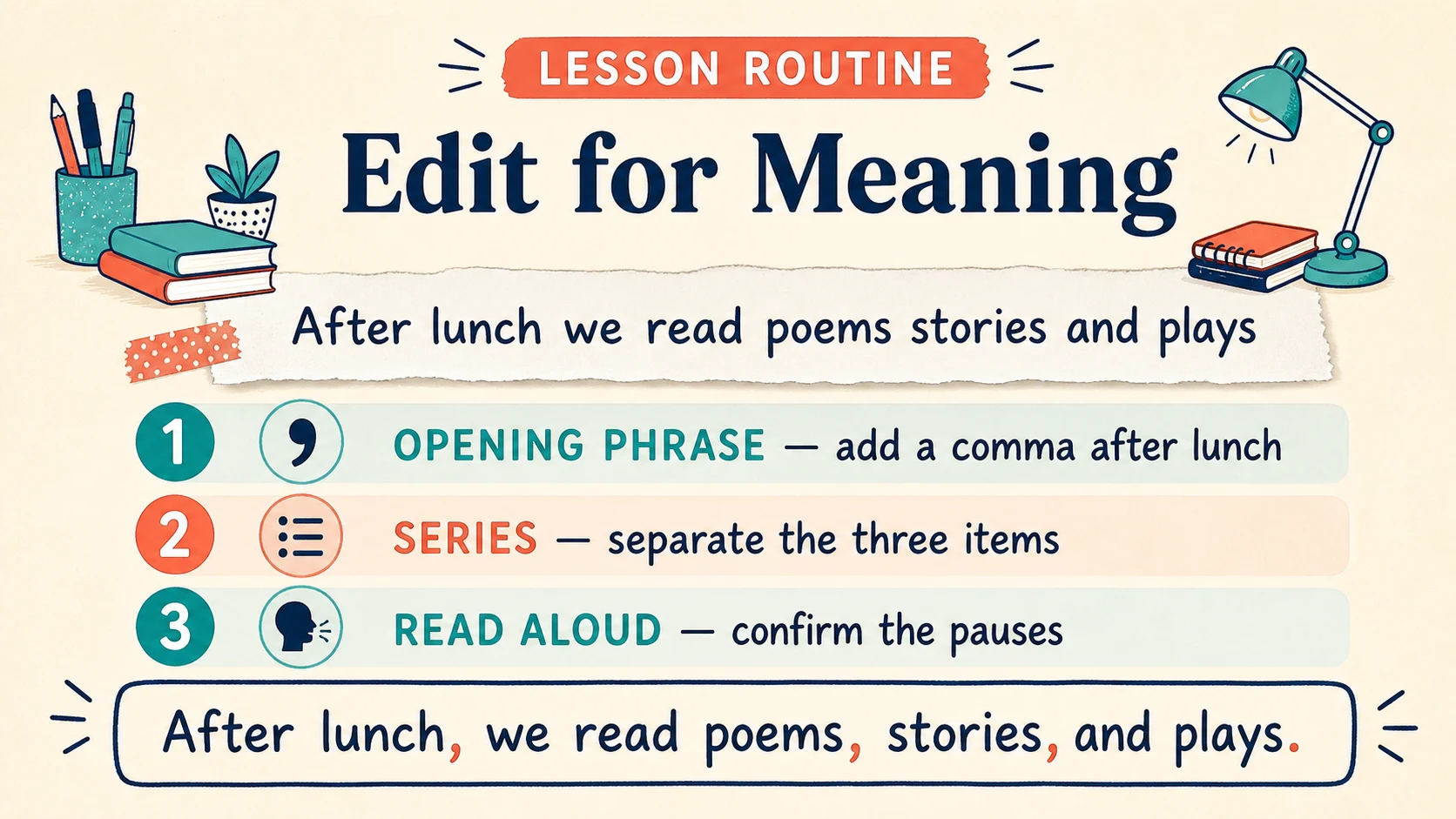
The 3rd Grade routine alternates explicit comparison, a small set of decisions, and explanation rather than treating all apostrophes as one pattern.
4th Grade: format already-written dialogue
The 4th Grade free sheet contains 14 problems. A suitable task boundary is the move from punctuating individual sentences to coordinating several conventions in dialogue. Teach the format explicitly before requesting original dialogue:
- Start a new line when the speaker changes.
- Use quotation marks around the spoken words.
- Place a comma before the closing quotation mark when a following dialogue tag completes the sentence.
- Keep the spoken sentence’s end punctuation inside the closing quotation mark.
Checked example 4
Unpunctuated:
Maya said I found the key
Leo asked Where was it
Corrected:
Maya said, “I found the key.”
Leo asked, “Where was it?”
The period and question mark remain inside the quotation marks. The second line uses a question mark because Maya’s location is being asked directly. This example belongs here because the spoken words are already provided; the learner can concentrate on dialogue punctuation without simultaneously inventing characters, content, and sentence structure.
The 4th Grade Punctuation guide and free sheet is therefore a better choice than an early end-mark page when the learner can punctuate ordinary sentences but loses track of marks around quoted speech.
5th Grade: coordinate comma rules in longer sentences
The 5th Grade entry sheet increases to 30 problems. The additional item count means a longer practice set, not proof of greater conceptual difficulty in every item. Inspect whether the page names a comma rule, mixes several rules, or asks for open editing.
Checked example 5
After dinner we played games.
Corrected sentence: After dinner, we played games.
The comma follows the introductory element After dinner. This is different from I ran fast, but she was faster, where the comma helps join two independent clauses with but. It is also different from list punctuation. The visible mark is the same; the grammatical reason changes.
This example belongs later in the progression because a learner must locate the main clause and recognize that the opening phrase sets the time. If the learner adds a comma after played, the issue is not simply “forgetting commas.” The learner may be responding to a perceived speaking pause without identifying the introductory element.
6th Grade: edit mixed punctuation in context
The 6th Grade free entry also has 30 problems. A productive upper boundary is independent editing: the prompt no longer announces which rule is needed, and a short passage may contain end punctuation, commas, apostrophes, and quotation marks.
Checked example 6
Unpunctuated:
On March 6 2026 Lena packed pencils paper and chalk but she couldnt find the rulers
Corrected:
On March 6, 2026, Lena packed pencils, paper, and chalk, but she couldn't find the rulers.
The first two commas punctuate a date used within a sentence. The next two separate a three-item list. The comma before but separates two independent clauses: “Lena packed…” and “she couldn’t find….” The apostrophe in couldn't marks omitted letters from not. This belongs at an upper level because the learner must detect and explain several rules without being told where each applies.
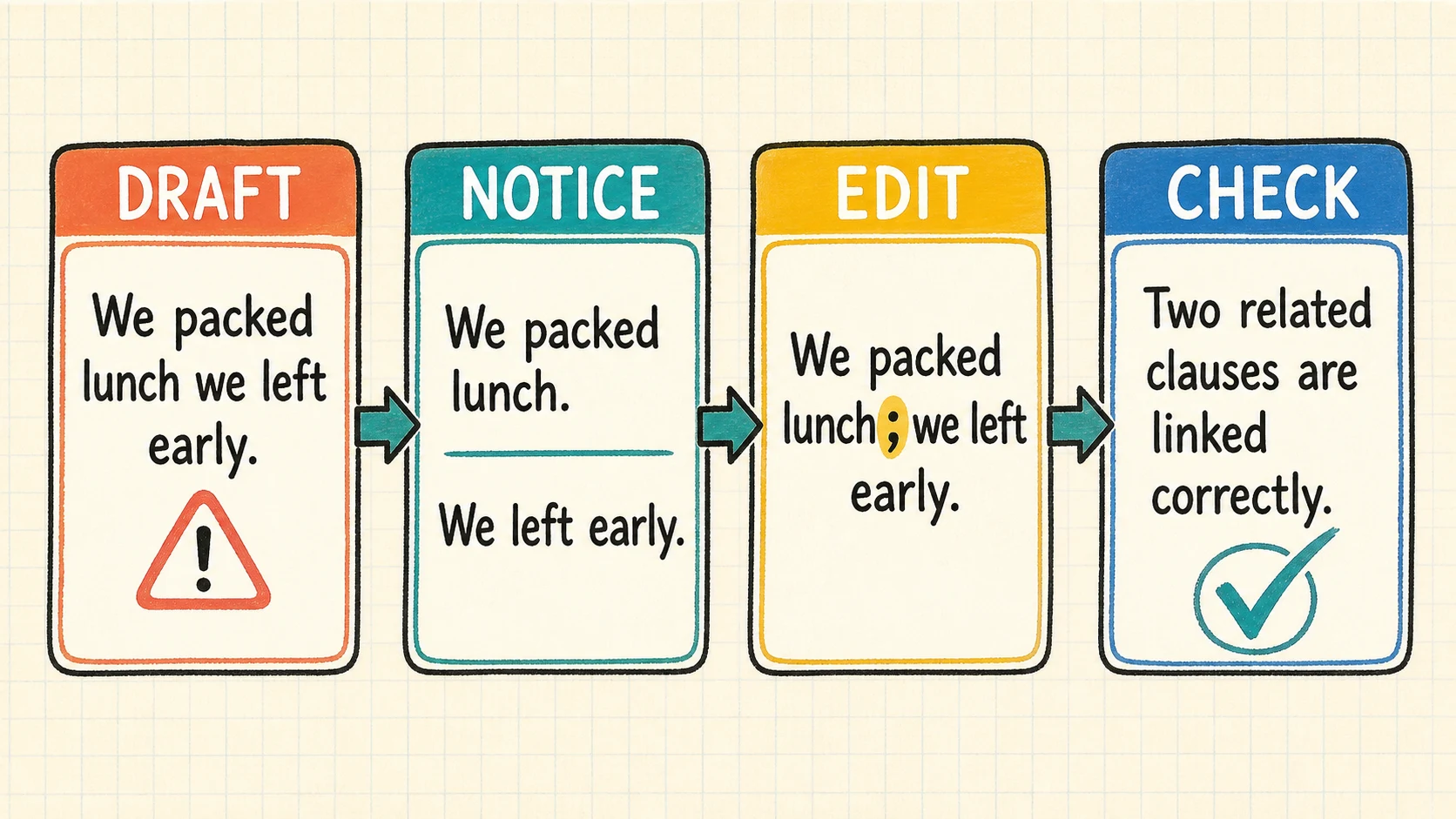
The upper-level progression changes the amount of supplied support: named-rule items come before mixed sentences and unprompted paragraph editing.
How representation and question design change
Difficulty should be defined by observable features of the task, never attached to the learner. The catalogue labels all seven free sheets “easy,” but that label alone cannot show what a particular item requires. Examine the page itself.
From sound and symbols to full sentences
A more supported representation might provide three large end-mark choices beside one short sentence. A less supported representation might remove the choices, use longer sentences, or place several errors in a paragraph. Reading load matters because a learner cannot demonstrate punctuation reasoning if decoding the sentence consumes the entire effort.
Representation also changes the kind of evidence you receive. Matching a spoken question to a card shows recognition. Writing a question mark after a printed sentence adds handwriting and print tracking. Correcting a paragraph adds scanning, rule selection, and the need to decide when no change is required.
From one named rule to competing possibilities
Question design becomes more demanding when it:
- removes a rule label;
- includes correct marks that must be left unchanged;
- asks for multiple mark types;
- contains more than one sentence;
- requires an explanation;
- asks the learner to apply the convention in original writing.
Do not skip directly from a list-comma drill to a paragraph containing dialogue, contractions, dates, and compound sentences. If the paragraph goes poorly, the result will not reveal which convention needs teaching.
The Common Core English Language Arts standards organize language conventions across grades and include increasingly varied punctuation expectations. They can help adults inspect the type of convention represented in a task, but local sequences and terminology differ. A WorksheetWise grade label should not be treated as proof of standards alignment.
Select the next worksheet with a short evidence check
Identify the smallest unsettled decision
Give three to five oral or printed examples before choosing a page. Ask the learner to answer and explain one choice. Listen for the rule being used.
Choose by this sequence:
- If sentence purpose is unclear, return to spoken statements, questions, and exclamations.
- If purpose is clear but the written mark is not, use end-mark matching or completion.
- If end marks are stable, select one comma context.
- If apostrophes are being inserted in every plural, contrast contractions with possession.
- If dialogue marks are misplaced, provide already-written speech for formatting.
- If individual rules are accurate but mixed writing is not, use short editing passages.
A lower grade label can be the correct starting point for a focused gap, while a higher grade page may be appropriate for a learner who can explain and edit the earlier conventions. That is a task selection decision, not a judgment about the learner.
Compare workload as well as content
The Kindergarten, 1st Grade, and 2nd Grade free sheets each contain 12 problems. The 3rd and 4th Grade sheets each contain 14. The 5th and 6th Grade sheets each contain 30. If attention or handwriting endurance would obscure the target skill, fold the paper, cover later items, or complete a small section at a time. Preserve the punctuation decision even when reducing the visible workload.
The full worksheet library can be used to compare nearby levels. Look for the page whose examples require one achievable next decision—not merely the page with the closest age or grade label.
Use a routine that makes reasoning audible
A five-step punctuation lesson
A short session can follow this repeatable routine:
- Read: The adult reads one sentence with meaningful expression.
- Notice: The learner identifies the voice cue or sentence structure.
- Name: Together, state one rule in plain language.
- Mark: The learner adds or selects punctuation.
- Explain: The learner points to the words controlled by the rule.
For end punctuation, try the same words with different intentions: “You finished.” “You finished?” “You finished!” Discuss how the reader’s interpretation changes. Do not teach the marks as interchangeable decorations.
For a comma lesson, keep the rule constant. On a list day, use lists in several contexts but avoid introducing dates and compound sentences as new material. On a dialogue day, provide the spoken words and focus on line breaks, quotation marks, commas, and internal end punctuation.
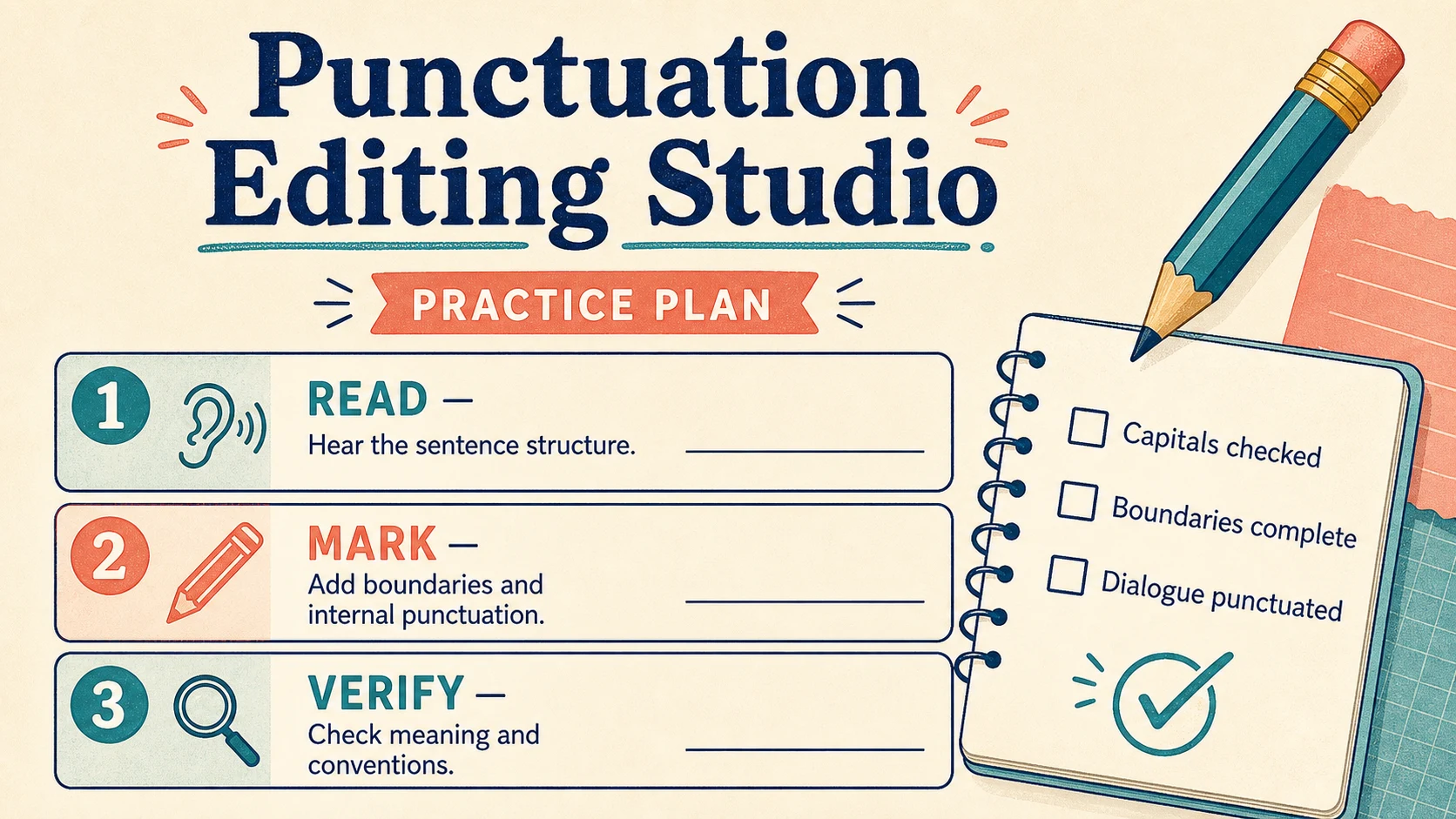
The two-week plan spaces review while keeping each day’s punctuation decision narrow enough to interpret.
Move from a mentor sentence to an edit
Select one sentence from a book being read aloud and ask what its punctuation tells the reader. This is a teaching suggestion, not a sourced claim about a particular title. Keep the discussion confined to a convention the learner has already encountered; a visually complicated sentence is not automatically a useful model.
Then present an unpunctuated sentence modeled on the same structure. Finally, ask the learner to find one relevant example in their own writing. The IES elementary writing practice guide recommends explicit strategy teaching, guided practice, feedback, and opportunities to write. In punctuation instruction, that supports connecting a modeled convention to editing and composition. The guide did not assess WorksheetWise.
The 6th Grade routine centers on editing, justification, and transfer because choosing the rule is part of the task.
Interpret errors before adding more practice
An incorrect mark is evidence about a decision, but it is not a diagnosis.
End-mark substitutions
If the learner writes a period after every sentence, read the items aloud and ask which ones request information. The learner may understand the symbols but not yet distinguish sentence purposes in print.
If every excited sentence receives an exclamation point, compare emphasis with sentence type. “Did we win?” can be spoken excitedly and still requires a question mark because it asks a direct question.
Commas placed wherever the reader pauses
A pause-based explanation is insufficient because speech rhythms vary. Ask the learner to identify the list items, the parts of the date, the two complete clauses, or the introductory element. If the learner cannot name the controlled structure, return to a single comma rule.
For I ran fast, but she was faster, check both sides: I ran fast and she was faster can each stand as a sentence. That supports the comma before but. Do not generalize this into “put a comma before every but.”
Apostrophes added to ordinary plurals
If a learner writes three dog's, ask whether letters are missing or ownership is being shown. Neither is true in the ordinary plural three dogs, so no apostrophe is needed. Contrast it with three dogs' bowls only after singular possession is secure; plural possession adds another decision.
Dialogue punctuation drifting outside the quotes
Do not immediately ask for more original dialogue. Return to already-written lines and color-code the spoken words, quotation marks, dialogue tag, and end punctuation. Once the learner reliably formats supplied dialogue, ask for two original lines with a speaker change.
Record the error pattern in specific language: “correctly identifies questions but omits the written question mark” is actionable. “Bad at punctuation” is not.
Adapt access without changing the punctuation target
Adaptations should remove unrelated barriers while preserving the decision being assessed.
For a learner with a heavy reading load, read the sentence aloud while leaving the punctuation blank. If the target is choosing the end mark, adult reading does not supply the answer when expression is kept neutral or deliberately compared.
For handwriting difficulty, offer punctuation cards, stamps, movable symbols, pointing, or verbal choices. The learner should still decide which mark belongs and why.
For visual crowding, reveal one item at a time or enlarge the print. For attention limits, divide a 30-problem sheet into short sets and revisit the same rule later. For multilingual learners, preteach unfamiliar vocabulary so the punctuation decision is not hidden by one unknown word.
For ages three and four, use brief adult-led oral, matching, manipulative, and movement work: walk to a period card after hearing a statement, raise a question-mark card after a question, or match symbols to expressive readings. Desk completion should not be the priority at those ages.
Do not “adapt” a comma task by telling the learner exactly where every comma goes. That removes the target decision. Model one item, complete one together, and then allow an independent attempt.
Boundaries of what a worksheet can establish
A worksheet can show how a learner responded to the items presented under particular conditions. It cannot establish a diagnosis, prove broad writing proficiency, or guarantee that the learner will use the same conventions in original composition.
Correct answers may reflect recognition of a repeated pattern rather than flexible understanding. Incorrect answers may reflect reading difficulty, unfamiliar vocabulary, fatigue, handwriting demands, or unclear directions rather than a punctuation misconception. Confirm the pattern with a brief oral example and one transfer sentence.
The catalogue facts establish available grades, resource counts, problem counts, and topic descriptions. They do not establish research outcomes, reviews, learner gains, universal curriculum placement, or the effectiveness of one worksheet over another. Suggestions in this guide—such as using mark cards, color-coding dialogue, or dividing a longer sheet—are practical instructional options, not claims drawn from a WorksheetWise study.
Turn one free sheet into the next teaching decision
Choose one real grade entry that matches the smallest unsettled punctuation decision. If the learner is beginning with sentence purpose, open the 1st Grade Punctuation guide and free sheet. Read the first three sentences aloud, let the learner select each end mark, and ask, “What did the sentence do—tell, ask, or exclaim?”
Record one observable next action from the response:
- If the learner identifies the sentence purpose but selects the wrong symbol, practice mark matching.
- If the learner selects correctly only after expressive reading, repeat the voice-to-mark routine with new sentences.
- If the learner selects and explains all three independently, move to the next relevant convention rather than repeating the whole page.
That single check gives you a defensible next step: teach the decision that remains unsettled, then select the nearby worksheet whose task features require that decision and no unnecessary leap.
Put it into practice
Use the guide with a real printable
Move from explanation to a short, observable practice task. Check the first item together, then adjust the next session from the learner's actual work.
Open the first free worksheetExplore a neighboring collection
Choose by a different teaching need
Addition Worksheets by Grade and Level Consonant Blends Worksheets by Grade and Level Counting Worksheets by Grade and Level CVC Words Worksheets by Grade and Level Decimals Worksheets by Grade and Level Digraphs Worksheets by Grade and Level Division Worksheets by Grade and Level Fractions Worksheets by Grade and Level