Curated collectionAnswer keys includedPrint-ready PDFs
Geometry Worksheets by Grade and Level
Show the full geometry progression across 7 real grade combinations, compare task boundaries, model checked examples and explain how to choose the next level.
Start with a real resource
Browse this worksheet collection
7 relevant free entry points are available. Each one includes a printable learner PDF and separate answer key.
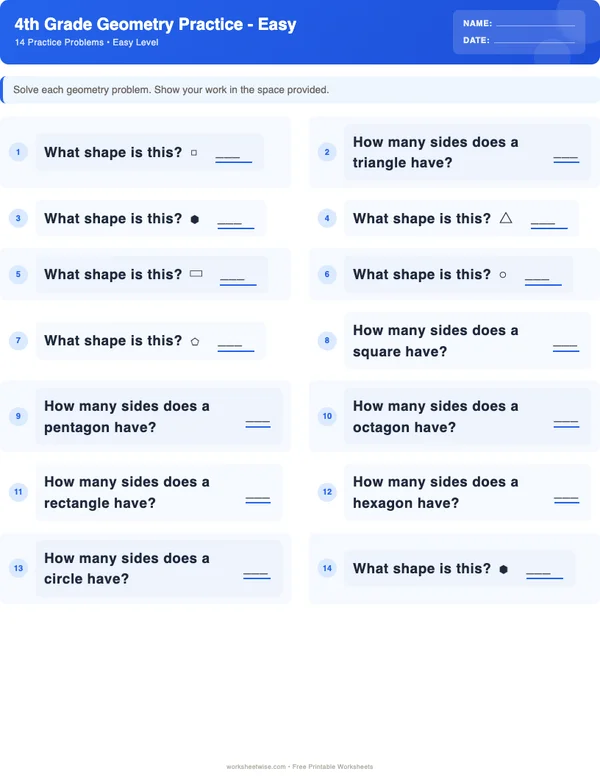
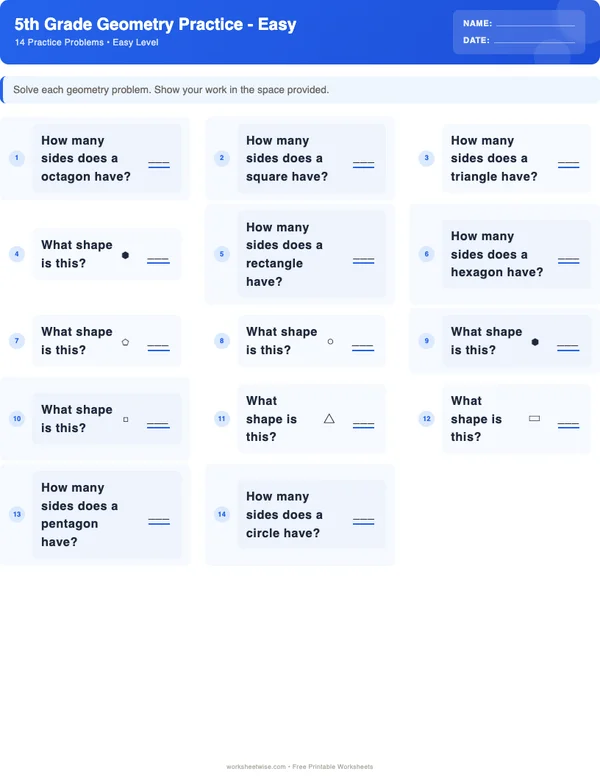
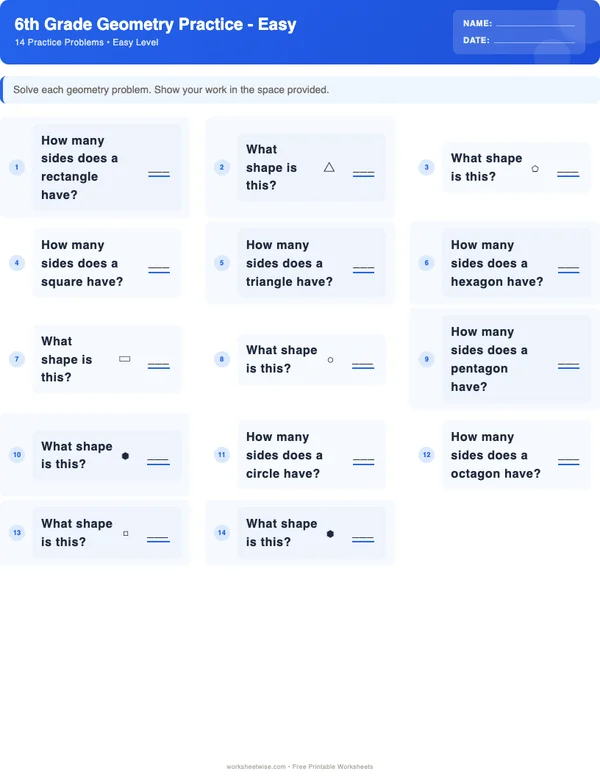
A useful practice loop
Print less. Observe more.
- Choose one skill and model the first item aloud.
- Use a short set and notice the learner’s strategy.
- Change the next task from the work you can see.
Need more than the free sheet?
Plus includes all 126 matching catalogue variations where available, plus saved deterministic generators and the worksheet designer.
See Plus membershipComplete guide
How to teach and practise geometry worksheets
3,295 words Updated 6 instructional visuals
Choose Geometry Work by What the Learner Must Do
The right geometry worksheet is the one that asks for the next useful action—not simply the one carrying the learner’s grade label. Across WorksheetWise’s seven grade combinations, the broad progression moves from recognizing and composing shapes to describing attributes, reasoning about area and perimeter, measuring angles, plotting coordinates, and analyzing transformations. The live catalogue contains 126 variants and seven free entry points, one each for Kindergarten through 6th Grade.
Start by watching the learner complete two or three representative tasks. Can the learner recognize a triangle after it has been turned? Can they explain why a square belongs to more than one shape category? Can they distinguish the space inside a rectangle from the distance around it? The answer identifies a more useful starting point than age alone.
Grade labels describe intended practice levels; local curriculum sequences differ. Age, when used during discovery, is an aid rather than a placement decision. In particular, work with ages three and four should prioritize brief adult-led oral, matching, manipulative, and movement activities over desk work. A child can sort solid objects, trace a large circle in the air, or build a shape before completing a printed page.
All seven free catalogue sheets are labeled “easy,” but that label should describe the task rather than the learner. Here, interpret an easier entry point as one with familiar representations, direct instructions, limited calculation, and little need to coordinate several properties at once. Inspect the actual questions before choosing. A page becomes more demanding when figures are rotated, irrelevant information appears, classifications overlap, measurements must be derived, or an explanation is required.
What Elementary Geometry Includes
Geometry is the study of shape, position, size, spatial relationships, and change. For an elementary learner, that definition becomes a connected set of actions:
- Recognize, sort, trace, build, and compose two- and three-dimensional shapes.
- Describe shapes using attributes rather than appearance alone.
- Partition and combine figures.
- Measure and reason about length, perimeter, area, angles, and volume.
- Locate points and figures on a coordinate grid.
- Analyze movements such as reflection, rotation, and translation.
These strands should not be treated as isolated vocabulary lists. A learner who builds two different rectangles with 12 tiles is simultaneously working with shape, multiplication structure, area, perimeter, and comparison. A learner who reflects a triangle on graph paper must attend to both the figure and its position.
The IES guide to teaching mathematics to young children recommends using developmental progressions, monitoring what children know, and helping them view and describe their world mathematically. That sourced guidance supports a progression from concrete action to pictures and language. The particular activities and selection decisions in this guide are editorial suggestions based on the supplied catalogue, not claims that IES evaluated WorksheetWise.
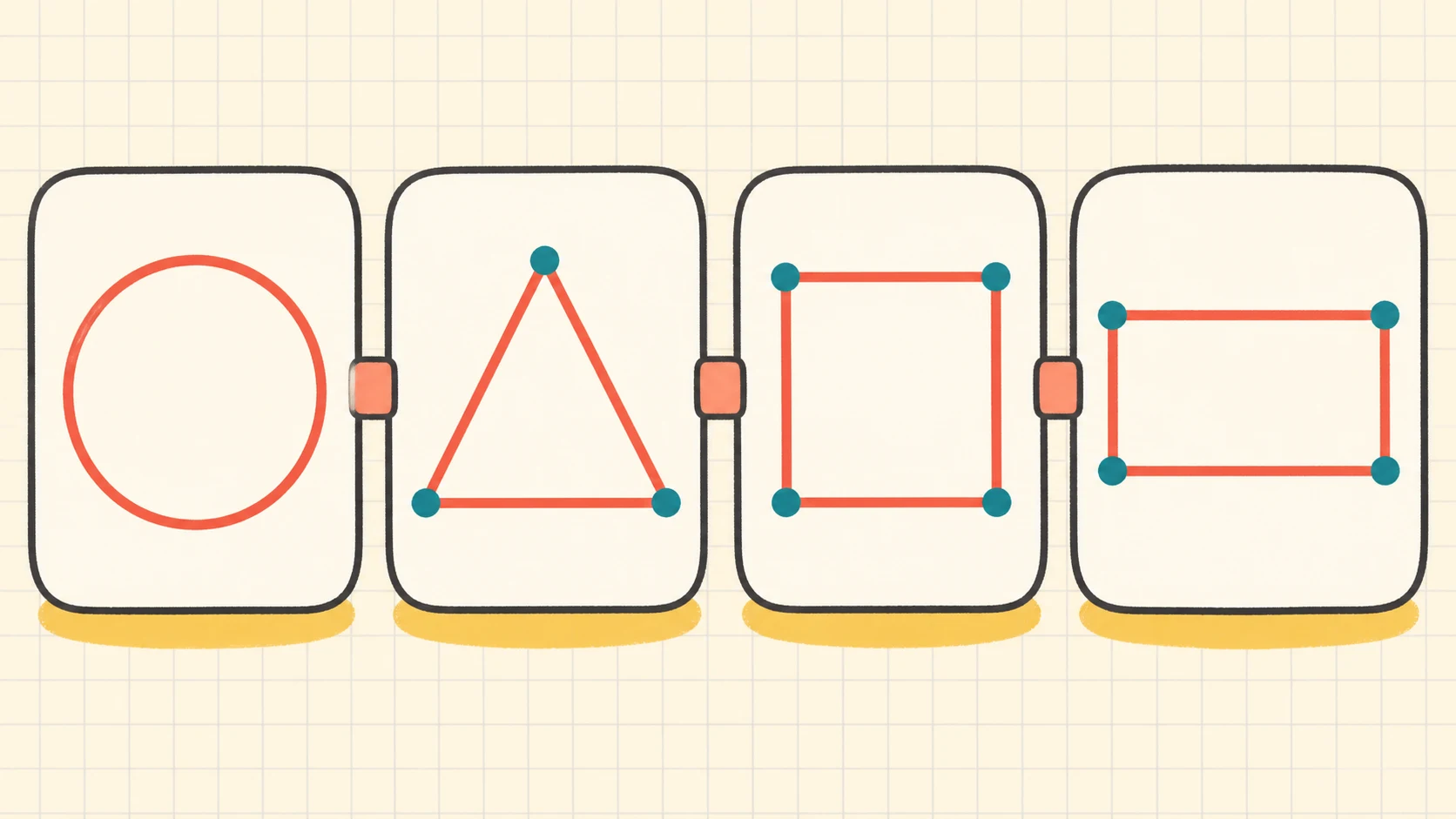
In the early progression, recognizing a figure, building it, and describing its visible attributes should remain connected.
The Seven Catalogue Starting Points
The seven grade combinations cover one subject and one topic—Math and Geometry—but the amount and expected kind of work change. Kindergarten, 1st Grade, and 2nd Grade free sheets each contain 20 problems. The 3rd and 4th Grade sheets contain 25. The 5th and 6th Grade sheets contain 30. Problem count affects session length, not conceptual difficulty by itself.
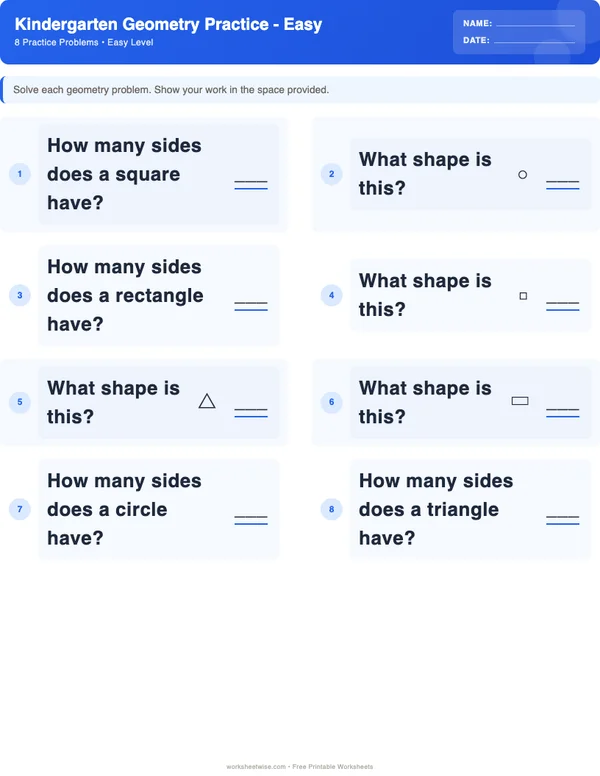
Kindergarten: recognize, match, and build
A suitable Kindergarten starting point emphasizes circles, triangles, rectangles, and other familiar figures in clear visual contexts. Include cubes, cones, cylinders, and spheres when real objects are available for comparison. Before asking a child to name a printed cylinder, let the child handle a can, roll it, and notice its flat circular ends.
Use the Kindergarten Geometry guide and free sheet when the learner can attend to a short picture task but still benefits from pointing, touching, sorting, and oral answers. Cover part of the page so only three or four questions are visible. A 20-problem sheet does not have to be completed in one sitting.
Do not accept position as a defining property. Present triangles pointing up, down, and sideways; use narrow, wide, right, and obtuse examples. Ask, “What remains true when I turn it?” rather than “Does this look like the triangle on the card?”
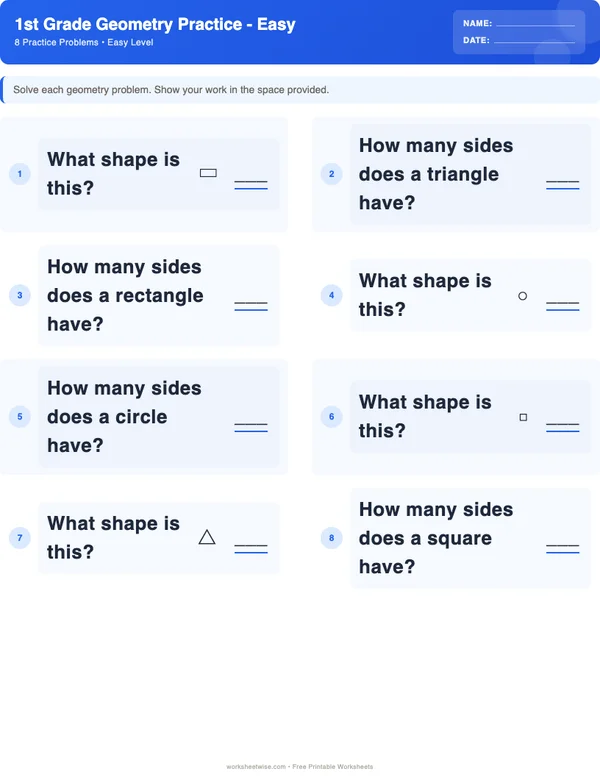
1st Grade: describe and compose
First-grade work should move beyond naming toward attributes and composition. A learner might count sides and vertices, distinguish flat figures from solid objects, or combine two triangles to make a larger figure. Pattern blocks, tangrams, cut paper, and geoboards preserve the spatial reasoning that a worksheet picture can otherwise hide.
The 1st Grade Geometry guide and free sheet is a useful entry point when the learner recognizes common shapes but gives appearance-based explanations such as “That is not a triangle because it is leaning.” Ask the learner to trace each side and mark each vertex. Then rotate the page and repeat the decision.
One checked example is a rotated right triangle. It still has exactly three straight sides and three vertices, so it remains a triangle regardless of which side is horizontal. This example belongs in early geometry because it reveals whether the learner is using defining attributes or memorizing a single prototype.
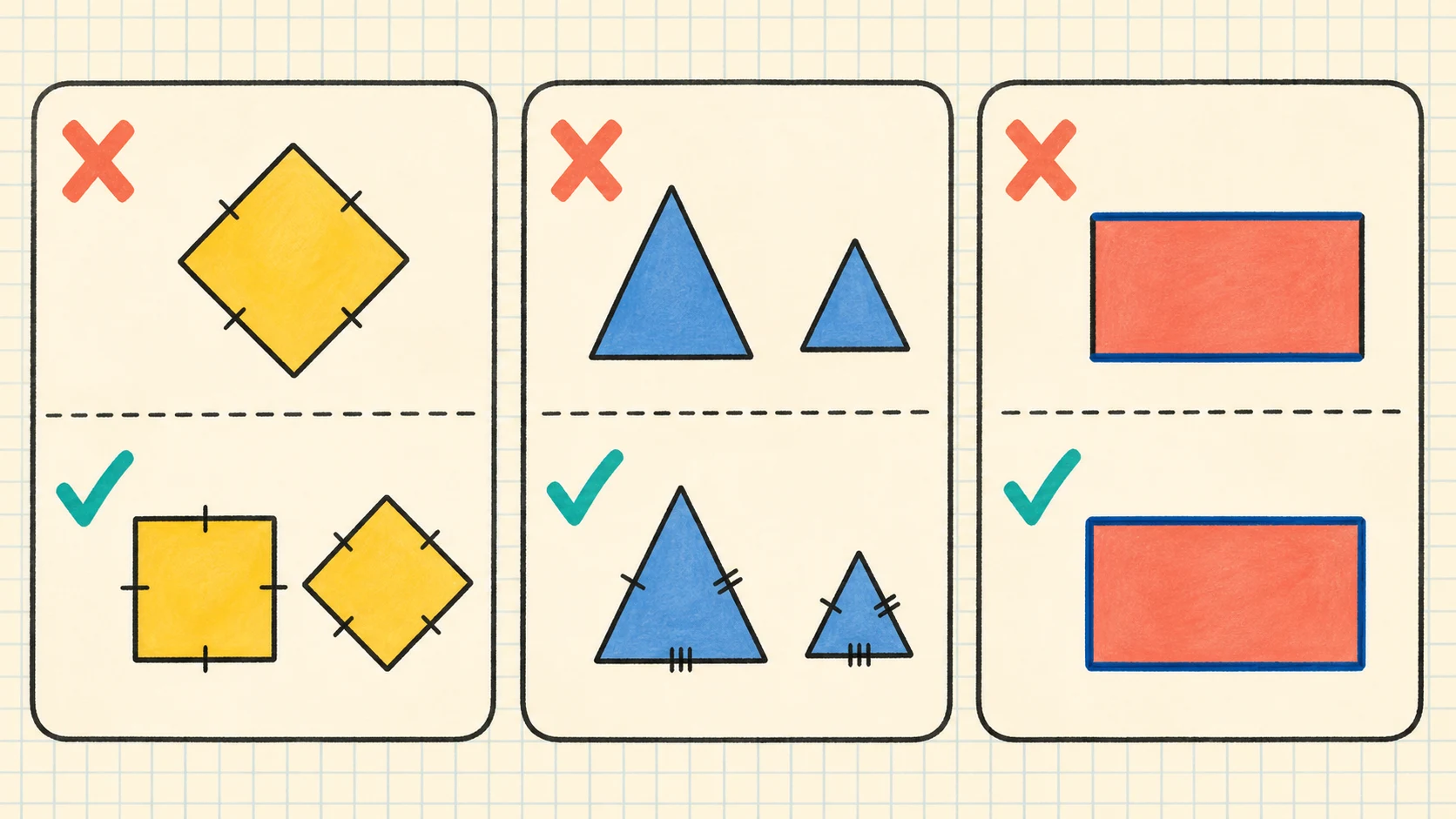
An early error is most useful when it leads to a specific test with shapes, not a broader judgment about the learner.
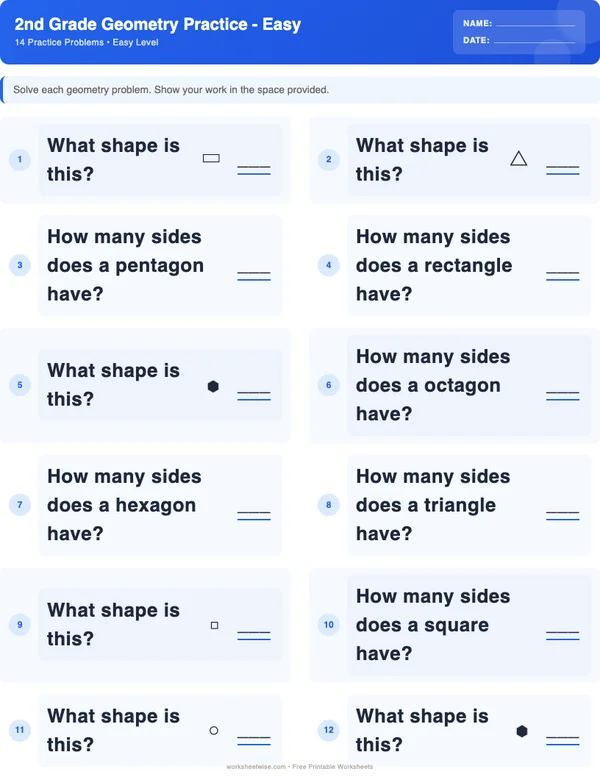
2nd Grade: classify and partition with greater precision
Second-grade practice can ask learners to identify shapes through stated properties, compose and partition figures, and discuss equal shares. The representation should still be strongly visual, but the question can demand more language: “Which figures have four sides?” is different from “Circle every rectangle.”
Choose the 2nd Grade Geometry guide and free sheet when the learner can name common figures in varied orientations and is ready to compare them. Include examples and non-examples. If every four-sided figure shown is a square, the question does not test whether the learner understands the broader class.
A productive boundary question is: “Is every square a rectangle?” Using the inclusive definition, yes: a square has four right angles and therefore meets the defining conditions for a rectangle; it also has four equal sides. “Is every rectangle a square?” No, because a rectangle can have unequal adjacent side lengths. This checked comparison belongs at the classification boundary because it requires properties, not visual resemblance.
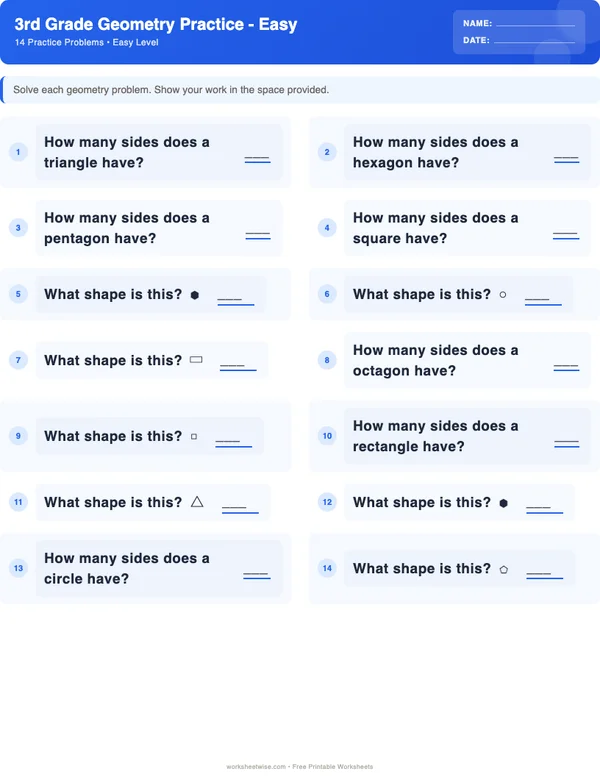
3rd Grade: connect tiled area with perimeter
Third-grade geometry provides an important transition from describing figures to measuring them. Begin with square tiles on a flat surface. The learner should build a rectangle, count the tiles covering it, and then count the unit lengths along its boundary. Only after those quantities are distinct should formulas compress the counting.
The 3rd Grade Geometry guide and free sheet contains a 25-problem free entry point. It is a sensible selection when the learner can count equal units and make rectangular arrays but needs to connect those arrays to area and perimeter.
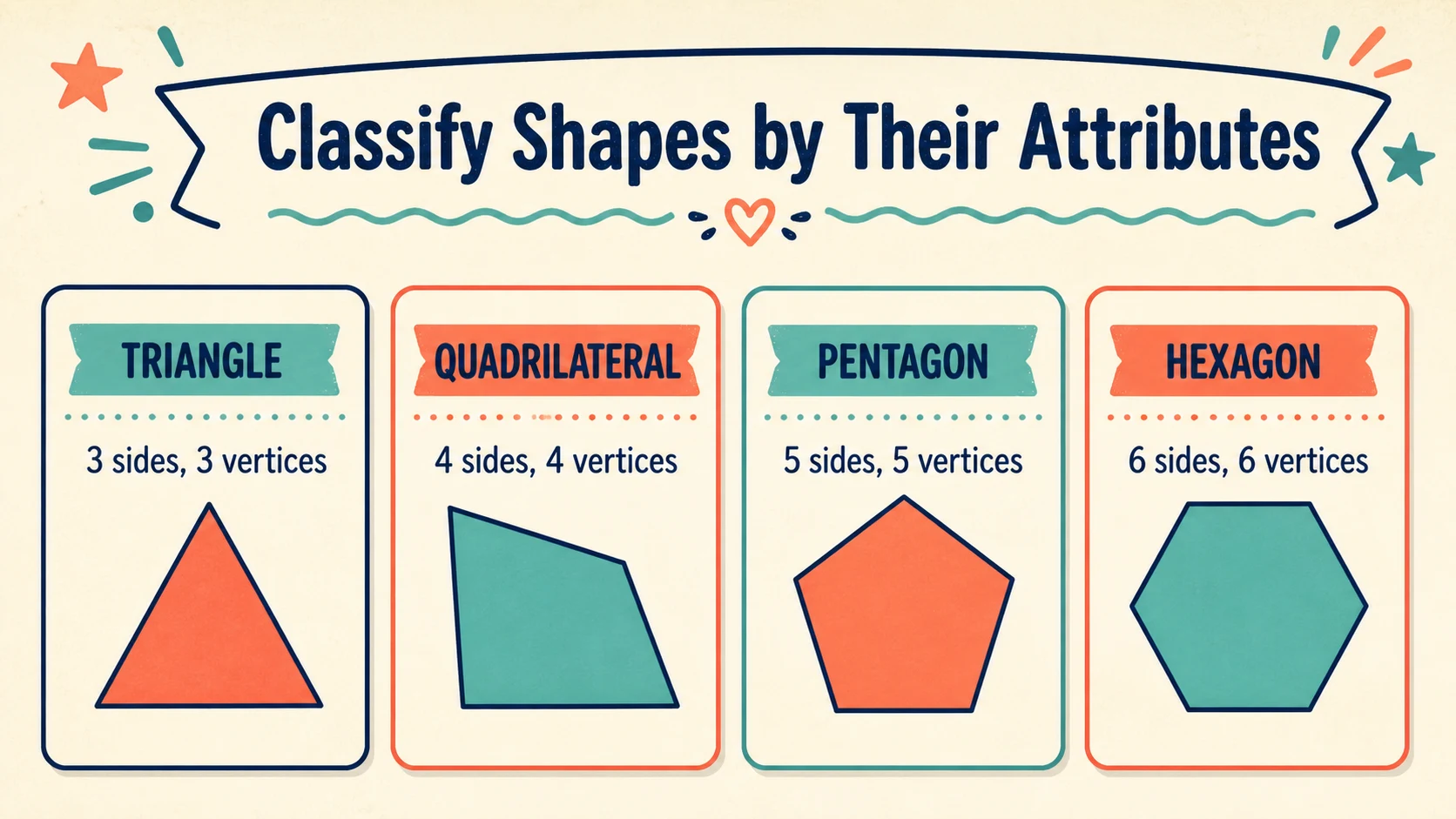
The middle-grade map clarifies why area, perimeter, attributes, and visual models should develop as connected forms of reasoning.
Here is a fully checked example using 12 square tiles:
- A rectangle has area square units and perimeter units.
- A rectangle also has area square units, but its perimeter is units.
- A rectangle still has area square units, while its perimeter is units.
The area remains constant because each construction uses all 12 tiles. The perimeters differ because the exposed boundary lengths differ. This example belongs here because it directly prevents the mistaken rule that equal areas must have equal perimeters.
4th Grade: measure angles and reason from properties
Fourth-grade practice can make angles explicit. A strong worksheet does more than ask learners to label acute, right, and obtuse angles by sight; it requires measurement, comparison, or reasoning about an unknown angle.
Begin away from the worksheet. Use a transparent protractor to measure the corner of a book and the angle made by an open door. Teach the physical decisions: place the center mark on the vertex, align the zero line with one ray, choose the scale that begins at zero on that ray, and read where the other ray crosses.
Select the 4th Grade Geometry guide and free sheet when the learner can identify an angle’s vertex and rays and is ready to measure rather than estimate alone. A diagram drawn out of scale should eventually be included so that the learner relies on given measures and relationships rather than appearance.
Checked example: two adjacent angles form a right angle. If one measures , the other measures . The check is . This belongs at the angle-reasoning boundary because the learner must combine geometric structure with subtraction.
5th Grade: coordinates, hierarchy, and volume
Fifth-grade work can coordinate several ideas at once: classifying figures through a property hierarchy, plotting points, and reasoning about volume with unit cubes. Graph paper is especially useful because it makes location and change visible.
Use the 5th Grade Geometry guide and free sheet when the learner can measure and classify individual figures and is ready to manage ordered pairs or multiple conditions. Its free entry point has 30 problems, so divide it into shorter sets when reasoning quality declines late in a session.
Checked coordinate example: plot , , , and . Horizontal side has length units, and vertical side has length units. The figure is a -by- rectangle, with area square units and perimeter units. This belongs in upper elementary geometry because the representation has changed from physical tiles to coordinate differences while preserving the same measurements.
6th Grade: derive, decompose, and transform
The 6th Grade catalogue entry is the seventh and highest supplied combination. Its free sheet has 30 problems. Appropriate work may require decomposing figures, reasoning about volume or area, plotting points, and analyzing transformations. The observable demand is greater when the learner must choose a method, carry information across a diagram, or justify why a result is invariant.
Checked example: a rectangle with vertices , , , and is translated by the rule . Its image has vertices , , , and . The side lengths remain 4 and 3 units, so the area remains square units and the perimeter remains units. This belongs at the 6th Grade boundary because the learner must apply a coordinate rule and identify what changes—position—and what does not—size and shape.
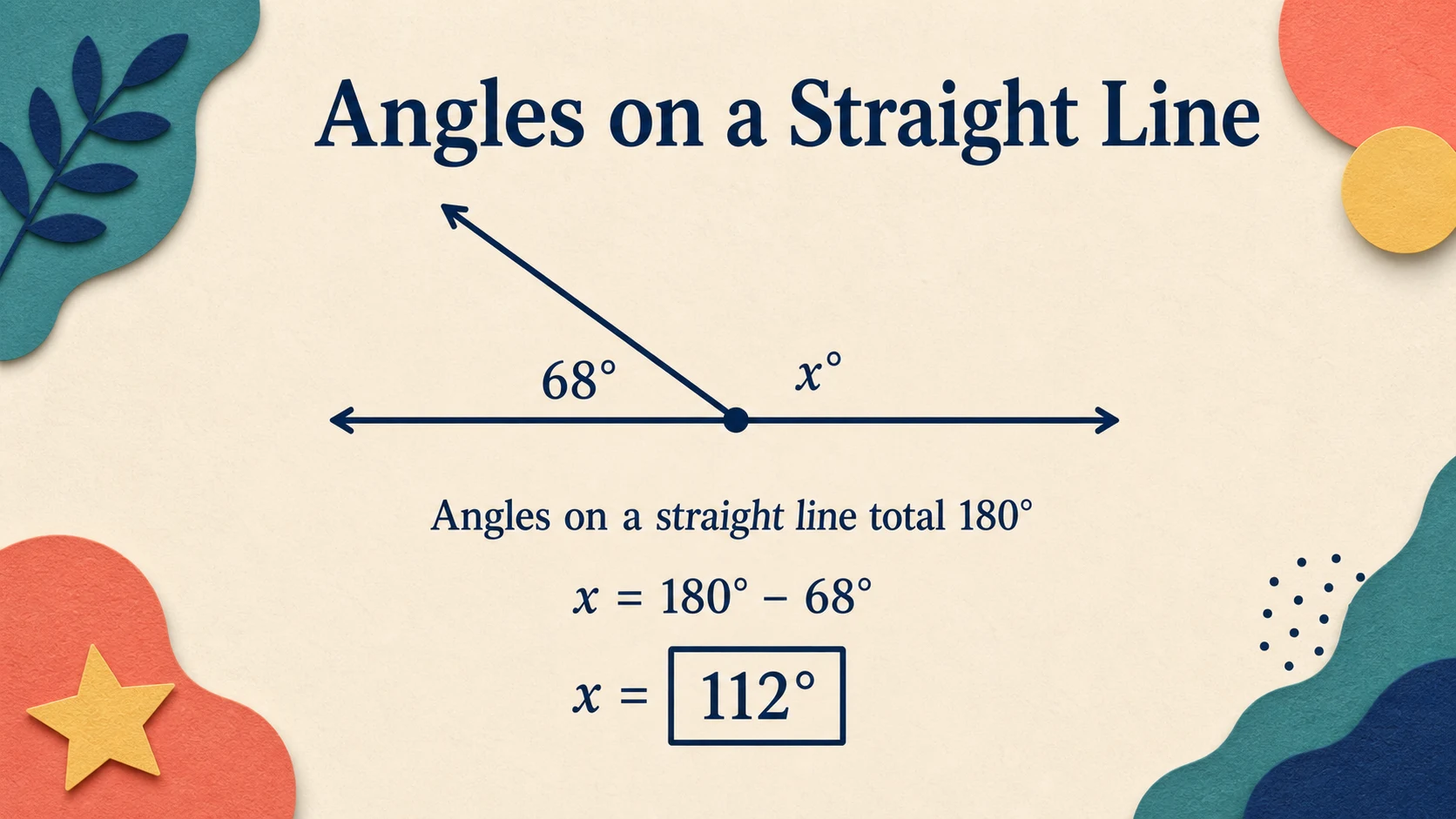
An upper-grade worked example should expose the representation change and the reason for each operation, not merely display an answer.
How Representations and Questions Should Change
The progression is not “pictures disappear and numbers take over.” Instead, representations become more coordinated.
A young learner may hold a cube, match it to another cube, and say that it can stack. Next, the learner examines a drawing of a cube and identifies faces, edges, or vertices. Later, a learner may use a net, calculate surface area, or compare the solid with a rectangular prism. The object, picture, diagram, and notation represent related ideas, but each introduces different cognitive demands.
Question design should also change deliberately:
- “Point to a triangle” asks for recognition.
- “Build a triangle” asks the learner to produce an instance.
- “Sort these figures into triangles and non-triangles” requires attention to boundaries.
- “Explain why the rotated figure is still a triangle” requires attribute-based justification.
- “Draw two different triangles that meet these conditions” requires generation under constraints.
- “Find an unknown measure and justify it” requires relationships and calculation.
Do not increase difficulty merely by adding more questions. Useful increases include varied orientation, less familiar examples, overlapping categories, missing measures, several representations, and a request to explain. Reduce difficulty by isolating one of those demands while preserving the target concept.
The Common Core mathematics standards illustrate a broad movement from identifying and composing shapes in early grades toward area, angle measurement, coordinate work, and geometric problem solving. They are a reference point, not evidence that a particular WorksheetWise sheet aligns with every state, school, or instructional sequence.
A Short Routine That Keeps the Geometry Visible
A worksheet should follow experience and discussion, not replace them. Use this repeatable 15–25 minute routine, shortening it for younger learners.
Build or find
Spend three to five minutes with an object, tiles, pattern blocks, tangrams, a geoboard, graph paper, or a classroom angle. Ask the learner to make, move, sort, or measure something related to the page.
For area and perimeter, build first. For transformations, slide or turn a transparent shape before applying a coordinate rule. For classification, rotate and compare cutout figures.
Say what matters
Ask for one complete observation: “This remains a triangle because it has three straight sides,” or “The area is 12 square units because 12 tiles cover the rectangle without gaps or overlaps.” Supply precise language after the learner has something concrete to describe.
Work a small set
Complete three to six worksheet items, not necessarily the entire page. Ask the learner to mark important information directly on diagrams: trace a boundary, shade an area, label a vertex, draw a right-angle box, or write coordinate differences beside a segment.
Check through another representation
Verify one answer in a different way. Rebuild a calculated rectangle with tiles, measure an estimated angle, count unit cubes after applying a volume calculation, or plot transformed coordinates on graph paper.
Record the next decision
Write one sentence: “Next time, include rotated triangles,” “Repeat perimeter with unlabeled sides,” or “Move from measured angles to unknown-angle equations.” This turns performance into a teaching decision rather than a score.
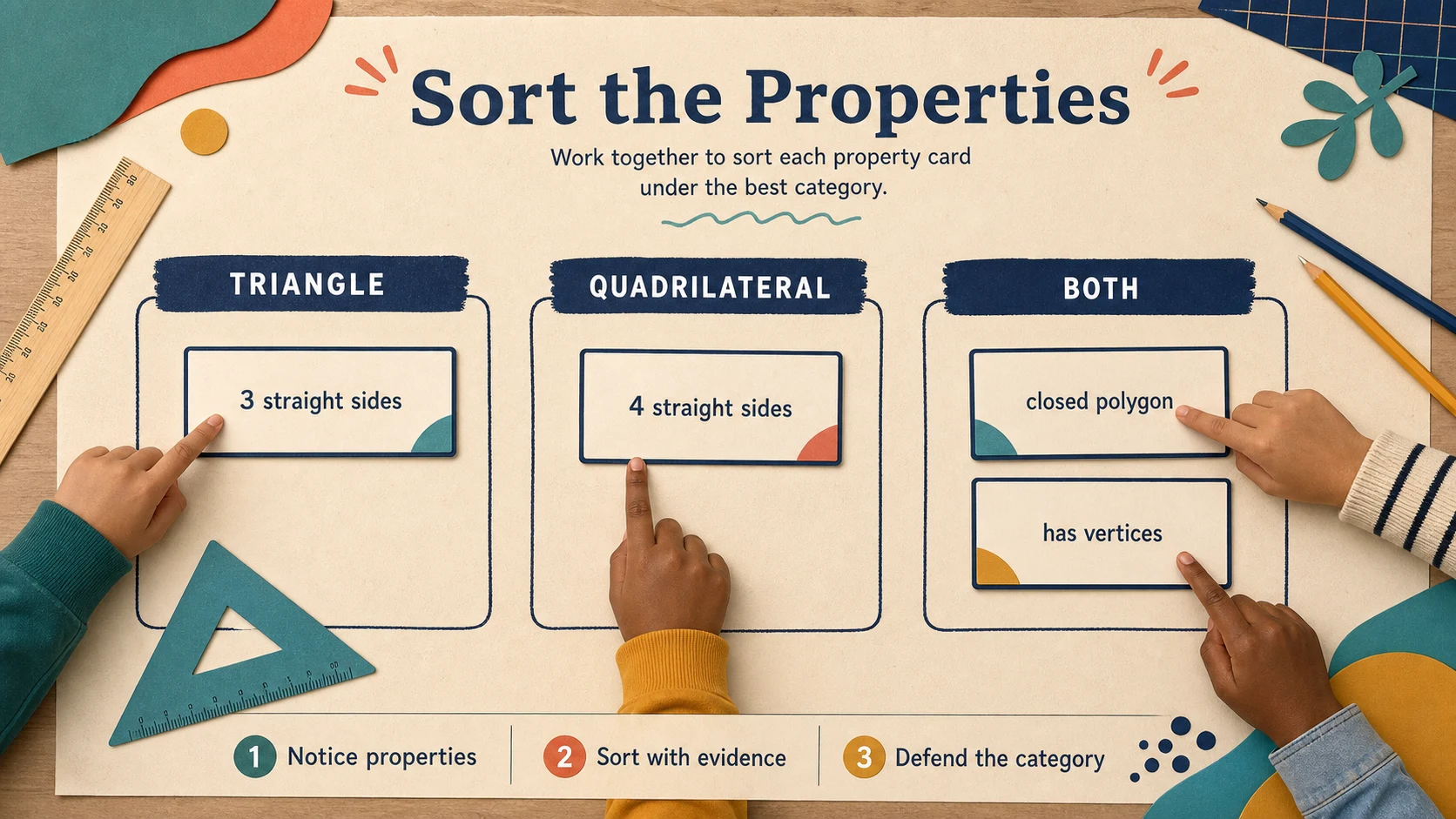
At the upper level, a brief routine still begins with a visible model and ends with a checked geometric claim.
The IES practice guide for assisting students who struggle with mathematics supports systematic instruction, clear mathematical language, representations, and deliberate word-problem teaching. Those principles inform the routine above. The exact timing, materials, and prompts are practical suggestions, not prescriptions from the source.
Read Errors as Evidence About the Task
An incorrect answer does not establish a diagnosis. It gives you a hypothesis to test with a nearby example.
If a learner rejects a sideways triangle, rotate a cutout while the learner watches. If the label changes when the paper turns, return to sides and vertices. The error likely concerns prototype dependence, but one response is not enough to make a broad conclusion.
If a learner calculates area when asked for perimeter, ask them to shade the inside and trace the boundary with a finger. Then rebuild a rectangle using tiles and count covered squares separately from edge units. Check whether the learner also confuses linear units with square units.
If a learner reads instead of on a protractor, examine setup before reteaching angle categories. Confirm that the center is on the vertex, the baseline follows one ray, and the chosen scale starts at zero on that ray.
If coordinates are reversed, ask the learner to move from the origin horizontally first and vertically second. Plot and in different colors. The comparison makes order visible without changing the target skill.
If a learner says every rectangle is a square, request a counterexample: draw a rectangle 2 units by 5 units, then check its four right angles and unequal adjacent sides. The correction should attach to defining properties, not to memorizing another picture.
Adapt Without Removing the Geometry
An adaptation preserves the geometric decision while reducing an unrelated barrier.
For a learner who finds dense pages difficult to track, reveal one row at a time. Keep the same figures and reasoning. For limited handwriting stamina, accept pointing, shape cards, oral explanations, or movable labels. For language support, pair terms with actions: “vertex—touch the corner,” “parallel—trace both lines,” and “perimeter—walk around the edge.” Maintain the mathematical vocabulary while making its meaning visible.
For visual-access needs, enlarge figures, strengthen contrast, increase spacing, and provide tactile outlines or physical solids when appropriate. Do not rely on color as the only classification cue. For motor-access needs, use larger manipulatives, digital dragging, eye-gaze choices, or adult scribing while the learner makes each mathematical decision.
When calculation is not the target, provide a multiplication chart or calculator if appropriate to the setting. When calculation is the target, changing that support would change the task and should be recorded. Similarly, reading a geometry prompt aloud preserves geometry unless interpreting the written wording is itself part of the intended assessment.
Art can provide another faithful representation. Tessellations foreground repeated transformations and fit; symmetry designs make reflection visible; perspective drawing invites discussion of lines, depth, and relative size. Keep a specific geometry question attached to the project so the activity does not become decoration alone.
Select the Next Real Worksheet
Use five checks before printing:
- Target: Name one action, such as classify quadrilaterals, distinguish area from perimeter, measure angles, or translate points.
- Prerequisite: Confirm the learner can perform the immediately earlier action with objects or a simple diagram.
- Representation: Choose manipulatives and clear pictures for a new idea; use varied diagrams, graph paper, and symbolic measures after meaning is secure.
- Question boundary: Decide whether the task asks for recognition, production, comparison, calculation, or explanation. Do not introduce several new demands at once.
- Length: Treat 20, 25, or 30 problems as a bank. Select a purposeful subset when a full sheet would obscure the evidence you need.
Stay at the same grade combination but alter the representation when the concept is sound and the format caused the error. Step back when the learner cannot demonstrate the prerequisite with concrete materials. Move forward when the learner succeeds across varied orientations, explains the relevant property, and checks an answer without relying on a memorized page pattern.
A two-week plan might alternate new work, brief retrieval, and application rather than assigning a fresh full sheet daily. For example, introduce area with tiles, revisit it with grids, compare equal-area rectangles, apply it in a coordinate figure, and then mix it with perimeter. The observable next step after each session should be narrower than “more geometry.”
The upper-grade plan spaces modeling, worksheet practice, checking, and review so that one long assignment does not carry the whole progression.
WorksheetWise’s catalogue establishes available grade combinations, counts, and broad topic coverage; it does not establish placement, standards mastery, or outcomes. Use the free sheet as a sample of task fit, not as a diagnosis. If none of the supplied pages isolates the exact representation you need, browse the full worksheet library or use the free deterministic worksheet generators to make a focused set.
For the next session, open the grade guide nearest the learner’s demonstrated action—start with the 3rd Grade Geometry guide and free sheet if area and perimeter are the current boundary—choose three questions, build the first one with square tiles, and record whether the learner counts covered squares or boundary units without prompting.
Put it into practice
Use the guide with a real printable
Move from explanation to a short, observable practice task. Check the first item together, then adjust the next session from the learner's actual work.
Open the first free worksheetExplore a neighboring collection
Choose by a different teaching need
Addition Worksheets by Grade and Level Consonant Blends Worksheets by Grade and Level Counting Worksheets by Grade and Level CVC Words Worksheets by Grade and Level Decimals Worksheets by Grade and Level Digraphs Worksheets by Grade and Level Division Worksheets by Grade and Level Fractions Worksheets by Grade and Level