What 6th Grade Fractions instruction should accomplish
A sixth-grade learner should be able to interpret fractions as numbers, compare and generate equivalent fractions, move between improper fractions and mixed numbers, and calculate accurately with all four operations. Division of a fraction by another fraction is an especially important sixth-grade goal. The learner should also estimate before calculating, choose a suitable model, simplify when appropriate, and explain why an answer is reasonable.
The most useful teaching sequence is:
- Check prerequisite understanding.
- Rebuild meaning with fraction strips, area models, and number lines.
- connect each model to symbols and equations.
- teach one operation at a time.
- mix problem types only after the learner can distinguish them.
- use errors and explanations—not speed alone—to choose the next lesson.
Grade labels describe the intended practice level, not an exact universal timetable. Local curricula and teaching sequences differ. The Common Core mathematics standards provide one widely used progression in which earlier grades develop equivalence and operations, while Grade 6 includes interpreting and computing quotients of fractions. Check the learner’s school materials if you need to match a particular local sequence.
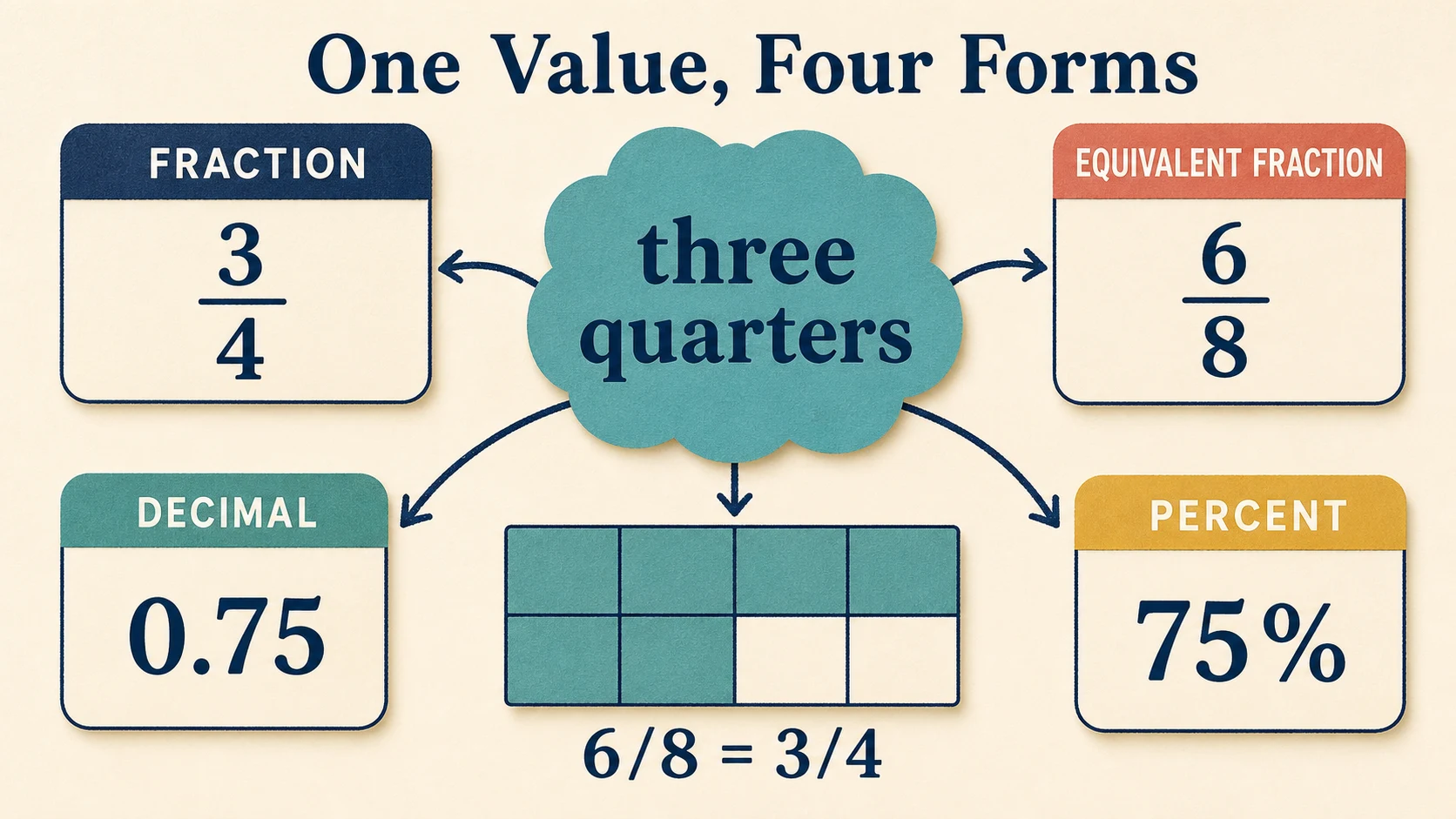
Fraction meaning, equivalence, comparison, and operations form a connected system rather than separate tricks.
Start with the prerequisites
Before assigning a full page of fraction operations, ask the learner to complete a short readiness check. Record not only correct answers but also models, explanations, hesitation, and self-corrections.
Whole-number knowledge
The learner needs dependable multiplication and division facts for finding common denominators, simplifying fractions, and working with mixed numbers. Test the underlying relationships:
- List the factors of 12 and 18.
- Find the least common multiple of 4 and 6.
- Explain why 24÷6=4.
- Decide whether 35 is divisible by 5 and explain how you know.
Slow fact recall does not automatically mean fraction understanding is weak. It may simply increase the calculation burden. Permit a multiplication chart during concept lessons if fact retrieval is obscuring the fraction reasoning, then practice the needed facts separately.
Fraction meaning and equivalence
Ask the learner to:
- shade 3/4 of a rectangle divided into four equal parts;
- place 5/4 on a number line;
- name two fractions equivalent to 2/3;
- compare 3/5 and 3/8;
- explain whether 4/6 and 2/3 represent the same number.
Listen for the idea of equal-sized parts. A learner who calls three shaded pieces “three-fourths” without checking whether all four parts are equal needs work on partitioning before formal operations.
Earlier fraction operations
Check whether the learner can add and subtract unlike denominators, multiply fractions, and interpret a fraction as division. These skills appear earlier in the catalogue progression and support sixth-grade fraction division.
A compact diagnostic could include:
52+101,87−41,32×53,3÷4
The checked answers are 1/2, 5/8, 2/5, and 3/4. If the learner misses several items for different reasons, separate the skills rather than reteaching every operation at once.
A grade-appropriate teaching progression
The sequence below is an instructional suggestion, not a claim that every school must follow the same schedule. Move forward when observed work shows stable understanding.
| Stage |
Main goal |
Helpful model |
Evidence of readiness to continue |
| 1. Meaning |
Interpret proper, improper, and mixed-number fractions as quantities |
Fraction strips and number lines |
Places fractions above 1 correctly and explains the unit |
| 2. Equivalence |
Generate and simplify equivalent fractions |
Folded strips, bars, and number lines |
Changes numerator and denominator by the same factor |
| 3. Comparison |
Compare using benchmarks or common units |
Number line |
Justifies comparisons without relying on denominator size alone |
| 4. Addition and subtraction |
Rename fractions with a common denominator |
Fraction bars |
Estimates, computes, and checks unlike-denominator results |
| 5. Multiplication |
Interpret a fraction of another quantity |
Area model |
Connects overlap in the model to multiplying numerators and denominators |
| 6. Division |
Interpret quotients as grouping or measurement |
Strips and number lines |
Explains what the quotient counts before using a procedure |
| 7. Mixed application |
Select an operation in context |
Diagram chosen by learner |
Labels the whole, writes an equation, and checks reasonableness |
| 8. Independent fluency |
Solve a varied set accurately |
Models available but optional |
Maintains accuracy when problem types are mixed |
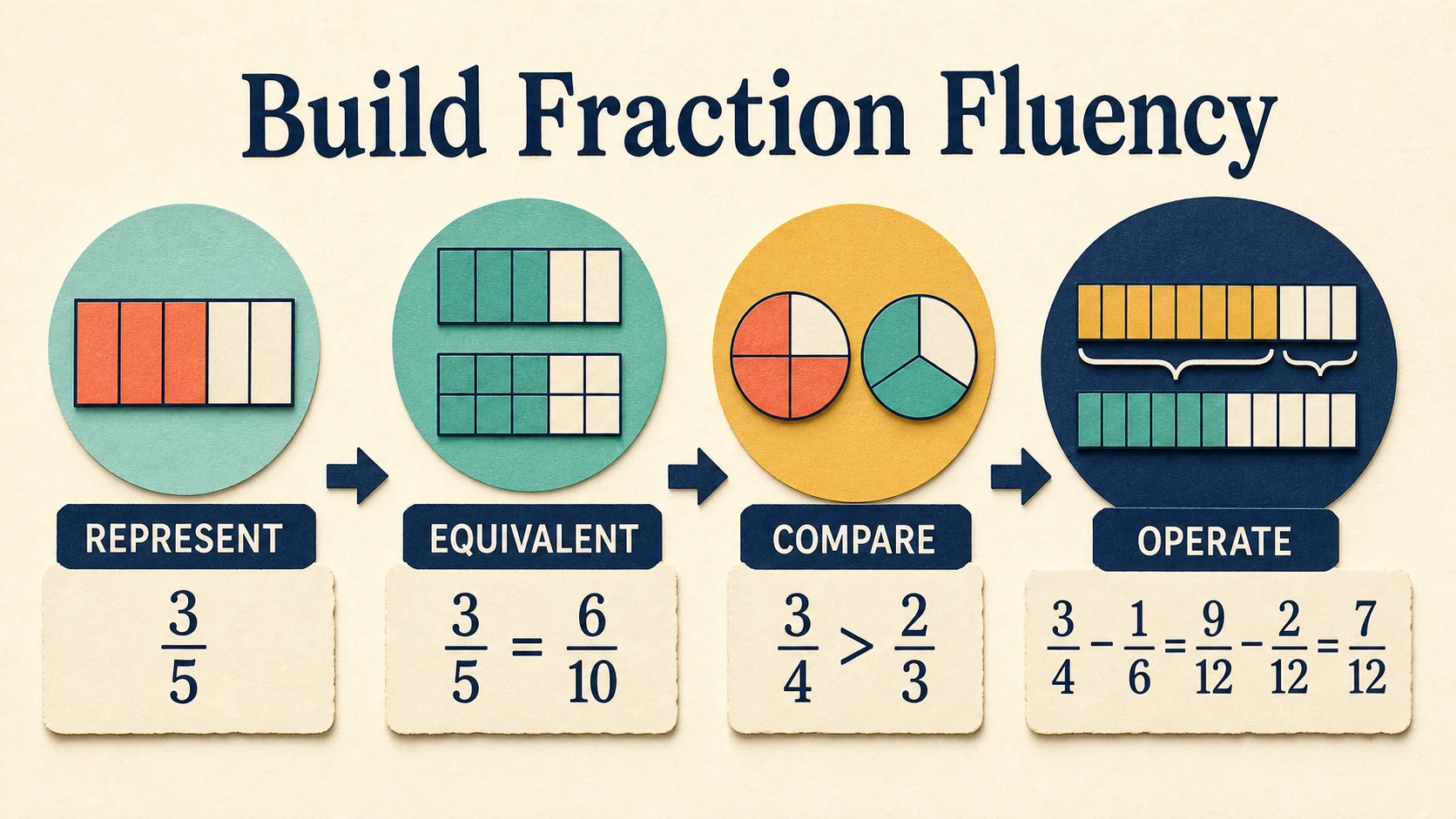
Support can fade from manipulatives to drawings, equations, and independent explanation.
Do not use one successful page as the only signal for advancement. Look for correct work on at least two occasions, including one set in which the operation is not announced in advance. A learner who can divide fractions under a heading titled “Division” may still need help deciding whether a word problem calls for division.
Use concrete and visual models deliberately
Models are most useful when they expose the mathematical structure. They should not be treated as decorations added after the calculation.
The IES guide on assisting students struggling with mathematics supports systematic instruction that includes clear representations and connections among representations. Its recommendations provide broad instructional framing; they do not evaluate WorksheetWise or this particular practice material. The IES early mathematics guide likewise offers high-level support for helping learners connect representations and mathematical ideas, although its stated audience is younger children.
Fraction strips and circles
Fraction strips make the size of the whole explicit. Place a strip divided into fourths beneath a strip of the same length divided into eighths. The learner can see that:
41=82,42=84,43=86
Use identical wholes. Comparing one-fourth of a small circle with one-eighth of a much larger circle introduces an unnecessary change in the unit.
Fraction circles can help with equal parts and equivalence, but they are less convenient for quantities greater than one. Use multiple complete circles if an improper fraction is represented.
Number lines
The number line shows that a fraction is a number with a location, not merely a shaded portion of an object. To place 5/4:
- mark 0, 1, and 2;
- divide each unit interval into four equal lengths;
- count five fourth-sized intervals from 0;
- label the point 5/4, or 141.
Number lines are especially useful for comparison, improper fractions, and division by measurement. For 3/4÷1/8, count how many one-eighth intervals fit into three-fourths. Six fit, so the quotient is 6.
Area models
An area model makes multiplication visible. Draw one whole rectangle, shade 2/3 vertically, and then shade 3/4 horizontally in another direction. The overlapping region covers 6 of 12 equal cells:
32×43=126=21
The drawing must divide the same whole in both directions. Two unrelated shaded pictures do not demonstrate the product.
From model to notation
Use this three-part prompt:
- What does each part of the model represent?
- Which equation matches the model?
- How does the written procedure record what the model shows?
Once the learner can answer all three, shorten the drawing or allow a mental model. Keep models available when a new operation or unfamiliar context is introduced.
Fully checked worked examples
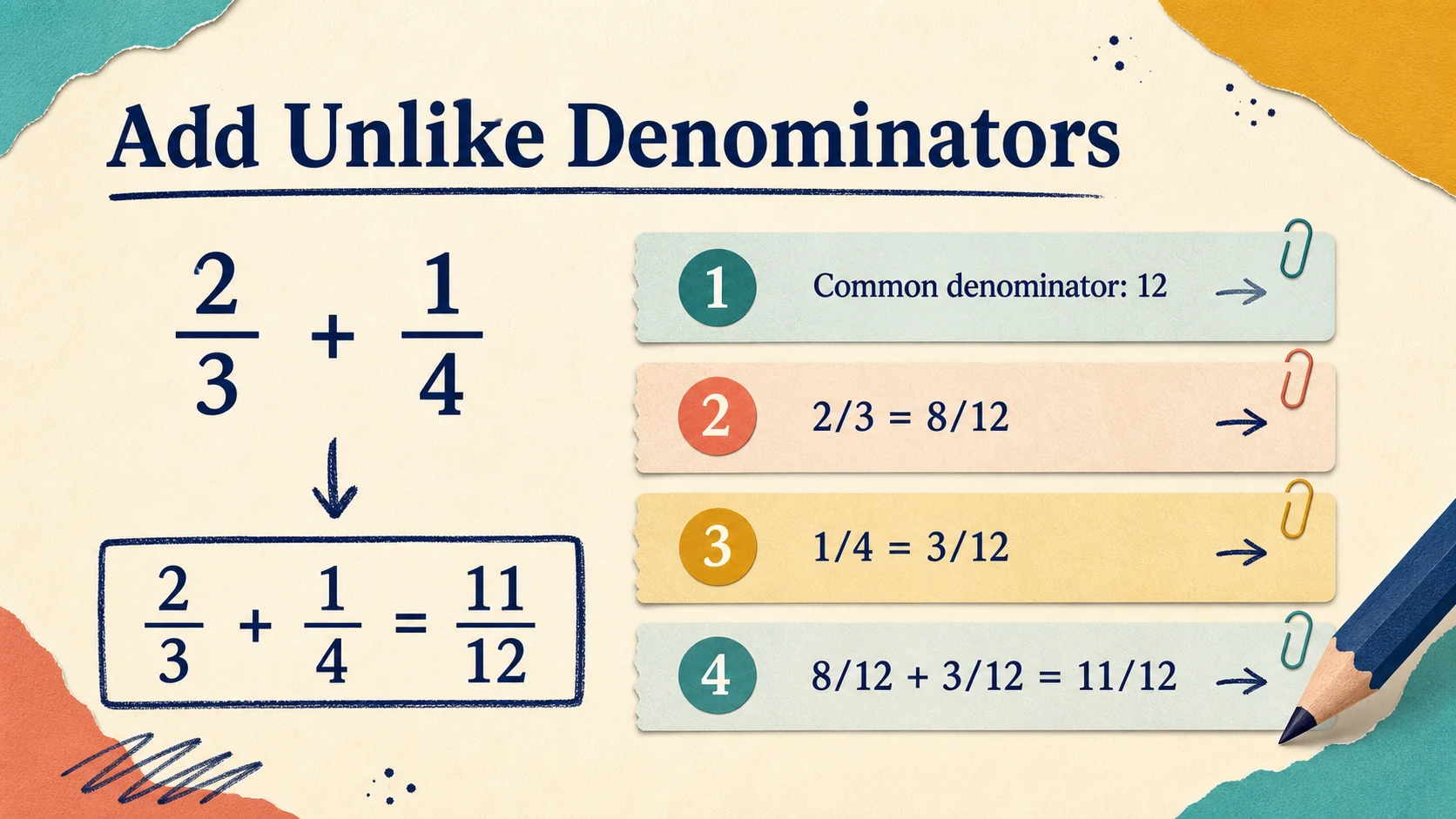
The representation should explain the calculation, while the final check confirms that the answer fits the original quantities.
Example 1: Compare fractions using a common unit
Compare 5/6 and 7/9.
First estimate. Both fractions are greater than 3/4, and both are less than 1, so the final comparison should remain within that interval.
The least common denominator of 6 and 9 is 18:
65=6×35×3=1815
97=9×27×2=1814
Because 15/18>14/18,
65>97
Check by measuring each fraction’s distance from 1:
1−65=61,1−97=92
Since 1/6<2/9, 5/6 is closer to 1. The comparison is confirmed.
Example 2: Add mixed numbers with unlike denominators
Calculate:
243+165
Estimate first:
243≈3,165≈2
The exact sum should be close to 5.
Add the whole numbers and fractions:
2+1=3
The least common denominator of 4 and 6 is 12:
43=129,65=1210
Then:
3+129+1210=3+1219
Rename the improper fraction:
1219=1127
Therefore:
243+165=4127
Check with improper fractions:
243=411,165=611
411+611=1233+1222=1255=4127
The two methods agree, and 4127 is close to the estimate of 5.
Example 3: Multiply fractions and simplify
Calculate:
97×143
Because both factors are positive and less than 1, the product must be less than either factor. Simplify across the factors before multiplying:
97×143
Seven and 14 share a factor of 7:
91×23
Three and 9 share a factor of 3:
31×21=61
Thus:
97×143=61
Check without cross-simplifying:
9×147×3=12621=61
The result, 1/6, is less than both original factors, as expected.
Example 4: Divide a fraction by a fraction
Calculate:
43÷52
Interpret the question as: “How many groups of size 2/5 are in 3/4?” The answer should be greater than 1 because 3/4 contains one complete 2/5, plus part of another.
Use the reciprocal procedure:
43÷52=43×25=815=187
Therefore:
43÷52=187
Check by multiplying the quotient by the divisor:
815×52=4030=43
The multiplication returns the original dividend, so the quotient is correct.
Example 5: Divide mixed numbers in context
A container holds 321 liters. Each serving uses 3/4 liter. How many servings does the container hold?
The question asks how many 3/4-liter groups fit into 321 liters:
321÷43
Convert the mixed number:
321=27
Divide by multiplying by the reciprocal:
27÷43=27×34=628=314=432
The exact quotient is:
432
Interpretation matters. The container provides four complete 3/4-liter servings, with liquid equal to two-thirds of another serving. If only complete servings count, the practical answer is four complete servings.
Check the remainder after four servings:
4×43=3
321−3=21
Since 21÷43=32, the remaining liquid is two-thirds of a serving. The result is confirmed.
Boundary cases learners should understand
Boundary cases reveal whether a learner understands the operation or has memorized a pattern.
Zero and one
For any nonzero fraction a/b:
ba+0=ba,ba×0=0,ba×1=ba
Also:
0÷ba=0
However, division by zero is undefined. Neither 3/5÷0 nor 0÷0 has an ordinary numerical answer. The instruction to “flip and multiply” does not make division by zero valid because zero has no reciprocal.
Products and quotients do not always grow
Multiplying by a fraction less than 1 makes a positive quantity smaller:
8×43=6
Dividing by a fraction less than 1 makes a positive quantity larger:
8÷43=332=1032
These facts often conflict with rules learned from whole numbers. Ask learners to predict whether an answer will increase or decrease before calculating.
Improper fractions are valid numbers
An improper fraction is not an error. For example, 11/4 and 243 name the same number. Whether to leave an answer improper or convert it to a mixed number depends on the directions and context. Require simplification when the task calls for simplest form, but do not imply that an equivalent unsimplified fraction is numerically false.
A short, repeatable lesson routine
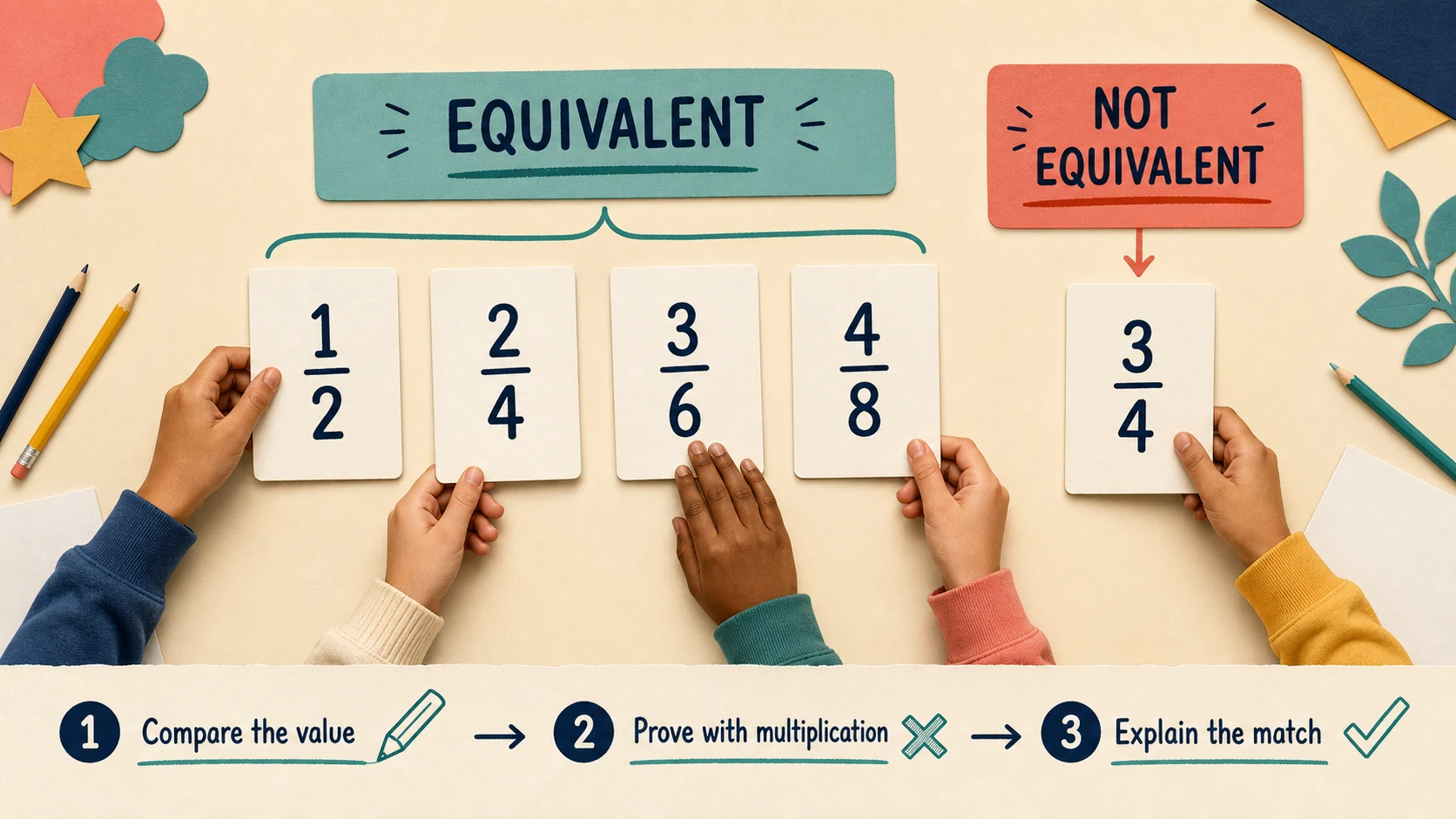
Predict, model, calculate, explain, and review in a routine short enough to repeat consistently.
A practical lesson can take about 20 to 30 minutes, but this is a flexible suggestion rather than a universal timetable.
1. Retrieval and readiness: 3–5 minutes
Give two or three short items from previous learning. Include a multiplication fact, an equivalence item, or a number-line placement. Stop to repair a prerequisite if it prevents access to the day’s task.
2. Model one idea: 5–7 minutes
Demonstrate one carefully chosen example. Say what the whole is, show the representation, connect it to an equation, and estimate the result. Avoid presenting several procedures in the same explanation.
3. Solve together: 5–7 minutes
Let the learner make the next decision: choose a denominator, partition the model, select an operation, or state whether the answer should be greater or less than 1. Give a prompt before giving the step.
4. Independent practice: 6–10 minutes
Use three to six problems focused on the same idea. Include one item that differs slightly, such as an improper result or a denominator that is already a factor of the other denominator.
5. Exit check: 2 minutes
Ask for one calculation and one explanation. For example: “Solve 2/3÷1/6, then explain what the 4 counts.” Use the response to decide whether the next session should repeat, vary, or extend the skill.
Choose practice by evidence, not page count
The 6th Grade Math hub can help adults locate practice within the broader subject, while the 6th Grade Fractions topic guide keeps the focus on this strand. Select a resource only after identifying the learner’s current need.
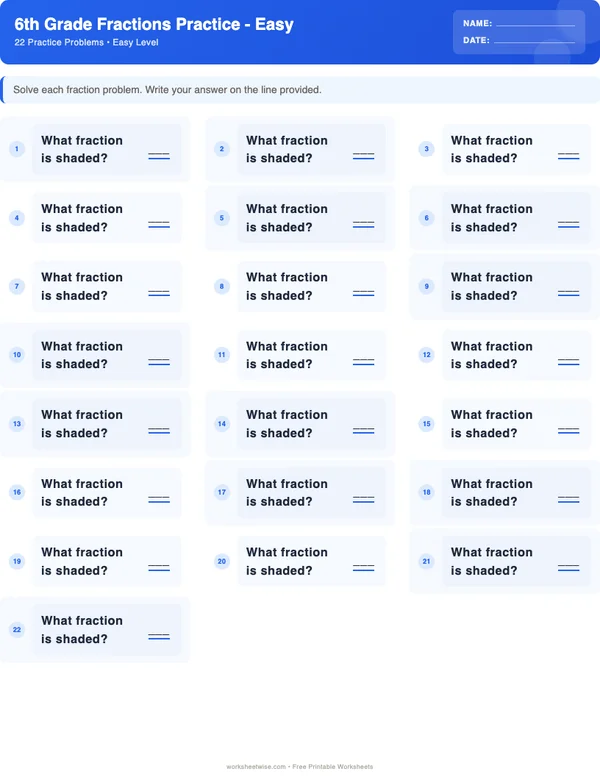
The free easy-level worksheet contains 22 exercises covering fractions, equivalence, comparison, and fraction operations, with a separate answer key. That makes it suitable for a brief mixed-skill check or foundational reinforcement. It does not, by itself, prove mastery of every sixth-grade fraction expectation.
Choose practice with these principles:
- For a new concept, use a small set with one clear structure and room for drawings.
- For a recurring error, assign several closely related examples that isolate that error.
- For operation choice, mix addition, subtraction, multiplication, and division only after each is secure separately.
- For retention, revisit a previously learned skill after a delay.
- For explanation, include prompts such as “Show why,” “Estimate first,” or “Name the whole.”
- For fluency, increase quantity gradually without removing reasoning checks.
A learner who solves five well-selected problems and explains them may provide more useful evidence than one who rushes through 30 nearly identical items.
Differentiate support and challenge
Differentiation should change the support, representation, number complexity, or reasoning demand while preserving the mathematical goal.
For additional support:
- use denominators that relate easily, such as fourths and eighths;
- provide fraction strips or a pre-partitioned number line;
- keep one whole visible in every model;
- allow a multiplication chart during concept work;
- write mixed numbers as improper fractions before beginning an operation;
- ask the learner to circle the operation and estimate first;
- reduce the number of problems while increasing discussion.
For learners ready for greater challenge:
- include unrelated denominators, such as sevenths and twelfths;
- ask for two solution methods;
- require a comparison without converting to decimals;
- include missing-number equations;
- ask the learner to create and solve a matching context;
- mix proper fractions, improper fractions, and mixed numbers;
- ask whether an answer is exact, simplified, and reasonable.
Do not equate challenge with larger numbers alone. Explaining why 2/3÷4/5 is greater than 2/3 can demand more reasoning than completing several longer calculations.
Diagnose common errors before correcting them
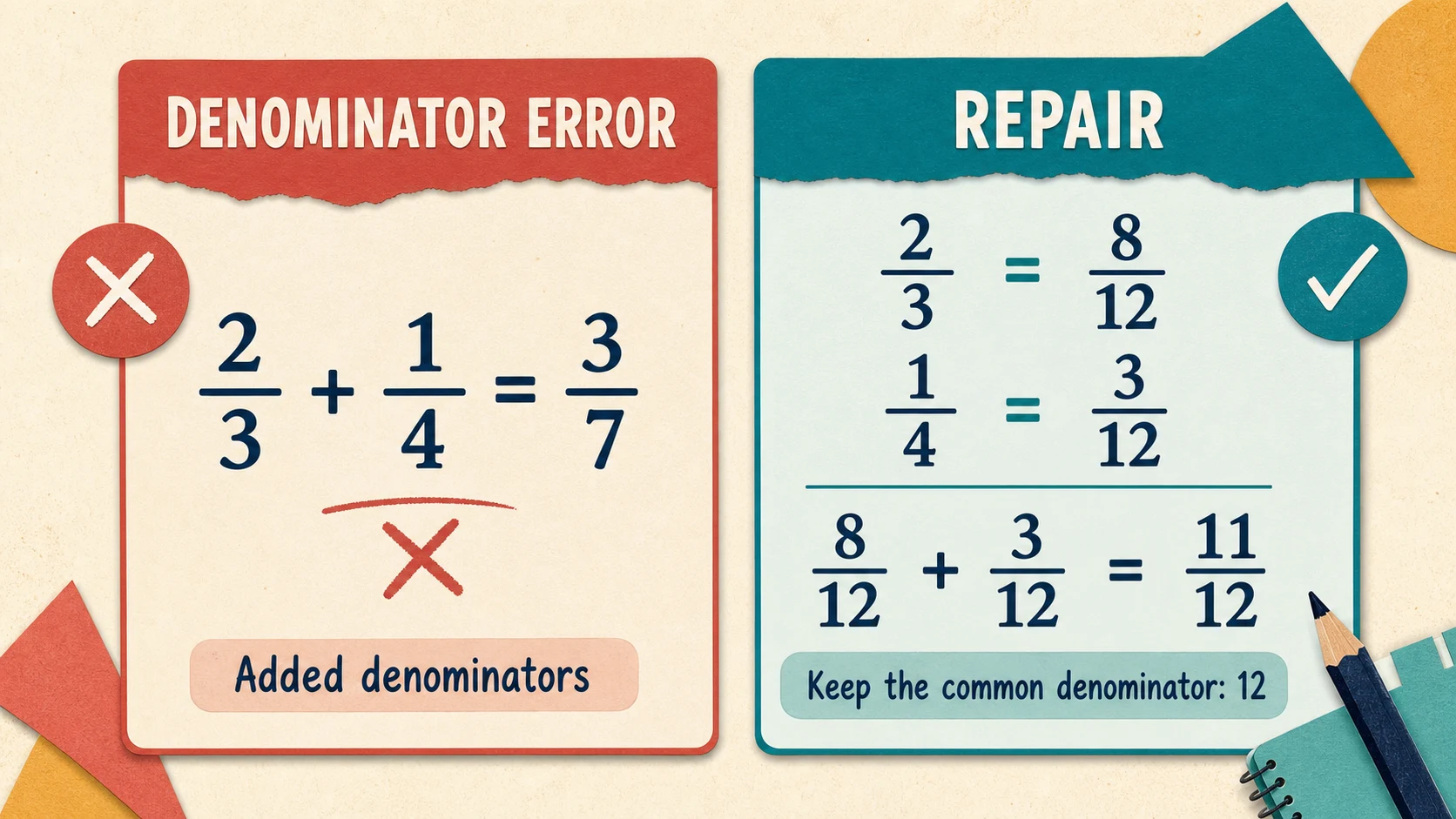
An incorrect answer becomes useful when it points to the next representation, prompt, or prerequisite.
| Observed work |
Likely issue to investigate |
Diagnostic prompt |
Teaching response |
| 1/4>1/3 because 4 is greater than 3 |
Treating denominators as whole-number size labels |
“Which is larger: one piece when a whole is cut into three or four equal pieces?” |
Compare equal-length strips and place both fractions on a number line |
| 2/5+1/3=3/8 |
Adding denominators as if fraction notation were two separate whole numbers |
“Are fifths and thirds the same-sized unit?” |
Rename both fractions with fifteenths before combining |
| 3/4×2/5=6/9 |
Adding denominators or using a mixed operation rule |
“What does the area model divide the whole into?” |
Draw a 4×5 grid and count the overlapping cells |
| 2/3÷4/5=8/15 |
Multiplying directly instead of dividing |
“How can multiplication check a quotient?” |
Write division, reciprocal multiplication, and the inverse check on three linked lines |
| 121=1/2 |
Dropping the whole number |
“Where is this number located relative to 1 and 2?” |
Plot it, then convert 121 to 3/2 |
| 4/8=1/4 after dividing only the numerator by 4 |
Changing the value rather than making an equivalent fraction |
“What happened to the size and number of pieces?” |
Group numerator and denominator by the same common factor |
| Correct computation but unreasonable operation |
Weak interpretation of the context |
“What does the answer count, and what is the unit?” |
Draw or act out groups before choosing an equation |
Treat the table as a set of hypotheses. The same wrong answer can arise from a slip, unclear notation, weak facts, or a conceptual misunderstanding. Ask the learner to explain the step before deciding what to reteach.
Monitor progress without overtesting
Use a simple record with four columns: date, skill, evidence, and next action. Evidence can include accuracy, model choice, explanation, and independence.
A weekly check might contain:
- one equivalence or simplification problem;
- one comparison;
- one addition or subtraction problem;
- one multiplication problem;
- one division problem;
- one context problem requiring operation choice.
Mark each response as secure, developing, or not yet secure. “Secure” should mean the learner can complete the item accurately, explain a key step, and handle a modest variation without immediate prompting.
Watch for productive changes:
- estimates become closer;
- models are chosen intentionally;
- common denominators are generated accurately;
- mixed numbers are converted without losing the whole;
- division answers are checked through multiplication;
- the learner notices and repairs unreasonable results.
Speed can be recorded, but it should not outweigh meaning and accuracy. If performance falls when problems are mixed, return briefly to blocked practice and then reintroduce mixed items in smaller sets.
A two-week practice plan
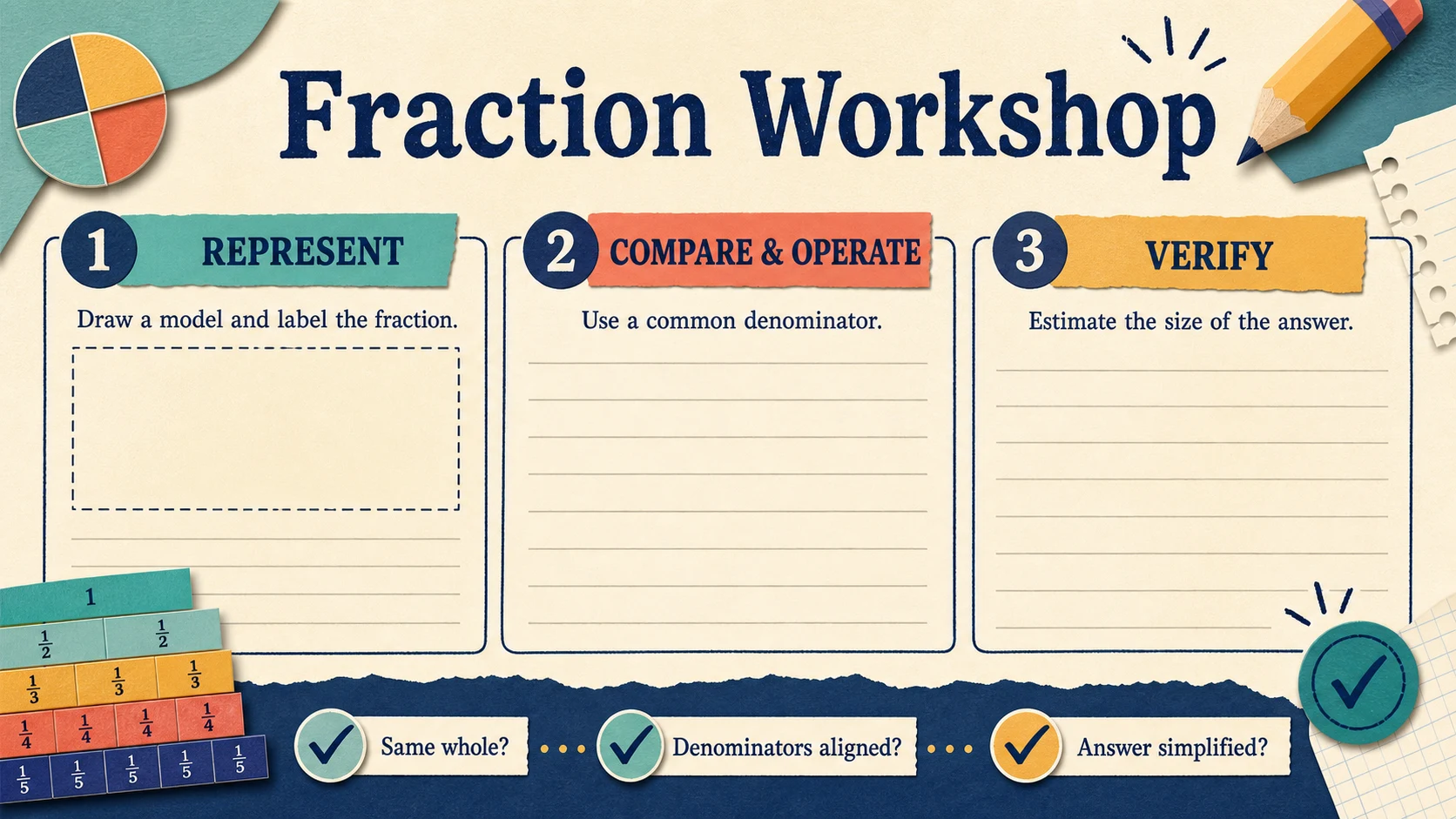
The plan alternates focused instruction, review, application, and evidence-based adjustment.
This plan assumes ten short sessions. Shorten, repeat, or reorder it according to observed work.
| Day |
Focus |
Suggested activity |
Exit evidence |
| 1 |
Readiness |
Check factors, equivalence, number-line placement, and earlier operations |
Identify one secure skill and one priority |
| 2 |
Fraction size |
Build and compare fractions with strips and number lines |
Explain why a larger denominator can mean smaller parts |
| 3 |
Equivalence |
Generate and simplify fractions using models, then symbols |
Produce two equivalents and justify simplification |
| 4 |
Add and subtract |
Estimate, find common denominators, and solve unlike-denominator items |
Complete one mixed-number calculation and check it |
| 5 |
Review |
Mix comparison, equivalence, addition, and subtraction |
Maintain accuracy without operation headings |
| 6 |
Multiplication |
Use an area model, then connect it to the written procedure |
Predict whether the product is greater or less than each factor |
| 7 |
Division meaning |
Use strips or a number line to count fractional groups |
Explain what a quotient counts |
| 8 |
Division procedure |
Divide proper fractions and mixed numbers; check by multiplication |
Solve and verify one mixed-number quotient |
| 9 |
Applications |
Choose operations for several short contexts |
Label the unit and explain the operation choice |
| 10 |
Cumulative check |
Use a brief mixed set and compare it with Day 1 evidence |
Select the next skill based on errors and explanations |
If Day 3 shows unstable equivalence, do not push into unlike-denominator addition merely to preserve the calendar. Repeat equivalence with clearer numbers and models. If Day 7 is secure, Day 8 can include more mixed numbers and boundary cases. The learner’s work should drive pacing.
Limitations and the honest next step
A worksheet can provide structured practice and an answer key, but it cannot determine why an error occurred, guarantee learning, replace responsive explanation, or establish comprehensive standards alignment. It also cannot account for every local curriculum sequence. Adults should use written work alongside conversation, models, and short follow-up checks.
Begin with the free 6th Grade Fractions worksheet. Ask the learner to complete a small sample rather than all 22 exercises immediately. Sort any errors into meaning, equivalence, comparison, operation, or explanation; teach the narrowest missing idea; then choose the next practice from the focused fractions pack or create a targeted set with the free worksheet generators.