Curated collectionAnswer keys includedPrint-ready PDFs
Subtraction Worksheets by Grade and Level
Show the full subtraction progression across 6 real grade combinations, compare task boundaries, model checked examples and explain how to choose the next level.
Start with a real resource
Browse this worksheet collection
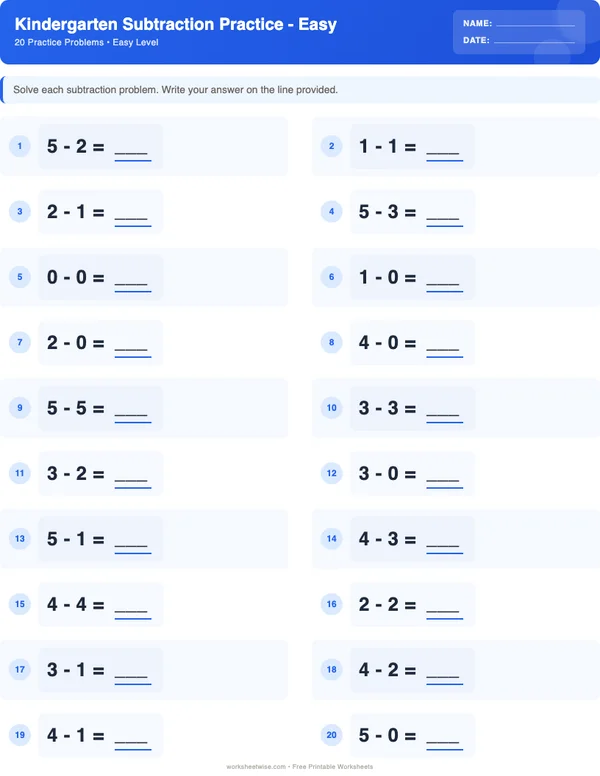
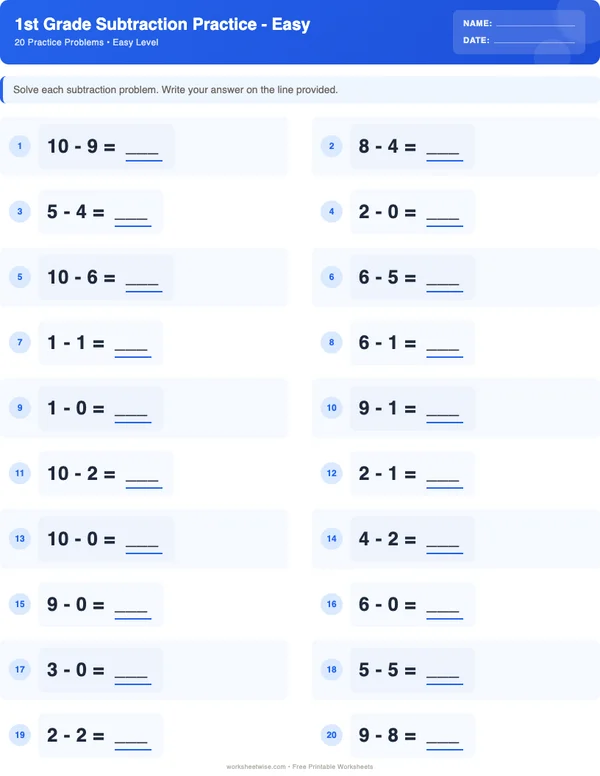
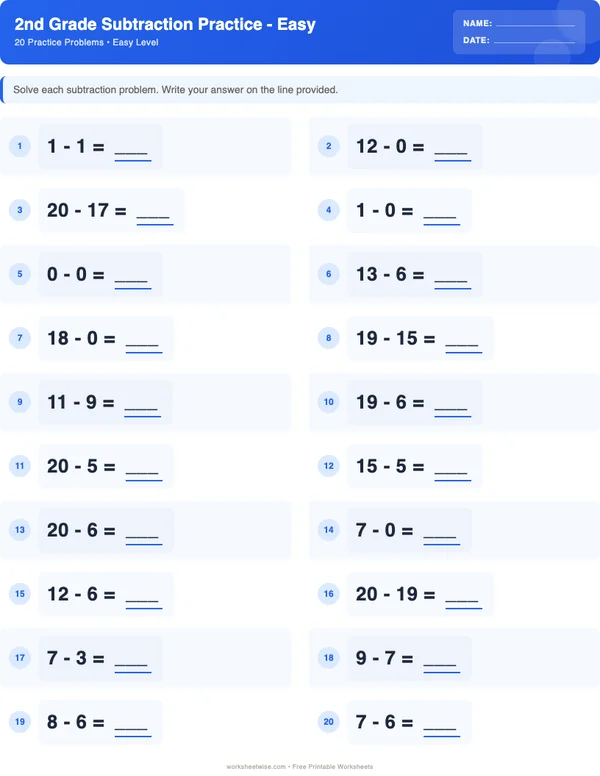
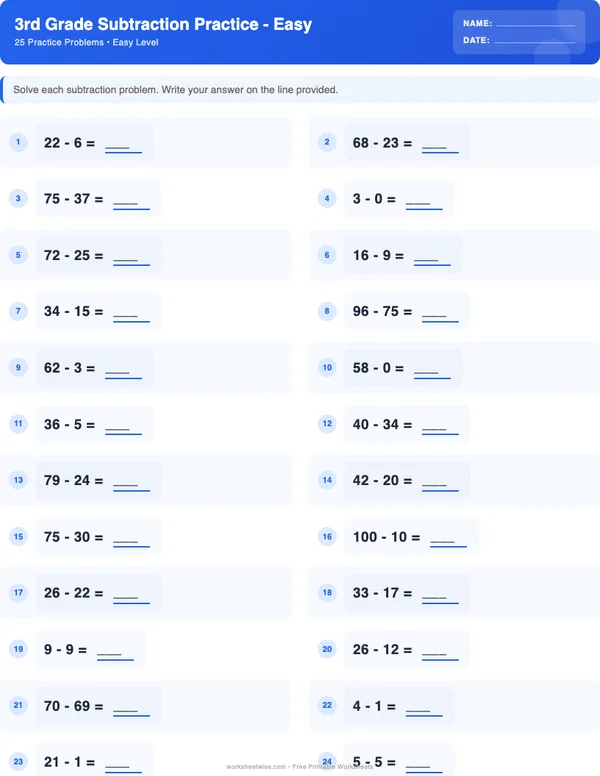
6 relevant free entry points are available. Each one includes a printable learner PDF and separate answer key.
A useful practice loop
Print less. Observe more.
- Choose one skill and model the first item aloud.
- Use a short set and notice the learner’s strategy.
- Change the next task from the work you can see.
Need more than the free sheet?
Plus includes all 108 matching catalogue variations where available, plus saved deterministic generators and the worksheet designer.
See Plus membershipComplete guide
How to teach and practise subtraction worksheets
3,305 words Updated 6 instructional visuals
Choose by the work on the page, not the grade name alone
The useful question is not “Which subtraction grade should this learner be on?” It is “What subtraction can the learner represent, explain, and check now—and what is the smallest productive next step?”
WorksheetWise’s live catalogue provides six subtraction entry points: Kindergarten through 5th Grade. The Kindergarten, 1st Grade, and 2nd Grade free sheets each contain 20 problems; the 3rd Grade and 4th Grade sheets contain 25; the 5th Grade sheet contains 30. All six free sheets carry the catalogue label “easy.” That label is only a starting filter. Before assigning a sheet, inspect the actual task features: number range, visual support, language load, whether regrouping is required, how many steps a problem takes, and whether the learner must choose the operation.
Grade labels describe intended practice levels, but local curriculum sequences differ. A learner may need a lower-grade sheet for one subtraction idea and a higher-grade sheet for another. That is normal instructional matching, not a diagnosis.
Use the six grade pages as real starting points:
- Kindergarten Subtraction guide and free sheet
- 1st Grade Subtraction guide and free sheet
- 2nd Grade Subtraction guide and free sheet
- 3rd Grade Subtraction guide and free sheet
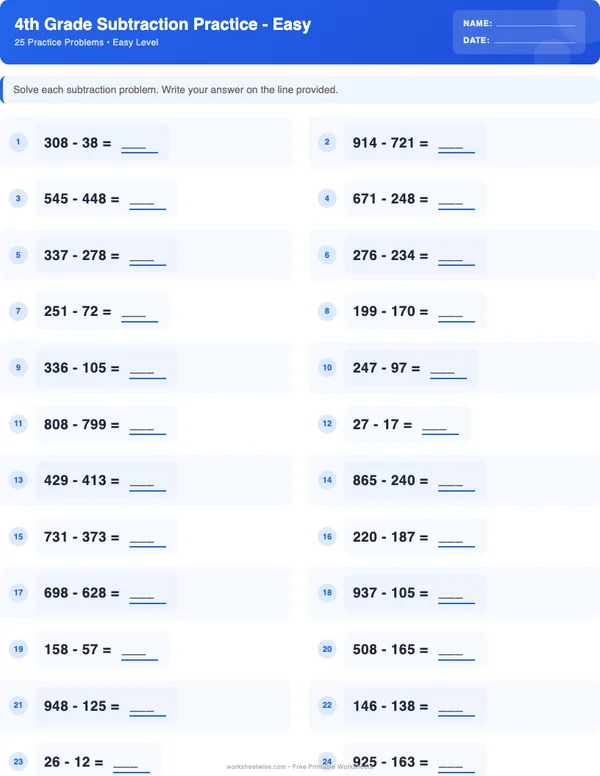
- 4th Grade Subtraction guide and free sheet
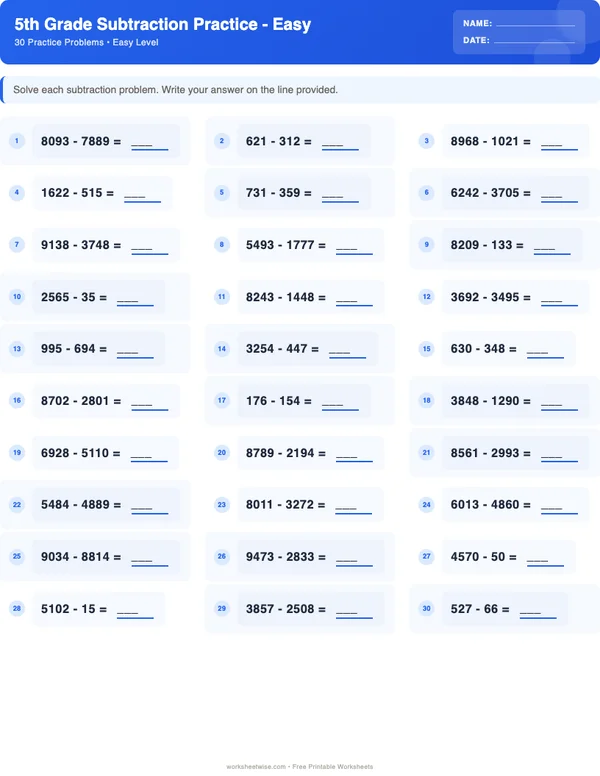
- 5th Grade Subtraction guide and free sheet
The catalogue currently contains 108 subtraction variants and six free entry points. That breadth is useful only if the adult chooses from evidence: watch one or two problems, identify the exact demand, and adjust one feature at a time.
What subtraction actually asks a learner to understand
Subtraction finds an unknown quantity from a relationship between quantities. It is broader than “take away,” and learners need experience with three distinct situations.
Removal: something leaves a known amount
Start with five counters. Move two away.
This is a removal situation because the initial amount, the amount removed, and the action are explicit. The learner can enact the story and count what remains. It belongs near the beginning of the progression because the symbols correspond directly to visible actions.
Check it with addition:
That check matters. Subtraction can feel harder than addition because the learner must hold a quantity in mind while reversing or undoing a relationship. Connecting the operations gives the learner another route instead of requiring counting backward every time.
Comparison: two amounts are measured against each other
Suppose Maya has eight counters and Leo has three. The question is, “How many more does Maya have?”
Nothing was removed. Place the two rows side by side, align their starting points, and match three pairs. Five counters in Maya’s row remain unmatched, so the difference is five.
A learner who understands only removal may hesitate because nobody “lost” three counters. Comparison tasks therefore test a different interpretation even when the arithmetic is familiar.
Missing part: an amount must be completed
“I need 10 markers. I have 6. How many more do I need?”
The relationship can be written in two connected ways:
The missing part is four because . This example belongs in an early subtraction guide because it makes the inverse relationship useful, not decorative. A learner who can solve the addition form but not the subtraction form may understand the quantities while still needing help connecting the notation.
The Addition Worksheets by Grade and Level collection can support this connection, but do not replace every subtraction problem with addition. Learners need to recognize when subtraction describes removal, comparison, or an unknown part.
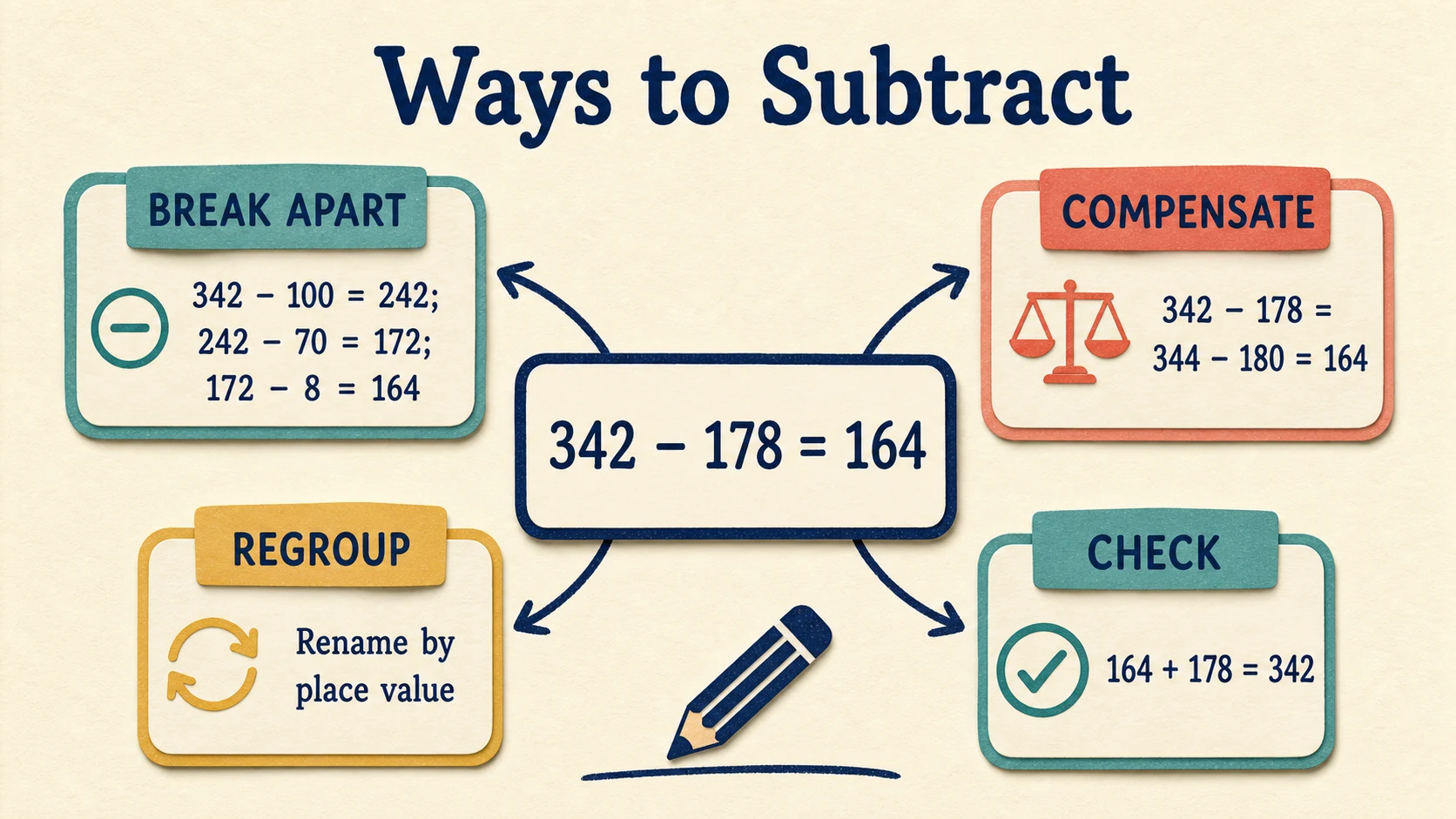
Use the map to locate the current demand—meaning, strategy, notation, regrouping, or application—before choosing more practice.
A useful progression across the six catalogue entry points
The catalogue verifies six grade combinations, but it does not establish that every learner or curriculum follows an identical sequence. The progression below is an instructional selection framework based on observable task boundaries. It is guidance for choosing among resources, not a claim that every sheet contains every listed feature.
Kindergarten: act out small changes before expecting symbolic fluency
Look for tasks in which the learner can touch, move, cover, or cross out objects. Productive starting work includes taking away within 5, then within 10, provided the learner can keep track of the starting set.
For , ask the learner to:
- Build five counters.
- Move two away.
- Count the remaining counters.
- Say, “Five minus two equals three.”
- Rebuild five by joining the two and three.
The goal is not a fast written answer. It is coordinating a story, a physical action, and a number sentence. If the page has 20 problems, it does not have to be completed in one sitting. Stop after a short set if attention or accurate counting declines.
1st Grade: connect models, equations, and facts
A suitable next step asks the learner to move between representations: objects, drawings, number paths, equations, and short stories. Work within 10 can expand toward subtraction within 20 when the learner has dependable strategies.
Consider . A learner might count back five, decompose 5 into 3 and 2 to reach 10, or use the known addition fact . The answer is eight:
Check:
This example belongs at the transition from direct modeling to strategic calculation. Thirteen objects could still be drawn, but the related fact is more efficient and exposes the operation’s structure.
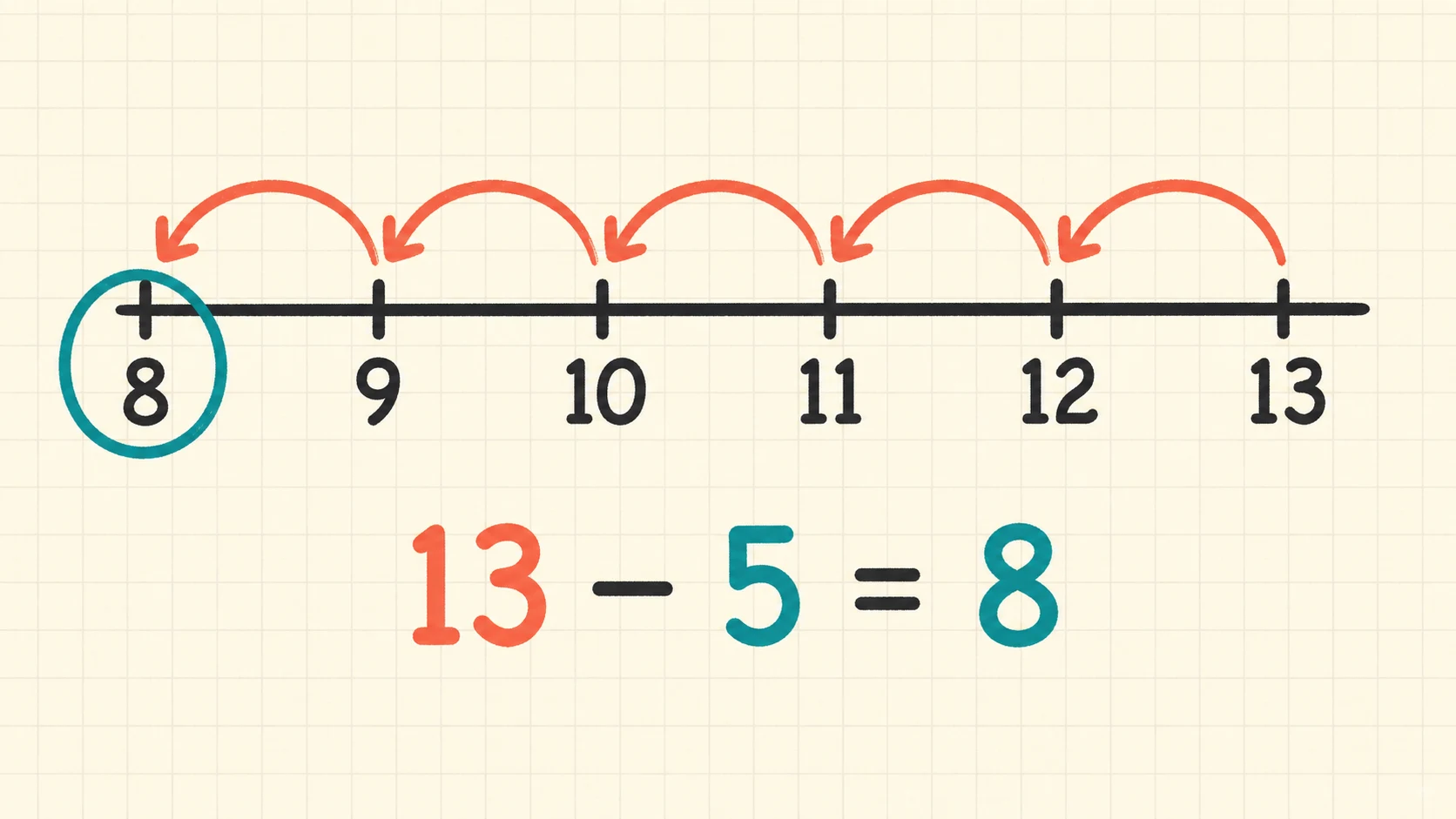
The important transition is not merely from pictures to symbols; it is from an action the learner understands to an equation the learner can explain.
2nd Grade: strengthen place value and introduce regrouping meaningfully
Choose tasks that require attention to tens and ones rather than just longer strings of facts. Before a learner uses a written regrouping procedure, build the numbers with base-ten blocks.
For , construct four tens rods and three ones cubes. Three ones cannot supply five ones, so trade one tens rod for 10 ones cubes. The quantity remains 43, now represented as three tens and 13 ones. Remove five ones, leaving eight. Remove two tens, leaving one ten:
Check:
The trade is the mathematical idea. Crossed-out digits are a record of that idea, not a substitute for it. This example belongs at the multi-digit boundary because it reveals whether the learner understands equivalent place-value representations.
3rd Grade: coordinate accuracy, explanation, and varied problem forms
At this entry point, the learner may need mixed practice: equations, missing numbers, multi-digit calculations, and word problems using all three subtraction situations. The catalogue’s free 3rd Grade sheet contains 25 problems, so plan a pause or divide the page if sustained accuracy is more informative than completion.
A productive progression might move from:
- a worked example with base-ten support;
- to a similar problem with a place-value prompt;
- to an unprompted calculation;
- to a word problem requiring the learner to decide whether subtraction fits;
- to an addition check.
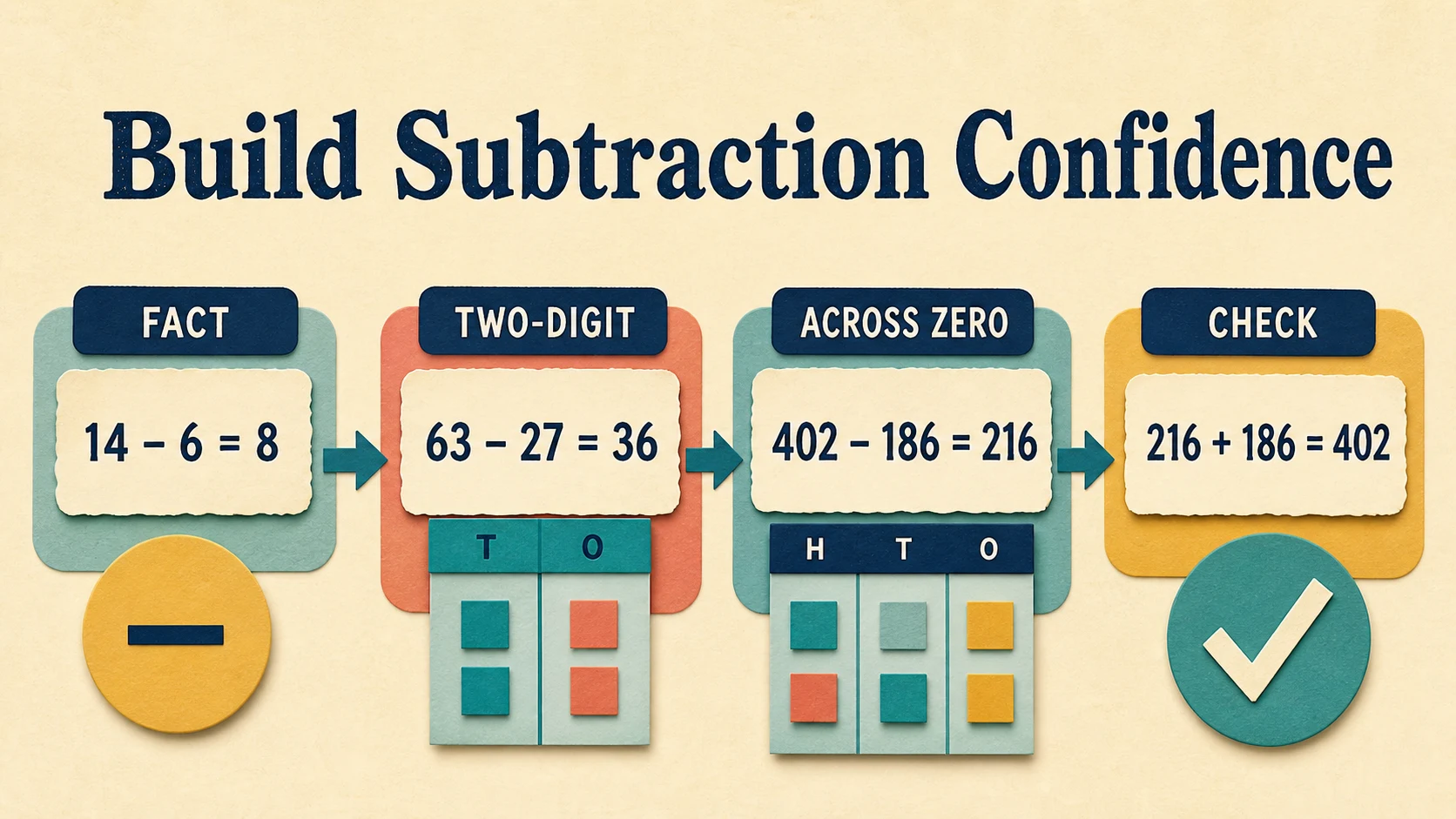
Remove support only after the learner can explain what each trade or difference represents.
4th Grade: maintain place-value reasoning as the numbers grow
A longer numeral does not create a new subtraction operation, but it increases the demand on alignment, regrouping, working memory, and checking. Look for whether the learner keeps ones under ones and tens under tens, especially when zeros appear.
Do not infer understanding from a run of answers alone. Ask for one explanation: “What value did you trade, and what was it replaced with?” A learner who can describe exchanging one hundred for 10 tens is showing place-value reasoning. A learner who can only recite “borrow from next door” may need a model before more independent practice.
The 4th Grade free sheet has 25 problems. Select a short sample first, then decide whether the remaining items offer useful practice or merely repeat an unresolved error.
5th Grade: choose complexity deliberately
The free 5th Grade sheet contains 30 problems, the largest free-sheet count in this catalogue. More problems do not automatically mean a better match. Inspect whether the intended work is whole-number subtraction practice, application, or another visible demand.
At this stage, subtraction may appear inside longer contexts or alongside other number forms in a local curriculum. Do not assume those features are present without previewing the resource. If decimal subtraction is the actual target, use the dedicated Decimals Worksheets by Grade and Level collection rather than treating any upper-grade subtraction sheet as interchangeable.
A good boundary check is whether the learner can estimate first, calculate accurately, and verify the result. If the calculation is correct but the operation chosen for a word problem is wrong, assign work on interpreting situations—not simply larger numbers.
How representation and question design should change
A worksheet can become harder without increasing the largest number. Adults should distinguish the sources of demand.
From physical action to mental representation
A progression may move through:
- real objects that the learner moves;
- pictures of objects that can be crossed out;
- structured models such as ten frames or base-ten drawings;
- number lines or open number lines;
- equations with a missing result;
- equations with a missing part;
- written stories requiring an operation choice.
These representations are not a staircase that must be climbed once and abandoned. A 4th Grade learner can return to base-ten blocks to clarify regrouping, then go back to the written algorithm. The model preserves the target skill because it represents the same quantities and operation.
From stated operation to chosen operation
Compare these two prompts:
- “Solve .”
- “Jordan needs 10 cards and has 6. How many more cards are needed?”
Both have the answer four, but the second requires the learner to identify a missing-part relationship before calculating. It adds interpretation without increasing the number range.
Teach the learner to identify the action or relationship before choosing an operation:
- Did an amount decrease?
- Are two amounts being compared?
- Is one part missing from a known whole?
- Is the question asking for what remains, the difference, or the amount needed?
Avoid relying on isolated keywords. “More” can appear in a comparison question whose solution uses subtraction. The whole relationship determines the operation.
From one procedure to flexible checking
A checked answer should make sense in context and reconnect to addition. For , use both:
and an estimate: 43 is about 40, 25 is about 30, and the difference should be around 10—not 60. Estimation is not an exact proof, but it can expose an unreasonable result.
The Common Core mathematics standards describe grade-level expectations involving addition and subtraction across elementary grades, including operation relationships, place value, and fluency. They are a useful reference for task boundaries, but a catalogue grade label does not by itself prove alignment with a particular standard or local sequence (Common Core State Standards, Mathematics).
What “easy” should mean when you inspect a worksheet
All six free catalogue entries are labeled “easy.” Do not turn that resource label into a label for a child. Define difficulty through what can be seen on the page.
An easier starting task usually controls several of these features:
- a familiar number range;
- one operation per item;
- visible quantities or a usable model;
- no regrouping, or one clearly modeled regrouping step;
- short, direct language;
- consistent layout;
- few irrelevant details;
- enough space to draw or record thinking;
- a manageable number of items at one time.
A harder task may increase one or more features:
- larger numbers;
- multiple regroupings;
- zeros in critical place-value positions;
- an unknown appearing somewhere other than after the equals sign;
- mixed operations;
- a word problem with more information to organize;
- no supplied representation;
- more items or longer sustained work.
Problem count affects workload, not mathematical complexity by itself. A 30-item page of familiar facts may be less conceptually demanding than five comparison problems requiring operation selection.
The IES practice guide for teaching mathematics to young children recommends building on children’s informal mathematical knowledge, using progressions, monitoring what children know, and helping them represent mathematical ideas in multiple ways. That supports previewing and adapting a page around observed understanding; it does not mean IES evaluated WorksheetWise materials (IES, Teaching Math to Young Children).
A short routine for using one page well
A worksheet is most informative when it sits inside a brief cycle of explanation, observation, practice, and checking.
Preview one problem
Choose an item that represents the page’s main demand. Do not begin by assigning all 20, 25, or 30 problems.
Ask: “What is happening here?” If it is a word problem, have the learner describe the situation before naming an operation. If it is a regrouping problem, ask what each digit represents.
Model, then invite an explanation
Work one example while narrating the quantities. For , show 43 with base-ten blocks, trade one tens rod for 10 ones cubes, and remove the specified amounts. Then ask the learner to explain why the total was still 43 after the trade.
The adult’s explanation should be short enough for the learner to reproduce in their own words.
Attempt a small set
Give three to five representative items. Watch rather than correcting every movement immediately. Record the type of support used:
- independent;
- solved after a question;
- solved with a model;
- solved after an adult example;
- not yet solved accurately.
This produces more useful evidence than a single percentage score.
Check by addition or context
For , ask whether . For a story problem, insert the answer back into the story. Six markers plus four more makes the needed 10.
Decide the next task feature
Keep the number range and representation stable if the learner is still constructing the idea. Remove one support if the learner explains and checks reliably. Increase only one major demand at a time: number range, regrouping, representation, language, operation choice, or workload.
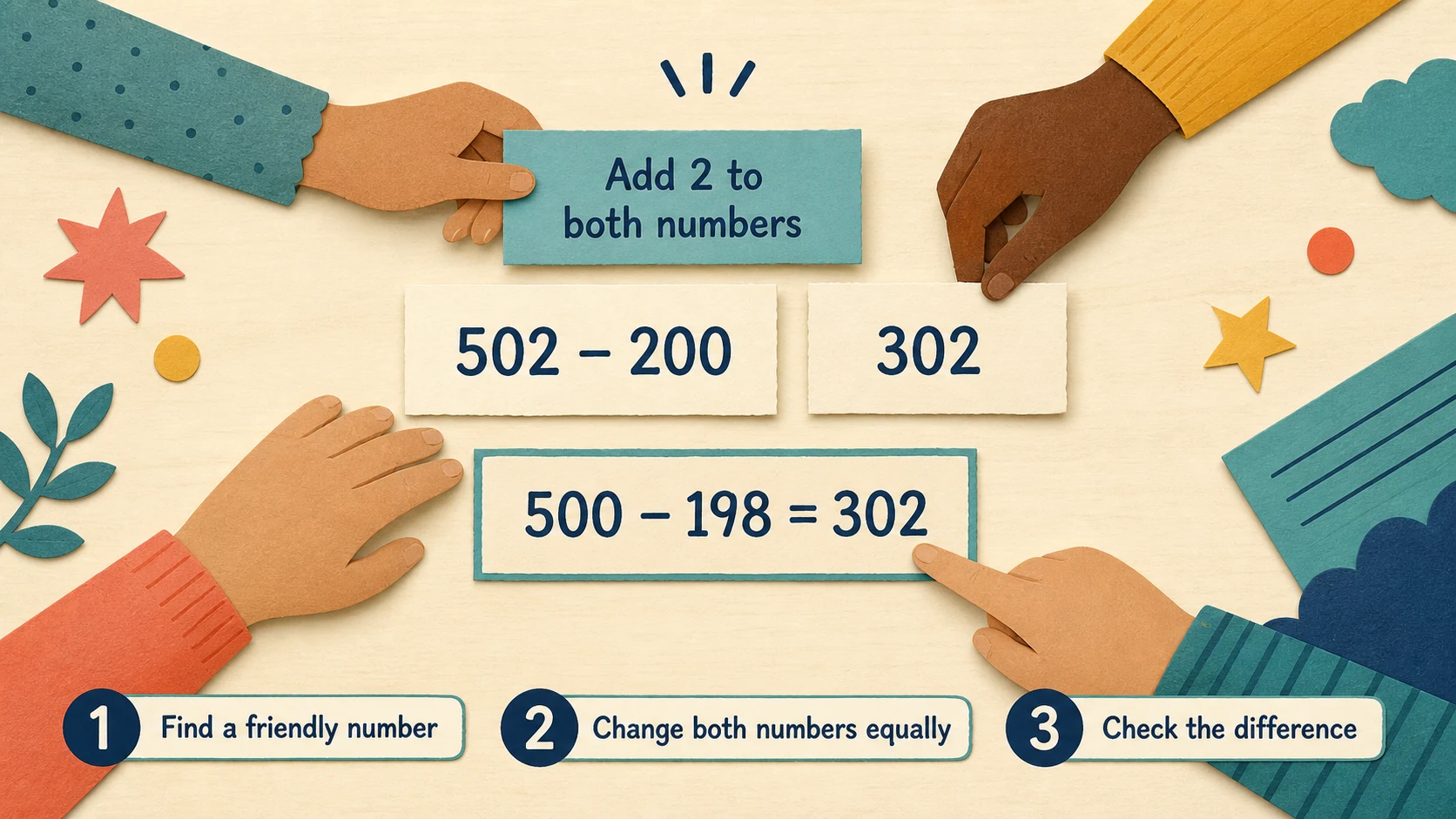
One modeled item, a short attempt, and a meaningful check reveal more than rushing through an entire 25-problem page.
Read errors as evidence about the task
An incorrect answer does not explain itself. Ask the learner to show the steps, then test the smallest plausible interpretation.
When the learner reverses digits within each column
For , a learner may write 26 by subtracting the smaller digit from the larger digit in each column: and , sometimes recording those results in an inconsistent order. The issue is not simply carelessness. The work suggests that the learner is treating each column as an isolated digit puzzle instead of preserving the values 43 and 25.
Return to base-ten blocks. Show that three ones cannot have five ones removed unless one ten is traded. After finding 18, check . Then try one structurally similar problem, not a whole page.
When every subtraction story becomes “take away”
A learner may solve “I have eight and you have three; how many more do I have?” only after pretending three objects were removed. The numerical answer may still be five, but the interpretation is incomplete.
Build two aligned rows. Match objects rather than removing them. Ask what the unmatched objects mean. Follow with a missing-part problem using the same numbers so the learner experiences different relationships that share a subtraction equation.
When counting backward causes tracking errors
For , a learner might say “13, 12, 11, 10, 9” and answer nine because 13 was counted as the first step. Mark the starting number without counting it as a jump, or use the related addition fact .
This does not mean counting back must be prohibited. It means the current method is producing a tracking burden. Offer a structured representation or a more dependable strategy.
When the operation is correct but the answer is unreasonable
Suppose a learner subtracts in a comparison problem but reports a difference larger than both original quantities. Ask for an estimate and reconstruct the context. The difference between eight and three cannot exceed eight.
The IES guide for assisting students who struggle with mathematics emphasizes systematic instruction, clear mathematical language, representations, number lines, and purposeful practice. These are useful response principles, not a basis for diagnosing a learner from worksheet performance (IES, Assisting Students Struggling with Mathematics).
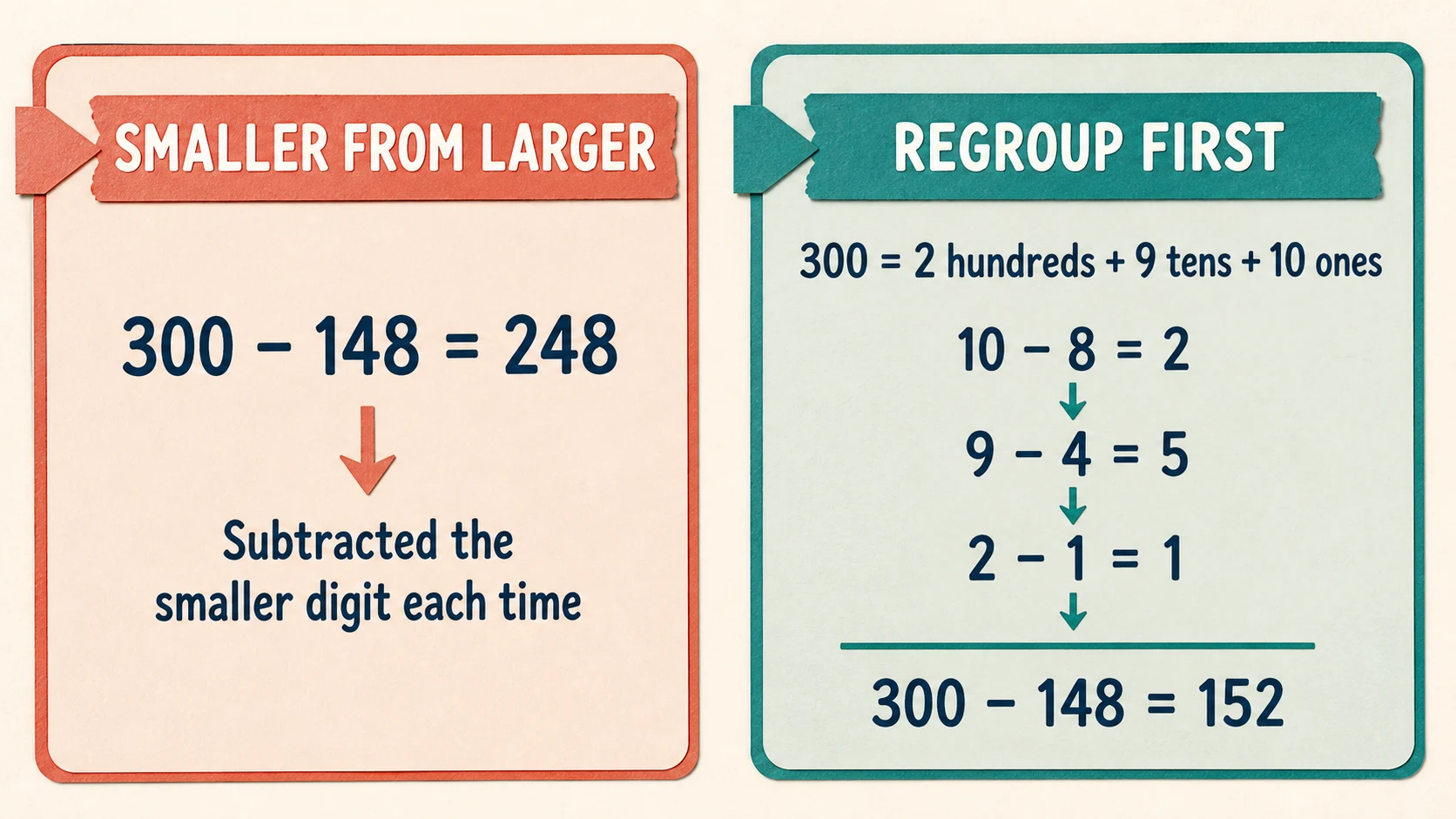
Match the response to the observed reasoning: place-value errors need place-value work, while story errors need interpretation work.
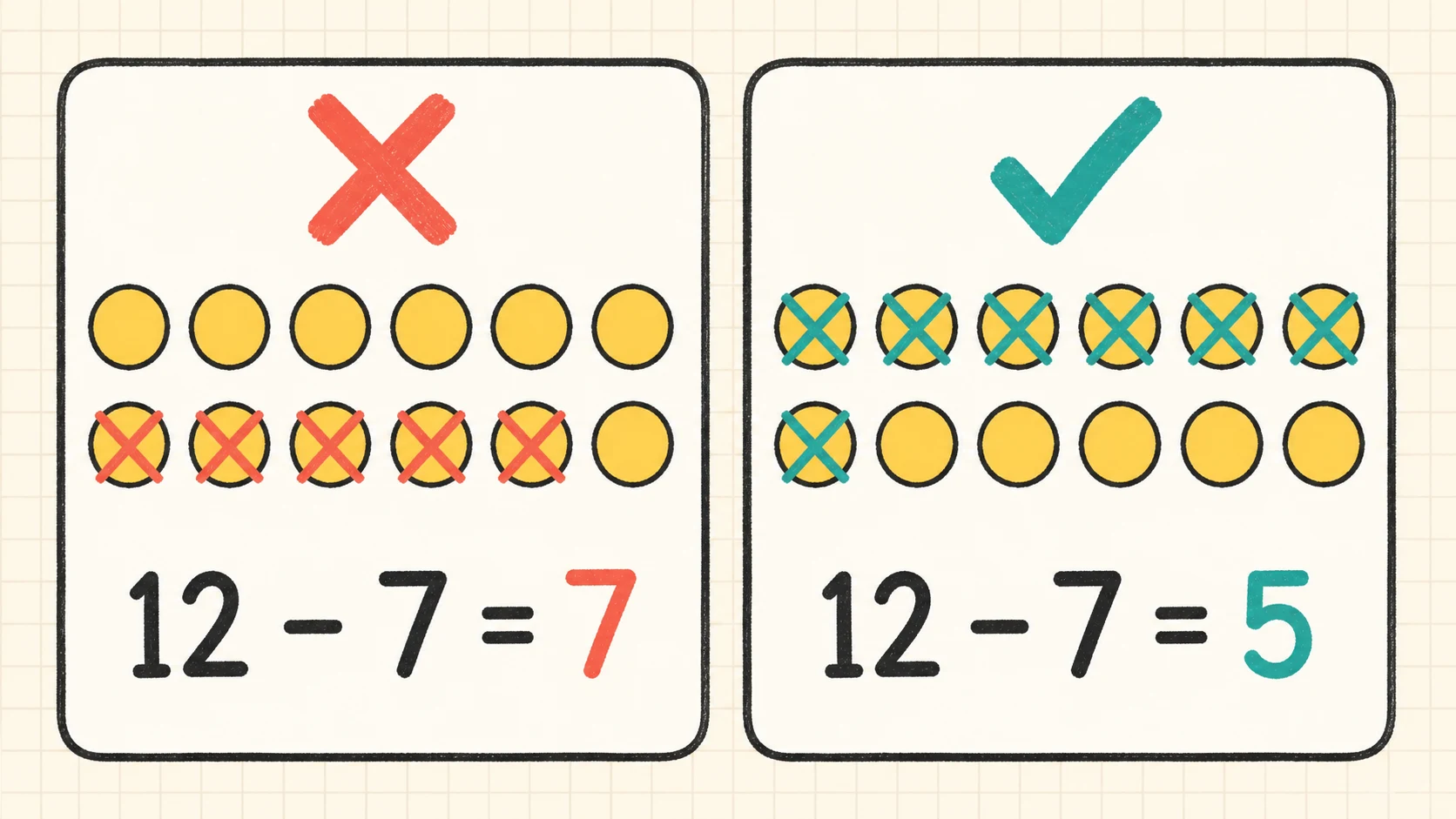
Early errors are best investigated with objects, drawings, and the learner’s explanation—not classified from an answer alone.
Adapt the work without removing the subtraction
An adaptation preserves the mathematical target while reducing an unrelated barrier.
If handwriting is slowing the work, let the learner point, use number cards, dictate an equation, or write only the answer and one explanation. If the page is visually dense, cover all but one row. If 25 or 30 problems exceed useful attention, assign a representative subset. If story language is the barrier, read the text aloud while keeping the operation choice with the learner.
For regrouping, supply base-ten blocks or let the learner draw tens and ones. That support does not make the task invalid; it makes place value visible. If the target is independent use of the written algorithm, fade the blocks after the learner can explain and record the trade.
Do not preserve workload at the expense of reasoning. Completing every item while repeating the same misconception is not productive practice. Equally, do not simplify the target until it disappears. If the goal is comparison, changing every prompt into an explicit “take away” equation removes the interpretation the learner needs to learn.
The free deterministic worksheet generators can help when the next step needs a controlled number range or a fresh short set. Generated practice should follow an observed need, not replace the conversation that identifies it.
Select the next real worksheet from observable evidence
Use this decision sequence:
- Identify the situation the learner understands: removal, comparison, or missing part.
- Find the largest number range the learner can represent accurately.
- Determine whether calculation is reliable without regrouping.
- If regrouping appears, ask the learner to model the trade and explain why value is preserved.
- Check whether the learner can connect subtraction to addition.
- Test one word problem in which the operation is not stated.
- Choose the grade-page entry whose visible task features provide one manageable next demand.
- Assign a short sample before committing to the full page.
Move forward when the learner can represent the quantities, solve a small varied set accurately, explain the strategy, and check at least one answer. Stay at the same boundary but vary the representation when the idea is understood inconsistently. Step back one task feature when the learner cannot yet explain what the numbers or regrouping marks mean.
These decisions are instructional, not diagnostic. A single sheet can be affected by fatigue, unfamiliar language, layout, attention, or prior experience. Use repeated observations across a few tasks before drawing conclusions.
Your practical next action is to open the 3rd Grade Subtraction guide and free sheet, preview one of its 25 problems, and compare its visible number range, representation, regrouping demand, and language with what the learner just demonstrated. If more than one major feature is new, choose an earlier grade entry; if the learner explains and checks the sample independently, use a short set from that page and observe which feature should change next.
Put it into practice
Use the guide with a real printable
Move from explanation to a short, observable practice task. Check the first item together, then adjust the next session from the learner's actual work.
Open the first free worksheetExplore a neighboring collection
Choose by a different teaching need
Addition Worksheets by Grade and Level Consonant Blends Worksheets by Grade and Level Counting Worksheets by Grade and Level CVC Words Worksheets by Grade and Level Decimals Worksheets by Grade and Level Digraphs Worksheets by Grade and Level Division Worksheets by Grade and Level Fractions Worksheets by Grade and Level