Curated collectionAnswer keys includedPrint-ready PDFs
Sentence Structure Worksheets by Grade and Level
Show the full sentence structure progression across 6 real grade combinations, compare task boundaries, model checked examples and explain how to choose the next level.
Start with a real resource
Browse this worksheet collection
6 relevant free entry points are available. Each one includes a printable learner PDF and separate answer key.
A useful practice loop
Print less. Observe more.
- Choose one skill and model the first item aloud.
- Use a short set and notice the learner’s strategy.
- Change the next task from the work you can see.
Need more than the free sheet?
Plus includes all 108 matching catalogue variations where available, plus saved deterministic generators and the worksheet designer.
See Plus membershipComplete guide
How to teach and practise sentence structure worksheets
3,596 words Updated 6 instructional visuals
Choose sentence structure practice by the thinking required
Sentence structure worksheets should move learners from hearing a complete thought to constructing, combining, repairing, and deliberately varying sentences. The useful progression is not simply “pick the learner’s grade.” Start by identifying the next sentence decision the learner needs to make:
- Is this a complete sentence?
- Who or what is the sentence about, and what do they do or are?
- What detail would make the sentence clearer?
- How can two related thoughts be joined?
- Where should a fragment, run-on, or comma splice be repaired?
- Which sentence pattern best creates the intended meaning, emphasis, or flow?
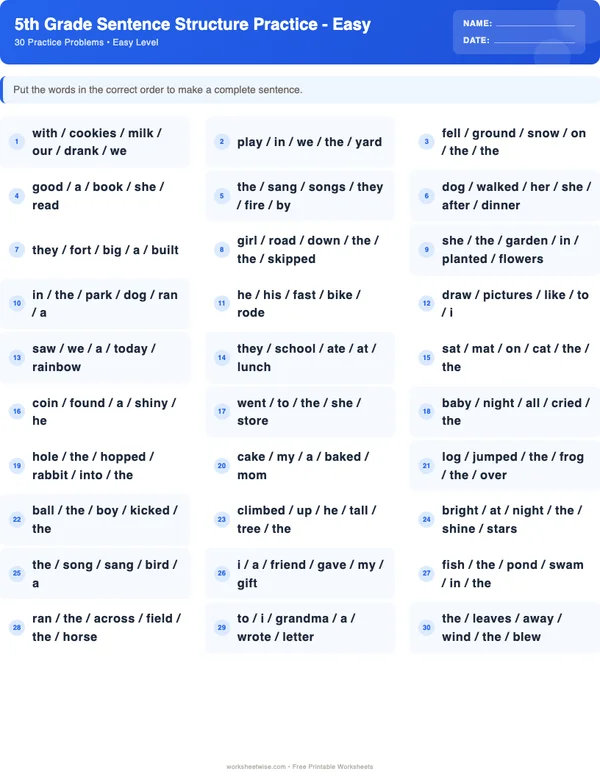
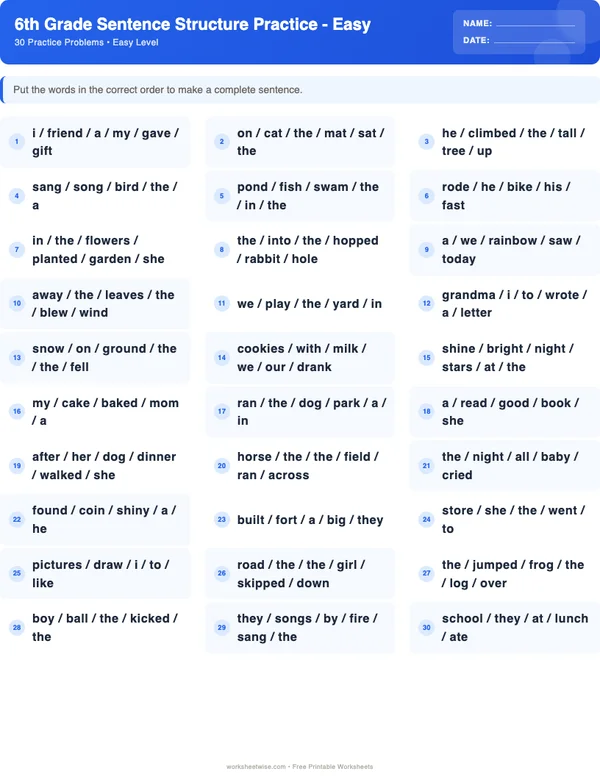
WorksheetWise currently lists 108 sentence structure variants across six grade combinations, with one free entry point for each grade from 1st through 6th. The free 1st- and 2nd-grade sheets contain 12 problems; the 3rd- and 4th-grade sheets contain 14; and the 5th- and 6th-grade sheets contain 30. Those counts describe practice volume, not instructional quality or appropriate placement.
Grade labels indicate the intended practice level, but local curriculum sequences differ. Use grade and age as discovery aids rather than placement decisions. A learner’s explanation, not the label on a worksheet, should determine where instruction begins.
The sentence test: someone or something, plus what happens
A complete sentence expresses a complete thought. For elementary instruction, the most usable first model is:
- Who or what? The subject: someone or something.
- Did what or is what? The predicate: what the subject does, has, feels, or is.
In The rabbit hops, the rabbit answers “Who or what?” and hops answers “Did what?” In The soup is hot, the soup is the subject and is hot tells what it is like.
This model is deliberately simpler than a complete grammatical analysis. It gives adults and learners a reliable way to test short examples without beginning with terminology. Once the learner can hear both parts, attach the terms subject and predicate.
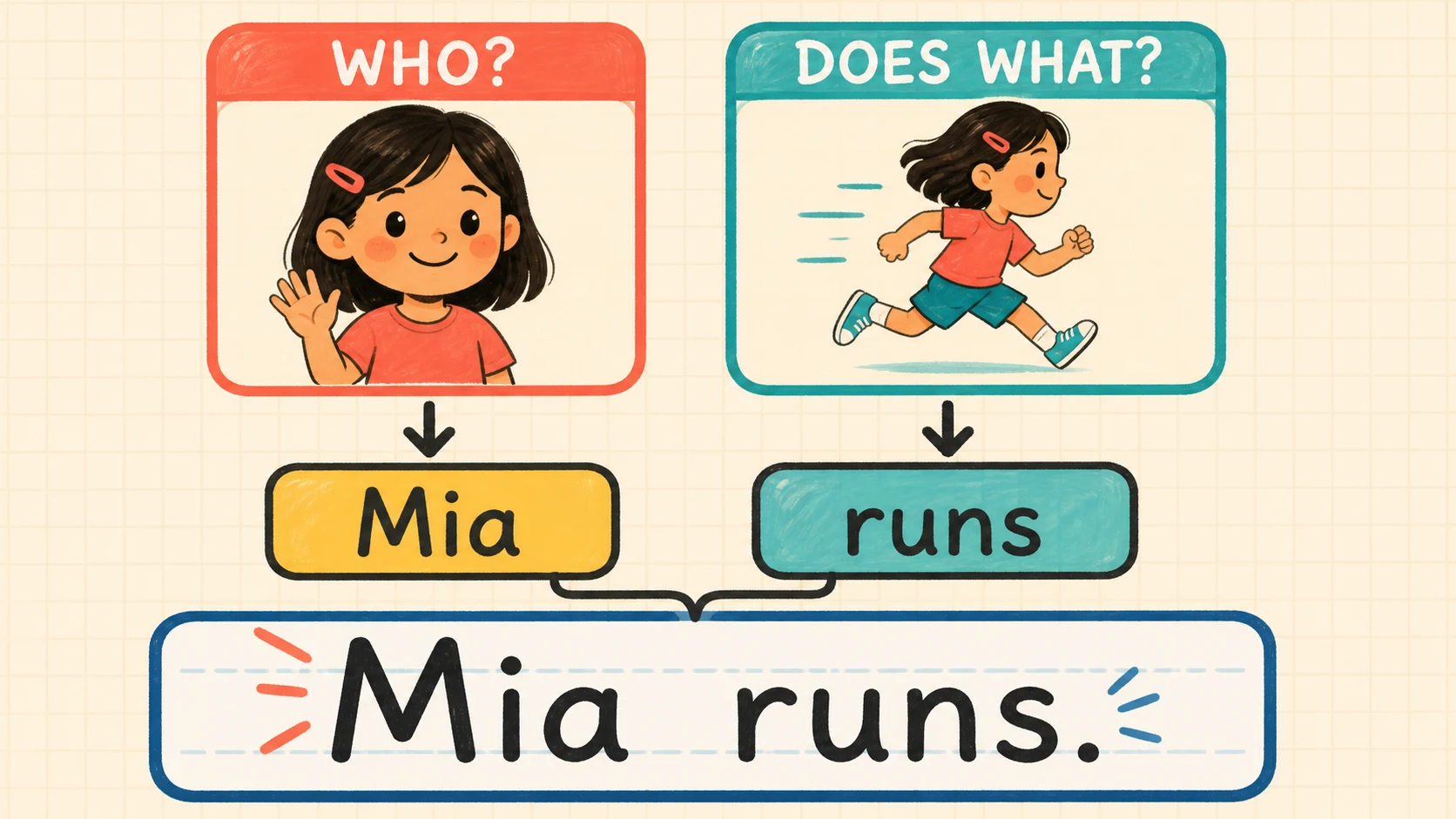
The early skill map keeps complete thoughts, subjects, predicates, and sentence construction connected rather than treating them as separate vocabulary lessons.
Checked example: why “under the table” is not a sentence
Say under the table aloud. Ask:
- “Is that a complete sentence?”
- “Who or what is under the table?”
- “What is happening there?”
The words name a location but do not tell who or what is there. Add The shoes are under the table.
Now check both parts:
- Who or what? The shoes
- What about them? are under the table
This example belongs at the earliest boundary because the learner can solve it orally, without handwriting or grammatical labels. It also reveals whether the learner understands completeness or merely looks for a capital letter and period.
Oral work should come first when sentence awareness is uncertain. The Institute of Education Sciences’ foundational reading guidance emphasizes explicit instruction and supported practice in foundational language and reading skills. It did not evaluate WorksheetWise materials; the practical application here is to model the thinking, respond together, and then ask for an independent response.
For ages three and four, keep any related experience brief and adult-led. Favor oral choices, picture matching, word cards, manipulatives, and movement over desk work. For example, give a child cards showing a dog and runs, say each part, then have the child place the cards together and act out the sentence. That activity preserves the sentence target without requiring extended pencil control.
Six grade entry points and their real task boundaries
The six catalogue combinations share the same broad topic, but a productive cross-grade sequence changes both the representation and the question.
| Grade entry point | Useful starting representation | Central question | Evidence that the learner may be ready to move on |
|---|---|---|---|
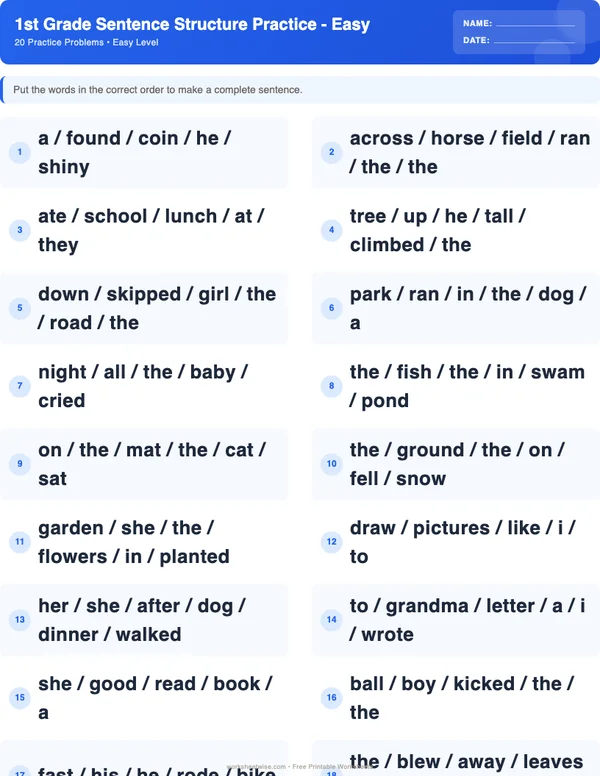
| 1st Grade | Spoken phrases, pictures, short printed sentences | “Is it complete? Who or what? Did what?” | Identifies and builds complete simple sentences without relying only on punctuation |
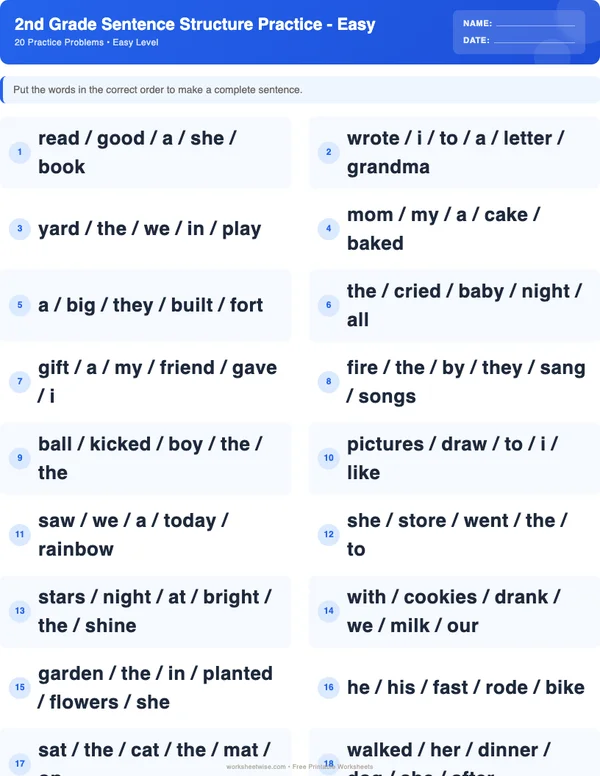
| 2nd Grade | Short sentences and movable detail phrases | “What can I add without losing the main thought?” | Expands a sentence while preserving a clear subject and predicate |
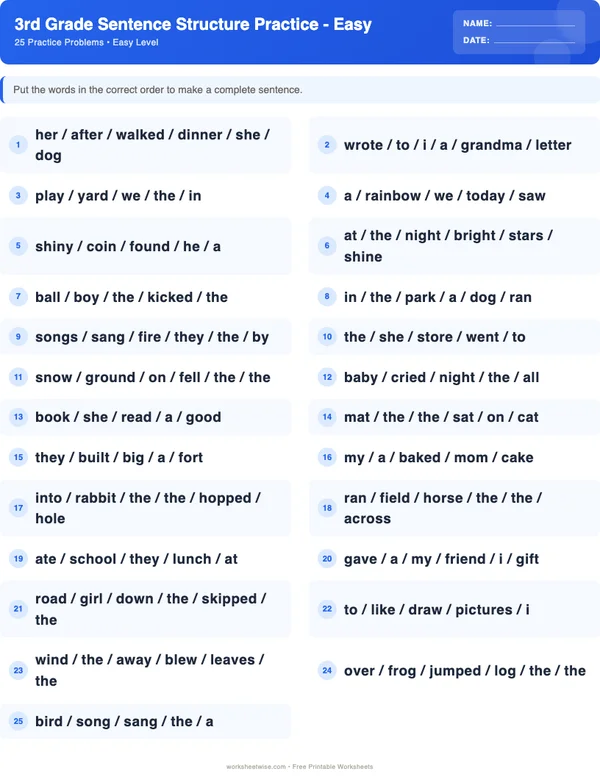
| 3rd Grade | Pairs of closely related sentences | “What repeats, and how can the ideas be combined?” | Produces a grammatical combined sentence and explains the joining choice |
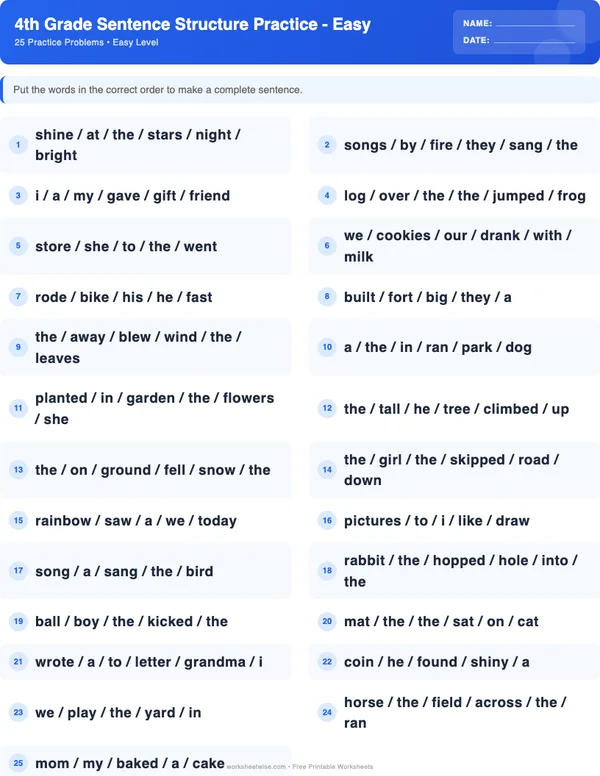
| 4th Grade | Fragments, run-ons, and complete sentences in context | “Where does each complete thought begin and end?” | Repairs boundaries while keeping the intended meaning |
| 5th Grade | Simple, compound, and emerging complex patterns | “How are the ideas related?” | Chooses coordination or subordination for a stated reason |
| 6th Grade | Short passages and mentor-sentence patterns | “How does structure affect emphasis, rhythm, and clarity?” | Revises several sentences intentionally rather than making every sentence longer |
These are teaching decisions derived from the supplied catalogue description, not a claim that every local curriculum uses this exact order. A 5th grader who cannot reliably locate two complete thoughts in a run-on may need a 4th-grade entry task. A 2nd grader who readily expands and combines sentences may benefit from selected 3rd-grade questions.
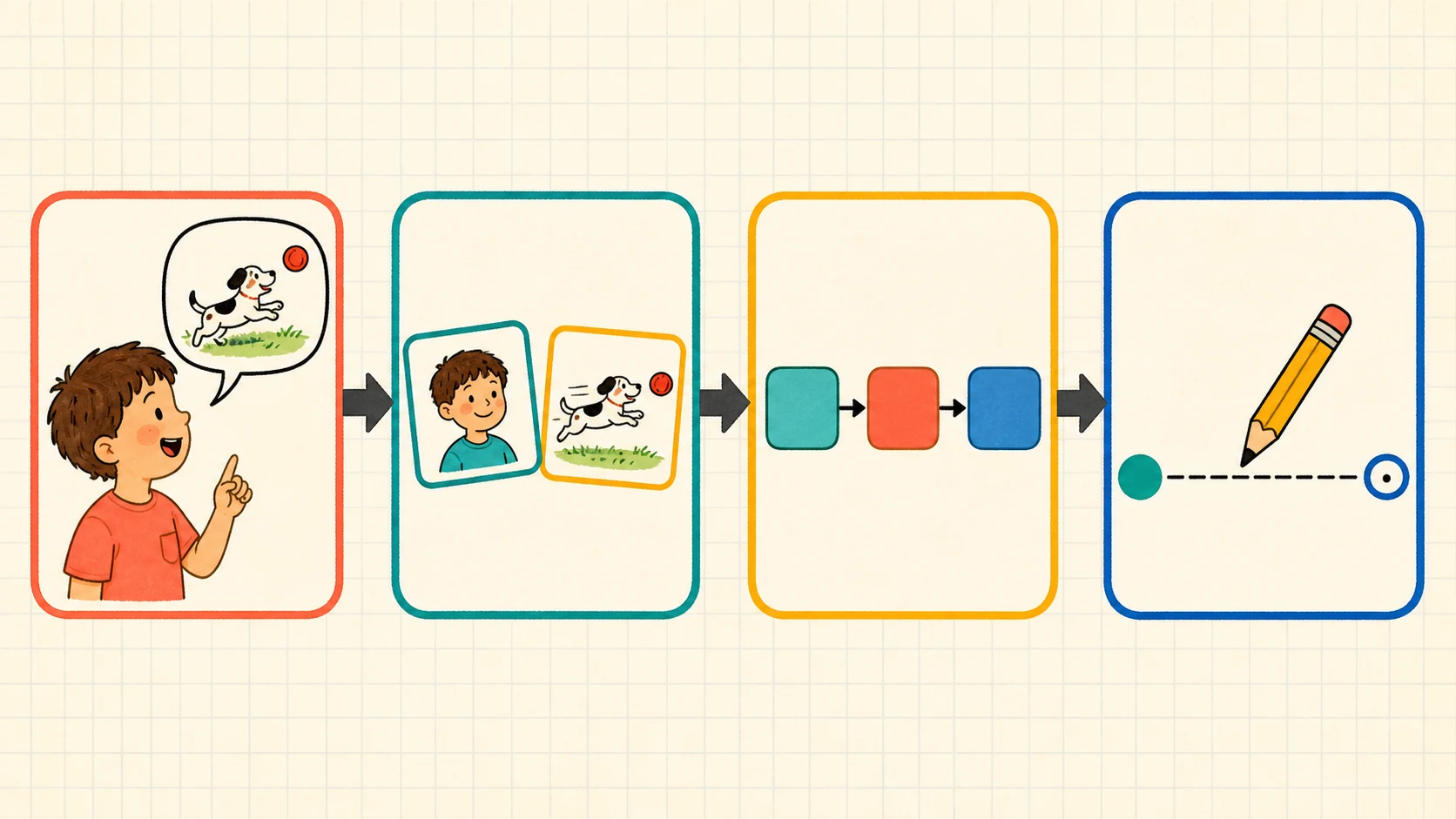
The 1st-grade progression makes independence visible: hear and sort complete thoughts, identify their two essential parts, then construct a sentence.
1st and 2nd grades: completeness before elaboration
Use the 1st Grade Sentence Structure guide and free sheet when the learner needs to distinguish a sentence from a fragment, find a basic subject and predicate, or build a short complete thought. Choose the 2nd Grade Sentence Structure guide and free sheet when completeness is mostly secure and the next decision is how to add useful detail.
The boundary matters. The tiny bird contains detail but remains a fragment. The bird sings is plain but complete. Do not reward length before completeness.
A suitable 2nd-grade expansion might begin with The bird sings and ask for where or when. Possible checked answers include:
- The bird sings in the oak tree.
- At sunrise, the bird sings.
Both retain the subject the bird and predicate sings. The added words answer a meaningful question rather than merely making the sentence longer.
3rd and 4th grades: combine, then control boundaries
Use the 3rd Grade Sentence Structure guide and free sheet when a learner can write complete simple sentences but repeats nouns or produces a string of short, similar statements. Questions should ask the learner to compare ideas before selecting a conjunction or another combining method.
Fourth-grade work should make clause boundaries more visible. The learner must decide whether a group of words is incomplete, whether two complete thoughts have been incorrectly fused, and which repair preserves meaning.
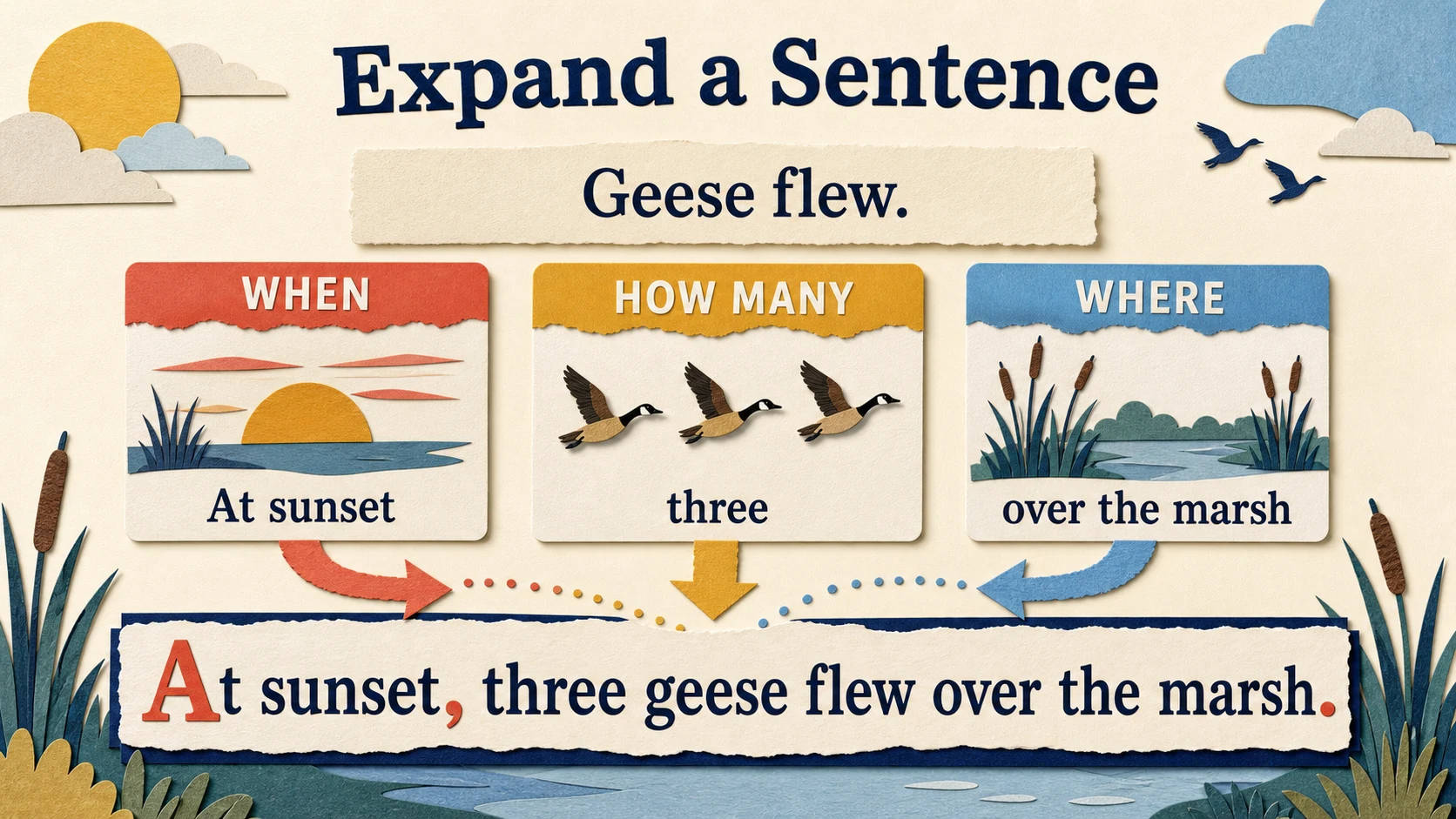
The 3rd-grade routine centers the decision that makes combining useful: notice repetition, identify the relationship, combine, and reread for meaning.
5th and 6th grades: structure becomes a writing choice
Use the 5th Grade Sentence Structure guide and free sheet for practice distinguishing and forming simple, compound, and complex constructions. At this level, a question should do more than request a conjunction. It should make the relationship between ideas matter.
The 6th Grade Sentence Structure guide and free sheet is the strongest catalogue starting point when a learner can form those structures but needs to vary openings, control sentence length, or imitate a purposeful pattern.
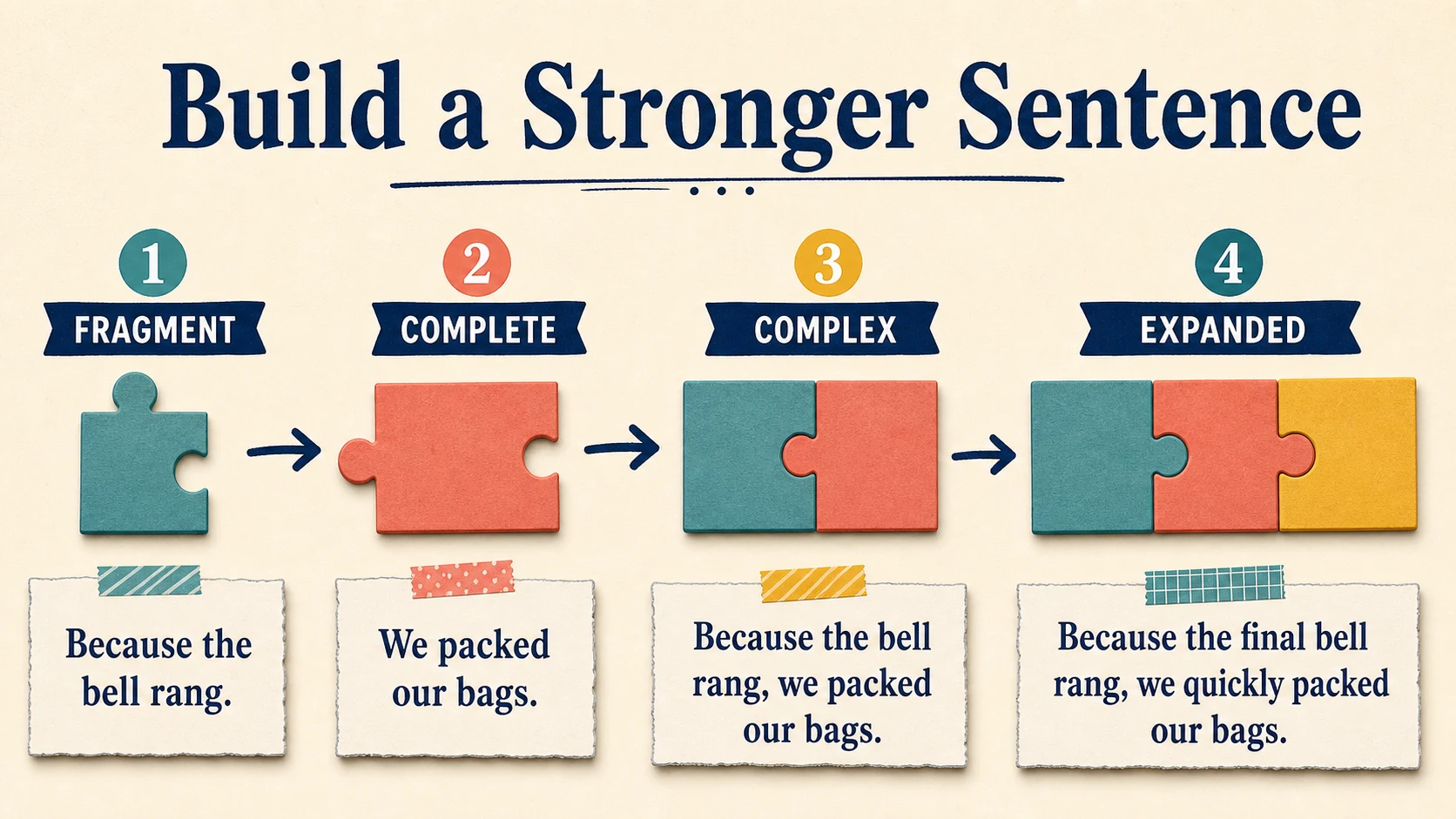
The upper-grade progression shifts the goal from naming structures to selecting and revising them for clarity, emphasis, and flow.
Sentence combining: preserve meaning before adding complexity
The IES elementary writing practice guide recommends teaching students to use the writing process and develop fluency with writing skills; its evidence discussion includes explicit work with sentence construction. That source is general instructional guidance, not an assessment of these worksheets.
Sentence combining is valuable because it requires several decisions at once: find repeated information, identify the relationship between ideas, remove unnecessary repetition, and check that the result remains grammatical. Teach one decision at a time before expecting elegant prose.
Checked example: two valid combinations with different boundaries
Start with:
The dog is big. The dog is brown.
A checked combined sentence is:
The dog is big and brown.
The repeated subject is stated once, while the two descriptions share the predicate frame is. This is a complete sentence.
Another useful result is:
The big, brown dog barked.
This construction correctly combines the two descriptions, but it also needs barked to become a complete sentence. The big, brown dog alone is a noun phrase, not a sentence. That distinction is essential: combining ideas does not excuse the loss of a predicate.
This example belongs around 3rd-grade combining work because the source sentences are structurally simple, repetition is obvious, and the learner can concentrate on how information is consolidated. A stronger follow-up is, “Which version emphasizes what the dog is like, and which emphasizes what it did?”
Checked example: the conjunction must match the relationship
Start with:
Maya wanted to ride her bike. It was raining.
Possible combinations include:
- Maya wanted to ride her bike, but it was raining.
- Although it was raining, Maya wanted to ride her bike.
Both are complete. The first coordinates two complete thoughts with but. The second makes the rain a dependent idea and places it first. Maya wanted to ride her bike, and it was raining is grammatical, but and does not express the contrast as precisely.
This belongs in 4th- or 5th-grade work because the task is no longer just deleting repetition. The learner must represent a logical relationship. Accept more than one answer when it is grammatical and preserves the intended meaning; ask the learner to explain the choice.
Fragments, run-ons, and comma splices need different repairs
A correction worksheet is useful only if the learner knows what kind of boundary failed.
- A fragment is missing an independent complete thought. It may lack a subject, a predicate, or the completion needed after a dependent opening.
- A run-on joins independent clauses without adequate punctuation or a joining word.
- A comma splice joins independent clauses with only a comma.
Teach learners to mark each possible complete thought before choosing punctuation. Ask “Who or what?” and “Did what?” on both sides.
Checked example: three repairs for one run-on
Consider:
The bell rang we packed our books.
There are two complete thoughts:
- The bell rang.
- We packed our books.
Three checked repairs are:
- The bell rang. We packed our books.
- The bell rang, and we packed our books.
- When the bell rang, we packed our books.
The period gives the thoughts equal separation. And coordinates them. When makes the ringing the time condition for packing. A semicolon could also join the two independent clauses, but it may be beyond the intended boundary of an elementary worksheet unless that punctuation has already been taught.
This example belongs in 4th-grade boundary work and remains useful in later grades because it separates correction from stylistic choice. The learner should first prove that two complete thoughts exist, then decide which relationship to show.
What a wrong answer may mean
Treat an error as evidence about the decision, not as a diagnosis.
If a learner labels After the storm ended as complete, the learner may be attending to the subject the storm and verb ended but overlooking how after leaves the listener waiting. Say the fragment aloud and pause. Ask, “What happened after the storm ended?” Then complete it: After the storm ended, we went outside.
If the learner inserts commas wherever speech pauses, contrast oral rhythm with clause structure. In The small, nervous puppy hid, the comma separates coordinate adjectives. In The puppy hid, it was nervous, the comma cannot by itself join two complete thoughts.
If every pair is joined with and, the learner may understand grammatical joining but not relationships. Offer a constrained choice: “Does the second thought add information, show contrast, give a reason, or tell when?”
If a learner produces only very short sentences, do not assume weak ideas. The current task may reward correctness without inviting expansion or variation. Provide one controlled revision target instead of saying “make it better.”
A repeatable lesson routine that exposes the thinking
A worksheet should sit inside a short cycle of speaking, modeling, writing, and checking. The adult’s job is to make the sentence decision audible before expecting independent pencil work.
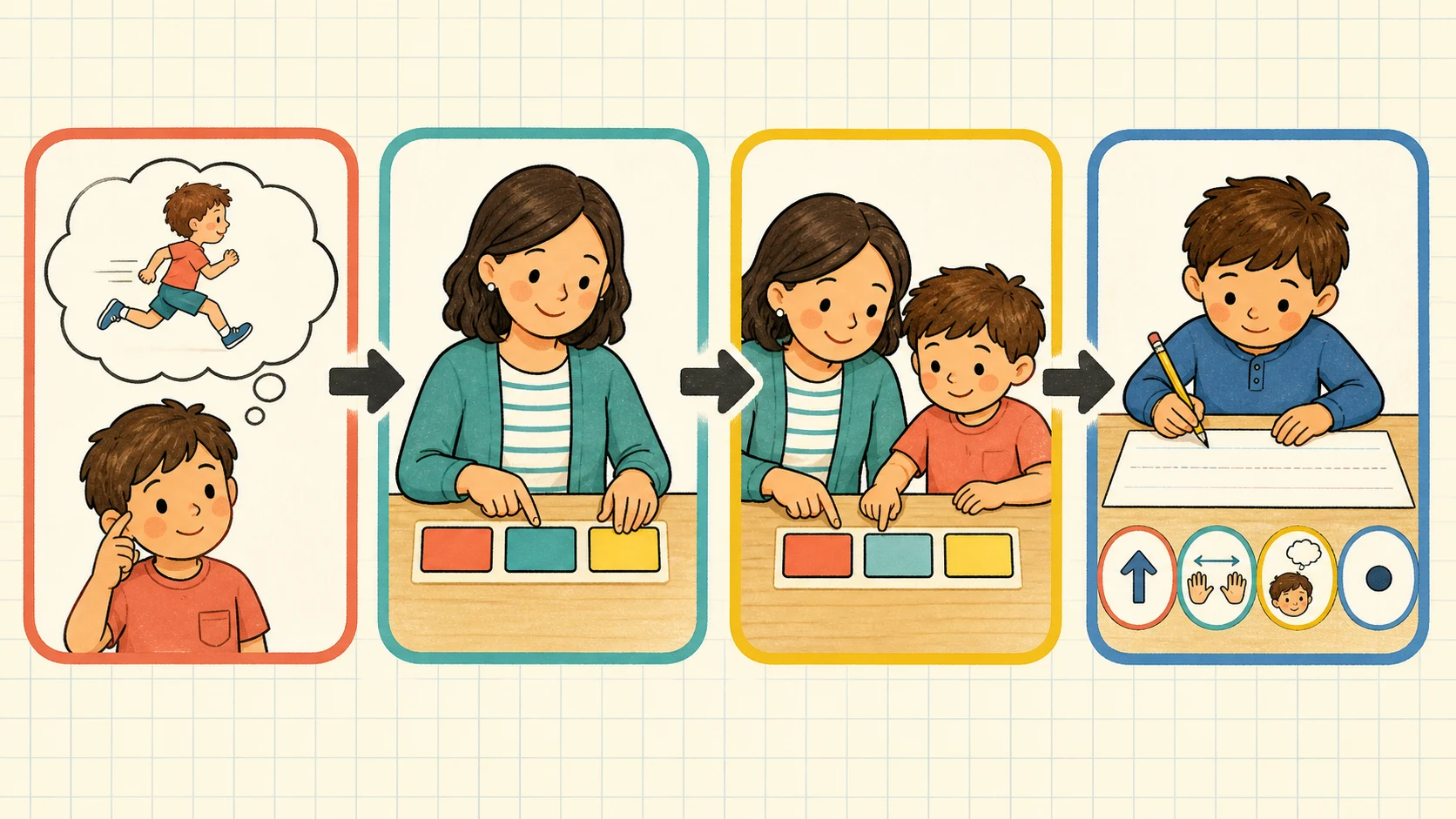
The early routine uses oral rehearsal and a shared check before independent items, so handwriting does not hide whether the learner hears a complete thought.
The 10-minute routine
Minute 1–2: Hear it. Say one sentence and one near-miss: The fox sleeps and behind the log. The learner signals complete or incomplete, then explains what is missing.
Minute 3–4: Build it together. Supply word cards or write chunks separately. Arrange the fox + sleeps + behind the log. Read the result aloud and check “Who or what?” and “Did what?”
Minute 5–7: Model one worksheet decision. Think aloud briefly: “I see two complete thoughts. I want to show contrast, so I will use but.”
Minute 8–9: Independent attempt. Ask the learner to complete two or three items, not an entire page by default. Require a verbal explanation for one response.
Minute 10: Transfer. The learner writes or says a new sentence about familiar content using the same pattern. This final step shows whether the skill transfers beyond recognizing a prepared answer.
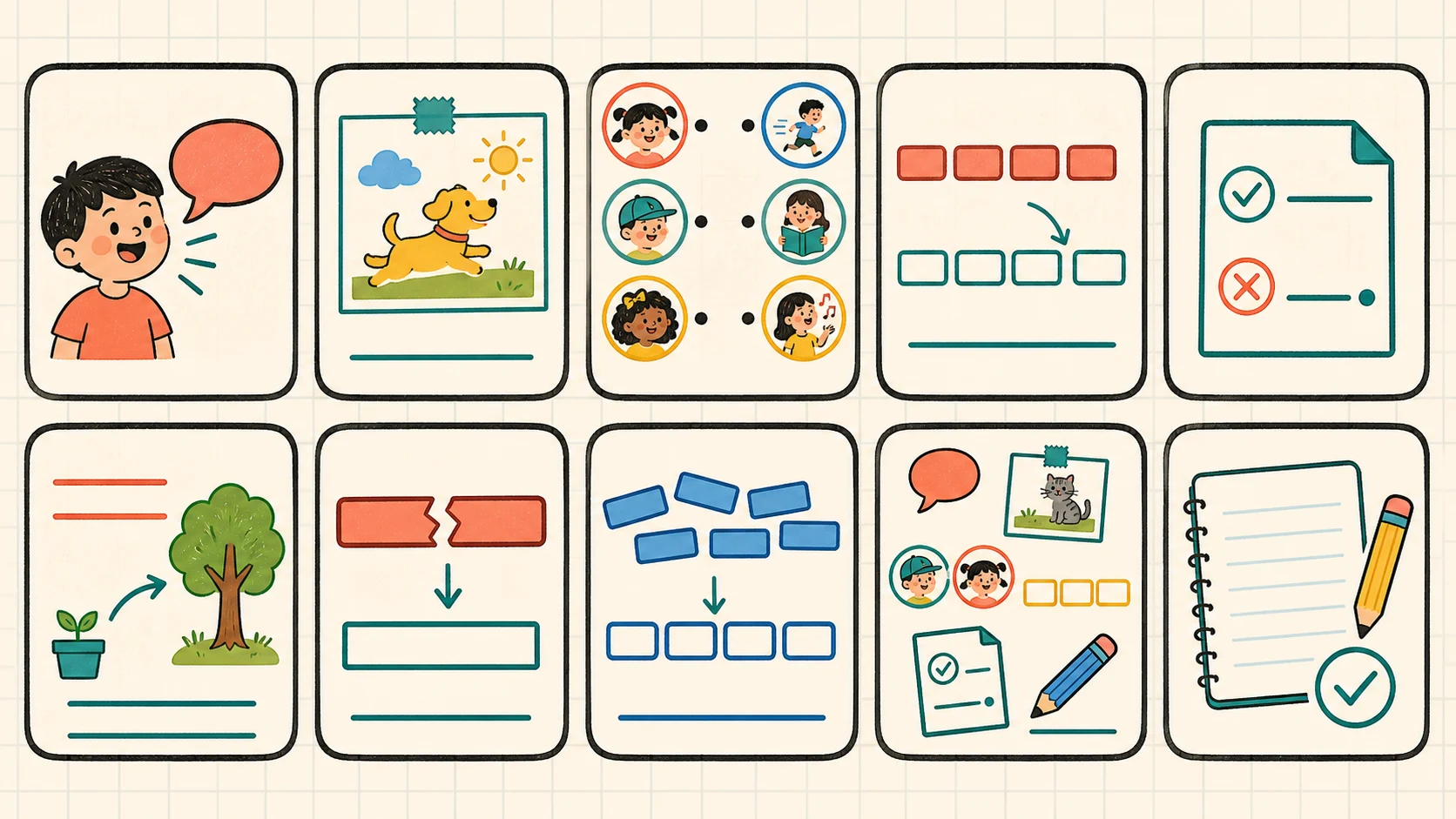
The two-week view alternates new decisions with brief review, allowing adults to revisit completeness instead of treating one finished sheet as mastery.
For daily combining practice, vary only one feature at a time: repeated subject, repeated predicate, addition, contrast, reason, or time. A short, accurate routine is more informative than pushing through a high problem count after attention or handwriting has deteriorated. This is a teaching suggestion based on task design, not a promised dosage or outcome.
Mentor sentences turn upper-grade analysis into imitation
A mentor sentence is a carefully selected sentence from a text the learner is already reading. Study one manageable feature: the opening, clause relationship, punctuation, or change in length. Then ask the learner to imitate the pattern with original content.
The Common Core English Language Arts standards describe an increasing expectation that students command conventions and vary sentence patterns for meaning, interest, and style. Those standards do not establish a universal worksheet order, and citing them does not claim alignment for a specific WorksheetWise resource.
Checked example: three openings, three effects
Begin with the plain sentence:
The hikers crossed the bridge.
Revise the opening three ways:
- Prepositional phrase: Under the dark clouds, the hikers crossed the bridge.
- Adverb: Carefully, the hikers crossed the bridge.
- Dependent clause: When the wind slowed, the hikers crossed the bridge.
Each version remains complete because the independent thought the hikers crossed the bridge is intact. The openings do different work: location or atmosphere, manner, and time. The dependent clause needs the independent clause; When the wind slowed alone is incomplete.
This example belongs in 5th- or 6th-grade practice because the learner is selecting a pattern for an effect, not merely proving completeness. Ask, “Which opening creates the most tension?” There is no single answer unless the surrounding context establishes one; the learner’s explanation matters.
Sentence length can be taught with the same restraint. Compare:
The door opened.
After three silent minutes, the heavy door at the end of the hallway slowly opened.
The short version can create emphasis. The longer version builds delay and detail. Longer is not automatically stronger. Have the learner place each version into a two-sentence scene and decide which rhythm fits.
Match the worksheet to observable task features
The catalogue calls each free sheet “easy,” but that label should describe the sheet’s observable demands, not the learner. Here, an easier entry should involve shorter sentences, familiar vocabulary, one clear operation per item, direct prompting, and limited competing punctuation or clause choices. A harder task would increase sentence length, reduce scaffolds, introduce multiple plausible revisions, require explanation, or move from isolated sentences into a passage.
Before choosing a printable sentence structure worksheet, inspect five features:
1. The unit being judged
Does the page present pictures, word groups, individual sentences, sentence pairs, or a paragraph? A learner who can repair isolated run-ons may still struggle to locate boundaries in a paragraph.
2. The response required
Circle-and-sort tasks test recognition. Filling a missing part provides constrained construction. Rewriting tests production and transcription together. Explaining a revision tests grammatical reasoning. Do not treat these as interchangeable.
3. The number of decisions per item
“Circle the complete sentence” presents one decision. “Rewrite the fragment as a complete sentence with an adjective and a prepositional phrase” requires several. If the learner fails, simplify the number of decisions before simplifying the underlying sentence concept.
4. The language load
Unfamiliar vocabulary, long directions, and dense passages can obscure sentence knowledge. Read directions aloud or explain an unfamiliar noun when vocabulary is not the target.
5. The amount of practice
The free sheets range from 12 to 30 problems. A longer page is not necessarily a higher conceptual level, and completing every item is not mandatory. Select a representative set, observe patterns, and continue only while responses remain meaningful.
A practical starting rule is to choose a page where the learner can explain the first modeled item and attempt the next two independently. Move back one task boundary if the learner cannot state what the question is asking. Move forward when answers are accurate, explanations are clear, and the learner can create a fresh example.
Adapt access without removing the sentence decision
Adaptations should reduce barriers while preserving the target.
- If handwriting is laborious, let the learner dictate, type, point, or arrange word cards. Keep the requirement to identify or construct the complete thought.
- If reading is the barrier, read each item aloud without signaling the answer. The learner should still make the sentence judgment.
- If attention is limited, cover all but one line and complete a small selected set. Do not replace a clause-boundary task with unrelated copying.
- If terminology is confusing, use “Who or what?” and “Did what?” first, then pair those questions with subject and predicate.
- If open-ended combining is overwhelming, offer two conjunctions and ask which relationship each creates.
- If the page is visually dense, rewrite one item with more spacing while keeping its words and response demand.
- If speaking is easier than writing, rehearse the full answer orally before recording it.
Avoid over-support that decides the grammar for the learner. Color-coding the subject and predicate may teach the distinction; pre-coloring every answer on an assessment item removes that decision. Likewise, inserting slash marks at every clause boundary is useful modeling, but independent work should eventually require the learner to locate those boundaries.
These adaptations support access; they do not identify a disability, establish a diagnosis, or guarantee progress. Persistent difficulty across settings should be documented with concrete examples and discussed with the learner’s teacher or appropriate school support team.
Know what a worksheet can and cannot show
A sentence structure page can sample recognition, construction, editing, or revision. It cannot by itself show how the learner writes during planning, whether ideas remain coherent across a paragraph, or whether the skill transfers into authentic writing.
A correct multiple-choice answer may reflect elimination rather than understanding. Ask for one explanation. Conversely, an incorrect written answer may come from spelling, handwriting, reading load, or misunderstanding directions. Let the learner respond orally once before concluding that sentence structure is the problem.
Do not infer mastery from one perfect page or a deficit from one difficult session. Record observable evidence:
- “Identified 5 of 6 fragments and explained what was missing.”
- “Joined every pair with and, including two contrasts.”
- “Located both complete thoughts but omitted the comma before but.”
- “Varied openings during guided practice but not in independent writing.”
Those notes point to the next lesson. Labels do not.
The strongest check is a near transfer: after the worksheet, give a new example with the same structure and different content. After repairing The bell rang we packed our books, try The rain stopped we ran outside. If the learner marks both complete thoughts and chooses a valid repair, the worksheet decision is becoming portable.
Make the next choice from one piece of evidence
Begin with a two-minute oral check: say beside the pond, The ducks swim, and The ducks swim the frogs jump. Ask the learner to identify what is complete, what is missing, and where one thought ends before the next begins.
Choose the resource from the first point of uncertainty:
- If beside the pond is accepted as complete, begin with the 1st Grade Sentence Structure guide and free sheet.
- If completeness is secure but sentences remain bare, inspect the 2nd-grade expansion entry.
- If repetition is the main issue, use 3rd-grade combining work.
- If boundaries fail between complete thoughts, select 4th-grade fragment and run-on practice.
- If the learner combines accurately but cannot explain relationships, compare 5th-grade compound and complex choices.
- If correctness is secure but writing sounds repetitive, use 6th-grade variation and mentor-sentence imitation.
Today’s practical next action is to open the linked 1st-grade free sheet, regardless of the learner’s grade, and use only its first three relevant items as a placement conversation. Ask for an explanation after each response. Continue there, step back to oral word-card work, or move to the next grade resource according to the sentence decision the learner can make independently—not according to age, page length, or the word “easy.”
Put it into practice
Use the guide with a real printable
Move from explanation to a short, observable practice task. Check the first item together, then adjust the next session from the learner's actual work.
Open the first free worksheetExplore a neighboring collection
Choose by a different teaching need
Addition Worksheets by Grade and Level Consonant Blends Worksheets by Grade and Level Counting Worksheets by Grade and Level CVC Words Worksheets by Grade and Level Decimals Worksheets by Grade and Level Digraphs Worksheets by Grade and Level Division Worksheets by Grade and Level Fractions Worksheets by Grade and Level