What 6th Grade Sentence Structure Means
Sixth-grade sentence structure instruction helps learners write complete, clear sentences and make deliberate choices about how ideas connect. The work typically includes:
- Identifying subjects and predicates
- Distinguishing sentences from fragments
- Separating or correctly joining complete thoughts
- Recognizing and repairing run-ons and comma splices
- Building simple, compound, and complex sentences
- Expanding, combining, and reducing sentences
- Varying sentence beginnings, patterns, and lengths for meaning and style
The concise answer is this: teach completeness first, coordination and subordination next, and stylistic variation after the learner can control sentence boundaries. Choose practice from the errors visible in the learner’s own work. A worksheet on complex sentences will not solve a persistent fragment problem, and repetitive sentence labeling will not automatically improve a learner’s writing.
Grade labels describe an intended practice level; local school, district, state, and homeschool sequences differ. Use “6th Grade” as a starting point, then adjust the pace according to observed work rather than age or the calendar alone.
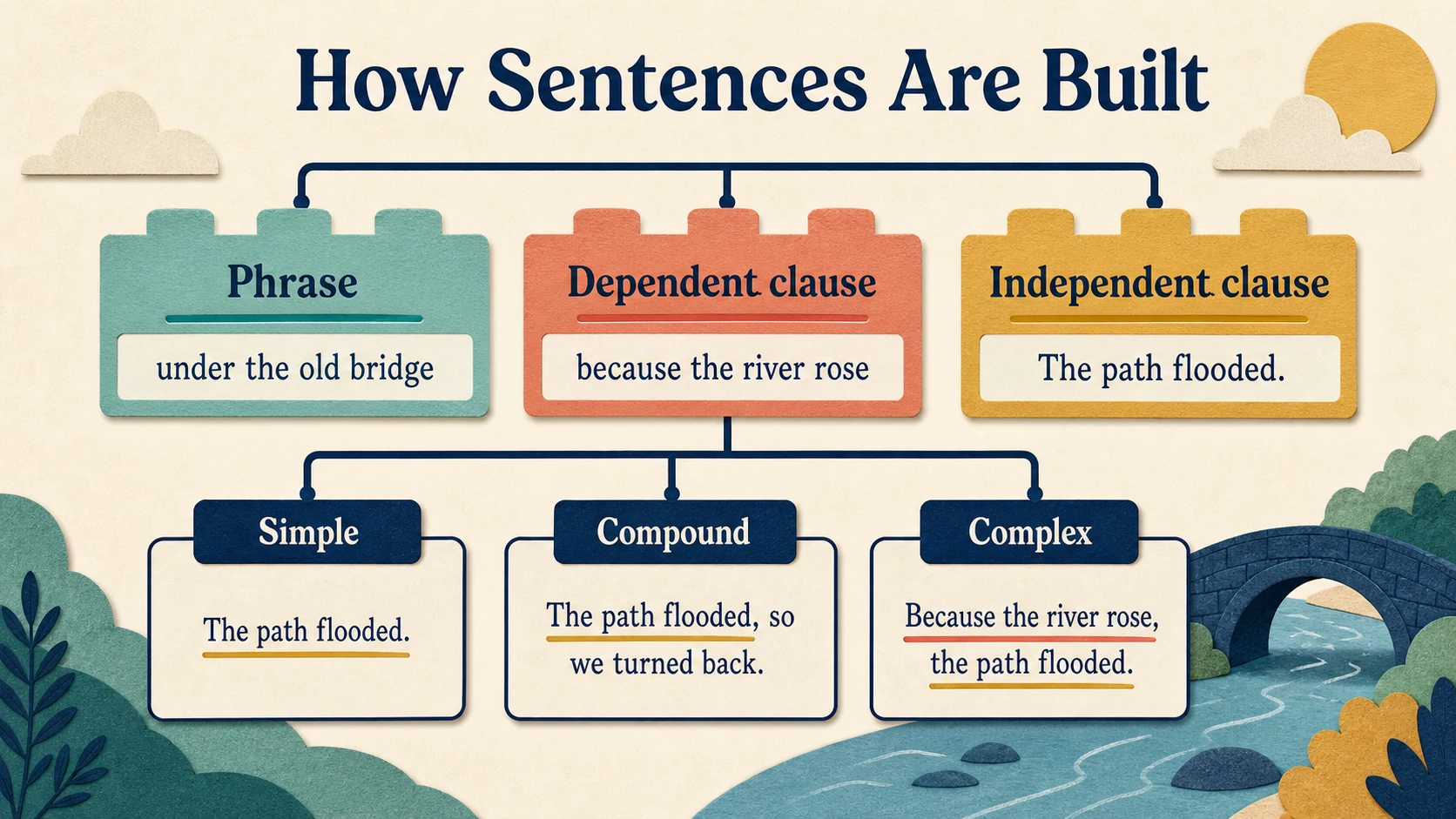
Sentence completeness supports later work with connections, expansion, punctuation, and style.
Prerequisites to Check Before Teaching New Patterns
Sentence structure depends on several smaller skills. A short diagnostic is more useful than assuming that every sixth grader needs the same starting lesson.
Subjects, predicates, and complete thoughts
Ask the learner to mark who or what each sentence is about and what is said about that subject:
The old bicycle near the fence needs a new chain.
The complete subject is The old bicycle near the fence. The simple subject is bicycle. The complete predicate is needs a new chain, and the verb is needs.
A practical oral check is “Who or what?” followed by “Did what?” or “Is what?” This language is an instructional scaffold, not a complete grammatical definition. It helps learners test ordinary sentences quickly, but commands, compound subjects, linking verbs, and unusual word order require more careful analysis.
Verb recognition
A learner who cannot locate a finite verb may mistake a phrase for a sentence:
Running toward the gate.
Running names an action, but this group of words does not state who was running or complete the thought. Compare:
Mateo was running toward the gate.
Here, Mateo is the subject, and was running toward the gate is the predicate.
Also check linking verbs:
The trail seems steep.
The sentence does not describe an action. Seems links trail to steep, but it still functions as the verb needed to complete the predicate.
Basic punctuation and conjunctions
Before asking a learner to repair run-ons, verify that the learner can:
- Recognize a statement, question, command, and exclamation
- Use appropriate end punctuation
- Identify common coordinating conjunctions such as and, but, or, so, yet, for, and nor
- Notice words that introduce dependent clauses, including because, although, when, if, while, and since
The IES foundational reading guide addresses kindergarten through third grade, not sixth-grade sentence instruction. Its usefulness here is limited to broad prerequisite framing: accurate word reading, language knowledge, and reading for meaning support later literacy work. It should not be presented as an evaluation of this guide or any WorksheetWise resource.
A Grade-Appropriate Teaching Progression
The progression below moves from sentence boundaries to purposeful variation. A learner may enter at any point, and apparent mastery in an isolated exercise should be checked in original writing.
| Stage |
Main question |
Sample task |
Evidence to advance |
| 1. Complete thoughts |
Does this group of words express a complete thought? |
Sort sentences and fragments |
Explains what a fragment lacks |
| 2. Core parts |
Who or what is the subject, and what is the predicate? |
Mark subjects and predicates |
Identifies both in varied sentences |
| 3. Word order and expansion |
Are the words arranged clearly, and can details be added? |
Reorder or expand a sentence |
Preserves meaning and agreement |
| 4. Coordination |
Are two equal complete thoughts joined correctly? |
Form compound sentences |
Uses a conjunction or semicolon correctly |
| 5. Subordination |
Which idea is central, and which depends on it? |
Form complex sentences |
Places and punctuates clauses accurately |
| 6. Boundary repair |
Where does one complete thought end? |
Correct run-ons and comma splices |
Chooses among valid repairs |
| 7. Combining and reducing |
Can repeated information be expressed more efficiently? |
Combine two or three sentences |
Retains all intended meaning |
| 8. Style and application |
Does the pattern suit the meaning and context? |
Revise a paragraph |
Varies structure without introducing errors |
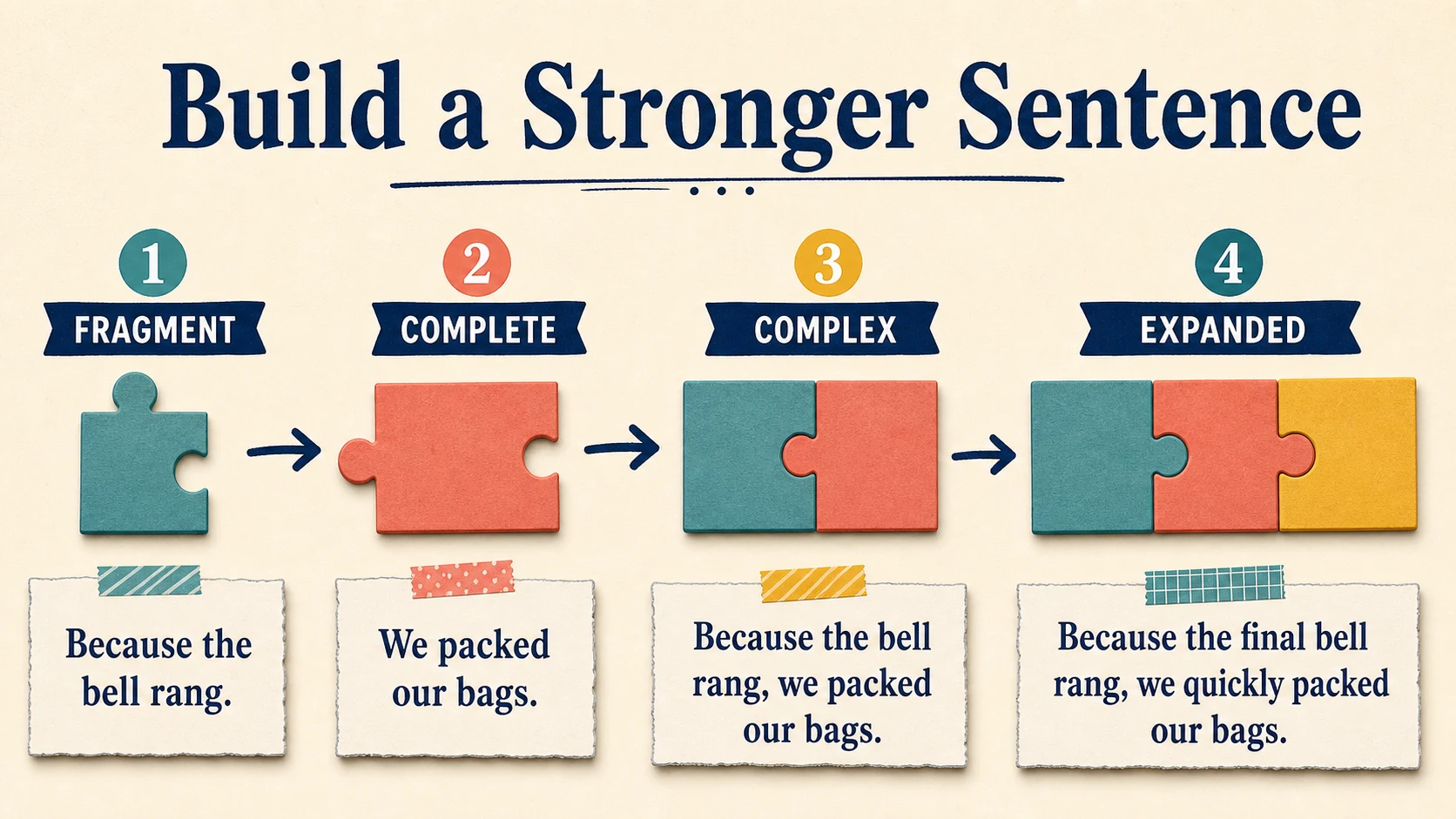
Move forward when the learner can explain and apply a pattern, then return to earlier skills when writing reveals a gap.
The Common Core English Language Arts standards provide one public reference point for the broader progression from producing complete sentences to expanding, combining, and reducing them for meaning, interest, and style. Local expectations may organize that progression differently. The catalogue lists relevant language standards across grades, but that should not be treated as a claim of comprehensive standards alignment for every activity.
Concrete and Visual Models
Sentence structure becomes easier to discuss when clauses are represented consistently. The following models are teaching tools rather than official notation.
The clause frame
Use a box for a complete independent clause:
[The rain stopped.]
A compound sentence contains two independent clauses:
[The rain stopped], so [the players returned to the field.]
A complex sentence combines an independent clause with a dependent clause:
Because the rain stopped, [the players returned to the field.]
The dependent clause Because the rain stopped contains a subject and a verb, but because leaves the thought unfinished. It depends on the main clause.
The train model
Imagine each independent clause as an engine capable of traveling alone. Two engines can be connected by:
- A comma and coordinating conjunction: , but
- A semicolon: ;
- A period, creating two separate sentences
A dependent clause is more like a car that must be attached to an engine. This model makes one important distinction visible: a comma by itself is not a sufficient connector between two independent clauses.
Color coding
For a short sentence, underline the subject once and the predicate twice. For clause work, use one color for independent clauses, another for dependent clauses, and a circle around the connecting word. If color distracts the learner, brackets and labels work just as well.
Begin with oral examples before requiring terminology. Say “after the final bell” and ask whether the thought feels finished. Add “the hallway became quiet.” The learner can hear the difference before labeling a dependent clause or prepositional phrase.
Fully Checked Worked Examples
The most useful worked examples show both the decision and the verification. The learner should see why an answer works, not merely copy its surface pattern.
Example 1: Reordering words into a complete sentence
Arrange these words:
carefully / the / measured / student / liquid / the
First locate a likely subject: the student. Next locate the verb: measured. Place the object after the verb: the liquid. The adverb carefully can sensibly describe how the student measured.
One correct answer is:
The student carefully measured the liquid.
Check:
- Subject: The student
- Predicate: carefully measured the liquid
- Complete thought: yes
- Capital letter and end punctuation: yes
- Meaning: all supplied words are retained
Another grammatically possible arrangement is Carefully, the student measured the liquid. The comma marks the introductory adverb. Word-order tasks sometimes have more than one valid answer, so evaluate grammaticality and meaning rather than matching only one sequence.
Example 2: Diagnosing and repairing a fragment
Original:
Although the library had already closed.
The group contains a subject, the library, and a verb, had closed. However, although makes the clause dependent and signals a contrast that never arrives.
Repair by adding an independent clause:
Although the library had already closed, the return slot remained open.
Check:
- Dependent clause: Although the library had already closed
- Independent clause: the return slot remained open
- Comma after the introductory dependent clause: yes
- Complete contrast: yes
A second valid repair removes the subordinating word:
The library had already closed.
That version is complete, but it changes the intended relationship because the contrast disappears.
Example 3: Correcting a comma splice
Original:
The model bridge looked fragile, it held every weight.
Both sides can stand alone:
The model bridge looked fragile.
It held every weight.
A comma alone does not correctly join these two independent clauses. Three possible repairs are:
The model bridge looked fragile, but it held every weight.
The model bridge looked fragile; it held every weight.
The model bridge looked fragile. It held every weight.
The first repair makes the contrast explicit. The semicolon preserves a close relationship without naming it. The period gives each thought more separation. All three are structurally complete; the best choice depends on the meaning and rhythm the writer wants.
Example 4: Combining repeated information
Original:
The fox crossed the field.
The fox moved silently.
The field was frozen.
A concise combination is:
The fox moved silently across the frozen field.
Check each idea:
- The fox crossed or moved across the field: retained
- The fox moved silently: retained
- The field was frozen: retained
- Repetition of the fox and the field: reduced
- New unsupported information: none
A learner might write The silent fox crossed the frozen field, but that changes the meaning. The original says the fox moved silently; it does not say the fox itself was silent in every respect. Sentence combining requires attention to meaning, not just shorter wording.
Example 5: Choosing a complex structure
Ideas:
Lena saved the document.
The computer restarted.
If the restart happened after the save:
After Lena saved the document, the computer restarted.
If saving was a response to a warning that a restart was coming, a different relationship may be needed:
Lena saved the document because the computer was about to restart.
Both sentences are grammatical, but they do not communicate the same facts. The connector must match the intended relationship. After expresses time; because expresses cause.
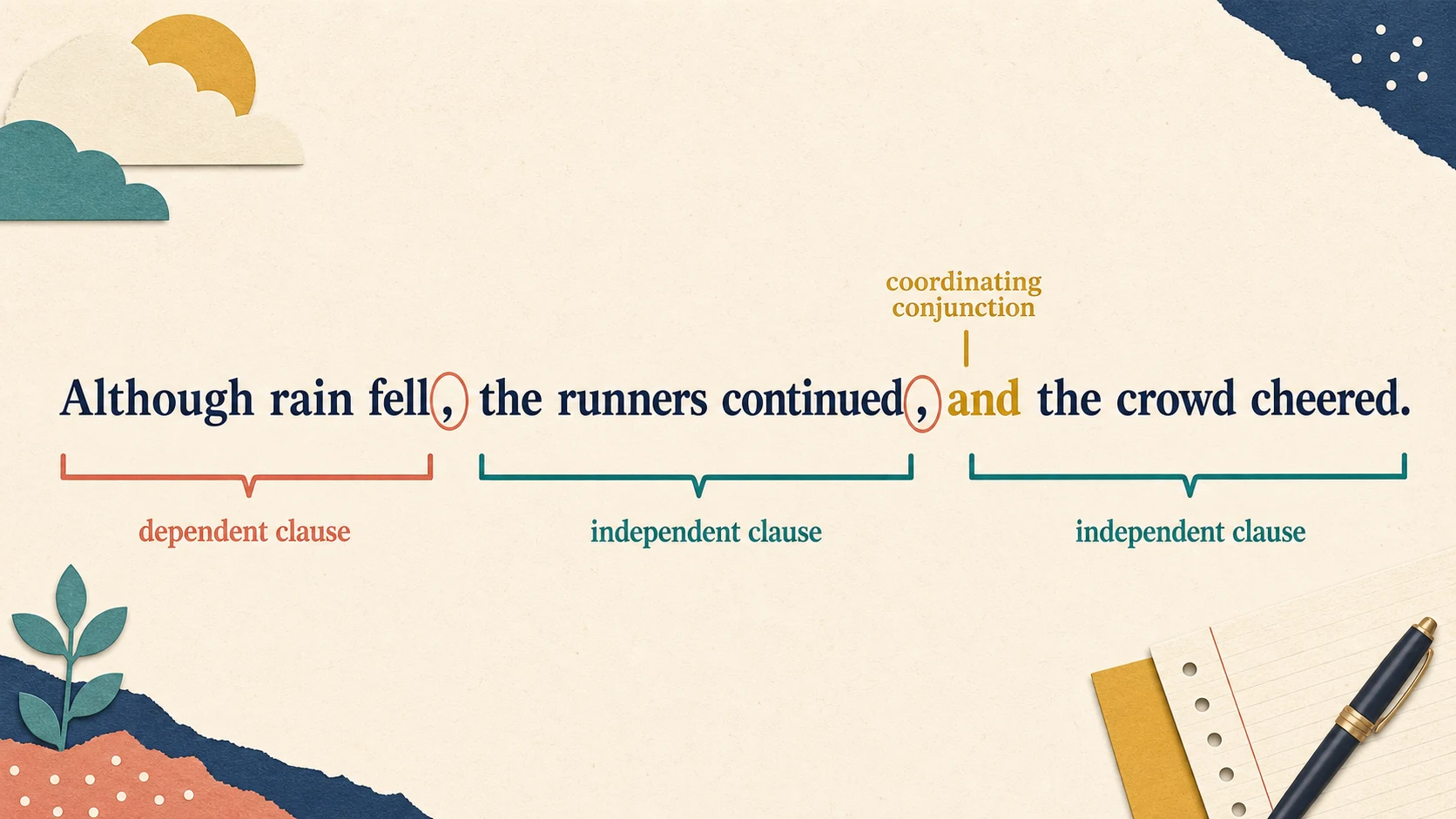
Check the clause structure, punctuation, and preserved meaning before accepting a revision.
Important Boundary Cases
Rules become useful when learners understand where a quick test can fail.
Commands with an understood subject
Place the notebook on the table.
This is a complete sentence even though you is not written. The understood subject is you, and place the notebook on the table is the predicate. A mechanical rule that every sentence must display a written subject would misclassify this command.
Short sentences and long fragments
Length does not determine completeness:
Birds migrate.
This is a complete sentence with a subject and predicate.
Through the narrow tunnel beneath the abandoned station.
This longer group is a fragment because it does not state what happened. Add a subject and predicate:
The hikers walked through the narrow tunnel beneath the abandoned station.
Compound predicates versus compound sentences
Priya opened the window and waved.
This is a simple sentence with one subject, Priya, and a compound predicate, opened the window and waved. No comma is needed before and.
Compare:
Priya opened the window, and her brother waved.
Now and joins two independent clauses. The comma helps mark that clause boundary.
A dependent clause can follow the main clause
We remained indoors because lightning flashed nearby.
The dependent clause follows the independent clause, so this ordinary arrangement does not require a comma before because. Compare the introductory order:
Because lightning flashed nearby, we remained indoors.
Here, the comma follows the introductory dependent clause.
Sentence variety is not random variety
Beginning every sentence differently can produce awkward writing. A short sentence may provide emphasis, while a longer sentence may connect related details. The goal is to choose structures that make relationships clear—not to force every available pattern into one paragraph.
A Short, Repeatable Lesson Routine
A focused routine can fit into roughly 15 to 20 minutes, but that timing is an instructional option, not a universal requirement. Extend or shorten it according to the learner’s attention, accuracy, and explanation.
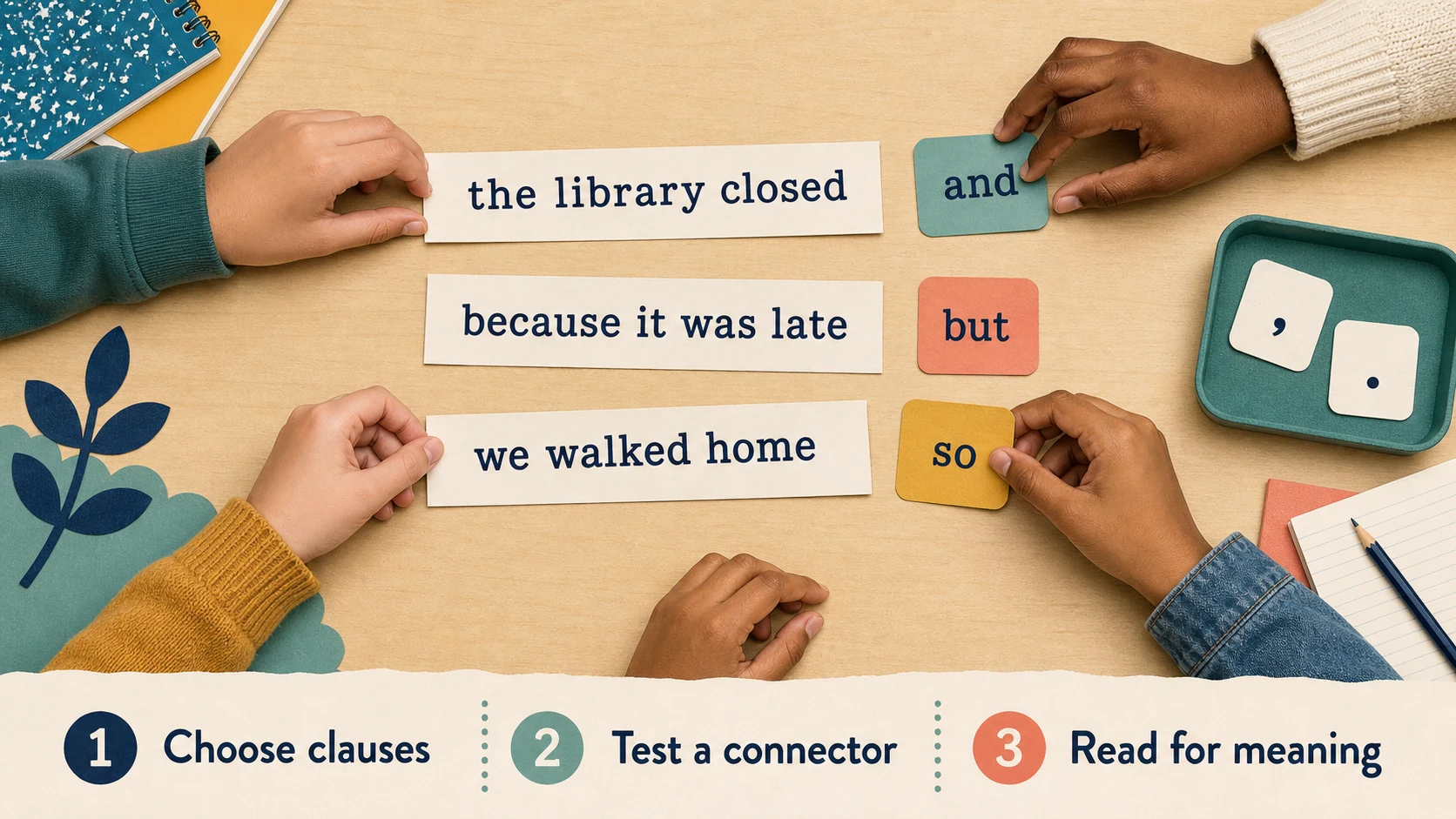
A compact cycle of noticing, modeling, guided practice, application, and review keeps structure connected to writing.
1. Notice
Present one sentence or error from recent work. Ask the learner to identify the subject, verb, and clause boundary before naming the lesson topic.
2. Model
Think through one example aloud. Mark the clauses, explain the relationship between ideas, select a connector, and verify punctuation. Keep the model visible.
3. Practice together
Complete two or three items with decreasing support. On the first, provide the clause labels. On the next, ask the learner to mark them. On the last, ask for an independent repair and an explanation.
4. Apply in meaningful writing
Have the learner revise one sentence from a paragraph, note, explanation, or response. If no recent writing is available, provide two facts to combine. Application reveals whether the learner can transfer the pattern beyond a worksheet format.
5. Review
End with one brief retrieval prompt: “What are three ways to repair two independent clauses joined only by a comma?” Revisit the same idea after a delay rather than assuming one correct session establishes durable control.
The IES guide to teaching elementary students to be effective writers supports high-level instructional practices such as providing writing time, teaching the writing process and foundational skills, and creating an engaged community of writers. It does not evaluate this specific topic page, worksheet, routine, or sixth-grade timetable.
Choosing Practice That Matches the Need
The 6th Grade grammar hub can help adults locate related practice, while the sentence structure topic guide keeps the focus on this skill family. Select a task by what the learner must decide.
| Observed need |
Useful practice |
Less useful as the only practice |
| Scrambled or unclear syntax |
Reorder words, then explain the subject-verb relationship |
Naming sentence types |
| Frequent fragments |
Sort complete and incomplete groups; complete fragments in two ways |
Copying correct sentences |
| Run-ons or comma splices |
Mark independent clauses and compare several valid repairs |
Adding punctuation without clause analysis |
| Repetitive short sentences |
Combine ideas while preserving every fact |
Adding random adjectives |
| Confusion about idea relationships |
Choose among connectors and explain changes in meaning |
Memorizing connector lists alone |
| Correct exercises but weak transfer |
Revise original writing and explain one change |
More isolated items of the same format |
| Overly long, tangled sentences |
Divide ideas, remove repetition, and restore clear clause boundaries |
Requiring every sentence to be complex |
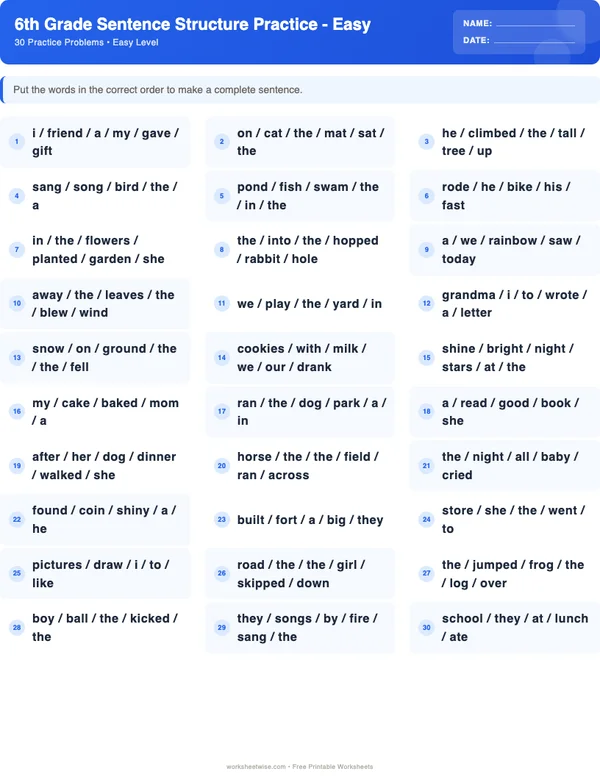
The free standard easy sentence-structure worksheet contains 30 word-order exercises with a separate answer key. Its stated focus is arranging words to make complete sentences, including word order, formation, syntax, and grammar. It is a reasonable choice for a learner who needs that precise foundation or a low-complexity starting point. It does not, by itself, cover the full progression of fragments, run-ons, clause relationships, combining, and stylistic revision.
The focused sentence-structure pack contains 18 worksheets and may suit families or educators who want a larger practice set. Quantity should not determine pacing. Sample a small number of items, examine the error pattern, and continue only while the practice matches the need.
Differentiation Without Lowering the Thinking
Differentiation changes the support, task size, or response mode while preserving the central decision.
When the learner needs more support
- Present one contrast at a time, such as sentence versus fragment.
- Read examples aloud before asking for labels.
- Provide clause brackets or color coding.
- Offer two connectors and ask which meaning fits.
- Use shorter sentences with familiar vocabulary.
- Let the learner explain orally before writing.
- Complete one example together, then remove one prompt at a time.
For word-order work, begin with cards or written chunks such as the hikers / followed / the marked trail. Move individual modifiers only after the core order is stable.
When the learner is ready for more complexity
- Ask for two valid revisions with different effects.
- Include interrupting phrases or longer subjects.
- Compare a compound sentence with a complex version.
- Require the learner to preserve all facts while reducing repetition.
- Ask the learner to revise a paragraph for both clarity and rhythm.
- Have the learner imitate the structure of a well-crafted sentence using original content.
A mentor sentence can support close study: mark its clauses, identify how details are placed, and create a new sentence with the same broad pattern. This is an instructional suggestion from the supplied catalogue guidance, not a claim that one routine guarantees better writing.
Common Errors and Diagnostic Responses
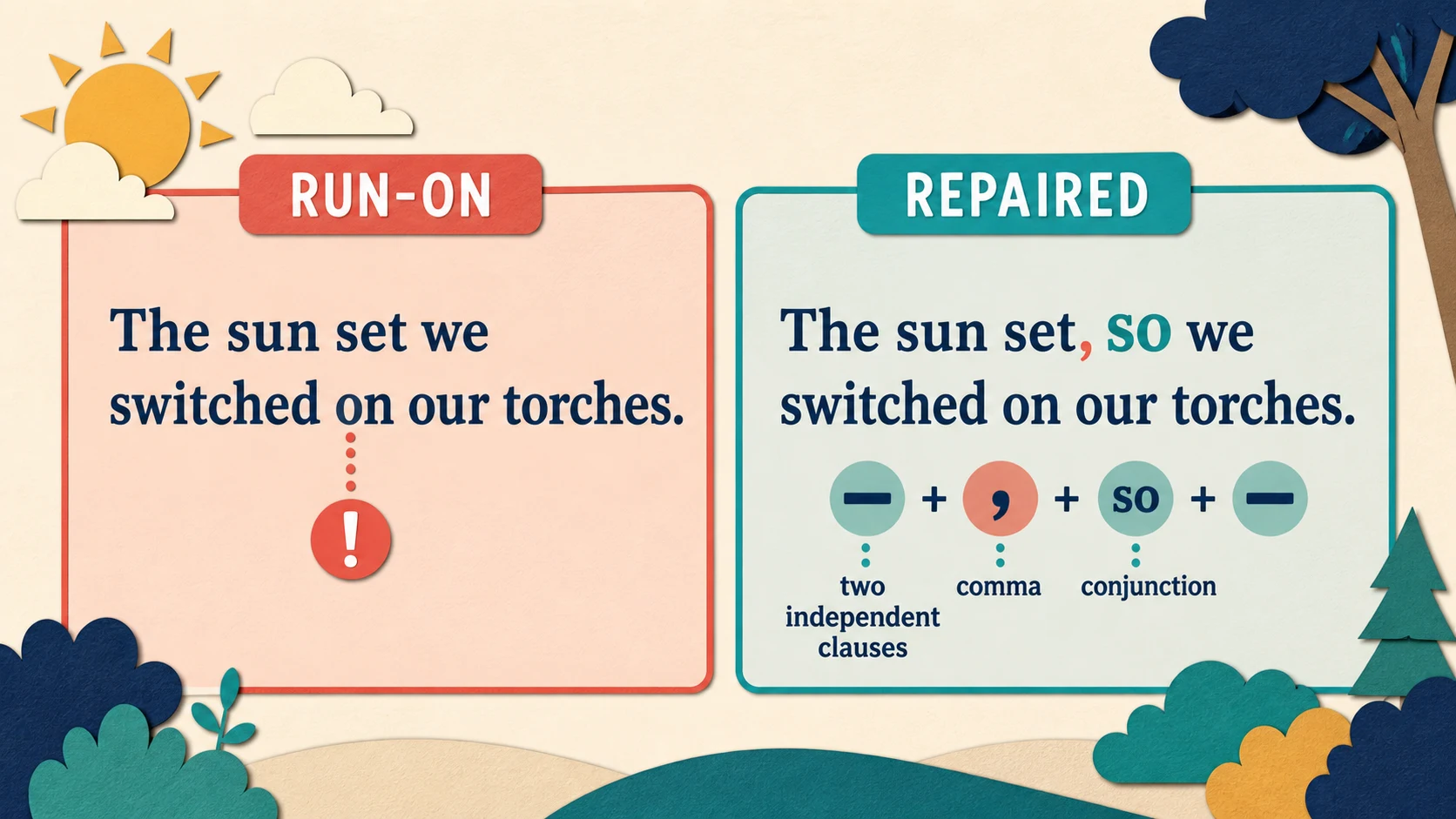
Treat an error as evidence about the next decision the learner needs to practice.
“It has a capital and period, so it is complete”
Example:
Because the bus arrived late.
Diagnosis: the learner is relying on surface punctuation instead of testing whether the thought is independent.
Response: remove the punctuation temporarily, bracket the clause, and ask what because makes the reader expect. Practice pairs in which only the presence or absence of a subordinating word changes completeness.
“A long sentence is a run-on”
Diagnosis: the learner is using length rather than clause boundaries.
Response: compare a long but controlled sentence with a short run-on. Count independent clauses and inspect how they are joined. A sentence can be long and correct; a run-on can be short.
“A comma fixes every pause”
Example:
The alarm sounded, everyone left.
Diagnosis: the learner is punctuating by breath or sound without identifying two independent clauses.
Response: have the learner read each side separately. Then choose a period, semicolon, or comma plus coordinating conjunction. Discuss the relationship expressed by each repair.
“And always needs a comma”
Example:
The rabbit turned and disappeared.
Diagnosis: the learner has overgeneralized the compound-sentence comma rule.
Response: identify whether words after and contain their own subject and predicate. Contrast The rabbit turned and disappeared with The rabbit turned, and the fox disappeared.
“More details always make a better sentence”
Diagnosis: the learner can expand but not select.
Response: ask which detail changes understanding and which merely adds clutter. Practice both expansion and reduction. Clear writing sometimes needs fewer words.
“Any connector can combine the ideas”
Diagnosis: the learner sees conjunctions as interchangeable punctuation tools.
Response: compare because, although, when, and so using the same two base ideas. Ask what relationship each version claims. Reject a grammatically shaped sentence when its connector distorts the intended meaning.
Monitoring Progress and Deciding When to Move On
Monitor three kinds of evidence:
- Recognition: Can the learner identify the pattern or error?
- Explanation: Can the learner explain why it works?
- Application: Can the learner use or revise the structure in original writing?
Record a small sample rather than relying on a single score. For example, once or twice a week, save:
- One sentence-analysis item
- One repair or combining item
- Two or three sentences from independent writing
- A brief learner explanation
Look for patterns across samples. A learner who answers nine isolated items correctly but continues writing comma splices needs transfer practice, not necessarily a harder worksheet. A learner who writes correctly but cannot use technical labels may need vocabulary clarification, but that does not erase the evidence of practical control.
Move forward when accuracy and explanation are reasonably consistent across more than one format. Continue review after moving on because sentence skills interact. A complex-sentence lesson may reveal an earlier weakness in verb recognition or sentence boundaries.
Limitations matter. A worksheet sample cannot establish every aspect of writing ability. Sentence-level correctness does not by itself demonstrate paragraph organization, evidence use, voice, or overall composition quality. These suggestions are educational guidance, not medical or child-specific advice. Persistent difficulty should be documented precisely and discussed with the learner’s teacher or an appropriately qualified professional who can consider the full context.
A Two-Week Practice Plan
This plan assumes ten short sessions across two weeks. It is a flexible model, not a universal timetable. Repeat, shorten, or reorder sessions in response to the learner’s work.
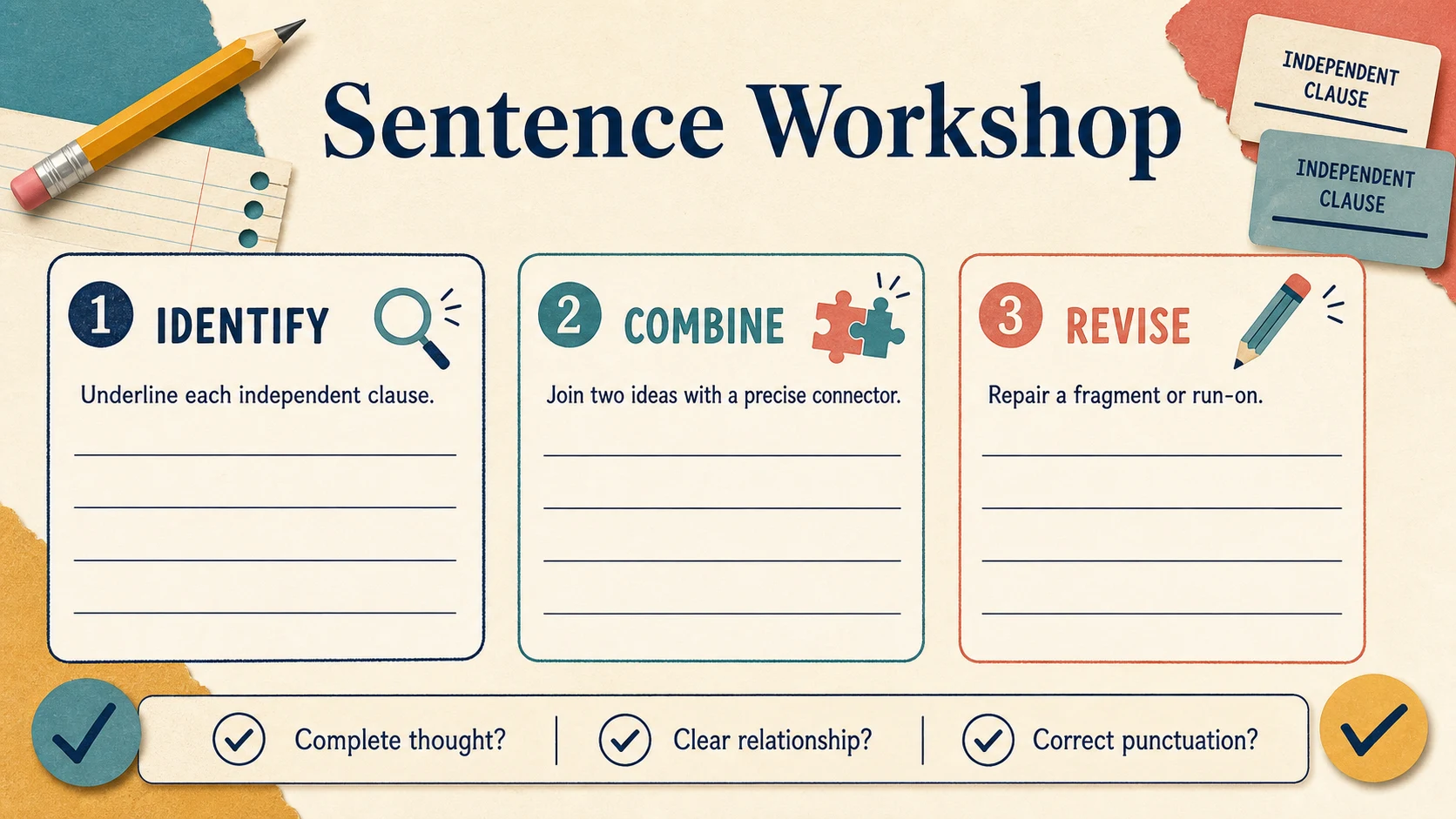
Alternate explicit instruction, focused practice, writing application, and delayed review.
| Day |
Focus |
Suggested work |
Quick evidence |
| 1 |
Diagnostic |
Sort sentences, fragments, run-ons, and correctly joined clauses |
Note error types, not just total accuracy |
| 2 |
Subjects and predicates |
Mark core parts in six varied sentences |
Explain one command with an understood subject |
| 3 |
Word order |
Reorder sentence parts and compare valid alternatives |
Check clarity, agreement, capitalization, and punctuation |
| 4 |
Fragments |
Complete dependent clauses and missing-subject fragments |
Explain what each original lacked |
| 5 |
Review and application |
Revise three sentences from authentic writing |
Save a before-and-after sample |
| 6 |
Compound sentences |
Join independent clauses in three valid ways |
Identify the meaning difference |
| 7 |
Complex sentences |
Choose subordinators for time, cause, condition, or contrast |
Label main and dependent clauses |
| 8 |
Run-ons and comma splices |
Mark boundaries before repairing punctuation |
Give two valid repairs for one item |
| 9 |
Combining and variation |
Combine repeated ideas; vary one sentence beginning |
Verify that every fact remains accurate |
| 10 |
Independent check |
Revise a short paragraph and explain two decisions |
Compare with Day 1 and choose the next target |
If Day 1 reveals unstable word order, spend more time on sentence formation before introducing multiple clause types. If the learner reliably identifies complete thoughts but writes repetitive sentences, begin with combining and variation. If performance drops when examples become longer, reduce vocabulary complexity while keeping the same structural decision.
The honest next step is to choose one visible need and collect a small baseline. For a learner who struggles to arrange sentence parts, begin with the free 6th Grade Sentence Structure worksheet, check only the first few responses, and ask the learner to explain each arrangement. Use those explanations—not the grade label or a fixed schedule—to decide whether to continue word-order practice or move to fragments, clause connections, and sentence combining.