Curated collectionAnswer keys includedPrint-ready PDFs
Place Value Worksheets by Grade and Level
Show the full place value progression across 6 real grade combinations, compare task boundaries, model checked examples and explain how to choose the next level.
Start with a real resource
Browse this worksheet collection
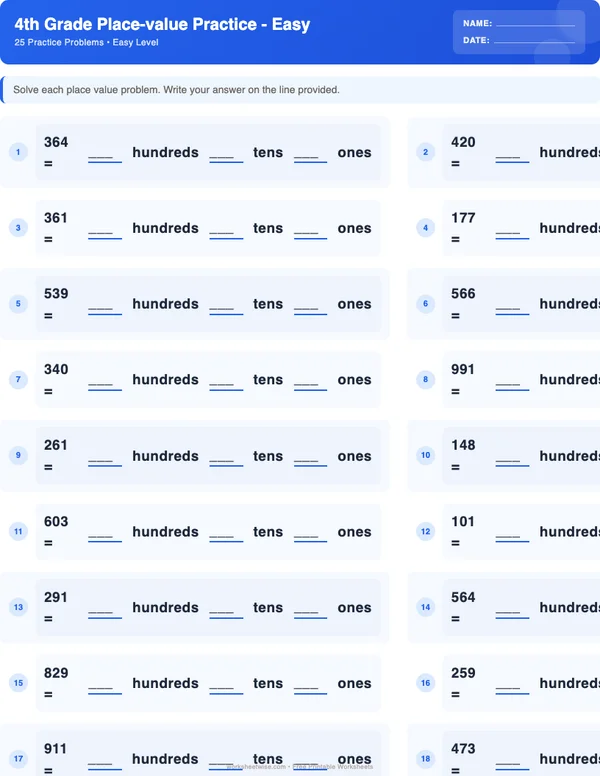
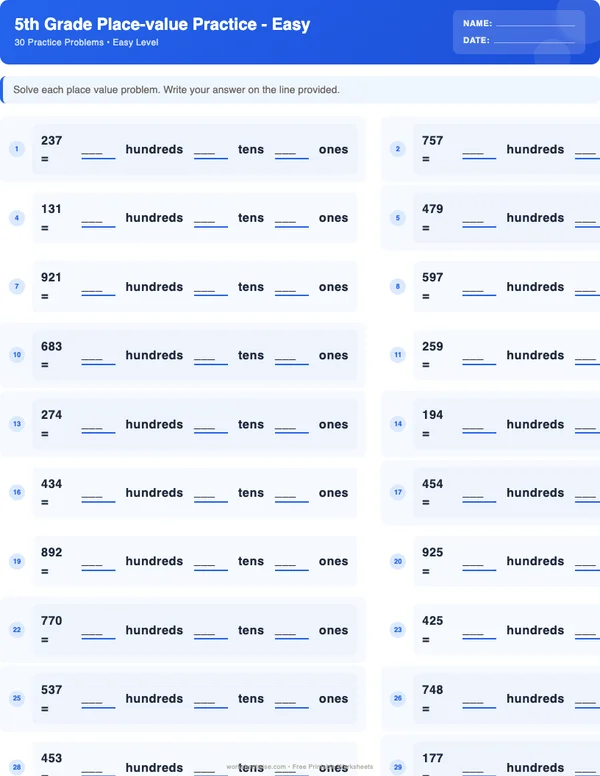
6 relevant free entry points are available. Each one includes a printable learner PDF and separate answer key.
A useful practice loop
Print less. Observe more.
- Choose one skill and model the first item aloud.
- Use a short set and notice the learner’s strategy.
- Change the next task from the work you can see.
Need more than the free sheet?
Plus includes all 108 matching catalogue variations where available, plus saved deterministic generators and the worksheet designer.
See Plus membershipComplete guide
How to teach and practise place value worksheets
3,311 words Updated 6 instructional visuals
Choose place value practice by what the learner can represent
Place value worksheets should follow a progression from grouping objects into tens, through reading and decomposing whole numbers, to reasoning about rounding and decimals. The most useful starting point is not automatically the learner’s current grade. Start with the highest task the learner can explain using objects, drawings, a place value chart, or a number line—not merely answer from memory.
The live WorksheetWise catalogue contains 108 place value variants across six grade combinations, from Kindergarten through 5th Grade. Each grade has one free entry sheet: 20 problems in Kindergarten, 1st Grade, and 2nd Grade; 25 in 3rd and 4th Grade; and 30 in 5th Grade. All six free sheets carry the catalogue label “easy.” Here, that label describes observable task features: the free sheet is an accessible entry point within its grade collection. It does not label a learner or guarantee that the sheet will feel easy.
Grade labels describe intended practice levels; local curriculum sequences differ. Age, when shown elsewhere in a worksheet search, is a discovery aid rather than a placement decision. For ages three and four, prioritize brief adult-led oral, matching, manipulative, and movement work over desk work. Asking a child to carry ten counters to a cup, bundle them, and say what changed is more suitable than expecting a full page of written place value notation.
What place value actually means
A digit’s value depends on its position. In 352, the digit 3 represents 300 because it occupies the hundreds place; the 5 represents 50; and the 2 represents 2 ones. This is more than learning place names. The learner must understand the multiplicative relationship between adjacent positions:
- Ten ones can be regrouped as one ten.
- Ten tens can be regrouped as one hundred.
- A digit moved one place left has ten times its previous value.
- A digit moved one place right has one-tenth its previous value.
That final relationship becomes especially important when decimals appear. The decimal point does not begin an unrelated topic. It marks the continuation of the same base-ten structure into tenths, hundredths, and thousandths.
The Common Core mathematics standards illustrate how this idea develops over multiple grades: early work includes composing teen numbers from one ten and some ones; later work addresses multi-digit place relationships, rounding, and decimal notation. Those standards are one reference sequence, not proof that every school teaches these skills at the same time.
A worksheet is therefore useful only when its representation and question design match the learner’s present reasoning. A page of correct answers can conceal counting-by-ones, memorized procedures, or guessing. Ask, “How do you know?” and request a model before moving on.
The six-grade progression in the live catalogue
Kindergarten: make one ten visible
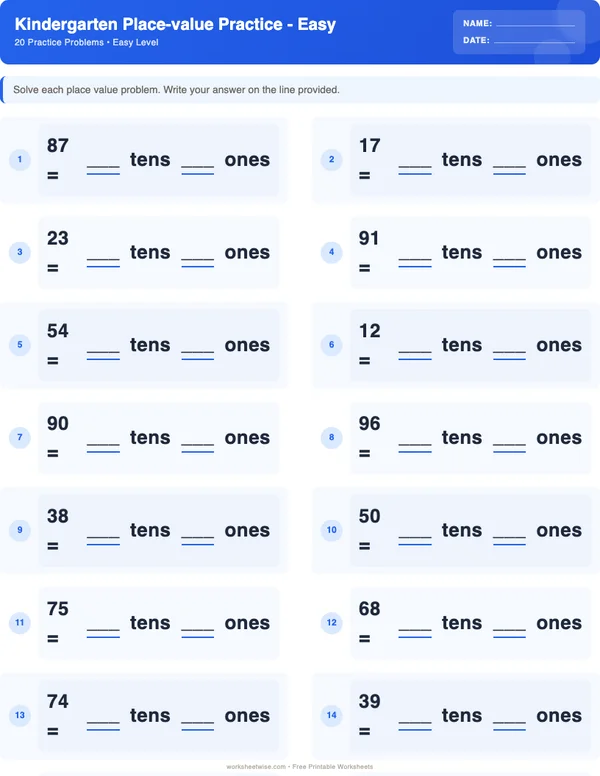
The Kindergarten Place Value guide and free sheet is the earliest catalogue entry. Its free sheet has 20 problems. Before or alongside it, build quantities physically. Give the learner 14 craft sticks, counters, or connecting cubes. Have them place ten into a cup, bag, or rubber-band bundle and leave four loose.
Checked example 1: Fourteen is 1 ten and 4 ones, because . If the learner counts all 14 objects again, accept the total, then ask whether the bundle can be counted as one group of ten. This example belongs at the Kindergarten boundary because it connects a teen number to one complete ten and leftover ones without requiring formal expanded notation.
For ages three and four, turn this into a two-minute oral or movement task: “Bring me ten blocks. Put them in the bowl. Now bring three more. How many are in the ten-group, and how many are outside?” Do not use a long written session as the default.
1st Grade: compose, decompose, and trade
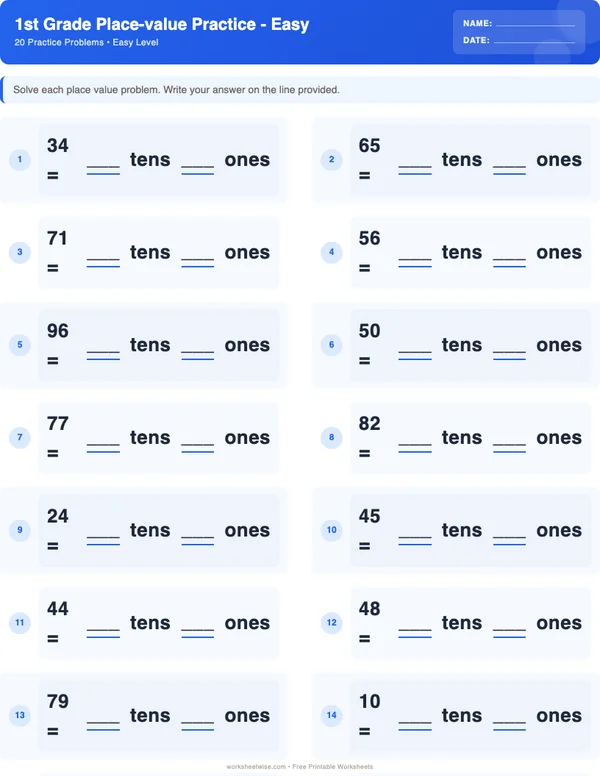
The 1st Grade Place Value guide and free sheet also provides a 20-problem free entry point. At this level, tens and ones should become flexible units. A learner needs to recognize 34 as 3 tens and 4 ones, build it from grouped materials, and recover 34 from that representation.
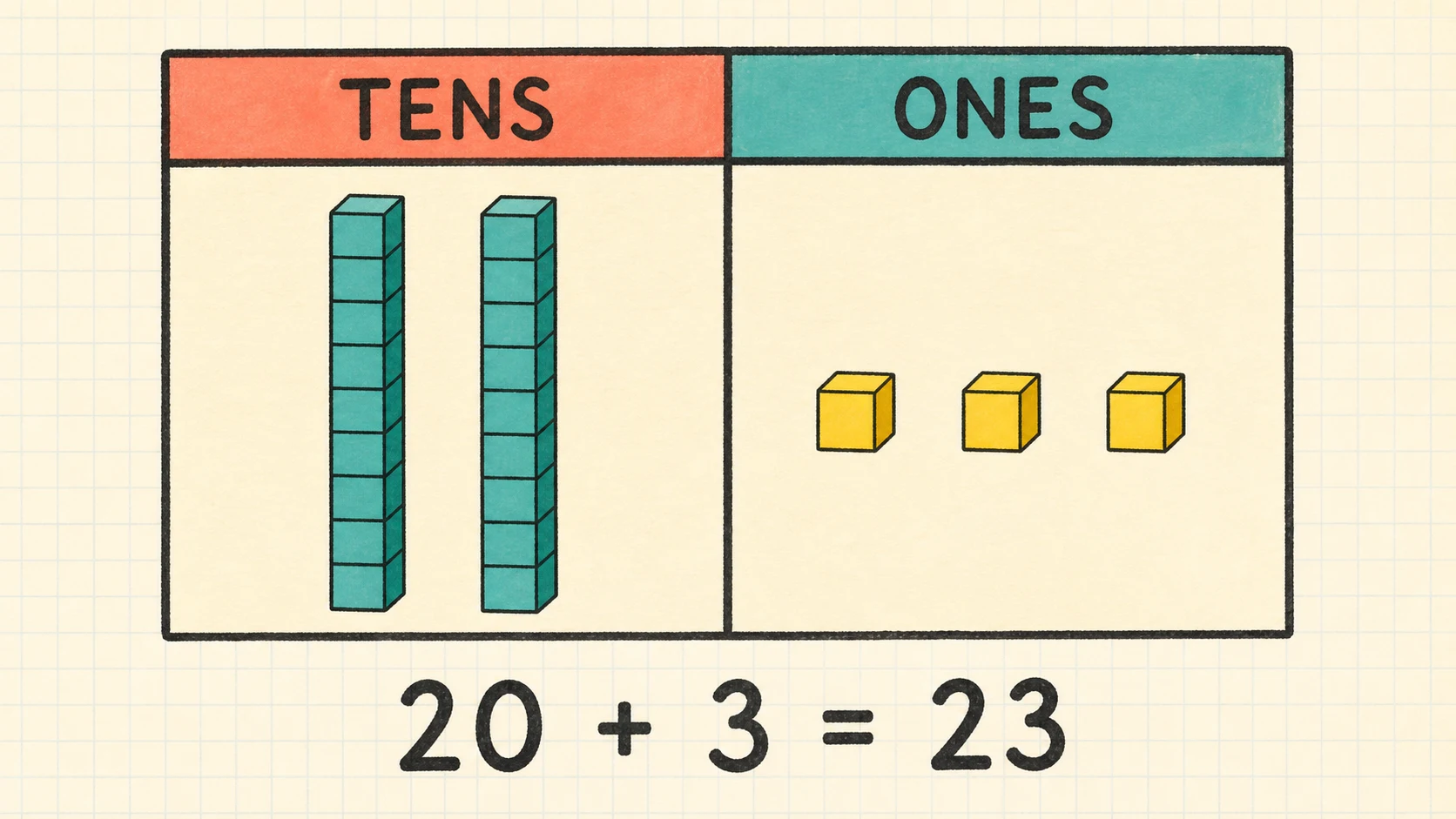
The useful transition is from grouped objects to “3 tens and 4 ones,” and only then to the numeral 34.
Checked example 2: Build 34 with three bundles of ten and four single sticks. The total is . Trade the three bundles and four singles for base-ten blocks if available; the quantity must remain unchanged. This belongs in 1st Grade practice because it coordinates a concrete model, place language, and a two-digit numeral.
If the learner writes 304 for “3 tens and 4 ones,” do not simply correct the numeral. Ask the learner to place each quantity in a tens-and-ones chart. The response may reveal that “three” and “four” were recorded as separate spoken parts without understanding positional notation.
2nd Grade: establish hundreds as a composed unit
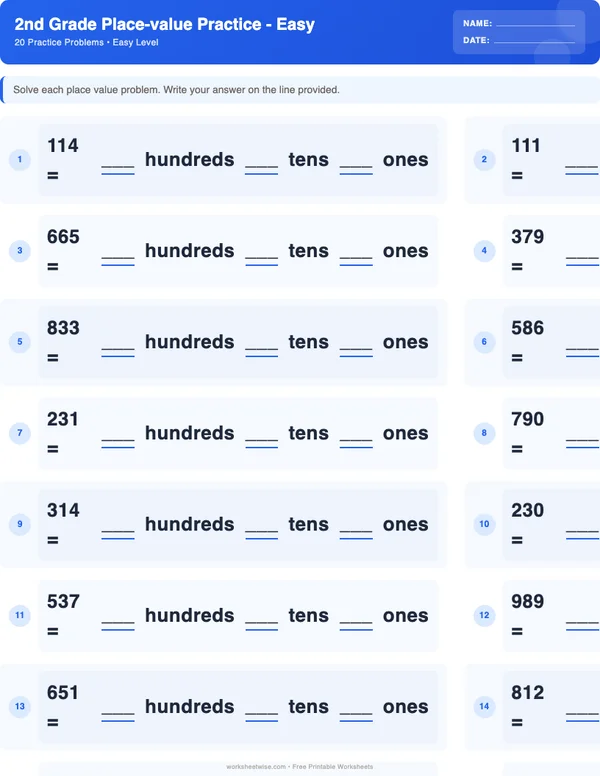
The 2nd Grade free sheet contains 20 problems. Practice can now connect hundreds, tens, and ones, but the critical conceptual move remains trading: 10 tens are not merely near one hundred; they equal one hundred.
Use base-ten blocks or a place value chart to compare:
- 1 hundred, 0 tens, 0 ones
- 0 hundreds, 10 tens, 0 ones
- 0 hundreds, 0 tens, 100 ones
All three represent 100. Ask the learner to trade without changing the total. The 2nd Grade Place Value guide and free sheet is a sensible entry point when the learner can already bundle tens but needs practice coordinating three places.
Checked example 3: In 407, the 4 represents 400, the 0 records that there are no tens, and the 7 represents 7 ones. Thus , not 47 and not . This example belongs at the hundreds boundary because the internal zero tests whether the learner treats position as meaningful rather than reading only the nonzero digits.
3rd Grade: translate among forms and justify rounding
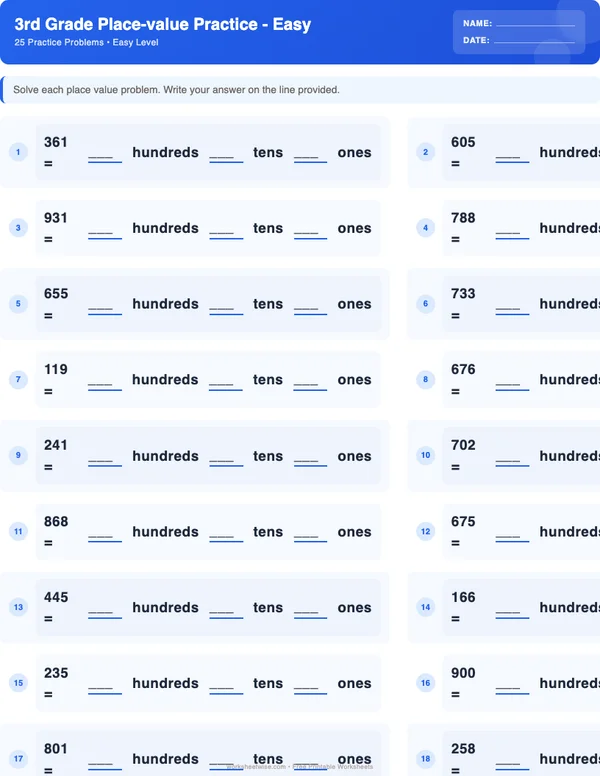
The 3rd Grade free sheet increases to 25 problems. Suitable work may include standard form, word form, expanded form, comparisons, and rounding, while concrete and drawn models remain useful.
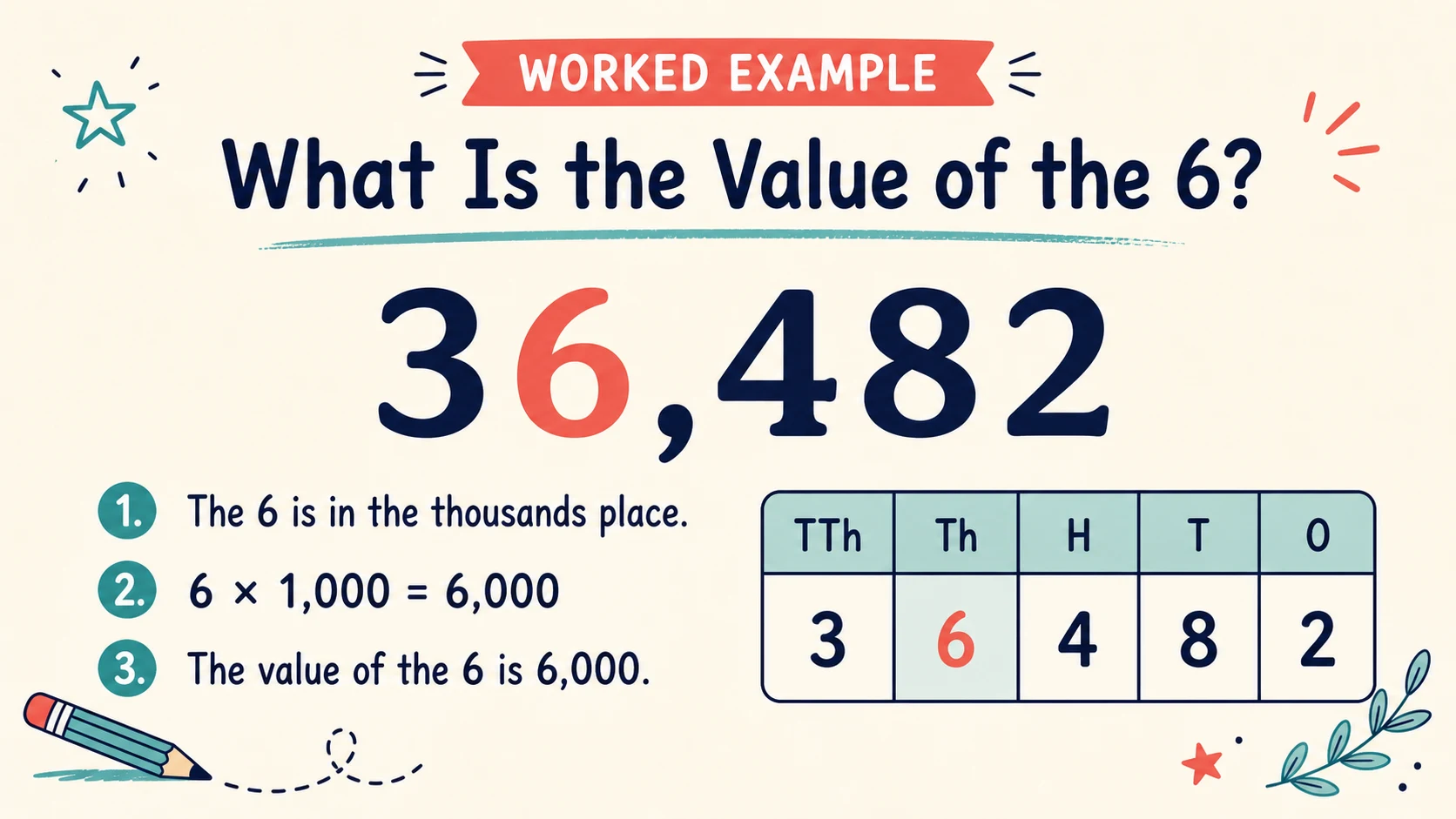
At this stage, a model should explain the written decomposition rather than serve as decoration beside it.
Checked example 4: For 4,352, the expanded form is . It is checked by recombining the parts: , plus 50 gives 4,350, and plus 2 gives 4,352. It also matches how the number is read: four thousand, three hundred fifty-two. This belongs in the 3rd Grade section because it links each digit to its value across four whole-number places.
For rounding 347 to the nearest ten, place 347 between 340 and 350 on a number line. Its distance from 340 is 7; its distance from 350 is 3. Therefore, 347 rounds to 350. This explanation is stronger than a marking trick because it identifies the two benchmarks and compares distances.
4th Grade: reason about relative value in larger numbers
The 4th Grade free entry sheet contains 25 problems. A useful transition into this collection is the ability to explain adjacent-place relationships, not just name digits in larger numbers.
Checked example 5: Compare the two 6s in 66,000. The left 6 represents 60,000; the next 6 represents 6,000. Since , the left 6 has ten times the value of the right 6. This example belongs at the 4th Grade boundary because the question asks for a multiplicative relationship between equal digits in adjacent places.
A learner who says “the first 6 is bigger because it comes first” has noticed position but has not yet quantified the relationship. Follow with a place value chart and ask how many groups of 6,000 make 60,000.
5th Grade: continue the base-ten pattern into decimals
The 5th Grade collection has the largest free entry sheet, with 30 problems. Upper-grade place value should connect whole-number reasoning to decimals rather than treating decimal places as a new list of names.
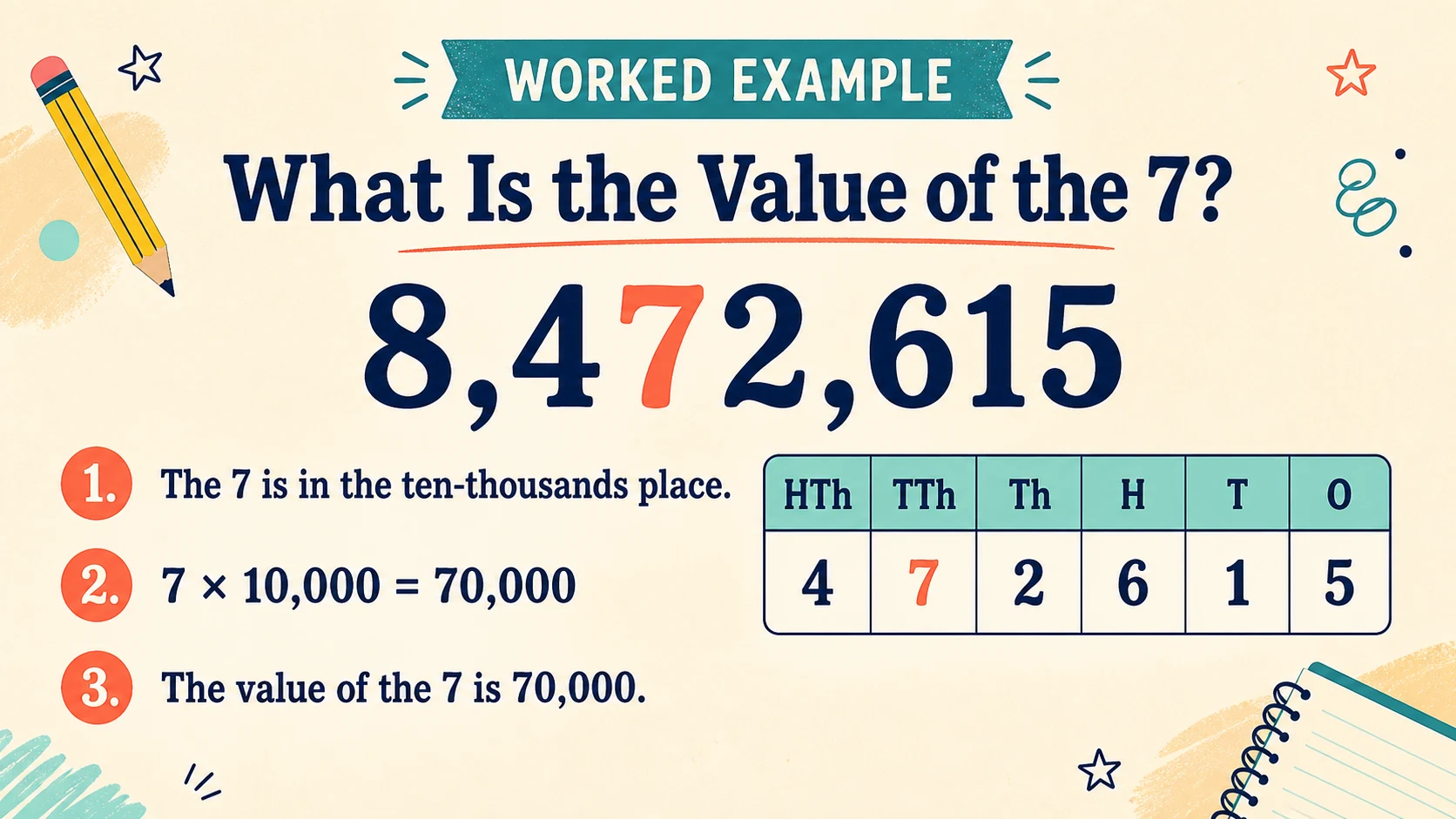
The decimal point marks a continuation of the place-value pattern: ones divide into tenths, and tenths divide into hundredths.
Checked example 6: In 4.44, the first 4 represents 4 ones, the second represents 4 tenths or 0.4, and the third represents 4 hundredths or 0.04. Each 4 is one-tenth the value of the 4 immediately to its left: and . Equivalently, each is ten times the value of the matching digit to its right. This belongs in 5th Grade practice because it extends an established whole-number relationship across the decimal point.
The 5th Grade Place Value guide and free sheet is appropriate when the learner can decompose whole numbers reliably and is ready to explain decimal place relationships. If tenths and hundredths remain abstract, use a hundred grid, decimal place value discs, or a measurement context before expecting independent symbolic work.
How representations and questions should change
Move from quantity to drawing to notation
A productive sequence is concrete, representational, then abstract:
- Build the number with objects or base-ten materials.
- Draw or record the groups in a place value chart.
- Write the numeral or equation.
- Explain why the representations are equivalent.
The IES guide on teaching mathematics to young children recommends intentionally helping young learners connect informal mathematical knowledge with representations and mathematical language. Applied here, an adult should not merely hand over blocks. Ask the learner to connect each block or bundle to a spoken place name and written digit.
Do not remove manipulatives according to a fixed age rule. Remove them when the learner can reconstruct the meaning without them. Conversely, adding blocks to a task does not automatically preserve the mathematics. If an adult builds every number and tells the learner what to write, the representation has replaced the thinking.
Change one task demand at a time
Place value questions differ along several dimensions:
- Number size: two digits, three digits, larger whole numbers, or decimals
- Representation: objects, pictures, charts, numerals, words, or expanded form
- Operation: identify, compose, decompose, compare, order, or round
- Independence: modeled, prompted, or unassisted
- Explanation: select an answer, produce an answer, or justify it
A learner who can write 582 as may not yet be able to build 582 from the instruction “5 hundreds, 8 tens, 2 ones,” compare 582 with 528, or round it. Those are related but distinct demands.
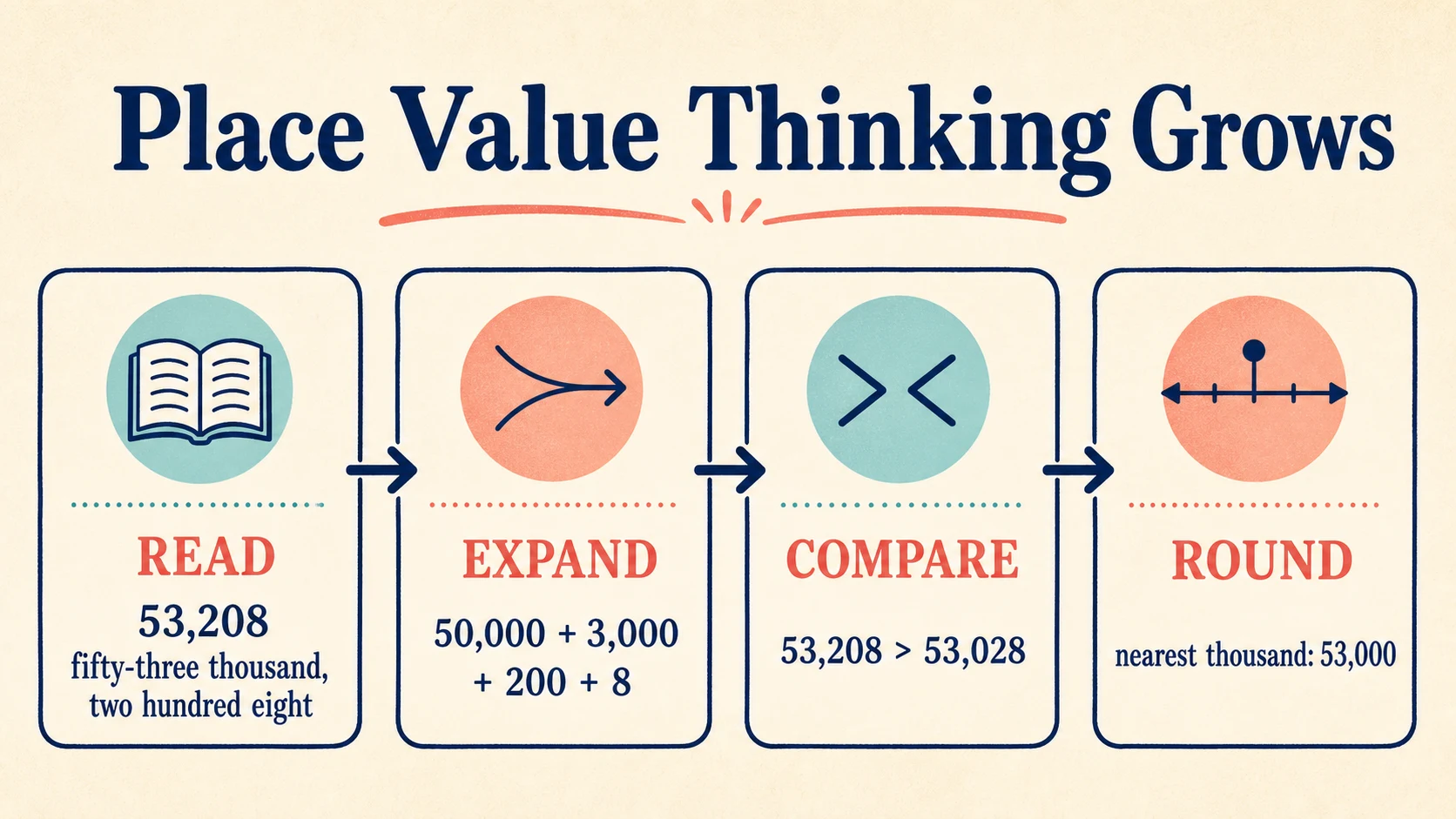
Increase independence only after the learner can state what each digit represents and verify the result with a model or relationship.
Difficulty should therefore be described by features. A more supported task might supply a labeled chart, use one representation, and ask the learner to match an answer. A more demanding task might omit labels, switch representations, include zeros, cross the decimal point, or require a written justification. These descriptions are more useful than calling either the worksheet or learner “advanced.”
Select the next real worksheet deliberately
Use a three-question placement check
Before choosing among the six free grade entry points, ask the learner to complete three brief actions:
- Represent: “Show this number with objects, a drawing, or a place value chart.”
- Translate: “Write the same number in another form.”
- Explain: “What is one digit worth, and how do you know?”
Choose the highest grade collection for which all three actions are mostly secure with the kinds of numbers involved. If representation breaks down, step back to the collection where the missing unit relationship is made visible.
Use these practical boundaries:
- Choose Kindergarten when the central work is recognizing one ten and leftover ones.
- Choose 1st Grade when the learner needs repeated composition and decomposition of two-digit numbers.
- Choose 2nd Grade when hundreds and internal zeros need attention.
- Choose 3rd Grade when the learner is coordinating standard, expanded, and word forms or beginning number-line rounding.
- Choose 4th Grade when the focus is larger whole numbers and ten-times relationships between adjacent places.
- Choose 5th Grade when that same relationship must extend into decimal places.
These are editorial selection suggestions grounded in the catalogue’s six grade combinations and teaching context. They are not diagnoses, assessments of a specific child, or claims about a district’s curriculum.
Read the page before assigning all of it
The free sheets range from 20 to 30 problems. Problem count is not a prescription for one sitting. Preview the question forms, identify the mathematical target, and decide whether to assign a row, a mixed sample, or the whole sheet.
A 30-problem sheet can be divided into short sessions if handwriting, attention, or processing load would otherwise obscure place value reasoning. A 20-problem sheet may still be inappropriate if its representation begins beyond the learner’s current understanding.
Use a routine that reveals reasoning
A short, repeatable routine makes worksheet practice more informative.
Before the page: build and predict
Select one representative problem. Ask the learner to build or sketch the number and predict what the written answer should show. For 306, the learner might place three hundred discs, no ten discs, and six one discs in a chart.
Say, “The empty tens column still matters. What does the zero tell the reader?” This directs attention to positional structure before pencil work begins.
During the page: pause for one explanation
After three to five items, choose one answer and ask for a proof:
- “Can you show that with a trade?”
- “What is this digit worth?”
- “Which two benchmarks surround the number?”
- “How does the value change if the digit moves one place right?”
The learner need not explain every problem. One strategically chosen explanation can reveal whether correct answers came from place value reasoning.
After the page: make one transfer
Finish with a new example that changes only one feature. After expanding 4,352, ask for 4,302 so the learner must handle a zero in the tens place. After rounding 347 to the nearest ten, ask for 342 using the same 340–350 number line.
Record one observable next action, such as: “Tomorrow, represent three numbers containing a zero in the tens place before writing expanded form.” Avoid broad judgments such as “needs more place value.”
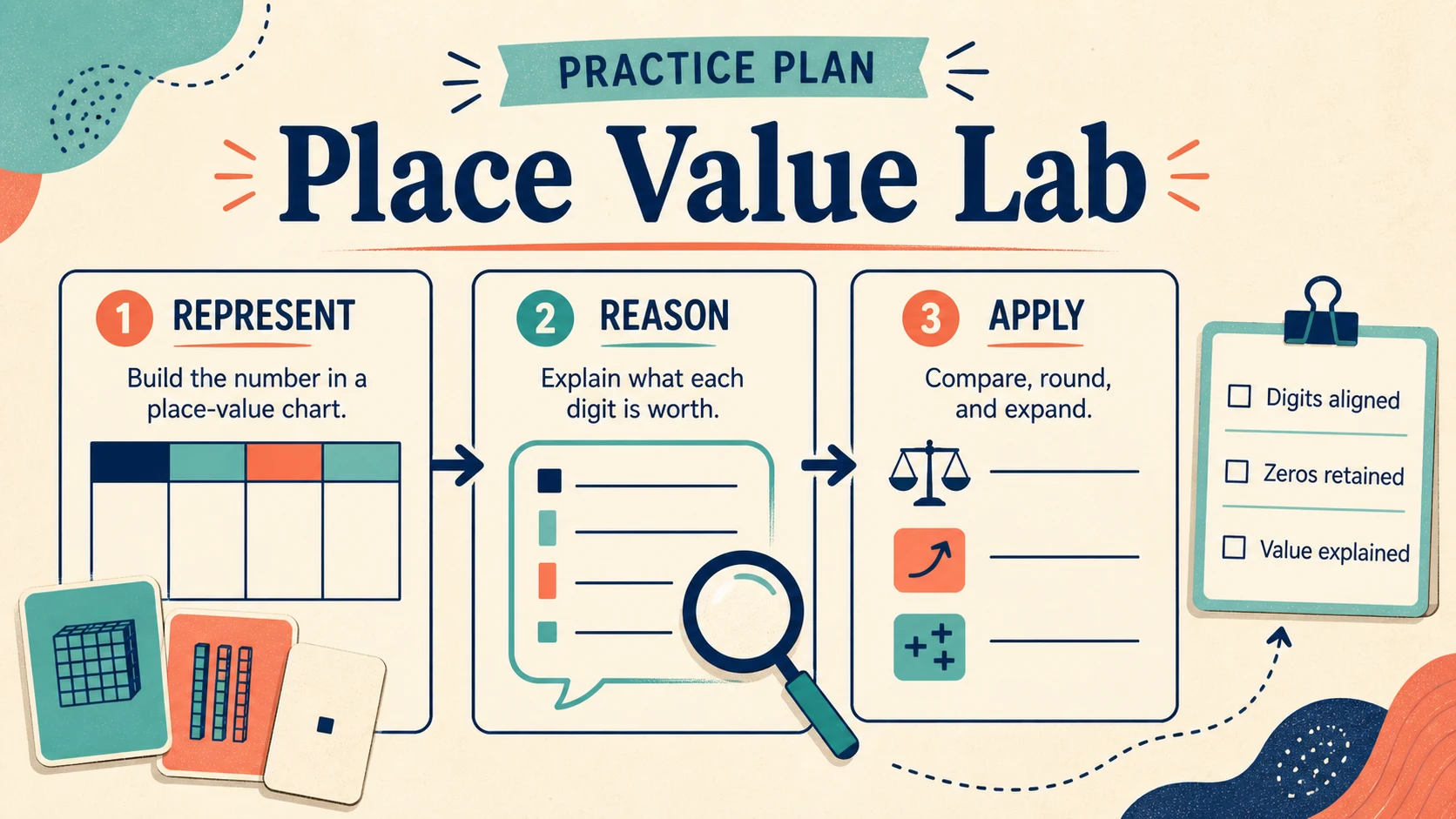
Space upper-grade practice across modeling, explanation, independent work, and review instead of treating one completed page as mastery.
Interpret errors before adding more problems
A numeral such as 304 for three tens and four ones
This response may indicate that the learner recorded the spoken digits separately. Ask for three tens and four ones in a chart. If the learner builds 34 correctly but writes 304, focus on translating the model to notation. If the learner builds three hundreds and four ones, return to the value of a ten.
Treating 407 as 47
The learner may be ignoring the zero placeholder or reading only visible quantities. Build 407 and 47 side by side. Ask what quantity is lost when the 4 moves from hundreds to tens. The contrast makes the positional change explicit.
Writing 4,352 as 4,000 + 300 + 5 + 2
The tens digit has been treated as five ones. Ask the learner to label each column and read the number aloud. Then compare with the target 4,352. Recombining the parts checks the expansion.
Rounding every number ending in 5–9 upward without naming the place
The learner may have memorized a digit rule without identifying benchmarks. Ask, “Rounding to what place?” For 2,451 rounded to the nearest hundred, the relevant benchmarks are 2,400 and 2,500. The number is 51 away from 2,400 and 49 away from 2,500, so it rounds to 2,500. A number line exposes the reasoning.
Believing 0.4 is smaller than 0.35 because 4 is smaller than 35
This imports whole-number comparison into decimals. Express both in hundredths: hundredths, while hundredths. Therefore, . A hundred grid or aligned place value chart preserves the place-value target.
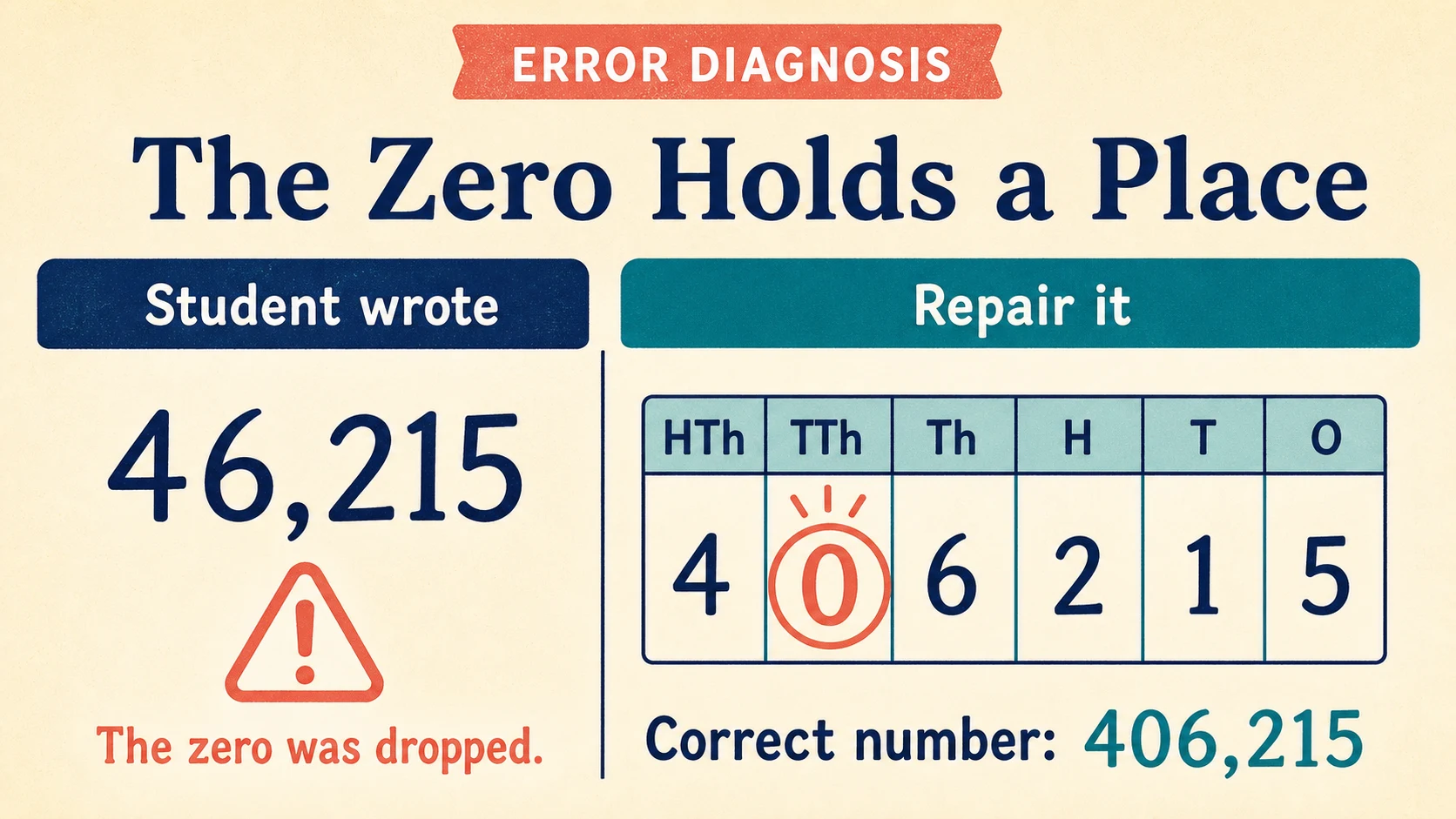
Treat an incorrect decimal answer as evidence to investigate the representation used, not as a diagnosis of the learner.
The IES guide for assisting students who struggle with mathematics supports systematic instruction, clear mathematical language, representations, and attention to common errors. That guidance can inform adult responses, but IES did not assess these WorksheetWise sheets.
Adapt access without changing the target
An adaptation preserves the intended reasoning while reducing an unrelated barrier.
If the target is decomposing 4,352:
- Read the direction aloud if decoding is the barrier.
- Enlarge the print or provide a spacious place value chart.
- Let the learner point to digit-value cards instead of handwriting every term.
- Cover other rows to reduce visual crowding.
- Allow base-ten discs or a chart while still requiring the learner to choose each value.
Do not preserve only the appearance of the task. If the adult states “4,000 + 300 + 50 + 2” and the learner copies it, the decomposition target has disappeared. If the target is independent symbolic translation, leaving a completed model beside every item may also change the demand. Support should be faded according to the specific task.
For rounding, replace a mnemonic with a number line, but keep the learner responsible for identifying the rounding place, locating the bounding benchmarks, and deciding which is closer. For decimal comparison, align numbers in a chart or add trailing zeros, but still ask the learner to justify the comparison by place value.
Know what a worksheet cannot establish
A completed worksheet provides a sample of written performance under particular conditions. It cannot by itself establish durable understanding, instructional placement, a learning diagnosis, or transfer to unfamiliar contexts. Correct multiple-choice responses may come from elimination; correct expanded forms may come from a memorized pattern; an incorrect page may reflect misunderstood directions or excessive writing load.
Check understanding through more than one mode:
- Ask the learner to build a number.
- Ask for a spoken explanation.
- Change the representation.
- Include an internal zero.
- Ask for a trade such as 10 tens for 1 hundred.
- Revisit the idea on another day.
Place value is also a foundation for other work, but this guide does not claim that completing these sheets produces a particular outcome. Once whole-number place relationships are stable, the Decimals Worksheets by Grade and Level can extend the same times-ten and divide-by-ten pattern. If the difficulty is earlier quantity formation rather than place value notation, the Counting Worksheets by Grade and Level may provide a more appropriate starting boundary.
Make the next session observable
Choose one free sheet from the six grade guides, preview its first five questions, and name the exact representation the learner will use. Then complete this sequence:
- Build one example.
- Solve three worksheet items.
- Explain one digit’s value.
- Correct one error by returning to the model.
- Write down the next task in observable terms.
For example: “Use the 3rd Grade Place Value guide and free sheet to solve three expanded-form items, then represent one number containing a zero on a place value chart.” That is a concrete next step, tied to a real resource, and it gives the adult evidence for whether to remain at that level or change the next worksheet.
Put it into practice
Use the guide with a real printable
Move from explanation to a short, observable practice task. Check the first item together, then adjust the next session from the learner's actual work.
Open the first free worksheetExplore a neighboring collection
Choose by a different teaching need
Addition Worksheets by Grade and Level Consonant Blends Worksheets by Grade and Level Counting Worksheets by Grade and Level CVC Words Worksheets by Grade and Level Decimals Worksheets by Grade and Level Digraphs Worksheets by Grade and Level Division Worksheets by Grade and Level Fractions Worksheets by Grade and Level