Curated collectionAnswer keys includedPrint-ready PDFs
Parts of Speech Worksheets by Grade and Level
Show the full parts of speech progression across 6 real grade combinations, compare task boundaries, model checked examples and explain how to choose the next level.
Start with a real resource
Browse this worksheet collection
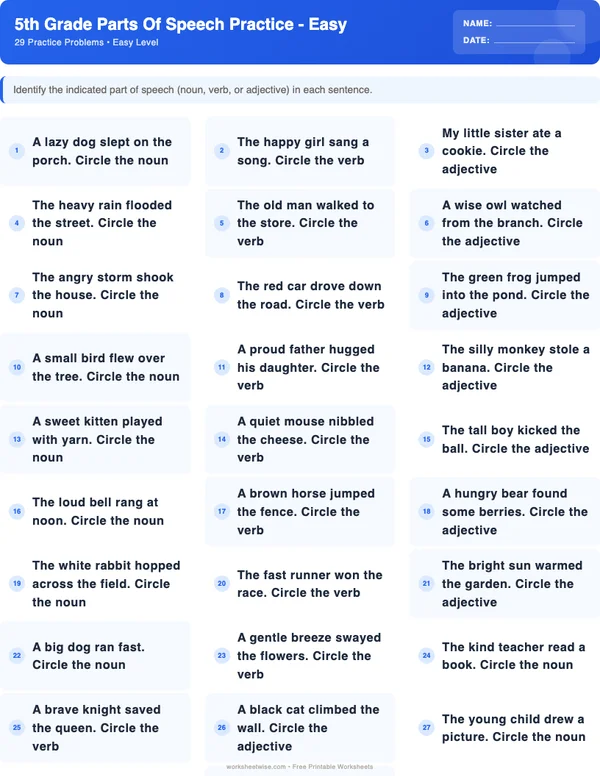
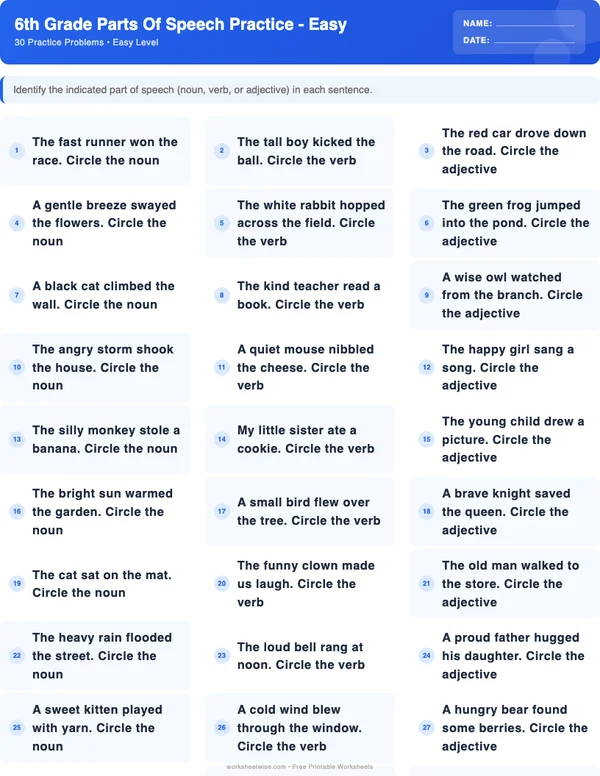
6 relevant free entry points are available. Each one includes a printable learner PDF and separate answer key.
A useful practice loop
Print less. Observe more.
- Choose one skill and model the first item aloud.
- Use a short set and notice the learner’s strategy.
- Change the next task from the work you can see.
Need more than the free sheet?
Plus includes all 108 matching catalogue variations where available, plus saved deterministic generators and the worksheet designer.
See Plus membershipComplete guide
How to teach and practise parts of speech worksheets
3,475 words Updated 6 instructional visuals
Choose by the work the learner can do, not by the grade number alone
Parts of speech worksheets help learners recognize what words do inside sentences: nouns name, verbs express action or a state, adjectives modify nouns, adverbs modify verbs or other modifiers, pronouns stand in for nouns or noun phrases, prepositions express relationships, conjunctions connect, and interjections express reactions. The most useful starting point is usually not memorizing all eight labels. It is distinguishing concrete nouns from verbs in short, meaningful sentences, then adding categories and grammatical ambiguity as the learner becomes more reliable.
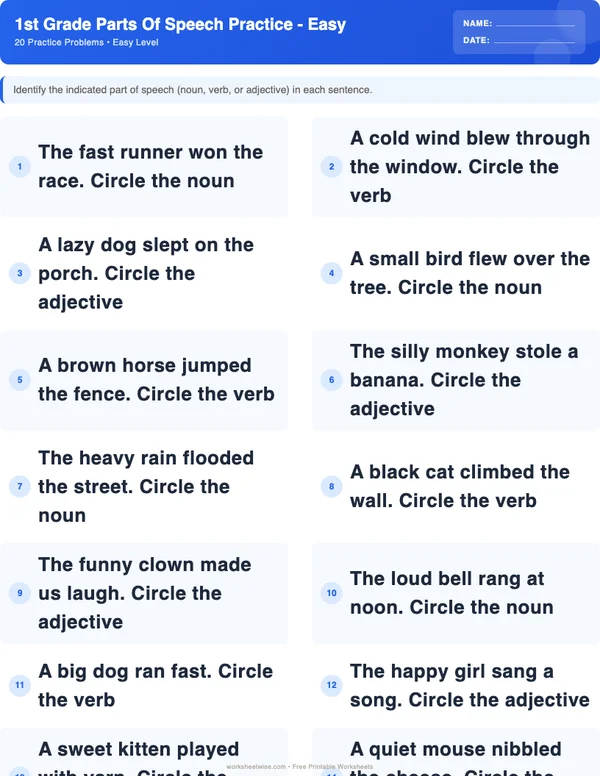
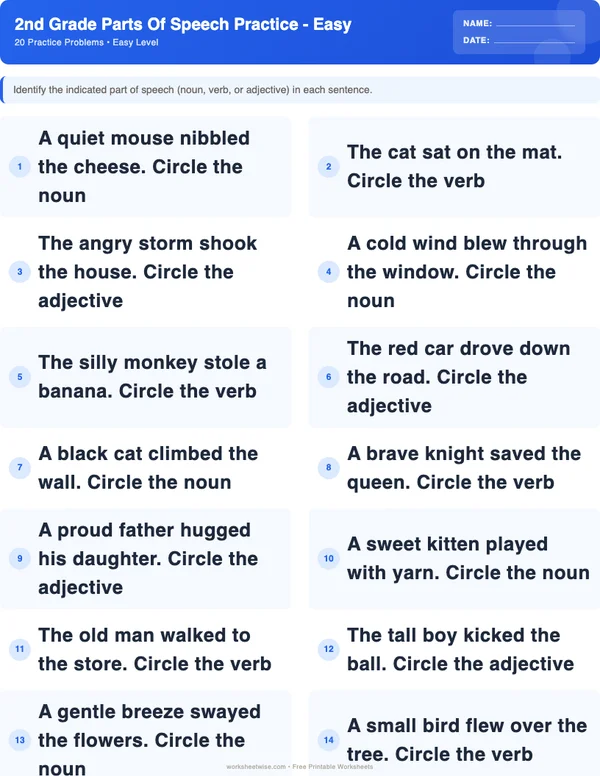
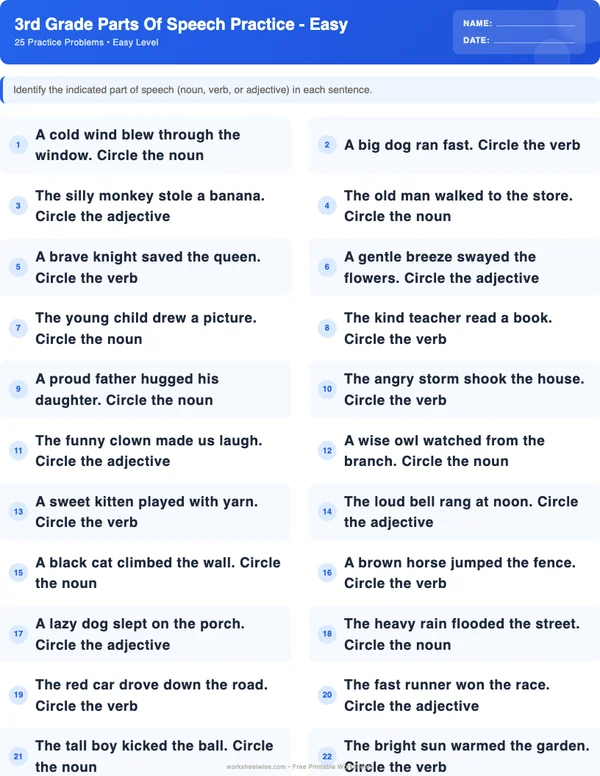
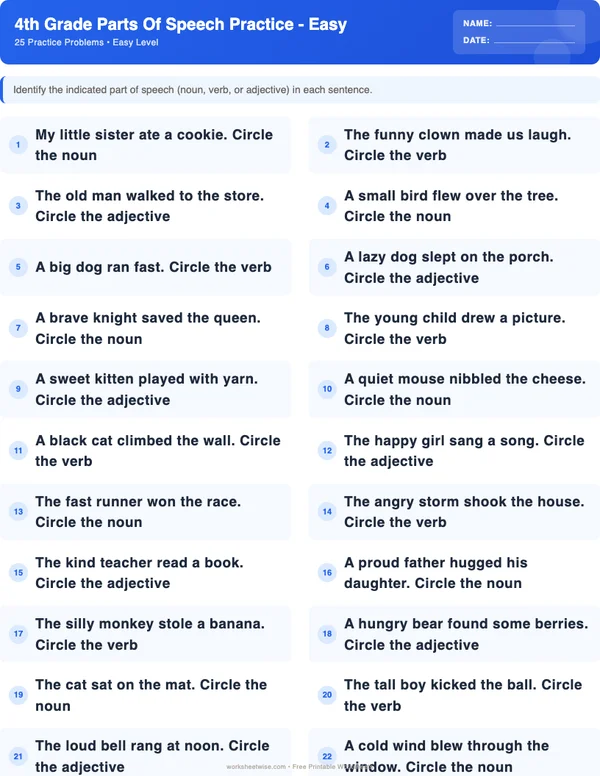
The WorksheetWise catalogue currently contains 108 parts-of-speech variants across six grade combinations, from 1st through 6th grade. Each grade has one free entry point. The free 1st- and 2nd-grade sheets contain 12 problems each; 3rd and 4th contain 14 each; 5th contains 29; and 6th contains 30. Those counts describe the live resources, not how many questions a learner must complete in one sitting.
All six free sheets are catalogued as “easy,” but that label should be interpreted through observable task features: how many categories appear, whether words are isolated or embedded in sentences, how much reading is required, whether context changes a word’s function, and whether the learner identifies, explains, or revises language. It must not become a label for the learner.
Grade labels describe intended practice levels; local curriculum sequences differ. Age, when used as a browsing aid, is likewise a discovery aid rather than a placement decision. For ages three and four, prioritize brief adult-led oral, matching, manipulative, and movement work over desk work. A child can hold up a cup for a noun, act out jump as a verb, or place a block under a chair without completing a printed classification exercise.
What a parts-of-speech answer must actually show
A correct answer depends on a word’s job in its sentence, not merely on the word itself. That boundary matters because a learner who memorizes “run is a verb” has learned an example, not the underlying concept.
Consider these checked sentences:
- The children run after lunch. Here, run tells what the children do, so it is a verb.
- The children went for a run. Here, run names an activity and follows the article a, so it is a noun.
- Turn on the light. Here, light names a thing, so it is a noun.
- We packed a light bag. Here, light describes the bag, so it is an adjective.
These examples belong on this page because the catalogue’s teaching guidance explicitly identifies contextual flexibility—particularly run and light—as part of the cross-grade progression. They also reveal why an upper-level question should include a complete sentence rather than ask for the category of a freestanding word.
A practical adult prompt is, “What job is this word doing here?” Follow it with evidence:
- What does the word name?
- What action or state does it express?
- Which noun does it describe?
- Which words does it connect?
- What relationship does it show?
That language keeps the discussion anchored to a sentence. It also prevents a definition-recitation task from being mistaken for grammatical analysis.
The Common Core English Language Arts standards include grade-specific language expectations involving conventions and the functions of words within sentences. That source can help adults compare the general scope of language instruction across grades. It does not establish alignment for any particular WorksheetWise sheet, and local standards may organize the content differently.
The six-grade progression in the live catalogue
The catalogue description traces a broad range from identifying nouns and verbs in simple sentences to classifying eight parts of speech in complex passages. The six grade pages provide real entry points along that range, but the catalogue facts do not specify that every question on a particular free sheet uses every category or representation. Preview the selected sheet rather than inferring its exact contents from the grade label.
1st grade: make noun and verb differences visible
Begin with short sentences containing an obvious person, animal, place, or object and an observable action:
The rabbit hops.
Rabbit is the noun because it names the animal. Hops is the verb because it tells what the rabbit does. This example belongs at the beginning of the progression because it contains one clear noun and one physical action without extra modifiers competing for attention.
Connect the printed sentence to movement. The learner can point to a toy rabbit or picture when naming the noun, then hop when identifying the verb. Thinking can also be treated as an action in language even though it is not as visible as jumping; introduce that distinction after physical verbs are secure.
The free 1st Grade Parts of Speech guide and sheet has 12 problems. Use the count to plan the session, not to demand completion. Six carefully discussed responses can provide better information than 12 hurried guesses.
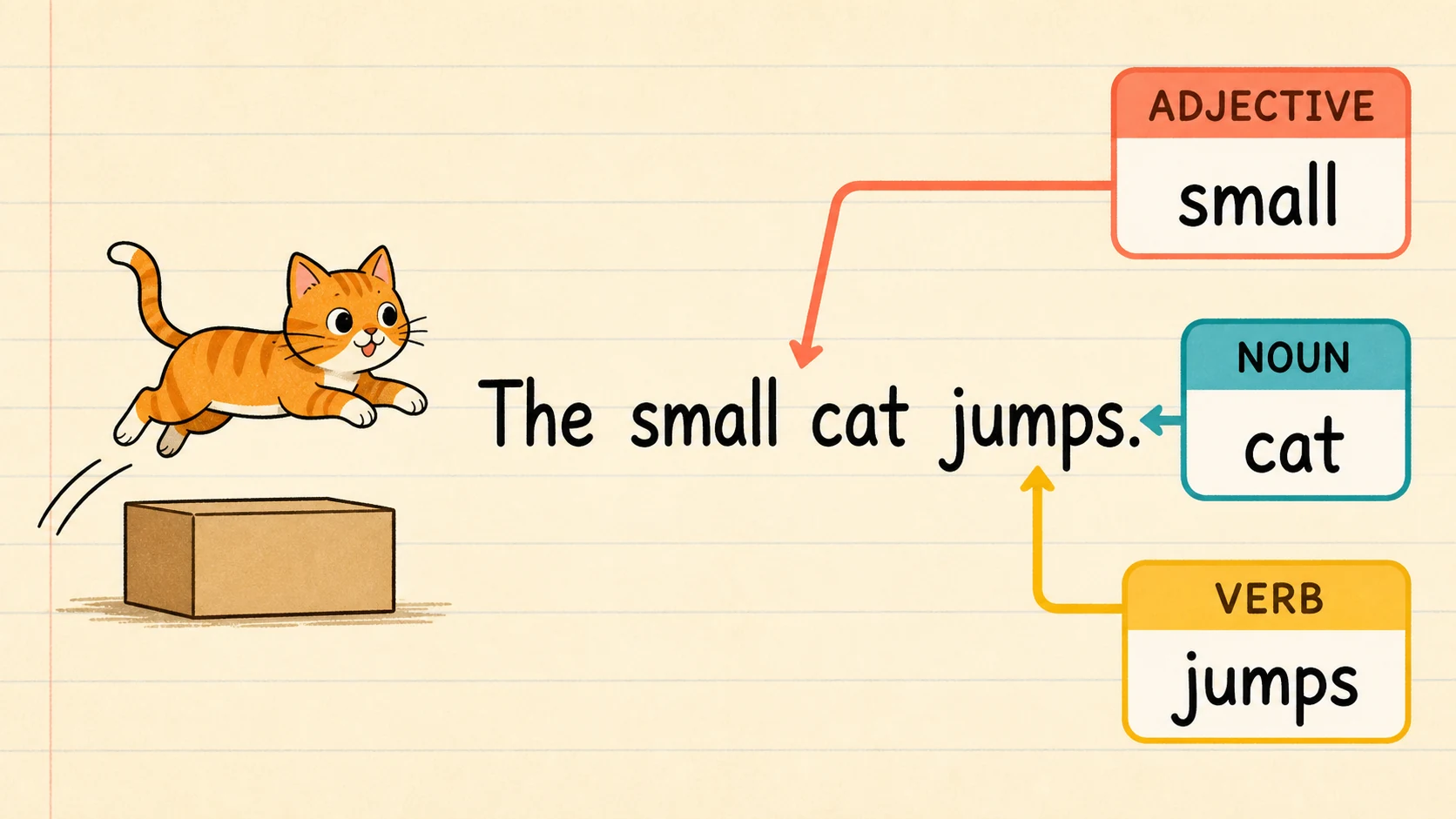
The concrete action and named object give the adult something observable to discuss before asking for a written label.
2nd grade: add adjectives without losing sentence structure
Once a learner can usually locate nouns and verbs, add adjectives in sentences where the modified noun is unmistakable:
The small turtle crawls.
Turtle names the animal, crawls expresses its action, and small describes the turtle. It does not describe the crawling. This is a checked three-category example suited to an early extension because every target word has one clear role.
Use classroom objects to generate alternatives: pencil can become a short yellow pencil; box can become a heavy cardboard box. Ask the learner to underline the noun once, circle the verb, and draw an arrow from each adjective to the noun it modifies. The arrow adds a relationship, not just another color code.
The free 2nd Grade Parts of Speech guide and sheet contains 12 problems. It is a sensible comparison point when the 1st-grade entry no longer requires meaningful thought but a larger classification set would still obscure the noun–verb–adjective relationships.
3rd grade: move from sorting to evidence in sentences
A word sort can prepare the categories:
| Nouns | Verbs | Adjectives |
|---|---|---|
| fox | carries | red |
| basket | waits | heavy |
Do not stop with the columns. Ask the learner to build and analyze a sentence:
The red fox carries a heavy basket.
Fox and basket are nouns. Carries is a verb. Red modifies fox, while heavy modifies basket. This example belongs in the middle of the progression because it asks the learner to preserve two separate adjective–noun relationships within one sentence.
The free 3rd Grade Parts of Speech guide and sheet contains 14 problems. A useful next-level signal is not merely a high score on a word sort; it is the ability to explain classifications inside sentences and to keep each modifier attached to the correct noun.
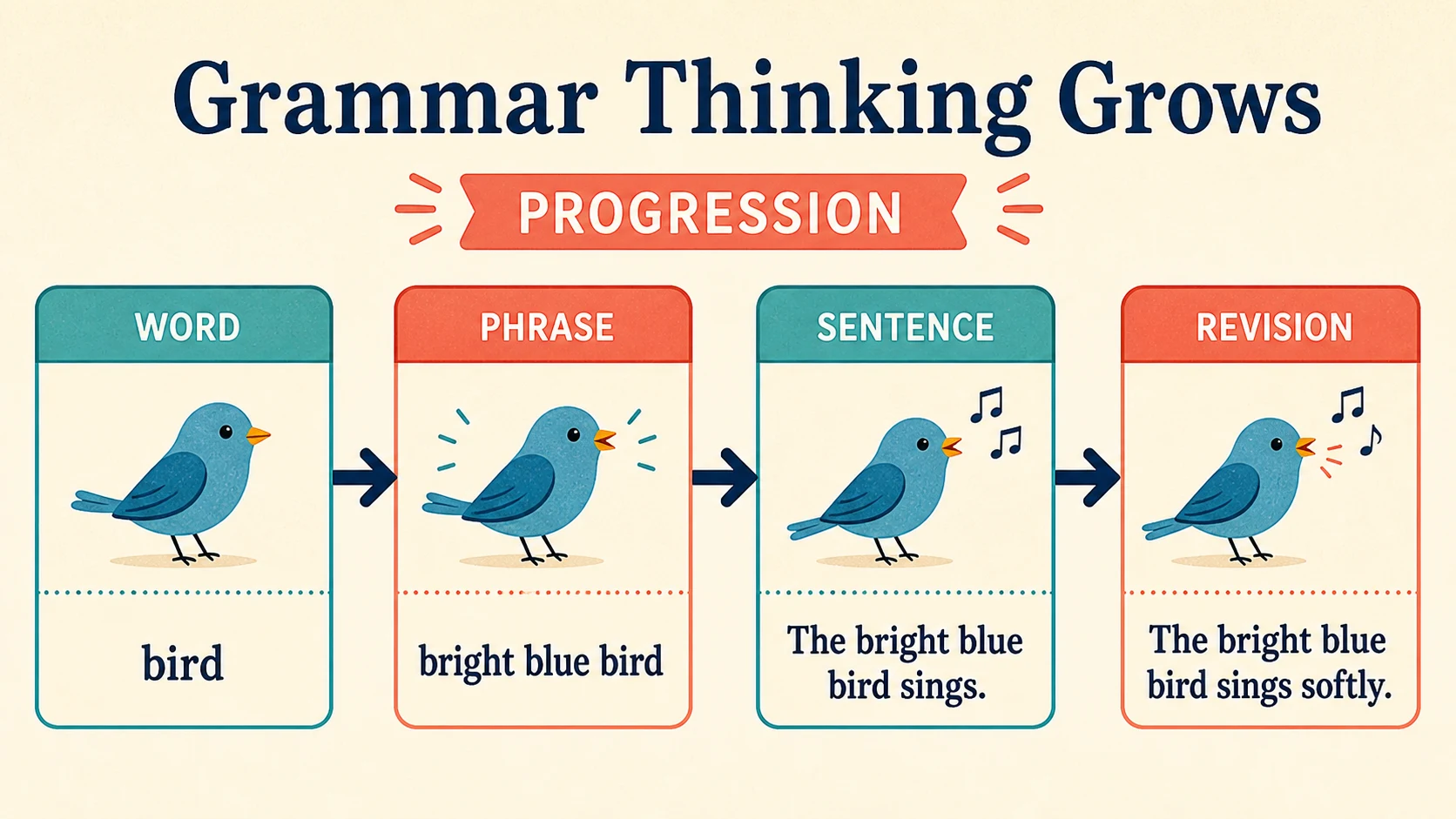
At the 3rd-grade entry point, independence should mean analyzing sentence context, not simply completing a longer list without help.
4th grade: contrast functions and demonstrate relationships
At this point, include words whose functions become clear only through syntax. Return to paired examples such as run as a noun and a verb. Introduce prepositions through a physical model before expecting paper analysis:
The marker is under the book.
Marker and book are nouns. Is is a linking verb. Under is a preposition expressing the marker’s relationship to the book.
Now move the marker on, beside, behind, and between other objects. The target remains identifying and interpreting the preposition; handwriting, drawing quality, or the ability to invent a long sentence is incidental.
The free 4th Grade Parts of Speech guide and sheet has 14 problems. Choose this entry when the learner can manage several familiar categories and is ready to use word order and sentence relationships as evidence.
5th grade: keep pronouns attached to antecedents
Pronoun work should include the noun or noun phrase to which the pronoun refers:
Maya placed the lantern on the table because she needed more light.
She is a pronoun whose antecedent is Maya. Lantern, table, and light are nouns in this sentence. Placed and needed are verbs. On is a preposition, and because connects the reason to the preceding idea.
This checked example belongs at an upper-elementary entry point because it combines classification with reference across a longer sentence. It also creates an opportunity to ask whether the pronoun points clearly to one antecedent.
Contrast it with:
Maya spoke to Elena after she entered the room.
The grammar identifies she as a pronoun, but the sentence alone does not establish whether she means Maya or Elena. The instructional response is revision, not guessing: “After Elena entered the room, Maya spoke to her” or “After Maya entered the room, she spoke to Elena,” depending on the intended meaning.
The 5th-grade free resource contains 29 problems. That is substantially more than the 14-problem 4th-grade free sheet, so preview the page and divide it if stamina would interfere with the language target.
6th grade: use classification to improve writing
The free 6th-grade sheet contains 30 problems, the largest free count in this catalogue. At this boundary, classification should increasingly support an authentic decision about wording.
Start with:
The animal went across the place.
A revision might be:
The spotted fox sprinted across the narrow bridge.
The revision replaces vague nouns (animal, place) with specific nouns (fox, bridge), replaces the general verb went with sprinted, and adds the adjectives spotted and narrow. Across remains a preposition.
This example belongs at the end of the page’s progression because the learner must do more than label categories. The categories become tools for explaining why a revision is more precise. “Add adjectives” is not an adequate rule by itself; the spotted, furry, quick, bright, interesting fox is longer but not necessarily better. Ask which detail the reader needs.
The IES practice guide Teaching Elementary School Students to Be Effective Writers recommends an instructional emphasis on the writing process, foundational writing skills, and opportunities to write for different purposes. Applied cautiously here, that supports using grammar analysis during sentence construction and revision rather than treating labels as an end in themselves. The guide did not assess WorksheetWise resources.
How representations and question designs should change
A genuine progression changes the thinking required. It does not merely put more questions on the page.
From objects and actions to printed words
At the earliest point, use a three-part connection:
- Hold up a real object: book.
- Perform an action: open.
- Say and display: I open the book.
The object anchors the noun; the movement anchors the verb; the sentence shows both roles together. A learner who can name the object but cannot locate book in the sentence may need support moving between the concrete model and print.
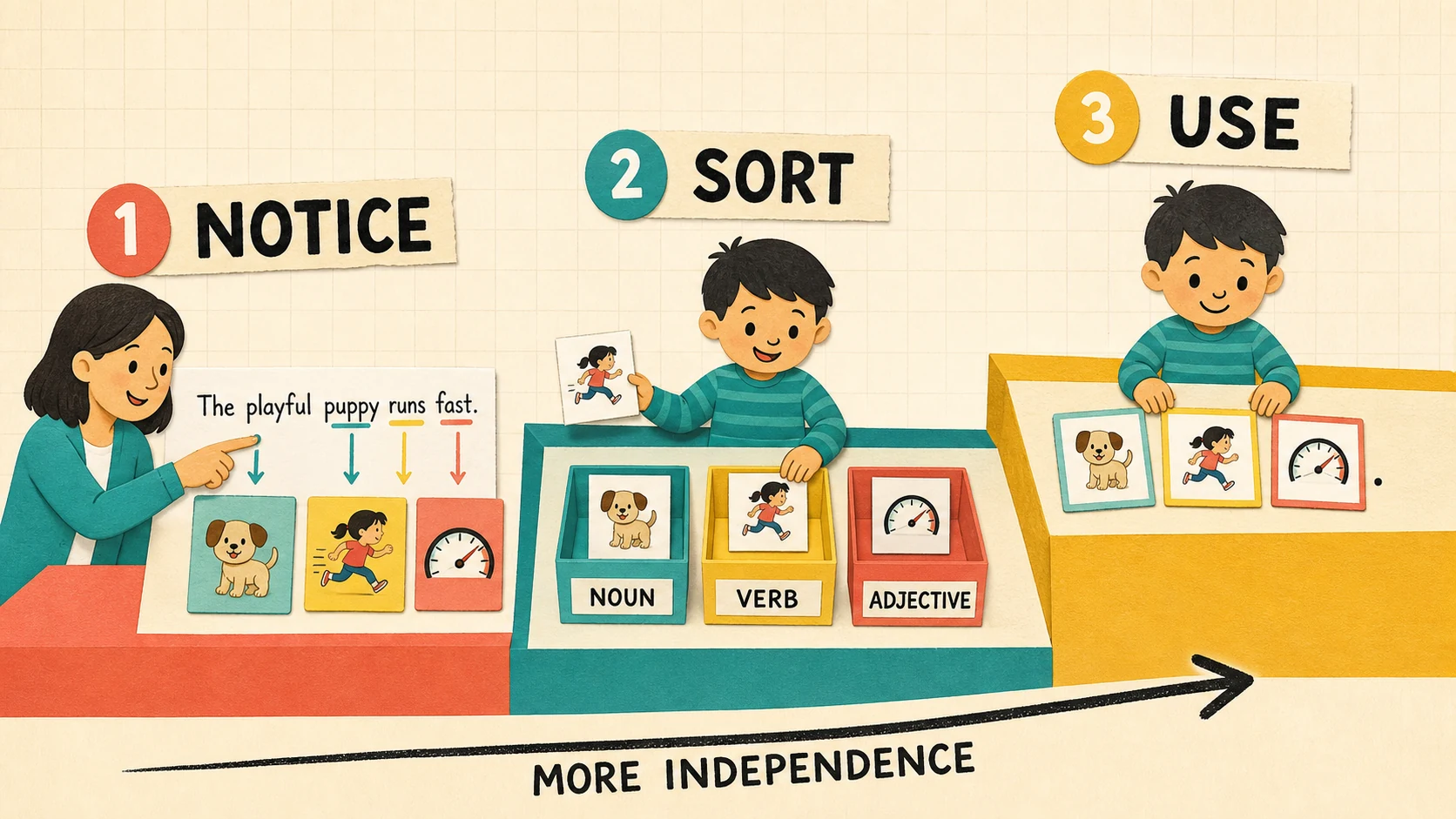
The relevant progression is from a modeled noun–verb decision to a justified sentence-level decision, with support removed only when evidence permits.
From closed choices to classification with reasons
Multiple-choice questions reduce the response burden, which can be useful when the target is recognizing a category. Open sorting asks the learner to retain category boundaries. Sentence marking adds the need to use context. Explanation prompts—“How do you know?”—reveal whether the correct label came from reasoning or chance.
A well-sequenced set might ask the learner to:
- Choose the noun in a two-word sentence.
- Sort six words into noun and verb groups.
- Mark nouns and verbs in three short sentences.
- Explain one answer.
- Write a sentence containing a specified noun and verb.
These are different demands. A learner can succeed at recognition while still needing support with retrieval or sentence construction.
From single-function words to contextual contrasts
Do not introduce ambiguity accidentally. First establish the category with clear examples. Then compare matched sentences:
- We light the candle. Light is a verb.
- The light is bright. Light is a noun.
- Carry the light bag. Light is an adjective.
All three classifications are checked from their sentence roles. The contrast is appropriate only after a learner understands that parts of speech describe functions. If it is introduced too early, the learner may conclude that the labels are arbitrary.
From identification to revision
Identification asks, “Which word is the verb?” Revision asks, “Which verb communicates the action precisely?” The second requires grammatical knowledge plus a writing decision.
The IES Foundational Skills to Support Reading for Understanding focuses on foundational reading instruction, including work with language and connected text. It is not a parts-of-speech worksheet review. Its relevance here is limited but useful: oral language, reading, and meaningful text should remain connected. Adults should not let isolated terminology displace actual reading and sentence use.
Mentor sentences from books the learner is already reading can supply authentic examples, but select short sentences whose target functions you have checked. Avoid asking a beginning learner to classify every word in a stylistically complex sentence.
Compare starting points before selecting a grade page
Use a brief oral check rather than assigning six worksheets to discover a starting point.
Start with nouns and verbs when the core contrast is uncertain
Say, “The dog sleeps.” Ask what names the animal and what tells what it does. Then try “Lena thinks.” If the learner recognizes only visible actions, explain that verbs can also express less visible actions or states. Select the 1st-grade entry when the learner benefits from concrete nouns, short sentences, movement, and a small category set.
Add adjectives when modification is the next boundary
Place two pencils on the table and ask for words that distinguish them: long, short, yellow, or sharp. Put one choice into a sentence and ask which noun it describes. Select the 2nd- or 3rd-grade entry when noun and verb decisions are stable but modifier relationships still need deliberate practice.
Move upward when context controls the answer
Use the paired run sentences. If the learner explains both roles from sentence evidence, try a preposition demonstration and a pronoun–antecedent sentence. The 4th- through 6th-grade entries become more plausible when the learner can coordinate multiple categories, longer sentences, contextual shifts, and revision decisions.
This is placement for a practice task, not a diagnosis. Reading load can hide grammatical knowledge, and oral success may exceed written performance. Conversely, fluent reading does not guarantee that a learner can explain a word’s grammatical function.
A repeatable routine for one worksheet session
A useful session can fit into four phases and does not require finishing the page.
Model one sentence
Read a checked sentence aloud. Think through one decision: “Bird names the animal, so it is a noun. Sings tells what the bird does, so it is a verb.” Keep the explanation specific to the sentence.
Solve two together
Let the learner point, move a word card, underline, or answer orally. Ask for evidence after the selection. If the worksheet uses several marking conventions, place a small key nearby so remembering colors or symbols does not replace grammatical thinking.
Try a short independent set
Choose three to six items. Watch which questions cause hesitation. Do not interrupt every error immediately; collect enough information to identify a pattern. Stop if decoding effort, fatigue, or handwriting has become the dominant task.
Reuse one answer in speech or writing
Ask the learner to change a noun, strengthen a verb, add one useful adjective, clarify a pronoun, or physically demonstrate a preposition. This transfer check shows whether the category can inform a new decision.
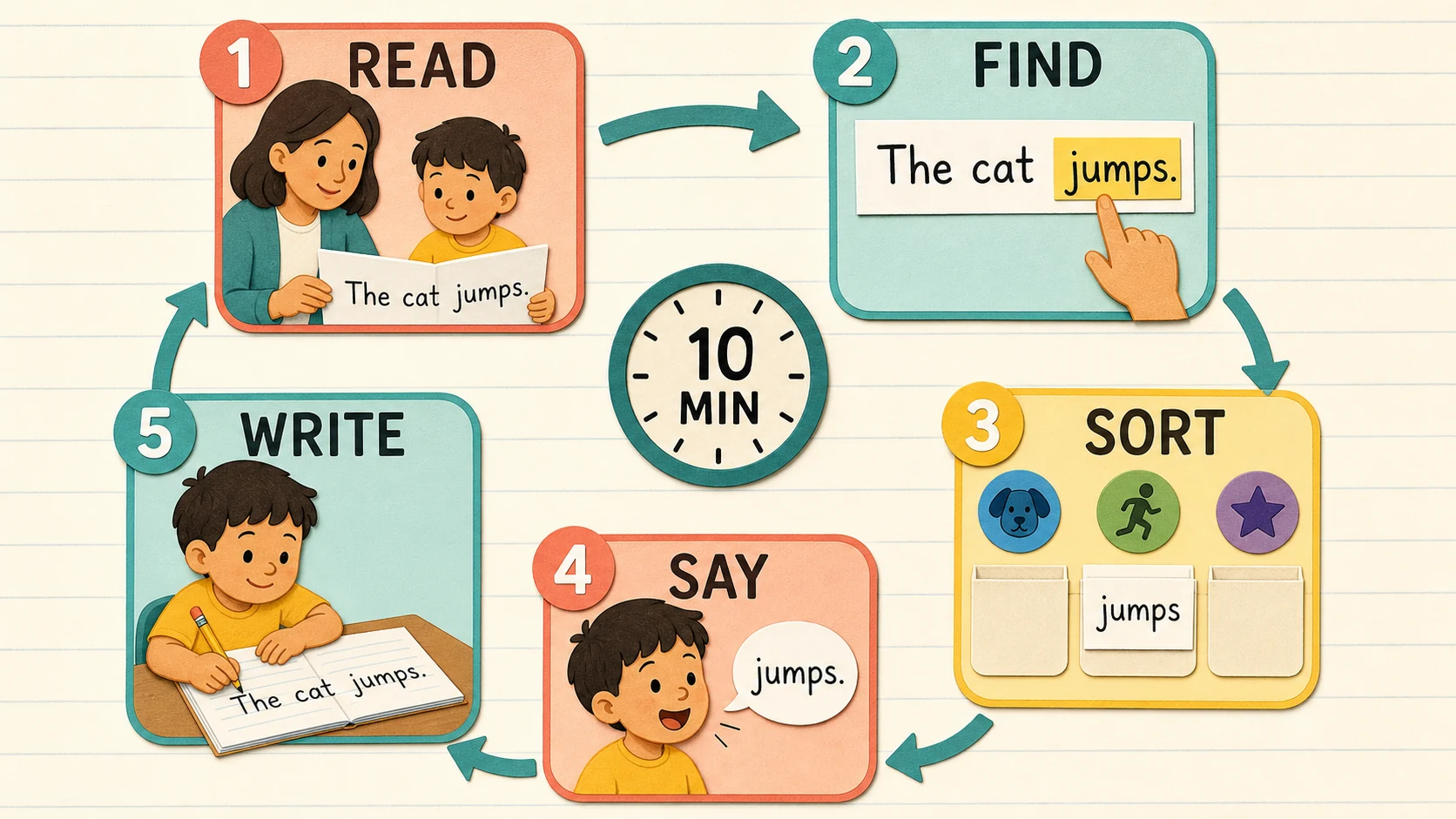
For the 1st-grade entry point, a compact model–practice–check cycle keeps attention on the noun–verb contrast instead of page completion.
A suggested two-week rhythm is three or four short sessions per week: introduce and model, practice with support, revisit errors, and then check a small independent set. This is a planning suggestion, not a sourced dosage requirement.
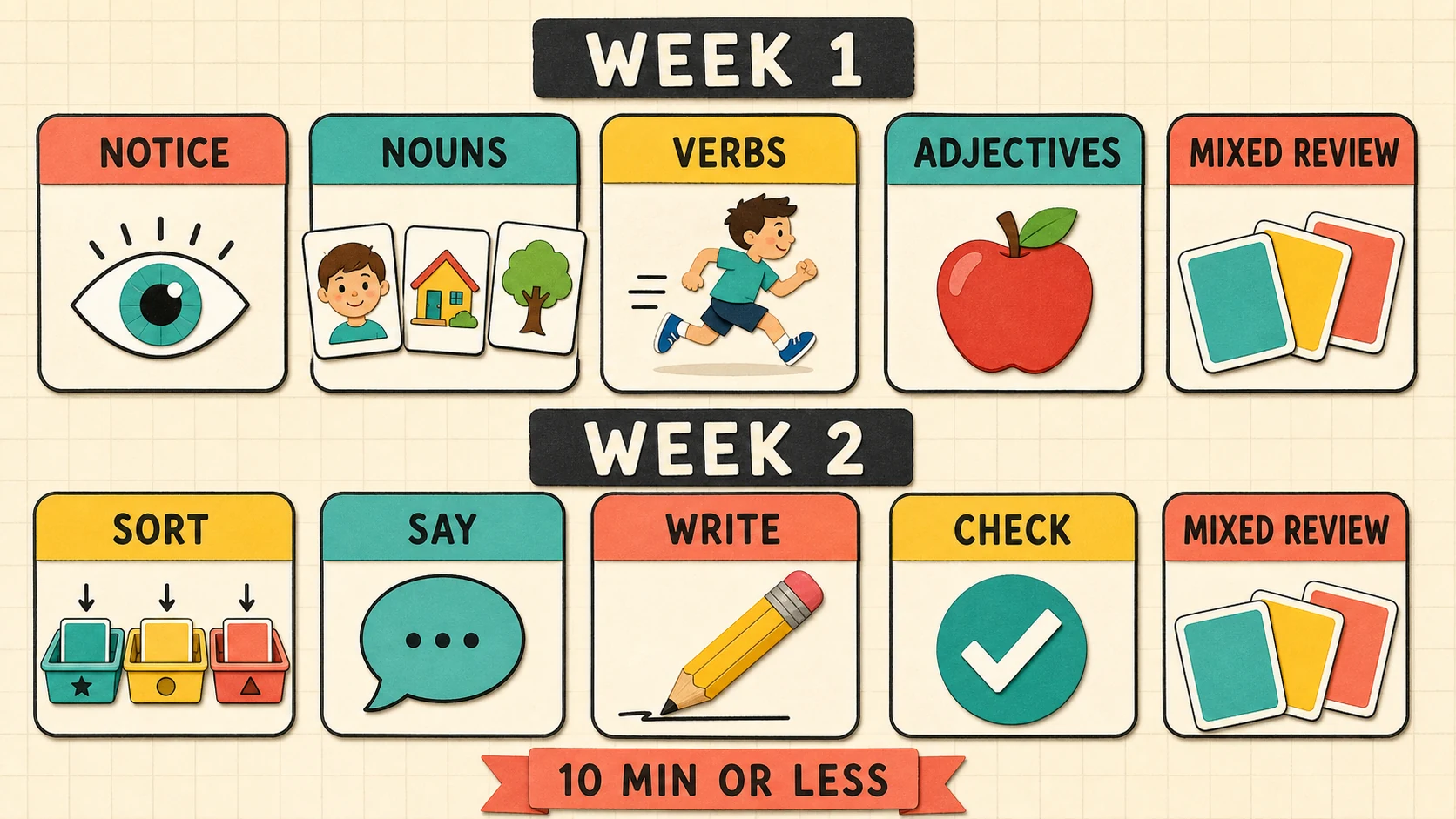
Space the 1st-grade work across short encounters so the adult can compare oral, movement-based, and printed responses.
Interpret errors before adding more categories
An incorrect label does not identify one cause. Look at the response and test the smallest plausible boundary.
Every action-like word is called a verb
If the learner labels run as a verb in “We went for a run,” place it beside “We run daily.” Ask what changes. Point out the article a in the first sentence and the position after the subject we in the second. The teaching response is a contextual contrast, not additional memorization of verb examples.
Every describing word is called an adjective
In “The turtle moves slowly,” slowly modifies moves, not turtle. Compare it with “The slow turtle moves.” Use arrows to show the modified word. Keep terminology proportional to the task: the important distinction is what the modifier describes.
The learner circles an entire prepositional phrase
In “The keys are under the chair,” a learner may circle under the chair. That response shows attention to the whole relationship phrase. If the question asks for the preposition, isolate under while acknowledging that the chair completes the phrase’s meaning.
A pronoun is identified but its reference is unclear
Recognizing they as a pronoun does not prove that the learner can maintain a clear reference in writing. Ask, “Who exactly does they mean?” If two answers are possible, revise the sentence by naming one antecedent.
Correct oral answers become incorrect on paper
Reduce copying, read directions aloud, offer word cards, or let the learner point. Then present the same grammatical decision. If performance improves, the original page may have mixed the target with reading, memory, visual scanning, or handwriting demands.
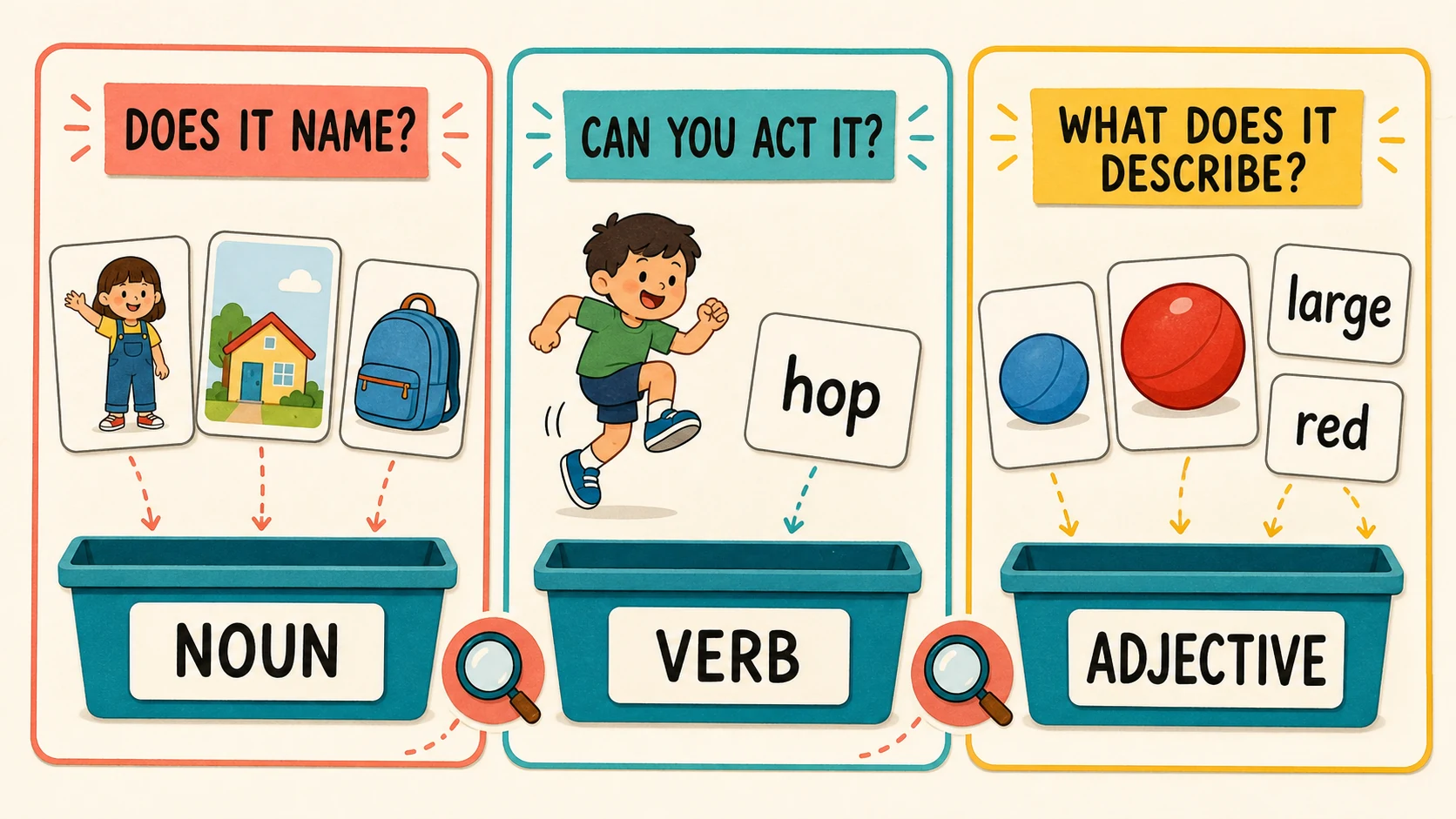
At the 1st-grade level, the useful response to an error is a small contrast or concrete demonstration that tests the noun–verb boundary.
Adapt the activity without removing the grammar
An adaptation preserves the target decision while changing an incidental demand.
For limited handwriting stamina, let the learner place N, V, and Adj cards beneath words instead of copying them. For a heavy decoding load, read the sentence aloud while the learner follows the print. For visual crowding, cover all but one item. For motor access, accept pointing or an oral response. For multilingual learners, confirm the sentence’s meaning before judging the grammatical classification; an unfamiliar vocabulary word can prevent a fair demonstration of the target skill.
Movement should clarify grammar, not turn the activity into a general movement break. Acting out jump, placing a block behind a cup, or holding up a named object directly represents the target. Likewise, shortening a 30-problem sheet preserves the skill if the selected questions still sample the intended distinctions.
Avoid adaptations that answer the question in advance. If every noun is paired with a picture but every verb is not, the visual format may reveal the category rather than support access. If the learner is supposed to determine what an adjective modifies, pre-drawn arrows would remove that decision.
Know what these worksheets cannot establish
A worksheet response is a narrow sample. It cannot diagnose a language, reading, attention, or learning condition. It cannot by itself establish mastery across conversation, reading, and writing. One score may be affected by vocabulary, decoding, directions, fatigue, handwriting, guessing, or prior exposure to the exact items.
The catalogue’s 108 variants and six free resources provide options, not a prescribed curriculum. The shared topic description names all eight parts of speech and a broad progression, but adults should not assume that moving through grade pages in order guarantees comprehensive instruction. Preview representations, directions, sentence complexity, answer expectations, and category coverage.
Nor should labels replace writing judgment. A sentence with three adjectives is not automatically stronger than one with none. An adverb is not automatically weak. A specific noun or strong verb is useful when it expresses the intended meaning more precisely.
Use standards and authoritative practice guides to understand broader instructional expectations, not as endorsements. Neither IES guide cited here reports an assessment of WorksheetWise, and the Common Core site does not certify these worksheets.
Make the next worksheet choice from one observable boundary
Choose the next page by completing this sentence: “The learner can ___ independently, and now needs practice with ___.”
Examples include:
- “The learner can distinguish concrete nouns from action verbs and now needs to connect adjectives to nouns.”
- “The learner can sort familiar words but now needs to use sentence context.”
- “The learner can label pronouns but now needs to identify clear antecedents.”
- “The learner can classify common categories and now needs to revise vague sentences.”
Then open the matching grade guide, preview its free sheet, and assign only enough items to test that boundary. If no fixed sheet matches the category mix or quantity you need, use the free deterministic worksheet generators to create a focused practice set. Start with one checked noun–verb sentence, observe the learner’s explanation, and let that evidence—not age, page length, or the word “easy”—determine the next task.
Put it into practice
Use the guide with a real printable
Move from explanation to a short, observable practice task. Check the first item together, then adjust the next session from the learner's actual work.
Open the first free worksheetExplore a neighboring collection
Choose by a different teaching need
Addition Worksheets by Grade and Level Consonant Blends Worksheets by Grade and Level Counting Worksheets by Grade and Level CVC Words Worksheets by Grade and Level Decimals Worksheets by Grade and Level Digraphs Worksheets by Grade and Level Division Worksheets by Grade and Level Fractions Worksheets by Grade and Level