What 6th Grade Multiplication Should Accomplish
Sixth-grade multiplication practice should make previously learned computation dependable enough to support ratios, fraction work, expressions, equations, area, and statistics. A learner at this level should not simply recite facts. They should be able to choose a sensible strategy, calculate accurately, estimate before or after computing, and explain what a product means in context.
In practical terms, teach multiplication in this order:
- Repair uncertain facts and place-value concepts.
- Reconnect arrays and area models to partial products.
- secure accurate multi-digit multiplication.
- Apply multiplication in sixth-grade work, including ratios, variables, and multi-step problems.
- Build independence through mixed practice and error analysis.
The learner’s observed work should determine the pace. A student who accurately solves multi-digit problems but hesitates over 7×8 needs targeted fact practice. A student who knows the facts but writes 306×4=1224 without understanding the zero’s place-value role needs modeling and explanation, not another timed fact page.
Grade labels describe the intended practice level, and local instructional sequences differ. The Common Core State Standards for Mathematics place foundational multiplication learning and the standard whole-number algorithm before sixth grade. In sixth grade, multiplication remains essential because it is used inside more advanced work. Therefore, a “6th Grade Multiplication” lesson may be prerequisite repair, grade-level application, or both.
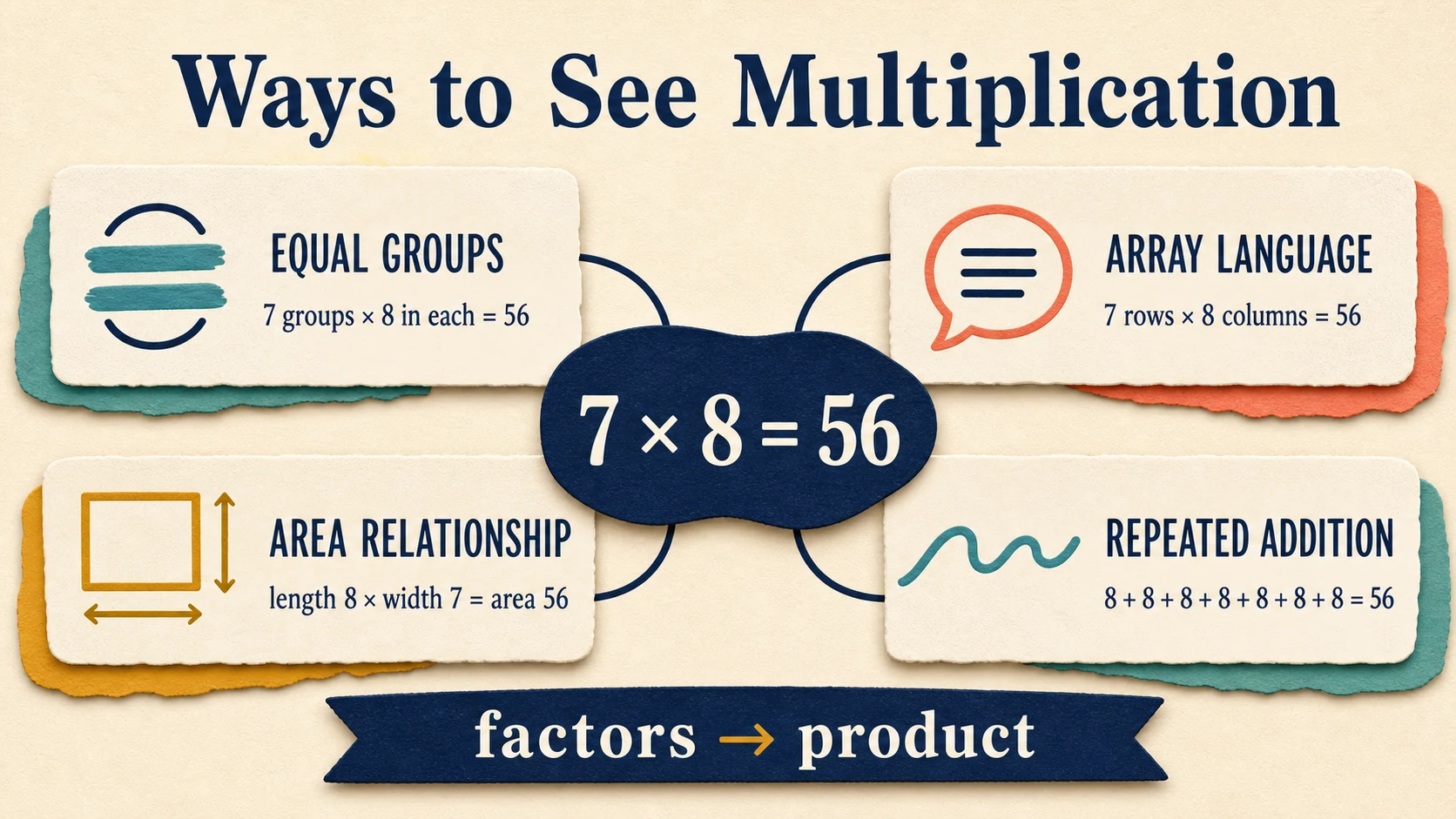
Multiplication fluency connects facts, place value, properties, algorithms, and applications.
Prerequisites to Check Before Moving Forward
A short diagnostic is more useful than assuming that every sixth grader needs the same review. Ask the learner to complete a few carefully chosen problems without coaching, then examine both the answers and the written work.
Fact knowledge and flexible strategies
Check facts involving 0 through 12, but distinguish recall from reasoning. If a learner cannot immediately recall 7×8, ask how they could derive it. Acceptable reasoning includes:
7×8=(7×5)+(7×3)=35+21=56
The learner does not need to use the same decomposition every time. They do need a reliable method that preserves the value of the expression.
Useful fact strategies include:
- multiplying by 0, 1, 2, 5, or 10 through known patterns;
- doubling to connect 4×n with 2×n;
- breaking a difficult factor into easier parts;
- reversing factors through the commutative property;
- checking a quotient with multiplication.
Skip counting can support early reasoning, but it should not remain the only method. Counting seven jumps to solve every 7×n fact is slow and increases the opportunity for a counting error.
Place value and addition
Before teaching a multi-digit algorithm, check whether the learner can:
- read and decompose whole numbers;
- explain the value of a digit by its position;
- multiply a one-digit number by a multiple of 10 or 100;
- add partial products accurately;
- estimate a product using nearby compatible numbers.
For example, 24×30 can be understood as 24×3 tens. Since 24×3=72, the product is 72 tens, or 720. A learner who merely says “add a zero” may get this problem right while lacking a dependable place-value explanation.
Meaning, language, and notation
Ask the learner to interpret an expression such as 6×14. It can describe six groups of 14, 14 groups of six, or the area of a rectangle with side lengths 6 and 14. In a story problem, however, the units determine which interpretation is clearest.
The learner should also recognize:
- factor: a number being multiplied;
- product: the result of multiplication;
- multiple: a result in a number’s multiplication sequence;
- unknown factor: a missing factor, as in 9n=63.
If vocabulary is unclear, teach it during worked examples rather than assigning definitions in isolation.
A Grade-Appropriate Teaching Progression
The following progression begins with prerequisite evidence and moves toward sixth-grade application. It is not a universal timetable. Spend more time where errors reveal an unfinished concept.
| Stage |
Instructional focus |
Evidence that the learner is ready to continue |
| 1. Meaning |
Equal groups, arrays, repeated addition, and factor-product language |
Explains what both factors represent |
| 2. Facts |
Facts through 12, properties, and derived strategies |
Solves accurately and derives forgotten facts |
| 3. Place value |
Multiples of 10 and 100; expanded form |
Explains why place value changes the product |
| 4. Partial products |
Break one or both factors apart |
Records and combines every partial product |
| 5. Standard algorithm |
Accurate alignment and regrouping |
Connects algorithm steps to place value |
| 6. Estimation |
Rounding or compatible-number checks |
Identifies clearly unreasonable answers |
| 7. Application |
Ratios, area, expressions, unknown factors, and multi-step problems |
Chooses multiplication and labels the result |
| 8. Mixed independence |
Varied formats without a named strategy |
Selects, completes, and checks a method independently |
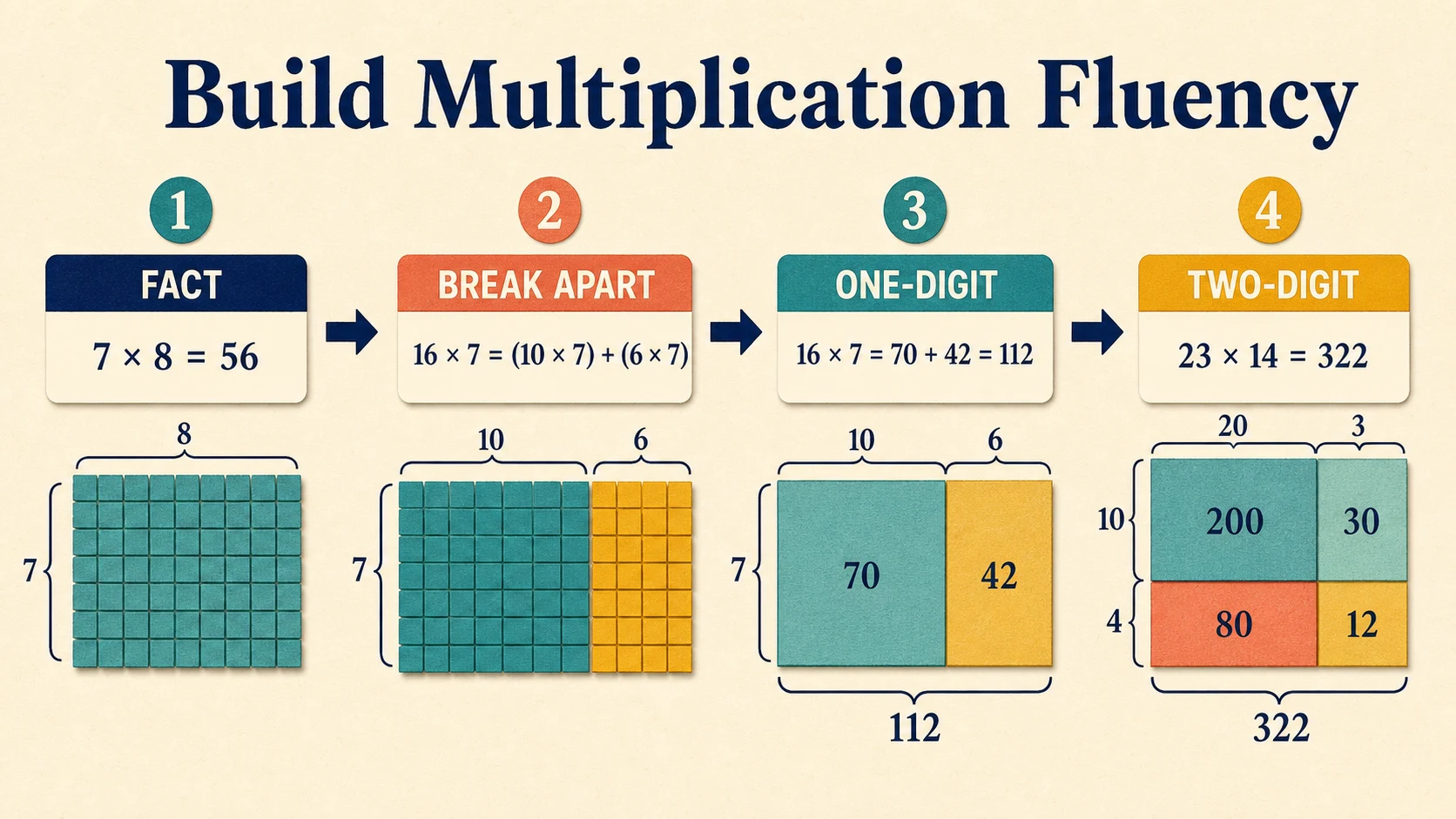
Move forward when the learner’s work is accurate and explainable, not simply when a page is finished.
The 6th Grade Math hub can help adults place multiplication beside related math practice. The broader 6th Grade worksheet hub is useful when planning work across subjects without treating every worksheet as a new lesson.
Concrete and Visual Models That Still Matter
Visual models are not childish decorations. They make the structure of multiplication visible. At sixth-grade level, use them briefly and purposefully, then connect them to efficient notation.
Equal groups and arrays
Counters, tiles, grid paper, or quick sketches can represent a product. For 4×6, arrange four rows with six objects in each row. The array shows 24 total objects and makes the relationship between 4×6 and 6×4 visible.
An array also prepares the learner for area. A rectangle that is 4 units by 6 units contains 24 square units. Keep the units explicit: 24 objects in a grouping problem and 24 square units in an area problem are numerically equal but describe different quantities.
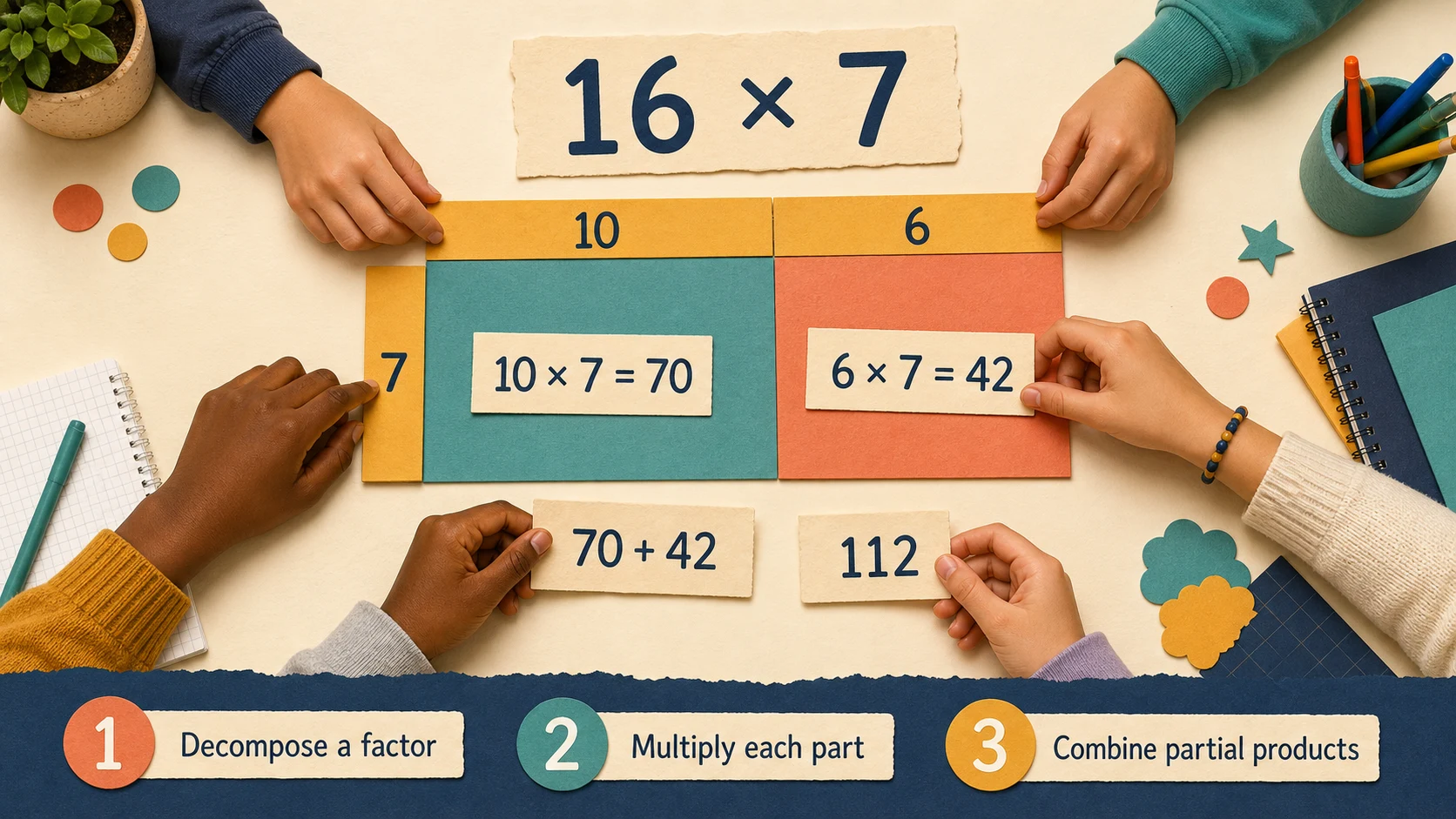
Area models and partial products
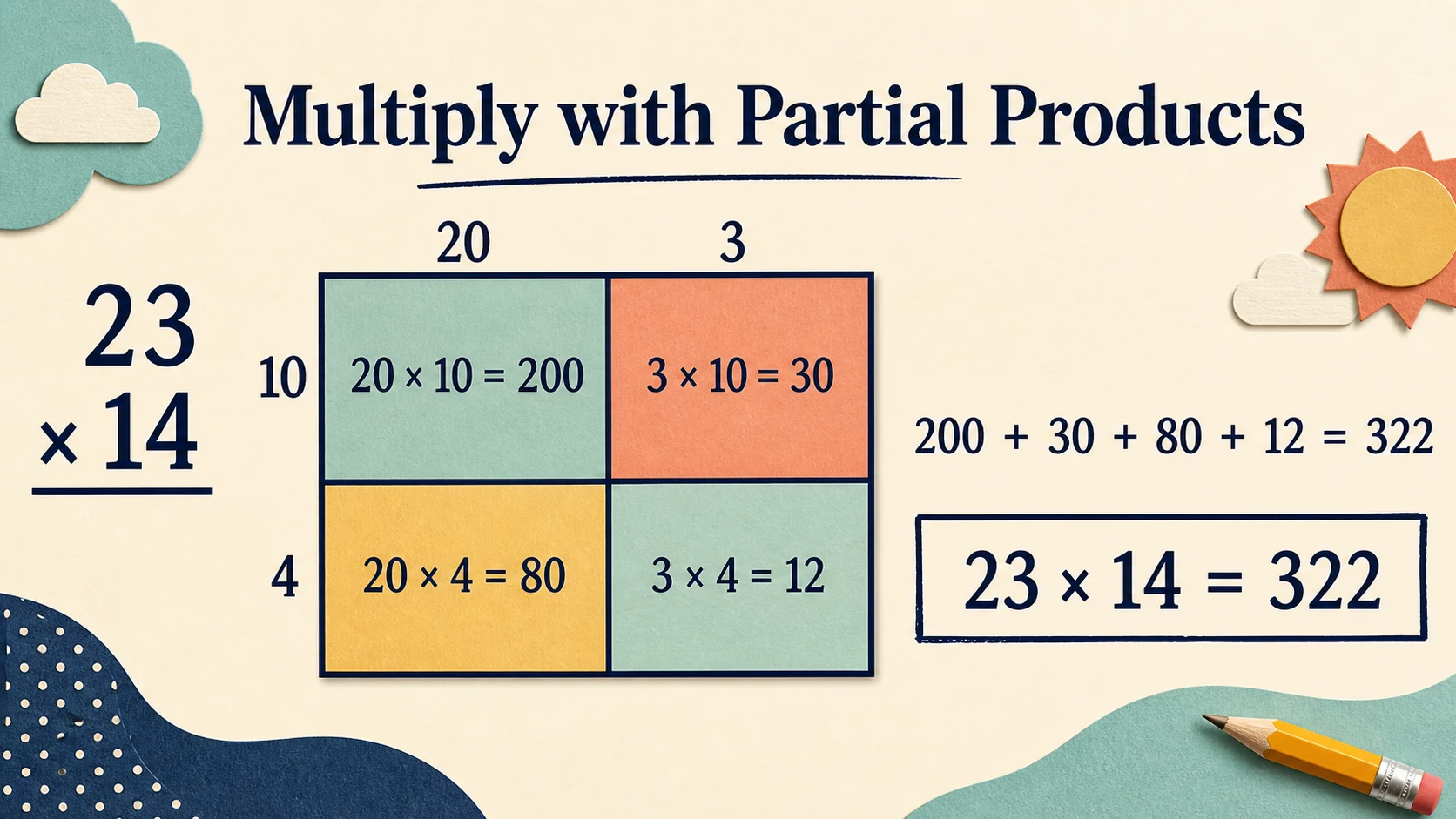
For 23×14, split 23 into 20+3 and 14 into 10+4. A rectangular area model produces four regions:
Then add:
200+30+80+12=322
This is the distributive property made visible. It also explains why a standard algorithm must account for ones multiplied by ones, ones by tens, tens by ones, and tens by tens.
Number lines and scaling
A number line can show repeated equal jumps, but it is most helpful when the number of jumps is small. For example, three jumps of 25 show 3×25=75.
Scaling language is more appropriate when multiplication changes a quantity. If one batch uses 18 counters, four equal batches use:
4×18=72
Ask whether the answer should be greater or less than 18. With positive whole-number factors greater than 1, the product should be greater than either single batch. This magnitude check helps expose misplaced digits and missing partial products.
Connect objects or diagrams to partial products, then connect partial products to concise written computation.
Fully Checked Worked Examples
The purpose of a worked example is not just to display an answer. It should reveal a method, a check, and the meaning of the result.
Example 1: Deriving a difficult fact
Find 8×7.
Break 7 into 5+2:
8×7=8×(5+2)
Apply the distributive property:
(8×5)+(8×2)=40+16=56
Therefore:
8×7=56
Check by reversing the factors:
7×8=7×(4+4)=28+28=56
Both methods produce 56.
Example 2: A boundary case involving zero
Find 4,508×0.
Zero groups of 4,508 contain no objects, so:
4,508×0=0
A frequent error is writing 4,508 because the learner confuses the identity property with the zero property. Multiplying by 1 leaves a number unchanged:
4,508×1=4,508
Multiplying by 0 produces 0. This remains true regardless of how large the other factor is.
Example 3: Multi-digit multiplication with partial products
Find 306×24.
Decompose 24:
306×24=(306×20)+(306×4)
Calculate each partial product:
306×20=6,120
306×4=1,224
Combine them:
6,120+1,224=7,344
Therefore:
306×24=7,344
Estimate to check magnitude:
300×24=7,200
The exact answer, 7,344, is close to 7,200, so its size is reasonable.
A useful place-value observation is that the zero inside 306 is not ignored. It records that there are no tens, while the 3 still represents 300.
Example 4: Standard algorithm connected to place value
Find 427×36.
First multiply by 6 ones:
427×6=2,562
Then multiply by 3 tens:
427×30=12,810
Add the partial products:
2,562+12,81015,372
Thus:
427×36=15,372
Check with an estimate:
400×40=16,000
The exact answer is reasonably close. If the learner had written 3,843 by treating 3 as 3 rather than 30, the estimate would immediately show that the answer was much too small.
Example 5: Multiplication in a ratio table
A recipe pattern uses 3 cups of one ingredient for each batch. How many cups are needed for 8 equal batches?
| Batches |
1 |
2 |
4 |
8 |
| Cups |
3 |
6 |
12 |
24 |
The number of batches is multiplied by 3:
8×3=24
Therefore, eight equal batches require:
24 cups
Check by doubling through the table: 2 batches use 6 cups, 4 use 12, and 8 use 24.
Example 6: Evaluating an expression
Evaluate 5n+12 when n=18.
Substitute 18 for n:
5(18)+12
Multiply before adding:
90+12=102
Therefore:
5n+12=102 when n=18
A learner who calculates 5(18+12) has changed the grouping and therefore changed the expression. Written structure matters as much as arithmetic accuracy.
A Short, Repeatable Lesson Routine
A focused lesson can be short if each part has a clear purpose. The IES guide on assisting students who struggle with mathematics supports high-level practices such as systematic instruction, clear mathematical language, visual representations, and deliberate review. That guidance does not evaluate this WorksheetWise topic or prescribe one universal lesson length.
| Lesson part |
Approximate time |
Adult action |
Learner action |
| Retrieval |
3–5 minutes |
Present three previously learned items |
Solve and explain one strategy |
| Model |
5 minutes |
Work one example aloud with a visual or place-value explanation |
Identify what each step represents |
| Guided practice |
5–8 minutes |
Prompt only as much as needed |
Complete two related examples |
| Independent practice |
8–12 minutes |
Observe without correcting every line immediately |
Solve a short, well-matched set |
| Check and reflect |
3–5 minutes |
Compare work with answers and select one error or success |
Correct, explain, and state a next target |
Keep the structure consistent while changing the mathematical focus in response to observed work.
During modeling, say why a step is valid: “The 3 in 36 represents 30, so this row is 427×30.” During guided practice, gradually reduce prompts. If the learner cannot start independently, return to a simpler example with the same structure.
The IES early mathematics practice guide concerns younger learners, but its broad emphasis on purposeful progressions, mathematical language, and monitoring can inform prerequisite repair. It should not be treated as sixth-grade-specific evidence.
Choosing Practice That Matches the Need
Select practice by error pattern, not by page title alone.
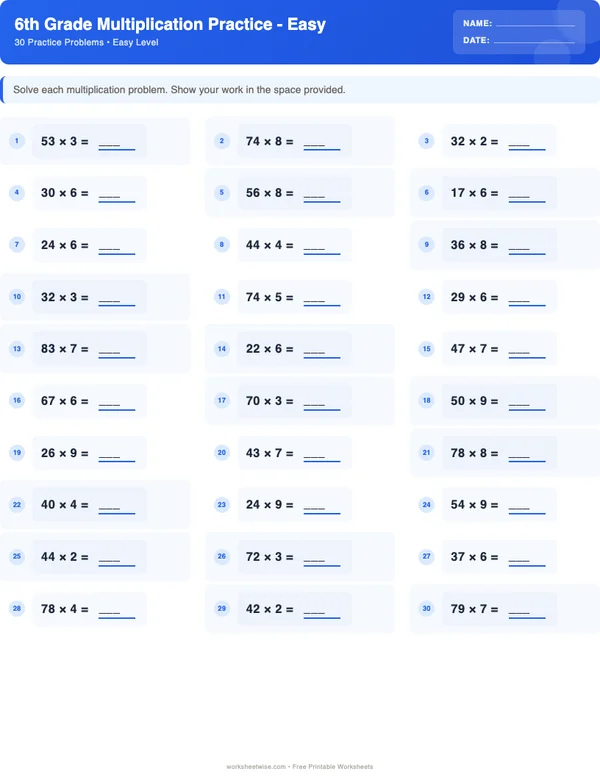
The free standard easy multiplication worksheet contains 30 exercises focused on multiplication facts, times tables, mental math, and number sense. It includes a separate answer key. It is most suitable when a sixth grader is beginning a review, needs reinforcement, or needs a manageable accuracy check.
Use a smaller selection from the page when stamina or accuracy is the immediate target. Ten carefully reviewed problems can provide better instructional information than 30 rushed answers.
For broader repetition, the 6th Grade Multiplication Worksheet Pack contains 18 worksheets. A pack can support spaced review, but worksheet count should not determine pacing. Stop and reteach when errors repeat.
Match the set to the learner
Choose:
- fact practice when recall or derivation is unreliable;
- grouped practice when introducing one method;
- mixed practice when checking whether the learner can choose a method;
- word problems when operation selection or unit interpretation is weak;
- error-correction tasks when computation is accurate only under close prompting;
- cumulative review after a skill has been taught and understood.
Avoid increasing difficulty merely because the learner completed a page. Look for accurate answers, reasonable speed without rushing, clear work, and the ability to explain or check a result.
Differentiation Without Lowering the Mathematical Goal
Differentiation changes access, quantity, representation, or support. It does not require replacing meaningful mathematics with repetitive busywork.
When the learner needs more support
- Reduce the number of problems while preserving the target skill.
- Provide a fact chart temporarily if fact retrieval blocks multi-digit reasoning.
- Use graph paper to support digit alignment.
- Color-code ones, tens, and hundreds in an area model.
- Ask the learner to state an estimate before calculating.
- Present one completed example beside one nearly identical problem.
- Let the learner explain orally before requiring a written explanation.
Remove supports one at a time. If graph paper improves alignment, keep it until the learner demonstrates consistent place-value organization.
When the learner is ready for extension
Increase reasoning demands before simply increasing digit length. Ask the learner to:
- solve one problem with two methods;
- find and correct a deliberately incorrect solution;
- compare two estimates and decide which is more useful;
- write a context for a given multiplication expression;
- determine a missing factor;
- evaluate an expression after substituting a value;
- explain why a product must fall within a stated range.
Extension should reveal structure. A six-digit computation is not automatically richer than explaining why 49×32 can be found using 50×32−32.
Common Errors and Diagnostic Responses
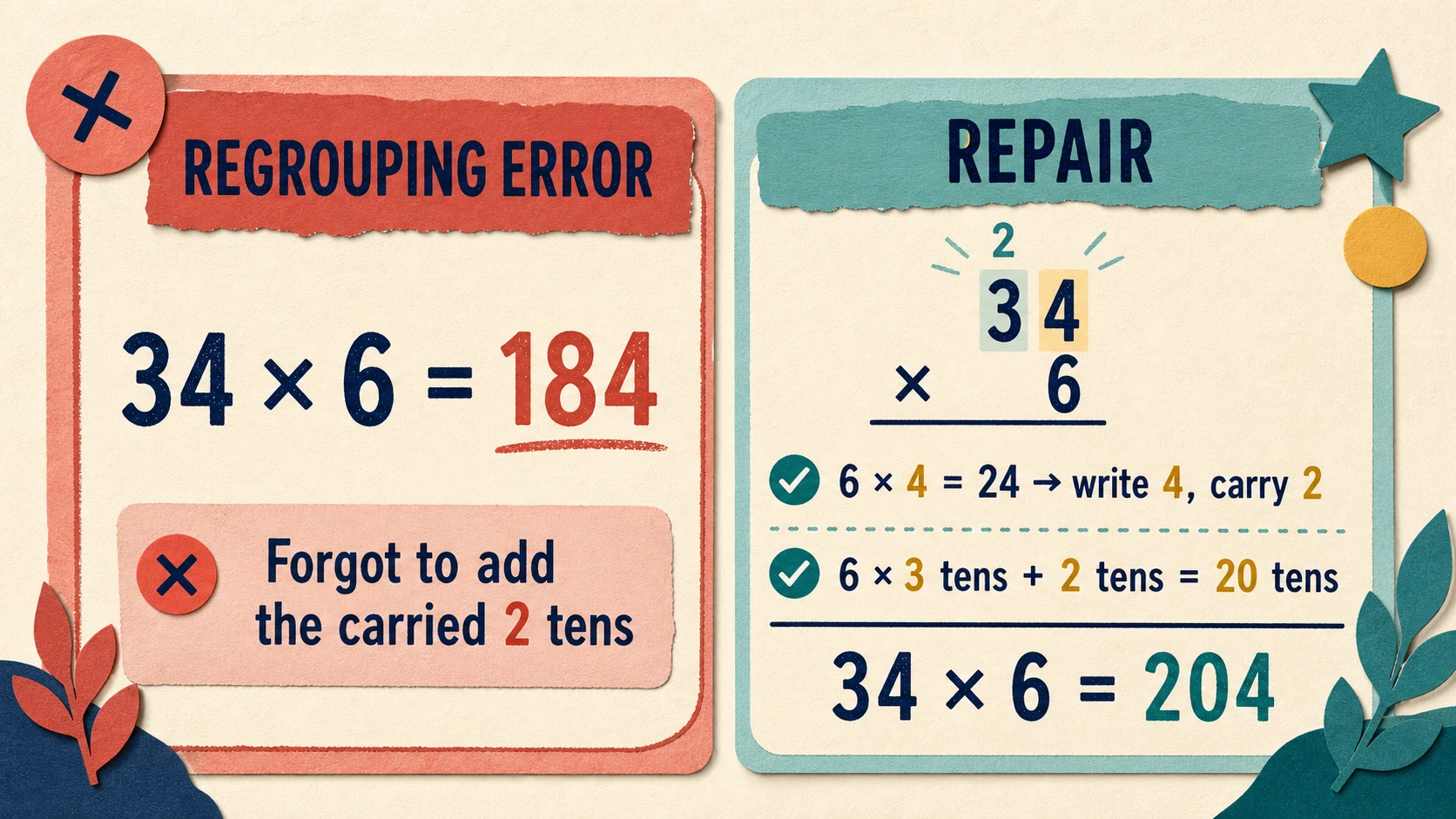
Treat an error as evidence about the next teaching move, not merely as a mark to correct.
| Observed error |
Likely issue to investigate |
Instructional response |
| 7×8=54 |
Unstable fact or counting slip |
Derive the fact using 7×5+7×3, then revisit it later |
| 632×0=632 |
Confusion between multiplying by 0 and by 1 |
Contrast zero groups with one group using a small concrete example |
| 24×30=7200 |
Appending zeros without place-value reasoning |
Interpret 30 as 3 tens and calculate 72 tens |
| Second algorithm row is not shifted |
Tens digit treated as ones |
Label the factor by place value and write n×30 before calculating |
| One partial product is missing |
Incomplete distribution |
Return to a four-region area model and account for every region |
| Digits drift into the wrong columns |
Organization or place-value difficulty |
Use graph paper and label column headings |
| Exact answer is unreasonable but accepted |
No estimation habit |
Require a rough range before or after computation |
| Correct arithmetic but wrong word-problem answer |
Operation or unit not interpreted |
Ask what one group contains, how many groups there are, and what unit is requested |
| 5(18)+12 becomes 5(30) |
Expression structure changed |
Substitute first and mark the existing grouping before calculating |
| Fast first attempt, repeated corrections |
Rushing rather than conceptual weakness |
Shorten the set and require a check after each small group |
Do not diagnose from one mistake. Give a parallel problem and see whether the pattern repeats. For example, after a missed tens shift in 427×36, try 214×23. If the learner correctly identifies the second partial product as 214×20, the original error may have been a lapse rather than a misconception.
Monitoring Progress and Deciding What Comes Next
Keep a simple record with four columns: date, skill, evidence, and next step. Evidence should be specific:
- “9 of 10 facts accurate; derived 7×8 without counting.”
- “Both partial products correct, but tens row misaligned.”
- “Calculation accurate; did not label square units.”
- “Estimated independently and rejected an unreasonable answer.”
A weekly check can include two facts, one place-value product, one multi-digit computation, and one application. Change the numbers while preserving the structure. Repeating the identical problems can test memory of those answers rather than transfer.
Move ahead when the learner can complete several related problems accurately, explain the essential reasoning, and check an answer with limited prompting. Revisit the skill when the same conceptual error appears across different problems.
A Two-Week Practice Plan
This plan assumes short weekday sessions. It is an instructional suggestion, not a sourced or universal timetable. Adjust the number of days, problem count, and support according to the learner’s observed work.
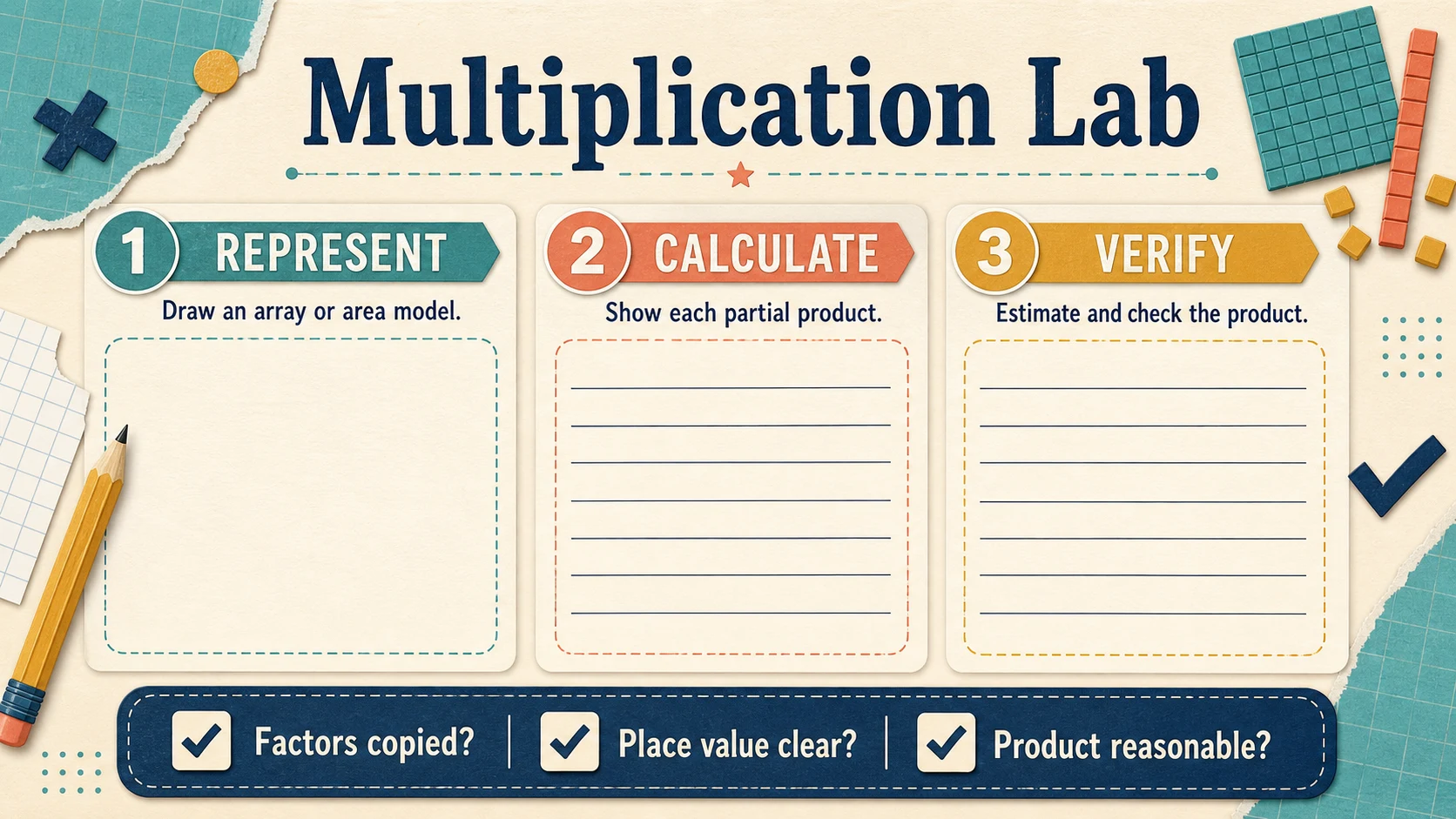
Alternate instruction, focused practice, application, and review rather than assigning an undifferentiated block of problems.
| Day |
Focus |
Suggested work |
What to record |
| 1 |
Diagnostic |
Sample facts, multiples of 10, one multi-digit problem, and one context |
Accurate skills and recurring errors |
| 2 |
Fact strategies |
Practice uncertain fact families using decomposition |
Facts derived reliably |
| 3 |
Place value |
Multiply by 10, 20, 30, 100, and related values |
Whether explanations mention tens or hundreds |
| 4 |
Area model |
Solve two-digit products with four partial products |
Missing or inaccurate regions |
| 5 |
Review |
Mix facts, place value, and one area-model problem |
Independence after four days |
| 6 |
Standard algorithm |
Connect each row to a partial product |
Alignment and regrouping |
| 7 |
Estimation |
Estimate, calculate, and compare |
Whether unreasonable answers are noticed |
| 8 |
Applications |
Use multiplication in ratio tables, area, or expressions |
Operation choice and units |
| 9 |
Error analysis |
Correct three prepared or previously observed errors |
Quality of explanations |
| 10 |
Cumulative check |
Complete a short mixed set and choose the next target |
Accuracy, strategy choice, and checking |
If Day 5 shows that partial products remain incomplete, repeat modeling before introducing the standard algorithm. If Day 7 reveals sound computation but poor estimation, continue computation practice while adding one magnitude check per lesson. The calendar serves the learning evidence, not the other way around.
Limitations and an Honest Next Step
Multiplication practice cannot by itself cover the full sixth-grade math program described in the catalogue, which also includes ratios and proportional reasoning, division of fractions, negative numbers, coordinate-plane work, expressions, equations, inequalities, variables, and statistics. A worksheet also cannot determine why a learner is making an error. That requires observing methods, asking for an explanation, and comparing performance across more than one problem.
The catalogue lists earlier Common Core multiplication standards because the central whole-number skills are developed before sixth grade. Do not describe a review worksheet as comprehensive sixth-grade standards coverage. At this level, its value is in strengthening prerequisite fluency and supporting more advanced applications.
Start with the free 6th Grade Multiplication worksheet. Ask the learner to complete a short sample without help, sort any errors using the diagnostic table above, and teach the smallest unfinished skill before assigning more practice. If a more precisely sized or varied set is needed afterward, use the free worksheet generators to create the next round around the evidence you observed.