What 6th Grade Division Should Include
Sixth Grade Division should connect three ideas: division as equal sharing or equal grouping, whole-number division based on place value, and division of fractions by fractions. A learner should be able to calculate a quotient, explain why the method works, check the result with multiplication, and interpret any remainder in context.
The most useful teaching sequence is:
- Confirm multiplication and basic division facts.
- Revisit equal-sharing and equal-group models.
- strengthen multi-digit division through place value, area models, or partial quotients.
- Connect those models to the standard long-division algorithm.
- Teach remainders as quantities that must be interpreted.
- Extend division to fractions by asking how many groups of one fractional size fit inside another.
The learner’s observed work should determine the pace. A sixth grader who calculates accurately but cannot explain a remainder needs different practice from one who loses track of place value during long division. Grade labels describe the intended practice level; local curricula and instructional sequences differ.
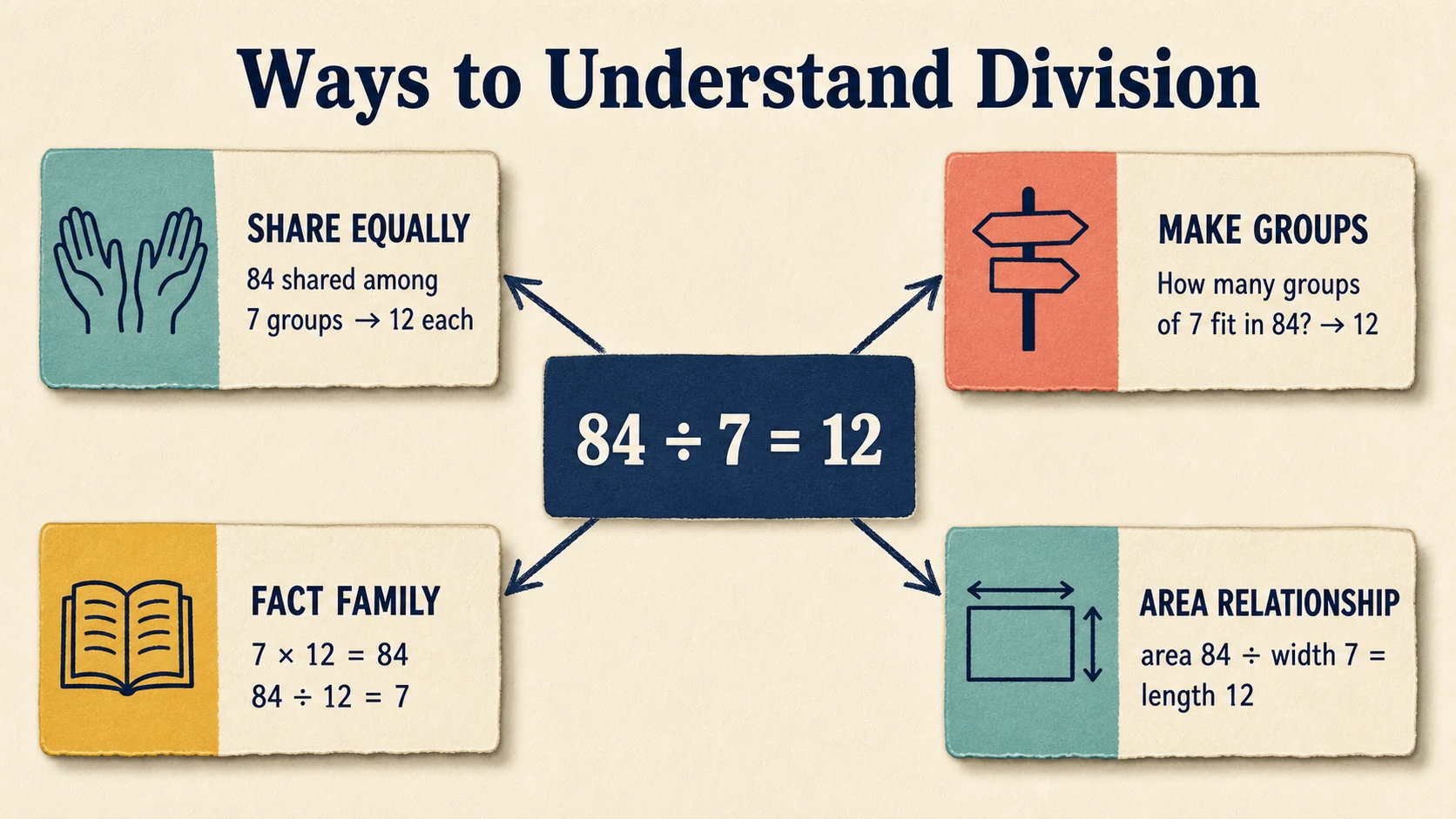
The skill map connects foundational meanings, calculation methods, fraction division, checking, and application.
The 6th Grade Math collection can supply practice, but practice is most effective when it follows a specific diagnosis. Do not choose a page merely because “division” appears in its title. First decide whether the learner needs work on facts, place value, the algorithm, fraction meaning, or interpretation.
Prerequisites to Check Before Teaching
Division becomes difficult when an unfinished prerequisite is hidden inside a new-looking problem. A short diagnostic conversation is usually more informative than assigning a full page immediately.
Multiplication and division relationships
Ask the learner to solve and explain:
- 42÷6
- 8×7
- 54÷9
- 6×□=48
The key relationship is:
dividend÷divisor=quotient
and therefore:
divisor×quotient=dividend
A learner does not need instant recall of every fact before beginning larger division, but weak fact knowledge increases the amount of attention required at each step. A multiplication chart may be used temporarily while the learner develops a dependable calculation method.
Place value and subtraction
For multi-digit division, check that the learner can:
- Read the value of each digit in a multi-digit number.
- Break numbers into useful multiples.
- Subtract accurately, including across zeros.
- Estimate whether an answer should contain tens, hundreds, or thousands.
- Write numbers in aligned columns.
For example, 1,848÷24 is easier to manage when the learner recognizes 1,848 as 1,200+480+168, each of which contains known multiples of 24.
Fraction foundations
Before dividing fractions, confirm that the learner understands:
- A fraction represents a quantity, not two unrelated whole numbers.
- Equivalent fractions name the same amount.
- Multiplying a fraction by a whole number creates repeated groups of that fraction.
- A reciprocal is formed by interchanging numerator and denominator.
- The size of the divisor affects the quotient.
The last point is essential. Dividing by a number smaller than one can produce a quotient larger than the dividend because more small groups fit into the same quantity. For instance, eight halves fit into four, so 4÷21=8.
A Grade-Appropriate Teaching Progression
The catalogue places sixth grade at the transition to more demanding mathematics, including fraction-by-fraction division. At the same time, whole-number long division, remainders, mental math, and number sense may still require consolidation.
| Stage |
Learner’s task |
Useful model |
Evidence of readiness to progress |
| Meaning |
Represent equal sharing and equal grouping |
Counters, drawings, grouped objects |
Explains what the quotient counts |
| Facts |
Derive division facts from multiplication |
Fact families, arrays |
Checks a÷b=c with b×c=a |
| Larger numbers |
Divide using manageable multiples |
Area model, partial quotients |
Records partial products and subtracts accurately |
| Standard method |
Use long division with place-value meaning |
Expanded notation beside the algorithm |
Explains each digit in the quotient |
| Remainders |
Interpret leftover quantities |
Objects, number lines, context sentences |
Chooses whether to keep, discard, round, or express the remainder |
| Fractions |
Find how many fractional groups fit |
Fraction strips, bars, equations |
Explains and checks a fraction quotient |
| Application |
Select an operation and interpret the result |
Diagram plus written equation |
Connects the numerical answer to the question |
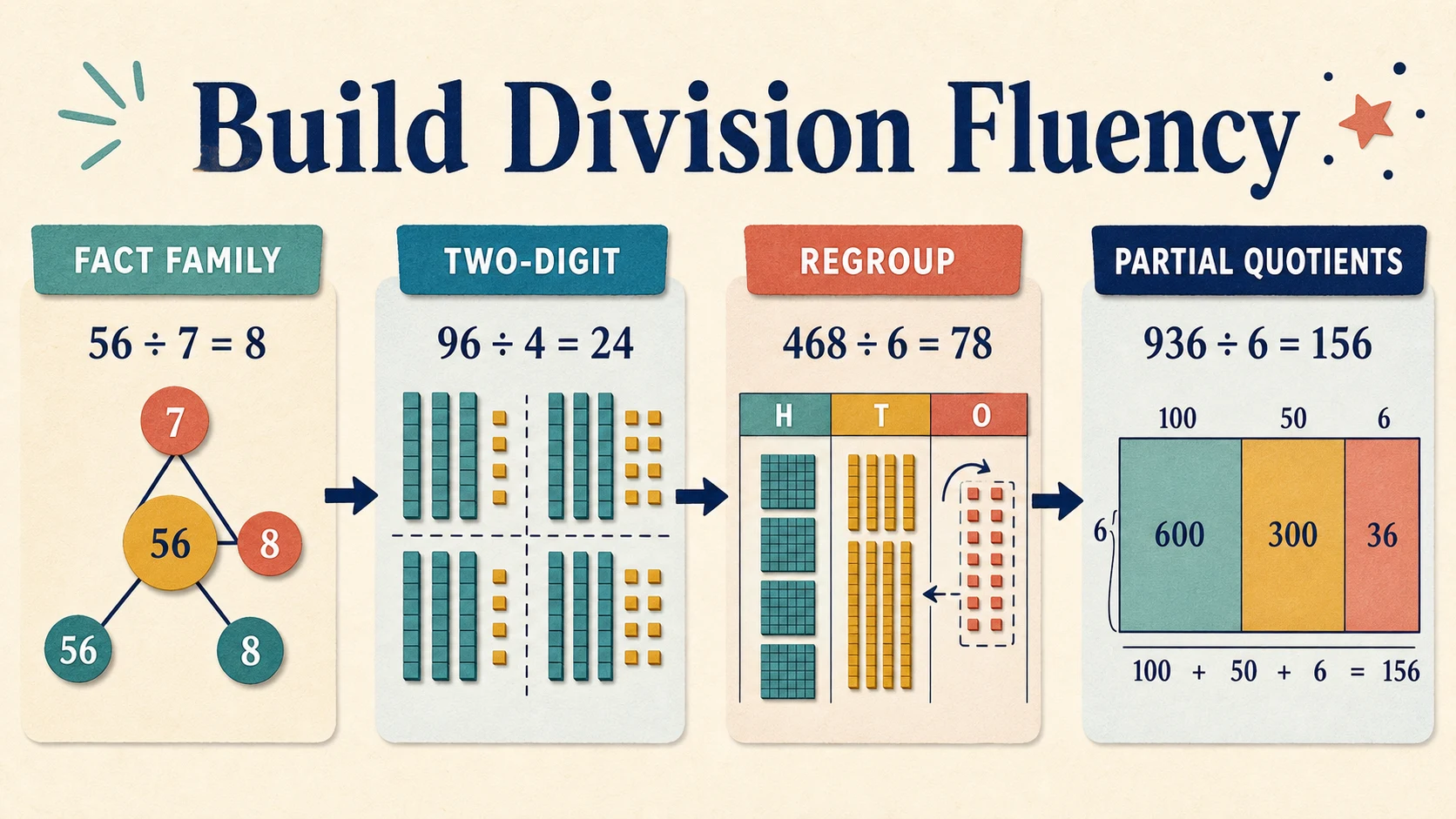
Support should fade only after the learner can explain and check the current method.
This is an instructional progression, not a universal timetable. A learner may move quickly through fact review but require several sessions on fraction models. Another may understand fraction division conceptually yet make frequent subtraction errors in long division. The 6th Grade worksheet hub can be used to coordinate division practice with related work in fractions, ratios, expressions, and other grade-level topics.
The Common Core State Standards for Mathematics provide one widely used description of grade-level mathematical expectations. Local programs may order, group, or name skills differently, so compare any practice choice with the learner’s current curriculum.
Concrete and Visual Models That Clarify Division
Equal sharing and equal grouping
The two foundational interpretations answer different questions.
Equal sharing, or partitive division: “Twelve counters are shared equally among three people. How many does each person receive?” Here, the number of groups is known, and the size of each group is unknown.
12÷3=4
Equal grouping, or quotitive division: “Twelve counters are placed into groups of four. How many groups can be made?” Here, the group size is known, and the number of groups is unknown.
12÷4=3
Both situations use division, but the quotient counts different things. Ask the learner to state what one group represents and what the answer represents. That language becomes especially important in word problems and fraction division.
Area models and partial quotients
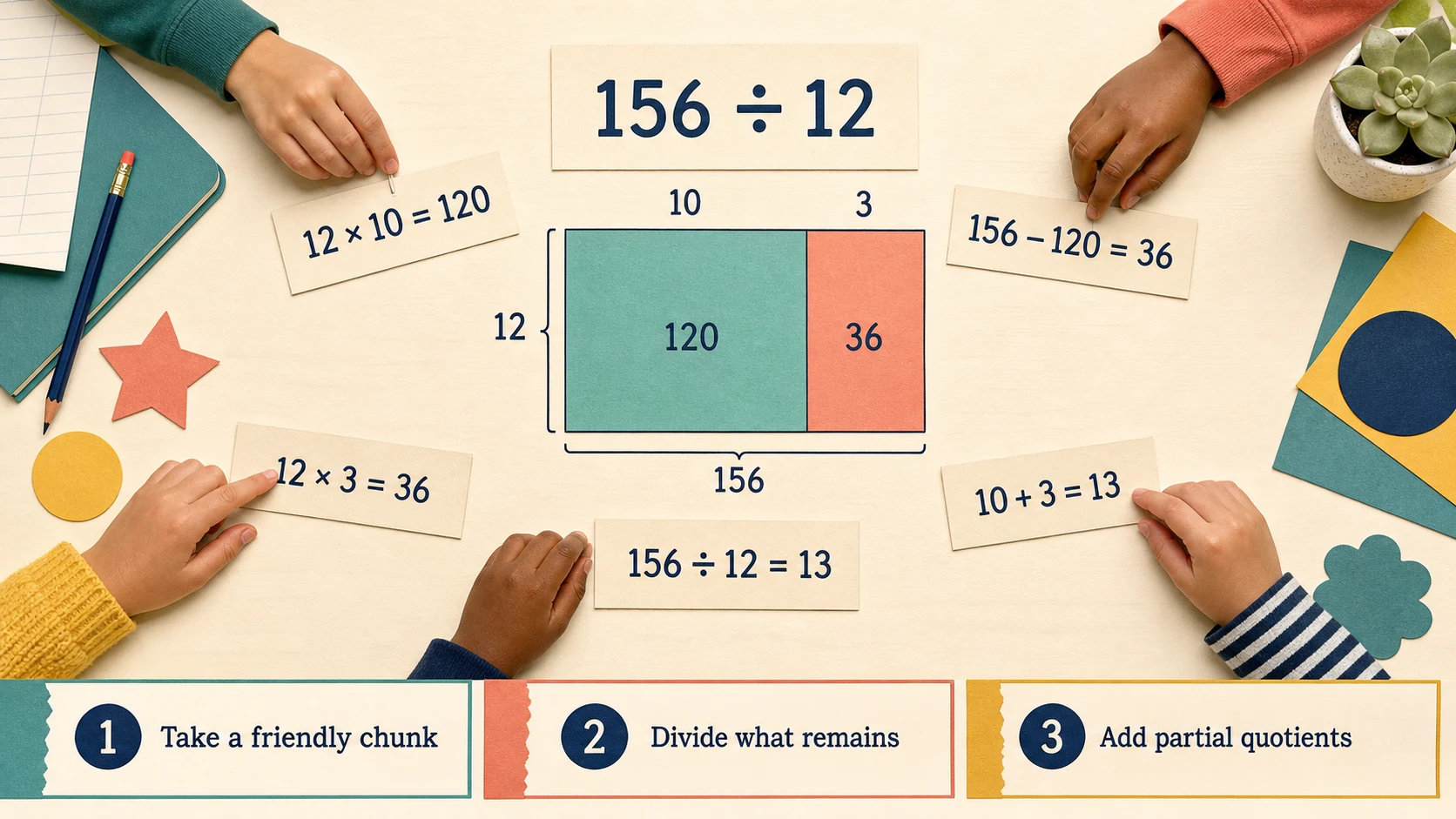
An area model treats the dividend as an area and the divisor as one side length. To find 156÷12, decompose 156 into multiples of 12:
156=120+36
Then:
120÷12=10
36÷12=3
So:
156÷12=10+3=13
Partial quotients record the same reasoning without requiring a drawn rectangle. The learner subtracts convenient multiples of the divisor, then adds the partial quotients. This makes the role of multiplication and place value visible before the notation becomes compressed.
Fraction strips and measurement
For 43÷81, ask, “How many eighths fit into three fourths?” Rename three fourths as sixth eighths:
43=86
Six groups of 81 fit, so:
43÷81=6
A strip diagram can display one bar divided into eighths, with six eighth-size sections shaded. This supports the meaning of the quotient before introducing a general procedure.
The IES guide on teaching mathematics to young children concerns younger learners, not sixth-grade instruction. It is relevant only as broader background for purposeful mathematical experiences and representations. It should not be treated as evidence about this worksheet or as a sixth-grade curriculum.
Fully Checked Worked Examples
Example 1: Equal grouping with an exact quotient
Problem: A tutor has 84 cards and makes packs of 7 cards. How many complete packs can be made?
The known group size is 7, so use equal grouping:
84÷7
Use the related multiplication fact:
7×12=84
Therefore:
84÷7=12
Answer: 12 complete packs.
Check:
12×7=84
The product equals the original dividend, so the quotient is correct. Notice that the quotient counts packs, not cards in each pack.
Example 2: Multi-digit division with partial quotients
Problem: Calculate 1,848÷24.
Choose convenient multiples of 24:
24×70=1,680
Subtract:
1,848−1,680=168
Then:
24×7=168
Subtract:
168−168=0
Add the partial quotients:
70+7=77
Therefore:
1,848÷24=77
Check:
77×24=77×(20+4)=1,540+308=1,848
The remainder is zero, and the multiplication check reconstructs the dividend.
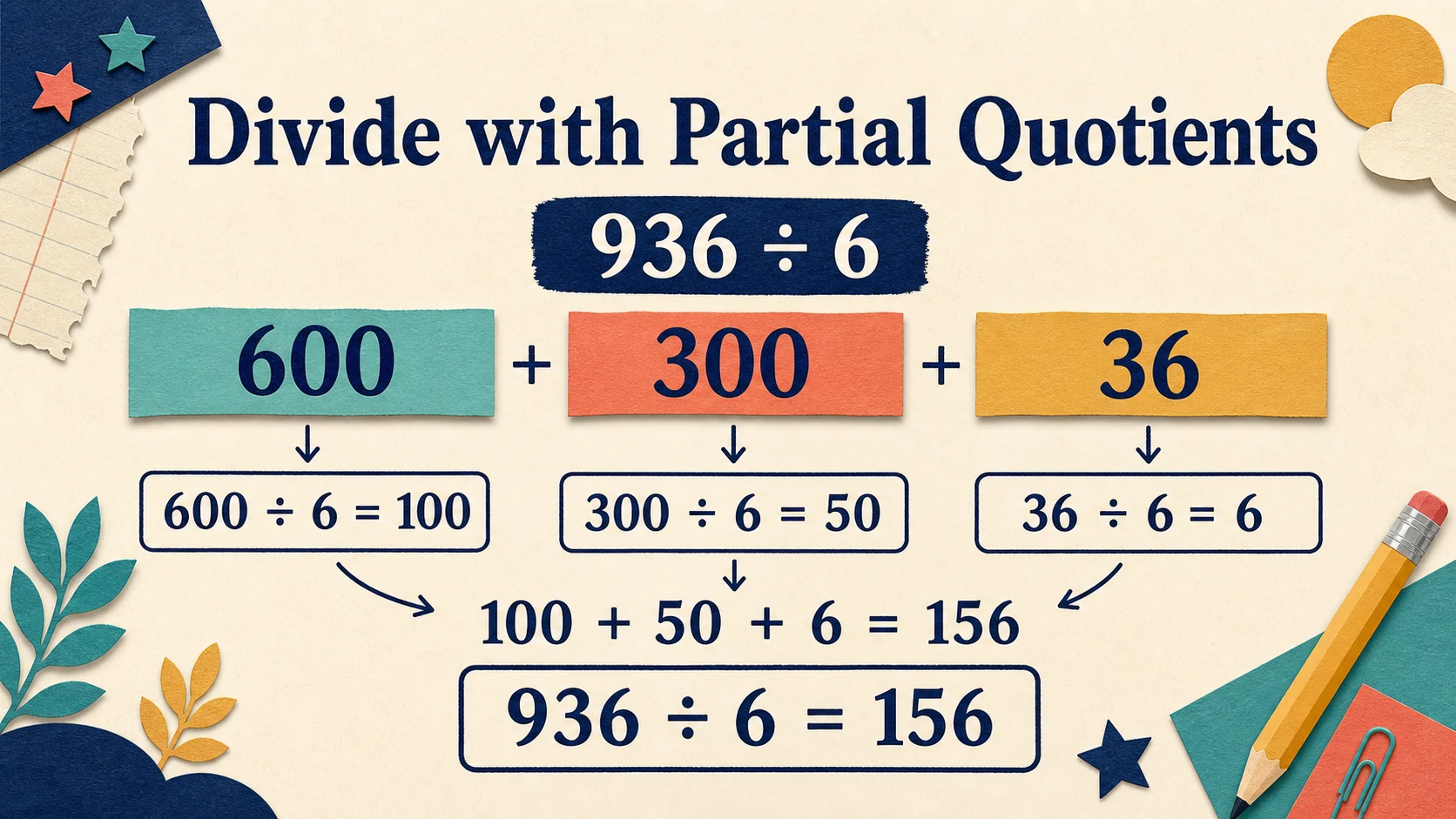
Concrete grouping, a visible decomposition, and an equation should tell the same mathematical story.
Example 3: A remainder that requires rounding up
Problem: Twenty-five students need transportation in vans that each hold 6 students. What is the least number of vans required?
Calculate:
25÷6=4 remainder 1
Four vans hold:
4×6=24
One student would still need transportation. A fifth van is therefore required.
Answer: 5 vans.
Check:
5×6=30
Thirty available places are enough for 25 students. The five unused places do not change the number of vans required.
Writing “4 remainder 1 vans” would not answer the practical question. The remainder represents a person, and that person still needs a place.
Example 4: A remainder that is reported directly
Problem: Sixty-seven counters are placed into bags of 8. How many full bags can be made, and how many counters remain?
67÷8
Since:
8×8=64
and:
67−64=3
then:
67÷8=8 remainder 3
Answer: 8 full bags, with 3 counters remaining.
Check:
8×8+3=64+3=67
Here the remainder should neither be discarded nor used to create another full bag. The question explicitly asks for complete bags and leftover counters.
Example 5: Dividing one fraction by another
Problem: Calculate 32÷61.
Interpret the problem as, “How many sixths fit into two thirds?”
Rename two thirds in sixths:
32=64
Four one-sixth groups fit into four sixths:
64÷61=4
Therefore:
32÷61=4
The reciprocal procedure gives the same result:
32×16=312=4
Check:
4×61=64=32
The check confirms both the calculation and the meaning: four groups of one sixth make two thirds.
Example 6: A non-whole fraction quotient
Problem: Calculate 43÷21.
Use the reciprocal procedure:
43×12=86=43?
That intermediate simplification would be incorrect because 86=43, not the required product after multiplying correctly across. Recalculate carefully:
43×12=46=23=121
Therefore:
43÷21=121
Check:
121×21=23×21=43
The quotient means one and one-half groups of size 21 fit into 43.
Boundary Cases Learners Must Understand
Several cases reveal whether the learner understands division rather than only following steps.
Zero and one
For any nonzero number a:
a÷1=a
Dividing by one leaves the quantity unchanged because groups of one contain exactly one item each.
Also:
0÷a=0
when a=0. Zero items can be divided into any nonzero number of equal groups, with zero in each group.
However:
a÷0
is undefined. There is no number that can be multiplied by zero to recover a nonzero dividend. Even 0÷0 does not have one determined quotient, because every number multiplied by zero gives zero.
Quotients smaller or larger than the dividend
With positive whole numbers greater than one, division usually produces a quotient smaller than the dividend:
20÷4=5
When dividing by a positive fraction smaller than one, the quotient may be larger:
3÷41=12
This is reasonable because twelve quarter-size groups fit into three wholes.
Remainders must be smaller than the divisor
In whole-number division, a valid remainder satisfies:
0≤remainder<divisor
If a learner writes 53÷7=6 remainder 11, another group of 7 can still be formed. The corrected result is:
53÷7=7 remainder 4
A Short, Repeatable Lesson Routine
A focused session can take roughly 15 to 25 minutes, but this is an instructional suggestion, not a prescribed or universal duration.
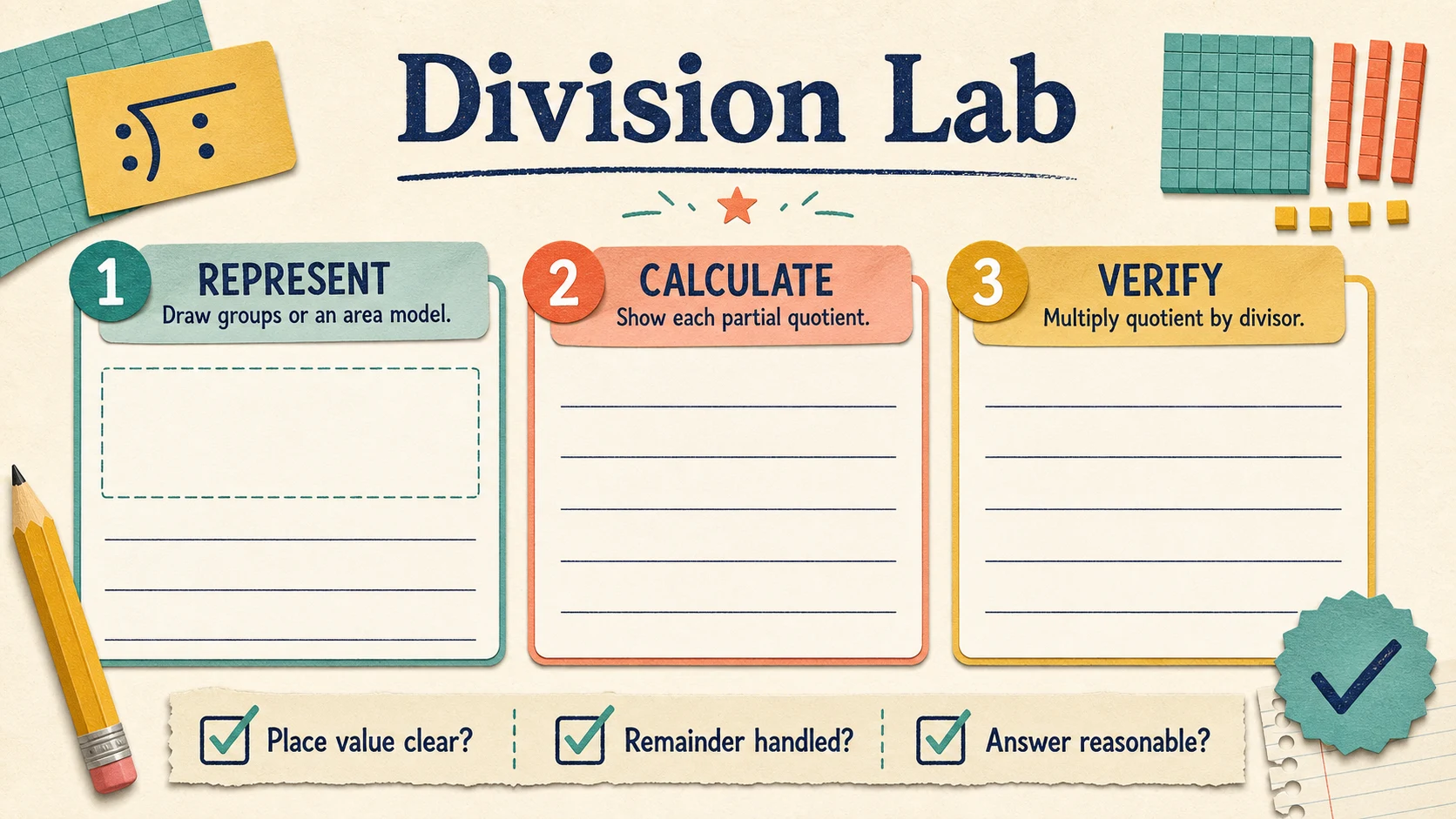
The routine moves from retrieval to explanation, guided work, independent work, and a final check.
1. Retrieve a prerequisite
Spend two or three minutes on related multiplication, subtraction, place-value, or fraction facts. Select only facts needed for the day’s division work.
2. Model one problem
Represent one problem with objects, a bar, an area model, or partial quotients. Narrate the meaning of each step. For long division, connect “divide, multiply, subtract, bring down” to place value rather than presenting the words as a stand-alone chant.
3. Solve one together
Let the learner make decisions. Ask:
- What does the divisor represent?
- Which multiple is useful?
- What should the quotient be close to?
- What does the remainder count?
- How can multiplication check the answer?
4. Assign a small independent set
Use three to six closely matched problems. A small set exposes thinking without burying a misconception under repeated errors.
5. Close with explanation and checking
Ask the learner to choose one answer, check it, and explain it in a complete sentence. Record the next teaching target while the evidence is fresh.
The IES practice guide for assisting students struggling with mathematics is an appropriate source for high-level guidance about structured support in mathematics. It does not evaluate WorksheetWise, prescribe this exact routine, or replace local instructional judgment.
Choosing Practice and Differentiating Support
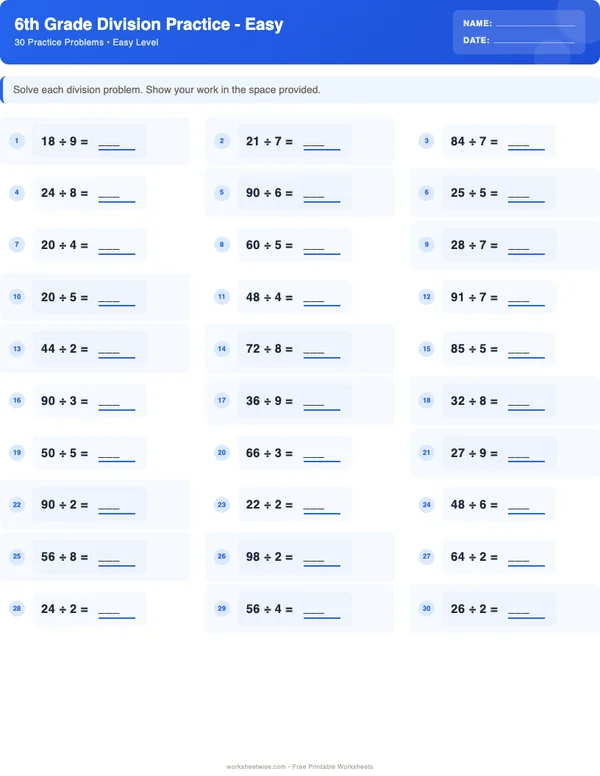
The available easy-level worksheet contains 30 exercises covering division facts, long division, mental math, and number sense. It includes separate answers for checking. That makes it a useful source of items, but a learner does not necessarily need all 30 in one sitting.
When the learner needs more support
Select a short group of problems with one stable feature:
- Exact quotients before remainders.
- One-digit divisors before multi-digit divisors.
- Multiplication facts available beside the work.
- Partial quotients before compressed long-division notation.
- Fraction divisors with visually convenient denominators.
- A diagram for every word problem.
Reduce the number of problems, not the mathematical explanation. Allow counters, graph paper, fraction strips, or a multiplication chart when those tools reveal the reasoning. Remove a support only when the learner’s work shows it is no longer needed.
When the learner is ready for more challenge
Increase reasoning demands rather than merely using larger numbers:
- Ask for two methods and a comparison.
- Provide an incorrect solution for analysis.
- Ask the learner to write a division context.
- Mix exact quotients and remainders.
- Omit the operation sign in a word problem.
- Ask for an estimate before calculation.
- Require a multiplication check.
- Ask how changing the divisor changes the quotient.
The focused 6th Grade Division pack contains 18 worksheets and may suit a longer sequence. Choose from it selectively according to the learner’s current target rather than treating completion of the entire pack as the goal.
Common Errors and Diagnostic Responses
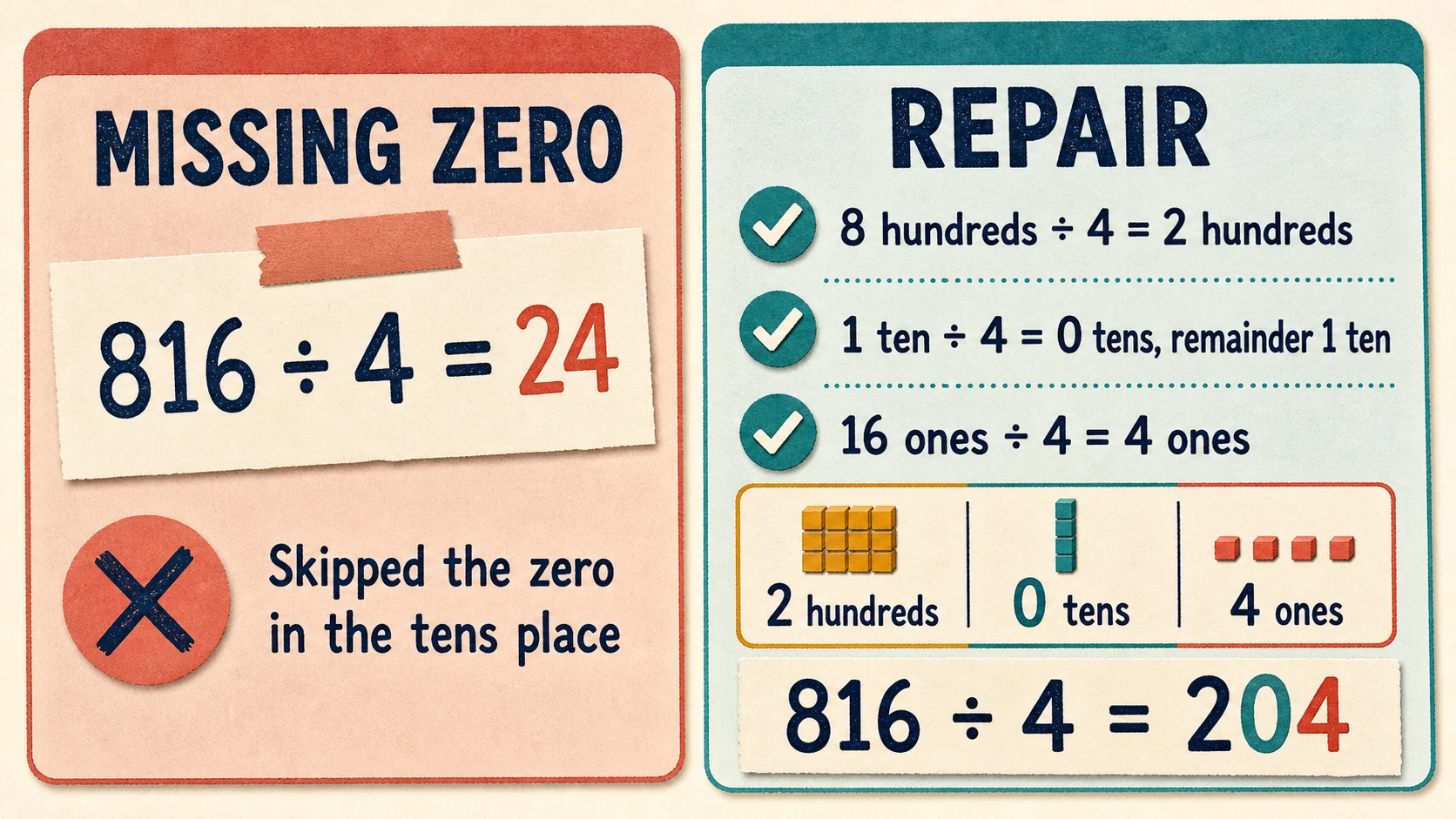
An error pattern points to the next representation, prompt, or prerequisite to teach.
| Observed error |
Likely issue to investigate |
Instructional response |
| Guesses division facts |
Multiplication relationship is insecure |
Build fact families and check every quotient by multiplication |
| Places quotient digits incorrectly |
Place-value reasoning is weak |
Use graph paper and label each quotient digit’s value |
| Subtracts the divisor only once |
Division is being treated as repeated single subtraction |
Use larger known multiples and partial quotients |
| Stops when a divisor does not fit the first digit |
Does not see the opening part of the dividend as one quantity |
Compare the divisor with the first one, two, or more digits |
| Writes a remainder equal to or larger than the divisor |
Incomplete grouping |
Ask whether another full group can be made |
| Always rounds a remainder up |
Applies one rule without reading the context |
Contrast capacity, full-group, leftover, and sharing situations |
| Inverts the first fraction |
Reciprocal procedure is memorized without structure |
Return to “how many groups fit?” and write multiplication checks |
| Expects division always to make smaller |
Whole-number pattern is overgeneralized |
Compare division by 2, 1, 21, and 41 |
| Cannot explain an answer |
Procedure may be detached from meaning |
Require a labeled model or context sentence |
Do not infer a broad learning difficulty from one mistake. First check whether the error repeats across comparable problems. A single wrong answer may come from copying, arithmetic, notation, or attention rather than the central concept.
Monitoring Progress Without Over-Testing
Use brief samples collected over time. A simple record can include:
- Problem type.
- Accuracy.
- Strategy used.
- Whether a model or prompt was needed.
- Quality of the multiplication check.
- Interpretation of units or remainders.
- One next teaching target.
A learner is ready for less support when accuracy and explanation remain dependable across more than one session and across slightly varied problems. Speed alone is insufficient. Conversely, a correct answer produced through a confused or uncheckable method deserves follow-up.
Useful weekly prompts include:
- “Show two ways to solve this.”
- “Estimate before calculating.”
- “Which step are you least certain about?”
- “Prove the remainder is valid.”
- “What would multiplication need to equal?”
- “What does the quotient count?”
Keep review cumulative but brief. Include one earlier problem type alongside the current focus. If errors return after a gap, revisit the model before adding more independent exercises.
A Two-Week Practice Plan
The following plan assumes ten short sessions. Adjust the length, number of items, and sequence according to observed work and local expectations.
Each day has a narrow focus, a check, and evidence for choosing the following session.
| Day |
Focus |
Suggested activity |
Exit evidence |
| 1 |
Diagnose prerequisites |
Facts, place value, subtraction, and one fraction model |
Identify one main barrier |
| 2 |
Meanings of division |
Model equal sharing and equal grouping |
Explain what the quotient counts |
| 3 |
Fact relationships |
Build multiplication-division fact families |
Check each quotient by multiplication |
| 4 |
Partial quotients |
Divide larger numbers with convenient multiples |
Record partial products accurately |
| 5 |
Long-division notation |
Connect each written step to place value |
Explain every quotient digit |
| 6 |
Exact and non-exact division |
Mix zero remainders and leftovers |
Verify remainder is smaller than divisor |
| 7 |
Remainders in context |
Compare round-up, discard, and report-remainder cases |
Give a context-based answer sentence |
| 8 |
Fraction division models |
Count fractional groups with bars or strips |
Predict whether quotient is above or below 1 |
| 9 |
Fraction procedure and checks |
Connect models to multiplication by a reciprocal |
Check quotient through multiplication |
| 10 |
Mixed application |
Solve a small mixed set and analyze one error |
Choose the next practice target independently |
On Day 10, avoid turning the session into a high-pressure test. The purpose is to see which knowledge transfers when problem types are mixed. If the learner succeeds with whole-number computation but misreads contextual remainders, return to Day 7-style tasks. If fraction calculations are correct but unexplained, revisit visual measurement models.
Limitations and the Next Useful Step
A worksheet can provide organized practice and an answer key, but it cannot observe hesitation, identify why an error occurred, or decide when a learner should move forward. Answer keys confirm results; they do not replace explanations. This guide also cannot account for every local sequence, curriculum vocabulary, or individual instructional need.
Use grade labels as indicators of intended practice level, not as guarantees that every learner should complete the same work on the same timetable. For persistent difficulty, coordinate with the learner’s classroom teacher or other qualified educational professional who can examine work across topics and settings.
The most honest next step is to sample a small, relevant set and study the method as closely as the score. Begin with the free 6th Grade Division worksheet. Select six to ten problems that match the current target, require a multiplication check on each, and use the resulting error pattern to choose the following lesson.