Curated collectionAnswer keys includedPrint-ready PDFs
Advanced Multiplication Worksheets
Define what advanced multiplication practice changes and what it deliberately keeps constant, then compare three checked examples, fading supports and readiness evidence.
Start with a real resource
Browse this worksheet collection
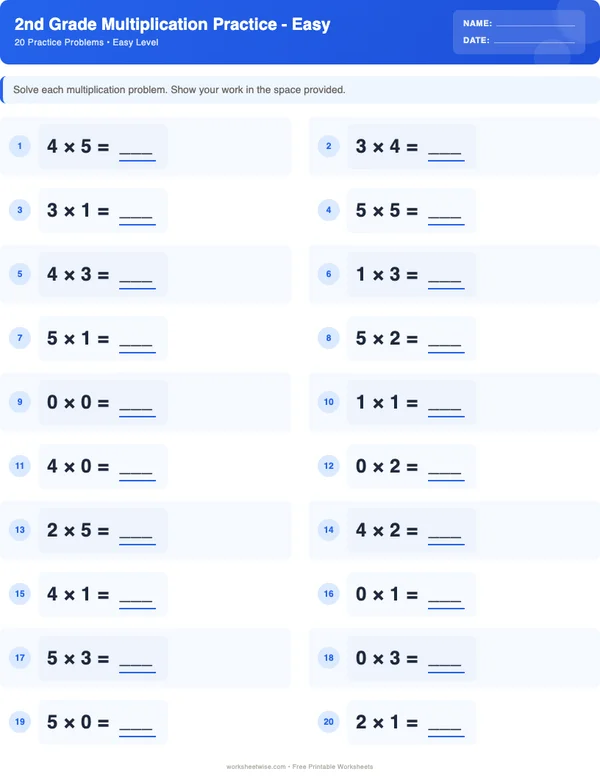
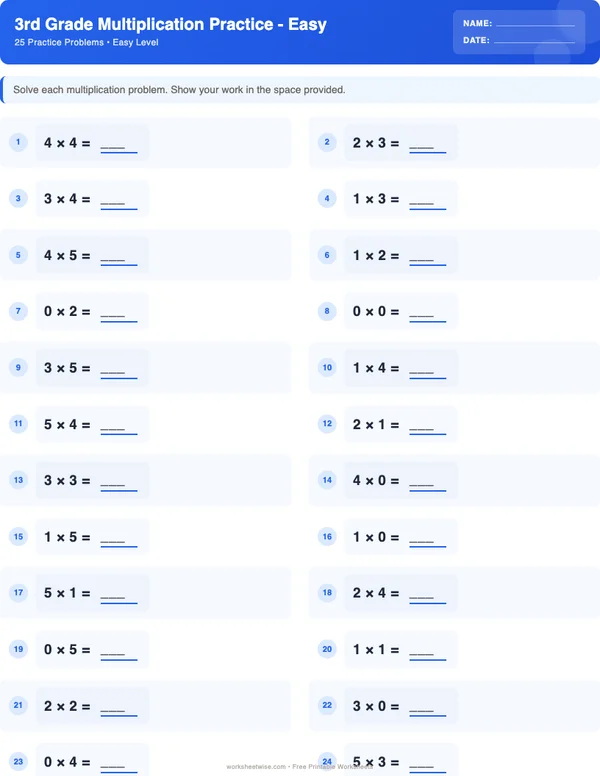
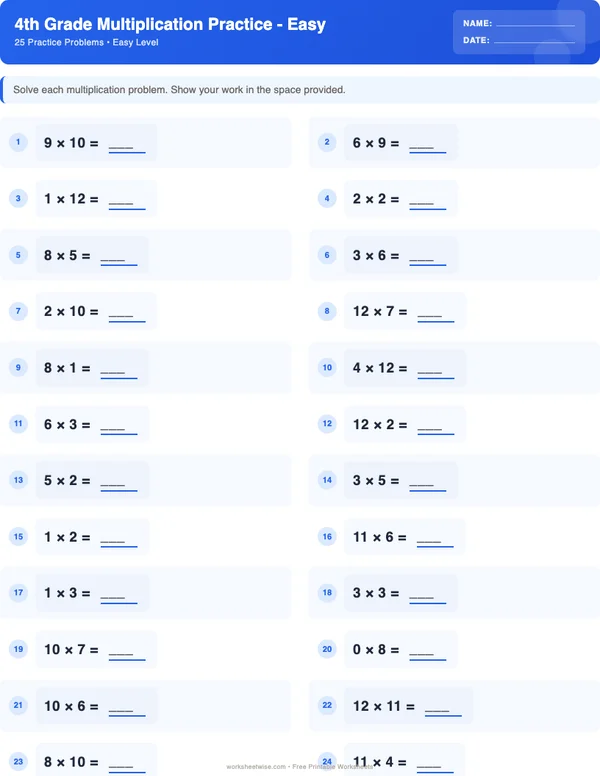
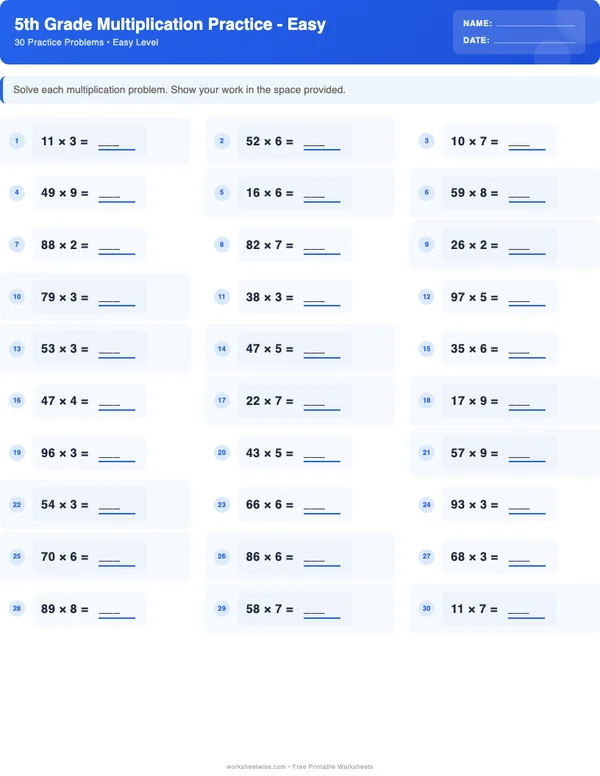
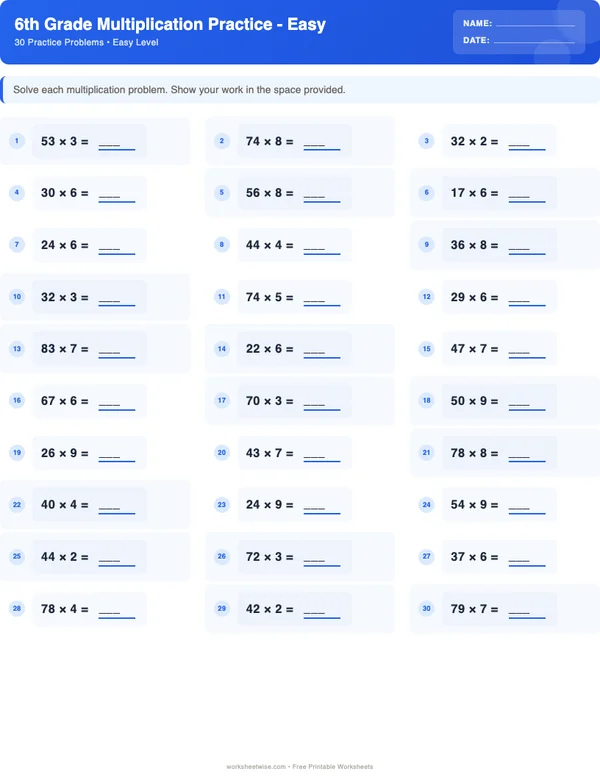
5 relevant free entry points are available. Each one includes a printable learner PDF and separate answer key.
A useful practice loop
Print less. Observe more.
- Choose one skill and model the first item aloud.
- Use a short set and notice the learner’s strategy.
- Change the next task from the work you can see.
Need more than the free sheet?
Plus includes all 30 matching catalogue variations where available, plus saved deterministic generators and the worksheet designer.
See Plus membershipComplete guide
How to teach and practise advanced multiplication worksheets
3,535 words Updated 6 instructional visuals
What “advanced” changes in multiplication practice
Advanced multiplication worksheets increase the reasoning and coordination required to solve a problem. They may use less familiar facts, larger factors, multi-digit computation, more than one valid strategy, or fewer built-in prompts. What should remain constant is the mathematical target: the learner must still understand multiplication as a relationship among equal groups, arrays, place value, and products.
On this page, “advanced” is a worksheet difficulty filter, not a description of a child. Define the level through observable task features:
- Factors are less immediately recognizable or contain more digits.
- Efficient decomposition matters more than repeated addition.
- The learner must organize several partial products.
- Visual or procedural prompts are reduced.
- Answers require estimation or another independent check.
- A familiar multiplication structure appears in a less familiar form.
Grade labels describe the intended practice level, but local curriculum sequences differ. Age and grade are discovery aids, not placement decisions. Choose from the evidence in the learner’s work: what the learner represents accurately, which steps remain stable, and whether reduced support changes the underlying reasoning.
The live catalogue contains 30 advanced multiplication variants across five grade categories, from 2nd through 6th Grade. The subject is Math and the topic is Multiplication. There are no free resources attached directly to this advanced-level page. However, each of the five grade-specific multiplication guides provides an easy free-sheet entry point. That makes the grade guides useful for checking prerequisites before selecting a harder variation.
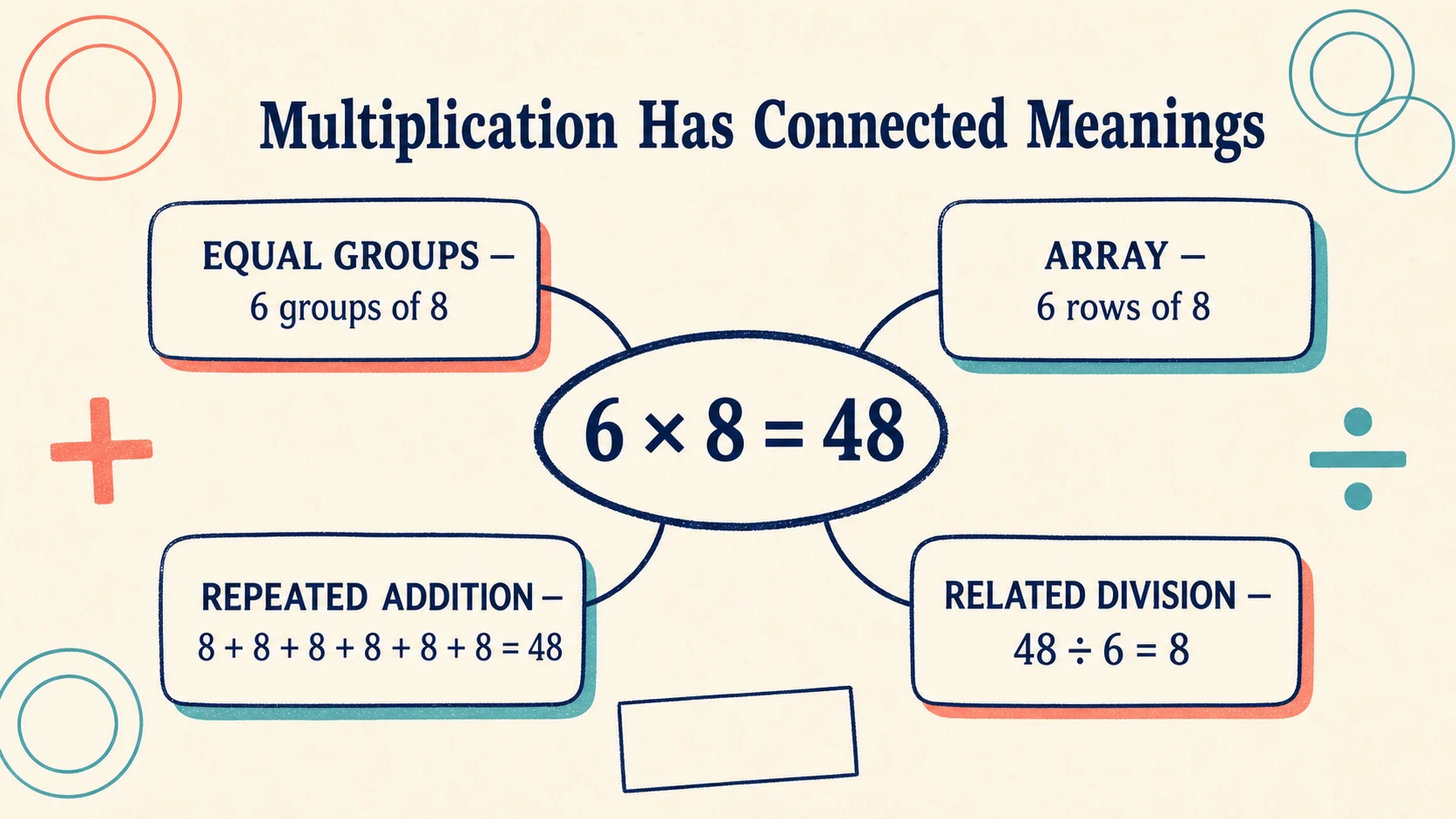
Use the map to locate the part that needs to stay stable—equal groups, arrays, facts, properties, or computation—before increasing the task demand.
The multiplication stays constant even when the page gets harder
A productive advanced task does not abandon meaning in favor of bigger numbers. It asks the learner to coordinate meaning, facts, place value, and notation more independently.
Consider the chain from to to . All three expressions depend on the same core idea: quantities can be decomposed and recombined without changing the product.
- can be decomposed as .
- can be decomposed as .
- can be decomposed as .
The later expressions require more bookkeeping, but the distributive property has not changed. If the learner cannot explain why the pieces may be added, a larger problem is merely masking an unfinished foundation.
The catalogue’s teaching guidance recommends beginning with equal groups and arrays, using strategic fact families, and introducing area models or partial products before expecting an unsupported standard algorithm. That is catalogue guidance, not a claim that every advanced variant contains those supports. It tells an adult which ideas to reactivate when a harder sheet reveals uncertainty.
The Common Core State Standards for Mathematics likewise describe a progression from interpreting products and properties toward multi-digit multiplication. The standards can help an adult understand a broad sequence, but they did not assess these worksheets, and a local school may organize instruction differently.
Compare easier, advanced, and harder task features
Difficulty should be identified from the work on the page, not from font size, decorative density, or the learner’s grade.
Nearby easier practice
A nearby easier task usually holds more decisions constant. It might:
- show an array or equal-group picture;
- concentrate on a strategic fact family such as ×2, ×5, or ×10;
- provide a decomposition;
- separate partial products into labeled boxes;
- use one-digit factors without regrouping;
- ask for one method at a time.
For example, with the prompt “Use and one more group of 8” is supported practice. The learner still reasons multiplicatively, but the useful split has been supplied.
The five grade-specific free entry points are all identified in the catalogue as easy sheets. Their problem counts are 20 in 2nd Grade, 25 in 3rd and 4th Grade, and 30 in 5th and 6th Grade. Problem count alone does not establish difficulty; these sheets are useful because their level designation provides a nearby prerequisite check.
Advanced practice on this page
An advanced version might present without naming a strategy, mix it with less familiar facts, or embed the fact in a larger computation. It may expect the learner to choose between doubling, a five-based decomposition, or a known fact.
For multi-digit work, an advanced task may omit an area-model grid and require the learner to create an organized written record. The demand is not simply “calculate more.” It is “choose, execute, and check with less prompting.”
Features beyond a productive challenge
A task may be harder without being a useful next multiplication task. Examples include:
- unreadably crowded layout;
- unfamiliar vocabulary unrelated to multiplication;
- several new mathematical ideas introduced at once;
- a long timed set when strategy selection is the target;
- complicated contexts that overload reading;
- decimal or fraction multiplication before those quantities are understood;
- so many items that fatigue, rather than multiplication, determines the errors.
Those features may have a place in later work, but they are poor choices when the goal is to observe multiplication reasoning cleanly.
Three checked examples reveal different kinds of advancement
The following examples are editorial teaching examples grounded in the catalogue’s stated multiplication progression. They are not quoted worksheet items and should not be read as claims about the contents of a particular variant.
Example 1: Choose a fact strategy for
A learner can use a five-based split:
Check by reversing the factors:
The product is also reasonable because it lies between and .
This example belongs here because the factors remain within 0 through 12, but the prompt does not supply the strategy. The advanced feature is independent selection and justification, not an unusually large answer. It reflects the catalogue guidance to approach ×6, ×7, ×8, and ×9 through distributive reasoning after pattern-based facts are established.
An easier neighboring version would draw seven rows of eight or provide the split . A harder version might ask for two efficient strategies and an explanation of why they agree. If the learner counts 56 individual marks, keep the factors but restore an array or ask the learner to circle a section and a section.
Example 2: Connect an array to
Split 14 into 10 and 4:
Check with an alternate split:
Both strategies preserve 14 groups of 6. They merely partition the 14 groups differently.
This example belongs at the advanced level because the learner must connect a known one-digit fact to place-value decomposition. It is a bridge between fact strategy and multi-digit multiplication. The computation remains short enough for an adult to see whether an error came from the fact , the place value in , or the final addition.
An easier version would show a rectangle divided into 10-by-6 and 4-by-6 sections. A productive harder variation would use , adding tens while preserving the one-digit multiplier. Moving immediately to two multi-digit factors would change more than one feature.
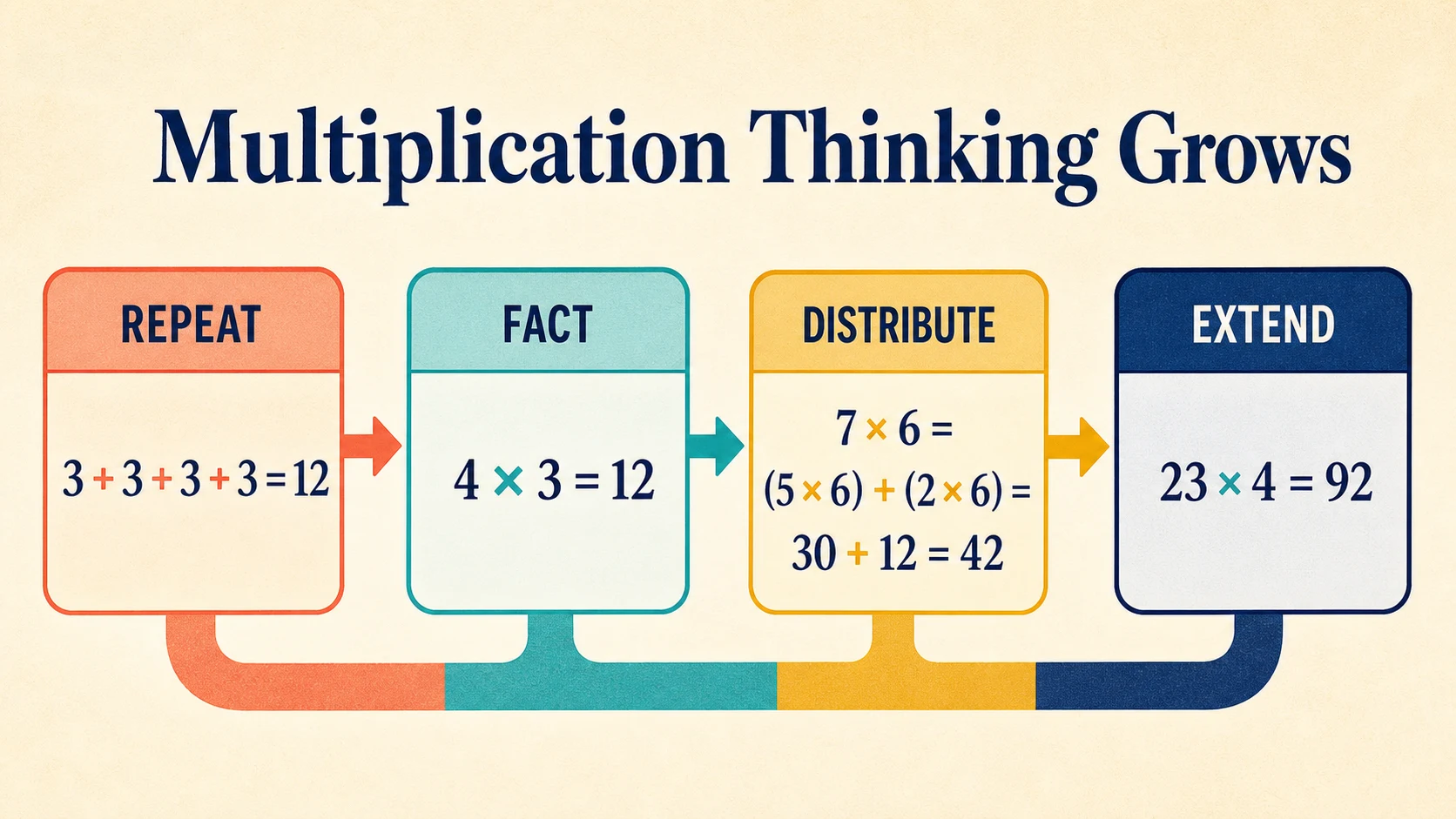
Use this progression to fade a supplied representation or strategy before increasing the size of both factors.
Example 3: Organize partial products for
Decompose both factors:
Calculate all four partial products:
Then combine them:
Check by estimation: is a little more than , and is a little less than . Since , an answer of 322 is plausible. A second exact check is .
This example belongs here because the learner coordinates four products, place value, and addition without losing a term. The arithmetic facts are modest; organization creates the advanced demand. An area model can preserve the multiplication target while reducing layout pressure.
A harder task might use a three-digit factor or omit all structure. That should come after the learner independently records every partial product and explains why is 200 rather than 20.
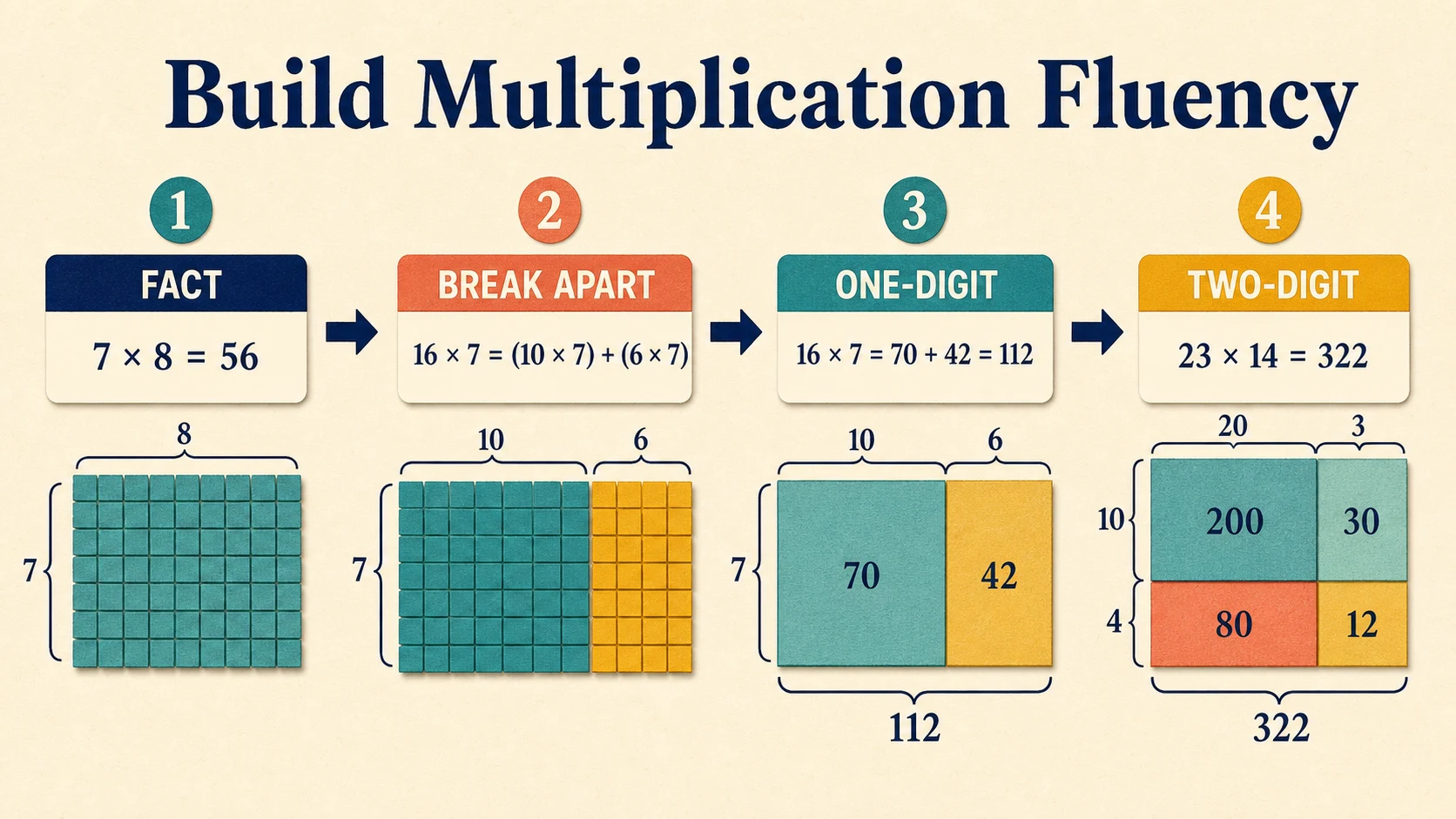
The useful transition is from visible decomposition to self-generated decomposition, not from small print to larger numbers.
A fourth example separates reasoning from notation
Example 4: Diagnose
Use place value:
Check with compensation:
A common incorrect answer is 2,114 written correctly by chance after an unclear procedure; another is 2,114 derived clearly from partial products. Those identical answers do not provide identical evidence. Ask, “What does the 300 contribute?” If the learner can say “seven groups of 300 make 2,100,” the place-value reasoning is visible.
An answer of 2,114 with no explanation may still be correct, but one item cannot show that the method is stable. An answer of 2,104 suggests the learner may have treated as 4 or combined the ones inaccurately. An answer of 214 suggests the hundreds value was not preserved.
This example belongs here because the internal zero tests place-value control without requiring difficult basic facts. It demonstrates why large-looking numbers are not automatically harder in every respect: may demand more place-value attention than , while using easier fact products.
False difficulty signals to ignore
A long worksheet is not necessarily an advanced worksheet
The catalogue ranges from 20 problems on the 2nd Grade free sheet to 30 on the 5th and 6th Grade free sheets. Yet all five free sheets are labeled easy. Item count affects workload and stamina, not necessarily the mathematical complexity of an individual problem.
If accuracy drops only in the final third of a page, test a shorter set before reteaching multiplication. Fatigue, visual tracking, or rushed recording may be producing the pattern.
Timed performance is not the same as strategy readiness
A learner who pauses to decompose accurately may be doing stronger multiplication reasoning than one who answers quickly but cannot represent the product. Time can be recorded when fluency is the explicit goal, but it should not replace analysis of strategy and error type.
The catalogue guidance says fact fluency should be built gradually after strategies are understood. That is a teaching recommendation from the supplied catalogue, not evidence about a particular learner’s future performance.
Bigger products do not always mean harder reasoning
Compare with . The first produces a much larger product, but its place-value pattern may make it easier. The second requires several partial products or regrouping.
Likewise, decorative arrays do not automatically make a task easy. An unlabeled array that the learner must partition and interpret can require substantial reasoning. Judge the decisions the learner must make.
A wrong answer does not prove the whole skill is missing
A single wrong product can arise from a fact error, a misplaced digit, an omitted partial product, inaccurate addition, or misunderstanding multiplication itself. Those causes call for different responses.
The IES practice guide on assisting students struggling with mathematics recommends systematic instruction, clear mathematical language, representations, and deliberate attention to word problems and fluency. Use that source as general instructional guidance—not as a diagnosis and not as an evaluation of WorksheetWise.
Select a variant by changing one demand at a time
Use a brief sample rather than assigning a full page immediately. Three to five items can reveal whether the selected feature is productive.
First, identify the target
Choose one target such as:
- selecting a fact strategy;
- interpreting an array;
- decomposing a multi-digit factor;
- recording every partial product;
- regrouping accurately;
- checking a product by estimation.
Do not combine “learn a new model,” “use two-digit factors,” and “work under time pressure” in the same first attempt.
Next, locate the support that can fade
Support may include an array, a partially completed equation, a place-value grid, a worked example, color separation, or an oral prompt. Remove only one support and see whether the learner reconstructs it.
If is correct only when the 10-and-4 split is drawn, ask the learner to draw the split on the next item. That is a meaningful fade. Removing the model entirely and simultaneously changing to would not reveal which transition caused trouble.
Then, use observable readiness evidence
Move to the next variation when the learner can:
- represent what the factors mean;
- choose or create a valid decomposition;
- keep place values distinct;
- include all necessary partial products;
- explain one check;
- repeat the process on a new item without copying the previous layout blindly.
Perfect speed is not required. One correct answer is not sufficient evidence. Look for the same reasoning across differently arranged examples.
For grade-specific context, compare the 3rd Grade Multiplication guide and free sheet, 4th Grade Multiplication guide and free sheet, and 6th Grade Multiplication guide and free sheet. Use the grades to discover likely material, then inspect actual task features before placing the learner.
Use a short routine that exposes the mathematics
A useful session can fit into 15–20 minutes. This schedule is an editorial suggestion for using the materials, not a sourced dosage or promised route to improvement.
Preview one decision
Show one problem and ask, “What will be the hardest decision here?” Possible answers include choosing a split, remembering a fact, lining up partial products, or checking the result.
If the learner cannot identify a starting point, restore a representation before assigning the page.
Work one example aloud
The adult models one concise chain:
I see . I can split 18 into 10 and 8. That gives 70 and 56. Their sum is 126. Since , 126 is reasonable.
Name the meaning of each number. Avoid narrating irrelevant details or turning the model into a script the learner must imitate exactly.
Try three to five carefully chosen items
Select items that share the target but vary superficially. For decomposition with a one-digit multiplier, a sequence might be:
The checked products are 78, 144, and 114. The common target is decomposing the first factor; the varying tens and ones reveal whether the method transfers.
Review an error, then retest
Do not finish with the corrected item. Give a fresh problem containing the same decision. After correcting an omitted tens product in , try :
If all four partial products appear, the response to feedback is observable. If one disappears again, restore the area-model structure.
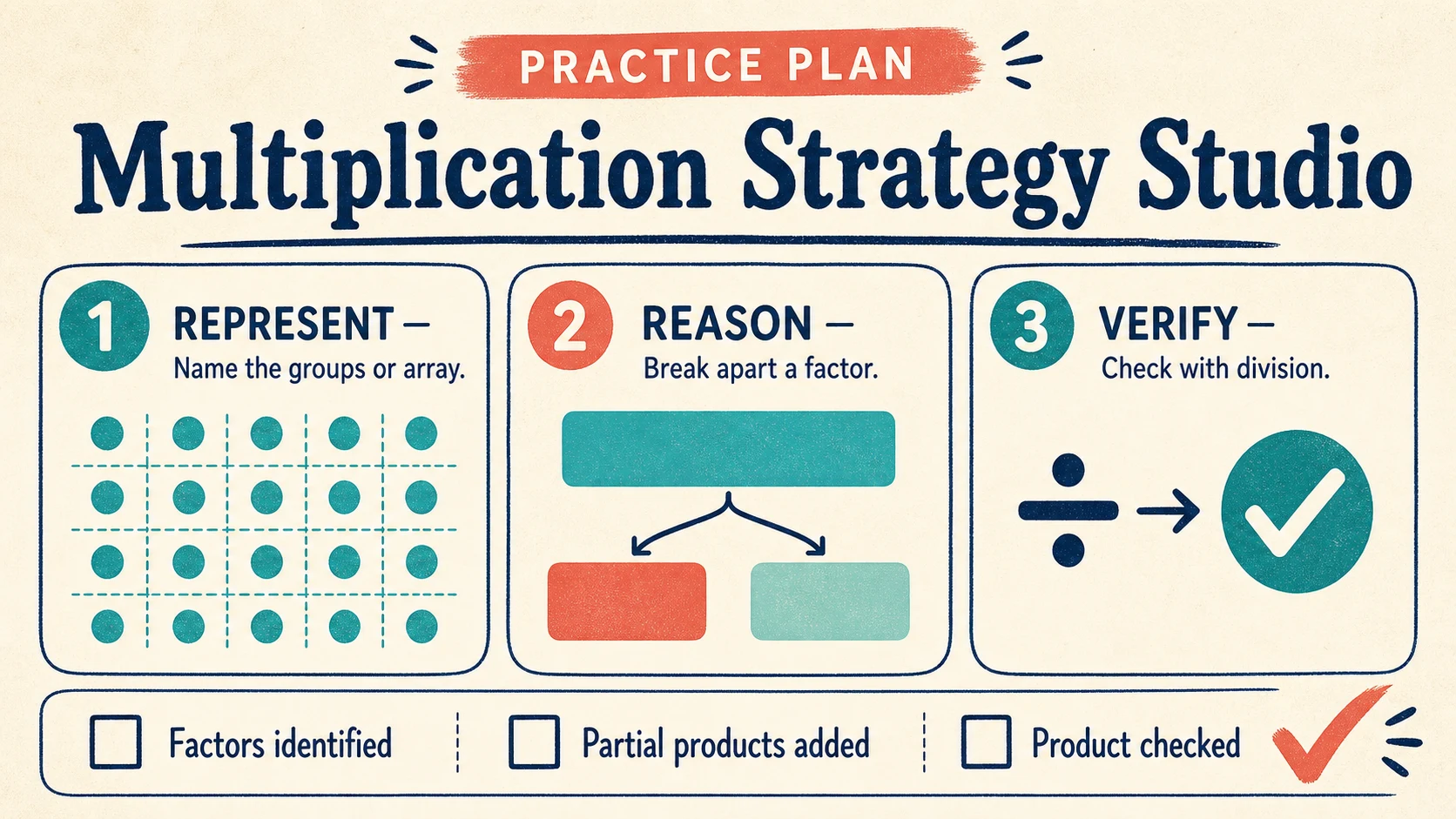
Use the plan as a spacing organizer; adjust the number of items from the learner’s work rather than treating two weeks as a guaranteed timetable.
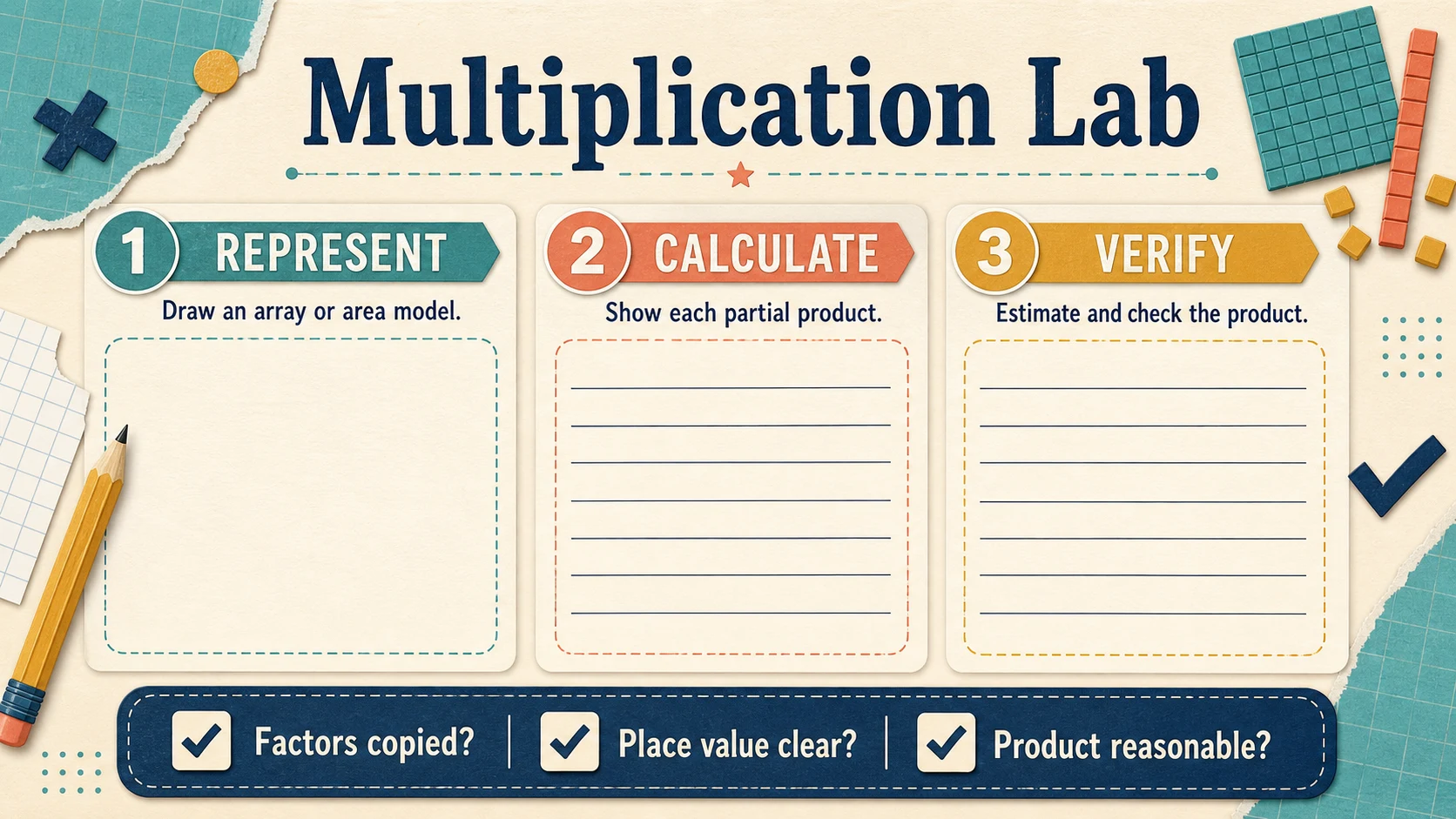
For upper-grade practice, alternate computation, explanation, and checking so repeated pages do not become unsupported answer production.
Interpret errors before choosing another page
The learner returns to repeated addition
For , writing seven 8s and adding them can show correct meaning. It also signals that an efficient multiplication strategy is not yet dependable.
Keep the factors constant. Ask the learner to bracket five 8s and two 8s:
The next action is not necessarily an easier fact. It is a more efficient representation of the same fact.
The learner knows facts but drops a partial product
In , suppose the learner calculates 200, 80, and 12 but omits , producing 292. The basic facts are not the main issue. The record does not yet guarantee that every part of one factor multiplies every part of the other.
Restore a four-cell area model or have the learner draw connecting arrows. Keep the numbers. Fade the organizer after all four interactions are recorded reliably.
The learner produces an implausible answer
For , a response of 3,760 is ten times too large. Ask for an estimate:
The exact calculation is:
Because 376 is near 400, the check catches the place-value error. If the learner calculates accurately but never checks scale, add an estimation prompt without simplifying the multiplication.
The learner confuses factor order with a different quantity
An array can show why and both equal 24 even though “four groups of six” and “six groups of four” describe different groupings. Rotate or redraw the array, then connect both equations to the same total.
The catalogue identifies commutative, associative, distributive, and identity properties as useful strategies. Use property names after the learner can describe the relationship; vocabulary should clarify the reasoning, not replace it.
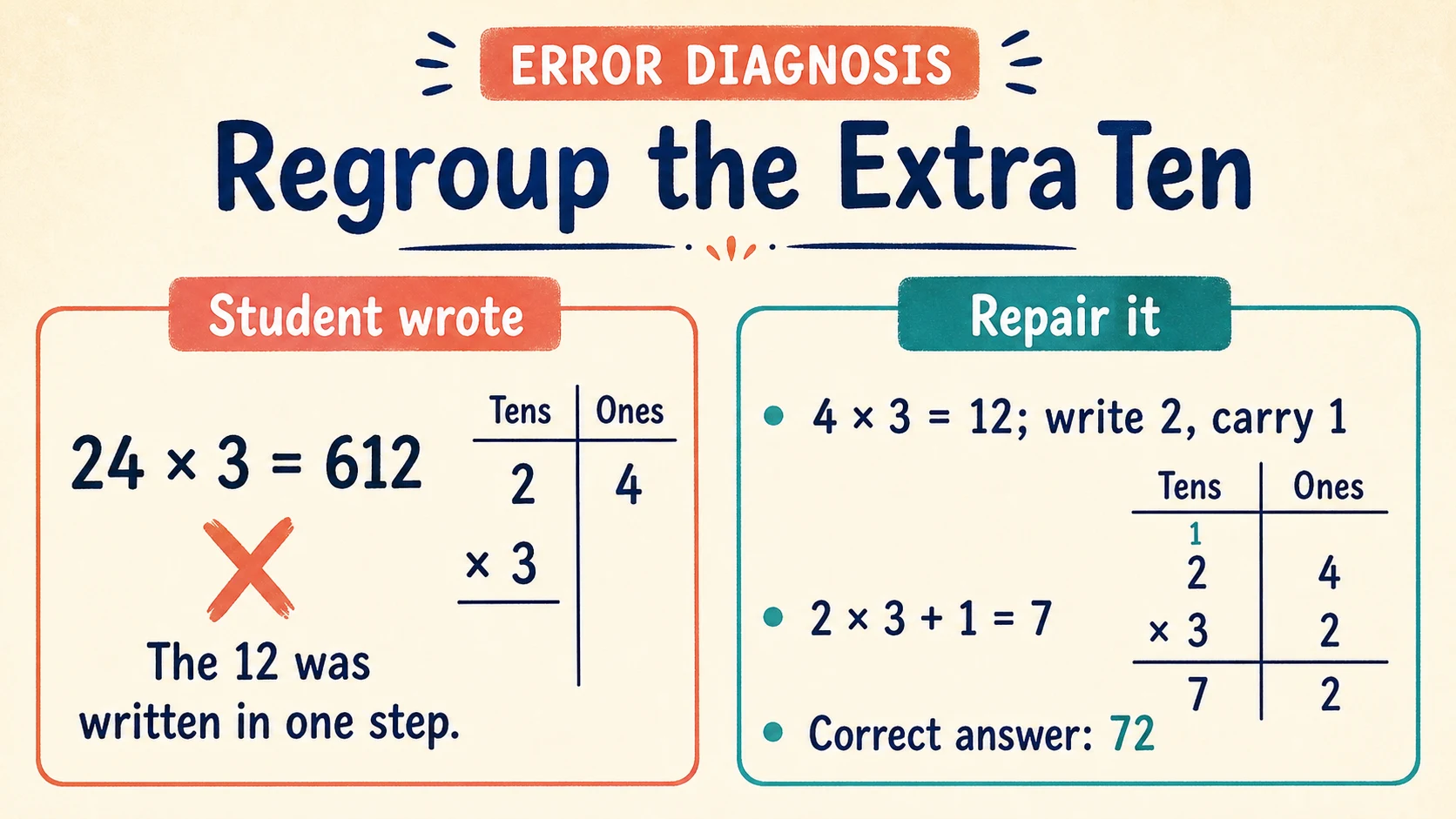
Match the response to the visible error pattern: fact retrieval, grouping, decomposition, place value, or recording—not to a global label for the learner.
Adapt the work without removing multiplication
An adaptation preserves the target when it changes access, layout, response mode, or quantity of practice while leaving the essential multiplication decision intact.
Useful adaptations include:
- Covering unused rows so only one problem is visible.
- Enlarging the page or increasing writing space.
- Allowing counters or tiles for an equal-groups interpretation.
- Providing graph paper to align partial products.
- Letting the learner explain a decomposition orally while an adult records it.
- Reducing the number of items while retaining varied examples.
- Supplying a multiplication chart when multi-digit organization—not fact recall—is the target.
- Reading a word problem aloud when reading is not being assessed.
- Offering an area-model frame without filling in its dimensions or products.
For a learner working on , a blank four-cell rectangle preserves the need to decompose and calculate. A fully completed model that requires only copying 322 does not.
The IES guide on teaching mathematics to young children emphasizes using developmental progressions, monitoring what children know, and helping them view and describe the world mathematically. Although this page serves elementary multiplication across grade categories, that early-learning guide is most relevant when an adult is deciding how much oral, visual, and hands-on support to retain. It did not evaluate these materials.
Boundaries of an advanced worksheet
A worksheet can provide controlled practice and visible written evidence. It cannot by itself establish conceptual mastery, explain why an error occurred, determine curriculum placement, or diagnose a learning condition.
The catalogue facts support these limited conclusions:
- This page filters for hard multiplication practice.
- It contains 30 variants.
- The catalogue spans five grade categories, 2nd through 6th.
- The current page itself has no free resource.
- Five grade-specific guides provide easy free-sheet entry points.
- The broader stated progression runs from concrete visual models through fact practice to multi-digit computation.
They do not support claims about guaranteed achievement, standards mastery, a particular learner’s needs, or the exact contents of every variant. The approved IES and Common Core sources offer general guidance and sequencing context; they have not reviewed WorksheetWise.
If the learner cannot yet build equal groups, interpret an array, or explain a one-digit product, move to the Easy and beginner Multiplication Worksheets. That is not a demotion. It is a decision to make the target observable before removing support. If multiplication is stable and the learner is ready to connect equal grouping with an inverse operation, Advanced Division Worksheets offer a related direction, but only after division meaning has been introduced.
Make the next variation an evidence-based choice
End the session by recording one sentence:
With ___ support, the learner could ___, but still needed help to ___.
For example:
With a blank area-model frame, the learner decomposed , calculated all four partial products, and checked that 322 was reasonable, but still needed help aligning the final addition.
That note gives the next decision. Keep the same number structure and remove only the alignment help. If instead the learner omitted , retain the area model. If the learner could not explain any partial product, return to a one-digit multiplier such as .
For the next session, open the free deterministic worksheet generators and create a short set that changes only the feature identified in your note. Start with three items, require a representation or estimate on each, and choose the following variation from what the learner actually does—not from age, page count, or the size of the products.
Put it into practice
Use the guide with a real printable
Move from explanation to a short, observable practice task. Check the first item together, then adjust the next session from the learner's actual work.
Open the first free worksheetExplore a neighboring collection