Curated collectionAnswer keys includedPrint-ready PDFs
Advanced Division Worksheets
Define what advanced division practice changes and what it deliberately keeps constant, then compare three checked examples, fading supports and readiness evidence.
Start with a real resource
Browse this worksheet collection
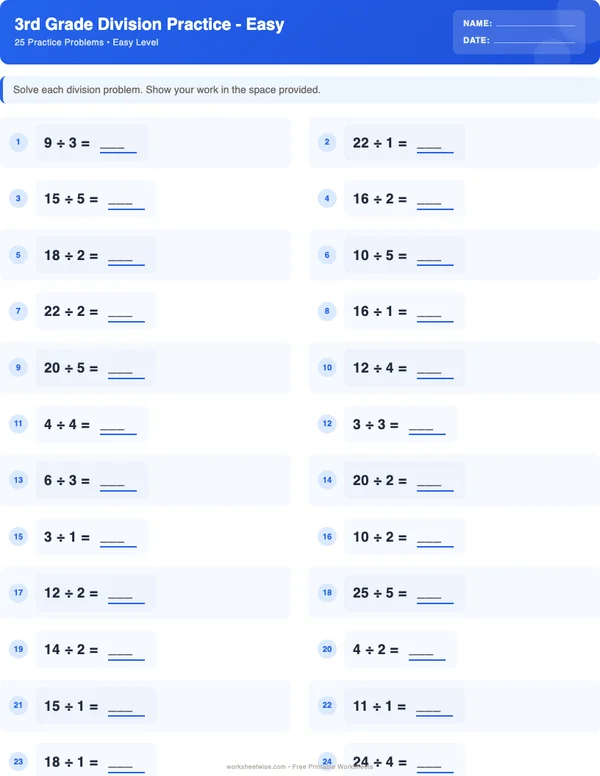
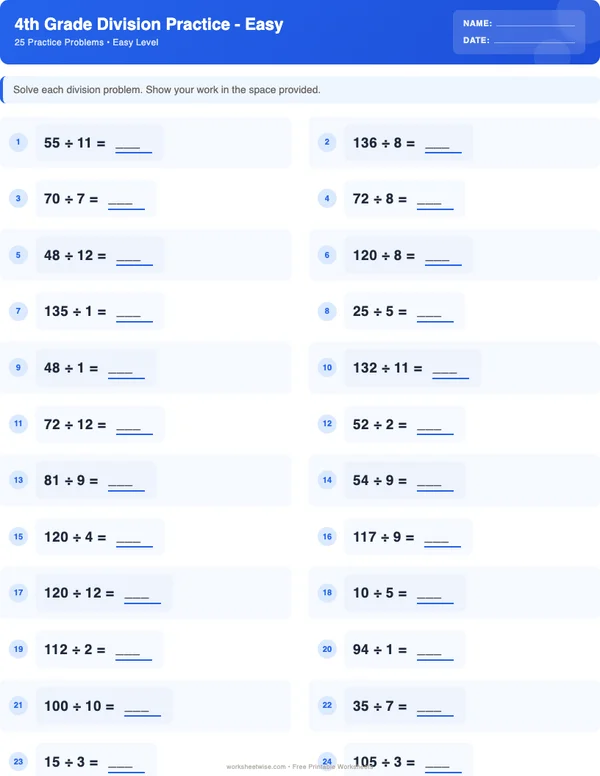
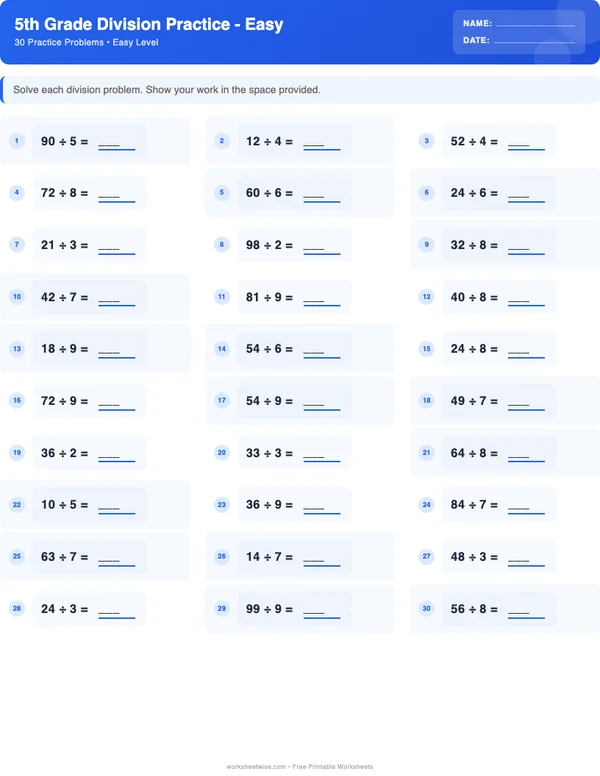
5 relevant free entry points are available. Each one includes a printable learner PDF and separate answer key.
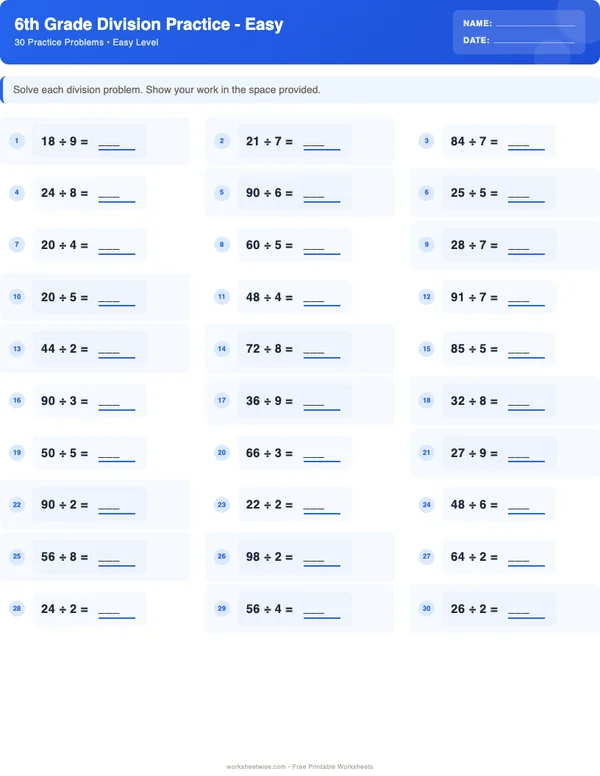
A useful practice loop
Print less. Observe more.
- Choose one skill and model the first item aloud.
- Use a short set and notice the learner’s strategy.
- Change the next task from the work you can see.
Need more than the free sheet?
Plus includes all 30 matching catalogue variations where available, plus saved deterministic generators and the worksheet designer.
See Plus membershipComplete guide
How to teach and practise advanced division worksheets
3,577 words Updated 6 instructional visuals
What “advanced” changes in division practice
Advanced division practice increases the reasoning load around division without changing the operation’s meaning. The learner still partitions a quantity into equal shares or determines how many equal groups fit into it. What changes is the size and structure of the numbers, the number of decisions required, the treatment of remainders, and the amount of support shown on the page.
On this page, “advanced” is a worksheet difficulty filter, not a label for a learner. Look for observable task features such as:
- Multi-digit dividends or divisors
- Quotients containing internal zeros
- Remainders that must be interpreted rather than merely recorded
- Missing diagrams, fact prompts, or partially completed steps
- Mixed exact and non-exact division
- Word problems in which the required operation is not named
- A need to estimate, calculate, and verify
- More than one defensible representation or solution method
The live catalogue contains 30 advanced division variants across five intended grade levels, from second through sixth grade. It contains no free resource at this exact advanced filter. The five grade-specific division guides provide free entry points, but their listed free sheets are easy-level practice. That distinction matters: use a free grade sheet to inspect prerequisite performance, not as though it were an advanced sample.
Grade labels describe intended practice level, and local curriculum sequences differ. Age or grade can help an adult discover plausible material, but neither should make the placement decision. Select from what the learner can explain and do now.
What stays constant as the work becomes harder
A more demanding page should not replace division sense with a longer procedure. Three ideas remain constant.
First, division has two related meanings:
- Sharing: How much is in each group?
- Grouping: How many groups of a given size can be made?
For example, can mean sharing 24 counters among 6 children, producing 4 per child. It can also mean making groups of 6 from 24 counters, producing 4 groups. The quotient is the same, but the situation being answered is different.
Second, multiplication remains the main verification tool. If , then must equal 672. If a remainder is present, the check becomes:
Third, place value must explain each written step. A learner who writes a correct long-division answer but cannot say what was divided, regrouped, or subtracted has shown procedural success on that item, not yet secure understanding across variations.
The catalogue guidance recommends connecting division directly to multiplication, establishing both sharing and grouping interpretations, and using concrete objects before formal notation. It also recommends area models or partial quotients as conceptual bridges before relying on a step mnemonic. These are catalogue-specific teaching suggestions. Separately, the IES practice guide on assisting students struggling with mathematics recommends systematic instruction, clear mathematical language, suitable representations, and deliberate practice with cumulative review. That source did not assess WorksheetWise or these worksheets.
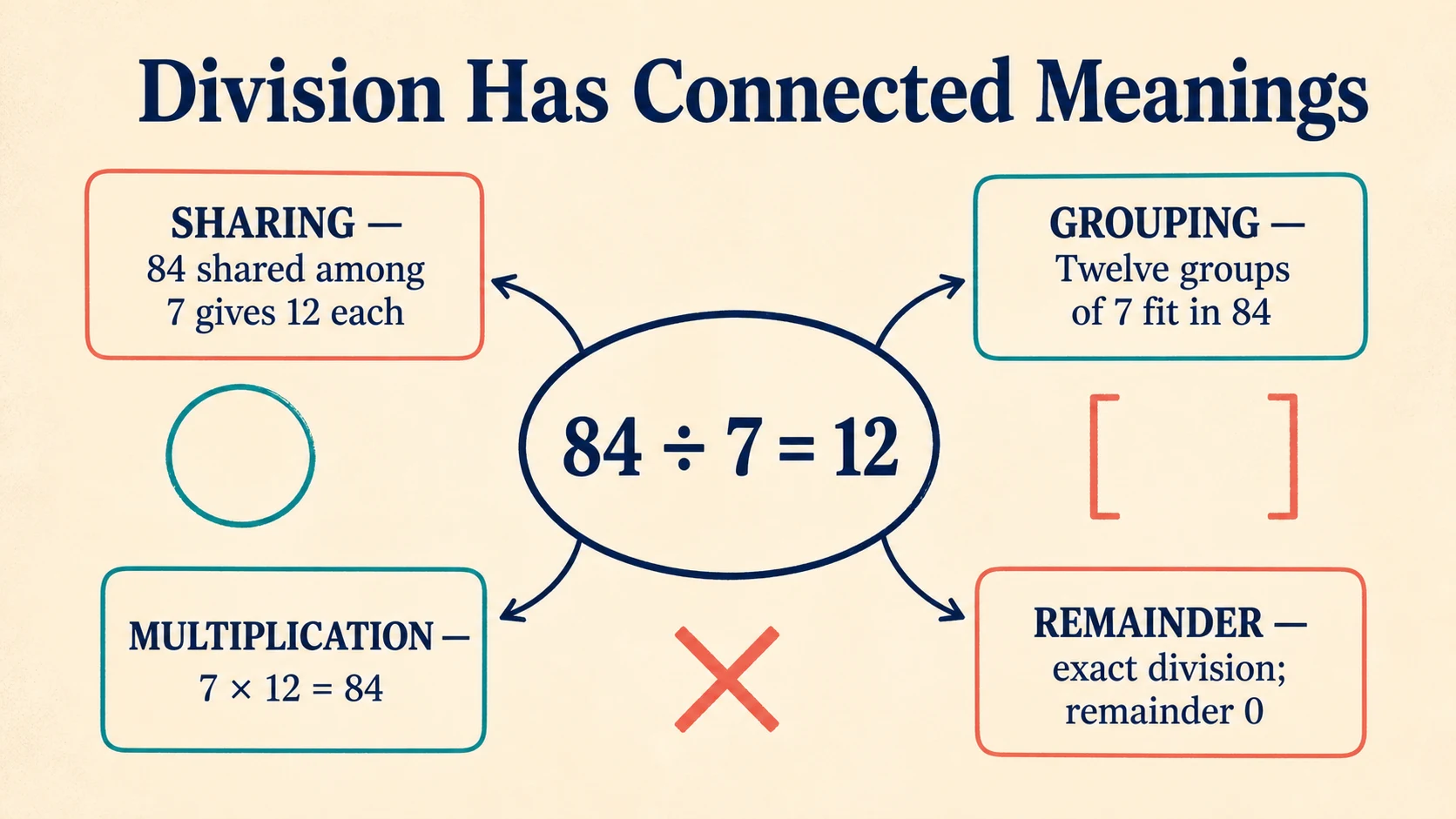
The underlying map remains equal groups, multiplication relationships, place value, calculation, and interpretation—even when an advanced variation removes the visible supports.
The nearby easier and harder task features
“Easier” and “harder” should describe the task, not the child. A page can be demanding for one reason and well supported in every other respect.
Features that reduce the reasoning load
A nearby easier division task may offer:
- A familiar single-digit fact, such as
- An array or equal-group picture
- A multiplication fact family beside the problem
- An exact quotient with no remainder
- One consistent format throughout the page
- A partially completed area model
- A word problem that explicitly says “shared equally”
- Space aligned for each long-division step
The easy and beginner division collection is the relevant nearby level when the learner still needs those features. Moving there is not a demotion. It is a way to isolate the missing prerequisite before returning to a more complex variation.
Features that create appropriate advanced demand
A task belongs at this level when it preserves recognizable division but asks the learner to coordinate several ideas. Examples include , a quotient with a zero such as , or a contextual remainder that changes the final response.
A harder variation might:
- Increase the divisor from one digit to two digits
- Require quotient estimation
- Include zeros in the dividend or quotient
- Mix problems with and without remainders
- Remove the model after the learner has used it successfully
- Ask for a written interpretation of the remainder
- Require an equation, calculation, and multiplication check
- Present irrelevant details in a short context
Do not raise all of these demands at once. If two-digit divisors are new, keep the quotient exact and provide generous working space. If remainder interpretation is the target, use manageable arithmetic so calculation errors do not obscure the reasoning.
What lies beyond this page’s useful boundary
A task is not automatically a better advanced division task because it introduces unrelated notation, dense reading, severe time pressure, or numbers chosen only for length. Decimal division, fraction division, or algebraic division may be a later curricular step, but the supplied catalogue facts do not establish those as capabilities of this page.
Likewise, a second- or third-grade label does not make multi-digit long division suitable simply because the page says “advanced.” Use the 3rd Grade Division guide and free sheet to examine equal grouping, fact relationships, and readiness with accessible numbers before choosing a substantially less supported task.
Three checked examples reveal three kinds of demand
The most useful comparison is not “small numbers versus big numbers.” It is the decision the learner must make.
Example 1: larger numbers, stable structure
Consider:
One place-value solution is:
- Six hundreds cannot be shared into 8 whole groups, so regroup 6 hundreds as 60 tens.
- With the existing 7 tens, there are 67 tens.
- tens with 3 tens remaining because .
- Regroup the 3 remaining tens as 30 ones; combine them with 2 ones to make 32.
- .
- Therefore, .
Check:
This example belongs here because the basic divisor fact is accessible, but the learner must coordinate regrouping across place values and interpret 8 in the quotient as 8 tens. It is more demanding than , yet it keeps the divisor, exact quotient, and verification structure stable.
A partial-quotients solution is equally valid:
If the learner can explain both methods, that is useful flexibility. Requiring both on every item, however, can turn representation into unnecessary volume.
Example 2: a zero that must be preserved
Now solve:
Using place value:
- hundreds divided by 5 gives 8 hundreds.
- The next digit represents 9 tens. ten with 4 tens remaining.
- Regroup the 4 tens as 40 ones and combine them with 5 ones to make 45.
- .
- The quotient is .
Check:
This example belongs here because zeros in the dividend can act as false difficulty signals. The answer is not hard because a zero appears; it is demanding because each digit’s place must be tracked correctly. A common wrong answer is 89, caused by losing the hundreds-to-tens structure rather than by misunderstanding the fact .
Compare it with . That variation introduces a zero in the quotient. A learner must record the zero tens because does not fit into the remaining zero tens. Omitting it gives 81, which fails the multiplication check:
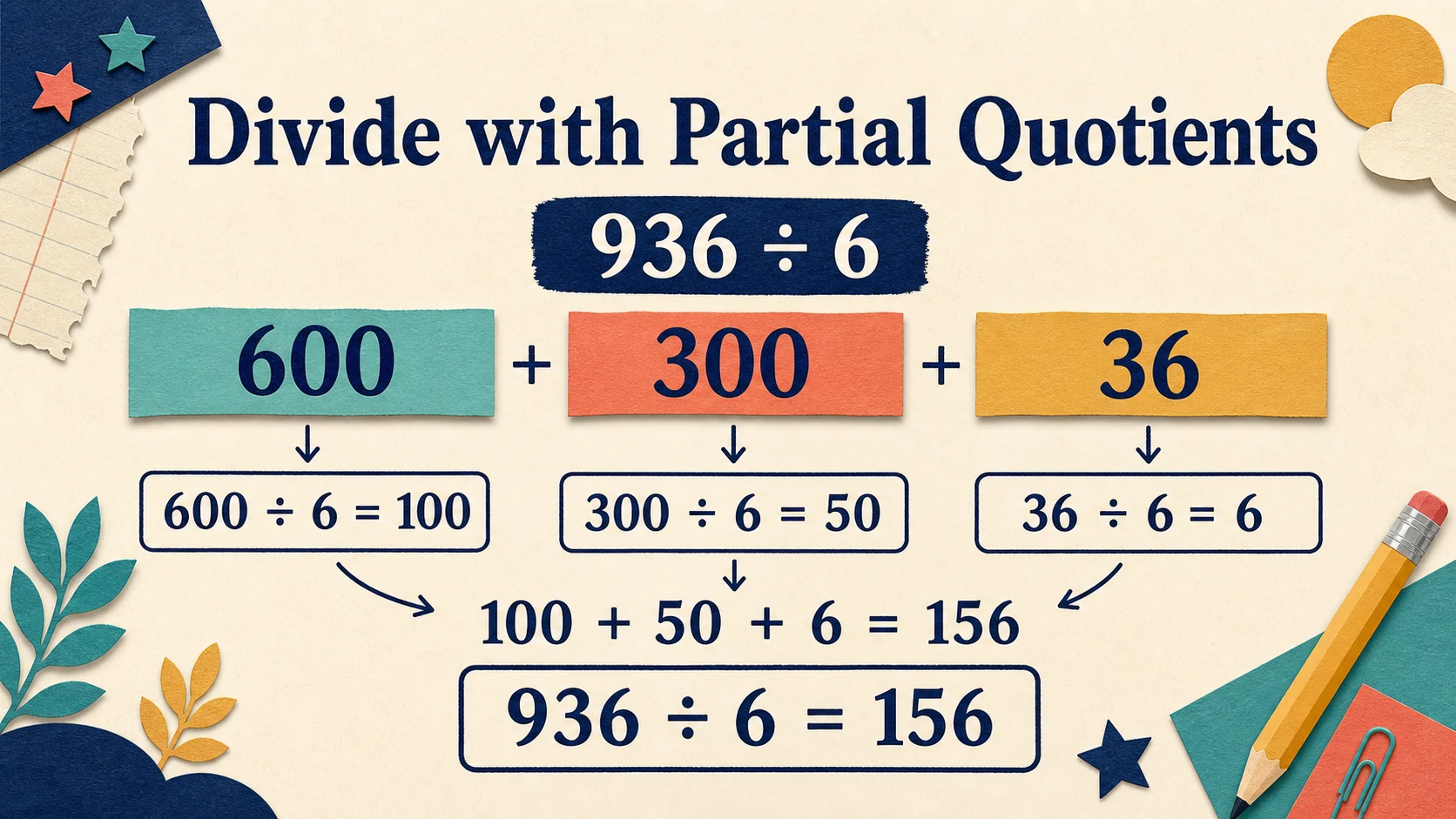
For an upper-elementary example, the representation should expose why the quotient digits occupy their places before the compact algorithm takes over.
Example 3: a two-digit divisor and an exact quotient
Consider:
Estimate first. Since is close to , and is a little more than 88, expect a quotient in the 80s.
Use partial quotients:
Therefore:
Check:
This belongs at the advanced level because the learner must estimate with a two-digit divisor, select useful multiples, subtract accurately, and combine partial quotients. The arithmetic still resolves exactly, which keeps remainder interpretation out of the way while the new divisor structure is being learned.
A nearby easier problem is : it tests whether the learner recognizes . A harder variation is , because it retains a remainder and adds another decision. That harder variation should come only after the learner can generate multiples of 21 efficiently.
Remainders are decisions, not leftover notation
The catalogue guidance specifically identifies remainder interpretation as critical: sometimes the context requires rounding up, sometimes using only full groups, and sometimes reporting the remainder itself. One calculation can therefore support several different answers.
Example 4: the same quotient, three contextual responses
Calculate:
because:
and:
Now change only the question.
Case A: Transport. A van holds 12 passengers. How many vans are needed for 157 passengers?
Thirteen vans carry only 156 passengers, so 14 vans are needed. The remainder forces rounding up.
Case B: Complete teams. A competition requires teams of exactly 12. How many complete teams can be formed from 157 entrants?
Thirteen complete teams can be formed, with 1 entrant not placed in a complete team. The answer to the question is 13 teams; rounding up would invent an incomplete team.
Case C: Leftover item. A shop packs 157 markers into boxes of 12. How many markers remain after all full boxes are packed?
The answer is 1 marker. Here the remainder, not the quotient, answers the question.
This example belongs here because the calculation remains constant while the interpretation changes. The advanced demand is semantic: the learner must decide what the quotient and remainder mean in the stated situation.
The catalogue’s van example uses the same principle with 25 students and vans holding 6: , but five vans are required. The Common Core mathematics standards describe a progression that includes interpreting whole-number quotients, solving problems involving remainders, using place-value reasoning, and later working fluently with multi-digit division. The standards provide curricular context; they do not verify alignment of a particular WorksheetWise resource, and local sequences can differ.
False difficulty signals to remove from placement decisions
Adults often judge a worksheet from its surface. Several visible features can mislead.
A long dividend is not sufficient evidence
uses a large dividend but a direct multiplication relationship. In contrast, uses smaller numbers but requires estimation, subtraction, and remainder verification. Digit count is only one task feature.
A fast answer is not necessarily a shallow one
A learner may answer immediately because the multiplication relationship is secure. Do not insist on long division merely to make the item look advanced. Ask, “How can you verify it?” or “Would 13 groups of 12 be too many?” An accurate explanation provides better evidence than extra written steps.
Slow work is not proof that the level is wrong
The learner may understand division but write slowly, align digits carefully, or need time to retrieve multiplication facts. Separate the target from the access demand. Permit a multiplication chart when the objective is interpreting remainders or understanding place value; remove it when fact retrieval itself is the chosen practice target.
Decorative complexity is not mathematical complexity
Crowded layouts, tiny writing spaces, elaborate themes, and lengthy directions can make a page harder to use without deepening division reasoning. Those are access barriers. They should not be treated as desirable advanced features.
Correct answers can conceal fragile reasoning
A learner who obtains should still be able to show why is 1,680, why 84 remains, and how multiplication checks the quotient. Conversely, one subtraction slip amid sound setup does not establish a conceptual division problem.
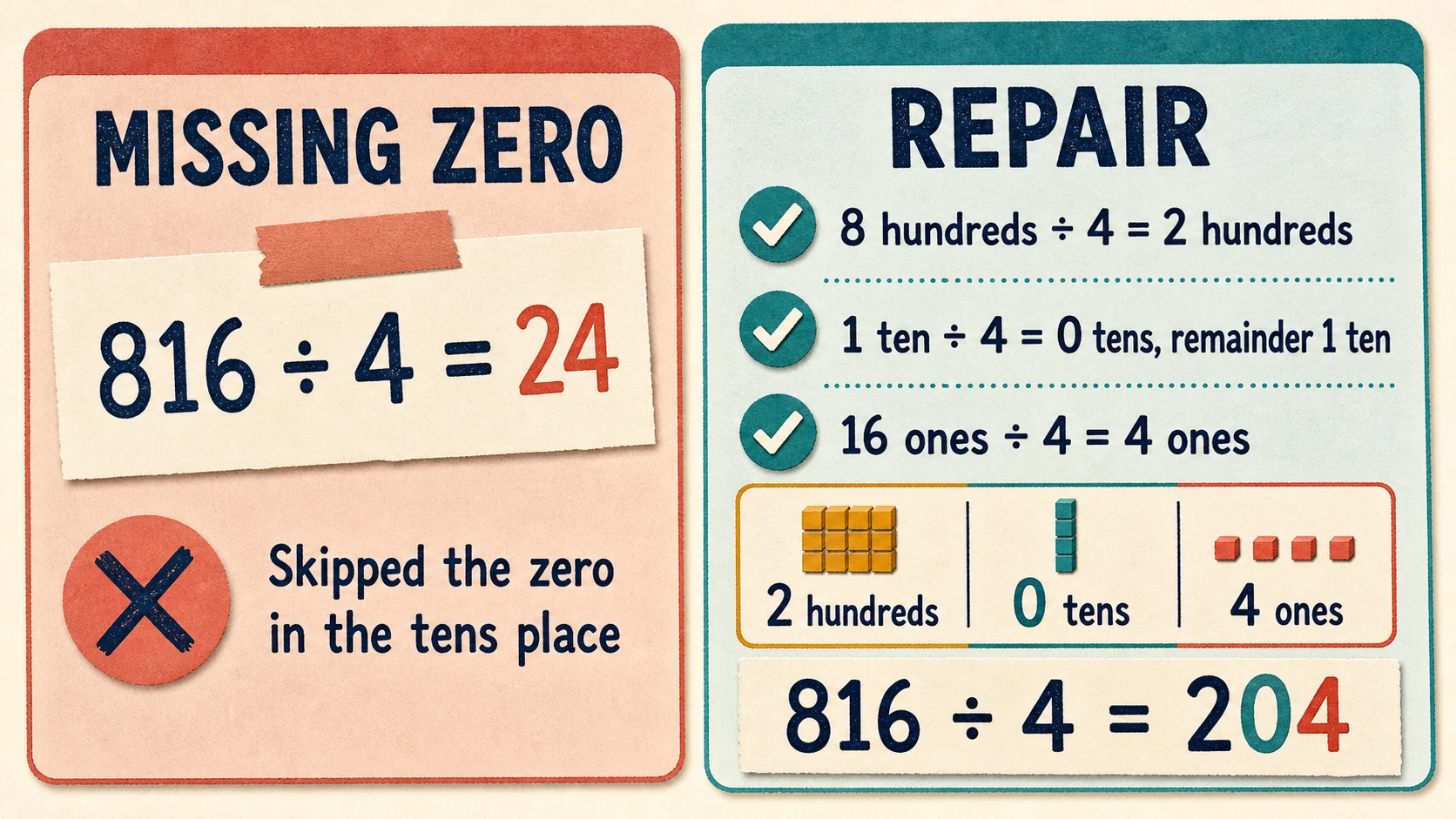
The useful response depends on the evidence: quotient placement, multiplication, subtraction, and remainder interpretation call for different follow-up prompts.
Choose a variation from observable readiness
Before selecting an advanced page, give three short probes rather than relying on grade, age, confidence, or a timed score.
Probe the operation’s meaning
Ask the learner to model twice: once as 24 shared among 6 groups and once as groups of 6 made from 24. Counters, quick circles, or spoken descriptions are enough.
Ready evidence includes:
- Six equal shares of 4 for the sharing interpretation
- Four groups of 6 for the grouping interpretation
- Recognition that verifies both
If the learner cannot distinguish the two situations, use concrete grouping and the 2nd Grade Division guide and free sheet before removing models.
Probe place value and multiplication access
Ask for , with a multiplication chart available if needed. Listen for the place-value explanation. If the quotient is correct but the learner cannot explain why the 8 means 80, keep an area model or partial-quotients scaffold.
Next, ask for useful multiples of a prospective two-digit divisor: for 21, can the learner generate , , and ? If not, choose a single-digit-divisor variation or work on multiplication structure first. The Advanced Multiplication Worksheets may be relevant when generating and decomposing products is the actual bottleneck.
Probe remainder interpretation
Present , then ask the van, team, and leftover questions from the checked example. A learner who calculates accurately but gives 13 vans needs interpretation practice, not necessarily easier arithmetic.
Use this decision rule:
- If meaning is uncertain, restore objects, drawings, and oral contexts.
- If place value is uncertain, keep the divisor manageable and add an area model.
- If multiplication facts obstruct the division target, provide a fact support temporarily.
- If the algorithm is secure but contextual answers are not, hold the arithmetic constant and vary the question.
- If all four areas are secure—meaning, place value, calculation, and interpretation—change one feature: divisor size, support level, quotient structure, or context.
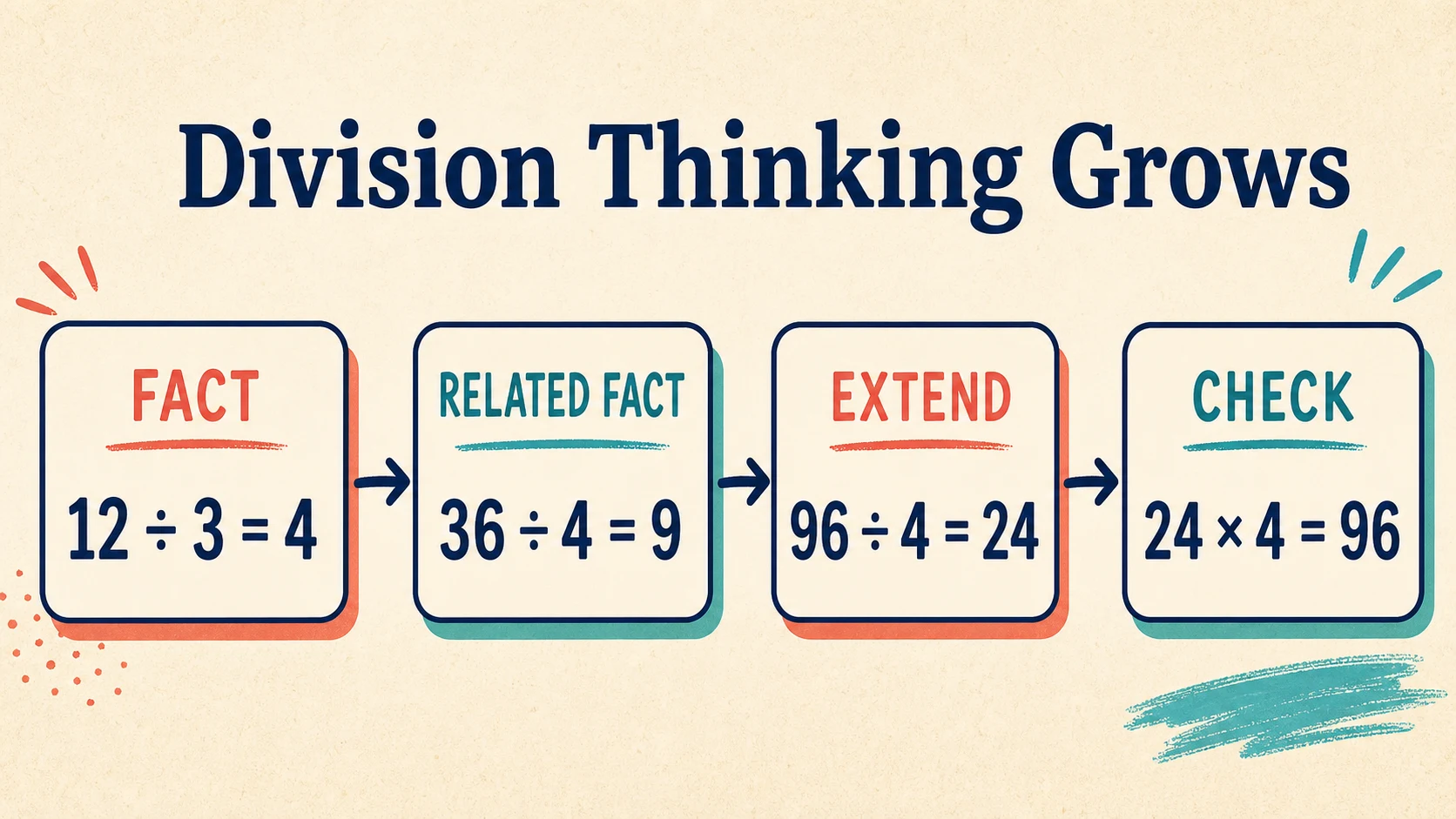
Progression should be visible in what the task removes or adds, not inferred from a learner label.
Fade supports without changing the target
A support is useful when it provides access to the intended reasoning. Fade it when it starts doing the reasoning for the learner.
For , a five-stage fade could be:
- Complete model: Show and ; ask the learner to combine the partial quotients.
- Prompted model: Provide boxes labeled “large useful multiple,” “amount remaining,” and “next multiple.”
- Blank area model: Give only the dividend and divisor; the learner chooses both partial quotients.
- Open workspace: Remove the model but invite any accurate method.
- Independent explanation: Ask for the quotient, estimate, and multiplication check without method prompts.
Change only the support across this sequence. Do not simultaneously introduce a less familiar divisor, denser layout, and contextual remainder. Otherwise, an error will not reveal which change caused the difficulty.
Adaptations that preserve division as the target include:
- Enlarging print and increasing writing space
- Reading a word problem aloud without interpreting it
- Allowing counters or base-ten blocks
- Providing a multiplication chart during place-value or remainder work
- Letting the learner explain orally while an adult records
- Reducing the number of items while retaining the same task types
- Highlighting the divisor consistently
- Covering later rows to reduce visual load
- Allowing untimed work
- Accepting partial quotients, an area model, or the standard algorithm when the method is not the assessed feature
An adaptation stops preserving the target if the adult chooses every quotient digit, rewrites the context as an equation when operation selection is being assessed, or supplies the remainder interpretation.
The IES early-mathematics practice guide supports developmental progressions, monitoring what children know, and teaching through representations and mathematical language. Although that guide focuses on young children rather than advanced upper-elementary division, its representation principles can inform prerequisite work. For ages three and four, prioritize brief, adult-led oral sharing, matching, manipulative, and movement activities over desk worksheets. Such activity is preparation for equal-group thinking, not advanced written division.
A short routine that produces usable evidence
A consistent routine helps the adult see where the reasoning breaks.
Estimate, solve, interpret, verify
Use this sequence for one to three carefully chosen problems:
- Estimate: “About how large should the quotient be?”
- Name the meaning: “Are we finding the size of each share or the number of groups?”
- Choose a method: Objects, drawing, partial quotients, area model, or long division.
- Solve aloud: The learner names important regrouping or partial products.
- Interpret: If there is a context, answer it with a unit.
- Verify: Multiply the quotient by the divisor and add any remainder.
- Reflect: “Which step carried the most thinking?”
For , a reasonable estimate is a little more than 12 groups because . The exact calculation gives . The context determines whether the response is 14 vans, 13 full teams, or 1 marker left. Verification gives .
Keep the routine brief. Five well-discussed items can reveal more than a page completed without explanation. This is an instructional suggestion based on the page’s task structure, not a research claim about a guaranteed amount of practice.
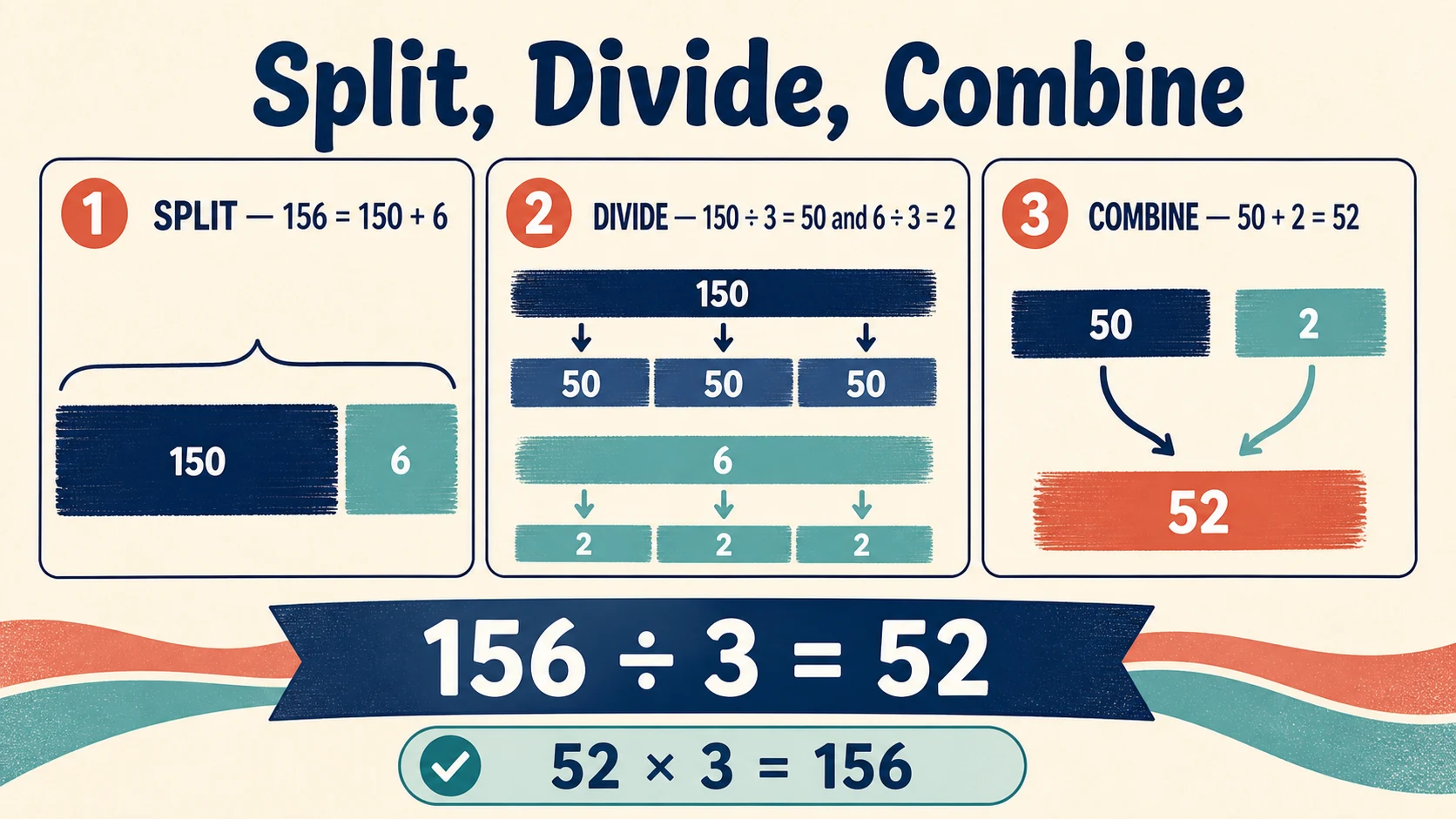
Even when the final page is advanced, a stable oral routine can keep estimation, operation meaning, calculation, and checking visible.
Read errors as evidence, not diagnoses
Record the first point at which the work becomes inconsistent. Do not infer a condition or fixed ability from a worksheet.
If a learner writes , ask what each quotient digit represents. The multiplication check quickly exposes the result: , not 672. The likely instructional response is to rebuild the quotient with place-value language or partial quotients.
If a learner writes , ask, “What value would 81 groups of 5 make?” The answer, 405, reveals that a place was lost. Return to expanded form:
If a learner writes , the remainder is not valid because it is greater than the divisor. Ask whether another group of 21 can be made from 84. Four more groups can, producing 84 with no remainder.
If a learner calculates correctly but says 13 vans are needed, preserve the arithmetic and revise only the contextual decision. Drawing 13 boxes with 12 passenger spaces shows one person still unseated.
These errors call for different responses. Repeating the entire page may add practice without addressing the point of failure.
Plan review around changes in one feature
A two-week sequence need not mean ten consecutive advanced worksheets. Mix supported reconstruction, independent calculation, contextual interpretation, and delayed review.
One workable pattern is:
- Early sessions: one supported example and two independent items with the same divisor structure
- Middle sessions: mixed exact quotients and remainders, with oral interpretation
- Later sessions: one unfamiliar arrangement, one previously successful item, and one multiplication check
- Delayed review: revisit a problem type after several days without showing the earlier solution
Record evidence in plain terms: “estimated within a useful range,” “kept the zero in the quotient,” “remainder smaller than divisor,” or “rounded up for capacity.” Avoid labels such as “advanced learner.” The record should tell the next adult what task feature to retain or change.
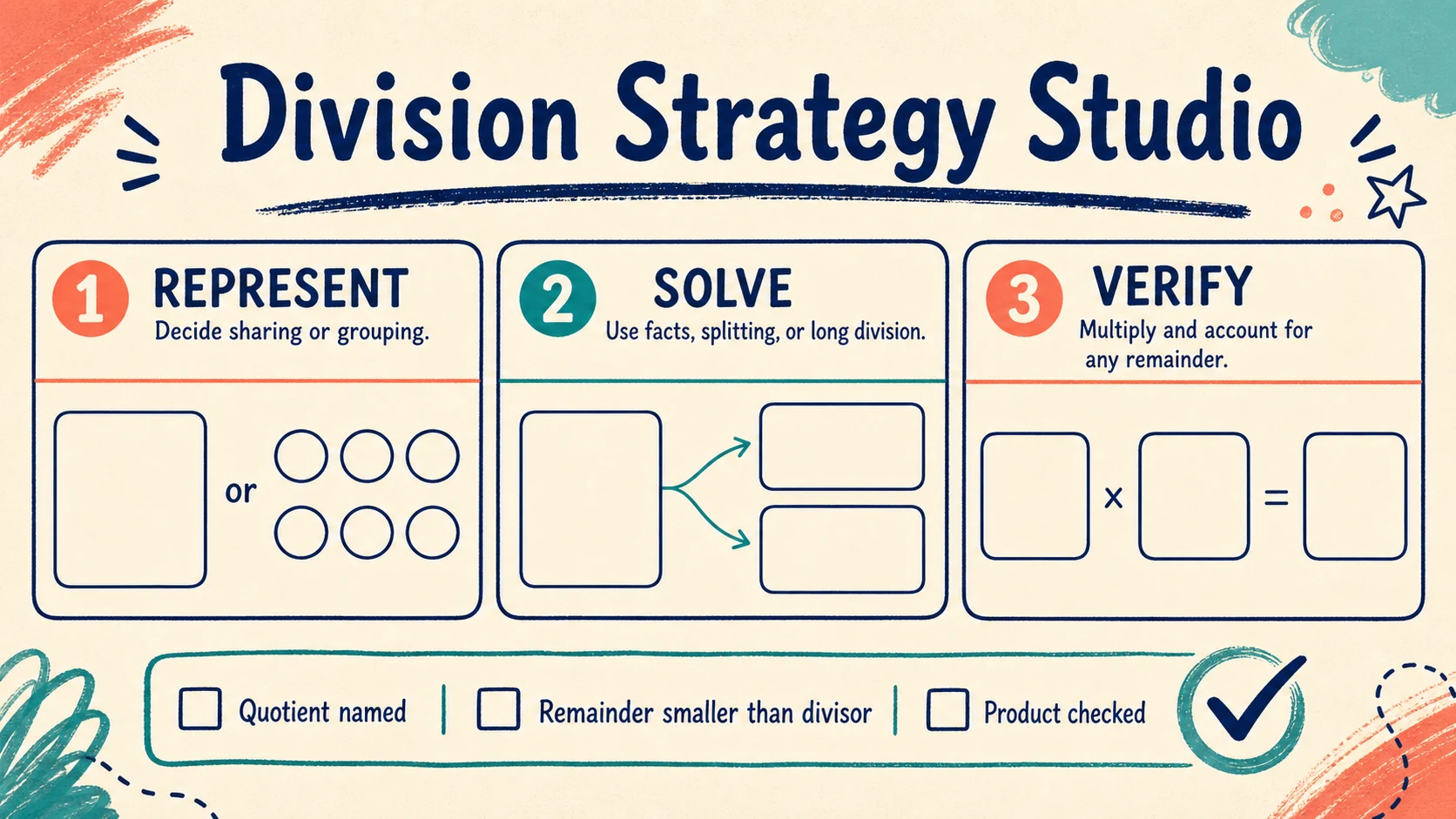
Review should revisit division relationships over time while varying only enough to show whether the reasoning transfers.
Make the next variation a controlled decision
After a learner completes several items, do not ask only, “How many were correct?” Ask what the evidence permits you to change next.
Keep the current variation when the learner can solve but cannot yet explain or verify it. Restore one support when errors cluster around a specific demand. Increase one feature when the learner:
- Estimates a sensible quotient range
- Chooses division from the context
- Maintains place value through the calculation
- Uses a valid remainder smaller than the divisor
- Interprets the remainder with an appropriate unit
- Verifies by multiplication
- Completes these actions on more than one arrangement, not just a repeated template
The page’s 30 variants offer breadth, but catalogue quantity does not establish mastery, alignment, or outcomes. Nor does an intended grade label override local teaching order. Use age and grade to discover possibilities; use observed work to decide placement.
For the next session, open the free deterministic worksheet generators and make one controlled change from a checked problem: keep a single-digit divisor but add an internal zero, keep a two-digit divisor but require an exact quotient, or keep the arithmetic constant and change how the remainder must be interpreted. Ask the learner to estimate, solve, explain, and verify one example before assigning the rest.
Put it into practice
Use the guide with a real printable
Move from explanation to a short, observable practice task. Check the first item together, then adjust the next session from the learner's actual work.
Open the first free worksheetExplore a neighboring collection
Choose by a different teaching need
Advanced Multiplication Worksheets Easy and Beginner Division Worksheets Easy and Beginner Addition Worksheets Easy and Beginner Counting Worksheets Easy and Beginner Fractions Worksheets Easy and Beginner Geometry Worksheets Easy and Beginner Money Worksheets Easy and Beginner Multiplication Worksheets