Curated collectionAnswer keys includedPrint-ready PDFs
Spelling Words Worksheets by Grade and Level
Show the full spelling words progression across 5 real grade combinations, compare task boundaries, model checked examples and explain how to choose the next level.
Start with a real resource
Browse this worksheet collection
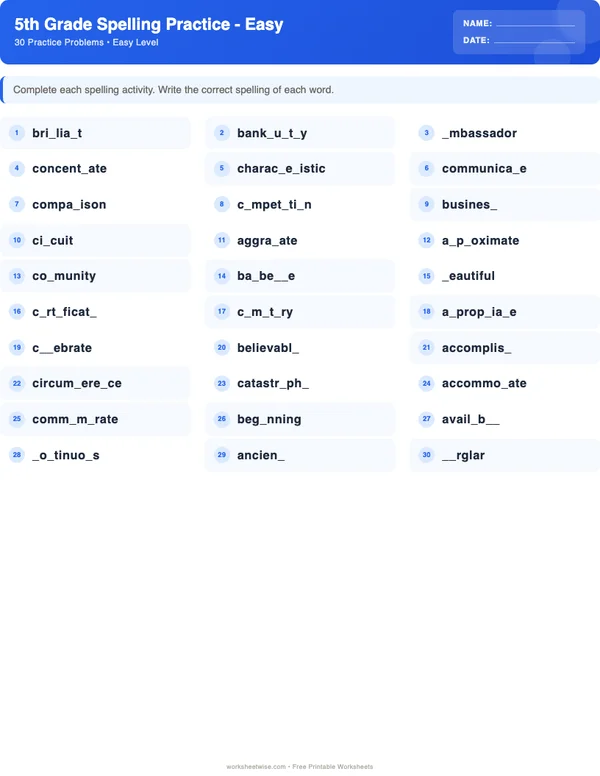
5 relevant free entry points are available. Each one includes a printable learner PDF and separate answer key.
A useful practice loop
Print less. Observe more.
- Choose one skill and model the first item aloud.
- Use a short set and notice the learner’s strategy.
- Change the next task from the work you can see.
Need more than the free sheet?
Plus includes all 90 matching catalogue variations where available, plus saved deterministic generators and the worksheet designer.
See Plus membershipComplete guide
How to teach and practise spelling words worksheets
3,265 words Updated 6 instructional visuals
Choose by the spelling decision, not the grade label
A useful spelling words worksheet does more than ask a child to memorize a list. It focuses attention on a pattern, gives the child a way to compare words, and checks whether that knowledge transfers to an unfamiliar word or a sentence.
The live WorksheetWise catalogue contains 90 spelling-word variants across five intended grade combinations. Each grade has one free entry sheet: 20 problems in 1st and 2nd grade, 25 in 3rd and 4th grade, and 30 in 5th grade. All five free sheets carry the catalogue label “easy.” Here, that label describes observable task features—a comparatively accessible entry point within that grade collection—not the learner.
Start by identifying the decision the child needs to make:
- Does the word contain a short or long vowel?
- Which spelling represents a long-vowel sound?
- Does adding a suffix require doubling or changing a letter?
- Can the child recognize a prefix, suffix, or meaningful base?
- Can the child divide and spell a multisyllabic word?
- Can the child preserve correct spelling while writing a sentence?
Then choose the grade page whose tasks make that decision visible. Grade labels describe intended practice level; local curriculum sequences differ. Age, when shown elsewhere in a worksheet collection, is a discovery aid rather than a placement decision. It should not override evidence from the child’s reading, spelling, and writing.
What spelling-word practice is meant to develop
Spelling is the process of representing spoken language and meaning with conventional written forms. It includes sound-letter relationships, recurring letter patterns, word structure, and knowledge of particular words that do not fit a simple rule.
Pattern study is more productive than treating every item as an unrelated string of letters. A long-a group such as cake, rain, play, and break illustrates the point. All four contain the same broad vowel sound, but the sound is represented by a_e, ai, ay, and ea. The instructional question is not merely “Can the child copy these words?” It is “Can the child notice the alternatives, remember which pattern belongs in each word, and use that knowledge when spelling another word?”
The IES foundational reading practice guide recommends systematic instruction in sound segments, their links to letters, decoding, and analysis of word parts. That guidance supports pattern-based word study, but it is not an assessment of WorksheetWise or a guarantee that a particular sheet will fit every child.
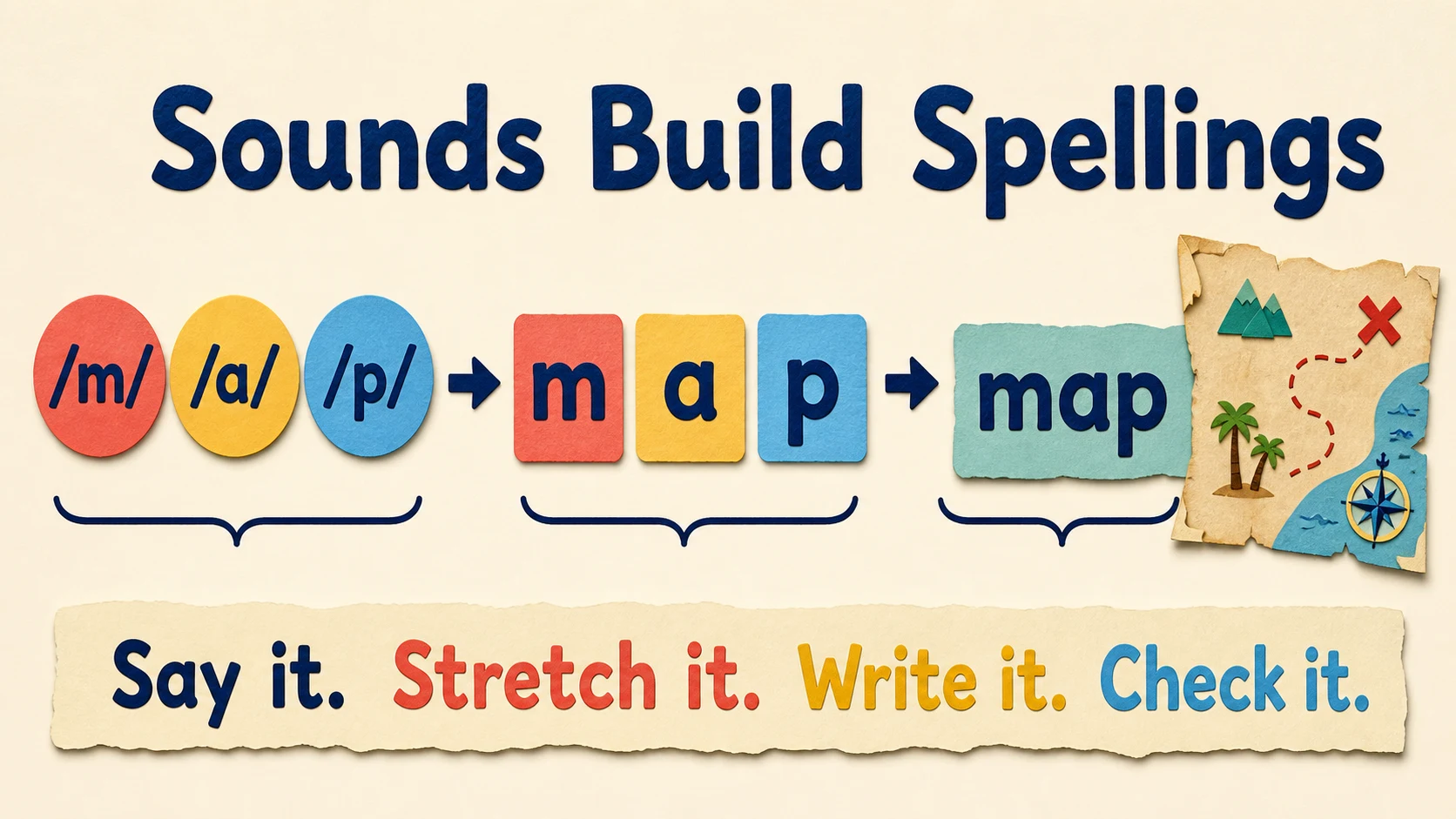
Early spelling work connects hearing a word, noticing its sounds, choosing letters, comparing patterns, and checking the completed word.
The catalogue’s spelling activities include look-cover-write-check, rainbow writing, sorting words by pattern, using words in sentences, and identifying misspellings. These formats have different purposes:
- Copying and rainbow writing can establish an accurate visual model, but repeated copying alone does not show recall.
- Look-cover-write-check removes the model briefly, requiring retrieval and self-correction.
- Sorting reveals whether the child can distinguish patterns.
- Misspelling identification requires comparison with a correct pattern.
- Sentence work adds meaning, grammar, handwriting, and working-memory demands.
- Dictation asks the child to move from heard language to written language without seeing the target word.
A well-chosen sheet isolates the intended spelling decision before combining it with these additional demands.
The five-grade progression in the live catalogue
The catalogue names the same broad content range across Grades 1–5: short vowels, long-vowel spellings, consonant doubling, r-controlled vowels, silent letters, prefixes, suffixes, and multisyllabic words. That description does not mean every listed feature appears on every free sheet, or that all grades treat each feature in the same way. The defensible progression is therefore a progression of task boundaries, support, and word complexity—not a claim about the unseen contents of an individual PDF.
1st grade: hear, match, and record a visible pattern
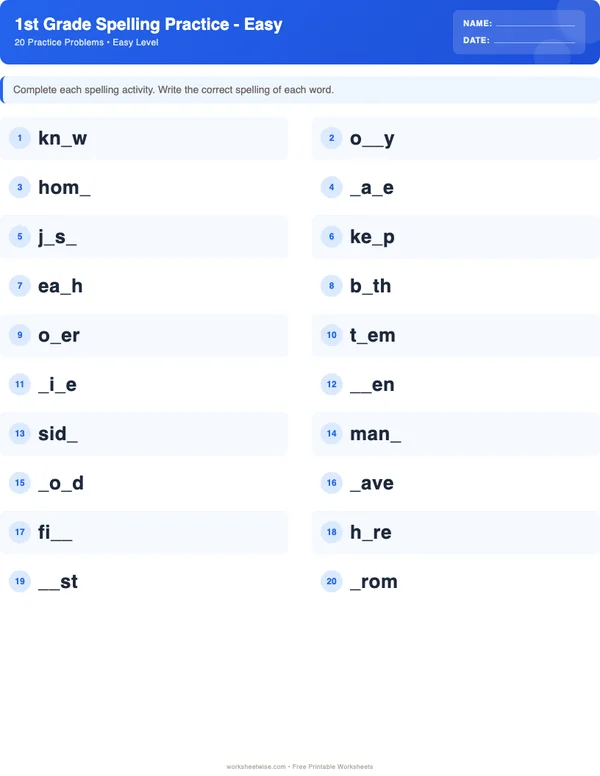
The 1st Grade Spelling Words guide and free sheet is the smallest free entry point at 20 problems. Appropriate starting tasks keep the contrast clear: short-vowel families, a familiar long-vowel pattern, or a small set of high-frequency words.
A checked example is a short-a sort:
- map, cat, jam → short a
- sit, hen, top → not short a
Each classification is correct: map, cat, and jam contain /ă/; the comparison words contain different short vowels. This belongs near a 1st-grade starting point because the child can make one audible vowel decision in short, single-syllable words. It does not require knowledge of suffix changes or syllable division.
Do not turn this into silent desk work if the learner cannot yet hear the contrast reliably. Say each word, let the child move a card into a group, and then ask for one written example.
For ages three and four, prioritize brief adult-led oral, matching, manipulative, and movement work over desk work. A child might step onto a “short a” card after hearing cat, or match picture cards for map and jam. That is exposure and observation, not a reason to place a preschooler into a numbered grade sequence.
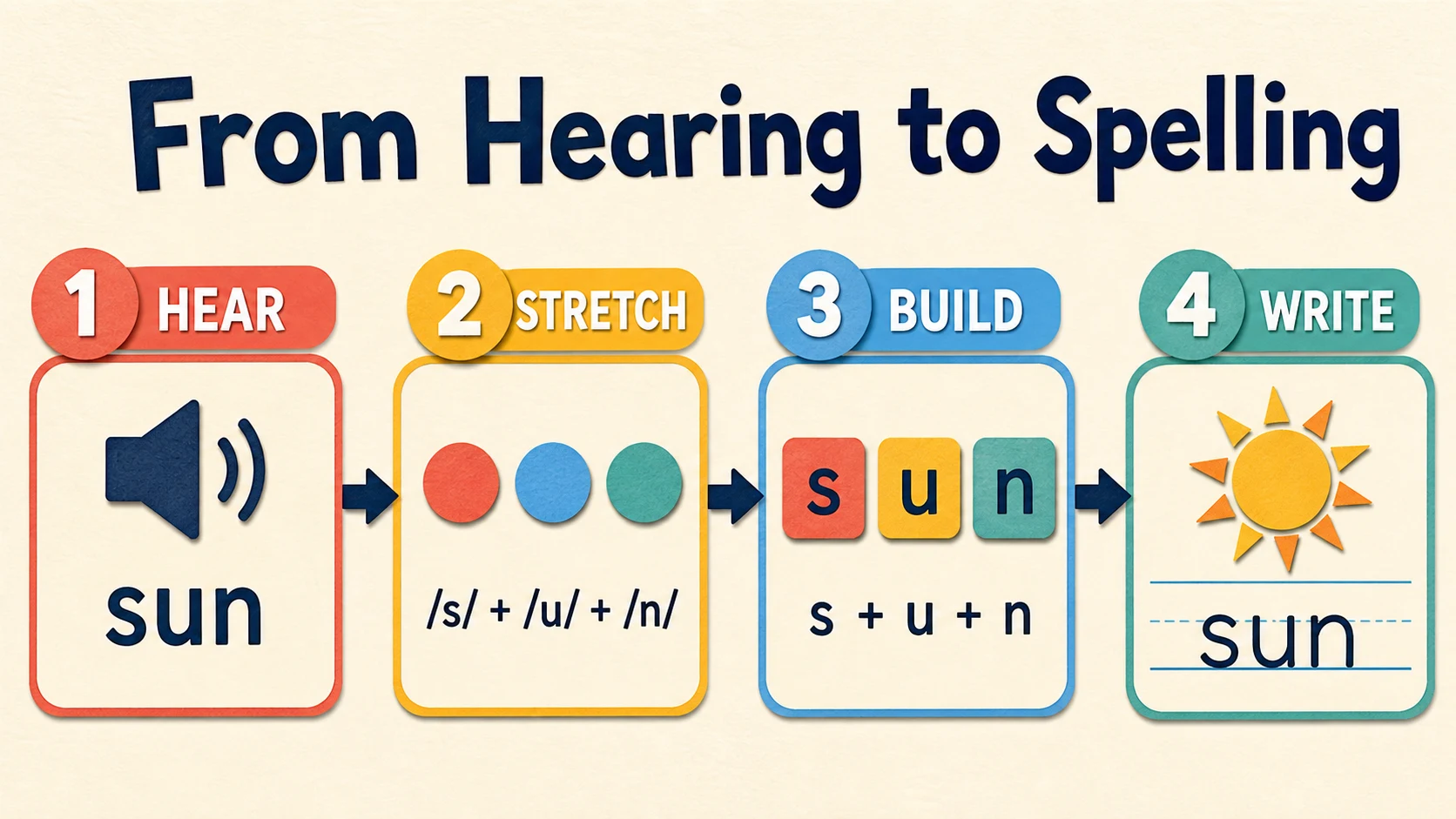
Support can fade from spoken comparison and card sorting to writing the same pattern without a visible model.
2nd grade: compare plausible vowel spellings
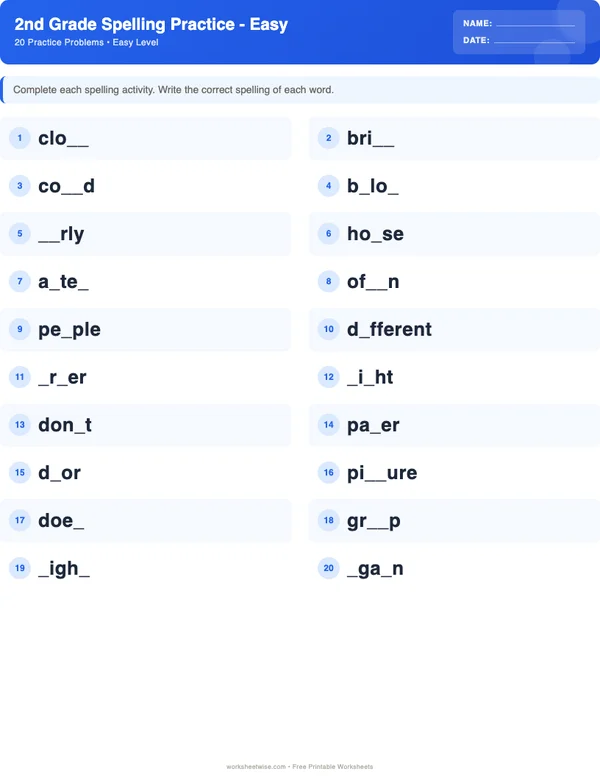
The 2nd Grade Spelling Words guide and free sheet also provides 20 problems, but the next useful boundary is often a choice among plausible spellings rather than recognition of one sound.
Consider the long-a words cake, rain, play, and break:
| Word | Long-a spelling | Position or structure |
|---|---|---|
| cake | a_e | final silent e changes the vowel |
| rain | ai | vowel team inside the word |
| play | ay | vowel team at the end |
| break | ea | less common spelling in this word |
All four examples are checked: each has the long-a vowel sound in standard US pronunciation, although break uses a less predictable representation. The group belongs at this transition because the sound stays constant while the written pattern changes. Sorting makes the alternatives visible.
A suitable challenge word is steak, which extends the ea representation. It should be presented as a word-specific extension, not proof that ea usually says long a. Two other possible extensions are spray for final ay and train for medial ai. Challenge words should extend the active comparison; they should not introduce an unrelated rule merely because they are longer.
3rd grade: explain a spelling change
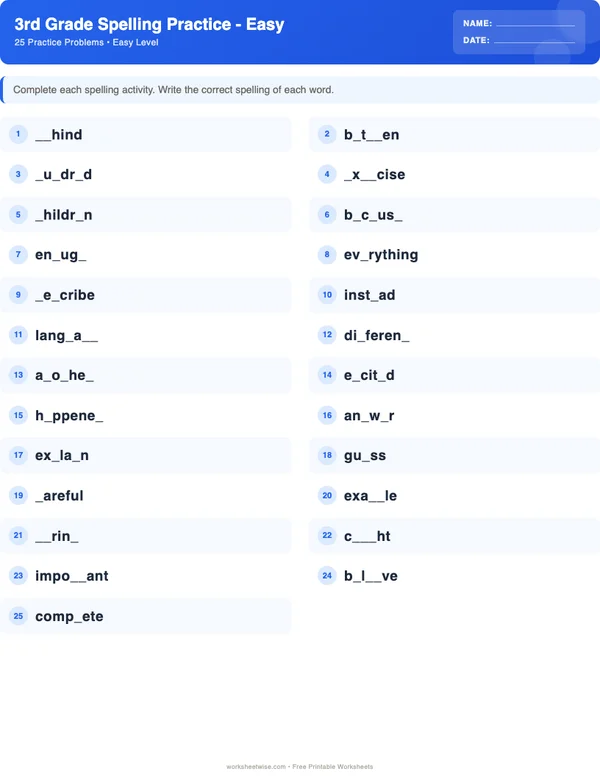
The 3rd Grade Spelling Words guide and free sheet moves to 25 problems. A productive boundary here is whether the child can explain what happens when a suffix is added.
Check this set:
- hop + ing = hopping
- hope + ing = hoping
- rain + ing = raining
- play + ed = played
In hopping, the final consonant is doubled after the short vowel in the one-syllable base hop. In hoping, the final e in hope is dropped before -ing; doubling the p would produce a different word. Raining and played retain their vowel teams. These examples belong in the middle progression because the child must hold the base word in mind, recognize its structure, and apply a change rather than copy an unchanged form.
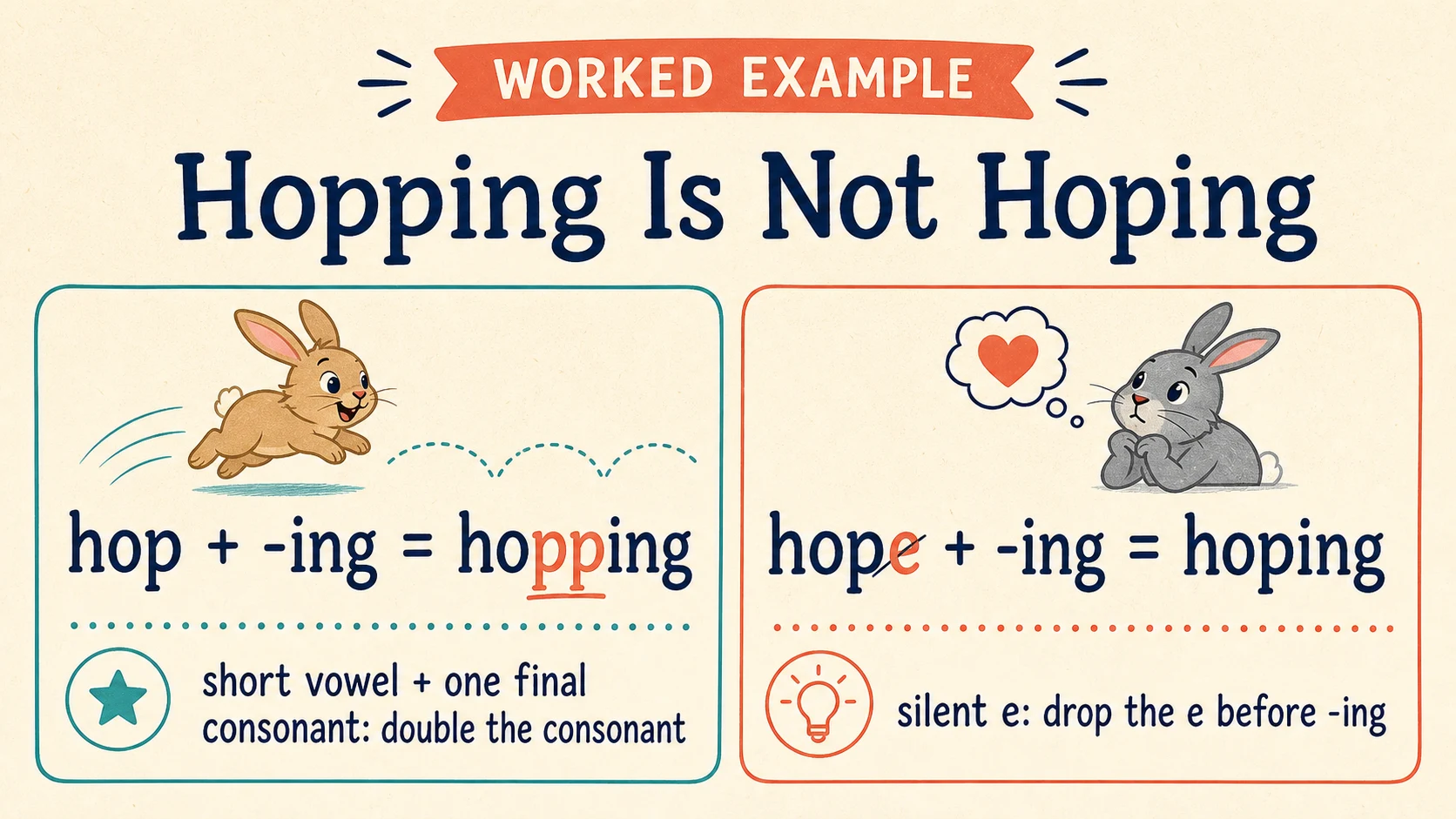
A worked middle-grade example should expose the decision—base word, relevant pattern, and resulting spelling—before independent practice.
4th grade: use meaningful parts
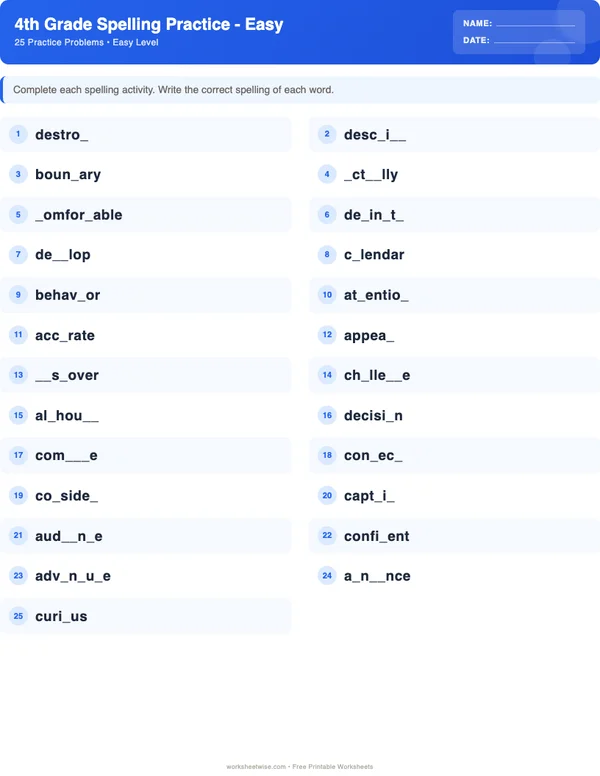
The 4th Grade Spelling Words guide and free sheet contains 25 problems. A useful starting point is the preservation of recognizable bases when prefixes or suffixes are attached.
For example:
- happy + un- = unhappy
- help + -ful = helpful
- care + -less = careless
- agree + dis- = disagree
Each construction is checked. The prefix un- is added before happy without changing the base. Helpful adds -ful, spelled with one final l as a suffix. Careless retains care and adds -less. Disagree combines dis- and agree without deleting either adjacent vowel.
This work belongs beyond simple sound matching because meaning helps organize the spelling. A child who knows that careless means “without care” can use care + less as a memory structure. The written word remains the target; discussing meaning is a support for that target, not a substitute for spelling it.
5th grade: coordinate syllables, morphology, and context
The 5th Grade Spelling Words guide and free sheet is the largest free entry point at 30 problems. The relevant change is not simply “harder words.” Tasks can ask the child to coordinate syllables, meaningful parts, less transparent spelling patterns, and sentence context.
A checked analysis of unhelpfulness is:
- prefix: un-
- base: help
- suffix: -ful
- suffix: -ness
- complete spelling: unhelpfulness
The final form contains one l in -ful. Its spoken syllables can be heard approximately as un / help / ful / ness. This example belongs at the upper end because several meaningful units must be assembled in order.
A context check might use: “Her unhelpfulness delayed the group.” The sentence supplies meaning and part of speech, while the internal word structure supports spelling. It would be a poor first example if the child is still unsure how helpful is built; in that case, reduce the number of attached parts.
How representation and question design should change
The learner’s response can look correct for very different reasons. Copying rain accurately while looking at it demonstrates visual matching and handwriting. Writing rain after the word is covered demonstrates short-term retrieval. Placing rain under ai instead of ay demonstrates pattern recognition. Spelling it during dictation adds listening and sentence demands.
Use this support sequence when introducing a pattern:
- Say the words and identify the shared sound.
- Display the words and mark the relevant letter groups.
- Sort the words by spelling pattern.
- Remove the display and retrieve selected words.
- Check each attempt against the model.
- Apply the pattern to a new but suitable word.
- Use two or more target words in a dictated sentence.
- Revisit the pattern later alongside previously taught patterns.
The Common Core English Language Arts standards include grade-banded expectations for conventional spelling, using spelling patterns and generalizations, and consulting references as needed. They can help adults understand why task demands broaden over time. They do not establish that a specific WorksheetWise worksheet is aligned to a particular local sequence.
A new word is an important check because memorized list performance can conceal weak pattern knowledge. After studying rain and train, for example, ask the child to spell mail. The checked answer is mail, with medial ai. Success suggests the child can extend that representation to another familiar one-syllable word. Failure does not prove a disorder or even lack of knowledge; it tells the adult to compare hearing, pattern choice, memory, and attention in a smaller follow-up task.
A repeatable pattern-study routine
A worksheet is best treated as one part of a short teaching cycle, not as the entire lesson.
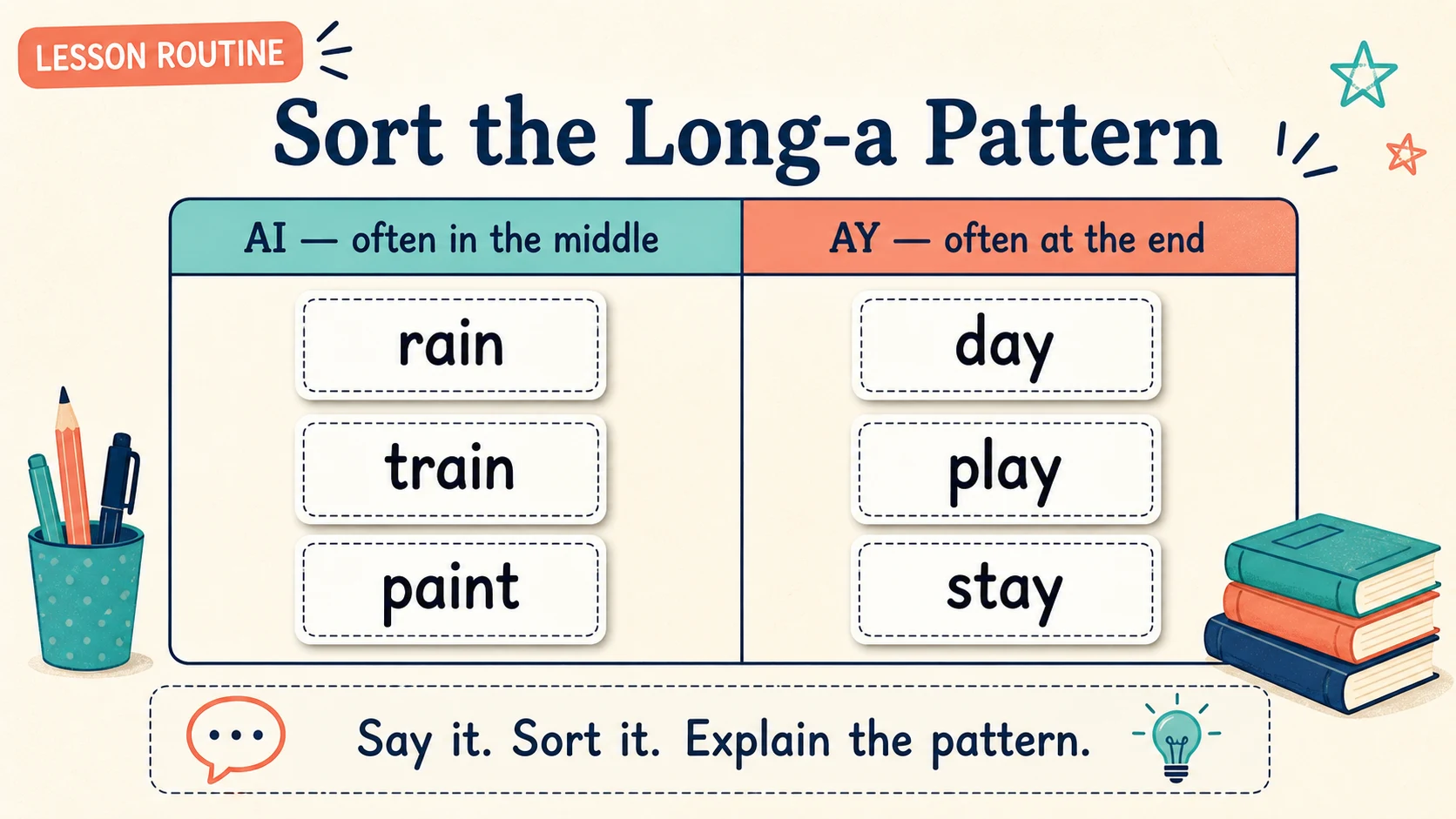
A middle-grade routine moves from noticing and explaining a pattern to retrieval, checking, and use in context.
Before writing: establish the contrast
Choose one central pattern and, where helpful, one comparison. For long a, sort rain, train, and mail under ai; play, stay, and spray under ay; and cake, name, and late under a_e. Read every word aloud.
Ask, “What stays the same in sound? What changes in spelling?” If the child cannot explain the categories, keep the headings and models visible during the first items.
During practice: look, cover, write, check
For each word:
- Look closely and say the word.
- Name or mark the important part.
- Cover the word.
- Write it from memory.
- Uncover it and compare letter by letter.
- Circle the exact part that differs.
- Rewrite a missed word accurately three times while attending to that part.
Writing three times is a catalogue teaching suggestion, not a punishment or a sourced dosage rule. Stop if the repetitions become rushed copies. One slow, explained correction is more informative than a row of unchecked reproductions.
After practice: sort and transfer
Mix studied words and ask the child to rebuild the pattern groups without headings. Add two or three challenge words that genuinely extend those groups.
Then dictate a sentence containing multiple targets. For example: “Jake will play in the rain.” The checked spellings are Jake with a_e, play with final ay, and rain with medial ai. This sentence belongs after the long-a sort because it requires three representations of the same vowel sound in connected writing.
Sentence dictation also introduces capitalization, spacing, handwriting, and punctuation. If the goal is specifically long-a spelling, score the target words separately from the capital letter and period. Otherwise, a punctuation error can obscure successful spelling.
The IES writing practice guide recommends explicit strategy instruction, attention to foundational writing skills, and regular opportunities to write. Using target words in meaningful sentences is consistent with that broader writing guidance. The guide does not prescribe this exact routine or evaluate these worksheets.
Read errors as evidence about the next decision
A wrong answer becomes useful when the adult identifies what changed. Record the child’s actual spelling before correcting it.
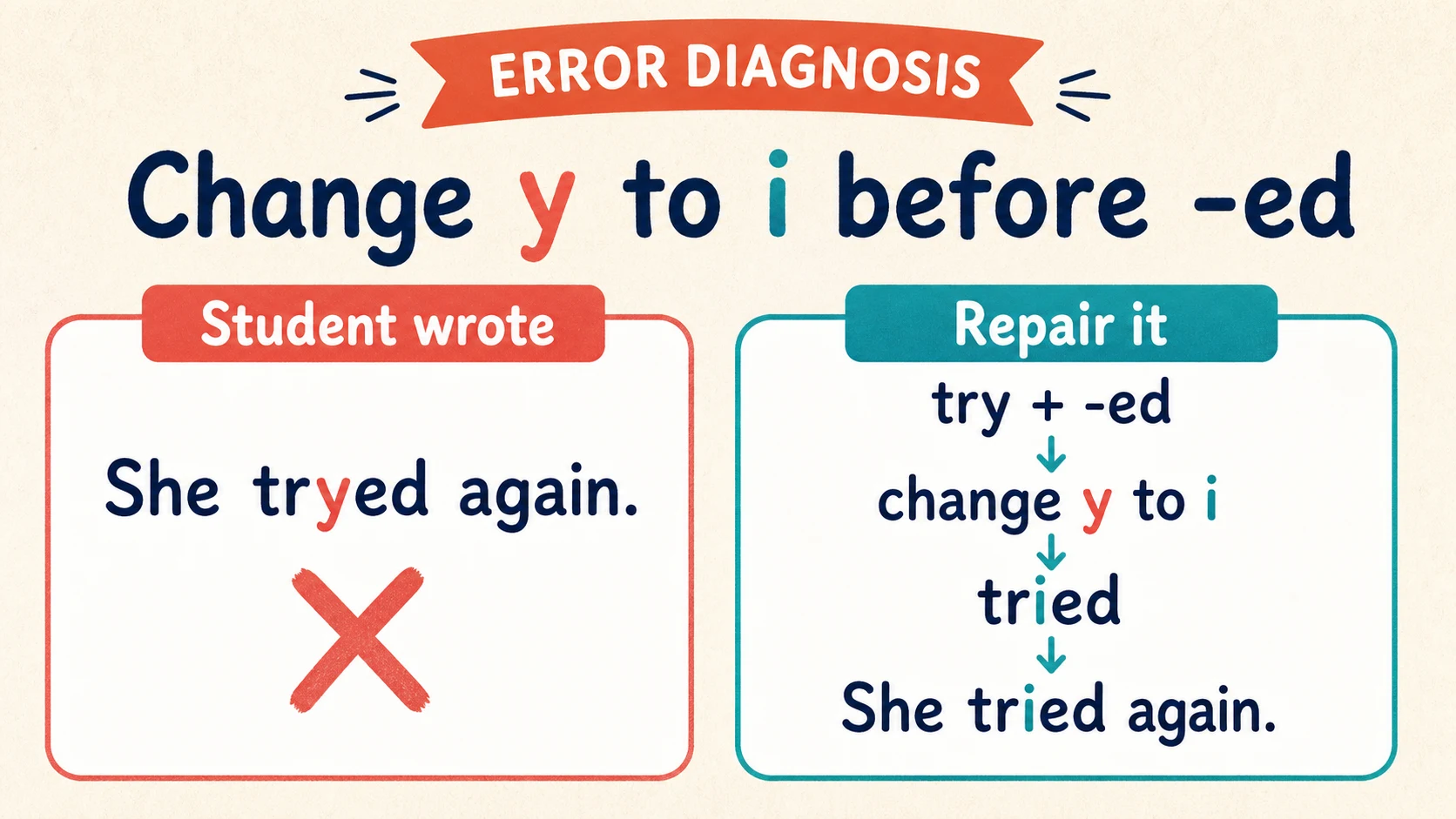
A middle-grade response should connect the visible error to one smaller comparison or word-building decision.
The sound is represented, but the pattern is wrong
If the child writes rane for rain, the long-a sound is represented plausibly, but the word-specific pattern is wrong. Compare rain/train with name/came. Ask the child to sort the words, underline ai and a_e, and then retrieve rain again.
Do not say only, “That is wrong,” because that discards evidence that the child heard the vowel and selected a possible long-a spelling.
A sound is omitted
If stamp becomes sap, ask the child to stretch the spoken word, move one counter for each sound, and map the letters again. The immediate issue may be attending to the consonant cluster, not remembering the whole word visually. Keep the printed word hidden until after the sound analysis if retrieval is the target.
The base is lost when a suffix is added
If helpful becomes heplful, have the child rebuild help + ful. Write the base first, verify it, and then attach the suffix. If hopping becomes hoping, contrast hop/hopping with hope/hoping and read both completed words aloud.
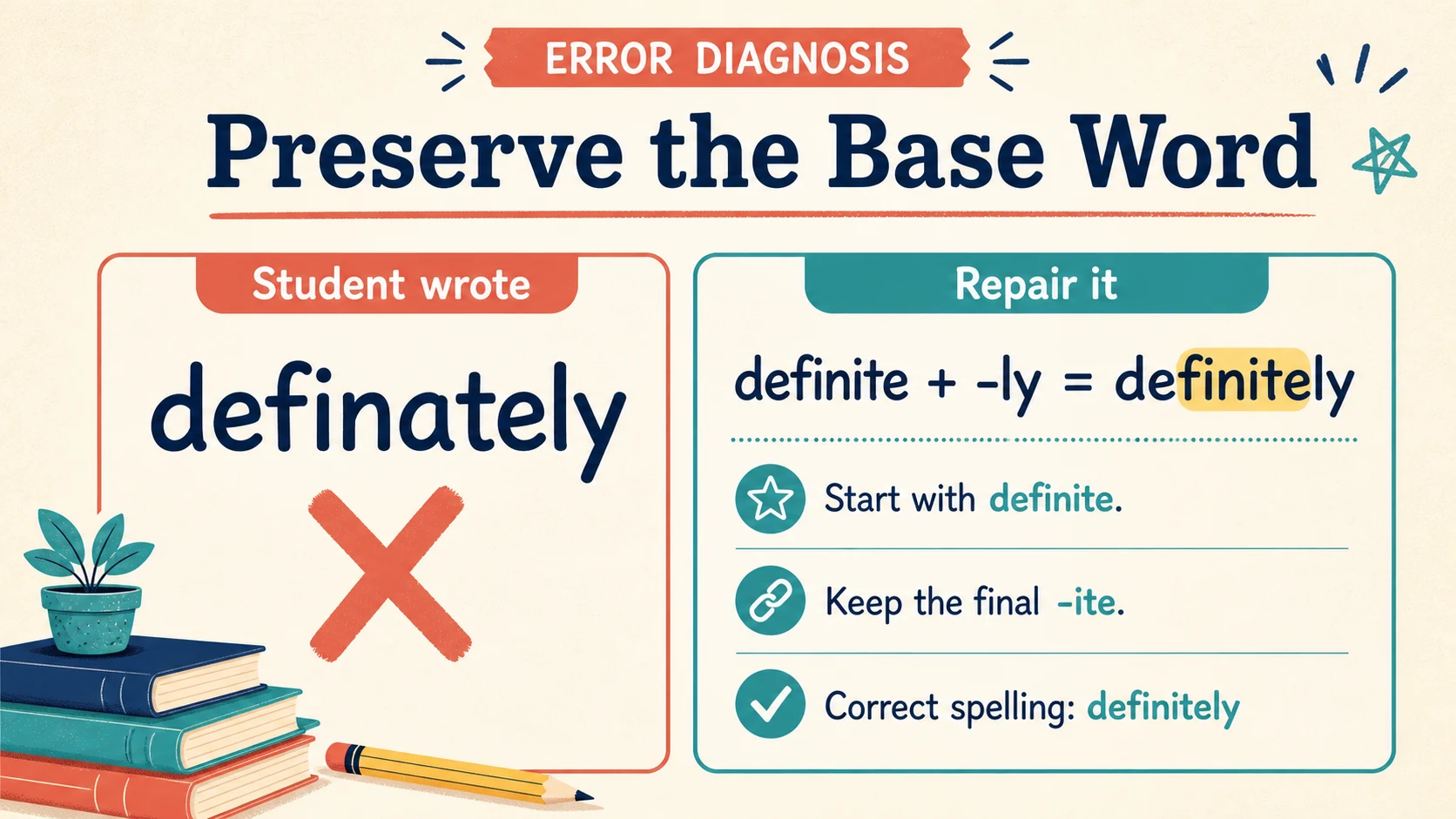
Upper-grade correction often requires locating whether the breakdown occurred in a syllable, base, prefix, suffix, or word-specific spelling.
The word is correct on a list but wrong in writing
If because is correct during look-cover-write-check but misspelled in a paragraph, retrieval may not yet be stable when attention is shared across ideas, sentence construction, and mechanics. Add brief sentence dictation, then ask the child to proofread only for the week’s target words.
None of these error patterns supports a diagnosis. A single misspelling can reflect incomplete knowledge, a momentary lapse, unclear pronunciation, fatigue, handwriting pressure, or competing demands. Look for repeated evidence across reading, isolated spelling, dictation, and ordinary writing before changing the instructional level.
Select a real worksheet with a three-sample check
Begin with the grade collection that matches current classroom material, but verify the fit before assigning the entire page.
Check the word pattern
Inspect whether the words share a teachable relationship. A focused ai/ay comparison is more coherent than a list containing unrelated vowel teams, suffix changes, silent letters, and multisyllabic words when those features have not been taught.
The catalogue states that its worksheets target specific patterns, but adults should still inspect the selected sheet. “Spelling words” is a broad category, not a complete lesson objective.
Check the response demand
Ask what the child must do:
- Copy a displayed word
- Retrieve a covered word
- Sort by pattern
- Identify and repair a misspelling
- Add an affix
- Spell from dictation
- Use the word in an original sentence
Choose the least-supported format that still produces mostly interpretable work. If the learner guesses through a full page, move back to sorting and model-supported comparison. If every answer is immediate and the child can explain the pattern, add an unfamiliar example or sentence application before moving to another grade.
Check the workload
The free sheets contain 20, 20, 25, 25, and 30 problems from Grades 1 through 5. Problem count is workload information, not a measure of conceptual difficulty. A 20-item sheet involving unfamiliar patterns may be more demanding than a 30-item review.
Give three representative items first:
- one straightforward example,
- one contrast or exception,
- one application without a visible model.
Continue if the child understands the directions and the errors reveal a manageable teaching point. Split the page if performance or attention deteriorates across the sample. Select a different task if success depends mainly on adult prompting.
Adapt the work without removing the spelling target
An adaptation preserves the essential decision while reducing an unrelated barrier.
For a child with limited handwriting stamina, use letter tiles for the first sort, then require a small number of handwritten target words. The spelling sequence remains visible without making endurance the main test.
For a learner who needs language support, preview each word’s meaning with a picture, action, or short sentence. Say the word naturally and have the child repeat it before spelling. Do not replace spelling with picture naming.
For a child who has difficulty holding long directions in mind, present one direction at a time and cover unused sections of the page. Keep the words and spelling rules unchanged.
For visual access, enlarge the print, increase spacing, or provide a clean card for each word. Avoid color coding that supplies the answer during an independent pattern sort.
For a learner ready for extension, add two or three words governed by the same active pattern. After rain, train, and mail, add trail or paint. Do not jump to an unrelated, obscure word simply to create challenge.
A word-study notebook can hold the pattern heading, two examples, a sentence, and personal “demon words”—the catalogue’s term for words a child repeatedly misspells. Use that informal label only if the child finds it helpful. A neutral heading such as “words I am still learning” may be preferable.
Boundaries: what a worksheet can and cannot show
A completed sheet provides a sample of performance under particular conditions. It cannot by itself establish mastery, grade placement, curriculum alignment, or a learning diagnosis.
Repeated copying may improve familiarity without demonstrating independent recall. A perfect isolated-word score may not transfer immediately to composition. Conversely, a child may misspell words during a timed or handwriting-heavy activity despite being able to explain the relevant pattern orally.
Regional pronunciation can affect sound-based judgments. Vocabulary familiarity also matters: it is difficult to analyze a word the child has never heard clearly or does not understand. Proper nouns, homophones, and historically irregular spellings may require word-specific knowledge rather than a general phonics rule.
Keep cumulative review modest and purposeful. Mix a few previously taught patterns into later sorts or dictation instead of retesting every old word each week. Connect spelling to reading by asking the child to find the current pattern in a book, but check each found word: the same letters do not always represent the same sound. For example, break and beak both contain ea, but they do not share the same vowel sound.
Make the next worksheet decision observable
Choose one current spelling feature and test it before printing a full sequence. If the child is studying long a, use cake, rain, play, and break. Ask the child to read the words, sort them by written pattern, complete one look-cover-write-check attempt for each, and spell one transfer word such as mail.
Use the result to decide:
- If sorting is inaccurate, teach the contrast with visible models.
- If sorting is accurate but recall is not, use short look-cover-write-check practice.
- If recall is accurate but sentence spelling breaks down, use brief dictation.
- If all three are accurate and explainable, add two pattern-based challenge words or inspect the next grade collection.
- If errors span several unrelated features, narrow the work to one contrast rather than increasing the grade level.
The practical next action is to open the 1st Grade Spelling Words guide and free sheet for an early pattern-based starting point, or move through the linked grade guides above until you find the first sheet whose representative items require a useful—not overwhelming—spelling decision.
Put it into practice
Use the guide with a real printable
Move from explanation to a short, observable practice task. Check the first item together, then adjust the next session from the learner's actual work.
Open the first free worksheetExplore a neighboring collection
Choose by a different teaching need
Addition Worksheets by Grade and Level Consonant Blends Worksheets by Grade and Level Counting Worksheets by Grade and Level CVC Words Worksheets by Grade and Level Decimals Worksheets by Grade and Level Digraphs Worksheets by Grade and Level Division Worksheets by Grade and Level Fractions Worksheets by Grade and Level