6th Grade · 3 live skills
6th Grade grammar worksheets
Pick the exact skill below. Each page combines a real free download, a separate answer key, practical teaching guidance and an optional focused pack.
See all 6th Grade subjects
Complete guide
How to teach and practise 6th grade grammar worksheets
3,245 words Updated 6 instructional visuals
Choose one grammar problem before choosing a worksheet
A useful starting point is not “sixth-grade grammar” as a whole. It is one observable problem in the learner’s current writing: an incomplete sentence, uncertain word classification, a run-on, an unclear pronoun, or one repeatedly misused punctuation mark.
The live WorksheetWise catalogue currently offers 54 sixth-grade grammar worksheet variants across three topics: Parts of Speech, Punctuation, and Sentence Structure. Each topic has one free entry sheet with 30 problems. The three free sheets are labelled “easy,” but that label describes their task design—not the learner. Here, an easier task should involve familiar directions, direct identification or correction, limited rule switching, and little independent composition. A more demanding task would require the learner to choose among several rules, explain a choice, edit connected prose, or apply the skill in original writing.
Use the learner’s own work to select among the three topics:
- Choose Sentence Structure when thoughts are incomplete, crowded together, or consistently expressed as short simple sentences.
- Choose Punctuation when the sentence is otherwise intelligible but commas, apostrophes, quotation marks, or end marks interfere with meaning.
- Choose Parts of Speech when the learner cannot explain how a word functions in its sentence or needs that knowledge to revise vague writing.
- If two problems appear together, begin with the one that most affects meaning. Repairing a run-on usually matters before naming every adjective in it.
Grade labels describe intended practice level; they do not determine placement. Local curricula teach and revisit grammar in different sequences. A sixth grader may need a focused review of subjects and predicates while also writing sophisticated ideas. That combination is normal evidence for task selection, not a diagnosis.
See the three live skills as connected but distinct
The three catalogue topics support one another, but they do not test the same knowledge.
Parts of Speech asks, “What job is this word doing here?” The catalogue progression ranges from identifying nouns and verbs in simple sentences to classifying all eight parts of speech in complex passages. Context matters because an English word can change jobs: run may be a verb in “We run daily” but a noun in “The run felt long.”
Sentence Structure asks, “How are words and clauses organized into a complete, readable thought?” Its scope includes subjects and predicates, fragments, run-ons, sentence types, expansion, and combining. A learner can correctly label every word in a fragment and still fail to make it a complete sentence.
Punctuation asks, “What mark shows the relationship the writer intends?” Its progression extends from end punctuation to commas in several functions, apostrophes, quotation marks, colons, and semicolons. Correct punctuation depends on structure. A learner must recognize two complete thoughts before deciding whether a comma and coordinating conjunction can join them.
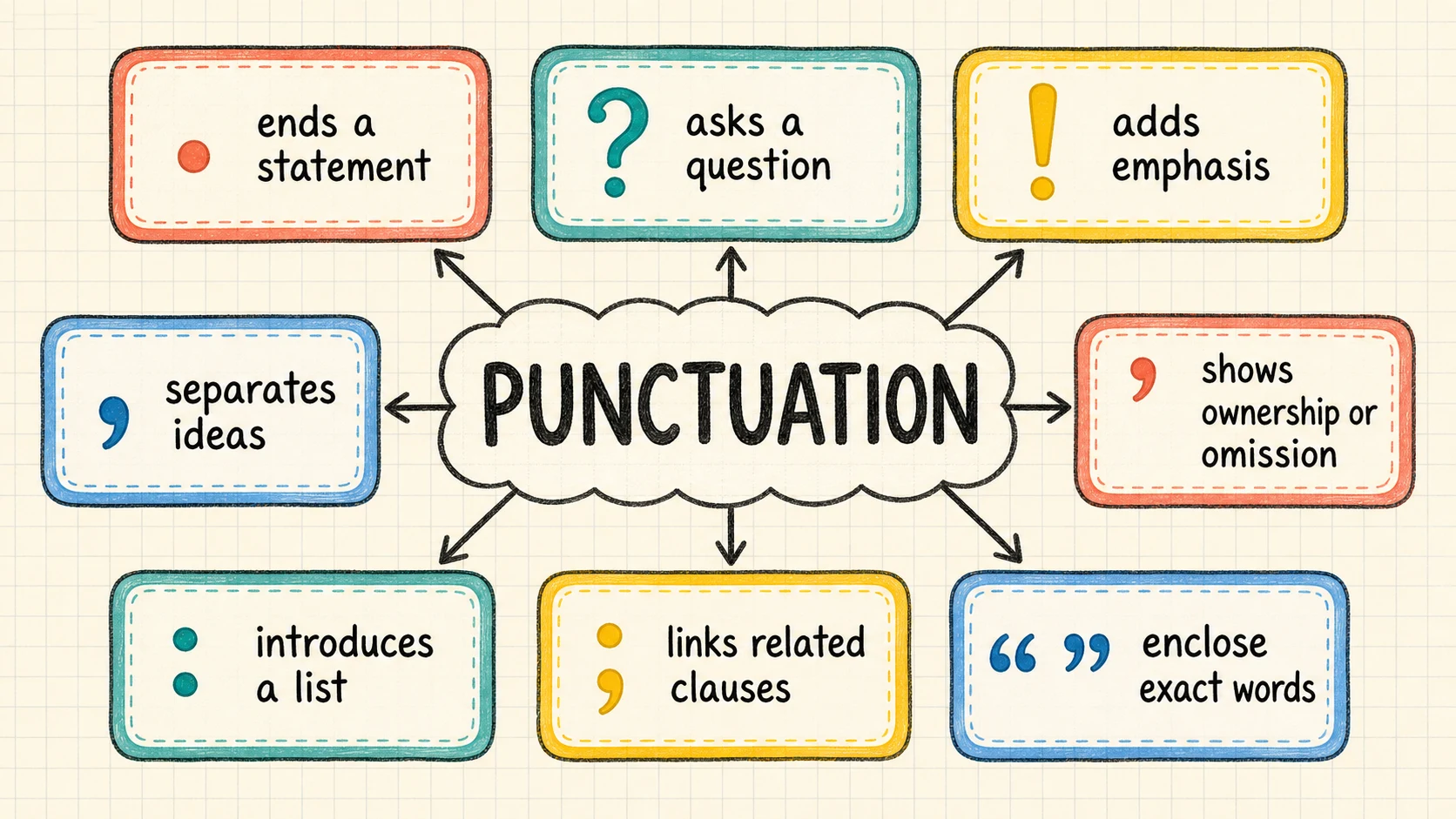
Use this map to isolate one punctuation function—such as a comma after an introductory element—rather than assigning every mark at once.
The Common Core English Language Arts standards provide a public description of grade-level language expectations, including conventions and their application in writing. That source can help an adult understand the broad instructional territory. It did not evaluate WorksheetWise, and a catalogue label alone does not establish that a particular learner has mastered a standard.
A practical progression across the three topics
A sensible instructional sequence follows the dependency in the learner’s error, not a rigid topic order:
- Establish whether the thought is complete.
- Identify the word or clause relationships needed to discuss it.
- apply the punctuation that makes those relationships visible.
- Return to the learner’s writing and check transfer.
For example, consider: “When the storm ended.” Calling when a conjunction does not repair the fragment. The learner first needs to recognize that the opening dependent clause leaves the reader waiting. Completing it—“When the storm ended, we inspected the garden”—then creates a meaningful reason to teach the introductory comma.
Start sentence work with complete thoughts
The 6th Grade Sentence Structure guide and free sheet is the strongest starting point when meaning breaks down at sentence boundaries. The live topic covers complete sentences, subjects and predicates, fragments, run-ons, sentence combining, compound and complex sentences, expansion, and varied beginnings.
Checked example: repair a fragment without discarding its idea
Consider:
Because the robotics team needed more time.
This is not complete in standard written English. The robotics team is the subject, and needed more time is its predicate, but because makes the group dependent. It prompts the question, “What happened because the team needed more time?”
One valid repair is:
Because the robotics team needed more time, the judges extended the deadline.
The opening clause is now attached to the independent clause the judges extended the deadline. The comma marks the boundary after the introductory dependent clause.
This example belongs at sixth-grade practice level because it goes beyond finding a missing noun or verb. The learner must notice how a subordinating word changes an otherwise complete-looking group and then connect that group logically to another clause.
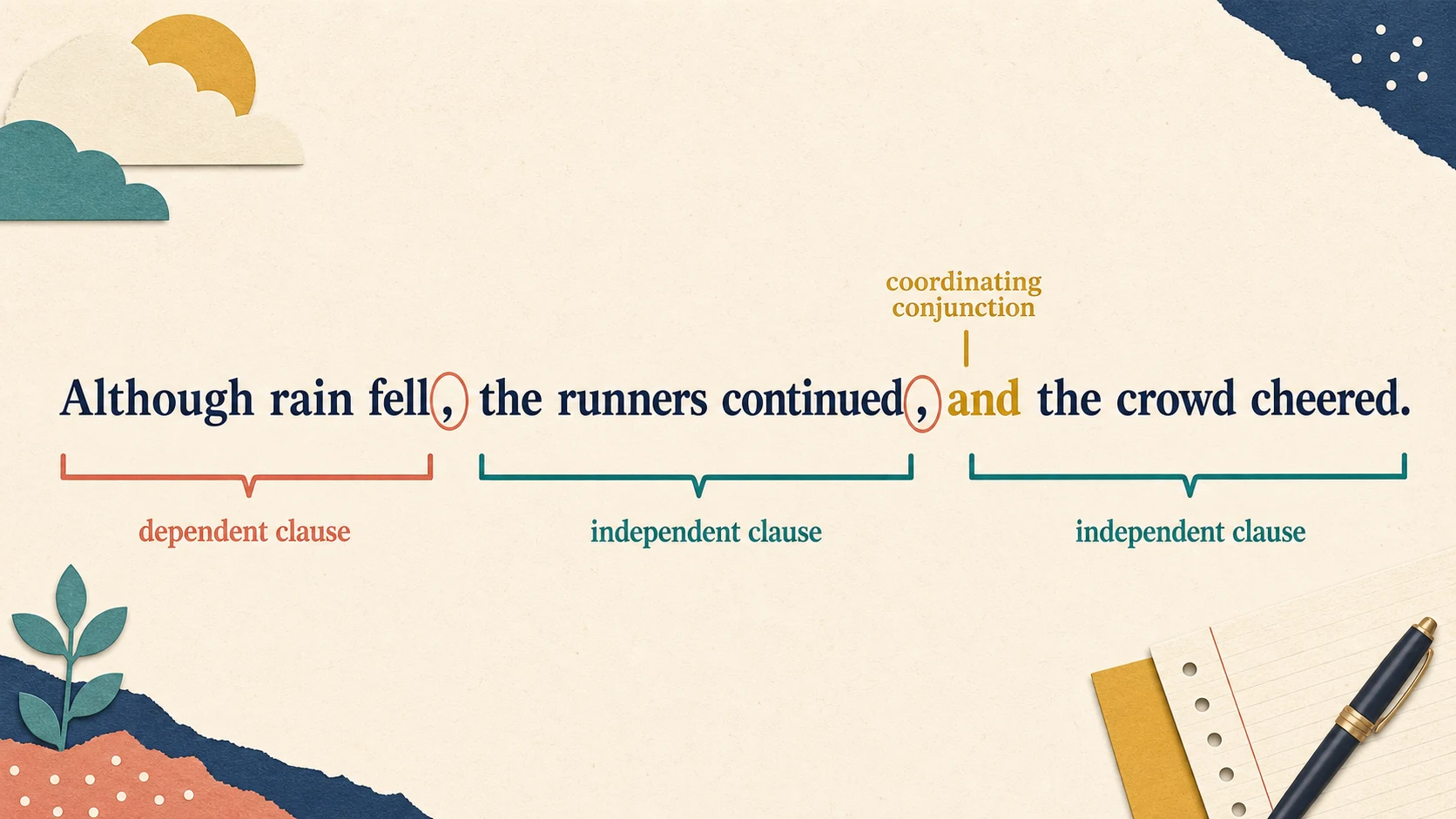
Cover the answer first, ask what the reader is still waiting to learn, and then compare the learner’s repair with the model.
Checked example: separate or coordinate a run-on
Consider:
Maya revised the introduction she left the conclusion unchanged.
There are two independent clauses:
- Maya revised the introduction.
- She left the conclusion unchanged.
The original has no valid boundary between them. Several repairs are possible, and each creates a slightly different presentation:
Maya revised the introduction, but she left the conclusion unchanged.
Maya revised the introduction; she left the conclusion unchanged.
Maya revised the introduction. She left the conclusion unchanged.
The first version makes the contrast explicit with but. The semicolon presents two closely related complete thoughts without naming the relationship. The period creates the firmest separation.
This is not merely a punctuation exercise. If the learner cannot locate the two complete clauses, asking for a comma rule will encourage guessing. Start with subject-predicate marking, then select a boundary.
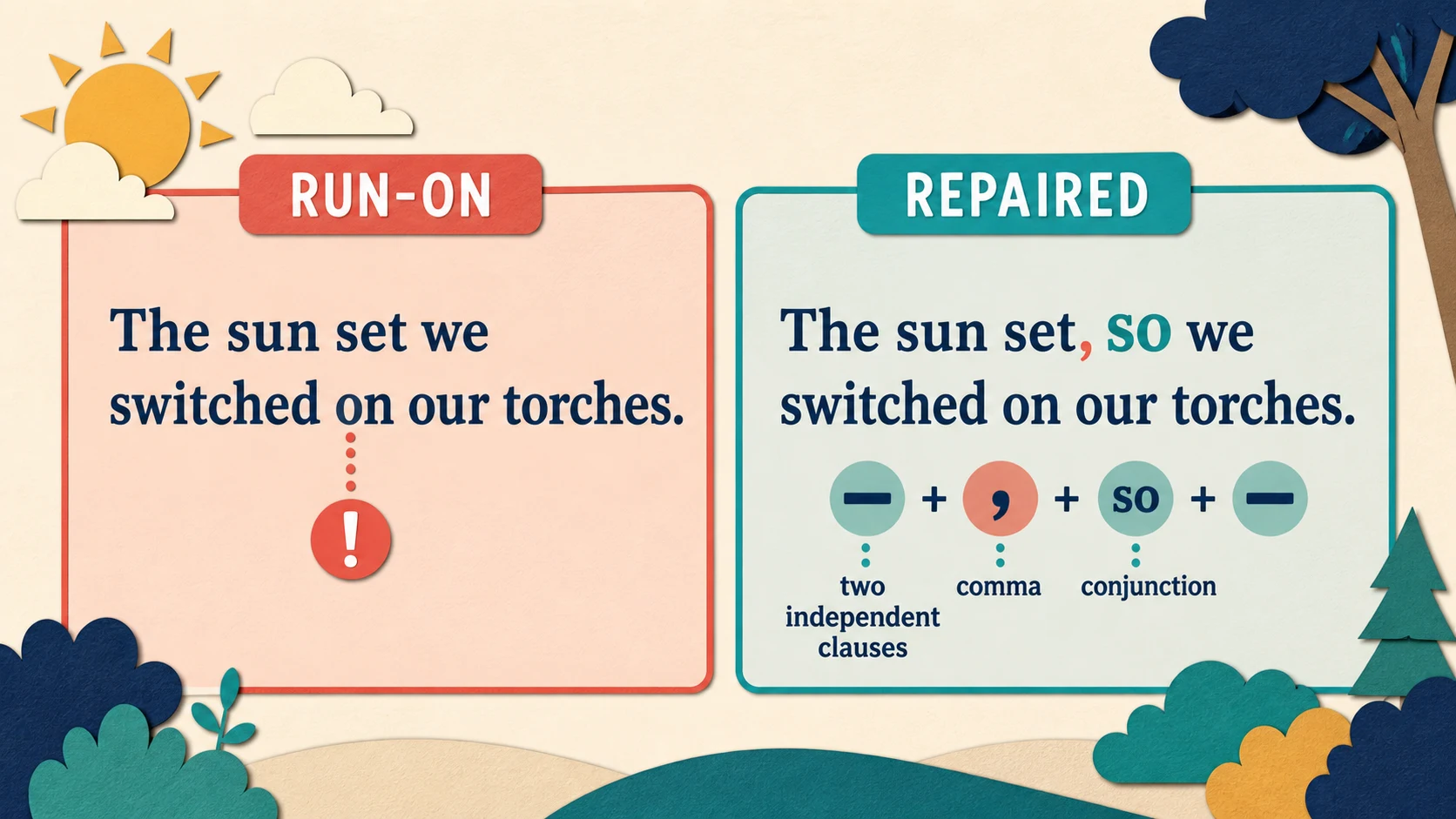
Match the response to the evidence: clause marking for a run-on, completion questions for a fragment, and combining choices for repetitive sentences.
Move from support to independent use
A useful sentence-structure progression is:
- Read two examples and explain which is complete.
- Underline one complete subject and double-underline its complete predicate.
- Repair one fragment with an orally supplied clause.
- Repair a new fragment without a supplied clause.
- Locate the boundary in a run-on.
- Choose among a period, semicolon, or comma plus conjunction.
- Revise one sentence from the learner’s own writing.
- Check later writing for the same feature without prompting.
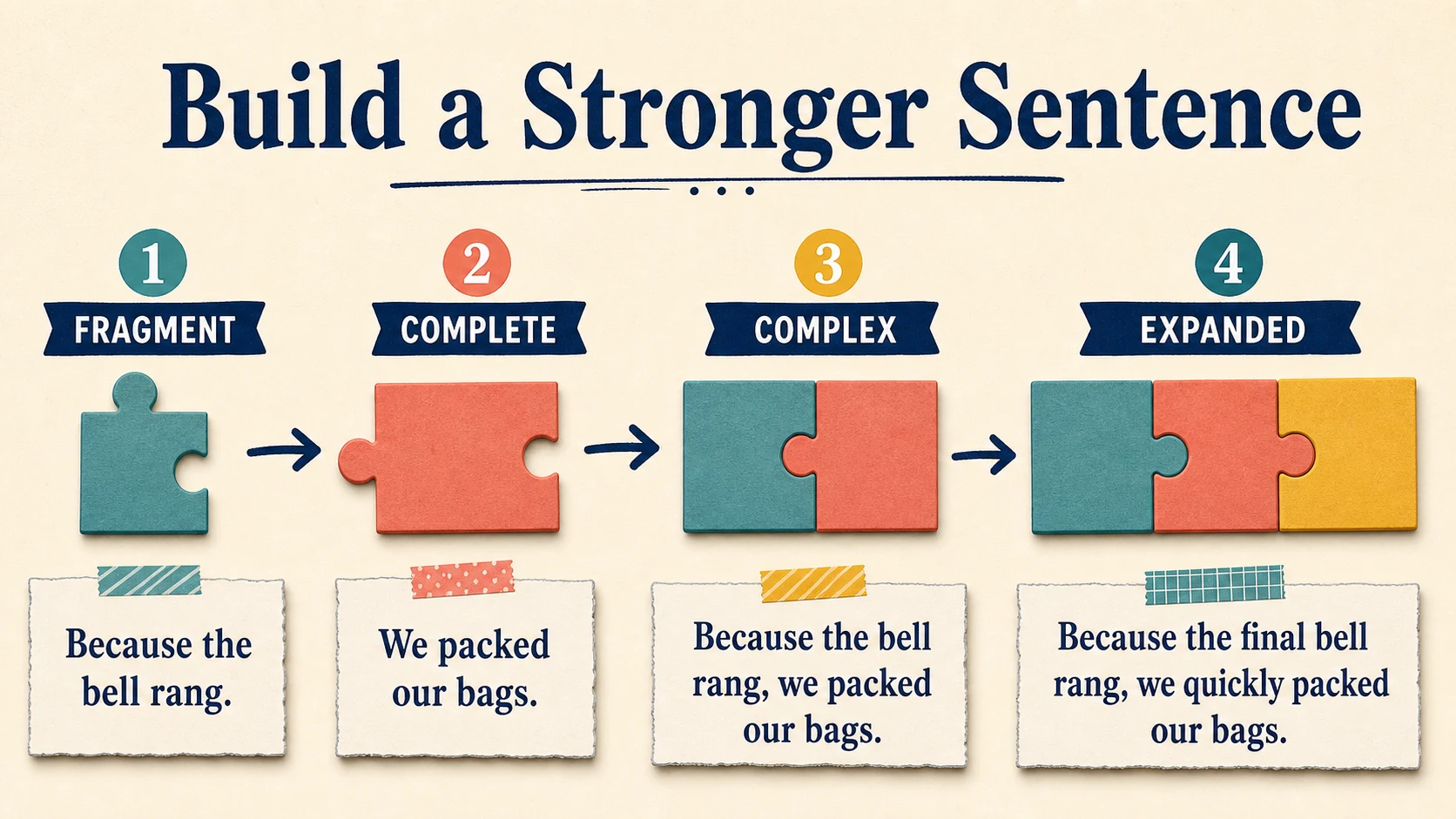
Move forward when the learner can explain the sentence boundary, not merely when an answer matches the key.
Use parts of speech to explain and revise real sentences
The 6th Grade Parts of Speech guide and free sheet covers nouns, verbs, adjectives, adverbs, pronouns, prepositions, conjunctions, and interjections. Its free sheet contains 30 problems.
Parts-of-speech practice is most useful when labels support another decision. Identifying a conjunction can help combine clauses. Locating a pronoun can expose an unclear reference. Distinguishing an adjective from an adverb can help a learner revise a description accurately.
Checked example: classify by function, not appearance
Compare these sentences:
We light the lantern at dusk.
The light reached the path.
We carried a light backpack.
In the first sentence, light is a verb: it names what we do. In the second, it is a noun: the light is the thing that reached the path. In the third, it is an adjective: it describes backpack.
All three classifications have been checked against the word’s function in its sentence. This example belongs in sixth-grade grammar because the learner must use syntax and meaning rather than rely on a memorized one-word category. A word list that labels light without context would hide the important reasoning.
A productive adult prompt is, “What is light doing in this sentence?” Avoid “What part of speech is light?” until the learner has examined the full sentence.
Checked example: make a pronoun’s antecedent unambiguous
Consider:
When Lena spoke to Ava, she sounded worried.
She could refer to Lena or Ava. The grammar is not necessarily malformed, but the reference is unclear. Two possible revisions preserve different intended meanings:
Lena sounded worried when she spoke to Ava.
When Lena spoke to Ava, Ava sounded worried.
The correct revision depends on the writer’s intended meaning; an answer key cannot infer that meaning from the original. This example belongs here because upper-grade parts-of-speech work should connect pronouns with antecedents rather than stop at circling the pronoun.
If a learner identifies she correctly but leaves the ambiguity, the missing skill is not pronoun recognition. Ask, “Which person does she replace, and can your reader know that?” That question converts a label into a writing decision.
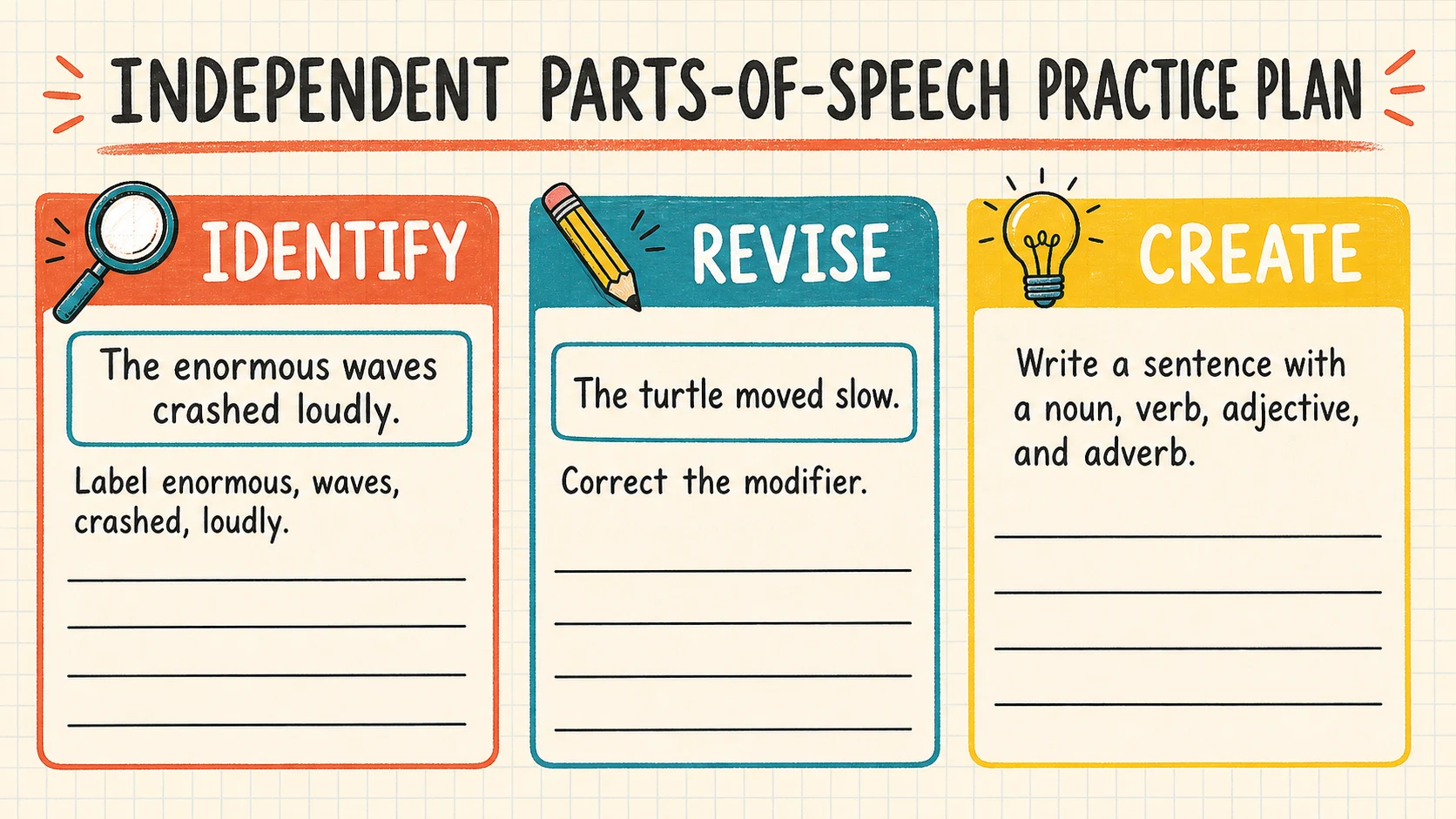
Keep review cumulative but narrow: revisit previously learned word functions while adding only one new decision at a time.
Teach punctuation as a meaning choice
The 6th Grade Punctuation guide and free sheet provides a 30-problem free entry point. The live topic includes end marks; commas in lists, dates, addresses, compound sentences, and introductory elements; apostrophes in contractions and possessives; quotation marks; colons; and semicolons.
Do not present “commas” as one skill. A learner who handles a list accurately may not understand a comma after an introductory phrase. Select one function and keep the other sentence features stable.
Checked example: compare an introductory comma with a compound-sentence comma
Sentence A:
After the final rehearsal, the cast packed the props.
After the final rehearsal is an introductory prepositional phrase. The comma separates that opening element from the main clause.
Sentence B:
The cast packed the props, and the director locked the theater.
The comma precedes and because it joins two independent clauses: The cast packed the props and the director locked the theater.
Both answers use a comma, but for different structural reasons. This example belongs at sixth-grade practice level because the learner must discriminate between two comma functions rather than insert marks wherever speech seems to pause.
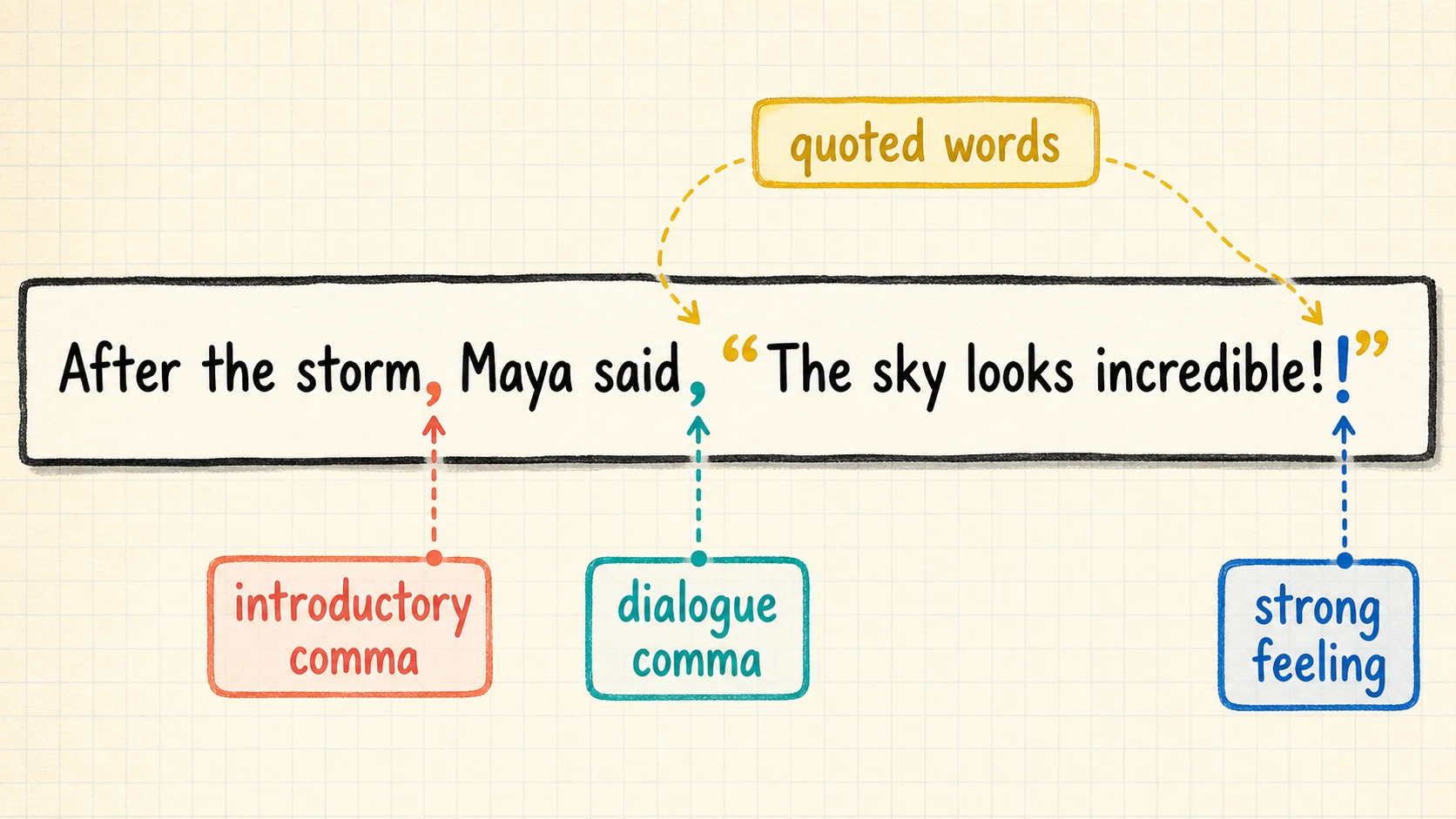
Ask the learner to name what the comma separates before accepting the mark as understood.
Checked example: distinguish possession from contraction
Compare:
The players’ equipment was stored near the field.
The players’re ready.
The first can be correct if the equipment belongs to multiple players: plural players takes an apostrophe after the existing s. The second is incorrect because players’re is not the conventional written contraction for players are. Write:
The players are ready.
Now compare a singular owner:
The player’s equipment was stored near the field.
The apostrophe before s signals one player’s possession. This example belongs here because it requires the learner to determine number and meaning before placing the apostrophe. A strategy such as “put an apostrophe before every final s” will fail.
The catalogue’s advice to distinguish contractions from possessives is supplied guidance specific to these resources. My suggested check is to have the learner expand any suspected contraction and name the owner in a possessive phrase. Those two tests reveal the intended relationship.
Interpret wrong answers before assigning more problems
A score tells you how many responses matched. It does not tell you why the learner missed them. Review a small sample aloud and look for a repeatable decision pattern.
What common response patterns may mean
If the learner marks under the old bridge as a sentence, ask for the “who or what” and “did what.” The phrase contains a noun but does not make a complete statement. The next task should contrast phrases with complete sentences, not introduce semicolons.
If every long sentence is labelled a run-on, the learner may be using length as the rule. Show one long, correctly structured sentence and one short run-on. Ask the learner to count independent clauses and inspect their boundaries.
If commas appear wherever the learner pauses while reading, oral phrasing has replaced structural analysis. Ask what the comma separates: list items, an introductory element, two coordinated clauses, or another named structure.
If the learner labels every word ending in -ly as an adverb, test function with a counterexample such as friendly in “The friendly guide waved.” Here friendly describes the noun guide, so it functions as an adjective.
If pronouns are identified accurately but antecedents remain unclear, move from identification to revision. Recognition has succeeded; reference control is the next bounded target.
These patterns are instructional hypotheses, not diagnoses. A single error may reflect distraction, unfamiliar vocabulary, ambiguous directions, handwriting difficulty, or a one-time guess. Confirm a pattern with two or three comparable items and one fresh example.
What to record
Use a brief evidence note:
Target: comma after an introductory element
Independent sample: 2 of 5 correct
Observed strategy: inserted commas after any opening word
Next prompt: bracket the whole introductory phrase before punctuating
Transfer check: one sentence from science writing tomorrow
This record is more actionable than “needs grammar help.” It identifies the task, the observed strategy, and the next check without labelling the learner.
Run a short routine that ends in writing
The Institute of Education Sciences guide on teaching elementary students to be effective writers recommends explicit instruction in writing processes and foundational writing skills, along with regular opportunities to write. That is sourced general guidance; it is not an assessment of WorksheetWise. The routine below is an editorial suggestion for using a selected sheet in a way that connects grammar practice to composition.
A 12-minute worksheet-to-writing routine
Minute 1: State the target. Say, “Today we will find where two complete thoughts run together and choose a boundary.”
Minutes 2–3: Model one item. Think aloud briefly: identify each subject and predicate, mark the clause boundary, and choose punctuation or a conjunction.
Minutes 4–7: Complete three to five items. Ask the learner to explain one choice. Do not require an explanation after every answer if that disrupts momentum.
Minutes 8–9: Sort the errors. Decide whether a miss came from finding the clauses, choosing the relationship, or applying the punctuation.
Minutes 10–11: Transfer the target. Revise one sentence from current schoolwork or write one original example about familiar content.
Minute 12: Set the next task. Record either “repeat with support,” “try a fresh item independently,” or “apply in a paragraph.”
For a daily warm-up, use fewer items across several days instead of finishing all 30 at once. In a writing mini-lesson, model with one sentence and then revise a sentence from the current draft. For test preparation, retain the selected-response format but require the learner to state the structural reason before checking the answer.
The IES Foundational Skills to Support Reading for Understanding addresses foundational reading instruction, including systematic work with language-related foundations. It offers useful background about explicit teaching, but it is not a sixth-grade grammar scope and did not review these worksheets. Do not use it to claim that completing a grammar sheet will produce a particular reading outcome.
Adapt access without removing the grammar decision
An adaptation preserves the target skill while reducing an unrelated barrier.
For a learner who tires during dense print, show five items at a time or cover the rest of the page. Keep the same grammar choices.
For a learner who reads slowly, read the sentence aloud while the learner follows the text. If the target is punctuation or clause structure rather than decoding, this preserves the intended decision.
For handwriting difficulty, allow pointing, highlighting, oral answers, or typing. Then ask for one independently written transfer sentence if composition is part of the target.
For unfamiliar vocabulary, define or replace a nonessential word while preserving the grammatical structure. If expedition blocks a comma exercise, use trip. Do not simplify the target clause relationship.
For a learner who guesses among eight parts of speech, reduce the initial choice set to the plausible categories, such as noun versus verb. Restore a broader choice set after the learner can justify the distinction in context.
For a learner ready for more complexity, do not merely add more items. Remove answer choices, mix two previously mastered rule types, ask for two valid sentence repairs, or require application in a short paragraph. Difficulty should be visible in the task: more rule discrimination, less prompting, longer context, or greater independent generation.
The catalogue teaching tips suggest oral language, movement, sorting, mentor sentences, explicit modelling, and editing practice. Those are supplied catalogue recommendations. Adults can use them selectively, but the live facts do not establish comparative effectiveness or guarantee an outcome.
Respect the limits of worksheet evidence
A completed worksheet offers a controlled sample. It can show whether a learner made a particular decision under those directions on that occasion. It cannot by itself establish mastery across writing contexts, explain the cause of an error, diagnose a learning condition, or prove standards attainment.
A 27-out-of-30 result may conceal one repeated misconception if all three misses concern the same comma function. A 20-out-of-30 result may combine several one-time slips with one clear pattern. Inspect the errors rather than relying only on the total.
Also distinguish identification from production. Circling the verb in 30 sentences does not necessarily mean the learner will choose a precise verb while drafting. Correcting a supplied run-on does not necessarily mean sentence boundaries will transfer to an original paragraph. Include a fresh item and a writing sample before moving on.
The catalogue contains three free resources, not a complete individualized curriculum. The 54 variants offer practice choices within the live sixth-grade grammar collection, but the verified facts do not establish a fixed order among every variant. Adults should use classroom requirements, current writing, and observed responses to decide what comes next.
If a learner’s difficulties are persistent, broad, or affecting participation across subjects, save concrete work samples and discuss them with the learner’s teacher or an appropriate qualified professional. Describe what happened—“independently found 1 of 5 clause boundaries”—rather than proposing a diagnosis.
Make the next assignment from visible evidence
Choose one sentence from the learner’s recent work and run this decision:
- If it is incomplete or contains two unmarked complete thoughts, begin with Sentence Structure.
- If its structure is clear but a specific mark is wrong, begin with Punctuation and name the exact function.
- If revision depends on understanding a word’s role or a pronoun’s reference, begin with Parts of Speech.
- If the sentence is already correct, ask the learner to explain why, then choose a nearby extension such as combining, expansion, or varied beginnings.
Do not assign all three free sheets as a general check. Start with three to five items from one topic, inspect the reasoning, and use a fresh sentence to verify the result. Continue when the learner explains the choice and applies it independently; step back to modelling when the rule is guessed or confused with another rule.
For the next session, open the 6th Grade Sentence Structure guide and free sheet, select one fragment-or-run-on target, and have the learner repair one real sentence after three practice items. Record the repair and the explanation. That observable work—not the grade label or total number completed—should determine tomorrow’s task.
Put it into practice
Use the guide with a real printable
Move from explanation to a short, observable practice task. Check the first item together, then adjust the next session from the learner's actual work.
Open the first free worksheet