What 6th Grade Decimals instruction should accomplish
A learner is ready for sixth-grade decimal work when they can explain decimal place value, compare and round decimals, connect familiar fractions with decimals, and accurately add, subtract, multiply, and divide decimals. Effective instruction should move between models, words, symbols, estimation, and computation. The learner’s observed work—not a fixed calendar—should determine when to move forward or return to a prerequisite.
Grade labels describe the intended practice level; local curricula and teaching sequences differ. The Common Core State Standards for Mathematics place fluent computation with multi-digit decimals in Grade 6, while related place-value, comparison, rounding, and operational ideas begin in earlier grades. This guide therefore includes both prerequisite checks and grade-level practice.
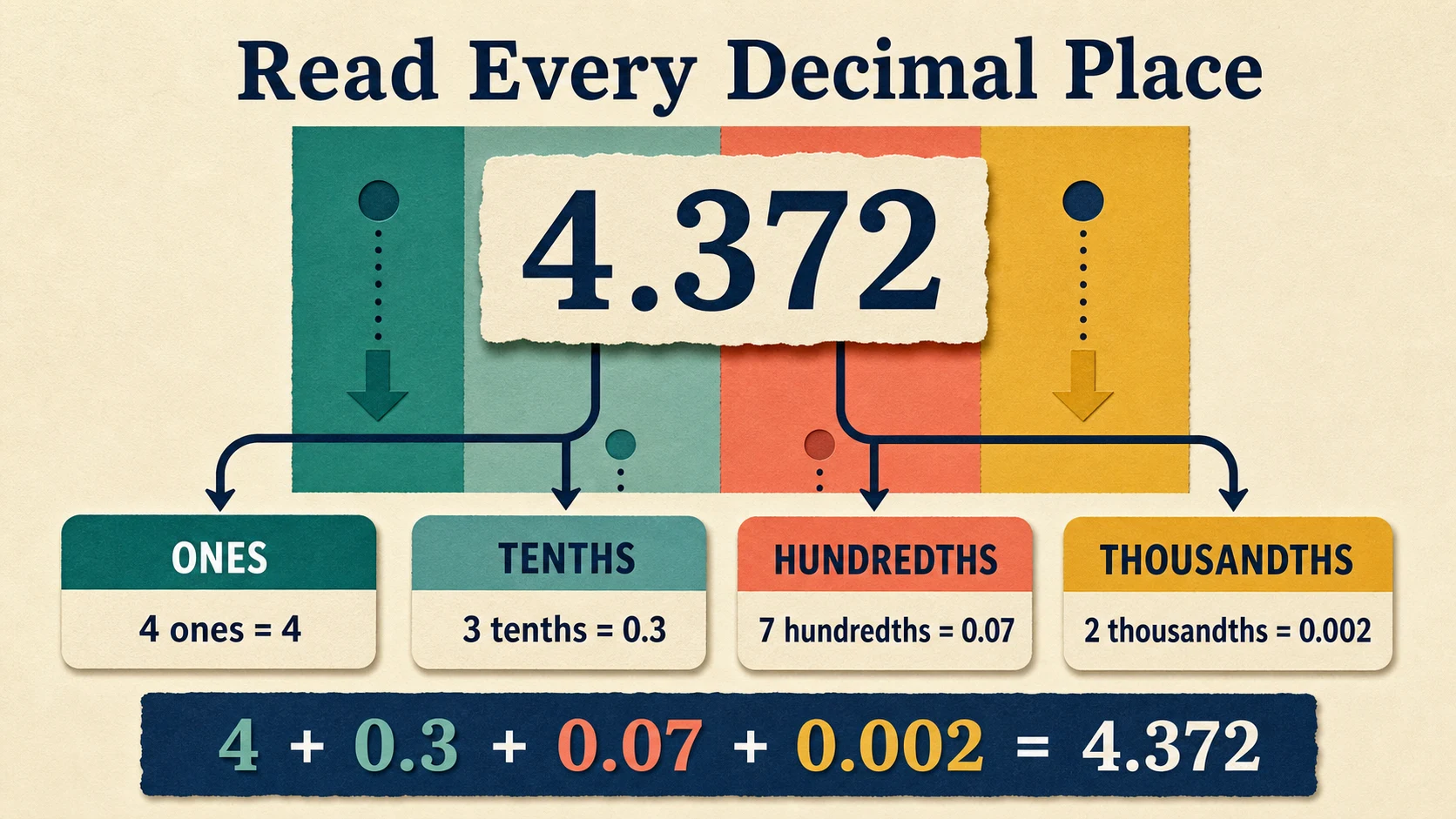
Place value and fraction meaning support comparison, rounding, estimation, and all four operations.
Use this guide to decide:
- whether the learner needs conceptual review or computation practice;
- which representation will make an error visible;
- how difficult the next problem set should be;
- when mixed and independent practice is appropriate.
The broader 6th Grade Math collection can help place decimal work alongside ratios, fractions, negative numbers, expressions, equations, and statistics.
Prerequisites to check before formal practice
A quick prerequisite check is more useful than assuming that a sixth grader remembers every earlier decimal skill. Ask the learner to solve a few short tasks and explain each answer.
Whole-number place value
The learner should understand that moving one place left makes a digit’s value ten times as great, while moving one place right makes it one-tenth as great.
For example, the digit 6 has different values in:
- 60: six tens;
- 6: six ones;
- 0.6: six tenths;
- 0.06: six hundredths.
If the learner reads 0.06 as “six tenths,” pause decimal operations. Use a place-value chart and ask what unit each digit counts.
Fraction and decimal connections
Check familiar equivalences such as:
- 3/10=0.3
- 27/100=0.27
- 5/10=50/100=0.5
- 1/4=25/100=0.25
The learner does not need to convert every possible fraction mentally before beginning, but denominators of 10 and 100 should be meaningful. A hundredths grid is especially helpful: shading 25 of 100 squares shows why 25/100=0.25.
Whole-number operations and multiplication facts
Decimal computation adds place-value demands to ordinary arithmetic. If a learner is still frequently losing track of regrouping or basic multiplication facts, separate those difficulties from decimal-point errors.
For example, an incorrect answer to 2.4×3 may come from either:
- misunderstanding that 24 tenths multiplied by 3 equals 72 tenths; or
- calculating 24×3 incorrectly.
Ask the learner to calculate 24×3 first. That small check identifies which issue needs attention.
Estimation and reasonableness
Give a problem such as 19.8+4.13 and ask for an approximate answer before an exact one. A reasonable estimate is about 20+4=24. Estimation need not be elaborate; its purpose is to establish the expected size of an answer.
The IES guide on assisting students who struggle with mathematics supports high-level practices such as systematic instruction, clear mathematical language, suitable representations, and ongoing attention to what students understand. Here, those principles justify checking prerequisites and explanations instead of relying only on a final score.
A grade-appropriate progression
Teach decimal ideas in a sequence that preserves meaning. Do not interpret the table as a universal timetable. A learner may need more time in one row and less in another.
| Stage |
Main learning goal |
Useful evidence of readiness to advance |
| 1. Place value |
Read, write, compose, and decompose decimals |
Explains why 0.4 equals 0.40 |
| 2. Fraction connections |
Relate tenths and hundredths to fractions |
Matches models, fractions, and decimals |
| 3. Compare and order |
Compare by place value, not numeral length |
Correctly explains why 0.4 is greater than 0.36 |
| 4. Round and estimate |
Use nearby benchmark values |
States the rounding place and checks neighboring values |
| 5. Add and subtract |
Combine like place-value units |
Aligns decimal points and checks by estimation |
| 6. Multiply |
Interpret products and place the decimal reasonably |
Estimates before calculating |
| 7. Divide |
Interpret quotient size and use equivalent forms |
Explains why adding a terminal zero does not change value |
| 8. Mixed application |
Choose an operation from context |
Labels quantities and checks whether the answer fits |
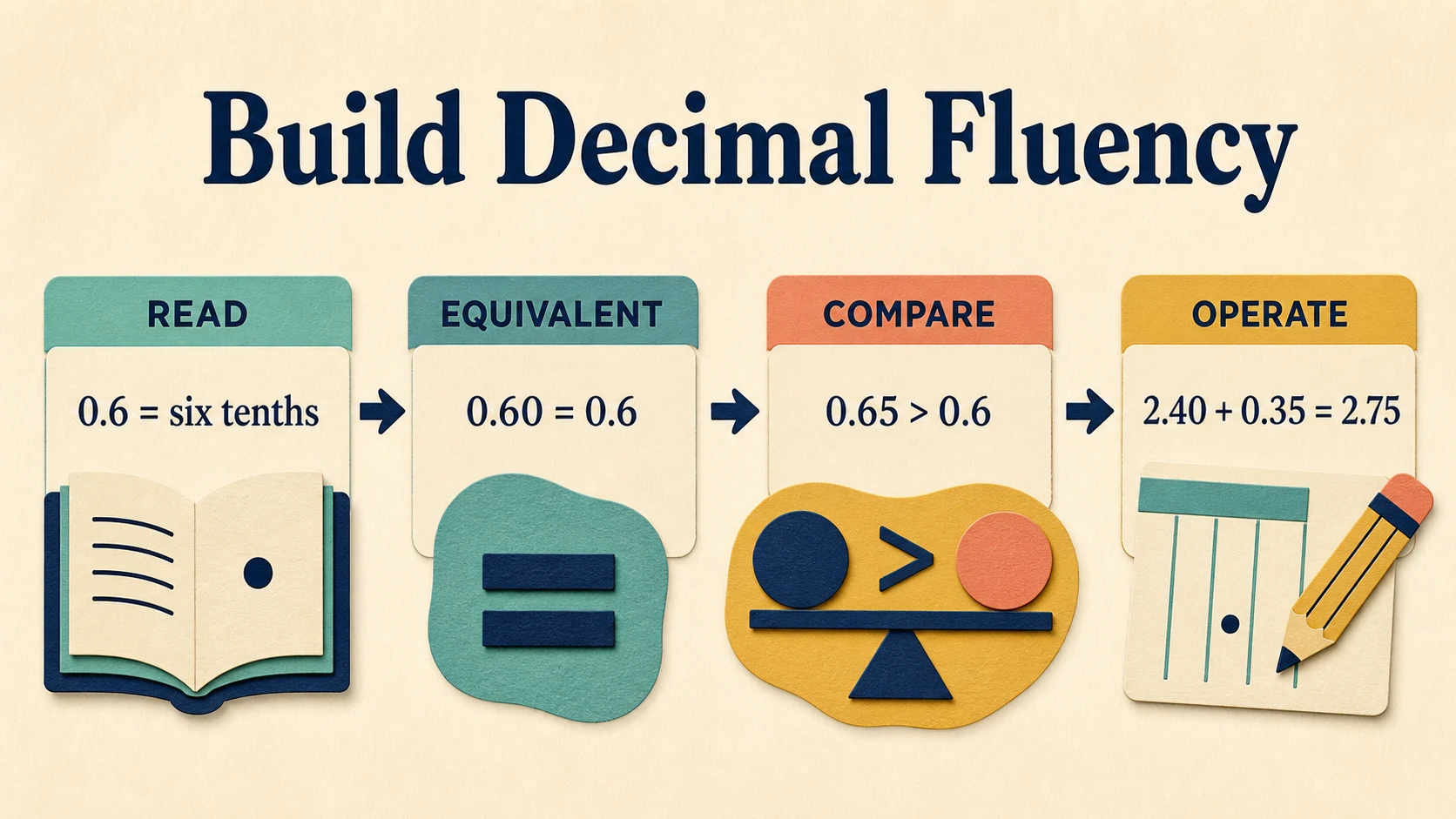
Progress from visible models and guided explanations toward mixed, independent computation.
Within each stage, use this smaller progression:
- Model the quantity or operation.
- Connect the model to mathematical notation.
- Solve with prompts.
- Solve a short set without prompts.
- Explain or check one answer.
- Mix the skill with previously learned material.
A learner who succeeds only when all problems use the same operation is not yet demonstrating flexible selection. Mixed practice should follow secure single-skill practice, not replace it at the beginning.
Concrete and visual models that preserve decimal meaning
Models are useful when they reveal the unit being counted. Before using any model, state what represents one whole. Changing the whole without saying so can make an otherwise accurate diagram confusing.
Base-ten blocks
Use a flat as 1, a rod as 0.1, and a small cube as 0.01. Under that convention:
- 3 rods represent 0.3;
- 6 small cubes represent 0.06;
- 3 rods and 6 cubes represent 0.36.
To compare 0.36 with 0.4, rename 0.4 as 0.40. Four rods can be viewed as 40 hundredths, while 0.36 is 36 hundredths. Therefore, 0.40>0.36.
This model also supports regrouping. In subtraction, one tenth can be exchanged for ten hundredths just as one ten can be exchanged for ten ones.
Hundredths grids
A 10×10 grid contains 100 equal squares. If the full grid represents 1, each row represents 0.1 and each square represents 0.01.
Shade 35 squares to show 35/100=0.35. Shade 5 more squares, and the total becomes 40/100=0.40=0.4. This provides a visible explanation of terminal zeros: the notation changes, but the amount does not.
Number lines
Number lines show magnitude and spacing. Place 2.3 and 2.4, then divide the interval into ten equal parts. The marks represent hundredths: 2.31, 2.32, and so on.
A number line is particularly helpful for rounding. Because 2.36 lies between 2.3 and 2.4 and is closer to 2.4, it rounds to 2.4 to the nearest tenth.
Money and measurement
Money can make hundredths familiar: $0.25 is 25 hundredths of a dollar. However, money alone does not model thousandths, and it may encourage learners to expect exactly two decimal places in every problem.
Measurement offers broader examples. A length of 1.25 meters can be decomposed as 1 meter, 2 tenths of a meter, and 5 hundredths of a meter. Always identify the measurement unit; 1.25 meters and 1.25 centimeters are numerically alike but represent different lengths.
The IES early-mathematics practice guide provides high-level support for intentionally using representations, mathematical language, and connected learning experiences. It does not evaluate WorksheetWise or prescribe this exact sequence.
Fully checked worked examples
The strongest worked examples show the reasoning that determines an answer, not just a memorized procedure.
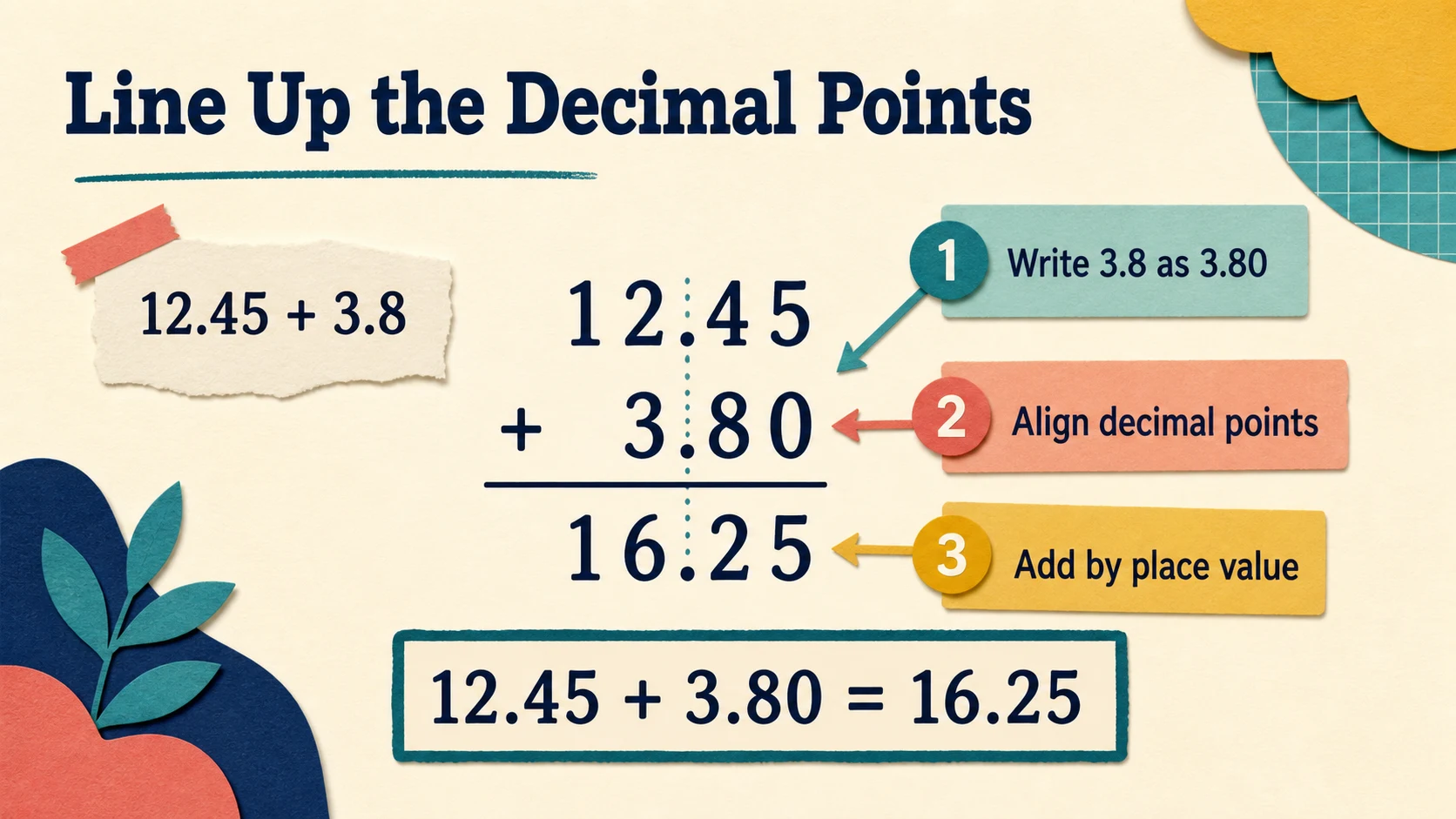
Connect the represented quantity to place-value language before applying a written method.
Example 1: Comparing decimals
Compare 0.36 and 0.4.
First, write both numbers to the same visible place:
0.36and0.40
Both have 0 ones. Compare tenths:
- 0.36 has 3 tenths.
- 0.40 has 4 tenths.
Because 4 tenths is greater than 3 tenths:
0.36<0.40
Therefore:
0.36<0.4
Check with hundredths: 36 hundredths is less than 40 hundredths. Numeral length is irrelevant; place value controls the comparison.
Example 2: Adding decimals with unequal lengths
Calculate 12.7+3.085.
Estimate first:
13+3=16
Write 12.7 as 12.700 and align decimal points:
12.700+3.08515.785
By place value:
- thousandths: 0+5=5;
- hundredths: 0+8=8;
- tenths: 7+0=7;
- ones: 2+3=5;
- tens: 1+0=1.
Thus:
12.7+3.085=15.785
The answer is close to 16, so it agrees with the estimate.
Example 3: Subtracting across zeros
Calculate 8−2.47.
Estimate:
8−2.5≈5.5
Rewrite 8 as 8.00:
8.00−2.475.53
One way to verify the regrouping is by addition:
5.53+2.47=8.00
Therefore:
8−2.47=5.53
The exact answer, 5.53, is close to the estimate of 5.5.
Example 4: Multiplying a decimal
Calculate 3.6×2.4.
Estimate:
4×2=8
Now use whole-number multiplication:
36×24=36×(20+4)=720+144=864
Because 3.6=36/10 and 2.4=24/10:
3.6×2.4=1036×1024=100864=8.64
Therefore:
3.6×2.4=8.64
The answer is near 8, as expected. An answer of 86.4 or 0.864 would conflict with the estimate.
Example 5: Dividing by a whole number
Calculate 7.56÷3.
Interpret the dividend by place value:
- 7 ones shared among 3 groups gives 2 ones per group, with 1 one remaining.
- Regroup the remaining one as 10 tenths; with the existing 5 tenths, there are 15 tenths.
- 15 tenths divided by 3 gives 5 tenths.
- 6 hundredths divided by 3 gives 2 hundredths.
So:
7.56÷3=2.52
Check by multiplication:
2.52×3=7.56
Therefore:
7.56÷3=2.52
Example 6: Dividing by a decimal
Calculate 4.2÷0.6.
Multiply both numbers by 10:
4.2÷0.6=42÷6
This transformation preserves the quotient because both the dividend and divisor were scaled by the same nonzero factor.
Now calculate:
42÷6=7
Therefore:
4.2÷0.6=7
Check:
7×0.6=4.2
This check is essential because some learners assume that division must make a number smaller. Dividing by a number less than 1 can produce a quotient greater than the dividend.
Boundary cases that reveal understanding
Routine problems can hide misconceptions. Include a few carefully selected boundary cases.
Zeros that change appearance but not value
0.5=0.50=0.500
Zeros added to the right of the last decimal digit do not change the value. In contrast:
0.5=0.05
Moving 5 from the tenths place to the hundredths place makes its value one-tenth as large.
Products less than either factor
0.4×0.3=0.12
The product is less than 0.4 and less than 0.3 because each factor is between 0 and 1. A learner who reports 1.2 should compare the result with the expected magnitude.
Division by numbers below one
3÷0.5=6
The expression asks how many halves fit in 3. There are 6 halves, so the quotient is greater than 3.
Rounding at a midpoint
To round 2.35 to the nearest tenth, compare 2.35 with the neighboring tenths 2.3 and 2.4. It is exactly halfway. Under the usual school rule of rounding a midpoint upward:
2.35→2.4
State the rounding convention being used. Do not let a learner treat the rule as a substitute for identifying the two neighboring values.
Subtracting nearly equal values
5.02−4.98=0.04
An estimate using whole numbers gives 5−5=0, indicating that the exact answer should be small. Addition verifies it:
4.98+0.04=5.02
A short, repeatable lesson routine
A focused lesson can fit into 15–25 minutes, but this is an instructional suggestion rather than a universal timetable. Adjust the length when attention, accuracy, or explanation quality declines.
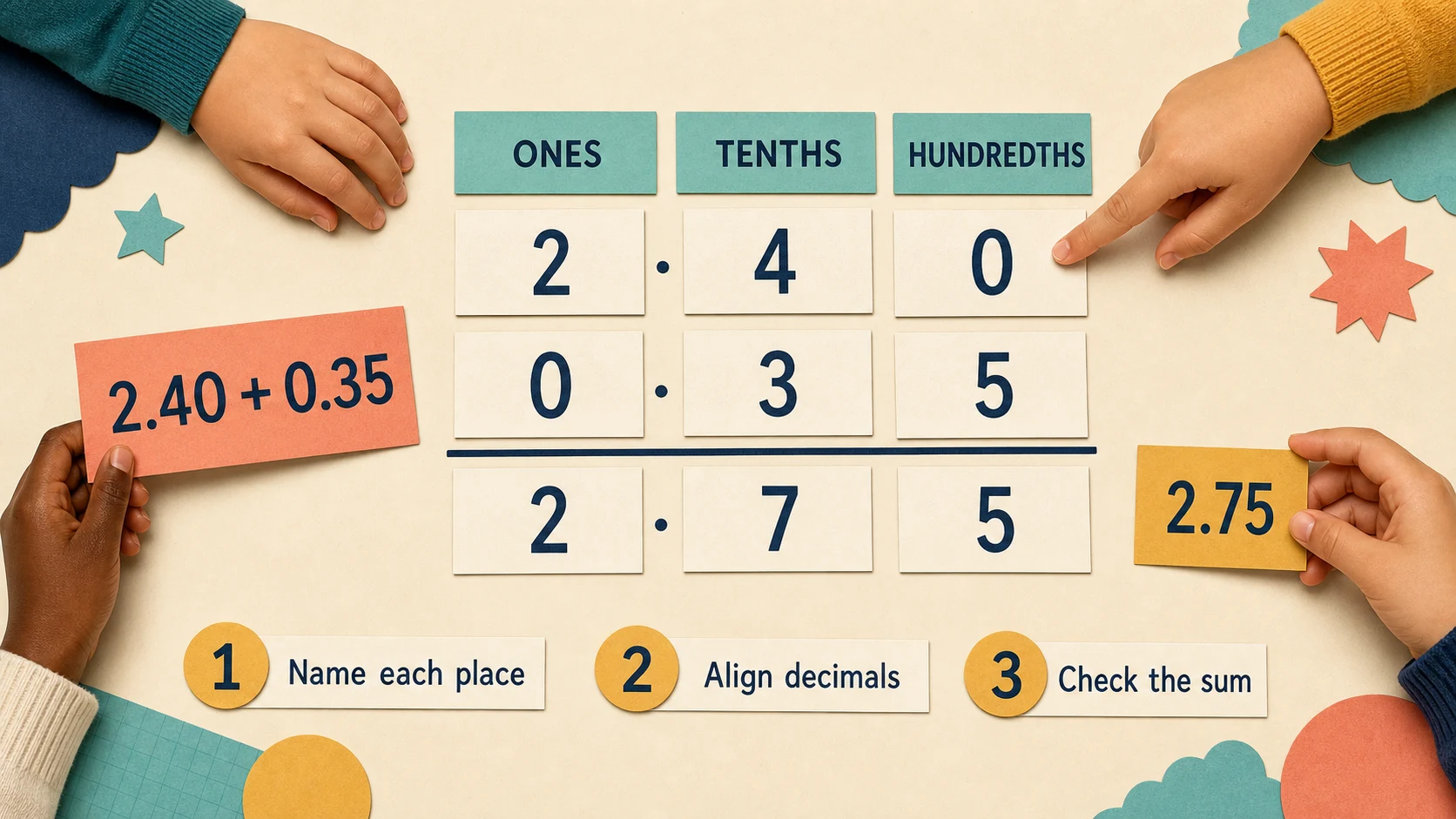
Use a brief cycle of retrieval, modeling, guided work, independent practice, and review.
1. Retrieve a prerequisite
Spend two or three minutes on one connected task:
- name the value of a digit;
- write a fraction as a decimal;
- locate a decimal on a number line;
- estimate an operation.
2. Model one idea
Work one example aloud. Use exact place-value language: “seven hundredths,” not merely “the seven.” Show how the diagram, written notation, and operation correspond.
3. Solve together
Give one similar problem. Ask the learner to choose the next step and explain why. Supply only the prompt needed to continue.
Useful prompts include:
- “What is the whole?”
- “Which digits count the same place-value units?”
- “About how large should the answer be?”
- “How could you verify it?”
4. Complete a short independent set
Assign three to six problems focused on the same idea. Stop to inspect the work rather than waiting until a long page is finished.
5. Close with one explanation
Ask the learner to explain one answer, correct one error, or create a similar problem. Record the next teaching decision: advance, repeat with less support, or return to a prerequisite.
Choosing useful practice
Practice should match the learner’s current error pattern. Difficulty labels alone are not enough.
Begin with single-skill practice when the written method is new. For addition, this might include several problems with unequal decimal lengths so that alignment matters. Once accuracy and explanations are stable, mix addition with subtraction. Later, combine all four operations and contextual problems.
A useful practice set includes:
- a few direct computations;
- one comparison or estimate;
- one problem requiring an operation choice;
- one item that asks for an explanation or check;
- previously learned material for review.
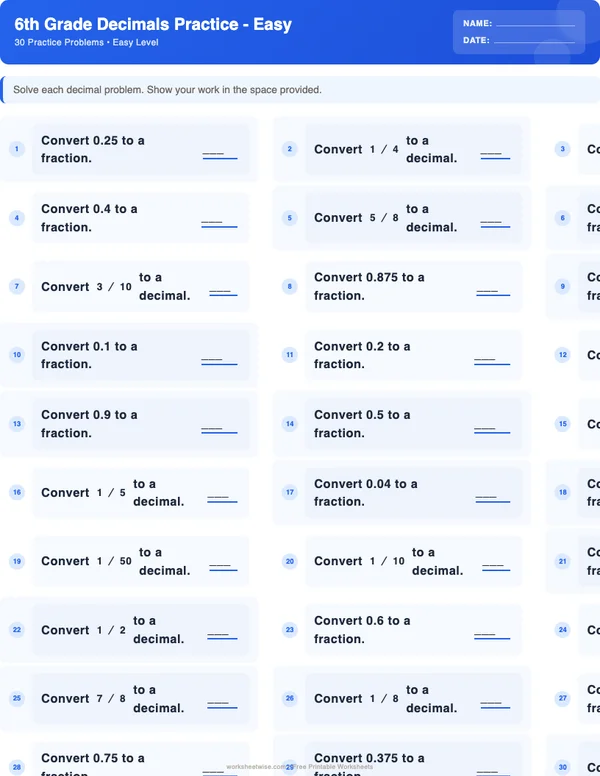
The free 6th Grade Decimals worksheet contains 30 easy-level exercises covering conversion, addition, subtraction, multiplication, decimal operations, fraction-decimal conversion, and number sense. It includes a separate answer key. It is suitable when a learner is beginning the topic or needs foundational reinforcement, but it should not be treated as evidence of complete mastery by itself.
For broader practice, the Decimals topic guide and worksheet collection provides the relevant topic location. The focused decimals pack contains 18 worksheets and is listed at $4.79. Select from it according to demonstrated need rather than assigning every page automatically.
Differentiation without lowering the mathematical goal
Differentiation should change access, representation, quantity, or pacing while preserving the important idea.
For a learner who needs more support:
- use a place-value chart or grid;
- reduce the number of problems in one sitting;
- provide one completed example;
- keep operation types separate initially;
- ask for an estimate before exact calculation;
- allow verbal explanations before written ones.
For a learner who is accurate but slow:
- inspect whether the delay comes from facts, notation, checking, or uncertainty;
- use short untimed sets before adding any time constraint;
- encourage efficient recording without skipping meaningful steps;
- compare methods after correctness is secure.
For a learner ready for extension:
- include missing-number equations such as 3.7+□=5.02;
- ask for two decimals between 0.38 and 0.39;
- compare two valid solution methods;
- require an error analysis;
- add multi-step contexts in which the operation is not named.
Extension should increase reasoning demands, not merely add longer strings of digits.
Common errors and diagnostic responses
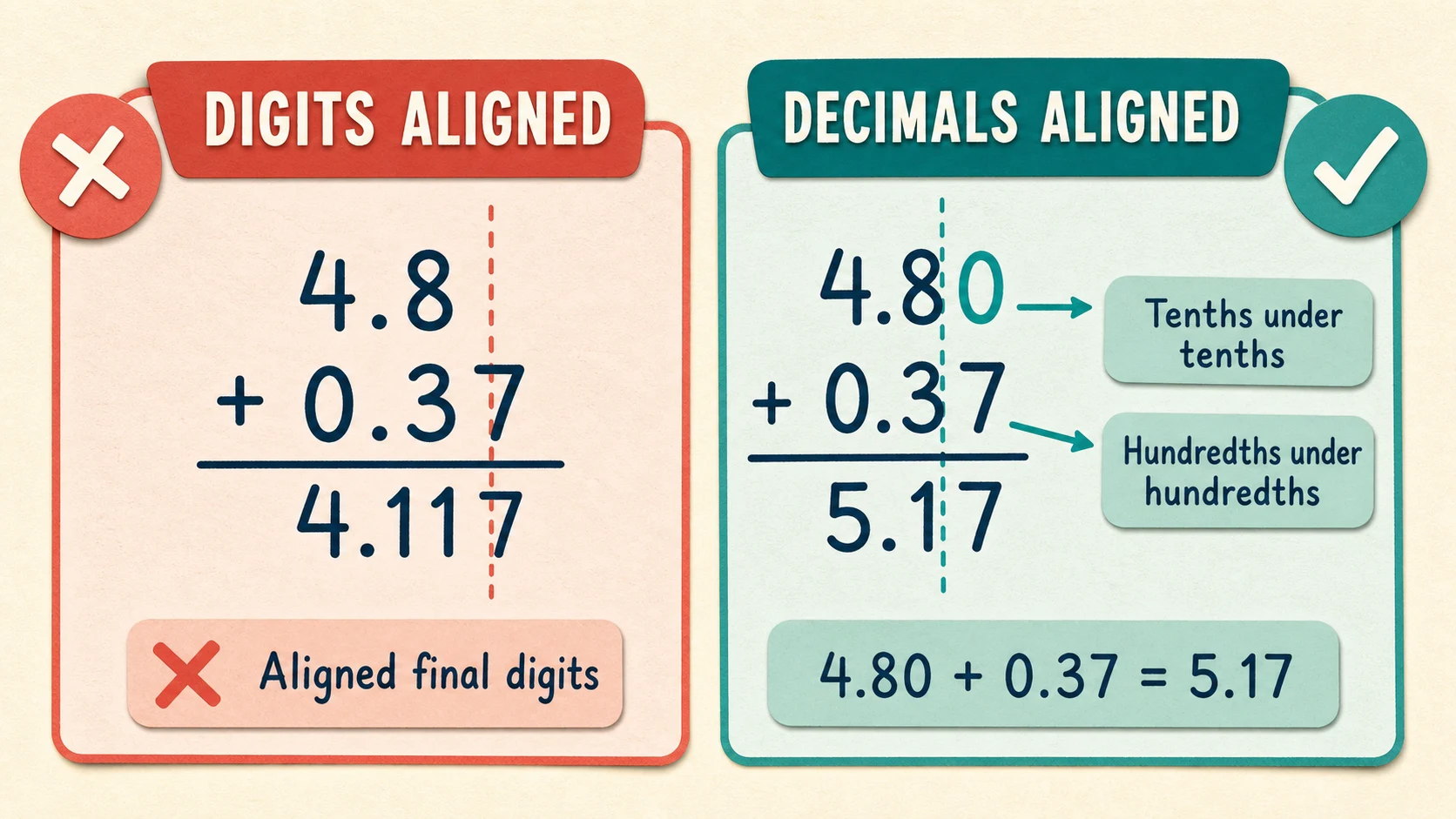
Treat repeated errors as evidence about the learner’s current reasoning, then choose a targeted response.
| Observed work |
Likely issue to investigate |
Teaching response |
| Claims 0.36>0.4 |
Compares numeral length or treats decimals like whole numbers |
Rename 0.4 as 0.40 and compare models |
| Calculates 3.2+0.45=3.77 |
Aligns final digits instead of decimal points |
Use a place-value chart and add like units |
| Writes 6−2.8=4.8 |
Regrouping across the decimal is unclear |
Rewrite 6 as 6.0 and verify by addition |
| Gives 2.5×0.4=10 |
Ignores product magnitude |
Estimate and express factors as fractions over 10 |
| Moves only one decimal in 4.2÷0.6 |
Applies a rule without preserving the quotient |
Scale dividend and divisor by the same factor |
| Says 3÷0.5=1.5 |
Assumes division always makes smaller |
Ask how many halves fit in 3 |
| Rounds 6.47 to 6.4 at the nearest tenth |
Looks at the wrong digit or truncates |
Identify neighboring tenths and locate 6.47 |
| Omits units in a context |
Treats numbers without quantities |
Label each value before choosing an operation |
Do not diagnose from one slip. Give a nearby problem and ask the learner to explain. If the same reasoning appears again, respond to that specific misconception.
Monitoring progress and deciding when to advance
Monitor a small set of indicators rather than relying on page completion:
- accuracy on a short independent set;
- correct decimal alignment and notation;
- use of a reasonable estimate;
- ability to explain place value;
- selection of the correct operation in context;
- successful checking by inverse operation or substitution;
- retention after a gap of several days.
A simple record can contain the date, skill, number correct, error type, level of prompting, and next step. “Eight of ten correct independently; both errors involved decimal comparison” is more actionable than “needs more practice.”
Advance when the learner is consistently accurate, can explain at least one representative problem, and retains the skill in later mixed work. Return to a model when errors cluster around meaning. If errors are isolated arithmetic slips, targeted computation practice may be enough.
The standards describe learning expectations, but they do not replace observation. Use the Common Core mathematics standards for broad grade-level context and the learner’s actual work for immediate pacing decisions.
A flexible two-week practice plan
This plan assumes ten short sessions. It is a practical example, not a mandated schedule. Combine, repeat, or postpone sessions according to the learner’s responses.
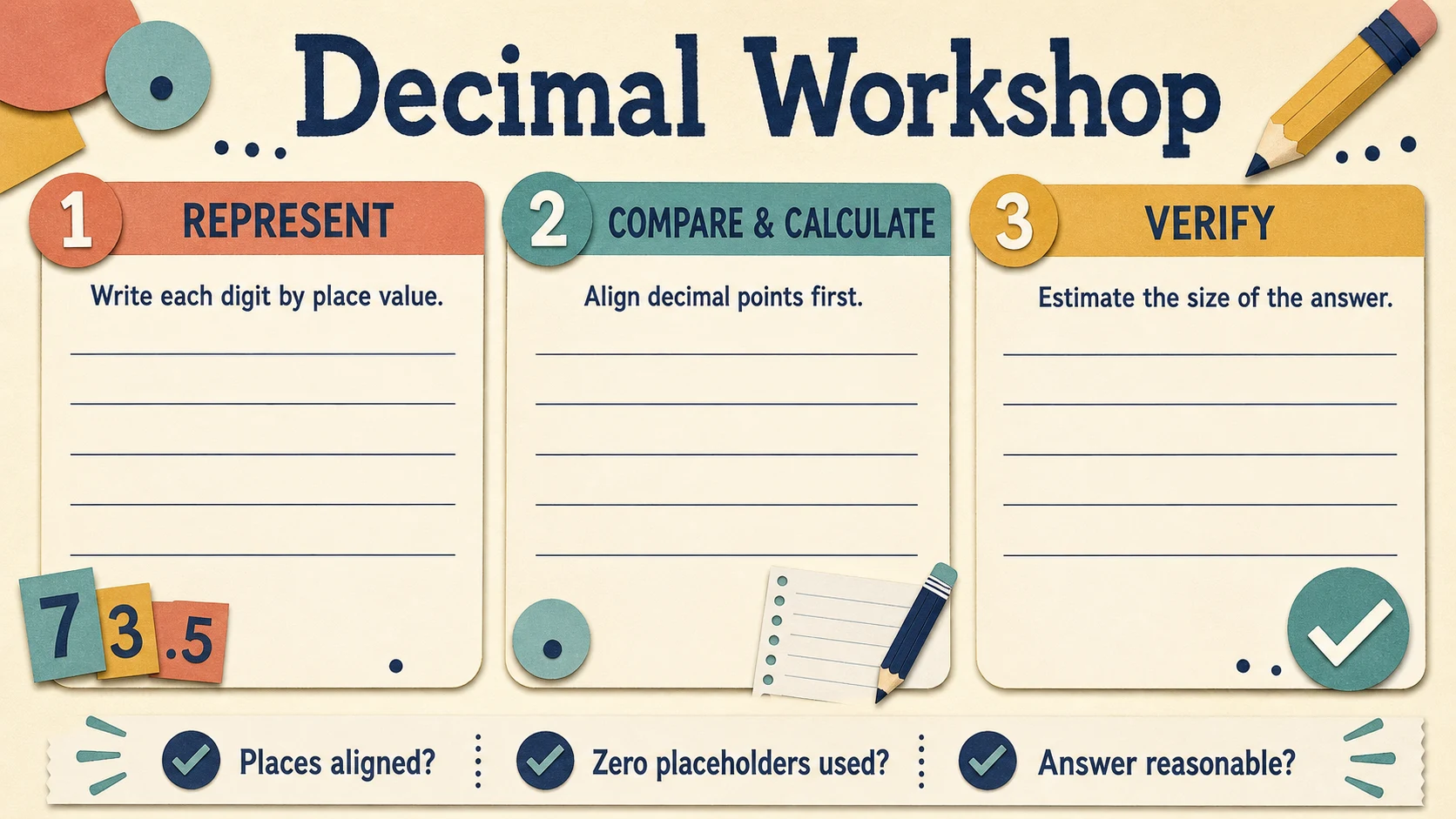
Use spaced review and mixed practice while allowing observed work to change the schedule.
| Session |
Focus |
Suggested evidence to collect |
| 1 |
Prerequisite check: place value, fractions, estimation |
Note whether errors concern meaning or arithmetic |
| 2 |
Read, write, compose, and compare decimals |
Ask for a model of 0.36 and 0.4 |
| 3 |
Order and round decimals |
Require neighboring benchmark values |
| 4 |
Add decimals |
Check alignment, estimate, and exact sum |
| 5 |
Subtract decimals |
Include whole-number minuends and regrouping |
| 6 |
Review comparison, rounding, addition, and subtraction |
Use a short mixed set |
| 7 |
Multiply decimals |
Estimate before using a written method |
| 8 |
Divide decimals by whole numbers and decimals |
Verify quotients by multiplication |
| 9 |
Choose operations in contextual problems |
Require labels and a reasonableness check |
| 10 |
Cumulative review and correction |
Revisit errors after independent work |
On Sessions 3, 6, and 10, include one or two problems from earlier sessions. Spacing helps reveal whether the learner can retrieve the method without an immediately preceding example.
If performance deteriorates as operations are mixed, return briefly to separate practice and then remix two operations at a time. If the learner remains accurate and explains the work, increase variation rather than simply increasing page length.
Limitations and the next useful step
A worksheet can provide structured practice and reveal patterns, but it cannot by itself determine why an error occurred. Answer keys confirm results; they do not replace discussion of strategy, place value, estimation, or operation choice. This guide also cannot account for every local curriculum sequence or individual learning need.
Begin with three prerequisite checks and one worked computation from this guide. If the learner explains them accurately, use the free 6th Grade Decimals worksheet as a short diagnostic practice set. Review the first several responses before assigning all 30 exercises, then choose the next lesson from the errors actually observed. For more precisely targeted follow-up, create a smaller custom set through the free worksheet generators.